7 654 résultats
196863415University of California Berkeley 1968. Hardcover. Very Good. Huge 1968 UC Berkeley hardcover yearbook in excellent unmarked near-pristine condition slight exterior wear. Campanile on the cover against yellow background. 560 pages. 6.1 lbs <br/> <br/> University of California, Berkeley hardcover
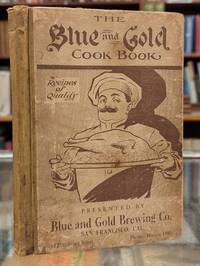
1912113441San Francisco: Blue and Gold Brewing Co 1912. Hardcover. Good/No jacket. Covers worn and soiled. Interior foxed. Blue and Gold Brewing Co hardcover
189436530New Spalding Club Aberdeen 1894. 4to. First and Sole Edition thus on laid paper with a frontispiece original tissue guard present title in red and black and a fine double-page facsimile parallel text in Latin and English free endpapers browned as usual frontispiece and facsimile lightly spotted; original series binding of olive green cloth blocked in blind club badge blocked in gilt on front board gilt back uncut a remarkably bright clean copy. EDITION LIMITED TO 525 NUMBERED COPIES. New Spalding Club publication no. 12. With the club's Seventh Report by Council 1893 and list of members to 30 June 1894 bound in at end. Hector Boethius or Boece 1465-1536 first principal of the University of Aberdeen is known for two important works of medieval Scottish history: the 'Historia Gentis Scotorum' Paris 1527 and his earlier Lives of the Bishops of Murthlack and Aberdeen Paris 1522. Of the latter work a facsimile text in the original Latin was issued by the Bannatyne Club publication no. 11 in 1825. The present edition remains the sole published transliteration. Moir was Co-Rector of Aberdeen Grammar School. Read 3742. New Spalding Club, Aberdeen, hardcover
196327360New Haven CT: Yale University Art Gallery 1963. 1st. Soft cover. Very Good. 6.9x6.9x0.2in. toning to covers at the spine. <br>This monograph is based upon a loan exhibition at the Yale University Art Gallery New Haven Connecticut April 2- June 28 1963. 147 objects are described of which 24 are illustrated in black and white and 2 in color on the front and back covers. <br>52pp 0.23lb 6.9x6.9x0.2in Yale University Art Gallery paperback
1823OB958<p>Edinburgh: W. Blackwood; London: T. Cadell 1823. Hard Cover. 2 p. l. vii-lviii 279 1 p.; 19 cm. Title continues: "and interspersed with extracts in the same stanza as the original by William Stewart Rose." Berni recast Boiardo's poem. "Berni undertook the revision of the whole poem avowedly altering no sentiment removing or adding no incident but simply giving to each line and stanza due gracefulness and polish. His task he completed with marvellous success; scarcely a line remains as it was and the general opinion has pronounced decisively in favour of the revision over the original. " Rose was an intimate of Byron and part of a circle of English italianists. Armorial bookplate of John Croft Deverell. Vg bound in full leather. Stock#OB958.</p> W. Blackwood / T. Cadell hardcover
171540525s Graavenhaage s Gravenhage: Gysbrecht Gasinet 1715. 8vo 21x14 cm. Wrappers renewed. xxxii: "Voorrede"16 pp. Inner margin short; lower margin title repaired; sl. soiled mainly in lower margins. With charming engraved vignette on title. With 2 exlibris of F. Ouwerling Tilburg pasted on fly-leaf and on verso title. - Interesting booklet attributed by "Boekzaal der Geleerde wereld" to Nikolaas van Amerongen in the "Catalogus Jakobus Koning" to Pieter Le Clercq and we traced a 1712 edition with on the title Pieter Antoine Huybert mentioned as the author. - Very rare Gysbrecht Gasinet unknown
01-085816th Century . Bartsch XV no. 2. Engraving. 133 x 154 mm. 16th Century unknown
01-085716th Century . Engraving. Bartsch XV no. 3. 135 x 145 mm. 16th Century unknown
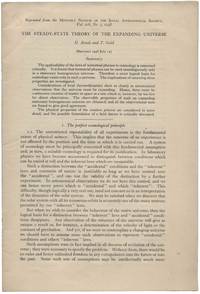
19484162London: Monthly Notices of the Royal Astronomical Society 1948. First edition. First edition the extremely rare offprint of the first published paper to propound the 'steady-state' model of the universe according to which the universe is expanding but unchanging with no beginning or end and in which matter is continually being created throughout space so that its average density remains constant. Hardcover. THE STEADY-STATE MODEL OF THE UNIVERSE. First edition the extremely rare offprint of the first published paper to propound the 'steady-state' model of the universe according to which the universe is expanding but unchanging with no beginning or end and in which matter is continually being created throughout space so that its average density remains constant. Bondi and Gold's Cambridge colleague Fred Hoyle published his own formulation of steady-state theory four months later in the same journal 'A New Model for the Expanding Universe' MNRAS Vol. 108 No. 5 pp. 372-382. Bondi Gold and Hoyle were led to steady state theory because of well-known problems associated with the then current evolving models of the expanding universe: such models predicted a cosmic age that was problematic less than the known age of some stars and they disliked Lemaȋtre's idea of a universe with an explosive beginning. Although the steady-state theory was eventually disproved by the discovery of the cosmic microwave background in the 1960s "Steady state was of enormous importance in the history of astronomy because it turned cosmology into a serious observational part of science by making predictions different from those of an evolutionary universe for which Hoyle coined the name big bang. The predictions included numbers sizes colors and brightnesses of galaxies at large distances compared to those near us" DSB under Gold. In 2014 an unpublished manuscript was discovered probably dating from early 1931 in which Einstein himself considered the possibility of a universe that expands but remains essentially unchanged his 'cosmological constant' being responsible for the continuous creation of matter from empty space O'Raifeartaigh et al. We have located only one other copy of this offprint at the Royal Society in London no copy on OCLC. No copies in auction records.</p> <br /> <p>"To the extent that there existed a standard cosmology in the late 1940s it was the evolutionary universe based on Einstein's field equations of 1917 either in the big bang version or the ever-expanding but no-bang Lemaître-Eddington version. In their discussions of 1946 and 1947 Hoyle Gold and Bondi agreed that an evolutionary universe governed by general relativity was unsatisfactory in whatever version. They concluded that an unchanging yet expanding universe was preferable and for this reason they postulated continual creation of matter to occur throughout space at such a rate that it compensated for the expansion and left the average density of matter constant the idea came from Gold. In early 1948 Gold and Bondi and independently Hoyle worked out their two formulations of the steady state universe.</p> <br /> <p>The theory presented in the 1948 Bondi-Gold paper was deductively founded on what they called the perfect cosmological principle the postulate that the universe is uniform not only spatially but temporally as well: it has always looked the same. This principle they claimed was a fundamental axiom from which physical results should be deduced; if theoretical extrapolations from experiments conflicted with the principle such as did the law of energy conservation they had to be rejected. Bondi and Gold consequently denied that the universe could be described by the energy-conserving theory of general relativity. Moreover they objected that relativistic cosmology was "utterly unsatisfactory" because it covered so many models and was based on so many free parameters that as a whole it could not be falsified observationally. In spite of the qualitative and philosophical flavor of their paper Bondi and Gold could prove that their theory led to a number of definite predictions including a specific rate of matter creation of about 10-43 g/s/cm3. It also followed from their theory that the metric of the steady state universe had to be of the De Sitter type a flat space expanding exponentially" DSB under Bondi.</p> <br /> <p>"There is a charming story not taken seriously by all historians about how steady state theory began. The idea came in 1947 Hoyle claimed when he and his fellow scientists Hermann Bondi and Tommy Gold went to a movie. The three knew each other from shared research on radar during World War II. Hoyle was versatile undisciplined and intuitive; Bondi had a sharp and orderly mathematical mind; Gold's daring physical imagination opened new perspectives. The movie was a ghost story that ended the same way it started. This got the three scientists thinking about a universe that was unchanging yet dynamic. According to Hoyle "One tends to think of unchanging situations as being necessarily static. What the ghost-story film did sharply for all three of us was to remove this wrong notion. One can have unchanging situations that are dynamic as for instance a smoothly flowing river." But how could the universe always look the same if it was always expanding It did not take them long to see a possible answer-matter was continuously being created. Thus new stars and galaxies could form to fill the space left behind as the old ones moved apart.</p> <br /> <p>"To many philosophical minds the steady-state universe proposed by Hoyle Bondi and Gold had a major advantage over the big-bang expanding universe. In their universe the overall density was kept always the same by the continuous creation of matter. In the big-bang universe with its radically changing density various physical laws might not apply the same way at all times. It would be impossible to extrapolate with confidence from the present back to the super-dense origin of the universe.</p> <br /> <p>"Steady-state theory also had an observational advantage over big-bang theory in 1948. The rate of expansion then observed when calculated backward to an initial big bang gave an age for the universe of only a few billion years-well below the known age of the solar system! That was certainly an embarrassment for the big bang theory.</p> <br /> <p>For some time cosmologists had measured ideas against a "cosmological principle" which asserted that the large-scale properties of the universe are independent of the location of the observer. In other words any theory that put we humans at some special place like the center of the universe could be rejected out of hand. Bondi and Gold insisted that the universe is not only homogenous in space but also in time-it looks the same at any place and at any time. They grandly called this the "perfect cosmological principle" and insisted that theory should be deduced from the axiom that we are not at any special place in either space or time.</p> <br /> <p>"Hoyle was less insistent that the perfect cosmological principle was a fundamental axiom. He preferred to have theory follow from a modification he proposed to Einstein's relativistic universe adding the creation of matter. The two different steady-state theories had enough in common however to be considered one for most purposes.</p> <br /> <p>"Much of the later development of steady-state theory came in response to criticism. In Great Britain especially scientists gave considerable attention to elaborating the theory. Their arguments were largely of a philosophical nature with little appeal to observation.</p> <br /> <p>"The cosmological debate acquired religious and political aspects. Pope Pious XII announced in 1952 that big-bang cosmology affirmed the notion of a transcendental creator and was in harmony with Christian dogma. Steady-state theory denying any beginning or end to time was in some minds loosely associated with atheism. Gamow even suggested steady-state theory was attached to the Communist Party line although in fact Soviet astronomers rejected both steady-state and big-bang cosmologies as "idealistic" and unsound. Hoyle himself associated steady state theory with personal freedom and anti-communism.</p> <br /> <p>"Astronomers in the United States found the steady-state theory attractive but they took a pragmatic approach. The rival claims of big-bang and steady-state theory must be settled by observational tests. One test involved the ages of galaxies. In a steady state with continuous creation of matter there would be a mixture of young and old galaxies throughout the universe. In a big bang with only an initial creation galaxies would age with time. And astronomers could look back in time by looking at more distant galaxies for observing a galaxy a billion light-years away meant seeing it in light that had left it a billion years ago. Observations reported in 1948 purported to find that more distant galaxies were indeed older. Score one for the big bang. Bondi and Gold reviewed the data carefully and in 1954 they showed that the reported effect was spurious. Score one for steady state. The age test might be able to distinguish between the rival theories in principle but in practice it could not.</p> <br /> <p>"Another possible test involved the rate of expansion of the universe. In a big bang the expansion rate would slow; in a steady state universe it would remain constant. Data from the Mount Wilson Observatory seemed to favor the big bang but not certainly enough to constitute a crucial test.</p> <br /> <p>"Meanwhile there was a solution to the embarrassing calculation that put the age of a big-bang universe less than the age of the solar system. Walter Baade showed that estimates of the distances to galaxies had mixed together two different types of stars. As a result the size of the universe had been underestimated by about a factor of two. If galaxies were twice as distant as previously thought then calculation with the observed rate of expansion gave an age of the universe twice as great as previously calculated - safely greater than the age of the solar system.</p> <br /> <p>"The most serious challenge to steady-state theory came from the new science of radio astronomy. Fundamental knowledge in the techniques of detecting faint radio astronomy signals advanced greatly during World War II especially with research on radar and especially in England. After the war research programs at Cambridge at Manchester and at Sydney Australia built radio telescopes to detect signals from outer space. They dominated radio astronomy for the next decade.</p> <br /> <p>"The program at Cambridge was led by Martin Ryle who in 1974 would receive the Nobel Prize in physics for his overall contributions to radio astronomy. In 1951 Ryle believed that radio sources were located within our galaxy and hence were of no cosmological interest. But over the next few years he became convinced that most of the radio sources he was detecting were extragalactic. His observations then could be used to test cosmological models. Ryle argued that his survey of almost 2000 radio sources completed in 1955 contradicted steady-state theory because more distant/older sources seemed to be distributed differently from nearby ones. But he overstated the significance of his initial data. Only after more years of work would radio observations argue strongly against steady-state theory" American Institute of Physics ;/a>.</p> <br /> <p>Both Bondi 1919-2005 and Gold 1920-2004 were born into Jewish families in Vienna but left Austria shortly before the Anschluss. Bondi was admitted as a foreign student at Trinity College Cambridge where he arrived in the fall of 1937; Gold became an undergraduate student at Trinity in the following year. In 1940 the British government concerned about possible fifth columnists interned many Austrian and German émigrés as enemy aliens. Thus it was that Bondi and Gold who did not previously know each other met as internees in a camp in Quebec Canada where they soon became close friends. The slightly more senior camp resident Max Perutz organized an informal "school" at which the young students could teach each other. Bondi's extraordinary mathematical skills and Gold's outstanding physical insights soon became obvious and complementary. Bondi and Gold did not return to England until 1942.</p> <br /> <p>Hoyle 1915-2001 entered Emmanuel College Cambridge in 1933 and went on to do graduate work in theoretical physics under Rudolf Peierls and Paul Dirac. In 1939 he secured a fellowship at St. John's College Cambridge. In 1940 the Admiralty the British government department responsible for the Royal Navy recruited Hoyle for theoretical research on radar. As director of the theory division at the radar establishment Hoyle recruited Bondi in June 1942 and on Bondi's advice in October 1942 Hoyle brought in Thomas Gold. Bondi Gold and Hoyle shared a small rented house close to their place of work spending their evenings and weekends debating problems in astrophysics. All three returned to Cambridge in 1945 and from 1947 they started to work together on cosmology.</p> <br /> <p>O'Raifeartaigh et al 'Einstein's steady-state theory: an abandoned model of the cosmos' European Physical Journal 39 353-367. For a very detailed account of the Bondi & Gold and Hoyle papers see Kragh Cosmology and Controversy 1996 pp. 162-201. The Einstein manuscript on a steady-state universe is 'Zum kosmologischen Problem' Albert Einstein Archive Online Archive No. 2-112 <br/> <br/> Offprint from: Monthly Notices of the Royal Astronomical Society Vol. 108 No. 3 1948. 8vo pp. 252-270. Stapled as issued in self-wrappers. / Hardcover. Monthly Notices of the Royal Astronomical Society unknown
1982003841Fairfield Washington U.S.A.: Ye Galleon Press 1982. New Edition. Hardcover. Fine/very good. Octavo cloth. <br/><br/>Considered among the most authentic of Indian Captivity narratives. "After being stolen as a lad in northwestern Ohio successively traded to various western tribes and finally adopted by the Snakes he wandered with them as far as California and Oregon . most remarkable - Howes B736." Ye Galleon Press hardcover
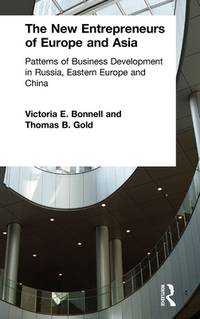
2002x-0765607751M E Sharpe Inc 2002. Hardcover. New. 357 pages. 9.00x6.25x1.25 inches. M E Sharpe Inc hardcover
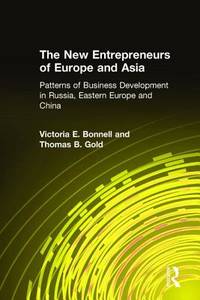
20022-076560776XM E Sharpe Inc 2002. Paperback. New. illustrated edition. 357 pages. 8.75x6.00x1.00 inches. M E Sharpe Inc paperback
15-8147San Francisco CA: Book Club of California 1934. 4to. Oblong. 4 pp. Folded Sheet Letterpress Very Good. Facsimile reproduction of a 1857 lithograph a view of Jackson. One of 500. San Francisco, CA: Book Club of California, 1934. unknown
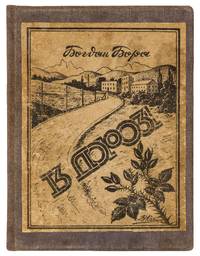
1946423496Rimini Italy: Zyttia w tabori 1946. Hardcover. Very Good. Limited edition one of 280 copies. Mimeographed. Octavo. pp. 1-4 i-iv v-vi 1-104. Illustrated with a portrait of Bogdan and four other full-page illustrations. Bound in original army linen over boards with mimeographed illustration mounted on the front cover. Small contemporary name in ink on front free endpaper slight staining and rubbing to the boards small marginal tears to endpapers very good.<br /> <br /> A very scarce book of poetry by the Ukrainian poet Bogdan Bora 1920-97 written and published at a prison camp in Rimini Italy about one year after World War II. Bora had been captured by British forces and sent to the prison camp in Rimini where he spent the following two years and published three books of poetry including this collection the title of which translated as “On the Road.†Bora’s poems written in Ukrainian are moving works evocative of the turbulent era. The cover design and a full-page portrait of Bogdan Bora were made by fellow inmate Volodimir Kaplun. In 1947 Bora was moved to Britain where he was given his freedom and lived out the rest of his days. Very scarce. OCLC locates only six copies in institutional holdings worldwide. Zyttia w tabori hardcover
1926054488London: Epworth Press - J. Alfred Sharp 1926. Second Impression . Hardcover. Very Good Plus. 8vo. LONDON : 1926. First published in 1924. Hardback. Dark-red textured cloth; gilt lettered spine and blind-lettered cover. Slight browning to end-papers. Neat owner name dated 1939; no internal markings. Slight foxing to fore-edge. Bright tight and clean. VERY GOOD. 288 pages. Texts as preached or made history by; George Whitefield George Moore David Brainerd J.G. Paton Philip Melanchthon C.G. Finney Countess of Huntingdon Thomas Wingfold et al. Will be well-packed for posting/shipping. 8vo. Rosley Books for Antiquarian books CHS Cumberland Everyman GKC Inklings Keswick Literature MacDonald Rarities Theology and History. . <br/> <br/> Epworth Press - J. Alfred Sharp hardcover
2020x-9811219125World Scientific Pub Co Inc 2020. Hardcover. New. 1st edition. 84 pages. 11.25x8.75x0.50 inches. World Scientific Pub Co Inc hardcover
41615802-nnew. unknown
41615802like new. unknown
20141-1939681154Monkfish Book Pub Co 2014. Hardcover. New. 243 pages. 10.50x7.25x0.75 inches. Monkfish Book Pub Co hardcover
1931ZB330909Leipzig: Kommissionsverlag Gustav Engel 1931. 158 2 pp library markings lacks back cover of paper wrappers text browned with light margin flaking rebacked with cloth tape reading copy only. - If you are reading this this item is actually physically in our stock and ready for shipment once ordered. We are not bookjackers. Buyer is responsible for any additional duties taxes or fees required by recipient's country. Leipzig: Kommissionsverlag Gustav Engel, hardcover
194813367London: T. Werner Laurie Ltd. 1948. First edition. A fine copy in a near fine dust jacket closed tear to lower front panel closed tear to head of spine panel some mild rubbing to edges. 13367. Octavo cloth. Apocalyptic novel in which an experimental station in Scotland blows up causing an uncontrolled atomic chain reaction the stratosphere ignites. ".the world suffers an explosion of insane wars including a nuclear attack on Canada by the U.S. The ensuing panic prompts mass suicides death cults sadism torture and plagues caused by mutated bacteria."-Brians: Nuclear Holocausts: Atomic War in Fiction 1895-1984. pp. 140. T. Werner Laurie Ltd. unknown
1958467570London : G. Rainbird 1958. First Edition. Hardcover. Near-fine cloth copy in a good if somewhat edge-torn with some loss and dust-dulled dust-wrapper. Remains quite well-preserved overall; tight bright clean and strong. Physical description; 38 pages 43 color plates : illustrations some mounted color ; 39 cm. Notes; Illus. some col. incl. 42 1 folding col. plates. Subjects; Painters Italian ; Biography. 15th century. Criticism and interpretation. Renaisssance. Schilderijen. London : G. Rainbird hardcover
19048792San Francisco: Whitaker & Ray Company 1904. First Edition. Hardcover. Good. Whitaker & Ray Company San Francisco 1904. First Edition. Covers reinforced at the outer edges and spine with white tape. First free end-paper missing. Front hinge separated from the text. Moderate foxing to a few pages most pages clean and bright. -- A Juvenile book of jingles characteristic of the west. Contains jingles on such subjects as the Chinaman Cliff House Golden Gate Park etc. Beautifully illustrated by 19 full page seven color litho-prints. -- One edition published in 1904 in English and held by 2 libraries worldwide. Size: Quarto. 39 pages not numbered. -- Condition:. Whitaker & Ray Company hardcover
1808004709Pearl Street New York City: T & J Swords 1808. 1st Edition . Hardcover. Good . Volume II only. A Good Plus volume with moderate foxing. Lovely decked publishers foredge. Paper over boards with cracked outer hinges front hint partially detatched- but a tight text block. 298 pages plus two pages of publishers back titles. Errata slip tipped in at rear. Original not a facsimile. Important text. Rev. Bowden was the first principle of the Connecticut Episcopal Academy in Cheshire Ct. 1796. He later 1802 served at Columbia College as a professor of moral philosophy and logic. Protected in a mylar slip. <br/> <br/> T & J Swords hardcover
32723278-nnew. unknown