542 résultats
192061861On a lake in northern New England 1920. Photographs. Small snapshots 3 x 4 1/2 inches nice images. The vintage outboard motor being used is especially interesting. Very good. 8871. <br/><br/> unknown books
6126Engraved frontis. viii 47 pp. 8vo later wrappers title a little browned uncut. London: Printed for W. Parker. 1777. First edition of "an important milestone in the early literature of gas analysis.Magellan 1722-90 was an Augustinian prior who emigrated to England and Protestantism in 1764. Elected F.R.S. 1774 he published this account of his researches on gases addressed to Joseph Priestley. The glass apparatus for impregnating water with fixed air carbon dioxide is described in detail. Newly improved by 'Mr. Parker' the apparatus was superior to that used by Priestley and described by him in 1772. Carbon dioxide was prepared by dissolving marble calcium carbonate in dilute sulphuric acid. Magellan also describes three new types of eudiometer he had designed; these and the apparatus for making carbonated waters are illustrated in the frontispiece."-Neville II p. 125. Very nice copy inscribed by Magellan at the head of the title-page: "Comte de Castelbourgh par L'Auteur." The attractive frontispiece depicts 24 figures of apparatus. ❧ D.S.B. IX pp. 5-6. unknown books
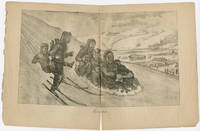
1905WRCAM32109Godthaab Greenland 1905. Lithograph 10 1/2 x 16 1/4 inches. Worn along left edge small closed tears along top and bottom edges of center fold. Two old soft secondary fold lines. Very good. An attractive image showing a family of Greenlanders sledding and skiing down a hill likely produced by Lars Møller Greenland's premier printer or by Møller's youngest son Steffen. The illustration shows a family of seven Greenland natives sledding down a hill while two other youngsters ski alongside with one of the skiers in the process of falling. Other winter sports enthusiasts cavort in the distance and the stark Greenland landscape is ably depicted. Lars Møller an accomplished printer and illustrator was the dominant figure in Greenlandic printing in the last quarter of the 19th century producing much of the printed output in the country. His son Steffen succeeded his father and produced impressive works in his own right including a native language speller from which this illustration may be an example. Knud Oldendow THE SPREAD OF PRINTING. WESTERN HEMISPHERE. GREENLAND Amsterdam: Vangendt & Co. 1969 pp.68-69 and passim. unknown books
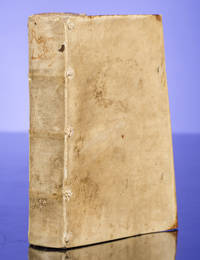
03734Paris: Aegidius Gorbinus 1578. A Remarkable Survival of Three Books by Ramón Lull - 'Doctor Illuminatus'<br/>One of Athanasius Kircher's Greatest Influences<br/><br/>LULL Ramón. Opusculum Raymundinum de auditu Kabbalistico sive ad omnes Scientias introductorium. Incipit libellus de Kabbalistico auditu in via Raymundi Lullii. Paris: Apud Aegidium Gorbinum. 1578. <br/><br/>Twelvemo 4 3/8 x 3 1/8 inches; 111 x 80 mm. 82 i.e. 80 leaves A8-K8. Woodcut printer's device on title Renouard no. 376. Folding table and two woodcuts in the text and five plates with woodcut diagrams including one with a volvelle with two moving parts. Title-page with the German Jesuit library stamps of "Domus Bonnensis" and "Bibl.script".<br/><br/>A fine copy of a rare and important work which includes among its five plates a volvelle mounted with its two movable parts still present.<br/><br/>Third Edition the previous two appeared in 1518 and 1538 in Venice all of which are very rare. "How successful was the thesis of 'De auditu kabbalistico' in the 16th and 17th centuries could be shown by the impressive reception of this treatise which ranges from about Giordano Bruno Claude Duret Johann Heinrich Alsted and Athanasius Kircher up to Leibniz" G. Kurz ed Meditation und Erinnerung in der Frühen Neuzeit p 115; trans. <br/><br/>This text has found an important place in the body of Kabbalistic texts with its attribution to Ramón Lull 1232-1316. However there is evidence that this is the work of a Renaissance physician and Kabbalist scholar when one goes back to the original 1518 edition. Pietro Mainardi born about 1456 obtained his doctorate at the University of Ferrara in 1490 and went on to teach medicine there until 1527. He was definitely a great scholar of Lull and while composing this work he drew heavily from Lull's Ars Brevis and inserted kabbalistic references and added very effectively some of his own. However he did not sign the work. He apparently wished to remain anonymous as the author so his name appears only in the colophon of the 1518 edition as the editor and publisher. Thus in later editions with different publishers and colophons the work became Opusculum Raymundinum. The work definitely has very scholarly content and a form so similar as to be considered a work of Lull and would from then on be ascribed to him. Its great success is attested by several documents and printed texts in which quotations from the present work De auditu would mingle with the Kabbalistic text collections of Lull.<br/><br/>In addition this is the first book that deepens and broadens the ars combinatorial method invented by Lull through which by using diagrams figures or words you can connect in a sort of mechanical logic information in each field to get closer to universal knowledge as well as to be able to memorize it. Many later scientists and philosophers Bruno Agrippa Kircher Alsted Leibniz and his followers or writers Roussel Raymond Queneau Perec Calvino Eco were interested in the theories expressed here.<br/><br/>Palau 143.864; Duveen 370; Caillet 6846; E. Rogent & E. Durà n Bibl. de les impressions lul-lianes Barcelona 1927 no 120; C. Ottaviano Lull's L'ars compendiosa 1930 p. 97 no. 17 under "E Écrits apocryphes.". <br/><br/>together with<br/><br/>LULL Ramón. Ars Brevis Illuminati Doctoris Magistri Raymundi Lull. Quae est ad omnes scientias pauco & brevi tempore assequendas introductorium & brevis via una cum figuris illi materiae deservientibus necnon & illius scientiae approbatione. In cuius castigatione attendat lector quam castigatissimè Magister Bernardus de lavinhera artis illius fidissimus interpres insudatit. Paris: Apud Aegydium Gorbinum. 1578. <br/><br/>Twelvemo 4 3/8 x 3 1/8 inches; 111 x 80 mm. 48 leaves A8-F8. Woodcut printer's device on title Renouard no. 376. woodcut diagrams on A5 recto B1 recto folding woodcut diagram between A6 and A7 B2 verso with a volvelle with two moving parts folding table between B7 and B8.<br/><br/>A fine copy of a rare and important work with the plate with the volvelle mounted with its two movable parts still present.<br/><br/>Rare compendium edition of the Ars Magna - and therefore defined Brevis - of the Catalan philosopher and theologian Ramón Lull who lived in the thirteenth century and was the author of numerous works of scientific argument mystical-philosophical and even literary. The work of Lull ranks for many critics of the foundations of modern science and was studied and deepened by thinkers such as Nicola Cusano Giovanni Pico della Mirandola Giordano Bruno Kircher Cartesio Descartes and Leibniz. <br/><br/>"This work written at Pisa in 1308 was the most widely read and widely distributed version of the Art. It corresponded to a desire peculiar to the second of the Art's phases to simplify the principles of the Art. The Ars Brevis starts by stating that it was written so as to facilitate access to the ‘Great Art' specifically the Ars generalis ultima 1305-1308".<br/><br/>"The Ars brevis operates in accordance with a remodelled version of logic that Llull dealt with in the Logica nova 1303: the ‘compartments' containing two or three concepts correspond therefore to propositions and syllogisms. The Art shows one how to ‘find' all possible propositions and syllogisms from the terms given in the Alphabet and how to verify their truth or falsity. The Tree of Science 1295-1296 on the other hand reveals how the structure of principles and relations in the Ars brevis is linked with the whole of the intelligible world.<br/><br/>The Ars brevis contains thirteen highly dense parts. The first part presents the Alphabet; the second the Figures; the third the definitions of the Principles; the fourth the Rules; the fifth the Table; the sixth the Evacuation of the Third Figure; the seventh the Multiplication of the Fourth Figure; the eighth the ‘mixing' ‘mixtio' or combining of the Principles and the Rules; the ninth the nine Subjects; the tenth the application of the Art; the eleventh the questions; the twelfth familiarisation with the Art; the thirteenth ‘the way to teach this Art'". See Anthony Bonner. Selected Works of Ramón Llull volume 1 pp. 569-646.<br/><br/>".The next twist in the path came from perhaps the strangest character in the history of Lullism the German Jesuit Athanasius Kircher 1602-1680 scientist mathematician cryptographer and student of Egyptian hieroglyphics. With the idea of perfecting Llull's Art he published in Amsterdam in 1669 his vast Ars magna sciendi. This work begins in reforming the alphabet of the Art inventing little symbols a heart for Concordantia a donkey for Animalia etc and continues with what Martin Gardner calls a fascinating mixture of Science and nonsense." Anthony Bonner. Doctor Illuminatus. A Ramon Llull Reader p. 68.<br/><br/>Palau 14370-14384; Duveen p. 370.<br/><br/>together with<br/><br/>LULL Ramón. Articuli Fidei Sacrosanctae ac Salutiferae legis Christianae cum corundem perpulchra introductione. Quos caeteras leges omnes improbando Illuminatus doctor Raymundus Lullius rationibus necessariis demonstrativè probat. Paris: Apud Aegydium Gorbinum. 1578. <br/><br/>Twelvemo 4 3/8 x 3 1/8 inches; 111 x 80 mm. 66 i.e. 64 leaves A8-H8 I2. Woodcut printer's device on title Renouard no. 376. <br/><br/>Articles of Christian faith Holy law and healing affairs with a fine introduction. <br/><br/>"Deus in Virtue tua sperantes & de tua gratia confidentes intendimus probare articules fidei per necessarias rationes." <br/><br/>The three books bound together as a sammelband.<br/><br/>Twelvemo. Contemporary full yapp-edged vellum manuscript title on spine unidentified armorial bookplate on front paste-down. A remarkable survival in almost pristine condition. Housed in a fleece-lined full brown scored calf clamshell case.<br/><br/>"The German Jesuit Athanasius Kircher 1601-1680 scientist mathematician cryptographer and student of Egyptian hieroglyphics was also a confirmed Lullist. He published in Amsterdam in 1669 a huge tome of nearly 500 pages titled Ars magna sciendi sive combinatoria. It abounds with Lullian figures and circles bearing ingenious pictographic symbols" Gardner Martin. Logic Machines and Diagrams.<br/><br/>Ramón Lull Poet Philosopher Alchemist Catalan Mystic - also known as Doctor Illuminatus. "The definitive Ars Magna Lull's greatest contribution to science - his attempt to unify all knowledge into a single system. Lull invented an ‘art of finding truth' which inspired Leibniz's dream of a universal algebra four centuries later. The most distinctive characteristic of his Art is clearly its combinatory nature which led to both the use of complex semimechanical techniques that sometimes required figures with separately revolving concentric wheels - ‘volvelles' in bibliographical parlance - and to the symbolic notation of its alphabet. These features justify its classification among the forerunners of both modern symbolic logic and computer science with its systematically exhaustive consideration of all possible combinations of the material under examination reduced to a symbolic coding. The Art's function as a means of unifying all knowledge into a single system remained viable throughout the Renaissance and well into the seventeenth century" DSB. Paris: Aegidius Gorbinus, 1578 unknown books
5274Luitpold Josef. DIE RUCKKEHR DES PROMETHEUS. Berlin Buchmeister 1927. Pictorial cloth 126 3 pp. illustrated with 33 woodcuts by O.R. Schatz. Text is clean and woodcuts are sharp and bright hinges are shaken cloth is lightly soiled and worn through at the head heel and extremities. Very good condition. <br/><br/> hardcover books
15984716Cologne: In Officina Birckmannica 1598. 12mo. 725895pp. 17th cent. vellum soiled. Two paper labels on spine. Popular handbook edition of this often reprinted work of religious instruction containing meditations for the seven days of the week. It first appeared in 1554 in Salamanca under the title LIBRO DE LA ORACION Y MEDITACION. The first Latin edition appeared in Cologne in 1586. Not in Adams or BL German STC. VD16 #L3244. Palau 107537. In Officina Birckmannica hardcover books
1681001379Amsterdam: Apud Janssonio Waesbergios 1681. Full Calf. Very Good. 330 6 pp. 12mo with copper engraved title page by Giovanni Van Den Avele. Pharsalia is considered a masterpiece and possibly the masterpiece of the Silver Age of Ancient Roman poetry. The epic poem concerns the Roman Civil War at the time of Caesar and most particularly the extended struggle between Caesar and Pompey the Great. Lucanus writing a century later during the reign of Nero far from glamorizing the warfare took a jaundiced view of the fraticidal battle and his portrait of both Caesar and Pompey was far from flattering. His "epic poem" therefore is epic in terms of length scope and ambition not in its portrayal of the principals. Because of the subject matter the popularity of "Pharsalia" has crested at times when a society still steeped in the Classical canon of literature descended into civil strife when the themes and point-of-view of Lucanus really resonated. Never was this more the case than in the seventeenth century when this copy was printed. First there was the final emergence of the Netherlands from under the yoke of Habsburg rule and then there was the English Civil War just to mention two instances both highly germane to the edition at hand. Thus the notes by Grotius and Modern calf with a black spine label and marbled endpapers. The work is incomplete and breaks off during the tenth book which Lucanus was still working on when he was forced to commit suicide. The binding is tight. Some leaves with more toning than others but overall quite clean. There are leaves in which the margins are parlously tight or the header is even close to being partially cut-off -- this is the upshot of the compact size of the copy and was the way the copy was issued over three centuries ago. This particular edition is not mentioned in Brunet. <br/><br/> Apud Janssonio Waesbergios unknown books
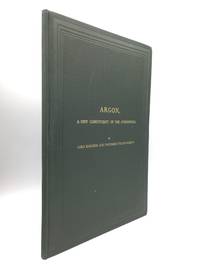
189673529Washington D.C.: Smithsonian Institution 1896. First Edition. Hardcover. Near fine. The first American edition of this important scientific memoir describing the manner in which the authors succeeded in extracting the previously unknown element argon in pure form and in analyzing its properties. For this discovery Lord Rayleigh 1842-1919 was awarded the 1904 Nobel Prize in Physics. Smithsonian Contributions to Knowledge Volume XXIX Number 1033. Quarto: 2ff 43 1 p. Original green cloth binding with gilt titles. Near fine. Smithsonian Institution hardcover books
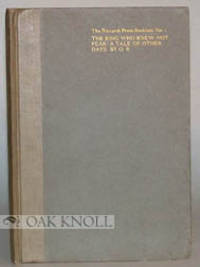
191263285London: Philip Lee Warner Publisher to the Medici Society 1912. half-cloth over boards. Riccardi Press. 8vo. half-cloth over boards. 30 6 pages. Limited to 530 numbered copies. The first book printed in Riccardi 11-point face. Tompkinson p.150. The Riccardi Press Booklets No.1.Spine age darkened. and rubbed along edges. Philip Lee Warner, Publisher to the Medici Society unknown books
199127846Nashville: Battery Press 1991. Hardcover. Very good. vii 202pp index; maps. Very good hardback in a jacket that is just a bit sunned on the spine. Previous owner's blindstamp on front free endpaper else internally fine. <br/><br/> Battery Press hardcover books
1958238231Jean-Jacques Pauvert 1958. Hard Cover. Very Good binding/Good dust jacket. Illustrated; No pencil or ink markings in text. Black cloth binding. Chip at bottom front dustjacket cover at middle and top of spine. Closed tears at top and bottom dustjacket spine. Small closed tears at top of front and rear dustjacket covers. DJ protected with Mylar Cover. Very Good binding / Good dust jacket. Jean-Jacques Pauvert unknown books
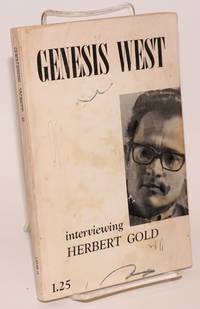
1964196610Burlingame: Chrysalis West Foundation 1964. Paperback. pp.99-207 5.5x8.5 inches illustrations; a worn good-only first edition trade paperback journal in pictorial wraps ink marks and handling soil to cover. Short poem and drawing by Beatle John Lennon on page 150 excerpted from "A Spaniard in the Works Chrysalis West Foundation paperback books
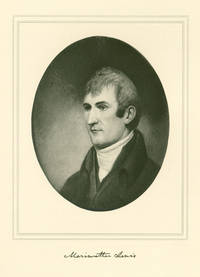
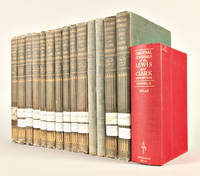
1905247478New York: Dodd Mead and Co 1905. First edition one of 200 large paper sets on Van Gelder paper. Seven volumes bound in fourteen parts plus atlas volume atlas with 56 maps & plates on 62 sheets. 15 vols. Large 8vo. Original gilt green cloth. Bookplate on front pastedowns. Spines lightly worn several lightly faded. Internally fine much of the text unopened. A very good set. First edition one of 200 large paper sets on Van Gelder paper. Seven volumes bound in fourteen parts plus atlas volume atlas with 56 maps & plates on 62 sheets. 15 vols. Large 8vo. One of 200 Sets on Large Paper. "The most elaborate work on this expedition" - Howes. <br/><br/>A cornerstone of modern historical research printing for the first time many major primary documents which did not appear in the Biddle edition including the Floyd and Whitehouse journals and material from the Clark-Voorihis papers along with facsimile manuscripts maps portraits and other illustrative matter. Also valuable is Victor Paltsits' bibliography of the Lewis and Clark expedition in the first volume. "This edition is notable for its thorough Introduction covering the history of the expedition and earlier exploration and a detailed account of the original journals and their various editions.In its maps and numerous illustrations the Thwaites edition is an outstanding source of visual materials relating to the expedition" - LITERATURE OF THE LEWIS AND CLARK EXPEDITION. Graff 2485; Howes L320 "b"; Wagner-Camp 13:7 note to 1842 Harpers ed.; Tweney Washington 76; Literature of the Lewis and Clark Expedition 5d.1 Dodd, Mead and Co unknown books
1969021837New York: Arno Press 1969. Octavo. In eight volumes volume eight contains the maps. Edited by Reuben Gold Thwaites with an introduction by Bernard De Voto. In the introduction."Toward the end of 1802 President Thomas Jefferson asked the Spanish minister a carefully unofficial question. Would the Spanish court "take it badly" if the United States should send a small expedition to explore the course of the Missouri River" which lay wholly in the still Spanish territory of Louisiana This history had become a national and international favorite reprinted translated and pirated. This expedition became the most important event of the American West. A very handsome near fine set bound in green cloth facsimile manuscript letter paste-down spines lettered and decorated in gilt. Previous owner's embossed stamp to front free endpapers. Very nice set. Arno Press unknown books
1905WRCAM52627New York: Dodd Mead & Company 1905. Seven volumes bound in fourteen parts plus atlas volume. Plates many in color facsimiles. Quarto. Original gilt green cloth. Octavo atlas maps laid in a red cloth drop-front box. Cloth somewhat worn particularly at spine ends. Library bookplates with withdrawal stamps on front pastedowns shelf labels on spines reference stamps across top edges. Some occasional offsetting from plates but generally clean internally. A solid set. Text volumes untrimmed. One of 200 large paper sets on Van Gelder paper with the atlas supplied from the reprint edition done by Argosy-Antiquarian Press. "The most elaborate work on this expedition" - Howes. A cornerstone of modern historical research printing for the first time many major primary documents which did not appear in the Biddle edition including the Floyd and Whitehouse journals and material from the Clark-Voorihis papers along with facsimile manuscripts maps portraits and other illustrative matter. Also valuable is Victor Paltsits' bibliography of the Lewis and Clark expedition in the first volume. "This edition is notable for its thorough Introduction covering the history of the expedition and earlier exploration and a detailed account of the original journals and their various editions.In its maps and numerous illustrations the Thwaites edition is an outstanding source of visual materials relating to the expedition" - LITERATURE OF THE LEWIS AND CLARK EXPEDITION. HOWES L320 "c." LITERATURE OF THE LEWIS AND CLARK EXPEDITION 5d.1. WAGNER-CAMP 13:7 note. TWENEY WASHINGTON 76. REESE BEST OF THE WEST 233 note. Dodd, Mead & Company hardcover books
1979Embry 135222Clarkson N. Potter 1979. First edition. Edges lightly sunned and several pages with barely noticeable tiny corner bends now straightened in fine dust jacket with tiny nick and crease to rear panel in mylar cover. B&W photos and drawings. Clarkson N. Potter, 1979. First edition. unknown books
19376594New York: International Publishers 1937. Hardcover. viii 252p. very good first edition in blue cloth boards and unclipped edgeworn and toned dj. Selections from Fox's historical critiques a memorial volume for the prominent British writer killed while serving with the International Brigades. International Publishers hardcover books
1953002951Paris: Les Hautes Etudes 1953. First Edition. Wraps. Very Good Plus/Fair. 8vo. viii 3 517 1 pp. Short closed tear of upper spine wraps. Otherwise tight clean a few leaves still uncut. Glassine torn along the spine toned by well-preserved elsewhere. <br/><br/> Les Hautes Etudes paperback books
1961129183Milano: Rizzoli Editore 1961. Hardbound. VG/VG- light wear to extremities of dj. in VG slipcase. A large weighty book. Green cloth with color pictorial glossy dustjacket all contained in a custom slipcase. Appx. 105 pp. 115 mostly color plates tipped-in to the text portion and 42 full-sheet color plates many of them folding. A most impressive book both by its content and its volumetric displacement. Text is in Italian. Transit mass would be 272 ounces. A stunning production detailing the work of Carpaccio in the Church of San Giorgio Degli Schiavoni. Rizzoli Editore hardcover books
1977122184Milano: Rizzoli Editore 1977. second edition. Hardbound. VG/VG- small rip in lower rear dustjacket in VG slipcase. A large weighty book. Green cloth with color pictorial glossy dustjacket all contained in a custom slipcase. Appx. 105 pp. 115 mostly color plates tipped-in to the text portion and 34 full sheet 13.5" x 16" color plates many of them folding. A most impressive book both by its content and its volumetric displacement. Text is in Italian. Transit mass would be 272 ounces. A stunning production detailing the work of Carpaccio in the Church of San Giorgio Degli Schiavoni. Rizzoli Editore hardcover books
1976122182Milano: Rizzoli Editore 1976. Hardbound. VG/VG in VG slipcase. A large weighty book. Red maroon cloth with color pictorial glossy dustjacket all contained in a custom slipcase. Appx. 217 pp. 138 mostly color plates tipped-in to the text portion and 50 full sheet 13.5" x 16" color plates. A most impressive book both by it's content and it volumetric displacement. Vital in the study of Caravaggio. Another version of this appears to have been printed in 1971 and this edition has a few extra illustrations at least and likely some additional or revised text. Text is in Italian. Transit mass would be 272 ounces. A stunning production. Rizzoli Editore hardcover books
1762249483Paris: de l'Imprimeries de H.L. Guerin & L.F. Delatour 1762. 42 pp. 7 full page engraved plates. 1 vols. Folio 18 x 12 inches. Contemporary drab wrappers uncut . Fine. 42 pp. 7 full page engraved plates. 1 vols. Folio 18 x 12 inches. From Description des arts et métiers. de l'Imprimeries de H.L. Guerin & L.F. Delatour] unknown books
1828D2439Paris: Firmin Didot pour Lami Denozan 1828. First Edition. Hardcover. Very Good. 8vo 210 x 132mm. viii cxlvi 48pp. notes and glossary. Illustrated with hand-colored engraved title with marginal vignettes of female personifications and muses by Richard Parkes Bonington. Illustrated throughout with 10 half-page lithographs printed on chine-collé carefully hand-colored heightened in gilt and mounted; six are by Richard Parkes Bonington and four are by Henry Monnier and 15 decorative initials highlighted with colors inspired by ornaments found on the Books of Hours printed in the fifteenth and sixteenth centuries. 19th-century full red morocco decoratively tooled in gilt five raised bands gilt doublures marbled endpapers all edges gilt; lightly foxed throughout miniatures remain bright and fresh; spine slightly scuffed. Armorial bookplate of J. Austin Stevens Junior to front pastedown. First Edition of this rare and unusual book OCLC locates only four copies all in German libraries. Férdinand Langlé littérateur dramatist and occasional necromancer focused his literary interests on the nostalgic and the romantic. In 1828 he edited Les Contes du Gay-Sçavoir a witty collection of medieval ballads and fables. The text is printed in Gothic characters and illustrated to imitate the style of medieval manuscript illumination; it is followed by endnotes and a glossary printed in Roman type. The major illustrator of the work Richard Parkes Bonington was an English Romantic landscape painter who also worked in lithography. He was a close and admired friend of painters Eugene Delacroix and Antoine-Jean Gros. Gordon Ray speaking of Bonington says his importance in the development of lithography can hardly be overstated.His designs for Vues pittoresques de lEcosse and Contes des Gay-Sçavoir are by no means negligible. Boningtons career as a lithographer was short but splendid. - Art of the French illus. book pp. 173 & 176. Fine fresh and bright rare colored copy of this nostalgic work on the medieval period. Brunet III 819; Carteret III p. 172 livre tres rare; Curtis 54-60; Ray 114 <br/><br/> Firmin Didot pour Lami Denozan hardcover books
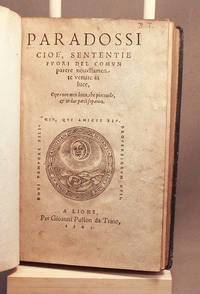
15436296Lyon: per Gioanni Pullon da Trino" i.e. Jean Pullon dit de Trin 1543. First edition. Very Good/Exquisitely rare first printing of Ortensio Lando's most famous book his first in a modern language that in later editions and in translations became a 16th-century best seller. Lando's name does not appear on the title page or anywhere in the book except in code. His real name shows up on no edition published in the 16th century. A dedicatory leaf after the colophon attributes the text to "M.O.L.M" interpreted generally as "Messer Ortensio Landi Milanese." More cryptically there is a phrase printed after the telos "SVISNETROH TABEDVL" mirror writing for "ludebat Hortensius" Ortensio has played. It is serious play. The Paradossi undertakes in the key of popular "world upside down" folklore to prove black what is commonly accepted as white. For instance it is better to be poor than rich better ugly than handsome better drunk than sober and so on. Biographical sketches of Lando are remarkable for how little information about him is available. Peer of Aretino and Doni friend to Etienne Dolet later incinerated for heresy he was a non-believer who nevertheless took Augustinian orders and later deserted them. Member of a prestigious literary club L'accademia degli elevati he was above all an outsider. All of his books landed on the Index of Prohibited Books and "I paradossi" in particular was widely banned and copies of it were confiscated. Probably the first book printed by the obscure Italian printer working in Lyon Giovanni Pullone da Trino later called "Jean Pullon de Trin". Following Pullon's modest press run the text was quickly taken up and reprinted badly by Bindoni and others in Venice twice in 1544 1545 1563 1594 etc. and translated into Latin into French by Charles Estienne 1553 and into English 1596. If you Google "Jean Pullon" you will get dozens of pages advertising pull-on jeans. . Octavo 17cm; 112 leaves signed A-O8. Printer's device on title page Ferraris 1 showing a human-faced moon in the sky reflected on the surface of the land. Bound in later 18th-century or 19th-century dark green leather in neoclassical style with gilt central losenge within gilt borders on both boards; gilt-tooled spine with leather title label. Joints reinforced but tender; light marginal stain along bottom edge; O7 torn and repaired remains of tape. Early marginalia trimmed close. Later c19 notes in French on endleaves. Pages not bright. All in all a very good copy of a very rare book. References: Ferraris "Giovanni Pullone e altri stampatori trinesi a Lione" in "Trino e l'arte tipografica nel XVI secolo." 2014 #1; USTC 116008 BM Italian 399; Grendler "Critics of the Italian World" #8; Gültlingen "Bibliographie des livres imprimés à Lyon." vol. X p. 7; Bongi "Catalogo delle opere di M. Ortensio Lando" p. xxxvi "eseguita in bel carattere rotonde cui la originalità e la bellezza danno il pregio sopre le ristampe"; not in Adams; not in Baudrier. per Gioanni Pullon da Trino" (i.e., Jean Pullon dit de Trin) hardcover books
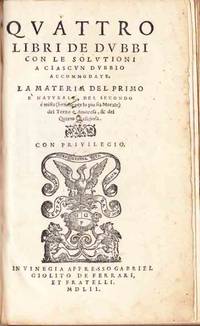
15526331Venice: Gabriel GIolito de' Ferrari 1552. First edition. Very Good/The title promises four sets of "questions and their solutions" and indeed that was the plan. Lando wrote Q&A on four topics: medical questions including dietary and aging functions ethical questions questions about religion and questions about love and sex. It was the love and sex part that raised the eyebrows of the censors and neither Lando or his publisher Giolito could get permissions to print it as the book was going to press. As Giolito himself declares in a postscript to the reader: "I promised you four books of doubts but since I haven't yet been granted a license for the doubts about love I'm forced to give you only three. Be well and enjoy as much of the book as I could give you." The license came later and the text appeared in later editions. This unfinished text with its publisher's apology represents a fascinating birthmark on the 16th-century book trade. The Q&A ranges over hundreds of topics calling upon the author's medical training much involved with the humors and temperaments associated with various organs objects and creatures his classical erudition and his training in the Augustinian order. The three sections together provide comprehensive insight into 16th century medicine and popular religious and moral thought. The odd matter of two versions of the dedication page leaf A ii is not easily explained. We suspect with some justification that Lando sought patronage for the same work in different locations knowing that Protestant Germany rarely spoke with Catholic Italy and vice versa. He might have found different backers in different markets. We know that to be the case with at least one other book of Lando's the "Sermoni Funebri" 1549 where some copies are dedicated to Fugger and others to Niccolo degli Alberti. That case is known and recorded. We find no recorded instance of the alternate dedication of "Quattro libri dei dubbi" to Fugger and no record of the author being identified by signing the dedication letter in any other copy. The "Quattro libri de dubbi" was quickly translated into French Lyon 1558 and by William Painter into English entitled "Delectable demaundes and pleasaunt questions with their severall aunswers." 1566 and again 1640. . Octavo 16 cm; 318 2 pages. Woodcut device on title page and on last page. Woodcut initials. Bound in recent vellum in period style yapp edges titled in ink on spine. Early 20th-century bibliographical note bound in. Marginal annotations in contemporary hand. Leaf a ii the dedicatory letter present in two states the cancel addressed to Johann Jakob Fugger closing with Lando's name and the original leaf addressed to Christoph Mielich and not signed as usual. Small perforation in the cancel affecting a word. Occasional light stains darker on last leaf. References: Bongi I 368; Melzi II 391; BM Italian 377 1556 ed.; Fontanini II 117. Gabriel GIolito de' Ferrari hardcover books