542 résultats
6551Numerous woodcut illus. in the text. Largely printed in black letter. 7 p.l. first leaf blank except for signature mark 63 1 pp. Small 4to early 20th cent. polished mottled calf by Riviere triple gilt fillet round sides spine richly gilt red morocco lettering pieces on spine dentelles gilt a.e.g. London: H. Denham 1576. Second edition "nowe newly corrected and augmented" of the first English book on hops. The first edition appeared two years earlier; both editions are very rare. This is "an eminently practical treatise illustrating the various methods of setting the roots making the hills and ramming the poles tying the bine and its pulling up and preservation with a number of curious cuts. It was the work of a practical man written for practical men and in this respect is far in advance of most of Scot's contemporaries who were still much interested in the superstitions of the time and the traditional pseudo-science of the Middle Ages."-Fussell I p. 12. Clinch in his English Hops a History of Cultivation and Preparation for the Market from the Earliest Times 1919 states that in many respects "the information is as useful today as it was nearly three-and-a-half centuries ago when it was published." Scot d. 1599 is most famous for his The Discoverie of Witchcraft 1584 in which he attacked the general belief in witchcraft and other forms of credulity and superstition including astrology alchemy and Catholicism. For more on Scot and his fascinating life see ODNB. Fine copy. Signature of T. Barling on first leaf. ❧ Henrey I p. 64 & no. 338. McDonald Agricultural Writers from Sir Walter of Henley to Arthur Young 1200-1800 pp. 34-36. unknown books
634118 leaves. Small 4to attractive modern marbled boards red morocco lettering piece on spine. Wittenberg: C. Heyden 1619. First edition of this rare book which is considered by A.D.B. to be the author's most important scientific work; it is a careful record of the third of the three bright comets of 1618-19. Schmidt 1570-1637 was "one of the last of the scholars of Germany who taught the language and literature of Greece in the spirit of Melanchthon. Schmidt was professor first of Greek and next of Mathematics at Wittenberg. His principal work was an edition of Pindar with a Latin translation and a careful commentary 1616."-Sandys II p. 272. Fine copy. ❧ A.D.B. Vol. 32 pp. 27-28. Zinner 4785. hardcover books
198448393San Francisco: The Yolla Bolly Press 1984. 1st edition thus. Copy B of 220 cc. SIGNED by Gold & Prochnow on the colophon. INSCRIBED by Setrakian on the ffep. Mauve cloth binding with gilt stamping. Slipcase with printed paper title label to spine panel. Square & tight. Spine panel ever-so-lightly sunned. A Nr Fine copy in a VG slipcase. xv 1 194 2 pp. Illustrated with woodcuts by Bill Prochnow. Facsimile letter at rear. Royal 8vo. 10" x 7-5/8" <br/><br/>Setrakian also a Fresno boy friend to Saroyan who headed the foundation that oversaw Saroyan's legacy cf. LA Times March 4 2002 The Yolla Bolly Press hardcover books
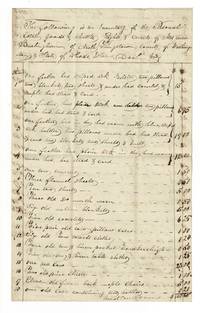
183357649V.p. 1833. A dozen or so items over half of which seem inconsequental. Ezbon or Esbon Sanford 1765-1846 was born in Newport worked in Washington County. He was a storekeeper innkeeper and cabinetmaker and is cited in various articles about Rhode Island furniture making. One receipt is from the "estate of Abigail Congdon" his mother-in-law which details payment for molasses and gin as well as a coffin for herself at $6.00. A detailed inventory May 15 1833 is included of the estate of Anna Buckingham of North Kingstown Washington County. All her belongings are listed including furniture: "eleven old fiddleback maple chairs" at $5. This type of chair is described in an article by Kathleen E. Johnson in Art & Antiques Magazine Sept/Oct 1981 as "an intentional translation of the elements of the carved mahoghany or walnut cabriole legged Queen Anne- style chair into the vocabulary of the turned chair tradition." A large floor plan for a house with its footprint neatly laid out is one of the more interesting documents with a detailed list of supplies joists ranging timber furing laths doors & frames roof boards shingles and nails each with prices. Ezbon Sanford held a local court office as Judge of the Court of Common Pleas and nother interesting document is dated 1830 from the state to the sheriff concerning the warrant for the arrest of George Young charging him as the father of Margaret Mitchel's "bastard child." The paper was signed by John H. Green Deputy Sheriff. Other names mentioned in his storekeeper receipts are Robert Hosford Robert Northrup Charles Douglas Weighty Underwood and Paul Austin. <br/><br/> hardcover books
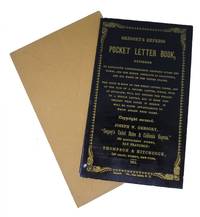
185148314San Francisco / New York: "Gregory's United States & California Express" 280 Montgomery Street / Thompson & Hitchcock 149 Pearl Street 1851. Shiny dark blue paper covers with gilt stamped lettering stapled. Buff paper mailing envelope. Wrapper insides: front instructions for use; rear 2 estimonials dated 1851 from the Panama Star newspaper. Unused Nr Fine with an envelope in similar condition. Unpaginated blank pages. 4-3/4" x 2-7/8" <br/><br/>From the inside of the front cover: "Gregory's California Express. This line one of the oldest established in the business dispatch messengers BY EVERY STEAMER leaving New-York and San Francisco in charge of Letters Parcels Packages Gold Dust and valuables for distribution throughout the United States and California. If possible letters should be directed to the care of mercantile houses or well-known residents in San Francisco or other parts of California by which means their earlier delivery may be insured. Letters directed simply to 'California' or 'at the mines' will not be forwarded as little probability exists of their reacing the persons so vaguely addressed." From the rear cover: "The Central Office of this Express is located in the throughly fire-proof building corner of Montgomery and Merchant Streets San Francisco from which the proprietor Daily dispatches Expresses by steamboat to all parts of the Mines and to Portland Oregon and Honolulu Sandwich Islands on the arrival of ecah steamer with packages from the States." A rare Gold Rush survivor documenting the 'letter & dispatch' business of the era. "Gregory's United States & California Express," 280 Montgomery Street / Thompson & Hitchcock, 149 Pearl St unknown books
1949131899Los Angeles: Lippert Pictures 1949. Oversize vintage black-and-white double weight still photograph of director Samuel Fuller with the cast and crew of the 1949 film dated Nov. 24 1948. <br/><br/>Fuller's auspicious directorial debut one of three films he made for independent producer Robert Lippert before moving to Hollywood studios. An intense portrait of guilt and psychological torment the film based on the life of Robert Ford displays many of the hallmarks of the iconoclastic director's subsequent career. <br/><br/>20 x 15 inches. Very Good plus with a couple of small closed tears to the bottom edge. <br/><br/>Criterion Eclipse 5. Lippert Pictures unknown books
7024Japan: 1816 or after. A fine complete and uncommonly well-illustrated set of scrolls concerning the famous gold silver and copper mine on Sado Island illustrating all the steps from mining to refining to minting along with the administrative and commercial activities associated with the mines. We have had several sets of "Sado Island Scrolls" and this is by far the finest in terms of the quality of the illustration completeness and richness of detail. The skilled artist of these scrolls has provided an enormous amount of valuable factual content by labeling each depicted person's role in the production of gold silver and copper. For a really excellent account of the history of mining on Sado Island and the scrolls produced there see Hamish Todd "The British Library's Sado Mining Scrolls" in The British Library Journal Vol. 24 No. 1 Spring 1998 pp. 130-43. Our description is largely based on this wonderful and beautifully researched article. Gold silver and copper mining on Sado Island just off the coast of Niigata Prefecture had its beginnings in ancient times. With the discovery in 1601 of the rich Aikawa gold and silver mine Sado experienced an economic boom. The Edo shogunate assembled miners and slave laborers mostly the homeless from throughout Japan and sent them to Sado to exploit the Aikawa mine and three other principal mines. It soon became the largest gold and silver mine in Japan attracting a population of 200000 and to a very large degree financed the Edo shogunate for several hundred years. A series of unique mining smelting and minting technologies developed at Sado were disseminated to other mines within Japan. Today the Sado complex of mines is on the "Tentative List" of Unesco World Heritage Sites. The Aikawa mine was one of the few mines at the time to be based on kodobori mine-digging. A series of pre-modern mine management systems and mining-related technologies ranging from mining to smelting were developed at Sado including methods for extracting gold from silver such as the Chinese haifuki cupellation method brought in from the Iwami Ginzan Silver Mine Shimane Prefecture; the yakikin method; as well as manufacturing-based operational formats such as the yoseseriba. It is particularly important to remember that the entire series of processes from mining and smelting to ultimately the production of gold coinage were carried out at this single mine and its environs. The finely drawn scrolls depict every process of extraction refining and minting. Each scroll has a title on a label on the outside: "Sado kozan saikutsu jikkei" "Actual View of Sado Mining". As we unroll the scroll we find another title "Sashu kingin saisei zenzu" "Sado Gold & Silver Extracted & Processed Illustrated" and a grand index of the pictorial contents of the three scrolls. The first scroll begins with a map showing the Aikawa mountain and the numerous entrances to the mining complex with names and locations of refining buildings. This is followed by wonderful paintings of the main entrance to the mine and the surrounding buildings; miners entering and working in the shafts; the ladders made from logs into which steps have been cut; lamps made of iron dishes to hold oil and attached to long iron handles; buckets and pulleys to remove water; baskets to carry ore; government officials the mine operator and surveyors discussing the best location for a new tunnel; carpenters constructing support beams; etc. Each person has a label so we know his exact title and function. The remainder of the scroll takes place outside of the mine: blacksmiths making tools; women removing waste material from the ore and placing the ore in sieves to be washed under the watchful eye of government supervisors; the administrative center for the mine where the ore is graded for sale to the smelters with a bookkeeper recording all the transactions; a back office where managers senior administrators of the mine and accountants are meeting; a room where the ore is examined once again; the ore sewn into sacks and carried out to be loaded onto oxen to be transported to the smelting works; a storage area with big locks; another government office where mine workers turned in their ID cards at the beginning of their shifts; the building known as Kanaba where the ore was pulverized to win the precious metals; a horsetail sieve to separate the ore into various constituents; grinding of the ore using ishiusu grindstones; the process of nekonagashi which used cotton cloth in wooden troughs to extract the very smallest particles using the gravimetric principle etc. The second scroll depicts the smelters called fukidaiku with men operating the bellows all watched by a guard. The gold/silver/lead alloy was then taken to an area called the Haifukidoko where the alloy was subjected to roasting in a cupel. The following scene shows the government office where the gold sujimengane and silver yamabukigin samples are examined. Now we shift to the scenes showing the processing of copper. We see the pulverizing and winning of the copper using methods similar to those for gold and silver with the addition of extensive smelting scenes employing large smelting furnaces nibukidoko mabukidoko and nanbandoko. There are a number of processing scenes including daifukisho which are not present in the BL set of scrolls. From the copper works we move to the coast of Sado where we see the extraction of alluvial gold and silver from the sand of the beaches by means of a technique called sluicing or nekonagashi. An Archimedes screw is used to draw water up to form a flow that could be used for sluicing. The material is then taken to a building called the Hamanagashi no seriba for further processing. The third scroll is devoted to minting in the Kobandokoro where small coins called koban were produced. Using the cementation process called shioyaki the partly refined gold is further refined. Above is a criss-cross construction of wooden planks known as a senryodana designed to trap any gold dust mixed with smoke from the smelting. The workers are wearing only loin cloths to prevent theft. The powdered gold is then mixed with salt and shaped into cones. Then the cones are burned slowly for seven or eight hours. Further processing steps are shown finally resulting in balls of gold called yosegane suitable for minting. Next the silver by-product is shown being processed and refined in a series of scenes. The following series of scenes show the gold being formed into metal strips called nobegane which were then polished by salt before being sent to the office run by the Goto family the Goto Yakusho. We see Sanemon Goto 2nd d. 1845 in his office. He succeeded to running the Goto Yakusho in 1816 and this is the basis for dating these scrolls. In this office the strips were tested for purity before being cut into small sections. In fine condition. There is minor marginal worming in the beginning of the second and third scrolls. hardcover books
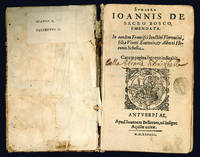
158273<p>COPY CONTAINING THE MINUTE OF A LETTER ADDRESSED BY GIORGIO RAGUSEO TO HIS COLLEAGE OF THE UNIVERSITY OF PADUA GIROLAMO PALLANTIERI</p><p>8vo 153x93 mm. 16 327 1 pp. and 1 folding plate with the movable parts to be cut out and the instructions on how to assemble them. Collation: †8 A-V8 X4. Printer's device on title page and several woodcut diagrams and illustrations in text. On the front pastedown label with the shelf mark "Scansia N. G10 Palchetto N.". On title page is the ownership's entry "Della libraria di Brisighella" and an old faded stamp. Contemporary binding made with a manuscript vellum leaf datable to the 12th-13th century inked title on spine and on the upper edge round worm holes and small losses to the panels heavier loss to the bottom part of the spine lacking ties and front flyleaf. Leaves †6 and †7 stained and with minor losses of paper and occasionally also of text small hole in the middle of quire M affecting a few letters other hole in the lower blank margin of ll. V3-X4 with no loss of text uniformly browned throughout first quire slightly loose. A genuine copy.</p><p>On back flyleaf recto is a manuscript note containing the minute of a letter presumably autograph by Giorgio Raguseo d. 1622 dated "Patavi ex academia nostra V. Non. Marti 94" 3 March 1594 and addressed to the "Admodum Rev.do ac Ecellentiss.o Patri Magistro Hieronimo Palanterio in almo Patavino Gimnasio theologiam publice proficienti" in which Raguseo thanks his colleague and professor of theology Girolamo Pallantieri 1533-1619 and asks his permission to print some not better specified academic "conclusiones ex variis doctoribus scholasticiis" which he thinks are worth publishing. It is also not clear which academy he is referring to in the letter.</p><p>On the verso of the same leaf is another note by the same hand quoting as a reminder the 1566 Giovanni Battista & Marchiò Sessa edition of <i>Le nuove teoriche de i pianeti</i> by Georg Peurbach in the translation by Orazio Toscanella.</p><p>RARE EDITION published in Antwerp of Sacrobosco's famous astronomical treatise accompanied by notes of Francesco Giuntini 1523-1590 Elie Vinet 1509-1587 and Albert Hero d. 1589 which appeared for the first time in the Lyon edition of 1562.</p><p>"Sacrobosco's <i>Sphaera</i> written in Paris around 1220 enjoyed a long popularity as the leading introduction to spherical astronomy. First printed in 1472 it went through at least a score of editions in the fifteenth century and something over 100 in the sixteenth … Publishing Sacrobosco entered a new and different phase in Wittenberg in 1531. Prior to that year all the editions were folio or quarto that is large often quite beautiful and presumably expensive volumes. In 1531 the Lutheran University of Wittenberg apparently sponsored a version cheap enough to become a required textbook for the astronomy course. It is fully illustrated with didactic figures and comes with a preface in praise of astronomy by Philipp Melanchthon … Demand for the small Sacrobosco textbook remained high at Wittenberg and a new edition was issued every few years. In 1538 a revised revision appeared: for the first time three of the diagrams incorporated moving parts. This proved to be such a popular feature that virtually every octavo Sacrobosco from the 1540s on – regardless of whether it was printed in Paris Antwerp Cologne or Venice – included these same identical volvelles. Incidentally these volvelles were not pre-cut and pasted by the printer. They were issued on ancillary sheets together with instructions for assembling them. Hence it is possible to find copies of these text books with no sign that the volvelles were ever in place and very occasionally the original sheet with the instructions and cutouts can still be found with the book" O. Gingerich <i>Sacrobosco as a Textbook</i> in: "Journal of History of Astronomy" 19 no. 4 Nov. 1988 pp. 269-273.</p><p>The letter contained in the present copy is particularly interesting as it connects two prominent figures of the University of Padua at the end of the 16th century highlighting their academic and professional ties. It is also worth noting that Raguseo wrote a commentary on Sacrobosco's <i>Sphaera</i> <i>Expositio super spheram Ioannis de Sacrobosco</i> Milan Biblioteca Ambrosiana manuscript N.207 sup. which has remained unpublished.</p><p>Giorgio di Ragusa or Raguseo as he was called after the name of his hometown today's Dubrovnik in Dalmatia was born on an unspecified date in the second half of the 16th century. He spent his youth in Venice where he was educated in mathematics by his father in the letters by L. Natali and in astrology his favourite discipline by Osvaldo da Gent and F. Barozzi. He then studied and graduated at the Studio of Padua first in the arts the exact date is not known then in 1592 in theology and in 1601 in medicine. In the meantime he took the minor orders and gained a certain reputation as an expert in Lull's art taking part in two public disputes over theological conclusions exposed according to R. Lull's method one in Venice in 1594 and the other in Padua in 1595. In 1599 he set off on a journey that kept him away from Venice for two years. In Pisa he met G. Mercuriale while in Naples he made the acquaintance of G. Della Porta. When he returned to Padua in the spring of 1601 he was appointed to the second ordinary chair of natural philosophy at the local Studio replacing C. Cremonini recently promoted to the first chair. In the following years he was deeply involved in all academic activities not only in teaching. His name in fact is one of those that most often appears in the commission that conferred the doctorate titles according to the practice of the Palatine counts and in this capacity on April 25 1602 he conferred the title of doctor in philosophy and medicine to W. Harvey. In 1613 in Venice he published twenty-four Aristotelian disputes under the title of <i>Peripateticae disputationes</i>. Around 1618 Raguseo took part in the discussions raised by the appearance of a comet. Despite his academic Aristotelianism he expressed an original position in the debate supporting the need for critical scrutiny by the senses and experience. From a letter of 1611 we also know that he used the telescope to verify some of discoveries announced by Galileo in the <i>Sidereus nuncius</i>. Raguseo died in Padua on 13 January 1622 cf. C. Preti <i>Giorgio da Ragusa</i> in: "Dizionario Biografico degli Italiani" LV 2001 s.v.; see also L. Thorndike <i>A history of magic and experimental science</i> VI New York 1941 pp. 198-202; M. Josipovic <i>Il pensiero filosofico di G. Raguseo</i> Milan 1985; and G.F. Tomasini <i>Gymnasium Patavinium</i> Udine 1654 pp. 309 and 445 for Ragueseo and p. 284 for Girolamo Pallantieri professor of theology from 1580 to 1603.</p><p>Bernardino Pallantieri was born in Castel Bolognese in 1533. In 1547 at the age of fourteen he entered the order of friars minor conventual taking the name of Girolamo. In Ferrara he studied philosophy with the theologian Filippo Braschi and the famous philosopher Vincenzo Maggio. He then continued his studies in Bologna under the guidance of Giovanni Antonio Delfini and Franceschino Visdomini. At first appointed regent of the Studio of Pavia in 1566 Pallantieri took up the chair of theology at that university. In 1568 he was called to Milan by St Charles Borromeo archbishop of that city who appointed him as preceptor of the candidates for priesthood and as his personal theologian. Pallantieri remained in Milan for 5 years then in 1573 he resumed his teaching in Pavia. Between 1575 and 1581 he was in Rome at the service of Cardinal Felice Peretti as his personal advisor and theologian. In 1581 he was called back to Bologna and in 1582 he was elected minister provincial of the friars minor of the province of Bologna. He was also a member of the Accademia degli Infiammati of Parma with the name of "Solingo". When his three-year mandate in Bologna expired in 1585 Pallantieri was called by the Reformers of the Studio of Padua to occupy the chair of theology and at the same time he was appointed superior of the convent of the Saint Anthony the patron of the city. Girolamo remained in Padua for ten years until about 1595. In 1603 he was appointed bishop of Bitonto by Pope Clement VIII but he moved to his diocese only in 1605. Pallantieri died in Bitonto in 1619 at the age of eighty-six cf. E. Papagna <i>Pallantieri Bernardino</i> in: "Dizionario Biografico degli Italiani" LXXX 2014 s.v.</p>Houzeau-Lamcaster no. 1658; L. Desgraves <i>Elie Vinet</i> Genève 1977 no. 125. Jean Bellère books
1983WRCLIT74290Issendorf: Verlag Michael Järnecke 1983. Large quarto. Flimsy flexible paper boards. Illustrations including color. Fragile spine cracked and repaired internally very good or better. First edition. One of 900 copies. Reproduces whimsical spray-gun drawings and text "Brain Footprints" along with handwritten diatribes. Includes an interview with the artist and an afterword by the publisher. Verlag Michael Järnecke hardcover books
200225785NY: Newmarket Press. Fine in Fine dust jacket. 2002. Hardcover. 1557044910 . First printing. Fine in a fine dust jacket. . Newmarket Press hardcover books
189872382London: Luzac & Co 1898. First Edition. Hardcover. Good. The first edition in English. Unlike its predecessors which were based on archaic Persian spoken in India Rosen's Grammar drew on the colloquial language of what was then modern Persia. 400 p. with the publisher's 1893 ads at the rear. Octavo. Original brown cloth binding with black stamping. Though the hinges are cracked the binding is still quite sound. The top edge is dust stained. Some general shelfwear to the boards which are darkened along the spine. Luzac & Co hardcover books
200126672NY: HarperCollins. Fine in Fine dust jacket. 2001. Hardcover. 0060287101 . Illustrated by Renee Graef. Second printing. Fine in a fine dust jacket. . HarperCollins hardcover books
1966240109New York: Benjamin Blom 1966. Hard Cover. Very Good binding. Blue cloth binding with light edgewear to extremities. ; previous owner bookplate is present; no markings in text. Very Good binding. Benjamin Blom unknown books
1896010003NY: Wholesale Dry Goods Republican Club of New York 1896. Hardcover. Very Good. An address delivered by John Rhoades Presidnet of the Greenwich Savings Bank of New York befoer the Wholesale Dry Goods Republican Club of New York. Stiff paper printed covers 17 pages. A businessman's ringing endorsement of McKinley during oen of the most hostoric presidentail elections in US history: "Populism will not bring about progress. Communism will not produce it. Socialism will not creat eit. Anarchy will destory it.Vote for McKinley Wholesale Dry Goods Republican Club of New York hardcover books
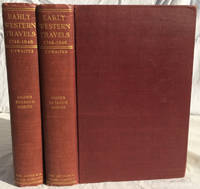
1905JR1018-049Cleveland OH: The Arthur H. Clark Company 1905. First Edition thus. Hardcover. Very Good/None. SEPARATE EDITIONS of 336 and 324 copies respectively printed at the Lakeside Press Chicago; title pages state that these volumes are separate publications from the Early Western Travels 1748-1846 Series Vols. XIX and XX. Two Volumes. Large 8vo. 9 1/2 x 6 1/2 inches. 349 1 ads; 356 10 ads pp. 16 illustrations on plates including 1 map 1 folding map 1 figure glossary; text clean unmarked. Burgundy cloth gilt spines top edge gilt; binding square and tight inner hinges cracked but holding firm shelf wear rubbed. Very Good. Reprints 3 of the most important and rarest contemporary publications about Western travel. The 3 volumes anthologized in these 2 volumes are: George W. Ogden's Ogden's Letters from the West 1821-1823 first published in New Bedford in 1823; William Bullock's fl. 1808-1828 Sketch of a Journey through the Western States London 1827; and Josiah Gregg's 1806-1850 Commerce of the Prairies New York 1844. REFERENCE: Clark & Brunet Arthur H. Clark Company No. 282. The Arthur H. Clark Company hardcover books
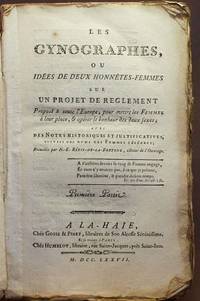
17776329The Hague but Paris: Gosse et Pinet; Humblot 1777. First edition. Fine/The collected works of Restif de la Bretonne would probably fill an entire wall case. He wrote tirelessly producing some 250 books--a considerable physical task if not the intellectual achievement of some of his contemporaries in the French siècle des Lumières. Restif was a libertine and he wrote quite a lot about sex. He also bravely ignored standard literary forms forging his own way into autobiography polemic essay pornography and fiction leaving trails that are yet to be explored. The volumes offered here in their completely original unsophisticated state form a part of an ambitious series of books that appeared over two decades under the umbrella title "Idées singulières" Modest Proposals an extensive compendium of rules and regulations for the creation of a utopia. Each title in the series proposes a reform project for a particular aspect of society. In the case of Les gynographes that aspect is the status of women in society. While not entirely a 21st-century feminist disappointingly he is unable to exceed received patriarchal attitudes Restif makes some presciently modern arguments including that gender inequality is a social construct and is not biologically determined and that education is the key to gender equality. Indeed the text betrays a disconcerting mix of statements that can be interpreted as misogynistic alongside truly revolutionary ideas about the condition of women in society. Even the 19th-century bibliographer P.L. Jacob notes that "some very singular and very original ideas" occur juxtaposed against "severe and unjust comments" about women. . 2 volumes octavo 22; viii 238; 239- 567 1 pages. Unbound untrimmed unmarked and completely unsophisticated copy in original publisher's marbled paper wraps. Pages not bright. Some dampstains and occasional spots. References: Courbin "Rétif et son oeuvre" #14595; Rives Childs XVI p. 245; Jacob XVII p. 143. Gosse et Pinet; Humblot paperback books
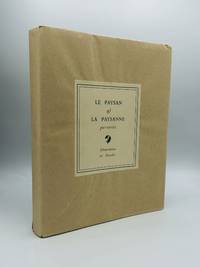
194871744Paris: Les Editions du Mouflon 1948. Wraps. Very good/Very good. Limited Edition one of 15 suites on Verge Diarches paper with two suites of plates by Jacques Touchet one in color and the other in black and white. This is exemplaire 19. The original drawing is not present. Extraordinarily prolific Restif 1734-1806 was a rival of the Marquis de Sade and is perhaps best known for the term named after him: retifism or shoe fetishism. In 1775 he published Le Paysan perverti an erotic novel with a moral purpose which was quite successful causing him to follow it with La Paysanne Pervertie 1784. Tall octavo: 189 p. The gatherings are bound together in the folded dust jacket over paper wrappers. A few short closed tears; otherwise very good. Les Editions du Mouflon unknown books
001866Tokyo: T. Hasegawa. N.d circa 1903. Probably first edition. Unpaginated twelve folded-over leaves including cover. Larger format 7.5 by 5.25 inches or 19 by 13.5 cm. Probably the best tale ever built around toothpicks! A fairy tale of the supernatural retribution meted out to lazy women with a second shorter variant of the same story included as well. This copy has particularly crisp and bright color! Light soiling to covers and some minor waviness where fabric dinged by bottom edge. <br /><br /> T. Hasegawa books
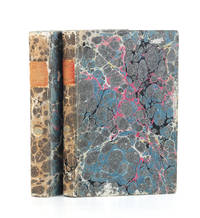
4876Six folding engraved plates. 1 p.l. xvi 322 pp.; 1 p.l. 238 pp. Two vols. 8vo cont. marbled boards orange & pale blue lettering pieces on spines. Lausanne: J. Mourer 1789. First edition. Razoumovsky 1759-1837 a wealthy Russian aristocrat spent most of his life in Switzerland Austria and Italy and wrote many noteworthy works on geological and mineralogical subjects see Zittel pp. 91 & 119. "Very scarce.First and only edition of an illustrated account of the fauna and geology of the Swiss Jura in the vicinity of Neuchâtel Murten and Biel northwest of Bern.The first volume describes the fauna according to the Linnean system. The second includes a geological description with notes on mining minerals fossils etc. The illustrations cover zoology especially reptiles entomology and geology including fossils."-Schuh Mineralogy & Crystallography: A Biobibliography 1469 to 1920 4045. Fine and attractive set. ❧ Poggendorff II 578-79. hardcover books
19368558New York: International Publishers 1936. First Edition. Cloth boards; dustjacket; 272pp. Private ownership stamp of A.C. Perlman to front endpaper. Tight straight copy in quite decent jacket chipped along upper extremities slightly soiled on rear panel; Very Good. Selections of Gold's newspaper commentaries most originally published in The Daily Worker and New Masses. International Publishers unknown books
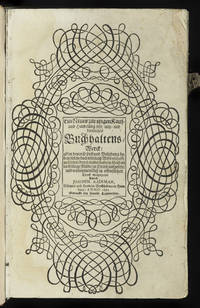
3399Title within elaborate calligraphic woodcut border title a little soiled & frayed around edges. 242 leaves the last a blank. Small folio cont. blind-stamped panelled pigskin over wooden boards binding somewhat soiled pigskin at one corner worn away remains of clasps & catches. Hamburg: A. Lichtenstein 1682. First edition extremely rare of this large and comprehensive Hamburg manual of accounting techniques. Only two other copies seem to be extant: one at the British Library and the other Tübingen. The book was a success and a second edition was published in 1714 under the title Der Werth-geschätzte Handels-Mann. Joachim Rademann was a chartered accountant at Hamburg. At the end of this his first published work he describes himself a "young man" and according to Schröder he married in 1683; otherwise nothing seems to be known of his life. Based on Christoph Achatius Hager's treatise Buchhalten uber proper Commission und Compagnia Handlungen first published at Hamburg ca. 1625 Rademann's book takes into consideration the changes and innovations that trading and coinage had seen since then and focuses on practical matters. The general ledger section comprises a Memorial a Journal and a Hauptbuch; the associated accounts include a Cassa-Buch cash journal a Banca-Buch bank account an Unkostenbuch book of charges a Monat-Buch monthly journal and a Factura-Buch and Rechnungs-Copey-Buch books of invoices. Precise examples taken from actual trading accounts at Hamburg are given throughout. "Rademann dispenses with long theoretical preambles and instead when differentiating between debtor and creditor points to the works of Hager and Gebhardt Overheiden. To the associated accounts Rademann adds the Portbuch von Briefe today's petty cash book. In the Memorial Rademann follows his predecessor Hager but adds a wealth of detail. The same applies to the Journal.The impersonal accounts that follow are remarkable not only for their multitude but also for the exceptionally delicate and skillful handling of the accounts. Rademann's work is nothing short of excellent."-Penndorf Geschichte der Buchhaltung in Deutschland p. 219 in trans. Very good copy of this extremely rare book. First fifteen leaves with light dampstaining. ⧠Hausdorfer 198. Historical Accounting Literature 28. Hoock/Jeannin II R.1. 1. Humpert 396. Schröder VI 3077 1. Not in Goldsmiths Kress or Rapp. hardcover books
1866286043New York 1866. unbound. very good. located in the Nevada District of the Colorado Territory with beautifully engraved vignettes of a miner working by torchlight and a group of miners sending ore from the mine shaft to the surface by way of an bucket-brigade. Signed by the Secretary and President of the Corporation whose main office was located in New York City. This certificate bears two uncancelled 25 cent Internal Revenue Certificate stamps applied to the certificate in their designated spaces. The stock certificate appears not to have been redeemed. Scarce. Very good<br/><br/> Folds are very light and the steel engravings are clearly printed. There is a small chip to the top margin above the printed border.<br/><br/> unknown books
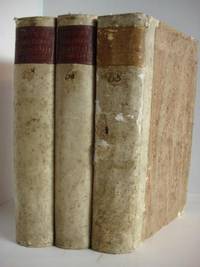
17605757Gottingen: Wittwe Vandenhoeck 1760. Published 1760-1791 general title page of Vol. 1 dated 1768. Folio. 12 volumes bound in 3 each volume in 4 parts each with its own title page. Indices. With numerous folding tables throughout. Frontispiece portrait of Putter. Cont. vellum over boards extremities a bit rubbed and a little chipping to the spine of Vol. 3 but quite a nice set. A key set for the study of German law by one of the foremost legal scholars of his day. Putter 1725-1807 taught law at Marburg and Gottingen. Ten years after Volume 12 a fourth physical volume was added. It has 3 parts i.e. parts 13-15 printed in 1801-1809. Wittwe Vandenhoeck hardcover books
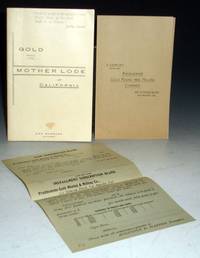
025641Los Angeles CA. 1974. 12mo. 36 unnumbered pages. Laid in is a facsimile of the original cash subscripton blank a four page promotional leaflet explaining why investing in their old mining venture was good in 1903 and they survived well enough to keep up their promises to reprint this in 1974. OCLC reports that the only copy of this item is in the Bancroft Library. photographs of the mine and miners map of the region and other data. Staple bound wraps. unknown books
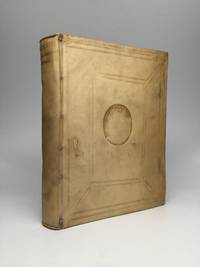
170266660Amsterdam: Henricum Wetstenium 1702. First Edition. Hardcover. The first edition of Broekhuizen's Elegies of Propertius. Janus Broukhusius or Jan van Broehuizen 1649-1707 was an influential classical scholar and poet whose editions of Propertius and Catullus were long influential. Many 19th and early 20th century editions of Propertius drew heavily on him including Pieter Burmann The Younger's 1780 edition completed by Van Sanlen. Brunet speaks well of the scholarship of Broekhuizen's edition Brunet III p.847; Schweiger II p.830-3. Square quarto. Cover measures 22.4 x 17.7 cm 8¾ x 7"; leaves = 21.5 x 16.4 cm. Typographic title page in black and red; second title page engraved by Mulder signed in the plate. Errata list on p.28. Pagination: 28 423 1 100 pp. Foliation: - 3 in fours 4in two A-3T in fours 3V in two. Textblock trimmed no loss. Full vellum binding possibly original certainly early with two binders blanks. Covers have blind-stamped rules and gilt lozenges. The spine is ink lettered. Slits for ribbon ties present but the ties are now departed. Fifteen possibly more pages have scholarly notes in Latin in an early hand. Very clean copy with virtually no foxing and what is there is very light and unobtrusive. Cover gilt is rubbed one small flaw in the top cover vellum. Henricum Wetstenium hardcover books