542 résultats
1990702799Boston: Houghton Mifflin. 1990. Very Good in Very Good DJ. Unless otherwise noted our first editions are first printings. First Edition. Hardcover. Very Good. Houghton Mifflin hardcover books
1990702798Boston: Houghton Mifflin. 1990. Advance Uncorrected Proof. Very Good in wrappers. Unless otherwise noted our first editions are first printings. First Edition. Softcover. Very Good. Houghton Mifflin paperback books
1973302771973. GOLD Herbert. "San Francisco Petal." In Playboy magazine November 1973. Also appearances by Robert Chatain. Very Good. $10.00. <br/><br/> unknown books

16843938Amsterdam: Apud Henricum Wetstenium 1684. 2 parts in 1. 4852595;11218pp. Indices at end of each part. Added engraved title. Title-page printed in red & black. Cont. speckled calf some rubbing small chip at head of spine & label lacking but quite sound. Apud Henricum Wetstenium unknown books
19671333285Oxford: Clarendon Press 1967. Hardcover. Octavo; G; Hardcover; Spine blue with gold print; Boards in blue cloth with gold print wear to corners and spine caps stain to top portion of spine scratches shelfwear; Text block has spotting to edges and endpapers mild bump to top corner else clean and tight; xii 374 pages. 1333285. FP New Rockville Stock. Clarendon Press hardcover books
17903249Dumbarton Scotland 1790. Good. Folio half-sheet 1 p. 20 lines name of the recipient on verso 2 vertical and 4 horizontal folds evidence of wax seal on verso old tape repair at top margin not affecting text ink gall corrosion on outer margin affecting one word. Preserved in mylar sleeve. An extremely curious provincial Scottish letter dated 1790 which incorporates misspellings based on non-standard sociolects of the Scottish dialect. While "worthless" relics such as this were almost invariably discarded they remain of the great interest in Ortheopy the study of pronunciation. Indeed much of what is known about Vulgar Latin pronunciation is preserved in graffiti in the ruins of Pompei. <br/><br/>Concerning the content of the letter: William Steuart or Stewart writes to John Adam Esq. describing water damage to four rooms in Dumbarton Castle: two were newly painted the other two newly wall-papered. An associate suggested that he procure a carpenter in Inversnaid to the amount of GBP 35 and therefore "if you have any masonwork to do I can do it at the time."<br/><br/>The letter is signed by Steuart but was clearly dictated by him to an unnamed scribe. Our transcription of the letter retains the original spelling:<br/><br/>"Dumbarton May 24th 1790. Dear Sir<br/>I received both your letters one of the 10th & the other of the 13th curant & have noted the contents. I told Capt. Roberson what work was to be don sic at the Castle hear sic this year when he simed i.e. seemed much surprised that his hous sic was not rough cast. Ther sic is 2 rooms neu sic painted & other two neu sic pappred sic which will be quite spiled i.e. spoiled with the watter sic comin through the wall & he has wrot i.e. wrote to Campt. Rudyard about it. Last neight sic I had a letter from Mr. Young beiging i.e. begging of me to go to Inversnaid to gat sic som sic Carpenter work don sic ther sic to the amount of GBP 35 so if you have any masson sic work to do I can do it at the time. I am Dear Sir your very humbel sic Serv't" shaky signature of William Steuart. <br/><br/>Questions remain: Why go to Inversnaid to procure a carpenter This extremely tiny village was located 30 miles away from Dumbarton Castle while Glasgow was only 13 miles away. And was recipient of the present letter to be identified with the architect John Adam Esq. of Edinburgh 1721-1792 son of William Adam and older brother of Robert Adam unknown books
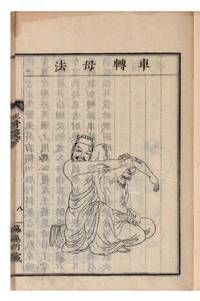
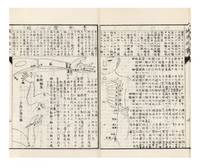
7010Many fine full-page woodcut illus. 46; 59 folding leaves. 8vo orig. yellow wrappers wrappers a little soiled orig. woodblock title-slips on upper covers labels a little soiled new stitching. Kyoto Osaka & Edo: 1808. First edition of one of the three most important Japanese works on orthopedic medicine. The book is based on Chinese medical science most notably the Sheng ji zong lu written in the 11th century and the Yi zong jin jian by Qian Wu active 1736-43 who also wrote the famous Yusuan Yizong Jinjian Imperially Commissioned Golden Mirror of Medical Learning published in 1742. Our work presents a system of surgical treatment to cure injuries to bones principally fractures and dislocations with instructions on how to stop bleeding and to bind or immobilize the injured part by bandaging. There is a substantial section on materia medica and the compounding of prescriptions considered essential to the treatment of bones in Japan. The numerous and fine woodcuts depict braces and corsets plasters manipulations bandaging techniques casts etc. Many of these techniques are clearly taken from Western medicine. Ninomiya 1754-1827 was a prominent medical doctor who laid down the foundations of orthopedic surgery in Japan. He studied in Nagasaki where he learned Western and Japanese techniques from Kogyu Yoshio 1724-1800 interpreter of Dutch and a famous physician and surgeon who had a "Western-style" room at his home in the city. After further study under a number of doctors throughout Japan including Gento Yoshiwara Ninomiya established himself in Edo where he had an extremely successful practice. After contracting syphilis as a baby from his wet nurse Ninomiya lost his nose and wore a artificial nose for the rest of his life. Nice set. Both volumes have some minor marginal dampstaining. ❧ Mestler A Galaxy of Old Japanese Medical Books III p. 152. unknown books
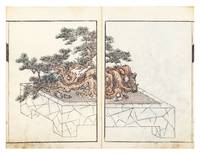
662824 color-printed woodcut illus. of which six are double-page & 18 are full-page. 20 folding leaves. Large 8vo orig. wrappers wrappers somewhat soiled orig. block-printed title label on upper cover new stitching. Osaka or Kyoto: very likely issued privately Preface dated 1808. First edition posthumously published of this extremely rare work by Buzen Sumie 1734-1806 edited by his son Aizan. WorldCat locates no copy of our edition; there was a later edition issued in 1826 with rather different images and color palette. The Union Catalogue of Early Japanese Books does not record a copy. Small tray or pot landscapes - known in the Edo period as senkeiban - have their origins in 10th century China. The "trays" in Chinese zhan jing pan or penjing were made out of copper or pottery. They were filled with soil rocks pebbles sand plants and miniature trees forming elaborately conceived miniature garden landscapes. The landscapes are clearly Chinese in style with mountains and pagodas surrounded by the sea or rivers represented by pebbles or sand. Many of the created landscapes include miniature houses temples gates stairways etc. The descriptive text for many of the images discusses the unity and philosophy involved in the creation and depiction of these miniature landscapes. The extensive explanatory text at the end describes in very great detail how to create the landscapes materials used aesthetic considerations how to care for the plants and trees etc. Aizan Sumie has provided a most interesting two-page "Afterword" in which he describes the genesis of this book. Buzen Sumie a bonkei and bonsai artist in the Chinese style created many senkeiban and the images in this work are a representative selection of his creations. The selection was made by the publisher Tadataka Katsu who also wrote a highly complimentary preface. Sumie's teacher was Settei Tsukioka. Very good copy. One image has some soiling. Minor thumbing and soiling. ❧ Brown Block Printing & Book Illustration in Japan p. 208-referring to the 2nd ed. of 1826 which she calls "delightful.". unknown books
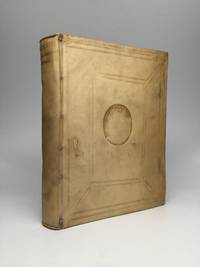
170266660Amsterdam: Henricum Wetstenium 1702. First Edition. Hardcover. The first edition of Broekhuizen's Elegies of Propertius. Janus Broukhusius or Jan van Broehuizen 1649-1707 was an influential classical scholar and poet whose editions of Propertius and Catullus were long influential. Many 19th and early 20th century editions of Propertius drew heavily on him including Pieter Burmann The Younger's 1780 edition completed by Van Sanlen. Brunet speaks well of the scholarship of Broekhuizen's edition Brunet III p.847; Schweiger II p.830-3. Square quarto. Cover measures 22.4 x 17.7 cm 8¾ x 7"; leaves = 21.5 x 16.4 cm. Typographic title page in black and red; second title page engraved by Mulder signed in the plate. Errata list on p.28. Pagination: 28 423 1 100 pp. Foliation: - 3 in fours 4in two A-3T in fours 3V in two. Textblock trimmed no loss. Full vellum binding possibly original certainly early with two binders blanks. Covers have blind-stamped rules and gilt lozenges. The spine is ink lettered. Slits for ribbon ties present but the ties are now departed. Fifteen possibly more pages have scholarly notes in Latin in an early hand. Very clean copy with virtually no foxing and what is there is very light and unobtrusive. Cover gilt is rubbed one small flaw in the top cover vellum. Henricum Wetstenium hardcover books
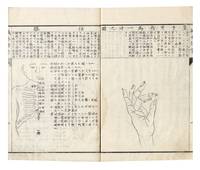
6530Numerous woodcut illustrations in the text. 31 folding leaves. 8vo orig. wrappers wrappers a little rubbed orig. block printed title label on upper cover label a little defective new stitching. Kyoto & Tokyo: 1864. First edition and rare. Imamura 1814-90 a leading doctor and historian of Japanese medicine was physician to the future Emperor Taisho when he was a youth. Imamura professor of medicine at Tokyo University found that many of the contemporary Japanese works on acupuncture had strayed from the classic teachings of the Chinese physicians. In this work Imamura makes a series of highly detailed and organized corrections to refine the fourteen meridians. The numerous striking woodcuts depict various parts of the body and pressure points. Very nice copy. Some light dampstaining. ❧ Mestler Old Japanese Medical Books I p. 297. unknown books
7485Numerous woodcut illustrations in the text. Title-page 31 folding leaves one leaf of colophon. 8vo orig. patterned blue semi-stiff wrappers orig. block-printed title label on upper cover label rubbed new stitching. Tokyo Kyoto & Osaka: 1864.<br /> First edition and rare. Imamura 1814-90 was a leading physician and historian of Japanese medicine of his period. Professor of medicine at Tokyo University he was physician to the future Emperor Taisho when he was a youth.<br /> Imamura found that many of the contemporary Japanese works on acupuncture had strayed from the classic teachings of the Chinese physicians. In this work he makes a series of corrections to refine the fourteen meridians.<br /> The numerous woodcuts depict various parts of the body and pressure points.<br /> Very nice copy. Light stain to first few leaves.<br /> â§ Mestler Old Japanese Medical Books I p. 297. unknown books
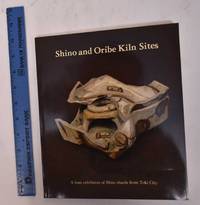
1981169747Oxford: Robert G Sawers Publishing / The Ashmolean Museum 1981. Softcover. VG- Cover shows tanning and wear. Owner's writing on first page otherwise clean and tight. Off-white and color-illustrated wraps off-white spine with black lettering. 96 pp. bw illustrations few in color. "A loan exhibition of Mino shards from Toki City at the Ashmolean Museum Oxvord Feburary 1981 and the Groninger Museum Groningen April 1981. Robert G Sawers Publishing / The Ashmolean Museum unknown books
1981224823Oxford: Robert G. Sawers 1981. paperback. near fine. More than 100 small black & white photo illustrations 16 larger and in color. 96pp. 8vo stiff pictorial wrappers. Oxford: Robert G. Sawers 1981. A near fine copy.<br/><br/> Robert G. Sawers unknown books
19696979NY: Dutton 1969. First edition. 372 pp. Fine in very near fine dust jacket. His second book and first novel. Briefly INSCRIBED by Gold. NY: Dutton, unknown books
20099008337Los Angeles: Red Hen Press 2009. Advanced Proof. Paperback. Fine Condition. Bound in publisher's original wrappers. <br/><br/> Red Hen Press paperback books
19599007763Los Angeles: Warde Richie Press 1959. 1st. Hardcover. Fine Condition. Beautifully printed in Zapf typefaces with Sapphire for display by the incomparable Warde Richie. Original binding with gold and black checkerboard pattern pastedowns. <br/><br/> Warde Richie Press hardcover books
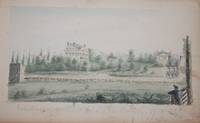
1828006534New York City 1828. Hardcover. Cloth spine. Marbled pastedown on boards. Leather centerpiece label on front board. Good. Original watercolors of rural Manhattan as it appeared in 1828. Among these and captioned are a farmhouse on Broadway and 8th Street; Kips Bay showing a boy sailing a small craft with a farmhouse in the background; a house in Bloomingdale the location of an early village now the Upper West Side along the river between 96th and 106th Streets; and a stately mansion surrounded by fields and less important buildings we would conjecture in or around Bloomingdale but captioned surely incorrectly the Battery. Most of the paintings are uncaptioned. Of these some are surely the Upper Hudson area or are scenes that we can't tell whether they are upstate or in the present day city. The artist also ventured away from the New York areas. Among the non-New York paintings are a depiction of the Cape Pogue Lighthouse on Martha's Vineyard which still stands; Fowey Harbour which is in Cornwall; and a few scenes which look very much like Scotland. Oblong 14 by 19.5 cm. 55 watercolors generally fully finished. Although the sketchbook has a label on its front board bearing the name of Walter Oddie who was a listed artist we believe a good amount of the artwork contained in this sketchbook is of his father-in-law Henry Meigs. Meigs had been a U.S. Congressman from New York and also held a number of other political positions in the city over the course of his career. More pertinently Meigs was known to be an amateur painter and as such an inspiration to Oddie. Given Oddies youth at the time -- he was 20 or 21 years old and from his diary for the years 1828 and 1829 now housed in the Winterthur Library we know he was just starting to paint we find it inconceivable that he would have had the skill yet to produce the sensitive and fine renderings of nature and buildings that typify this sketchbook. Further underlying our thinking about attribution is that some of captioning only makes sense if Meigs were the primary artist. We do consider it quite likely that Oddie may have done some of the sketchier work contained herein as well as contributing in bits and pieces to his father-in-laws work as well as perhaps copying some of it in this sketchbook. To us it isnt really so important who was responsible for particular paintings in the sketchbook. Rather the significance lies in the recording of New York City and its surroundings at the time we suspect that there may be no recording anywhere of some of the buildings and locations at this time. And of course not to be minimized is the beauty of the better paintings contained in the sketchbook.Whatever the degree of Oddies contribution the sketchbook does have something to say about his career and visa versa given that it contains the type of artwork for which he became known later. Oddie was born in Maryland Washington D.C. or possibly New Orleans but spent almost his entire life in New York and more specifically New York City Brooklyn or Long Island. In 1828 the year most of the watercolors in the catalogue were executed Oddie was spending much of his time in the city.Once Oddies interest in painting was sparked he was believed to have been largely self-taught but he did come to study art with Hudson River School painter Robert Walter Weir and Anthony Lewis De Rose a portrait and historical painter. From the diary we know that Oddie did work with De Rose in 1829; we believe that his tutelage with Weir came later. From the diary we know that Oddie was regularly going to art exhibits and critiquing what he saw. The diary also discloses or corroborates our prior sense that Oddie sometimes would work off of engraved prints. To what degree he was merely copying the prints as opposed to using the prints as a spur to his own imagination we can not determine with certitude. We tend to think the views of Scottish and Welsh castles contained in the Sketchbook were done by Meigs not Oddie and so they might well have been done from life.From the diary we know that Oddie had some day job that occupied him during the week and so he did most of his painting at that time on the weekends when he would often go for long hikes along the Hudson. Oddie also refers in the diary to having been in Hudson then and now the county seat of Columbia County and so it is very plausible that some of the upstate scenery is from around there. Again we think some of these paintings may have been done by Meigs.Oddie would become an associate member of the National Academy of Design where he frequently exhibited his artwork.One further note we spoke of questioning one caption referring to the Battery. In 1828 the urbanized part of the city didnt even reach 14th Street but the Battery as the oldest part of the city was thoroughly urbanized. Thus the painting could not be of the Battery. But the landscape is very consistent with the topography of Upper Manhattan. <br /> hardcover books
1978WRCLIT60146New York: Arbor House 1978. Printed wrappers. Uncorrected page proof of the first edition. Near fine. Arbor House unknown books
1978WRCLIT24225New York: Arbor House 1978. Printed wrappers. Uncorrected page proofs of the first edition. Fine. Arbor House unknown books
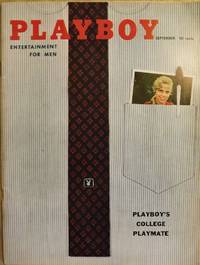
1958304001958. GOLD Herbert. "Sleepers Awake." In Playboy Magazine September 1958. Very Good. $50.00. <br/><br/> unknown books
1920009370Elkhorn Oregon now a dead post office 1920. Unbound. Very good. This lot of consists multiple items: <p style="margin-left:3%; margin-right:3%;">One canceled check from the Silver King Mining Company <p style="margin-left:3%; margin-right:3%;">One application and contract to purchase Silber King Mining Company stock <p style="margin-left:3%; margin-right:3%;">Two Silver King Mining Company employment agreements accepting shares of capital stock in lieu of wages <p style="margin-left:3%; margin-right:3%;">Two letters on Silver King Mining Company letterhead regarding "grub" needed at the mine <p style="margin-left:3%; margin-right:3%;">One note on plain paper enclosed in a Silver King Mining Company envelope and <p style="margin-left:3%; margin-right:3%;">One file copy of a letter regarding the transfer of a stock certificate. The items are in nice shape. <p>Two of the covers are postmarked with Doane Type 2 No. 1 "railroad track" cancels. Doane Cancels were the Post Office Department's first attempt to improve postmark legibility by issuing rubber handstamps. The name honors Edith R. Doane a Postal Historian who became interested in these early 20th Century Handstamps in the 1950's. They were used at smaller 4th class post offices where receipts did not exceed $500 in a year. Type 2 Doane Cancels have 2 sets of railroad track type bars with a number in them. They were issued from Sep. 29 1903 until Jun. 30 1905. The "1" inside the bars meant the Elkhorn Postmaster annual compensation less than $100. <br /><br />The contents of two letters suggest that one supervisor and four miners worked the mine and are rather eye-opening with regard to life at site: <p style="margin-left:3%; margin-right:3%;">"Have recd some of the grub. Wish you would send me $5 or $10 . . . as my old 30-30 is Broke and I want to get it fixed . . . as there is a cooger hanging around. . . have got to get some nails to do some fixing up things and have borrowed money to by Postage Stamps and tobacco. I hear there has been $150000 put up to sink on the Silver king how is it. There was a party here from Portland who tells me that . . . there was some machinery bought for the Silver King. What is it. . . I have rcd. 100 lbs of flower and the bacon coffee one case - tomatoes - and one case milk beans and if you have sent anything more I have not recd it old man shire said that was ll that was there - I am out of lard and sugar." <p>The mine was located in the Lester Mining District on the western slope of the Cascades about 24 miles from the summit of Mt. Jefferson and ten miles from Gates and 17 miles from a railway station at Lyons. The complex consisted of 12 contiguous claims with a total of 240 acres. The "Queen Vein" reached by tunnel contained the best developed and richest ore. Although only traces of gold lead and zinc were present assays showed in places it contained up to almost 41 ounces of silver per ton. Although no official production numbers were recorded the mine is remembered for providing a large amount of silver for the relative short time it was operated. It is still accessible and safe to explore as the Bureau of Land Management has left it open and ungated. <br /><br /> A nice grouping of documents from a short-lived but productive Oregon silver mine made more interesting by the use of relatively scarce postal handstamps on the companies outgoing mail. <br /><br /> books
1985197567n.p. The Author 1985. 1985. First edition. Oblong 4to. Illustrated with 26 lino and wood-cut drawings by Clarke. Printed yellow pictorial board; spiral bound. Fine fresh. No signatures or bookplates. #9/50 numbered copies the entire edition. An attractive alphabet book. F. Hardcover. [n.p.] The Author [1985]. hardcover books
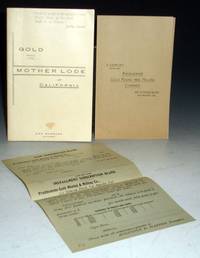
025641Los Angeles CA. 1974. 12mo. 36 unnumbered pages. Laid in is a facsimile of the original cash subscripton blank a four page promotional leaflet explaining why investing in their old mining venture was good in 1903 and they survived well enough to keep up their promises to reprint this in 1974. OCLC reports that the only copy of this item is in the Bancroft Library. photographs of the mine and miners map of the region and other data. Staple bound wraps. unknown books
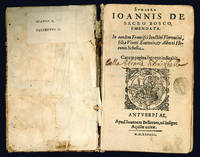
158273<p>COPY CONTAINING THE MINUTE OF A LETTER ADDRESSED BY GIORGIO RAGUSEO TO HIS COLLEAGE OF THE UNIVERSITY OF PADUA GIROLAMO PALLANTIERI</p><p>8vo 153x93 mm. 16 327 1 pp. and 1 folding plate with the movable parts to be cut out and the instructions on how to assemble them. Collation: †8 A-V8 X4. Printer's device on title page and several woodcut diagrams and illustrations in text. On the front pastedown label with the shelf mark "Scansia N. G10 Palchetto N.". On title page is the ownership's entry "Della libraria di Brisighella" and an old faded stamp. Contemporary binding made with a manuscript vellum leaf datable to the 12th-13th century inked title on spine and on the upper edge round worm holes and small losses to the panels heavier loss to the bottom part of the spine lacking ties and front flyleaf. Leaves †6 and †7 stained and with minor losses of paper and occasionally also of text small hole in the middle of quire M affecting a few letters other hole in the lower blank margin of ll. V3-X4 with no loss of text uniformly browned throughout first quire slightly loose. A genuine copy.</p><p>On back flyleaf recto is a manuscript note containing the minute of a letter presumably autograph by Giorgio Raguseo d. 1622 dated "Patavi ex academia nostra V. Non. Marti 94" 3 March 1594 and addressed to the "Admodum Rev.do ac Ecellentiss.o Patri Magistro Hieronimo Palanterio in almo Patavino Gimnasio theologiam publice proficienti" in which Raguseo thanks his colleague and professor of theology Girolamo Pallantieri 1533-1619 and asks his permission to print some not better specified academic "conclusiones ex variis doctoribus scholasticiis" which he thinks are worth publishing. It is also not clear which academy he is referring to in the letter.</p><p>On the verso of the same leaf is another note by the same hand quoting as a reminder the 1566 Giovanni Battista & Marchiò Sessa edition of <i>Le nuove teoriche de i pianeti</i> by Georg Peurbach in the translation by Orazio Toscanella.</p><p>RARE EDITION published in Antwerp of Sacrobosco's famous astronomical treatise accompanied by notes of Francesco Giuntini 1523-1590 Elie Vinet 1509-1587 and Albert Hero d. 1589 which appeared for the first time in the Lyon edition of 1562.</p><p>"Sacrobosco's <i>Sphaera</i> written in Paris around 1220 enjoyed a long popularity as the leading introduction to spherical astronomy. First printed in 1472 it went through at least a score of editions in the fifteenth century and something over 100 in the sixteenth … Publishing Sacrobosco entered a new and different phase in Wittenberg in 1531. Prior to that year all the editions were folio or quarto that is large often quite beautiful and presumably expensive volumes. In 1531 the Lutheran University of Wittenberg apparently sponsored a version cheap enough to become a required textbook for the astronomy course. It is fully illustrated with didactic figures and comes with a preface in praise of astronomy by Philipp Melanchthon … Demand for the small Sacrobosco textbook remained high at Wittenberg and a new edition was issued every few years. In 1538 a revised revision appeared: for the first time three of the diagrams incorporated moving parts. This proved to be such a popular feature that virtually every octavo Sacrobosco from the 1540s on – regardless of whether it was printed in Paris Antwerp Cologne or Venice – included these same identical volvelles. Incidentally these volvelles were not pre-cut and pasted by the printer. They were issued on ancillary sheets together with instructions for assembling them. Hence it is possible to find copies of these text books with no sign that the volvelles were ever in place and very occasionally the original sheet with the instructions and cutouts can still be found with the book" O. Gingerich <i>Sacrobosco as a Textbook</i> in: "Journal of History of Astronomy" 19 no. 4 Nov. 1988 pp. 269-273.</p><p>The letter contained in the present copy is particularly interesting as it connects two prominent figures of the University of Padua at the end of the 16th century highlighting their academic and professional ties. It is also worth noting that Raguseo wrote a commentary on Sacrobosco's <i>Sphaera</i> <i>Expositio super spheram Ioannis de Sacrobosco</i> Milan Biblioteca Ambrosiana manuscript N.207 sup. which has remained unpublished.</p><p>Giorgio di Ragusa or Raguseo as he was called after the name of his hometown today's Dubrovnik in Dalmatia was born on an unspecified date in the second half of the 16th century. He spent his youth in Venice where he was educated in mathematics by his father in the letters by L. Natali and in astrology his favourite discipline by Osvaldo da Gent and F. Barozzi. He then studied and graduated at the Studio of Padua first in the arts the exact date is not known then in 1592 in theology and in 1601 in medicine. In the meantime he took the minor orders and gained a certain reputation as an expert in Lull's art taking part in two public disputes over theological conclusions exposed according to R. Lull's method one in Venice in 1594 and the other in Padua in 1595. In 1599 he set off on a journey that kept him away from Venice for two years. In Pisa he met G. Mercuriale while in Naples he made the acquaintance of G. Della Porta. When he returned to Padua in the spring of 1601 he was appointed to the second ordinary chair of natural philosophy at the local Studio replacing C. Cremonini recently promoted to the first chair. In the following years he was deeply involved in all academic activities not only in teaching. His name in fact is one of those that most often appears in the commission that conferred the doctorate titles according to the practice of the Palatine counts and in this capacity on April 25 1602 he conferred the title of doctor in philosophy and medicine to W. Harvey. In 1613 in Venice he published twenty-four Aristotelian disputes under the title of <i>Peripateticae disputationes</i>. Around 1618 Raguseo took part in the discussions raised by the appearance of a comet. Despite his academic Aristotelianism he expressed an original position in the debate supporting the need for critical scrutiny by the senses and experience. From a letter of 1611 we also know that he used the telescope to verify some of discoveries announced by Galileo in the <i>Sidereus nuncius</i>. Raguseo died in Padua on 13 January 1622 cf. C. Preti <i>Giorgio da Ragusa</i> in: "Dizionario Biografico degli Italiani" LV 2001 s.v.; see also L. Thorndike <i>A history of magic and experimental science</i> VI New York 1941 pp. 198-202; M. Josipovic <i>Il pensiero filosofico di G. Raguseo</i> Milan 1985; and G.F. Tomasini <i>Gymnasium Patavinium</i> Udine 1654 pp. 309 and 445 for Ragueseo and p. 284 for Girolamo Pallantieri professor of theology from 1580 to 1603.</p><p>Bernardino Pallantieri was born in Castel Bolognese in 1533. In 1547 at the age of fourteen he entered the order of friars minor conventual taking the name of Girolamo. In Ferrara he studied philosophy with the theologian Filippo Braschi and the famous philosopher Vincenzo Maggio. He then continued his studies in Bologna under the guidance of Giovanni Antonio Delfini and Franceschino Visdomini. At first appointed regent of the Studio of Pavia in 1566 Pallantieri took up the chair of theology at that university. In 1568 he was called to Milan by St Charles Borromeo archbishop of that city who appointed him as preceptor of the candidates for priesthood and as his personal theologian. Pallantieri remained in Milan for 5 years then in 1573 he resumed his teaching in Pavia. Between 1575 and 1581 he was in Rome at the service of Cardinal Felice Peretti as his personal advisor and theologian. In 1581 he was called back to Bologna and in 1582 he was elected minister provincial of the friars minor of the province of Bologna. He was also a member of the Accademia degli Infiammati of Parma with the name of "Solingo". When his three-year mandate in Bologna expired in 1585 Pallantieri was called by the Reformers of the Studio of Padua to occupy the chair of theology and at the same time he was appointed superior of the convent of the Saint Anthony the patron of the city. Girolamo remained in Padua for ten years until about 1595. In 1603 he was appointed bishop of Bitonto by Pope Clement VIII but he moved to his diocese only in 1605. Pallantieri died in Bitonto in 1619 at the age of eighty-six cf. E. Papagna <i>Pallantieri Bernardino</i> in: "Dizionario Biografico degli Italiani" LXXX 2014 s.v.</p>Houzeau-Lamcaster no. 1658; L. Desgraves <i>Elie Vinet</i> Genève 1977 no. 125. Jean Bellère books
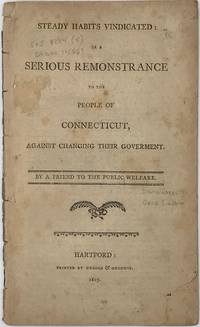
180565766Hartford CT: Printed by Hudson & Goodwin 1805. First edition. 8vo. 20 pp. Sabin 15859. American Imprints 8284. Disbound pamphlet. Bottom corner of title leaf chipped a good copy. <br/><br/> Printed by Hudson & Goodwin unknown books