542 résultats
15779612Venice: Gabriel Giolito de' Ferrari 1577. Firdt Italian trans. 2nd issue. Vellum. Very good -. 4to. 202671pp. Large woodcut device on title and verso of final leaf. Text illustrated with 28 text woodcuts most within a decorative woodcut border. Cont. vellum part of the bottom edge and one corner rat gnawed exposing the boards under the vellum; some light text soiling. Still a decent copy. The first Italian translation second issue with the 1577 date rather than 1576 of contemporary theologian Luis de Granada 1504-1588. See Bonghi. GIOLITO DE'FERRARI II pp. 357-358. Gabriel Giolito de' Ferrari hardcover books
197269512New York: Random House 1972. First Edition. Hardcover. Very good/Very good. First printing with the $2.50 price on the front flap of the dust jacket and the correct ads on the rear panel. "The time has come." A volume in the Bright and Early Books for Beginning Beginners series. Octavo. Original glazed paper over boards. Some wear to the corners and tips. The dust jacket is a bit shelfworn with a closed tear to the top of the rear panel; else about very good. Younger 51. Random House hardcover books
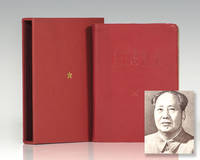
1964100159Beijing: Central Political Department of the Chinese People's Liberation Army 1964. First edition of Quotations from Chairman Mao. Duodecimo in the original iconic red vinyl title to front cover in blind frontispiece portrait of Chairman Mao. With the textual error on pp. 82/83 corrected and Lin Biao's calligraphic endorsement leaf after the frontispiece tipped in from a later printing. In 1972 an edict was issued that Lin's name was to be obliterated from history following disclosures that he had plotted a coup and planned to assassinate Mao; consequently "many surviving copies in the Chinese language have that page legitimately torn away mutilated or censored" Schiller p. 36. In near fine condition. Housed in a custom red slipcase. Printed for the General Political Department of the People's Liberation Army the first edition of Mao's Quotations was issued in two states and bindings: the uncorrected first state text in red vinyl plastic and the corrected second state in paper wrappers. The corrected copies issued in wrappers and intended for high-ranking officers were released first; the uncorrected copies issued in red vinyl and for use by brigade teams were released shortly afterwards as the sturdier binding took longer to manufacture. By the start of the Cultural Revolution in 1966 the red vinyl design had become symbolic of Mao's slogan "The East is Red" and the paper wrappers were discontinued. The year 1966 also "signaled the start of a major translation and publication project when the Little Red Book was issued in over 50 different languages of countries where Socialism might triumph" Schiller p. 55. The book was printed in large quantities until Mao's death in 1976; by the late 1970s however a change of government meant further circulation of the book was discouraged with millions of copies were collected and destroyed. His Little Red Book however sometimes referred to as the "Chinese Bible" "forms a brilliant compilation that is still readable and admired today for its political theories and strategies" ibid. p. 57. Central Political Department of the Chinese People's Liberation Army unknown books
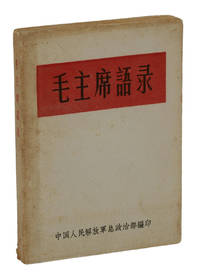
1964140939355China: General Political Department of the Chinese People's Liberation Army 1964. First Edition. Very Good. 250 pp. First edition. Printed wraps; text in Chinese with 30 chapters. The endorsement leaf by Lin Baio has been excised as is common in many copies. In promoting the Little Red Book Biao rose to prominence in Mao's inner circle with Biao becoming seen as Mao's successor. However when unsubstantiated rumors surfaced that Biao was plotting to assassinate Mao Biao was killed and subsequently the endorsement leaf was excised from remaining copies. Very Good or better with wear at foot of spine toning and light foxing occasional corner crease to pages. Following the Bible this is the most-printed text world-wide. [General Political Department of the Chinese People's Liberation Army] unknown books
1964140938964China: General Political Department of the Chinese People's Liberation Army 1964. First Edition. Red vinyl over wraps. Near Fine. 250 pp. First edition. Red vinyl covers over wraps; text in Chinese with 30 chapters. The endorsement leaf by Lin Baio has been excised as is common in many copies. In promoting the Little Red Book Biao rose to prominence in Mao's inner circle with Biao becoming seen as Mao's successor. However when unsubstantiated rumors surfaced that Biao was plotting to assassinate Mao Biao was killed and subsequently the endorsement leaf was excised from remaining copies. Near fine with light foxing to textblock edge light toning to pages. Following the Bible this is the most-printed text world-wide. [General Political Department of the Chinese People's Liberation Army] unknown books
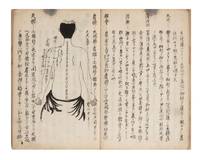
7077Many fine brush & black ink illus. in the text. 45 folding leaves. 8vo 245 x 170 mm. orig. wrappers wrappers somewhat soiled old stitching. Japan: at end in trans.: "copied in 1807." We learn from the first leaf of the index at the beginning of this manuscript that this is a later copy of a unpublished manuscript by Hori 1725-62 a native of Kyoto whose father was also a prominent physician. Hori began to lecture in 1758 but died early. In this work Hori provides a guide to finding pressure points for acupuncture based on bone measurement. Using bone length measurement for the measurement of acupoints location is called the "bone length method." Hori was remarkable for his unique and influential expansion of this method by incorporating the "twelve zodiac method" in establishing pressure points on the body and determining whether the meridian is open at a certain moment. The text makes many references to the classics of Chinese and Japanese acupuncture. For each of the 14 meridians Hori has listed their pressure points the organs to which they are associated illnesses etc. The fine illustrations depict the meridians and pressure points. Fine copy. Minor staining in upper margin and a little wormed. unknown books
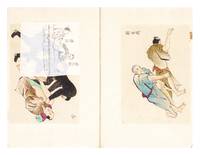
691531 finely hand-colored mounted drawings with eight fine black & white brush drawings on slips also pasted on. 36 folding leaves of which 20 are text. 8vo 253 x 180 mm. orig. patterned wrappers manuscript title label on upper cover new stitching. Japan: late Edo. Gento Yoshiwara d. 1800 was one of the three most important orthopedic specialists in Japan during the final years of the 18th century along with Bunken Kagami and Genka Ninomiya. Yoshiwara studied both Dutch medicine in Nagasaki and Chinese medicine being greatly influenced by the Chinese Dao yin treatment of massage and exercise. Unlike the works of Kagami and Ninomiya Yoshiwara's most important work - "Seikotsu yoketsu" - remained in manuscript as it was restricted to students of Yoshiwara's school Ninomiya was a student. Yoshiwara's trade name or mark was "Kyoinsai." Following the 20 leaves of manuscript text which describe 13 types of treatment in detail is a series of 31 finely drawn and hand-colored illustrations of treatments and manipulations including fixing dislocated shoulders fingers and jaws; spinal stretching dealing with hip problems etc. Many of these treatments have rather fanciful names: "Windmill" "Bear Hug" "Bird's Wing" "Control the Wind" "Crane Feather" "Playing with a Fish" "Worm" "Play with a Jewel" "Tail of the Bird" "The Snail Method" "Riding on the Dragon" "Swallow's Tail" etc. An additional eight smaller pasted-on black & white drawings show further treatments. A number of pharmaceutical ointments and plasters are described. In fine and fresh condition although the outer upper corner of all the leaves has been a little nibbled by a mouse. The scribe of this manuscript has used one incorrect character when spelling Yoshiwara's name on the first leaf giving his name as "Yoshio." ❧ Mestler A Galaxy of Old Japanese Medical Books III p. 152. unknown books
6812Eight full-page drawings & one illus. in the text. 17 folding leaves. 8vo 243 x 165 mm. orig. blue semi-stiff wrappers some dampstaining to upper portion of each leaf. Japan: mid-Edo. Kagawa 1683-1755 a member of the medical family dynasty studied in Kyoto with Ryozan Goto and Jinsai Ito from whom he learned moxibustion and the therapeutic value of the waters of hot springs. Kagawa established the successful Ippondo medical school and was one of the most enthusiastic practitioners of moxibustion of his time. There is another manuscript of this text at Kyoto University attributed to Kagawa. Some of the illustrations are very different. The introductory remarks describe the importance of the precise placement of the moxa on the skin how to measure the placements based on distance from certain bones or joints of the body and the various techniques and occasions for moxibustion applications. Following this the text precisely describes the moxibustion locations on the body and how to locate each one with references to Simiao Sun's classic text Qian jin fang Essential Prescriptions Worth a Thousand Gold Pieces compiled in 650-59. Kagawa lists many diseases and injuries for which moxibustion is appropriate. There is a most interesting section on how to treat unsuccessful moxibustion procedures application of certain ointments etc. The attractive illustrations depict moxibustion loci on an osteological background and loci on the stomach arms legs and feet. As mentioned above there is dampstaining to the upper fifth of each leaf but all the characters remain completely legible. unknown books
711427 folding leaves. 8vo 234 x 158 mm. orig. wrappers manuscript title label on upper cover new stitching. Japan: on final page in trans.: "Copied 1854 by Wakabayashi in today's Tottori Prefecture a member of the Shinshoken." Manipulative therapy has a long history in Japan. "Healing of the sick through rubbing of the body was known to the earliest Japanese physicians who brought the art to a high state of development. Massage was early pre-Nara period linked with the treatment of fractures and bandaging and remained one of the chief factors in the care of the body sharing with mineral baths acupuncture gymnastics and 'deep breathing' in the preliminary development of physical therapy in Japan.The achievements and learning in the practice of massage also contributed to the establishment in the latter part of the 17th century of the 'Seikotsu-Jutsu' which was a system of treatment for fractures and dislocations."-Mestler A Galaxy of Old Japanese Medical Books II pp. 484-85. Gento Yoshiwara d. 1800 was one of the three most important orthopedic specialists in Japan during the final years of the 18th century along with Bunken Kagami and Genka Ninomiya. Yoshiwara whose trade name or mark was "Kyoinsai" studied both Dutch medicine in Nagasaki and Chinese medicine and was greatly influenced by the Chinese Dao yin treatment of massage and exercise. Unlike the works of Kagami and Ninomiya Yoshiwara's most important work - "Seikotsu yoketsu" - remained in manuscript as it was restricted to students of Yoshiwara's school; the present manuscript contains a reworking of that text. The beginning of the main part of the text on the fifth leaf provides the name of Yoshiwara and the location of his school in Hizen province today's Nagasaki Prefecture and the name of two disciples Wada and Abe. The text describes 13 types of treatment in detail including treatments of dislocated shoulders fingers and jaws; spinal stretching dealing with hip problems etc. Many of these treatments have rather fanciful names: "Windmill" "Bear Hug" "Bird's Wing" "Control the Wind" "Crane Feather" "Playing with a Fish" "Worm" "Playing with a Jewel" "Tail of the Bird" "The Snail Method" "Riding on the Dragon" "Swallow's Tail" etc. Some relatively minor worming at the beginning and light marginal dampstaining. ❧ Mestler A Galaxy of Old Japanese Medical Books III p. 152. unknown books
667022 leaves including some blanks or pages ruled in ink for entries. Agenda format 315 x 100 mm. stitched as issued uncut. Nuremberg: 1598. A fascinating document of a type that rarely survives: the manuscript account book for the spring 1598 Leipzig fair of Hans Straub I or the Elder 1541-1610 the prominent Nuremberg gold- and silversmith alderman and son-in-law of Wenzel Jamnitzer the best-known German goldsmith of his time. The first leaf bears Straub's hallmark interwined initials "HS" over an arrow pointing upward within a plain shield & also containing the inscription "No. 72". Our manuscript sheds important light on the business relations in the late 16th century between the Nuremberg goldsmiths and their trade at the Leipzig fairs. Our account book is a list of sales orders and expenditures of Nuremberg goldsmith Hans Straub the Elder during the Leipzig Easter fair held in May 1598. While Straub is not expressly named he can be identified by his hallmark on the first leaf. At the fair trade was done in goblets rings knife-sheaths cutlery jewelry gemstones etc. Several business partners are named including the Nuremberg goldsmiths Heinrich Hahn Haan David Lauer and Paulus Koch. As an example of a transaction we see that the council of Halle paid over 33 florins for a goblet. In 1596 Straub was elected Alderman of the Artisans the most elevated and honorable office to which a Nuremberg artisan could aspire. Straub retained this position until his death in 1610. In 1569 he married Anna daughter of the famous goldsmith Wenzel Jamnitzer. On his father-in-law's death in 1585 Straub inherited his casting molds and used them extensively in his own creations. Despite his long period of activity relatively few pieces made by Hans Straub have survived see Nürnberger Goldschmiedekunst 1541-1868 2007 ed. by Karin Tebbe et al. Vol. I p. 409. In fine condition. ❧ The mark is similar to Marc Rosenberg Der Goldschmiede Merkzeichen Frankfurt 1925 Vol. III no. 3969. unknown books
16113462Latin manuscript on vellum with large 6 in diameter suspended black wax seal of James I of England and autograph of Anne of Denmark dated July 23 1610 granting title to Corrodownan Manor in County Cavan Ulster to one John Browne Gent. of Gorgiemill near Edinburgh and his descendants during the Plantation i.e. colonization of Ulster under James I beginning in 1609. The colonists were settled on land confiscated from the Irish inhabitants following the conquest of Ulster 1594-1603 under James's predecessor Elizabeth I. The Plantation was intended to consolidate royal control of Ulster and repress rebellion by importing a substantial Protestant population. Like John Browne and indeed James himself many of the new colonists were Scottish. Some of these families went on to form the backbone of the Protestant Ascendancy in the province. John Browne and his heirs however were not among them. Sir George Carew sent by the king in 1611 to report on the progress of the Plantation noted that "he Browne . sent an agent who took possession set the lands to the Irish returned to Scotland and . performed nothing." The land was sold in 1613 to another Scottish colonist Archibald Acheson. Acheson's descendants were raised to the peerage of Ireland in 1806 as Earls of Gosford and still owned the property in the late nineteenth century. The first nineteen lines of the document grant the Scottish Browne the rights and privileges of James's English and Irish citizens. Especially notable are the requirement that the grantee maintain an adequate supply of arms for defense against the king's enemies lines 77-80 the attempt to encourage the growth of towns 74-76 and the ban on sale of the property to "mere Irish" or to anyone who failed to acknowledge the sovereign as head of the church thus excluding all Catholics by swearing the Oath of Supremacy 114-121. See Rev. George Hill The Conquest of Ireland. An Historical Account of the Plantation of Ulster at the Commencement of the Seventeenth Century 1608-1620 Belfast 1877 308; idem Plantation Papers. Containing a Summary Sketch of the Great Ulster Plantation in the Year 1610 Belfast 1889 188-190; F.J. McCaughey Arvagh. Sources for a Local History Arvagh 1998 16.; Moiré chemise lined with exact recess for seal housed in handsome ruled red morocco clamshell case with gilt title to front cover and raised bands gilt particulars and decoration to spine; gilt rolled edges. Two leaves 65 x 81 cm; the first illuminated with a portrait of the king. Stain to upper left see image.; 65 x 81 cm; 1 pages; Signed by Notable Personage Related; All shipments through USPS insured Priority Mail. . hardcover books
1711LLV2175Oxoniae:: E. Theatro Sheldoniano 1711. 1711. 8vo. xvi 140 44 60 pp. Title engraved vignette index; few stains. Original gilt-stamped decorative panels mottled calf; joints reinforced stickers on spine. Former ownership blind emboss stamps on first and last few leaves including title. Very good. Second edition issued earlier in 1693. This edition printed at the Sheldonian Theatre of Paterculus’ Roman history contains the addition of 44 pages of additional notes. It contains not all copies do Dodwell’s Annales Velleiani. Lowndes vol. 4 p. 1798. "His Compendium of Roman History consists of two books dedicated to M. Vinicius and covers the period from the dispersion of the Greeks after the siege of Troy down to the death of Livia AD 29. The first book brings the history down to the destruction of Carthage in 146 BC; portions of it are missing including the beginning. The later history especially the period from the death of Julius Caesar 44 BC to the death of Augustus AD 14 is treated in much greater detail. / The author does not display real historical insight although generally trustworthy in his statements of individual facts. He may be regarded as something of a courtly annalist rather than an historian. His chronology is inconsistent though sometimes useful. On Caesar Augustus and above all on his patron Tiberius he lavishes praise or flattery; but his portrait of the latter is a useful corrective to the sensationalist attacks of a Tacitus as is his treatment of Livia. The repetitions redundancies and slovenliness of expression may be partly due to the haste with which as the author frequently states it was written. The inflated rhetoric the straining after effect by means of hyperbole antithesis and epigram belong firmly to the Silver Age of which Paterculus is the earliest example. He purposed to write a fuller history of the later period including the civil war between Caesar and Pompey and the wars of Tiberius; but there is no evidence that he did so. His chief authorities were Cato’s Origines the Annales of Quintus Hortensius Pompeius Trogus Cornelius Nepos and Livy." Wikip. See: Eleanor Cowan ed. Velleius Paterculus: Making History Classical Press of Wales 2011. E. Theatro Sheldoniano, 1711. unknown books
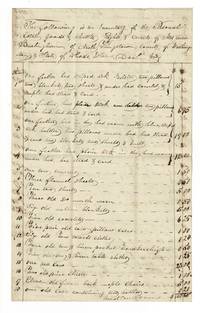
183357649V.p. 1833. A dozen or so items over half of which seem inconsequental. Ezbon or Esbon Sanford 1765-1846 was born in Newport worked in Washington County. He was a storekeeper innkeeper and cabinetmaker and is cited in various articles about Rhode Island furniture making. One receipt is from the "estate of Abigail Congdon" his mother-in-law which details payment for molasses and gin as well as a coffin for herself at $6.00. A detailed inventory May 15 1833 is included of the estate of Anna Buckingham of North Kingstown Washington County. All her belongings are listed including furniture: "eleven old fiddleback maple chairs" at $5. This type of chair is described in an article by Kathleen E. Johnson in Art & Antiques Magazine Sept/Oct 1981 as "an intentional translation of the elements of the carved mahoghany or walnut cabriole legged Queen Anne- style chair into the vocabulary of the turned chair tradition." A large floor plan for a house with its footprint neatly laid out is one of the more interesting documents with a detailed list of supplies joists ranging timber furing laths doors & frames roof boards shingles and nails each with prices. Ezbon Sanford held a local court office as Judge of the Court of Common Pleas and nother interesting document is dated 1830 from the state to the sheriff concerning the warrant for the arrest of George Young charging him as the father of Margaret Mitchel's "bastard child." The paper was signed by John H. Green Deputy Sheriff. Other names mentioned in his storekeeper receipts are Robert Hosford Robert Northrup Charles Douglas Weighty Underwood and Paul Austin. <br/><br/> hardcover books
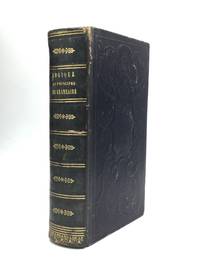
176973187Paris: Chez Briasson 1769. First Edition. Hardcover. Very good. Dumarsais 1676-1756 was a French lawyer philologist and free thinker who contributed to Diderot's Encyclopedie 1751-72. In this posthumously published work he treats the subject of grammar as a philosopher. Octavo: xv 1 700 4 p. In a 19th century blue morocco binding with gilt and blind-stamped decorations and marbled endpapers. Bookplate to the front pastedown. The spine is lightly faded with a bit of scuffing to the extremities; otherwise very good. Chez Briasson hardcover books
1982034350New York: Ballantine Books 1982. 1st Edition. 192p. b/w illus. quarto format stiff wrappers A Hilltown Press book. Ballantine Books unknown books
USHELIV00GKVery Good. Shepard Richard F. Live & Be Well: a Celebration of Yiddish Culture In America From the First Immigrants to the Second World War. LEVI VICKI GOLD. NP: NP ND. Book condition: Very good. Dust Jacket Condition: Very good. unknown books
198761345Chapel Hill & London: University of North Carolina Press 1987. First edition. xii 267 pp w/index. Near fine in near fine dust jacket with sunning to spine and along top edge. Chapel Hill & London: University of North Carolina Press unknown books
198749758Chapel Hill: The University of North Carolina Press. Very Good. 1987. Hardcover. Chapel Hill and London: The University of North Carolina Press 1987. F/NF . The University of North Carolina Press hardcover books
1931011629Paris: Draeger Freres 1931. Soft cover. Very Good. A lot of 4 annual catalogs from the preeminent French house of wine each strikingly illustrated or designed by various French artists. The 1932 issue is illustrated by Edy Legrand. Black paper cover is an oval cut out that reveals pictorial underneath. It is missing its right lower quadrant and is split in the upper right quadrant. The 1934 catalogue is designed by French artist Alfred Latour. Spiral bound. Clear plastic spiral spine tanned and the covers a tad soiled. The 1936 catalogue is designed and illustrated by French artist A. M. Cassandre. Spiral bound plastic toned covers slightly soiled. The 1955 catalogue is designed by Alfred Latour with color reproductions of paintings by Andre Marchand. Spiral bound. The pages and colored plates in all the issues are near fine. 1955 catalogue from the preeminent French house of wine. Strikingly designed by Alfred Latour with color reproductions of paintings by Andre Marchand. Spiral bound. Near fine. Draeger Freres unknown books
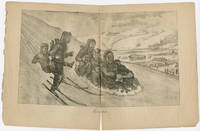
1905WRCAM32109Godthaab Greenland 1905. Lithograph 10 1/2 x 16 1/4 inches. Worn along left edge small closed tears along top and bottom edges of center fold. Two old soft secondary fold lines. Very good. An attractive image showing a family of Greenlanders sledding and skiing down a hill likely produced by Lars Møller Greenland's premier printer or by Møller's youngest son Steffen. The illustration shows a family of seven Greenland natives sledding down a hill while two other youngsters ski alongside with one of the skiers in the process of falling. Other winter sports enthusiasts cavort in the distance and the stark Greenland landscape is ably depicted. Lars Møller an accomplished printer and illustrator was the dominant figure in Greenlandic printing in the last quarter of the 19th century producing much of the printed output in the country. His son Steffen succeeded his father and produced impressive works in his own right including a native language speller from which this illustration may be an example. Knud Oldendow THE SPREAD OF PRINTING. WESTERN HEMISPHERE. GREENLAND Amsterdam: Vangendt & Co. 1969 pp.68-69 and passim. unknown books
200664031Jerusalem:: Devora Publishing. Very Good in Very Good dust jacket. 2006. Hardcover. 1932687661 . Color photographs throughout. First edition. Faint damp mark along bottom edge of text block else very good in a very good dust jacket. . Devora Publishing, hardcover books
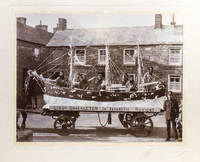
1909265421Penzance 1909. Vintage photograph on card mount embossed photographer's stamp on mount "Preston/Penzance". Photo 10-3/8 x 13-3/8 in. Fine. Vintage photograph on card mount embossed photographer's stamp on mount "Preston/Penzance". Photo 10-3/8 x 13-3/8 in. This large vintage photograph showing a horse-drawn parade float model of Shackleton's Nimrod with the ship's name and "Lieut Shackleton in Antarctic Regions" painted on the side. Manning the float are 6 young men and a small boy all in cold weather gear.<br/><br/>It's a wonderful demonstration of the interest in polar exploration during the Heroic Age. Many of the expeditions enjoyed send off and welcome parades and this is almost certainly a relic from one of these for the Nimrod expedition 1907-09. The largest of all parades for the Nimrod was actually held in Lyttleton New Zealand where as many as 50000 people turned out for the send off. Indeed the photographer here Preston was based in Penzance. The image was almost certainly taken by him or his son Richard. <br/><br/>The Nimrod Expedition 1907-9 was Shackleton's first Antarctic expedition as leader - he had previously sailed under Scott on the Discovery Expedition. Shackelton was attempting to be the first to reach the South Pole. Though he failed at this the expedition was notable for reaching the farthest South point just over 100 miles from the pole and for the ascent of Mount Erebus. Shackleton returned to England a hero and was subsequently knighted by Edward VII. unknown books
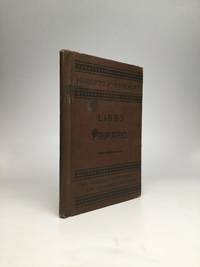
188768676San Francisco: The History Company Publicadores 1887. First Edition. Hardcover. Good. Scarce Spanish language schoolbook with lessons modeled after those in early American primers. Bancroft 1832-1918 is best known for his monumental 39-volume history of the Pacific Coast region from Central America to Alaska. Numerous textual illustrations. Small octavo. Original printed brown paper-covered boards. Pencil marginalia to a few pages. Period previous owner's ink signature to the front flyleaf with a pencil inscription to the front pastedown. The corners are showing with some general shelfwer and minor spotting to the boards. The History Company, Publicadores hardcover books
1576393Lyons: J. Quadratius for A. de Harsy 1576. Sm. 8vo. 80424pp. With the final 2 blank leaves. Index. Cont. vellum soiled. One leaf with a marginal repair touching a shoulder note. The 12 books of medicine of Alexander of Tralles was a 6th century classic and was often reprinted in both Greek and Latin. Our Latin translation by Johann Gunther first appeared at Strasbourg in 1549. Wellcome Medical Library I #214. See Stillwell. AWAKENING INTEREST IN SCIENCE 1450-1550 III #265. BL French STC p. 10. (J. Quadratius, for) A. de Harsy hardcover books
5595148 leaves including the final blank Roman letter except for the two-line title in gothic type 51 lines & headline capital spaces with guide letters. Folio 290 x 188 mm. late 17th-cent. panelled English speckled calf rebacked with the orig. spine laid-down minor staining to a few leaves in blank upper margins. Basel: J. Amerbach 1494. First edition of the "first bibliography to be compiled as a practical work of reference."-Grolier Club Bibliography 7. Tritheim 1462-1516 one of the leading polymaths of his age was appointed the 25th abbot of the monastery at Sponheim in 1483. "One of the first of his many self-imposed tasks was the reorganization and cataloguing of the monastic library if one can call reorganization the process of transforming forty-eight mongrel volumes into a splendid collection of 2000 printed books and manuscripts many of great importance and rarity. "It was during the progress of this work no doubt as his exceptional knowledge of books caused inquiries frequently to be addressed to him that he conceived the notion of compiling a new and ambitious bibliography of ecclesiastical writers. He began work in 1487 and by the spring of 1492 he was able to send the complete manuscript to the bishop of Worms. He then revised it and in 1494 the Liber de scriptoribus ecclesiasticis a folio of nearly 300 pages issued from the Basle press of Johann Amerbach. "From Alexander bishop of Cappadocia down to himself Tritheim sets out in chronological order nearly a thousand writers largely but not exclusively ecclesiastical giving a short account of each followed by a list of his or her writings. Nor are these lists merely perfunctory: it is obvious from such a heading as that for St. Augustine under which he enumerates 277 works that Tritheim must have lavished an immense amount of genuine research on his bibliography. In all about 7000 books are recorded. An alphabetical index of authors arranged of course by Christian names is added. The contrast between the feeble theological bibliographies of the manuscript age and this first attempt in the printing era is very striking."-Besterman The Beginnings of Systematic Bibliography pp. 7-8. The title of the book is somewhat misleading since the work is not restricted to ecclesiastical writers but also includes authors such as Dante Poggio and Sebastian Brant. A fine and crisp copy of a book which has become uncommon on the market preserved in a box. Bookplate of the Society of St. John the Evangelist Cowley Oxford. With a note on the rear paste-down referring to "Derby" the Earls of Derby and a shelf-mark. ❧ Goff T-452. unknown books