542 résultats
197132742Athenai: Bibliotheke tes Boules ton Hellenon 1971. First edition. Black cloth stamped in gilt. Corners slightly bumped else fine copies in very good soiled dust jackets. 262; 275 pp. Illus. with 608 facsimiles. 4to. Prologos Vasileiou I. Krapsite . "Incunabula and Publications of the 15th and 16th c." in the Library of the Greek Parliament. Warmly inscribed by Vassilios I. Krapsitis Secretary General to the Parliament and author of the preface to the late book dealer and Latin American scholar Maury Bromsen. Text in Modern Greek. Preface also in English. Primarily facsimiles of incunabula and early printed books of the 15th and 16th centuries. 418 pages of facsimiles 66 pages of bibliographical descriptions in Latin and Greek 16 pages of indices 6 pages of introduction and preface. Bibliotheke tes Boules ton Hellenon hardcover books
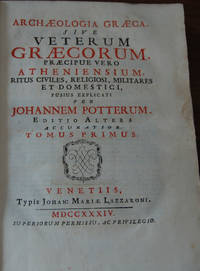
173424539Venetiis: Typis Johan: Mariae Lazzaroni 1734. First Edition printed in Italy. Two volumes. Quarto pp. iv 480; ii 356 xxiv. Bound with 9 folding engraved plates. Title-page in volume one printed in red and black. Bound with the half-title in volume 1 in contemporary vellum. One hinge strarting a little bit o/w a very nice clean crisp set. The OCLC locates 4 copies in this country of 6:CIT STA TYC LRU. Archbishop of Canterbury Potter was a learned classical scholar and first published this work in 1697-1698. It was translated into German and considered the standard for years. It contains a study of the civil government of Athens the religion of Greece; the military affairs of the Grecians. Some of their miscellaneous customs etc. Typis Johan: Mariae Lazzaroni unknown books
17184938Paris: Chez Emery Fils 1718. First edition. First edition. 4to. 128xl4755pp. Woodcut device on title & 2 woodcut headpieces. Nicely bound in period style full calf with red morocco spine label. Title-page lightly soiled. A vindication of early Church fathers by Remi or Remy Ceillier 1688-1761. Chez Emery, Fils unknown books
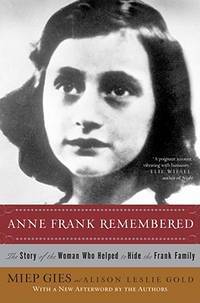
2009192828Simon & Schuster 2009-02-10. Paperback. Very Good. Clean has a good binding no marks or notations. Light edgewear. TP HS Simon & Schuster paperback books
173510359Amsterdam: Aux depens de la Compagnie 1735. First edn. 12mo pp. 276. aeg. Bound in contemporary calf elaborately stamped on both covers rebacked with new end papers and the original spine laid down. Some light water stain to the top margin o/w a very nice little book. Scarce the OCLC lists 2 Paris printings of the same year noting just three copies. This not listed. A piece of fiction about the Roman court of Nero. Aux depens de la Compagnie unknown books
338122 leaves Gothic type 43 lines. Folio 301 x 213 mm. disbound some worming towards end. Padua not Pavia: Pierre Maufer about 1475. First edition a remarkable discovery of the third known copy of the true first edition of the first modern book devoted solely to anatomy. The other two surviving copies are in the Biblioteca Corsiniana Rome and the Biblioteca Comunale Viterbo. The rarity of this book is well-known: it is revealing that Castiglioni Choulant and Garrison all cite the 1478 edition as the first printing. Its influence was great: "The first outstanding anatomist worthy of the name.the Anathomia of Mondino was the most used anatomical text up to the end of the sixteenth century probably because it contained the most important technical indications in brief and concise form."-Castiglioni A History of Medicine pp. 341-43. Mondino ca. 1275-1326 a native of Bologna was the son of an apothecary and the nephew of a professor of medicine. He attended the University of Bologna where he studied under Alderotti Thaddeus of Florence an early dissector and took his medical degree in 1300. Mondino soon became a professor of medicine at the university. "Mondino's chief work is his compendium of anatomy Anatomia Mundini completed in 1316 which made him in Castiglione's sic words 'the first outstanding anatomist worthy of the name.' Mondino's book dominated anatomy for over two hundred years. The major reason for Mondino's great popularity was the simplicity conciseness and systematic arrangement of his book which is divided into six parts: 1 an introduction to the whole body and a discussion of authorities; 2 the natural members including the liver spleen and other organs in the abdominal cavity; 3 the generative members; 4 the spiritual members the heart lungs trachea esophagus and other organs of the thoracic cavity up to the mouth; 5 the animal members of the skull brain eyes ears; and 6 the peripheral parts bones spinal column extremities. This organization was not the result of any philosophical approach to the subject but rather derived from the necessity of dissecting the most perishable organs first. "Mondino should be regarded as the restorer of anatomy if only because his popular textbook and his experimental teaching were instrumental in preparing the revival of the subject. His text was the first book written on anatomy during the Middle Ages that was based on the dissection of the human cadaver; his efforts consolidated anatomy as a part of the medical program at Bologna and encouraged further study. His book also dominated the teaching of anatomy and no real improvements were made upon it until 1521 when Berengario da Carpi wrote his famous commentary on Mondino."-D.S.B. IX pp. 468-69. "Mondino's book soon became a classic text; he was venerated soon after his death as a divine master and anyone who was found differing from his book was regarded as monstrous. For three centuries the lecturers on anatomy were required to use his book in their teaching as may be seen in the statutes of many medical schools."-Castiglioni op. cit. pp. 344-45-& see the detailed account of the contents of this book and methods of dissection which it reveals on pp. 341-45. A very fine copy with all edges uncut and preserved in a slipcase. Two contemporary annotators have made a number of neat comments in the wide margins. This copy was clearly removed from a sammelband. The final four leaves have some worming becoming increasingly more pronounced but not at all offensive touching the text of the final three leaves. ❧ Choulant-Frank pp. 88-96. Garrison-Morton 361-describing the 2nd edition of 1478-"The first modern book devoted solely to anatomy written for his students in 1316. Mundinus re-introduced human dissection which had been neglected for 1500 years before him; he was the most noted dissector of his period." Garrison History of Medicine pp. 160-61. GKW M25666-citing Pavia in error. ISTC im00871200. Klebs 688.1. Sarton III Pt. I p. 843-"In spite of his personal observations Mondino was almost entirely dependent upon Galen and Theophilos and upon Arabic authorities.". unknown books
166527468London: Printed for the Authour and are to be sold by Robert Butler 1665. 1st edition Wing M-334A. Recent dark-brown full speckled calf binding executed in a period style with gilt spine lettering. Binding - Fine. Text block - VG usual browning to paper/top edge occasionally closely trimmed infrequently affecting running title/faint prior owner blindstamp to preliminary blank. 10 132 pp. T.p. printed in red & black. Headpiece. Decorative initial capital letter to p. 1. 8vo: A - I8. 6-5/8" x 4-1/4" <br/><br/>Fairly scarce work by this divine author attribution from Wing- OCLC lists only microform copies & none at auction these last 30 years. . Printed for the Authour, and are to be sold by Robert Butler unknown books
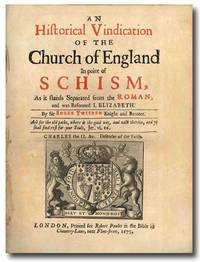
1675WRCLIT67247London: Printed for Robert Pawlet . 1675. 81982pp. Quarto. Extracted from binding. Title in red and black Royal Coat of Arms on title slight tanning and faint foxing R2-3 with clean tears in from foremargin no loss otherwise a very good copy. Third edition of one of Twysden's most widely read antiquarian works first published in 1657. It is a "detailed account of the increase of papal powers over England from the Saxons to the Reformation . arguing . that it was the Church of England rather than Rome which had held fast to the true faith. Twysden denied that the English church 'made a departure from the Church which is the ground and pillar of truth' p. 196. This temperate and urbane argument placed Twysden within the tradition of earlier apologists for the Church of England such as Richard Hooker and Thomas Fuller" - DNB. ESTC R15191. WING T3554. McALPIN III:717. Printed for Robert Pawlet ... unknown books
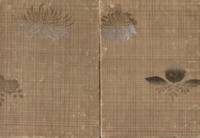
86003001Edo c.1700-50 n.p. Brown & silver covered boards very clean 7 double-page b.w. erotic woodblock illustrations mounted on mica flecked paper 18 x 25 cm. accordion folded illustration size: 31 x 12 cm. FIRST & ONLY UNRECORDED COPY! . . . . A VERY RARE UNRECORDED EARLY BOOK . . . A BIZARRE & UNIQUE EROTIC BOOK . . . UNSIGNED BUT CLEARLY THE WORK OF A MASTER ARTIST . BY SUKENOBU OR HIS :SCHOOL: . A unique and hitherto unfound odd and most unusual erotic book of the early-mid-18th century. One of the most bizarre erotic books ever done in Japan. . The graphically explicit work portrays men and women with genitals on their foreheads engaged in heterosexual and homosexual intercourse. There is no other book with such unusual and strange illustrations. . . THE TITLE: THE LEGEND OF AMANJAKU or AMAN NO JAKU: Chinese Title: TIAN XIE GUI YUN . THE MEANING OF AMANJAKU: Japanese Buddhist literature is abundant with variations on the theme of "Aman-No-Jaku" aka. "Amanjaku" "Manojaku" commonly understood to be a "Heavenly Evil Spirit." . This spirit or demon-like creature in Japanese folklore is usually depicted as being a male during the day and female at night. The demon is usually depicted as a kind of small Oni devil and is thought to be able to provoke a person's darkest desires and instigate him into perpetrating wicked deeds. . Amanjaku is also depicted in Chinese and Japanese mythology the AMANOJAKU is a changeling a water spirit that infiltrates the human world to play cruel tricks on people by reading their minds and twisting their requests or desires to be used against them. . The "AMANOJAKU" is also known the "Lord of the River" and in Japan serves Bishamonten one of the four Deva kings of Buddhism as a minor demon. See Wikipedia below. . In Japanese the term "Amanojaku" also refers to a person who is deliberately contradictory someone who argues for the sake of arguing or can be used in common Japanese conversation to refer to someone who is a "Perverted Demon." . THE ILLUSTRATIONS: THE BUDDHIST THEME:. This work is unusual in that the genitals of common people are located on their foreheads. A symbolist meaning can be in Buddhist concept that sex and sexual hedonism is openly on the minds of 'lay' people. The Buddha and his disciples on the other hand do not have sex organs on their foreheads meaning their organs are covered and in a different usual location. This can symbolize 'self control' over such biological energies. Devout Buddhist disregard sex as a pleasurable pastime and devote themselves to monastic focus. By contrast "lay" people are distracted with hedonistic pleasure a path away from rather than towards the Dharma or teachings of Buddhism. . In a sense this work illustrates the overwhelming force of evil or the "Amanojaku" and how it distracts people from the "Righteous Path" towards the Dharma and the ultimate goal of attaining Nirvana. It can be posited that this work is designed to give understanding to "lay" people by way of visual example of what forces direct their energies away from the Buddhist teachings in an effort to redirect them towards the "Righteous Path" and life style. . EXCEPTIONALLY RARE UNIQUE WORK: . The work is exceptionally RARE unusual and erotic there are no other example showing genitals on the foreheads of any other Japanese book cited anywhere in the bibliographic literature or record. . This work is certainly RARE in subject content and quantity. Though it was woodblock printed and unsigned which was usual for Japanese erotic works which were banned by the Shogun we have not found anything similar or recorded anywhere in the bibliography. Being woodblock printed one assumes there are other copies in existence. The average printing from woodblocks were somewhere between 100-200 copies. However in this instance no others exist. We have the strong feeling the book could have been the production of a famous Japanese illustrator and perhaps financed by a Buddhist temple again there are no known facts about this rarity. . THE EROTIC ILLUSTRATIONS: . Number 1: This work begins showing the Buddha flanked by two of his disciple monks. The title is written in four Japanese Kanji in Kambun & Chinese characters. The Buddha and his two disciples listen to two elderly Buddhist believers: one is a male he has and erect penis on his forehead. The other is a woman she has a vagina on her forehead. Neither the Buddha nor his two disciples monks show genitals on their foreheads. The couple have come to consult with the Buddha about their grievances. . Number 2: Shows a man and a woman in a Tatami matted room both wear lovely 18th century decorated Kimono. They embrace each other and are engaged in making love from their foreheads which show an erect penis and testicles inserted into the woman's forehead where her vagina is located. Adjacent to the young couple is an older woman who has become aroused by the adjacent couple's making love. The old woman uses a dildo tied to a post which she hugs while inserting the dildo into the vagina on her forehead. . Number 3: Shows a couple laying on a blanket their Kimono pulled down and opened and used as a top cover. They engage in love-making and kiss. The man has an erect penis on his forehead the woman a vagina on hers. There is some used Chirishi toilet paper just above her head on the floor used to wipe the love fluids. There is a folded package of yet unused Chirishi in readiness. Chishiri shown in Japanese Shunga erotic prints prints & paintings is an 'erotic symbol' indicative of sexual excitement with lots of love fluids flowing. Ergo the need for paper to clean up the results of erotic love-making. . Number 4 shows an adult man with an erect penis on his forehead penetrating the anus of a younger man who's smaller but erect penis is seen on his forehead as he faces his lover. The younger man has no pubic hair yet indicating his youth. . Adjacent to these two men is a woman in the next room. The door is open she is a secret voyeur of the two men. Her vagina is also on her forehead. A Shogi board and two bowls for stones is located in the front left of the illustration. Gay activities in Japanese society were accepted as a norm and were not especially unusual. However to find graphic examples in Japanese erotic books are exceptionally rare and seldom found. . Number 5: Depicts a fully clothed man on his knees he bends over a sleeping woman. He has a very large erect penis and begins to penetrate a woman with her vagina on her forehead. She is fully clothed and sleeping on a wooden "pillow" which supports her elaborate hair coiffeur. . Number 6: Depicts a lively scene of two men and a woman. One man with a very large and erect penis pulls the woman's arm toward him while she fends him off with a straight arm to his head. A second excited man also with a large and erect penis on his forehead masturbates and ejaculates in ecstasy. The woman has a vagina on her forehead. The scene is likely an intended rape of a young girl. She looks away in an effort not to allow him to pull her close enough to insert his penis into her exposed vagina. . Number 7: Illustrating a lonely old man in bed. He has an erect penis on his forehead and holds a kind of pot with a large opening. He faces down and inserts his penis into the pot for gratification. . THE TEXT: The text in Shunga erotic Japanese books & prints is often an erotic dialogue describing the erotic action. Often these words are onomatopoetic mimicking the sounds of people in orgasm or making comments about making love or the pleasure and good feelings. The size and hardness of the penis or the flavor and the juices of the vagina and its supple feelings of euphoria when engaged in love-making. All wear 18thcentury period Kimono. . MODE AND FASHION OF THE MID-18TH CENTURY: The room furnishing and Kimono of the participants in this work all wear 18th century period Kimono with period decorations. The style of Kimono and room screens reflect this period. . BINDING AND MOUNTING: Binding: The book has probably been rebound sometime after the 1750's with a more recent thin brown decorated paper with a silver chrysanthemum and a Mon family crest with gold and black on both front and rear covers. Each cover has a distinctly different kind of illustration but of the same theme. The corners and edges are a bit worn some loss to the paper as usual for a work from this period. . Mounting: At an earlier time each page was expertly mounted on a stiff Washi hand-made Japanese paper into an accordion folded book. Each illustration is bordered with a rare and stunning crushed oyster-shell powder mixed with rice-glue and overlaid on the border paper. The stunning effect is a rare shimmering pearl-like color and hue with a remarkable effect. This rare and largely unknown effect has been used for print backgrounds by some of the later masters. . This was no ordinary mounting and appropriate for an exceptionally and most unusual RARE book ! . Contents: By and large the contents are clean solid with a two old worm holes for the first 6 of 7 pages. These are small and towards the edge and does not detract from the overall quality of the illustration. On page 7 there are a few center margin old minor worm holes. All of these have been restored when the prints were laid down on the thick Washi paper creating book format. The work is otherwise solid and firm. There are a few 'rubs' on the old Washi paper which was made from very soft Kozo fibers common to any item of this period on this on handmade papers of the period. . CONDITION OF THE WOODBLOCK PRINTS: . These are very early black and white woodcut prints. Each print has an excellent and vivid impression key blocks are black and superbly printed with strong images. The paper is old and has the patina of paper from that age the usual minor mild surface rubbing or thumbing in the lower corners which is common. . We tend to be overly critical of any flaws found on our books and believe it is better to overly describe rather than avoid such discussion any imperfections. Suffice to say by and large this is an excellent item in very nice condition something that any collector or museum would be proud to own. Please review photos posted to our website. . R A R I T Y OF SUBJECT: The placement of the genitals on the forehead gives one a lot of room to theorize on the meaning of such artistic expression. In our 50 years of experience in dealing Japanese woodblock printed books and painted original art this is the first and only example with such imaginative and symbolist expression. With the beginning of the work showing the Buddha and his two disciples lacking any genitals on their foreheads one can simply assume that in a Buddhist way they have given up carnal desire as represented by common people who's foreheads display genitals perhaps meaning that sex is on their minds or they simply view others as sexual objects eager to make love and engage in carnal thoughts and activities. Obviously seeing an erect penis on some man whiles others see what he thinks and feels is an insight to his innermost thoughts and desires. In all cases in this book the men all show an erect penis. The women are a bit more difficult to fathom. Their vaginas are simply visible on their foreheads and no fluids are visible or other evidence of their carnal desire or sexually excited stated. All of the men have public hair adjacent to their sex organs while all women are lacking any pubic hair completely. This is an erotic symbolism giving full view to women's genitals. . "BANNED" or "PROHIBITED" BOOKS: Shun Pon Haru Bon: In the case of this item it is very likely that it was printed in a much smaller discreet quantity than the 200 copies possible off the blocks. Due to the "banned" nature of such books there is no date publisher nor place cited. One is simply left to determine the date and artist by stylistic analysis. It is well-known that during the Tokugawa period 1603-1868 erotic prints and books were "BANNED" or "PROHIBITED" by decree of the Shogun. One of the influencing factors was that during this period some Shoguns were changing their views and being influenced by Christians who entered Japan during this period. The Shogun did not want foreigners and Jesuit missionaries to think that Japan was a crass and base nation. Naturally foreigners soon learned that prostitution was rampant and so this strange logic from the Shogun never had much affect on the Christians and surely not on the Japanese. . The Shogun enforced severe punishments for persons involved in drawing printing carving blocks and publishing erotic books and prints. With out the "Kiwame" or censor's approval seal all such items were "Banned" outright by the Shogun decree. . While these "Prohibited" books and prints were widely circulated in an "underground" society there are ample examples of famous artists taking on commissions to produce erotic books and prints fun or profit. The record and bibliography is loaded with these examples. "Banning" such erotic works simply meant that the number printed were limited to smaller numbers and distribution was done under the table discretely circulating such books privately among collectors. During these times it was not necessary for artists to sign their such artistic creations by-and-large the population had a very good idea who the artist was by being familiar with their style and other works it was simply a "public secret" who the artist was. Often the artist poked fun at the Shogun with political jokes and assumed names to confound any chance of being discovered by the authorities. . Over the centuries this knowledge decreased and is now the domain of the art historian or scholar to identify and determine the actual artist. Stylistic analysis remains the standard method for unsigned works. . THE ARTIST/SCHOOLS: While there are no signatures or seals indicating the artist's name or even his alternate Go studio name we believe this work is part of the "Primitives and First Century of Ukiyo-e School 1660-1765" period. See Lane below. The women's coiffeur is very similar to those found in this period as well as the drawing style technique and genre. It is this cataloger's opinion that this work was likely the creation of one of the Moronobu School masters. Perhaps done by Sukenobu Yoshikiyo Morishige Sugimura Moronobu Kiyonobu Masanobu or others from this period. We believe this work was likely done from around 1710-1750. It was also likely that it was done by one of the artists listed below. . LIKELY ARTIST ATTRIBUTION: . MORONOBU SUKENOBU SCHOOL: Nishikawa Sukenobu 1671 -August 20 1750 often called simply "Sukenobu" was a Japanese printmaker from Kyoto. He was unusual for a Ukiyo-e in being based in the imperial capital of Kyoto. He did prints of actors but gained note for his works concerning women. His Hyakunin Joro Shinasadame: Appreciating 100 Women in two volumes published in 1723 depicted women of all classes from the empress to prostitutes and received favorable results His Hyakunin Joro Shinasadame: Appreciating 100 women in two volumes published in 1723 depicted women of all classes from the empress to prostitutes and received favorable results Leading members of this school were: Nishikawa Sukenobu the founder; Nishikawa Suketada; Kawashima Nobukiyo; Nishikawa Terunobu; and Takagi Sadatake. . NISHIKAWA MORONOBU SCHOOL: Nishikawa Moronobu 1618-July 25 1694 was a Japanese painter and printmaker known for his advancement of the Ukiyo-e woodcut style starting in the 1670s. Leading members of the MORONOBU school were: Nishikawa Moronobu the founder; Hishikawa Morofusa; Hishikawa Moroyoshi; Hishikawa Moronaga; Hishikawa Moroshige; Hishikawa Morohira; and Tamazaki Ryujo. . BIBLIOGRAPHY: . This title is NOT listed in any of the below resources: SHIBUI Kiyoshi. UKIYO-E NAISHI. BIBLIOGRAPHY OF JAPANESE EROTIC ILLUSTRATED WOODBLOCK PRINTED BOOKS. H. KERLEN. CATALOGUE OF PRE-MEIJI JAPANESE BOOKS & MAPS IN PUBLIC COLLECTIONS IN THE NETHERLANDS. Richard Lane: IMAGES FROM THE FLOATING WORLD THE JAPANESE PRINT; pages 28 40-60 show examples of the Ukiyo-e primitives 1660-1765 especially the Moronobu school pp.60-88 et al. . NOT LISTED IN: . KSM SHIBUI Kiyoshi: UKIYO-E NAISI. BIBLIOGRAPHY OF JAPANESE EROTIC ILLUSTRATED WOODBLOCK PRINTED BOOKS. Modern Reading: UKIYO-E NAISHI KERLEN H.: CATALOGUE OF PRE-MEIJI JAPANESE BOOKS & MAPS IN PUBLIC COLLECTIONS IN THE NETHERLANDS. Not in any other usual bibliographies on Japanese E-hon woodblock printed books. . See: WIKIPEDIA: http://en.wikipedia.org/wiki/Amanjaku . hardcover books
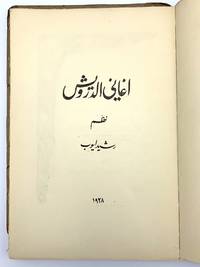
1928404840New York: Syrian-American Press 1928. A very good copy internally clean the front wrapper with large chip at fore-edge. 8vo. Frontispiece by Kahlil Gibran. Original printed wrappers. FIRST EDITION PRESENTATION COPY inscribed on the front flyleaf in Arabic: "Ila Akhiy Jawaad 'Arid To my brother Jawaad 'Arid Rashid Ayyub." This is the second of the three volumes of verse published by the Lebanese-born poet Rashid Ayyub 1872-1941 nicknamed the "complaining" or "dervish" poet. It's frontispiece is a characteristic image by Kahlil Gibran Jubran Kahlil Jibran. As a merchant he visited Paris and Manchester and later emigrated to New York where he joined the romantic movement of the Mahjar "exiled" poets founding with other writers al-R bi a al-Qalamiyya the first Arab-American literary society. A scarce title especially inscribed. <br/><br/> Syrian-American Press unknown books
198716168New York: Paragon House 1987. First Edition. Hardcover. Very good /very good . 8vo. Publisher's blue cloth in original dust jacket. Very good plus. Jacket very lighty edgeworn and toned. Original price sticker at rear panel. Interior clean and bright. 217 pp. <br/><br/>A critical assessment of the state of contemporary advertising. Paragon House hardcover books
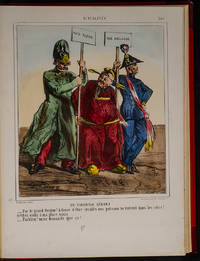
05043Paris: A. de Vresse & Maison Martinet 1862. A Fine French Album of Sixty-Six Caricatures Including Twenty-Eight with Hand-Coloring<br/><br/>PELCOQ Jules illustrator. Actualités. Paris: A. de Vresse & Maison Martinet 1862-1863. <br/><br/>Folio 13 3/4 x 10 1/8 inches; 350 x 257 mm. Twenty-eight fine and mainly amusing hand colored lithograph plates all heightened with gum arabic and thirty-eight black and white lithograph plates making a total of sixty-six plates all signed numbered and titled Actualités. All plates mounted on stubs. A few of the black & white plates and one color plate No. 363 with light mainly marginal foxing. One of the color plates No. 133 lightly toned and color plate No. 226 with neat marginal repair just touching image.<br/><br/>Contemporary half red morocco over red pebbled cloth boards ruled in gilt. Front cover with rectangular black morocco label lettered in gilt. Smooth spine decoratively tooled and lettered in gilt marbled endpapers. A wonderful collection.<br/><br/>The Plates:<br/><br/>Color: Numbers 13 14 15 19 31 56 78 133 137 215 226 227 241 251 281 291 317 318 331 335 337 342 346 347 349 356 360 & 363 <br/><br/>Black & White: Numbers 4 5 6 43 77 99 102 107 115 116 122 135 147 148 155 161 162 163 165 168 201 210 217 223 227 265 282 292 317 318 324 325 363 386 389 389 397 & 398.<br/><br/>Note: Some plate numbers are duplicated but the plates are all different.<br/> <br/>Pelcoq Jules 1825-1887. "Jules Pelcoq born in Belgium was a Parisian book illustrator and colleague of Honoré Daumier and contributed to Le Charivari and other French periodicals of the time. He also covered the French side for the Illustrated London News during the Franco-Prussian War. While covering the 1870 siege of Paris Pelcoq dispatched his work by balloon to London. Wood engravings were then made from his sketches once they arrived in England. His work captures the attempt by Parisian troops to break through the surrounding Prussian army and the plight of citizens on the edge of starvation forced to eat animals from the Parisian zoo. Pelcoq often signed his name with pseudonyms such as: Jipé or Pipey<br/><br/>By the 19th century caricature in France had become a highly evolved form of public discourse about famous figures politicians artists and writers etc. and the events of the day. During the 19th and early 20th centuries French periodicals such as La vie Parisienne Le journal amusant Le petit journal pour rire and Le Charivari became well-known for the caricatures they published. Caricaturists many of whom published under pseudonyms themselves became public figures. Paris: A. de Vresse [&] Maison Martinet, 1862 unknown books
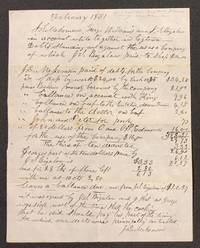
185148953Logtown Eldorado County California 1851. SIGNED by McKemson at conclusion. Now housed in an archival mylar sleeve. Bit of age toning. Fold-lines. Later pencil annotation at top noting location of Logtown. Very Good. Single sheet 25 lines of mss ~ 7 words per line ~ 175 words. 2 sums penned to right of sheet. Docket summary to verso. All writing clear & sharp entirely legible. 9-5/8" x 7-1/2" <br/><br/>An interesting & information-laden letter detailing the contractual & financial agreements between two individuals engaged in mining along with sums paid for divers aspects of same to wit: "to John and Peter for pork" .75 "balance on beef to the butcher down Town" 4.15 and "balance on account with King" 9.86. We note athat the value of labor is recognized e.g. "it was agreed by J. S. Bigalow and I that as George was sick most of the time that the cooking that he did should pay his part of the living for which our bebts were principally contracted." <br /> <br />A nice primary source ADs documenting divers aspects of mine life amongs those so practiciing. unknown books
1832010488Boston: Published by Crocker & Brewster 1832. Hardcover. VG. 12mo publisher's brown textureed cloth engraved frontispiece of family scene vii 192p. Some loss to cloth at spine ends. Solid unophisticated copy in original binding typical of New England-printed Christian tracts of the period. Published by Crocker & Brewster hardcover books
1981224413New York: Arbor House 1981. First. hardcover. fine/very good. 8vo 1/2 green cloth d.w. New York: Arbor House 1981. Very good<br/><br/> Arbor House unknown books
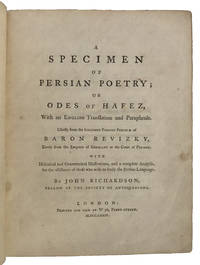
1774ME1081London:: Printed and Sold at No. 76 Fleet-Street 1774. 1774. 4to. iv xv 1 68 pp. Original full calf gilt spine; neatly rebacked to style preserving original endsheets. Inscribed by an early owner "This Book belonging to Monsieur Pierre Monneron." Extremely rare. This is the first edition in English of the ghazals of Hafez translated by one of the leading Persian orientalists of his day John Richardson FAS of Wadham College Oxford and famous for his seminal work written in conjunction with Sir William Jones the work being A Dictionary Persian Arabic and English 1777. / Hafez was previously unknown to the western world until Count Karl Emerich Reviczky von Revisnye 1737-1793 the Hungarian Orientalist and bibliophile 'discovered' him and brought his poetic classic to Europe with this Vienna printing. The work features an extensive text on Hafez and a translation of selected ghazals . Reviczky von Revisnye also issued in 1784 1794 a catalogue of his Greek and Latin library using the pseudonym of "Periergus Deltophilus". In the prefatory essay for that volume he shows an interest in the printing of Nicolas Jenson Aldus Manutius and the Estiennes. / Hafez was born in Shiraz Persia and lived approximately from 1325/26–1389/1390. He is considered a mystic and poet. His life and poems are the subject of much analysis commentary and interpretation influencing post-fourteenth century Persian writing more than any other author. FULL TITLE: A Specimen of Persian Poetry; or Odes of Hafez With an English Translation and Paraphrase. Chiefly from the Specimen Poeseos Persicae of Baron Revizky Envoy from the Emperor of Germany to the Court of Poland. With Historical and Grammatical Illustrations and a complete Analysis for the assistance of those who wish to study the Persian language. Printed and Sold at No. 76, Fleet-Street, 1774. unknown books
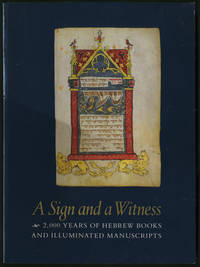
198827204New York and Oxford: The New York Public Library and Oxford University Press 1988. First edition. Stiff decorated paper wrappers. A fine copy. xiii 223 pp. Illus. with b/w and color reproductions. 4to. Includes: Dead Sea Scrolls: Light on the Text and Canon of the Bible How Hebrew Manuscripts Are Made The Decoration of Medieval Hebrew Manuscripts the Hebrew Manuscript As Source for the Study of History and Literature Forming the Great Collections Early Hebrew Painting The Development of Hebrew Printing in the Sixteenth and Seventeenth Centuries The Hebrew Book in a Christian World Publishing and the Rise of Modern Hebrew Literature The Art of the Hebrew Book in the Twentieth Century Between Western Culture and Jewish Tradition: Translations Text and Texture: Early Adventures in the Fourth Dimension plus bibliography. The New York Public Library and Oxford University Press unknown books
1988013490New York Oxford: The New York Public Library and Oxford University Press 1988. This volume edited by Dr. Gold was four years in the making. It accompanied the exhibition of Hebrew works at the New York Public Library-October 151988 to January 14 1989. The exhibit drew from the extensive holdings of the Library as well as loans of important manuscripts and printed books from other collections in the US Europe and Israel.Illustrations throughoput the catalogue many in color. Four small brown spots on final page may be binder's glue. Otherwise a clean crisp copy. 224pp. First Edition. Color Illustrated Wrappers. Nearly Fine/No Jacket. Quarto. The New York Public Library and Oxford University Press Paperback books
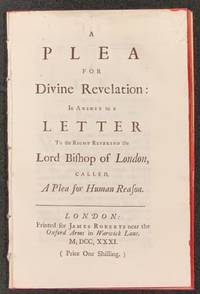
173149175London: Printed for James Roberts near the Oxford Arms in Warwick Lane 1731. 1st Printing. Disbound now housed in an archival mylar sleeve. VG. 68 pp. Red edgestain. 8vo. 7-3/8" x 4-3/4" <br/><br/>Jackson the author of "A Plea for Human Reason". Printed for James Roberts near the Oxford Arms in Warwick Lane unknown books
1999UWOLPLA00fpClarkson N. Potter 1999. Very Good. Wolfman Peri. A Place for Everything: Organizing the Stuff of Life. Gold Charles. New York NY: Clarkson N. Potter 1999. 192pp. Illustrated. 4to. Hardcover. Book condition: Very good. Top front corner lightly bumped. Dust Jacket Condition: Very good. Edges lightly rubbed. Clarkson N. Potter hardcover books
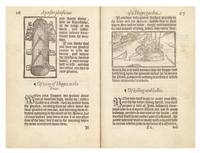
6551Numerous woodcut illus. in the text. Largely printed in black letter. 7 p.l. first leaf blank except for signature mark 63 1 pp. Small 4to early 20th cent. polished mottled calf by Riviere triple gilt fillet round sides spine richly gilt red morocco lettering pieces on spine dentelles gilt a.e.g. London: H. Denham 1576. Second edition "nowe newly corrected and augmented" of the first English book on hops. The first edition appeared two years earlier; both editions are very rare. This is "an eminently practical treatise illustrating the various methods of setting the roots making the hills and ramming the poles tying the bine and its pulling up and preservation with a number of curious cuts. It was the work of a practical man written for practical men and in this respect is far in advance of most of Scot's contemporaries who were still much interested in the superstitions of the time and the traditional pseudo-science of the Middle Ages."-Fussell I p. 12. Clinch in his English Hops a History of Cultivation and Preparation for the Market from the Earliest Times 1919 states that in many respects "the information is as useful today as it was nearly three-and-a-half centuries ago when it was published." Scot d. 1599 is most famous for his The Discoverie of Witchcraft 1584 in which he attacked the general belief in witchcraft and other forms of credulity and superstition including astrology alchemy and Catholicism. For more on Scot and his fascinating life see ODNB. Fine copy. Signature of T. Barling on first leaf. ❧ Henrey I p. 64 & no. 338. McDonald Agricultural Writers from Sir Walter of Henley to Arthur Young 1200-1800 pp. 34-36. unknown books
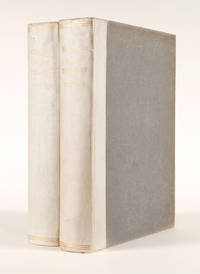
1903WRCAM48587Chicago: A.C. McClurg & Co. 1903. Two volumes: lxiv2353; 10355-711pp. Facsimiles illustrations and two folding maps. Thick quartos. Original half vellum and paper covered boards spines gilt. Some light soiling to the bindings and light wear to the corners. Small bookplate on rear pastedown of both volumes. Very clean internally. Aside from the light binding wear near fine overall. Untrimmed and unopened. Large paper copy number 16 of an edition of 150 thus. This is the first scholarly edited edition of Hennepin's most important work edited by Reuben Gold Thwaites who has added an introduction notes and an index. Based on the so-called "Tonson" issue first published in London in 1698 this is perhaps the most important 17th century account of the upper Midwest and the Great Lakes. HOWES H416. GRAFF 1862. FIELD 685. GREENLY MICHIGAN 8. SABIN 31371. all refs. A.C. McClurg & Co. hardcover books
9308pamphlet. 23 pages. Tall slim 8vo modern wrappers; uncut & unopened. Newark 1891.<br/><br/> unknown books
1857WRCLIT18302New York & London: Samuel French & Son 1857. 36pp. Printed orange wrappers. Near fine. First edition of this playlet based on Delano's own experiences in the diggings in 1850. Ascribing priority of printings to French plays is usually tentative at best; however this copy bears an advertisement for the play version of TEN NIGHTS IN A BAR ROOM as a new publication so it seems certain that this is at least a very early printing if not the first. EBERSTADT 134:123. Samuel French & Son unknown books
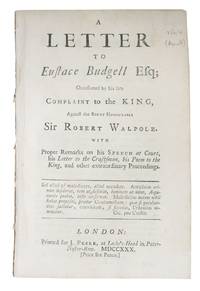
173048567London: Printed for J. Peele at Locke's Head in Pater-Noster-Row 1730. 1st printing. Disbound with binding remnants along spine. Now housed in an archival mylar sleeve. Age-toning a VG copy. 35 1 blank pp. Signed at end: "R. M." Headpiece & decorative initial capital letter p. 3. Headpiece p. 34. 8vo signed in 4s. 7-1/2" x 4-3/4" <br/><br/> Printed for J. Peele, at Locke's Head in Pater-Noster-Row unknown books