1 329 résultats
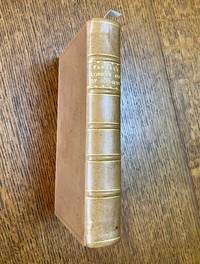
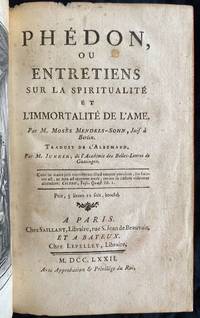
177243257Paris et Bayeux chez Saillant et Lepelley 1772. 1st French-language edition. Period full leather binding with gilt spine and red edges with original marbled endpapers 8vo. Includes frontis copperplate etching. XXIV 342 1 pages. “Traduit de l’Allemand par M. Junker de l’Académie des Belles-Lettres de Goettingen.â€<br> This first French edition appeared 5 years after the first German edition of 1767<br> <br> "Phaedon or On the Immortality of the Soul" Phaedon Oder Ueber Die Unsterblichkeit Der Seele In Drey Gespraechen is one of Mendelssohn's 1729-1786 most famous publications establishing his reputation as the "German Socrates of Berlin." It is a philosophical interpretation of the Platonic dialogue "Phaedo" and is preceded by a biography on "The Life and Character of Socrates." The important German-Jewish philosopher was one of the most important representatives of the Enlightenment in Prussia and throughout Germany.<br> <br> Mendelssohn's Phaedon is a “classic of rational psychology on the immortality of the human soul a defining work by this leading enlightenment philosopher who launched the Jewish thinking of the modern age" with his tribute to Socrates modeled on Plato's dialogue the Phaedo.<br> Mendelssohn used Plato's famous dialogue the Phaedo as a model to publish Phädon oder über die Unsterblichkeit der Seele. With this seminal work "he reached the heights of fame" Wigoder Dictionary of Jewish Biography 342. <br> The work unites Mendelssohn's "paean to Socrates with an elaboration of the dreadful personal moral and political implications if a person's life is her 'highest good'… <br> This 'classic of rational psychology' as Dilthey put it also contains an argument for the simplicity and immortality of the human soul explicitly singled out for criticism by Kant in the 2nd edition of the Critique of Pure Reason. Mendelssohn supports the notion that the soul is simple and thus indestructible by noting that certain features of the soul namely the unifying character of consciousness and the identity of self-consciousness cannot be derived from anything composite whether those composite parts be capable or not of thinking… <br> As for the human soul's fate after death Mendelssohn appeals to divine goodness and providence which perhaps explains why following the publication of the Phaedo he finds himself needing to revisit the proofs for God's existence" Stanford Encyclopedia.<br> According to Mendelssohn’s modern biographer Alexander Altmann “The work that would establish Mendelssohn's world-wide renown and win him the title 'the German Socrates' was the dialogue Phaedon which was published in 1767. In this work he presented Socratic wisdom from the mouth of the ancient philosopher but in the language of the Enlightenment that is in his own words as a modern philosopher. <br> The work drew both praise and criticism but was on the whole popular in intellectual circles. It demonstrates Mendelssohn's unique ability as a Jew to be comfortable in the realm of both classical and enlightened philosophy not to mention languages. David Sorkin remarks ‘What is ironic is that Mendelssohn was known and revered as much for the quality of his prose as for his thought.†<br> Mendelssohn was himself often referred to as the German Plato or the German Socrates. <br> And “As a Jew living in Germany Moses Mendelssohn 1729-1786 stands at a pivotal point in the history of Jewish emancipation in Europe. There were Jews before him who had access to the corridors of power in Germany and elsewhere in Europe but Mendelssohn represents the first to be socially accepted to a significant extent within enlightened German culture without converting. <br> He not only conformed to the culture of the German Enlightenment in many ways but also helped shape the culture through his philosophical contributions. At the same time Mendelssohn refused to turn away from traditional Judaism. He attempted to become a full- fledged member of society during the emergence of modern Europe while remaining a proponent of Judaism as a revealed religion. Moreover he sought to use his place of influence to encourage Jewish acculturation in Germany and to speak on behalf of the emancipation of Jewish people…. <br> The traditional mentality of the European Jews prior to Mendelssohn's time included a kind of resignation to the incompatibility of Jewish learning and 'worldly' philosophy. This resignation contributed to Jewish cultural isolation. Alfred Jospe describes the conundrum in which a Jew found himself if he wished to enter the culture of the non-Jewish world: The Jew could gain access to the culture of the world only by rebelling against the traditional repudiation of all mundane wisdom. <br> It is just at this point that Mendelssohn broke the mold. He not only acquired modern German culture but did so by means of his understanding of and contributions to the philosophy that shaped that culture. In his monumental biographical study Alexander Altmann focuses as much on Mendelssohn's philosophy and his answers to contemporary critics as he does on the details of the events and influences of his life. Altmann states with appropriate admiration that “Considering the state of degradation in which the Jewish population lived in eighteenth-century Germany. Mendelssohn's rise to fame and his acceptance into the republic of letters was an amazing feat of personal achievement.†<br> The amazing feature of Mendelssohn's achievement is that he accomplished it as an avowedly traditional Jew. Mendelssohn has been rightly described as a rabbinic scholar but he made his reputation in non-Jewish intellectual circles as a literary critic and philosopher….with the help of both Gotthold Lessing and the Berlin publisher Friedrich Nicolai he was accepted into the inner circle of the Berlin Aufklärung. <br> His essays reviews and translations earned him tremendous status among German intellectuals. <br> The favorable comparison made by Lessing between the quintessential German poet Goethe and Mendelssohn is a mark of the esteem in which he was held. ‘Lessing told Friedrich Heinrich Jacobi that once Goethe regained his reason he would be hardly more than an ordinary man. At the very same time he said of Mendelssohn that he was the most lucid thinker the most excellent philosopher and the best literary critic of the century’" Clark 2005. P. 57-58. <br> OCLC: 19939219. <br> Very light edgewear to front endpapers touch of spotting a gorgeous copy in the original leather binding with tooled gilt spine with raised bands and leather label. Beautiful and scarce. B KH-10-30-RLB-’e. Paris et Bayeux, chez Saillant et Lepelley unknown
172844794Wien, Wolfgang Schwendimann, 1728. 4° (33 x 21,5 cm). Mit einem gest. Frontispiz u. einer weiteren Kupfertafel von J. A. Schmutzer bzw. E. A. Dietell nach N. B. Belau sowie 9 (von 10?) Portrait-Kupfertafeln. 4 Bll., 112 S., 1 Bl., Ldr. d. Zt. a. 7 Bünden m. reicher Rückenverg. u. goldgepr. rotem Rückenschild.
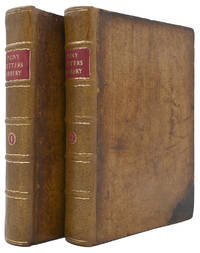
1772001257London.: Lockyer Davis 1772. 1st Edition 1st Printing. Hardcover. Very Good/Not called for>. Two volumes complete.Original18th c half calf over marbled boards with matching leather label. Contemporary signature of previous owner on paste down and on verso of front blank. There is also a lengthy quote from the author written by a previous owner on front blank. Some minor browning to prelims. Leather missing from tip lower boards volume one.Internally fresh and clean. Overall a superb set of a scarce title. <br/> <br/> Lockyer Davis hardcover
1718238501718 A Paris, chez Joseph Mongé ... M.DCC.XVIII., 1718. in-12 (9,5x16,5cm),[6], 72, 83, [12], 339, [12] p, [1] pl.-bl pp., 3 parties reliées en un volume.: "L'histoire abrégée de la Moscovie, des Czars ou Empereurs qui y ont regne, jusques a present", "La relation de ce que Pierre Alexeowitz, a present regnant, a fait de plus remarquable dans ses Etats" - Nouvelle édition française, rare. Illustrée d'un portrait au frontispice de Pierre 1er et d'une grande carte dépliante. Réimpression de l'originale française parue en 1717 chez Jean Boudot. Reliure en pleine basane brune d'époque. Dos à nerfs orné. Coiffes de tête et queue en partie élimées. Epidermures sur les plats. Frottements au coiffes et bordures,tranches rouges.Texte et ill.fraiches.
178710919<p>J. Scatcherd and J. Whitaker B. Law and G. and T. Wilkie. London. 1787. FOURTH EDITION. 8vo. 8.6 x 5.4 inches. Portrait frontis of Farley plus 12 copper engravings of a bill of fare for each month of the year. Some light browning to a handful of leaves but generally a fresh and clean copy throughout. Finely bound in attractive recent full speckled tan calf. Spine with raised bands. The compartments ruled and lettered in gilt. Single blind ruled border on boards. gilt. A very good copy of this famous work.</p> J. Scatcherd and J. Whitaker, B. Law, and G. and T. Wilkie. London. 1787 hardcover
17517954London: Printed by James Bettenham for Paul Vaillant 1751. FIRST EDITION 2 vols. 4to pp. iv lxxxvii i 440 16; iv 509 33. Engraved head- and tail-pieces in each chapter. Contemporary calf edges sprinkled red. A touch toned some water-staining to final leaves of vol. 2. Recently rebacked spines divided by raised bands between gilt rules red morocco labels hinges relined with paper old leather somewhat marked. A friend of Swift and Pope John Boyle Fifth Earl of Orrery 1707-1762 was on poor terms with his father who had featured in Swift’s ‘Battle of the Books’ following his row with Bentley and was left little in his will but nonetheless inherited something of his classical scholarship translating Horace as well as producing this substantial annotated translation of Pliny. It saw a second edition the same year. ESTC T132377. Printed by James Bettenham, for Paul Vaillant hardcover
1776M112271776. Fletcher John Later red half morocco with marbled boards. Gilt lettering on spine. Cheshunt College book plate. 1st item lacks half title 2nd item is Baker #344 hardcover
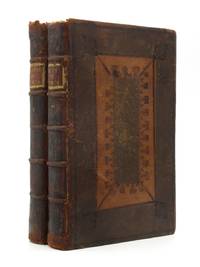
17271253E031London: T. Woodward and J. Peele 1727-1728. 2nd Edition . Hardback. Printed pages: 8vo. viii 312; 196 36 144. Very Good. 5.25 x 8 inches 13 x 20 cm. Complete two volume set. Contemporary Cambridge panelled full calf leather bindings. Spines with five raised bands and morocco title labels. Gilt decorated board edges. Red speckled page edges. Front joint of Volume II is cracked but board is securely attached. Wear to ends of spines. Tear to leather on front board of Volume I. Good solid bindings. Very clean text with just a little light foxing and a few light marks. Engraved frontis by Grison to both volumes. Volume II includes the 'Letter from Mr. Freret' with text in the original French with English translation on facing pages. Numerous attractive headpieces tailpieces and historiated capitals. Originally published in French as 'Les Voyages de Cyrus' in 1727. This is the second English language edition with Volume I dated 1727 and Volume II dated 1728. Scarce. ESTC: T121199. Overall condition is Very Good. Size: 5.25 x 8 inches 13 x 20 cm. T. Woodward and J. Peele hardcover
172471703vol.I part I 14 lxxvi 10 1-280 24 pages vol I part II 12 281-653 33 pages vol II part I 8 1-318 pages vol.II part II 8 323-676 58 pages Vol.III 2 1-535 49 red and black title pages decorative headpieces and capitals Printed for W. Mears, and T. Edlin hardcover
173212115050049In the Savoy: Printed by E and R Nutt and R Gosling Assigns of E Sayer Esq for N Lintot at the Cross-Keys against Saint Dunstan's Church in Fleet-Street 1732. 1st Edition. Hardcover. Very Good/No Dust Jacket. Full Title: A General Abridgement of Cases in Equity Argued and Adjudged in the High Court of Chancery etc with Several cases never before published Alphabetically digested under proper Titles: with Notes and References to the Whole. And Three Tables the First of the Names of the Cases the Second of the several Titles with their Divisions and Subdivisions; and the Third of the Matter Under General Heads Contemporary full leather covers are lightly marked and rubbed with worn bumped corners worn spine ends leather on external hinges is cracked but covers are held firmly binding is sound end-papers are darkened clean pages some gilt decoration to edge faces of covers. Chapter Headings are: Abatement and Revivor; Account; Affadavits; Agreements Articles and Covenants; Amendment; Annuity and Rent-Charges; Answers Pleas and Demurrers; Assignment and Privity; Award and Arbitrament; Bankfupt; Baron and Feme; Bill; Bonds and Obligations; Charity; Commissions for Examing of Witnesses; Common; Conditions and Limitations; Contribution and Average; Copyhold; Costs; Courts and their Jurisdiction; Creditor and Debtor; Customs of London and York; Decree; Deeds and other Writings; Devises; Dower and Jointure; Evidence Witnesses and Proof; Executors and Administrators; Fines and Recoveries; Guardian; Heir and Ancestor; Ideots and Lunaticks; Infant; Injunction; Interest Money; Jointenants and Tennants in Common; Legacies; Limitations of Suits and Demands; Master and Servants; Mortgages; Notice; Portions; Power; Privilege; Process; Purchase and Purchaser; Remainder; Rent; Tithes; Trade and Merchandize; Trial; Trust and Trustees; Waste; Writs. Quantity Available: 1. Shipped Weight: 2-3 kg. Pictures of this item not already displayed here available upon request. Inventory No: 12115050049. All our books music and maps are sent by a tracked mail service. This book is heavier than 1kg and may incur additional delivery charges on some delivery services to some locations. In the Savoy: Printed by E and R Nutt and R Gosling (Assigns of E Sayer Esq) for N Lintot, at the Cross-Keys against Saint Dunst hardcover
174700JT32nFrance 1747. In 1747 the Marquis A.M. De Roquepines requests an absolute leave of his superior officer for reasons of poor health. It appears he is so ill that he is putting his affairs in order. Research finds the very same Roquepines becomes the Marechal de Camp. Very Good. 8vo - over 7¾" - 9¾" tall. Manuscript. unknown
1785031613Falkirk: Patrick Mair 1785. Book. Good. Full Leather. New Edition. 4" x 6 1/2". Brown leather over boards. From the title page: A New Edition Wherein the Old Obfolete Words are rendered more intelligible; and adapted to the Understanding of fuch who have not Leifure to ftudy the meaning and Import of fuch Phrafes without the Help of a Gloffary. Staining on endpapers and pages and foxing throughout. A few small tears and wrinkles. Cracked and repaired boards. Loosening but interior tight. Patrick Mair Hardcover
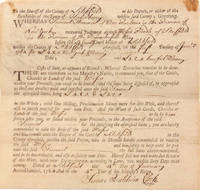
1764316301Litchfield CT 1764. 1p. partially printed and accomplished docketed and signed by Wolcott on the verso. 6-1/4 x 6 inches. Very good. 1p. partially printed and accomplished docketed and signed by Wolcott on the verso. 6-1/4 x 6 inches. 'COMMIT UNTO THE KEEPER OF THE GAOL'. A court writ for the recovery of a judgement against Moses Prindle. Reading in part: "To the Sheriff of the County of Litchfield or his Deputy or either of the Constables of the Town of Salisbury within said County; Greeting. Whereas Samuel Thomson of Nine Partners in the Province of New York recovered judgement against Moses Prindle of Sheffield in the Province of Massachusetts Bay before the adj. County Court Holden at Litchfield within the County of Litchfield aforesaid on the first Tuesday of January 1764 for £ 4-8.0 New York Money and £ 1.2.0 lawful Money. Whereof Execution remains to be done. These are therefore in his Majesty's Name to command you that of the Goods Chattles or Lands of said Moses within your Precincts you cause to be levied and the same being disposed of or appraised as the Law directs paid unto the said Samuel. And for want of such Goods. you are hereby commanded to take the Body of the said Moses and him commit unto the Keeper of the Gaol in Litchfield ."<br/><br/>Oliver Wolcott 1726-1797 was a signer of the Declaration of Independence and the Articles of Confederation as a representative from his home state of Connecticut where he also served as the Nutmeg State's 19th Governor and as a major general of Connecticut militia during the American Revolution. Born in Windsor Wolcott graduated at the top of his Yale class in 1747. After graduation he raised and lead a militia company in the French and Indian War and afterward settled in Goshen CT where he studied medicine before moving to Litchfield to become a merchant. He was appointed sheriff of the county and served from 1751-1771. According to a "Historical Note" in the Connecticut State Library ".when viewed through the lens of the county court files Wolcott was an incompetent sheriff who allowed the vagrant thief Joseph Negro to escape from jail in 1754. Wolcott was also sued by a neighbor for his cruel and tyrannical treatment of Wolcott's servant Lidia Collis. The girl had fled to the neighbors for protection only to be dragged home by her master." <br/><br/>Isaac Baldwin 1715-1805 was born in Milford Connecticut to David and Abigail Wilkinson Baldwin. A licensed preacher he gave up the pulpit for the plow moving to Litchfield where he ws a representative to General Assembly served as Town Clerk Clerk of the County Court and Clerk of the Probate Court. He was married to Anna Collins and had three daughters and four sons. unknown books
170244388(Paris, Jean Boudot, 1702). 4to. Without wrappers. Extracted from ""Mémoires de l'Academie des Sciences. Année 1699"". Pp. 112-126 and 1 engraved plate. (showing the ""Moulin a Feu"" Textillustrations.
179943865Halle, Rengerschen Buchhandlung, 1799. Without wrappers. In ""Annalen der Physik. Herausgegeben von Ludwig Wilhelm Gilbert"", Bd. 2, Erstes Stück. (The entire issue offered). Titlepage to vol. 2. Pp. 1-118 a. 2 folded engraved plates. Cavendish's paper: pp. 1-62. (the torsion balance of Michell shown on the plates).
177053455Paris, L'Imprimerie Royale, 1770. 4to. Without wrappers. In ""Histoire de L'Academie Royale des Sciences. Année MDCCLXVII. Avec les Memoires de Mathematiques & de Physique, pour la même Année."" Pp. 423-470 and 10 folded engraved plates. Clean and fine.
176631081(Berlin, Haude et Spener, 1766). 4to. No wrappers, as issued in ""Mémoires de l'Academie Royale des Sciences et Belles Lettres"", tome XX, pp. 91-164 (91-116"117-143"144-164). 1 engraved plate ( belonging to ""Microscope..."")
177041596(Berlin, Haude et Spener, 1770). 4to. No wrappers, as issued in ""Mémoires de l'Academie Royale des Sciences et Belles-Lettres"", Tome V, pp. 203-221, 1 plate and pp. 222-288, 1 engraved plate.
175842952(Berlin, Haude et Spener, 1758). 4to. No wrappers as issued in ""Memoires de l'Academie Royale des Sciences et Belles Lettres"". tome XII, 1756. Pp. 165-234 a. 1 folded engraved plate.
175945126(Berlin, Haude et Spener, 1759). 4to. No wrappers, as issued in ""Mémoires de l'Academie Royale des Sciences et Belles Lettres"", Année 1757, tome XIII, pp. a. 1 engraved plate.
170244405(Paris, Jean Boudot, 1702 a. 1703). 4to. Without wrappers. Extracted from ""Mémoires de l'Academie des Sciences"". Année 1699 a. Année 1700. Pp. 44-51 and 1 textillustration. (depicting his + pp. 64-71.
175146906Leipzig, Gleditsch & Lanckis, 1751. 4to. No wrappers. In: ""Nova Acta Eruditorum, Anno MDCCLI"", March- Issue, Pars I-II. Entire issue in 2 parts offered. With titlepage to the volume 1751. Pp. 97-192. Koenig's paper: pp. 125-135 a. pp. 162-176. With 2 engraved plates. Titlepage with 2 stamps and a bit soiled. Leaves as usual a bit browned.
170244388Paris Jean Boudot 1702. 4to. Without wrappers. Extracted from "Mémoires de l'Academie des Sciences. Année 1699". Pp. 112-126 and 1 engraved plate. showing the "Moulin a Feu" Textillustrations. <br/><br/><em>First apperance of this classic paper in which Amontons decribes his invention of a thermic motor."As early as 1699 Amontons proposed a thermic motor: a machine using hot air and external combustion with direct rotation. The experiments carried on in connection with this machine led him to note that ordinary air going from the temperature of ice to that of boiling water increases in volume by about one third."DSB I p. 139.Together with L'HOPITAL "Methode Facil pour trouver un Solide Rond qui étant mû dans un Fluide en repos paralellement." 1699/1702. Pp. 107-112 </em> unknown
179943865Halle Rengerschen Buchhandlung 1799. Without wrappers. In "Annalen der Physik. Herausgegeben von Ludwig Wilhelm Gilbert" Bd. 2 Erstes Stück. The entire issue offered. Titlepage to vol. 2. Pp. 1-118 a. 2 folded engraved plates. Cavendish's paper: pp. 1-62. the torsion balance of Michell shown on the plates. <br/><br/><em>First German edition of Cavendish's famous paper in which he calculated the weight of the earth and determined its mass. He also as the first observed gravitational motion of minute portions of matter. He estimates the earth's mass to 66 x 10 to the potential of 24 kg. The original paper "Experiments to determine the Density of the Earth" appeared in Philosophical Transaction 1798."Cavendish published five papers between 1784 and 1809.With one exception they were comparatively minor productions.The exception was his determination of the density of the earth or weighing of the world in 1798 by means of John Michell's torsion balance. The apparatus consisted of two lead balls on either end of a suspended beam; these movable balls were attracted by a pair of stationary lead balls. Cavendish calculated the the force of attraction between the balls fro the observed period of oscillation of the balance and deduced the density of the earth from the force. He found it to be 5.48 times that of water. Cavendish was the first to observe gravitational motions induced by comparatively minute portions of ordinary matter.By weighing the world he rendered the law of gravitation complete. The law was no longer a proportionally statement but a quantitatively exact one; this was the most importent addition to the science of gravitation since Newton."DSB III p. 158. </em> unknown
177053455Paris L'Imprimerie Royale 1770. 4to. Without wrappers. In "Histoire de L'Academie Royale des Sciences. Année MDCCLXVII. Avec les Memoires de Mathematiques & de Physique pour la même Année." Pp. 423-470 and 10 folded engraved plates. Clean and fine. <br/><br/><em>First edition. The author here describes his invention of this microscope with full instructions for manufacture and with fine drawings of every part of the instrument on 10 fine plates. </em> unknown