EULER, LEONHARD - THE GAME PHARONBiblio.com
1 329 résultats
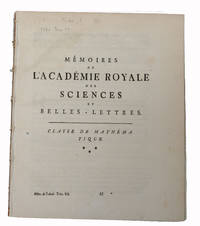
176631081Berlin Haude et Spener 1766. 4to. No wrappers as issued in "Mémoires de l'Academie Royale des Sciences et Belles Lettres" tome XX pp. 91-164 91-116;117-143;144-164. 1 engraved plate belonging to "Microscope." <br/><br/><em>3 first editions by Euler in algebra in optics and in the theory of chance - in this last paper he discusses the so-called St. Petersburg paradox the Game Pharon. </em> unknown
175842952Berlin Haude et Spener 1758. 4to. No wrappers as issued in "Memoires de l'Academie Royale des Sciences et Belles Lettres". tome XII 1756. Pp. 165-234 a. 1 folded engraved plate. <br/><br/><em>First printing of Euler's importent large memoir in which he develops the mathematical theory of windmills and generates analytically the equations of the effects of winds on duoble-bended surfaces in relation to mechanical work. - Together with d'Alembert and Daniel Bernoully Euler laid the foundation of mathematical physics. - Enestroem E 233. </em> unknown
175945126Berlin Haude et Spener 1759. 4to. No wrappers as issued in "Mémoires de l'Academie Royale des Sciences et Belles Lettres" Année 1757 tome XIII pp. a. 1 engraved plate. <br/><br/><em>First printing of an importent paper in which Euler shows how to manufacture catoptrical telescopes and microscopes in accordance with general rules and founded on his own experiments. - The calculation concerning light ray aberrations brought about due to the sphericty of the glass is a masterpiece of analysis of the highest order and he also incorporates the mathematical theory of achromatic combination of lenses which was first realized by Dollond in the same year 1757. </em> unknown
177041596Berlin Haude et Spener 1770. 4to. No wrappers as issued in "Mémoires de l'Academie Royale des Sciences et Belles-Lettres" Tome V pp. 203-221 1 plate and pp. 222-288 1 engraved plate. <br/><br/><em>Both papers first edition. The first paper is Euler's discussion of "Cramers Paradox" and it contains his inventions of 2 kinds of curves "Cusps of first kind" or keratoid cusp and "Cups of second kind" or ramphoid cusp. - Enestroem E 169.The second paper contains Euler's famous proof of "The fundamental Theorem of Algebra". - Enestroem E 170. </em> unknown
170244405Paris Jean Boudot 1702 a. 1703. 4to. Without wrappers. Extracted from "Mémoires de l'Academie des Sciences". Année 1699 a. Année 1700. Pp. 44-51 and 1 textillustration. depicting his pp. 64-71. <br/><br/><em>First appearance of the 2 papers which represents Homberg's main works. In these papers he shows for the first time how to determine equal weights of substances that all acids differ only in water content and that dry acids combines in equal proportions with alkali. In the first paper he also gives the Pygnometer Bottle its modern form."Probably his most importent work was on the strenght of acids and the quantity required to neutralize a given quantity of alkali two papers published in 1699 and 1700 - the papers offered - Homberg recognized that different alkalis neutralized the same acid in different proportion but believed that the relative strenghts of two acids could be determined by using the same alkali in each case. he treated the the question of neutralization or dissolvability as he called it in quite quantitative fashion showing that if an alkaline salt were treated with an acid the gain of weight ofthe salt wasan indication of the amount of acid absorbed.Homberg nevertheless understood the fundamentals of the process and thereby laid the foundation for an understanding the nature of salts."DSB VI p. 478.Parkinson "Breakthroughs" 1700 C. </em> unknown
175146906Leipzig Gleditsch & Lanckis 1751. 4to. No wrappers. In: "Nova Acta Eruditorum Anno MDCCLI" March- Issue Pars I-II. Entire issue in 2 parts offered. With titlepage to the volume 1751. Pp. 97-192. Koenig's paper: pp. 125-135 a. pp. 162-176. With 2 engraved plates. Titlepage with 2 stamps and a bit soiled. Leaves as usual a bit browned. <br/><br/><em>First printing of this important paper in which Koenig set forth his "Law of least Action". The law states that the kinetic energy of a system of mass points is equal to the sum of the kinetic energy of the motion of the system relative to the center of gravity and of the kinetic energy of the total mass of the system considered as a whole which moves as the center of gravity of the system."While still in Franeker Koenig wrote the draft of his important essay on the principle of least action which was directed against Maupertuis. The controversy touched off by this work which was published in March 1751 resulted in perhaps the ugliest of all the famous scientific disputes. Its principal figures were Koenig Maupertuis Euler Frederick II and Voltaire; and as is well known it left an unseemly stain on Euler’s otherwise untarnished escutcheon. The quarrel occupied Koenig’s last years almost completely; moreover he had been ill for several years before it started. Koenig emerged the moral victor from this affair in which all the great scientists of Europe—except Maupertuis and Euler—were on his side. The later finding of Kabitz2 testifies to Koenig’s irreproachable character."DSB. </em> unknown
17772318BB2 Bände. Leipzig, Weidmanns Erben und Reich, 1777. Gr.-8°. 1 Portrait, 13 Bl., 574 S.; 1 Bl., 618 S., 29 Bl. Mit 4 gefalteten Karten und 1 Tafel. Pappbände der Zeit mit Rückensch.
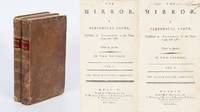
178229831AB1782. Fourth Edition overall First Dublin Edition. In Two Volumes complete set. Dublin Printed by T.Henshall for T.Walker 1782. Small Octavo 10 cm x 18 cm. VI 288 VIII 288 pages. Hardcover / Original 18th century leather with new spinelabels made to style. Both Volumes now in protective Mylar. Some minor wormhole-damage to the last 20 pages of Volume Two.Minor lesions to some pages only. Faded dampstain to both Volumes. Still both Volumes firm and complete. Important scottish enlightenment publication. From the library of one "John Courtenay" with his name in ink on the titlepages of both Volumes. This is possibly John Courtenay 22 August 1738 - 24 March 1816 who was an Irish officer in the British Army later becing a politician in England. He was a Whig member of Parliament MP at Westminster from 1780 to 1807 and again in 1812. Wikipedia With interesting articles especially on Female Matters of the 18th century: On Duelling Regulations proposed - Story of Captain Douglas / Remarks on the Poems of Ossian / Of Beauty - Philosophical Opinions of it / The Mussulman's Mirror / Censure of a particular piece of indecorum at the theatre / Of Female Manners / Change to those of Scotland considered / Description of a Tour through the Highlands by a London Family / Of Education - A classical contrasted with a fashionable education / Description of a shopkeeper virtuoso in a letter from his wife Rebecca Prune / Distresses of the families of Soldiers - Story of Nancy Collins / Danger of too refined an education to girls in certain circumstances in a letter from Harriet B. / Behaviour of Great LAdies in town to their country acquaintance in a letter from Elizabeth Homespun / Recital of a conversation critcism on the Tragedy of Zara / The Hardship of educating a young lady in an expensive manner and then leaving her with a very slender provision for her support; History of herself by S.M. / Account of a younger brother in the country in a letter from Joseph Fielding / Essay on Dreams / Of the privilege of fashion to alter nature; some accountof certain fashionable peculiarities in Edinburgh / Antiquarius on the Virtues of certain ancient medicines / On Superstition and the Fear of Death / Emilia on Female accomplishment / etc. etc. Mirror Club act. 17761787 a prominent group of Scottish literati who published the Edinburgh journals The Mirror 177980 and The Lounger 17857 evolved from a small Edinburgh literary debating society known as the Feast of Tabernacles 177077. The latter was a self-selected group of young writers lawyers preachers and landed scions whose acknowledged leader was the politician Henry Dundas. Many of these individuals had earlier belonged to the Belles Lettres Society 175963 the junior version of the Select Society a famous grouping of Scottish politicians philosophers preachers and writers. In its early evolution from the Feast of Tabernacles about 17767 the founding members of the Mirror Club included Henry Mackenzie William Craig Alexander Abercromby William Macleod Bannatyne and Robert Cullen. Other members from this time were the lawyers George Ogilvie d. 1785 William Gordon of Newhall d. 1778 and George Home of Wedderburn 17341820. Later corresponding members who contributed essays or correspondence included James Beattie David Dalrymple William Greenfield Robert Henry David Hume bap. 1757 d. 1838 William Richardson William Strahan Alexander Fraser Tytler and his father William Tytler. The publisher and future lord provost of Edinburgh William Creech whose idea it was to publish The Mirror should be considered an ex officio club member since he was the only contact for many of the correspondents. Any forced division between core and corresponding members is somewhat misleading however since Dalrymple Richardson and Alexander Fraser Tytler made a far greater contribution to the club's publications than certain full members. Tytler in fact became one of the club's principal essayists. The Mirror Club's ethical essayswhich copied the form and continued the function of The Spectator 171114 of Addison and Steeleappear to have been well received. Macleod Bannatyne reported that 400 copies of each issue were printed the same number that was recorded in Eminent Scotsmen by William Chambers. This number significantly underestimates the number of actual readers in an age when paper periodicals were widely circulated. Many of the club's essays were printed elsewhere with twenty-three papers and one poem appearing in the Caledonian Mercury the Scots Magazine and The Bee. The bound collection of The Mirror went through eleven editions prior to 1802 and The Lounger six editions before 1805. While no subscription lists have been found acknowledged subscribers included James Beattie William Strahan Dugald Stewart John Home William Richardson Hugh Blair and Jane Gordon duchess of Gordon. The indisputable driving force of the Mirror Club was Henry Mackenzie who from his early years had been groomed by the Edinburgh literati to succeed David Hume as their convivial leader and adjudicator of literary taste. Mackenzie composed 49 of the 110 issues of The Mirror and 62 of the 101 issues of The Lounger. Occasionally he composed several different drafts of a paper that he sent to friends including Adam Smith for comment. He also revised the majority of the essays for publication. Three of Mackenzie's closest friends William Craig Alexander Abercromby and Alexander Fraser Tytler accounted for 68 of the remaining 100 essays. As a microcosm of the Scottish literati the publishing arm of the Mirror Club provides valuable insights into the socio-economic agenda professional background and inter-generational networks of landed and literary lowland society. All club members came from families well connected to Scotland's élite by status interests marriage and profession. They viewed themselves as the legal and literary representatives of Scottish landed society and they believed that a united and enlightened class of landowners could lead the country out of its economic backwater. Along with their teacher and in the case of Mackenzie and Craig their friend Adam Smith the core members of the Mirror Club shared a vision of Scotland as an improving capitalist community where economic and social power was held by the owners of land and where the status quo was strengthened by a complicated system of patronage deployed by Henry Dundas. The agrarian nature of Scottish improvement was strongly endorsed by club members. The liberal Macleod Bannatyne and conservative Abercromby composed a series of essays on the corruption of rural values by urban fashion. Other issues were thinly disguised warnings against the upward mobility of Scotland's urban merchant classes and paeans to the independence and gentility of landowners. On landed estates gentlemen could continue to perform the roles of patriarchs over small leaseholders while maintaining a happy and deferential retinue of servants. This gentrified world was personified by Home and Tytler who preferred to live and write from their estates as well as by Macleod Bannatyne's memorable character Umphraville. A competing interest group within the membership came from the legal profession. Two young lawyer members were George Ogilvie and William Gordon of Newhall though neither published an essay in The Mirror. Gordon died on 11 January 1778 a year before its appearance while Ogilvie died shortly before the initial publication of The Lounger in 1785. George Home of Wedderburn was already establishing himself in Edinburgh's legal community when The Mirror first appeared. He served for more than thirty years as principal clerk of the court of session where he was eventually succeeded by Sir Walter Scott. He was also elected a fellow of the Royal Society of Edinburgh. As befitted his status and seniority in legal circles Home had the privilege of composing the first Mirror essay and later contributed on staple club themes such as the value of social affection and personal cheerfulness see no. 34. In the prominence given to the legal profession the club demonstrated a clear preference for law over the church. Nevertheless clergymen such as John Logan were prominent in the Feast of Tabernacles and the connection between the moderate party of the Church of Scotland and the revival of Scottish belles-lettres was retained in Lounger essays by William Greenfield and Robert Henry. Moreover many Mirror papers including Mackenzie's famous series 'The story of La Roche' nos. 424 advocated religious belief and feeling. In terms of form and style the Mirror Club's offerings were self-conscious imitations of The Spectator Mackenzie proudly earning the epithet of the Scottish Addison. However it is evident that the club also developed the essay genre and championed the new literary form of the novel as the moral preceptor of the modern age. At one level the club's thinking remained parochial and transitional providing advice to a Scottish élite that was distinctly hierarchical and yet sufficiently poor to provide greater social and economic mobility than its English counterpart. But in its literary output the club also aimed to create a revolutionary new paradigm for ethical and cultural analysis by delineating the progress of individual character and passions through the structures of civilized manners formal education and custom. Nowhere was this more forcefully advanced than in the club's re-evaluation of Shakespeare as the creator of unique individuals with complex personalities. The club's attention to the philosophical analysis of Shakespeare was continued by Schlegel Coleridge and Hazlitt to name a few. Improving humane and tolerant the Mirror Club popularized Enlightenment values principally among the Scottish gentry. Yet collaterally the club and its publications provided a far wider readership with an innovative characterization of Scottish identityone that affirmed the ethical and sociable community rather than the uniquely covenanted nation. Source: Oxford Dictionary of National Biography - Article by John Dwyer hardcover
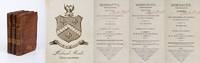
180029745AB1800. First Irish Edition. Three Volumes complete set. Dublin Printed for W. Watson and Son G. Burnet G. Folingsby etc. etc. 1800. Small-Octavo 10.5 cm x 17 cm. II 239 276 283 pages. Hardcover / Original 18th/19th-century leather with original spinelabels. All three Volumes in protective Mylar. The labels and spoine slightly damaged only. All Volumes firm and in overall very good condition. From the library of Richard Meade Ballymartle with his bookplate to the pastedown of Volume I. Bindings a little shaky but still intact; stronger rubbed with loss to labels. Bookplate / Exlibris of Richard Meade of Ballymartle attached to pastedown of Volume I. "Mordaunt. Character Sketches of Life Characters and Manners in Various Countries; including the Memoirs of A French Lady of Quality" was a powerfully written anti-French Revolution novel in three volumes in the form of 34 character sketches of famous politicians royalty generals the wealthy and the celebrity of the day. It also offers detailed eyewitness accounts of John Moore's observations as he travelled throughout Europe in the last years of the 18th century. There are gripping accounts of the heroic feats of a dashing British Officer included which were actually accounts of John Moore's son General Moore". John Moore FRSE 1729 1802 was a Scottish physician and travel author. He also edited the works of Tobias Smollett.He was born on 10 October 1729 in Stirling the son of Rev Charles Moore of Rowallan d1735 and his wife Marion Anderson. The family moved to Glasgow in his youth and he was educated at Glasgow Grammar School. He was then apprenticed to Dr. John Gordon in Glasgow 1745 to 1747. After taking a medical degree at Glasgow he served as a Surgeon's Mate with the army in Flanders during the Seven Years' War then proceeded to London to continue his studies and eventually to Paris where became surgeon to the household of the British ambassador there. In 1751 he returned to Glasgow to rejoin Dr. John Gordon also then practising with Dr. Thomas Hamilton. From 1769 to 1778 he accompanied the Duke of Hamilton who was linked to Thomas on a Grand Tour of Europe. On his return he took up residence in London. In 1792 he accompanied Lord Lauderdale to Paris and witnessed some of the principal scenes of the Revolution. His Journal during a Residence in France 1793 is the careful record of an eye-witness and is frequently referred to by Thomas Carlyle. In 1784 he was elected a Fellow of the Royal Society of Edinburgh. His proposers were Andrew Dalzell James Gregory and John Robison. He died in Richmond in Surrey now part of London on 21 February 1802. He is buried in Stirling. His novel Zeluco 1789 a close analysis of the motives of a selfish profligate produced a great impression at the time and indirectly through the poetry of Byron has left an abiding mark on literature. Byron said that he intended Childe Harold to be a poetical Zeluco and the most striking features of the portrait were undoubtedly taken from that character. Moore's other works have a less marked individuality but his sketches of society and manners in France Germany Switzerland Italy and England A View of Society and Manners in France Switzerland and Germany London W. Strahan & T. Cadell in the Strand 1779 2 vol.; A View of Society and Manners in Italy with anecdotes related to some eminent characters London W. Strahan & T. Cadell 1781 2 vol. were also very popular during his lifetime and furnish valuable materials for the social historian. "Mordaunt. Character Sketches of Life Characters and Manners in Various Countries; including the Memoirs of A French Lady of Quality" was a powerfully written anti-French Revolution novel in three volumes in the form of 34 character sketches of famous politicians royalty generals the wealthy and the celebrity of the day. It also offers detailed eyewitness accounts of John Moore's observations as he travelled throughout Europe in the last years of the 18th century. There are gripping accounts of the heroic feats of a dashing British Officer included which were actually accounts of John Moore's son General Moore. Wikipedia hardcover
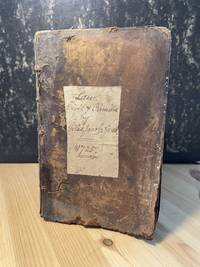
172531757AB1725. First Edition. London In the Savoy Printed by E. and R. Nutt and R. Gosling Assigns of Edward Sayer Esq. for T. Corbett at Addison's Head 1725. Small Octavo. 3 unnumbered 224 8 unnumbered pages. Original full leather. Binding in very porr condition but still in its original state. Needs repair. Interior very good with pre-owner's name in ink on titlepage: "RMA Mainish - 1825". Extremely scarce publication. Price reflects condition. Giles Jacob 1686 8 May 1744 was a British legal writer whose works include a well-received law dictionary that became the most popular and widespread law dictionary in the newly independent United States. Jacob was the leading legal writer of his era according to the Yale Law Library. The literary works of Giles Jacob did not fare as well as his legal ones and he feuded with the poet Alexander Pope both publicly and in literary form. Pope named Jacob as one of the dunces in his 1728 Dunciad referring to Jacob as "the blunderbuss of the law". Jacob is remembered well for his legal writing though not so much for his poetry and plays. Giles was born in Romsey Hampshire and was baptized on 22 November 1686. Among eight children Giles was the only son of Henry and Susannah Jacob. Henry Jacob was a maltster who lived until 1735. Giles Jacob's legal training included employment by Thomas Freke and then as a secretary to Sir William Blathwayt. Working for Blathwayt he engaged in litigation and dispensation probably in manorial courts. Jacob's first book The Compleat Court-Keeper 1713 gives detailed and practical instructions for how to administer estate matters. He combined this with a chronological summary of statute law and the combination was financially successful. Jacob always had an interest in contemporary poetry and the literary life and in 1714 he wrote a farce called Love in a Wood or The Country Squire. This play was never produced. He persisted however and in 1717 he wrote a satire of Alexander Pope's The Rape of the Lock in the form of The Rape of the Smock. The poem was low and bawdy and the next year he wrote a serious work titled Tractatus de hermaphroditis about the legal status of intersex people published by Edmund Curll in 1718 along with the first English-language publication of Ioannes Henricus Meibomius's A treatise of the use of flogging in venereal affairs. Title page from an 1811 edition of Jacob's The New Law Dictionary. In 1719 two works appeared by Jacob both very successful. The first was Lex constitutionis which was a thoroughly researched compendium of statute law common law and criminal law schematized according to which powers of the executive branch of the government were involved. While the work's fame and usefulness were surpassed in a few years Jacob's book was a well regarded analysis. The same year he produced the first volume of the Poetical Register with a second volume in 1720. This work provided biographies of contemporary authors as well as earlier ones. According to the literary editor Stephen Jones: He is generally accurate and faithful and affords much information to those who have occasion to consult him. It cannot be denied that he possessed very small abilities; but he was fully equal to a task where plodding industry and not genius must be deemed the essential qualification. In the Poetical Register Jacob criticized the play Three Hours After Marriage 1717 which had been written by John Gay with anonymous assistance from John Arbuthnot and Alexander Pope. Jacob wrote that its scenes "trespassed on Female Modesty". He subsequently criticized that play for "obscenity and false Pretence". Jacob had admired Pope had been on good terms with him and had submitted the biographical entry of Pope in the Poetical Register to Pope himself for correction. Jacob likely did not realize that Three Hours After Marriage had been anonymously co-authored by Pope. In The Dunciad of 1728 Pope pounced: Jacob the scourge of grammar mark with awe Nor less revere him blunderbuss of law. Pope explained Jacob's offense as follows: "he very grossly and unprovoked abused in that book the Poetical Register the authors friend Mr. Gay". The play Three Hours After Marriage was panned by most critics as obscene and literary historian Thomas Lounsbury has explained that no one criticized the play "without incurring from Pope an enmity that never died out". In 1725 Jacob wrote The Student's Companion and regarded it as his favorite of the books he had written. It was a guide to studying law with practical tips reviews and indexes. In 1729 his most famous work nine years in the making appeared: A New Law Dictionary. It combined a dictionary of legal practice with an abridgment of statute law and it reached its fifth edition by the time of Jacob's death. As late as 1807 "Jacob's Law Dictionary" was still a very profitable copyright. His last work was Every Man his Own Lawyer which outsold even the law dictionary. It was a self-help book for average citizens who might be involved in litigation. Jacob's legal writings were of a practical and descriptive sort often compared unfavorably to the analytic and theoretical treatises by authors like William Blackstone. But according to historian Julia Rudolph authors like Jacob had a different purpose in that they "were dealing with the problem of knowledge management or 'information overload' and in response to this problem the learning of the law was systematized alphabetized and organized." Jacob's most successful non-legal writing was of a similarly practical and descriptive sort. Jacob married Jane Dexter in 1733 and they had at least one daughter also named Jane.4 He and his family moved to Staines Middlesex where he died on 8 May 1744. Wikipedia hardcover
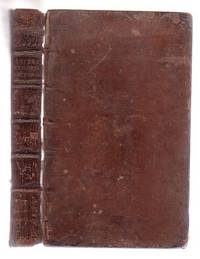
17477095Cambridge: Cmabridge J. Bentham Printer To the University. Fair with no dust jacket. 1747. Second Edition. Hardcover. Owner's signature of "Thomas Skelton March 1798" on title page. Front board nearly detached. Leather split along entire length of rear joint. A few chips to leather up to 1". Neat pencil marginalia from a later date. Piece torn from rear free endpaper. Damp stains to upper 1" of folding plates. Some foxing and browning to preliminary leaves. Text block in good condition.; xviii 273 x pages five folding plates. Full calf boards. Five raised bands on spine. Page Dimensions: 200mm x 122mm. ; 8vo . Cmabridge, J. Bentham Printer To the University hardcover
1785100772Weidmann / Weidmannsche Verlagsbuchhandlung, Hildesheim 2003-2007 (= Nachdruck der Ausgabe / Reprint of the edition Weidmann, Leipzig 1762-1785). zus. CXLVIII/8877 S., 8°., Original-Leinen / original cloth,
1732628L19London: E Midwinter 1732. Leather. Good. 7" by 4". None. A geographical survey of London and its surrounding areas compiled by the company of Parish-Clerks. A fascinating eighteenth century survey of London. This work discusses the value of various rectories and vicarages the rebuildings of churches charity and other schools Alms-houses Courts Houses and more in each individual parish. With an alphabetical Table of all the Streets Courts Lanes Allets Yards Rows etc within the Bills of Morality. The frontispiece bears the arms of the Parish-Clerks with a brief history of them below the image. To the front of the work there is a hand written prayer by a contemporary hand. The writing is to the recto of the first two endpapers. Bookplate to the front pastedown for C H Waterland Mander. Likely to be the bookplate of Charles Henry Waterland Mander the author of 'A Descriptive and Historical Account of the Guild of Cordwainers of the City of London'. Mander was also the solicitor and clerk to the Cordwainers Company of the City of London. In a full calf binding. Externally generally smart with rubbing to the extremities spine and joints. A few light spots to boards. Bookplate to front pastedown C H Waterland Mander. Contemporary ink inscription to the recto of front endpapers a prayer. Internally firmly bound. Pages are generally bright with occasional scattered spots. Good E Midwinter hardcover
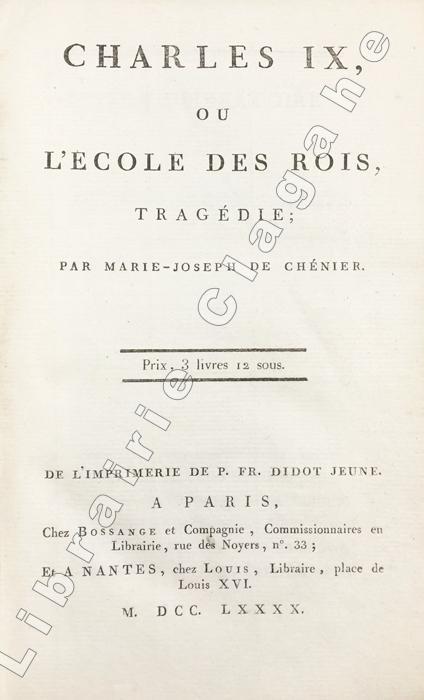
17906385Paris, Bossange (Imprimerie de P. Fr. Didot Jeune) et Nantes, Louis, 1790 ; (2) ff., 262 pp., (1) p.La pièce Charles IX est suivie de : Discours prononcés devant M.M. les Représentants de la Commune, le vingt-trois aoust 1789 ; De la liberté du théâtre en France ; de huit lettres ; Épître aux manes de Voltaire.Suivi de : [Dulaure, Jacques-Antoine] Crimes et forfaits de la Noblesse et du Clergé, depuis le commencement de la Monarchie jusqu'à nos jours. Paris, sans nom, sans date (1793) ; VI, 164 pp. et frontispice satirique gravé. Deux volumes reliés en un tome in-8 ; plein veau marbré, dos lisse orné et doré, pièce de titre en maroquin vert, tranches jaspées (reliure de l'époque).
17304896DBZurich, 1730. 22 x 27 cm (Blattgrösse). Titelblatt und 11 Druckgrafiken auf 6 Blatt. Lose Blätter mit Fadenheftung. + Wichtig: Für unsere Kunden in der EU erfolgt der Versand alle 14 Tage verzollt ab Deutschland / Postbank-Konto in Deutschland vorhanden +
17772318BBLeipzig, Weidmanns Erben und Reich, 1777. Gr.-8°. 1 Portrait, 13 Bl., 574 S.; 1 Bl., 618 S., 29 Bl. Mit 4 gefalteten Karten und 1 Tafel. Pappbände der Zeit mit Rückensch. + Wichtig: Für unsere Kunden in der EU erfolgt der Versand alle 14 Tage verzollt ab Deutschland / Postbank-Konto in Deutschland vorhanden +, A|B|C 2 Bände.
1751LR0042<p><em>The Letters of Pliny the Younger With Observations on each Letter; And an Essay on Pliny's Life Addressed to Charles Lord Boyle By John Earl of Orrery.</em> 1751 two volumes. 4to 25x20 cm 9¾x8". iv lxxxvii 440 16; iv 509 32 pp. Engraved allegorical title-page device by Michael Van der Gucht twenty-three large head- & tailpieces engraved by Jacob Bonneau after designs by Samuel Wale and numerous decorative initials. Period full calf red leather spine labels. First Edition thus.</p><p><strong>About this book</strong></p><p>First Edition of this translation of the classic letters first issued between c.100 and c.109. John Boyle fifth Earl of Cork fifth Earl of Orrery and second Baron Marston 1707-1762 had literary aspirations and became a friend of Jonathan Swift Alexander Pope and Samuel Johnson. But they had no illusions about his intellectual gifts; and Boyle took some revenge on Swift's condescension in Remarks on the Life and Writings of Jonathan Swift London 1751. His translation and commentary on the wonderful letters of Pliny the Younger appeared five years after the first translation into English done by William Melmoth and were not an improvement. But the letters which survey the whole range of Roman life and society including the eruption of Mount Vesuvius and the death of Pliny the elder as well as problems with the upstart Christians are fascinating; and Boyle's comments are complacently entertaining. The translator's very long introduction describes not only the life of Pliny but many aspects of Roman history government laws and ways of life including detailed accounts of the baths and gymnasia.</p><p>Gaius Plinius Caecilius Secundus born Gaius Caecilius or Gaius Caecilius Cilo 61 – c. 113 better known as Pliny the Younger was a lawyer author and magistrate of Ancient Rome. Pliny's uncle Pliny the Elder helped raise and educate him.</p><p>Pliny the Younger wrote hundreds of letters of which 247 survive and which are of great historical value. Some are addressed to reigning emperors or to notables such as the historian Tacitus. Pliny served as an imperial magistrate under Trajan reigned 98–117 and his letters to Trajan provide one of the few surviving records of the relationship between the imperial office and provincial governors. Two of the letters included are to Tacitus: The first letter describes the journey of his uncle Pliny the Elder during which he perished during the eruption of Vesuvius; the second one describes his own observations in a town across the bay see photo 12. These letter are probably the very first detailed description of a volcanic eruption. The eruption column with its umbrella-shaped cloud that is also found at other volcanoes was named after him Plinian eruption column.</p><p>Pliny rose through a series of civil and military offices the cursus honorum. He was a friend of the historian Tacitus and might have employed the biographer Suetonius on his staff. Pliny also came into contact with other well-known men of the period including the philosophers Artemidorus and Euphrates the Stoic during his time in Syria. Wikipedia</p> Printed by James Bettenham for Paul Vaillant hardcover
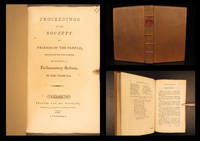
179329720<p>A rare and historically significant bound volume uniting four tracts central to Britain's late eighteenth-century parliamentary reform movement. Included are "Proceedings of the Society of Friends of the People" 1793 "Treachery No Crime or the System of Courts" by Charles Pigott 1793 "An Historical Essay on the Principles of Political Associations in a State" by John Brand 1796 and "Petition of the Friends of the People" 1793. These works illustrate the intellectual division between loyalists and reformers in the years following the French Revolution as British Whigs debated representation and political legitimacy. Pigott's essay is particularly striking for its bold critique of monarchical corruption framed through the defection of General Dumouriez. Each tract retains its original pagination reflecting separate printings later united in one octavo volume. Near Fine condition; expertly rebound in modern full leather with clean unmarked leaves. Collation: 69 3; 4 159; 6 106 2 107–138; 15 pp. Octavo 8vo single volume. #29720 PHOTOS AVAILABLE UPON REQUEST.</p> Mr. Westley, J. Ridgeway; T.N. Longman and J. Owen; J. Ridgway hardcover
175535632London: Scots Magazine 1755. First Edition. Leather bound. Defective. Octavo. 12 monthly issues bound in one volume. 648 pages 16 pages partial index. No illustrations in this volume. Brown calf leather binding with red leather title labels on the spine. Defective. Missing all the preliminary pages. Missing index pages and rear end papers after the name "Stuart". Leather covers are rubbed and edge worn. Outer joints and inner hinges are cracked. Covers are loose but attached. Title page has light damp stains and a small scuff. Pages 159 160 have an edge tear resulting in minor loss of print. The first page is present in the January issue. Defective.<br /> <br /> A sampling of subjects covered in this volume include East India Company Mutiny Bill; Sir Isaac Newton on the ancient year; Affairs in Spain Barbary and France; An Account of Mr. Johnson's English Dictionary; Improvements of the musket and of church-music; 'Pensylvania' German Protestants; Importance of British Plantations; Gov. Dinwiddies Speech to the assembly of Virginia; Gov. Dobb's message to the assembly of N. Carolina; Affairs in the United Provinces and the Plantations; General Braddock's defeat with the lists; Further accounts of the fatal action in America; Affairs in France and the Plantations; Different accounts of General Braddock's defeat; An Examination of the Edinburgh Review; A New History of 'Pensylvania'; Of the French 'incroachments' in America; Gov. Glen's interview with the Cherokee Indians; Speeches of Indian Chiefs and several more articles. Contents also include European history public affairs parliament acts births deaths marriages poetry book reviews and more. Interior contents are mostly in good condition. Volume published during the French Indian War era in America. Scots Magazine unknown
1790B4011London: Captain Sutherland J. Johnson 1790. Occaisional light browning but otherwise a very good copy. . Binding: Expertly rebacked in a brown half calf saving the original marbled boards. 5 Raised bands in 6 compartments. Tooled gilt lettering on two. Notes: Blackmer 1623; Weber 618 Size: 8vo 130mm x 210mm Category: Book Voyages General;Book Mediterranean;Book Near East Turkey; Captain Sutherland, J. Johnson hardcover
173189ghW. Innys London 1731. 1st Edition. Hardcover. Fair/No Jacket. 365 pages as found. Seventeen copper plate illustrations Table 12 missing plus frontis illustration. Two of these are folded - they are in tight snug condition. At some stage rebound in board with leather spine and facings. The spine edges have wear but the binding is strong and very stable. The faces have wear and scuffing. They are strong and dignified. The front and end pages are spotted by foxing. The papertrims are bound. The contents are very firm to the binding. They are considering their age lively and engaging. They are as informative and welcoming as at publication. One of the folded plant illustration tables contentedly shows a Hottentot mother puffing serenely and happily at a marijuana pipe! There is wear and marking and staining throughout. However the bodies of the pages are clear and bold and certain despite character-instilling tanning. A useful gratifying enchanting book that rests comfortably in the hand and on the shelf. fk. Our orders are shipped using tracked courier delivery services. W. Innys, London hardcover
172850632hEdinburgh: Mr. Thomas Ruddiman 1728. Book. Very Good. Hardcover. 1st Edition. 8vo - over 7¾ - 9¾" tall. Contemporary full tooled Cambridge paneled calf with raised bands and burgundy gilt title label to spine. Some minor professional restoration to binding. Edges and endpapers mildly toned. Otherwise a clean tight and unmarked book. Very neat -- a sound and handsome copy of this scarce political Scottish Church tract. No half-title. vi242pp. Mr. Thomas Ruddiman Hardcover
1798AQ24597London: s.n. 1798. 15pp 1. Uncut. Stitched as issued. A trifle creased browned and dust-soiled. An apparently unrecorded edition in original state of a liturgy to be used on the day of national thanksgiving ordered in celebration of the British victory over the French fleet at the Battle of the Nile. Owing to Nelson’s first dispatches being intercepted confirmation of the British victory in the first days of August 1798 - which represented one of the most significant reversals of fortune in the naval Age of Sail securing supremacy of the Mediterranean for the Royal Navy - did not reach England until 2nd October. Jubilant celebrations erupted around the country. The usual databases record numerous variants of the edition published by George Eyre and Andrew Strahan printers to the King. The present edition without any information in the imprint besides the date is seemingly unaccounted for. Intriguingly those editions that are recorded run to only 11pp.; the present issue however contains a 3pp 'Communion Service' evidently not included in other states - perhaps suggesting an edition printed for the use of a specific unidentified parish Not in ESTC. . Quarto. [s.n.] unknown
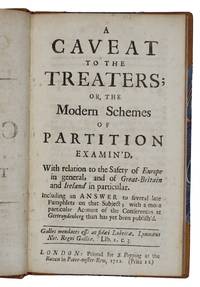
1711AQ26623London: Printed for S. Popping 1711. 8 88pp. Modern half-calf marbled paper boards contrasting red morocco lettering-piece. Minor shelf-wear. Half-title browned. The sole edition of a pamphlet variously attributed to Bishop of Chichester Francis Hare 1671-1740 and physician and satirist William Wagstaff 1683/4-1725 demonstrating 'the Danger of leaving the House of Bourbon in possession of the whole Spanish Monarchy or of any considerable part of it' occasioned by the peace negotiations March-July 1710 held at Geertruidenberg in the United Provinces between representatives of Louis XIV and the Dutch in an attempt to conclude the War of the Spanish Succession and written partly in response to three contemporary pamphlets; The ballance of Europe: or an enquiry into the respective dangers of giving the Spanish monarchy to the Emperour as well as to King Philip; Reasons why this nation ought to put a speedy end to this expensive war; and An essay at a plain exposition of that difficult phrase a good peace - all commonly ascribed to Daniel Defoe 1660-1731. ESTC T56742. First edition. 8vo. Printed for S. Popping hardcover
1790AQ19050Londini i.e. London: Sumptibus editoris excudebant M. Ritchie & J. Sammells 1790. 4 484pp 2. With a terminal errata leaf. Handsomely bound in contemporary navy morocco ruled and lettered in gilt A.E.G. A trifle rubbed. Marbled endpapers later armorial bookplate of William Cavendish to FEP inked ownership inscription of Cavendish dated 1824 and recent bookplate of Robert J. Hayhurst to verso of FFEP internally clean and crisp. Gaius Plinius Caecilius Secundus c.61-c113 administrator of part of the Roman Empire. Pliny the Younger adopted by his uncle Pliny the Elder studied philosophy and rhetoric under Nicetes Sacerdos and Quintilian eventually rising to the political court where he prosecuted provincial governors on charges of corruption and extortion. He achieved the ranks of both Praetor and Consul in 100 AD. Friend of Tacitus Martial and Suetonius Pliny was likewise a published author with these 10 books of letters issued between 100 and 109 - collectively they form almost the entirety of Pliny's surviving work and offer a valuable insight into the Roman world of the 1st Century. They deal with various issues including one of the few accounts of the eruption of Vesuvius made by an eyewitness for the Younger Pliny had accompanied his uncle and adoptive father to the area in 79 AD describing the event in detail in a letter to Tacitus VI. This handsome copy is from the library of Whig grandee and noted arts connoisseur William George Spencer Cavendish 6th Duke of Devonshire 1780-1858. ESTC T133036. 8vo. Sumptibus editoris excudebant M. Ritchie & J. Sammells unknown