6 502 résultats
190763141Princeton NJ 1907. 4to 28 cm. 10 pages typed rectos only approximately 2850 words each leaf mounted along the left edge to a larger heavier sheet each page double-spaced with 29 separate ink corrections deletions and additions by Cleveland in his characteristic hand 44 words added 19 deleted 20 typos of poor strikes corrected; in addition there are numerous editorial marking on each page "by Grover Cleveland" is written in pencil in another hand underneath the title on the first page and "corrected by Cleveland" is written in pencil in yet another hand at the upper corner of the first page. The longest correction or addition occurs in the final paragraph where Cleveland strikes through four words replacing them with twelve. Following publication the "Youth's Companion" the essay appeared in newspapers e.g. "The Daily Republican" Monongahela Pennsylvania 25 February 1908 under the title "Our People and Our Ex-Presidents." We found one other unsigned essay by Cleveland at auction also a 10-page typescript with holograph corrections "Woman's Mission and Woman's Clubs" sold at Christie's in 2002 $8000. Very good condition throughout. 9870. An essay on the relationship between the American people and their ex-presidents by the only man who was ex-president twice. It addresses the expectations and demands the people place on their former presidents the personal financial effects these may have and the failure of the country to provide any support for them. Noting thankfully his own personally secure estate he based this one and cites specific examples of financial distress among earlier presidents. That combined with his own observations gave him concern for future ex-presidents. "If in concluding this discussion a personal word is necessary or permissible in view of the fact that I am the only man now living who could at this time profit by the ideas I have advocated I hope my sincerity will not be questioned when I say that I have dealt with the subject without the least thought of personal interest or desire for personal advantage. I am not in need of aid from the public treasury. I hope and believe that I have provided for myself and those dependent upon me a comfortable maintenance within the limits of accustomed prudence and economy and that those to whom I owe the highest earthly duty will not want when I am gone." <br/><br/> unknown books
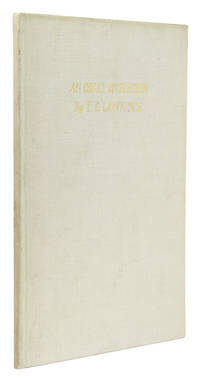
1937308243Corvinus Press 1937. No. 20 of 30 copies on J.B. Green unsized paper edition of 32. 1 vols. 4to. White linen. Fine. No. 20 of 30 copies on J.B. Green unsized paper edition of 32. 1 vols. 4to. Poet and diplomat James Elroy Flecker 1884-1915 burned bright and briefly. He joined the diplomatic service in 1908 trained for two years and was posted to Constantinople in 1910 "but in September a slight fever was diagnosed as tuberculosis and he returned to England to a sanatorium. He pronounced himself cured and . went back to Constantinople in March 1911 to be transferred in April to Beirut. Flecker was not a very efficient vice-consul" ODNB. His first formal collection of verse The Bridge of Fire was published in 1907 and The Golden Journey to Samarkand was published in 1913. He died in Switzerland aged thirty-one.<br/>Lawrence knew Flecker in Beirut before the war. "Flecker probably introduced Lawrence to contemporary poetry" wrote Wilson in his introduction to Minorities 1971. <br/>According to O'Brien An Essay on Flecker was "written in 1925 with the intention of publication in a periodical and did not appear in print until 1937". O'Brien A198; Ridler p. 58 #41 [Corvinus Press unknown books
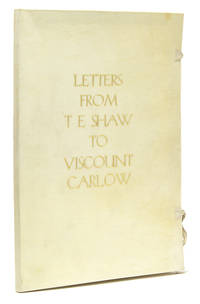
1936308242Corvinus Press 1936. No. 11 of 17 copies this copy on Milbourn hand made paper. 15 unnumbered leaves. 1 vols. 8vo. Full white vellum with yapp edges upper cover titled in gilt by Sangorski & Sutcliffe. Liddell Hart bookplate. No. 11 of 17 copies this copy on Milbourn hand made paper. 15 unnumbered leaves. 1 vols. 8vo. Presentation to Eric Kennington. Inscribed to artist Eric Kennington: "EK from Carlow"<br/><br/>Only 17 copies were printed on a variety of paper stocks for private distribution only.<br/><br/>RARE. O'Brien A193 [Corvinus Press unknown books
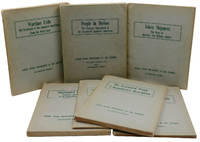
1946140941373Washington D.C.: U.S. Government Printing Office 1946. First Edition. Very Good. First edition first printings. Seven titles: Wartime Exile 167pp.; Impounded People 239pp.; The Relocation Program 105pp; Administrative Highlights of the WRA Program 82pp.; Token Shipment 104pp.; The Evacuated People 200pp.; People in Motion 270pp. Good. Wraps worn some soiled foxed chipped or stained; People in Motion has a long tear to the rear cover. Handwritten titles on spines which are also creased and chipped with loss to spine ends. Pages toned sometimes creased. <p><br /> <br /> Rare documents of the American government's official record of its WWII internment of people of Japanese descent one of the most controversial official programs in American history as reported by the War Relocation Authority. The WRA managed the forced confinement of people of Japanese ancestry in America during World War II as well as their return to civilian life with the commencement of the war. U.S. Government Printing Office unknown books
48387The papers both manuscript and printed document Read's various careers in education business farming and law in Massachusetts and Maine as well as his family's activities from the decades before his marriage in 1790 through the mid-nineteenth century. Some usual attic wear and soil to a small percentage of the papers but a very good lot overall. For the archive Read's multi-faceted career began with his matriculation at Harvard 1777-1781 where he studied for the ministry and became such a well-regarded Hebrew scholar that he was engaged to fill a teaching post in the subject while still an undergraduate. Following his graduation Read taught school for two years before being elected a tutor at Harvard; he resigned that position in 1787 to begin the study of medicine eventually leaving that field behind to open an apothecary shop in Salem. During the 1790s he invented a number of steam engine related improvements and organized the Salem Iron Factory for which he invented a number of manufacturing improvements. After serving in Congress Read moved to Belfast Maine where he served on the local bench for decades while participating in a variety of civic activities and operating his farm. He was elected to the American Academy of Arts and Sciences in 1791 and was an honorary member of the Linnaean Society of New England from 1815.<br/><br/>Included in the family papers offered here is material related directly to Read's life in Massachusetts and Maine account ledgers land surveys correspondence broadsides copies of his own publications receipts for law and medical books from Boston booksellers James White and James W. Burditt etc. approximately 85 items; a detailed view of the construction of his house in Salem Massachusetts in the late 18th-century as represented by a collection of 65 receipts most of them made out to Mrs. Elizabeth Read from a variety of contractors carpenters and other workmen on the job; manuscript and printed material related to the operation Belfast Academy including a ledger several broadsides and a variety of minutes memoranda and other instruction from the town selectmen as presented by Read approximately 25 pieces; material related to the family of Elizabeth Jeffrey Read's wife including guardianship documents and related ledgers business papers and school work 15 pieces; and material related to Read's son William J. Read including letters to his father his 1826 appointment as a Maine justice of the peace and extensive documentation of his years at Bowdoin College 1820-1823 30 items.<br/>Among the interesting items in the archive are the following:<br/>1 Three manuscript "cash books" books kept by Nathan Read in Massachusetts in the 1790s and in Belfast Maine in the 1820s and for a five year period 1836-1841.<br/>2 Three autograph letters written by Mrs. Read addressed to her husband in Washington D.C. while he was serving in Congress.<br/>3 READ Nathan. An Essay on Creation and Annihilation the Future Existence and Final State of All Sentient Beings. Belfast ME: Charles Giles printer 1845. Second edition first published anonymously in Belfast 1828. 8vo. 14 pp. With extensive manuscript additions and corrections by the author. OCLC locates two copies Harvard Bowdoin. Original plain wrappers stitched. Fine.<br/><br/>4 CONGRESS O'BRIEN Jeremiah 1778-1858 Maine Congressman 1823-1828. Discussing the limits of Congressional power in an autograph letter to Nathan Read Belfast Maine resident inventor former Massachusetts congressman signed by O'Brien 22 February 1828 at Washington. 4to. 9 3/4 x 8 inches. 4 pages one sheet of American laid paper folded approximately 775 words in ink. Folded for mailing; with its original franked envelope bearing a Washington D.C. cancellation stamp and O'Brien's red wax seal broken. Responding to a recent letter from Nathan Read and apparently differing from his viewpoint O'Brien writes primarily of dubious Constitutional grounds for congressional action on internal improvements and on education seeing both as doomed to inequity inefficiency and excessive cost: "I am not for loading the national government with subjects that can be better & more economically performed by the constituent parts of the Union." As evidence he cites an example: that of J.C. Calhoun then vice-president who had earlier let the controversial "Rip Rap Contract" as secretary of war and was accused of sharing in profits from it. The letter addresses issues of the day summarizes a portion of its author's philosophy of government and echoes arguments continued through every American era.<br/>5 DECORATIVE ARTS SILVER TYLER David. Selling tablewear to a Nathan Read in an autograph receipt signed twice 29 August 1790 in Boston for delivery of goods to Read. Half-sheet folio 8 x 8 inches. Tyler 1760-1804 worked as a silversmith and jeweler in Boston 1785-1803. Included in the order were "6 Large Table Spoons" £5 8 and "12 Small Tea Spoons" £2 along with sugar tongs a salt shovel and a pen knife.<br/>6 Two manuscript ledger books kept by Mrs. Read's guardian in the 1760s documenting his management of her assets. Such colonial records for wards are quite scarce in trade.<br/>7 Signed receipts from the following Salem Massachusetts and surrounding area artisans 1790-1793 documenting their work or sale of products in the construction of the Read's house: Sam Austin Eben. Caldwell Jno. Appleton Ezra Leavis Nath. Hopkins Peter Oliver Daniel Bancroft Wm. Phelps Abel Gardner Edward Brown Sam. McIntire "frontispiece to your house" Sam Archer Joseph Mackintire Sam Archer Nath. Knight and Nathan Putnam among others.<br/>8 At least four unrecorded broadsides a series of partly printed receipts from the financial office at Bowdoin College in the early 1820s all completed in manuscript some with extra notes and signed by John Abbot treasurer and librarian of the college an extensive file of manuscript material dealing with the founding and management of Belfast Academy in the early 1820s and a variety of other material from Nathan Read's estate papers. <br/><br/> unknown books
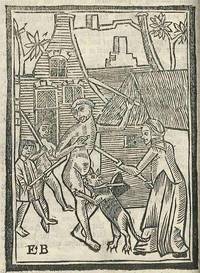
1684WRCLIT66732London: Printed by T.J. for Edward Brewster . and Thomas Passenger . 1684. Three parts bound in one volume. 80 leaves A-U4; 56 leaves A-O4; and 8160pp. Quarto. Modern blind paneled calf raised bands gilt label. First two parts illustrated with spirited woodcuts. Occasional foxing and mild spotting marginal smudges to first title usual tanning lower forecorners of E2-3 in first part torn away and replaced with a few letters and a few words in the sidenote in ms a few upper margins dust-soiled last three gatherings in third part supplied from another copy and trimmed slightly shorter at lower margin; a good sound copy neatly bound. First edition of the third part. An omnibus gathering of these three separately printed editions each with independent register and with the title of the first part taking into account the presence of the latter two. The terminal advert leaf to the first part is present. Wing attributes the text of the first part to John Shirley and that for the third is occasionally attributed to the publisher Edward Brewster. The first part is illustrated with 62 woodcut illustrations signed 'E.B.' of which 23 are repeats; the second part includes 15 woodcuts all of which appear as well in the first part. The first part was first printed in this form in 1667 and the second in 1672; the first part was reprinted again in 1701. Among the most widely adapted of the beast fables the tales of Reynard the Fox originated in the 12th and 13th centuries with early versions in French Dutch Latin and German being notable. Caxton printed a translation based on a Flemish text in 1481. The character of Reynard an anthropomorphic fox and trickster has since become almost an archetype in the literatures of several languages. ESTC R24532 & R218371 & R40614. WING S3513 & M2912 & S3436. BRUNET IV:1228. LOWNDES VII:2076. Printed by T.J. for Edward Brewster ... and Thomas Passenger ... hardcover books
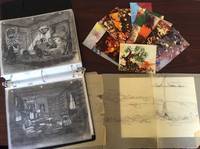
13256Used; Like New/Used; Like New. A remarkable and important collection of 178 original drawings designs and color samples by the Academy Award-nominated art director Franz Bachelin from the 1959 Jules Verne adaptation Journey to the Center of the Earth together with several original documents relating to the production of the film. The drawings include designs for almost every important location in the film from set designs for the opening scenes in 1880's Edinburgh with bagpipers on parade to action scenes of the whirlpool at the Earth's core the attack of a winged lizard and the lost city of Atlantis. 145 drawings are in black ink and graphite on 8.5 x 11" sheets hole-punched each labeled with a scene number and many with other indications; 5 are in colored pencil 9 x 8." A further 4 larger plans on tracing paper approx. 22-26 x 9" show Bachelin's meticulous planning of the final sequence of adventure scenes and the geographical location of the lost city of Atlantis! <br style="">Also with the drawings are 10 small cards 3 x 5 to 6 x 7" bearing vibrant sample color and texture schemes in marbleized patterns; 13 mimeographed 10 x 5" copies of drawings of the "prehistoric animal fight" showing dinosaurs battling it out in the water; and a lovely small painting of a tree and a sunset on card 5.5 x 4.5". <br style="">Together with the drawings are several documents from the production of the film including: a set construction estimate 4 pp.; May 12 1959; a large production cross plot showing the complete filming schedule over 52 days 1 p.; June 9 1959; a complete list of the crew members including a duck trainer! with phone numbers 1 p.; June 15 1959; a chart showing the total labor and materials costs for each of the elaborate set and location shoots - over $449000 2 pp.; December 3 1959; a typed copy of the film's credit 1 p.; n.d.; and a telegram inviting Bachelin to a pre-Academy Awards cocktail party for nominees 1 p.; n.d.<br style="">The drawings are in fine to very fine condition overall with only slight toning a few with slight tears or corner creases; one of the larger tracing paper drawings is in delicate condition with some creasing and tearing due to the paper. The documents are in good to fine condition some with toning creases and tears.<br>Overall a superb collection of drawings and materials from this iconic adventure film.<br style="">Journey to the Center of the Earth a loose adaptation by Charles Brackett from the novel by Jules Verne was directed by Henry Levin and starred James Mason Pat Boone and Arlene Dahl. Released in 1959 it was a box office success pleasing audiences with its fantastical plot sets and special effects a particular feature were iguanas with glued-on fins playing the part of dimetrodons! The film was nominated for three Academy Awards for Best Art Direction-Set Decoration Lyle R. Wheeler Franz Bachelin Herman A. Blumenthal Walter M. Scott Joseph Kish Best Effects Special Effects and Best Sound Carlton W. Faulkner. unknown books
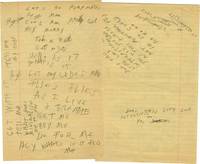
1977127072N.p.: N.p. 1977. Original manuscript by Joey Ramone for an unrecorded Ramones song "Let's Go Playmates" executed by the punk legend in holograph pencil on both the recto and verso of a legal size sheet of lined notebook paper. The lyrics appear in every orientation a beautiful messy gathering of ideas-some crossed through-rather than a finished song. They read variously: Recto "Let's go playmates / Hey man / Cool man / Pretty cool / Hey Mommy / Take a bath / Get a job / What is it / Hey got my ludes man / Tell me my son / Flies flies / As I live and breathe / Get me / Buy me / Do for me / Hey what's in it fer me / Get with it / Tell me / What does minimalism me to you." Verso: "Does this life look interestin to you well you too can have all this and more / Not another fly / Im so cold / No no no." <br/><br/>A rare example of the songwriting process of a writer for a band whose work stands not only at the top of the punk ladder but really in a realm of its own. The manuscript is not dated but judging from the content it could not have been written after 1978 though probably not prior to the 1977. The final lyric "Does this life look interestin to you" puts it right on the borderline between the band's early fun-drug-crazed songs and the later more goofily philosophical ones. In any case one hell of a piece of paper. <br/><br/>Lined legal size notebook paper 8 x 12.5 inches. Fine. N.p. unknown books
1794277980Philadelphia: John Fenno 1794. Second. paperback. very good-. Published for the House of Representatives. 4 folding tables. 65pp. 12pp. appendix. Folio original blue wrappers margins uncut backstrip of spine lacking front and back wrapper with some light dampstaining internally very good. Philadelphia: Printed by John Fenno 1794. Very Scarce.<br/><br/> Enlarged second edition printed the same year as the first edition. Folding tables show the exact expenditures and receipts of the United States government for the year 1793. The rest of the text are figures of receipts from custom duties duties on alcohol and other revenue sources and payments by the Federal government are delineated item by item and dated. Payments to individuals have each person's name listed. The appendix is titled: Appendix containing statements shewing the operation of the funds for reducing the domestic debt to the close of the year 1793. Also statements of the foreign and domestic debts of the United States and of the expenditure of the proceeds of foreign loans to the same period. In 1793 the revenue for the Federal budget was 4.8 million dollars and the public debt was 80.4 million dollars. John Fenno the printer of this work printed many works for the administration of George Washington and the Congress. He was an ardent Federalist and a protege of Secretary of the Treasury Alexander Hamilton. Fenno also was the publisher of the Federalist newspaper Gazette of the United States. Evans 27931<br/><br/> John Fenno unknown books
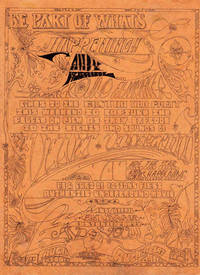
196712983Boston: np 1967. First Edition. Fine. 11 3/8” x 8.5” offset poster black ink on brown paper. Hand-lettered in a psychedelic style designed by "T. F Murphy.” PROVENANCE: From the estate of Velvet Underground guitarist Sterling Morrison with Morrison's widow Martha's signed letter of provenance included. Originally glued to another piece of paper the poster has been professionally restored and is now backed with archival rice paper. Fine. <br/><br/>Rare poster to what has become an historic event. The Velvet Underground played The Boston Tea Party the Beantown equivalent of Max's Kansas City numerous times throughout their career. And their performances over the weekend of August 11th-12th might have been just another appearance had Andy Warhol not been present to film the band. The footage he shot is one of only two performance films of The Underground with synched sound and more importantly is the only footage of the band in color extant. Capturing The Velvets just before the WHITE LIGHT/WHITE HEAT sessions Warhol's footage features the Exploding Plastic Inevitable and utilizes numerous experimental techniques – in- camera edits sudden zooms single-frame stills sweeping panoramas – meant to mimic the experience of seeing live The Velvets and their troupe. Warhol's film was long believed lost. As Steve Nelson remembered: "There's this mythical film that was shot at the Tea Party in August 1967 . That weekend was the first time they incorporated the Andy Warhol side of The Velvet Underground into the Tea Party presentation. Andy actually came there . and Paul Morrissey was there and supposedly they filmed . I know they were there; I know they were pointing cameras. Was there any film in the cameras or did it just disappear I really don't know. The film just never seems to have shown up" quoted in WHITE LIGHT/WHITE HEAT 158. The film was unearthed remastered and restored in 2009-2010 and toured museums and art houses around the country from late 2010 through early 2011 as THE VELVET UNDERGROUND IN BOSTON 1967 16mm 33 mins. Dir: Andy Warhol. C/O THE VELVET UNDERGROUND 53 and NEW YORK ART 202 reproduce the original art for this poster but not the poster itself the latter noting it now seems erroneously that the shows “never took place.” Not in DeRogatis. A rare artifact to an important Warhol film and document of The Velvet Underground in their prime. Warhol's film work continues to be recognized as being as groundbreaking as anything he did on canvas and The Velvets remain probably the most influential band of the last fifty years. As Lester Bangs has written: "Modern music begins with the Velvets and the implications . of what they did seem to go on forever." With extraordinary provenance from the estate of VU member Sterling Morrison knee-weakeningly cool. np unknown books
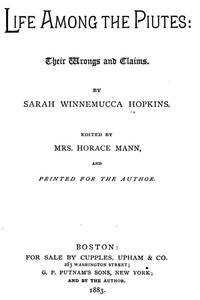
19963406V.p. 1996. A collection of 410 titles concerning Women in the West. Condition Statement: Overall most of the books in the collection are in "good" or "good" condition which typically describes a book that is sufficiently worn the binding soiled scuffed stained or spotted and may have loose joints hinges pages etc. To a lesser extent there are books in "fair" condition namely a well-worn book that has complete text pages including those with maps or plates but may lack endpapers half-title etc. The binding and/or jacket may also be worn. Women in the American West: Books and Ephemera from the Collection of Dorothy Sloan. SEE DETAILED FINDING AID on our website. <br/><br/>Dorothy Sloan b. 1943 is justly considered to be one of great scholar-booksellers of Western Americana Texana and Latin Americana. Dorothy Sloan Rare Books auction catalogues are recognized as models of their kind and feature an unusually broad array of printed books maps manuscripts and ephemera and are particularly strong in 19th-century materials. In many instances Sloan's bibliographic descriptions have become the description of record.<br/>She began her career at John Howell in San Francisco and thence to Jenkins Company in Austin. She issued her first rare book catalogue in 1984 and her first auction catalogue in 1994. Suffice it to say that as a woman she was literally a pioneer in such an endeavor. <br/><br/>Over the years she built a collection of Women in the West which is described in the 29-page Inventory below. Here is a collection of both women authors and women as the subject of historical and literary narrative. Most of the collection was kept in storage for the last twenty-eight years awaiting cataloguing and eventual sale. As we all know "Life" often interferes with our plans particularly as we grow older. <br/><br/>When Dorothy retired last year we acquired the collection of Women in the West. We are pleased to offer it en bloc for the price of $8200 which includes free shipping in the Continental United States. <br/><br/>Of the 410 titles in the collection nearly 25% are more than a century old. The earliest book in the collection is Sally Hastings' Poems on different subjects. To which is added a descriptive account of a family tour to the West. Lancaster 1808. The author describes her travels from Lancaster County to Washington PA. through the Alleghenies and gives an account of the Ohio River at Pittsburgh.<br/><br/>Only a handful of titles in the collection were published in the last 30 years the "newest" one dated 1996 namely: Anne Butler and Ona Siporin Uncommon common women. which contains culturally and ethnically diverse accounts of women who lived in the American West.<br/><br/>The physical size of the collection is considerable. Without any packing material it would encompass 15 large boxes. There are photographs gum cards engravings various inscribed books plays of the California Gold Rush memoirs and captivity narratives travelogues captivity narratives autobiographies Western novels pamphlets private press material a few 'zines journals catalogues and magazines. It is the culmination of decades of labor spanning all genres in the Western Americana tradition. The collection represents women's voices of a myriad of ethnicities including various Native American tribes African and African-American women Hispanic women prostitutes madams cowgirls ranchers pioneers and their struggles in the face of physical social and cultural adversity. <br/><br/>We are reluctant to mention "highlights" as it would suggest that "lowlights" do not merit attention from scholars and bibliophiles alike. We invite readers to peruse the Inventory of the collection capably prepared by Hunter Corb to allow readers to make that determination for themselves. <br/><br/>Included is the first edition of Miriam Colt's autobiography which describes her ill-fated expedition to Kansas Went to Kansas 1862 in which she traveled more than 1300 miles to establish a communal vegetarian colony. Colt provides vivid and frightening details of a family's ordeals on the frontier landscape including severe illness and encounters with lawless gangs. Defrauded of their investment in the Vegetarian Settlement Company the Colts left Kansas in the fall of 1856. Colt's husband and son died en route leaving only mother and daughter to return to New York. <br/><br/>Another work of interest is Sarah Hopkins's Life Among the Piutes an autobiography written at the encouragement of Ralph Waldo Emerson. This is considered to be the first book written and published in English by a Native American woman. It provides "extensive information about pre-White northern Paiute culture the types of foods marriage and other social practices as well as political leadership" Paher while simultaneously increasing awareness and sympathy for the plight of Native Americans. <br/><br/>Melinda Rankin's Twenty Years Among the Mexicans describes her missionary labor in south Texas and Mexico. Herein are depicted the experiences of the first Protestant woman missionary in Latin America. Although laws in Mexico at the time forbade the introduction of any form of Protestantism into the country Rankin traveled there in 1852 and established the first Protestant mission in Northern Mexico continuing her work there for a few decades before returning to the United States due to health problems. This narrative describes not just Rankin's missionary labors but also many dramatic events in Texas and Mexico including revolutionary turmoil the American Civil War and her capture by the notorious military leader rancher and outlaw Juan Cortina.<br/><br/>From early settlers of the West during and shortly after the American Revolution; to ranchers and pioneering women in the early days of the Republic of Texas and the fight for independence; to overland travels in covered wagons on the famed Oregon Trail at the outset of the American Civil War; to excursions into Mexico and Latin America at the end of the 19th and into the 20th centuries. Over two hundred years of women's experiences can be found within this collection and as such there is something for every student and subject matter.<br/><br/>SEE DETAILED FINDING AID ON OUR WEBSITE which enumerates each and every one of the 410 titles:<br/><br/>https://www.michaellaird.com/cat.phpid=307. unknown books
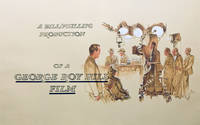
19732316951973. Pen and ink watercolor and pencil heightened with white on cream paper. 27 x 42 inches. Framed. Fine. Pen and ink watercolor and pencil heightened with white on cream paper. 27 x 42 inches. The original illustration for the second of four title cards used in the opening credits of the classic 1973 motion picture "The Sting" Provenance: Estate of George Roy Hill unknown books
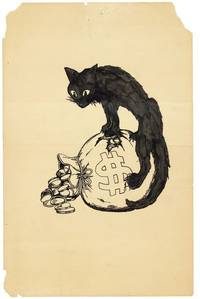
191332077Chicago: I.W.W. Publishing Bureau n.d. but 1913. Reprint 1917. 12mo 17cm.; original drab pictorial staplebound card wrappers; 32pp. Wrappers separated and staples cleanly removed; still a Good complete copy of a very uncommon pamphlet. Accompanied by the original cover artwork 43x27.75cm. black ink on cream stock several losses and a few closed tears to margins none approaching image old vertical fold line stock rather brittle from age and poor quality else Near Very Good. Quite possibly the earliest iteration of Ralph Chaplin's now-ubiquitous "Sabo-Tabby" the I.W.W.'s black cat symbol for sabotage. The present work shows the black cat with its claws fully extended while it arches its back on top of a bag of money coins spilling out. As Chaplin later wrote "My 'Sab Cat' was supposed to symbolize the 'slow down' as a means of 'striking on the job'" cf. https://iww.org/history/icons/black_cat though many including the United States government interpreted it as something much more pernicious. In fact the accompanying pamphlet with its cover art and title raised serious red flags and by the time the United States entered WW1 all copies of Sabotage still in the hands of the I.W.W. were destroyed. The present copy has the small promotional blurb by Jack London dated 1913 on p. 32 though the headquarters address printed on the recto and verso of the rear wrapper 1001 W. Madison St. in Chicago indicates that this is a reprint dating around 1917 probably just before an order was made to destroy all copies. MILES 462. I.W.W. Publishing Bureau unknown books
738736 folding leaves of which four are blank. 8vo 240 x 170 mm. orig. blue semi-stiff wrappers wrappers somewhat worn orig. label heightened in gold with manuscript title new stitching. Japan: n.d.<br /> During the Edo period there were 12 Korean delegations to Japan whose purposes were mostly to congratulate a new Tokugawa shogun. The missions which normally included 300-500 Koreans accompanied by roughly 1500 Japanese escorts symbolized the amicable relationship between the two nations and in the early years served to legitimize the Tokugawa shogunate.<br /> These delegations which usually took nine or ten months round-trip were enormously expensive undertakings for both countries. The Koreans brought many luxurious presents both public and private gifts and the Japanese in turn furnished equally lavish gifts including large quantities of silver. Also the receiving Japanese were obligated to fund a number of elaborate and costly banquets during the delegation's travels on the mainland and in the capital city as well as provide accommodations throughout.<br /> Our manuscript is concerned with one of the three final missions which took place in 1748 1764 and 1811 this last mission was held on the island of Tsushima located roughly halfway between Kyushu and the Korean mainland. All three of these missions experienced considerable cost-cutting. We suspect our manuscript is a record of the banquets for the final 1811 mission as there is a reference to a Russian translator at this time there was considerable tension between Japan and Russia because of the Russian desire to open trade with the island nation.<br /> Our manuscript describes a series of banquets served during one of these three final missions. In spite of the newly instituted austerity it is clear that the participants ate very well. For each of the 13 banquets we are given the number of guests and their official positions the number of dishes per tray what foods were served etc. Some of the banquets were limited to just a dozen or so guests and others included more than 300 people. <br /> The cuisine is very much in the tradition of the ritualistic preparation and serving of the food on a series of trays known as honzen ryori "main tray cuisine" which was the dominant banqueting style for the elite from the Muromachi period through the Edo period. Various seafoods including luxury items like lobster smoked fish roe octopus and preserved fish are listed along with preparations of chickens eggs many kinds of vegetables burdock daikon radish ginger eggplant wild wasabi and many vegetables that are today quite obscure cooked in various ways pickles mushrooms fruits persimmons pears yuzu nuts rice and other grains and elaborate confections including sweets of Portuguese origin like pound cake or kasutera.<br /> Fine copy preserved in a chitsu. unknown books
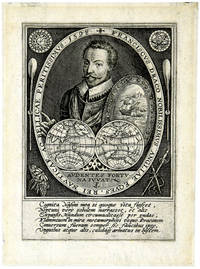
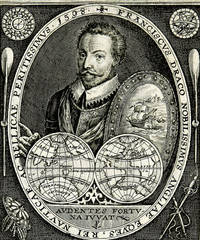
1598WRCAM41697Cologne 1598. Approximately 4 1/2 x 6 1/4 inches. An excellent sharp crisp impression. Fine. In a blue half morocco slipcase. This rare portrait of Drake by Crispin van de Passe comes from an early volume of engraved portraits EFFIGIES REGUM AC PRINCIPUM EORUM SCILLICET Cologne 1598. Drake who circumnavigated the globe in 1577-80 appears under the title "most noble English knight very experienced in all things nautical and military." "The portrait of Drake is of especial interest: it is a close copy of the smaller Hondius Drake portrait which in its first state exists in only two copies Royal Geographical Society and Huntington Library. It depicts him in bust with a shield and with a two-hemisphere terrestrial map displaying the track of his circumnavigation" - Kraus. De Passe's stylized monograph appears near the bottom of the portrait. Epigrammatic verses in Latin by Matthias Quad appear beneath the portrait. KRAUS DRAKE 59. SABIN 58995. GRAESSE V:154. BRUNET IV:414. unknown books
1598235791598. Engraved portrait approximately 4 1/2 x 6 1/4 inches. An excellent sharp crisp impression. Fine. In a blue half morocco slipcase. The very rare Crispin van de Passe portrait of Drake.<br/> <br/>This rare portrait of Drake by Crispin van de Passe comes from an early volume of engraved portraits Effigies Regum Ac Principum Eorum Scillicet Cologne 1598. Drake who circumnavigated the globe in 1577-1580 appears under the title "most noble English knight very experienced in all things nautical and military." "The portrait of Drake is of especial interest: it is a close copy of the smaller Hondius Drake portrait which in its first state exists in only two copies Royal Geographical Society and Huntington Library. It depicts him in bust with a shield and with a two-hemisphere terrestrial map displaying the track of his circumnavigation" - Kraus. De Passe's stylized monograph appears near the bottom of the portrait. Epigrammatic verses in Latin by Matthias Quad appear beneath the portrait.<br/> <br/>Kraus Drake 59; Sabin 58995; Graesse V:154; Brunet IV:414. unknown books
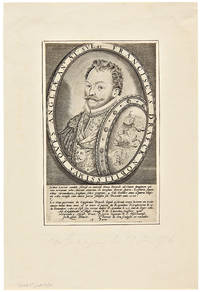
1583WRCAM47035Paris 1583. Engraved portrait oval with surrounding legend and text beneath on laid paper 6 7/8 x 4 1/4 inches. Cut to just within plate mark and inlaid into later wove paper sheet. Later ink inscription on verso reading: "from Holland / 1809." Minor wear and soiling. Matted. Very good. A clean impression of the second state of this famous portrait of Sir Francis Drake at age forty-three shortly after he returned from circumnavigating the globe the basis for most of the later images of him. The image is taken from a portrait purportedly painted from life by Jean Rabel the Elder and is said to be a credible likeness of the famed navigator. The legend beneath the portrait indicates the dates of Drake's circumnavigation listing Rabel as the painter and Thomas de Leu as the engraver. Thomas de Leu 1560-1612 a pupil of Rabel moved to Paris around 1576 and became one of the most noted portrait engravers of his time. This engraving of Drake was the basis for many later images of him including the well-known engravings by Jodocus Hondius and Crispin van de Passe. <br> <br> The earliest graphic image of one of the greatest figures in maritime history. Marianne Grivel "Au Sieur Rabel Parangon du la 'pourtraicture'." in H. Zerner and M. Bayard's RENAISSANCE EN FRANCE Paris 2009 pp.227-92 2d state. unknown books
1859620331859. Oblong folio sheet 7 1/4 x 14 in. staff ruled by hand in red ink. Music notation with corrected lyrics on recto additional verses on verso.<br/>An extremely rare complete vocal score with accompanying dance entirely in Emmett's hand. Emmett joined Dan Bryant's minstrel troupe in 1859 when the company introduced his "Dixie" on the New York stage as well as the present composition for which sheet music evidently was published in 1860 although locating a recorded copy has proved unsuccessful. <br/>Virtually all of Emmett's manuscripts were deposited early on in the Ohio State Library and are now in the archives of the Ohio History Connection. There are three drafts of the 'John Come Down de Hollow' there: a pencil ms. of words only entirely different from the finished version about a slave pursued by a bulldog in the rain; a fragment of Emmett's walk around in a different key a variant setting and the first two lines of lyrics only dated 1860; and a fair copy dated 1859 comparable to ours with full score and extra verses on the verso. Ours contains a textual revision not in the OHC copy. The lyrics of Emmett's song involve the dandy John's courtship advice to the ladies on how to avoid ending up an old maid the dandy John and the efforts of the singer to avoid marriage. Written in dialect with the usual stereotypical transgressions such lyrics are now generally accepted as having been appropriated and adapted from African-American sources. Intriguingly William Cullen Bryant collected the lyrics of a work-song version of 'John Come Down de Hollow' from slave sources during a visit in 1843 to a plantation in South Carolina. There "he witnessed a corn-shucking arranged for his benefit by the obliging proprietor unnamed but it may have been William Gilmore Simms. See Norris Yates "Four Plantation Songs Noted by William Cullen Bryant" in Southern Folklore Quarterly v. 15 1951. As described by Bryant "The negroes began to strip the husks from the ears.keeping time to the music.the songs were generally of a comic character but one of them was set to a singularly wild and plaintive air which some of our musicians would do well to reduce to notation." The differences between Bryant's 'plaintive' version and Emmett's provides a rare documentation of the typical way in which African-American sources were changed into comic minstrel repertoire.<br/>At the conclusion of the vocal score is a "Dance" in ten measures which would have been the 'walk round' element of the song mentioned in the title a minstrel dance which Emmett introduced in 1859 to the Bryant's Minstrels' performance routine one which typically closed the first half of the show. It is generally thought to have its origins in African circle shouts brought over by slaves and typically included a competitive element in which each dancer gets a chance to display his best moves while others clap or 'pat Juba' on their bodies. All stops were pulled out for these boisterous minstrel finales which were soon adopted by other bands and Emmett's walk-'rounds defined the type and are considered his most significant contribution to minstrelsy. Hans Nathan devotes an entire chapter to the walk-'rounds in his definitive biography of Emmett and closes with particular mention of "John Come Down de Hollow." As previously mentioned the song was evidently published as sheet music but Nathan could not locate a copy nor have we succeeded.<br/>Although he is today remembered chiefly as the composer of "Dixie" Emmett's importance to minstrelsy the overwhelmingly dominant American musical entertainment of the 19th century can hardly be underestimated. He was a founding member in 1843 of the Virginia Minstrels generally accepted as the first black face Negro minstrel troupe with what would become the full complement of banjo fiddle bones and tambourine. Their popularity and influence quickly spawned the genre with numerous imitators on both sides of the Atlantic and the devoted following of both white and black audiences. He was an accomplished banjoist and his many compositions were central to the repertoire. Hollywood produced a movie of his life starring Bing Crosby in 1940 and he was inducted into the Song Writer's Hall of Fame in 1970. For the definitive study of Emmett and his music with an entire chapter on Emmett's walk-rounds see Hans Nathan's "Dan Emmett and the Rise of Early Negro Minstrelsy." Apart from later transcriptions and quotes from "I Wish I was In Dixie's Land" and a transcription of seven verses of "Old Dan Tucker" which sold at auction in 1978 the present manuscript is the only strictly contemporary full draft of any of Emmett's numerous other compositions to appear in the auction records of the past fifty years this copy in 1964 to 2016. <br/><br/> unknown books
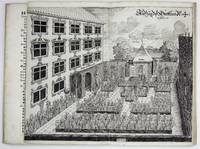
1641401738Augsburg: Johann Schultes and Mathias Rembold 1641. From the Collection of Arthur & Charlotte Vershbow. Folio 300 x 203 mm. Letterpress title printed in red and black torn and repaired 15 double-page or folding engraved plates or plans by Matthäus Rembold 1629-1657 on guards. Contemporary vellum. Some plates trimmed closely. Provenance: purchased from Ars Libri 1990. FIRST EDITION of this work on civil architecture by the eminent Ulm architect Joseph Furttenbach the Elder. The Architectura privata describes his own dwelling-house and grounds and the fine copperplates show the basics and elevations of the house windows portals grotto and gardens among other things. With its small grotto richly decorated with rare flowers arranged in compartments Furttenbach's garden courtyard epitomizes the intimate "secret garden" owned by the wealthy bourgeoisie in early seventeenth-century Germany and the Netherlands. The grotto in his garden is described as being filled with artifice and exotica including shell-encrusted sculptures and waterworks painted cosmological imagery and mirrors. The flowers depicted are identifiable as the most sought after and costly bulbs of the period the narcissus tulip fritillary and crown imperial demonstrating Furttenbach's knowledge of current botanical research. Following his studies in architecture and engineering in Italy Furttenbach returned to Ulm where he designed buildings and gardens and published a number of treatises on architecture and fortification. His construction of the Ulm city fortifications were among the strongest of their time remaining impregnable during the Thirty Years' War. Berlin Kat. 1958. <br/><br/> Johann Schultes and Mathias Rembold hardcover books
608287"Judy Garland" & "Mrs. Ethel M. Garland" in blue/black fountain pen ink June 30 1939. 4to 12 pages signed by Garland on page 12 with original stiff light blue wrappers with "Agreement Re: 'The Wizard of Oz'" typed on upper cover. Also signed by Garland's mother Mrs. Ethel M. Garland an Assistant Treasurer of Loew's and the President of Robern Sportswear; with blindstamped corporate seal of Loew's. Agreement between Loew's incorporated and Robern Sportswear Inc. for their manufacture and sale of children's skirts and suits marked or labeled with the names of fanciful characters from the film "The Wizard of Oz" and/or the books "The Wizard of Oz" and "The New Wizard of Oz" for which Loew's is to receive 4 1/2% of the selling price and Judy Garland "a minor and her mother Mrs. Ethel M. Garland" to receive 1/2%. Signed by Authors. No Binding. Very Good. paperback books
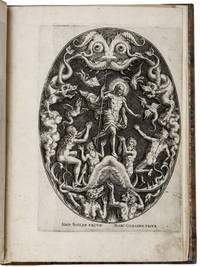
15705934b<b>GHEERAERTS THE ELDER'S GROTESQUE SUITE OF ENGRAVINGS DEPICTING SCENES OF CHRIST'S PASSION</b><br /><br />8vo 1 engraved title page and 13 full-page engravings and extra illustrated with additional 4 engravings from other suites. Quarter bound in 19th-century calf and marbled paper boards gold-stamped lettering piece laid to spine marbled end papers. Only minor edge wear to boards joints tender. The suite of engravings in fine dark strikes with only the occasional minor stain; two of the additional engravings Labors of Hercules are trimmed laid down and carry later annotations in pencil.<br /><br /><p>Rare first and only edition only state of a suite of 14 full-page 16th-century engravings which ingeniously refigure the traditional subjects of Christ's Passion in a manner at once timely/fashionable and archaizing/antique. The <i>Passio verbigenae</i> published by Jan Sadeler I 1550-1600 after the designs of Marcus Gheeraerts the Elder c. 1520-c. 1590 depicts scenes occurring between Christ's meditation on the Mount of Olives and his Resurrection each presented in the manner of ancient Roman <i>grottesche</i> a form widely popular in Renaissance and Mannerist art following the rediscovery in the late 15th-century of grotesque frescos at Nero's Domus Aurea in Rome. The symmetrical exquisite obscure delicate and often bizarre nature of this style suited the Mannerist tastes of Flemish printmakers in the late 16th century. Here however Gheeraerts and Sadeler use the style not for weird or frivolous ancient iconography but instead to recount the most central and important story of Christianity the Crucifixion of Jesus and his triumph over death. In this case it is likely that Gheeraerts and Sadeler saw the grotesque mode as a historical form dating from the time of Christ which conferred authenticity to the subject matter. In this way the suite of engravings is both a fine curio and a document participating in the new movement of Early Christian archeology which rose to prominence in the decades before 1600.</p><p>The suite's engraved title page and 13 full-page engravings are arranged in an oval frame as quasi-symmetrical compositions with a principal iconographic moment from the Passion in the upper-middle register and an ancillary scene below. The title page shows the <i>Arma Christi</i> or Instruments of the Passion surmounting death/demons with Latin verse by Favolius at the bottom the attribution to Favolius "D. Favol: canebat" has been abraded in the present example. The principal plates depict the Last Supper with as the ancillary scene Judas receiving thirty pieces of sliver Agony in the Garden Judas and soldiers enter garden Judas embracing Jesus leading to his arrest Simon Peter cuts off ear of Malchus Christ before Caiaphas the Denial of Peter the Flagellation tormentors bind sticks for flogging Crowning with Thorns Christ given reed <i>Ecce Homo</i> mocking of Christ; Christ carrying Cross Instruments of the Passion Soldiers take Christ's cloak and prepare him for Crucifixion soldiers dig post hole for Cross Crucifixion soldiers roll dice over cloak Descent from Cross tomb sealed Harrowing of Hell demons in Hell and the Resurrection soldiers at tomb.</p><p>The present volume was extra illustrated by an early collector with 4 further grotesque plates designed by Gheeraerts. These are 1 the <i>Ignis</i> Fire plate from the Four Elements series published by Philips Galle 2-3 Hercules fighting Hydra and Hercules afflicted by the Cloak of Nessus from Gheeraerts' suite of the Twelve Labors of Hercules and 4 Hercules drawing his bow against the Centaur Nessus who is absconding with Deianeira from the 'Ornaments for goldsmiths in squares octagons and lozenges' suite by Gheeraerts and Galle.</p><p>Complete suites of the <i>Passio verbigenae </i>are very rare with OCLC locating U.S. examples only at the National Gallery of Art and the Metropolitan Museum of Art; the Blanton Museum of Art Texas holds a partial suite.</p><p><i>Ornamentprenten in het Rijksprentenkabinet</i> 85; Hollstein <i>Dutch and Flemish etchings engravings and woodcuts c. 1450-1700</i> v. 7 p. 102 nos. 87-99; SKB 230; Foulc 544; Jessen 289; E. Hodnett <i>Marcus Gheeraerts the elder of Bruges</i> pp. 60-61 72.</p> hardcover books
191222680EGlen Ellen Sonoma County CA 1912. Original Autograph Letter Signed by Jack London to his friend poet George Sterling. 3 pages 8†x 5†dated July 13 1912. With the postmarked envelope which is addressed by Charmian London to George Sterling Carmel-by-the-Sea CA - which is crossed out with “Bohemian Club San Francisco†at the bottom of the address. The text of the letter indicates that it was written on board the ship Dirigo toward the end of the voyage and reads in full: “133 days at sea On board Ship Dirigo 145 W. Long. 42 N. Lat. July 13 1912. Blessed Greek: Just to let you know we’re back. Expect to see you at Jinks and later at ranch to tell you all about the voyage. Say - never let him know it - I’ve forgotten the name of our partner in the tent at Bohemian Grove. You and I are third owners each in the outfit. Only I don’t know what I’ll have to bring. A cot Blankets of course. Find out from him and have a letter at Glen Ellen giving me his name and all essential data. Of course you’ll be at the Jinks. I haven’t had a drink for 144 days! Wolf. Charmian sends love. Say: this time you shall not escape me. You must play pinochle. Greatest two-handed game invented.†Creases from folding else fine. The voyage London speaks of is that of a 148 day sail from Baltimore to Seattle aboard the windjammer Dirigo he took with his wife Charmian. The Bohemian Club is a private club in San Francisco which has a restricted campground called Bohemian Grove in nearby Monte Rio. On August 18 1904 Jack London went with his close friend the poet George Sterling to "Summer High Jinks" at the Bohemian Grove. Subsequently London was elected to honorary membership in the Bohemian Club and took part in many activities. Other noted members of the Bohemian Club during this time included Ambrose Bierce Gelett Burgess Allan Dunn John Muir Frank Norris and Herman George Scheffauer. George Sterling 1869 - 1926 was an American writer based in the San Francisco California Bay Area and Carmel-by-the-Sea. He was considered a prominent poet and playwright and proponent of Bohemianism during the first quarter of the twentieth century. In addition to Jack London his work was admired by writers as diverse as Upton Sinclair Theodore Dreiser and Sinclair Lewis. The American historian Kevin Starr wrote this about Sterling: “The uncrowned King of Bohemia so his friends called him Sterling had been at the center of every artistic circle in the San Francisco Bay Area. Celebrated as the embodiment of the local artistic scene though forgotten today Sterling had in his lifetime been linked with the immortals his name carved on the walls of the Panama-Pacific International Exposition next to the great poets of the past.†unknown books
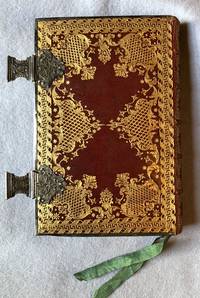
17562896Rome: Gioacchino & Giovanni Giuseppe Salvioni 1756. 8vo 208 x 133 mm. 24 407 1 pp. 2 parts the Office of the Dead separately titled. Printed in red and black. Engraved frontispiece and 12 full-page engravings by Arnold Van Weserhout and Jacob Frey after Joseph Passarus Giuseppe Passaro two engraved title vignettes 12 engraved tailpiece vignettes a few unsigned others by Frey after Passaro or by M. Schedi engraver 3 engraved capital initials numerous red-printed woodcut initials. Foxing occasionally severe short marginal tear to fol. Z7.Slightly later eighteenth-century Roman gold-tooled red goatskin covers with large dentelle border composed of a triple neo-classical roll-tooled outer frame enclosing six large ornaments each with a basketweave design of diagonally crossing gilt fillets framed in volutes and leafy sprigs a few tiny petal or star tools board edges protected with a probably later frame of silver or silver-plated metal discreetly nailed to the binding two elaborately chased silver fore-edge clasps and catches spine in six uniformly gold-tooled compartments gilt edges with gauffred border design pair of green ribbon page markers marbled endpapers; 20th-century black morocco felt-lined case. Provenance: with Gumuchian Catalogue XII/1930/225; Maurice Burrus bookplate purchased from Gumuchian in 1934 purchase notes at end. A striking rococo binding in fine condition on a luxuriously printed and illustrated Office of the Virgin from the official Vatican press.From the mid- to late eighteenth century the Salvioni press used one or more bookbinding workshops that produced finely gold-tooled bindings for their Vatican publications. Although often referred to as the "Salvioni bindery" this appellation is circumstantial: "the Salvioni firm was responsible for promoting the bindings but it is not known which workshop produced them" British Library Database of Bookbindings. Some of these "Vatican" bindings incorporated variously colored or mottled leather. This example with its basketweave cartouches relies purely on tooling for its effect. An example evidently from the same workshop on a book printed at Rome in 1791 by Salomini using analogous cartouches as corner-pieces as well as a similar "spiraling" border design and some of the same leafy spray and star tools is reproduced in Legature papali no. 264."Whereas the . more flamboyant bindings produced by the Salvioni Bindery rely frequently on polychrome enamel heightening these Vatican bindings strike a somewhat more sober note with their very fine dark-red morocco and rich gold-tooling of high quality" Martin Breslauer Catalogue 107/428.Gumuchian Catalogue de Reliures du XVe au XIXe siecle no. 225 plate 68. Cf. British Library Database of Bookbindings Shelfmark c27e18; For other "Salvioni" bindings see Miner / Walters Art Gallery The History of Bookbinding no. 523; Biblioteca Apostolica Vaticana Legature papali da Eugenio IV a Paolo VI no. 264 plate CXCIII. Gioacchino & Giovanni Giuseppe Salvioni hardcover books
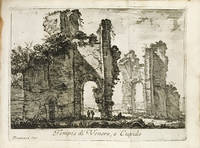
17501656031750. PIRANESI Giovanni Battista. Il Mercurio Errante delle Grandezze di Roma. Text by Giovanni Pietro Rossini the Elder. Two volumes in one. 10 192; 2 146 8 pp. Illustrated with 19 folding engraved plates by Piranesi Jean-Laurent Legeay and Philothée-François Duflos. 16mo. 160 x 86 mm bound in contemporary Italian vellum. Rome: A spese di Fausto Amidei 1750. First Edition of the Mercurio Errante guidebook to Rome to be illustrated with Piranesi's etchings; the seventh edition chronologically. This copy contains seven original Piranesi etchings of Roman vedute; they are considered to be "some of his earliest known works; they must have been executed between 1740 the year of his arrival in Rome and 1741 the date of the first edition of Barbiellini's publication Roma antica and Roma moderna" Exploring Rome: Piranesi and His Contemporaries p. 73. "They are of particular importance in plotting the development of Piranesi's graphic skills as they range from his first tentative efforts to some highly sophisticated compositions" Wilton-Ely. Piranesi's etchings were subsequently reissued in the Varie Vedute in 1745 and 1748 and following their appearance in the 1750 edition of Rossini's Mercurio Errante they reappear in the 1760 1771 and 1789 editions. "Scott has suggested that all these views were designed like modern-day postcards and were probably kept loose and then added to the volumes at the request of the buyer. No two editions of the work exhibited here have the same number of plates by the different artists" Exploring Rome idem. Rossini calls for 18 plates; the present volume contains 19. Overall a very appealing copy. Rossetti Rome G-1210. Borroni 8066/8. Schudt 294. Kissner Collection 992. Schlosser Magnino p. 601. Wilton-Ely 1994 p. 90 et seq. hardcover books
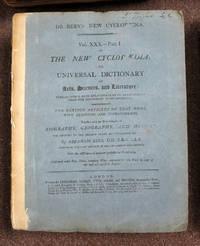
182041461London: Printed for T. N. Longman and O. Rees No. 39 Paternoster-Row 1820. 1st edition thus. 80 volumes in original publishers quarter-bound cloth beige spines over light blue paper-covered boards black lettering printed to front board and paper title labels on spine. 7 volumes period half-bound in black leather spine and edges with gilt & brown lettering and labels to spines over green cloth boards. Boards heavily worn and rubbed edges bumped and spines chipping. Some boards detached. Some volumes with previous owner signature penned to front board B. Fulford. Binding and paper age-toned as one would expect with the ages of the titles with the occasional stain & foxing. Withal a Good original set sold w.a.f. 87 volumes total. 80 of the Cyclopaedia 7 volumes of Plates. 7 volumes of plates b/w engravings. Cyclopaedias: ~ 11-1/4" x 9". Plate Volumes: 11" x 8-3/4" <br/><br/>"I. The Work will be printed in Quarto at the Office of A. Strahan Esq. with New Types cast for the Purpose and on a superfine yellow woven Paper. II. The Work will be comprised in about Twenty Volumes. III. Three sheets stitched in blue paper will be regularly published every Week till the whole be completed price One Shilling. IV. Numerous Plates engraved in a superior stile sic of elegance will be given in the course of the Publication. V. A Part of Half a Volume containing Seventeen Numbers together with the Plates will be regularly published in advance price Eighteen Shillings in boards. VI. A few copies will be printed on a superfine royal woven Paper with proof impressions of the Plates to be sold in Parts of Half Volumes only price One Pound Sixteen Shillings in boards. VII. Number I and Part I was published on Saturday January 2 1802." <br /> <br />"The encyclopaedia was largely Rees' own work and was especially strong in new and well-written biographical articles. The articles on music were written by Dr. Charles Burney and those on botany were mostly written by Sir James Edward Smith the founder of the Linnean Society.Rees's Cyclopaedia is said to have outclassed the Encyclopaedia Britannica of that time and 'remains a monument to the memory of another native of Wales namely dr. Abraham Rees the Encyclopaedist who was a native of Llanbrynmair Montgomeryshire." Cyclopaedia - dot - org. <br /> <br />Dr. Rees' Cyclopaedia is known all over the world and is often hailed as one of the greatest collections of material in the field of Encyclopedias. Printed for T. N. Longman and O. Rees, No. 39 Paternoster-Row hardcover books