6 502 résultats
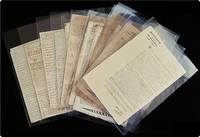
150437063Campeche Merida: Various publishers 184243. Folio and slightly smaller 31 cm; 12.25"; and slightly smaller. 38 pp. 11 blank. <br><br>The culture and politics of central Mexico in the 19th century often did not coincide with those of the Yucatan especially after the dissolution of the constitution of the First Empire. The long-smoldering discontent that the post-Empire constitutions engendered reached the breaking point for the Yucatecans in March of 1841 and on the 16th of that month => the peninsula declared its independence from the rest of Mexico.<br>Â Â Â Â The Yucatecans were perhaps encouraged by the Tejanos and their successful separation from Mexico in 1836.<br>Â Â Â Â The four manuscript documents two broadsides and nine newspapers in this collection date from the period of the first Mexican invasion of the peninsula and the central government's failed attempt to quell what it saw as a rebellion an invasion that was not repelled until April 1843. Included here are: 1 A pair of letters dated Merida 17 and 24 January 1843 from Juan de Regil to Mauricio de Santelices of Havana regarding the political situation. 2 A printed broadside proclamation by President Miguel Barbachano Mérida 2 December 1842 imposing a heavy tax on and forced loans from the nation's industrialists merchants and professionals. 3 A manuscript extract from a letter Merida 21 December 1842 from an unknown Spanish national to Santelices requesting assistance in leaving Yucatan due to the oppressive new tax but also giving first-hand information about => military operations. 4 An Autograph Letter Signed Campeche 17 February 1843 from Geronimo Ferrer y Valls Spanish commercial agent in Yucatan to the Captain General of Cuba in Havana expressing concern for the safety of Spanish nationals in the Yucatan and containing details of => murders and summary military executions. 5 A printed broadside entitled Opinion General Verdaderas ideas y convicciones de las secciones del ejército del Estado acampadas extramuros de esta Ciudad Campeche: José M. Peralta 1843. And 6 Nine issues of the Boletin del Espiritu del Siglo dated January to June 1843 most with => excellent content on Yucatecan resistance to the invasion by Mexico.<br>Â Â Â Â The Boletin del Espiritu del Siglo published in Campeche by Jose Maria Peralta is quite scarce with only Yale reporting ownership of a very good but incomplete run. Present here are issues from 1843: 43 7 January 46 13 January 48 15 January 52 19 January 53 20 January 63 30 January 144 22 April 148 26 April and 189 6 June.<br>Â Â Â Â => Primary source material on the Republic of the Yucatan is rare. <br>Â Â Â Â <br>Â Â Â Â Neither broadside is found in WorldCat CCILA or Palau. Boletin del Espiritu del Siglo is not listed in Charno Latin American Newspapers nor in CCILA. Some newspaper issues and one broadside are browned or partially so. Overall condition is good or better. Various publishers unknown books
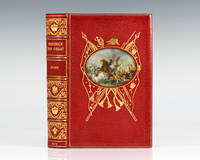
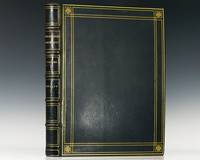
191927014London: Constable 1919. Octavo bound in full scarlet crushed levant morocco Cosway-style binding by Bayntun-Riviere. Front and rear panels with single gilt filler border upper cover set with an oval miniature painting of a battle scene under glass framed with a variety of weapons and emblems gilt; spine in six compartments with five raised bands a decorative panel in the rest each bearing crown eagle or fleur-de-lys; board edges gilt dotted turn-ins gilt doublures and free endpages of yellow watered silk all edges gilt. In fine condition. Housed in a custom cloth folding box. Frederick the Great was King of Prussia from 1740 until 1786 the longest reign of any Hohenzollern king. His most significant accomplishments during his reign included his military victories his reorganization of Prussian armies his patronage of the arts and the Enlightenment in Prussia and his final success against great odds in the Seven Years' War. Frederick was the last titled King in Prussia and declared himself King of Prussia after achieving full sovereignty for all historical Prussian lands. Prussia had greatly increased its territories and became a leading military power in Europe under his rule. Cosway bindings named for renowned 19th-century English miniaturist Richard Cosway were popularized if not invented in the early 1900s by the renowned London bookselling firm of Henry Sotheran. The earliest Cosway bindings were created by Miss C.B. Currie who faithfully imitated Cosway's detailed watercolor style of portraiture from designs by J.H. Stonehouse Sotheran's manager. These delicate miniature paintings often on ivory were set into the covers or doublures of richly-tooled bindings and protected by a thin pane of glass. Constable hardcover books
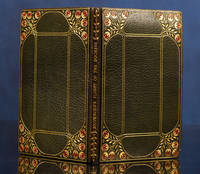
04964Campden Gloucestershire: Essex House Press 1905. You're my friend: I was the man the Duke spoke to;<br/>I helped the Duchess to cast off his yoke too;<br/>So here's the tale from beginning to end My friend!<br/><br/><br/>ESSEX HOUSE PRESS. BROWNING Robert. THE BELVOIR BINDERY.<br/>The Flight of the Duchess. Campden: Essex House Press 1905. <br/><br/>One of 125 copies all printed on vellum this being no. 123. <br/><br/>Small octavo 7 1/4 x 4 7/8 inches; 184 x 124 mm. 42 pp. Hand colored frontispiece by Paul Woodroffe hand-painted initials throughout printers device on colophon.<br/><br/>Bound ca. 1905 by The "Belvoir" Bindery stamp-signed in gilt on front paste-down. Full sage green crushed levant morocco covers with central panel and four rounded side panels formed by gilt rules the corners with a spray of five inlaid red morocco water lilies and gilt foliage. Smooth spine vertically lettered in gilt and decoratively tooled with foliate extensions. Gilt-dotted board edges gilt rolled turn-ins vellum liners and endleaves all edges gilt. A very very pretty little binding in near mint condition.<br/><br/>A lovely copy of the fourteenth and last of the Essex House "Great Poems Series" in a very attractive binding by the respected craftsman and teacher James Samuel Hewitt-Bates at his Belvoir Bindery. <br/><br/>J.S. Hewitt-Bates born 1864 taught bookbinding at the Leicester School of Art and also operated a bindery on Belvoir Road in that city. A disciple of William Morris and an enthusiastic participant in the Arts & Crafts Movement he was the author of a number of works on bookbinding including the pamphlet included with this binding which reprints an essay he wrote for the journal "The Bibliophile" outlining his philosophy of bookbinding. According to Bates "The principles which ought to govern the right and proper binding of a book are strength durability and fitness. The decoration of a book ought to be in harmony with the nature of the work. The design ought always to be simple and flat without shading." He emphasizes the importance of high-quality materials sound construction and expert forwarding. <br/><br/>This actual binding is featured on a full-page black and white photograph facing p. 6. on his promotional pamphlet for The Belvoir Bindery entitled "Bookbinding for the Book-Lover" circa 1918 40 pp. brown pictorial wrappers with many full-page photos of bindings. Bates' qualifications and skills as a bookbinder are treated in the work citing awards of First Class Honors First Prizeman Silver Medallist of the City and Guilds of London Institute and holder of the SkinnerÃs Company Prize.<br/><br/>"After Kelmscott had closed several of the workmen employed there moved to the Essex House Press started by C.R. Ashbee in 1898 as an addition to the several crafts practiced at his 10-year-old Guild of Handicrafts originally at Essex House in Mile End Road London. It was different from the other private affairs of the time in that it was deliberately conceived as a part of a larger whole. The Essex House Press was then an Arts and Crafts press par excellence; no doubt as a result of Ashbee's work in other crafts such as jewelry and metalwork it reveals more of Art Nouveau in many of its books than one would have expected from so devoted a follower of Morris. Cave. The Private Press pp. 125-125.<br/><br/>"Three other important presses date from the nineties - Eragny Essex House and Ashendene. The Essex House Press was one of several activities of the Guild of Handicraft founded and led by C.R. Ashbee first in the Mile End Road later at Campden in Gloucestershire. The books and bindings were often excellent experimental and generally small. The Press began in 1898 consciously to carry on the traditions of William Morris and continued to issue books almost until the Great War; but the whole enterprise is perhaps most interesting in the context of Guild Socialism and the application of ideas which had been preached by Ruskin and Morris." Franklin. The Private Presses pp. 10-11<br/><br/>Franklin. The Private Presses p. 201; Cave. The Private Press pp. 124-125. Campden, Gloucestershire: Essex House Press, 1905 unknown books
196283782New York: Duell Sloan and Pearce 1962. First edition of this early biography of The Dalai Lama. Octavo original cloth frontispiece. Signed and dated in the year of publication by His Holiness The Dalai Lama on the front free endpaper. Laid in is a note to the recipient on official Tibetan letterhead from the private secretary to the Dalai Lama stating that The Dalai Lama has signed this copy. Also inscribed on the half-title page by the author "With warmes regards and best wishes to Kenneth Crouch- and with a special salute from- Lowell Thomas Jr. Dec. 14 62." Near fine in a very good dust jacket with some tape to the exterior. Jacket design by Gary Gore. Contemporary signatures of His Holiness are scarce. Housed in a custom half morocco clamshell box. Rare and desirable signed. Duell, Sloan and Pearce hardcover books
184561443Wetumpka Alabama: printed and published by Charles Yancey 1845. First edition originally published serially in Charleston SC in "The Magnolia" Jan. -- Oct. 1841; the original manuscript was destroyed when the author's Savannah house burned and had to be reconstructed for the serial publication. 8vo. iv 248 pp. Noted as "Two Volumes in One" on the front wrapper with a separate title page for volume two but continuous pagination and chapter numbering throughout. Hubbell "The South in American Literature p. 497: "His best novel." BAL 2795: "Written not later than July 1838." Wright I 495 noted as one of 45 novels published in the South among the 2775 entries in that volume covering 1774-1850 in the University of Virginia online catalogue description. Ellison 530 calling for 246 pages. For a full account of the book's writing publication and reception see Curtis C. Davis "Chronicler of the Cavaliers" Richmond 1953. Gift inscription at the head of the front wrapper: "C. B. Adams Daily Journal / from T. H. Pease. / July 16 1847." After studying at Yale and Amherst Charles Baker Adams 1814-1853 became State Geologist of Vermont Thomas H. Pease was a mid-century bookseller and publisher In New Haven Ct. Scattered foxing but still a very good copy. Original printed blue-green wrappers soiled some old insect damage at lower front corner spine ends show a little wear. 9756. A novel of colonial Virginia Governor Alexander Spotswood's service 1710-1722. Harper had published Caruthers' earlier novels but his loss of the original manuscript in the fire combined with the 1837 economic crash closed that door; after the serial publication he looked south to Charles Yancey brother of congressional firebrand William Lowndes Yancey in the boomtown of Wetumpka Alabama "about to try very patriotically to establish a Southern Publishing House for ourselves." <br/><br/> printed and published by Charles Yancey unknown books
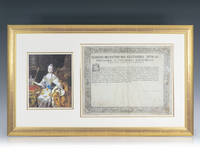
98658<span class="match">Document </span>in Cyrillic boldly signed by Catherine the Great "Ekaterina." Renewal of an appointment for Lieutenant General Otto von Derfelden dated 1784. Double-matted with an image of <span class="match">Catherine</span> Catherine II Russian: Yekaterina Alekseyevna also known as Catherine the Great born Princess Sophie of Anhalt-Zerbst was Empress of Russia from 1762 until 1796 the country's longest-ruling female leader. She came to power following a coup d'etat which she organized--resulting in her husband Peter III being overthrown. Under her reign Russia was revitalized; it grew larger and stronger and was recognized as one of the great powers of Europe. That said however she was a usurper of the Russian throne because her son Paul I should have naturally been the Tsar following Peter III's death. In her accession to power and her rule of the empire Catherine often relied on her noble favourites most notably Grigory Orlov and Grigory Potemkin. Assisted by highly successful generals such as Alexander Suvorov and Pyotr Rumyantsev and admirals such as Fyodor Ushakov she governed at a time when the Russian Empire was expanding rapidly by conquest and diplomacy. In the south the Crimean Khanate was crushed following victories over the Ottoman Empire in the Russo-Turkish wars and Russia colonised the territories of Novorossiya along the coasts of the Black and Azov Seas. In the west the Polish-Lithuanian Commonwealth ruled by Catherine's former lover king Stanislaw August Poniatowski was eventually partitioned with the Russian Empire gaining the largest share. In the east Russia started to colonize Alaska establishing Russian America. Catherine reformed the administration of Russian guberniyas and many new cities and towns were founded on her orders. An admirer of Peter the Great Catherine continued to modernise Russia along Western European lines. However military conscription and the economy continued to depend on serfdom and the increasing demands of the state and private landowners led to increased levels of reliance on serfs. This was one of the chief reasons behind several rebellions including the large-scale Pugachev's Rebellion of cossacks and peasants. Catherine decided to have herself inoculated against smallpox by a Scottish doctor Thomas Dimsdale. While this was considered a controversial method at the time she succeeded. Her son Pavel was later inoculated as well. Catherine then sought to have inoculations throughout her empire stating: "My objective was through my example to save from death the multitude of my subjects who not knowing the value of this technique and frightened of it were left in danger." By 1800 approximately 2 million inoculations were administered in the Russian Empire. The period of Catherine the Great's rule the Catherinian Era is considered the Golden Age of Russia. unknown books
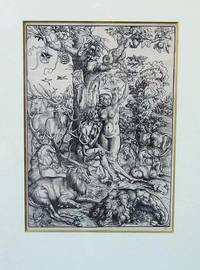
15092751509. Woodcut. <b>Hollstein VI.10.1; Bartsch XI.319.1; Dodgson II.294.57. </b>Later impression. Provenance: King Friedrich August II of Saxony Lugt 971. 13 5/8 x 9 3/4. Trimmed just outside the platemark. With some minor repairs. books
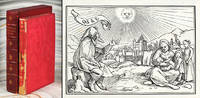
18301071768vo. London: William Pickering 1830. 8vo 188 leaves 1-5 6-14 360 =376 pp. With 90 wood engravings after Holbein by John and Mary Byfield. Original red/pink silk somewhat worn section within foxed or stained withal a decent copy of a great rarity. Enclosed in a red morocco pull-off box. § Large-paper copy of the first edition with an introduction by Dibdin. Limited to 12 copies of which three are known today including this one. Jackson states 12 large-paper copies on india paper; published at one guinea. The Rylands copy is in calf-backed red silk. The Old Testament text accompanying each engraving is in five languages. The advertisement in vol.II of the Pickering Aldine Poets 1830 includes the note ‘Dr. Dibdin has given five specimens of the wood cuts in his Bibliographical Decameron vol. i. 174-180 where will be found a copious account of this work.’ Windle and Pippin A54a. Jackson 73. The Robert Pirie copy with his bookplate and a note at the front that this and a copy on vellum were both lost after he purchased them -- the vellum copy has never been found. William Pickering hardcover books
1935226762London Jonathan Cape 1935. 1935. First trade edition. 4to. Illustrated with 54 plates and 4 folding maps. In a designer binding of full tan niger morocco gilt stamped the covers with elaborate interlocking linear design based on the traced route of a journey by Lawrence in the desert spine lettered in gilt marbled doublures and endpapers. Enclosed in a mahogany edged slipcase with marbled boards and a matching marbled chemise. Fine fresh as new. Binding by J.J.D. Yardley 1971. Includes correspondence between binder and Colonel Bradfer Lawrence giving a detailed story of the binding design and materials used to bind the book and to make the unusual slipcase. H.J. Desmond Yardley 1905-1972 was a binder who enrolled at the Central School of Arts and Crafts where he was taught by William Matthews. In 1956 he was elected to the Guild of Contemporary Bookbinders later becoming an exhibiting Fellow of the Designer Bookbinders. Exhibited: "The Art of the book William Morris and after 1892-1977 Fitzwilliam Museum Cambridge England 1978.". Hardcover. Fine. London, Jonathan Cape, 1935. hardcover books
48055Elephant folio bound in full blue morocco gilt titles and tooling to the spine front and rear panel raised bands. Volume of ten portraits of <span class="match">British</span> <span class="match">royalty</span> with a title page in calligraphy which reads "The Portraits contained in this volume have been presented to The Honorable Rodman Wanamaker C.V.O. as a mark of the Friendship and High Esteem in which he is held by those who have inscribed their Signatures." The book features portraits held within thick cardstock pages with short biographies penned in calligraphy on the opposite page. Signed portraits include: Queen Mary; Queen Alexandra; Albert Duke of York later King George VI; The Duchess of York Elizabeth The Queen Mother; Prince Henry; Prince George; Princess Mary Viscountess Lascelles; and Princess Victoria. Also includes an unsigned photo of the Prince of Wales. In near fine condition. Rodman Wanamaker was a department store magnate and patron of the arts as well as a major early supporter of aviation. He made major contributions to the liturgical arts in Great Britain including the sponsorship of a sterling silver altar and silver pulpit at the church of the Queen's estate in Sandringham England as well as a massive processional cross for Westminster Abbey. Rare and desirable hardcover books
196230019New York: McGraw-Hill Book Company Inc 1962. First edition of the Dalai Lama's first autobiography. Octavo original half cloth illustrated. Signed by His Holiness the Dalai Lama on the title page with the added words "with prayers." Near fine in a near fine dust jacket with light rubbing. Housed in a custom half morocco clamshell box. Recognized at the age of two as the reincarnation of the Thirteenth Dalai Lama Tenzin Gyatso was brought to Lhasa the capital of Tibet and enthroned two years later as the fourteenth Dalai Lama. In 1959 following the Chinese suppression of the Tibetan national uprising he was forced to seek asylum in India. As Tibet's leader-in-exile he has worked tirelessly not only on behalf of the Tibetan people but as a voice for human rights worldwide. "My Land and My People is without a doubt one of the most moving memoirs I have ever read" Stanley Gosh Saturday Review. McGraw-Hill Book Company, Inc hardcover books
1917R5124Published at the Governing Senate 1917. Paperback. Good. Folded sheets sometimes in two gatherings. The paper is brittle sometimes with large chips eliminating text -- but overall legible and satisfactory. The collection includes: Numbers 151-155 158-181 183x2-186 193-198 200 x2 202 205-214 217-221 224 published 1 July - 15 September 1917. A total of 58 issues very rare. The October Revolution is said to have begun with the storming of the provisional government's Winter Palace on 25 October 1917 according to the pre-Revolutionary calendar which lagged behind the Western calendar by 2 weeks. 25 October corresponds to 7 November in the post-Revolution calendar tho all Russian religious holidays still lag 2 weeks behind their Western counterparts. <br/><br/> Published at the Governing Senate paperback books
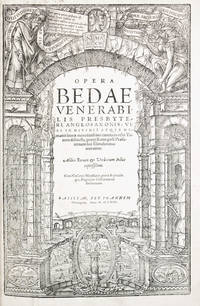
1563254015Basileae i.e. Basle: Per Joannem Hervagium 1563. First collected edition. Title within architectural border with device of Johann Herwagen. Profusely illustrated with iwoodcut maps music tables diagrams. Text in two columns; with Index. 4 vols. Folio. Contemporary calf rebacked new leather spine labels labels misnumbered later endpapers; covers worn but sound one joint starting but firm. Text show various degrees of slight worming and scattered light foxing but overall a very good sound set of this massive collected edition complete except for the final blank leaf of Volume VI. First collected edition. Title within architectural border with device of Johann Herwagen. Profusely illustrated with iwoodcut maps music tables diagrams. Text in two columns; with Index. 4 vols. Folio. The Father of English History. This is the first of three continental editions of the works of Bede the others being from Cologne in 1612 and 1688. Johann Herwage  a printer originally from Strassburg  married  the widow of the great Basel printer Johann Froben and for a while collaborated with his stepson Hieronymus Froben. From 1532 however he again started printing under his own name.<br/><br/>RARE ON THE MARKET. Adams B-477 Per Joannem Hervagium unknown books
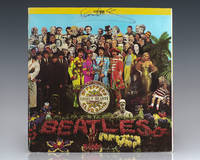
1967123671Hollywood: Capitol Records 1967. Rare Sgt. Pepper's Lonely Hearts Club Band LP boldly signed by Paul McCartney one of the most-admired and influential lyricists of the twentieth century. Quarto signed by Paul McCartney on the front panel. Recording produced by George Martin. Cover by M C Productions and The Apple. Staged by Peter Blake and Jann Haworth. Photographed by Michael Cooper. Wax figures by Madame Tussauds. A splendid time is guaranteed for all. In near fine condition. Rare and desirable. Released on May 26 1967 The Beatles' eighth studio album Sgt. Pepper's Lonely Hearts Club Band spent 27 weeks at number one on the Record Retailer chart in the United Kingdom and 15 weeks at number one on the Billboard Top LPs chart in the United States. It was lauded by critics for its innovations in songwriting production and graphic design for bridging a cultural divide between popular music and high art and for reflecting the interests of contemporary youth and the counterculture. Its release was a defining moment in 1960s pop culture heralding the Summer of Love while the album's reception achieved full cultural legitimization for pop music and recognition for the medium as a genuine art form. Capitol Records unknown books
19625520London: Weidenfeld and Nicolson 1962. First edition of the Dalai Lama's first autobiography. Octavo original black cloth illustrated. Signed by His Holiness the Dalai Lama on the title page with the added words "with prayers." Near fine in a excellent dust jacket with light rubbing. Housed in a custom half morocco clamshell box. A very sharp example uncommon signed. Recognized at the age of two as the reincarnation of the Thirteenth Dalai Lama Tenzin Gyatso was brought to Lhasa the capital of Tibet and enthroned two years later as the fourteenth Dalai Lama. In 1959 following the Chinese suppression of the Tibetan national uprising he was forced to seek asylum in India. As Tibet's leader-in-exile he has worked tirelessly not only on behalf of the Tibetan people but as a voice for human rights worldwide. "My Land and My People is without a doubt one of the most moving memoirs I have ever read" Stanley Gosh Saturday Review. Weidenfeld and Nicolson hardcover books
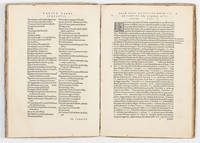
675816 p.l. 74 leaves. Folio later vellum-backed boards foot of spine defective occasional light soiling & dampstaining. Basel: H. Petri 1529. First edition of the two texts together. The De Temporum Ratione is a significant book in several ways. Most notably "this book helped to establish the custom of counting years from the birth of Christ. When we say that Queen Elizabeth II was born in 1926 not 'in the 16th year of the reign of George V' or 'in the year 2678 after the foundation of Rome' or in the '2nd year of the 481st Olympiad' we are indebted to the Venerable Bede."-Printing & the Mind of Man 16n. "Bede's greatest practical effect was on the Western calendar. His decisions beginning the year calculation of Easter names of days and months calculations of eras and so forth in most instances finally determined usage that was only refined not changed by Gregorian reform."-D.S.B. I p. 565. "The De Ratione Temporum first published in 1505 is particularly important. It contains a remarkable theory of tides based upon Pliny but also upon personal observation; first mention of the establishment of a port i.e. the mean interval between the moon's meridian passage and high water following; this interval is different in different ports."-Sarton I p. 511. Pierre Duhem described Bede's establishment of a port as the only original formulation of nature to be made in the West for some eight centuries. This is the first printing of De Natura Rerum which contains such physical science as was then known. It collects the wisdom of the ancient world on these subjects and has the special merit of referring phenomena to natural causes. It contains a particularly important section - the "De Comptu vel Loquela digitorum" - which is "our main almost our only source for the study of mediaeval finger reckoning or symbolism."-Sarton I pp. 510-11. See also Smith History of Mathematics II p. 200. This work was edited by Johannes Sichardt 1499-1552 professor of law who during the years 1526-30 lived in Basel and while teaching also edited and prepared for printing Latin manuscripts he had found in libraries in monasteries. He also served as adviser to the Basel printers Cratander Bebel and Henricus Petri. Good copy preserved in a box. Early signature of "Mallarii" on title with motto in Greek. Armorial bookplate dated 1915 of Bishop's College Cheshunt an Anglican theological college that closed in 1968. ❧ Sichardt: Bietenholz ed. Contemporaries of Erasmus Vol. III p. 247. hardcover books
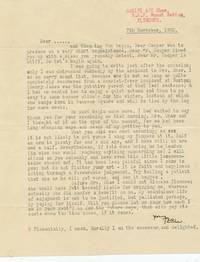
2464Lawrence refers to Charlotte Payne-Townshend Shaw reformer women's rights advocate and wife of author George Bernard Shaw. Lawrence writes to Charlotte's Shaw's doctor William Cooper who took care of Lawrence's broken wrist. In this upbeat letter with a literary reference to American author Henry James Lawrence gives an update on Charlotte as well as his own injured wrist. At the end he asks for the cost of the bill which he supposes Charlotte would have paid had she not become indisposed from an accident. In part "and then the fun began. Dear Cooper was to presume on a very short acquaintance. Dear Dr. Cooper lined you up with a class you probably detest. Dear Mr. Cooper is stiff. So let's begin again. I was going to write just after the occasion; only I was detracked suddenly by the accident to Mrs. Shaw.she is not so long or quite recovered from a scarlet-fever incident at Buxton; Henry James was the putative parent of that last sentence.she bumps down in Hanover square and will be tied by the leg for more weeks.I had wanted to say thank you for examining me that morning. Mrs. Shaw and I thought of it on the spur of the moment.What you had said was most assuring; as it is not likely to get worse I snap my fingers at it. Half an arm is plenty for one's old age and I have still and arm and a half. Nevertheless if fate does bring me to London No wise man would prophesy anything concerning me I will attend on you.It has been less painful.but do not flatter your art - it is faith and happiness acting through favorable judgement. Try telling a patient that she or he will get worse and see it happen! Before Mrs. Shaw I could not discuss finance; she would have felt herself liable for bringing me.My scandalous life of enjoyment is not to be justified but palliated perhaps by paying for itself.let me know how much I am in your debt ." The asterisk is actually the "@" symbol and points to another below the signature with the following explanation. "Financially I mean. Morally I am the assessor and delighted." In his hand he writes and signs "Yours T. E. Shaw." With envelope docketed by William Cooper explaining the letter. The letter is matted with envelope and printed photograph of Lawrence dressed in desert clothing as Lawrence of Arabia. Dr. Cooper explains that Lawrence "seeing two old people in difficulty with a car which wouldn't start he offered to help them but the handle hand crank of the car on a backfire hit him in the wrist & broke it." The incident occurred in March 1927 near Cranwell but since Lawrence did not take the needed time to allow the wrist to heal it never fully recovered. The letter shows Lawrence's wit and good humor about his own accident as well as his concern for his good friend Charlotte Shaw. unknown books
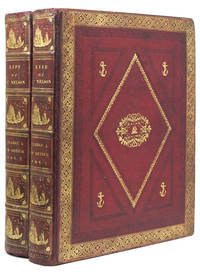
1809307574London: Printed by T. Bentley Bolt Court Fleet Street for T. Cadell and W. Davies in the Strand and W. Miller Albemarle Street 1809. First Edition. Illustrated. vi 375 1 blank; ii 511 1 blank pages. 2 vols. Imperial Quarto. Contemporary straight-grain red morocco with elaborate tooling and nautical motifs in gilt and blind; spine with five raised bands lettered and stamped in gilt. All edges gilt. Board edges worn particularly at corners joints neatly repaired. Two bookplates including famous Napoleonic collector Calvin Bullock and A.F. Woodward to front endpapers of each volume gift inscription at front preliminary "To Captain Henry Fisher R.N. with every good wish from Frances & Augustine Woodward in perfect remembrance of Feburary-1895.". Interior generally clean and bright. Handsome. First Edition. Illustrated. vi 375 1 blank; ii 511 1 blank pages. 2 vols. Imperial Quarto. Printed by T. Bentley, Bolt Court, Fleet Street for T. Cadell and W. Davies, in the Strand and W. Miller, Albemarle Street unknown books
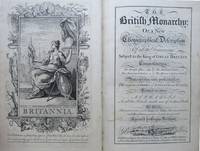
17483799Frontispiece of Britannia enthroned engraved Title list of Subscribers Contents Title of 1743 and 190 engraved plates many illustrated with head & tail pieces: Folding map of the King's Dominions in Europe Africa and America follows plate 7; A folding Table of Several Particulars. as plate 163. Tastefully rebound in eighteenth century style full lozenge blind ruled calf; five raised bands; ruled green morocco label. A handsome supple copy.; All shipments through USPS insured Priority Mail. George Bickham hardcover books
199415922J1994. An original camera clapperboard used in the creation of the classic final picture in the film trilogy adaptation of Forrest Gump which eventually won the Academy Award for Best Picture. A clapperboard is a pair of hinged boards clapped together at the beginning of a film shot in order to aid sound synchronization and at the same time record the shot number and the number of individual takes of a scene. The board lists the production name the director’s name Robert Zemekis the cameraman’s name Don Burgess the scene number the roll of film number the take number and the date of shooting. 11 inches wide by 9 3/4 inches tall. Very good condition. The film won 6 Academy Award Oscars for Best Picture Best Actor - Tom Hanks Best Director. Best Adapted Screenplay Best Visual Effects and Best Film Editing. hardcover books
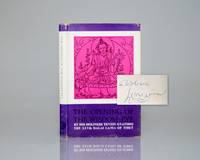
19684545Bangkok: The Social Science Association Press of Thailand 1968. First edition in English of the Dalai Lama's first book on Buddhist philosophy. Octavo original cloth. Signed by the Dalai Lama on the title page in Tibetan "with prayers." A near fine copy in a excellent dust jacket that is lightly rubbed. Housed in a custom half morocco clamshell box. Rare especially signed. The Opening the Eye of the Western Eye is a succinct thorough overview of the doctrines of Buddhism as they have been practiced for a thousand years in Tibet. The Dalai Lama here discusses the need for religious practice and the importance of kindness and compassion. Originally written for Tibetan lay people this was the Dalai Lama's first book on Buddhist philosophy to appear in English. Written for both Tibetan and Western readers Opening the Eye of New Awareness is the Dalai Lama's first religious work. It is not an edited transcript of public lectures but is His Holliness' own summation of Buddhist doctrine and practice. Completed in 1963 just four years after his escape from Tibet and four years after completing his religious education it is a work of consummate scholarship by a twenty-seven year-old geshe wise beyond his years. The Social Science Association Press of Thailand hardcover books
20831EBeverly Hills CA: National Pictures Corp n.d. Original 109 page shooting script with color rewrite pages for the classic 1953 science fiction film Invaders from Mars written by Richard Blake directed by William Cameron Menzies starring Helena Carter Arthur Franz Jimmy Hunt and Leif Erickson. Bradbound in printed studio covers. Very good lightly used copy with some minor spotting to the front cover and minor edge wear. Enclosed in a handsome custom red morocco and cloth clamshell box. Due in large part to Menzies’ innovative techniques Invaders from Mars was the first feature science fiction film to show aliens and their spacecraft in color and was rushed into production to premiere before the much-anticipated George Pal film of H.G. Wells’ novel War of the Worlds. William Cameron Menzies 1896 - 1957 worked to great acclaim primarily as a production and set designer notably for The Thief of Bagdad 1924 The Adventures of Tom Sawyer 1938 David O. Selznik’s Gone With the Wind 1939 and Alfred Hitchcock’s Spellbound 1945. Mr. Menzies won two Oscars at the very first Academy Awards in 1929 for Best Art Direction for The Dove and Tempest and in 1940 at the 12th Academy Awards won an Academy Honorary Award for “outstanding achievement in the use of color for the enhancement of dramatic mood†for Gone With the Wind. Some of his other films include The Iron Mask 1929 Our Town 1940 The Pride of the Yankees 1942 For Whom the Bell Tolls 1943 and Duel in the Sun 1946. National Pictures Corp hardcover books
614444to. 7 pages approximately 1200 words in a completely legible hand on lined stationery with the embossed stamp of Evans and Cogswell Charleston. Docketed on the verso of the final leaf "July 15 1861 / James Simons / to / Governor Pickens / Reply to Letter / of Gov. P / 11 July 1861." Brigadier General James Simons's draft copy of a letter further explaining his reasons for resigning his command given in reply to a July 11 letter from Gov. Pickens that apparently had quarreled with earlier correspondence from Simons responding point by point to criticisms he feels the Governor has leveled against him over differences of opinion regarding the military defensibility of Charleston Harbor. Most if not all of the Pickens-Simons correspondence concerning this matter has been published; the James Simons papers at the University of South Carolina holds correspondence from Pickens but we have not been able to locate the original manuscripts or other drafts for the Simons portion of this correspondence. Old tideline from dampstaining with professional conservation work cleaning the paper restoring chipped areas along the lower edge through leaf-casting and completing several letters and marks with matching manuscript on four leaves. Folded for mailing or filing. 61444 9835. Following the Union Army take over of Fort Sumter by Major Robert Anderson on December 26 1860 just six days after South Carolina seceded from the Union Gov. Pickens directed Major General Schinierle to occupy Fort Moultrie Fort Johnson and Castle Pinckney and to establish a battery on Morris Island to prevent at all costs the reinforcement of Anderson's men. Simons as commander of the 4th Brigade of the Charleston Militia was second in command of the defenses for the harbor occupying the critical spot at Morris Island at the harbor's entrance. He expressed his concerns over the defense of the harbor in a six-page report to the Governor on January 1 1861: "I cannot sacrifice to matter of Etiquette questions and issues of such momentous importance as now surround us . The line of operations embraces four points 1 Fort Moultrie 2 Castle Pinckney 3 Fort Johnson 4 Morris Island. By the map which accompanies this paper it will appear that your lines of communication with these points . are directly within the range and effective power of Fort Sumter - the Citadel of the Harbour controlling every point. At the first return of fire from Fort Sumter your lines of communication are utterly cut off." He goes on to report: "Fort Moultrie - This position is wholly untenable - Lt. Col. De Saussure . gave you prompt notice of this fact on the morning after his occupation." To this Gov. Pickens responded with great offense insinuating that Simons was counseling abandonment of the harbor defenses. Simons' first letter of resignation came almost immediately on January 8 but he was prevailed upon by the Secretary of War to withdraw it. The 4th Brigade under Simons command led the first attack on Fort Sumter on April 12 1861. The controversy between Simons and the Governor continued to simmer until a few months after Anderson and his Union forces had surrendered Fort Sumter. By July in spite of Simons' successes defending the Charleston harbor he again offered his resignation. Gov. Pickens apparently wrote to refute Simons arguments. Simon replies in this lengthy manuscript letter: "I had hoped I would not have been obliged to extend this correspondence but I am sure your sense of justice will indulge me a letter further. I have assigned among other reasons for resigning that you have not shown that recognition which appeared to be due to me as a general officer. I detailed several instances but confined myself to the facts neither canvassing nor questioning your intuition or motive. You reply that you do not think my reasons for resigning are sufficient yet you adopt a line of argument to arrive at this conclusion which not only admits the facts I have stated but is founded . on a settled intention not to consult me and why Because on two occasions having been called into council & my opinion specially asked I ventured to differ from you & express opinions not in conformity with yours. In other words my rank position & counsel as a public officer were to be overlooked because I did not yield acquiescence to that which did not accord with my honest convictions . I must ask your indulgence a little longer. You say that about the 29 December I made "a regular Military Protest" against everything you had done or prepared to do & demanded a council of War. That on the 3 day of January last you endorsed on the back of my demand for a council of War that you could agree to no council of War that would drive you to any such conclusions. Permit me in justice to myself to show you the mistaken impressions under which you seem to labour. The date of my Report was 1 Jany & not 29 December. This date is important as you will see. I respectfully ask leave to correct your misapprehension also as to its being a 'regular Military Protest.' It appears to me that you are mistaken. The paper I sent to you was a Report on the defense of the Harbour of Charleston. I sent it to you because on 31 Dec. 1860 you directed Major Genl. Schinierle in you own words as follows -'You are now ordered to see and attend particularly to the objects & the commands I have detailed to you above & further purpose you are directed to call into requisition and council the valuable aid and co-operation of Brigadier General Simons.' Thus called and in pursuance of my responsibility and duty as Brigadier General I made a Report of my examination of the Harbour & my opinion thereon. That it was a Report & not a Protest I cite your excellency as both witness & judge. On the 2 Jany. You say in a letter to me 'Your Extraordinary report I received last night & have only to say that I do not pretend that the orders & disposition of the forces in Charleston Harbour are at all perfect or beyond the criticism of strict military rule.' If you thought it then 'a regular Military Protest' it seems to me that you would not have called it a report." Simons goes on to protest Gov. Pickens' actions in removing Capt. Gifford's Company from his command in late June "without giving me the least notice." He also asks for a copy of his original report which was reviewed and approved of by members of the Governor's Board of Ordnance at the time "as this document forms part of the public record of this transaction and may be of use to me in after history ." In conclusion Simons states that he regrets the "controversial character" of their correspondence and he does "disclaim any aggressive intention or spirit against yourself or your administration of public affairs. I hope I am too loyal a citizen to set so evil an example. I have been obliged to present my as it appears to me right in the record and to disclose the grounds on which I felt myself constrained to retire from my post at such a season but this does not abate my consideration for your high official station or my ardent hope for the successful termination of the Great Revolution in which we are engaged." Gov. Pickens did accept Simons' resignation. Simons went on to volunteer as a private in an artillery unit having given up his rank though he did not long serve in that capacity resuming his legal career. This letter with all of the corrections additions and deletions given here along with other letters in the Simons-Pickens correspondence was published as Address to the Officers of the Fourth Brigade Giving Them the Grounds for His Resignation; Respectfully Submitted to Them by James Simons July 1861 Charleston: Evans & Cogswell 1861; Parrish & Willingham 5048: Huntington Georgia Duke North Carolina Library Co. of Philadelphia South Carolina Historical Society. Manuscript material from Brig. Gen. James Simons is scarce with the last recent records of sales at auction being for his manuscript report of the defenses of Charleston Harbor 1 Jan. 1861 having sold at Sotheby's in 2004 $9600 and the same item at Bloomsbury NY in 2008 7500 pounds. <br/><br/> unknown books
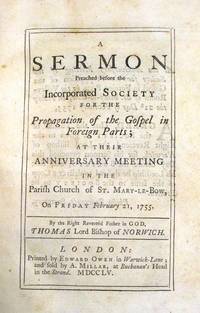
176729803London 1767. Bound in attractive contemporary or early 19th century half morocco marbled boards marbled endpapers and raised spine bands. 'Sermons' stamped in gilt on spine. Bookplate of Paul Beilby Thompson 1784-1852 the first Baron Wenlock an English Whig and Member of Parliament during the late 1820's and the 1830's. Pages 80; 77 1; 99 1; 88; 91; 119 1; 68 1; 98 1 pp each as issued. A lovely set in Near Fine condition tear to one blank margin on the 1767 Sermon and spotting on a couple of its leaves.<br/><br/> The Preachers listed chronologically are Thomas Hayter 1755 James Johnson 1758 Anthony Ellis 1759 Richard Newcome 1761 John Hume 1762 Philip Yonge 1765 William Warburton 1766 John Ewer 1767. In addition to their Sermons the pamphlets print the Society's Charter its Proceedings over the preceding year names of members and donors; the names of the Society's missionaries in Canada the American Colonies and the West Indies with their narrative reports on their work including conversions of Indians and Negroes; and a list of the Bishops and Deans who have preached before the Society beginning in 1701. The form of a bequest to the Society is usually printed at the end.<br/> The Society's efforts in the American colonies aroused great resentment among some leading American clergy particularly Charles Chauncy and Jonathan Mayhew who viewed its activities as attempts to establish the Church of England in the New World and to destroy the democratic organization of American churches. Their resistance during the 1760's paralleled political developments which would produce the American Revolution. <br/> Certainly the Sermons reflect the high-water mark of British self-assurance. Bishop Hume describes "the real state of the multitudes-- a set of thoughtless illiterate untutoured creatures." Warburton's 1766 Sermon "a statement of British manifest destiny." Gephart dismisses objections of non-Episcopalians to the Society's mission: Americans suffer from the "outrageous folly" of "Freethinking." They are "a People where wealth and Civil Faction have as usual inflamed religious zeal." And the Society of Jesus has "immerged themselves in the worst part of civil intrigues." At the same time he and his colleagues unequivocally denounce "the infamous traffic for Slaves" which "directly infringes both divine and human Law." They are "endowed with all our Faculties possessing all our qualities but that of colour; our BRETHREN both by Nature and Grace." <br/>HAYTER: ESTC T47758. JOHNSON: Goldsmiths' 9409. Sabin 36223. ELLIS: ESTC T14001. NEWCOME: Sabin 54938. ESTC N23710. HUME: ESTC N37286. Goldsmiths' 9804. YONGE: Adams American Controversy 65-28. WARBURTON: Adams American Controversy 66-61. Sabin 101276. Blockson 8984. Gephart 10084. EWER: Adams American Controversy 67-5. unknown books
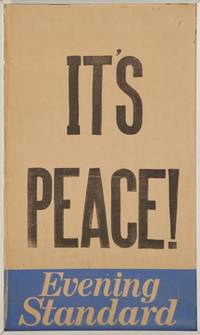
12513Used; Like New/Used; Like New. A graphically striking vintage news banner issued by the Evening Standard in two colors proclaiming peace at the end of WW2. Signed and inscribed on the verso in ink from Bob Freeman "To George and Pattie" later gifted by George Harrison presumably after his divorce from Pattie Boyd in 1977 to Ringo Starr and acquired by us from the Collection of Ringo Starr.  29 by 17 inches. In very good condition with tears professionally mended with Japanese tissue and archivally framed with the signed portion on verso left visible within a rear window on mat.  <br style="">Robert Freeman is a photographer and designer most famous for his album cover photos for The Beatles and his design work on the end credit sequences of their first two films and the related film posters and advertising materials.  He was the Beatles' most favoured photographer during the years 1963 to 1966 and shot arguably the most well known images of them. He photographed and designed the covers for five consecutive album covers of the Beatles-sanctioned UK album releases on the Parlophone label. Most of those images were also adapted by Capitol Records for the US releases they compiled from the Beatles' UK recordings.<br style=""> unknown books