6 502 résultats
1963C1354Program for the First Piatigorsky Cup: International Grandmaster Chess Tournament July 2 to 27 1963 48 pages with photographs including photographs of the contestants table and diagrams. Octavo 8 1/2" x 4 1/2" bound in original publisher's spiral binding in blue felt wrappers with black and silver Piatigorsky Cup stamped to cover. Included nine first day tickets for the cup. Signed or inscribed by all the contestants to Mrs Piatigorsky. <br /><br />The Piatigorsky Cup was a triennial series of double round-robin grandsmaster chess tournaments held in the United States in the 1960's. Sponsored by the Piatigorsky foundation only two events were held in 1963 and 1966. the Piatigorsky Cups were the strongest U S Chess tournaments since New York 1927. Jacqueline Piatigorsky was married to cellist Gregor Piatigorsky. One of the strongest woman chess players in the U S and a regular competitor in the U S Women's Chess Championship she designed the cup and was the primary organizer of the tournaments. The prize funds were among the largest of any chess tournament up to that time. Every player was guaranteed a prize and all traveling and living expenses were paid. The First Piatigorsky Cup was held in the Ambassador Hotel Los Angeles in July 1963. The tournament field of eight included players from five countries. the soviet representatives Paul Keres and World Champion Tigran Petrosian finished equal first to share the cup with a score of 8 1/2/14 receiving more than half of the $10000 prize fund $3000 for first. Keres won most of the games in the tournament six but lost twice to Samuel Reshevsky. The Cup was Petrosian's first tournament since winning the 1963 World Championship match with Mikhail Botvinnik and was one of two first prizes he shared in his six-year reign as champion. He was the first reigning champion to play in an American tournament since Alexander Alekhine at Pasadena 1932. After losing the second round to Svetozar Gligoric Petrosian was never in danger the rest of the tournament. The remainder of the tournament field included to Americans Reshevsky and Pal Benko two Argentinians Oscar Panno and Miguel Najdorf and two Europeans Gligoric Yugoslavia and Frank Olafsson Iceland. U S Champion Bobby Fischer decline an invitation after his demand for $2000 appearance fee was refused by the tournament organizers. Gligoric led halfway through the tournament with 4 1/2/7 but scored only three draws in the last seven games and finished fifth behind Najdorf and Olafsson. Petrosian finished the strongest with 5/7 in the second half. Before the last round Petrosian led with 8 points followed by Keres with 7½ and Najdorf and Ólafsson with 7. Both Petrosian and Keres had Black in the final round. Petrosian drew his game against Reshevsky but Keres beat Gligorić to result in a tie for first place with 8½ points each.<br /><br /><b>Condition:</b> Edges sunned inscriptions to front end paper and title else spiral spine cracked else very good. Piatigorsky Cup Committee paperback books
181864316Washington City 1818. 4to. Three-pages approximately 600 words; the Monroe response approximately 80 words in full below. Folded for mailing; otherwise fine in all respects. Lt. Jones a Naval officer prefaces his case with a reminder to President Monroe that they had met in July when Jones reported on "the motives and feelings of the Mediterranean Memorialists" referring to the September 1816 dispute between Commodore Oliver H. Perry and one of his officers Capt. John Heath who commanded a detachment of Marines aboard the U.S. frigate Java in the Mediterranean and the resulting court martial convened aboard ship in December of that year. The subaltern officers aboard ship including Jones signed a petition protesting the actions of Com. Perry toward Capt. Heath. This resulted in a request by their superior officers that all the subalterns who had signed the petition be recalled to the United States. see: "American State Papers" 15th Cong. 1st session 1818 Naval Affairs pp.453-6. Jones who had begun service in the Navy at the age of 15 appeals to the President regarding the resulting suspension of his promotion without the chance to defend himself in the more formal setting of a court martial: "How hard is my case! Condemned without trial; even without a hearing. To submit was my duty. To appeal is my right." Monroe's response some 80 words is written on the verso of the second integral leaf in full: "Lt. Jones of the navy. Will it not be proper to make some nominations of the young men who have made the atonement required The public attention was drawn to the object & feeling much excited which are reasons for terminating the affr. in favor of this young man many members have spoken to me. Still I would wish that the particular can be taken up by itself. JM / If any nomination is made it had better be added to those going in." A native of Virginia Thomas ap Catesby Jones continued to serve in the U.S. Navy until his death in 1858. He saw service in the War of 1812 including in the New Orleans campaign and the Mexican War and commanded the Pacific Squadron in the 1840s. He was by many accounts a controversial figure who in his later naval career meted out harsh discipline to his crew. Herman Melville who served aboard Jones's flagship the "United States" in the Pacific is believed to have modeled the captain of "White Jacket" and "Commodore J" in "Moby Dick" on Jones. " In 1850 in a politically charged court-martial shortly after White Jacket was published Jones was found guilty on three counts mostly related to 'oppression' of junior officers and relieved of command for several years" Wikipedia. <br/><br/> unknown books
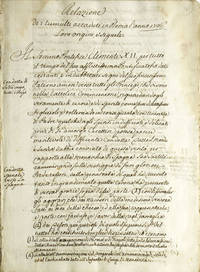
1736257005Rome 1736. 59 pp. in all on laid paper. 4to all with one exception approx. 27 x 20 cm. Provenance: Frederick North 5th Earl of Guilford 1766-1827; library of Sir Thomas Phillipps ex Ms. 7544; with H.P. Kraus. 59 pp. in all on laid paper. 4to all with one exception approx. 27 x 20 cm. Riots in Rome: The Spanish Bourbons in Southern Italy - from the Thomas Phillips Collection. Following the acquisition of the Kingdom of Naples and the Two Sicilies by the Bourbons of Spain in 1736 the conquering Spanish troops returning through Rome and Papal States provoked anti-Spanish riots in March of 1736. The following 6 manuscripts each in a different contemporary hand all from the collection of Sir Thomas Phillips and comprising Phillips Ms. 7544 relate to those events. They are as follows:<br/><br/>1 CONTI Antonio attributed to. "Relazione dei tumulti accaduti on Roma l'anno 1736. Loro origine e sequele." 13 pp. on 7 leaves.<br/>2 "Sopra il tumulto populare seguito in Roma il 13 Marzo 1736." 6 2 blank pp. on rectos of 7 leaves. <br/>3 "Se domanda se un Popolo si solleva tumultiamente nel Domnio altrui contro una nazione con offesa del Sovrano di essa ottenuto il perdona generale ." 4pp. on two leaves.<br/>4 Same text as above with minor differences e.g. "amnistà " for "perdona". 4 pp. 21.5 x 15 cm.<br/>5 Manuscript Letter fair copy headed "Sigl. Mio" 2 Giuglio 1736" beginning: "Non potevate far cosa pui grata all mia amicizia che commnicarmi la lettera trasmessa da Roma ."12 4 blank pp. Docketed on final page: "Relazione dei tumulti seguiti in Roma l'anno 1736 per i scrivi Austrici contro i Spagnuoli"<br/>6 Manuscript Letter fair copy headed "Sigl. Mio". 15 pp. N.p. n.d. <br/><br/>From the collection of Thomas Phillips 1792-1872. "His collection of over 60000 manuscripts was an outstanding achievement in the annals of bibliophily" ODNB and such was the scale that over 100 years passed after his death until the last tranche of the papers were finally sold in 1977 to H.P. Kraus.<br/><br/>The attribution would seem to be based on a manuscript of the same title in the University of Chicago Special Collections Library v. OCLC: 154339939. unknown books
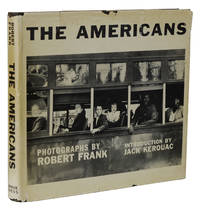
1959180731005New York: The Grove Press 1959. First Edition. Hardcover. Very Good. First edition first printing. Publisher's black cloth binding with gilt titles on spine in dust jacket with price intact. Very Good with rubbing to gilt on spine pages toned. front free end paper lightly creased. In a Very Good dust jacket which is toned lightly insect worn and edge worn with chipping and several short tears. An outsider's nuanced view of American society as seen through the Swiss-born photographer's lens. The Grove Press hardcover books
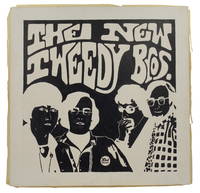
140940286Portland: no publisher. Unbound. Very Good. Late 1960s. Single-sheet white cardstock measuring 14"x14" with original black painted design covering a 12"x12" area signed on the back in pencil by Judi Biandel. Appears to an original artist's mockup for the 1960s Portland rock band The New Tweedy Bros. with a nearly-identical image of the four band members being used for posters and later included in the 2017 re-issue pf the band's only LP though the colors are inverted. It could possibly have been a mock-up for an LP that never materialized to be released by Dot Records who released a 7" for the band whose LP eventually came out on Ridon. It is the size of an LP sleeve the colors appear inverted from other examples found on band flyers but the lettering is not inverted. Very Good with masking tape applied along rear edges two small areas of tape damage to rear. A legendary psychedelic-pop band based in Portland Oregon who inspired the Grateful Dead. Their original self-titled LP on Ridon is one of the most collectable and hard to find albums of the era. Contemporary original artwork for the band is very uncommon. [no publisher] unknown books
1928140436Beverly Hills CA: Metro-Goldwyn-Mayer MGM 1928. Draft script for the 1929 silent film. <br/><br/>Lon Chaney plays a heavily-scarred wild animal trapper whose daughter's upcoming marriage is threatened by the return of her femme fatale mother. The mother harbors bitterness to Chaney and seeks revenge on him by attempting to woo her daughter's fiance thwarted by a gorilla Chaney releases from a cage that gruesomely attacks her. Lon Chaney's penultimate silent film and the last of his collaborations with director Tod Browning. The film was released with a Movietone music and effects soundtrack that could be played alongside the film. <br/><br/>Tan titled wrappers rubber-stamped copy No. 10751 and production No. 415 dated Dec. 31 1928 with credits for producer Irving Thalberg. Title page integral with the first page of the text with credits for story writers Tod Browning and Harry Sinclair Drago and screenwriter Waldemar Young. 75 leaves with last page of text numbered 75. Mimeograph duplication. Pages about Fine wrapper Good plus bound with two gold brads. Metro-Goldwyn-Mayer [MGM] unknown books
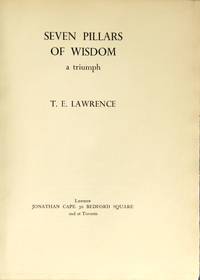
193542250London: Jonathan Cape 1935. Third i.e. second complete edition overall preceded by the incomplete "Oxford Edition" of 1922 8 copies only were printed 6 still extant and the rare privately printed "Subscriber's Edition" of 1927 170 copies; this is the limited issue 750 numbered copies of the first trade edition; sm. 4to pp. 672; frontispiece portrait of a bust of Lawrence 4 folding maps 2 facsimiles 1 double-p. and illustrations throughout some in color by John Kennington Roberts Lamb Dobson Sargent Young Gill Spencer Rothenstein and Carline; 3 of the illustrations herein did not appear in the 1926 subscriber's edition and this limited edition contains a number of illustrations not in the trade edition; original tan pigskin and brown buckram gilt lettered spine t.e.g. the others uncut; fine copy in a cream cloth slipcase. Winston Churchill called this book of Lawrence of Arabia's covert activities in the Arab revolt against the Ottoman Empire "one of the greatest books ever written in the English language." O'Brien A041. <br/><br/> Jonathan Cape hardcover books
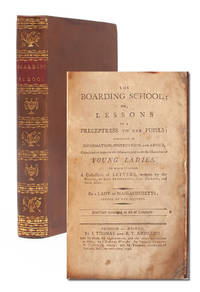
17983468Boston: Isaiah Thomas and E.T. Andrews 1798. First edition. Rebound to style in full calf with morocco and gilt to spine. Original endpapers retained. 252 pages. Paper repairs to chips along the outer edges of title and dedication pages not touching text. Pages toned with light scattered foxing throughout mostly limited to pages 193-209; overall unmarked legible and pleasing. The second work by the first native-born American woman novelist it has become quite scarce. Currently the only first edition on the market this title has appeared only three times at auction since 1983.<br/><br/>The rare second novel by best-selling Massachusetts author Hannah Webster Foster. Only one year before the release of her epistolary novel The Coquette made Foster a literary sensation. "Not only was it the first novel written by a native-born American woman in its depiction of an intelligent and strong-willed heroine the novel transcends many of the conventions of its time and place" History of American Women. Her sophomore release was no less important. Continuing to deploy the popular epistolary form of its predecessor The Boarding School "promotes improved female education through its depiction of an exemplary boarding school teacher" and remained "equally concerned with the status of women in the early republic" ANB. At a time when the fledgling nation was debating women's status and establishing its earliest statutes on schooling Foster uses her platform to argue "the many advantages of a good education and the importance of improving those advantages." Dividing the work into two key sections Foster uses the first portion to describe "the finishing school run by Mrs. Maria Williams including exhortations on social conduct reading and general preparations for survival"; meanwhile the second portion is dedicated to "letters from the students to the teacher and to each other demonstrating the beneficial effects of Mrs. William's instruction" History of American Women. Recent scholarship has emphasized that The Boarding School builds upon an already central concern in Foster's prior novel: "the crucial role played by tightly knit circles of women" which "would have been deeply resonant to the young women who were her primary readers" Pettengill. Like The Coquette her second book "portrays women during the crucial transition in their lives from daughterhood to wife-and-motherhood from parental to husbandly authority. But the boarding school set is younger with school days still fresh in their memories and the complications of courtship and marriage only just coming into their range of vision.in The Boarding School the male world is shadowy and vague.not yet jostling the women with demands that threaten even as they support the logical self-sufficiency of sisterhood and the female sphere" Pettengill. By bridging the didactic advice book with the epistolary novel Foster suggests that women need education as "the foundation of a useful and happy life" and that school provides them with this as well as with a lifelong female community built on shared experience. The "perfect Republican mother" Mrs. Williams provides the girls with the perfect model on which to base themselves giving Foster a means for arguing that women must educate other women in order to create a strong and lasting national foundation Newton. <br/><br/>BAL 6242. ESTC W29990. Evans 33748. Isaiah Thomas and E.T. Andrews unknown books
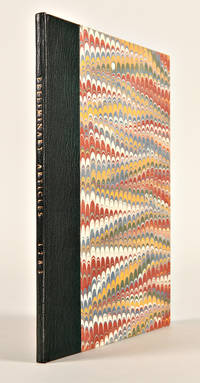
1783WRCAM21253London 1783. 10pp. printed in double columns in parallel English and French. Small quarto. Modern half morocco and marbled boards. A very good crisp copy. This preliminary settlement had been a stumbling block to the general settlement of the other parties in the American Revolution. All other treaties were concluded the day after this one. It revolves mainly around questions of trade with various colonies. England's final treaty with Holland was not concluded until the following year. This is the official English edition of the preliminary articles. SABIN 65045. hardcover books
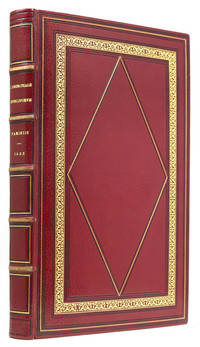
1633306616Paris: Societatis Typographic Librorum Officii Ecclesiastici . 1633. Engraved title numerous small and large engraved vignettes head-and tail-pieces one full-page engraving; text printed in black running headlines and chapter headings in red numerous large decorated initial capitals. 1 vols. Folio. Full red crushed morocco covers decorated with single black and gilt fillets including a central diamond in black and gilt with a gilt-rolled frame spine in six compartments with raised bands gilt lettered in two others with simple frame of black and gilt fillets wide gilt turn-ins with large gilt cornerpieces a.e.g. gilt-stamped on the turn-in of the inside front cover "French Binders Garden City NY" and on that of the rear cover "H. Hardy Relieur 1934 G. Pilon Doreur." Very slight rubbing to extremities still near fine with some toning to text. In a quarter morocco slipcase with chemise. Engraved title numerous small and large engraved vignettes head-and tail-pieces one full-page engraving; text printed in black running headlines and chapter headings in red numerous large decorated initial capitals. 1 vols. Folio. Bound by The French Binders 1934. Beautifully bound in full red morocco by The French Binders successors to The Club Bindery and signed on the rear turn in by two of the firm's most distinguished binders Henry Hardy and Gaston Pilon. <br/>The French Binders traces its lineage back to The Club Bindery founded in 1895 by members of the Grolier Club to provide exceptionally fine bindings for American collectors. The Club Bindery moved to Cleveland where it was successively renamed the Rowfant Bindery 1909-1913 the Booklover's Shop 1914-1917 and finally The French Binders 1918-1920s as in-house bindery to Doubelday in Garden City New York. Henry Hardy worked for all incarnations of the bindery starting with The Club Bindery; his brother-in-law Gaston Pilon worked with Chambolle-Duru in Paris and came over to America to join the Rowfant Bindery. Both Hardy and Pilon were named Officers of the French Academy in 1933 the highest recognition given by the French government to naturalized Americans see Martin Antonetti's essay in Bound to Be the Best: The Club Bindery. Provenance: Estelle Doheny red morocco booklabel; Carl C. Kalbfleisch brown morocco booklabel Societatis Typographic Librorum Officii Ecclesiastici .. unknown books
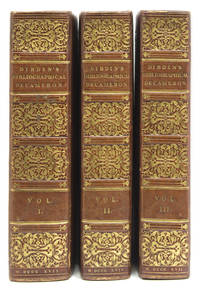
1817306787London: Printed for the author by W. Bulmer and Co. Shakespeare Press 1817. First edition with half-titles and errata. Hundreds of engravings and examples of type etc. some tinted in red and blue. 3 vols. Imperial 8vo. Contemporary straight-grained red morocco by Charles Smith covers gilt ruled with gilt side-pieces along central panel spines in six compartments with elaborate gilt scrollwork gilt turn-ins blue silk doublures with gilt cornerpieces duplicated on silk free endpapers a.e.g. Foxed minor rubbing to boards an attractive copy. First edition with half-titles and errata. Hundreds of engravings and examples of type etc. some tinted in red and blue. 3 vols. Imperial 8vo. Bound by Charles Smith. Dibdin's lavish work in an ornate binding by Charles Smith one of the more active and competent binders in London of the 1810s-'30s with his "13 Church St Soho" ticket in volume 1. Windle & Pippin A28; Jackson no.40; Hart no.186; Bigmore and Wyman pp. 169-70. Provenance: R.P. Hooper bookplate Printed for the author by W. Bulmer and Co. Shakespeare Press unknown books
1858240889London: Published by W.S. Johnson & Co 1858. First edition. iv 328; iv 304; iv 320 pp. 3 vols. 8vo. Bound in contemporary presentation green pebbled morocco gilt extra a.e.g. by Leighton Son and Hodge. Spine faded else fine. First edition. iv 328; iv 304; iv 320 pp. 3 vols. 8vo. Presentation Binding Inscribed to His Daughter. Inscribed by the author 1814-1880 to his Daughter "To Violet Kate Egan/ from her father/ Pierce Egan/ with his tenderest love and/ affection/ March 8th 1870." Sadleir 811; Wolff 2045 Published by W.S. Johnson & Co unknown books
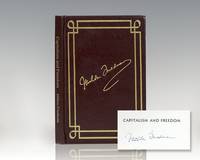
199587985Chicago: The University of Chicago Press 1995. Special anniversary edition of Friedman's magnum opus. Octavo bound in full leather gilt titles to the spine front and rear panel all edges gilt silk bookmark bound in. Signed by Milton Friedman on the title page. In fine condition. Milton Friedman "is regarded as a giant within the economics profession and is one of the two or three most referenced and revered economics figures in the 20th century" Pressman 161. Capitalism and Freedom was selected by the Times Literary Supplement as one of the "hundred most influential books since the war." It also placed tenth on the list of the 100 best non-fiction books of the twentieth century compiled by National Review and on Time Magazine's top 100 non-fiction books written in English since 1923 and Modern Library 100 best non-fiction books of the twentieth century. The University of Chicago Press hardcover books
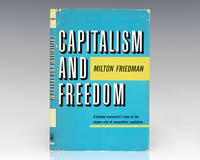
1962116467Chicago: University of Chicago Press 1962. First edition of Friedman's magnum opus. Octavo original blue cloth. Fine in a near fine dust jacket with light wear. An exceptional example. "Friedman a laissez-faire economist and professor at the University of Chicago is considered one of the leading modern exponents of liberalism in the 19th-century European sense. In Capitalism and Freedom he argued for a negative income tax or guaranteed income to supersede centralized bureaucratized social welfare services which in his view are inimical to the traditional values of individualism and useful work" Britannica. Selected by the Times Literary Supplement as one of the "hundred most influential books since the war". It also placed tenth on the list of the 100 best non-fiction books of the twentieth century compiled by National Review and on Time Magazine's top 100 non-fiction books written in English since 1923. University of Chicago Press hardcover books
1857197Mayhew the Brothers <i>Paved With Gold or the Romance & Reality of the London Streets. An Unfashionable Novel. </i>London Chapman & Hall March 1857- March 1858 all 13 installments boxed. Illustrations by H. K. Browne Item 221 featuring the English painter and engraver Henry Thomas Alken also known as Ben Talley O. with his color portrait. Condition is generally good but Part XIII shows separation wear. All installments are present and complete housed in a hard folding cloth box. Chapman & Hall paperback books
16364The Movement. San Francisco: Student Nonviolent Coordinating Committee of California and San Francisco: The Movement Press. Sept. 1965 Vol. 1 No. 9. October 1965 Vol. 1 No. 10 February 1966 Vol. 2 No. 2 December 1697 Vol. 3 No. 12. 1965-1966 issues are 8 pages; 1967 issue is 12 pages. Tabloid. Illustrated newsprint. An important underground paper of the civil rights movement which connected activists across the country with news on protests boycotts and organized actions. These issues cover topics such the Watts Riots student protests the Cesar Chavez's National Farm Workers Association which he described in the paper as "somewhere between a movement and an industrial union." An important publication which connected civil rights activists across the country and centered voices of those on the frontline of political action. <br/><br/>The Movement gave national and local leaders a platform to express their viewpoints and support each other in their struggles. Four crisp copies of one of the most significant underground Civil Rights-era newspapers of its time which was essential in connecting activists on a national level. Very good condition. Some light wear and minor tears along folds. unknown books
193719595Ec.1937. Original set of thirty-six drawings from the Hal Roach Studio for the ‘Topper Car’ which was custom-created for the classic screwball comedy film ‘Topper’ starring Cary Grant Constance Bennett Roland Young Billie Burke and Alan Mowbray. The drawings are on vellum sheets ranging in size from 13 3/4†x 8 1/4†to 13 3/4†x 16 1/2†and show aspects and lines of the car with various perspectives and details. With occasional notations including one presumably in the hand of Tony Gerrity one of the designers at Bohman & Schwartz which reads: “Walt - am going to look at Barker’s trucks this afternoon - be back around 3:30. Tony.†Includes an original illustrated brochure for the Cord automobile which was the initial inspiration for the car used in the film but after researching the matter determined that it wasn’t large enough to accommodate camera equipment and stunt drivers. With the original brown envelope 15†x 10 1/4†which has “F. 17 - Topper Automobile Sketches†written at the top right corner. The Cord brochure is in fine condition in printed wrappers and all of the drawings are in uniformly near fine only slightly used condition with creases from folding and occasional unobtrusive holes from removed staples. ‘Topper’ tells the delightful story of a fun-loving adventuresome couple George and Marion Kerby Cary Grant and Constance Bennett who are killed in an automobile accident. They return as ghosts and set about lightening up the rather conventional life of their friend bank president Cosmo Topper Roland Young much to the consternation of his wife Clara Billie Burke. The ‘Topper Car’ driven by the Kerbys was custom built by the Bohman & Schwartz Co. using a 1936 Buick Roadmaster chassis. hardcover books
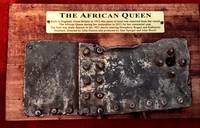
2012264California & Florida: Hollywood 2012. original movie prop. wooden plaque. Fine/Fine. Stained Wooden plaque 17" W x ~10 3/8" H mounted with two steel plates ~14" W x ~ 6" H x 3/4-1" D from the vessel "African Queen." The plates have a total of 18 rivets and a grouping of 4 bolts & nuts which surround a 3/4" hole seemingly from a former bolt. The left lower plate has been signed in ink "Stephen Humphrey Bogart" by Humphrey Bogart's son. 7 lbs. 7 oz. A brass plate 10 3/8" W x 2" H screwed onto the board reads: "THE AFRICAN QUEEN / Built in England Great Britain in 1912 this piece of steel was removed from the vessel / The African Queen during her restoration in 2012 for her centennial year. / The boat was made famous in the 1951 movie starring Humphrey Bogart and Katharine Hepburn directed by John Huston and produced by Sam Spiegel and John Woolf." Two LARGE POVENANCED & MOUNTED FRAGMENTS from THE "AFRICAN QUEEN"! We also include a fine black & white promotional photo of the memorable "African Queen" depicting Kate Hepburn and Bogie in costume. Much of the film was shot in Technicolor with huge cameras in Uganda and the Congo in Africa. During the shooting on location the cast and crew often suffered from sickness and had to endure rough living conditions. In one scene Hepburn was playing an organ but had a bucket nearby because she was frequently sick between takes. Bogart later boasted that he was the only one to escape illness which he attributed to not drinking any water but instead fortifying himself with whiskey that he had brought. Because it was too dangerous to film actors Bogart and Hepburn in an actual croc-and-creature infested African rivers the scenes in which Bogart and Hepburn are in leech-infested water were shot in studio tanks at Isleworth Studios Middlesex. Because of the dangers involved when the "Afrtican Queen" went through rapids and over a waterfall a model was used in the studio tank in London. Most of the action takes place aboard the African Queen of the movie's title. Many scenes aboard the boat were filmed using a raft with a mockup of the boat on top. Once when removing sections of the boat to make room for the large Technicolor camera a heavy copper replica of the boiler nearly fell on Hepburn. The small steam-boat used in the film to depict the African Queen was built in 1912 in England for service in Africa. At one time it was owned by actor Fess Parker. In December 2011 plans were announced to restore the boat and an auction was held to help pay for its restoration which was completed by the following April. The African Queen is now on display at Key Largo Florida. "The African Queen" is a 1951 adventure film adapted from C. S. Forester's 1935 novel. The film was directed by John Huston and produced by Sam Spiegel and John Woolf. The screenplay was adapted by James Agee John Huston John Collier and Peter Viertel. It was photographed in Technicolor by Jack Cardiff. The film stars Humphrey Bogart who won an Academy Award for Best Actor and Katharine Hepburn with Robert Morley Peter Bull and Theodore Bikel. The Library of Congress has declared the film "culturally historically or aesthetically significant." As World War I is about to begin Rev. Samuel Sayer Robert Morley and his sister Rose Katharine Hepburn are British Methodist missionaries serving in a village in German East Africa. Their supplies are delivered by a small tramp steamer named the African Queen captained by seedy Canadian boat captain Charlie Allnut Humphrey Bogart whose crude behavior they can barely tolerate. Though Charlie warns them that war has broken out between Germany and Britain the missionaries choose to stay only to witness the Germans destroy their mission village. When the Germans drive off its natives Reverend Samuel protests and is beaten by a German soldier. Afterwards he becomes delirious and dies. When Charlie returns shortly afterward he and Rose bury her brother and depart in the African Queen. After Charlie tells Rose that the Germans have a gunboat the Königin Luise German for "Queen Louisa" guarding a huge lake downriver Rose conceives of a plan to convert the African Queen into a torpedo boat in order to sink the hated German warship. Though Charlie believes that her plan to reach the lake is suicidal--since they would have to get past a German fort and run three sets of dangerous rapids on the Ulanga River--ever insistent Rose manages to convince him. During their journey down-river Charlie Rose and the African Queen overcome many obstacles including the German fort and the rapids. The African Queen is flooded after the first rapids; then sustains bullet holes in its boiler when they pass the fortress and its soldiers shoot at them. These holes cause the ship's engine to stop running. Charlie barely manages to patch up the boiler when they enter the second set of rapids. The steamer is again flooded as it gyrates through these rapids. While celebrating their survival the two embrace but break off from embarrassment. Soon however they develop an affectionate relationship. They manage to get more fuel and drain the boat and as they watch hippopotamuses and other creatures the third dangerous group of rapids comes up. This time as it goes over the falls the hull of the boat is badly scraped. When Charlie dives under the boat to inspect the damage he discovers that the propeller shaft and its blades have been damaged. With his expertise and Rose's suggestions Charlie manages to straighten the shaft and weld a new blade onto the propeller so they are able to resume their dangerous journey. All appears lost when Charlie and Rose get lost and the African Queen becomes stuck in muck and dense reeds. When Charlie tries to tow their boat he emerges from the water covered with disgusting leeches. All their efforts to free the African Queen fail. With no supplies left Rose and Charlie turn in convinced they have no hope of survival. Exhausted Rose prays that she and Charlie may go into Heaven. Providentially as they sleep heavy rains raise the river and float the African Queen into the lake where they narrowly avoid being spotted by the Königin Luise. Anticipating the warship's return Charlie and Rose hastily labor to fill two oxygen cylinders with explosives. They use nails as firing pins and shove the cylinders through holes in the bow of the African Queen as spar torpedoes. When the Königin Luise returns the couple steam the African Queen out onto the lake in darkness planning to ram the Königin Luise before diving overboard and swimming to safety in Kenya. Unfortunately a storm erupts as they head toward the warship. Because the bow holes of the African Queen aren't sealed water floods in causing the brave little vessel to sink and capsize. Thrown overboard Charlie loses sight of Rose but is soon taken aboard the Königin Luise. Because he believes Rose has drowned when the German captain Peter Bull accuses him of being a spy Charlie doesn't defend himself so the captain sentences him to be hung. Unexpectedly Rose is brought aboard right after Charlie's sentence is handed down. When questioned by the captain she defiantly confesses their plot. The captain then sentences her to be executed as a spy too. Charlie begs the German captain to marry them before carrying out his sentence so he conducts a brief marriage ceremony Just as the Germans are about to hang them there is a huge explosion which causes the Königin Luise to sink. The warship had struck the submerged hull of the African Queen and detonated its torpedoes. Rose's plan worked after all and the newly married couple swim happily to safety. Details adapted from Wikipedia and other sources. Best available condition. Formerly in the possession of a gentleman who attended the 2012 Florida auction. Hollywood unknown books
189456228N.p. Cambridge Mass. 1894. 4to approx. 200 pages several diagrams and drawings in loose sheets often with paste-overs and cancels and bound in contemporary marbled boards tied with string and nearly broken; spine perished; good or better and legible. For a good account of Holmes see DAB. Born in 1815 in Peterborough N.H. and a graduate of Phillips-Exeter Harvard and Harvard Law he removed to St. Louis where he was first the city then the county attorney. In 1868 he returned to Cambridge where he became a professor of law at Harvard. He "did no legal writing but was widely interested in other subjects. His Realistic Idealism in Philosophy Itself 1888 exhibits extensive philosophic and scientific reading but has no perceptible influence and now seems unreadable . His scholarship and fairness have been praised by his opponents. In his old age he compiled a Genealogy of the Holmes Family of Londonderry N.H. containing garrulous sketches of his relatives and a long autobiography" DAB. As well as this extensive treatise on gravitation and electricity begun when he was nearly 80. <br/><br/> hardcover books
184556973Baltimore: published by F. Lucas Jr. 170 Market Street 1845. 8vo pp. x 2 xi-xii 2 11-334 2; frontispiece and 4 chromolithograph plates of signal flags; contemporary full sheep neatly rebacked new black morocco label on spine; the plates lightly spotted but on the whole very good and sound. This copy with a presentation on the front pastedown: "To the Association of New York Pilots with the compliments of Messrs. Rogers and Black per Colt & Robinson proprietors of the New York & Offing Electro-Magnetic Telegraph." Dedicated to Samuel F. B. Morse "inventor of the American Electro-Magnetic Telegraph." Rogers a trained engineer from New York City worked as Morse's assistant in constructing the first telegraph line from Washington to Baltimore. He was himself an inventor and pioneered the use of insulated cables for use underground and underwater. During the Civil War he helped develop the military telegraph system. American Imprints 5604; see Sabin 72626 for a later edition. <br/><br/> published by F. Lucas, Jr., 170 Market Street unknown books
18333474London: Longman Rees Orme Brown Greene & Longman 1833. First edition. Near Fine. Publisher's cloth binding retaining the delicate paper label to front board. Some bumping to corners and faint spotting to boards but a pleasing square copy in all. Internally a clean with just a bit of scattered foxing to endpapers and preliminaries. Scarce on the market this book documents Marcet's efforts to expand knowledge access to the working classes in order to make political self-advocacy possible. Presented by Marcet to Professor Pierre Prevost the philosopher and physicist best known for his experiment on the body's radiation of heat this copy bears his ownership signature on the front endpaper and an inscription from Marcet at the header of the title: "Prof. Prevost from the Author." <br/><br/>A peer of such feminist thinkers as Maria Edgeworth Marcet is considered one of the most important figures in the history of women's education in science and economics. Her "Conversations" books which include texts on politics economics and science were ranked among the best-known educational texts of the nineteenth century. In addition to making these rigorous fields accessible to women who might otherwise be denied such training they also welcomed in young boys whose access to quality education might be hindered by class. Among her most famous readers was Michael Faraday who encountered her books while serving as a bookbinder's apprentice and was inspired to delve more deeply into the sciences Science History Institute. The present work seeks to popularize economic theory and put forward an argument for decreasing wage gaps among rich and poor; and in line with her overall project Marcet seeks to make her argument accessible to readers of all education levels. Wrapped in allegory in order to welcome in labor-class readers who may not have complex economic vocabularies Marcet's tale posits the need for new economic policy into a series of nine allegorical essays told "through the eyes of honest John Hopkins a laborer on low wages" Liberty. Scholars have increasingly viewed John Hopkins as an important and previously undervalued piece of Marcet's oeuvre; and her desire to bring the working class into dialogue about their own economic state signals an important cultural change. "Marcet was engaged in the work of the knowledge broker -- creating and maintaining networks between and among scientists and the larger public. Knowledge sharing was based upon the personal and social connections she facilitated by bringing together bankers scientists and professional economists such as Malthus Ricardo Mill and others. It was extended to the popular culture through the many editions of her Conversations addressed to the middle classes and enlarged to include the working classes with her John Hopkins's Notions on Political Economy" L. Forget. Lesser known but nonetheless one of Marcet's culturally important contributions this volume contains important lessons on how to expand a class's knowledge base and provide the tools for political and economic self-advocacy. Notably this copy reveals the influential scientific communities she participated in connecting her to men in the hard sciences who knew of and read her work.<br/><br/>Feminist Companion 713. Women in Science 125. Dictionary of Economics. Near Fine. Longman, Rees, Orme, Brown, Greene & Longman unknown books
19522294Washington DC: U.S. Department of Commerce Office of Technical Services 1952. First Edition. Near Fine. Near Fine copy in original orange paper wraps with spine lighly sunned. Internally about Fine. Quarto measuring 7.75 x 10 inches and collating 2 41 pages: complete. Rare surviving copy of the first survey of electronic digital computers in the U.S. organized by pioneering mathematician Mina Rees. The only first edition on the market this is a title that has never before sold at auction and is listed by OCLC at only 10 institutions.<br/><br/>In her introduction to the survey Rees notes that "Until recently all commercially available general-purpose digital computers were large and cost many hundreds of thousands of dollars. Within the past year however a number of manufacturers have smaller more compact usually slower automatic computers for sale at less than one hundred thousand dollars." Because this change opened the door to a wider variety of businesses and firms accessing computers Rees points to the symposium as being timely and necessary. In this space and this historic moment scientists mathematicians manufacturers and government agencies could consider how to continue improving and reducing cost on the machines; and they could consider their wide applicability across fields. Rees herself a luminary who became the first woman president of the American Association for the Advancement of Science is featured in this survey among other notables including Albert Auerbach and Richard E Sprague. The papers include work the MINIAC the Elecom and the Circle Computer. These were the first of their kind as was the symposium itself. Complete with over 20 black and white photos charts and diagrams it is an important and rare piece documenting computers' shift into the necessary and ubiquitous technology they are today.<br/><br/>Origins of Cyberspace 853. Near Fine. [U.S. Department of Commerce, Office of Technical Services] unknown books
194195094New York: Reynal Hitchcock Inc 1941. First limited edition of French adventurer Gontran de Poncins' classic account of his solo unsupported journey in the Canadian Arctic. Octavo bound in three quarters morocco over cloth covered boards with gilt titles and tooling to the spine. One on only 550 copies this is number 81. Boldly signed by the author on the front free endpaper "Before I disappear for good!.I remain your friend 'Eskimo Miki' de Poncins." With the original Publisher's Note laid in which explains "The Vicomte Gontran de Poncins author of KABLOONA called out of the Arctic to join the colors of his country disappeared in the debacle of the French Republic following the fall of Paris. It has therefore been impossible to obtain his signature for this limited edition." Poncins did in fact survive and this is one of the scarce copies that he signed. Written in collaboration with Lewis Galantiere Gontran de Poncins' Kabloona recounts the French aristocrat's solo unsupported journey in the Canadian Arctic where he lived with the Inuit for nearly 15 months between 1938 and 1939. Bored with the business world curiosity drew de Poncins to exotic areas throughout the world; his unique technique in relaying his observations of the cultures he discovered was not scientific but provided stylized personal points of view and descriptions. Initially describing the Inuit way of life as primitive and inferior de Poncins soon experienced a deep spiritual awakening after undergoing weeks of hardship in the Arctic and became so well-adapted to the lifestyle he was essentially adopted by the Inuit. Reynal, Hitchcock, Inc hardcover books
18112473New York / Philadelphia: I. Riley and P. Byrne 1811. First American Edition. Full leather. Very good. From the personal library of President James Buchanan The Law Dictionary signed by Buchanan on the title page. Octavo ii 553pp. Full period calf title in gilt on spine over red morocco label. Statement on title page that this is the First American Edition from the Second London Edition. Spine repaired at ends reinforced hinges. Some age toning with foxing on endpapers. This is Volume V from a complete set of 6 volumes. Signed by President James Buchanan on the title page. This law book is from the personal library of President James Buchanan. His library was primarily held at his home in Lancaster PA called Wheatland. The majority of his presidential papers correspondence and books went to Dickinson college his alma mater. After graduating with honors in 1809 James Buchanan moved to Lancaster and became a legal apprentice to James Hopkins. He was admitted to the Pennsylvania Bar in 1812. Buchanan would go on to serve in the House of Representatives from 1821-1831 United States Senator 1834-1845 then as the 17th Secretary of State under President James K. Polk. He was elected President of the United States in 1856 serving one term. He predicted in retirement that "history would vindicate my memory" but his inability to stop the succession of the southern states has sealed his legacy as one of the least successful presidents in history. I. Riley and P. Byrne unknown books
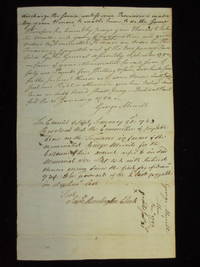
08261Hartford and Middlebury. Manuscript document signed "Testament / Saml. Huntington Clerk" of Council of Safety Hartford Jan. 20 1783; 7 3/4" x 12 1/2" - To "His Excellency the Gov. & Council of Safety" presenting petition of George Merrill of Hartford. "In.Dec. 1780 Chauncey Whittlesey of Middletown Purchaser of Cloathing for this State and for the Use of the Continental Army.bought of.Merrill Sundry articles of Cloathing to the amount of about BP 1100 money.At the time Merrill consented to part with his said Goods he had the strongest assurance from Whittlesey and some of the Members of the Council of Safety.that he should be paid.cash or something equivalent. That to his very great Disappointment and Embarrassment in his Business he was obliged to Receive.many Payments at a very great loss.Now informed by Mr. Whittlesey that he has Nothing in his hands to pay." Beseeching the Council to make good on the debt "Payable out of the two penny Tax" for the balance due of BP 41." Above Huntington's signature as Clerk it is resolved that the Council on Safety will pay. Slight smudge on "m" in Saml. A fine example. Manuscript document signed by Whittlesey Middlebury Jan. 16 1783 certifying that a "ballance" of BP41 " Lawfull Money" remains unpaid; 6 1/2" x 7 3/4". A fine example. A Yale educated minister Whittlesey was a "purchasing clothier" and supplier of rum for the Continentals. During John Adams' administration he acted as buying agent for cavalry swords. Manuscript ledger sheet 8 1/4" x 13" - "State of Conn. in account with George Merrill.for Sundry Articles of Cloathing." plus interest for 13 months. Boldly signed by Merrill upon receiving funds at Pay Table Office Jan. 23 1783. A fine fresh example. Samuel Huntington 1731 - 1796 Signer of the Declaration of Independence and the Articles of Confederation. He served as President of the Continental Congress from 1779 to 1781 and was the 18th Governor of Connecticutt from 1786 until his death. <br/><br/> hardcover books