122 150 résultats
1894124133Oxford: printed for the Association by the Printers to the University 6 issues with the imprint of Horace Hart; the last 5 with that of Frederick Hall 1894-1919. The state of women's education in Oxford at the height of the suffragette agitation An important set of reports published by the pioneering Association for Promoting the Higher Education of Women AEW containing a mass of information relating to the state of women's education in Oxford at the height of the suffragette agitation. The earliest report dates from 1894-95 and the latest from 1918-19 each running from October of one year to the same month of the next. The sequence is incomplete with two issues missing 1900-01 and 1910-11. The reports are scarce in any sequence. WorldCat and Library Hub record runs at the London School of Economics and the British Library. The society's papers and publications are held in the Bodleian deposited there in 1975. The question of women's suffrage and its relevance within the structures of the University of Oxford had been a topic of frequent discussion prior to the formal debate on the subject at the Oxford Union on 19 February 1880. Societies like the Oxford Women's Liberal Association OWLA and the Women's Emancipation Union plus the activism of Florence Davenport Hill who had been a founder member of the Bristol Women's Suffrage society in 1868 and had since moved to Headington paved the way for groups like the AEW and later the Oxford Women's Suffrage Society. The organization's work led to the founding of four women's colleges: Lady Margaret Hall and Somerville opened in 1879 followed by St Hugh's in 1886 and St Hilda's in 1893. St Anne's also originated as part of the AEW catering for female students who lived with private families in Oxford while attending courses run by the society. The AEW counted the activist Eleanor Smith 1823-1896 among its founding members and Annie Rogers 1856-1937 Oxford's first woman don as a secretary. Perhaps the most significant sections in these reports are those titled "General Statistics" which provide accounts of lectures attended by students tutorial arrangements results of examinations donations and subscriptions. The report of 1917-18 also provides a commentary on the "extension of the University Parliamentary Franchise to women who being British subjects and not subject to any legal incapacity have attained the age of thirty and have been admitted to and passed the final examination and kept under the conditions required of women by the University the period of residence necessary for a man to obtain a degree at Oxford. They are registered on specially favourable terms as the Act admitting them is so drafted that the fee of £1 for registration cannot be required of persons who are not graduates. The Register contains at present the names of 409 women." The AEW continued its activities until November 1920 when it dissolved itself as the university by admitting women to membership had taken responsibility for them. 23 issues octavo; comprising a total of 616 pages the issues c.20-30 pp. in length. Original printed paper wrappers sewn and wire-stitched as issued. Housed in a former library's dark purple cloth flat-back box with metal latch closure paper label to spine reading "Australian Council for Educational Research". Each issue complete with stamps shelf marks and labels of the Education Department Library latterly the Board of Education Library. Overall a scarce survival in very good condition. Shelfwear and creasing to wrappers those for the earliest issue detached; rear wrapper for the 1909-10 issue torn but no loss. hardcover
1965160722London: Jonathan Cape 1965. Scarce proof copy Proof copy of the first edition first impression. The text and illustrations are printed in brown and green throughout the green appearing much lighter in the proof one illustration slightly differs. The book was published in laminated boards without a dust jacket. Octavo. Illustrated throughout by Lennon. Original white wrappers. With dust jacket. Book fine dust jacket with minor rubbing to edges. hardcover
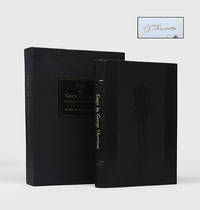
166828Guildford: Genesis Press 1987. First edition first printing no. 1438 of 2500 copies signed by the former Beatle and the illustrator. A fine production as expected from Genesis the pioneers of high quality art-rock publications. With foreword by Jeff Lynne middleword by Elton John and backword by George Harrison. CD contains the following tracks: Sat Singing Recorded March 1980. Lay His Head Recorded April 1980. For You Blue Recorded live in Washington DC December 1974. Flying Hour Recorded March 1978. Quarto. Illustrated throughout by Keith West together with photographs by Gered Mankowitz Brian Roylance Richard Young and John Carter. Original black half-morocco boards gilt edges lettering to spine gilt with limited edition CD 'Songs' the whole contained in custom-made clamshell box with card tray lettering to front cover and spine gilt. Minor rubbing to CD cover otherwise fine. hardcover
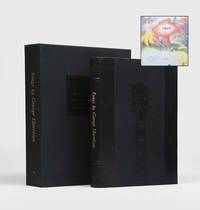
184417Guildford: Genesis Press 1992. I look at the world and I notice it's turning while my guitar gently weeps First edition number 1602 of 2500 copies signed by the former Beatle and the illustrator Keith West. This is a fine production from Genesis the pioneers of high quality art-rock publications with a foreword by Ringo Starr "middleword" by Elton John and "backword" by George Harrison. Loosely inserted is a hand-coloured drawing by the illustrator Keith West. The CD contains the following tracks: "Life Itself" "Hottest Gong in Town" "Tears of the World" and "Hari's on Tour Express" recorded live in Washington D.C. in December 1974. Quarto. With 3 photographic plates tipped in illustrated limitation page tipped in 2 folding plates at centrefold illustrations by Keith West throughout. Original black half morocco boards lettering to spine gilt edges gilt. In publisher's clamshell box with limited edition CD 'Songs' in card tray gilt lettering to spine and leather label lettered in gilt with card guitar bookmarker. In fine condition. hardcover
100964The Pastoral Review Ltd. Sydney Melbourne and London. 1929. The Pastoral Review Ltd. 1929. First edition. Large thick 4to. iv 540 pages. With b/w photographs to almost every page of houses interiors exteriors owners and their familes gardens landscapes livestock etc. 45 properties described in detail. Mostly these are based in New South Wales but there are a few from Victoria and Southern Australia. Bound in full black morocco gilt not unlike a family Bible. All page edges gilt. Marbled endpapers. The leather to upper joint has partially split but joint is sound and has been professionally strengthened along front hinge. Head and tail of spine very frayed and worn lower corners and outer edge of upper board rubbed. Pages lightly browned otherwise a clean and sound copy of a scarce item the first volume of the second series of Pastoral Homes. hardcover
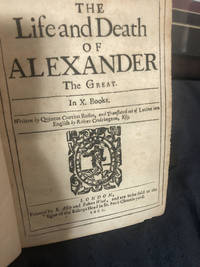
1661Bv1103<p>"NONE BUT ALEXANDER COULD PERFORM WHAT ALEXANDER HATH DONE": SCARCE 1661 EDITION IN ENGLISH OF QUINTUS CURTIUS RUFUS' LIFE AND DEATH OF ALEXANDER THE GREAT CODRINGTON Robert translator. The Life and Death of Alexander the Great. In X. Books. London: E. Alsop and Robert Wood 1661. Small quarto 6 x 7-1/2 modern full brown calf elaborately gilt-decorated spine raised bands black morocco spine label. Housed in a custom black linen slipcase. 1661 edition the scarce second edition of Robert Codrington's esteemed translation into English of this life of Alexander the Great a splendid volume attractively bound in full calf. Curtius Rufus flourished in the first century C.E.; particulars of his life are unknown. His Historiarum Alexandri Magni "introduces a number of picturesque details which are grouped effectively; and the career of the great Macedonian is regarded as a series of brilliant and romantic adventures. There are a number of carefully finished speeches worked into the narrative and much sententious reflection. The style is evidently formed on that of Livy" Peck 449. Preceded by John Brende's 1553 first translation into English which ran through a number of printings in the intervening century before Codrington undertook his new translation "exactly conferred with the Original and purged from many gross errors and absurdities with which it before abounded." Codrington's translation first appeared in 1652 under a slightly different title see Wing C7699. Title page with wood-cut engraved vignette engraved headpieces and ornamental initials. Occasional mispagination toward the end as issued without loss of text. A superlative example handsomely bound. Book Bv1103. $4000. We specialize in rare Ayn Rand as well as other legends and landmarks.</p> E. Alsop and Robert Wood hardcover
1852List2521London 1852. Five groups of documents measuring 13 x 8 inches various paginations see full description below. Fine condition. A scarce set of primary source documents relating to the protection of British territory in the Caribbean in particular along the Mosquito Coast during the period of varied interests in the area in the period following the Anglo-Spanish agreement on the slave trade. Consisting of a series of secretarial copies of reports delivered to Peter McQuhae Commodore of H.M.S. Imauam stationed in Jamaica these dispatches offer an overview of the issues confronting the British Navy in Jamaica during the period and in the Caribbean more broadly. Most of the documents refer to issues with Cuba the most interesting perhaps being a letter warning of an impending filibustering expedition against Cuba by a pro-slavery faction in the American South. <br /> <br /> The group consists of five groups of bound documents some bound out of order and likely bound later. Contents are as follows: <br /> <br /> 1. Addington A.M. Four Page Report Concerning Placing a Ship of War at Grey Town to Discourage Invasions on the Mosquito Coast March 13 1851. <br /> <br /> Henry Addington writes McQuhae to recommend stationing a warship at Grey Town:<br /> <br /> “.it would be sufficient that a Ship of War should from time to time look in grey Town without remaining there at any time long enough to endanger the health of the crew… to provide for the case which is possiblee tho’ not at all likely that during the interval between the visits of a Ship of War some expedition of Nicaraguan or some of the North Americans returning from California might take advantage of the comparatively unprotected state of the lace to take possession of it and that the cruiser on its return to Grey Town might find the place so occupied Lord Palmerston concieves taht in such an event it would seem to be inconsistent with the Honor of this Country that a British Ship of War should acquiesce in such an aggression and it would be right that the intruder should be expelled if the Commander of the Ship of War should find as he probably would that he had the means of doing so without much difficulty and that in case he should repel the intruders and re-establish the authorities of the Mosquito Government demanding the liberation of any British or Mosquito subjects who might have been made Prisoners and holding hostages for their relief if they should have been removed up into the interior of the Country.<br /> <br /> It It is to be hoped however that all questions of dispute in regard to Grey Town will beoon be settled because Her Majesty’s government has through Her Majesty’s Minister at Washington proposed to the Government of the United States that an arrangement should be made by which the Sovereignty of Grey Town… should be transferred to the State of Costa Rica… Lord Palmerston desires me to add that there are at present at Washington a plenipotentiaries both from Nicaragua and Costa Rica for the purpose of conducting this negotiation…â€<br /> <br /> 2. Addington G.M. Single Page Letter in Secretarial Hand Warning of Incoming Ships to Cuba Carrying Enslaved Individuals January 24 1852. <br /> <br /> Addington writes to McQuhae about two incoming vessels carrying enslaved Africans passing on information received at Rio De janeiro by another British vessel:<br /> <br /> “I am directed by Earl GraH.M. Minister at Rio reporting that he had recieved information that two Slavers had sailed from Havana to… the coast of Africa… with the intention of returning with Cargoes of slaves which are to be landed at the Entrade de Cuchillo in Cuba.â€<br /> <br /> 3. Seymour G.F. et al. Four Reports Bound Together on Varied Subjects including the Case of the Creole British Fishing Rights in Spanish Waters off of Cuba and Porto Rico and the Case of a Detained British Vessel in Cuba 1852. <br /> <br /> A series of four reports addressed to McQuhae on various subject as follows:<br /> <br /> A. Report dated May 17 1852 from Seymour discussing the case of the Creole detained in 1851:<br /> <br /> “.enclosing copies of a letter from the Under Secretary of State for Foreign Affairs approving of the course I had pursued with regard to the Creole and of a despatch from the Earl of Malmesbury to Her Majesty’s Minister at Madrid relative to the rights of British Subjects to fish on the coast of Cuba…â€<br /> <br /> B. Letter from Augustus Stafford Apriul 23 1852 discussing the Creole mostly discussing the enclosure of varied reports on the subjects but with little specific information. <br /> <br /> C. Addington A.M. April 21 1852 letter discussing the Creole case and the enclosure of documents. <br /> <br /> D. Earl of Malmesbury April 14 1852 letter discussing the Creole case in more detail:<br /> <br /> “ The Right thus claimed rests on this universally admitted precept of international Law “dominium finitur ubi finitur armorum vis†which in modern practice has been construed to mean “about one marine league from the mainland†and H.M.’s Govt are clearly justified in demanding that the Spanish authorities shall be ordered not to meddle or interfere with British fishermen outside that three mile boundary…â€<br /> <br /> 4. Earl of Malmesbury et al. Series of Three Secretarial Copies of Reports Concerning Impending Filibuster Raids on Cuba Giving Instructions for Assisting Spanish Forces. <br /> <br /> A very interesting series of reports detailing the planned response to pending “Piratical Attacks†showing the extent to which British forces were prepared for an American filibuster attack on the island and the degree to which they intended on assisting the Spanish forces. As follows:<br /> <br /> A. Seymour G.F. Secretarial Copy of Letter Written on May 5 1852 from Cumberland at Bermuda relaying the transmission of a full report of instructions to the British forces regarding an impending filibuster raid:<br /> <br /> “ I hereby enclose for your guidance… orders… relative to the assistance which is to be afforded by Her Majesty’s Ships on the application of the Captain General of Cuba in the Transport of Troops in the event of a Piratical attack being again made on that island by which you will govern your conduct…â€<br /> <br /> B. Earl of Malmesbury. Secretarial Copy of a Letter Dated April 10 1862 discussing piratical attacks:<br /> <br /> “.that in the event of a Piratical Attach being made upon that island… HM’s ships might assist in conveying troops to any poiunt of the Coast of Cuba at which the invading Party might effect a landing…â€<br /> <br /> C. Honley P. Secretarial Copy of an Undated Letter c. 1852 regarding piratical attacks:<br /> <br /> “Her Majesty’s ships might assist in coveying Troops to any point off the Coast of Cubat at which the invading Party might effect a landing… you should be instructed until further ORders that if the Captain General of Cuba should require your assistance for the transport of troops in the manner pointed out in your abovementioned dispatch you should comply with that demand…â€<br /> <br /> 5. Crampton Sir John. Copy of a Letter in Secretarial Hand Relaying the Impending Danger of a Pro-Slavery Filibuster Mission from Florida May 17 1852. <br /> <br /> A fascinating letter relaying information received from M. Calderon de la Barca concerning an impending filibuster mission against Cuba led by a Dr. Wren part of an organization called “The Lone Star Association:â€<br /> <br /> “.it would appear that the government of the United States has also received an intimation that something of the sort is on foot for the President informed M. Calderon that orders had already been sent to the U.S. Authorities at the different Ports of the Union to be prepared to take vigorous measures for the repression of any such attempts… an expedition is in fact meditated by certain parties in the South and that it is intended that it should leave some Port of Florida. The real object of this expedition however as as I am told not Cuba… but San Domingo for the purpose of acting as auxiliaries to the Dominicans against the Haytians… it is by no means impossible that its ultimate aim would be Cuba… the persons I am given to understand engaged in the expedition are a Dr. Wren who is president of a society called “The Lone Star State Association…â€<br /> <br /> The letter is worthy of further study - we find references to a Dr. Wren in newspaper articles from the period but were unable to pinpoint his identity or the history of his organization. An article from a Loudon Tennessee newspaper describes Dr. Wren as a “representative of New Orleans societies†and described a meeting in Loudon in 1852 trying to recruit for the overthrow of the Spanish colonial government of Cuba through an invasion. unknown
1873140948037Vienna: L. C. Zamarski & C. Dittmarsch 1873. The Babylonian Talmud complete in 24 books bound in 12 volumes. The title page to the first volume is undated but typically dated 1864 in institutional catalogs; the second volume is dated 1866 the last volume is dated 1872 but the last page of the Taharot Vol. XXIV is dated 1873. Tall quarto each volume measuring 14" x 10". Bound in half cloth and paper-covered boards leather spine labels with gilt lettering. Title pages printed in red black yellow and gilt. Very Good overall lots of edge wear with exposed boards chipping toning and wear to spines. Cloth of volume 7 appears to have been inexpertly repaired; binding tape repair to rear hinge. Other than that the bindings are sturdy; contents have a little foxing with age. Occasional marginal notes presumably from either Ernest or Walter Jacob; a few pages of notes in Hebrew laid in as well. <p>This set has a very distinguished provenance: it came from the estate of Walter Jacob a significant leader in Reform Judaism in America author of 43 books and the chief rabbi at Rodef Shalom in Pittsburgh. His father Ernest Israel Jacob 1899-1974 was district rabbi of Augsburg and was deported to Dachau concentration camp for several months after Kristallnacht in 1938; he eventually emigrated to the US. Walter's grandfather Benno Jacob was considered one of the great biblical commentators of liberal Judaism. Ernest Jacob has written a note on the front pastedown of the first volume: "The textual corrections and marginal annotations in this Vienna edition of the Babylonian Talmud are by the late orientalist Samuel Landauer a great Aramaic scholar formally librarian of the University library at Strasbourg Alsace from whose estate I bought this work. Ernest I. Jacob." <p>A lovely 19th century Hebrew edition of the central text of Rabbinic Judaism and the source of Jewish law and theology compiled in the 3rd to 6th centuries in Mesopotamia. <p>International buyers please note: shipping this set outside the United States will require extra charges due to its weight and size. L. C. Zamarski & C. Dittmarsch unknown
1940581774Atlanta Georgia: Atlanta University 1940. Softcover. Near Fine. Original set of two 12" 78 rpm red vinyl records. One record features Mattiwilda Dobbs singing soprano accompanied by Robert Williams singing tenor on one side "New Born" and the other record features Mae Belle Finch singing soprano. Both records credit Kemper Harreld as director. The Dobb's record has one faint scratch on the "New Born" side the Finch record has a few faint scratches to both sides overall near fine in good original unprinted paper sleeves with a small dampstain to one creasing and edgewear including chips and tears to both. The runout etches suggest that these records could have originally been issued as a set. According to Spelman College these recordings at least the Dobbs recordings were from a performance in January of either 1946 or '47 when the chorus was invited to play on the CBS radio program Wings Over Jordan.<br /> <br /> Mattiwilda Dobbs the daughter of Atlanta civic and political leader John Wesley Dobbs graduated from Spelman College in 1946 with a degree in Spanish and music. She went on to have a highly successful career in music and was a pioneer for Black performers becoming the first Black singer to perform at La Scala in Italy and the first Black woman to land a long-term contract and sing a lead role with the Metropolitan Opera as well as the first Black singer to play a lead role at the San Francisco Opera. Her New York Times obituary states that her voice was "praised by critics for its crystalline purity and supple agility and for her impeccable intonation sensitive musicianship and captivating stage presence." It goes on to say that Dobbs "made relatively few recordings."<br /> <br /> Also featured is Mae Belle Finch. Although she never went on to make the name for herself that Dobbs did she sings here with great passion and gives a haunting performance of "I Wonder as I Wander." The director of these performances Kemper Harreld was a successful African-American concert violinist who founded both the Morehouse College and Spelman College Glee Clubs.<br /> <br /> Unrecorded by both OCLC and Discogs and equally unknown in the trade. A rare set of records showcasing two very early performances by Mattiwilda Dobbs. Atlanta University unknown
194316542JUniversal City: Universal Pictures 1943. An original carbon typescript story treatment 7 pages for the film story for 1943 Universal horror film classic. The film stars Lon Chaney Jr. as the Wolf Man and Bela Lugosi as Frankenstein's monster. with Ilona Massey Patric Knowles Lionel Atwill Maria Ouspenskaya under the direction of Roy William Neill. “The film involves the Wolf Man - Larry Talbot who is brought back to life. Seeking a way to return to his death to escape his werewolf curse he meets with gypsy Maleva Maria Ouspenskaya who advises him that the only way to stay dead is to confer with Dr. Frankenstein. The doctor is long dead but his equipment is in working condition leading Talbot to seek the help of scientist Dr. Mannering Patric Knowles and Frankenstein descendant Baroness Elsa Frankenstein Ilona Massey. Talbot then attempts to have his life sucked from his body and transferred into Frankenstein's monster Bela Lugosiâ€. Very good. Each page is in an acid free clear plastic sleeve in a new binder. Enclosed in a handsome custom cloth clamshell box. Universal Pictures hardcover
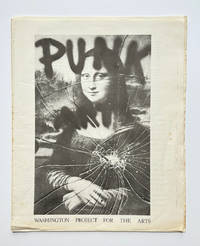
513a<p>First Edition. Multiple formats and dimensions see individual descriptions below Very good. items loose as issued. 513</p><p><em>The exhibition Punk Art organized in Washington DC in 1978 by the Washington Project for the Arts is generally considered the first exhibition of visual arts related to the punk movement. The present collection of materials represents the principal print materials produced for the show. Included are: 1 Punk Art exhibition catalog. 35.5 x 29 cm 27 pp. tabloid format folded but unbound offset on white newsprint-like commercial stock. With a preface by WPA director Alice Denney and an essay on "Punk Precedents" the remainder consisting of interviews with artists and illustrations of works. 2 Letter size mail flyer offset on white commercial stock. Recto with image and exhibition details verso with WPA letterhead and postage-paid notice. 3 Folded exhibition calendar/poster 60.5 x 45.5 cm unfolded 22.5 x 20.5 folded offset on brown commercial stock. With WPA and exhibition-related events for May and June 1978. 4 Exhibition opening invitation 12.5 x 10 cm folded offset on folded brown paper bag printed with illustration and event details. Folded bag contains small card 10 x 11 cm detailing perks for different donation amounts. 5 Poster for Punk Art exhibition at the School of Visual Arts in New York November 1978 executed in black silkscreen on heavy stock ca. 50 x 65 cm. Miller tells us that this poster was created by students in Al Brunele's printmaking workshop at SVA in vanishingly small numbers.</em></p> Washington Project for the Arts
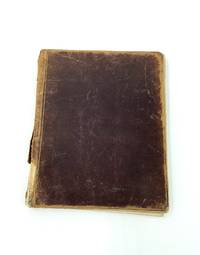
0012000United States Legislature. Fair with no dust jacket. Hardcover. On offer is an autograph album circa 1830-1861 coinciding with the 29th through 34th United States Congresses which ran from 1845 to 1857. The autographs contained within include 262 United States Senators and Congressmen. The majority of the autographs do not have accompanying dates however one signer dated their entry 1843 and another dated their entry 1850. This album provides a quintessential glimpse into Antebellum Period US politics. It is clear to see from the signatures and accompanying notation of the state from which each signer hails some also note their home towns that the American legislature is still fully functional at this point. The album is easy to navigate as the owner has had all the Senators sign at the beginning of the album and then left a few blank pages before having Congressmen sign in the later pages of the album. The owner was able to gather 46 signatures of Senators from Alabama Arkansas Connecticut Delaware Florida Georgia Illinois Indiana Iowa Ohio Kentucky Louisiana Maine Maryland Michigan Mississippi Missouri North Carolina New Hampshire New Jersey New York Pennsylvania Rhode Island South Carolina Tennessee Texas Vermont Virginia and Wisconsin. The owner then gathered 216 signatures from Congressmen from from Alabama Connecticut Delaware Florida Georgia Illinois Indiana Iowa Kentucky Louisiana Maine Maryland Massachusetts Michigan Mississippi Missouri North Carolina New Hampshire New Jersey New York Ohio Pennsylvania Rhode Island South Carolina Tennessee Texas Vermont Virginia and Wisconsin. Some highlights of the Senators category include: - John Bell U. S. Secretary of War as "Jno: Bell / of Tennessee" on page 6- Lewis Cass U. S. Secretary of State as "Lewis Cass" on page 2- Salmon P. Chase U. S. Secretary of Treasury and Supreme Court Chief Justice as "S. P. Chase / Ohio" on page 1- Thomas Corwin U. S. Secretary of Treasury as "Tho Corwin / Lebanon / Ohio" on page 1- Hannibal Hamlin U. S. Vice President U. S. Minister to Spain and Governor of Maine as "H. Hamlin / Maine" on page 3- Robert M. T. Hunter Confederate Secretary of State as "R M T Hunter / Virginia" on page 4- William R. King U. S. Vice President as "William R. King / of Alabama" on page 1Senators of other historical importance include: - Roger Sherman Baldwin Governor of Connecticut as "Roger Sherman Baldwin / of Connecticut" on page 8- Thomas Hart Benton U. S. Senator from Missouri from 1821-1851 as "Thomas H. Benton / U. S. Senate / Mri." on page 3- Andrew P. Butler co-author of the Kansas-Nebraska Act as "A. P. Butler / of South Carolina" on page 4- James Cooper Union General as "James Cooper / Penna." on page 5- William L. Dayton U. S. Minister to France as "Wm. L. Dayton / Trenton N. Jersey" on page 7- Augustus Dodge U. S. Ambassador to Spain as "A. C. Dodge / Iowa" on page 8- Henry Dodge Governor of Wisconsin Territory as "Henry Dodge / Wisconsin" on page 2- Stephen A. Douglas who defeated Abraham Lincoln for Senator as " S. A. Douglas / Chicago / Illinois" on page 6- Alpheus Felch Governor of Michigan as "Alpheus Felch / Michigan" on page 2- Henry S. Foote Governor of Mississippi as "HS Foote / Miss" on page 7- John P. Hale U. S. Minister to Spain as "John P. Hale / Dover N. H." on page 8- George W. Jones U. S. Minister to New Grenada as "Geo. W. Jones / S. U. S. / Dubuque / Iowa" on page 1- Thomas G. Pratt Governor of Maryland as "Thomas G. Pratt / Maryland" on page 1- Pierre Soulé U. S. Minister to Spain as "Pierre Soulé" on page 7- James Whitcomb Indiana Governor as "Jas. Whitcomb / Indiana" on page 2- David Levy Yulee the first elected U. S. Senator of Jewish ancestry as "D. L. Yulee / Florida" on page 3Some highlights of signatures among the Congressmen include: - Albert Gallatin Brown Governor of Mississippi Confederate Senator from Mississippi page 28- Howell Cobb U. S. Secretary of the Treasury Governor of Georgia President of Provisional Confederate States Congress page 9- Winfield S. Featherston Confederate Brigadier General page 32- Isham G. Harris Governor of Tennessee page 15- David S. Kaufman 1st U. S. Congressman from Texas from 1846-1851 page 24- Humphrey Marshall Confederate Brigadier General U. S. Minister to Qing Empire page 31- Lafayette McMullen Governor of Washington Territory page 49- Charles S. Morehead Governor of Kentucky page 30- James Lawrence Orr Governor of South Carolina Confederate Senator from South Carolina U. S. Ambassador to Russia page 24- Frederick P. Stanton Acting Governor of Kansas Territory page 33- Alexander H. Stephens Vice President of Confederacy from 1862-1865 Governor of Georgia page 35- Thaddeus Stevens the well-known Radical Republican page 40- Robert Toombs Confederate Secretary of State page 53. The album may have belonged to Hugo Jackson of Chicago. His signature is found separated from the politicians on a late page in the album. Our informal research was unable to discover any further biographical data on Jackson. This acquisition comes with a Certificate from John Reznikoff a premier authenticator who works with authentication services including PSA and JSA James Spence Authentications as well as numerous auction houses. The diary has a leather cover in good condition save for some small marks and scuffing. The binding shows signs of age and there is loss to the spine see photos. Many of the pages of the album are very loose or have come detached. There are some small ink stains throughout. Overall fair condition. Measurement: 6.375" x 7.875" x .75". ; Autograph; 16mo 6" - 7" tall; Signed by Author . hardcover
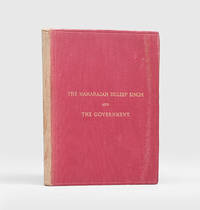
1884189408London: Printed by the Ballatyne Press "For Private Circulation" 1884. Duleep Singh reclaims his throne First and only edition privately issued of this controversial presentation of the maharajah's grievances against the British Government's claims to the Punjab. Decidedly uncommon around 14 copies traced institutionally just a couple at auction. An excellent copy of a fragile fugitive and highly desirable work here in a variant binding to the black skiver usually encountered. The child king Duleep Singh 1838-1893 Maharajah of Lahorewas carried into exile following defeat in the Second Anglo-Sikh War 1848-9 converting to Christianity in 1854 obtaining a royal audience and becoming "an immediate success" with the Queen and eventually settling in Elveden Suffolk with Bamba Müller his "part-Ethiopian part-German" ODNB wife who he had met in Cairo when returning from his mother's funeral in India; "Duleep Singh loved Elveden and rebuilt the church cottages and the school. His fame as a shooter of game was revived in the grounds of the great estate". However "amid European glamour the spirit that had tasted sovereignty was hibernating somewhere in the mind of Duleep Singh. Prompted initially by his mother then by his cousin Thakur Singh Sandhanwalia and finally by the supposed prophecies of the tenth Sikh guru Duleep Singh began a battle with the British government asserting the illegality of the annexation of the Punjab and demanded to be reinstated as maharajah. In 1886 he tried to return to India to place himself as the prophesied head of the Sikh people but was arrested at Aden. Here he was received back into the Sikh faith". From Paris he made himself the centre of various plots to overthrow British rule in the Punjab scheming with Russian and Irish revolutionaries to force the Khyber Pass but all of these conspiracies came to nothing. Increasingly dogged by ill health he sought a reconciliation with Victoria who "responded with a full pardon through the secretary of state on 1 August 1890". He died in Paris in 1893 and was carried back to his beloved Elveden and buried in the graveyard of St Andrew's and St Patrick's Church. The present work represents the historical groundwork to his campaign for reinstatement to the throne and was distributed solely to those who he felt could be of influence to that end. It was "compiled partly from historical sources and partly from private information and documents furnished" Preface by Duleep Singh himself and encompasses a sketch of the early history of the Punjab; a biographical narrative of the Maharajah; and an explanation "of the peculiar Relations in which the Maharajah stands towards the Government and the causes of the differences between them". Octavo. pp. viii 183. Original moderate red cloth over flexible boards title gilt to the front cover single fillet blind panel to both covers grey-blue decorative endpapers. Slightly rubbed the spine sunned; endpapers a little browned pale toning to the text-block else a very good copy. hardcover
19112092902138301906Not Available 1911. Soft Cover. Fine. Number of pages: 8242p Size: 23cm Not Available paperback
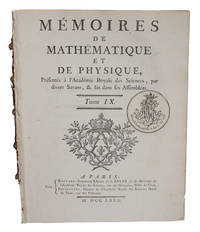
178044921Paris Moutard Panckoucke 1780. 4to. Extract from "Mémoires fe Mathematique et de Physique Présentés à l'Academie des Sciences par divers Savans" Tome IX. With titlepage to vol. IX. Pp. 2 167- 264 and 4 folded engraved plates. The memoir has also its own titlepage. Fine and clean. Wide-margined. <br/><br/><em>First printing of this monumental memoir the invention of the TORSION BALANCE dealing with the best way to construct a magnetic compass. The paper contains the design of a torsion suspension declination compass and the demonstration that the forces of torsion is proportional to the angle of twist. Coulomb received the prize awarded by the Academy for this paper drafted by the Academy in 1777 he shared the prize with Van Swinden. - "The importance of this memoir for Coulomb's career is that it CONTAINED ELEMENTS OF ALL HIS MAJOR PHYSICAL STUDIES: the quantitative study of magnetism torsion and the torsion balance friction and fluid resistance and the germ of his theories of elasticity and magnetism."DSB."Coulomb’s first writings on torsion were presented in his Academy prize-winning memoir of 1777 "Recherches sur la meilleure maniere de fabriquer les aiguilles aimantées.". his simple elegant solution to the problem of torsion in cylinders and his use of the torsion balance in physical applications were important to numerous physicists in succeeding years. In chapter 3 Coulomb developed the theory of torsion in thin silk and hair threads. Here he was the first to show how the torsion suspension could provide physicists with a method of accurately measuring extremely small forces. He showed that within certain angular limits torsional oscillation consisted of simple harmonic motion. He examined the parameters relating the angle of twist to the length diameter and elastic properties of the torsion thread. In the range of simple harmonic oscillation Coulomb demonstrated that the force of torsion was proportional to the angle of twist. He used this principle in measuring small magnetic forces and also called attention to its use in measuring other forces notably those of fluids in motion. Eventually he was able to measure forces of less than 9 x 10⁻⁴ dynes.""Coulomb’s major memoirs in electricity and magnetism are his 1777 memoir on magnetic compasses the famous series of seven electricity and magnetism memoirs read at the Academy from 1785 to 1791 and several magnetism memoirs prepared after the French Revolution. In his electrical studies Coulomb determined the quantitative force law gave the notion of electrical mass and studied charge leakage and the surface distribution of charge on conducting bodies. In magnetism he determined the quantitative force law created a theory of magnetism based on molecular polarization and introduced the idea of demagnetization basically that combinations of magnetic poles can "cancel" each other."DSB.Parkinson "Breakthroughs": 1777:P </em> unknown
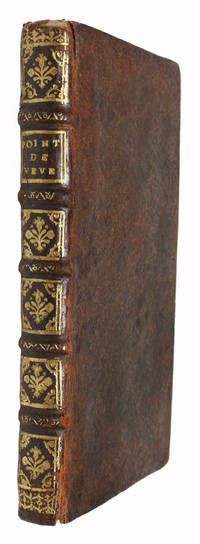
167944323Paris Thomas Jolly 1679. Small8vo. 15x9 cm. Contemp. full sprinckled calf. raisedbands richly gilt spine. Top of spine a bit worn. Edges of covers gilt. 12861 pp. Last page "Extrait du Privilege du Roy". 34 fine full-page engravings 25 copper-engraved a. 9 in woodcut. A paperflw at foot of titlepage neathly repaired no loss of paper or letters. Internally clean and fine printed on thick good paper. <br/><br/><em>Extremely scarce first edition of Leclerc's important work on binocular vision in which he finds that one of the eyes has a dominant status thus announcing the discovery of the "Master-eye" - a discovery of outmost importance in the theory of shooting and elsewhere. With use of diagrams he shows that "things that can be seen clearly are seen with but one single eye.". He records and depicts a large series of experiments with binocular vision and shows geometrically the relation to the science of perspective and points out the importance of understanding the physiology of binocular vision for perspective painting in general.Sebastien Leclerc was originally an engraver who studied physics and geometry in relation to perspective theory a field of which he became famous. In 1672 he was appointed to "l'Academie de Peinture" as professor in perspective. He was also engraver to Louis XIV and was appointed professor at "l'Ecole des Gobelins". </em> unknown
169141859Leipzig Grosse & Gleditsch 1691. 4to. Contemp. full vellum. Faint handwritten title on spine. a small stamp on titlepage. In: "Acta Eruditorum Anno MDCLXXXXI". 85906 pp. and 13 of 15 folded engraved plates. The 2 first plates lacks but they do not belong to the papers listed.Leibniz' papers: pp.277-281 a. 1 plate pp. 435-439. Johann Bernoulli: pp. 274-276 a. 1 plate. Huygens: pp. 281-282. - Jacob Bernoulli: pp. 282-290 a. 1 plate. <br/><br/><em>All papers first apperance. All 5 of extreme importence in the development of the Calculus. Leibniz' 2 papers on the catenary curve paper 1-2 offered here was written at the instigation of Jacques Bernoulli. Following the example of Blaise Pascal who had initiated in 1658 a contest for the construction of the cycloid Leibniz also provoked the geometers of his time by challenging them to submit at the fixed date of mid-1691 their geometric method for the construction of the catenary curve. Leibniz later provided the answer followed by Johann Bernoulli and Huygens.'These two papers are a historical account of the origin of the study of this transcendental curve and at the same time the first physical-geometric construction showing the species-relationship between the catenary and the logarithmic curves as two companion curves; one arithmetic the other geometric. All of the differentials of the catenary curve are arithmetic means of corresponding differentials of the logarithmic curve; and all of the differentials of the logarithmic curve are geometric means of the catenary.'"The Catenary is the form of a hanging fully flexible rope or chain the name comes from "catena" which means 'chain' suspended on two points. The interest in this curve originated with Galileo who thought that is was a parabola. Young Christiaan Huygens proved in 1646 that this cannot be the case. What the actual form was remained an open question till 1691 when Leibniz Johann Bernoulli and the then much older Huygens sent solutions to the problem to the "Acta" Jakob Bernoulli 1690 Johann Bernoulli 1691 Huygens 1691 and Leibniz 1691 - these 4 1691-papers offered here - in which the previous year Jakob Bernoulli had challenged mathematicians to solve it. As published the solutions did not reveal the methods but through later publications of manuscripts these methods have been known. Huygens applied with great paper 4 virtuosity the by then classical methods of 17th century infinitesimal mathematics and he needed all his ingenuity to reach a satisfactory solution. Leibniz the papers 1-2 and Bernoulli paper 3 applying the new Calculus found the solutions in a much direct way. In fact the catenary was a test-case between the old and the new style in the study of curves and only because the champion of the old style was a giant like Huygens the test-case can formally be considered as ending in a draw." Grattan-Guiness in "From the Calculus to Set Theory 1630-1910.".The paper by JACOB BERNOULLI no. 5 offered here is a milestone papers as it marks the invention of the "SYSTEM OF POLAR COORDINATES" with points located by reference to a fixed point and a line through that point. Although newton had earlier also devised such a coordinate system in 1671 his work was not known so that the credit for the discovery generally goes to Bernoulli. Parkinson Breakthroughs 1691.Further papers contained in this volume of Acta Eruditorum:DENYS PAPIN: Mecanicorum de Viribus Motricibus sententia asserta a D. Papino adversius C.G.G. L. Leibniz objectiones. pp. 6-13. The plate lacks. - and Dion. Papini Observationes quaedam circa materias ad Hydraulicam spectantes. Pp. 208-213 a. 1 plate. This importent paper is part of the LEIBNIZ-PAPIN-CONTROVERSY.JACOB BERNOULLI: Specimen Calculi Differentialis in dimensione Parabolæ helicoidis ubi de flexuris curvarum in genere carundem evolutionibus. Pp. 13-22. The plate lacks. - and J.B. Demonstratio Centri Oscillationis ex Natura Vectis reperta occassione eorum quæ super hac materia in Historia Literaria Roterodamensi recensentur articulo.Pp.317-321.LEIBNIZ: O.V.E. Additio ad Schediasma de Medii Resistentia publicatum in Actis mensis Febr. 1889. Pp. 177-178. and O.V.E. Quadratura Arithmetica Communis Sectionum Conicarum quæ centrum babent.Pp. 178-182 a. 1 plate.TSCHIRNHAUS: Singularia Effecta Vitri Caustici bipedalis quod omnia magno sumtu hactenus constructa specula ustoria virtute superat per D.T. Pp. 517-520 </em> hardcover
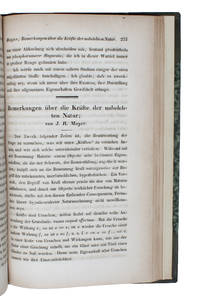
184246883Heidelberg C.F. Winter 1842. Bound in a nice later hcalf. Raised bands titlelabel with gilt lettering. In: "Annalen der Chemie und Pharmacie. herausgegeben von Friedrich Wóhler und Justus Liebig" Vol. 42. 6356 pp. Mayer's paper: pp. 233-240. Volume 42 is offered bound together with vol. 41. 8376 pp. a. 1 folded plate. This volume contains importent cehemical papers by Kolbe Cahours Kopp Wöhler Laurent and Liebig the first printing of Liebig's famous work on animal physiology and pathology <br/><br/><em>First printing of one of the most important papers in physics chemistry and physiology in the 19th century. The paper is the first to propose an equivalence of all forms of energy including heat and a conservation of total energy. Although Mayer was the first to set forth the general law of the conversation of energy the first thermodynamical law it was James Joule who first put the law on firm footing. "The paper of 1842 the paper offered set out Mayer’s definitive view on the conservation of force and established his claim to priority; historically the paper also provides insight into the processes through which Mayer arrived at his theory."DSB."Originally trained as a physician mayer did not enjoy medical practice. About 1840 he began to be interested in physics and he entered thhe field of research . In 1842 he not only presented a figure for the mechanical equivalent of heat but he also clearly presented his belief in the conversation of energy. He had some difficulty getting his paper on the subject published but Liebig finally accepted for the importent journal he edited. Though Mayer was five years ahead of Joule his paper aroused no interest and in the end it was Joule with his imposing experimental background. who received credit for working out the mechanical equivalent of heat. And it was Helmholtz who recieved credit for announcing the law of conservation of energy because he announced it so much more systematically. Yet Mayer went further than either of the other two for he included living phenomena in the realm of energy conservation a daring step in a decade when vitalism with its view that the laws of inanimate nature did not apply to living systems was still a considerable force. Mayer argued that solar energy was the ultimate source of all energy on earth both living and non-living. He further suggested that solar energy was derived from the slow contraction of the sun or by the fall of meteors into the sun in either case kinetic energy being converted to radiant energy."Asimov"After 1860 Mayer was finally given the recognition he deserved. Many of his articles were translated into English and such well-known scientists as Rydolph Clausius in Germany and John Tyndall in England began to champion Mayer as the founder of the law of the conservation of energy."Alan Lightman "Great Ideas in Physics" p. 8.Parkinson "Breakthroughs" 1842 P. - Magee "A Source Book in Physics" p. 196 ff. - Dibner: 157 listing the offprint with a different title - PMM: 330 offprint-version. - Garrison & Morton: 606. </em> hardcover
179758364Kiøbenhavn Johan Rudolph Thiele 1797 1799. 4to. Uncut and unopened in original blue boards. Published in: "Nye Samling af det Kongelige Danske Videnskabernes Selskabs Skrifter." Vol. V. Wessel's paper: pp.469-518 and 3 folded engraved plates the last plate inserted at p. 463. The whole volume V offered in its original binding. Engraved titlevignette. XII670 pp. 15 engraved plates. 4 leaves with upper right corners gone not affecting Wessel's paper. <br/><br/><em>First edition of this important first systematical treatment of the theory of complex numbers and at the same time the first work to add vectors in three-dimensional space."Wessel’s fame as a mathematician is based entirely on one paper written in Danish and published in the Mémoires of the Royal Danish Academy that established his priority in publication of the geometric representation of complex numbers. John Wallis had given a geometric representation of the complex roots of quadratic equations in 1685; Gauss had had the idea as early as 1799 but did not explicitly publish it until 1831. Robert Argand’s independent publication in 1806 must be credited as the source of this concept in modern mathematics because Wessel’s work remained essentially unknown until 1895 when its significance was pointed out by Christian Juel. The title of Wessel’s treatise calls it an "attempt" to give an analytic representation of both distance and direction that could be used to solve plane and spherical polygons. The connection of this goal with Wessel’s work as a surveyor and cartographer is obvious. The statement of the problem also suggests that Wessel should be credited with an early formulation of vector addition. In fact Michael J. Crowe in A History of Vector Analysis University of Notre Dame Press 1967 defines the first period in that history as that of a search for hypercomplex numbers to be used in space analysis and dates it from the time of Wessel whom he calls the first to add vectors in three-dimensional space." DSB. </em> hardcover
0012221Midland Maryland: Improved Order of Red Men Tribe. Fair with no dust jacket. Hardcover. On offer are two historically significant ledger books spanning 10 years maintained by Chiefs of the Improved Order of Red Men of Tioga Tribe No. 126 in Midland Maryland. PLEASE REQUEST FULL BIO ON THE RED MEN FROM SELLER excluded due to word count restrictions. The first ledger spans 1919-1923 and the second covers 1931-1936. Each ledger contains the annual Roll of Chiefs where attendance is kept for each weekly meeting. This is followed by hundreds of pages of meeting minutes wherein the intimate detail of the tribes attendance discussions motions officer nominations elections and tribe finances are meticulously recorded. Excerpts follow to give the flavour of the ledgers: .Moved and Sec. Charles Bevidge be suspended from all rights and privileges of the order carried. Moved and Sec we porospone sic class initiation until Dec 30 on account of Indusstrial condition. Carried Oct 28 1919. .Moved and second Bill of Brother Jas Albright for one load of cal be received and paid. Carried. $4.25. Moved and second that a committee of three be appointed and work in conjunction with the other lodges to see about getting a doctor on committee Bro Harry Sulser John Laslo James Albright Motion carried March 16 1920. Brother McGee reported on Halloween social to be held between Red Men and Ladies Bible class. The committee desires that the Red Men get up an entertainment and Ice cream and all members are requested to bring a parcel post Oct 18 1921. Council fire was kindled for the purpose of burying our deceased brother William C. Muir. Sachem appointed. Bros Lindsey Baiman Leese and Sarage as pallbearers. Brother Muir died at the age of 81 years Sunday evening July 23 at 5: 30 oclock July 26 1935. This was a special meeting held in celebration of the 37th anniversary and 204 Washington birthday celebration. The orders Washington Birthday Ritual was used. The slations were filled as follows: long list of names and positions of tribe members.At the close of the Ritualistic Service brother Taylor was called on and he read a history of the Tribe after which the Tribe adjourned to partake of a Banquet prepared for the occasion. Dart Ball and the other amusements were indulged in Feb 22 1936. Committee reported having visited Black Hawk Tribe at Westerport. That an open air District meeting will be held in Westernport Sat Sept 19 carried. Carnival committee reported progress Moved and Sec Resignation of Bro Hunt be accepted and his successor elected. Moved and Sec we go into election of Jr. Sagamore carried . Moved and Sec we paint the outside of building for Carnival. Carried Aug 6 1936. The ledgers are absolutely brimming with names of Officers and Members of this Red Men tribe making them as interesting to a genealogist as they are to one who studies fraternal societies Maryland in the early 20th century or the Red Men more specifically. The ledgers measure 9x14 inches. They each contain hundreds of un-numbered pages. The pages ledgers are custom printed for the Red Men by Labor Saving Lodge Books in Cedar Rapids Iowa. They contain handwriting on most pages filling in the printed fields. There is tipped in ephemera and extra pages particularly in the second ledger. Both ledgers show signs of their age. Pages are in tact but the spines are loosening and the cloth hardcovers are beginning to crack and peel. Writing is legible. Overall Fair. Note: Ask seller for a link to the 19th Century ledger of a New York tribe of the Red Men being sold separately. ; Manuscripts; Folio 13" - 23" tall; Signed by Author . Improved Order of Red Men Tribe hardcover
194816388JNew York: Random House 1948. First Edition First Printing. The novel basis for Red River the classic Howard Hawks directed 1948 Western film starring John Wayne and Montgomery Clift for which Chase co-authored the screenplay. Hardbound in original tan cloth. A rare book especially in dust jacket. Some minor offsetting from a clipping listing the film cast on the adjacent copyright and dedication pages Near fine in a clean tight copy in a near fine bright dust jacket with a few tiny mends by an expert paper conservationist. 216 pages. Enclosed in a custom clamshell box. In a career of many fine films John Wayne’s three greatest performances are considered those in The Searchers She Wore a Yellow Ribbon and Red River where Wayne plays the hard-edged cattle drive boss Tom Dunson. Red River has been selected by the Library of Congress as a national film treasure. Random House hardcover
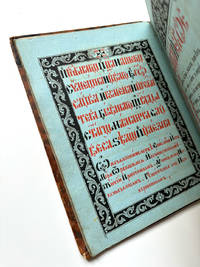
3231<p><strong>An unusually well preserved example of this mystical guidance on spiritual growth in delicate calligraphy on attractive blue paper.</strong></p><p>After twenty-five years serving as an abbot of the Monastery of Saint Mamas in Constantinople Symeon the New Theologian 949–1022 stepped down to write his spiritual instructions sharing his personal mystical experiences. His "central theme is the conviction that by applying the classical methods of mental prayer one experiences a contemplative "vision of light" . Symeon emphasised that such experience is attainable by all who earnestly immerse themselves in the life of prayer" Britannica. His mystical practices prepared the way for Hesychast mysticism "a 14th-century Eastern movement in contemplative prayer" id.</p><p>The manuscript contains a selection of Symeon's moral instructions or "Words" about monastic life as well as his poetic "Hymns of Divine Love" including an "alphabet in couplets" encouraging new monks prayers and stories of his own spiritual struggle and exploits the thoughts on mental paradise the attainment of divine purity the height of contemplation one can ascend repentance and what the attention to prayer is defining three kinds of it. The volume ends with the brief quote of St Barsanuphius about the superiority of mental labour and faith over physical rituals.</p><p>It is interesting to note that the publication of Symeon's works happened rather later and more or less around the creation of this manuscript: "very few of Symeon's works have been published in Slavonic and Russian languages" Otkrytaia pravoslavnaia entsiklopediia our translation: his works remained untranslated until the publication of the collection of spiritual opuses by Orthodox authors Dobrotoliubie Philokalia 1793 which included a list of his short moral instructions in the form of maxims. In 1852 a separate edition of Symeon's "Twelve Practical Words" in modernised Church Slavonic was printed at the Moscow University press; the "Words" from the 1852 edition have some similarities with the present manuscript but their translations differ significantly and the manuscript includes 24 "Words" instead of 12. The choice of the "Words" and other writings for this volume was most likely determined by the compiler's or scribe's personal taste.</p><p>Our text is written on lovely blue paper with a watermark showing the Yaroslavl coat of arms a bear holding a spear in a crowned roundel the abbreviation "IaMPG1" for Yaroslavl Paper Manufacture and the date "1805". The headpieces with backgrounds in black ink are calligraphed with elegant asceticism and the decorative initials in different sizes are rendered in red. As witnessed in a handful of neat marginal comments the manuscript was read yet very carefully as its pages are in near mint condition.</p><p><strong>With uncommon provenance from a 19th-c. Russian business woman.</strong> The volume was presented on June 22 1868 by "M. Maksimina" to her "beloved sister in the holy spirit and benefactress" Klavdiia Ivanovna Ganeshina. Ganeshina 1821-88 was herself a merchant and a hereditary honourable citizen of Moscow. She was one of the owners of an estate which they sold in the early 1880s to an important Moscow lace-making company. Her husband Vasilii Alekseevich Ganeshin 1799-1866 was also a hereditary honourable citizen of Moscow.</p><p><strong>Provenance</strong><br />Klavdiia Ivanovna Ganeshina gift inscription in verso of upper flyleaf from "M. Maksimina"; Ia. A. Khomiakov recent inscription in Russian on upper flyleaf.</p><p>Description<br />Octavo 21.3 x 17.7 cm. 200 manuscript ll. in black and red ink incl. ornamental title 17 headpieces and decorative vignettes and initials on blue laid paper with Yarosavl watermark.<br />Binding<br />Contemporary brown marbled calf spine with raised bands and blind stamped ornaments boards with blind-stamped ornamental frames gilt gauffered edges.<br />Condition<br />Binding a bit worn overall upper spine restored with black tape a few small wormholes traces of paper labels on spine private library shelf number in black along gutter near title; very light marginal soiling mostly to first and last pp. a few small pencil marks pagination errors without affecting the text otherwise nicely fresh internally.<br />Bibliography<br />The editors of Encyclopaedia Britannica "Saint Symeon the New Theologian" // Encyclopaedia Britannica; Drevo. Otkrytaia pravoslavnaia entsiklopediia "Simeon Novyi Bogoslov" 2023. ref: 3231</p> [Russia, early to mid-19th century]. hardcover
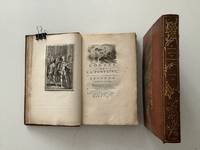
176420446AB1764. 2 volumes. Amsterdam 1764 22 : 14 cm. X 214 pages 1 leaf; VIII 254 pages 1 leaf engraved Portrait of Fontaine 2 engraved title-vignettes 77 full-page engraved plates 63 engraved text-vignettes. Red half-calf binding spine richly gilt with title in gold top edge gilt singed Blanchetiere-Bretault This rare and very beautiful Amsterdam edition is printed two years after the monumental first edition from Paris which was commissioned by Ferniers Géneraux and which is very scarce and sought after. This is the most beautiful and well-executed of the re-impressions Paris 1762 -without vignettes Amsterdam 1764 and London 1764. -"Celle d'Amsterdam 1764 2 vol. in-8. fig. copiées sur celles de l'édition de 1762 est assez belle." Brunet III:760. The illustrations of this edition are excellent and copied from the beautiful first edition" many of them are engraved and signed by C. Boily and all are after Eisen. Most of the vignettes are after Choffard. The portrait of La Fontaine is engraved by Macret after Ficquet. "Cette imitation de l'édition des fermiers généraux est assez jolie. Le portrait de La Fontaine est tantôt gravé par Savaret et tantôt par Macret suivant les exemplaires." Cohen p. 310.The illustrations of this work are considered Eisen's main work the book is considered one of the greatest works of rococo book-illustration and it has greatly inspired later tradition in this field. - Occasionally some minor spotting but allover clean with wide margens two edges uncut beautifully bound by Blanchetiere-Bretault. unknown
18931711060061New York: Henry T. Thomas New York 1893-01-01. First Edition. Hardcover. Good. Limited edition of 1000 copies. Four parts complete all published bound as one. Large folio 61 x 48 cm. Bound in 3/4 tan leather over marbled boards. Leather spine labels with gilt. Original color pictorial wrappers bound in. Some conservation efforts to wrappers particularly of part 1. Title vignette 16 vignettes as well as 16 color heliographic plates by W. S. Vanderbilt Allen. Library perforated stamp on title page limitation page and on bottom right margin of the color plate pages. Bottom blank corner of plates 1 2 and 10 chipped with loss to margin corner. "The cover title calls for 'A collection of Forty-four plates of Coaching Hunting Amateur Races and Horses in Show Rings' but the project was never finished." - Christies The Le Vivier Library of Sporting Books and Modern First Editions30 October 2012 London Sale 4354. Vanderbilt Allen was a grandson of Cornelius Vanderbilt and was trained in Paris by Gerome and Claude Monet. Refs: Bennett p. 101. Scarce portfolios. <br> This is an oversized or heavy book which requires additional postage for international delivery outside the US. Henry T. Thomas, New York hardcover
16191903070006Lutetiae Parisiorum: Typis Regiis 1619. First Edition. Hardcover. Good. 1st edition of Du Val's collected works of Aristotle. 2 volumes bound in 4. Folio 40 x 26 cm. Bound in contemporary Cambridge-style paneled calf. Rebacked and restored bindings. 6 raised bands. Title pages in red and black with engraved portrait of Aristotle. Text in Greek and Latin in parallel columns. Institutional blind stamps. Dampstaining along bottom scattered marginal staining. First title has its margins trimmed and conserved. Collated: Tome 1 part 1: 16 430 p.; T.1 p.2: 431-1251 p. 19; T.2 p.1: 3 469 p. 1; T. 2 p.2: 470-1104 p. 16. <br> According to John Lempriere's Classical Dictionary Aristotle's "treatises have been published separately; but the best edition of the works collectively is that of Duval." p. 96. Refs: Brunet I. 459. <br> Subtitle: "Veterum ac recentiorum interpretum ut Adriani Turnebi Isaaci Casauboni Julii Pacil studio emendatissima. Cum Kyriaci Strozae Patritii Florentini libris duobus Graecolatinis de Republica in supplementum politicorum Aristotelis. Sed nouissimae huic editioni omnium quae hactenus prodierunt ornatissimae accessit breuis ac perpetuus in omnes Aristotelis libros commentarius siue Synopsis Analytica Doctrinae Peripateticae non antehac visa; in qua ut in expeditiore tabella Aristotelis philosophia omnis provt ea suo ordine descripta est perspicue breuiterque indicatur & pro rerum dignitate exponitur. ; Authore Guillelmo Du-Val Pontesiano Philosophiae Graecae & Latinae in Parisiensi Acade" <br> This is an oversized or heavy book which requires additional postage for international delivery outside the US. Lutetiae Parisiorum: Typis Regiis hardcover