Office of the LadiesBiblio.com
122 150 résultats
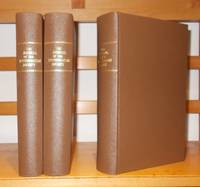
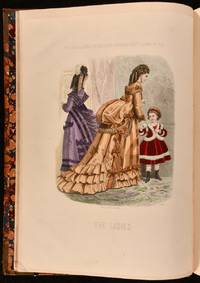
1872833F2London: Office of the Ladies 1872-1873. First edition. Leather. Very Good. 16.5" by 12". Not Stated. The first forty-one issues of the very scarce Victorian fashion periodical 'The Ladies'. Bound in three volumes and illustrated throughout with eighteen hand-coloured fashion plates. The complete 1872 run of the very scarce Victorian era fashion periodical 'The Ladies' from March 1872 to January 1873 bound in three volumes.Weekly issues each running just over twenty pages and featuring contemporary adverts to the rear and a supplement to each issue.Volume I begins with Vol I. No I. Saturday March 30th 1872 and concludes with No. 14 Vol 1. Saturday June 29th 1872. With seven hand coloured fashion plates.Volume II begins with No. 15 Vol. I Saturday July 6th 1872 and concludes with No. 27 Vol. II Saturday September 28th 1872. Illustrated with seven hand coloured fashion plates and one further plate.Volume III begins with No. 28 Vol. II Saturday October 5th 1872 and concludes with No. 41 Vol. II Saturday January 4th 1873. This volume also includes a separately paginated extra Christmas number. Illustrated with four hand coloured fashion plates and two further colour plates.With illustrations and discussions of fashionable hairstyles capes and shoes and eighteen hand coloured fashion plates each depicting two women in ideal contemporary dress. Articles discuss the popular fashions of the day - based on Parisian designs - and with discussions of 'Theatre Gossip' new operas and performances being held and notices of births and marriages. In half calf bindings with marbled paper covered boards. Rubbing to back strips board perimeters and joints with tail of front joint of volume I starting with some detaching of the leather. Head of rear joint of volume I starting. Boards holding firm. Internally firmly bound. Pages exceptionally clean and bright with the odd instance of light offsetting. Plates bright with only the odd spot to perimeters. Very Good Office of the Ladies hardcover
19712091502133700896National Palace Museum 1971. Soft Cover. Fine. The book is in fine condition. National Palace Museum paperback
19922091502135703991Nihonhyoronsha 1992. Soft Cover. Fine. The book is in fine condition. Nihonhyoronsha paperback
19832080702109502880Nigensha 1983. Soft Cover. Fine. Number of pages: 1 volume 1 commentary Nigensha paperback
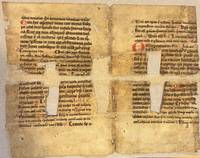
3591Southern France or Northern Italy late 13th century. Manuscript on vellum. Written space approx. 65 × 95 mm; overall leaf size ca. 90 × 125 mm. Text in two sizes of gothic textualis written in dark brown ink rubrics in red. Reused as binding waste with rectangular cut-outs consistent with sewing support slots for an early modern binding. Trimmed at one side with staining worming and losses to the text yet the passages are largely legible and the text could be identified. Manuscript on vellum. Written space approx. 65 × 95 mm; overall leaf size ca. 90 × 125 mm. Text in two sizes of gothic textualis written in dark brown ink rubrics in red. Bifolium; 4 pages. <p><br /> Unusual 13th-century breviary fragment combining the legend of Saint Cecilia with Bede’s All Saints’ Day homily.<br /> <p><p><br /> A small-format bifolium from a Latin breviary preserving a liturgical reading cycle that interweaves the Historia passionis sanctae Caeciliae virginis with Bede’s Homilia LXXI. In solemnitate Omnium Sanctorum. The texts are copied in a compact formal book hand with smaller rubricated insertions and interlinear additions in a secondary notula script. The size layout and script suggest a portable breviary produced for monastic or private devotion.<br /> <p><p><br /> The Cecilia text includes familiar episodes from the Latin Passio including Angelum Dei habeo amatorem Haec Valerianum quendam iuvenem habebat sponsum and Cantantibus organis along with the insertion Domine Iesu Christe seminator casti consilii. These segments appear in the form typical of liturgical readings not continuous narrative.<br /> <p><p><br /> Interwoven is a significant portion of Bede’s Homilia LXXI. In eadem solemnitate Omnium Sanctorum traditionally read on the feast of All Saints which begins: Laudem Domini qui superna caelorum regna spiritibus angelicis… While the Cecilia passages derive from the broader Passio tradition textual features show alignment with versions known from homiliaries. This direct juxtaposition of Cecilia’s passion with Bede’s theological reflections is unusual: we could not locate another surviving breviary containing both texts in this combination suggesting a regionally specific reading order or a customized compilation.<br /> <p><p><br /> Saint Cecilia one of the most venerated Roman martyrs was revered from the early Middle Ages as the patron saint of music virginity and spiritual marriage. Her Passio though apocryphal in parts circulated widely and was integrated into liturgical use by the 9th century. The Homiliae of Bede ca. 673–735 particularly those for major feasts remained standard reading in monastic contexts for centuries. The presence of both in this fragment suggests a breviary or homiliary adapted to a community with a particular devotion to Cecilia and access to Bede’s homiletic corpus.<br /> <p><p><br /> The script—a regular and angular gothic textualis with looped ascenders and clubbed minims—is consistent with manuscripts produced in southern France or northern Italy in the latter half of the 13th century. The rubricated initials and the textualis–notula script pairing support the same dating.<br /> <p>. unknown
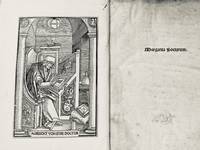
1503723<p>Post incunable: publisher not identified or Venezia: Albertino da Lessona 1502. 1503. It is bound in full seventeenth century vellum with spine label. . The first printing of the Margarita Poetica was printed by Johannes Sensenschmidt in1472 between 1472 and 1503 there appeared at least a dozen editions In this edition the marginal index letters correspond to those of 1493 Venice edition. <br />¶ Eyb went to Italy and devoted himself to humanistic study at the Universities of Pavia and Bologna. He returned to Germany in 1451 having been appointed Canon at Eichstätt and Bamberg. From 1452 to 1459 he was again a student at Bologna gaining the degree of doctor in 1459. The Margarita is named after Eyb's mother and was written in 1459.<br /><br />Fabriccius observed the "Eyb stressed two things throughout the Margarita: to be able to write well and to be disposed to live properly."<br /><br />¶ In a contrast to "Ars Dictaminis" perhaps the Middle Ages version of TEXTING von Eyb uses this work to re-Introduce Cicero's Vetera Rhetorica. While certainly there are many late medieval texts on letter writing Eyb as can be seen in the structure of this book<br /><br />The Content are in three parts the first Epistola five Prologus is a revised and augmented version OF M.T.C. CICERO with excerpts taken from classical authors and Italian humanists and formulas for letter-writing. The first part offers style samples of Roman rhetoric poetry and epistolography. <br />¶The second part the AUCTORITATES consists of an a Florilegium Roman writer and with its third part extracts from Petrarca Terence Plautus and SenecaCicero Lactantius Macrobuius Plutarchus etc finally 30 speeches as models of humanistic eloquence.<br />¶ The third part ORATIONES: contains selections from Petrarch dramatic poets Terence <br />Seneca Plautus and a variety of humanist speeches by Renaissance copyists letter-writers and philosophers including Johannes Lamola Poggius Florentinus Galeatius Sforza and the author himself. Folio a8 B-X8 Y8 this copy is lacking the final gathering signed with numbers 1-4 only comprising a Materiarum-tabula which is not present. Gatherings a-I have printed decorated intitials; K-X have blanks some with printed guides for manuscript initials not filled in.<br /><br /><br />Panzer IX 107 4; Rare: Not in Adams VD 16 BM Geman or Italian.</p> [publisher not identified] or [Venezia: Albertino da Lessona, 1502]. Â hardcover
003220Steyning Sussex: The Vine Press 1928. Soft cover. Very Good. Octavo. vi ix i 14 vipp. Hermes Books Vine Press; no. 1. Limited to 416 copies; this is No. 199. Title-page and colophon printed in red-and-black. Second page printed in red. Orange red and silver-green patterned paper wrappers; printed paper label on front cover. "Of this book Four Hundred copies have been printed upon antique laid paper and Sixteen upon large hand-made paper. <br/> <br/> Steyning, Sussex: The Vine Press, 1928. paperback
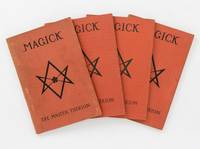
1929143727Paris: Printed at Lecram Press Privately Published by The author 1929. First Edition. Paperback. Very Good. Paris Printed at Lecram Press Privately Published by The author 1929 and 1930 first issue of the first edition. Quarto four sections paginated continuously comprising xxxii 436 pages with numerous illustrations plus a colour plate depicting the lamen magical pendant of the author tipped in on page 1 a black and white plate of the signs of the grades loosely inserted between pages 374 and 375 and a colophon leaf in the first and last sections. Overlapping salmon-pink thick textured wrappers lettered and decorated in black on the front panels; all edges uncut; spines a little sunned and rubbed; head of two joints and the foot of one of them cracked but stabilised; some covers slightly marked; trifling loss to silverfish to the bottom margin of five leaves at the beginning of the first section and the top margin of about ten leaves and the rear cover of the last section with slight and inoffensive surface loss to some covers; minimal signs of age and use; a very good set rare in any condition. Crowley was dissatisfied with the quality of the binding and the colour plate of this first issue of the first edition and the bulk of the print-run was trimmed and bound up as one volume in cloth minus the colour plate and with a variant title leaf. It lists the author as both The Master Therion and Aleister Crowley omits the subtitle shown above and gives a publication date of 1929 which is when just the first section was printed. 4 items. Printed at Lecram Press [Privately Published by The author] paperback
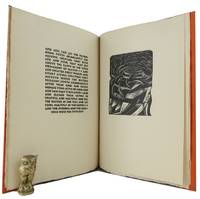
1924172392London: The Nonesuch Press 1924. Pp. 56 French-folded 12 full page illustrations; tall cr. 4to; black papered boards lettered and decorated in gilt small surface chip at foot of spine fore-corners of boards faintly bruised tiny spot to lower board; uncut; dust wrapper soiled and worn edges chipped and split the front panel detached large triangular piece torn from top edge of back panel; book label of David Levine Sydney above the earlier ex libris label of Joseph Halle Schaffner the free endpapers faintly offset a couple of leaves a trifle creased; Nonesuch Press London 1924. Edition limited to 375 numbered copies printed by the Curwen Press on handmade paper. McKitterick 14. Paul Nash 1889-1946 studied at the Slade School and worked for a while with Roger Fry at the Omega Workshop. Joseph Halle Schaffner 1897-1972 was a director of the Chicago clothing manufacturing firm Hart Schaffner and Marx. He collected books on several subjects including the history of science a collection he bequeathed to the University of Chicago. The Nonesuch Press unknown
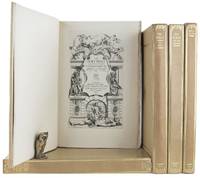
1925162776London: The Nonesuch Press 1925. Reprinted according to the Authorised Version 1611. In five volumes totalling approximately 1600 pages each volume with an engraved pictorial title page headpiece and tailpiece by Stephen Gooden printed from the copper; narrow med. 4to; cream papered boards lettered and decorated in gilt edges occasionally a trifle bruised the spines slightly darkened small orange/red ink stain to bottom edge of lower board Volume 2 Genesis to Ruth; uncut and partly unopened; book label of David Levine Sydney on upper pastedowns free endpapers faintly offset a little light foxing mainly to top edges of leaves; The Nonesuch Press London 1924-27. One of 1250 numbered copies Apocrypha and 1000 sets on Japon vellum total editions 1275 and 1075 respectively. McKitterick 20 and 21. The Apocrypha was published separately in 1924 but the five volumes were always intended to form a uniform edition and were advertised as such from the beginning. The Nonesuch Press unknown
1572EE4911Haeredum Iohannis Quentel / Viduam Mauricii a Porta / et al 1572. ~DATE RANGE: 1547-1572 ~FULL TITLES: D. Dionysii Carthusiani Enarrationes piae ac eruditae in quatuor prophetas quos vocant maiores. Imprint: Coloniae : Ex Officina Haeredum Iohannis Quentel. M.D. LVII. BOUND WITH: D. Dionysii Carthusiani Enarrationes piae ac eruditae in duodecim prophetas quos vocant minores. IMPRINT: Coloniae Apud Geruuinum Calenium & haeredes Iohannis Quentel. M. D. LXVIII. 2 VOLS IN 1. / D. Dionysii Carthusiani Insigne commentariorum opus in Psalmos omnes Davidicos. Imprint: Parisiis Apud Dionysiam & Hieronymum de Marnes viduam spectabilis viri Ambrosii Girault. M.D. XLVII. BOUND WITH: D. Dionysii Carthusiani Enarrationes piae ac eruditae in quinque libros Sapientiales. IMPRINT: Coloniae ex officina Haeredum Ioannis Quentel. M. D. LV. 2 VOLS IN 1. / D. Dionysii Carthusiani Enarrationes piæ ac eruditæ in quinque Mosaicæ legis libros. Imprint: Coloniae : Apud haeredes Joannis Quentel et Geruuinum Calenium M.D. LXVI. / D. Dionysii Carthusiani enarrationes piae ac eruditae in libros Iosue Iudicum Ruth Regum Primum secundum tertium & quartum item Paralipomenon primum & secundum . Coloniae Ex Officina Haeredum Ioannis Quentel. M.D.LII. BOUND WITH: D. Dionysii Carthusiani eruditae ac piae enarrationes in Librum Iob Tobiae Iudith Hester Nehemiae Machabaeorum primum & II. IMPRINT: Coloniae. Impensis Geruini Calenii & haeredum Iohannis Quentel. Anno M. D. LXXII. 2 VOLS IN 1. / D. Dionysii Carthusiani in quatuor Evangelistas enarrationes. Paris. Apud Viduam Mauricii a Porta. M.D.LII. BOUND WITH: D. Dionysii Carthusiani in omnes B. Pauli epistolas commentaria. IMPRINT: Parisiis Apud spectabilem viduam Maruicii a Porta. 1548. BOUND WITH: D. Dionysii Carthusiani in Catholicas septem epistolas piae ac eruditae admodum enarrationes. Eiusdem Commentarii doctissimi in Acta Apostolorum Apocalypsim ac Hymnos ecclesiasticos. IMPRINT: Parisiis. Apud Viduam Maruitii a Porta. 1548. 3 VOLS IN 1. ~PAGINATION: 16 814 2 12 358pp. 12 327ff. 28 593 2pp. 12 1015pp. 12 611 4 501pp. 10 348 4 130 5 170ff. ~Full uniform 18th-century mottled calf bindings raised bands to spines. Spines decorated in gilt with small tools. Blind triple fillets to boards. Gilt decor to board edges much rubbed. Two brown gilt labels per spine intact only on 'libros Iosue .'. Other vols have single label remaining or none 'Prophetas'. All edges red. Endpapers marbled in Placard pattern. Folios 21 x 31.5cm. Library markings to prelims including Pusey Library markings to all vols. Owner's signature of E. B. Pusey to vols I & II. Loss to spines of 'Prophetas' & 'Pentateuch'. Headbands loose. Splitting over all outer hinges but all hinges holding. Decorated initials throughout to all vols. Publisher's devices to all title pages. Dedicatory epistle to Henry VIII dated 1532 to 'in quatuor Evangelistas enarrationes'. A little sidelining and annotation in old hand especially to final vol. with some more recent pencil sidelining throughout. Text printed in double columns. Some age-browning and foxing mostly to vol. I & 'enarrationes in Librum Iob .'. Tiny amount of worm damage to inside front board of 'Psalmi'. Tear 7cm to p. 1015 of 'Pentateuch' minor effect to text. With tickets from 2005 Christie's sale. 19th-century bookmarks to vols I & II one with Pusey's name on part of ironmonger's bill. 5 striking identical woodcuts 12.5 x 16.2cm of Denis with the Virgin and Child to verso of some tps in vols I-IV. Woodcut of Denis triumphing over devil 12.7 x 17cm to final page of vol. I. All woodcuts signed with monogram 'A W' i.e. Anton Woensam c.1493/1496 - c.1541 a frequent collaborator with the Quentel publishing house. Denis the Carthusian 1402-1471 theologian and mystic. Collection of 16th century editions of his influential Biblical commentaries with close association with E. B. Pusey 1800-1882 leading figure in Oxford Movement. ~Robust packaging. All UK orders trackable others on request. Used books are exempt from USA tariffs. Hardback. Hardback. Good/Fine. c. 500pp. per vol. Haeredum Iohannis Quentel / Viduam Mauricii a Porta / et al Hardcover
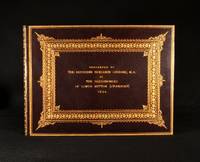
1894770L6Lower Milton: N/A 1894. First edition. Fine Binding. Fine. 14" by 18.5". Not Stated. A beautiful unique work on the parish of Lower Mitton in Stourport. A presentation book created by the parishioners of the area and gifted to their Reverend Benjamin Gibbons. With the bookplate of Reverend Benjamin Gibbons to the front pastedown.Benjamin Gibbons was a curate at St Mary's Kidderminster. Prior to this he was the vicar of Little Mitton. Loosely inserted is a photograph of the New Church of the Parish being constructed and a list of subscribers for the 'New Church for the Parish of Lower Mitton'. The list shows their contributions to the church. The reverend is noted as the second subscriber who pledged £3000 towards the church. This book was produced on Reverend Gibbon leaving Little Mitton after thirty-three years as their Vicar. There are photographs of the church and various buildings around the parish including the schools vicarage and high street. Each page has beautiful hand-painted decorative borders. Lower Mitton was an area now known as Stourport in Kidderminster Worcestershire. Bound by Zaehnsdorf in a stunning full morocco binding. Held in a custom clamshell case which is in need of repair. A fantastic piece of local history for Stourport. with original photographs of the area at the end of the nineteenth century. In a full crushed morocco binding. Externally in an excellent condition. A few small marks to the front board. Internally firmly bound. Pages are very bright with just the odd light spots to pages. Fine N/A unknown
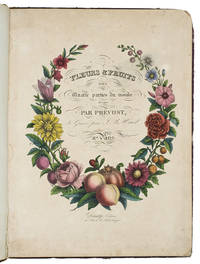
1837ABC_47224Paris 1837. Folio ca. 35 x 26.5 cm. Dauty Contemporary half sheepskin maroon watered silk sides title in gold on the front board. With an engraved title-page and 11 of 23 engraved botanical prints: 4 showing 5 kinds of fruits each 3 showing 9 types of flowers each and 4 showing flower bouquets. All prints are stipple engravings and coloured by a contemporary hand some parts glazed with egg white. 12 ll. Extremely rare botanical print series showing both European and exotic fruits and flowers engraved by Jean-Baptiste Huet the younger 1772-1852 after designs of Benoît-Louis Prévost 1735-1804 or Jean-Louis Prévost 1760-1810. It also includes four plates showing bouquets from Europe America Asia and Africa. Only one complete copy is known at the Bibliothèque nationale de France we have traced no copy in sale or auction records and it is not mentioned in the usual botanical bibliographical works. The BnF copy is described in the Inventaire du fonds français après 1800 where the series consists of 23 prints issued all together under this title. The BnF and the IFF date the work ca. 1837-1839 but it is more likely that it is ca. 1837-1838 as Dauty died in 1838 and he printed at Rue de Bibliothèque no. 16 only in 1827 and 1835-1838. The BnF ascribes the designs for the prints to Benoît-Louis Prévost but Jean-Louis Prévost remains a possibility for he produced another famous print series of flowers and fruits in the same style of stipple engravings Collection des fleurs et fruits 1805.With a contemporary inscription "A M.elle Vincent" on the first free endleaf dedicating it to or belonging to the famous French 19th-century botanical painter Henriette Vincent 1786-1834 who was a student of Gerard van Spaendonck and Pierre-Joseph Redouté. Head and foot of the spine damaged and spine slightly worn boards a little rubbed edges slightly worn corners bumped. Some light browning and foxing throughout title-page a little more browned and with a light marginal water stain. Lacking 12 plates according to IFF. Otherwise in good condition. An extremely rare botanical print series vividly hand-coloured.l BnF FRBNF40503621; IFF Inventaire du fonds français après 1800 Huet p. 518; not in Nissen BBI; Pritzel; Stafleu & Cowan. hardcover
02-0071San Francisco Calif.: Alan Wofsy Fine Arts 1995-2013. Recent publications. 28 vols. The first catalogues appeared in 1995 and there are now 28 volumes covering 87 years of Picasso's 91-year lifespan. Cloth in dust-jackets. Approximately 9500 pp. with 32000 mainly black & white illustrations. Includes many works unknown to Zervos. Titles in English and French; Spanish and Catalan for the early years. Chronology and concordances to Zervos and the major Picasso museum catalogues and monographs. Individual volumes priced at $150.000 each. 10% discount for the 27 volumes. Five of the volumes catalogue the printed graphic work and four are revisions of the standard Bloch and Mourlot catalogues and one covers the linocuts. San Francisco, Calif.: Alan Wofsy Fine Arts, 1995-2013. Recent publications. hardcover
000037Lakeside Press. Chicago: 1930. Very fine. Rockwell Kent proofs. Folio. Gray wraps with exposed spine threads tipped-in reproductions of title pages or sample pages for each volume. This prospectus includes Melville's "Moby Dick" a 3-volume edition with 275 illustrations by Kent. Other titles included Poe "Tales" Dana "Two Years Before the Mast" and Thoreau "Walden". Volume is laid into morocco and cloth book-sty le case included with trial proofs of several title pages and ilustrations by Kent. Also included are a group of 4 ALsS from Frances Kent wife of Rockwell 3 TLsS from Rockwell Kent containing excellent content regarding "Moby Dick". This is a magnificen t archive from one of the greatest illusrators of all time. Lakeside Press. Chicago: 1930. hardcover
194343453London New York; Published on Behalf of the Polish Ministry of Foreign Affairs by Hutchinson & Co 1943. 1st edition. Original illustrated red and white paper wrappers. 8vo. 16 pages. 22 cm. National Government Publication. Printed in red and black ink. Includes a note by Polish Foreign Minister Edward Raczynski and speeches by Deputy Prime Minister Stanislaw Mikolajczyk.<br> The official 16-page diplomatic publication from December 1942 by the Polish Government-in-Exile in London marking a turning point in international understanding of the Nazi destruction of the Jews of Europe. <br> Jan Karski a courier for the Polish Underground had smuggled microfilmed evidence and intelligence out of occupied Poland to London. This raw intelligence gathered from his time secretly inside the Warsaw Ghetto and the Izbica transit camp formed the core of the facts published in the booklet.<br> <br> "In October 1942 at the height of the destruction of Polish Jewry Jan Karski born Jan Kozielewski was ordered to clandestinely go to the West and deliver a report on the situation of occupied Poland to the Polish government-in-exile in London. The situation of the Jews in Poland was to be one section of that report. Since the government in exile was concerned with the internal politics of Poland's underground parties Karski held meetings with the different factions including the Jewish Zionist and the Jewish Socialist Bund movements. <br> Thus shortly before his departure Karski met with two Jewish leaders who asked him to inform the world's statesmen of the desperate plight of Polish Jewry and of the hopelessness of their situation. Their message was: 'Our entire people will be destroyed.'<br> The Jewish leaders' appeals touched Karski and he decided to see things with his own eyes in order to make his report. With great risk to his life he was smuggled into the Warsaw ghetto and into a camp in the Lublin area. The horrors he witnessed marked him deeply and propelled him to become not only the messenger of the Polish underground but to concentrate on giving voice to the suffering of the dying Jews.<br> In November 1942 Karski reached London delivered the report to the Polish government-in-exile and set out to meet Winston Churchill other politicians journalists and public figures. Upon completing his mission Karski went on to the United States where he met with President Roosevelt and other dignitaries and tried in vain to stir up public opinion against the massacre of the Jews. In 1944 while in the United States Karski wrote a book on the Polish Underground Story of a Secret State with a long chapter on the Jewish Holocaust in Poland.<br> After the war Karski stayed in the United States where he was later appointed Professor at Georgetown University Washington DC.<br> On 2 June 1982 Yad Vashem recognized Jan Karski as Righteous Among the Nations" Yad Vashem. <br> <br> Leading Holocaust scholar Lucy Dawidowicz cites the booklet in her now classic work "The Holocaust and the Historians" Harvard 1983 p. 167; the report could not be more explicit in its description of the horrors nor in its plea for help: <br> "The new methods of mass slaughter applied during the last few months confirm the fact that the German authorities aim with systematic deliberation at the total extermination of the Jewish population of Poland and of the many thousands of Jews whom the German authorities have departed to Poland from Western and Central European countries and from the German Reich itself. The Polish Government considers it their duty to bring to the knowledge of the Governments of all civilised countries the following fully authenticated information received from Poland during recent weeks which indicates all too plainly the new methods of extermination adopted by the German authorities." <br> The report elaborates: "The actual process of deportation was carried out with appalling brutality. At the appointed hour on each day the German police cordoned off a block of houses selected for clearance entered the back yard and fired their guns at random as a signal for all to leave their homes and assemble in the yard. Anyone attempting to escape or to hide was killed on the spot. No attempt was made by the Germans to keep families together. Wives were torn from their husbands and children from their parents. Those who appeared frail or infirm were carried straight to the Jewish cemetery to be killed and buried there. <br> On the average 50-100 people were disposed of in this way daily. After the contingent was assembled the people were packed forcibly into cattle trucks to the number of 120 in each truck which had room for forty. The trucks were then locked and sealed. The Jews were suffocating for lack of air. The floors of the trucks were covered with quicklime and chlorine. As far as is known the trains were dispatched to three localities - Treblinka Belzec and Sobibor to what the reports describe as 'Extermination camps.' <br> The very method of transport was deliberately calculated to cause the largest possible number of casualties among the condemned Jews. It is reported that on arrival in camp the survivors were stripped naked and killed by various means including poison gas and electrocution. The dead were interred in mass graves dug by machinery." <br> <br> Read more about the singular importance of this publication at <br> en.wikipedia.org/wiki/The_Mass_Extermination_of_Jews_in_German_Occupied_Poland# . <br> In 2020 Polish Postal authorities chose this very publication to illustrate their official first day cover honoring righteous Poles who had saved Jews during the Holocaust see illustration. <br> <br> Subjects: World War 1939-1945 - Jews - Poland. World War 1939-1945 - Poland - Atrocities. Holocaust Jewish 1939-1945 - Poland. Jews - Poland. OCLC: 234118765. <br> Touch of staining at staples without the rust almost always seen in other surviving copies. Very Good condition. A copy with rust stains sold in 2018 at auction for over £6000. Rare and very important. BHOLO2-97-48-MMXRLADFACC. London, New York; Published on Behalf of the Polish Ministry of Foreign Affairs by Hutchinson & Co unknown
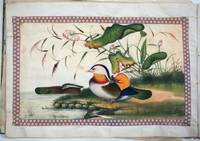
183027903Canton: SunQua Studio 1830. Silk covered boards. The 12 bird images are full page finely done with grass rocks and flowers with shrubs or trees. Unusually the half page images are mounted on the verso of the sheets of bird images. The half page images include collections of shells 4; women playing musical instruments 8; men sitting a scribe man smoking butcher melon fish and vegetable sellers and a few of the punishment images. <br /> <br /> Oblong 4to 8 1/4 x 13 1/4". Leaves mounted with to paper leaves with an unusual paper border with a purple circle pattern on pale background paper. Chinese style binding opening from the back of the album. Bound in a green gold blue and red silk woven in a daisy pattern which sometimes appears with a Sunqua stamp. Without background painting. The first image with some cracking but not affecting the characters some slight browning. Most in very good condition. SunQua Studio unknown
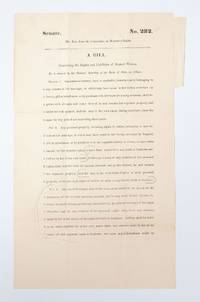
18615555Columbus Ohio: Richard Nevins 1861. First edition. Bifolium slip bill printing measuring 330 x195mm and complete in 3 pages. Lower blank portion of conjugate leaf trimmed; some splitting along fold lines. Early pencil annotations throughout. Slip bills such as this with widely spaced numbered lines were designed for in-session discussion debate and annotation; and they were printed exclusively for the use of delegates. Therefore few survive. Unrecorded in OCLC with no other known copies noted the present is perhaps the only extant recording of the proposals that would be refined into the final version of the law later that year. <br /> <br /> Ten years earlier during the height of her work for abolition Jane Elizabeth Jones spoke before the Ohio Women's Convention in Salem to connect that movement with the fight for women's rights: "We should demand our recognition as equal members of the human family.as human beings; and when this point is established the term 'woman's rights' will become obsolete" Ohio History. Highlighting Black Americans' and women's humanity was crucial to her work. And in 1861 alongside reformers Frances Gage and Hannah Cutler she would continue to push this message even further. Speaking to the Ohio legislature regarding women's property rights she called upon Senators "to imagine themselves with the legal rights of women" -- to confront the terrible realities of being a human "whose property and wages became their husbands' at marriage" as did even their own bodies Broad Movements. An electrifying orator Jones managed to get a sufficient number of men to support the cause during that session. The result was the present bill.<br /> <br /> While differences exist between the text of this slip bill and the final legislation the impact was massive for the women of Ohio. And it was a bellwether for women across the US who were clamouring for equality. In its final state the "1861 law declared that any real estate that a woman had acquired before or during the marriage was her separate property and under her sole control. She could collect the rents and profits. She could contract to manage her real estate.The 1861 law also declared that a woman's personal property including wages acquired before and during marriage was now her separate property and under her sole control regardless of divorce" Little. While it would take another 26 years for women to achieve full property rights with the passage of the Married Women's Property Act in 1887 the present efforts constituted a victory -- at least for white women. For Black and Indigenous women the laws did not significantly budge and they found fewer white allies than would be hoped given the movement's basis in "common humanity."<br /> <br /> An important piece of U.S. Midwestern and Ohio legal and gender history further comparative research could be done between the terms of the bill as drafted and its final iteration as well as to the extent it offered a model for continued efforts within the women's rights movement's varied organizations. [Richard Nevins] unknown
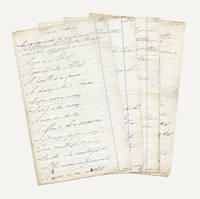
1873ALEP 13<p><em><strong>8 manuscript pages on 4 sheets; sheets each 12 x 8 inches</strong></em></p><p>This fascinating unrecorded compendium of colorful jargon offers numerous examples of "Language Used by Professional Thieves Bank Forgers River Pirates Burglars and other Defraudators of Society."</p><p>The text gives both definitions of words and phrases such as "a peter is a safe" "soap means money "vamose sic is running away" as well as example sentences like "When the bloak sic was copped he sent a century to his mouthpiece means when he got arrested he sent his lawyer 100 dollars" or "He grafted at the gaffs and got fifty red thimbles means that he operated at the fair and secured 50 gold watches."</p><p>Most of the words and phrases which appear in the "Thieves Slang" are accounted for in "Green's Dictionary of Slang" the largest historical dictionary of English slang but there is some variation as to the definitions. "Soft sugar" for example appears in Green's Dictionary only to mean "something easy." Here it is defined as "paper money." The example sentences are seemingly the author's inventions.</p><p>Also included is a poem titled "San Quentin" which was composed during one of the author's many stints there. The first stanza reads "San Quentin is a place of care / A grave for man alive / A tombstone for to try a friend / But not a place for man to thrive."</p><p>Both the "Thieves Slang" and San Quentin poem were penned by Henry Allen who describes himself in the text as "one whose experience as a criminal in all parts of the world is considered second to none." English-born Allen spent most of his life in correctional facilities on both sides of the Atlantic eventually earning the moniker of "Chief of San Quentin" due to his frequent stays. However in 1870 after serving a five-year bid for pilfering $250.00 from the till where he worked Allen renounced his criminal ways cast aside his "nips and jimmy" and took to lecturing on the subject instead.</p><p>In 1873 he toured around California receiving a mostly lukewarm reception. A review of his lecture published in the Petaluma Evening Argus in July of that year complained that Allen's speaking "was not of the most approved style as he did not stick to one point long enough to elucidate it completely but shifted from one to another In a careless and indifferent manner." This and other published reviews of the lecture mention both his "description of the language used by the members of his former profession" and the San Quentin poem.</p><p>An article published in the Sacramento Bee later that month wrote that Allen was disgusted with the unfavorable response he had received. He told the paper "When I take into consideration the cold reception I met with by the residents of this city I am fully convinced that they look upon me as one unworthy of kind consideration." In the article he also mentions that he had written a book detailing his life behind bars "which is considered to be the best criminal work ever written in this world's history." Though he does not specify who exactly considered it as such. Allen's opus does not appear to ever have been published which is possibly due to the fact that he perished in a railway accident in Oakland later that year.</p><p>It is unclear if the present text was used during Allen's lecture as notes for his unpublished tome or something else entirely. Regardless it a fascinating collection and an exciting addition to the scholarship of slang.</p><p>From the estate of Ron Lerch.</p>
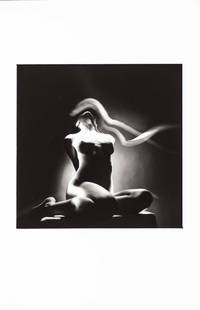
49593Prague: České Centrum Fotografie Czech Center for Photography 2011. First edition. Hardcover. Near fine to fine condition. 18/33 with 15 original photographs six of them signed on versos the others with CF stamp including artist name on verso frontispiece with CF stamp and artist name below photo. Total edition of 200. Folio. 45pp. 15 plates of original photographs with printed tissue guards including the frontispiece. Original black half leather over brown boards with debossed lettering on cover housed in matching black half cloth clamshell box with debossed lettering on brown cover. Original frontispiece photograph by Michal Macku. Title page printed in brown and black. Graphic design by Vladimir Lederer.<br /> <br /> Jiri Jaskmanicky: 'This book is dedicated to my most precious teacher Mrs. Libus Zivna from Jaromer.' With introductory texts by Jan Mlcoch and Frantisek Dostal the latter with photogravure of photo by Frantisek Dostal on facing page. Includes photo-illustrated chronology of exhibitions and publicationa of the Czech Center for Photography from 1997 to 2011 including documents in photogravure on pages opposing the text pages. Photogravure depicting the chairman of the institute on page facing first page of chronology.<br /> <br /> At rear fourteen full page photographs from the original negatives six of them signed on verso by Frantisek Dostal 1976 Petr Helbich 1972-74 Jan Mlcoch 2009 Miroslav Pokorny 1980 Ladislav Postupa 1963 Vasil Stanko 1987. Eight photographs with CF stamp and name of artists on verso frontispiece below the image by Josef Bartuska 1936 Antonin Gribovsky 1963 Tibor Honty 1940 Frantisek Povolny 1947 Jaroslav Rössler 1966 Drahomir Josef Ruzicka 1921 Jan Svoboda 1973 Bohumil Stastny Neony 1. pol. 30. let / 2011 frontispiece photo by Michal Macku 2011. The dates in parenthesis indicate the date the original photograph was taken. Text in Czech. Clamshell box with light sunning at top and bottom edges else in fine condition. České Centrum Fotografie (Czech Center for Photography) hardcover
16-4225Paris: Imprimerie Impériale 1862. . Folio. 2 vols. 54 x 42.5. 93 color plates some folding to twice the size of the album. Original boards. Light to moderate foxing. Plate volumes only. Heavy vols. Loosely inserted is a pencil signed and dedicated engraving of Napoléon III by Pollet.Rare the atlas not in OCLC; Bibliothèque nationale de France identifier ark:/12148/bpt6k1308058.Campagne de l'Empereur Napoléon III en Italie 1859. Atlas des Marches. Atlas des batailles. Rédigé au Dépôt de la Guerre d'après les documents officiels étant Directeur le Général Blondel sous le Ministère de son Excellence le Maréchal Comte Randon 1860-1861. Paris Imprimerie Impériale 1862. 2 volumes in-folio demi-percaline verte dos lisse reliure de l'éditeur. .Atlas bien complet de deux titres deux tableaux et de 93 cartes lithographiées et coloriées par Erhard Schièble. Il manque probablement un volume de texte. .Bon exemplaire. Rousseurs. in modo molto dettagliato i piani delle battaglie in ordine cronologico per giornate di combattimento: Palestro Novara Turbigo Pontenuovo Buffalora Magenta Pavia Milano Melegnano Livorno Bobbio Vaprio Lonato Castiglione Piacenza Brescia Castelgoffredo Medole Rebecco Madonna della Scoperta Solferino San Martino Cavriana Guidizzolo Pozzolengo Peschiera Verona Bormio Tirano Custoza Pastrengo Castelnuovo Valeggio Villafranca etc. Les cartes donnent les marches des armées en présence depuis le 29 avril jusqu'au 6 juillet 1859. 2. Atlas des champs de bataille rédigé au Dépôt de la Guerre d'après les documents officiels étant directeur le général Blondel sous le ministère de S.E. le Maréchal Comte Randon. 1860-1861. - Comprend : un titre gravé la table des planches un tableau des signes conventionnels employés dans la cartographie de l'atlas et 24 cartes 7 en grand dépliant 7 à double page 10 à pleine page en couleurs ; le tout gravé par Erhard Schieble. Les cartes détaillent de façon très précise les moments successifs des batailles de Montebello Palestro Robechetto Magenta Melegnano et Solferino. BnF 340881770. Expertise by Christian GASCHBoite Postale 40558004 NEVERS Cedex. Paris: Imprimerie Impériale, 1862. hardcover
Z1-E-018-01622Office for Official Publications of the European Communities. Used - Good. Inside spine damaged. Ships from UK in 48 hours or less usually same day. Your purchase helps support Sri Lankan Children's Charity 'The Rainbow Centre'. Ex-library so some stamps and wear but in good overall condition. 100% money back guarantee. We are a world class secondhand bookstore based in Hertfordshire United Kingdom and specialize in high quality textbooks across an enormous variety of subjects. We aim to provide a vast range of textbooks rare and collectible books at a great price. Our donations to The Rainbow Centre have helped provide an education and a safe haven to hundreds of children who live in appalling conditions. We provide a 100% money back guarantee and are dedicated to providing our customers with the highest standards of service in the bookselling industry. Office for Official Publications of the European Communities unknown
1857BRONTECH011372Smith Elder & Co London. 1857. First edition. Octavo. Two volumes: pp viii 294 2 adverts; iv 258 2. 8 pages of adverts plus 16-page catalogue dated June 1857 at rear of second volume. Original purple cloth decorated in blind lettered in gilt on spines.On the covers of the first volume are the library labels evidently of the period of the Grand Pump Room Library which was situated in the Abbey Church Yard Bath and which was part of the bookshop founded by William Meyler printer publisher newspaperman and politician. It was in Meyler's bookshop that Shelley and Mary Godwin lodged during their stay in Bath in 1816/17.Small ownership signature on front free endpaper of first volume. A bit of foxing here and there. Covers faded especially at the spines. A very good tight set. Smith, Elder & Co, London. hardcover
1857014773London: Taylor and Francis 1857. Volumes 3 4 5 6 7 & 8. Bound in 3 volumes. Issues 40 to 142. Collation 317pp 268pp 327pp 336pp 388pp 470pp including index 7 full page plates text illustrations throughout. Bound in modern cloth gilt bands and lettering. Bindings in very good clean firm condition. Internally 2 corners nicked with very slight loss on text some light staining to about 40 pages. Pages in very good clean condition. A very nice clean run. F. First Edition. Cloth. Very Good. 8vo. Taylor and Francis Hardcover
1961182473London: D. Survey War Office and Air Ministry 1961. Before the collapse of the Aden Protectorate A collection of charts covering the Arabian Peninsula stretching to encompass North Africa India and the Maldives. The isogonals are correct to 1963. We have traced only three institutions that hold maps from this GSGS 4930 series: the British library the National Library of Scotland and the National Library of Australia. In the 1950s and 60s the RAF was heavily involved in supporting UK interests in the Middle East. In particular they defended the UK's protectorates and allies in southern Yemen by airlifting ground troops into insurgent-controlled areas. "The most prominent COIN counter-insurgency operation of the mid-1950s took place in Western Aden after continuing low-level unrest in the remote Wadi Hatib area persuaded the government to establish a new fort at Robat. The fort together with a number of other isolated military outposts subsequently came under attack from two dissident tribes who received backing from Yemen. The British were obliged to airlift troops from Aden Colony into the affected area and this relief operation was soon followed by the application of more forceful air control measures - warnings followed by the bombing of rebel villages crops and water supplies. These operations were sustained throughout the second half of 1954 but there was no obvious reduction of insurgent activity" Ritchie p. 61. These activities would grow in frequency and scale during the 1960s with the Aden Emergency. Notably these maps were issued in the same year that the RAF restructured its forces in the Middle East forming the Headquarters Middle East Command. Colour maps approximately 880 x 1145 mm folding to approximately 298 x 220 mm keys to recto; text printed in blue and orange. Extremities a little toned and creased small closed tear to margin of Sheet NE 01.5/43 not affecting printed area light dust-soiling and foxing to fold lines and versos: a very good collection. Sebastian Ritchie "RAF Counter-Insurgency Operations in Oman and Aden 1950-1970" Air Power Review vol. 11 no. 1 2008. unknown