1 326 résultats
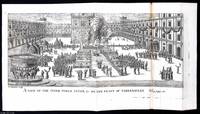
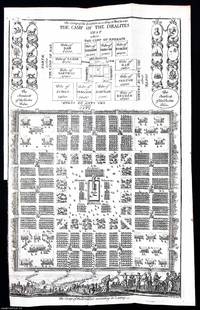
1748372017Printed for T. Osborne in Gray's Inn; A. Miller in the Strand; and J. Osborn in Paternoster Row London 1748. Unframed Print. Very Good Condition. This 1748 engraving presents a detailed depiction of the Israelite encampment based on interpretations by Reyherus and Lamy. It illustrates the standards of the Twelve Tribes showing how the Israelites were arranged during their journey through the wilderness. The tribal banners of the Twelve Tribes of Israel were significant symbols representing each tribe's identity heritage and role within the Israelite community. These banners known as "degel" in Hebrew were used to organize the encampment of the Israelites during their journey through the wilderness as described in the Book of Numbers. The image reflects biblical scholarship and cartographic traditions of the time. Engravings like this were used as visual aids in theological studies helping scholars and readers understand the structure and symbolism of the Israelite encampment. Engravings such as this one contributed to the broader effort of documenting and interpreting biblical events in historical and artistic contexts and was printed in London by T. Osborne A. Miller and J. Osborn.1 folding plate. Close cropped at the left margin and a couple of tears neatly repaired from the rear. The exodus of the Israelites from Egypt represents a pivotal moment in Jewish history as recounted in the Old Testament's book of Exodus. The narrative reveals that the Israelites endured years of enslavement in Egypt until God appointed Moses to guide them out of bondage and return them to the land promised to their forefathers. Following a series of plagues and miraculous events Pharaoh initially consented to their departure but subsequently reneged on his decision and pursued them with his forces. At the Red Sea God miraculously parted the waters enabling the Israelites to cross safely while the Egyptian army was engulfed as the waters returned. This escape signifies the commencement of the Israelites' journey toward the Promised Land and their emancipation from servitude. Size: 20 x 33 cms. Category: Universal History; Unframed Prints : Old; Printed before 1800; PRINTS : Antiquarian Interest; Special Features. This item may require more postage than the rates shown for delivery outside the UK. If extra postage is required we will contact you before processing your order and you will be given the details and option to decline the extra cost. Printed for T. Osborne, in Gray's Inn; A. Miller, in the Strand; and J. Osborn, in Paternoster Row unknown
1748372019Printed for T. Osborne in Gray's Inn; A. Miller in the Strand; and J. Osborn in Paternoster Row London 1748. Unframed Print. Very Good Condition. 1 folding plate. The design of the porch and altar is reminiscent of the structure of the ancient Temple. The porch was situated at the front of the sanctuary leading to the entrance of the Holy Place. Beyond the porch lay the Inner Court which housed the large altar. The area between the porch and the altar served as the location where priests interceded for the people of God who were gathered in the outer court just outside the walls. Size: 15 x 33 cms. Category: Universal History; PRINTS : Antiquarian Interest; Printed before 1800; Special Features. This item may require more postage than the rates shown for delivery outside the UK. If extra postage is required we will contact you before processing your order and you will be given the details and option to decline the extra cost. Printed for T. Osborne, in Gray's Inn; A. Miller, in the Strand; and J. Osborn, in Paternoster Row unknown
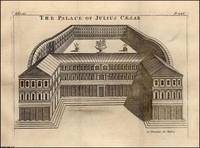
1748351255Printed for T. Osborne in Gray's Inn; A. Miller in the Strand; and J. Osborn in Paternoster Row London 1748. Unframed Print. Very Good Condition. This 1748 engraving depicts the Horti Caesaris or Gardens of Caesar which were part of Julius Caesar's grand estate in ancient Rome. The palace buildings shown surrounding the gardens were known for their lavish design fountains and sculptures reflecting the wealth and influence of Caesar. The engraving was printed in London by T. Osborne A. Miller and J. Osborn.1 folding plate. Size: 15 x 20 cms. Category: Universal History; PRINTS : Antiquarian Interest; Printed before 1800; Special Features. This item may require more postage than the rates shown for delivery outside the UK. If extra postage is required we will contact you before processing your order and you will be given the details and option to decline the extra cost. Printed for T. Osborne, in Gray's Inn; A. Miller, in the Strand; and J. Osborn, in Paternoster Row unknown
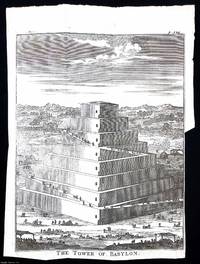
1748372018Printed for T. Osborne in Gray's Inn; A. Miller in the Strand; and J. Osborn in Paternoster Row London 1748. Unframed Print. Very Good Condition. This 1748 engraving visually represents the Tower of Babel a structure described in the Book of Genesis as an ambitious attempt by humanity to build a tower reaching the heavens. According to the biblical account God intervened by confusing human language leading to the dispersion of people across the world. The image reflects 18th century interpretations of the story incorporating architectural elements inspired by Mesopotamian ziggurats such as Etemenanki a temple dedicated to Marduk in Babylon. The engraving was printed in London by T. Osborne A. Miller and J. Osborn.1 folding plate. Close cropped at the right margin and a couple of tears neatly repaired from the rear. In the Book of Genesis it is stated that the Babylonians sought to establish their reputation by constructing a grand city and a tower that reached the heavens. However God intervened by causing such confusion among the workers' language that they were unable to communicate effectively with each other. Size: 21 x 28 cms. Category: Universal History; PRINTS : Antiquarian Interest; Printed before 1800; Special Features. This item may require more postage than the rates shown for delivery outside the UK. If extra postage is required we will contact you before processing your order and you will be given the details and option to decline the extra cost. Printed for T. Osborne, in Gray's Inn; A. Miller, in the Strand; and J. Osborn, in Paternoster Row unknown
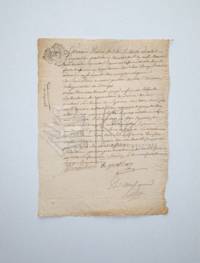
17560010147France. Good with no dust jacket. 1756. Ephemera. On offer is fascinating manuscript from 1756 detailing a significant financial transaction with the document's author Germain Pierre Blanchebarbe the Lord of Grandbourgone who was one of France's leading noblemen in the mid-18th century. The document describes an agreement to pay for wood provided by one Francois Blanche. An excerpt from the document follows: Nous mandons de payer a francois Blanche . La somme de sept cent une livres trois sols neufs deniers . Du prix de bois. Translation: We mandate to pay to francois Blanche . The sum of seven hundred and one livres three sols nine cents remaining . Of the price of wood. The price is a significant sum equal to approximately three years ordinary wages so the amount of wood cut must have been substantial. The importance of the document is the author. Blanchebarbe was a French nobleman who also served as Grand Master of Waters and Lands of Blois under Louis XV. This was a purchased position and to hold it meant that Blanchebarbe was indeed a wealthy man. Of significance is that he sold this position to Jacques-Donatien Le Ray de Chaumont Jacques-Donatien. Le Ray de Chaumont was one of the wealthiest and most powerful aristocrats in all of France. He made a fortune in shipping and in ceramic manufacturing. In 1750 he acquired the Château de Chaumont as a country home. He served Louis XVI at the Court at Versailles as the Governor of Les Invalides in Paris and as Grand Master of Waters and Lands of Blois the position he purchased from Blanchebarbe. Le Ray de Chaumont was very sympathetic to the American cause for independence and used his powerful position to sway the King and the powerful administrators of the French government to provide huge loans to the nascent American government. Le Ray also provided a fully staffed mansion for Benjamin Franklin. Le Ray's support for the American cause also involved having his shipyards refit a merchant vessel into a warship that he then gifted to America under the name USS Bonhomme Richard for use by Captain John Paul Jones named after the character in Franklins book Poor Richards Almanac. As a result of his efforts he is often referred to as the French Father of the American Revolution. Unfortunately his support for the Americans led to the bankruptcy of the French government. When crops failed in France in the 1780s there was no money to purchase grain to stave off mass starvation and the population rose in revolt. As such Le Ray can also be considered a Father of the French Revolution. For a historian especially of American history this document connects directly with two of the most significant revolutions in modern western history. Such a simple page would be a prize in any library due to its connections. The manuscript is a one-page single-sided document measuring 9.75 inches by 7.25 inches. The edges show feathering and staining that would be appropriate to its age. The page bears a printed seal. The wording is obscured but there is a clear image of a sailing ship. The handwriting is generally very legible. ; Manuscripts; 8vo 8" - 9" tall; 1 pages; Signed by Author .
1777BTETM0002432London: Printed for Fielding and Walker 1777. 1st Edition. Hardcover. Good/No Jacket. quarto 4to 9 12 × 12 in 241 × 305 mm . Please email for Photographs or further information. Good - No dust jacket as issued. Complete: half-title; title with engraved vignette; list of plates; contents; preface; 4 full-page engraved plates; engraved ornaments; Errata p. 332 and Index present; terminal blanks present. Text/plates: scattered spotting/foxing see photos. Binding: contemporary speckled calf; gilt-decorated spine with red morocco title label; rubbed/worn to extremities. Upper board detached but presentclean split at the front joint/hinge; textblock and sewing sound. Paper note: final text leaf pp. 331/332 on thicker stock comparable to the plate paper integral and sewn in. Collation: 4 1 1 2 1340 3 pp. incl. terminal blanks. Prelims: half-title; title engraved vignette; list of plates; contents; preface. Illustrations: 4 full-page engraved plates engraved ornaments often described as additional head/tailpieces/vignettes. Rear matter: Errata Index present. Please see Photos as part of condition report. 1777 1st Edition THE HISTORY OF THE FLAGELLANTS or the Advantages of Discipline; Being a Paraphrase and Commentary on the Historia Flagellantium of the Abbe Boileau Doctor of the Sorbonne Canon of the Holy Chapel &c. By Somebody Who is Not Doctor of the Sorbonne Jean-Louis De Lolme Author Bio: Jean-Louis de Lolme 1740 16 July 1806 was a Genevan and British political theorist and writer on constitutional matters born in the then independent Republic of Geneva. As an adult he moved to England and became a British subject. Synopsis: A fine example of Delolmes provocative English adaptation of Abbé Boileaus highly controversial history of flagellation first published 1700. It traces the practice throughout history and literature with its uses as punishment religious self-discipline private atonement or erotic practice. The illustrations include devils whipping men Henry II's penitance for the death of Thomas Becket and Bernadine of Sienna whipping a bare-breasted woman to extinguish her ardour. Format: Hardcover quarto 4to 9 12 × 12 in 241 × 305 mm Note: Binding/size selection follows standard bibliographic conventions and is approximate; exact measurements may vary. Language: English Published By: Printed for Fielding and Walker London Condition Report: Dust Jacket: No Jacket Dust Jacket Condition: No Jacket Good - No dust jacket as issued. Complete: half-title; title with engraved vignette; list of plates; contents; preface; 4 full-page engraved plates; engraved ornaments; Errata p. 332 and Index present; terminal blanks present. Text/plates: scattered spotting/foxing see photos. Binding: contemporary speckled calf; gilt-decorated spine with red morocco title label; rubbed/worn to extremities. Upper board detached but presentclean split at the front joint/hinge; textblock and sewing sound. Paper note: final text leaf pp. 331/332 on thicker stock comparable to the plate paper integral and sewn in. Collation: 4 1 1 2 1340 3 pp. incl. terminal blanks. Prelims: half-title; title engraved vignette; list of plates; contents; preface. Illustrations: 4 full-page engraved plates engraved ornaments often described as additional head/tailpieces/vignettes. Rear matter: Errata Index present. Please see Photos as part of condition report. SKU: BTETM0002432 Shipping Info: Approximate Package Dimensions H: 12.5 L: 30 W: 25 Units: cm W: 2Kg Tracked Shipping Insurance Coverage as per Customer Request Printed for Fielding and Walker hardcover
177726884London England: Printed for the Company of Stationers 1777. Twenty-two issues of this yearly British almanac bound in one volume; consecutive and inclusive from the 1777 issue to 1797. These are printed in red & black have the tax stamps on the margins of the title pages and are of 32 pages' length with exceptions or notes as below: 1782: On page 31 the section "VI Rebus by Mr. R. Richardson of Frosterly" has been solved with the manuscript letters & names of clues neatly written at the margins. 1786: pgs 1-2 15-32; However another issue is bound after this incomplete issue that is entire in 48 pages. These almanacs are noted on the title pages as printed for the Company of Stationers; and this "extra" issue is noted on the title page as "Printed for T. Carnan in St. Paul's Church Yard; who after an expensive Suit in Law and Equity by the unanimous Opinion of the Judges of the Court of Common Please dispossessed the Stationers' Company of their pretended exclusive Privilege of Printing Almanacks which they had usurped for two Centuries; a convincing Proof that no unjust Monopoly will ever stand the Test of an English Court of Justice." 1788: pgs 1-2 15-32 only. 1793 Misbound pages out of order and complete 32 pages. 1795: A name of "Old Batholomew" has been added in ms. at the 4th Sept. in the monthly almanac pages section. 1797 pgs 1-16 only. "The existence of the Ladies' Diary or the Woman's Almanack an 18th century English magazine devoted largely to problems and puzzles in mathematics indicates that stereotypes about the inability of women to understand and enjoy mathematics were less strongly believed in the 18th century than they are today.The Ladies' Diary became one of the widely read 18th century magazines devoted to the popularization of science and mathematics; these were addressed mainly to readers with no specialized training in the subjectsThe Ladies' Diary differed from these others primarily in the language used in some of the problems--language which reminds the reader that the problems were addressed to women" from the excellent overview of the magazine its influence & impact by Teri Perl San Francisco State Univ. Historia Mathematica 6 1979 article on the 'Diary' Indecipherable by us previous owner name on back endpaper.Approx. 4" x 6 3/8" size; bound in marbled-paper covered boards leather corners edges tinted yellow; spine covering gone; wear to the edges tips of the binding; bottom cord of top board let go; the block still solidly sewn some edges trimmed close; contents generally clean and in good condition. . First Edition. Hard Cover. Good. Printed for the Company of Stationers hardcover books
178427164A Vienne & A Strasbourg: Chez Les Freres Gay Imprimeus-Libraires et al 1784. Four eighteenth century publications; all French texts bound in one volume. All regarding the plague especially in Russia & Europe as below: De Mertens Charles. Traite de la Peste Contenant L'Histoire de Celle qui a Regne A Moscou en 1771A Vienne & a Strasbourg Chez les Freres Gay Imprimeurs-Libraires a Paris Chez Didot.Mequignon. MDCCLXXXIV. Frontispiece portrait engraving of de Mertens by J. Mansfeld 1783. xxviii 142 pages. "The plague stimulated local research in disease prevention which was boosted by discovering indigenous plague in newly conquered territories of the Caucasus. The epidemic was professionally exposed to Western European academia by Belgian physician Charles de Mertens 1737 - 1788. " from the online wiki Samoilowitz M.D. Lettre Sur Les Experiences Des Frictions Glaciales Pour La Guerison De La Peste Et Autres Maladies Putrides.A Strasbourg Chez Lorenz & Schouler Imrpimeurs du Directoire de la Noblesse. 1782. 43 pages. Danilo Samoilowitz Samoilovich et al 1742/4 - 1805 is noted among other titles as "Chirurgien-Major du Senat de Moscou" and was a witness to and attempted to treat the victims of the great Russian Plague of 1770-72 often at great personal hazard. The U.S. NIH National Library of Medicine lists several articles extolling the significance of Samoilowitz' contribution to epidemiology; see especially the 2013 June issue of Vesalius for the thorough Tatiana Sorokina article "A Victory Over the Plague in Moscow 1770-1772" which details the public and private response to the epidemic and specifically Samoilowitz' and others work combatting the outbreak. Samoilowitz M.D. Memoire Sur L'Inoculation De La Peste Avec A La Description de Trois Poudres Fumigatives Antipestilentielles. A Strasbourg Chez les Freres Gay Libraries. 1782. 36 pages. Paris J.-F. Memoire sur La Peste. A Avignon. Et se Trouve A Marseille Chez Jean Mossy Imprimeur du Roi de la Marine & Libraire au Parc. MDCCLXXVIII. xxxvi 86 pages. One leaf with small corner chip no loss. Provenance binding condition: A handwritten table of contents in French on the endpaper; below this is the handwritten name with the acquisition date of 21 June 1887 & the address of collector George Brush M.D. U.S. Navy; in service as a surgeon & medical inspector from 1861-1894; each title page of the contents also with the handwritten name of T.A. Emmet. Volume approx. 5" x 7 5/8" size; bound in marbled paper covered boards polished speckled calf leather corners and spine gilt titled spine label. Some edge tips wear and rubbing to the binding; surface of spine leather split at edges; securely sewn; first two leaves corners clipped; contents clean and fairly fresh in very good condition. Premiere Edition. Leather. Very Good. Chez Les Freres Gay Imprimeus-Libraires et al books
178200TP08Paris France 1782. On June 13th 1782 'Docteur rege de la Faculte de Medecine en L'Universite de Paris ancien Proffesseur de les Ecoles.' Etienne Pourfour-de-Petit first hired by the University in 1732 writes the Faculty beseeching that the Faculty honor and uphold his 1760 retirement 'edict'. Superbly interesting document that highlights the struggles of the revolutionary period and transition of power. The Professor obviously a monarchist and of the 'ancien regime' is faced with a new board made up of the rebels. Easily read is a certain disdain to the new Faculty members his deep respect for the Monarch but also an embracing of the new revolutionary ideas. Biographical Notes: SIR THOMAS PHILLIPPS 1792-1872. Born in 1792 Sir Thomas Phillipps from childhood was obsessed with the idea of obtaining virtually anything written or printed on paper including cartloads of documents from wastepaper merchants and the entire inventories of booksellers. "I wish to have one copy of every book in the world" he declared to a friend. He very nearly succeeded. His collection ultimately grew to more than 100000 books and at least 60000 manuscripts. As a result of his extravagant purchases Sir Thomas was permanently on the verge of bankruptcy and was constantly pursued by creditors. So many books arrived at his house that it was impossible to unpack his acquisitions much less keep pace with them. Visiting scholars driven to distraction would spend days hunting for an elusive text in the dusty heaps that filled every room. Because Sir Thomas has a morbid dread of fire most of his collection was housed in coffinlike boxes that could be carted away quickly. Visitors to Middle Hill were struck too by the presence of numerous logs a ploy he used to lure beetles away from his books. As Sir Thomas relentlessly pursued his passion the house itself began to crumble and its floors started to sag under the cast weight of hundreds of tons of paper. His neglect of Middle Hill was partly deliberate however. Sir Thomas's chief enemy in life James Halliwell had married his daughter against his wishes. It appears that Halliwell was in Sir Thomas' eyes the worst kind of criminal a book thief who had stolen valuable works from university libraries and even from his father-in-law. Having no sons Sir Thomas was unable to prevent Halliwell from inheriting his estate. To ensure that his detested heir would never receive anything of value Sir Thomas's solution was to allow Middle Hill to fall unto complete disrepair. He even went so far as to chop down and sell for lumber the centuries-old oak trees that lined the majestic mile-long drive to his home. In 1863 Sir Thomas decided to move - in order to accommodate his books. With the aid of 160 men 103 wagonloads of books and papers drawn by 230 horses the books were lumbered from Middle Hill top their new estate in nearby Cheltenham. It is said that for years afterwards the countryside was littered with the remains of carts that had collapsed under the sheer weight of the Phillipps collection. Sir Thomas continues to add to his library until his death in 1872. After Sir Thomas's death his immediate family had no room for his collection. So vast was the library that although individual items and large sections were sold privately or through numerous auction sales the Phillipps collection is still being sold more than a century after the death of its owner. In the course of its sales many treasures have come to light. As late as 1964 part of the long-lost and unique medieval manuscript of the Roman poet Ovid's Metamorphoses appeared and was subsequently reunited with its other half at Magdalen College Oxford. Once destined for destruction as worthless wastepaper this and many other priceless works were saved by the single-minded obsession of the greatest bibliomaniac of all time. Autograph. Manuscript. Very Fine. Folio - over 12" - 15" tall. Paperback
1787358416Annual Register London 1787. Booklet - Unbound Pages. Very Good Condition. 11 pages. An authentic standalone article extracted from a larger volume. Not a reprint or reproduction but an original work in its own right. Preserved in a modern card cover prepared for practicality - an unassuming but serviceable presentation that favours function over finery. Size: 13 x 20 cms. Category: Annual Register; Printed before 1800; New Arrivals; This item may require more postage than the rates shown for delivery outside the UK. If extra postage is required we will contact you before processing your order and you will be given the details and option to decline the extra cost. Annual Register unknown
17900JT108France: None 1790. As determined by the decree of October 6 1789 Monsieur A.M. Outrebon has made his 'Patriotic Contribution' of 25% of his salary is revealed in this Department of Finance for the revolutionary coffers in 1790 France. Revolutionary vignette. Super period piece less than a year after La Bastille.Overall in good shape better without some chipping to the top edge and general ageing. Autograph. Manuscript. Good. 8vo - over 7¾" - 9¾" tall. None Paperback
17910JT109AFrance 1791. Royal edict dated May 29 1791 wherein it is decreed that the public servants that refused to take their civic oath and their punishments. Signed in print M.L.F. DU PORT and by LOUIS King of France. Superb vignette. . Autograph. Manuscript. Very Good. 8vo - over 7¾" - 9¾" tall. Paperback
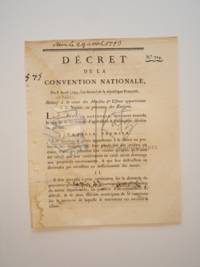
17920JT111France 1792. Dated November 27 1792 'DECRET DE LA CONVENTION NATIONALE' dealing with the employees and their lodgings in both the Louvre and the Tuileries of the deposed King Louis XVI. Signed inprint by M. Monge and countersigned by Garat. Includes a bold unidentifiable signature. Some yellowing but otherwise in good condition. Autograph. Manuscript. Good. 8vo - over 7¾" - 9¾" tall. Paperback
17930010123Good with no dust jacket. 1793. Ephemera. On offer is a superb document issued two days following the creation of the notorious Committee of Public Safety which deliberately created the Reign of Terror following the French Revolution. The Decree was published on April 8th 1793 two days following the creation of the infamous Committee of Public Safety. It deals with the seizure of property specifically mills and factories that were owned by emigres those French aristocrats who had fled France following the Revolution. This emigration created several problems for the Revolutionary government. There now existed outside of France and within the borders of her enemies a very motivated group who were dedicated to the overthrow of the Revolution. Also among other assets the mills and factories that they owned were now idle contributing to lost food production and jobs. The National Convention ordered that all emigres return to France. Failure to do so would result in being permanently barred from ever re-entering the country and all of their assets would be forfeited to the government. This Decree addresses this. An excerpt from the decree follows: Relatif à la vente des Moulins et Usines appartement a la Nation ou provenus des Emigres Translation: Relative to the sale of the Mills and Factories owned by the Nation or originating from the Emigrants The Decree follows a report from the Committees of Agriculture and Food. Further excerpts from the document follow: Les moulins et usines appartement a la nation ou provenus des emigres qui sont places sur des rivieres ou cours d'eau ne pourront etre vendus qu'apres qu'il aura ete verifie que leur conservation ne cause aucun dommage aux proprietes environnantes et que leur destruction ne deviendra pas necessaire aux dessechement des marais. Translation: The mills and factories belonging to the nation or originating from the emigrants which are located on rivers or watercourses can only be sold after it has been verified that their preservation does not cause any damage to the surrounding properties and that their destruction will not become necessary for the draining of the marshes. . Apres ce rapport le directoire du department sur l'avis de celui du district ordonnera la vente desdits objets ou il y fera surseoir si le cas l'exige. Translation: . After this report the director of the department on the advice of that of the district will order the sale of the aforementioned objects or will have it postponed if the case requires it. The manuscript is signed by Louis-Jérôme Gohier the President of the Executive Council and Minister of Justice. When Napoleon became dictator Gohiet served in his government as Consul-General in Amsterdam. He was offered a similar position in the United States but was too ill to take up the position. For a historian or a collector of material from the earliest days of the French Revolution this is a superb item documenting the earliest efforts of the French people to establish a republican government separate from the monarchy and the feudal system that had ruled France for a millennium. For a person involved in the financial or economic world it is a wonderful piece of evidence of what can happen to a society where economic realities are cast aside. This double-sided single sheet document measures 8.75 inches by 7.0 inches. It has been separated from a larger bound volume and the thread holes are visible. There is some staining from dampness and from age. Otherwise it is in very good condition. ; 8vo 8" - 9" tall; 1 pages .
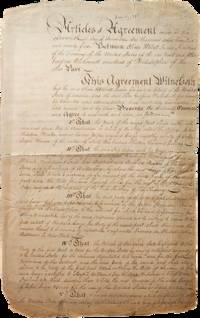
1795List3024Philadelphia Pennsylvania 1795. Two pages measuring 10 x 16 ¼ inches. Toned folded with tears at folds and marginal damage; excellent. A contract dated December 11th 1795 between Philadelphia merchant John Godfried Wachsmuth and Secretary of the Treasury Oliver Wolcott Jr. in which Wachsmuth agrees to ship $113000 worth of coffee sugar and cocoa to Amsterdam for which the US government would advance Wachsmuth the funds. The items would be consigned to an Amsterdam banking house the bankers would pay the proceeds to the United States and the US would in turn pay Wachsmuth in specie.<br /> <br /> At the time the US was finally recovering from the precarious financial situation that followed the Revolutionary War and had successfully negotiated trade deals with Great Britain and Spain. Despite political upheaval in the Netherlands the country had been and remained a significant trading partner for and investor in the US. This contract specifies that the goods will be consigned to Wilhelm and Jan Willink Nicolaas and Jacob Van Staphorst and Nicholas Hubbard; this group in particular invested heavily in the US making large loans to the government and purchases of land via the Holland Land Company including investing in the Louisiana Purchase.<br /> <br /> A deal of this sort had a number of benefits for the new country; most importantly it would continue to build a positive trade relationship with the Netherlands and improve the US’s credit abroad and it would bring more specie into the US which was experiencing a specie drain due to its imports exceeding its exports.1 It involved significant risk for Wachsmuth—he would be responsible for ensuring the bankers ultimately received the value of the goods in specie—but the potential reward in terms of both profits and a relationship with Amsterdam’s most important bankers seem to have been worth it.<br /> <br /> Of interest to scholars researching the economic growth of the early United States especially in terms of foreign trade relations.<br /> <br /> 1 Nicholas A. Curott and Tyler A. Watts “What Caused the Recession of 1797†Studies in Applied Economics 48 February 2016. unknown
1795358514Annual Register London 1795. Booklet - Unbound Pages. Very Good Condition. 29 pages. An authentic standalone article extracted from a larger volume. Not a reprint or reproduction but an original work in its own right. Preserved in a modern card cover prepared for practicality - an unassuming but serviceable presentation that favours function over finery. Size: 13 x 20 cms. Category: Annual Register; Printed before 1800; New Arrivals; This item may require more postage than the rates shown for delivery outside the UK. If extra postage is required we will contact you before processing your order and you will be given the details and option to decline the extra cost. Annual Register unknown
1796BTETM0001845London: Printed for T. Longman B. Law G.G. and J. Robinson T. Cadell S. Bladon R. Baldwin J. Sewell J. Johnson H.L. Gardner W. Lowndes F. and C. Rivington W. Bent J. Scatcherd and J. Whitaker G. and T. Wilkie E. Newberry and J. Walker 1796. 5th Edition or Later Reprint. Leather. Very Good/No Jacket. sextodecimo or sixteenmo 16mo 4 × 6 34 in 102 × 171 mm . Thomas Bewick. Please email for Photographs or further information. Very Good - Bookplates from 3 Previous Owners on marble FEP. Collation: pp. 232 Please see Photos as part of condition report. 1796 Reprint FABLES By The Late Mr Gay Author Bio: John Gay 30 June 1685 4 December 1732 was an English poet and dramatist and member of the Scriblerus Club. He is best remembered for The Beggar's Opera 1728 a ballad opera. The characters including Captain Macheath and Polly Peachum became household names. Illustrated By: Thomas Bewick Illustrator Bio: Synopsis: 2 parts in 1 volume; pagination is continuous. Brown calf binding. Illustrated throughout with wood engravings attributed to Thomas and John Bewick. With Gay's dedication to Prince William Augustus Duke of Cumberland. Format: Leather sextodecimo or sixteenmo 16mo 4 × 6 34 in 102 × 171 mm Note: Binding/size selection follows standard bibliographic conventions and is approximate; exact measurements may vary. Language: English Published By: Printed for T. Longman B. Law G.G. and J. Robinson T. Cadell S. Bladon R. Baldwin J. Sewell J. Johnson H.L. Gardner W. Lowndes F. and C. Rivington W. Bent J. Scatcherd and J. Whitaker G. and T. Wilkie E. Newberry and J. Walker London Condition Report: Dust Jacket: No Jacket Dust Jacket Condition: No Jacket Very Good - Bookplates from 3 Previous Owners on marble FEP. Collation: pp. 232 Please see Photos as part of condition report. SKU: BTETM0001845 Shipping Info: Approximate Package Dimensions H: 12.5 L: 30 W: 25 Units: cm W: 2Kg Tracked Shipping Insurance Coverage as per Customer Request Printed for T. Longman, B. Law, G.G. and J. Robinson, T. Cadell, S. Bladon, R. Baldwin, J. Sewell, J. Johnson, H.L. Gardner, W. hardcover
1714230704052016ybvkGuernsey 1706 / 1714. 2 manuscripts in brown(ed) ink on vellum with orig. black wax(?)-seals with imprinted Royal Arms of England (three-lions) surrounded by engraved words, difficult to read. - I. ca. 14 x 38 cm; II. ca. 12 x 31 cm, formerly folded, framed above each other under glass around mid-20th century (ca. 42 x 52 cm).
17851011H2London; Dublin: Printed for T. Cadell; Printed for Messrs White Byrne Cash and Moore 1785-1786. Leather. Very Good. 7" by 5"; 6.5" by 4". None. A witty and wide ranging series of essays defending and examining the lives of old maids across history society and literature complete in three volumes made up of two first edition volumes and one later Dublin edition. Volumes I and II in a contemporary half calf binding with marbled paper boards. Volume III bound in a contemporary full calf. Volume III not uniform in binding with the preceding volumes. A mixed-edition set with the first two volumes being from the first edition of 1785 and the third volume from the later Dublin edition of 1786. With essays on the 'situation and treatment of old maids in general' 'the ingenuity of old maids' 'old maids in ancient history' and 'christian and other modern old maids'.Hayley writes to the preface that he devotes himself 'with a new species of Quixotism to the service of Ancient Virginity. It is my intention in the following work to redress all the wrongs of the autumnal maiden and to place her if possible in a state of honour content and comfort.' William Hayley was an English writer who is best known for creating a biography of the poet William Cowper. Hayley's work provides an eighteenth century perspective of the morals lifestyle and sexuality of older women. A fascinating essay collection discussing a commonly ostracised group of people particularly at the time of writing. Volumes I and II in a contemporary half calf binding with marbled paper boards. Volume III bound in a contemporary full calf. Externally generally smart. Rubbing to paper boards of volumes I and II. Slight rubbing and bumping to extremities resulting in minor loss to calf. Slight discolouration to calf. Bookplates of Cullen House Library with small ink annotation to paste downs of volumes I and II. Binder's discreet stamp to paste downs of volume I and II. Slight offsetting and the odd spot to endpapers. Internally firmly bound. Pages bright and clean with one or two spots and handling marks to fore edge. Very Good Printed for T. Cadell; Printed for Messrs, White, Byrne, Cash, and Moore hardcover
17972072556London: C. Cooke (1797). (4), XVI, (2), 20-152, (4); (6), 71, (1); VI, 108 Seiten. Mit gestochenem Portraitfrontispiz George Granvilles von Strange nach Benjamin Vandergucht, 3 Titelkupfern von W. Hawins und C. Warren nach Richard Coubould sowie vier Kupfertafeln von P. Neagle, C. Warren und W. Nutter und J. Woodman nach Gemälden von T. Kirk und Edward Francis Burney. 12° (14,5 x 9,5 cm). Marmorierter Lederband der Zeit mit goldener Deckelrahmung, goldgeprägtem Titel auf nachtblauem Rückenschild sowie Goldprägung auf dem Rücken. [Hardcover / fest gebunden].
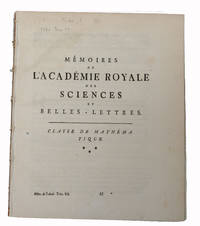
176631081Berlin Haude et Spener 1766. 4to. No wrappers as issued in "Mémoires de l'Academie Royale des Sciences et Belles Lettres" tome XX pp. 91-164 91-116;117-143;144-164. 1 engraved plate belonging to "Microscope." <br/><br/><em>3 first editions by Euler in algebra in optics and in the theory of chance - in this last paper he discusses the so-called St. Petersburg paradox the Game Pharon. </em> unknown
176631081(Berlin, Haude et Spener, 1766). 4to. No wrappers, as issued in ""Mémoires de l'Academie Royale des Sciences et Belles Lettres"", tome XX, pp. 91-164 (91-116"117-143"144-164). 1 engraved plate ( belonging to ""Microscope..."")
170231267Frankfurt am Main, Apud Johannem David. Zunnerum et Nicolaum Wilhelmum Helwig,1702. Small folio. Very nice recent blue hcalf w. gilt lettering on spine. Title-page printed in red and black, w. woodcut vignette and stamp: ""Jews college, London"". Some brownspotting, but all in all a very nice copy. (12), 184, (8) (Index) pp.
17282410240334xbvk'Venezia. Apresso Cristoforo Zane. Con Licenza de' Superiori, e Privilegio. MDCCXXVIII' (1728). xl, 454 pages, 1 blank sheet. - Strong italian vellum binding of the period over 5 slightly raised bands with blank endpapers, all edges sparkled red; 8vo.(ca. 18 x 12 x 3 cm).
17982210060291xbvk''London: printed for T. Cadell, Jun. and W. Davies, in the Strand. 1798''. 2 blank sheets; singleside printed titlesheet, 411 pages, 1 blank page; 2 blank sheets. - Marbled strong full-leather binding of the period with gilt corners, gilt-decorated spine and ornamental gilt-titled red leather-spinelabel; 8vo.(ca. 21 x 13 x 2,5 cm).