1 329 résultats
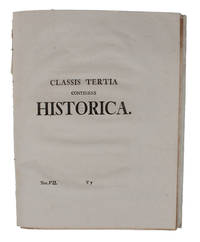
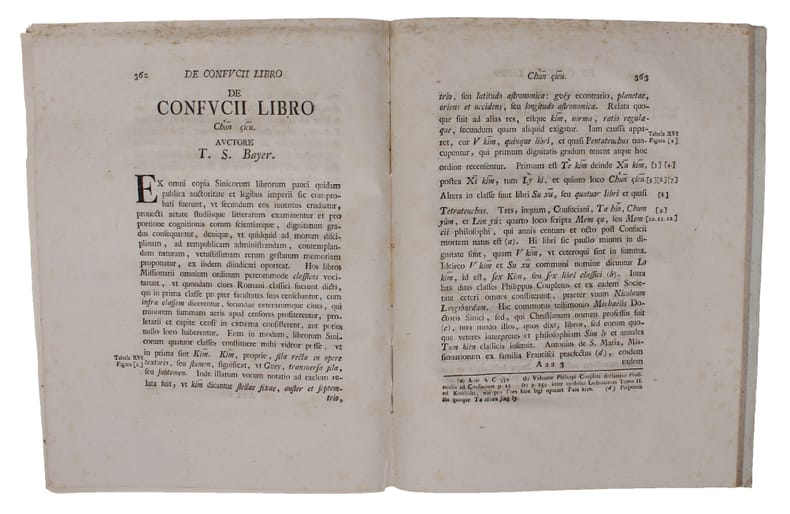
174050862Petropoli, St. Petersburg, Typis Academiae, 1740. 4to. No wrappers. In: ""Classes Tertia continens Historica. Commentarii Academiae Scientiarum Imperialis Petropolitanae"", Tomus VII ad Annos 1734 & 1735. The whole section of ""Historica""offered. Title-page to Tome VII (with engraved vignette), halftitle (to the section) a. pp. 345-426, 6 engraved plates. Bayer's paper: pp. 362-426 and 5 engraved plates with numerous chinese characters. Clean and broad-margined.
174050862Petropoli St. Petersburg Typis Academiae 1740. 4to. No wrappers. In: "Classes Tertia continens Historica. Commentarii Academiae Scientiarum Imperialis Petropolitanae" Tomus VII ad Annos 1734 & 1735. The whole section of "Historica"offered. Title-page to Tome VII with engraved vignette halftitle to the section a. pp. 345-426 6 engraved plates. Bayer's paper: pp. 362-426 and 5 engraved plates with numerous chinese characters. Clean and broad-margined. <br/><br/><em>First printing in part of the first Western translation of any part of Confusius' influential Chun Cieu being the fourth volume of his works. "The title Chun Cieu Chunqiu signifies the Spring and Autumn. He discourses like an historian of the expditions of diversr princes of their Virtues and Vices of the fatigues they underwent. The title is an emblematic title because that states flourish when their Princes are endowed wit Virtue and Wisdom which is represented by the Spring and that on the contrary they fall like the leaves and are utterly destroyed when their Princes are dispirated or are wicked which is represented by the Autumn."James Legge.The section also comprises Bayer. Elementa Calmucia. 1 pp. and 1 engraved plate numerous characters and Bayer. De Venedis et Eridano Fluvvio. Pp. 346-361. </em> unknown
175728781Genevæ, Fratres Cramer, 1757. Cont. boards. Light staining to upper corner on frontcover. XII,82 pp. A few scattered brownspots. On good paper.
175728781Genevæ Fratres Cramer 1757. Cont. boards. Light staining to upper corner on frontcover. XII82 pp. A few scattered brownspots. On good paper. <br/><br/><em>First edition. "Tronchin sometimes physician to Voltaire showed that the so-called "Poitou-colic" was caused by drinking water which had passed through lead gutters. Tronchin introduced inoculation into Holland France and Switzerland; he was Boerhaave's favourite pupil and became a very wealthy practioner." Garrison & Morton No. 2095. - Waller 9686. </em> hardcover
17791310952Leipzig, Löper, 1779. Kl.-4to. 22 S., 1 Bl. weiß. Rücken-Broschur (angestaubt, teilw. mit schmaler Nässespur im Außenrand).
17291253220Altdorf, J. W. Kohles, 1729. Kl.-4to. 91 S., 1 gefalt. Stammtafel. Neuer Ppbd (teilw. mit kl. Feuchtigkeitsspur im Außenrand).
17301316270Altdorf, M. D. Meyer, 1730. Kl.-4to. 44 S., 1 geneal. Falttafel. Rücken-Broschur (angestaubt, teilw. mit schwacher Nässespur).
1747008081Leipzig Und Gorlitz: Verlegts Richter Und Compagnie 1747. Hardcover. Near Fine/No Jacket. 16mo. David Hollazens Past. in Gunthersberg in Hinter-Pommern Evangelische Gnaden-Ordnung Wie eine Seele von der Eignen Gerechtigkeit u. Frommigkeit herunter Und zum Erkenntniß ihres sundigen Elends gebracht; Hierauf aber In den Wunden-Holen Jesu geleitet werde Und solchergestalt Durch den Glauben Zur Vergebung der Sunden und zu einem frommen Leben komme : In Vier Gesprachen aufgesetzt. The evangelic order of grace : or How a soul may be brought from self-righteousness to a knowledge of its sinful misery; and thereupon led to the wounds of Jesus; and in this manner through faith to the forgiveness of sins and a pious life : in four dialogues. Later quarter calf and speckled paper boards mid to late 19th century. Unlettered spine. Speckled edges. 32 208 6. Engraved frontis head- and tailpieces. Red and black titles. Chip to spine head. Rubbing to boards and extremities. Slight cracking to calf spine. Small white damp stain to tail edge of text block. Interior is remarkably clean with only a few rust spots. David Hollatz d. 1771 was a Lutheran preacher and was the grandson of German Lutheran theologian and dogmatist David Hollatz the Elder whose best-known work is Examen theologicum acroamaticum 1717. Jackson 1914. New Schaff-Herzog Encyclopedia of Religious Knowledge third ed. London and New York: Funk and Wagnalls. Verlegts Richter Und Compagnie hardcover
1784211667Leipzig 1784. First edition in German. 4 148 pp. 1 vols. Small 8vo. Contemporary marbled boards. Very good plus. First edition in German. 4 148 pp. 1 vols. Small 8vo. unknown books
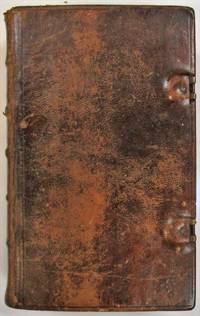
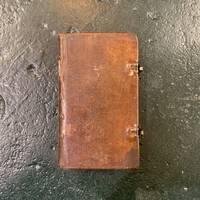
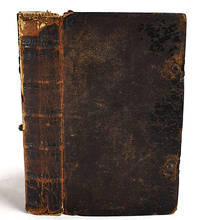
179936252Germantaun: Gedruckt bey Michael Billmeyer 1799. Bound in original sheep raised spine bands lacking the clasps some chipping but a firm binding. Frontispiece. pp 8 148 8 585 9- Register 26 pp. Printed in two columns per page. Very Good. Some music is included.<br/>Evans 35453 36193. ESTC W6294. Gedruckt bey Michael Billmeyer unknown books
1799248375Germantown Pennsylvania: Michael Billmeyer 1799. Woodcut Frontispiece music in text. 6 148 8 585 9 26 pp. 1 vols. 8vo. Contemporary sheep with metal clasps. Front hinge starting else Very Good. Woodcut Frontispiece music in text. 6 148 8 585 9 26 pp. 1 vols. 8vo. Michael Billmeyer unknown books
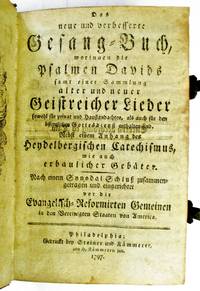
179730892Philadelphia: Gedruckt bey Steiner und Kammerer und H. Kammerer jun 1797. Bound in contemporary calf raised spine bands clasps. Relief-cut frontispiece. Pages 8 148 8 585 43. Printed in double columns. Endpapers spotted. A Very Good copy in an attractive contemporary binding. Early ink writing on front free endpaper modern bookplate. <br/><br/> "First edition of this song-book and hymnal which includes much musical notation" Jenkins.<br/>Evans 32100. III Jenkins 745. ESTC W6293. Gedruckt bey Steiner und Kammerer, und H. Kammerer, jun unknown books
1799248375Germantown Pennsylvania: Michael Billmeyer 1799. Woodcut Frontispiece music in text. 6 148 8 585 9 26 pp. 1 vols. 8vo. Contemporary sheep with metal clasps. Front hinge starting else Very Good. Woodcut Frontispiece music in text. 6 148 8 585 9 26 pp. 1 vols. 8vo. Michael Billmeyer unknown
17971305130012Philadelphia : Gedruckt bey Steiner und Kammerer 1797-01-01. First Edition. Hardcover. Good. 0x0x0. Early Pennsylvanian German Imprint Octavo 17 cm. Bound in contemporary leather brass clasps on leather straps. Rebacked restoration to claps. 8 148 8 585 43 p. frontis musical notation. Spotting and staining. First edition of this song-book and hymnal which includes much musical notation" Jenkins. Evans 32100; First Century of German Language Printing 1090; III Jenkins 745. Philadelphia : Gedruckt bey Steiner und Kammerer hardcover
17974183Baltimore MD: Samuel Saur 1797. Second edition. Hardcover. VG. 12mo 7"x4". 572pp register. Full leather covered wooden boards with leather/metal hooked clasps. Hymnal text in German. Very old ex-library spine label. Leather chip missing from head spine extreme with board and endband exposed. Leather well-conditioned light cracking over joints. Edgewear. Text slightly swollen so that it is best to leave book unclasped. Previous owner's marks to front pdep. Front and rear leaves chipped and starting endpapers cracked over hinges. Small closed tear to p222. Heavily foxed and toned interior. In seller's black vinyl sleeve.<br /> Subtitled: Von Alten und Neuen Auserlesenen Geistes Gesängen Allen Wahren Heils-Begierigen Säuglingen der Weisheit Insonderheit Aber Denen Gemeinden des Herrn. Samuel Saur hardcover
17972509280006Germantown Philadelphia PA: Gedruckt bey Michael Billmeyer Germantaun Pa. 1797. Hardcover. Good. 18th Century Pennsylvania German Psalter: German-language hymnal Early Mennonite Bound in contemporary leather over wooden boards. Chipping with minor loss to spine leather. Leather clasps with brass hooks. 6 572 24 21 1 pages. Early ownership signatures from 1802. Evans 31816. "The larger Psalterspiel of which the second edition appeared in 1729 in Schaffhausen contained 1047 hymns on 849 pages. Of these a selection was published as the small Psalterspiel mainly for the use of the 'Inspired' . The American reprint became quite popular with some sects Dunkers Mennonites etc. as is evidenced by the numerous editions of the book 1744 1760 1764 1777 1781 1795 1797 1813 1829. My ancestors Rittenhouse family made the paper for this book at their papermill in Rittenhousetown Wissahickon PA. Gedruckt bey Michael Billmeyer, Germantaun [Pa.], hardcover
179951120Leipzig, Johann Benjamin Georg Fleischer, 1799. Contemp. hcalf. Gilt spine. Titlelabel with gilt lettering. A paperlabel pasted on top of spine. Stamps on title-page. XX,172 pp. and 4 large folded plates. A few brownspots to the first few leaves.
179951120Leipzig Johann Benjamin Georg Fleischer 1799. Contemp. hcalf. Gilt spine. Titlelabel with gilt lettering. A paperlabel pasted on top of spine. Stamps on title-page. XX172 pp. and 4 large folded plates. A few brownspots to the first few leaves. <br/><br/><em>Scarce first edition. Here Lehmann standardized the Hachure Representation. Hachures are an older mode of representing relief. They show orientation of slope and by their thickness and overall density they provide a general sense of steepness. Being non-numeric they are less useful to a scientific survey than contours but can successfully communicate quite specific shapes of terrain. They are a form of shading although different from the one used in shaded maps. - Poggendorffr I 1410. </em> unknown
1761704191761. London: J. Purser; for M. Withers 1761. 2nd. ed. London: J. Purser; for M. Withers 1761. 2nd. ed. With Interesting Comparisons Between Roman and English Law Justinian I Emperor of the East 483-565 CE. Harris George 1722-1796 Editor and Translator. D. Justiniani Institutionum Libri Quatuor: The Four Books of Justinian's Institutions Translated Into English With Notes. London: Printed by J. Purser; for M. Withers 1761. xv 1 73 1 121 1 100 92 11 5 pp. Copperplate table of descents. Quarto 10" x 8". Contemporary mottled tree calf rebacked in period style with gilt fillets and retained existing lettering piece hinges mended. Light rubbing to boards corners bumped and somewhat worn. Copperplate allegorical vignette featuring Lady Justice at head of dedication iii. Moderate toning to text somewhat heavier in places light foxing light soiling to preliminaries and rear endleaves small tear to lower margin of table two leaves of contemporary manuscript notes laid-in. $950. Second edition. This well-respected edition is notable for its elegant parallel translation. Harris an advocate of Doctor's Commons provides an interesting historical introduction and notes that compare the rules of Roman and English law. The final section is a translation of "Concerning the Succession of Descendents" Book 118 of the Novels. This work was owned by many sophisticated lawyers in Great Britain and America such as Thomas Jefferson. who owned a copy of this edition. The first edition was published in 1756 its final edition the third in 1811. One of the laid-in manuscript leaves is a copy of the table of descents and its accompanying text from pp. 28-31. The other is an itemized bill or estimate for spinning and weaving cloth with a crude diagram of a spinning wheel. Sowerby Catalogue of the Library of Thomas Jefferson 2191. English Short-Title Catalogue T102256. unknown books
1756704151756. With Interesting Comparisons Between Roman and English Law Justinian I 483-565 CE Emperor of the East. Harris George 1722-1796 Editor and Translator. D. Justiniani Institutionum Libri Quatuor: The Four Books of Justinian's Institutions Translated Into English With Notes. London: Printed for C. Bathurst and E. Withers 1756. xv 1 73 1; 121 1; 100; 92; 11 5 pp. Copperplate table of descents. Quarto 11-1/4" x 9". Contemporary paneled calf with early rebacking raised bands and lettering piece to spine. Light rubbing and some shallow scuffing to boards heavier rubbing to extremities and spine wear to spine ends and corners boards partially detached owner bookplate of Charles Frost of Hull to front pastedown title page partially detached but secure. Moderate toning and light foxing to text early annotations most likely by Frost to several leaves offsetting to margins of preliminaries and rear endleaves. $950. First edition. This well-respected edition is notable for its elegant parallel translation. Harris an advocate of Doctor's Commons provides an interesting historical introduction and notes that compare the rules of Roman and English law. The final section is a translation of "Concerning the Succession of Descendents" Book 118 of the Novels. This work was owned by many sophisticated lawyers in Great Britain and America such as Thomas Jefferson. Second and third editions were published in 1761 and 1811. Frost 1781-1862 an English lawyer was a notable legal writer and antiquary. He is known today for his research into the early history of Hull England. Sowerby Catalogue of the Library of Thomas Jefferson 2191 second edition. English Short-Title Catalogue N8181. unknown books
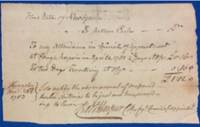
1785BOOKS288117--/No Dustjacket. 1785. 4 1/4" x 6 3/4" on woven paper. Robert Harpur 1731-1825. Harpur served in various capacities in the New York government during the American Revolution. He was a member of the New York State Assembly from 1777 to 1784. He was Deputy Secretary of State under John Morin Scott and Lewis Allaire Scott from 1778 to 1795. In the spring of 1795 Robert Harpur with his 2nd wife Myra and family moved west along the Susquehanna River settling near Belden Brook on his Warren Patent which is near present day Harpursville NY. Harpur College which is a part of Binghamton University was named for him. Arthur Parks 1st. Major New York State Commissioned 1775. He was elected to the Council of Appointment of New York State in 1781 Reference. Wikipedia . unknown
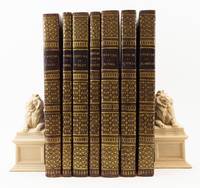
1800ST17757London: William Miller; T. M'Lean; William Bulmer 1800-18. 370 x 270 mm. 14 1/2 x 10 1/2". Seven volumes. <br/> Uniformly bound in stately contemporary dark burgundy straight-grain morocco covers with gilt palmette-and-wheat-sheaf border inner frame of blind-stamped grapevine raised bands spine compartments densely gilt with repeating botanical tools gilt lettering gilt-rolled turn-ins all edges gilt. Two engraved titles with hand-colored vignettes not included in plate count and 356 FULL-PAGE HAND-COLORED PLATES FEATURING COSTUMES OCCUPATIONS AND SOCIAL INTERACTION OF VARIOUS NATIONS. Volume I-III V and VI with text in French as well as English. Front pastedown with armorial bookplate of Edward Gordon Douglas-Pennant 1st Baron Penrhyn. Abbey Life 430; Abbey Travel 71 244 370 373 532 533. Joints and extremities lightly rubbed one board with a couple of faint scratches two rear boards with neat older repairs to short tears at tail edge but the bindings quite sound and most attractive on the shelf. Flyleaves a little foxed minor offsetting from plates to text leaves occasionally more pronounced but never offensive isolated minor marginal foxing to plates otherwise very fine WITH CLEAN BRIGHT PLATES.<br/> <br/> This is a collection of major early 19th century color plate books with well-drawn and richly-colored engravings in bindings that make a handsome appearance on the shelf. All of these works have appealing plates where the costumes of the various social strata are carefully and colorfully delineated. And two of the volumes--those showing British costumes and the book on Chinese punishments--contain in addition a good deal of diverting background detail that serves as a revealing context for each of the costumes depicted. The content of each of the volumes is worth noting. With a few exceptions the plates in the "Costumes of China" portray ordinary working-class men and women toiling at their trades. We see a bookseller with his wares spread out on a mat women sewing and embroidering a butcher a fisher a barber a man with a "magic lantern" show and a "man striking a small gong during an eclipse" an ancient ritual that the author tells us he was privileged to witness on 17 November 1789. The "Punishments of China" volume is filled with almost gleefully painful depictions of all degrees of disciplinary action from the relatively minor twisting of the ears or chaining to an iron pole to the humiliating ordeal of the wooden collar to methods of execution by beheading or by crucifixion using a cord. The opulent and brightly colored costumes in Dalvimart's volume on Turkey are mostly those of the ruling classes although also represented is a wide variety of native dress from the many regions of the vast Turkish empire of the day which included Bosnia Albania Syria Egypt and parts of Greece. It is particularly interesting to contrast the clothing of the very heavily veiled Turkish and Egyptian women with the much more relaxed style of the Greek women and the nearly immodest garb of the female Bedouin. We also are shown a eunuch an odalisque from the harem a grand vizier various royal functionaries and government officials all splendidly attired. The Russian costumes based on engravings done by C. W. Müller at the request of Empress Catherine the Great are focused on the ethnic dress of the empire's many holdings. The Laplanders and Finns wear clothing that would look familiar to most Europeans but the Mongols in their Oriental dress would be quite exotic. The clothing of the northern tribes such as the Kamchatkans Aleutians Koriaks and Tungoosi will impress the modern reader with their similarity to the traditional dress of Native American and First Nation peoples. The Tchutski woman is even depicted naked to display her tattoos. Bertrand de Moleville's Austrian costumes also illustrate the native dress of the empire's citizens but the illustrations here are less fashion plates than romanticized scenes: peasant couples are shown courting and dancing; Croatian women gossip beside a stream; and a wild-haired Bohemian gypsy whose "profession is not hard to guess" from her state of "déshabillé" flees with her naked and no doubt illegitimate child. Pyne's "Costumes of Great Britain" is one of the most highly praised works in this set and for good reason: the simple working men and women of Britain it depicts are always shown going about their daily tasks in the midst of a well-realized scene. The woman selling "salop" a hot morning beverage is seated at her cart with its urn judiciously located by the watchman's stall surrounded by customers including soldiers and a woman with her market basket. A fireman with an ax and a torch hurries toward his engine company while they unwrap their hose. The potter is at his wheel the tanner is cleaning skins and the bill-sticker posts the winning lottery numbers. The clothing while carefully detailed is almost secondary to the depictions of everyday life. The "Military Costumes of Turkey" illustrates the official regalia "uniform" is much too drab a word for these outfits worn by officers in various regions of the empire. Perhaps the most intriguing plate here is that of the Ladle Bearer a post that was also illustrated in "Costumes of Turkey." What appears to be a man with a giant spoon is in fact the holder of an important military position equivalent to the color-bearer in a western army. We are told that the loss of its ladles is the greatest disgrace that can befall a Turkish regiment: if the two great ladles the size of a grown man that are borne into battle at the head of the troops are captured the regiment must be disbanded and formed anew. Former owner Edward Gordon Douglas-Pennant 1st Baron Penrhyn 1800-86 was a leading figure in the Welsh slate industry; he owned the Penrhyn Quarry the largest slate quarry in the world at the end of the 19th century. He was known for his paternalistic attitude to his employees creating the "model village" of Llandegai to house the quarry workers. It was notable for having "no corrupting alehouse." He was ruthless enough to fire 80 men in 1868 because they did not vote for his son George who was running for a seat in Parliament. Single volumes from this set appear with frequency in the marketplace; full sets show up much less often; sets as handsome and well preserved as the present are rarely seen. William Miller; T. M'Lean; William Bulmer unknown
1799005767London: Printed By Samson Low and Sold By C. Law and others 1799 167pp 1 rebound in brown cloth with new endpapers binding and hinges tight. Volume II only. NO LABELS INSCRIPTIONS NOR MARKINGS. Printed By Samson Low and Sold By C. Law [and others] hardcover
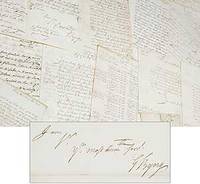
17183874591718. Unbound. Near Fine. A remarkable archive of 24 letters from Admiral of the Fleet George Byng sent to Rear Admiral George Delaval who commanded the Blue Squadron under Byng’s command along with associated documents from George Saunders and Josiah Burchett Secretary of the Admiralty relating to the British naval campaign of 1718 in the Mediterranean culminating in the Battle of Cape Passaro Sicily on the 11th August. A mix of quarto and folio sheet with many folded once to form four pages. Each letter is Signed by Byng with one signed twice. Despite their age the letters are near fine or better with only light wear and housed in a custom cloth chemise with printed labels.<br /> <br /> The Battle of Cape Passaro resulted in the defeat of the Spanish by the British Fleet under Sir George Byng four months before the War of the Quadruple Alliance. The Spanish refused to re-embark their army from the Sicilian mainland. Despite war not having been formally declared Byng correctly anticipated approval from home and attacked and routed the Spanish fleet thwarting their ambitions to take Italy and Sicily.<br /> <br /> The subject matter of the letters is concerned with supplies day-to-day naval matters and continuing hostilities against the Spanish and includes details of several rendezvous for meeting up in the event of separation owing to bad weather. Common problems are mentioned such as desertion and shortage of food and more particularly wine. The earliest is dated May 17th concerning the mobilization of troops and pressed men for the campaign. The letter of May 29th regards the Line of Battle detailing ships ordnance and men commanders and formation and pennants and the signals to be used. On July 3rd Byng gives orders to oppose the landing of the Spanish in Italy with a warrant order of operations to “take sink burn or destroy†the King of Spain’s ships; the last of the series dates from the December 9th from the Admiralty office not by Byng congratulating Delaval on his safe arrival at Spithead and requesting him to escort the fireship Griffin to Deptford. Byng sent mail from on board his ship the Barfleur whilst at sea and also from the Admiralty office in London.<br /> <br /> Byng was sent on subsequent diplomatic missions on behalf of England to negotiate with Italian princes and states and was instrumental in the acceptance of the terms of the Quadruple Alliance by Spain. In 1718 Byng was already a respected member of the establishment having supported the accession of William and Mary at the Glorious Revolution contributed to the burning of the French fleet at Vigo and leading the bombardment squadron during the capture of Gibraltar. He was rewarded with a knighthood and a regular promotion. After the success of 1718 this included membership in the Privy Council admittance to the Order of the Bath and the title of Viscount Torrington which his descendants still bear today. In 1727 Byng was made First Lord of the Admiralty and the Royal Naval College at Portsmouth was founded in his memory.<br /> <br /> Delaval also had a distinguished naval and diplomatic career from a young age with victory at the Battle of Malaga in 1704 and missions to Spain and Portugal as well as his promotion to Rear Admiral and leadership of The Blue Squadron. He is perhaps best known for rebuilding his ancestral seat the celebrated Seaton Delaval Hall in Northumberland now a National Trust property with architect Sir John Vanbrugh.<br /> <br /> It is important to note that Admiral George Byng should not be confused with his fourth son John Byng also present at the Battle of Cape Passaro as a 13 years old who built a respectable career as a naval officer and became an Admiral but was court-martialed and shot by firing squad on 14 March 1757.<br /> <br /> A remarkable collection of letters from the First Lord of the Admiralty during the reign of King George II. <br /> <br /> A detailed list of the correspondence is available upon request. unknown
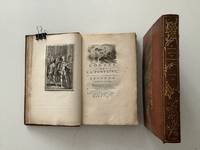
176420446AB1764. 2 volumes. Amsterdam 1764 22 : 14 cm. X 214 pages 1 leaf; VIII 254 pages 1 leaf engraved Portrait of Fontaine 2 engraved title-vignettes 77 full-page engraved plates 63 engraved text-vignettes. Red half-calf binding spine richly gilt with title in gold top edge gilt singed Blanchetiere-Bretault This rare and very beautiful Amsterdam edition is printed two years after the monumental first edition from Paris which was commissioned by Ferniers Géneraux and which is very scarce and sought after. This is the most beautiful and well-executed of the re-impressions Paris 1762 -without vignettes Amsterdam 1764 and London 1764. -"Celle d'Amsterdam 1764 2 vol. in-8. fig. copiées sur celles de l'édition de 1762 est assez belle." Brunet III:760. The illustrations of this edition are excellent and copied from the beautiful first edition" many of them are engraved and signed by C. Boily and all are after Eisen. Most of the vignettes are after Choffard. The portrait of La Fontaine is engraved by Macret after Ficquet. "Cette imitation de l'édition des fermiers généraux est assez jolie. Le portrait de La Fontaine est tantôt gravé par Savaret et tantôt par Macret suivant les exemplaires." Cohen p. 310.The illustrations of this work are considered Eisen's main work the book is considered one of the greatest works of rococo book-illustration and it has greatly inspired later tradition in this field. - Occasionally some minor spotting but allover clean with wide margens two edges uncut beautifully bound by Blanchetiere-Bretault. unknown