1 329 résultats
175146906Leipzig, Gleditsch & Lanckis, 1751. 4to. No wrappers. In: ""Nova Acta Eruditorum, Anno MDCCLI"", March- Issue, Pars I-II. Entire issue in 2 parts offered. With titlepage to the volume 1751. Pp. 97-192. Koenig's paper: pp. 125-135 a. pp. 162-176. With 2 engraved plates. Titlepage with 2 stamps and a bit soiled. Leaves as usual a bit browned.
175146906Leipzig Gleditsch & Lanckis 1751. 4to. No wrappers. In: "Nova Acta Eruditorum Anno MDCCLI" March- Issue Pars I-II. Entire issue in 2 parts offered. With titlepage to the volume 1751. Pp. 97-192. Koenig's paper: pp. 125-135 a. pp. 162-176. With 2 engraved plates. Titlepage with 2 stamps and a bit soiled. Leaves as usual a bit browned. <br/><br/><em>First printing of this important paper in which Koenig set forth his "Law of least Action". The law states that the kinetic energy of a system of mass points is equal to the sum of the kinetic energy of the motion of the system relative to the center of gravity and of the kinetic energy of the total mass of the system considered as a whole which moves as the center of gravity of the system."While still in Franeker Koenig wrote the draft of his important essay on the principle of least action which was directed against Maupertuis. The controversy touched off by this work which was published in March 1751 resulted in perhaps the ugliest of all the famous scientific disputes. Its principal figures were Koenig Maupertuis Euler Frederick II and Voltaire; and as is well known it left an unseemly stain on Euler’s otherwise untarnished escutcheon. The quarrel occupied Koenig’s last years almost completely; moreover he had been ill for several years before it started. Koenig emerged the moral victor from this affair in which all the great scientists of Europe—except Maupertuis and Euler—were on his side. The later finding of Kabitz2 testifies to Koenig’s irreproachable character."DSB. </em> unknown
17441316203Leipzig, Langenheim, 1744. Kl.-4to. 36 S. Rücken-Broschur (angestaubt, braunfleckig).
175042900(Petropoli (St. Petersbourg), 1750). 4to. Uncut, without wrappers. Extracted from ""Novi Commentarii Academiae Scientiarum Imperialis Petropolitanae"", Tom. I. ad Annum 1747 et 1748. Pp. 3-19 a. 1 engraved plate., and pp. 20-48.
175042900Petropoli St. Petersbourg 1750. 4to. Uncut without wrappers. Extracted from "Novi Commentarii Academiae Scientiarum Imperialis Petropolitanae" Tom. I. ad Annum 1747 et 1748. Pp. 3-19 a. 1 engraved plate. and pp. 20-48. <br/><br/><em>First printing of both papers. The second is important as it contains Euler'is second proof of the Euler-Fermat theorem which Euler presents as a consequence of the theorem that abp = apbp mod p. This paper also includes results about possible divisors of a2n b2n and Euler uses this to show again that F5 is not prime. - Enestroem No. 133 a. 134. </em> unknown
17931314183Würzburg, F. X. Rienner, 1793. 2 Bl., 56 S. Rücken-Broschur (angestaubt).
17091261684Leipzig, J. H. Richter, 1709. Kl.-4to. Titelkupfer, 15 Bl. Rücken-Broschur (braunfleckig, Name auf Titel).
17031304085(Kopenhagen), W. A. Jersin, 1703. Kl.-4to. 1 Bl., 22 S. Rücken-Broschur (feuchtwellig, Ränder etwas gebräunt, das letzte Bl. mit Klebespur unter Verlust weniger Buchstaben).
174050926(Petropoli, St. Petersburg, Typis Academiae, 1740). 4to. No wrappers. In: ""Classes Prima continens Mathematica. Commentarii Academiae Scientiarum Imperialis Petropolitanae"", Tomus VII ad Annum 1735, &..... Euler's papers: pp. 135-149, 150-161, 174-183 a. 184-200 and 2 engraved plates. Clean and fine.
174050926Petropoli St. Petersburg Typis Academiae 1740. 4to. No wrappers. In: "Classes Prima continens Mathematica. Commentarii Academiae Scientiarum Imperialis Petropolitanae" Tomus VII ad Annum 1735 &. Euler's papers: pp. 135-149 150-161 174-183 a. 184-200 and 2 engraved plates. Clean and fine. <br/><br/><em>First printing of 4 importent early papers by Euler. Enestroem: E42 E43 E44 a. E45.E42: This is Euler's second paper on the "Brachistochrone problem".E43. Here Euler introduces THE EULER CONSTANT. "The Euler-Mascheroni constant also called Euler's constant is a mathematical constant recurring in analysis and number theory usually denoted by the lowercase Greek letter gamma."E44: "This is an extensive paper that develops a method for finding a family of curves arising from the constant of integration of dz = Pdx which is treated as the second variable; the rudiments of partial differentiation are presented and there is an extensive survey of homogeneous functions centred around what is now know as Euler's Theorem for such functions. The origins of this paper would seem to be Proposition 15 of Vol. 2 of the Mechanica relating to families of tautochronous curves where an integration relying on Euler's Theorem is required." Ian Bruce.E45: Here Euler introduces the FUNCTION NOTATION fx. "This is an equally extensive paper that continues the development of methods for finding a family of curves arising from the constant of integration of dz = Pdx which is treated as the second variable. A method is developed for finding the modular equation for the first order equation that is extended to cover a number of cases; this in turn is extended to second and higher orders. The method involves finding suitable functions to integrate starting from a part of the modular equation that is integrable so that the whole equation is of this form. This paper is noteworthy in addition as it seems to be the first in which the function notation albeit in a slightly different form from the modern meaning is introduce. I have not been able to check all the equations at this stage."Ian Bruce.This section also contains DANIEL BERNOULLI: Demonstrationes theorematum svorum de oscillationibus corporum filo flexili connexorum et catenae verticaliter suspensae. Pp. 162-173. </em> unknown
175142770(Berlin, Haude et Spener, 1751). 4to. No wrappers, as issued in ""Mémoires de l'Academie Royale des Sciences et Belles-Lettres"", tome V, Année 1749, pp. 339-372, 1 folded geometrical plate (to the first paper) and 3 fine double-page folded engraved plates showing the quadrant.
175142770Berlin Haude et Spener 1751. 4to. No wrappers as issued in "Mémoires de l'Academie Royale des Sciences et Belles-Lettres" tome V Année 1749 pp. 339-372 1 folded geometrical plate to the first paper and 3 fine double-page folded engraved plates showing the quadrant. <br/><br/><em>Kies was one of the first to propagate Newton's discoveries in Germany and dedicated two of his works to the Englishman. The crater Kies on the Moon is named after him.The paper on the instrument describes and depicts the large quadrant in the Berlin observatory invented by Hadley described in Transactions of the Royal Society in 1732."From 1742 to 1754 at the recommendation of the mathematician Leonhard Euler he Kies was made professor of mathematics at Berlin's Academy of Sciences and astronomer at its observatory. His reports from this time include De la Situation la plus avantageuse des planètes pour découvrir les irrégularités de leurs mouvemens Sur les Éclipses des étoiles fixes par la lune and Description d'un instrument qui se trouve ." </em> unknown
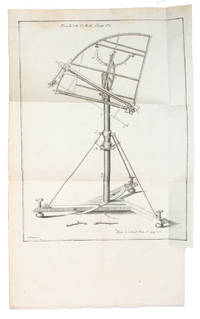
170244387(Paris, Jean Boudot, 1702). 4to. Without wrappers. Extracted from ""Mémoires de l'Academie des Sciences. Année 1699"". Pp. 206-227 a. 5 large engraved plates (tables). Textillustrations. Last leaf with a small paperloss in inner margin
170244387Paris Jean Boudot 1702. 4to. Without wrappers. Extracted from "Mémoires de l'Academie des Sciences. Année 1699". Pp. 206-227 a. 5 large engraved plates tables. Textillustrations. Last leaf with a small paperloss in inner margin <br/><br/><em>First appearance of a milestone paper on the friction loss of energy in machines hereby establishing the basic concepts of friction."In the same year 1699 Amontons produced the first known study on the question of losses caused by friction in machines. He then established the las of proportionality between friction an the mutual pressure of the bodies in contact." DSB I p. 138. </em> unknown
170645174(Paris, Jean Boudot, 1706). 4to. Without wrappers. Extracted from ""Mémoires de l'Academie des Sciences. Année 1705"". Pp. 229-232, 232-234, 234-236 a. 267-272.
170645174Paris Jean Boudot 1706. 4to. Without wrappers. Extracted from "Mémoires de l'Academie des Sciences. Année 1705". Pp. 229-232 232-234 234-236 a. 267-272. <br/><br/><em>First apperance of one of Amontons last papers on the barometer. He develops after having noted that barometers are affected by heat as well as by the weight of the atmosphere his mercury barometer. </em> unknown
171145236Paris, Jean Boudot, 1711. 4to. Without wrappers. Extracted from ""Mémoires de l'Academie des Sciences. Année 1709"". Pp. 364-400 and 2 large folded engraved plates. With engraved frontispiece and titlepage to Année 1709.
171145236Paris Jean Boudot 1711. 4to. Without wrappers. Extracted from "Mémoires de l'Academie des Sciences. Année 1709". Pp. 364-400 and 2 large folded engraved plates. With engraved frontispiece and titlepage to Année 1709. <br/><br/><em>Reamur's first zoological work a pioneer-work in which he as the first describes the formation of the shells and in which he proved that they grow not like the other parts of the animal body by expansion but by the external addition of new parts : he also assigned the cause of the variety of colour figure and magnitude which distinguishes one shell from another."Réaumur’s first three communications to the Academy on geometrical subjects were presented in 1708 and 1709 and demonstrate a degree of mathematical sophistication worthy of a student of Varignon. Had Réaumur decided to remain a mathematician he might well have been one of the greatest geometers of his age. In November 1709 however he quite suddenly changed the course of his scientific career by reading a paper on the growth of animal shells. From then on Réaumur’s work would be characterized by its extraordinary richness and diversity but never again would he devote himself to the pure mathematical researches that had so fascinated him in his youth."DSB."Réaumur was among the greatest naturalists of his or any age. In the breadth and range of his researches in the patient detail of his observations and in the brilliant ingenuity of his experiments it would be difficult to name his equal. Thomas Henry Huxley has compared his favourably with Darwin."DSB.Together with Reaumur's work is a notable paper by NICOLAS LEMERY "Conjectures et Reflexions sur la materie du Feu ou de la Lumiere" pp. 400-418. </em> unknown
1759137120Paris: J. Barbou 1759. Full period French binding in Calf five raised bands gilt ornamentation on spine author and title in gilt on red leather spine label in second compartment. 8vo. Full period French binding in Calf five raised bands gilt ornamentation on spine author and title in gilt on red leather spine label in second compartment. 263 pages. First edition Bigmore and Wyman p.228. Minor soiling to the text block else a fine copy.<BR> <br /> <BR> <br /> In this volume Fournier sets out to prove that Gutenberg was not the inventor of the printing press by examining the history of printing. He believes that the technology Gutenberg made popular existed long before the German printer's work. <BR> <br /> <BR> <br /> "Peter Simon Fournier a French engraver and letter-founder was born at Paris 1712 and died 1768. He studied under Colson painter of the Academy of Saint Luc and devoted himself first to the art of wood-engraving; he afterwards as an engraver on steel rendered himself famous in all countries. In some of his works he seeks to prove that Gutenberg is not the inventor of printing and maintains that long before Gutenberg engraving on wood had been employed for printing images and inscriptions; that during his residence in Strasburg Gutenberg attempted the application of this art to the printing of books and that on his return to Mayence he first printed the Donatus and the Catholicon of Johannes de Janua with engraved and solid blocks. Fournier's ingenious theories were ably refuted by Baron Heinecken in his "Idée Générale d'une Collection complette d'Estamples" Leipsic: 1771" Bigmore & Wyman p 229. J. Barbou unknown
179843088Paris, Fuchs et Guillaume, An VIe. (1798). Contemp. hcalf. Spine gilt. Very slightly rubbed. Small stamps on verso of titlepage. In: ""Annales de Chimie, ou Recueil de Mémoires concernant la Chemie"" Tome 26. - 340 pp. a. 1 engraved plate.(the entire volume offered). Vauquelin's papers: pp. 155-169, pp. 170-177 a. pp. 259-265. Some brownspots to the first and last leaves, otherwise fine and clean.
179843088Paris Fuchs et Guillaume An VIe. 1798. Contemp. hcalf. Spine gilt. Very slightly rubbed. Small stamps on verso of titlepage. In: "Annales de Chimie ou Recueil de Mémoires concernant la Chemie" Tome 26. - 340 pp. a. 1 engraved plate.the entire volume offered. Vauquelin's papers: pp. 155-169 pp. 170-177 a. pp. 259-265. Some brownspots to the first and last leaves otherwise fine and clean. <br/><br/><em>First printing of the papers in which Vauquelin describes and announces his discovery of Beryllium."The discovery of beryllium resulted from the Abbé Haüy's observation of the close similarity and probable identity of beryl and the emerald. At his suggestion Vauquelin made some very careful chemical analyses of these two minerals and found in 1798 that they are indeed identical and that they contain a new earth which he named glucina but which is now known as beryllia. The metal was isolated thirty years later by Wöhler and Bussy independently.At the suggestion of the editors of the "Annales de Chemie." he called the new earth 'glucina' meaning sweet." Weeks in "Discovery of the Elements" p. 153-54. - Parkinson "Breakthrough" 1798 C.The volume contains other importent papers in the history of chemistry Hassenfratz "De l'Areométrie" "Suite." 2 Paprs. Berthollet Chaptal Guyton Fourcroy Priestly first app. in French etc. </em> unknown
174046843(Paris, L'Imprimerie Royale, 1740). 4to. Without wrappers. Extracted from ""Mémoires de l'Academie des Sciences. Année 1737"". Pp. 205-227 a. 2 folded engraved plates.
174046843Paris L'Imprimerie Royale 1740. 4to. Without wrappers. Extracted from "Mémoires de l'Academie des Sciences. Année 1737". Pp. 205-227 a. 2 folded engraved plates. <br/><br/><em>First appearance of this extremely importent paper in which Clairaut directly confirms the rotation and the orbital movement of the Earth around the Sun and giving an indirect proof of the axiom that the velocity of light does not depend on whether the light source moves away or toward the observer. The Earth does move after all !!In 1728 James Bradley trying to measure the stellar parallax discovered stellar aberration - the angular displacement of the apparent direction of starlight due to the earth's motion - and attributed it to the combined effect of the finite velocity of light and the earth's orbital velocity. But Bradley had not given any theoretical proof but Clairaut did in the offered paper.Aberration is "the apparent change in direction of a source of light caused by an observers component of motion perpendicular to the impinging rays. During this time the telescope has moved a short distance causing the photons to reach a spot on the focal plane displayed from the former image position. This discovery provided the first direct physical confirmation of the Copernican theory. A second importent application of aberration has been its clear-cut demonstration that as is axiomatic to special relativity light reaching the earth has a velocity unaffected by the relative motion of the source toward or away from earth."McGraw-Hill "Concise Encyclopedia.". </em> unknown
173550850(Petropoli, St. Petersburg, Typis Academiae, 1735). 4to. No wrappers. In: ""Classes Prima continens Mathematica. Commentarii Academiae Scientiarum Imperialis Petropolitanae"", Tomus IV ad Annum 1729. The whole section of ""Mathematica""offered. Pp 1-118 pp. and 10 engraved plates. Euler's papers: pp. 49-67 a. 2 engraved plates. Pp. 67-89 a. 1 engraved plate. Wide-margined, clean.
173550850Petropoli St. Petersburg Typis Academiae 1735. 4to. No wrappers. In: "Classes Prima continens Mathematica. Commentarii Academiae Scientiarum Imperialis Petropolitanae" Tomus IV ad Annum 1729. The whole section of "Mathematica"offered. Pp 1-118 pp. and 10 engraved plates. Euler's papers: pp. 49-67 a. 2 engraved plates. Pp. 67-89 a. 1 engraved plate. Wide-margined clean. <br/><br/><em>Both first editions and some of the earliest mathematical papers by Euler. The first paper is a masterful work in which Euler first establishes a surprisingly simple geometric condition for tautochronic curves and then shows how to generate such curves both analytic and algebraic starting from the familiar cycloid ; the next paper extends the analysis to a resistive medium where the resistance is in proportion to the square of the speed. - Enestroem E12 and E13.The section Mathematica also contains papers by Jacob Hermann Christopher Maier G.W. Krafft and Daniel Bernoulli "Problema astronomicum inneniendi altitudinem poli." pp. 89-94. </em> unknown