1 544 résultats
1998RWARE0000056810US: Fundación de Crédito Oficial 1998. Paperback. New. Fundación de Crédito Oficial paperback
1967B54827Switzerland: Beyeler Bale 1967. Hardcover. Very Good/Very Good. Blue stamped white cloth boards in dust jacket bellyband and plastic wrap quarto illustrated in color and b&w. Book has faint toning and foxing to edges of boards and spine binding tight mild off-setting to endpapers text clean and unmarked with foxing to edges of block. DJ has toning mild rubbing. THIS LARGE HEAVY BOOK WILL REQUIRE ADDITIONAL SHIPPING FEES. Beyeler Bale hardcover
1974Q-0960069224Felicie 1974. Hardcover. New. In shrink wrap. Looks like an interesting title! Felicie hardcover
197460463New York: Felicie 1974. First Edition Thus; First Printing. Hardcover. Very Good in a Very Good- dust jacket. A few tears to jacket edges. Some rubbing to jacket. ; 4to 11" - 13" tall; 276 pages. Felicie hardcover
1955213503New York: Harry N. Abrams 1955. First Edition; First Printing. Hardcover. Very Good in a Very Good dust jacket. Foxing on side text block edge.; Folio 13" - 23" tall. Harry N. Abrams hardcover
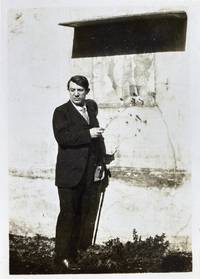
191778126Paris 1917. Fine. Paris 1917 6.30 x 8.60 cm une photographie Original photograph likely unique and unpublished of Pablo Picasso at the Casa di Marco Lucrezio Pompeii spring 1917 Paris 1917 63 x 86 cm one photograph Original photograph depicting Pablo Picasso in the spring of 1917 at the Casa di Marco Lucrezio in Pompeii holding a twig in front of a wall on which there is a Pompeian fresco. Contemporary silver print perhaps unique from Jean Cocteau's personal archives then the Maurice Sachs collection. Exceptional almost undiscovered and probably unpublished photograph taken by Jean Cocteau during the stay. On 16 April 1917 Picasso visits Pompeii accompanied by Jean Cocteau and Léonide Massine to prepare the ballet Parade the first work described as surrealist by Guillaume Apollinaire for the new season of Serge de Diaghilev's Ballets Russes. On his return this initiatory journey inspired his monumental painting: the Parade stage curtain a real visual signature of the ballet marking the beginnings of Picasso's neo-classical period and today preserved at the Musée national d'Art Moderne Georges Pompidou. Pierre Daix in his bibliography dedicated to the painter recounts the aesthetic shock caused by the discovery of the Pompeian frescoes: Giovanni Carandente to whom we owe the best studies on this trip highlights that Picasso was strongly struck by the animation and the sensuality that the cataclysm of the year 79 AD had brutally destroyed. If it is true as he wrote to Gertrude Stein that he immediately drew many Pompeian fantasies which are a little daring attracted as he was by the erotic elation that emerges from these licentious paintings . these memories settled in him to emerge with force thereafter. . Everything that had made up the Pompeian universe was preserved on the site as well as in the National Archaeological Museum of Naples . In its singularity this universe contributed to enriching Picasso's cultural heritage with something more alive more trembling than he had gained from his museum visits until then. He particularly loved the conciseness of the paintings: two or three years later the impressions felt in Pompeii were to translate into a real creative explosion a series of paintings which all bore traces of these never buried memories. This source was to remain alive until La Danse of 1925. Pierre Daix Picasso. Unique and early original photograph of Picasso taken and printed by his friend Jean Cocteau in a mythical place that will influence his aesthetic for the long-term. Provenance: Jean Cocteau's personal archives then the Maurice Sachs collection and Max-Philippe Delatte. unknown
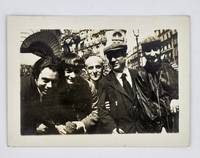
191678127Paris 1916. Fine. Paris 12 août 1916 6.30 x 8.60 cm une feuille Original photograph likely unique taken by Jean Cocteau showing Pablo Picasso and Co in Montparnasse in front of the café La Rotonde the 12 August 1916 Paris 12 august 1916 63 x 86 cm one photograph Original photograph by Jean Cocteau taken on 12 August 1916 showing Manuel Ortiz de Zárate Moïse Kisling Max Jacob Pablo Picasso and the model Pâquerette his girlfriend at the time posing in front of the famous café La Rotonde on Boulevard du Montparnasse in Paris. Contemporary silver print probably unique from Jean Cocteau's personal archives then the Maurice Sachs collection. This image was published in Billy Klüver's book entitled A day with Picasso: twenty-four photographs by Jean Cocteau 1997. However Klüver states that he didn't know the original photograph and used a modern reprint from the negative in the Cocteau archives for his work. We have not found any other copy of our original photograph in international public collections. Billy Klüver has assembled and commented on the twenty-one photographs taken by Jean Cocteau on 12 August 1916 in Montparnasse close to this intersection of the Boulevard Raspail and the Boulevard du Montparnasse which was named Place Pablo-Picasso in 1994. They take us to the café La Rotonde before which a beaming Picasso in a cap speaks with Max Jacob whose baldness shines in the sun behind them Henri-Pierre Roché in uniform and Manuel Ortiz de Zarate sit at a table on the terrace of the same café where Pablo is next to the glowing Pâquerette and the young Polish painter Moïse Kisling. Pâquerette with her hair in a headband a chic dress is the queen of the encounter. . It's the relaxed life at the back. Pâquerette or rather Émilienne Pâquerette Geslot was then a star model of the fashion designer Poiret who was all the rage at the time. A real one-day film of Picasso outside of his studio. Pierre Daix Picasso In his book Klüver questions the presence of all these artistic authorities in the making in a Paris that is deserted by war. The answer is according to him to search in the direction of the Salon d'Antin an exhibition organized by André Salmon in July 1916 in which all the protagonists of our photograph took part with the exception of Pâquerette. It is also on this occasion that Picasso reveals his Demoiselles d'Avignon to the public. This extremely rare image taken by Jean Cocteau with his mother's Kodak camera immortalizes a moment of joy that depicts the artistic all-Montparnasse of the early 20th century. Provenance: Jean Cocteau's personal archives then the Maurice Sachs collection and Max-Philippe Delatte. unknown
1948822901948. Fine. s. d. vers 1948 17.30 x 21.30 cm une feuille n.d. around 1948 Photograph: 17.3 x 21.3cm; Leaf: 18 x 24cm one leaf. Rare original photograph of Pablo Picasso turning towards one of his ceramic creations taken by Michel Sima. Contemporary silver print. Pencil inscription on the back. Very light scratch on the surface not affecting the image. In September 1946 Pablo Picasso set up his workshop in the attic of the Château Grimaldi in Antibes in a former guards room to which the curator Romuald Dor de la Souchère gave him the keys so that he could work there as he pleased. It is the artist Michel Sima sculptor and photographer who introduced the two men. Arriving from his native Poland in 1929 Sima whose real name was Michel Smajewki met Picasso in Paris where he frequented the Académie de la Grande Chaumière and was the pupil of Zadkine. From mid-September to mid-November 1946 in Antibes then from 1947-48 and until the beginning of the 50's in Vallauris Sima regularly photographed Picasso who willingly posed for the camera - alone or with his companion Françoise Gilot in front of completed works or those in progress staring at the lens or on the contrary focusing on his work Anne de Staël L'Atelier des combles 2009. Sublime chiaroscuro shot of the master contemplating his work. Provenance: Paul Destribats collection. unknown
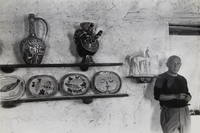
1948822941948. Fine. s. d. vers 1948 17.30 x 21.30 cm une feuille Original photograph of Pablo Picasso in his workshop in Vallauris with his ceramics and plaster s.d. around 1948 Photograph: 17.3 x 21.3cm; Leaf: 18 x 24cm one leaf. Splendid portrait of Pablo Picasso taken by Michel Sima in Picasso's Madoura workshop in Vallauris with his ceramics and a plaster model of his Centaure 1948. Contemporary silver print. Pencil inscription on the back. Thanks to the author of this superb portrait Picasso began his impressive ceramic production at the Madoura workshop in the small town of Vallauris known for its pottery tradition. Sima photographed with vigour the master and his many creations exhibited on the bare walls of his workshop bathed with Mediterranean light. Picasso produced 2000 unique pieces between 1947 and 1948 and revolutionised the forms and techniques of this medium to which he added fragments of pigments saggar broken bricks to the bellies of his ceramics in the form of owls doves fauna invisible women. ""Au mois de septembre 1946 Pablo Picasso installe son atelier dans les combles du château Grimaldi d'Antibes dans une ancienne ""salle des gardes"" dont le conservateur Romuald Dor de la Souchère lui a confié les clés pour qu'il y travaille à sa guise. C'est l'artiste Michel Sima sculpteur et photographe qui a fait se rencontrer les deux hommes. Arrivé de sa Pologne natale en 1929 Sima de son vrai nom Michel Smajewski avait fait la connaissance de Picasso à Paris où il avait fréquenté l'Académie de la Grande Chaumière et été l'élève de Zadkine. De la mi-septembre à la mi-novembre 1946 à Antibes puis en 1947-48 et jusqu'au début des années 50 à Vallauris Sima photographiera régulièrement Picasso qui se prête volontiers au jeu de la pose - seul ou avec sa compagne Françoise Gilot devant des oeuvres terminées ou en cours d'achèvement fixant l'objectif ou au contraire concentré sur son travail"" Anne de Staël L'Atelier des combles 2009. Magnificent contrasting and brilliant print of Pablo Picasso in his creative sanctuary. Provenance: Paul Destribats collection. unknown
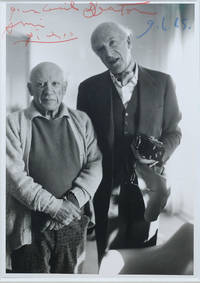
19652784France: np 1965. First edition. Very Good. Cecil Beaton. INSCRIBED BY PICASSO IN RED AND BLUE CRAYON TO THE PHOTOGRAPHER CECIL BEATON: "pour Cecil Beaton. Ami Picasso 9.6.65.". Cecil Beaton British 1904 -1980 photographed virtually every prominent person in public life over the course of his career which spanned more than half a century. Everyone from the Queen to the Rolling Stones sat before his lens. As an arbiter of glamor the opportunity to sit for Beaton represented the pinnacle of success for many but in some cases it was Beaton who pursued the sitter and he had followed Pablo Picasso Spanish 1881 - 1973 long before they first met.<br /> <br /> As one of the foremost artists of the twentieth century Picasso was sought after by many who wanted to rub elbows with success. He became one of those whom Beaton photographed several times over a period of many years first at the rue de la Boetie in Paris in 1933 then at the rue Augustins in 1944 and finally at Mougin in the south of France in 1965. Vickers. In addition to taking photographs Beaton wrote about Picasso in his private diary sketched his portrait and after the 1965 sitting wrote a profile of Picasso for Vogue Magazine.<br /> <br /> Photographs from Picasso's home in the hills above Mougin reveal a close bond between the two men. Here they appear relaxed comfortable with one another and with a gleam in their eyes. By then Picasso was 84 years old and still painting late into the nights. Writing in Vogue Beaton describes Picasso's energy as he gave Beaton a tour of the sprawling studio crowded with paintings some still wet with paint and others from decades before.<br /> <br /> Beaton wrote of Picasso's welcome: "Pablo said 'It has been twenty years since I last saw you!' A golden Picasso threw open his arms. 'After so long we must embrace.'" The two then made much fun about the passage of years and how they had aged. Beaton. A clear sign of affection Picasso inscribed select prints and dedicated them to Beaton. Picasso writes in red and blue crayon on this print: pour Cecil Beaton. Ami Picasso 9.6.65. The print stands as testament to the kinship between the two artists.<br /> <br /> Provenance: With stamp "From the Beaton Studio / Sotheby Parke Bernet" on verso sold Sothebys Parke Bernet 1978. Also with stamped notation "1/1" possibly indicating that this is a unique print. We have not been able to locate any others.<br /> <br /> Silver gelatin print. Signed inscribed and dated by Pablo Picasso "pour Cecil Beaton / Ami / Picasso 9.6.65" in red and blue ink recto. Image: 111â„4 x 73â„4 in. 28.5 x 19.6 cm.; sheet: 111â„2 x 91â„4 in. 29.2 x 23.4 cm. Majestically framed to an overall size of 24 x 19.5 in. Small abrasion evident to the right of Beaton's left ear; otherwise fine.<br /> <br /> References:<br /> <br /> Vickers Hugo ed. Cecil Beaton: Portraits & Profiles. London: Frances Lincoln 2017. P 152.<br /> <br /> Beaton Cecil. "Golden Picasso" Vogue Magazine volume 146 November 15 1965. np unknown
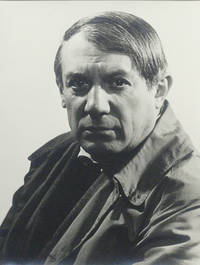
19322650<p>Paris: np 1932. Fine. MAN RAY CAPTURES PICASSO'S ESSENCE IN LEGENDARY PORTRAIT. AN ICONIC PHOTOGRAPH WITH IMPORTANT PROVENANCE: From the famous Sotheby's sale of 1995 of items from the "Estate of Juliet Man Ray The Man Ray Trust and the Family of Juliet Man Ray". The son of Russian-Jewish immigrants Emmanuel "Manny" Radnitzky 1890-1976 grew up in Brooklyn New York. He displayed creative abilities from a young age and studied to be a painter. He adopted "Man Ray" as his pseudonym and in 1915 formed the New York group of Dada artists with Marcel Duchamp. In the 1920s and 1930s Paris was the destination for the international avant-garde offering an exceptional number of galleries art dealers and wealthy patrons who promised artistic freedom. Man Ray sailed to the "City of Light" in 1921 joined Parisian Dada and Surrealist circles and became intimate associates with Pablo Picasso Max Ernst and other leading artists. He pursued fashion and portrait photography creating a pantheon of the city's cultural life. "As a photographer I was in demand" Ray explained to John Bainbridge a writer at The New Yorker. "I was like a doctor. Everybody needed me." Bolz To be photographed by Man Ray meant you had made it in the Parisian art world.<br /><br />Ray often said that Old Masters especially Hans Holbein the Younger Rembrandt and Vermeer inspired his portraits. "I. admired the respect with which they treated the proportions of human features" he wrote in an article published in Modern Photography magazine in November 1957. He also made considerable technological advancements in the field by creating "rayographs" photographic images composed of ordinary objects placed on photo sensitive paper exposed to light and developing solarization the process of tone reversal observed in cases of extreme overexposure. "I photograph the things that I do not wish to paint the things which already have an existence" Ray said. Schwarz 10 Ray sought to create a sense of drama and mystery believing that his photography could transcend the mechanical nature of a camera.<br /><br />When photographing his friends and colleagues Ray's emotional and psychological insights allowed him to expose the soul of each subject. One such subject and friend was Pablo Picasso. Man Ray and Picasso met in 1921 in Paris. They became friends through their connection to Surrealism spending holidays together and collaborating on creative pursuits. In his autobiography Man Ray described Picasso: "He gave me the impression of a man who was aware of all that was going on about him and in the world in general a man who reacted violently to all impacts but had only one outlet to express his feelings: painting." Man Ray 177 The intensity and awareness that Man Ray described is masterfully captured in his portraits of the painter.<br /><br />This photo we have on offer is from Man Ray's renowned series of Picasso portraits and coincided with the publication of the first volume of Picasso's catalogue raisonné reflecting the critical position Picasso's work occupied in the French artistic establishment. In this almost sculptural photograph from 1932 Man Ray unusually presented Picasso in an open trench coat over his jacket and tie. Picasso's dark hair is slicked down and his smooth face looks directly into the camera. Ray used light on the outlines of Picasso's face to create a contemplative image that showed him as a dark and shadowy figure juxtaposed against the light background. Picasso's riveting gaze also conveys a reflective and sober mood. This print has the Man Ray stamps M28 and M30 on the reverse and was lot 348 from the sale of the "Estate of Juliet Man Ray The Man Ray Trust and the Family of Juliet Man Ray" Sotheby's March 22 and 23 1995. <br /><br />Man Ray and Picasso remained close confidantes after this collaboration and during the summer of 1937 Man Ray filmed his friends including Pablo Picasso during a trip to the French Riviera. The result was On the French Riviera with Man Ray and Picasso a documentary film which portrayed the friendship of Picasso and Ray at the center of a close-knit community of artists.<br /><br />German occupation led Ray to leave Paris for the United States in 1940. He lived and worked in New York and Los Angeles returning to Paris in 1951 and resuming his friendship with Picasso and other artists. Ray died in Paris in 1976 yet his creativity and innovative techniques which demonstrate the distinctive cultural landscape of Paris during the interwar period had a substantial influence on contemporary art. Contributing to magazines like Vogue Vanity Fair and Harper's Bazaar he paved the way for Richard Avedon Annie Leibovitz and other artistic photographers. Ray achieved international recognition for his photography which he elevated to an art form. On May 14 2022 Man Ray's Le Violon d'Ingres 1924 sold for $12.4 million setting a new world record as the most expensive photograph ever sold at auction.<br /><br />He was a masterful portraitist renowned for capturing the essence of his subject's personality and mood. This collaboration between two of the most prolific creative and eclectic artists of the twentieth century had truly spectacular results.<br /><br />Provenance: Sotheby's London 22nd and 23rd March 1995 Lot 348: "Property of the Estate of Juliet Man Ray The Man Ray Trust and the Family of Juliet Man Ray."<br /><br />Image/Print Size: 9 x 11 3/4 in. Elegantly framed with wooden frame under UV-protecting museum glass to an overall size of 20 ½ x 24 ½ inches.<br /><br />Paris: 1932; printed later. Silver print. With Man Ray stamps on reverse: M28 and M30 - 'Man Ray 31 bis Rue Campagne Première Paris XIVe' and the copyright stamp ADAGP. Fine condition.<br /><br /><br />References:<br /><br />Diane M. Bolz. "Visual Moment: Man Ray in Paris." Moment Magazine. Winter Issue 2022.<br /><br />The Editors of Encyclopaedia Britannica. "Man Ray." Encyclopedia Britannica. 14 Nov. 2022.<br /><br />Arthur Lubow. Man Ray: The Artist and His Shadows. New Haven: Yale University Press 2021. <br /><br />Man Ray. Photographs by Man Ray: 1920 Paris 1934. Hartford: James Thrall Soby 1934. <br /><br />Man Ray. Self Portrait. London: Bloomsbury 1988.<br /><br />Man Ray and Jean-Hubert Martin. Man Ray Photographs. London: Thames and Hudson 1982.<br /><br />Arturo Schwarz. Man Ray: The Rigour of Imagination. London: Thames and Hudson 1977. <br /><br />Slate Photo. "Man Ray's Portraits." Slate Magazine. February 6 2013.<br /><br />Alden Whitman. "Man Ray is Dead in Paris at 86; Dadaist Painter and Photographer." The New York Times. November 19 1976.</p> np
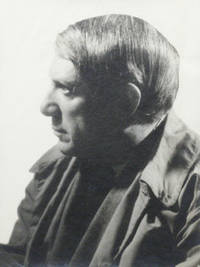
19322651Paris: np 1932. Fine. MAN RAY CAPTURES PICASSO'S ESSENCE IN LEGENDARY PORTRAIT. AN ICONIC PHOTOGRAPH WITH IMPORTANT PROVENANCE: From the famous Sotheby's sale of 1995 of items from the "Estate of Juliet Man Ray The Man Ray Trust and the Family of Juliet Man Ray". The son of Russian-Jewish immigrants Emmanuel "Manny" Radnitzky 1890-1976 grew up in Brooklyn New York. He displayed creative abilities from a young age and studied to be a painter. He adopted "Man Ray" as his pseudonym and in 1915 formed the New York group of Dada artists with Marcel Duchamp. In the 1920s and 1930s Paris was the destination for the international avant-garde offering an exceptional number of galleries art dealers and wealthy patrons who promised artistic freedom. Man Ray sailed to the "City of Light" in 1921 joined Parisian Dada and Surrealist circles and became intimate associates with Pablo Picasso Max Ernst and other leading artists. He pursued fashion and portrait photography creating a pantheon of the city's cultural life. "As a photographer I was in demand" Ray explained to John Bainbridge a writer at The New Yorker. "I was like a doctor. Everybody needed me." Bolz To be photographed by Man Ray meant you had made it in the Parisian art world.<br /> <br /> Ray often said that Old Masters especially Hans Holbein the Younger Rembrandt and Vermeer inspired his portraits. "I. admired the respect with which they treated the proportions of human features" he wrote in an article published in Modern Photography magazine in November 1957. He also made considerable technological advancements in the field by creating "rayographs" photographic images composed of ordinary objects placed on photo sensitive paper exposed to light and developing solarization the process of tone reversal observed in cases of extreme overexposure. "I photograph the things that I do not wish to paint the things which already have an existence" Ray said. Schwarz 10 Ray sought to create a sense of drama and mystery believing that his photography could transcend the mechanical nature of a camera.<br /> <br /> When photographing his friends and colleagues Ray's emotional and psychological insights allowed him to expose the soul of each subject. One such subject and friend was Pablo Picasso. Man Ray and Picasso met in 1921 in Paris. They became friends through their connection to Surrealism spending holidays together and collaborating on creative pursuits. In his autobiography Man Ray described Picasso: "He gave me the impression of a man who was aware of all that was going on about him and in the world in general a man who reacted violently to all impacts but had only one outlet to express his feelings: painting." Man Ray 177 The intensity and awareness that Man Ray described is masterfully captured in his portraits of the painter.<br /> <br /> This photo we have on offer is from Man Ray's renowned series of Picasso portraits and coincided with the publication of the first volume of Picasso's catalogue raisonné reflecting the critical position Picasso's work occupied in the French artistic establishment. In this monumental photograph from 1932 Man Ray unusually presented Picasso in an open trench coat over his jacket and tie. Choosing to shoot this portrait in profile he captured Picasso's pensive expression. Ray used a bold lighting effect and an unadorned background so as not to detract from the subject. Picasso is slightly out-of-focus creating a subtle softness. The print is also on thin tissue-like paper creating texture and depth. Man Ray was famous for experimenting with different types of paper for his prints. This 1932 Portrait of Picasso was selected for Man Ray's seminal 1934 album which included his most important photographs. This print has the Man Ray stamps M28 and M30 on the reverse and was lot 487 from the sale of the "Estate of Juliet Man Ray The Man Ray Trust and the Family of Juliet Man Ray" Sotheby's March 22 and 23 1995. <br /> <br /> Man Ray and Picasso remained close confidantes after this collaboration and during the summer of 1937 Man Ray filmed his friends including Pablo Picasso during a trip to the French Riviera. The result was On the French Riviera with Man Ray and Picasso a documentary film which portrayed the friendship of Picasso and Ray at the center of a close-knit community of artists.<br /> <br /> German occupation led Ray to leave Paris for the United States in 1940. He lived and worked in New York and Los Angeles returning to Paris in 1951 and resuming his friendship with Picasso and other artists. Ray died in Paris in 1976 yet his creativity and innovative techniques which demonstrate the distinctive cultural landscape of Paris during the interwar period had a substantial influence on contemporary art. Contributing to magazines like Vogue Vanity Fair and Harper's Bazaar he paved the way for Richard Avedon Annie Leibovitz and other artistic photographers. Ray achieved international recognition for his photography which he elevated to an art form. On May 14 2022 Man Ray's Le Violon d'Ingres 1924 sold for $12.4 million setting a new world record as the most expensive photograph ever sold at auction.<br /> <br /> He was a masterful portraitist renowned for capturing the essence of his subject's personality and mood. This collaboration between two of the most prolific creative and eclectic artists of the twentieth century had truly spectacular results.<br /> <br /> Provenance: Sotheby's London 22nd and 23rd March 1995 Lot 487: "Property of the Estate of Juliet Man Ray The Man Ray Trust and the Family of Juliet Man Ray."<br /> <br /> Image/Print Size: 6 3/4 x 9 3/8 in. Elegantly framed with wooden frame under UV-protecting museum glass to an overall size of 20 ½ x 24 ½ inches.<br /> <br /> Paris: 1932; printed later. Silver print on thin paper. With Man Ray stamps on reverse: M28 and M30 - 'Man Ray 31 bis Rue Campagne Première Paris XIVe' and with the copyright stamp ADAGP. Fine condition. <br /> <br /> <br /> References:<br /> <br /> Diane M. Bolz. "Visual Moment: Man Ray in Paris." Moment Magazine. Winter Issue 2022.<br /> <br /> The Editors of Encyclopaedia Britannica. "Man Ray." Encyclopedia Britannica. 14 Nov. 2022.<br /> <br /> Arthur Lubow. Man Ray: The Artist and His Shadows. New Haven: Yale University Press 2021. <br /> <br /> Man Ray. Photographs by Man Ray: 1920 Paris 1934. Hartford: James Thrall Soby 1934. <br /> <br /> Man Ray. Self Portrait. London: Bloomsbury 1988.<br /> <br /> Man Ray and Jean-Hubert Martin. Man Ray Photographs. London: Thames and Hudson 1982.<br /> <br /> Arturo Schwarz. Man Ray: The Rigour of Imagination. London: Thames and Hudson 1977. <br /> <br /> Slate Photo. "Man Ray's Portraits." Slate Magazine. February 6 2013.<br /> <br /> Alden Whitman. "Man Ray is Dead in Paris at 86; Dadaist Painter and Photographer." The New York Times. November 19 1976. np unknown
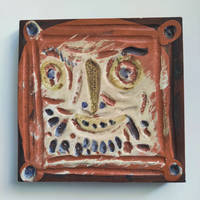
196874908<p>PABLO PICASSO Spanish 1881-1973</p><p>Petit visage barbu A.R. 557</p><p>Verso impressed "Madoura Plein Feu" and "Empreinte Originale de Picasso"<br />Hand-numbered "J139A 9/100"<br />Size 17.2 X 17.2 cm</p><p>Partially glazed and engraved terracotta plaque <br />Conceived in December 1968 - January 1969 and executed in a numbered edition of 100</p>
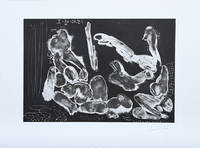
1966172734Paris: Galerie Louise Leiris 1966. Edition of 50. Signed in pencil lower right by Picasso numbered lower left. Printed by Piero and Aldo Crommelynck. Etching and aquatint on Rives watermarked wove paper all edges deckled. Image size: 31.8 x 47.1 cm. Sheet size: 45.6 x 62 cm. Framed size: 59.6 x 76.8 cm. Excellent condition. Presented in a black and gold leaf wooden frame with conservation acrylic glazing. Bloch 1387; Baer 1409. unknown
1965127727Paris: Galerie Louis Leiris 1965. Edition of 50. Signed in pencil lower right by Picasso numbered lower left. Etching and aquatint on Richard de Bas paper. Image size: 27.1 x 37.6 cm. Sheet size: 42 x 51 cm. Framed size: 63 x 56 cm. Excellent condition. Presented in a hand-made white gold leaf frame with acrylic glazing. Bloch 1218; Baer 1200 Bb1. unknown
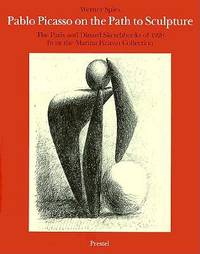
1995mon0000270863Prestel Verlag 1995-10-23. Hardcover. New. 1st 1995 HB Prestel; new mint copy in stock for immediate dispatch from the UK Prestel Verlag hardcover
7361955like new. unknown
2001PMV220903ZParis: Réunion des musées nationaux 2001. Hardcover. Good/Not issued. 241 x 318 x 58 cm. Hardcover • Illustrations en noir et en couleurs couverture illustrée en couleurs • <b><i>French text original</i></b>. Réunion des musées nationaux hardcover
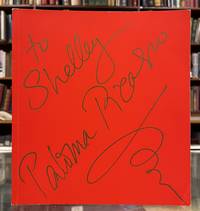
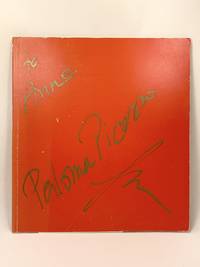
198498929Parfums Paloma Picasso 1984. Softcover. Very good/No jacket. Inscribed by Paloma Picasso.<br /> <br /> Bottom outside corner is creased. Covers have mild edge wear. Parfums Paloma Picasso unknown
1984034955Parfums Paloma Picasso 1984. Book. Very Good. Soft cover. Signed and Inscribed By Paloma Picasso. First Edition. 12pp. Red square wraps. Photos of Paloma Picasso 11 black and white one color to promote her first perfurme. Author inscription and signature in gilt sharpie on the front panel. Contributing photographers are Alexander Liberman David Douglas Duncan Helmut Newton Horst Richard Avedon others. Size: 11 1/2" x 12 1/2". Parfums Paloma Picasso Paperback
198446198Italy: Parfums Paloma Picasso 1984. First Edition. Original wraps. Fine. 12 photographs quarto by celebrated photographers including avedon christensen lamy & newton. A very good copy in red wraps Boldy inscribed on the front cover to Anne Berg was vice pres. of events at Rich's Dept Store in Atlanta. Laid in is a thank you letter to Berg plus a photograph Ann Berg with <br/><br/> Parfums Paloma Picasso paperback
014261New York: Parfums Paloma Picasso 1984 Promotional booklet to celebrate the launch of Picasso's first scent. With photographs of Paloma Picasso by David Douglas Cuncan Horst Helmut Newdon Avedon others. No text. Crease to corner and rubbed spot to front wrapper. INSCRIBED by Picasso on the covers. New York: Parfums Paloma Picasso, 1984 unknown
196558639Corcoran Gallery of Art / Baltimore Museum of Art. As New. 1965. Paperback. FREE UPGRADE to Courier/Priority Shipping Upon Request IN STOCK AND IMMEDIATELY AVAILABLE FOR SHIPMENT - AS NEW THE TEXT BLOCK IS PRISTINE CLEAN UNMARKED AND IN EXCELLENT CONDITION - - 40 pp. With 24 ills. 5 col. . 27 x 22 cm. -- with a bonus offer-- . Corcoran Gallery of Art / Baltimore Museum of Art paperback
17-0697London: Gimpel-Hanover 1964. 8vo. ca 24 pp. Very Good. Soft Cover. Illustrated paper wraps. Staple binding. Color and B&W plates throughout. Scarce. [London?]: Gimpel-Hanover, 1964. paperback
1946240409015Les Editions Braun & Cie / Tudor Publishing 1946. Hardcover. Good. 0x0x0. NO Dust Jacket. Text is Very Clean. No writing or tears to text. Has minor cover wear. Les Editions Braun & Cie / Tudor Publishing hardcover