10 867 résultats
Cartella contenente 61 incisioni all'acquaforte originali, numerate e firmate (le dimensioni variano da cm 33x23 a cm 22x16, fino a cm 5,5x7,5) Incisioni stampate sui torchi a mano di Franco Sciardelli. 4to (cm 52x36). . . Ottimo (Fine). . . .
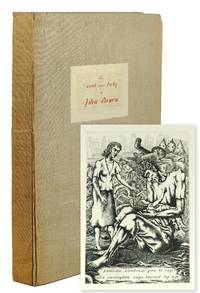
19401262991940. New York: Lee A. Ault & R. C. von Ripper 1940. <br /> <br /> Huge folio 50 pp. text and illustration engraved throughout on folded leaves separated with tissue guards in stiffened wrappers with an additional suite of 22 plates lacking some together in the original cloth portfolio and card slipcase. Together with seven sheets of proof plates and a folder of five related press clippings bearing the printed label of Monica McCall Inc. Wrappers lightly toned portfolio worn and splitting slipcase considerably worn and stained and lacking spine panel plates themselves are very good throughout with only a hint of age-toning to the outer margins.<br /> <br /> § Copy V signed by Von Ripper and Muriel Rukeyser one of three Rives paper with a suite of etchings on Velin de Normandie from a total edition of 67 copies. This copy belonged to Muriel Rukeyser who has extracted some of the suite of prints they now number 22 and added seven proof sheets some showing and annotating alternate inking options as well as a small collection of related press clippings gathered for her by Monica McCall her literary representative and sometime lover.<br /> <br /> An important collaboration between Rukeyser and the Austrian-born surrealist etcher Rudolph von Ripper 1905-1960 on the eve of America's entry into the Second World War. Rukeyser's poem looks to the legacy of John Brown the militant abolitionist of the 1850s and celebrates the possibility of spiritual renewal through resistance to injustice. It first appeared in the June 1940 edition of Poetry Magazine. Here the poem is fully engraved and illustrated with original etchings by von Ripper and interleaved with the etched verses of the old Civil War marching song. By the time Von Ripper was engaged on this project he was only 35 but had already fought for the French Foreign Legion been imprisoned and tortured by the Gestapo and been wounded while fighting on the Republican side in the Spanish Civil War. His direct physical experience of the rise of fascism is evident in his visceral Goya-like etchings. The series was exhibited in the Bignou Gallery in New York in 1941. A contemporary review described it is "an unusal undertaking brilliantly executed the drawings forming not so much illustrations or decorations as actual parts of the poem. Realism symbolism powerful design and dramatic presentment mark these plates which form a distinguished piece of bookmaking. unknown
1733140941304London: Aeneis Tabulis Incidit Iohannes Pine 1733. First Edition. Near Fine. 1733 1737. Two volumes. First edition first issue with "post est" error in the Caesar medallion on page 108 of Volume II. In a lavish full brown morocco binding with five raised bands and ornate gilt stamping to spine borders on covers wide turn-ins and beautifully patterned endsheets; all edges gilt. Near Fine with a light amount of rubbing to joints spines lightly faded a scuff to the front cover of Volume II and small former owner bookplates of noted collector Abel E. Berland to the front pastedowns. Pine's Latin text was based on Talbot's 1699 edition and is remarkable for being entirely illustrated with engraved copper plates throughout the text. Aeneis Tabulis Incidit, Iohannes Pine unknown
1733140941304London: Aeneis Tabulis Incidit Iohannes Pine 1733. First Edition. Near Fine. 1733 1737. Two volumes. First edition first issue with "post est" error in the Caesar medallion on page 108 of Volume II. In a lavish full brown morocco binding with five raised bands and ornate gilt stamping to spine borders on covers wide turn-ins and beautifully patterned endsheets; all edges gilt. Near Fine with a light amount of rubbing to joints spines lightly faded a scuff to the front cover of Volume II and small former owner bookplates of noted collector Abel E. Berland to the front pastedowns. Pine's Latin text was based on Talbot's 1699 edition and is remarkable for being entirely illustrated with engraved copper plates throughout the text. Aeneis Tabulis Incidit, Iohannes Pine unknown books
Acquaforte Firma e numerazione a matita. Carta Fabriano Rosaspina. Timbro a secco dello stampatore Romero. Esemplare 37/60. cm 32,3x41,9 (Foglio 49,7x65). pp.. . Ottimo (Fine). . Tiratura 60. .
Acquaforte originale a colori Firma e numerazione a matita. Tirata sui torchi dello stampatore Piergiorgio Spallacci. Esemplare 73/150. Cm 34,5x28 (Foglio cm 66x50). . . Ottimo (Fine). . Tiratura 150. .
Acquaforte originale in nero, numerata e firmata dall'Artista, realizzata per i 10 anni della Galleria Schwarz Incisione stampata da Giorgio Upiglio (Milano). Lastra cm 11,3 x 14,8 (Foglio cm 26,5 x 19,2). . . Ottimo (Fine). . Tiratura 60 esemplari. .
Litografia originale su lastra litografica di zinco, firmata in basso a sinistra. Al retro dichiarazione di V. Agnetti Opera n. 8 del catalogo dell'opera grafica di Castellani. Cm 90 x 69. . . Ottimo (Fine). . Tiratura 90 esemplari. .
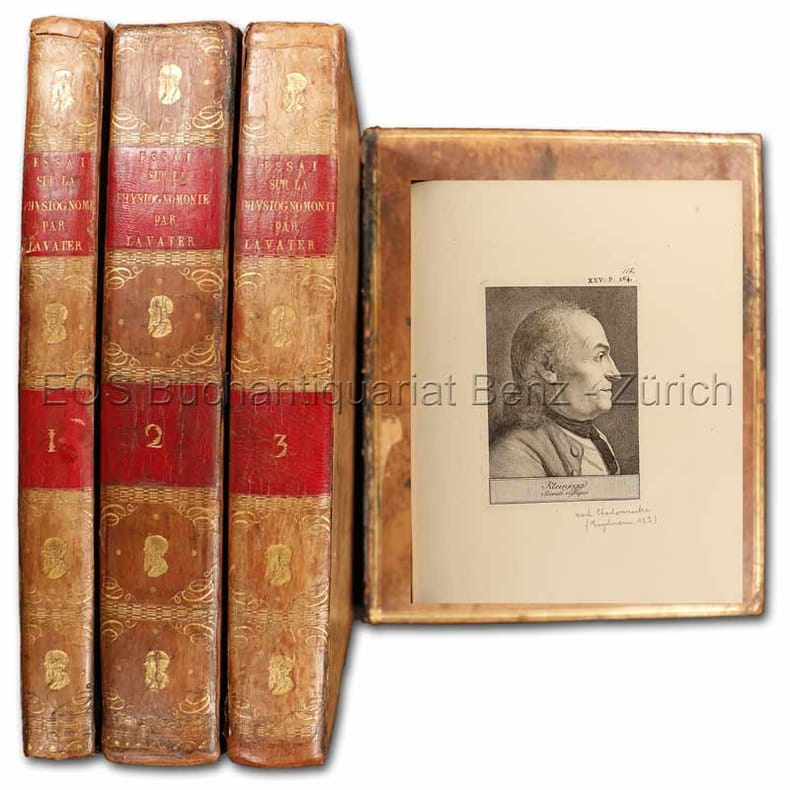
17816037CBLa Haye, (Imprimé chez Jacques van Karnebeek) resp. chez I. van Cleef, (1781)-1803. Gr.-4°. Mit 193 Kupfertafeln und zahlr. Vignetten von Schellenberg, Lips, Holzhalb, Chodowiecki u.a. Kalbleder d. Zt. mit je 2 roten Rückenschildchen, Goldfileten und etwas Rückenvergoldung, Goldschnitt. + Wichtig: Für unsere Kunden in der EU erfolgt der Versand alle 14 Tage verzollt ab Deutschland / Postbank-Konto in Deutschland vorhanden +, Einbände und Tafel 4 Bde.
1907141361907 Sans lieu, [1907-1908], grand panorama déroulant (9 m x 33 cm environ) sur 6 feuilles lithographiées en couleurs, réalisé par SEM en collaboration avec Auguste Roubille.Quelques restaurations anciennes au rubans adhésif, et quelques restaurations plus récentes au Filmoplast, aux extrémités au verso, très bon état de lensemble.
24137Pars Imprimerie Chaix 1897 Planche N°27, format 29 x 40 cm (toutes marges). Chromolithographie d'époque avec le timbre à sec de l'Imprimerie Chaix (Lugt 1777c). Notre exemplaire est une des très rares épreuves imprimées sur papier Japon (Our plate is one of the few copies printed on Japanese paper). Original plate in good condition). LES MAITRES DE L'AFFICHE, prestigieuse publication d'art, éditée par l'atelier de lithographie Chaix, dont la parution s'étala de décembre 1895 à novembre 1900. Chaque livraison comportait 4 planches de reproduction en chromolithographie d'une remarquable qualité d'impression des plus belles affiches illustrées des grands artistes français et étrangers (auxquelles il faut ajouter 16 planches de lithographies originales données en prime aux abonnés). Lors de l'Exposition universelle de 1889, fut organisée la première exposition rétrospective dévolue à l'affiche, celle-ci devait valider la reconnaissance officielle d'appartenance de l'affiche au monde de l'art. Jules Chéret (1836-1932) y sera sacré '' Maître de l'affiche '', c'est aussi à cette date que Seurat commencera à collectionner les affiches de Chéret. Alfons Maria Mucha, 1860-1939. Bel exemplaire d'une des très rares épreuves imprimées sur papier Japon, du tirage de tête (Our plate is one of the few copies printed on Japanese paper) ( Photographies sur demande / We can send pictures of this book on simple request )
9 radierungen von Emil Schumacher vorwort von Hans Platschek (cm 30x24,5; 25x11). Den druck der Radierungen besorgte Katelhon, Wamel bei Soest/W. Alle Rechte bei Johanna Schiessel. 9 incisioni numerate e firmate a matita dall'artista (cm 30x24,5; 25x11) Esemplare 44/70. folio (cm 50x37). pp. 10. . Ottimo (Fine). . Prima edizione di 70 es. numerati. .
1980KOS064800055TBD 1980 Soft Cover Fine
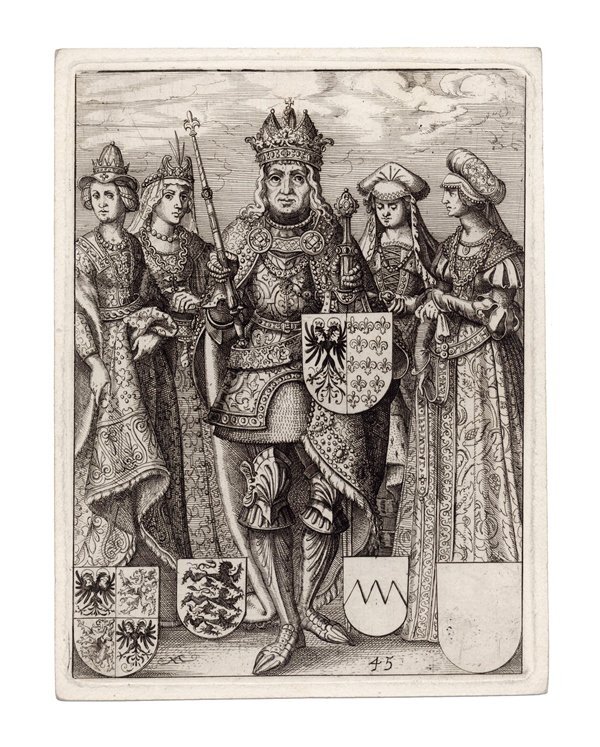
15835251583 (tirage postérieur par la Chalcographie du Louvre, XIXe siècle). 26 PLANCHES DE LA RARISSIME SUITE DES PORTRAITS DES DUCS DE BAVIÈRE ET LEURS ADMIRABLES COSTUMES
17816037CB4 Bde. La Haye, (Imprimé chez Jacques van Karnebeek) resp. chez I. van Cleef, (1781)-1803. Gr.-4°. Mit 193 Kupfertafeln und zahlr. Vignetten von Schellenberg, Lips, Holzhalb, Chodowiecki u.a. Kalbleder d. Zt. mit je 2 roten Rückenschildchen, Goldfileten und etwas Rückenvergoldung, Goldschnitt.
18271392DBZürich, J. J. Meyer, 1827. Quer-4° (21 x 29,5 cm). (4) 169 S. Mit 1 kol. Titelvignette, 32 kol. Aquatinta-Tafeln von J. J. Meyer, 6 (dv. 1 kl.) Umrissradierungen und 1 gest., gef. Karte von H. Keller (nach eigener Aufnahme). Halblederband der Zeit in Pappschuber.
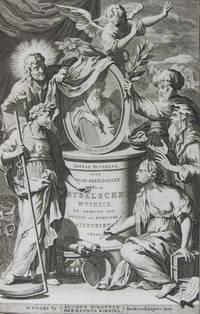
170018867Utrecht: Anthony Schouten; Hermannus Ribbius 1700. Second edition. Hardcover. g to vg. Folio 15 6/8 x 10 2/8". 42 844 36pp Index 4 845-1716 36pp Index. Text in Dutch. Contemporary blind-stamped vellum with gold lettering and tooling to spines. Raised bands. Additional engraved allegorical titles by Gilliam van der Gouwen after Wilhelmus Goeree and Philip Tideman. Title pages in red and black lettering. Decorative initials. Originally published in 1690 this work is an extensive encyclopedical study of Jewish Biblical life and times and of the Ancient Near East incl. Egypt. This complete two-volume set is embellished throughout with no less than 87 engraved plates including 29 folding and 36 in-text engravings. The magnificent engravings depict numerous Biblical scenes as well as the ancient coins of the period; the Enoch Hebrew Assyrian Phoenician Egyptian Copte Armenian and Chinese alphabets; astronomical observations; views of Jerusalem; scrolls and writing instruments; the first 13 Assyrian kings; footwear in Antiquity; mosaic floor tiles; Solomon's Temple etc. Moderate and sporadic rubbing along edges. Gold partly and slightly faded on spines. Light and minor water-staining along margin of very first leaves in first volume. Title page remargined not affecting text. Front free endpaper fly-leaf additional engraved title and title of second volume slightly and partly chipped along edges not affecting text or illustration. Very minor and sporadic foxing/age-toning throughout. A nearly fine amply-magined copy with clean plates throughout. Anthony Schouten; Hermannus Ribbius hardcover
18095Barcelone, ediciones Poligrafa, s.d. In-folio, 67 pp., en feuilles, couverture originale illustrée, chemise et emboîtage de l'éditeur de toile écrue illustrée (petites taches à l'emboîtage).
60 mm (diameter) and 62 x 75 mm. In their original brass and wooden frames. Half-length portrait of baron de La Châtre, the father of the publisher Maurice Lachâtre, with the decoration of the "Légion d'honneur" clearly visible on his robe. He was born and died in Issoudun, was appointed a knight on 12 December 1803 and promoted to the rank of an officer on 14 June 1804. He participated in the Revolutionary Wars as well as in the Napoleonic Wars, reaching the rank of colonel, and was granted the title of a "Baron de l'Empire" on 19 March 1808. Narrow cracks in the portrait; small flaw at lower margin. - Half-length portrait of his wife and the mother of Maurice Lachâtre, Élisabeth-Constance Séonnet (born on 23 June 1784 in Issoudun, died on 13 November 1860 in Maisons-Laffitte), in a sitting position, her left arm resting on the back of the chair, wearing a white dress and a furry scarf round her shoulders. The miniature was probably created soon after her wedding on 13 April 1803. Marginal flaw to wooden frame. Xavier Gaignault et Hervé Coutau-Bégarie, Le colonel Pierre-Denis de La Châtre, baron de l’Empire (Éditions Guénégaud, 2007).
Each 211 x 168 mm. In identical gilt wooden frames. A pair of atmospheric oriental genre scenes by an unidentified, but obviously professionally trained artist, masterfully capturing the light and mood: a mosque's courtyard with visitors and beggars, and a small bazaar with merchants, pedestrians, and a belly dancer within the picturesque environment of humble dwellings.
Ca. 676 x 480 mm to 755 x 523 mm. Coloured etchings on paper. Partly heightened in gold and silver. Two of the prints mounted on canvas. Rare supraporte prints from the famous publishing house Remondini, depicting four episodes from the biblical Parable of the Prodigal Son. In the sequence of the biblical narrative, the etchings with legends in Spanish and Latin show the Prodigal Son collecting his share of the inheritance from his father, the Prodigal Son leaving the parental home, the Prodigal Son being reduced to serve as a swineherd after he squandered his fortune, and the reconciliation with his father following his desperate return home. The beautiful coloured etchings are wholly Rococo in style, from the large ornamental frames to the opulent clothing of the protagonists and decor within the scenes. Embracing the timeless character of a parable, the 18th century viewers were supposed to identify with the protagonists and have their taste in Rococo ornaments met. - The house of Remondini was founded in Bassano del Grappa by the merchant Giovanni Antonio Remondini (1634-1711) and was successfully expanded by his son Giuseppe Remondini (1672-1742). Apart from prints and books, Remondini produced decorated papers for various uses and wallpapers. In the 18th and early 19th centuries, Remondini was among the largest print publishers of Italy. The supraportes with the Prodigal Son are a beautiful example of the large portfolio of the company and its international market. - With occasional stains and some foxing. The return scene shows old restorations due to water damage, leaving some areas brittle, especially in the lower margin, and causing minimal losses to the print. The departure scene shows two small defects.
Gouache on paper, ca. 32 x 45 cm (sheet dimensions ca. 41.5 x 52 cm). Meticulous panoramic view of the bay, shoreline and city of Naples from Santa Lucia in the west to Mount Vesuvius in the east. The foreground shows fishing boats and other small vessels as well as a paddle steamer flying the French flag and a U.S. navy barque. - Margins tinted in grey wash, showing some light staining and a few tiny holes, caption title lettered in pink. The vividly coloured view is perfectly preserved. - Provenance: near-contemporary ink annotation on verso "Naples / Magasin de Beaux Arts / Place Cappella a Chiaja No. 6 / Sous le Palais Partanna / Tenú par Gaetano Calvi". Sold in 2015 through Holger Christoph, Bonn (sale 38, lot 411) to a German private collector and subsequently through Dobiaschofsky in Berne (2018) and Zisska in Munich (2021). A comparable, likewise unsigned example is held by the Bibliothèque nationale de France (dept. Estampes et photographie: "Napoli da Posilippo", Smith-Lesouëf 7277). For the painter Giuseppe Scoppa and his family cf. R. Rinaldi, Pittori a Napoli nell'Ottocento (2001), p. 247. See also Thieme/Becker XXX, 1936; Comanducci V (1974).
Ca. 477 x 326 mm (neat line). Etching on paper. Only known specimen of an anonymous copy after Georg Daniel Heumann’s monumental 1735 copper print engraving based on a design by Salomon Kleiner, with additional portraits of Empress Maria Theresa and the later Emperor Joseph II and his wife. This faithful, though qualitatively inferior copy was probably made on the occasion of the wedding of Archduke Joseph of Austria and Princess Isabella of Parma on 6 October 1760 in Vienna. The couple is shown in a double portrait presented by a crowned eagle flying on the right side of the tower. They are opposed by a similarly presented profile portrait of Maria Theresa on the left side. Superimposed, the two medallion-bearing eagles would form the double-headed Habsburg eagle. - Joseph's first and happiest marriage lasted only three years, as Isabella died of smallpox on 27 November 1763 at the age of 21, leaving behind a devastated widower. 1763 is thus the latest possible date for the creation of this beautiful etching. - Good impression with some minor stains and a larger brown stain to the upper left margin.
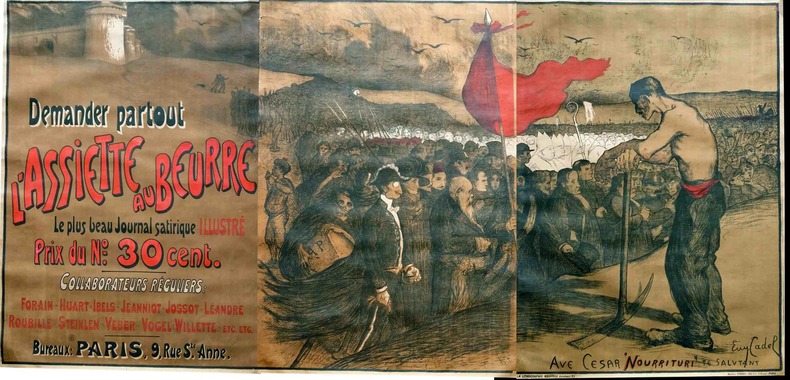
190111227, La Lithographie nouvelle, Atelier Cadel, [1901 ca]. Affiche en 3 panneaux mesurant 320 x 155 cm, doublés de japon et entoilés.
Superficie in rilievo su jesmonite. Multiplo originale numerato e firmato dall'artista sul retro contenuto in display in perpex. Esemplare 9/10 Display in perspex di Euromod, Roma. Confezione di Green Imballaggi, Roma. Progetto grafico by Artefatto, Roma. Cm 28x30. . . Perfetto (Mint). . Tiratura di 10 es. num. + IV p.d.a.. . La jemsonite è un composto di gesso e resina acrilica di produzione inglese che possiede eccellenti qualità di resistenza meccanica, durabilità e non tossicità. Non richiede manutenzione e può essere pulita con acqua e sapone. Questo multiplo pertanto ha la caratteristaca di opera durevole nel tempo, come se fosse realizzato in pietra o bronzo