10 867 résultats
1927355490725414London 1927. First Edition. Hard Cover. London: Published by the Fleuron Limited and printed at the Curwen Press 1927-1930. CONTAINS SIGNED WOOD ENGRAVINGS BY JOHN NASH IN VOLUME 3 AND ERIC RAVILIOUS IN VOLUME 4. Publisher's yellow brown pink or purple buckram with gilt lettering to the spine t.e.g. others uncut spines a little faded. Robert Gibbings writes on the Golden Cockerel Press Eric Gill on intaglio printing from woodblocks Paul Nash on woodcut patterns Douglas Percy Bliss on the tools of the wood-engraver etc. W A Thorpe on the Wood-Engravings of John Nash Wood and Metal in the Invention of Printing by Victor Scholderer German Woodcut Lettering by Dr. Julius Rodenberg et al. Generously illustrated with examples of the work of many of the great wood engravers of the time Eric Ravilious John Nash Tirzah Garwood Gwen Raverat Clare Leighton et al. Vol 1 yellow buckram from 1927 is # 25 of 75 copies of which 70 are for sale. Vol 2 brown buckram from 1928 is # 42 of 80 copies of which 75 are for sale. In addition to the blocks in the text there is a fold-out in collotype of woodcut wall-papers opposite page 1. Vol 3 pink buckram from 1929 is # 18 of 80 copies of which 75 are for sale and contains one of the few woodcuts to be produced in Tirzah Garwood's lifetime Vol 4 purple buckram from 1930 is # 27 of 75 copies of which 70 are for sale. A very good set. Containing signed wood-engravings by Eric Ravilious and John Nash. NB: THESE SPECIAL EDITION SETS ARE VERY RARE AS THE SIGNED ENGRAVINGS BY ERIC RAVILIOUS AND JOHN NASH ARE USUALLY FOUND REMOVED. NNB: Dustwrappers not present. Further photographs available upon request. hardcover
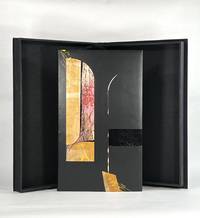
10427Berkeley CA: Editions Koch 2003. Full Leather. Fine binding. Folio. 44 pp. frontis plates. Limited edition one of 120 copies this copy out of series; there are also 26 lettered deluxe copies with a suite of 10 engravings. All are signed by Bringhurst Wagener and Peter Koch at the colophon. Bound by Camille Botelho in black box calf with inlays and onlays of dyed calf vinyl snakeskin painted paper mylar laminates and a porcupine quill; hand embroidered endbands; vinyl snakeskin doublures. A fine copy in clamshell box. <br /> <br /> True to form Peter Koch has produced a marvelous edition of what remains of Parmenides's poem "On Nature." The fragments of the poem are rendered in this opposite page bilingual edition with the Greek on the left and Bringhurst's English translation on the right. The poetry is brilliantly accompanied by Wagner's striking engravings a frontispiece and 4 additional wood engravings in red and orange. <br /> <br /> Given it survives only in fragments there is some debate as to the "meaning" of the symbolism of Parmenides's poem making it a work ripe for interpretation. But at base his view of reality is one of stasis unchangeable. And while that enduring Greek logic marks the work Wagener introduces remarkably abstract and kinetic illustrations printed in an urgent deep red and orange—projecting anything but stasis. It is the discord between the logical understanding or reality and the emotional understanding of it that spoke to Botelho and informed her design of this incredible binding. She writes: "In the design I thought of Parmenides looking out past shadowy arches from within a dark room to find total chaos beyond. The curve of the Mylar inlay and the curve of the porcupine quill mimic a column marking a threshold beyond which is uncontrolled noise and movement and mess. I wanted the disparity between the smoothness of the box calf and the chaos of the inlays and yellow foiling to be a comment on how frightening examining one's reality can be." Magnificently achieved Botelho has created an exceptional binding that bridges Parmenides and Wagener giving voice to the paradox she sees in this metaphysical conversation on the nature of reality. Editions Koch unknown
17263094Paris, Rollain, Quillau, Desaint, 1726 ; quatre tomes in-4 ; plein maroquin rouge cerise à grain long, dos à nerfs ornés, titre doré, triple filet doré d'encadrement des plats, filet doré et fleurons décoratifs en écoinçons, roulette décorative dorée sur les coupes et en intérieur, toutes tranches dorées (Thouvenin, relieur de 1813 à 1834) ; (6) ff., 696 pp. ; (1) f., 719 pp. ; (1) f., 552, 4 pp., (1) f. ; (1) f., 240, 408, 221, XX pp. et en tout, portrait gravé de l'auteur en frontispice, 6 cartes et plans et 70 portraits gravés blasonnés hors-texte et 4 vignettes.
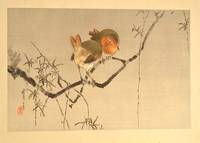
1916898711916. Seitei KachÅ çœäºèб鳥 Prints Bird and Flower<br /> <br /> Watanabe Seitei 渡辺çœäº also ShÅtei artist <br /> <br /> Tokyo: Okura Shoten Okura Yasugoro<br /> <br /> Taisho 5 1916<br /> <br /> Brown cloth clasped portfolio 28.2 x 38 cm. A complete collection of the 22 color prints the preface and table of contents page 24 sheets in all with a colophon label on the inside of the rear cover. <br /> <br /> A wonderful production in color woodblock of the work of the important artist Watanabe Seitei 渡辺çœäº 1851-1918. Okura Shoten was also the publisher of Seitei's other two books the 3 volume Seitei KachÅ Gafu çœäºèŠ±é³¥ç”»èœ of 1890-1 and the KachÅ Gafu èŠ±é³¥ç”»èœ of 1903 but this portfolio is by far the rarest of all his works. Prints from the series are seldom seen and much prized complete sets like this one are vanishingly rare. <br /> <br /> After studying under Kikuchi YÅsai èŠæ± 容斎 1788-1878 also known as Kikuchi Takeyasu and Kawahara RyÅhei and established artist Shibata Zeshin 柴田是真 1807-1891 in his youth he traveled to Europe in 1878. One of the early practitioners of the Nihonga 日本画 style of Western-influenced traditional painting he is primarily known for his work with bird and flower subjects which he revolutionized with his delicate and playful ability to capture the reality of color plumage and other details. <br /> <br /> Overall the condition of the covers is quite good and the prints are well printed. The heavy paper on which the prints are mounted are a bit toned but the prints themselves are quite good and clean with wonderful colors and impressions. A cornerstone of any Japanese bird and flower collection. Enclosed in a custom clasped cloth box. unknown
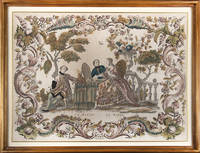
112186n.p. n.d. eighteenth century circa 1750. . A suite of four original hand coloured engravings titled in Spanish and French La Manna Le Matin; El Mediodia Le Midi; Eldespues de Comer L'Apres Diner and Le Soir La Tarde each approx. 50 x 68 cm modern gilt frames.<br /> An exquisite suite of four eighteenth century conversation piece engravings in the rococo style showing the nobility at leisure dining and dancing outdoors in a bucolic setting. Each image is beautifully set within delicately coloured scrolled borders featuring flowers foliage leafy tendrils and fruit. These prints capture the privilege and lifestyle of the aristocracy and are typical of French decorative art in the early to mid eighteenth century.<br /> n.p., n.d. [eighteenth century, circa 1750]. unknown
Head-and-shoulders portrait, turned to the left. Watercolor on paper. 124:96 mm. A fine watercolor study, signed on the reverse by an unkown hand.
52,8 x 37 cm. Woodcut on paper (two conjoined sheets). Rare pirated copy of the famous south-west view of the Strasbourg Cathedral by Daniel Specklin (1536-1589). A "Matthias Huebner" from Schneeberg in Saxony, who is presented as the author of the print in the modified text in the strapwork frame to the right ("Matthias Huebner Schnebergensis faciebat Argent. Cal. Ian M. D. LXVI"), has not been identified. The monumental view of the Cathedral, including the staffage figures and the strapwork cartouche with the date, correspond with the original published by Bernhard Jobin in Strasbourg (as depicted in Hollstein). - Trimmed, insignificant marginal damage, two restored tears on the left. Smoothed, slightly soiled, somewhat toned. Hollstein LXXIII, 67, 1 (with illustration on p. 66). Strauss, German single-leaf woodcut, III, S. 975, I (of II; with fig. II). Cf. Passavant III, p. 350f. Drugulin I, 290f. Bartsch IX, 303, 1.
240:348 mm. In Passepartout. Sorgfältig ausgeführtes Aquarell, das den bekannten österreichischen Kurorts Bad Ischl, einst Sommerresidenz der kaiserlichen Familie in einer sehr hübschen Darstellung um 1850 darstellt. - Provenienz: I) Mrs Callow's Collection. II) Mehrfach ausgestellt bei Walker's Galleries, London, April 1927 (vgl. "Walker's Quarterly, April 1927, S. 46). III) The Fine Art Society, London. April 1958 und Oktober 1959 (entsprechende Schildchen auf die Verso-Seite einer Trägerplatte montiert).
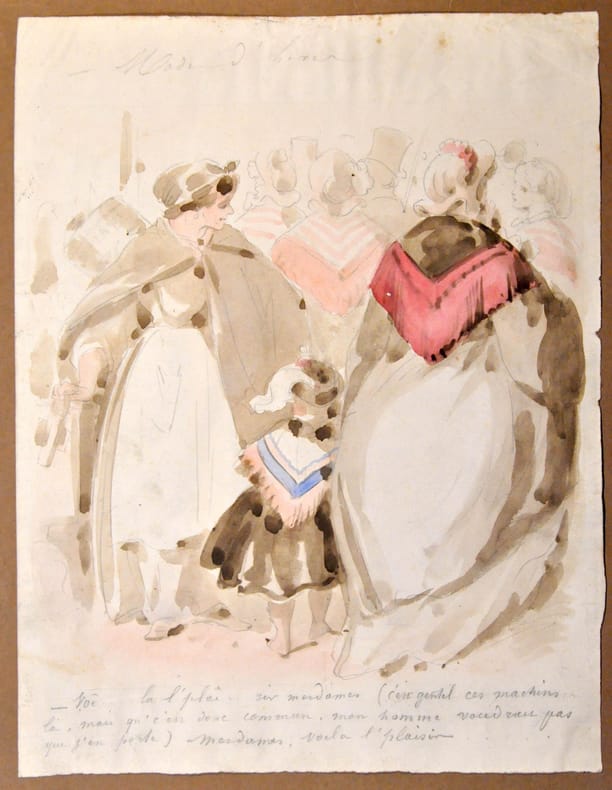
188029201880 Une grande caricature hors texte rempliée ; 72 aquarelles annotées ; 59 dessins au crayon et 1 à la plume. Grand in plano (420 x 280 mm) en demi basane rouge, dos à six nerfs orné, titre en or. Les aquarelles et dessins originaux annotés sont montés sur papier brun tabac : collés au recto de chaque feuille selon leur taille essentiellement par groupes de 2 ou 4 , et quelques grands dessins. ___
25 draught sketches on 20 pages (9 on cardboard, 11 on silk paper). Mostly large 4to. Includes 2 ff. with 7 pen-and-ink drawings. Collection of very early designs for refined ladies' fashion, some executed in great detail (pen-and-ink, pencil, crayons; some watercolouring). Three sketches bear a (probably later) stamp on the reverse: "Maria Jungwirth | Goldradierung, Kunstgewerbe | Wien, VI., Capistrangasse 3". - Maria Jungwirth from Krems studied at the Wiener Kunstgewerbeschule under Oskar Strnad, Alfred Roller, Josef Hoffmann, Franz Cizek, Adele von Stark from 1914 to 1917. She specialized in gold etching and watercolours. - Somewhat dusty; slight edge defects.
177244477Paris, , 1772. In-8 sur un grand papier vergé (204 x 132 mm) de 2 ff.n.ch. (titre et frontispice), (1)-8-124 pp., figures et texte gravés, veau marbré, dos lisse orné, pièce de titre de maroquin rouge, triple filet doré d'encadrement sur les plats, filet doré aux coupes, roulette intérieure, tranches rouges (reliure de l'époque).
174042730Paris, chez J. Chereau, rue St. Jacques, au Coq (Augsburg, Martin Engelbrecht, 1740 circa). 8 gravures en taille-douce en feuilles (18,5 x 31,5 cm).
169644496Paris, Antoine Dezallier, 1696. 2 tomes en 1 vol. in-folio, maroquin rouge, doublé de maroquin rouge, dos orné, double rangée de filet, tranches dorées (Fairbain and Armstrong).
Large folio (ca. 64 x 49 cm). Title-page with etched, coloured and pasted vignette plan of the Church of the Holy Sepulchre, 4 pp., and 14 lithographs by Albert Adam, Charles Claude Bachelier, Hubert Clerget, Charles Fichot, and Jules Gaildrau after F.-E. Pâris (12 printed in colour). Stored loosely, as issued, in original paper wrapper with title and modern brown half cloth portfolio with white cloth ties and giltstamped title lable pasted to upper cover. Elaborate album of lithographs based on drawings by Vice Admiral François-Edmond Pâris from a visit to the holy city in 1861. The album follows his itinerary as described by Pâris in the introductory text. Leading his squadron from Jaffa to Jerusalem, Pâris drew a charming scene of pilgrims gathering at the fountain of Abu-Nabbut. Before entering the city, he captured an impressive view of Jerusalem from the Mount of Olives. 52 important sights are marked in the uncoloured lithograph and described in the text. The view of the city is followed by impressions of Christian places of worship such as the Holy Grave, the Prison of Christ, and the Chapel of Saint Helena in the Church of the Holy Sepulchre, the Tomb of the Virgin Mary, the Grotto of the Nativity in nearby Bethlehem, and an unusual, uncoloured view of the interior of the Golden Gate (Gate of Mercy). The final three lithographs present two beautiful interiors of the Mosque of Omar and one of the Al-Aqsa Mosque. All sights depicted are described in the text. - François-Edmond Pâris (1806-93) commanded the 2nd Division of the French fleet in the Mediterranean when he visited Jerusalem. Leading primarily scientific missions, Pâris was a talented draughtsman who took an interest in naval architecture, steam engineering, and geography. Today Pâris is considered the father of modern maritime ethnography; he played an important role in the modernisation of the National Maritime Museum in Paris. - Original paper wrapper rather wrinkled with some repaired tears and restored loss to corners. Title-page a little stained; several tears to margins professionally repaired. Lower right corner of the first text-sheet repaired without text loss. Lithographs generally well preserved, but some lightly affected by stains in the margins; occasional tears to the sheets and corners restored, not affecting the illustrations. Blackmer 1255. Röhricht 2762. Tobler 231.
45 Skizzen (einige laviert) auf 23 Bll. Originaler Halblederband mit Deckeltitel "F. Gauermann's Skizzenbuch v. J. 1830". Das Skizzenbuch enthält Baum- und Figurenstudien, Skizzen von Kühen in Ställen sowie Landschaftsskizzen. Einige davon sind datiert und beschriftet, u. a. "vom Ausflug mit Höger 1831. Oktober", "Mit Pollak und Höger 1831 im September", "mit Höger am 14. Oktober 1831 auf dem Rabenstein", "mit Höger im Thiergarten am 3. Dezember 1830". - Friedrich Gauermann unternahm mit seinen Schwägern, den Landschaftsmalern Joseph Höger (1801-77) und Wilhelm Pollak (1802-60), zahlreiche Reisen durch Österreich, wo Skizzen und Studien für spätere Ölgemälde angefertigt wurden. - Der Einband berieben und bestoßen, die Skizzen teils braun- und fingerfleckig und mit Klebeband im Mittelfalz fixiert.
17443820DBZürich, zu finden bey David Herrliberger; Basel, gedr. bey Daniel Eckenstein, 1744-48. Folio. Seitenkollation folgend. Mit gesamthaft 189 Kupfertafeln. Kalbleder d. Zt., Rücken auf 6 Bünden mit reicher Vergoldung und Rückenschildchen. + Wichtig: Für unsere Kunden in der EU erfolgt der Versand alle 14 Tage verzollt ab Deutschland / Postbank-Konto in Deutschland vorhanden + 3 Teile in 2 Bdn.
EXTREMELY RARE retrospective on the works of Mexican painter Raul Anguiano. SIGNED by the artist. INCLUDES ORIGINAL LITHOGRAPH, "Three Women from Behind", signed by Anguiano, numbered 187/500. Includes dozens of color reproductions of Anguiano's drawings and paintings. Also includes photographs of Anguiano's process, an essay by Buxo on Anguiano's style (in English), and a short autobiographical piece by Anguiano himself (in English). 285x285mm, 175 pages. Blue leather hardcover with silver dust-jacket. [CONDITION:] Dust-jacket very lightly worn around all edges. Lithograph has a long crease that appears to be a defect caused DURING THE PRINTING PROCESS. Otherwise, this extremely rare book and original lithograph are in VERY GOOD CONDITION.
Oblong folio (ca 370 x 240 mm). With 11 (of 24) numbered leaves containing 52 hand-coloured lithographic pen-drawings of people, animals, equipment & gear and goods, from a caravan travelling to Mecca, each drawing including a base for cutting out, mounting on card stock or wood, and arranging them upright in three-dimensional scenes. Lacking 12-24 (of 24). Loose leaves. The first eleven leaves of a very rare lithographic print series issued in parts. Most copies were probably cut up by children and destroyed in play. The human figures to be cut out include Turkish, Arabic, African and Middle Eastern men and women in Islamic costume, including both masters and servants, some of the men with a variety of firearms, spears, daggers, and various gear and goods. There are also camels, horses and donkeys, often with their gear for riding or for carrying loads. The series must have provided many children and adults with their first notion of Muslim society and culture and is rich in authentic details. "Kleine Welt des Bilderbogens" dates the series to ca. 1855, just after Sir Richard Burton's famous visit to Mecca disguised as an Afghan in 1853 (he was one of the few Europeans who had ever visited Mecca and lived to tell of it). The complete series of 24 leaves comprised four groups of leaves, each leaf with the title, relevant subtitle and imprint (without date) at the foot: 1-6: Die Ueberbringung des heiligen Teppich; 7-13: Die Reise durch die Wüste (not present here: 14-16: Das Lager in der Wüste; 17-24: Die Gefahren der Wüste). The artist is not named. The drawings are printed on unwatermarked wove paper. The paper is fairly thin and the drawn bases have no folding tabs, as the publisher intended the cut-outs to be pasted onto card stock with a folding tab at the foot of the base or wood so that they could stand without support. - Occasional pencil marks. Some edge flaws and duststains, waterstains and browning. Includes two uncoloured sheets (numbered 10 and 23) on somewhat later, stronger paper. Kleine Welt des Bilderbogens: der Wiener Verlag Trentsensky (1977), 111. Katharina Siefert, ed., Paläste, Panzer, Pop-up-Bücher: Papierwelten in 3D (2009), with a chapter, "Die Carawane nach Mecca", pp. 31-38. Not in KVK; WorldCat.
13 watercolours and pencil and ink drawings mounted on 60 leaves of white and brown-toned paper. Splendid red morocco binding by Alphonse Giroux of Paris with covers and spine gilt and inlaid (wanting the fore-edge lock). Small oblong folio (340 x 245 mm). Red moirée silk endpapers. All edges gilt. A magificently bound, early album containing sketches by the artistically gifted princess as well as by other artists. It was not until the year of her birth that her father Louis Philippe, the Duke of Orleans (1773-1850), who had had to leave Europe after the French Revolution and spent several years in America, returned to France, where in 1830 he accepted the crown, following the deposition of Charles X. Until the February Revolution of 1848 and his emigration to England he reigned as "King of the French". - The present album contains three unsigned portrait studies in pencil attributable to the princess, probably based on details from an old master painting (possibly a Crucifixion or Lamentation of Christ). In her youth, Clementine is known frequently to have copied details from Dürer, Michelangelo, Leonardo da Vinci, Holbein, and Titian. Two of the present studies are dated "1831", when she was but fourteen years old: among the earliest of her known works, they show off her remarkably developed talent. - Among the other drawings in the album is a watercolour still life with fowl, signed "D. Pedro 1850" and inscribed, "Offert À Son Altesse Royale Madame La Duchesse de Saxe Cobourg Gotha le 3 Juin 1851", while a similar still life is signed "D. Suid [?] fecit / 20 Set. 1850". Other drawings include four pencil sketches by the English painter and engraver William Daniell (1769-1837), who had accompanied his uncle Thomas Daniell to India in 1784 and subsequently produced a wealth of highly regarded landscapes and scenes of Indian life (including work for the famous "Oriental Scenery" volume), many of which are in the Royal collections (cf. Thieme/Becker VIII, 361f.). His signed contributions are two boating scenes (1827, one entitled "Patience in a Punt"), an Indian riverside scene (1827) entitled "The Plantane tree, Bengal", and an "Indian Bull" (1830, inked and watercoloured). Another particularly finely executed watercolour shows a beach scene at Ingouville (in Normandy), dated August 1839 and signed "L. Laurent". In addition, there are three skilled but unsigned pen-and-ink sketches, apparently also by a trained artist, showing a watchman with a shouldered musket, the Falls of Clyde in Scotland ("Chute de la Clyde / Lanarke 11 Juillet 51"), and the profile study of a lady (all but the latter washed in ink). A few torn stubs show the album to have formerly comprised several additional leaves, while the faint nature-printed impressions left by plants between two leaves prove that the album was once also used to preserve botanical mementos. - The princess grew up in the Palais Royale in Paris. In 1843 she was married to Prince August of Saxe-Coburg; in 1861 she would give birth to Prince Ferdinand of Saxe-Coburg, who in 1887 accepted the crown of Bulgaria, against the wishes of the European Powers and indeed those of the house of Coburg. Having long lived under the same roof with the similarly aged Victoria of Kent, later Queen Victoria (1819-1901), Clementine maintained a lifelong correspondence with the Queen of England, and her more than 600 letters are now in the Royal Archive in Windsor. Also the Hoover Institution at Stanford University keeps material from the estate of Princess Clementine within the so-called "Czar Ferdinand I of Bulgaria papers". Her artistic productions have remained enduringly popular: in 1990, one of her pencil drawings ("Etude des chiens") sold for 20,000 Francs (Paris, Tajan, 5 Dec. 1990, lot 23).
1 Blatt. Ca. 285:242 mm. Dargestellt ist ein einfaches bäuerliches Gebäude aus Holz und Stein mit umgebender Vegetation. Zusätzlich ist die Zeichnung mit einem Doppelrahmen in Bleistift versehen. Die Zeichnung dokumentiert die künstlerische Ausdrucksweise Elisabeths als junges Mädchen, der späteren Kaiserin von Österreich ("Sisi"), die ihre Kindheit in Bayern verbrachte und in jungen Jahren in Schloss Possenhofen am Starnberger See lebte. - Minimal braunfleckig. Aus Wittelsbacher Besitz. Die Zuordnung zu Elisabeths Hand erfolgte durch Stilvergleich mit eigenh. signierten und datierten Zeichnungen Elisabeths, die in demselben Konvolut beilagen.
1947015744Paris , Compagnie française des arts graphiques 1947 Reliure
Oblong 4to. Leporello of 12 chromolithographs, each segment 245 x 350 mm. In a protective box with pictorial cover. The only foreign-language edition of this work that originally appeared in identical form in Vienna in 1925, very rare. - Pictorial narrative which flows continuously through the illustrations on both sides, the animals coming on one side and leaving on the other. Oskar Laske (1874-1951) mainly worked as a painter from 1904. He excelled as a graphic artist and saw his works published in the Vienna-based "Zeitschrift für vervielfältigende Kunst", one of the leading international fine art journals of the day. For the next fifteen years, print-making dominated Laske's oeuvre. In 1907 Laske joined the Hagenbund and in 1924 the Vienna Secession. His work was not only exhibited at those artist associations but also internationally. - Some wear to the first plate. F. C. Heller. Die bunte Welt. Handbuch zum künstlerisch illustriertem Kinderbuch in Wien 1890-1938 (Wien 2008), p. 293. Cf. Lily Schulz-Laske & Elisabeth Kesselbauer-Laske, Oskar Laske. Der künstlerische Nachlaß (Wien 1952), Lithographien, p. 29, nos. 28-39. Exhibition catalogue "Oskar Laske", Kunsthaus (Wien 1996), Ill. pp. 96f.
16405012Très belles épreuves du 3è état sur 4. Le Brun n’aurait gravé que 7 planches dont cette série. Rare. Robert Dumesnil 4à7 iii/iv; IFF. Cadres bois dorés modernes sous vitre anti-uv (25,5 x 34,5 cm) Très bon 1640
24136Pars Imprimerie Chaix 1897 Planche N°94, format 29 x 40 cm (toutes marges). Chromolithographie d'époque avec le timbre à sec de l'Imprimerie Chaix (Lugt 1777c). Notre exemplaire est une des très rares épreuves imprimées sur papier Japon (Our plate is one of the few copies printed on Japanese paper, original plate in good condition). LES MAITRES DE L'AFFICHE, prestigieuse publication d'art, éditée par l'atelier de lithographie Chaix, dont la parution s'étala de décembre 1895 à novembre 1900. Chaque livraison comportait 4 planches en lithographie, des plus belles affiches illustrées des grands artistes français et étrangers. Chaque livraison comportait 4 planches de reproduction en chromolithographie d'une remarquable qualité d'impression des plus belles affiches illustrées des grands artistes français et étrangers (auxquelles il faut ajouter 16 planches de lithographies originales données en prime aux abonnés). Lors de l'Exposition universelle de 1889, fut organisée la première exposition rétrospective dévolue à l'affiche, celle-ci devait valider la reconnaissance officielle d'appartenance de l'affiche au monde de l'art. Jules Chéret (1836-1932) y sera sacré '' Maître de l'affiche '', c'est aussi à cette date que Seurat commencera à collectionner les affiches de Chéret. Bel exemplaire d'une des très rares épreuves imprimées sur papier Japon, du tirage de tête (Our plate is one of the few copies printed on Japanese paper) ( Photographies sur demande / We can send pictures of this book on simple request )
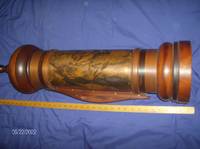
1992DEMO006065IStatesboro GA: The Boxwood Press 1992. First Limited edition. Hardcover. Fine. In a mahogany and copper scroll case with vertical slot and hidden crank handle; with a protective velvet cloth <br/><br/>Only 16cc.Remarkable bilingual presentation / re-interpretation of this Biblical work placing it in the the Reagan / Bush era. Illustrated with 16 color etchings by Bernard Solomon the translator and etcher. He realized there were remarkable parallels between the Biblical story of Esther and that of Anita Hill Clarence Thomas and the U.S. Senate Judiciary Committee. This interpretation unfolds sequentially as each leaf is unrolled from the 33 in. high scroll holder. The body of the scroll holder is one of the original copper plates used for the etchings which is why it is limited to an edition of only 16. The top and bottom of the handcrafted minaret-style case is finely shaped and polished mahogany by Anthony V. Mann. Designed with a hidden crank to rewind the scroll into the case. Altogether remarkable! The Boxwood Press hardcover