10 867 résultats
111055Reeves and Turner London. c. 1884. Reeves and Turner . Undated but c. 1884. Second Edition greatly englarged and carefully revised. Cloth bound hardback with deckled edge text block with no DW. 8vo. Illustrated with woodcuts by Thomas and John Bewick and their pupils. Boards worn and stained with corners bumped and chipped. Red title plates to front board and spine chipped. Page edges heavily browned. Endpapers grubby with closed tear and gift dedication in ink to front free endpaper. Some foxing to text. Book ow/ sound and containing some beautiful Bewick woodcuts depicting lost social history. hardcover
Ink mark to page 45 of Part II and a few fingermarks. No other added marks or inscriptions. No creasing to covers. A tight page block with foxing to dusty edged pages, well rubbed full-leather boards, edges and spine with surprisingly clear intact maroon title block to spine. Front board held just by binding cords and front end paper present but loose. Some loss to lower edge of title page. Page numbering in good order. 327 plus 360pp. Parts I and II of Bewick's Birds present in one volume. Wood engravings by T Bewick. Green Sandpiper at p100.
0259286931.Gpaperback. Good. Access codes and supplements are not guaranteed with used items. May be an ex-library book. paperback
Signed upon title page by author. 180 pages. Index. References. Biographical overview. List of works. Colour illustrated endpapers. "E.J. Hughes is famous for his unforgettably rich and accomplished landscapes, primarily depicting the British Columbia coast. His works now command the highest auction prices ever paid for a living Canadian artist, confirmation of his emergence as a major figure on the international art scene... The passionate collector has always been central to the emergence of important artists. In this extraordinarily personal account, the world of a collector comes alive. Here are 76 Hughes sketches, paintings and prints, in colour and black and white - only a handful previously published in book form - accompanied by a text rich with anecdotes about the joys, frustrations and satisfactions of the chase. This is a very human story of art as master - one which sheds important new light on Hughes and his work." - from dust jacket. "Hughes is the chronicler of a landscape almost too beautiful and too alive with spirit to be believed." - Globe and Mail. Clean, bright and unmarked with negliglble wear. Dust jacket now preserved in glossy new archival-grade Brodart cover. Gift quality. Book
180 pages. Index. References. Biographical overview. List of works. Colour illustrated endpapers. "E.J. Hughes is famous for his unforgettably rich and accomplished landscapes, primarily depicting the British Columbia coast. His works now command the highest auction prices ever paid for a living Canadian artist, confirmation of his emergence as a major figure on the international art scene... The passionate collector has always been central to the emergence of important artists. In this extraordinarily personal account, the world of a collector comes alive. Here are 76 Hughes sketches, paintings and prints, in colour and black and white - only a handful previously published in book form - accompanied by a text rich with anecdotes about the joys, frustrations and satisfactions of the chase. This is a very human story of art as master - one which sheds important new light on Hughes and his work." - from dust jacket. "Hughes is the chronicler of a landscape almost too beautiful and too alive with spirit to be believed." - Globe and Mail. Clean, bright and unmarked with very light wear. Appears unread. Faintly visible tape repair to back panel of dust jacket which is now preserved in glossy new archival-grade Brodart cover. An excellent copy. Book
- Lucien Vogel éditeur, Paris 1920, 18x24cm, une feuille. - Estampe originale en couleur, tirée sur papier vergé, signée en bas à gauche de la planche. Gravure originale réalisée pour l'illustration de La Gazette du bon ton, l'une des plus belles et des plus influentes revues de mode du XXème siècle, célébrant le talent des créateurs et des artistes français en plein essor de l'art déco. Célèbre revue de mode fondée en 1912 par Lucien Vogel, La Gazette du bon ton a paru jusqu'en 1925 avec une interruption durant la Guerre de 1915 à 1920, pour cause de mobilisation de son rédacteur en chef. Elle se constitue de 69 livraisons tirées à seulement 2000 exemplaires et est illustrée notamment de 573 planches en couleurs et de 148 croquis représentant des modèles de grands couturiers. Dès leur parution, ces luxueuses publications « s'adressent aux bibliophiles et aux mondains esthètes » (Françoise Tétart-Vittu « La Gazette du bon ton » in Dictionnaire de la mode, 2016). Imprimées sur beau papier vergé, elles utilisent une police typographique spécialement créée pour la revue par Georges Peignot, le caractère Cochin, repris en 1946 par Christian Dior. Les estampes sont réalisées grâce à la technique du pochoir métallique, rehaussées en couleurs et pour certaines soulignées à l'or ou au palladium. L'aventure commence en 1912 lorsque Lucien Vogel, homme du monde et de la mode - il a déjà participé à la revue Femina - décide de fonder avec sa femme Cosette de Brunhoff (sur de Jean, le père de Babar) la Gazette du bon ton dont le sous-titre est alors « Art, modes et frivolités ». Georges Charensol rapporte les propos du rédacteur en chef : « En 1910, observe-t-il, il n'existait aucun journal de mode véritablement artistique et représentatif de l'esprit de son époque. Je songeais donc à faire un magazine de luxe avec des artistes véritablement modernes [...] J'étais certain du succès car pour la mode aucun pays ne peut rivaliser avec la France. » (« Un grand éditeur d'art. Lucien Vogel » in Les Nouvelles littéraires, n°133, mai 1925). Le succès de la revue est immédiat, non seulement en France, mais aussi aux Etats-Unis et en Amérique du Sud. À l'origine, Vogel réunit donc un groupe de sept artistes : André-Édouard Marty et Pierre Brissaud, suivis de Georges Lepape et Dammicourt ; et enfin ses amis de l'École des beaux-arts que sont George Barbier, Bernard Boutet de Monvel, ou Charles Martin. D'autres talents viennent rapidement rejoindre l'équipée : Guy Arnoux, Léon Bakst, Benito, Boutet de Monvel, Umberto Brunelleschi, Chas Laborde, Jean-Gabriel Domergue, Raoul Dufy, Édouard Halouze, Alexandre Iacovleff, Jean Émile Laboureur, Charles Loupot, Charles Martin, Maggie Salcedo. Ces artistes, inconnus pour la plupart lorsque Lucien Vogel fait appel à eux, deviendront par la suite des figures artistiques emblématiques et recherchées. Ce sont ces mêmes illustrateurs qui réalisent les dessins des publicités de la Gazette. Les planches mettent en lumière et subliment les robes de sept créateurs de l'époque : Lanvin, Doeuillet, Paquin, Poiret, Worth, Vionnet et Doucet. Les couturiers fournissent pour chaque numéro des modèles exclusifs. Néanmoins, certaines des illustrations ne figurent aucun modèle réel, mais seulement l'idée que l'illustrateur se fait de la mode du jour. La Gazette du bon ton est une étape décisive dans l'histoire de la mode. Alliant l'exigence esthétique et l'unité plastique, elle réunit pour la première fois les grands talents du monde des arts, des lettres et de la mode et impose, par cette alchimie, une toute nouvelle image de la femme, élancée, indépendante et audacieuse, également portée par la nouvelle génération de couturiers Coco Chanel, Jean Patou, Marcel Rochas... Reprise en 1920 par Condé Montrose Nast, la Gazette du bon ton inspirera largement la nouvelle composition et les choix esthétiques du « petit journal mourant » que Nast avait racheté quelques années auparavant : le magazine Vogue. [ENGLISH DESCRIPTION
192057577Lucien Vogel éditeur | Paris 1920 | 18 x 24 cm | une feuille
HD-165o.J. AM EINGANG ZUM ELYSÉE. - Meine Herren, der Prinz hat mich beauftragt, Ihnen mitzuteilen, dass er nicht zu sprechen ist.- Soll das heissen, dass er unserem Rat nicht länger folgt?- Nein, er meint, Sie haben ihn lange genug reingeritten. Armes Frankreich! Armer Prinz. Zeitgenössisch aquarellierte Lithographie, auf chamoisfarbenem Velin, mit der Adresse: Chez Aubert Pl. de la Bourse,29. Paris., sowie: Lith. de Me.Ve.Aubert r. de l'Abbaye 5.Paris. Darstellungsgröße 23,5:20,2 cm, Blattgröße 35,8:27,2 cm. Literatur: Daumier-Register 2041 II (von 2); Delteil 2041, I1 (von 2), Blatt 29 der Serie ?Actualités? Erschienen am 22.11.1850 in ?Le Charivari?. ? Sur blanc.
- Lucien Vogel éditeur, Paris 1921, 18x24cm, une feuille. - Original color print, printed on vergé paper, signed in the plate. An original print used to illustrate the Gazette du bon ton, one of the most attractive and influential 20th century fashion magazines, featuring the talents of French artists and other contributors from the burgeoning Art Deco movement. A celebrated fashion magazine established in 1912 by Lucien Vogel, La Gazette du bon ton appeared until 1925, with a hiatus from 1915 to 1920 due to the war (the editor-in-chief having been called up for service). It consisted of 69 issues printed in only 2,000 copies each and notably illustrated with 573 color plates and 148 sketches of the models of the great designers. Right from the start, this sumptuous publication "was aimed at bibliophiles and fashionable society," (Françoise Tétart-Vittu, "La Gazette du bon ton", in Dictionnaire de la mode, 2016) and was printed on fine vergé paper using a type cut specially for the magazine by Georges Peignot, known as Cochin, later used (in 1946) by Christian Dior. The prints were made using stencils, heightened in colors, some highlighted in gold or palladium. The story began in 1912, when Lucien Vogel, a man of the world involved in fashion (he had already been part of the fashion magazine Femina) decided, with his wife Cosette de Brunhoff - the sister of Jean, creator of Babar - to set up the Gazette du bon ton, subtitled at the time: "Art, fashion, frivolities." Georges Charensol noted the reasoning of the editor-in-chief: "'In 1910,' he observed, 'there was no really artistic fashion magazine, nothing representative of the spirit of the time. My dream was therefore to make a luxury magazine with truly modern artists...I was assured of success, because when it comes to fashion, no country on earth can compete with France.'" ("Un grand éditeur d'art. Lucien Vogel" in Les Nouvelles littéraires, no. 133, May 1925). The magazine was immediately successful, not only in France but also in the United States and Latin America. At first, Vogel put together a team of seven artists: André-Édouard Marty and Pierre Brissaud, followed by Georges Lepape and Dammicourt, as well as eventually his friends from school and the School of Fine Arts, like George Barbier, Bernard Boutet de Monvel and Charles Martin. Other talented people soon came flocking to join the team: Guy Arnoux, Léon Bakst, Benito, Boutet de Monvel, Umberto Brunelleschi, Chas Laborde, Jean-Gabriel Domergue, Raoul Dufy, Édouard Halouze, Alexandre Iacovleff, Jean Émile Laboureur, Charles Loupot, Chalres Martin, Maggie Salcedo. These artist, mostly unknown when Lucien Vogel sought them out, later became emblematic and sought-after artistic figures. It was also they who worked on the advertising drawings for the Gazette. The plates put the spotlight on, and celebrate, dresses by seven designers of the age: Lanvin, Doeuillet, Paquin, Poiret, Worth, Vionnet and Doucet. The designers provided exclusive models for each issue. Nonetheless, some of the illustrations are not based on real models, but simply on the illustrator's conception of the fashion of the day. The Gazette du bon ton was an important step in the history of fashion. Combining aesthetic demands with the physical whole, it brought together - for the first time - the great talents of the artistic, literary, and fashion worlds; and imposed, through this alchemy, a completely new image of women: slender, independent and daring, which was shared by the new generation of designers, including Coco Chanel, Jean Patou, Marcel Rochas, and so on... Taken over in 1920 by Condé Montrose Nast, the Gazette du bon ton was an important influence on the new layout and aesthetics of that "little dying paper" that Nast had bought a few years earlier: Vogue. [FRENCH VERSION FOLLOWS] Estampe originale en couleur, tirée sur papier vergé, signée en bas au centre de la planche. La Gazette du bon ton, l'une des plus belles et des p
- Lucien Vogel éditeur, Paris 1921, 18x24cm, une feuille. - Estampe originale en couleur, tirée sur papier vergé, signée en bas au centre de la planche. La Gazette du bon ton, l'une des plus belles et des plus influentes revues de mode du XXème siècle, célébrant le talent des créateurs et des artistes français en plein essor de l'art déco. Célèbre revue de mode fondée en 1912 par Lucien Vogel, La Gazette du bon ton a paru jusqu'en 1925 avec une interruption durant la Guerre de 1915 à 1920, pour cause de mobilisation de son rédacteur en chef. Elle se constitue de 69 livraisons tirées à seulement 2000 exemplaires et est illustrée notamment de 573 planches en couleurs et de 148 croquis représentant des modèles de grands couturiers. Dès leur parution, ces luxueuses publications « s'adressent aux bibliophiles et aux mondains esthètes » (Françoise Tétart-Vittu « La Gazette du bon ton » in Dictionnaire de la mode, 2016). Imprimées sur beau papier vergé, elles utilisent une police typographique spécialement créée pour la revue par Georges Peignot, le caractère Cochin, repris en 1946 par Christian Dior. Les estampes sont réalisées grâce à la technique du pochoir métallique, rehaussées en couleurs et pour certaines soulignées à l'or ou au palladium. L'aventure commence en 1912 lorsque Lucien Vogel, homme du monde et de la mode - il a déjà participé à la revue Femina - décide de fonder avec sa femme Cosette de Brunhoff (sur de Jean, le père de Babar) la Gazette du bon ton dont le sous-titre est alors « Art, modes et frivolités ». Georges Charensol rapporte les propos du rédacteur en chef : « En 1910, observe-t-il, il n'existait aucun journal de mode véritablement artistique et représentatif de l'esprit de son époque. Je songeais donc à faire un magazine de luxe avec des artistes véritablement modernes [...] J'étais certain du succès car pour la mode aucun pays ne peut rivaliser avec la France. » (« Un grand éditeur d'art. Lucien Vogel » in Les Nouvelles littéraires, n°133, mai 1925). Le succès de la revue est immédiat, non seulement en France, mais aussi aux Etats-Unis et en Amérique du Sud. À l'origine, Vogel réunit donc un groupe de sept artistes : André-Édouard Marty et Pierre Brissaud, suivis de Georges Lepape et Dammicourt ; et enfin ses amis de l'École des beaux-arts que sont George Barbier, Bernard Boutet de Monvel, ou Charles Martin. D'autres talents viennent rapidement rejoindre l'équipée : Guy Arnoux, Léon Bakst, Benito, Boutet de Monvel, Umberto Brunelleschi, Chas Laborde, Jean-Gabriel Domergue, Raoul Dufy, Édouard Halouze, Alexandre Iacovleff, Jean Émile Laboureur, Charles Loupot, Charles Martin, Maggie Salcedo. Ces artistes, inconnus pour la plupart lorsque Lucien Vogel fait appel à eux, deviendront par la suite des figures artistiques emblématiques et recherchées. Ce sont ces mêmes illustrateurs qui réalisent les dessins des publicités de la Gazette. Les planches mettent en lumière et subliment les robes de sept créateurs de l'époque : Lanvin, Doeuillet, Paquin, Poiret, Worth, Vionnet et Doucet. Les couturiers fournissent pour chaque numéro des modèles exclusifs. Néanmoins, certaines des illustrations ne figurent aucun modèle réel, mais seulement l'idée que l'illustrateur se fait de la mode du jour. La Gazette du bon ton est une étape décisive dans l'histoire de la mode. Alliant l'exigence esthétique et l'unité plastique, elle réunit pour la première fois les grands talents du monde des arts, des lettres et de la mode et impose, par cette alchimie, une toute nouvelle image de la femme, élancée, indépendante et audacieuse, également portée par la nouvelle génération de couturiers Coco Chanel, Jean Patou, Marcel Rochas... Reprise en 1920 par Condé Montrose Nast, la Gazette du bon ton inspirera largement la nouvelle composition et les choix esthétiques du « petit journal mourant » que Nast avait racheté quelques années auparavant : le magazine Vogue. [ENGLISH DESCRIPTION ON DEMAND]
19711187927Boston: Godine 1971. First/Limited Edition. Approx. 8.5" x 11.75" VG hardcover in black quarter-leather with gilt lettering in VG dark denim blue slipcase with marbled olive/blue paper-covered sides. This copy is one in a Limited Edition of 100 quarter-leather bound by hand; the artist has SIGNED on the colophon and hand-numbered this copy #XVII. Rubbing to corners and spine ends of slipcase and boards with mild color loss to marbled sides of case. Interior clean and tight throughout. Shelve with Folio Society. 1187927. Shelved Dupont Bookstore. Godine unknown books
Litografia dal libro ''A mezzo della notte'' (composto da 15 litografie ad uno e due colori dell'Artista e poesie di Gianni Malabarba) Firma e numerazione a matita. Timbro a secco dello stampatore Giorgio Upiglio. Carta Fabriano. Esemplare p.d.a.. cm 33x47. . . Ottimo (Fine). . Tiratura 50 + XX + 4 H.C. (A-D). .
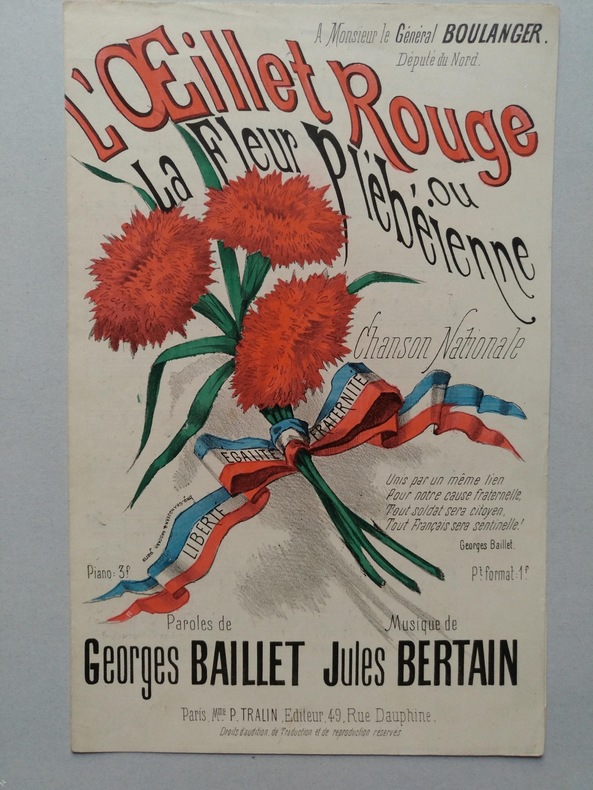
1888105941888 Paris, Tralin, éditeurs, (1888); Partition grand in-8°, 3pp. Couverture illustrée en couleurs.
356941J Snow 1837. SIXTH THOUSAND octavo half leatherbound brown heavy boards gilt lettering & tooling/decoration to spine with rsaised bands also aeg frontispiece illus title page xviii 590pp illus VG moderate scuffing & surface loss to leatherwork minor fading & rubbing to boards moderate soiling to gilt page edges & eps occasional light cracking to gutters prev. owner's name in ink to prelims moderate foxing throughout J Snow 1837 hardcover
56 ages. 49 Illustrations rendered for colouring from original designs by 21 native artists. Colour code provided. Light wear. Unmarked. Nice copy. Book
1907002660Cleveland: Privately Printed 1907. Paperback. Near Fine. 8 p. 1 leaf of a plate loose as issued: portrait; 23 cm. No stitching; loose in a brown wrapper as issued. Wrapper title in black within a decorative border. Wrapper title: A Portrait of Shakespeare by Nicholas Parr printed from the original plate with descriptive text. This is #125 of a limited edition of 250 copies. The engraver is actually Nathaniel not Nicholas Parr d. 1751 according to the Oxford DNB. The wrapper is handmade paper watermarked Fabriano Italy. The text is printed on handmade paper with an elaborate armorial watermark. Small label inside back wrapper for the Burrows Brothers Co. Cleveland Ohio probably the printer. The plate was only previously printed in 1747 for inclusion in Thomas Whincop's A List of All the Dramatic Authors with Some Account of Their Lives. Very scarce. In Near Fine Condition: wrapper lightly creased; clean and bright. Privately Printed paperback
- Lucien Vogel éditeur, Paris 1921, 18x24cm, une feuille. - Original color print, printed on vergé paper, signed in the plate. An original print used to illustrate the Gazette du bon ton, one of the most attractive and influential 20th century fashion magazines, featuring the talents of French artists and other contributors from the burgeoning Art Deco movement. A celebrated fashion magazine established in 1912 by Lucien Vogel, La Gazette du bon ton appeared until 1925, with a hiatus from 1915 to 1920 due to the war (the editor-in-chief having been called up for service). It consisted of 69 issues printed in only 2,000 copies each and notably illustrated with 573 color plates and 148 sketches of the models of the great designers. Right from the start, this sumptuous publication "was aimed at bibliophiles and fashionable society," (Françoise Tétart-Vittu, "La Gazette du bon ton", in Dictionnaire de la mode, 2016) and was printed on fine vergé paper using a type cut specially for the magazine by Georges Peignot, known as Cochin, later used (in 1946) by Christian Dior. The prints were made using stencils, heightened in colors, some highlighted in gold or palladium. The story began in 1912, when Lucien Vogel, a man of the world involved in fashion (he had already been part of the fashion magazine Femina) decided, with his wife Cosette de Brunhoff - the sister of Jean, creator of Babar - to set up the Gazette du bon ton, subtitled at the time: "Art, fashion, frivolities." Georges Charensol noted the reasoning of the editor-in-chief: "'In 1910,' he observed, 'there was no really artistic fashion magazine, nothing representative of the spirit of the time. My dream was therefore to make a luxury magazine with truly modern artists...I was assured of success, because when it comes to fashion, no country on earth can compete with France.'" ("Un grand éditeur d'art. Lucien Vogel" in Les Nouvelles littéraires, no. 133, May 1925). The magazine was immediately successful, not only in France but also in the United States and Latin America. At first, Vogel put together a team of seven artists: André-Édouard Marty and Pierre Brissaud, followed by Georges Lepape and Dammicourt, as well as eventually his friends from school and the School of Fine Arts, like George Barbier, Bernard Boutet de Monvel and Charles Martin. Other talented people soon came flocking to join the team: Guy Arnoux, Léon Bakst, Benito, Boutet de Monvel, Umberto Brunelleschi, Chas Laborde, Jean-Gabriel Domergue, Raoul Dufy, Édouard Halouze, Alexandre Iacovleff, Jean Émile Laboureur, Charles Loupot, Chalres Martin, Maggie Salcedo. These artist, mostly unknown when Lucien Vogel sought them out, later became emblematic and sought-after artistic figures. It was also they who worked on the advertising drawings for the Gazette. The plates put the spotlight on, and celebrate, dresses by seven designers of the age: Lanvin, Doeuillet, Paquin, Poiret, Worth, Vionnet and Doucet. The designers provided exclusive models for each issue. Nonetheless, some of the illustrations are not based on real models, but simply on the illustrator's conception of the fashion of the day. The Gazette du bon ton was an important step in the history of fashion. Combining aesthetic demands with the physical whole, it brought together - for the first time - the great talents of the artistic, literary, and fashion worlds; and imposed, through this alchemy, a completely new image of women: slender, independent and daring, which was shared by the new generation of designers, including Coco Chanel, Jean Patou, Marcel Rochas, and so on... Taken over in 1920 by Condé Montrose Nast, the Gazette du bon ton was an important influence on the new layout and aesthetics of that "little dying paper" that Nast had bought a few years earlier: Vogue. [FRENCH VERSION FOLLOWS] Estampe originale en couleur, tirée sur papier vergé, signée en bas à gauche dans la planche. Gravure originale réalisée pour l'illustration de La
- Lucien Vogel éditeur, Paris 1921, 18x24cm, une feuille. - Estampe originale en couleur, tirée sur papier vergé, signée en bas à gauche dans la planche. Gravure originale réalisée pour l'illustration de La Gazette du bon ton, l'une des plus belles et des plus influentes revues de mode du XXème siècle, célébrant le talent des créateurs et des artistes français en plein essor de l'art déco. Célèbre revue de mode fondée en 1912 par Lucien Vogel, La Gazette du bon ton a paru jusqu'en 1925 avec une interruption durant la Guerre de 1915 à 1920, pour cause de mobilisation de son rédacteur en chef. Elle se constitue de 69 livraisons tirées à seulement 2000 exemplaires et est illustrée notamment de 573 planches en couleurs et de 148 croquis représentant des modèles de grands couturiers. Dès leur parution, ces luxueuses publications « s'adressent aux bibliophiles et aux mondains esthètes » (Françoise Tétart-Vittu « La Gazette du bon ton » in Dictionnaire de la mode, 2016). Imprimées sur beau papier vergé, elles utilisent une police typographique spécialement créée pour la revue par Georges Peignot, le caractère Cochin, repris en 1946 par Christian Dior. Les estampes sont réalisées grâce à la technique du pochoir métallique, rehaussées en couleurs et pour certaines soulignées à l'or ou au palladium. L'aventure commence en 1912 lorsque Lucien Vogel, homme du monde et de la mode - il a déjà participé à la revue Femina - décide de fonder avec sa femme Cosette de Brunhoff (sur de Jean, le père de Babar) la Gazette du bon ton dont le sous-titre est alors « Art, modes et frivolités ». Georges Charensol rapporte les propos du rédacteur en chef : « En 1910, observe-t-il, il n'existait aucun journal de mode véritablement artistique et représentatif de l'esprit de son époque. Je songeais donc à faire un magazine de luxe avec des artistes véritablement modernes [...] J'étais certain du succès car pour la mode aucun pays ne peut rivaliser avec la France. » (« Un grand éditeur d'art. Lucien Vogel » in Les Nouvelles littéraires, n°133, mai 1925). Le succès de la revue est immédiat, non seulement en France, mais aussi aux Etats-Unis et en Amérique du Sud. À l'origine, Vogel réunit donc un groupe de sept artistes : André-Édouard Marty et Pierre Brissaud, suivis de Georges Lepape et Dammicourt ; et enfin ses amis de l'École des beaux-arts que sont George Barbier, Bernard Boutet de Monvel, ou Charles Martin. D'autres talents viennent rapidement rejoindre l'équipée : Guy Arnoux, Léon Bakst, Benito, Boutet de Monvel, Umberto Brunelleschi, Chas Laborde, Jean-Gabriel Domergue, Raoul Dufy, Édouard Halouze, Alexandre Iacovleff, Jean Émile Laboureur, Charles Loupot, Charles Martin, Maggie Salcedo. Ces artistes, inconnus pour la plupart lorsque Lucien Vogel fait appel à eux, deviendront par la suite des figures artistiques emblématiques et recherchées. Ce sont ces mêmes illustrateurs qui réalisent les dessins des publicités de la Gazette. Les planches mettent en lumière et subliment les robes de sept créateurs de l'époque : Lanvin, Doeuillet, Paquin, Poiret, Worth, Vionnet et Doucet. Les couturiers fournissent pour chaque numéro des modèles exclusifs. Néanmoins, certaines des illustrations ne figurent aucun modèle réel, mais seulement l'idée que l'illustrateur se fait de la mode du jour. La Gazette du bon ton est une étape décisive dans l'histoire de la mode. Alliant l'exigence esthétique et l'unité plastique, elle réunit pour la première fois les grands talents du monde des arts, des lettres et de la mode et impose, par cette alchimie, une toute nouvelle image de la femme, élancée, indépendante et audacieuse, également portée par la nouvelle génération de couturiers Coco Chanel, Jean Patou, Marcel Rochas... Reprise en 1920 par Condé Montrose Nast, la Gazette du bon ton inspirera largement la nouvelle composition et les choix esthétiques du « petit journal mourant » que Nast avait racheté quelques années auparavant : le magazine Vogue. [ENGLISH DESCRIPTIO
RARE collection of 12 lithographic reproductions of drawings illustrating scenes from life in an Eastern European Jewish shtetl. Includes an introduction by the Director of Visual Arts at the University of Judaism in Los Angeles Dr. Eric Ray. Folio measure: 455x357mm. Prints measure: 440x350mm. 12 b&w unpaginated prints & text page (same measure as prints) laid in portfolio (folder format). Folder front side slightly stained and worn. Folder edges and corners worn. Reproductions bottom right corner slightly creased/wrinkled. Text page bottom corners creased/wrinkled. [SUMMARY]: This extremely rare lithographed edition of beautiful drawings on Jewish themes is otherwise in good condition.
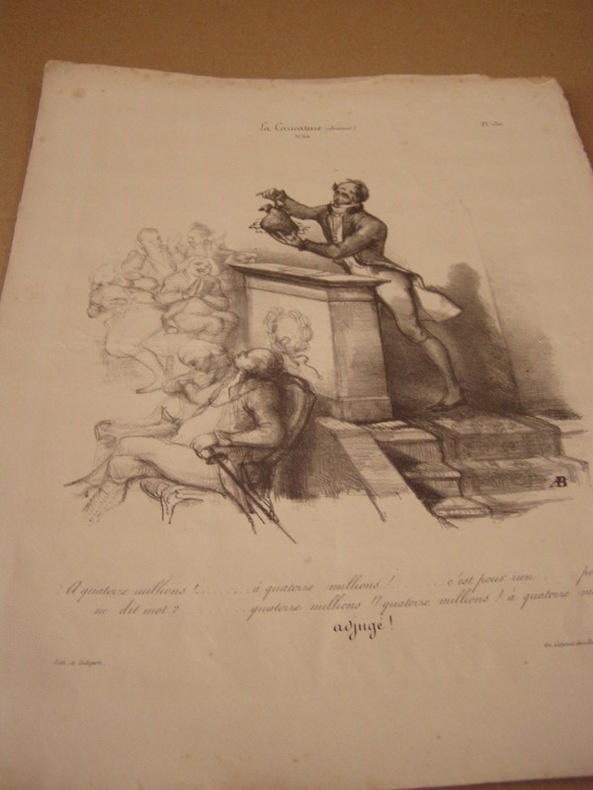
25215Planche HT parue dans La Caricature morale, religieuse, littéraire et scénique, volume 3, 19 janvier 1832, (Planche n°130) Hauteur : 35.6 cmx Largeur : 27.2 -Dimensions - Image Hauteur : 20 Largeur : 20.5 - Titre en bas au centre : « A quatorze millions !.....à quatorze millions !.....c’est pour rien…..personne / ne dit mot ?......quatorze millions !! quatorze millions ! à quatorze millions ! / adjugé ! » ; indications : en ht au centre : « La Caricature (Journal) / N°64. », en ht à dte : « Pl. 130. »Inscription - Dans la lettre : « Lith. de Delaporte. » [imprimeur], « On s’abonne chez Aubert, galerie vero dodat. » [éditeur] ; dans l’image, en bas à dte, signature : « AB » [Auguste Bouquet, dessinateur]
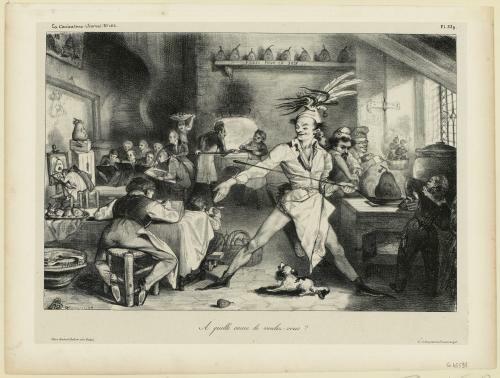
26359Planche HT parue dans La Caricature politique, morale, littéraire et scénique, volume 6, 13 décembre 1833 (Planche n°339)Pl. 339. / La caricature (journal) n°162. - Titre en bas au centre : « A quelle sauce la voulez-vous ? » ; indications : en ht à gche : « La Caricature (Journal) N°162. », en ht à dte : « Pl. 339. » - Dans la lettre : « Chez Aubert, Galerie véro Dodat. » [imprimeur], « L. de Becquet, rue Furstemberg 6. » [éditeur] ; dans l’image, en bas à gche, signature : « AB. » [Auguste Bouquet, dessinateur]Inscription - Sur le mur de gche, un graffiti représentant une poire à face humaine couronnée. Sur la tranche de l’étagère au mur, inscription « POIRES POUR LA SOIF… ». A gche au premier plan, une marmite de « MARMELA […] [MARMELADE] » de
pp. xiv; 186. Plus 49 full page facsimile illustrations. Small 4to. Original printed wraps. Limited Edition. **PRICE JUST REDUCED! REF2