8 853 résultats
1968137925Beverly Hills CA: Metro-Goldwyn-Mayer MGM 1968. Archive including 20 vintage linen-backed production photographs a trade advertisement a film program and a souvenir booklet from the 1968 film "2001: A Space Odyssey." From the collection of NASA scientific consultant Frederick I. Ordway III with images prominently featuring Ordway production designer Harry Lange Arthur C. Clarke Stanley Kubrick and others. One photograph has Ordway's name written on the recto in silver marker. All photographs mounted on matte board as issued. <br /> <br /> Ordway and Clarke began working together on matters of science fact in 1951 and Clarke personally invited him to be the factual advisor on the film. <br /> <br /> Kubrick's sprawling science fiction epic traces the evolution of human intelligence under the influence of an unspecified alien force. Along with "Blade Runner" Kubrick's masterpiece forever altered the standard for visual and conceptual sophistication in science fiction and genre films. The pre-production for the film set standards as well as Kubrick hired one of the greatest science fiction authors of the 1960s Arthur C. Clarke to be his screenwriter and hired over 20 scientists like Ordway to consult on every detail of the film. The film's high degree of scientific accuracy coupled with bleeding-edge special effects and minimal use of dialogue make "2001" universally recognized as one of the most influential films ever made. The development of the film was kept strictly under wraps and behind-the-scenes material of any kind is rare. <br /> <br /> Winner of an Academy Award for Best Special Effects and nominated for three others including Best Director. Set in space shot on location in Scotland England Arizona and Utah. <br /> <br /> Photographs 8 x 10 inches mounted on 11 x 14 inch matte board. Trade advertisement 9 x 12 inches full-color creased. Souvenir booklet 7.25 x 16 inches full-color 12 leaves saddle stapled folded. Program 5.5 x 8.5 inches black and white saddle stapled single leaf. Very Good to Near Fine. Metro-Goldwyn-Mayer [MGM] unknown
1928140436Beverly Hills CA: Metro-Goldwyn-Mayer MGM 1928. Draft script for the 1929 silent film. <br/><br/>Lon Chaney plays a heavily-scarred wild animal trapper whose daughter's upcoming marriage is threatened by the return of her femme fatale mother. The mother harbors bitterness to Chaney and seeks revenge on him by attempting to woo her daughter's fiance thwarted by a gorilla Chaney releases from a cage that gruesomely attacks her. Lon Chaney's penultimate silent film and the last of his collaborations with director Tod Browning. The film was released with a Movietone music and effects soundtrack that could be played alongside the film. <br/><br/>Tan titled wrappers rubber-stamped copy No. 10751 and production No. 415 dated Dec. 31 1928 with credits for producer Irving Thalberg. Title page integral with the first page of the text with credits for story writers Tod Browning and Harry Sinclair Drago and screenwriter Waldemar Young. 75 leaves with last page of text numbered 75. Mimeograph duplication. Pages about Fine wrapper Good plus bound with two gold brads. Metro-Goldwyn-Mayer [MGM] unknown books
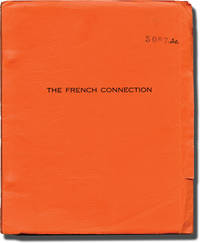
1970144038Los Angeles: Twentieth Century-Fox 1970. Revised Draft script for the 1971 film. SIGNED by director William Friedkin on the title page. <br/><br/>Friedkin made his name with this gritty adaptation of Robin Moore's non-fiction account of east coast drug trafficking. Perhaps the greatest of the many 1970s crime films that were shot on location in New York City with glorious period detail in nearly every frame. The screenplay was written by author Ernest Tidyman one year after the publication of his seminal Harlem-based crime novel "Shaft." Winner of five Academy Awards including Best Picture Best Director Best Screenplay and Best Actor for Gene Hackman along with three additional nominations. <br/><br/>Orange titled wrappers. Title page present dated October 6 1970 with credits for screenwriter Tidyman director Friedkin and producer Phil D'Antoni. 95 leaves mechanical duplication last leaf numbered 93. Pages Near Fine wrapper about Near Fine bound internally with two gold brads. <br/><br/>Grant US. Hardy BFI Companion to Crime. Spicer US. Twentieth Century-Fox unknown books
1969137209Burbank CA: American Broadcasting Company ABC 1969. Collection of 217 individually numbered contact sheets amounting to 2650 images from the 1969 film. Housed in two original three-ring binders from the film's publicity department. The occasional frame is circled or crossed through in red marker. A robust collection that documents nearly every facet of the film's production including numerous candid images of the cast and crew at work. <br /> <br /> Woody Allen's first film as a director one of the great American comedies the film that set the template for Allen's 1970s work. A massive archive documenting the birth of an utterly new and unique voice in cinema one that would become something even bigger in 1979. <br /> <br /> Set and shot in San Francisco and inside the walls of San Quentin State Prison. <br /> <br /> Sheets 8 x 10 inches most in three-hole mylar sleeves some with holes punched directly in left margin others laid in. Very Good overall few frames excised general modest edgewear. Binders with signs of use as expected one spine label missing other partially lacking but with titles intact. American Broadcasting Company [ABC] unknown
1960141447Tokyo: Shockiku Ofuna 1960. Draft script for the 1960 film. Text in Japanese. <br/><br/>A young woman is hitchhiking when the driver who picks her up attempts to molest her. A young gangster comes to her aid and then leads her on a wild relationship through the Japanese underground towards the eventual destruction of both of them. <br/><br/>White titled perfect bound wrappers. Title page present. 40 leaves with last page of text numbered 40. Mechanical duplication. Pages Near Fine wrapper Near Fine bound with two staples. <br/><br/>Godard Histoires du cinema. Shockiku Ofuna unknown books
1956141458Tokyo: Nikkatsu 1956. Draft script for the 1956 film. Text in Japanese. <br/><br/>A yakuza boss and his right hand man escape from prison and examine their relationship both matters of loyalty and betrayal as well as the scams and crimes they pull in their criminal history. <br/><br/>White titled perfect bound wrappers. Title page present. 41 leaves with last page of text numbered 37. Mechanical duplication. Pages Near Fine wrapper Near Fine. Nikkatsu unknown books
1966141426Tokyo: Nikkatsu 1966. Draft script for the 1966 film. Text in Japanese. <br/><br/>Based on a novel by Takashi Suzuki a repressed Catholic young man living in a boardinghouse is infatuated with the landlady's daughter and when he cannot express his feelings he turns to violence. He joins a gang and begins a fighting routine exploiting the weakness of classmates. <br/><br/>Set in Okayama shot on location in Japan. <br/><br/>Red titled perfect bound wrappers. Title page present. 113 leaves with last page of text numbered 19. Mechanical duplication. Pages Near Fine wrapper Near Fine. <br/><br/>Criterion Collection 269. Nikkatsu unknown books
1969143218Tokyo: Gendai Eigasha 1969. Draft script for the 1969 film. Front wrapper notes a date of 1969 and credit as a Gendai Eigasha production. <br/><br/>The second page is a elegaic introduction to the film story: "On the erotology and insurrection of sugi Sakae who wrote of dancing as flowers strangled and left in spring and It Noe who lived her entire life in confused beauty-we the youth and you and I in our degenerate joy which reaches an unbalanced complicity are talking."<br/><br/>Based on the life of anarchist Sakae sugi and his relationship with three women.It is the first film in Yoshida's trilogy of Japanese radicalism followed by "Heroic Purgatory" 1970 and "Coup d'Etat" 1973. Considered to be one of the most representative films from the Japanese New Wave movement. <br/><br/>Set in and shot on location in Japan. <br/><br/>White titled wrappers dated 1969. Title page present. 86 leaves with last page of text numbered d-44. Mechanical duplication. Pages Near Fine wrapper Very Good plus with mild foxing on rear wrapper title on spine. Gendai Eigasha unknown books
1962135663Universal City CA: Universal Pictures 1962. Original Pacific Title hand painted artwork for the original trailer advertising the classic 1962 film. In the final trailer Gregory Peck's name as the lead actor preceded this card making this a slightly alternate draft of the design. <br/><br/>14 x 20 inches. White gouache on stiff black illustration board. Very Good plus overall with mounting pinholes at the corners and brief tape remnants on edges. Minor edge bumping and creasing on the lower edge not affecting the artwork. Universal Pictures unknown books
1940131332Los Angeles: Self published 1940. First Draft script for an unproduced film titled "And Now Goodbye" an adaptation of his 1931 novel. Included are three typed letters signed by Hilton. Each letter is from Hilton to producer Lester Cowan on Warner Bros. Columbia Pictures and RKO Radio Pictures letterhead dated October 24 1939 May 14 1940 and May 22 1940 respectively. <br/><br/>In the letters Hilton discusses his negotiations with Laurence Olivier about the project having lunch with Mrs. Hitchcock and giving her the script hoping she'd impress her husband with it how the war has affected show business his book writing and his transfer from Columbia to RKO. <br/><br/>Hilton began writing the script 15 days after the release of "Lights Out in Europe" a short war documentary he wrote commentary for six months before the release of Hitchcock's "Foreign Correspondent" with dialogue from Hilton. Set in and around the dilapidated fictional town of Browdley. <br/><br/>Blue titled wrappers noted as First Draft on the front wrapper dated April 29 1940 with credits for screenwriter Hamilton. Title page present dated April 29 1940 noted as FIRST DRAFT with credits for screenwriter Hamilton. 128 leaves carbon typescript on onionskin stock. Pages Good plus wrapper Poor now encapsulated in archival mylar bound with two gold brads. Self published unknown books
1965135614Neuilly-sur-Seine France: Societe Nouvelle de Cinematographie SNC 1965. Vintage oversize double weight photograph of director Jean-Luc Godard behind the camera on the set of the 1965 film. Shot by photographer Georges Dudognon in the summer of 1965 with his stamp on the verso. <br/><br/>In a custom museum-quality frame archivally mounted with UV glass. 9 x 12 inches. Near Fine. <br/><br/>Criterion Collection 421. Godard Histoires de cinema. Societe Nouvelle de Cinematographie [SNC] unknown books
1969141375New York: Two Faces / New Yorker Films 1969. Vintage poster for the 1969 film an experimental mix of documentary and fiction. Poster designed by Robert Frank. <br/><br/>Director Robert Frank's first feature film in which he follows poet Peter Orlvosky and his mentally ill brother Julius as they move through the late 1960s Beat scene while Peter tries to care for his mostly catatonic brother. When Julius wanders off he is replaced in the film by actor Joseph Chaikin. The film examines the boundaries of reality and sanity and features the screenwriting debut of Sam Shepard and the first feature film appearance of Christopher Walken. <br/><br/>The film was restored and released by Steidl in 2007 along with a book publication outlining the film. From the Steidl book: "Frank's feature debut was first screened in 1968 at the Venice Film Festival. Everything which had defined Frank's art up to that point turns up in this film - the look at America 'from the outside' the poetic libertinage of the Beats the marginal in a central role. It celebrates the return of the poetic essay as assemblage the affirmation of the underground as a wild cinematic analysis in the form of a collage and skillfully weaves together opposites plays counterfeits against the authentic pornography against poetry acting against being Beat cynicism against hippie romanticism monochrome against colored. The story contains bizarre twists and turns and appears to be a rather artless-film-within-a-film being shown at a rundown movie theater."<br/><br/>26.75 x 20.75 inches. Near Fine. Two Faces / New Yorker Films unknown books
1959141457Tokyo: Nikkatsu 1959. Draft script for the 1959 film. Text in Japanese. With a single notation in holograph pencil. <br/><br/>Small-time deliquent criminals greatly enjoy robbing other people but fall into big trouble when they accidentally rob the Yakuza. <br/><br/>Brown titled perfect bound wrappers. Title page present. 84 leaves with last page of text numbered 18. Mechanical duplication. Pages Near Fine wrapper Near Fine. Nikkatsu unknown books
1959141461Tokyo: Nikkatsu 1959. Draft script for the 1959 film. Text in Japanese. <br/><br/>Based on Sueko Yasumoto's novel and one of the first examples of media dealing with the plight of zainchi or ethnically Korean Japanese citizens and their identity and struggles. One man has always worked faithfully for the Toho Company and another man is working for an underworld boss trying to scam Toho. They find each other again when one begins trailing and investigating the other. <br/><br/>White titled perfect bound wrappers. Title page present. 177 leaves with last page of text numbered 16. Mechanical duplication. Pages Very Good plus wrapper Very Good plus bound with two staples. Nikkatsu unknown books
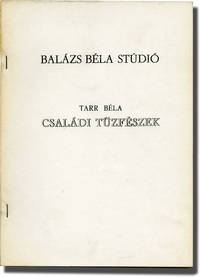
145506Budapest: Balsz Bela Studio 1977. Vintage post-production promotional script for the 1977 Hungarian film. Includes a prose narrative describing the film story reviews quotes and critical essays. Text in Hungarian.<br /> <br /> Easily the most rigidly philosophical promotional script ever issued with the narrative portion being essentially one long run-on sentence wherein Tarr describes his intentions for his first film. It would be 30 years before the rest of the world caught on to his genius and he would retire just 10 years after that. He passed away in 2026 at the age of 70.<br /> <br /> Off-white titled card wrappers saddle stapled. Title page present followed by a cast and credits list dated 1977. 56 leaves with last page of text numbered 54. Mimeograph front wrapper printed with offset duplication. Rectos only. Pages and wrapper about Near Fine with light toning at the edges of the wrappers. Balsz Bela Studio unknown
1957156242Los Angeles: Twentieth Century-Fox 1957. Final Draft script for the 1957 film. <br /> <br /> The first screen adaptation of the 1926 novel by Ernest Hemingway. One of the most honest film adaptations of its era attributable mainly to the screenplay by novelist and Hemingway acolyte Peter Viertel. Featuring a standout performance by Errol Flynn as the hedonistic hard-drinking burned-out Mike Campbell. in other words as himself. <br /> <br /> Shot on location in Pamplona Paris Biarritz and Mexico.<br /> <br /> Blue titled wrappers noted as FINAL on the front wrapper rubber-stamped copy No. 97 and production No. 683 dated February 20 1957. Distribution page present with receipt removed. Title page present dated February 20 1957 noted as Final Script. 154 leaves with last page of text numbered 142. Mimeograph duplication rectos only with blue revision pages throughout dated variously between 3/11/57 and 6/3/57. Pages with silverfish damage to the corners of the first few pages and final revision page else Near Fine wrapper Very Good plus with toning and creasing at the extremities and a small dampstain to the heel bound internally with three gold brads. Twentieth Century-Fox unknown
1924141664Berlin: Film-Kurier 1924. Original German programs for the two-part film series "Die Nibelungen" including one for "Die Nibelungen: Siegfried" and one for "Die Nibelungen: Kriemhild's Revenge" produced by German film magazine "Film-Kurier." Text in German. <br /> <br /> Based on the thirteenth century epic poem "Nibelungenlied." "Film-Kurier" was the first German film journal published daily beginning in 1919. The journal's classic era lasted until 1933 when its publisher Alfred Weiner had to flee Germany due to his Jewish origins. The issues from this era remain striking to this day because they were printed using a gravure reproduction process. Each day's issue would focus on a single film. <br /> <br /> 9 x 11.75 inches. Each program six pages folded loose leaves as issued. Very Good plus with a horizontal fold tiny pinholes to the corners and an occasional short closed tear. <br /> <br /> Masters of Cinema 46. Film-Kurier unknown
1948152186N.p.: N.p. 1948. Draft script for the 1948 British film. Copy belonging to production manager Mickey Delamar with his name in manuscript pencil to the title page and his manuscript annotations throughout. With revision pages laid in throughout the script along with a distribution receipt signed by Delamar and with a reference photograph from the film showing actors Vivien Leigh and Ralph Richardson. <br /> <br /> Delamar worked as a producer production manager and assistant director on over 30 films and was active in the film industry for four decades. His credits include Charlie Chaplin's "A King in New York" 1957 Francois Truffaut's "Fahrenheit 451" 1966 and Terence Young's "Mayerling" 1968.<br /> <br /> Based on the classic 1877 novel by Leo Tolstoy about how all happy families are alike but each unhappy family is unhappy in its own way. <br /> <br /> Set in St. Petersburg. <br /> <br /> Black titled wrappers. Title page present with credits for novelist Tolstoy and screenwriters Jean Anouilh Julien Duvivier and Guy Morgan. 190 leaves with last page of text numbered 165. Mimeograph duplication rectos only with pink and white undated revision pages throughout. Housed in a navy spring binder as originally used. <br /> <br /> Pages supple but Very Good only overall with curling at the edges. Photograph about Very Good with moderate soil and toning. Binder Good with soil overall. N.p. unknown
1948152186N.p.: N.p. 1948. Draft script for the 1948 British film. Copy belonging to production manager Mickey Delamar with his name in holograph pencil to the title page and his holograph annotations throughout. With revision pages laid in throughout the script along with a distribution receipt signed by Delamar and with a reference photograph from the film showing actors Vivien Leigh and Ralph Richardson. <br/><br/>Delamar worked as a producer production manager and assistant director on over 30 films and was active in the film industry for four decades. His credits include Charlie Chaplin's "A King in New York" 1957 Francois Truffaut's "Fahrenheit 451" 1966 and Terence Young's "Mayerling" 1968.<br/><br/>Based on the classic 1877 novel by Leo Tolstoy about a young woman whose loveless marriage leads her to begin an affair with a dashing Czarist officer. <br/><br/>Set in St. Petersburg. <br/><br/>Black titled wrappers. Title page present with credits for novelist Tolstoy and screenwriters Jean Anouilh Julien Duvivier and Guy Morgan. 190 leaves with last page of text numbered 165. Mimeograph duplication rectos only with pink and white undated revision pages throughout. Housed in a navy spring binder as originally used. <br/><br/>Pages supple but Very Good only overall with curling at the edges. Photograph about Very Good with moderate soil and toning. Binder Good with soil overall. N.p. unknown books
1974148727Tokyo: Toei 1974. Draft script for the 1974 Japanese film. Text and titles in Japanese. <br/><br/>Based on a series of magazine articles written by journalist Koichi Iiboshi which were in turn based on memoirs written by yakuza crime boss Kozo Mino. The fifth and final film in director Kinji Fukasaku's yakuza pentalogy following feuding gangs in post-war Hiroshima. <br/><br/>Set in Hiroshima.<br/><br/>Tan titled wrappers. 67 leaves with last page of text numbered D27. Mimeograph duplication printed on rectos and versos. Pages Very Good plus wrapper Very Good slightly wavy with light dampstains to the extremities bound perfectly. Toei unknown books
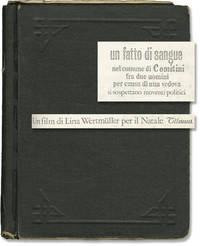
148341London: Lord Grade 1978. Draft script for the 1978 film here under the working title "Titoli di Testa." Copy belonging to script supervisor Franca Invernizzi with her extensive manuscript annotations on nearly every page and many page versos regarding camera shots takes timing and dialogue. Bound in after the script is an annotated list of scenes and several handwritten pages of Invernizzi's notes. Text in Italian.<br /> <br /> In 1920s Sicily a capitalist and a socialist vie for the affections of a grief-stricken woman whose husband was killed by a fascist mafioso. The follow-up to director Lina Wertmuller's Oscar-nominated 1976 film "Seven Beauties" and a lyrical formidable film in its own right. <br /> <br /> Set and shot on location in Sicily. <br /> <br /> Script:<br /> <br /> Black faux-leather untitled wrappers. Title page present with credits for director Lina Wertmuller. 326 leaves with last page of text numbered 301. Xerographic duplication rectos only with white undated revision pages throughout. Pages Very Good with some revision pages lightly worn and toned to the edges wrapper Very Good lightly edgeworn with several tape repairs to the spine with perfect binding.<br /> <br /> List of scenes:<br /> <br /> 10 leaves with last page numbered 10. Xerographic duplication rectos only. Pages Very Good plus with light edgewear. Lord Grade unknown
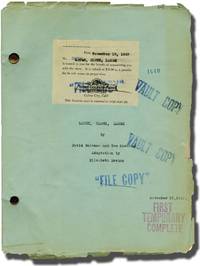
1927134524Beverly Hills CA: Metro-Goldwyn-Mayer MGM 1927. Shooting script for the 1928 film. Metro-Goldwyn-Mayer file copy with rubber stamps on the front wrapper indicating such. Carbon typescript with descriptive text and intertitles in black type. A few typeovers and annotations in manuscript pencil throughout. A rare example of a silent film screenplay. <br /> <br /> Based on the 1923 stage adaptation by David Belasco and Tom Cushing about professional clowns Tito Chaney and Simon Siegel who take in an abandoned child and name her Simonetta Young who was 15 at the time. When Simonetta is older she joins the circus and meets Count Luigi Ravelli Asther who becomes infatuated with her. Ravelli consults a doctor about his fits of uncontrollable laughter and there he meets Tito who has come to seek help for his fits of uncontrollable weeping. The two decide to help each other but soon find they are both vying for Simonetta's love. <br /> <br /> Nominated for an Academy Award in 1929 for Best Title Writing the only year for that category. <br /> <br /> Set in Italy shot on location in Elysian Park a suburb of Los Angeles California. <br /> <br /> Blue studio wrappers noted as FIRST TEMPORARY INCOMPLETE on the front wrapper rubber-stamped production No. 1640 and copy No. 5236 dated November 19 1927 with credits for playwrights Belasco and Cushing and screenwriter Meehan. 72 leaves carbon typescript on watermarked onionskin stock. Pages Near Fine wrapper Very Good now encapsulated in mylar bound with two gold brads. <br /> <br /> Blake 2001 US. Metro-Goldwyn-Mayer [MGM] unknown
1966140604Los Angeles: Expanding Cinema 1966. Shooting final for the 1966 film. Copy belonging to actor Peter Haskell with his holograph annotations throughout and his shooting schedule laid in. <br/><br/>Mary Ellen Bute's final film and one of the only cinematic adaptations of James Joyce's masterfully complex work of fiction "Finnegans Wake." Shot over a two year period Bute was tasked with transforming Joyce's impenetrable prose without losing any of the work's surreal lyrical essence. The subsequent film maintains the original novel's oneiric style. Bute and her husband Ted Nemeth were longtime collaborators and Nemeth worked as both cinematographer and producer of the film. In 1965 it was honored at the Cannes Film Festival as Best Debut and remains Bute's sole feature length film. <br/><br/>Shot on location in New York City and Dublin. <br/><br/>Brown untitled wrappers. Title page present dated March 4 1963 and December 3 1962 noted as Shooting Final with credits for screenwriters Mary Ellen Bute Romana Javitz and T. J. Nemeth Jr and editor A.I.M.S. Street. 148 leaves with last page of text numbered 139. Mimeograph duplication with onionskin revision pages throughout. Pages Very Good plus wrapper Very Good plus. Some pages detaching and wrapper slightly cracked. Bound internally with prong binding. Expanding Cinema unknown books
1960143342Tokyo: Toho Company 1960. Draft script for the 1960 film. With the stamp of cast/crew member Takahashi Toshihiro to the page edges and manuscript ink annotations to the rear wrapper. Text and titles in Japanese.<br /> <br /> A film that bought depictions of modern life into Japanese films of the 1960s particularly with respect to the idea of the independent woman. A young widowed bar hostess finds herself torn between a conventional life and potential financial independence when she must decide to either remarry or open her own bar. <br /> <br /> Set in Tokyo's Ginza district shot on location in Tokyo. <br /> <br /> White titled wrappers noted as 2 on the front wrapper. Title page present. 94 leaves with last page of text numbered f-31. Xerographic duplication printed on rectos and versos. Pages Near Fine wrapper Good with foxing wear to the binding and light soil overall. With perfect binding.<br /> <br /> BFI 694. Criterion Collection 377. Toho Company unknown
1929137372Budapest: Hunnia Filmstudio 1929. Presentation copy of an Early Draft script for the Hungarian film released in Hungry in 1932 as "Tavaszi zapor" in Frace in 1933 as "Marie Legende Hongroise" and in the United States in 1935 as "Spring Shower." Housed in a likely hand-sewn floral cloth-covered portfolio the script is INSCRIBED by the Hungarian-American feminist and radical socialist screenwriter Ilona Fulop on the title page: "To Mac: / Because You still trust me! / Ilona / Christmas 1929 / Hollywood Cal." A unique and attractive item and probably the only surviving copy of the script. <br/><br/>The story of a poor girl driven out of her village when she becomes pregnant by her employer's wealthy fiance finding refuge working as a maid in a brothel. After her daughter is taken from her however she falls into alcoholism and dies. A maid in Heaven as she was on earth she saves her daughter from befalling a similar fate by "emptying her mop bucket" on her daughter's head via a rain shower at a pivotal moment. <br/><br/>A multinational production in which a Hungarian screenwriter and Hungarian director both with experience in Hollywood shot a film starring a French actress using frozen assets from a French producer that had been mandated for exclusively Hungarian use. Though not a box office success at the time it is now regarded as one of the all-time great films originating from the country. In a 1919 article entitled "What is 'Revolution' Doing to Love" screenwriter Fulop describes herself as a socialist radical as opposed to a revolutionary or a Bolshevik and her desire to further equal rights for women strongly defines her as a modern-day feminist as well. "Spring Showers" with its women- and proletarian-friendly plot thus comes as little surprise. <br/><br/>Housed in floral cloth-covered portfolio titled wrappers. Title page present with credits for screenwriter Fulop. 78 leaves with last page of text numbered 77. Carbon typescript. Pages Very Good portfolio Very Good bound with a single line of hand-stitching. Hunnia Filmstudio unknown books