[Ohne Autor]Antiquariat.de

3 325 résultats
194511081Rom, Libreria Editrice Vaticana, 1945. Editio Typica 8° (18,5-22,5 cm). VIII, 263 S. Ganzleder mit goldgeprägtem Deckeltitel und Ganzkopfgoldschnitt
186910912Augsburg, Kranzfelder, 1869. Lex.-8° (25-30 cm). 16 S. Leinwand mit goldgeprägter Deckelverzierung sowie Ganzkopfrotschnitt
199411211Freiburg/Basel/Wien, Herder, 1994. 12° (15-18,5 cm). 16*, 432 S. OKunstleder mit OUmschlag und zwei Lesebändchen
196513005[ohne Ort], [ohne Drucker], 1965. 12° (15-18,5 cm). 52, 15, 22, 69 S. OLeinwand mit goldgeprägtem Deckeltitel [2 Warenabbildungen]
177436723Passau, F. G. Mangold, 1774. 4°. Mit einigen Holzschn.-Initialen u. -Vignetten sowie Notenbeispielen. Durchg. in Rot u. Schwarz gedruckt. 4 Bll., 195 (1) S., Blindgepr. Ldr. d. Zt. a. 4 Bünden m. dreiseitigem Rotschnitt.
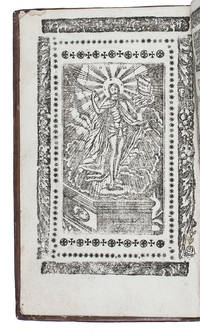
1801EBLBODAMZ2KRKiev 1801. 8vo in 4s 18.5 x 11.5 cm. Pechersk Lavra Monastery of the Caves Contemporary gold-panel-stamped and gold-tooled calf by the Kiev Monastery of the Caves sewn on 4 cords with a panel stamp of Jesus on the front board 9.7 x 4.5 cm perhaps with a name in the left half of the lower border and a panel stamp of Maria with the serpent holding an apple under her feet 9.5 x 4.3 cm each in a gold-tooled border and with another gold-tooled border around the whole board gold-tooled spine with "Kanonu Paskhi" Easter Canon in Old Slavonic capitals in the second of five compartments gilt edges. The endpapers like the paper of the book itself are laid and have a blue-green cast. Easter liturgy in Old Church Slavonic with title-page and about 20 other pages printed in red and black the title in a woodcut border and with a woodcut Paschal lamb a full-page engraving of Jesus's Resurrection 10 x 6 cm on the back of the title-page all pages after the title-page with borders made up of 4 woodcut strips woodcut head- and tailpieces and decorated initials a 17 mm and a 9 mm series and decorations built up from cast fleurons. Set in 3 sizes of Old Slavonic poluustav cyrillic type. Printed on laid paper with a blue-green cast. A Russian Orthodox service book for Easter and the week following it in the Old Church Slavonic language printed published and bound at the Pechersk Lavra Monastery of the Caves in Kiev. The monastery was established in the 11th century. After the fall of Constantinople in 1453 the Orthodox Churches in Russia and Ukraine developed independently. The power of the Czars allowed the Russian Orthodox Church to dominate so that the Ukrainian Church came under the Moscow Patriarchate in 1686. The Monastery of the Caves is therefore now Ukrainian Orthodox but fell under the authority of the Russian Orthodox Church when the present service book was published. It nevertheless had its own traditions and rites so that the present book should be regarded as part of the Ukrainian heritage.The only other copy we have located is at Amsterdam University Library one of three Easter service books by the Kiev Pechersk Lavra recorded on WorldCat all octavos. With a lengthy cyrillic inscription on an endleaf. The sewing is somewhat loose and as a result a few leaves are tattered at the edges. There are occasional minor smudges and drops of candle wax. Much of the gold-tooling has rubbed off the binding and the spine is slightly damaged. In spite of these minor defects the book is in good condition especially for a book of this nature.l For the Kiev bindery: S. A. Klepikov "Historical notes on Ukrainian bookbinding" in: The book collector 15 1966 pp. 135-142. unknown
1896AQ28784Mechliniae i.s. Mechelen: H. Dessain 1896. xli 502 60 24pp 2. With a half tile. Printed in red and black. Elaborately bound in contemporary richly gilt-tooled red morocco device of seated christ proffering book with Greek letters alpha and omega within ornate border to both boards A.E.G. with eight divisional red moire cloth tabs one partially perished gilt dentelles decorated endpapers. Slightest of rubbing to extremities. Internally immaculate. An exquisitely bound late nineteenth-century Continental edition of the Roman Missal. The Roman Missal with origins in the high middle ages is the liturgical book from which the text and rubrics for the celebration of Catholic Mass with both prayers and music. One of the major advances of the Council of Trent the Catholic counter to the Protestant Reformation was to standardise the Missal. Pope Pius V acting on the concilliar deciion formalised this in his Quo Primum on 14 July 1570 - insisting that the standard form of the Missal was used throughout the Church except where a local missal could be proved to be of two centuries antiquity. Perhaps one of the most controversial Counter-Reformation decisions made at Trent the use of a standard Missal prevented the celebration of the Mass in vernacular languages and signified a further strengthening of Papal authority: particularly as all printed editions were prefaced by the Pope's order of standardisation. The Missal of Pius V was further edited by Clement VIII in 1604 and later by Urban VIII in 1634. . Large 8vo. H. Dessain hardcover
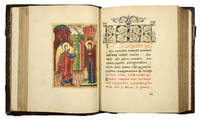
94903Russia 1866. . 4to 23 x 185 cm. Illuminated manuscript on paper ff. 4 index 4 blank 344 17 lines per page alphabetic signatures and pagination of Cyrillic alphabetic numerals 35 full-page illuminations in watercolour 36 headpieces in black and gold with first lines in gilt; occasional light spotting and soiling mostly marginal. Contemporary gilt-stamped red morocco gilt spine with raised bands edges gilt and gauffered gilt endpapers; slightly rubbed lacking both clasps.<br /> An exceptionally fine example of an Old Believer liturgical book beautifully illustrated with 35 full-page illuminations.<br /><br />Created by a skilful master they depict in great detail the most significant events of the New Testament including the Annunciation the Nativity the Baptism of Christ the Ascension the Twelve Apostles and more.<br /><br />This volume was made for and used by Old Believers who separated from the official Russian Orthodox Church as a protest against church reforms introduced by Patriarch Nikon of Moscow between 1652 and 1666. These Old Believers refused to accept alterations and amendments to the Holy texts aimed at bringing their religious practice closer to the 'original' Greek Orthodoxy. They refused to allow sacred texts to be printed instead reproducing them as manuscripts. <br /><br />The large size of this book its high-quality paper neat script very detailed illuminations and attractive gilt binding prove beyond doubt that no expense was spared on its production. As the colophon indicates it was made for Evdokiia Ivanovna Babaeva the wife of a merchant in Kolomna which was then an important trade point near Moscow. There are records of several men with this surname in Kolomna during the mid-XIX century all of them owners of factories in the city and probably members of the same wealthy merchant family. Kolomna was also important as a centre of the Old Believer community. The city's Bishop Paul fiercely opposed Patriarch Nikon's reforms and was consequently stripped of the rank of Bishop exiled and eventually killed in 1656 rendering him a martyr in the view of many Old Believers.A century later 156 Old Believers were officially registered in Kolomna then a city of 5400 inhabitants. Many more practised their beliefs in secret to avoid persecution.<br /><br />This volume later belonged to Cornelius J. Hauck 1893-1967 whose outstanding and somewhat eclectic collection was formed with the help of the well-respected antiquarian bookseller Emil Offenbacher between 1945 and 1965. The collection was given to the Cincinnati Historical Society Library in 1966 where it remained largely unknown to the world until part of it was auctioned by Christie's in New York in 2006.<br /><br />Russian manuscripts of this quality and preserved in such pristine condition are extremely rare.<br /> S.S. Mikhailov Istoriya staroobriadchestva g. Kolomna i ego okrestnostey Kolomna Staroobriadcheskaya obshchina khrama Nikoly na Posade v g. Kolomna 2013. Russia, [1866]. hardcover
Later wrappers, 8vo. 219, 16 pages, 20 cm. In Hebrew. Personal copy of Rabbi Jacques J. Lyons with his stamp. Jacques Judah Lyons (1814-1877) was an American rabbi. He was born and educated in Surinam, but ultimately left for America in 1837. He was the rabbi at Congregation Beth Schalom in Virginia and from 1839 onward, was the elected rabbi of Congregation Shearith Israel in NYC. He helped found Mount Sinai Hospital (Wikipedia, 2019) . SUBJECTS: Humash. OCLC lists 4 copies worldwide (Ets Haim, U. Library Amsterdam, Bamberg) . Vinograd Roedelheim, 71. Lacks wrappers. Has been trimmed down with some minor loss of text to title page. (RAB-66-11)
Edizioni Esca, settembre 1966. Documenti Pontifici, Paolo VI. Lettere Pastorali sui documenti Pontifici. Lettere Pastorali sui documenti conciliari. Liturgia. Strumenti della comunicazione sociale. Chiesa. Ecumenismo. Documenti della IV sessione del Concilio: presentazioni. Riflessioni sul Concilio. Altre lettere Pastorali dell'Episcopato Italiano. 2342 pagine. 22 cm x 32 cm.Indice schematico, indice analitico, indice degli autori, indice generale. Libro in ottime condizioni. Ordinarie tracce del tempo. Non ci sono strappi o scritte al suo interno. Spedizioni tracciabili con raccomandata in tutta Italia entro 24 ore dall'ordine. Hardback cover, all in good conditions, no price clipped, no inscriptions or markings inside. Worldwide delivery.
cm. 18 x 25,5, vi-246 pp. Historiae Musicae Cultores - Biblioteca Partendo dal principio che la musica sacra non si identifica necessariamente con la musica religiosa, sono presi in considerazione vari aspetti della musica legata all?idea del sacro in maniera indipendente dai generi e dalle culture. L?argomento ? affrontato dal punto di vista filosofico, storico e di analisi in un arco cronologico dall?antichit? ai nostri giorni. Starting with the principle that sacred music cannot necessarily be identified with religious music, various aspects of music, bound to the idea of sacredness in some independent way by genre and culture, are taken into consideration.The matter is dealt with from a philosophical and historical point of view analysing a chronological period ranging from ancient times to the present day. 510 gr. vi-246 p.
cm. 17 x 24, xii-174 pp. con 16 figg. n.t. e 14 tavv. f.t. di cui 4 a colori. Historiae Musicae Cultores - Biblioteca Nove contributi seguiti da animate discussioni testimoniano che fonti frammentarie di canto liturgico possono procurare rivelazioni importanti. Nel volume vengono trattate consuetudini liturgico-musicali peculiari, che spaziano da Trento a Padova, da Como a Benevento, da Ravenna al Paese Basco, in un arco temporale compreso fra l?Alto Medioevo e l?et? moderna. Completano il quadro i riferimenti ad alcuni progetti in progress che valorizzano l?apporto dell?informatica allo studio del repertorio liturgico. Nine papers and the following lively discussions testify how fragmentary sources of hymns can procure important revelations. The volume deals with characteristic liturgical musical customs in vast areas from Trento to Padova, from Como to Benevento, from Ravenna to the Basque Country in a space of time ranging from the early Middle Ages to Modern times. Detailed references to current projects and the contribution of computer science in the study of liturgical repertoires conclude the picture. 395 gr. xii-174 p.
cm. 15 x 21, xxxviii-256 pp. con 1 tav. f.t. e molti es. mus. n.t. Fondazione Giorgio Cini - Istituto Venezia e l'Oriente. Orientalia Venetiana Un?indagine centrata sulla ricostruzione del significato dell?esperienza musicale in Cina sia in ambito teorico che applicativo. Abbandonato il dubbio tentativo di sistematizzare le sfaccettature di una esperienza tanto complessa all?interno di una meta-teoria musicale, si ? privilegiata l?individuazione di specifici ?itinerari di senso? che testimoniano la variet? delle risposte cinesi agli interrogativi sul ?significato? della musica. Each study in this volume explores and clarifies one or more aspects of the multifaceted nature of Chinese musical experience, focusing on its construction of meaning, both in the theoretical debate and in the realm of practice. Rather than attempting to construct some kind of meta-theory for the comprehension of Chinese music as a whole, it aims at reconstructing local itineraries of ?sense? deriving from context and comparison, to show the extraordinary variety of responses given in China to the problem of musical meaningfulness. Inglese 420 gr. xxxviii-256 p.
cm. 18 x 25,5, 348 pp. 746 gr. 348 p.
cm. 17 x 24, xii-276 pp. con es. mus. n.t. Quaderni della ?Rivista Italiana di Musicologia? 575 gr. xii-276 p.
cm. 15 x 23, xiv-518 pp. Rilegato. Fondazione Giorgio Cini - Civilt? veneziana - Studi 926 gr. xiv-518 p.
1980019359Böhlau Verlag, Köln 1980. Reprint, Faksimile, Nachdruck Leinen Sehr gut
Very Good Latin Paperback. Pbo. Roy. 8vo. (24 x 16 cm). In Latin. [viii], 129, [1] p., index. Introductio in librum Ieremiae. The Book of Jeremiah is the second of the Latter Prophets in the Hebrew Bible, and the second of the Prophets in the Christian Old Testament.
Very Good French Original 1/4 leather bdg. Six compartments on spine, second has book title gilt. 12mo. /17 x 12 cm). In Hebrew and French. [viii], 565, [1] p. All edges gilt. Prieres journalieres a l'usage des Israelites du rite Portugais. Traduction française de A[lexandre] Crehange. Crehange who wrote under the pen name Ben Baruch, was a French Jewish writer and communal leader. Créhange was born to a religious Jewish family in Étain, a small town in Lorraine, where his father worked as hazzan of the local synagogue. By 1801, the family had moved to Dijon. He moved at a young age to Germany to work at a commercial house, but returned to France after going bankrupt. There he worked as a peddler and bookkeeper in Saint-Étienne, while serving as head of the Jewish community of nearby Lyon. Créhange moved to Paris in the 1830s. A supporter of the French Revolution of 1848, he published "La Marseillaise du travail", in which he provided new words to La Marseillaise to celebrate the cause of the proletariat, and a pamphlet purporting to show how the Tanakh prescribes a republic as the optimal form of government.At the same time, he became the spokesman for the Parisian Orthodox community in a series of disputes with the Consistoire central, which he saw as representing the interests of the Jewish elite. In 1848 he organized the Club démocratique des fidèles, which promoted republicanism and civic responsibility, and started a weekly periodical, La Vérité, in which he defended the rights of the Orthodox. He ardently lobbied for the introduction of universal male suffrance in consistorial elections.[5] Créhange also advocated against the heavy taxes imposed by the Consistoire on meat sold by butchers that it authorized as kosher, the sale of seats and aliyot in the synagogue, the costly dues for burial rites and plots, and the ban on private prayer assemblies. Créhange was one of the ten founders of the Alliance Israélite Universelle, of which he served as vice-president in 1863-1864, and would later become secretary of the Comité de Bienfaisance Israélite and the Consistoire central. Créhange translated and edited a number of liturgical volumes during the Second Empire. In 1846, Créhange published in two volumes a French translation of the Tseno Ureno under the title La Semaine Israélite, ou le Tzeéna Ouréna Moderne, Entretiens de Josué Hadass avec sa Famille sur les Saintes Ecritures. He also published a translation into French of the Hagaddah (1847); a book of prayers of the French Jews entitled Tefillat 'Adat Yeshurun (1850); Min?ah ?adashah, prayers of the Sephardic Jews (1855); an illustrated translation of Tehillim (1858), festival prayers for the use of Franco-Spanish and Franco-Portuguese Jews (6 vols., 1861-63); and from 1850 to 1872 an almanac, Annuaire Parisien. He edited two periodicals: La paix, revue religieuse, morale et littéraire (1846) and Annuaire parisien du culte israélite (1851-71). (Source: Wikipedia). [= Daily prayers for the use of Israelites of the Portuguese rite]. First and Only Edition. Aviva Ben Ur's Rare Book list: 103a. OCLC: 55233895.; 875026624.
Mm 170x240 Volume nella sua copertina rigida editoriale con scritte in oro al piatto e al dorso. Testo di 708 pp. Opera in perfetto stato di nuovo. Imponente repertorio bibliografico sulla musica medievale.
Mm 120x170 Opuscolo di pp. 10 della liturgia d'apertura per il nono centenario della nascita di S. Ubaldo, 11 settembre 1985. Opera in buone condizioni.
Mm 120x170 Opuscolo di pp. 7 per l'organizzazione della liturgia d'apertura per il nono centenario della nascita di S. Ubaldo, 11 settembre 1985. Opera in buone condizioni.
Mm 110x190 Collana "Quaderni di spiritualità". Volume nella sua brossura originale, 125 pagine. Opera in buone condizioni, presenta alcune sottolineature a matita. Spedizione in 24 ore dalla conferma dell'ordine.
Mm 120x175 Volume cartonato di pp. 1663, astuccio editoriale, rarissime sottolineature a penna. Timbro di appartenenza al frontespizio. Testo originale con traduzione italiana a fronte. Opera in ottime condizioni. SPEDIZIONE IN 24 ORE DALLA CONFERMA DELL'ORDINE. WORLDWIDE DELIVERY.
Mm 140x210 Collana "Sulle vie del concilio". Volume nella sua brossura originale con sovraccoperta in acetato, 257 pagine. Opera in buone condizioni, presenta alcune sottolineature e una scritta a matita in chiusura del volume. Spedizione in 24 ore dalla conferma dell'ordine.