King, Martin Luther, JrBiblio.com
7 433 résultats
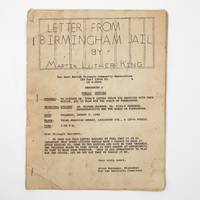
1963372454Harlem New York 1963. 14pp. duplicated typescript. 8vo. Stapled at gutter margin. 14pp. duplicated typescript. 8vo. Unrecorded printing of MLK's Letter from Birmingham Jail distributed by indefatigable community organizer and advocate Alice Wragg Kornegay 1932-1996 founder of the East Harlem Triangle Community Association. Kornegay produced this mimeographed version in preparation for an Association meeting to discuss the Letter three weeks before the March on Washington in August 1963. In her printed note on the first page she wrote "We send you this letter because we feel that it is so important that every citizen should have a chance to read it. After reading it come to the meeting and give up your thoughts. The Triangle plans to take action in this moment of opportunity. We want to hear from everyone. This is our opportunity to plan for the future let no one say that we passed it by."<br /> <br /> King's non-violent Birmingham campaign protesting racism and racial segregation in Birmingham began on April 3 1963. Arrested and jailed on Good Friday April 12 for violating an Alabama injunction against demonstrating that same day a group of white clergyman published a letter in a Birmingham newspaper denouncing King's campaign. King details the writing of his famous Letter from Birmingham Jail in his Why We Can't Wait: "Begun on the margins of the newspaper in which the statement by the white clergyman appeared while I was in jail the letter was continued on scraps of writing paper supplied by a friendly black trusty and concluded on a pad my attorneys were eventually permitted to leave me."<br /> <br /> "Without notes or research materials King drafted an impassioned defense of his use of nonviolent but direct actions. Over the course of the letter's 7000 words he turned the criticism back upon both the nation's religious leaders and more moderate-minded white Americans castigating them for sitting passively on the sidelines while King and others risked everything agitating for change. King drew inspiration for his words from a long line of religious and political philosophers quoting everyone from St. Augustine and Socrates to Thomas Jefferson and then-Chief Justice of the United States Earl Warren who had overseen the Supreme Court's landmark civil rights ruling in Brown v. Board of Education. For those including the Birmingham religious leaders who urged caution and remained convinced that time would solve the country's racial issues King reminded them of Warren's own words on the need for desegregation 'justice too long delayed is justice denied.' And for those who thought the Atlanta-based King had no right to interfere with issues in Alabama King argued in one of his most famous phrases that he could not sit 'idly by in Atlanta' because 'injustice anywhere is a threat to justice everywhere'" Barbara Maranzani "Behind Martin Luther King's Searing 'Letter from Birmingham Jail'" https://www.history.com/news/kings-letter-from-birmingham-jail-50-years-later.<br /> <br /> In early May mimeographed drafts of the letter were circulated to King's close associates and important community leaders and clergy extant in at least . After the New York Times chose not to publish the letter extensive excerpts were published from one of the mimeographed drafts without King's consent on May 19 1963 in the New York Post Sunday Magazine; other newspaper and magazine printings followed in June. Within days of the New York Post printing however the American Friends Service Committee received King's permission to publish 50000 copies in pamphlet form with an iconic wrapper title with jail bars in the background - the first separate printing of the Letter.<br /> <br /> A critical text of the Civil Rights movement in an unrecorded printing which speaks its immediate impact and use as a rally cry ahead of the March on Washington. Not recorded by the Martin Luther King Papers Project unknown
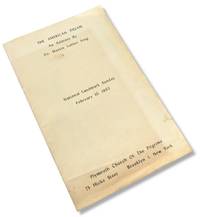
196365889Brooklyn: Plymouth Church of the Pilgrims 1963. 13pp. Offsetting to wraps some foxing throughout else a very good example. Provenance upon request. On February 10 1963 Dr. Martin Luther King Jr. came to Brooklyn Heights. He delivered an address at Plymouth Church that he called “The American Dream.†Dr. King worked on the piece and it evolved into his historic “I Have a Dream†speech delivered later that year on August 28 in Washington D.C.<br /> <br /> OCLC locates no examples. Plymouth Church of the Pilgrims unknown
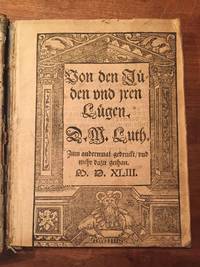
1543Boston2Von den Jüden und iren Lügen Zum andernmal Gedruckt vnd mehr dazu gethan.Wittemberg Lufft 1543. 128 pages. 18.5 cm. Bound in a 15th century leaf. 17th century inscription on the inside board. This is Panzer 3425.This work is printed in the same year as the first edition but enlarged as the title indicates. Title page lower margin cut. Else good. <br /> German religious reformer and founder of the Lutheranism movement Martin Luther grew increasingly hostile towards the Jews following their refusal to accept his religious reformations. <br /><br /> In the present work the most virulent of Luther's anti-Semitic attacks he subjects the Jews to a torrent of vile abuse. His practical suggestions range from forced labor to outright banishment: "First their synagogues should be set on fire and what ever does not burn up should be covered over with dirt so that no one may ever be ale to see a cinder or stone of it. Secondly their homes should likewise be broken down and destroyed.And this ought be done for the honour of God and of Christianity in order that God may see that we are Christians and that we have not wittingly tolerated or approved of such public lying cursing and blaspheming."<br /><br /> Due to Luther's vituperative anti-Jewish polemics the Lutheran church retained all the superstitious abhorrence of the Jews inherited from the medieval Catholic church.On Luther's conception of the Jews in this work see J. Trachtenberg The Devil and the Jews- The Medieval Conception of the Jew and its Relation to Modern Anti-Semitism 1983 p.183 et<br /><br /><br /><br /><br /><br />
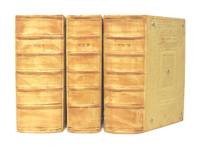
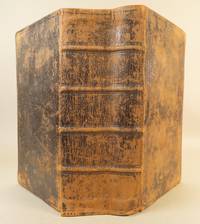
168110510Wittenberg Christian Schrödtern 1681-1682. 3 volumes 52 1189 2378 columns 28 601 1202 columns 1 32 524 1048 columns 28 688 1376 columns 1 48 602 1204 columns 26 751 1502 columns 96 1 p. Blind-stamped Leather with 5 raised bands each board equipped with 5 brass studs Folio Facsimile Edition of the famous Bach Bible in 3 volumes all kept in a perfectly fitting wooden case decorated with gilt. The set contains a true and complete reprint of Bach's Bible being a German Bible with extensive commentaries by Abraham Calovius founded on the writings of Martin Luther. This is the first complete facsimile-edition of Bach's Bible published by the Dutch publisher Uitgeverij Van Wijnen after the original being preserved in Concordia Seminary Library St. Louis. Each volume contains Bach's handwritten monogram on the title page and the set contains a total of 348 additions by Bach. Among which many underlined passages -both in red and black ink- various corrections of typographical and grammatical errors but most importantly his comments in the margins. A unique glimpse into Bach's personal beliefs and how he understood his vocation. Wittenberg, Christian Schrödtern hardcover
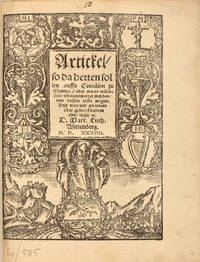
1538LCS-1864037<p><strong>The Smalkalde Articles written by Luther in 1536 in preparation for the Council of Mantua.</strong></p><p><strong>"<em>Schmalkaldic Articles</em></strong><em> <strong>are one of the confessions of faith of Lutheranism</strong></em><strong>".</strong></p><p>4to of 32 ll. Half-vellum flat spine brown morocco lettering piece. <em>20th century binding</em>.</p><p>191 x 151 mm.</p><p>Rare first edition of the "Articles of Smalkalde" written by Luther in 1536 and which offer a synthesis of his doctrine.</p><p>Graesse <em>Trésor de livres rares</em> 306.</p><p>Luther's attacks on the papacy were repeated and virulent. In 1535 Pope Paul III wearily proposed convening a council. The Protestants of the Smalkalde League meeting in assembly nevertheless made demands to take part. The council was convened in Mantua for May 1537. Immediately Luther compounded what would later be known as the Smalkalde articles in which he exhibited the essential points of his doctrine. The Council was postponed and did not take place until 1545 in the city of Trent.</p><p>" In 1534 Alessandro Farnese was elected as Pope Paul III with a clear message of internal church reform. To further this mission and to respond to the rise of Protestantism he called for an ecumenical church council to meet at the Italian city of Mantua in 1537. Given the importance of this council for Christian unity and the future of reformed forms of worship the elector of Saxony asked Luther to prepare an official statement of doctrine that would both represent his views and indicate where negociation might be possible. Luther agreed and with some imput from his Wittenberg colleagues carefully laid out what he saw as the central pillars of Christian teaching. Yet these doctrinal statements or articles were never presented at the council which was delayed a number of times finally meeting in Trent beginning in 1545. Instead they were discussed at a general meeting of the Protestant Schmalkaldic League although even here the collected princes and theologians declined to affirm them due mostly to concerns that they were too exclusionary and divisive especially the statements on the Eucharist and papacy. Luther then published the articles in 1538 adding a preface but leaving their structure and content otherwise intact. As these articles offered a clear and comprehensive summary of Luther's doctrine they would be extremely important as a Lutheran confession of faith and in 1580 would be incorporated into the authoritative collection of fundamental Lutheran documents known as the 'Book of Concord'" The Essential Luther 23.</p><p><strong>"Schmalkaldic Articles</strong> are one of the confessions of faith of Lutheranism written by Martin Luther in 1536. The articles were prepared as the result of a bull issued by Pope Paul III calling for a general council of the Roman Catholic Church to deal with the Reformation movement. The council was actually postponed several times until it met in Trent in 1545. John Frederick I Lutheran elector of Saxony wished to determine what issues could be negotiated with the Roman Catholics and what could not be compromised. He asked Luther to review earlier statements of faith by the reformers to determine what was absolutely essential to the faith. After Luther prepared the articles he invited several reformers to Wittenberg to discuss them and after some minor changes eight theologians signed them. They were then sent to the elector in January 1537.</p><p>In February 1537 the Protestant secular heads of state who were members of the Schmalkaldic League met with several theologians at Schmalkalden to decide how to deal with a council of the Roman Catholic Church. Luther became ill and could not attend but John Frederick I presented Luther's articles to the gathering. Because of Luther's somewhat controversial doctrine of the Lord's Supper Philipp Melanchthon urged that the Augsburg Confession and its Apology previously presented to Emperor Charles V adequately presented the reformer's faith and that additional statements should not be added. This decision was adopted and the Schmalkaldic Articles were not officially accepted. They were however circulated and read and 44 theologians signed them as an expression of their personal faith. Subsequently they were included in the <em>Book of Concord</em> 1580.</p><p>The Schmalkaldic Articles are divided into three sections. The first discusses the unity of God the Trinity the Incarnation and Christ and on these subjects Luther believed there was no real controversy between Roman Catholics and Protestants. The second section dealt with Christ and justification by faith. According to Luther "<em>On this article rests all that we teach and practice against the pope the devil and the world.</em>" This section also discusses the mass monastic orders and the papacy. The third section discusses 15 articles that could be considered by Roman Catholics and Protestants. It includes such subjects as sin the Law repentance the sacraments confession the ministry and a definition of the church".</p><p>FRANCAIS</p><p><strong>Les articles de Smalkalde rédigés par Luther en 1536 en vue du concile de Mantoue.</strong></p><p>In-4 de 32 ff. Demi-vélin dos lisse pièce de titre de maroquin brun en long. <em>Reliure du XXe siècle</em>.</p><p>191 x 151 mm.</p><p>Rare édition originale des " articles de Smalkalde " rédigés par Luther en 1536 et qui offrent une synthèse de sa doctrine.</p><p>Graesse <em>Trésor de livres rares</em> 306.</p><p>Les attaques de Luther contre la papauté sont réitérés et virulents. En 1535 de guerre lasse le pape Paul III propose de réunir un concile. Les protestants de la ligue de Smalkalde réunis en assemblée posent quand même des exigences pour y participer. Ce concile est convoqué à Mantoue pour le mois de mai 1537. Aussitôt Luther compose ce qu'on dénommera plus tard les articles de Smalkalde où il expose les points essentiels de sa doctrine. Le concile sera reporté et n'aura lieu qu'en 1545 dans la ville de Trente.</p> H. Lufft
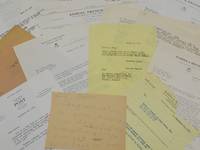
19681409452171968. Very Good. An archive of fourteen documents of various sizes mostly pertaining to the publication of Martin Luther King Jr.'s Stride Toward Fredom which was published September 17 1958 several documents regarding the State of Alabama's audit of King and one document pertaining to "Strength to Love". Very Good overall. One document Remittance Advice December 23 1953 with a 1"x3 area of loss from the publisher's letterhead. <br /> <p>Stride Toward Freedom is King's historic account of the 1955-1956 Montgomery bus boycott. The book describes the conditions of African Americans living in Alabama during the era and chronicles the events and participants' planning and thoughts about the boycott and its aftermath. The boycott sparked Rosa Parks' refusal to give up her seat to a white rider and catapulted King to the prominent leadership position of the civil rights movement.<br /> <p>Shortly after the end of the boycott King hired two literary agents Marie F. Rodell and Joan Daves of the first Marie Rodell and Joan Daves Inc. Rodell and Daves would soon sign a contract with Harper & Brothers for King to write his memoir or the Montgomery Bus Boycott with a working title of A Moment in History. The book would be published under the title Stride Toward Freedom. <br /> <p>The archive contains:<p>-A carbon copy of the 'Remittance Advice' from Harper Brothers to Rodell and Daves in the amount of $2000 payable on signing. This was an advance against all monies accruing under the terms of the contract signed October 17 1957 forA Moment in History; this is dated December 23 1957.<br /> <p>-A typed letter signed by Eugene Exman of Harper & Harper and Brothers to Marie Rodell dated May 21 1958 regarding the first carbon of the "edited" first chapter.<br /> <p>-A typed letter signed by Frank Elliot of Harper & Brothers to Joan Daves dated May 21 1958 in regarding the selection and clearance of photographs to be used in Stride Toward Freedom. Elliot concludes the letter by stating that Daves should be receiving galley proofs of the book next Monday. Elliot was an editor for the Religious Books Department at Harper & Brothers.<br /> <p>-A Photostat copy of a contract dated May 22 1958 from Frank Elliot at Harper & Brothers to Jay Leviton for the rights to use one of Leviton's photographs in the publication of Stride Toward Freedom. Leviton was paid $50 for use of his image.<br /> <p>-A typed letter unsigned dated June 9 1958 from Frank Elliot to Joan Daves reguarding the final revision of the last chapter and when page proofs could be expected. The letter includes several manuscript notes in an unknown hand.<br /> <p>-A small handwritten note from Rodell and Daves used to write text for a congratulatory text to King on the publication of the book care of the Statler Hotel. "Congratulations on your publication day & yours marathon radio & TV performances We'll have to see you tomorrow or Friday Joan & Marie" followed by "Sent 9/17/58 3:10 pm". Three days following this King was stabbed with a letter opener at a book signing; it was then from his hospital bed he confirmed his belief in the "redemptive power of nonviolence."<br /> <p>-A typed unsigned letter dated June 19 1959 from the Editorial Dept. at Samuel French to Marie Rodell rejecting the dramatization rights for Stride Toward Freedom as they feared there would not be much of a market for it among the amateur producing groups. <br /> <p>-A two-page-typed contract dated August 14 1965 for the Japanese rights to Stride Toward Freedom. with Kinseido Ltd. Signed by the publisher only likely Joan Daves' retained copy. Staple no longer holding at top corner.<br /> <p>-A carbon copy of a typed unsigned letter sent to Martin Luther King dated April 13 1960 from Dolores Gentile of Marie Rodell and Joan Daves Inc. This was the cover letter for a carbon copy of the Marie Rodell and Joan Daves Inc.'s report of King's 1958 earnings for Stride Toward Freedom to the State of Alabama. <br /> <p>-A photostat on State of Alabama letterhead dated January 4 1960 with signatures from Martin Luther King Jr. and his wife Coretta S. King addressed to "All Banks and Banking Institutions" giving them authority to allow Lloyd D. Hale Agent State Department of Revenue Income Tax Division to inspect all the King's records in their possession.<br /> <p>-A typed letter signed by Lloyd D. Hale on State of Alabama letterhead dated April 12 1960 addressed to Marie S. Rodell and Joan Dandes Inc. requesting King's literary agency's records of the date and net amount received by King for the years 1956 1957 and 1958. The letter references the authorization from the Kings noted above as an attachment.<br /> <p>-A typed unsigned letter dated April 19 1960 from Joan Daves to Lloyd D. Hale outlining a report of payments made to King. The general consensus was that the State's audit was largely a sham in an effort to legally prosecute MLK and defeat the civil rights movement.<br /> <p>-A typed letter signed by E. N. Brandt of The Saturday Evening Post dated December 22 1960 written to Marie Rodell stating that Martin Luther King declined to write a piece entitled "Is It Moral To Break An Unjust Law" King used this theme extemsively in his Letter From a Birmingham Jail in 1963.<br /> <p>-A retained contract for Strength to Love for British publisher Hodder and Stoughton Limited dated August 1th 1968 signed by the publisher. unknown
195822512NY: Harper. Fine in Near Fine dust jacket. 1958. First Edition; Later Printing. Hardcover. Inscribed on the fep by King. I purchased this more than twenty five years ago from the person to whom it is inscribed. ; 8vo 8" - 9" tall; 230 pages; Signed by Author . Harper hardcover
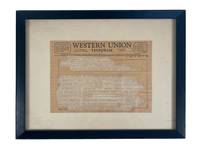
1966223481966. Martin Luther King Jr. Chicago King Jr. Martin Luther. Western Union telegram sent May 19 1966 supporting the Independent Union of Public Aid Employees during the Chicago Freedom Movement. The message documents King's public alignment with labor activism and welfare reform campaigns during his Northern civil rights organizing in Chicago where he sought to address structural inequality in housing employment and public assistance systems.<br /> <br /> Original telegram from Dr. Martin Luther King Jr. to the Independent Union of Public Aid Employees. May 19 1966. Western Union telegram. Chicago Illinois. Measures 8" x 5.5" unframed 12.5" x 9.5" framed. An extraordinary piece of civil rights ephemera this original 1966 Western Union telegram was sent by Dr. Martin Luther King Jr. and "the staff" to the Independent Union of Public Aid Employees IUPAE during the height of the Chicago Freedom Movement. The telegram reflects King's growing commitment to labor justice economic equality and Northern civil rights struggles supporting public labor unions engaged in collective social welfare reform.<br /> <br /> The telegram reads as follows:<br /> <br /> "CD199.=PD CHICAGO ILL 29 154P CDT.<br /> =INDEPENDENT UNION OF PUBLIC AID EMPLOYEES.=<br /> ATTN ALLEN KAPLAN PRES 26 WEST HARRISON CHGO.=<br /> <br /> ALL OF US HAVE BEEN PAYING CLOSE ATTENTION TO THE DEVELOPMENT .=OF THE STRUGGLE IN WHICH YOU ARE NOW ENGAGED. WE RECOGNIZE .=THAT YOU TOO SHARE THE VISION OF A SOCIETY IN WHICH ALL MEN .=ARE TREATED WITH JUSTICE AND DIGNITY. WE OFFER OUR SUPPORT .=TO YOU IN YOUR STRUGGLE FOR COLLECTIVE BARGAINING RIGHTS AND .=A MORE HUMANE WELFARE SYSTEM. WE LOOK FORWARD TO WORKING MORE .=CLOSELY WITH YOU IN THE COMING MONTHS--FAITHFULLY.=<br /> <br /> DR MARTIN LUTHER KING JR AND THE STAFF.=="<br /> <br /> Sent on May 19 1966 this message directly coincides with King's relocation to Chicago in early 1966 to launch the Chicago Freedom Movement his most ambitious campaign to confront systemic racism in the urban North. Co-led by the Southern Christian Leadership Conference SCLC and the Coordinating Council of Community Organizations CCCO the campaign sought to challenge racial segregation in housing employment discrimination and inequities in municipal services. King recognized that structural injustice in Northern cities was just as debilitating as the overt segregation of the South. The IUPAE a union representing frontline welfare workers had staged actions demanding not only better workplace conditions but also systemic reforms to a punitive welfare system that disproportionately affected Black and poor communities. By expressing solidarity with public employees fighting for "collective bargaining rights and a more humane welfare system" King extended his vision of the "Beloved Community" beyond civil rights into economic justice and labor rights themes that would define his final years. That same year King endured resistance not only from segregationists but also from local city officials including Mayor Richard J. Daley and endured physical threats during open housing marches in white neighborhoods like Marquette Park. His support for labor organizations particularly in Chicago foreshadowed the Poor People's Campaign and his final act of solidarity-marching with striking sanitation workers in Memphis in 1968.<br /> <br /> Overall very good condition with light toning and minor creasing to telegram. Framed under glass in black wood frame. A rare and powerful primary document linking Dr. King's Northern campaign for racial and economic justice with the struggles of organized labor a direct and material expression of King's belief that "all labor has dignity."and his "VISION OF A SOCIETY IN WHICH ALL MEN .ARE TREATED WITH JUSTICE". An exceptionally historic piece. unknown
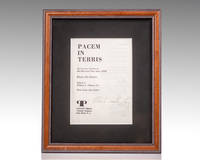
1963149593Glen Rock NJ: Paulist Press 1963. Original printed pamphlet of Pope John XXIII's 1963 Pacem in Terris. Boldly signed by Martin Luther King Jr. at the bottom of the title page. Martin Luther King Jr. was a Baptist minister and activist who became the most visible spokesperson and leader in the civil rights movement from 1954 through 1968. He is best known for his role in the advancement of civil rights using the tactics of nonviolence and civil disobedience based on his Christian beliefs and inspired by the nonviolent activism of Mahatma Gandhi. King led the 1955 Montgomery bus boycott and in 1957 became the first president of the Southern Christian Leadership Conference SCLC. With the SCLC he led an unsuccessful 1962 struggle against segregation in Albany Georgia. Pope John's Pacem in Terris was issued on April 11 1963. The day after on April 12 King would be arrested for his nonviolent protesting against racism and racial segregation in Birmingham Alabama writing his Letter from Birmingham Jail on the 16th. Matted and framed. In fine condition. The piece measures 11.25 inches by 9.25 inches. Rare and desirable. Pope John XXIII’s 1963 encyclical Pacem in Terris “Peace on Earth†stands as one of the most influential Catholic social teachings of the twentieth century articulating a global moral framework grounded in human dignity universal rights and the ethical responsibilities of both individuals and states. Issued amid Cold War tensions and only months before his death the document broke new ground by addressing itself not only to Catholics but to “all people of good will†reflecting John XXIII’s broader ecumenical and humanitarian vision. Pacem in Terris condemned nuclear proliferation affirmed the equality of all peoples and called for structures of international cooperation capable of safeguarding peace and justice. Paulist Press unknown
19632111002American Friends Service Committee 1963. softcover. near fine. Second printing June 1963. This letter was written on April 16 1963 and published for the first time May 1963. In near fine condition. American Friends Service Committee unknown
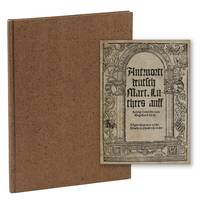
1522140948314Wittemberg Wittenberg: Nickell Schyrlenz Schirlentz 1522. First edition. Near Fine. First edition of Martin Luther's riposte to King Henry VIII's pamphlet "In Defense of the Seven Sacraments" preceding the Latin edition by one month. Unpaginated 47 pp blank A-F4. Laid paper text in German woodcut title illustration featuring cupids. Collated complete. Small quarto recently bound in brown speckled paper-covered boards. Near Fine with tape marks to rear board perceptible in raking light light toning and thumbing and occasional foxing to contents. Title page repaired with backing paper to margins soiling to first and last pages faint dampstain to upper right corner of first few leaves. Binding solid interior overall clean and bright.<br /> <br /> <p>A well-preserved copy of a treatise by one of the most famous men in history. In 1521 Henry VIII of England published an attack on Martin Luther and defense of the Catholic Church that earned him the title "Defender of the Faith" from Pope Leo X. Henry's Assertio Septem Sacramentorum was swiftly translated into German and sold well on the Continent. Luther perceived a threat and published this furious response the following year mocking Henry''s new title and his qualification for the role. Henry himself would soon defy the Catholic Church after his demand for the annulment of his first marriage was rejected but he and Luther continued their acrimonious correspondence and never reconciled. Nickell Schyrlenz [Schirlentz] unknown
15501503130064Gedruckt zu Wittemberg : Durch Hans Lufft 1550-01-01. Hardcover. Acceptable. Folio. 380 of 383p. Collation: A1-Z6 A1-Z6 Aa1-Aa2 lacking Aa3-Aa4 Aa5-Rr4 Lacking Rr5 Rr6 Ss1-Ss5 in 6's. Bound in contemporary pigskin. Bindings decorated in blind. 5 raised bands. Contemporary brass corners and latches. Woodcut title page and 62 woodcuts throughout most by Hans Brosamer and some by Georg Lemberger. Good binding. Shelfwear. Chipping and loss to head and tail of spine. Loss to board edges. Lacking clasps. Lacking first and final blank. Top of title page missing from signature removal. Cracking to hinges. Soiling to pages. Loss to tail of leaf 33 affecting last 2 sentences of text. Marginal loss to f209. Tear to halfway of leaf 216. Contemporary marginal notation to the Gospels. Contemporary underlining to select pages throughout. Repairs to leaf 229 and 277. Tanned pages with some staining. <br><br> The Prophets of the Old Testament with the New Testament and Apocrypha from Martin Luther's translation of the Bible. Gedruckt zu Wittemberg : Durch Hans Lufft hardcover
156415908Kiøbenhaffn Lorentz Benedict 1564. 4to. Senere helldrbd. 188156114 blade. Titelblad og fortale samt sidste blad i smuk lystryk faksimile 3 blade ialt. de sidste 10 blade kantrepareret. Lettere brugsspor. 3 træskårne titelblade tæt beskåret foroven. Talrige større træsnitillustrationer i teksten. <br/><br/><em>Første danske udgave af Luthers Postil og af største sjældenhed i komplet stand. Kun ganske få bevarede på private hænder. De fleste eksemplarer i de offentlige biblioteker er ukomplette Lauritz Nielsen anfører kun 7 komplette eksemplarer. En af de mest betydningsfulde bøger fra Benedichts trykpresse og det største i omfang.Extremely scarce first Dansih edition of Luther's "Hauspostille" with only af few copies still on private hands.Thesaurus I 104. - Birkelund 24. - Lauritz Nielsen 1084. - Paulli 20. </em> unknown
192936266Munich: Bremer Presse 1929. Hardcover. Near Fine. Hardcover. 365 copies. This is a magnificent production from the famed Bremer Presse of Germany - probably their masterpiece. They published books from 1911 to 1939 interrupted only by World War I. It was founded by Willy Wiegand and like England's Doves Press rejected ornament except for splendid initials draw by Anna Simons and relied upon carefully chosen types and painstaking presswork to produce its limited edition hand printed books. The colophon states that this edition was printed to commemorate the 400 year anniversary of the publication of Martin Luther's German bible. The text was based on the editions published in 1545 and 1546. The Bible German: Lutherbibel was the first German language Bible translation from Latin sources. The New Testament was first published in September 1522 and the complete Bible containing the Old and New Testaments with Apocrypha in 1534. Luther continued to make improvements to the text until 1545. The five volumes are: Die Bucher Mose; Teil des Alten Testaments; Teil des Alten Testaments; Die Propheten; Das Neue Testament. Each volume has a different copy number. They are bound uniformly in blue paper boards with linen spines with the title written in calligraphy. The volumes are housed in gray paper board slipcases. In near fine condition in very good slipcases. Measures 10 x 14 inches. Unpaginated each volume about 250-300 pages PRI/011623. Bremer Presse hardcover
751Wittenberg 1532. Quarto 8 1/4 X 6 1/2 inches . First edition A-Z4 a-z4 aa-nn4 oo2 pp4 241 Leaves Bound in full modern calf a very nice copy. Luther proceeds line by line some times giving one line from Matthew five pages of commentary! Here is a shortened example: from the greek. And His commentary. Benzing Luther 3011;VD 16; L 4754; Pegg Swis; 2988;. Here is a shortened example: from the greek. And His commentary.<br /> <br /> V. 3. Blessed are the poor in spirit for theirs is the kingdom of heaven.<br /> <br /> This is a delightful sweet and genial beginning of his sermon. For he does not come like Moses or a teacher of law with alarming and threatening demands; but in the most friendly manner with enticements and allurements and pleasant promises. And indeed if it had not been thus recorded and if the first uttered precious words of the Lord Christ had not been given to us all an over-curious spirit would tempt and impel everybody to run after them even to Jerusalem yes to the end of the world if one might hear but a word of it all. Then there would be plenty of money forthcoming to build a good road and every one would boastingly glory how he had heard or read the very words that the Lord Christ had spoken. O what a wonderfully happy man would he be held to be who should succeed in this! That is just the way it surely would be if we had none of our Savior's words written although much might have been written by others; and every one would say: Yes I hear indeed what St. Paul and his other apostles have taught but I would much rather hear what he himself said and preached. But now that it is so common that every one has it written in a book and can read it daily nobody regards it as something special and precious. Yes we grow tired of them and neglect them just as if not the high Majesty of heaven but some cobbler had uttered them. Therefore we are duly punished for our ingratitude and contemptuous treatment of these words by getting little enough from them and never feeling or tasting what a treasure force and power there is in the words of Christ. But he who has grace only to recognize them as the words of God and not of man will surely regard them as higher and more precious and never grow tired or weary of them.<br /> <br /> Kindly and sweet as this sermon is for Christians who are our Lord's disciples just so vexatious and intolerable is it for the Jews and their great saints. For he hits them a hard blow in the very beginning with these words rejects and condemns their doctrine and preaches the direct contrary; yes he denounces woe against their way of living and teaching as is shown in the sixth chapter of Luke. For the substance of their teaching was this: If it goes well with a man here upon earth he is happy and well off; that was all they aimed at that God should give them enough upon earth if they were pious and served him; as David says of them in Psalm 144: "Our garners are full affording all manner of store; our sheep bring forth thousands and ten thousands in our streets; our oxen are strong to labor; there is no breaking in or going out; there is no complaining in our streets.". Wittenberg ,1532 unknown
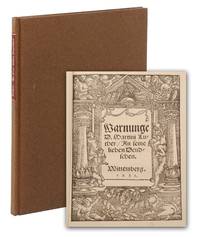
1531140949420Wittenberg Germany: Hans Lufft 1531. First edition. First edition. First printing with date misprinted as "1231" on the title page as per Benzing. 63 pp. Bound in recent brown paper over boards with red morocco spine label. Text in German. Small 4to A1-D4. Title page with Georg Lemberger woodcut border Luther Taf. 34 showing angels surrounding the entrance to the book. Near Fine annotations in a contemporary hand have been washed out with varying degrees of success much of them still visible; tidemark to fore tail corner otherwise a very clean and fresh copy. Uncommon in its first printing. <p>After the Diet of Augsburg Charles V gave Protestants six months to renounce the Evangelical reforms and return to the Catholic church or else face armed persecution. During this period a confederation of Protestant states dubbed The Schmalkaldic League was formed with the intention of defending themselves from the Empire's repression. Luther joined Philip Melanchthon and several other theologians at Torgau in signing a declaration in defense of the creation of an armed Protestant league something he had adamantly refused to do on multiple prior occasions. The Warnunge An Seine lieben Deudschen was composed as a theopolitical justification of this new declaration of the right to armed resistance at Torgau. In it Luther walks a fine dialectical line with one of the clearest practical applications of his Two Kingdoms doctrine: as a minister of the Gospel he must counsel peace and could not press for war; but neither would he reprove those who took up arms to defend themselves against tyranny. Benzing 2908; VD16 L7736. Hans Lufft unknown
17208417<p>201084 312 pages. Full ruled black calf. All edges gilt with modest gauffering to top & bottom. Four raised bands. Eisenach was Luther's childhood home & place of refuge during his best-selling translation of the Greek New Testament to German using the Vulgate only for comparison. Blank fly leaves as well as recto & verso of pastedowns contain Hoffmann family genealogical records see image. Scarce Eisenach imprint with but two copies found on WorldCat. 11 x 20 cm or 4.5 x 8 in.</p> Boëtio [Johann Adolph Boetius] hardcover
175353654Wittemberg Vidua Scheffler 1753. 4to. Contemporary full calf with five raised bands to richly gilt spine. Edges of boards blindtooled. Boards slightly warped and with lsigns of wear. Internally very nice and clean with only a few scattered brownspots. A nice tight clean and completely unrestored copy. Title-page printed in red and black. 4 18 6 CCLII 2 pp. two folded engraved plates. <br/><br/><em>The exceedingly rare first edition of the first published biography of Aldus Manutius including "the first real attempt at an Aldine bibliography" Grolier Aldus. This legendary publication constitutes not only the earliest but also one of the most important sources on Aldus and his publications. Written by Christian Gottlieb Unger 1671-1719 presumably in the early 1700'ies it circulated in manuscript-form for decades until 1753 when Samuel Luther Geret German theologian lawyer and politician took upon himself to edit the manuscript and have it published. Renouard mentions a 1729-edition but this is a ghost See "Grolier Aldus Manutius: No. 135".Grolier Aldus Manutius: No. 135.Renouard pp. iv-v. </em> hardcover
19261211270031Bremer Presse 1/1/1926. Hardcover. Very Good. The masterpiece of the Bremer Presse printed in 14-point German type and accompanied by Anna Simons' calligraphic initials 5 volume set. No. 244 of 365. Folio. Bound in vellum. Gilt spine. TEG. Vellum slightly soiled faint white paint smear to spine of Vol. I rear cover of Vol IV scuffed and with few tiny gouges. Interiors in fine condition. Limited edition 244 of 365 sets. Anna Simons' gorgeous typography. Published on the 400th anniversary of the first Lutheran bible. The text however is based on later editions of 1545 and 1546. Contents: t.1. Die Bucher Mose. t.2. Das 2. Teil des Alten Textaments. t.3. Das 3. Teil des Alten Testaments. t.4. Die Propheten. t.5. Das Neue Testament.Tysk. This is an oversized or heavy book that requires additional postage for international delivery outside the US. Bremer Presse hardcover
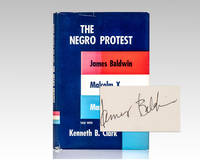
1963149928Boston: The Beacon Press 1963. First edition of this collection of interviews done by Kenneth B. Clark. Octavo original half cloth. Boldly signed by James Baldwin on the title page. Fine in a near fine dust jacket with a small closed tear to the front panel. With a talk with Kenneth B. Clark and with a note about the interviews by Henry Morgenthau III. Interviews recorded for National Educational Television in May-June 1963. Conversations with James Baldwin Malcolm X and Martin Luther King with Kenneth B. Clark as the moderator. The Beacon Press hardcover
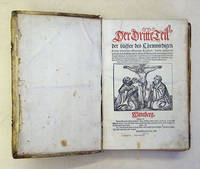
74375Wittenberg Hans Lufft 1550. 4° 31 x 21 cm zweifarbiges Titelblatt mit Holzschnitt 7 Bl. 276 Bl.; 318 Bl. zahlreiche Holzschnitt-Initialen. Schweinslederband der Zeit blindgeprägt ohne Schliessen. Handschriftliches Bibliotheksschild a. Rücken Deckel min wurmstichig Vorsätze etwas fleckig u kleinen Randläsuren. innen sauber Marginalien von alter Hand. VD16 L 3312. Namenszug a. Titelblatt Johannes Minnenius Dank an die Frau Kollegin Oberacker-Pilick für die Uebersetzung. Vorwort von Philipp Melanchthon. Dritter Band der ersten deutschen Gesamtausgabe von Luthers Schriften Wittenberger Ausgabe die noch von Luther selbst begonnen wurde 1548-1573. Der Titelholzschnitt Luther u. Kurfürst Johann Friedrich von Sachsen neben dem Kruzifix kniend ist eine Kopie nach Lucas Cranach d. J. An der Herausgabe waren u. a. Kaspar Creutziger Georg Maior u. Georg Rörer beteiligt. Philipp Melanchthon schrieb Vorreden zu 8 Bänden. 010 Wittenberg, Hans Lufft, 1550 unknown
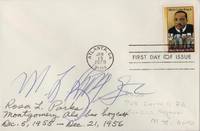
v2151<p>Rosa Parks & Martin Luther King Sr. Signed First Day Cover PSA/DNA Slabbed & Graded NM 7.5. First Day Cover with a unique Martin Luther King Jr. Stamp measuring 4.125" x 6.125" and encapsulated to a size of 6.5" x 10". Signed by Martin Luther King Sr. as "M.L. King Sr." and signed & inscribed by Rosa Parks "the mother of the Civil Rights Movement" as "Rosa L. Parks Montgomery Ala bus boycott Dec. 5 1955 - Dec 21 1956". Postmarked Atlanta GA and dated Jan 13 1979. Encapsulated and PSA/DNA graded NM 7.5. This item comes with a Certificate from John Reznikoff a premier authenticator for both major 3rd party authentication services PSA and JSA James Spence Authentications as well as numerous auction houses. Book #v2151. $3900. We specialize in Rare Ayn Rand history and science.</p>
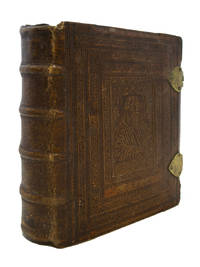
157568885Wittenberg: Gedruckt Durch Hans Lufft 1575. Die Fürnemsten vnd besten Schrifften des Hocherleuchten vnd Geistreichen Mannes . Herrn Doctoris Martini Lutheri von den beiden Sacramenten des Newen Testaments nemlich von der Heiligen Tauff vnd dem Abendmal des Herrn. Itzt aus Christlichen vnd groswichtigen ursachen von newes in druck verordnet und den Sacramentsfeinden und Schwermern der Carlstadischen Zwinglischen und Caluinischen Secte alten und newen entgegen gesatzt zu schutz und erklerung der Warheit und zu dempffung der meuchlinge schleichenden gifft und Schwermerey. Durch die Theologen der Vniversitet Witteberg. Wittenberg: Gedruckt Durch Hans Lufft 1575.<br> <br> Full Description:<br> <br> LUTHER Martin. Die Fürnemsten vnd besten Schrifften des Hocherleuchten vnd Geistreichen Mannes . Herrn Doctoris Martini Lutheri von den beiden Sacramenten des Newen Testaments nemlich von der Heiligen Tauff vnd dem Abendmal des Herrn. Itzt aus Christlichen vnd groswichtigen ursachen von newes in druck verordnet und den Sacramentsfeinden und Schwermern der Carlstadischen Zwinglischen und Caluinischen Secte alten und newen entgegen gesatzt zu schutz und erklerung der Warheit und zu dempffung der meuchlinge schleichenden gifft und Schwermerey. Durch die Theologen der Vniversitet Witteberg. Wittenberg: Gedruckt Durch Hans Lufft 1575.<br> <br> First edition of these collected works of Martin Luther. Quarto 7 3/4 x 6 1/8 inches; 196 x 155 mm. 20 424 leaves. A few page numbers misprinted but collates complete. Title-page printed in red and black. Printed in black letter. Engraved initials.<br> <br> Full contemporary pigskin over wooden boards. Boards heavily stamped in blind. With a central device portrait of Martin Luther embossed to front board and another unknown person's portrait to back board. With two brass clasps fully intact. Boards beveled. All edges dyed brown. Some chipping to head and tail of the spine and some minor cracked to top of spine hinges but still very strong. Preliminary leaves with some fraying and toning to edges but not affecting text. Pastedowns not fully complete. Front free endpaper with old ink manuscript notes. Lacking rear free endpaper. A few other leaves with neat marginalia. Some minor dampstaining and toning throughout. Leaves 5M3-5N2 with some holes to outer blank margin not affecting text. Leaves 5N3 and 5N4 with small paper repair to outer upper corners not affecting text. Overall a very good copy in a wonderful binding.<br> <br> A collection of Martin Luther's writings disputing the sacraments of Holy Baptism and the Lord's Supper. "Theological and doctrinal disputes were to persist for the rest of Luther's career on issues such as the Eucharist or Lord's Supper: Heiliges Adendmahl and baptism both within the evangelical movement involving figures such as the sacramentarian Karlstadt and the Swiss reformers Ulrich Zwingli 1484-1531 and Johannes Oecolampadius 1482-1531 and outside it with the Anabaptists. On both issues Luther resisted the accounts of these sacraments as having a mere symbolic value often arguing that this viewpoint comes from an urge to put reason above the authority of scripture. The Stanford Encyclopedia of Philosophy.<br> <br> HBS 68885.<br> <br> $3750. Gedruckt Durch Hans Lufft unknown
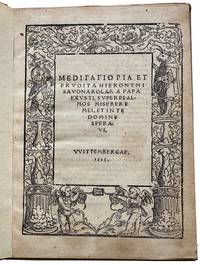
152343260Wittemberg: Np. 1523. First Edition with preface by Martin Luther. Wittemberg. N.p. 1523. 8vo. 20cm First Edition with preface by Martin Luther decorated title-page un-paginated i18p. text in Latin engraved folded frontis portrait Savanorola contemporary annotations in margins small worm-holes in leaves slightly affecting some text bound in modern grey boards with title in black: "Luther- Meditatio Heir . Savanolae. 1523" very good to fine rare. very good to fine. ~~ Savonarola's last writings "Inflex ego" & "Trestilia" when in prison before execution in 1498. Martin Luther was a great admirer of Savonorola as a harbinger of the Protestant Reformation and was impressed by these pair of meditations the second of which was unfinished. The location of the publication-Wittenberg-is significant being associated with Martin Luther and considered the birthplace of the Protestant Reformation. Although "Meditopia" has no publisher listed a copy of the book is in the University of Warsaw with a contemporary hand-written publisher's name; Johann Rhau-Grunenberg 1508-1825 noted for publishing Martin Luther's earliest works including the Indulgences of 1517. Np. unknown
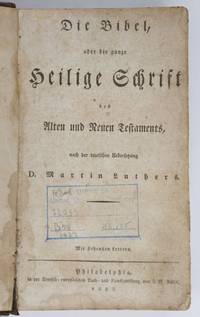
182754126Philadelphia: J. G. Ritter 1827. Hardcover. Good. Two parts thick octavo. VIII 1096; 328. Old Testament and Apocrypha paginated continuously; collective title page; New Testament with separate full title page. Text in two columns. Contemporary calf rubbed; spine with raised bands gilt title. Wear at spine cap some loss 3/4 inch at spine tail. Light dampstain at bottom margin; mild foxing throughout somewhat heavier at final 50 leaves. A good complete copy.<br /> <br /> Rare early nineteenth-century edition of the Bible in Luther's German translation published in Pennsylvania. Apart from the 1828 New Testament very few copies of any of the Luther Bible editions published by Johann Georg Ritter 1772-1840 at Philadelphia between 1826 and 1829 survive. In his 1893 pioneering work The First Century of German Printing in America Oswald Seidensticker locates no complete Luther Bibles and only two editions of the New Testament which were published by Ritter in 1826 304 pages and 1828 541 pages. These were of course often bound with the Old Testament along with their full title-page. The 1828 New Testament is the only portion of Ritter's biblical editions that is widely held in institutional libraries. Expanding upon the work of Seidensticker the editors of The first Century of German Language Printing in the United States of America 1989 assign only four Luther Bible editions Old and New Testaments bound together to Ritter one in 1827 and three in 1829. OCLC however locates Luther Bible editions published by Ritter in all four years between 1826 and 1829. A careful comparison of the paginations reveals that Ritter's Luther Bibles appeared in several variants. The 1827 edition was re-issued in 1829 as a "Zweyte Auflage" with 20 additional pages of preparatory material immediately preceding the Old Testament. Variants of the present edition also appeared in which the Apocrypha 160 pages was separately paginated. Some surviving copies lack the Apocrypha and only contain the 936 pages of the Old Testament. Our careful review of OCLC locates only sixteen surviving copies of Ritter's Luther Bibles containing both the Old and New Testaments published between 1826 and 1829. Twenty-four copies of the separately bound 1828 New Testament have survived as well. The only two copies of our 1827 edition have been located: the University of Waterloo and the Wurttembergische Landesbibliothek. The results of our census are appended below.<br /> <br /> Johann Georg Ritter appears to have begun his career in Reading Pennsylvania where he printed two German-language works for the firm of William M'Carty and Davis in Philadelphia: Geschichte des americanischen Kriegs von 1812 1817; Hoch-Deutsches reformirtes A B C-und Namen-Büchlein für Kinder welche anfangen zu lernen 1818. He later moved to Philadelphia and set up his own shop Der Deutsche-europäischen Buch- und Kunsthandlung. Sammlung religiöser deutscher Gesaenge which he edited along with J. G. Schmauk was published in 1824 and has been tentatively attributed to Ritter after his move to Philadelphia; Karl Rudolph Demme's Letzte ehre des Christlichen Predigers in einer Christlichen Gemeine Philadelphia 1825 is the earliest work to appear under his imprint. He catered chiefly to the German-speaking Reformed community with religious works sermons and elementary school texts. He briefly published in 1825 a periodical edited by Johann Carl Gossler Philadelphier Magazin für Freunde der deutschen Literatur in Amerika.<br /> <br /> Provenance: Stamp of Library of United Theological Seminary at title. Full title and imprint: Die Bibel oder die ganze Heilige Schrift des Alten und Neuen Testaments auch der deutschen Uebersetzung D. Martin Luthers. Mit stehenden Lettern. Philadelphia in der Deutsch-europäischen Buch- und Kunsthandlung von J. G. Ritter 1827. New Testament title: Das Neue Testament unsers Herrn und Heilandes Jesu Christi verteutscht von Dr. Martin Luther. Mit stehender Schrift. Philadelphia in der Deutsche-europäischen Buch- und Kunsthandlung von J. G. Ritter 1827.<br /> <br /> Refences: O. Seidensticker The First Century of German printing in America 1728-1830 Philadelphia 1893; Bötte & Tannhof The First Century of German Language printing in the United States of America vol. 2 1808 - 1830 cf. nos. 2878; 3044; 3045; 3046. Not in Darlow & Moule.<br /> <br /> INVENTORY<br /> <br /> •Die Bibel oder Die ganze Heilige Schrift des Alten und Neuen Testaments New Testament with separate title page<br /> <br /> 1826 - xii 868 304 pages 18 cm - Southern Methodist University Bridwell Library<br /> "New Testament has special t.p.: Das Neue Testament Unsers Herrn und Heilandes Jesu Christi verteutscht von D. Martin Luther."<br /> <br /> 1826 - 2 volumes in 1 19 cm - Pennsylvania State Univ; Brigham Young Univ UT<br /> "New Testament has special t.p. and separate paging."<br /> <br /> 1827 - viii 1096; 328 pages - Wurttembergische Landesbibliothek - OUR EDITION<br /> <br /> 1827 - viii 1096; 328 pages 22 cm - Univ of Waterloo Libr CA ON - OUR EDITION<br /> <br /> 1827 2 Aufl. - viii 936; 328 pages 22 cm - Baker Univ KS; American Bible Soc Libr PA <br /> "Zweyte Auflage. Mit stehenden Lettern."/ Spine title: Biblia./ The Holy Bible in German./ The New Testament has special title page and pagination: Das Neue Testament unsers Herrn und Heilandes Jesu Christi./ Bound in brown leather tan end papers sprinkled red edge brass clasps missing title in gold on spine./ Text printed in verse form double column single rule down center of page. Chapter summaries in smaller type references between verses." N.B.: Our researches indicate this copy lacks Aprocrypha = 160 pages probably separately paginated as Hillsdale 1829 edition below.<br /> <br /> 1827 - viii 1557 3 462 p. - Bethel Coll Libr N Newton KS; American Antiquarian Soc Libr MA; United Theog Seminary Libr OH; Library of Virginia<br /> "The New Testament 462 p. has separate title page./ Printed in two columns./ "Die Propheten nebst den Büchern so man Apocrypha nennet verdeutscht durch D. Martin Luther."-- Page 965-1557. Shoemaker 28112; Bötte & Tannhof German printing 2878."<br /> <br /> 1828 20. Aufl. - viii 936; 328 pages 22 cm - Univ. of Virginia<br /> N.B.: Our researches indicate this copy lacks Aprocrypha = 160 pages probably separately paginated as Hillsdale copy 1829 edition below.<br /> <br /> 1828 - 1324 462 pages 23 cm - Buffalo & Erie Cnty Pub Libr Rare Books NY; Calvin Col and Theol Seminary MI<br /> "New Testament has special t.p. and separate paging."<br /> <br /> 1829 2 Aufl. - 2 20 1096 x 328 pages 23 cm 2 Aufl. - Univ of Waterloo Libr CA ON<br /> <br /> 1829 Zweyte Aufl. mit stehenden Lettern. 23 cm - viii 336 i.e. 936 160 328 pages ; 23 cm - Hillsdale Coll. Mossey Libr MI<br /> "Apocrypha and New Testament each have special t.p./ Apocrypha has publication date 1829; New Testament has publication date 1828."<br /> <br /> <br /> •Das Neue Testament unsers Herrn und Heilandes Jesu Christi <br /> <br /> 1826 - 304 pages 18 cm - Kansas City Pub Libr MO; Webster Eden Libr MO; Franklin & Marshall Col PA; German Soc of Pennsylvania Horner Libr<br /> <br /> 1827 - 462 pages 23 cm - New York Pub Libr<br /> <br /> 1828 Neue Aufl. - 542 pages 8vo - Universiteit Goettingen<br /> longer title page text: . Mit kurzem Inhalt eines jeden Capitels und vollständiger Anweisung gleicher Schriftquellen ; Wie auch aller Sonn- und Festtägigen Evangelien und Episteln.<br /> <br /> 1828 Neue Auflage - 542 p. 18 cm - American Antiquarian Soc Libr MA<br /> Shoemaker 32318; Bötte & Tannhof German Printing 2970<br /> <br /> 1828 New ed. - 542 pages - Univ of Ontario Group; Univ of Toronto Thomas Fischer Rare Book <br /> "mit kurzem Inhalt eines jeden Capitels und vollständige Anweisunggleicher Schriftstellen wie auch aller Sohn- und Festtägigen Evangelien und Episteln."<br /> <br /> 1828 - 542 pages 19 cm - 20 Libraries 19 US; 1 CA<br /> "Text printed in double column verse form single rule down center of page title centered across top of both pages. Chapter summaries in matching type references after verses. mit kurzem Inhalt eines jeden Capitels und vollständiger Anweisung gleicher Schriftstellen wie auch aller Sonn- und Festtägigen Evangelien und Episteln. J. G. Ritter hardcover