Bible ( Rare Complete Copy )Biblio.com

6 582 résultats
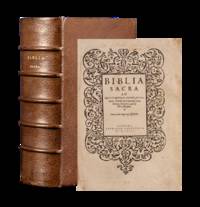
1584096038London: Imprinted at London : By Christopher Barker printer to the Queenes most excellent Maiestie Anno 1584. 1584. Bishops Bible. ESTC Citation No. S674. STC 2nd ed. 2141. Collation signature complete a1-c8 a1-cccc8 in 8s dddd4 Psalmes a6-l6m4. one signature in 7 but complete 1 full page plate Adam & Eve text map 1 full page map engraved titles. Book measures 11 x 8 inches. A1 title page chipped lacking section of margin in places with loss of engraved area title laid down dd6cc6bbb2ddd2vvv8yyy7zzz1 these pages have short tears mainly single tear with very minor loss of text or the odd letter 8 other pages have closed short tears. Occasional annotations in a early hand some margins trimmed with loss of lettering some other minor defects. Bound in recent full calf panelled boards raised bands leather title label full gilt edges new endpapers. Internally some staining to Psalmes. Pages in very good condition throughout. A very nice copy. Very Good Plus. Large 8vo. Imprinted at London : By Christopher Barker, printer to the Queenes most excellent Maiestie, Anno 1584. hardcover
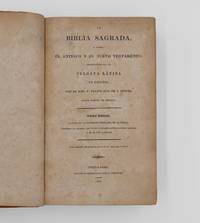
1824373835New York: Edicion Estereotipica por A. Chandler 1824. First American Edition of the Bible in Spanish. 928; 251pp. 4to. Contemporary panelled calf usual wear front hinge neatly repaired. Foxing. Provenance: Essex Institute label on front pastedown. In half red morocco slipcase and chemise. First American Edition of the Bible in Spanish. 928; 251pp. 4to. First American edition of the Bible in Spanish printed by the American Bible Society for the use of missionaries in South America. It is among the earliest Catholic bibles printed in the United States noted on the verso of the titlepage as "Edicion 1". The text was taken from the Madrid edition of 1797 translated from the Latin by Felipe Scio de San Miguel Bishop of Segovia.<br /> <br /> Scarce on the market with no examples in the auction records for the last half century. Shaw & Shoemaker 15340; O'Callaghan 1824; Parsons 813 Edicion Estereotipica por A. Chandler unknown
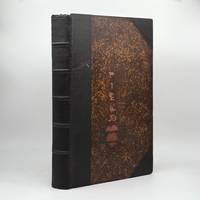
371476Amsterdam: Joseph Jacob and Abraham the sons of Solomon Proops 5522. Titled printed in red and black. 2 178 2 179-332 10 Introduction etc. 2 160 2 161-350pp. Publisher's introduction and other preliminaries misbound preceding the later Prophets. Folio 15-7/8x10 inches. Nineteenth or early 20th century half morocco and marbled paper boards rear joint splitting worn at joints and head and tail of spine. Foxing principally to the title tear to the final text leaf. Provenance: General Theological Seminary bookplate. Titled printed in red and black. 2 178 2 179-332 10 Introduction etc. 2 160 2 161-350pp. Publisher's introduction and other preliminaries misbound preceding the later Prophets. Folio 15-7/8x10 inches. Besides being the first bi-lingual edition in Hebrew and Spanish this edition is the first Hebrew book whose publication was financed by an American - Abraham Mendes de Castro 1689-1762 of Curaçao - intended for use in the West Indies with the sale proceeds to benefit the Jewish communities of Jerusalem and Hebron. Cowley 102; Darlow & Moule 5156; Zedner 102; not in Steinschneider or Roest Joseph, Jacob and Abraham, the sons of Solomon Proops unknown
15546212Lyon: Jean de Tournes 1554. First edition. Octavo 6 3/4 x 4 3/4 inches; 171 x 121 mm. . 16 1152 76 pp bound without the last two blank leaves as in most copiese.g. Mortimer OCLC. The penultimate leaf had only a fleuron at the foot of the page and the final leaf was blank. Arabesque title border and 198 with 1 repeat woodcuts in the text by Bernard Salomon. Title-page with faint early ink "ex-Libris petri ------ at top blank margin. Title-page expertly cleaned some occasional mainly marginal faint foxing otherwise a superb example of this wonderfully illustrated mid sixteenth-century Latin Bible. Bound ca. 1880 by Chambolle-Duru in full brown crushed levant morocco spine with five raised bands lettered in gilt gilt ruled board edges decorative gilt turn-ins marbled endpapers all edge gilt. Armorial bookplate "In Memori: Weiler Bibliotheca Trautner Falkiana" on verso of front free endpaper.<br /> <br /> First De Tournes Latin Bible based on Robert Estienne's text and beautifully illustrated with 198 woodcuts by Bernard Salomon. "Considerable work could be done on Salomon's sources for these cuts. The Expulsion from Paradise suggests Holbein's version; the New Testament shows some dependence on the set owned by Sébastien Gryphius. the Apocalypse blocks are enlarged copies of the fine Janot Apocalypse. But the cumulative effect of Salomon's carefully detailed scenes is that of an individual contribution to Bible illustration. Particularly interesting from the point of view of technique are the night scenes in Exodus and the storm over Noah's ark. In this 1554 Bible the New Testament blocks are printed with arabesque strip borders at the sides. Arabesque and type ornament headpieces." Mortimer Contents include: Old Testament; Psalms; New Testament Epistles Acts; Index Testimoniorum & Index Epistolarum.<br /> <br /> Robert I Estienne 1503-1559 was a French protestant printer and scholar born into a printmaking family. He would take over his family's Paris firm in 1526 where he printed significant works in Latin Greek Hebrew and other languages. His 1531 Thesaurus linguae latinae is considered a major milestone in lexicography. Despite his many commissions for the King religious tensions forced Estienne to flee to Geneva. <br /> <br /> This bible was illustrated by Bernard Salomon c.1508-1561 a French artist who is known for engravings and illustrations. Although little is known about his life his art reveals stylistic influences from Mannerism and the School of Fontainebleau executed in a detailed and small scale. Salomon is known to have collaborated with the printer Jean de Tournes and produced decoration for emblem books bibles and classic texts. Many of his engravings also appear as source material for art objects such as a Faience plate at the MET featuring the Sacrifice of Noah.<br /> <br /> Brunet I 876 & Supplement I 125; Darlow & Moule 6134 note; Mortimer French no. 81. Jean de Tournes unknown
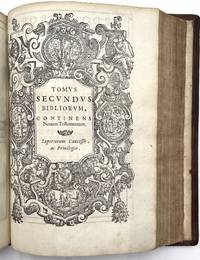
3144Professionally rebacked extremities bumped. Occasional light foxing and browning to some sheets small tear paper flaw to the fore-edge margin of Mi small triangular tear with slight loss to the fore-edge margin of HHiiiii. Generally a very clean and fresh copy. Very good. <p>Sacra Biblia Acri Studio Ac Diligentia Emendata Rerum atque Verborum permultis & perquàmdignis Indicibus aucta. Superiorum Concessu ac Privilegiis. Venice: Apud Iolitos 1588. </p> <br /> <p> Octavo. Two parts in one small quarto volume. 16 679; 199 1 blank 200 indices pp. General and New Testament titles within ornate woodcut borders. Illustrated with 246 woodcuts. Full nineteenth-century blindstamped leather spine with raised bands and title lettered in gilt. All edges stained brown. </p> . unknown
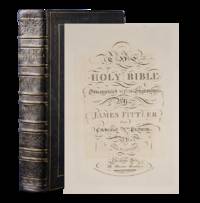
17956211London: R. Bowyer 1795. First thus. Near Fine. Two large quarto volumes 12 1/2 x 9 3/4 inches; 318 x 248 mm. Unpaginated. Text in double columns. With two copper-engraved title-pages with a separate title-page for the New Testament and sixty-two plates including two frontispieces from the works of Dürer Rembrandt Van Dyck Rubens and others. Lower corner of 3H3 possible paper-fault torn away with no loss of text. Some foxing to a few of the plates otherwise remarkably bright and fresh. Contemporary English full dark blue straight-grained morocco. Covers with two gilt borders surrounding blind-stamped Greek key design. Spines with five double raised bands ruled in gilt blind-stamped Greek key design and lettered in gilt in compartments. Board-edges decorated in blind elaborate gilt decorated turn-ins gray liners and endleaves all edges gilt. Gift signature to front flyleaf in volume one dated 1841 and a tipped-in square of paper with another nineteenth century gift inscription. Some light scuffing to the boards otherwise near fine.<br /> <br /> A spectacular example of the large paper edition this Bible sometimes called the "Killer Bible" for its typographical error in Mark 7 verse 27: "Let the children be killed" rather than "filled." It was richly illustrated by James Fittler 1758-1835 an esteemed British engraver of portraits and landscapes who served as marine engraver to King George III. He produced illustrations for the Boydell Shakespeare and Dibdin's Aedes Althorpinae. In this edition Fittler based his engravings on Old Master paintings befitting the gravity of the text. The printer Thomas Bentley produced large editions for Thomas Macklin Rudolph Ackermann and Paul Colnaghi all publishers of plate books; he also printed several of the earliest books for the Roxburghe Club.<br /> <br /> ESTC lists three editions of the Bowyer and Fittler Bible: this one which ESTC describes as the large paper edition; the regular two-volume quarto edition also 1795; and a: two-volume twelvemo edition 1796 which was issued in parts. ESTC T95050. Near Fine. R. Bowyer unknown
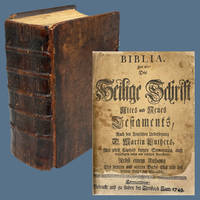
1743P49<p><strong>Summary: </strong>Germantown: Christopher Saur 1743. 4to 9.5 X 7.5 in. The first Bible printed in America after Elliot's Indian Bible of the 1660s and the first American Bible printed in a European language. A very good copy in original beveled boards.</p><p><strong>Description:</strong> There are several clippings pertaining to this edition of the Bible mounted on the front pastedown. Printed general title page 1743 laid down with loss to the lower border and imprint which have been replaced in facsimile. Ornamental headpiece at the beginning of Genesis. Text in two column black letter with cross references and short summaries at the beginning of each chapter. The text is based on Martin Luther's version by way of the 34th edition of the Halle Bible with books three and four Esra and three Maccabees supplied from the Berlenburg Bible. The present copy has "parallelen" spelled correctly a second issue of the title had this word misspelled as "parllelen" as it was made in haste. Printed New Testament title page 1743. Ornamental headpiece at the beginning of Matthew. Concludes with a Register 3 pp.</p><p><strong>Collation:</strong> 2 A-Z4 2A-2Z4 3A-3Z4; 4A-4Z4; 5A-5Z4 6A-6I4 6J2 Old Testament; A-Z4 2A-2M4 2N2 New Testament. <u>Lacks</u> Rrr-Sss Psalm 23-56.</p><p><strong>Binding:</strong> Period full sheep over beveled oak boards. Sometime expertly rebacked with the original spine laid on. A portion of one strap perished with the original hasp and other strap remaining. Binding chipped in various places but nicely restored.</p><p><strong>Condition:</strong> Some dampstaining in places most prevalent to first few leaves; some toning occasional soiling and spotting as typical; small hole to final leaf with loss of a few letters; a few instances of shaved catchwords in places; introductory leaf remargined with loss of a few letters to margins.</p><p><strong>Note: </strong>1200 copies of this Bible were printed by Christopher Saur. He was a man of conviction in matters of morality and religion and he sought to produce a Bible that his fellow Germans could read in their native tongue. He appealed to Germany where Dr. Heinrich Luther provided him with the type in exchange for a presentation copy. It took him three years to complete the printing of the Bible. Saur made every effort to promote the reading of the Scriptures. His asking price was eighteen shillings but his quoted as saying that "to the poor and needy we have no price." An estimated 120 copies have survived making copies of the 1743 edition quite scarce.</p><p><strong>References:</strong> D&M 4240; Evans 5127; Wright 31.</p> Christopher Saur hardcover
155067900En Leon i.e. Strassburg: en Casa de Sebastian Grypho i.e. Augustin Fries 1550. BIBLE IN SPANISH; ENZINAS Francisco de. First Edition in Spanish of Ecclesiasticus<br> <br> BIBLE IN SPANISH. ENZINAS Francisco de translator. Ecclesiastics. Libro de Jesus Hiio de Syrach qu'es llamado el Ecclesiastico. traduzido de Griego en lengua Castellana En Leon i.e. Strassburg: en Casa de Sebastian Grypho i.e. Augustin Fries 1550.<br> <br> First edition in Spanish of Ecclesiasticus. Small octavo 6 x 3 5/8 inches; 151 x 91 mm. 3 109 leaves. With numerous woodcut initials. With an imitation Gryphius woodcut device printed in reverse on title. We could only locate 3 copies at libraries Cambridge Madrid and Copenhagen. No other copy besides this present copy has been at auction in the past 50 years.<br> <br> Early 19th-century mottled sheep. Boards tooled in gilt. Spine stamped in gilt. With red morocco spine label lettered in gilt. Board edges tooled in gilt. Marbled endpapers. Some minor dampstaining mainly to lower blank margin of preliminaries. Signature G is toned. Leaves O3 and O4 with marginal paper repair not affecting text. Final leaf is toned and has a near invisible paper repair not affecting text. Overall a very good copy.<br> <br> "A native of Burgos educated at Louvain and Wittenberg Francisco de Enzinas 1518-52 was a humanist scholar and Protestant convert who produced the first Spanish version of the New Testament printed in 1543 in Antwerp. He formed a partnership with the Strassburg printer Augustin Fries to publish Spanish translations of Greek classics and the remainder of the Bible of which he was only able to complete Psalms Ecclesiasticus Job and Proverbs before his death. Baudrier VIII 241 not having seen or located a copy citing Brunet supplement II 712"<br> <br> "Even before the complete edition of Castellio's Latin Bible appeared Enzinas who had already produced a Spanish Bible New Testament in Antewerp in 1543 had translated the Psalter the Wisdom of Solomon Jesus Sirach present copy and the book of Job into Spanish. All of these appeared with the false address 'En Leon en casa de Sebastian Grypho' though they were in fact his translations from manuscript versions of Castellio's edition. Enzinas continued to work on his translations until his death on 30 December 1552. He had planned to have his Spanish Bible printed in Geneva but this fortunately for Calvin never came to pass." Gilly Spanien und der Basler Buchdruck pp. 342-9 510-11. Found in Sebastian Castellio 1515-1563: Humanist and Defender of Religious .By Hans R. Guggisberg Bruce Gordon.<br> <br> "FRIES Augustine: printer in Zurich and Strasburg began to print at the former place about 1540. In 1547 he printed two books in English by John Hooper Heitz p. 39. Soon after this he moved to Strasburg and there printed among other things several works in Spanish by Franzisco de Enzinas in 1550 and 1551 Wiffen I pp 179 etc." A Century of the English Book Trade: Short Notices of All Printers. By Edward Gordon Duff.<br> <br> HBS 67900.<br> <br> $8500. en Casa de Sebastian Grypho [i.e. Augustin Fries] unknown
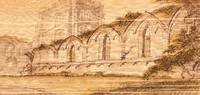
06244Paris: Printed by P. Didot Sen. and sold by W. Edwards and Sons Halifax 1791. A Superb Early Edwards of Halifax Vellum Binding with an Edwards Fore-Edge Painting<br /> <br /> FORE-EDGE PAINTING. EDWARDS OF HALIFAX binder and artist. BIBLE IN ENGLISH. The Book of Common Prayer and Administration of the Sacraments and other Rites and Ceremonies of the Church according to the use of the Church of England: Together with the Psalter or Psalms of David. Paris: Printed by P. Didot Sen. and sold by W. Edwards and Sons Halifax 1791.<br /> <br /> Twelvemo 5 5/8 x 3 3/8 inches; 143 x 86 mm. ii title-page verso blank xxii preface & table 408 pp. <br /> <br /> With a fine contemporary fore-edge painting by Edwards of Halifax. The scene is St. Martin's Church Canterbury and shows the single figure of a cemetery worker seated on the ground and behind him a row of grave stones<br /> <br /> Full contemporary vellum covers bordered in dark blue with Greek key pattern enclosing a decorative gilt border. Smooth spine elaborately decorated in gilt with dark blue stained spine labels lettered in gilt. Gilt decorated board edges and turn-ins pink marbled endpapers all edges gilt.<br /> <br /> A wonderful example of an Edwards of Halifax ' Fore-Edge' painting on a book originally bound and sold by Edwards of Halifax.<br /> <br /> Neat ink gift inscription on second front blank "Eliz. Buckle. / April 2 1818."<br /> <br /> Provenance: Elizabeth Buckle; Tony Hattersley. <br /> <br /> Tony Hattersley was a renowned English antiquarian bookseller who retired to a giant granite mansion hidden up the valley behind Whitby Dracula's landing place. His books were sold by Bonham's in two parts. Part 1 11/09/07. Paris: Printed by P. Didot Sen. and sold by W. Edwards and Sons, Halifax, 1791 unknown
1738ST20462Zurich: David Gessner 1740 1738 1738. 162 x 90 mm. 6 3/8 x 3 1/2". 270 pp.; 192 16 pp.; 64 pp. <br/> LOVELY PIERCED VERMEIL SILVER BINDING over dark brown sharkskin the metalwork with intricately twining strapwork accented with acanthus leaves a basket of flowers and two eagles elongated vermeil head and tail caps over spine two fore-edge clasps gilt patterned paper pastedowns all edges gilt. Housed in a fine modern brown morocco felt-lined clamshell box. First two works with extra engraved illustrated title page. Ink gift inscription on front flyleaf: "Helen McDowell/ from her/ affectionate/ illegible/ with sincere/ good wishes/ for her future/ happiness/ August 1864." For the binding: Hayward "Silver Bindings from the J. R. Abbey Collection" 14. Sharkskin with just a hint of chafing occasional mild browning or foxing to leaves but QUITE A FINE COPY clean and fresh internally and the binding shining and unworn.<br/> <br/> Beautifully executed and wonderfully preserved this New Testament is an excellent example of the vermeil bindings--that is silver-gilt or gilded/gilt silver--produced in Switzerland and southern Germany during the Baroque period. As is typical this binding is without a hallmark but it closely resembles another New Testament bound in shagreen and vermeil described and pictured as item #14 in Hayward's "Silver Bindings from the J. R. Abbey Collection" which Hayward indicates was produced in Zurich in the early 18th century. These intricate silver bindings were popular for religious works presenting what Hayward calls a "combination of ostentatious wealth and piety" and this one was executed with great skill featuring graceful lines and delicately rendered details. There are two main types of silver bindings from the period: engraved and pierced bindings like the present example which were especially popular in the 17th century; and embossed or repoussé bindings which came into fashion in the late 17th and early 18th century. Of the two the engraved and pierced bindings are generally valued more highly because they required more time and skilled labor. David Gessner unknown
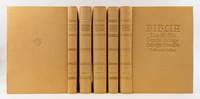
1926ST16973Munich: Bremer Presse 1926-28. ONE OF 365 COPIES. 360 x 250 mm. 14 1/4 x 10". Five volumes. Edited by Carl von Kraus. <br/> VERY FINE TAN MOROCCO BY WERNER G. KIEßIG stamp-signed with his "K" mark at foot of lower cover upper covers lettered in blind lower cover with small round book stamp of former owner Martin Wandersleb smooth spines divided into panels by blind rules blind-stamped titling marbled endpapers leather hinges top edges black other edges untrimmed. In the original brown dust jackets with paper title labels to spines. Housed in the original slightly worn matching marbled paper slipcases. With titles and initials drawn by Anna Simons. Front pastedown with bookplate of Martin Wandersleb. Eyssen 88; Ransom p. 257. ◆One or two faint spots of foxing one small marginal smudge but A CHOICE COPY with no signs of use inside or out.<br/> <br/> This is a superb copy of the signal achievement of the Bremer Presse in a restrained but impressive binding produced by Berlin master bookbinder Werner G. Kießig. Printed on Zander handmade paper with a typeface specially cut by Louis Hoell and initials designed by Anna Simons this set was issued to celebrate the 400th anniversary of the completion of the Lutheran Bible. Rodenberg tells us that this work had for years been the highest goal of the press and Eyssen proclaims "a better and more textually reliable re-creation of this national monument is hardly conceivable." Colin Franklin noted in "The Private Presses" that the Gutenberg Museum in Mainz described the Bremer Presse as "the Queen of the Private Presses." According to Ransom the press offered the Bible in three different bindings: in boards for $310 in vellum for $420 and in morocco for $470. Because she was a woman Anna Simons 1871-1951 was barred from studying at the Prussian Arts and Crafts School so she travelled to England to learn from Edward Johnston at the Royal College of Art. Johnston's biographer Priscilla Johnston writes "She was one of the best students Johnston ever had and certainly one of those who exercised the greatest influence afterwards for she disseminated his teaching throughout Germany where it was perhaps more fruitful even than in England." She designed some 1400 initials and title pages for the Bremer Press. <br /> <br /> Binder Werner G. Kießig 1924-2014 apprenticed with German master binder Kurt Grünewald and studied with Bruno Scheer before attaining the rank of Meister in 1948. Although he lived in East Germany for much of his career his status as a master craftsman afforded him more freedom than usual--to exhibit internationally and to join organizations like Meister der Einbandkunst MDE and Designer Bookbinders. He was the preferred bookbinder for volumes produced by Wolfram Benda's Bear Press. From the 1970s on Kießig signed his bindings with the stamp of a "K" in a stylized book designed by Herbert Prüget.<br /> <br /> Our bindings also bear the stamp of former owner Martin Wandersleb 1924-2005 designed by Otto Rohse. The bookplate designed for this bibliophile and theologian by the artist Gerhard Marcks is on the front pastedown. This set was also part of the collection of Hamburg collector Barbara Achilles d. 2010 who put together an impressive library of private press books. Bremer Presse unknown
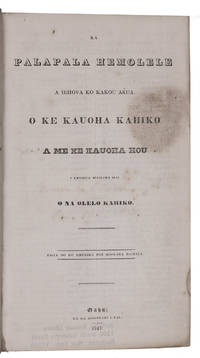
1843L3LFICT78EKXOahu and Honolulu: American Bible Society 1843. Later half calf. Large 8vo 24 x 14 cm. Including: Ke kauoha hou a ko kakou haku e ola'i a Iesu Kristo oia ka olelo hemolele no ke ola a na lunaolelo i kakau ai. Second edition of the entire Bible in the Hawaiian language but the first edition in octavo to be published in a single volume. The translation a joint effort of American missionaries and Hawaiian advisers was a monumental work of language and scholarship. "Neither of the two very different groups of people who produced the Baibala - the missionary scholars working with ancient texts and the Hawaiian chiefs and advisors guardians of a millennium of traditional Kanaka learning - could have produced even a pedestrian Bible translation on their own. Together through over a decade of incessant and mostly fruitful labor and cooperation they created a work for the ages among the best Bible translations of their century and an enduring literary monument today" Lyon.The first gospels in the Hawaiian language were printed in 1827-1828 ultimately leading to a complete translation of the New Testament in 1835 which was revised in 1837. The first translation of the Old Testament was published in 1838 and together with the 1837 New Testament incorporated in a complete edition of the Bible in three volumes. In 1843 these texts were reprinted with several mistakes corrected in a more compact version and then bound together to form this edition of the Bible. Apparently sales of the 10000 copies printed were slow with records showing that "between 400 and 600 Bibles were bound and presumably distributed each year" Forbes. This slow distribution could explain why no new edition of the complete Bible in Hawaiian appeared until 1868.With an 1853 owner's inscription on the title page. Slightly foxed and with several sections slightly browned; a very good copy.l Forbes 1416; Judd 165; Lyon "No ka Baibala Hemolele: The making of the Hawaiian Bible" in: Palapala I 2017 pp. 113-151. American Bible Society, unknown
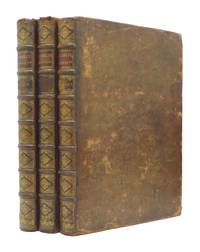
172812597s-Graavenhaage Pieter de Hondt 1728. 3 delen in 3 banden 2 titelprent gegraveerde opdracht 148 2 2 149-280 titelprent 2 gegraveerde opdracht 160 p. Origineel blind- en goud-bestempeld Leer met ribben Folio imperiaal papier H. 47 x B. 33 x D. 4 cm. De tekstbladen zijn in de marges hier en daar heel licht gevlekt verder een goed exemplaar. Luxe uitgave van de prentbijbel van Pieter de Hondt bestaande uit 214 gravures door Gerard Hoet Arnold Houbraken en Bernard Picart met bijgevoegde tekst van Jacques Saurin. De prentbijbel is geïllustreerd met 2 titelprenten en 212 gravures waarvan 29 dubbel paginagroot. Alle gravures hebben een onderschrift in 6 verschillende talen resp. Hebreeuws Engels Duits Latijn Frans en Nederlands en bij elke gravure is de tekst van Jaques Saurin gevoegd. De begeleidende tekst is fraai versierd met gegraveerde kapitalen en grote kop- en sluitvignetten die betrekking hebben op de betreffende bijbelse geschiedenis. PRINT BIBLE 3 parts in 3 bindings 2 title-print engraved dedication 148 2 149-280 title-print 2 engraved dedication 160 p. Original blind-stamped and gold-stamped Leather with ribs Folio H. 47 x W. 33 x D. 4 cm. The text sheets are somewhat spotted in the margins.Luxury edition of Pieter de Hondt's picture bible consisting of 214 engravings by Gerard Hoet Arnold Houbraken and Bernard Picart with accompanying text by Jacques Saurin. The picture bible is illustrated with 2 title prints and 212 engravings 29 of which are double-page sized. All engravings have a caption in six different languages respectively Hebrew English German Latin French and Dutch and each engraving is accompanied by the text of Jacques Saurin. The accompanying text is handsomely decorated with engraved capitals and a large head and closing vignettes relating to the relevant biblical history. A fine set. s-Graavenhaage, Pieter de Hondt hardcover
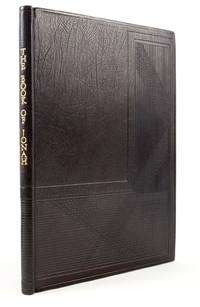
1926ST20084Waltham St. Lawrence: Golden Cockerel Press 1926. No. 48 OF CLXXV COPIES. 258 x 195 mm. 10 1/4 x 7 3/4". 15 3 pp. <br/> Understated black crushed morocco by J. Franklin Mowery stamp-signed "JFM 94" on rear turn-in wraparound design of blind-stamped L-shaped panels of intersecting lines smooth spine with vertical gilt lettering leather hinges edges untrimmed. Original illustrated upper cover of dust jacket repaired at one corner bound in at rear. In a matching morocco-lipped slipcase. Title page with large woodcut of the risen Christ four large vignettes in the text four pictorial half borders and four full-page woodcuts all by David Jones printer's device in colophon. Front pastedown with bookplate of Jan van der Marck. Chanticleer 40. A pristine copy.<br/> <br/> This is a wonderfully--if understatedly--bound copy of one of the most strictly limited Golden Cockerel Press productions. The binding is the work of J. Franklin Mowery retired Head of Conservation at the Folger Shakespeare Library and past president of the Guild of Book Workers. Mowery studied bookbinding under Professor Kurt Londenberg at the Staatliche Hochschule für bildende Künste Academy of Art in Hamburg and trained as a paper conservator under Otto Wächter in Vienna before returning to the U.S. to work at the Huntington Library. According to his article "A Binder's Training" Guild of Book Workers' Journal XX 1981-82 the blind-stamping technique seen here was "particularly favored by Professor Londenberg" and often employed by Mowery for the range of design possibilities it offers. The method uses dies to stamp the patterns: "a photographic process can transfer any black and white image onto zinc plates that are deeply etched and mounted onto type-high metal blocks for heated impressions or onto wood for cold embossing." Mowery stated that lines of the design here represent the driving rain of the storm that struck Jonah's ship. Founded in 1920 with the intention to print fine editions of important well-known books as well as new literary works of merit from young authors the Golden Cockerel Press was purchased in 1924 by the illustrator and wood-engraver Robert Gibbings. "Under his direction" says Cave the Press was "transformed into the principal vehicle for the renaissance of wood-engraved book illustration that took place in the years between the wars." In addition to doing wood engravings himself Gibbings employed a stable of eminent artists including among others Eric Gill Blair Hughes-Stanton John Nash John Farleigh Eric Ravilious and David Jones. The memorable woodcuts are the work of Jones 1895-1974 who had a brief but impressive career as an illustrator before eye strain forced him to abandon engraving in 1930. In his published study of Jones' work Douglas Cleverdon says that in the short time Jones was engraving "he produced a remarkable amount of work of great variety; some witty some mystical; some boldly cut some delicately shaded; some simple to print some virtually impossible. Although he never attained . . . the greatest technical mastery in the conventional sense his prints are nearly always distinguished by their excellence of design personal commitment and absolute individuality." Our binding was commissioned by collector and self-described "radical" museum administrator Jan van der Marck 1929-2010 who championed artists that pushed boundaries--often to the consternation of the museum boards who employed him. Golden Cockerel Press unknown
1827180737Paris: Darü't T baatü'l Mülkiyyeü'l Mamure 1827. The Old and New Testament in Ottoman Turkish First Ottoman Turkish edition of the Old and New Testaments together funded by the British and Foreign Bible Society and based on the translation made by Ali Ufki Bey d. 1675 an influential agent for European diplomats in 17th-century Turkey. We have only traced four institutional copies. Unusually the Ottoman text is fully vocalized. Ali Ufki Bey christened Wojchiech Bobowski was known in Europe as Albertus Bobovius. After his enslavement by the Tartars in the Ukraine he was forcibly converted to Islam and brought to Istanbul where he worked in the Ottoman palace for over two decades. The editor the famous Turcologist Jean-Daniel Kieffer d. 1833 had published a standalone Turkish edition of the New Testament in 1819 always with the British and Foreign Bible Society. Kieffer's starting point was Ali Ufki Bey's Ottoman Turkish text revised according to critical comments on the first edition of his New Testament. Kieffer also compared the Ottoman text "with the original texts as well as with the standard English French and German versions. W. Seaman's Nogai New Testament of 1666 T. Erpenius' Arabic version H. Martyn's Persian version H. Brunton's Nogai New Testament of 1813 and with the London Polyglot. On crucial questions he had the advice of Baron Silvestre de Sacy" Darlow & Moule. The present edition was printed in 5000 copies on the presses of the Louvre hence the "Royal Printing House" imprint. The same binding - arguably a publisher's binding - is found on another copy of this edition. 2 vols in one large quarto 257 x 222 mm pp. ii 984; ii 3 i 318. Titles within double typographical ruling. Contemporary Ottoman Turkish brown sheep blind stamped to a panel design arabesque cornerpieces on inner corners large arabesque centrepieces flat spine triple blind ruled gilt lettered title. 20th-century inked and pencilled Ottoman Turkish annotations on pastedowns and first title. Spine and extremities refurbished boards a bit rubbed contents slightly toned but overall clean a little light marginal water staining along outer edge of initial gatherings: a very good copy. Darlow & Moule 9456. hardcover
1635P07<p>Summary: Rouen: John Cousturier 1635. 3 vols. in 4to 9 x 7 in. A complete Douai-Rhemes Douay-Rheims Bible rebound in black calf. Together two works in three volumes. Complete Bible text including the summaries annotations and tables. Seven steel engravings numerous head- and tailpieces with woodcut initials.</p><p>Description: New Testament The fourth edition of the Rheims New Testament which generally follows the second edition of 1600. Likely printed at Rouen with text presented in single column Roman font. Six steel engravings include three of the four Evangelists portraits of St. Paul and St. John before Revelation and a representation of the Day of Pentecost. The engraved title page is provided in facsimile. The engraved plate before Matthew is lacking; Old Testament The second edition of the Douay Old Testament which generally follows the first edition of 1610. Text presented in single column Roman font within ruled border. The first volume includes the additional engraved title page which is provided in facsimile in the second volume.</p><p>Collation: New Testament a4 e4 i4 A-Z8 Aa-Xx8 Yy-Zz4 Aaa-Bbb4. Lacks Ccc2 the final two leaves of the Table; Old Testament Vol 1 A-Z4 Aa-Zz4 Aaa-Zzz4 Aaaa-Zzzz4 Aaaaa-Zzzzz4 Aaaaaa-Nnnnnn4 Oooooo2; Vol 2 A-Z4 Aa-Zz4 Aaa-Zzz4 Aaaa-Zzzz4 Aaaaa-Zzzzz4 Aaaaaa-Kkkkkk4 a4 e4 i4 o4 u2. Complete.</p><p>Binding: The three-volume set is beautifully bound in contemporary-style black calf. Covers with gilt-tooled centerpiece surrounded by gilt lines and blind rolls and four gilt fleurons at corners. Spines with found raised bands and extensive blind- and gilt-tooling to compartments. Each spine with two red gilt-ruled labels and the words "Old Testament" and "Doway" or "New Testament" and "Rhemes" in gilt along with date at foot. New plain endpapers.</p><p>Condition: New Testament Overall the text is crisp and clean. L8 tissue repair without loss; Mm1 short closed marginal tear; Vv3-8 bottom corner piece torn off with loss of sidenotes; Xx3-Zz1 marginal worming; Yy1-3 first two leaves of Table reinforced with some loss; Yy4-Zz1 remargined; Zzz-Bbbb4 fraying to edges; Old Testament Vol. 1 A-5D tiny wormhole to foot infrequently affecting catchword; N-2I small light stain to head; Old Testament Vol. 2 A1-E3 small wormhole to upper outer margin; small stain to upper gutter occasionally impacting a few lines of text; 4R-u pen-tip sized wormhole. Note: After the publication of the 1635 Douay Old Testament it would be another 115 years before the next Roman Catholic Bible was printed.</p><p>References: New Testament Herbert 479; STC 2946; D&M 370; ESTC S102550. Old Testament Herbert 499; STC 2321; D&M 387; ESTC S1501.</p> John Cousturier hardcover
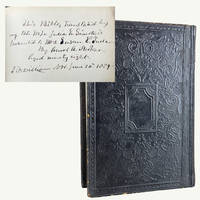
1876R69<p><strong>Description: </strong>Quarto 9.75" x 6.5". Text in two column Roman font. 3-892 Old Testament 1-276 pp. New Testament. The books of the Old Testament are arranged in Jewish order with Chronicles at the end. One of 950 copies.</p><p><strong>Binding: </strong>Rebacked in matching black calf with original spine laid down. Embossed cloth spine with "Holy Bible" and "Translated by Julia E. Smith" lettered in gilt to spine. All edges speckled red. Rubbed to edges with loss of small portions of relaid spine.</p><p><strong>Condition:</strong> Crisp clean and bright.</p><p><strong>Provenance: </strong>Note inked on front flyleaf reads "This Bible translated by my late wife Julia E. Smith is presented to Mrs. Susan E. Tullar by Amos A. Parker Aged Ninety Eight – Fitzwilliam N.H. June 20th 1889."</p><p><strong>Note: </strong>A remarkably well-preserved copy of the first and only Bible translated entirely by a woman. Julia E. Smith 1792–1886 of Glastonbury Connecticut used her knowledge of Latin Greek and Hebrew to render the entire Bible into English. A member of the Sandemanian sect which sought to restore the Apostolic church she dedicated eight years to her translation but did not publish it for another twenty-one years.</p><p>Sampson recounts Julia's deep passion for the project: "I cannot express how greatly I enjoy the work of translating and now the real meaning of different texts would thrill through my mind till I could hardly contain myself." According to one account she became so engrossed in her work that she often failed to hear the dinner bell and had to be summoned by her sisters.</p><p>Elizabeth Cady Stanton in her radical and controversial work <em>The Woman's Bible</em> remarked that Smith's translation would become a rarity in the next century "much sought after by bibliomaniacs to say nothing of scholars who will want it for its real value."</p><p><strong>References:</strong> Herbert 2202; Hills 1918; Rumball-Petre 201; Stanton Elizabeth Cady. <em>The Woman's Bible</em>. Sampson Emily. <em>With Her Own Eyes: The Story of Julia Smith.</em></p> American Publishing Company hardcover
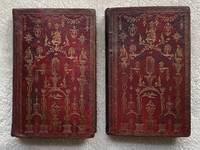
1787271Edinburgh: Assigns of Alexander Kincaid 1787. Very good. Two works in two volumes. Large Octavo 211 x 130 mm. Collation: BIBLE: A-4A8 complete. PSALMS: A-E8 complete. Contemporary Scottish bindings: red morocco elaborately tooled in gilt to a "Chippendale" motif smooth spines gilt; marbled endpapers a.e.g. in vol. 1 the front joint expertly repaired and tape removed from inner hinges. Preserved in a protective cloth case. INNOVATIVE AND HIGHLY UNUSUAL SCOTTISH CHIPPENDALE ROCOCO BINDINGS COMBINING CHINOISERIE AND NEOCLASSICAL ELEMENTS EXHIBITING THE INDEPENDENCE OF SCOTTISH WORK AT THIS TIME. <br /> <br /> The present example is a striking hybrid of late 18th-century decorative art in Britain the likes of which we have not encountered hitherto. Here "oriental" birds and peacocks are juxtaposed with patriotic depictions of Britannia uncharacteristically surmounted by a fleur-de-lis bold anchors columns sunbursts dripping garlands flowers sheaves of wheat and urns. Presented in the Chippendale style the present binder who is as yet unnamed introduces rococo ornaments while enclosing all of the above with an unmistakably neoclassical greek-key roll. <br /> <br /> EIGHTEENTH-CENTURY ROCOCO BINDINGS OF THIS QUALITY ARE RARE PARTICULARLY THOSE EXECUTED IN SCOTLAND. <br /> <br /> Rococo book arts in Scotland have been almost completely unexplored on account of the paltry number of examples with which we are able to study. Robert Adam's designs for the bindings of his "Ruins of Spalatro" 1764 is a bold statement of the neoclassical for he was justly celebrated. But we now know that Adam was not exclusively "Grecian." David Pullins' heroic archival research in Sir John Soane's Museum has shown that Adam received three previously unexamined commissions for a seemingly antithetical kind of decoration which he calls "neoclassical chinoiserie" specifically Adam's drawings for an unrealized chinoiserie looking-glass dated 1769 for Edwin Lascelles 1st Earl of Harewood. SOURCE: "Robert Adam's Neoclassical Chinoiserie" in: West 86th: A Journal of Decorative Arts Design History and Material Culture online. We would argue that the present bindings exhibit such a blend of Chippendale chinoiserie rococo and neoclassical. For a general note on English "Chippendale" and "Chinoiserie" bindings see G.D. Hobson "English Bindings of J.R. Abbey" p. 126.<br /> <br /> ¶ Our bindings may be linked to four others -- all greatly inferior -- which share the large "eagle" tool in common as noted by Mirjam Foot:<br /> <br /> 1. British Library Davis 253 Bible Edinburgh 1790 = Henry Davis Gift Vol. II No. 283; <br /> 2. National Library of Scotland F.4.e.9 Bible Psalms Edinburgh: Assigns of A. Kincaid 1789; <br /> 3. Washington Cathedral Library Bible Edinburgh 1789; <br /> 4. Glasgow University Library DXC 48-48A Bible Cambridge 1792 Psalms Glasgow 1793. <br /> <br /> PROVENANCE: red morocco bookplate of "MARION MALLOCH 1794" inside both volumes -- sold by us to a private collector in 2007 -- bought back by us in 2023. <br /> <br /> ¶ REFERENCES: ESTC 91765 Darlow & Moule 1319; ESTC 91766. Assigns of Alexander Kincaid unknown
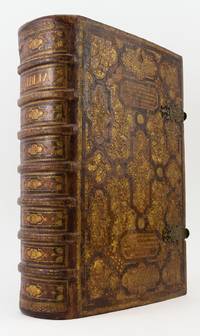
1720ST19425Nuremberg: J. A. Endter 1720. 433 x 278mm. 17 x 11". 68 p.l. first blank 1-664 1-904 pp. 8 leaves. <br/> ONCE SPECTACULAR AND STILL REMARKABLY IMPRESSIVE CONTEMPORARY GERMAN CALF ELABORATELY GILT WITH A PAINTED BROWN STRAPWORK DESIGN OVER REVERSE BEVELLED WOODEN BOARDS two cartouches on each cover with four- or five-line quotations from the Bible initials "J A B" and "D B" and the date "1726" on upper cover the strapwork forming geometric compartments filled with gilt foliate and floral sprays accented with small putti raised bands spine gilt in compartments with central strapwork lozenge containing gilt flower surrounded by foliage two brass and probably later leather clasps dramatic endpapers of green and gilt decorated paper edges gilt and gauffered in ornate lily pattern some expert restoration at spine ends and at top and bottom of joints. With woodcut initials and tailpieces additional engraved title page 11 engraved portraits of the Dukes of Saxony engraved portrait of Luther by Kilian after Sandrart missing an additional portrait of Luther and 28 engraved plates and plans seven of them double-page. ◆Paint and gilt somewhat rubbed other signs of use to the binding but the once-magnificent binding quite sound and still very very striking. Occasional minor foxing stains and thumbing N5 with five-inch curving tear into text no loss two plates with old six- to seven-inch tears into image one mended on verso with discolored cellotape a handful of other minor tears but still a pleasing copy internally generally quite clean and fresh.<br/> <br/> At 5 1/4" thick and with a lavish overall decorative design this is a memorable specimen of a German post-fanfare binding very likely produced as a wedding gift for the couple whose initials appear on the cover. Support for this supposition resides in the binding's quotations from German Scripture traditionally used at Lutheran weddings: Genesis 2:18 "And the Lord God said It is not good that the man should be alone; I will make him a helpmeet for him" and Colossians 3:14 "But above all these things clothe yourselves in love which is the bond of perfection". A perfect family Bible for a young couple of high degree this handsomely illustrated edition is known as the "Kurfürstenbibel" because of its portraits of the Electoral Princes called "Kurfürsten" in German. Such a Bible was originally prepared for Ernst I Duke of Saxe-Gotha and Altenburg as a celebration of Martin Luther's Bible translation. The Endters one of the prominent German printing families issued several printings of it beginning in 1641 and continuing to the end of the 18th century. In addition to portraits of Luther and the Protestant princes of Germany it contains the maps views and illustrated half-titles by Jacob van Sandrart and others first used in the edition of 1686. Although it bears some small signs of use the binding remains an object of imposing beauty. J. A. Endter unknown
1862ST20857London: Edmund Evans for Sampson Low Son and Co 1862. ONE OF PERHAPS 10 COPIES PRINTED ON VELLUM. 260 x 195 mm. 10 1/4 x 7 3/4". vii 1 235 1 pp. <br/> Publisher's stiff vellum smooth spine with gilt lettering edges untrimmed. In a modern felt-lined blue buckram drop-back box. Decorative initials in red or blue title page and text leaves with full criblé border of vined foliation occasionally inhabited eight or 10 leaves with more extensive illustrations at head or foot all engraved by W. J. Linton after illustrations by John Franklin. Front pastedown with ex-libris of Marion Hope Rattey. A Large Paper Copy. McLean "Victorian Book Design" p. 184. Short thin cracks to head and tail of front joint spine vaguely soiled upper cover with two very small brown spots and one trivial red mark occasional mild rumpling or naturally occurring variations in the grain or thickness of the vellum as usual a couple of minor smudges but still a very agreeable copy the binding solid and without the splaying common in vellum books the interior clean fresh and bright and the margins extraordinarily wide.<br/> <br/> This is an infrequently encountered copy of a beautiful Victorian book on vellum issued by one of the era's top printers. The volume was printed by Edmund Evans 1826-1905 who is now best remembered for his illustrations and advances in color wood engravings. Relatively little is known about this book's production: Ruari McLean tells us that it was "entirely printed" by Evans but it is unknown whether he was responsible for the design as well McLean remarks that "if Evans was responsible for its design it shows his superiority in book-making". We also are unsure how many copies were printed on vellum although the general consensus is 10. Regardless as McLean tells us "it is one of the prettiest books of the 'sixties" with sharp deep impressions of the type on the rich creamy vellum jewel-like colored initials and elegant wood-engraved illustrations. These illustrations are the work of John Franklin ca.1800-68 a painter and draftsman who was highly respected in his own time. The precisely realized borders feature idealized human forms posed within a robust botanical largely acanthus context the figures posing with balletic grace their expressive faces often turned gently away from the reader. The size of the leaf here is significant: the untrimmed edges retain their tiny printing pinholes which would normally have been trimmed away with regrettable loss. And not surprisingly our vellum printing is almost never seen: we could trace just two copies at auction since 1924. Former owner Marion Hope Rattey 1922-97 was likely the daughter of bibliographer Clifford C. Rattey 1886-1970 whose impressive library featured incunabula and block prints. [Edmund Evans for] Sampson Low, Son, and Co unknown
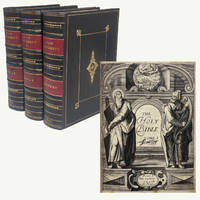
1800CJW1405London: T. Bensley for T. Macklin final volume Bensley for T. Cadell & W. Davies 1800. First Printing of this Edition. 484 x 390 mm. 19 x 15 1/4". Seven volumes. <br/> Once splendid contemporary black straight-grain morocco gilt covers framed by Greek key roll palmette roll and multiple gilt rules double raised bands spine compartments densely gilt with rows of alternating star and circlet tools gilt titling turn-ins with gilt chain roll purple endpapers all edges gilt some inexpert but not obvious repairs to joints and backstrips. With more than 100 allegorical headpieces and tailpieces and some 70 SPLENDID LARGE-FOLIO SIZE COPPER PLATES after Fuseli Reynolds West and others. Herbert 1442 and 1651. ◆Extremities rather rubbed boards a bit scuffed but the decorative contemporaneous bindings solid and not without appeal. Plates somewhat foxed mostly to margins mild to moderate offsetting from plates occasional mild offsetting in the text bed but still a fresh wide-margined copy.<br/> <br/> The most prodigious form of scripture in English ever published the Macklin Bible features very large and bold type fine Whatman paper and a series of engravings by some of the most celebrated artists of the period. Like the Boydell "Shakespeare Gallery" also printed by Bensley our Macklin Bible is a vast picture book with illustrations that are grand both in size and emotional impact. According to DNB Macklin 1752/3-1800 announced his intention to produce a lavishly illustrated luxuriously produced folio Bible in 1789 and he spent the next 11 years and £30000 making his dream a reality. His efforts paid off: "the subscription list for 703 copies at £46 1s. apiece was headed by the king the queen and the prince of Wales." Sadly Macklin died just five days after the last engraving was finished and did not live to see his masterpiece become one of the most acclaimed English Bibles. As DNB observes "The Macklin Bible endures as the most ambitious edition produced in Britain often pirated but never rivalled." Copies of the Macklin Bible were often put into ornate bindings as was the present set; despite the depradations of time the workmanship of a superior London binder remains apparent. T. Bensley for T. Macklin [final volume Bensley for T. Cadell & W. Davies] unknown
1597ST19351Frankfurt: heirs of Andreas Wechel Claude de Marne & Johann Aubry 1597. Fourth Complete Greek Bible printed in Germany. 388 x 258 mm. 15 1/8 x 10 1/8". 4 p.l. 1 blank leaf attached to backing of folio :4 1098 2 pp. <br/> VERY STATELY 17TH CENTURY RED MOROCCO covers with mitered gilt frame gilt supralibros of Baderon de Maussac Olivier 745 at center raised bands spine panels with gilt flower gilt lettering all edges gilt. Printer's Pegasus device on title and final page. Front flyleaf with ink inscription recording the purchase on 24 February 1680 at Toulouse for 24 livres. Darlow & Moule 4653; VD16 B 2578; Adams B-979. ◆Three minute dents to front board a hint of wear to bands and corners isolated faint foxing blank recto of frontispiece leaf and blank verso of final leaf with faint blue shadow from endpapers but all of these quite trivial and otherwise A BEAUTIFUL COPY--fresh clean and bright internally with very wide margins and strong impressions of the plates and in a lustrous binding showing few signs of use.<br/> <br/> This handsome and remarkably well-preserved tall folio Greek Bible from a distinguished German printing firm comes in a shiny armorial binding with aristocratic French provenance. Darlow & Moule assigns the editing of this issue to Franciscus Junius François du Jon or Friedrich Sylburg noting that the Old Testament "is based on the Basel edition of 1545 . . . with correction from the Complutensian text and useful notes." The New Testament follows the text of Robert Estienne's 1568-69 edition. The Wechel family had a long tradition of humanist printing with an emphasis on Greek texts beginning with the press of Christian Wechel fl. 1520-54 in Paris and continuing after his son Andreas d. 1581 fled to Frankfurt to escape the persecution of Protestants in France. Andreas' descendants carried on the business through the first quarter of the 17th century. Olivier's "Reliures Armoriées Françaises" 1926 pl. 745 offers three possible attributions for the supralibros here all from the Languedoc region during the first half of the 17th century: Jean de Baderson; Jacques de Baderon seigneur de Maussac a member of the Parlement of Toulouse; and Jacques de Baderon de Maussac seigneur de Montagnac et de Corneillan and commandant of the city of Collioure. The inscription on the flyleaf here indicating that the book was purchased in Toulouse perhaps supports the case for the member of the Parlement in that city. The 24 livres paid for our imposing volume in 1680 would have represented as much as two months' wages for a worker in the region of its purchase. heirs of Andreas Wechel, Claude de Marne & Johann Aubry unknown
1717062622Oxford: John Baskett Printer to the King's most Excellent Majesty 1717. Leather Bound. Folio. Measures 52 x 34 x 14 cm. Bound in leather likely late 19th century. Binding split at rear joint. Some damage to text block especially prelims; a few loose pages some chips and tears foxing some pages darkened. Three rounds of restoration are evident the most recent carefully documented a fourth round required. Herbert 942A: "A magnificent edition printed in large type. With many plates at the beginning and end of books engraved on steel from the designs of various artists. Some of the initial letters are similarly engraved. Unfortunately the book contained many misprints and earned the nickname 'A Baskett-ful of Errors'. From the misprint The Parable of the Vinegar for vineyard in the headline above Luke xx this edition is commonly known as the 'Vinegar Bible'." "John Baskett 1665–1742 attained the title of “printer to the King’s most excellent majesty†in 1709 but his publishing career turned for the worse when he issued this richly-engraved folio Bible in 1717. Quick to point out the Bible’s numerous misprints Baskett’s competitors branded it “a Baskett-ful of Errors.†The edition’s more lasting nickname has been the “Vinegar Bible†because the words “Parable of the Vinegar†appear at the top of the page containing Luke 20:9 Christ’s Parable of the Vineyard." - smu.edu Special Collections. John Baskett, Printer to the King's most Excellent Majesty unknown
1604372251London: Robert Barker 1604. Text in Roman type in two columns. Titles within woodcut borders woodcut illustrations head and tail-pieces. 4 190; 117 i.e. 127; 128-187 i.e 197 omitting 129 as issued and other errors in pagination; 121 11 leaves. Complete with the leaf signed Ai preceding the general title. Bound with preceding the Bible: The Booke of Common Prayer with the Psalter or Psalmes of Dauid. Title in red and black within woodcut border. 46 leaves complete. ESTC S93831. Bound with following the Bible: The Whole Booke of Psalmes. 10 70pp only. Lacking terminal three signatures. 4to. Early mottled calf rebacked brass corner pieces and hinges lacks clasps upper cover detached marbled endpapers gilt edges. Provenance: William James signature and inscription dated 1663 on leaf preceding the general title; Frances Garway inscription on brass plate on covers dated 1701; Thomas Bever armorial bookplate inscriptions on endpaper circa 1748; Francis Hutchinson Synge; Arthur John Snow Paget inscription dated 1851 General Theological Seminary bookplate. Text in Roman type in two columns. Titles within woodcut borders woodcut illustrations head and tail-pieces. 4 190; 117 i.e. 127; 128-187 i.e 197 omitting 129 as issued and other errors in pagination; 121 11 leaves. Complete with the leaf signed Ai preceding the general title. Bound with preceding the Bible: The Booke of Common Prayer with the Psalter or Psalmes of Dauid. Title in red and black within woodcut border. 46 leaves complete. ESTC S93831. Bound with following the Bible: The Whole Booke of Psalmes. 10 70pp only. Lacking terminal three signatures. 4to. An excellent example of the Geneva Bible with Tomson's revised New Testament and Junius' Revelation. The principal Bible of 16th-century Protestantism and the Geneva Bible was used by Shakespeare Oliver Cromwell John Knox John Donne and John Bunyan. This edition contains the famous reading "breeches" in Genesis Chapter III verse 7 which first appeared in 1579. Although Barker's imprint on title of this edition reads "Printer to the Queenes most excellent Majestie" the colophon reads "Printer to the Kings most excellent Maiestie" as James I had ascended in March 1603. Darlow & Moole 209; ESTC S159; Herbert 274; STC 2190 Robert Barker unknown
1653371930London: Roger Daniel 1653. Title in red and black. Engraved printer's device on the title state B. Text in two columns. 8 1279 1 pp. 4to 7-3/8 x 5-3/8 inches. Eighteenth century red morocco panelled in gilt spines gilt with black morocco lettering pieces marbled endpapers gilt edges. Provenance: Viscount Palmerston bookplate; General Theological Seminary bookplate. Title in red and black. Engraved printer's device on the title state B. Text in two columns. 8 1279 1 pp. 4to 7-3/8 x 5-3/8 inches. The rare first printing in England of the Septuagint the earliest translation of the Hebrew Old Testament into Greek the scarce printing in quarto format. The text is derived from the Sixtine text and edited by John Biddle 1615-1662 the Unitarian controversialist who was imprisoned by the Parliamentary Commissioners for his religious views. <br /> <br /> "Roger Daniel's version of the text of the Sixtine edition was prepared for the use of the scholars at Westminster School. This appeared in 1653 and was edited by the Socinian John Biddle. Its publication may have owed something to the interest in the Septuagint generated by Codex Alexandrinus and the frustration produced by the failure of Young's attempts to edit it" S. Mandelbrote "English Scholarship and the Greek Text of the Old Testament" p. 87.<br /> <br /> A rare issue from the same setting as the octavo edition imposed in quarto without rules separaring the columns. Wing 2nd ed. B2718A; ESTC R12599; Darlow & Moule 4692 Roger Daniel unknown