(Bible, Thumb) [Taylor, John]Biblio.com
6 582 résultats
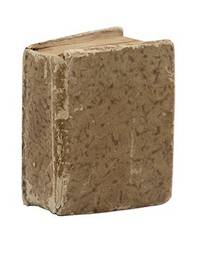
1802373649Boston: Printed by Thomas Fleet 1802. The tenth American thumb Bible. Separate title pages to each work. With three wood or metal cuts in N.T. 1013-160; vi 107 2 ii-iv iv pp. 1 vols. Miniature 2-1/16 x 3-1/4 inches in 12s. Dappled tan pastepaper over wooden boards. Leaf A1 in OT supplied and remargined. The tenth American thumb Bible. Separate title pages to each work. With three wood or metal cuts in N.T. 1013-160; vi 107 2 ii-iv iv pp. 1 vols. Miniature 2-1/16 x 3-1/4 inches in 12s. A splendid copy of the miniature Bible printed by Thomas Fleet in 1801-2 the tenth American thumb Bible. The text is a paraphrase of the Old and New Testaments by John Taylor 1578-1653 known as the Water Poet; the earliest surviving edition of which was printed in London in 1614. In America five editions were printed in the 1760s and four more between 1786 and 1799. All are rare and survive in just a few copies. After about 1810 the number of thumb Bibles and the variousness of their titles and imprints increased markedly.<br /> <br /> The Fleet thumb Bible is two volumes bound as one each with a separate dated title page. Following the New Testament are Prayers for Morning and Prayers for Evening.<br /> <br /> There are four other recorded copies of this book: at the Morgan Library PML81221 lacking all half title and titles and other leaves; at AAS the Welch Stone copy lacking the half title and six pages of the Old Testament; at the Boston Public library rebound; and at the Lilly Library bibliographer Ruth Adomeit's copy in the original binding lacking the first leaf.<br /> <br /> A gorgeous copy in original binding. Shaw & Shoemaker 1383; Welch 1293.10; Adomeit A10 Printed by Thomas Fleet unknown
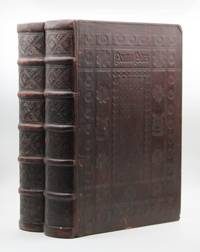
1914353913Leipzig: Insel Verlag 1914. No. 208 of 300 copies limitation leaf at end of each volume. Photolithographic facsimile of the 42-line Bible printed in colors with gilt ornamental incipit pages book headings and red and blue initials and headlines throughout. 2 vols. Folio. Publisher's full blindstamped brown calf after the original binding on the Fulda Landesbibliothek copy. Finely rebacked preserving original spines. No. 208 of 300 copies limitation leaf at end of each volume. Photolithographic facsimile of the 42-line Bible printed in colors with gilt ornamental incipit pages book headings and red and blue initials and headlines throughout. 2 vols. Folio. The first and finest facsimile of the great landmark of printing history the Gutenberg Bible reproduced from the Berlin copy now in the Universitätsbibliothek at Tubingen with some leaves in the first volume reproduced from the Landesbibliothek copy at Fulda. Insel Verlag unknown
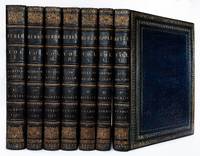
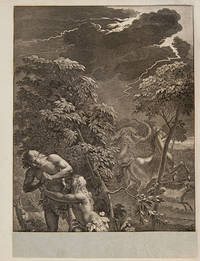
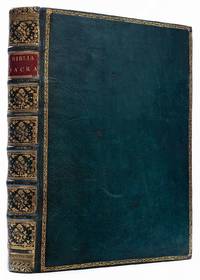
57837London: Printed for Thomas Macklin by Thomas Bensley 1800. 7 vols. Large folio 47.25 x 38 cm. Contemporary blue straight-grain morocco by C. Meyer sides ruled in gilt with decorative fillet and roll borders spine with raised bands and gilt in compartments brown coated endpapers all edges gilt and with some gauffering. Engrave title and 70 full-page engraved plates after Fuseli Reynolds Kauffman Hamilton West etc. plus numerous vignette head- and tail-pieces. Ex libris Gaddesden Library with their armourial bookplate to front-pastedown of each volume. Joints to volume one with professional restorations occasional light offsetting and spotting generally a fine example of this landmark edition of the bible. The most prodigious form of scripture in English ever published the Macklin Bible features large and bold type fine Whatman paper and a series of engravings by some of the most celebrated artists of the time. Macklin announced his plan to produce a lavishly illustrated luxuriously produced folio Bible in 1789 and he spent the next 11 years making his dream a reality though it proved a costly endeavour. He paid Reynolds £500 for his Holy Family and William Sharp £700 for its engraving. The average cost for 45 of the Bible's other engravings was £220 and the total cost of the publication was an estimated £30000 approximately £4500000 in today's money. His efforts paid off: "the subscription list for 703 copies at £46 1s. apiece was headed by the King the Queen and the Prince of Wales" DNB. Macklin died just five days after the last engraving was finished and did not see his masterpiece become one of the most acclaimed English Bibles. "The Macklin Bible endures as the most ambitious edition produced in Britain often pirated but never rivalled" DNB. A further volume of the Apocrypha was published in 1816. London: Printed for Thomas Macklin by Thomas Bensley, 1800. hardcover
107689Oxford Printed for the Society at The Clarendon Press 1817. . 8 vols; large 4to 32.5 x 26 cm; extra-illustrated with over 800 additional plates mounted on thin card and bound-in plus the 56 issued plates and 8 maps including mezzotints stipple engravings copper engravings and steel engravings some folding some two per page a few in text occasional light soiling to margins very occasional offsetting; contemporary dark blue straight-grained morocco gilt covers with wide gilt borders of small tools with large fan-shaped corner devices spines in six compartments gilt lettered direct in second third and fifth others richly gilt broad raised bands gilt all edges gilt joints of vols I and II expertly restored occasional light rubbing a very handsome set.<br /> A fine bible extra-illustrated with over 800 additional plates after Guercino Cipriani Rubens Sadeler Durer Blake and other Old Masters.<br /><br />This annotated edition according to the King James Version was prepared for the Archbishop of Canterbury Charles Manners-Sutton 1755-1828 by his domestic chaplains. D'Oyly 1778-1846 was rector of Buxted in Sussed and later became rector of Lambeth. Mant 1776-1848 subsequently became Bishop of Down Connor and Dromore in Ireland.<br /> Herbert 1658; Darlow/Moule 1072. Oxford, Printed for the Society, at The Clarendon Press, 1817. hardcover
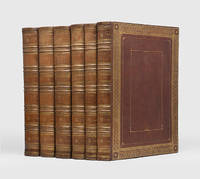
1800173564London: printed for Thomas Macklin by Thomas Bensley 1800. The grandest Bible ever printed in Britain First Macklin edition of the Bible handsomely bound. "The most ambitious edition produced in Britain often pirated but never rivalled" ODNB this Bible is a masterpiece of book art published at the apogee of British copperplate engraving and involving some of the best artists of its day. The Bible dedicated to the king was published serially between 1791 and 1800 in 70 parts each at £1. 1s. Thomas Macklin 1752-1800 began work on the project in the year following the opening of his famous Poets' Gallery in Pall Mall. The prospectus issued in 1789 explained that he was planning to add scripture pictures to his exhibition to be then reproduced in a "magnificent Bible". The paintings were realised by several artists including Hamilton Fuseli and Loutherbourg and exhibited at the Poets' Gallery between 1790 and 1796. Initially promising 60 plates the project eventually included 71 some of which never appeared in Macklin's exhibitions. Most of the headpiece and tailpiece vignettes were designed by Loutherbourg the type was cut by Joseph Jackson and his apprentice Vincent Figgins and the paper made by Whatman. The Bible took 11 years to complete and the publication costs exceeding £30000 almost bankrupted Macklin. Though the final engraving was finished five days before his death the last of the vignettes was not completed for another six weeks and he consequently never saw the finished work. Some copies of the Bible were bound in a fine neoclassical style by contemporary London binders particularly Staggemeier and Welcher. This set is unsigned but the treatment of the spine appears closer to the work of Kalthoeber see Maggs Cat. 1212 II no. 164. This set is bound in six volumes as recommended in the instructions to the binder vol. I. However sets are sometimes found bound in seven. 6 vols large folio 458 x 370 mm. With 71 copper engraved plates after Fuseli and others 113 wood engraved vignette head- and tailpieces. Contemporary diced russia spines with raised bands compartments lettered and tooled in gilt elaborate gilt frames to covers incorporating foliate and flower tools board edges and turn-ins tooled in gilt leather inner hinges marbled endpapers edges gilt silk bookmarkers. Bound with half-titles. A few trivial marks and light scuffs to covers small cosmetic repair to rear cover of vol. I superficial splits to a couple of joints subsequently retouched and now firm occasional foxing to contents and offsetting from plates else clean and bright. A very good set. ESTC T123175; Herbert 1441; Lowndes I p. 192. Maggs Bros Ltd Bookbinding in the British Isles Sixteenth to the Twentieth Century Cat. 1212 Part II 1996. hardcover
1569Q42<p>Geneva: John Crispin 1569. 4to 8.125 x 5.75 in. The scarce <em>second edition</em> of the Geneva Bible in quarto. Printed in Geneva in Roman font with illustrations double-page maps and provenance of a famous paper maker.</p><p><strong>Description</strong></p><p>Lacks the first preliminary leaf <em>Calendar Historical</em> and begins with <em>To The Reader </em>1 p. <em>Of the Golden Nombre</em>… etc.3 pp. <em>A Supputation of the years </em>1 p. <em>A Table of the Cycle of the Sunne </em>1 p. <em>Kalendar </em>with a small woodcut at the beginning of each month 6 pp. <em>Fairies in France and elsewhere </em>1 p. The printed title page 1569 with decorative headpiece and Crispin's device. Text in two column Roman type with the complete set of illustrations and maps in the text. Bound with four of the additional double-page maps including the Wanderings of the Israelites Nu 33 Ezekiel's Temple Ez 48 Description of the Holie Land before NT title and the Description of the Countreis and Places before Acts. Also bound with the Degrees of Consanguinitie Lev 18 and the map at Joshua provided in facsimile. Printed New Testament title page 1568 with printer's device. Ends with the <em>Table</em> and the <em>Order of the Years</em> 1 p. First chapter woodcut initials head and tailpieces.</p><p><strong>Collation</strong></p><p>par.8 -par1 4 a-c4 d-z8 A-Z8 Aa-Gg8 Old Testament n3-8 Table of Names Aa-Bb4 Cc-Ss8 Tt3 New Testament. <em>Lacks</em> Apocrypha Psalter and first preliminary leaf.</p><p><strong>Binding</strong></p><p>Newly rebound in speckled brown calf. Elaborate blind tooling and rolls to boards within concentric frames. Spine with four raised bands and extensive blind tooling to compartments. One red morocco label with gilt-rules and the words "Holy Bible" letter in gilt and a date of 1569 letter in gilt to foot. New plain endpapers.</p><p><strong>Condition</strong></p><p>Overall a clean text; trimmed close with infrequent loss to first letter of the marginal notes; a-c small stain to lower gutter; Q7-R1 old tape repair with a couple of lines of text replaced in manuscript; T2-3 upper dark marginal stain impacting three lines of text; final map with a tear along fold; Tt1-3 last few leaves of tables with tape repairs to margins.</p><p><strong>Provenance</strong></p><p>Bookplate of James Whatman 1702-1759 on front pastedown with his signature on first blank leaf. On the next four blank pp. at the front Whatman described the history of the Geneva version in a neat hand likely on his own wove paper. Whatman produced high-quality white paper in the 1740s that was used by state papers and also used in printed books. He was the first paper maker in Europe to make wove paper.</p><p><strong>Note</strong></p><p>The second edition of the Geneva version printed in Geneva. The second edition is a smaller book than the 1560 first edition. The Apocrypha was removed from this copy likely by a zealous Puritan. The Psalter was an integral part of this edition and is lacking from this copy but four of the five maps are present.</p><p><strong>Scarcity</strong></p><p>RBH records only three copies at auction since 1910. OCLC shows only six copies in institutions.</p><p><strong>References</strong></p><p>Herbert 130; ODNB 40776; STC 2106; not in USTC.</p> John Crispin hardcover
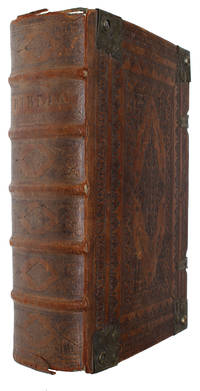
163360241Kiøbenhaffn Melchior Martzan og Salomon Sartor 1632- 1633. Folio binding: 37 x 25 cm. Bound in a spledid contemporary full calf binding over wooden boards. Rich elaborate gilding to both boards and spine. The gilding is vague especially on the front board but the tooling is very sharp and the binding overall is magnificent. With four beautiful ornamented brass edges to each board and two large ornamented brass clasps. All edges are gilt and beautifully blindtooled. Wear to capitals where the cords are loosening a bit and with a bit of loss of leather. A bit of wear to hinges at the cords which are showing. But overall the binding is in splendid condition. Also internally extremely well preserved. The title-page has a tiny restored hole to lower right corner and the first four leaves might have been inserted. They are slightly smaller at the outer margin than the other leaves. But that might also be due to restoration as the binding has not been tampered with at any point and is completely unrestored. The text is unusually nice clean and fresh by far the nicest copy we have ever come across. Pasted-down front end-paper with the ownership signature and lacquered coat-of-arms seal of Severin Svanenhielm Severin Seehusen 1664-1726 as well as the ownership signatures of Søren Schiøtz 1796-1863 with names of members of his family C. Th. Zahle and Erik Zahle. With the book plate of William Davignon d. 1924. The brass corners carry the initials HL and are depicted in Johannes Rudbeck's Svenska Bokband I fig. 26 p.53. The binding there is dated 1622 whereas our binding is from 1633 or right after. The brass fittings were a commercial merchandise for sale in Germany and probably also in both Sweden and Denmark. Engraved title-page as well as the engraved portrait of Christian IV all by the royal engraver Simon the Pas. Without the half-title which merely contains the printed words "BIBLIA / Paa Danske" which is almost never present. 21 - not counting the engraved title-page and the portrait 353 i.e. 354 due to the erroneous double pagination 353 226 159 ff. <br/><br/><em>A magnificent copy of the scarce first edition of the last i.e. the third of the Danish folio-bibles known as "Christian IV's Bible" being a slightly revised edition of the Bible of 1589. Christian IV is the most famous Danish king ever to have lived and the Christian IV bible is extremely sought-after. An unusually fresh and complete apart from the always lacking half-title copy of this splendid bible printed by the first royal printer Melchior Martzan and Salomon Sartor part 2. The numerous woodcut illustrations are the same that were used for the Frederik II Bibel from 1589. The four engraved leaves - the portrait and the three title-pages - are by Simon de Pas.Bibl. Dan.I9 - Thesaurus II 378. - Birkelund 41. - Darlow and Moule 3160. Provenance: Svanenhielm was a family of Danish and Norwegian nobility. Morten Hansen Seehuusen 1629-1694 was a merchant from Bredstedt in Schleswig-Holstein who re-located to Stavanger Norway. His son Severin Seehusen 1664-1726 was an official in Bergen as well as in Stavanger and Northern Norway. He owned among other properties Damsgård Manor outside Bergen Svanøy in Sunnfjord and Arnegård in Stavanger. In 1720 Severin Seehausen was ennobled under the name Svanenhielm. Søren Daniel Schiøtz 1796-1863 was a Norwegian bailiff and judge who was also very much engaged in religious matters and came to play an important role in the history of theology in Norway. He was one of the founders of the Norwegian Mission Society and the Norwegian Israeli Mission. He translated several important upbuilding pieces from German among them a comprehensive bible history. Carl Theodor Zahle 1866 – 1946 was a highly important Danish lawyer and politician. He was prime minister of Denmark from 1909 to 1910 and again from 1913 to 1920. In 1895 he was elected member of the lower chamber of the Danish parliament for the Liberal Party. A campaigner for peace in 1905 he co-founded the Social Liberal Party Det Radikale Venstre. He stayed on as a member of Parliament for Det Radikale Venstre until 1928 when he became a member of the upper chamber of Parliament Landstinget. In 1929 he became Minister of Justice a post which he held until 1935. Zahle was instrumental in starting negotiations for a new Danish–Icelandic Act of Union in 1917 which resulted in Iceland being recognized as a sovereign nation in a personal union with the king of Denmark the following year. Erik Zahle 1898-1969 was a famous Danish art historian author and museum director. </em> hardcover
158857770Kiøbenhaffn Matz Vingaard 1588-89. Folio. 39 x 27 cm. Samtidigt hellæderbind i brunt kalveskind over svært træ og med kanter i smig. Lettere ophøjede bind på ryg. Håndsyede kapitælbånd. Lille hak i skindet på nederste rygfelt. Med de 4 originale hængselsbeslag i støbt messing bevarede men den ene strop fornyet og den anden mangler. Permerne har begge blindtrykte arabesker i midterfeltet en stor arabesk og i hjørner og kanter 6 pyramideformede arabesker som alle er med en blindtrykt krone i pyramidens top. Permerne har mindre messingstifter med store hoveder til beskyttelse af bindet ved opslag. Marmoreret snit. Bindet er ganske velbevaret med kun lidt kantslid og let slid på de ophøjede rygbind. 22353i.e.354226159 blade. Komplet men uden de 3 blanke blade. Træskåret titelblad med tekst trykt i rødt i midterfeltet. Titelbladsvarianten med kongens kobberstukne portræt af Goltzius opklæbet på bagsiden en del eksemplarer udkom uden portrættet. Blad 2 med rigsvåbnet bladet er kantrepareret. 2 træskårne deltitelblade. Registerbladene med svag skjold i ydre marginer. De sidste 35 blade delvist omkantede for det meste i ydre marginer. Ganske få spredte brunpletter. Iøvrigt ganske lette brugsspor. Et udmærket velbevaret og komplet eksemplar bortset fra de 3 blanke.På forreste friblad er anført lidt af eksemplarets ejerhistorie fra 1819 - erhvervet af Mikkel Johannesson Fladebøe som her delvist klausulerer dens ejerskab til fremtidige ejere af gården Fladebøe . Senere synes den overgået til andre i slægten bosat i U.S.A. Olaf Albertsen Axel Albertsen Stanley Albertsen Sidney Albertsen. Folio. 39 x 27 cm. Contemporary brown full calf over heavy wooden boards with oblique edges. Sloghtly raised bands to spine. Hand-stitched capital bands. A small notch to the leather of bottom compartment of spine. With the four original brass clasps preserved but one strap has been renewed and the other is missing. Boards with large blindstamped centre-arabesque and six pyramid shaped arabesques to corners and edges all with a blindstamped crown on top. Large-headed bras spins to boards to protect the boards when open. Marbled edges. A bit of wear to edges and light wear to the raised bands. 22 353i.e.354 226 159 ff. Complete save for the three blank leaves. Woodcut title-page with centre-text printed in red. The title-page variant with the engraved portrait of the king by Goltzius mounted on verso. Several copies were issued without portrait and some were issued as here with the title-page mounted on verso. F. 2 with the royal arms restored at edges. Two woodcut helf-titles. The index-leaves with a vague damp stain to the outer margins. The last 35 leaves have been partly re-edged mostly at the very outer margins. A bit of light scattered brownspotting. Light signs of wear. An overall well preserved copy in- as well as externally. Front free end-paper with handwritten notes on provenance from 1819 onward – bought by Mikkel Johannesson Fladebøe who partly clauses the ownership of the copy to the future owners of the estate Fladebøe. It seems to have then passed to other generations of the same lineage located in The United States Olaf Albertsen Axel Albertsen Stanley Albertsen Sidney Albertsen. <br/><br/><em>The magnificent first printing of the second Danish-Norwegian Bible in folio. This the second Danish Bible in folio is also the first to be printed by a Dane. The scarce and famous "Frederik II-Bible" constitutes the magnum opus of the famed book printer Mads Vingaard "and the most extensive work of printing undertaken in Denmark during the sixteenth century. The book is profusely illustrated with woodcuts copied from a german Bible issued by Sigmund Feyerabend in Frankfurt a. M. 1560. The original woodcuts were made by the artist and craftsman Virgil Solis. Wide woodcut borders together with pictures using themes from the Scriptures surround the title pages and the illustrations. On the reverse of the first title page many copies have pasted in a portrait of Frederich II engraved by the Dutch artist Hendrick Goltzius. However this portrait may also be found on a separate leaf." Thesaurus I.Lauritz Nielsen 405. - Thesaurus I 129. - Birkelund 34. </em> hardcover
1638371824Cambridge: Thomas Buck and Roger Daniel 1638. Large paper copy. Ruled in red throughout. Roman letter in two columns. Engraved title page within architectural border featuring Biblical characters a vignette of the 'Last supper' and printer's device. 12 642 151 3 202pp. Bound with preceding the Bible: The Book of Common Prayer. 104pp. And with following the Bible: Whole Book of Psalmes. 8 1 2-90 10 pp. Folio 17 x 11 inches. Contemporary black morocco gilt covers panelled with roll tool borders and central arabesque design in gilt flat spine gilt with marching morocco labels gilt edges minor wear at joints lower corners bumped. Provenance:Webb early inscription on the front pastedown; Maggs Brothers item 827 in unidentified mid-20th century catalogue clipping laid in; General Theological Seminary bookplate. Large paper copy. Ruled in red throughout. Roman letter in two columns. Engraved title page within architectural border featuring Biblical characters a vignette of the 'Last supper' and printer's device. 12 642 151 3 202pp. Bound with preceding the Bible: The Book of Common Prayer. 104pp. And with following the Bible: Whole Book of Psalmes. 8 1 2-90 10 pp. Folio 17 x 11 inches. This edition contains the first major revisions of the King James version standardising the use of italics and altering several readings. "This remained the standard text until the publication of Dr. Paris' Cambridge edition of 1762" Herbert.<br /> <br /> A lovely example bound in contemporary English black morocco and measuring 430x280mm is considerably larger than the dimensions cited by Darlow & Moole 402 375x234 mm and Darlow & Moole 403 for a "large thick paper" copy 397x270 mm. Bible: Herbert 520; Darlow & Moule 402 and 403; ESTC S123371; STC 2nd ed 2331. Common Prayer: Griffiths 1638:2; STC 2nd ed. 16410; ESTC S902. Psalms: STC 2nd ed. 2682; ESTC S122380 Thomas Buck and Roger Daniel unknown
1497WB19676Strasbourg: Johann Reinhard Grüninger 26 April 1497. Hardcover. Very Good. Chancery Folio; 304 x 207mm; 490 leaves of 492 lacking blank Z6 and the final leaf of the table; a bifolium from gathering B is bound in A. It features red and blue Lombard capitals with a woodcut depicting Saint Jerome on the title page. The first bifolium has undergone extensive repair work at the gutter and outside edges with the first leaf being soiled chipped and laid down on new paper. Throughout the volume there are smaller repairs and tears with one larger tear that has been repaired affecting the text on page ss2. <br /> <br />Dampstaining and some soiling are present particularly at the ends and there is worming affecting some of the text. The final leaf has been heavily repaired resulting in loss of text at the outer edge. The book is bound in modern black blindstamped morocco with clasps in a style reminiscent of the period with gilt edges showing some signs of wear. The provenance of the book includes extensive marginalia with an inscription indicating it belonged to Georgius Wenceslaus Pastor of Olbersdorf dated 1635 who acquired it from Samuel Ursinus. <br /> <br />A Bible printed by the prolific Strasbourg printer Johann Reinhard Grüninger replete with annotations credibly by Georgius Wenceslaus the Lutheran pastor who served in Olbersdorf a town in the historical region of Silesia which is now part of modern-day Poland. It features a woodcut on the title page portraying Saint Jerome depicted both in contemplative study and in prayer at the foot of the cross. <br /> <br />HC 3122; BMC I 111; BSB-Ink B-476; GW 4277; Bod-inc B-308; Goff B-600; ISTC ib00600000. Uncommon in commence. <br/><br/> [Johann (Reinhard) Grüninger,] hardcover
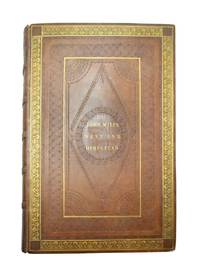
176369256Cambridge: Printed by John Baskerville 1763. BIBLE IN ENGLISH; BASKERVILLE John. BASKERVILLE John. The Holy Bible Containing the Old Testament and the New. Translated out of the Original Tongues and with the Former Translations Diligently Compared and Revised by His Majesty's Special Command. Appointed to be Read in Churches. Cambridge: Printed by John Baskerville 1763.<br> <br> Full Description:<br> <br> BIBLE IN ENGLISH. The Holy Bible Containing the Old Testament and the New: Translated out of the Original Tongues and with the Former Translations Diligently Compared and Revised by His Majesty's Special Command. Appointed to be Read in Churches. Cambridge: Printed by John Baskerville 1763.<br> <br> First edition with the list of subscribers in the third state ending with "The Hon. Charles York Esq; Attorney General." Two large folio volumes in one 19 1/8 x 12 1/4 inches; 480 x 311 mm. Complete with 573 leaves. Text ends on leaf 13E1 and is followed by an Index and Tables a-e f1. List of subscribers bound in after title-page and dedication. Text in double columns.<br> <br> Beautifully bound in early 19th-century full diced tan calf. Boards elaborately ruled and tooled in gilt and blind. Spine stamped and lettered in gilt. Front board lettered in gilt reading "John Miles/ West End/ Hampstead." Marbled endpapers. All edges marbled. Gilt dentelles. Back board with some very mild scuffing and a tiny bit of worming to head of board and at top and bottom of outer hinge. Some light foxing to first title-page and preliminary leaves but text is very clean. With the dates of births and deaths of the Miles family in old ink manuscript on the front free endpaper. Overall a very good clean copy.<br> <br> Originally priced four guineas in sheets for subscribers "the edition consisted of 1250 copies of which 556 were remaindered in 1768 and bought by the London bookseller R. Baldwin at 36s. each.Baldwin was offering copies at three guineas in sheets in 1771" Gaskell.<br> <br> "One of the most beautifully printed books in the world" Dibdin. This edition "has always been regarded as Baskerville's magnum opus and is his most magnificent as well as his most characteristic specimen" T.B. Reed A History of the Old English Letter Foundries p. 279. Gaskell declared that the title-page to the New Testament is "a perfect page of fine printing."<br> <br> Although the Baskerville Bible is now recognized as one of the greatest Bibles of all time it was initially a financial failure. Costing £2000 to print the remaining stock about half of the edition was remaindered five years after publication to a London bookseller. It was Baskerville's last great book.<br> <br> "Aesthetically the highest point in English Bible printing so far was John Baskerville's folio printed at Cambridge in 1763. To achieve his ambition to print a folio Bible Baskerville had to become University Printer on not very advantageous terms. The Bible uses his types paper and ink and shows his characteristic 'machine-made' finish: very smooth and even in colour and impression with glossy black ink on smooth paper. The design is traditional but the quality of material and workmanship is so high and the conventions are so delicately modified and consistently applied that the result is extremely impressive" The Cambridge History of the Bible: The West from the Reformation to the Present Day p. 464.<br> <br> Darlow & Moule 857. ESTC T93106. Gaskell Baskerville 26. Herbert 1146. Huntington Library Great Books in Great Editions 6.<br> <br> HBS 69256.<br> <br> $15000. Printed by John Baskerville unknown
1483D16617Venice: Franz Renner de Heilbronn 1483. Hardcover. Near Fine. 4to 218 x 156mm. Pagination: 3 476 leaves 1. Collation: a12 b8 c12 d8 e12 f-g8 h-k12 l-m8 n-p12 q-r8 s12 s12 t8 v10 x-y12 A-I12 K8 L-P12 Q8 R6 S-X12. Contents include the prefaces of St. Jerome and the Interpretation of Hebrew names at the end. Fol. a1r with an opening 14-line initial F of blue staves and extensive red penwork flourishing of scrolling acanthus similarly decorated initial I on fol. a3v. Double columns of 50 lines of small Gothic type: 6:65G and larger heading type: 7:130G rubricated in red and capitals touched in red large initials alternately painted red and blue over printed guide letters. Original beveled wooden boards backed in a 19th-century calf spine with four raised bands in five compartments edges speckled red contained in custom cloth case; repaired closed tear to l3 corner of Q8 renewed final leaf with repaired closed tear starting from gutter minor marginal dampstaining a few stray spots a few closed marginal tears some of which repaired lacking clasps vellum leaves somewhat darkened; overall very good compact early bible complete and enhanced with dense early modern inscriptions on flyleaves. The four original vellum flyleaves bound three in the front and one at the rear have extensive contemporary and later annotations detailing names of owners in numerous hands written in Latin and French and two whimsical drawings of heraldic shields. At its earliest known location the bible resided in Luxembourg Lutzenberg. One prominent name Hiegaerts seems to be tied to the historic region of Flanders and variously dated in the 17th century. Archival descriptions expertly detail further provenance until about the year 1850 when the bible was likely sold with Thomas Baker bookseller of London. <br/><br/>Franz or Franciscus Renner 14501486 a German printer from Heilbronn published this small quarto of the Latin Vulgate in Venice in 1483 it was the fifth and final edition of Renners incunable Bibles from that city. An earlier folio edition of 1475 which he produced with Nicolaus de Frankfordia fl. 14731516 preceded it as did editions in 1476 1478 1480 and 1482. The 1475 edition was notably the first Bible printed in Venice within the burgeoning print industry. By 1483 Renner was printing works independently and had printed more than 40 incunabula five of these Latin Bibles. With this quarto edition the last edition he made in Venice Renner pioneered a more convenient design for people i.e. educated clerics to read the Bible. Although this Bible originated in Venice early inscriptions dating to about 1500 locate the books ownership as far as northern Europe probably first in Luxembourg and in the possession of a cleric. This copy of Renners important biblical production is significant not only for leading the way in format and portability and for being a prime example of early printed biblical commentary from Venice but for the amazing survival of its original vellum wrappers that record over 300 years of ownership marks. The leaves are a veritable treasure-trove of readership evidence throughout the early modern period. ISTC ib00578000. Franz Renner, de Heilbronn hardcover
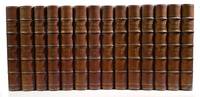
196892Boston: R. H. Hinkley Company N.D. First Edition; First Printing. Fine binding. All 14 volumes Very Good or better. Number 795 of 1000 limited edition numbered sets. Each volume leatherbound with hubbed spines and gilt filligree surrounding inner pastedown edges. Top text block edge of each volume gilt. Vol. XIV and Vol. I FEP detached. Hinges undergoing various states of starting. R. H. Hinkley Company unknown
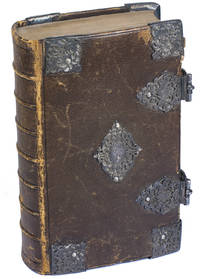
1676B86H56UKANV9Amsterdam: Joannes van Someren Abraham Wolfgang Michiel de Groot Hendrik and Dirk Boom 1676. Late 18th- or early 19th-century brown sheepskin with late 17th-century silver fittings: corner-pieces with two birds 2 centerpieces: on the front board the coat of arms of Catharina Maria Daey as the wife of Pieter Eebels combining the Daey and Ebels coats of arms with her initials above "MD" on the back board a depiction of Mary and Child. The two anchor plates and two catch plates show a female head within ornamental decoration and they are connected by clasps with the names of the owner "Catrijna Maria Baey huisfrou" on the inside of the bottom clasp and her second husband "Kappiten Pieter Eebels" on the inside of the top clasp. Further with marbled endpapers and gilt edges. 8vo 15.3 x 9.3 cm. Ad 1 with an engraved general title page with the coat of arms of the Dutch Republic surrounded by the motto "Eendracht maeckt macht" between the title and the impressum. Further with the woodcut coat of arms of the city of Amsterdam on the verso of the title page below the 'acte van consent" together with the manuscript signature in brown ink of J. le Maire a small woodcut decorated initial at the start of the text of the book of Genesis and a woodcut floral tailpiece at the end of the Old Testament. Ad 2 with a separate typographical title page for the New Testament with a woodcut floral vignette on that title page the woodcut coat of arms below the "acte van consent" on the verso of the title page a woodcut headpiece and tailpiece and 2 woodcut decorated initials. Ad 3 with a separate typographical title page for the psalms with a woodcut vignette of a kneeling man playing a harp all psalms are accompanied by musical notation. 3 works in 1 volume. With: 2 BIBLE - NEW TESTAMENT - DUTCH. Het Nieuwe Testament . Amsterdam for Joannes van Someren Abraham Wolfgang Michiel de Groot Hendrick and Dirk Boom 1677.3 PSALMBOOK - DUTCH. De CL Psalmen des propheten Davids . Amsterdam Johannes van Someren Abraham Wolfgang Michiel de Groot Hendrick and Dirk Boom 1676. Very scarce early edition of the Dutch States Bible as published by the Amsterdam publisher's "company" of Joannes van Someren Abraham Wolfgang Michiel de Groot and Hendrik and Dirk Boom. The present copy presumably was a gift to Catharina Maria Daey 1645-in or after 1689 on the occasion of her marriage in October 1681 to Captain Peter Ebels 1644-in or after 1689 in 1681. Their names are engraved on the inside of the silver clasps. Together they had 6 children. Peter Ebels was Catharina Maria's second husband she was married to Hermannus Folckers ca. 1639-1680 from 1664 until his death and the pair had 3 children.The present edition includes the New Testament and the 110 psalms of David but does not include the apocrypha. It is the first or one of the earliest editions of the Dutch States Bible published by the "company" of Van Someren Wolfgang De Groot and H. & D. Boom. It is very scarce as barely any copies of this edition are known in institutions. WorldCat mentions 2 copies one in the US and one in Australia while the STCN does not list this 1676 edition of the work as a whole and only lists two copies incl. 1 incomplete of the New Testament and only 1 of the Psalms.A more detailed overview of the provenance is available upon request.With a small auction catalogue clipping mounted on the back pastedown including some manuscript annotations giving details about the auction: "10-6-1925. Veiling van Huffelt's antiquariaat". The binding is somewhat rubbed and scratched mainly around the spine the engraved general title page is somewhat soiled. Otherwise in very good condition.l General: I. le Long Boek-zaal der Nederduytsche bybels p. 823; an 1676 8vo ed. by Van Someren and an 1677 4to ed by Boom; WorldCat 12888441 221949558 2 copies; cf. Darlow & Moule 3328 1683/1684 ed.; WorldCat 312838290 1 copy 1675/1676 ed.; ad 1: cf. STCN 296511013 1 copy 1677 4to ed. by same printers; USTC 1813190 1 copy same as STCN; ad 2: STCN 305830120 2 copies incl. 1 incomplete; ad 3: STCN 39791296X 1 copy; USTC 1812276 1 copy. Joannes van Someren, Abraham Wolfgang, Michiel de Groot, Hendrik and Dirk Boom, unknown
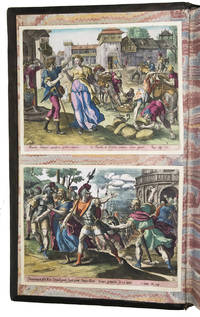
17485985Gorinchem 1748. Large folio. Nicolas Goetzee Contemporary calf over wooden boards spines ribbed and richly gilt in a fine light flower design with broad richly ornamental gilt borders and elegant gilt inner-panel with large gilt flowers at the four corners and large flowered gilt central ornaments. With engraved allegorical frontispiece by J. Punt after J. de Wit large engraved vignette by J. Punt on title 12 double-page folding engraved maps by W.A. Bachine including a plan of Jerusalem and 61 double-page engraved plates by Jan Luyken including 2 with four half-page illustrations to one plate and extra mounted on endpapers of both volumes 8 half-page engraved bible-illustrations by G. de Jode all richly coloured by hand. 2 volumes. 12 19 3 342 2 151; 4 12 172 4 77 ll. Edition by Nicolas Goetzee of the Dutch Staten Bijbel States Bible the authorized translation first published in 1637 newly illustrated with 12 folding double-page maps each map accompanied by a folding double-page leaf with explanatory text and extra illustrated with the large series of Bible scenes by Jan Luyken generally known as Icones Biblicae and originally published without a letterpress title or text by Pieter Mortier in 1708. The series consisted of 62 large folio prints including the title-print not included by Goetzee. The series is here in second state with the address of P. Mortier replaced by J. Covens & Mortier. The text is printed in Roman type and our copy is bound in a fine richly gold-tooled Dutch binding of the period.In good condition.l Bijbel en prent 21 idem with the Luyken-series; Cat. Bijbel-tentoonstelling Amst. 1914 1255; Poortman I p. 248; for Luyken's print-bible: Poortman II p. 131; Van Eeghen & Van der Kellen 429. ABE CAT Bibles Sermons & Psalmbooks hardcover
1777182896London: Oxford University Press 1777. First Edition; First Printing. Fine Binding. Very Good in decorative leather boards. Many page edges mended with additional stationary by previous owner. Light foxing throughout text block edges. Light stain on bottom text block edge. Oxford University Press unknown
1735ST18632Amsterdam: Petrus Shenk 1735-38. First Edition in Dutch. 415 x 264 mm. 16 3/8 x 10 3/8". Entirely complete with continuous pagination but with a jump in page numbering from the end of book XIII to the beginning of XIV as usual. 15 parts in eight volumes. Translated by Florentius H. J. van Halen. <br/> HANDSOME CONTEMPORARY VELLUM covers with large gilt entrelac centerpiece framed with gilt floral rule with bouquet-like cornerpieces gilt floral border raised bands compartments richly gilt titles and volume numbers handwritten in ink on spines all edges gilt. With head- and tailpieces 15 engraved titles printed in red and black with engraved vignettes and complete with frontispiece two engraved portraits of the author and the engraver the latter with shorter margins probably tipped-in and 760 OFTEN STRIKING COPPER ENGRAVINGS on 758 plates one with partial hand coloring a few double-page. Front pastedown of first volume with handwritten note in French on lined paper; with additional black & white title to first work erroneously dated 1728. Nissen ZBI 3661; see also: Faber du Faur "German Baroque Literature" p. 472. Trivial soiling to the vellum the seventh volume with a faint marginal dampstain affecting a few quires but not touching engravings the odd negligible blemish but AN OUTSTANDING SET the very attractive original bindings showing only insignificant wear and THE CONTENTS ESPECIALLY FRESH AND CLEAN THROUGHOUT WITH VERY FINE IMPRESSIONS OF THE PLATES.<br/> <br/> This is the first Dutch translation of Scheuchzer's "Sacred Nature" one of the most splendid German illustrated books of the 18th century presenting what surely is the most impressive combination of biblical exegesis and scientific illustration to be found in any printed book. First published in 1731-35 as the "Physica Sacra" in Latin and as the "Kupfer-Bibel" in German so-named for the amazing array of copperplate engravings this work is arranged according to the progression of books in the Bible citing passages from those chapters where phenomena from the natural world are mentioned. The typical pattern here includes a textual citation followed by the author's often lengthy remarks on the passage and in many cases a dramatic engraving to illustrate what is said. The plates are identical to the earlier editions retaining the inscriptions in Latin and German and are the work of Johann-Melchior Fuseli of the well-known Zurich family of 18th and 19th century artists. The engraved scenes are always executed with great skill are generally very animated and are often fascinating. Of the 760 images meant to illustrate the text many are strictly or primarily depictions of biblical scenes; several are simply illustrations of specimens of nature; and a large number perhaps half offer a kind of combination. An example of this last type includes a wonderful scene showing the birth of Man as related in Genesis 1:26-27 depicting not only a startled Adam in his fecund paradise but also 10 images of fetuses placentas and the skeletons of children attached like mounted specimens to the architectural frame of the illustration. According to Faber du Faur it is in this work that "the Baroque attains philosophically as well as artistically its high point and its conclusion. It is the last of those elegant works which do not really contain illustrations to a text but which are in effect composed of splendid plates with a text to accompany them." Scheuchzer 1672-1733 was a prolific naturalist who promoted at every opportunity the most modern scientific ideas though without wanting to risk the accusation of being irreverent. He says that the present work represents an attempt at finding a harmony between reason and revelation though it can also be seen as an effort to promulgate progressive theories under the venerable cloak of biblical commentary. The bibliographies disagree about the number of plates that ought to be present in this work and in other editions but ours corresponds to copies previously sold at auction as complete. Copies of the "Physica Sacra" and its translations show up regularly for sale but almost never does one see the work both complete and as here with a clean and fresh text in remarkably well-preserved and attractive contemporary bindings. Petrus Shenk unknown
1613U11<p><em>The Holy Bible conteyning the Old Testament and the New: Newly translated out of the originall Tongues: And with the former Translations diligently compared and revised by his Majesties Speciall commandement.</em></p><p><strong>Summary</strong></p><p>A textually complete 72-line folio King James She Bible. Bound with Speed's Genealogies in eighteenth century calf.</p><p><strong>Description</strong></p><p>Pulpit Folio 15.5" x 10.5". General title page in facsimile. Preliminaries include the <em>Translators to the Reader </em>11 pp.; <em>Kalendar</em> in red and black 6 ff.; <em>Almanack </em>1 p. in red and black; <em>The Table and Kalendar Expressing the order of the Psalms and Lessons… </em>5 pp.; <em>The Names of all the Books…</em> in red and black 1 p. Bound with <em>The Genealogies…</em> by John Speed 34 pp. without the double-page map. Text in two column black letter in smaller type with 72 lines to the full column. Text within ruled border. Each chapter begins with a woodcut initial. New Testament title page 1613 features the Tetragrammaton above the Agnus Dei and the Holy Dove with Matthew and Mark on either side; on the left side are the tents of the twelve tribes and on the right side the twelve apostles; below the letterpress are the Lamb slain along with Luke and John. Many headpieces vignettes and decorated initials throughout.</p><p><strong>Collation</strong></p><p>A-B4 -A1 title C6 D4 prelims; A-C6 Genealogies; A-Z6 Aa-Zz6 Aaa-Zzz6 Aaaa-Mmm6 Nnnn6 Bible text. <strong><em>Lacks</em></strong> general title page supplied in facsimile.</p><p><strong>Binding</strong></p><p>Eighteenth century calf rebacked and recornered with original spine laid down. Boards paneled in blind. Spine with six raised bands blind stamps to compartments and a red morocco label with the words "Holy Bible" lettered in gilt. Plain endpapers.</p><p><strong>Condition</strong></p><p>Light browning and staining but generally clean throughout; trimmed occasionally touching headline; A2 A3 of prelims with lower marginal loss; A4 B6 Kkkk2-5 with marginal fraying or loss not impacting text; Z6 Ss6 NT title with small repair to gutter; Uuu6 with small marginal loss; final leaf of Revelation stained and laid down.</p><p><strong>Provenance </strong></p><p>Eighteenth century ownership inscription of Thomas Chisnal to A23. Badder family manuscript record of births from 1765-85 to 3T5v.</p><p><strong>Note </strong></p><p>The true 1613 folio edition "easily distinguishable from the other large folio editions by its smaller type" Herbert. The number of leaves are reduced from 732 to 508 and was "no doubt designed as a cheaper alternative for poorer churches" Norton <em>A Textual History of the King James Bible</em> p. 76. This true second folio introduces four readings that have become standard: 'that ye may have' for 'the he may haue' Ez 6:8 'she poured it not' for 'she powred it' Ez 24:7 'as a flower' for 'as floure' 2 Es 15:50 and 'what thy right hand doeth' for 'what they right doeth' Mt 6:3.</p><p><strong>References </strong></p><p>Herbert 322; USTC 3005767; ESTC S122066.</p> Robert Barker hardcover
1696ABC_48370Antwerp 1696. 8vo. Hieronymus Verdussen for Niclaes Braau in Haarlem Exquisite 18th-century gold-tooled multi-colour morocco mosaic binding. The basis of the binding is red morocco the boards show a large flower executed in gold-tooled white green yellow and black morocco onlays with small brown morocco leaf shaped corner pieces within a cusped and scalloped gold-tooled double fillet frame. The outer frame is a gold-tooled black morocco onlay with detailed floral and leaf shaped gold-tooled brown and green morocco onlays. The binding is sewn on 5 supports with corresponding raised bands on the spine. The six compartments are beautifully decorated with gold-tooled yellow 1st 4th and 6th compartment black 2nd and 3rd and green 5th morocco onlays with the title lettered in gold on the black morocco of the 2nd and 4rd compartments the other compartments are show detailed gold-tooling and a small green or red morocco small circular onlay. Further with gold-tooling on the raised bands the head and foot of the spine the board edges and the turn-ins. Gilt edges and green silk covered end papers. With 39 detailed woodcut illustrations in the text and woodcut decorated initials and small printed manicules. The text is set in a Gothic letter with incidental use of Roman type. 1 1 blank 14 837 27 pp. Very rare late-17th-century Antwerp edition of the New Testament edited by Henricus van den Leemputte 1588-1657 in a magnificent 18th-century mosaic binding. The binding is made by or in the style of the French Parisian binders Le Monnier. "The delicate construction finesse of tooling and delineation and the fantasy of these bindings render them veritable jewels." see The History of bookbinding 525-1950 A.D. no. 456.Van den Leemputte was a highly educated cleric from a noble family in the Southern Netherlands. He held high offices within the diocese bishopric of 's Hertogenbosch. Aside from the present version of the New Testament first published in 1622 he wrote several treatises on the Holy Sacraments published 1624 and edited two works one manual for explaining the Holy Scripture and one defence of the Catholic church against the Reformed church.From the library of Carlo de Poortere 1917-2002 a director of the family tapestry business and a Belgian bibliophile with a large collection of 17th- and 18th-century book bindings and illustrated books from the 16th-20th centuries. It had previous been part of the collection of English Baptist minister and book collector Andrew Gifford 1700-1784. The "of the Museum" below his name in the engraved bookplate seems to refer to his position as assistant keeper of books and manuscript at the British Museum from 1757 until his death. Curiously he bequeathed his collection of books manuscripts pictures and other curiosities not to the British Museum but to the Bristol Baptist College. In the 1970s the Trustees of this college decided to sell all copies of the Gifford collection to pay for renovations to the chapel.With the gold-tooled red morocco bookplate of Carlo de Poortere on the verso of the blank fly leaf and a near contemporary engraved paper bookplate on the verso of the title-page possibly of Andrew Gifford 1700-1784. The binding shows minor signs of wear at the outer corners of the boards and spine otherwise it is in fine condition. The bottom outer corner of the first blank flyleaf and the title-page have been restored a slight water stain in the bottom margin of the first half of the work some occasional slight browning. Quire 24 has been mis-bound at the end of the work in quire 3H4 but the collation is complete. Otherwise in very good condition. A very rare late 17th-century edition of the New Testament in an exquisite 18th-century mosaic binding.l STCV 12918655 1 copy; USTC 1535523 1 copy same as STCV; WorldCat 66131050 4 copies including the STCV copy; cf. The history of bookbinding 525-1950 A.D. An exhibition held at the Baltimore Museum of Art November 12 1957 to January 12 1958 no. 456 plate XC. ABE CAT Art History ABE CAT Bibles Sermons & Psalmbooks hardcover
1612R28<p>London: Robert Baker 1612. 4to approx. 7.5" x 5.5". A scarce copy of the first separately issued quarto New Testament of the King James Version. A very early printing closely conforming to the first edition He Bible.</p><p><strong>Description: </strong>Title page 1612 with woodcut border featuring the four gospel symbols and the figures of fides and humilitas with the royal arms above. Text in single column black letter with headings and marginal references in Roman type. Concludes with dated colophon 1612. First chapter floriated initials head- and tailpieces.</p><p><strong>Collation:</strong> A-Z8 -A4 A5 Aa-Vv8. Lacks two leaves Matthew 2:17-4.</p><p><strong>Binding:</strong> Nineteenth century blind paneled brown calf. Rebacked with old brown morocco spine. Gray plain endpapers. All edges red. Rubbed with bumped corners.</p><p><strong>Condition:</strong> Text is generally clean with sporadic marginal spotting; final leaf lightly soiled; title page with short marginal tear mounted on a stub with small loss to inner margin; four leaves with lower marginal loss not impacting text; headlines cropped on a handful of leaves; overall a bright copy.</p><p><strong>Provenance: </strong>"M W Stoddard August 1870" to front endpaper; "Thomas Bonn was born in the year 1694" to verso of title page.</p><p><strong>Note:</strong> Arguably the most important book ever published in English and an opportunity to own a first edition at the fraction of the price of a complete He Bible. Macaulay said of it "If everything else in our language should perish the King James Bible would alone suffice to show the whole extent of its beauty and power" PMM 114. The quarto New Testament is more scarce than its complete quarto Bible counterpart H313 and slightly more common than the very scarce octavo and 12mo editions H310 and H315.</p><p><strong>References:</strong> Herbert 318; ESTC 2910; USTC 3004925 with only 18 copies in holdings.</p> Robert Barker hardcover
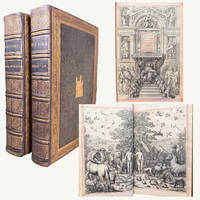
1660T24<p><em>The Holy Bible containing the Bookes of the Old and New Testament…</em></p><p><strong>Summary:</strong> Pulpit Folio in 2 Vols. 19" x 13". A pulpit folio Field's Bible commemorating the restoration of Charles II. Bound in contemporary morocco with six double plate engravings including Adam and Eve in the Garden and Solomon's Temple.</p><p><strong>Description:</strong> 2 works in 2 vols. Begins with <em>The Book of Common Prayer </em>with printed title page 1660 preceded by a full-page engraving of the Royal Arms by Hollar. The entire work is elaborately ruled in red and features wide margins. Engraved title page by Diepenbeeck and Lambart featuring King Solomon on the throne with David Moses and Aaron above. Double page plate of Adam and Eve in the Garden featuring a variety of animals including a unicorn. The second double page plate with vestments and details of the tabernacle. Other plates include a map various views of Solomon's temple and a very large fold-out of Jerusalem.</p><p><strong>Collation:</strong> a2 A-Z2 Aa-Ll2 BCP par4 parpar4 A-Z6 Aa-Zz6 Aaa-Kkk6 Lll4 Genesis-Job; Mmm-Zzz6 Aaaa-Yyyy6 Zzzz8 a-y4 A-Z6 Aa-Dd6 Ee8 Psalms – Revelation.</p><p><strong>Binding:</strong> Nineteenth century dark green paneled morocco. Covers with gilt stamp image featuring Kin's College Chapel in Cambridge around an elaborate gilt rolled border. Spine with six sets of double raised bands and elaborate tooling to compartments with the words "Holy Bible" and "Genesis – Job" or "Psalms – Revelation" lettered in gilt along with a date to foot. Red endpapers. All edges gilt with inner dentelles. </p><p><strong>Condition:</strong> The text is clean and bright appearing unread; Garden of Eden plate mounted to stub with repaired closed tear; Map of Jerusalem with a few short closed tears. Joints in volume 2 cracked but holding firm.</p><p><strong>Note:</strong> A very good copy of the popular Restoration Bible celebrating the return of Charles II. The text was first published the previous year by John Field printer to the University of Cambridge who had been commissioned to supply a lectern bible for use in churches and libraries. Former university Vice-Chancellor John Worthington noted that "For a fair large letter large paper with fair margin … there was never such a Bible in being". This work is the first King James Bible provided with illustrations and beautiful double-plate engravings at that.</p><p><strong>References:</strong> Herbert 668; ESTC R17044; Wing B2258.</p> John Field hardcover
1527318283Coloniae: Petrus Quentel excudebat 1527. First Protestant Bible printed in Latin. Title-page with large woodcut vignette of arms of Cologne lion and gryphon rampant with and three crowns; numerous illustrations by Anton Woensam and ornamental initials throughout. Ff. 8 CCCXXV 1 LXXXVII i.e. 85 5. 1 vols. Folio. Recent half calf and marbled boards. Title page soiled old remargining tissue repairs on verso; some marginal worming and soiling generally clean with generous margins. Stamps of Cambridge Public Library in ink or in blind on four leaves. First Protestant Bible printed in Latin. Title-page with large woodcut vignette of arms of Cologne lion and gryphon rampant with and three crowns; numerous illustrations by Anton Woensam and ornamental initials throughout. Ff. 8 CCCXXV 1 LXXXVII i.e. 85 5. 1 vols. Folio. The first Protestant Bible in Latin edited by Johan Rüdel Rudelius printed in Cologne by Peter Quentel or Quentell and notable for the wood engraved illustrations by Anton Woensam Anton von Worms particularly those at the head of each of the four gospels. Matthew faces an angle who is touching his stylus; a lion is seated beside Mark; a bull with Luke; and an eagle stands beside John.<br /> <br /> Quentel was the printer of Tyndale's quarto Cologne English New Testament known from a single surviving fragment in the Grenville Collection where this same illustration to Matthew appears. It is a reasonable inference that each of the four gospels would have carried an illustration. The project which had "'got as far as the letter K' the signature that would have taken the work well into Mark" ODNB was unfinished at the time of Tyndale's flight from Cologne in 1525. Quentel's print shop was raided but sheets of the first gospel translated from the original Greek and printed in English soon began to circulate in England. Tyndale settled in Worms where Schöffer completed an octavo printing of the first complete English New Testament in 1526 a facsimile of the Grenville fragment and its illustration were published in 1871.<br /> <br /> The blocks for the illustrations evidently survived the raid on the Quentel's shop and are used here at the head of each of the four gospels.<br /> <br /> A notable edition in the history of the printing of the Bible. Adams 1007; not in Darlow & Moule but see note to 6107; VD16 B2589.OCLC: 22847218 Petrus Quentel excudebat unknown
024052San Francisco: Arion Press. Limited Edition. Large Folios. One of the most beautiful modern fine-press Bibles limited to only 150 copies each with hand-colored and gold-accented initial letters. This is copy no. 121. Presented in two imposing volumes 18 × 13 inches designed and produced by Andrew Hoyem and the legendary Arion Press who employed craftsmanship and techniques directly descended from Gutenberg’s era. Arion Press unknown
59948Lugdunum Lyon: Jean Mareschal 1532. Large folio 43.5 x 23 cm. ff.827624. Full eighteenth-century bluish green French morocco sides ruled with gilt foliate border spine with raised bands and lavishly gilt in compartments each with central fleuron device red morocco label lettered in gilt the edges of boards decorated with gilt roll marbled endpapers all edges gilt. Title-page printed in red and black along with the tables of canons. Latin text printed in double and triple column within printed border. Title-page with elaborate woodcut borders and vignette of St. Jerome in his study full-page woodcut illustration of God creating the earth at the head of the Old Testament captioned 'Opus sex dierum' three-quarter woodcut depicting the Nativity scene at the head of the New Testament half-page woodcut of King Solomon at the head of proverbs 112 woodcut vignettes and numerous additional woodcut initials in the text. Engraved bookplate of "L'Olivette" with "G.O." monogram to front pastedown the bookplate engraved by Silvain Guillot a Parisian armorial engraver to front pastedown along with a small library shelf mark. Title-page bears the old ownership inscription of the Jesuit College in Antwerp; in the same hand are an additional 5 instances of marginal annotations on ff. 2r 57v 141v 156v and 175v. Minor shelfwear internally generally very good but with some light occasional damp-staining four small marginal holes on E7 not affecting the text and some repairs to edges of the last few leaves overall a well-illustrated edition of the Vulgate in a superb French binding. Mareschal's Bible was the first to include the Third Book of Maccabees an addition which resulted in his later condemnation by the Council of Trent which declared the book to be apocryphal forcing him to flee to Switzerland and subsequently to take up permanent residence in Heidelberg. The woodcut of the Nativity scene is a close copy of Hans Springinklee's woodcut which first appeared in a 1517 prayer book before being used for the 1520 Lyon edition of the Bible Mortimer Harvard French 63 as well as Luther's 1524 German Translation of the Old Testament with a different artist's monogram. The smaller woodcuts are more simplistic copies of those found in other Lyon bibles from this time produced by Mareschal Crespin and Sacon such as Mortimer Harvard French 66 Crespin's 1529 Bible. USTC locates 15 copies all in Europe save for 2 copies in the UK. Adams 1012. Lugdunum [Lyon]: Jean Mareschal, 1532. hardcover
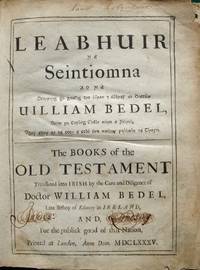
168555695<p>FIRST PRINTING OF THE OLD TESTAMENT IN IRISH<br />EXCELLENT UNSOPHISTICATED COPY IN ITS ORIGINAL BINDING <br />first edition 4to. 2 title 1142pp. contemporary sheep double blind fillet border on sides light old water stain at lower corner of the first and last few leaves title page and last leaf a little dust marked binding rubbed spine rubbed and a little worn and chipped at head and foot joints cracked but tight but generally a very good tight firm and clean copy.<br />Early signature "James Lindsay" on title page crossed out and another early but later signature "Laur. Colquhoun" at head of title page. Engraved armorial bookplate of "A. C./ Clathick" and a small gilt armorial crest at head of spine.<br />Wing 2nd ed. B2759A ESTC r23375 <br />The first printing of the Old Testament in Irish is usually known as 'Bedell's Bible'. William Bedell when consecrated Bishop of Kilmore in 1629 "found a deplorable state of things in his diocese. He observed with much regret that the English had all along neglected the Irish as a nation not only conquered but undisciplinable and that the clergy had scarce considered them as part of their charge but had left them wholly in the hands of their own priests without taking any other care of them but the making them pay their tithes". Disgusted by this un-Christian attitude Bedell interested himself in the Irish culture adopted simple Irish dress and totally eschewed the opulent life-style normal for seventeenth century bishops opposed corruption and tyranny where he found it sought the company of and accepted the hospitality of his catholic Irish neighbours and avoided that of the rich and not only learned the Irish language himself but insisted on its use by his Protestant diocesan clergy. His enthusiasm and sympathy for the Irish earned him their trust affection and respect; he became for them 'optimus anglorum' the best of the English and on his death during the bitter 1641-2 war he was paid the unprecedented honour of being given a military funeral by the local Irish chieftains.His most enduring achievement is the translation of Bible or more precisely the Old Testament into the Irish language. Bedell saw an Irish Bible as an essential element in bringing the Word of God to the people indeed the making available of the scriptures in the vernacular was a key and characteristic element of the Protestant project throughout Europe. He secured the services of competent persons Murtagh King and Dennis Sheridan to translate the Bible and he himself revised the whole comparing it with the Hebrew Greek and Latin so as to correct the errors of the English. He had got to the stage of making preparations for its printing in his own house but the war and his death in 1642 prevented that and for years his manuscript version of it passed through many hands until the famous Robert Boyle scientist philosopher and theologian heard of it later in the century.<br />Boyle born into a wealthy Co. Cork family had been taught Irish in his childhood both at home and at Eton. Boyle like Bedell was passionate about making the Scriptures available in vernacular languages. In 1680 he had a new Irish type manufactured by Joseph Moxon to enable the reprinting in 1681 of the New Testament in Irish first printed almost a century earlier and he resolved to print Bedell's manuscript also. When he obtained it it was in such "a confused heap pitifully defaced and broken" that it had to be reworked and parts of it retranslated. This task of re-editing the manuscript was undertaken by Narcissus Marsh Provost of Trinity College Dublin and a man who shared many of Bedell's attitudes. Marsh engaged as his collaborators Dr. Andrew Sall and Paul Higgins both good Irish scholars and both former Catholic priests. Marsh himself learned Irish to facilitate his task but his main editorial work was done on a retranslation of Bedell's work back into English that he had made for the purpose. When their work was complete Boyle who had initially offered to pay a quarter of the cost paid the whole bill and the book was printed by Everingham using the new Moxon Irish type. "The first sheet of Genesis was printed off in April and the Psalms were being printed in March 1685. The remainder of the sheets with the exception of the Apoctyphia which Boyle declined to print were run off before the end of 1685 which is the Imprint date of the Old Testament. . An intended preface seems not to have materialized" Maddison. It is sometimes stated that 500 copies were printed but to our knowledge no documentary evidence for this exists. Boyle had indeed contracted to print 500 of the New Testament of 1681 and the printer printed off at least another 180 so it may be supposed that the number of Old Testaments printed would have been similar. When Boyle in 1702 discovered that Irish was also the language of large parts of Scotland "he still had some copies of the Old Testament in Irish since distribution in Ireland had not succeeded so well as expected" Maddison. He subsequently sent the circa 80 remaining copies to Scotland together with the circa 150 remaining New Testaments.<br />It seems very likely given its early Scottish provenance that the present copy is one of those 80 copies sent to Scotland. Lawrence Colquhoun was the 1st Earl of Killermont ca.1682-1770. The armorial bookplate is that of his descendant Archibald Campbell Colquhoun c1755-1820 of Clathick and Killermont son of Agnes Colquhoun heiress of Killermont. He was Lord Advocate Sheriff of Perthshire and M.P. for Dumbartonshire. He adopted the additional name of Colquhoun on succeeding his mother at Killermont in 1804.Vide: R. E. W. Maddison 'Robert Boyle and the Irish Bible' in Bulletin of the John Rylands Library 1958 v.41 p.81-101<br />Dermot McGuinne Irish Type Design A History of Printing Types in the Irish Character Irish Academic Press: 1992</p> Printed [by Robert Everingham] hardcover