(Bible in Greek)Biblio.com
6 582 résultats
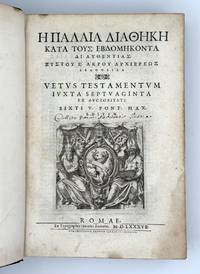
1587371783Rome: Franciscus Zanetti 1587. Text in Greek with short Latin notes at the end of each verse in two columns. Large engraved vignette on title with figures of Moses and Esdras on either side of the arms of Sixtus V. aâ´ A-3Sⶠ3Tâ¸. 8 783 1pp. Folio. Eighteenth century red morocco arms of the second Duke of Newcastle on the covers marbled endpapers gilt edges minor darkening to spine and wear to joints. Scattered minor dampstaining at lower outer corner of a few leaves. Provenance: Collegii Paris. Societas Jesu.early inscription on title; Douglass Maxwell Moffat booklabel with original invoice purchasing the volume from Davis & Orioli in 1940; General Theological Seminary bookplates. Text in Greek with short Latin notes at the end of each verse in two columns. Large engraved vignette on title with figures of Moses and Esdras on either side of the arms of Sixtus V. aâ´ A-3Sⶠ3Tâ¸. 8 783 1pp. Folio. Commissioned by Pope Sixtus V to assist the revisers who were preparing the Latin Vulgate edition ordered by the Council of Trent the "Sixtine" or "Roman" edition of the Septuagint was edited by Cardinal Antonio Carafa based on the Codex Vaticanus and became the standard for all the later editions of the Septuagint for three centuries after its publication. Darlow & Moule no. 4647; Adams B1246; BM STC Italian 1465-1600 p. 94 Franciscus Zanetti unknown
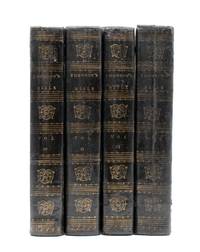
1808354112Philadelphia: Printed by Jane Aitken 1808. First edition. 512; 490; 444; 472pp. 4 vols. 8vo. Contemporary full black morocco gil likely bound by Jane Aitken minor wear at joints one spine splitting but holding. First edition. 512; 490; 444; 472pp. 4 vols. 8vo. "Charles Thomson 1729-1824 made the first translation of the Septuagint into the English language and the first English translation of the New Testament in the western hemisphere. Thomson spent twenty years in making the translation. The books called Apocrypha which are included in the canon of the Greek Old Testament but not in the Hebrew were omitted in his translation. After copying the manuscript four times he had it published at Philadelphia by Jane Aitken the first woman to print any part of the Holy Scriptures in America and the daughter of the printer Robert Aitken. It is of interest that the name 'Cha. Thomson' appears as the signer of the Congressional resolution in the front of the 1782 Aiken Bible" Hills.<br /> <br /> Charles Thomson emigrated to America from his native Ireland in 1739. On recommendation of Benjamin Franklin he served as a tutor at the College of Pennsylvania later the University of Pennsylvania. He later left teaching for business in which he prospered. "Because of his reputation for fairness and integrity he was chosen by the Indians to keep their record of proceedings at the treaty of Easton 1757 and in the following year he was adopted into the Delaware tribe with a name meaning `man who tells the truth'" DAB. He was an early and ardent supporter of the Revolution and was unanimously elected Secretary to the Continental Congress serving in that post from 1774 to 1789. Thomson "was the very man in Philadelphia with whom John Adams busily probing the minds of all and sundry on the vital questions involved would wish to have as he did have 'much conversation.' 'This Charles Thomson' Adams wrote 'is the Sam Adams of Philadelphia the life of the cause of liberty they say.'" DAB. Thomson resigned his post when he was offered no part in Washington's inauguration ceremonies nor any post in the new administration. He devoted the next twenty years to his monumental translation.<br /> <br /> Jane Aitken continued her father Robert's business after his death in 1802. "She had in 1810 a printing house in Philadelphia. She obtained much reputation by the productions which issued from her press" Thomas. In addition to being one of the first American female printers Jane Aitken was also a bookseller bookbinder businesswoman and employer. The typeface Aitken used for the Thomson Bible was an attractive and utilitarian type developed in 1796 by two Scotsmen Binney and Ronaldson at their Philadelphia type foundry. The Thomson Bible is considered her greatest printing achievement and the first Bible printed by a woman in America.<br /> <br /> This set in a very unusual American full morocco gilt binding likely bound by Aitken's shop. See Spawn Willman and Carol Spawn "The Aitken Shop: Identification of an Eighteenth-Century Bindery and Its Tools" in The Papers of the Bibliographical Society of America vol. 57 no. 4 1963 pp. 422-37. Darlow & Moule 1005; Herbert 1514; Rumball-Petre 184; O'Callaghan 1808.2; Wright p.113; Hills 153; Thomas History of Printing in America p.402 Printed by Jane Aitken unknown
1791345231Worcester: Isaiah Thomas 1791. First Edition of Isaiah Thomas's Folio Bible. 50 engraved plates. Folio. Contemporary calf red morocco lettering piece. Expert repairs at top and bottom of spine. Housed in a morocco backed box. First Edition of Isaiah Thomas's Folio Bible. 50 engraved plates. Folio. "The two Thomas Bibles of 1791 were without doubt far in advance of any other publications of the same kind that had appeared in America in point of typography excellence of paper binding and general execution"--Wright Early American Bibles pages 74-88. Evans 23186; Hills 29; ESTC W4497 Isaiah Thomas unknown
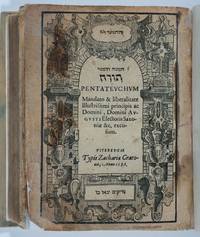
158653478Wittenberg: Zacharias Crato Krafft 1586. First edition. Hardcover. Very Good. Four parts quarto published between 1586 and 1587. Register continuous through parts 1 and 2; separate registers for parts 3 and 4. Collation in 4s: 1-65 blank 33.4; 1-30 lacks blank 30.4; 1-32 lacks 32.4 colophon. 506 leaves. Title within elaborate woodcut borders. Single-column text in vocalized Hebrew with cantillation; printed side-glosses. Separate Hebrew half-titles within woodcut borders for the latter three parts Former Prophets; Later Prophets; Hagiographa; names of the biblical books set in large font within woodcut cartouches. Later vellum. Title and following three leaves with marginal reinforcement slight text loss. Occasional mild embrowning else very good with bright half-titles. <br /> <br /> First Wittenberg edition of the complete Hebrew Scriptures with a concluding list of Haftaroth readings noting the Ashkenazi and Sefardi variations. Our copy is the variant with Hebrew and Latin title. A majority of the few surviving copies are bound with a Hebrew title and the publisher's information is taken from the colophon which provides a Jewish calendar date of 5347 = 1587. Vinograd notes that individual books and sections of the Hebrew Bible had been printed at Wittenberg since a quarto edition of the prophet Obadiah appeared in 1521. The title-page designs were re-used in the Hebrew bible published at Frankfurt am Oder in 1595. Each book closes with the Masora Finales printed in square type.<br /> <br /> Andreas Masch notes in his revised edition of Le Long's Bibliotheca Sacra 1778: "This edition of the Hebrew Bible is so rare and infrequent that it was omitted in the earlier edition of Le Long's work at Paris but it is known to Wolffius Bibliotheca Hebraea not in its entirety but only in respect of certain parts." One can speculate as to why the edition is rare but it may be worth noting that "when Hans and Friedrich Hartmann decided to start producing Hebraica in an effort to become the official printer for the univeristy of Frankfurt/Oder they were able to do so relatively quickly by hiring away five experienced workmen from Zacharias Croto's Wittenberg firm which was having financial difficulties" Burnett.<br /> <br /> Masch continues: "At the colophon is noted the year and the name of those at whose expense this Hebrew Bible was published: colophon info in Heb. and Latin The above example is therefore attributed to the liberality of the prince and to the expense of the two citizens of Wittenberg But the Rühilii brothers were not correctors of the work but citizens and senators of Witteberg whose name is quite famous in the history of the Germanic Bibles. The work came from the workshop of Zacharias Craton otherwise known as Kraft to whom we owe several editions of German Bibles. The title in both copies represents a gate in which above and below Ps. 118 com. 20. is printed. In accordance with the first Plantin edition the text was printed so as to match nearly page-for-page. It is composed of four parts with the five festival books added to the Pentateuch; but each part is decorated with a special title." Full title: חמשה חומשי תורה Pentateuchum mandato & liberalitate illustrissimi principis ac Domini Domini Augusti Electoris Saxoniae. Vitebergae: Typis Zacharia Cratonis Anno 1586. alternate Hebrew title: חמשה חומשי תורה × ×“×¤×¡ ×¢× ×¨×‘ העיון על ידי זכריה כר×טו.<br /> <br /> References: Benzing Buchdrucker 16/17 p. 471; Le Long/Masch I 1778 pp. 33-34; Steinschneider 277; VD16 ZV 29818 quarto; Vinograd 21. Not in: Adams; Darlow & Moule; Delaveau & Hillard. Cf. Burnett Christian Hebraism in the Reformation Era p. 204. Zacharias Crato [Krafft] hardcover
185369294Philadelphia: Isaac Leeser 1853. BIBLE IN ENGLISH; LEESER Isaac. LEESER Isaac translator. The Twenty-Four Books of the Holy Scriptures. Carefully translated according to the Masoretic Text on the Basis of the English Version after the best Jewish Authorities; and supplied with short Explanatory Notes. By Isaac Leeser. Hebrew "For it shall not be forgotten out of the mouth of his seed." Dent. xxxi 21. Philadelphia: Isaac Leeser 1853.<br> <br> Full Description:<br> <br> BIBLE IN ENGLISH. LEESER Isaac translator. The Twenty-Four Books of the Holy Scriptures. Carefully translated according to the Masoretic Text on the Basis of the English Version after the best Jewish Authorities; and supplied with short Explanatory Notes. By Isaac Leeser. Hebrew "For it shall not be forgotten out of the mouth of his seed." Dent. xxxi 21. Philadelphia: Isaac Leeser 1853.<br> <br> First edition of the first complete translation of the Old Testament by a Jewish translator into English building upon Leeser's 1845 translation of the five books of the Pentateuch translation in 1845-1846. Folio 10 3/8 x 8 3/8 inches; 275 x 212 mm.<br> <br> Original full brown morocco. Boards ruled and elaborately stamped in gilt. Spine stamped and lettered in gilt. All edges marbled. Marbled endpapers. Binding with some restoration along joints and edges. A bit of foxing mainly to the preliminaries. Some occasional light dampstaining. Overall a very good copy.<br> <br> "Having published a five-volume Pentateuch-cum-haftarot lections from the Prophets translation in 1845-1846 as well as a complete vocalized and accentuated Hebrew Bible in 1848 the first such edition published in the U.S. he proceeded from April 1852 to September 1853 to extend his translation efforts to the entire Hebrew Bible. The result was his Twenty-Four Books of the Holy Scriptures the first translation of all of Tanakh into English by a Jew complete with short explanatory notes. Leeser explained in the preface to his magnum opus that he undertook the project in order to provide Anglophone Jewry with a vernacular version of the Bible "which has not been made by the authority of churches in which they can have no confidence" pp. iii-iv. The book achieved wide popularity among English-speaking Jews and even some Gentiles especially in America and went through multiple editions." Sotheby's<br> <br> "The translation of the Bible was Leeser's great literary achievement and represented many years of patient labor and devotion to a task which he considered sacred. Leeser was not fully equipped for this work for he was no specialist in Hebrew philology nor a master if Jewish learning in general and he was quite conscious of his shortcomings but he was inspired. He says in his preface: 'I thought in all due humility that I might safely go to task confidently relying upon that superior aid which is never withheld from the inquirer after truth.' He made good use of the various German translations by Jews of the collective commentary known as the Biur vol. III sec. 81 and of other Jewish exegetic works. As a result his translation though based in style upon the King James version can be considered an independent work for the changes he produced are numerous and great. His prime concern was to supply the traditional interpretation when necessary and the retention of the Jewish spirit at times even at the expense of beauty of style. The translation went through numerous editions and until the new Jewish Publication Society version was issued in 1917 it was the only source from which many Jews not conversant with Hebrew derived their knowledge of the Bible in accordance with Jewish tradition" Waxman History of Jewish Literature 1090.<br> <br> HBS 69294.<br> <br> $12500. [Isaac Leeser] unknown
1743536711743. SAUR BIBLE. Biblia Das ist: Die Helige Schrift Altes und Neues Testaments Nach der Deutschen Uebersetzung D. Martin Luthers mit Jedes Capitels Furtzen Summarien Ach Bengefugten Vielen und Richtigen Parallelen; Rebst dem Gewohnlichen Anhang des Dritten und Vierten Buchs Esra und des Dritten Buchs der Maccabaer. Germantown: Christoph Saur 1743. 4to. 4 995. 1 277 7 pp. printed in double columns. Ornamental capitals. Contemporary calf over bevelled wooden boards tooled brass clasps raised bands. Repaired loss to foot of spine made up in matching leather; lower half of second column of one leaf expertly supplied in facsimile; boards rubbed; toning and light scattered foxing else a very good copy. Evans 5127. Darlow & Moule 4240. Hildeburn 804. Seidensticker p. 20. The first European language Bible printed in America and the second Bible printed in America after John Eliot's Indian Bibles of the 1660s. The German text is based on Martin Luther's translation by way of the 34th Halle edition with some books of the Apocrypha III and IV Esra and III Maccabees supplied from the pietistic Berlenburg Bible. It was printed with type sent from Frankfurt by Heinrich Ehrenfried Luther who received twelve of the completed Bibles in return. Though Saur was criticized by the Lutherans in Philadelphia for the ideological slant of his Bible the combination of translations and Protestant traditions did much to keep Saur above much of the local German sectarian conflict. Believed to have been printed in an edition of 1200 copies slightly over one-tenth are known to have survived. Christoph Saur 1693-1758 was a native of Wittgenstein Germany who settled in Germantown Pennsylvania and practiced medicine before turning to printing. A very nice copy of a landmark in American religious and printing history. unknown
172033133-1260Nuremberg J. A. Endter 1720. With engr. illus. title 12 full-page engr. portraits by J. C. Claussner 9 plates with portraits of biblical figures 4 double-page maps with fine baroque cartouches and illustrations 2 double-page plans 21 engr. pictorial titles and plates some double-page and folding several woodcut initials and vignettes. 2 cols. Printed title in red and black; 67 unn. leaves 664 pp.; 904 pp. 8 unn. leaves. Large folio. Contemporary calf in the style of Swedish gilt leather bindings richly gold-tooled in a panel design with flowers and ornaments flower tool in center and corners of frames both covers lettered each with 2 Bible quotations spine on raised bands with richly gilt rococo ornamentation in compartments 2 brass clasps new ties goffered edges marbled end- papers all edges gilt slightly restored. Nuremberg J. A. Endter 1720. A beautiful example of the so-called "Kurfürsten Bible" also called "Weimar Bible" or "Ernestinian Bible" Present here is a copy of the 12th edition this Bible appeared until 1768. Its first printing commissioned by Duke Ernest the Pious of Saxe-Weimar was in 1641. Editors were Johann Gerhard 1582-1637 theologian at Jena and his successor Salomon Glassius 1593-1656 a.o. It was the most popular German Bible of its time using Luther's text of 1545 and including the Apocrypha. There is a glossary and each chapter is accompanied by texts from S. Glassius' "Biblisches Handbüchlein" meant as a help for the lay reader. A detailed history of the conception and printing of this epochal Bible is given in the preliminaries. This edition contains a wealth of pictorial matter the title showing Moses and Christ to the left and right of the pillars of a temple which bears the coat of arms of the Duke. It is followed by the portraits of the Saxon electors with their coats of arms and Martin Luther: some engravings include small views More than 30 full-page plates show biblical characters like Moses Isaiah Ezekiel Daniel and the 4 evangelists Noah's ark 2 plans of Jerusalem 4 maps 1 folding plate showing camps of the Israelites. 18 plates serve as titles to various books of the Bible with scenes from the following contents in 12 small compartments. The last illustration is the double-page picture of the presentation of the Augsburg Confession to Charles V 1530 the full text of which is included. - Slight browning or foxing in parts some wormholes and tears repaired. Fine copy in a rare nice binding engravings in dark impressions. - Bibelsammlung Stuttgart E 1198; Jahn 79ff.; cf. Graesse I 379; this edition not in Darlow/Moule Lüthi etc. BIBLES ; KURFÜRSTENBIBEL ; RELIGION / THEOLOGY ; ILLUSTRATED BOOKS BEFORE 1900 ; Nuremberg, J. A. Endter hardcover
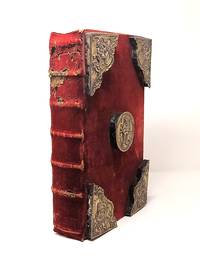
2868<p><strong>Very rare first separate edition of the Gospels printed during Catherine II's reign and mentioning her name when she had just become Russian Empress. </strong>We could trace no other copy oustide Russia whether in public institutions like at auction in recent decades; the only other copies we could find in Russia are at Russian State Library and the National Library of the Republic of Karelia - no copy at auction there either.</p><p><strong>Complete with its full-page copper engravings by two important masters and kept in a lovely velvet binding with fine silver ornaments.</strong></p><p>These large-format luxury Holy Gospels intended for use on the altar were printed by order of Tsarina Catherine II at the Moscow Synodal Printing House "the main centre for the production of Cyrillic printed books" at that time Vasileva our translation here and below. Each of the four Gospels begins with large historiated headpieces depicting the Annunciation Nativity Baptism and Resurrection intricate initials and full-page engravings of the Evangelists which are placed in intricate rocaille frames; all other pages are framed within linear borders. An unusual addition appears on leaf 394: a small woodcut crucifixion in the margin.</p><p>The remarkable full-page representations of the Evangelists are signed by the engraver Vasilei Ikonnikov and the artist Semen Vtorov two masters who "defined the style of illustrations of Cyrillic liturgical books in the second half of the century . and prepared a whole plethora of illustrators" Vasilieva. They received professional academic training before joining the Moscow Synodal Printing House's Drawing Chamber which had opened in 1756. Initially apprenticed they advanced to positions as engravers and tutors. Ikonnikov still an apprentice in 1762 had studied at the Slavic-Greco-Latin Academy and also trained in the engraving chamber of the Academy of Sciences.</p><p>Naming the new Empress this is the first separate edition of Gospels printed during Catherine's rule which had just begun that year 1762. A complete edition of the Old and New Testament had appeared just a couple of months earlier in September 1762; and the first edition of our Gospels published in 1757 didn't mention Catherine as she hadn't ascended to the throne yet. This 1757 edition is also very rare with only two known copies located: also in the Russian State Lib. and Kolomenskoe Museum Estate. Our 1762 edition was followed by several more editions republished with minimal changes over the next years and decades including a slightly more common edition in July 1763 the Fekula copy now in the NYPL for example.</p><p>The present rather fresh example is kept in a pleasant red velvet binding with nicely preserved metal repoussé silver mountings on both sides. On the recto four shaped corner pieces depict the Evangelists—John Matthew Luke and Mark positioned clockwise from the top left—surrounding a central roundel with Christ enthroned. On the verso a finely chased and engraved cross occupies the centre with four floral cornerpieces. Each Evangelist is set within an elaborate interior rendered in varied textures alongside their symbolic beasts including the especially curious anthropomorphic ox of St Luke and the very bestial lion of St Mark complemented by baroque ornaments along the borders.</p><p>Description<br />Folio 38.6 x 23.3 cm. Title and 457 ll. printed in red and black incl. four full-page copper engravings by Ikonnikov after Vtorov dated 1757 Matthew Mark and John and 1758 Luke with five historiated wooduct headpieces vignettes large initials and borders.<br />Binding<br />Contemporary red velvet over wooden boards boards with silver and brass repoussé mountings in corners and centres of boards silver pieces of upper cover with contemporary hallmarks probably from Iaroslav spine with raised bands.<br />Condition<br />Wormholes and minor losses on spine velvet rubbed at extremities a few small stains on boards without buckles mountings on lower board replaced; marginal light soiling and staining more so on the last few leaves two leaves with closed tears last leaves with small puncture contemporary ownership inscription at the bottom of the last page overall a crisp example.<br />Bibliography<br />Vasileva L. N. Knizhnaia graviura v izdaniiakh kirillicheskoi pechati Moskovskoi sinodalnoi tipografii XVIII-XIX vekov Rossiikskaia Akademiia Khudozhestv 2004; Kharebova L. S. Knigi kirillicheskoi pechati v khranilishchakh Respubliki Kareliia 1569-1830 gg.: katalog Petrozavodsk 2013 p. 175-176 # 154; Zernova Kameneva 620; Guseva II 282.</p> [Sinod. Tip.], Moskva, November 1762. hardcover
1574P37<p><strong>Summary:</strong> London: Richard Jugge 1574. Folio 13 x 9 in. The third folio edition of the Bishops' Bible with a fold-out map. Text in attractive black letter and a good number of woodcuts and four titles.</p><p><strong>Description:</strong> 26 out of 28 preliminary leaves present with Calendar printed in red and black. Lacks general title but all four other title pages are present. Printed in smaller type than the 1572 folio but still contains woodcuts as chapter summaries Genesis Exodus Numbers Matthew Mark Luke John etc. and an additional full-page composite cut before Revelation and a few maps. First chapter initials and decorated head and tailpieces throughout.</p><p><strong>Collation:</strong> A-M8 N6 Gen-Deut; Aa-Ss8 Tt6 Joshua-Job; Aaa-Sss8 T6 V6 Psalms-Mal; Aaaa-Mmmm8 Nnnn6 Apocrypha; A-Q8 R6 New Testament. <u>Lacks</u> general title and R4-R6 last three leaves. With two page fold-out map of <em>New Map of Places Mentioned in the New Testament </em>bound at front but <u>lacks</u> the two page fold-out maps in Exodus and Joshua.</p><p><strong>Binding:</strong> Rebacked in marbled calf with old marbled sheep covers laid on. Front cover with some surface loss. Spine with four raised bands and a red gilt-lined label with the words "Bishop's Bible." Plain endpapers.</p><p><strong>Condition:</strong> Generally a very good copy with marginal notes occasionally shaved; Occasional staining to the top and bottom margins e.g. D3-D6 K6-K8; some browning; Aii Matt 1 piece torn from inner column with loss of a few verses; B4 closed tear to outer edge just touching the text and through several notes; C1 long closed tear through most of the inner portion of the leaf without loss; G7 closed tear to bottom of inner column through 18 lines; M7 closed tear with loss to the first several lines of text to both columns; ex-library bookplate of Zion Research Library on front pastedown.</p><p><strong>Note:</strong> The third folio edition of the Bishops' Bible. Printed in smaller type with 63 lines to the column. After the first folio which contains over 120 woodcuts the number of woodcuts in the Bishops' Bible gradually decreases. The third folio still contains a good number of cuts and the fold-out map at the beginning of this copy is quite nice.</p><p><strong>References:</strong> Herbert 137; STC 2109; ESTC S107032; Luborsky & Ingram 2109.</p> Richard Jugge hardcover
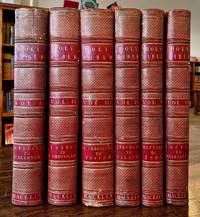
1800512129Thomas Bensley for Thomas Macklin 1800. First Edition. Hardcover. VERY GOOD. First edition of The Macklin Bible a masterpiece of book design that has been called 'the last of the great Bibles.' Complete in six volumes without the posthumously published Apocrypha. Elephant Folio 19' x 15.5' and . Full red morocco covers with gilt rolled Greek meander borders spines with double raised bands gilt in seven compartments all edges gilt gilt dentelle marbled endpapers. Sturdy bindings are remarkably solid despite the demands of these heavy textblocks. Very Good ex-libris from the John Wilson Collection of Multnomah County Library with small bookplates on paste downs a few penciled notes to versos of title pages but otherwise unmarked. Wide margins. Bindings scuffed and soiled rubbed along joints wear at heads and tails. Contents generally bright with typical offsetting from engravings; many tissue guards still present. Handwritten 2pp. 1889 note from London bookseller Henry Sotheran tipped-in to Vol. 1 wherein he apologizes for the lack of The Apocrypha which was published in 1816. Exhaustively illustrated throughout with engravings including 70 full-page copperplates after Benjamin West Angelica Kauffman Henry Fuseli William Artaud Joshua Reynolds Philip James de Loutherbourg and others. Weighing in at well over 100 lbs this Macklin Bible will ship in multiple boxes and will require additional fees for international delivery. Thomas Bensley for Thomas Macklin hardcover
173833238-165Zurich Johann Heinrich Bürckli 1738. 2 cols. 386 pp.; 256 pp.; 88 pp. 8vo c. 165 x 95 x 25 mm. 18th century Zurich Vermeil binding fine chased goldplated silver over wooden boards covered with black velvet edges gilt. Exlibris. Zurich Johann Heinrich Bürckli 1738. Attractive New Testament in the Zurich version printed for domestic use preciously and splendidly bound in a much sought-after Zurich Vermeil binding fine chased goldplated silver over wooden boards. This N.T. is a typical example out of one of the roughly thirty editions printed in Zurich during the 18th century. It is remarkable that Ambrosius Lobwasser 1515-1584 as a Lutheran thereby paved the way for Calvinist liturgical songs in German speaking countries cf. MGG VIII 1075 by using for his metrical psalms the Geneva book of Psalms prepared by Marot and Beza between 1532 and 1560. His object was to popularize in Germany the melodies of the French Psalter of the beauty of which he had received a deep impression during a long sojourn in Berry; and thus he adhered to the texts which served as channels for these melodies in order that the meter and versification might accord with the French model. The book is housed in an attractive contemporary Zurich binding. Zurich was the most important place of manufacture for Vermeil bindings and shows the design that was common there at this time. Forming a wide frame on both covers and the back it is composed of leafy scroll- and lattice-work with flower and ornamental depictions. In the center of both covers is a small pelican engraved as a symbold for Jesus Christ or as a sign of mercy or possibly an owner sign. This binding is uncommon in that the silver cagework extends round the edges of the covers.- The work shows considerable craftsmanship and is in pristine and fine condition. - Not in VD 18 nor Darlow/Moule; cf. Bibliothek Otto Schäfer Europäische Einbandkunst 1992 121; not in Leemannn-van Elck Bibelsammlung im Grossmünster zu Zürich 1945 but cf. no. 40; the same Buchschmuck der Zürcher-Bibeln 1938 124; cf. Lösel Zürcher Goldschmiedekunst 1983 pl. 256-257; cf. Bibelsammlung Stuttgart E 1347 in similary binding but published by Gessner in 1738; cf. Henkel/Schoene Emblemata col. 811. BINDINGS ; HELVETICA:ALLGEMEIN ; BIBLES ; Zurich, Joh(ann) Heinrich Bürckli hardcover
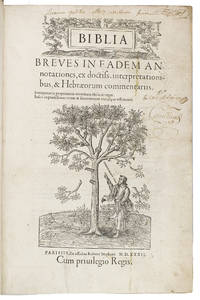
1532ABC_49016Paris: Roberti Stephani = Robert Estienne 1532. Modern gold-tooled brown calf with the title lettered in gold on the spine red sprinkled edges. Folio. With Estienne's large olive-tree device on the general title page and the divisional titles of parts 3 interpretatio and 4 index a woodcut decorative border around the word "Biblia" on the general title page and 79 decorated metalcut criblé initials. 4 parts in 1 volume. Including: - Hebraica Chaldaea Graecáque & Latina nomina virorum .- Index rerum et sentiarum quae in Veteris & novi testamenti libris continentur. Second enlarged and first fully glossed edition of the famed Estienne Bible. The work is "considered the earliest genuine attempt at a critical edition of the Vulgate text. it became practically the foundation of the official Roman Vulgate" Schreiber. The first edition of this Bible was Estienne's first major work and "immediately established him as the most outstanding figure in the Paris book trade at the time" Schreiber. The present copy is complete with the glossary and index which appear as parts 3 and 4. It also includes the beautiful criblé initials by engraver Geoffroy Tory 1480-1533.Robert Estienne 1503-1559 acquired Vulgate manuscripts during his years in Paris and printed numerous editions throughout his career beginning in 1528. Unlike the first edition the present edition includes marginal references concise notes and an extensive index of significant Hebrew words. It also contains Estiennes distinctive typographical symbols indicating words present in the Hebrew text but omitted from the Latin version and vice versa. Notably this edition is the first in which Estienne placed the Acts of the Apostles between the Gospels and the Pauline Epistles rather than at the end of the volume as was then customary.With an annotation at the top of the title page another in the middle of the title page and a signature below. The front and back board are somewhat scratched. The title page has been reinforced in the margins likely with the final blank of the second part which is missing to repair the tear in the bottom half large ink stains in the inner margin of leaves 243-244 and 306-307 of the first part a tear in the outer margin of leaf 7 of part 3 minor ink thumb prints on some of the leaves each leaf has been ruled in reddish-brown ink with manicules on some of the leaves. Otherwise in very good condition.l Darlow & Moule 6112; Renouard p. 35.1; USTC 181366; cf. Schreiber The Estiennes 37 other ed. Roberti Stephani [= Robert Estienne], unknown
1489371804Strasbourg: Johann Prüss 1489. Text in double columns 52 lines per column. 450 leaves with erratic pagination and collation. Two leaves present in early manuscript facsimile Interpretations of Hebrew Names leaves b2 and b7. Partially rubricated. Contemporary manuscript marginalia with chapter summaries in the lower margins throughout and shoulder notes in the OT with extensive annotation on the title. Folio. Early blindstamped pigskin later brass bosses and clasps joints splitting some loss at bottom of spine. Title mounted with paper losses at fore-edge and lower margins affecting the manuscript annotation but not the text. Cloth clamshell box. Text in double columns 52 lines per column. 450 leaves with erratic pagination and collation. Two leaves present in early manuscript facsimile Interpretations of Hebrew Names leaves b2 and b7. Partially rubricated. Contemporary manuscript marginalia with chapter summaries in the lower margins throughout and shoulder notes in the OT with extensive annotation on the title. Folio. The second Prüss Bible. Place of publication and printer from Goff publication date from colophon Kk5v. Not in Darlow and Moule. This copy from the famed bible collection of W. A. Copinger. See his lengthy bibliographic description in Incunabula Biblica item 79 and plate XLI. ISTC ib00588000; GW 4265; Hain-Copinger 3104; Proctor 543; Goff B588; BM 15th cent. I 122 IB.1658; Walsh J.E. 15th cent. printed books 196; Stillwell B516; Bodleian Lib. 15th cent. B-297; Copinger W. Incunabula Biblica 79; BSB-Ink B-462. Provenance: W. A. Copinger bookplate; General Theological Seminary booklabel blindstamp on the title Johann Prüss unknown
1591P36<p><strong>Summary:</strong> London: Deputies of Christopher Barker 1591. Pulpit Folio 15 x 9.75 in. A later pulpit folio Bishops' Bible with attractive black letter text. Textually complete with a portion of the general title the New Testament title and in very good condition.</p><p><strong>Description:</strong> Includes nine preliminary leaves with the <em>Kalendar</em> ending on the full-page Adam and Eve engraving. The general title page 1591 in red and black is laid down. Text is in two column black letter. The New Testament title page 1591 within architectural border. First chapter initials and decorated head and tailpieces throughout.</p><p><strong>Collation:</strong> A-Z6 Aa-Zz6 Aaa-Zzz6 Aaaa-Zzzz6 Aaaaa6 Bbbbb4. Complete.</p><p><strong>Binding:</strong> Rebound in modern brown calf with original covers laid down. Covers within double blind-rolled border and fleurons at corners. Spine with six blind-lined bands and blind rolls to compartments. A dark red gilt-lined label with the words "Holy Bible 1591" in gilt. Plain endpapers.</p><p><strong>Condition:</strong> The text is generally in very good condition with good margins throughout. Occasional staining mostly marginal and a few minor marginal tears. General title is missing 60 percent with the bottom portion mounted an inserted on the verso of a leaf before the prelims. Below the title is a slip of paper with "William Ingham and Richard Weles bought this booke." On the front free endpaper is a large inscription 'John Smeeton His Book" and at the top are records of the births of five children 1658-1661. On the recto of the following leaf is a bookplate that reads "in the Savoy John Smeeton August 20 1675."; inserted after the title are two slightly defective leaves of the <em>Proper Lessons</em> in manuscript; Prelims include the<em> Almanacke</em> and <em>Kalenda</em>r about one third of June/July is missing and the whole is a bit worn; the final preliminary leaf with some paper repairs to the top edge reducing the border of the Adam and Eve engraving; bottom corner of Genesis 2 is torn away and replaced in manuscript; G1-N3 Ex-Num worm hole to the top inner margin not impacting text; Kk4 paper flaw removing some letters of sidenote on verso; Tt3 paper flaw without loss; Tt6 Bbb2 Yyyy3 with closed tears into the text; Uu1 piece torn from margin just touching the text and removing a couple of word from the sidenote; Xx2-Zz6 slight marginal worming; Qqqq6 possibly a paper flaw with old repair slightly obscuring some letters of text; final leaf bound slightly askew with some lower marginal repair.</p><p><strong>Note:</strong> One of a series of large folio black letter Bishops' Bibles. These Bibles were often used in parish churches but people of means bought them for private us as was apparently the case in this copy. The folio Bishops' Bibles that have survived are frequently imperfect as is the copy described in Herbert's catalog.</p><p><strong>References:</strong> Herbert 209; STC 2156; ESTC S121300.</p> Deputies of Christopher Barker hardcover
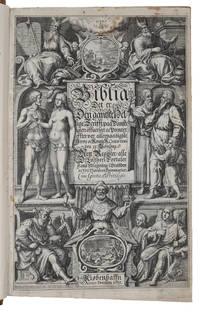
163361362Kiøbenhaffn Melchior Martzan og Salomon Sartor 1632- 1633. Folio. Bound in a splendid recent full calf pastish binding with five raised bands. Gilt floral ornamentation to spine and boards ruled in gilt. End-papers renewed. First 10 leaves with marginal repairs. A few leaves in the New Testament last part closely trimmed in upper margin occassionally touchly text. Last 10 leaves with marginal repairs. Internally with occassional miscolouring and brownspotting but an overall nice copy. Engraved title-page and the engraved portrait of Christian IV all by the royal engraver Simon the Pas. Without the half-title which merely contains the printed words "BIBLIA / Paa Danske" which is almost never present. 21 - not counting the engraved title-page and the portrait 353 i.e. 354 due to the erroneous double pagination 353 226 159 ff. <br/><br/><em>A nice copy of the scarce first edition of the last i.e. the third of the Danish folio-bibles known as "Christian IV's Bible" being a slightly revised edition of the Bible of 1589 Frederik II's Bible. Christian IV is the most famous Danish king ever to have lived and the Christian IV bible is extremely sought-after. The numerous woodcut illustrations are the same that were used for the Frederik II's Bibel from 1589. The four engraved leaves - the portrait and the three title-pages - are by Simon de Pas. Despite already having two beautiful folio-bibles Denmark's supply of Bibles was insufficient for the nation's needs. In many parishes only the church had a copy with a few more in the homes of the wealthy. This shortage was particularly severe in Norway due to its distance from the capital which limited the benefits of initiatives from the King. Funds were raised from churches in Zealand and Norway with Norway contributing generously. Two printers Melchior Martzan and Salomon Sartor were employed with Martzan overseeing corrections and sales. Norwegian churches' significant contributions were rewarded with copies equivalent to their donations while Zealand's lesser contributions received no compensation. Biblioteca Danica I 9. Thesaurus II 378. Birkelund 41. Darlow and Moule 3160. </em> hardcover
1791373866Worcester: Isaiah Thomas 1791. First Edition of Isaiah Thomas's Folio Bible. 50 engraved plates. 4 460; 2 461-1012pp. Text in two columns. 2 vols. Folio. Contemporary calf panelled in gilt and blind spine with raised bands in six compartments tooled in gilt on either side of each band red and black morocco labels expert repairs. Moderate to heavy foxing repaired tears to text leaves and plates. First Edition of Isaiah Thomas's Folio Bible. 50 engraved plates. 4 460; 2 461-1012pp. Text in two columns. 2 vols. Folio. "The two Thomas Bibles of 1791 were without doubt far in advance of any other publications of the same kind that had appeared in America in point of typography excellence of paper binding and general execution" Wright.<br /> <br /> Dubbed "the Baskerville of America" by Benjamin Franklin Isaiah Thomas issued a folio and a quarto Bible almost simultaneously. Published immediately after the ratification of the Bill of Rights the folio edition arguably his magnum opus opens with a note from Thomas situating it as an important accompaniment to this national development: "The civil authority hath set an example of moderation and candor to all Christians by securing equal privileges to all; and it must be their ardent and united wish independently of foreign aid to be supplied with copies of the sacred Scriptures the foundation of their Religion - a religion which furnishes motives to the faithful performance of every patriotic civil and social duty."<br /> <br /> In preparing the work Thomas compared the language of "not less than eight" significant English Bibles most but not all of which were printings of the King James translation and then had every page of the present edition examined by "the Clergymen of Worcester and . other capable persons." <br /> <br /> In keeping with his patriotism all the plates are by American engravers an expensive undertaking: the majority by Joseph Seymour with others by John Norman Samuel Hill and Amos Doolittle. It is unusual to find complete copies with all fifty plates. The plate list often lacking is present in this copy. The work was issued either in one volume or in two volumes as here the latter including an additional general title page for the second volume bound in as a cancel.<br /> <br /> A celebrated American Bible from one of the young country's most important printers. Evans 23186; Hills 29; ESTC W4497; Sabin 5172; Wright Early American Bibles pages 74-88 Isaiah Thomas unknown
1788375629Worcester: Isaiah Thomas 1788. Numerous woodcut illustrations including full-page frontispiece. 144pp. 12mo. Modern calf red morocco lettering piece. Repair to final leaf affecting the final three lines frontispiece paper-backed with repaired tears and small area of loss in the image a few leaves likely supplied from another copy. Numerous woodcut illustrations including full-page frontispiece. 144pp. 12mo. A cornerstone for any collection of American children's books American illustration or American Bibles this classic children's book is an American reprinting of the edition first published by Hodgson in London in 1783. Containing nearly 500 illustrations it is the first Bible printed in the United States specifically for children. The rebus format of the small volume presents the young reader with famous Bible stories in an amusing format that encourages reading puzzle solving and Bible study.<br /> <br /> "A touchstone of eighteenth-century American book illustration this 'curious' children's Bible contains nearly five hundred woodcuts made by American artists. The most ambitious woodcut book produced in America up to that time it is one of the sixty-five children's book titles produced by the pioneer publisher of children's literature and preeminent early American printer Isaiah Thomas 1749-1831 who had learned the art of engraving while apprenticed in his youth to the Boston printer Zechariah Fowle" American Treasures of the Library of Congress online exhibition.<br /> <br /> Complete copies of the first hieroglyphic and children's Bible printed in America are very rare with even Brinley's copy lacking a leaf. This is a book that saw extremely heavy use and given its young audience inevitable if often loving misuse. Welch 510; Rosenbach 128; Evans 20961; O'Callaghan p.33; Hamilton 122; Rumball-Petre 167; Brinley 5805; Sabin 17990. Not in Hills Isaiah Thomas unknown
183952150Philadelphia: Bagster & Marshall 1839. First American edition. Hardcover. Good . Octavo. 6 10 778pp. Pointed Hebrew text in two columns the New Testament with only vocal marks. Continuous pagination in Arabic numerals; but separate Hebrew pagination for the Old and New Testaments. Contemporary three-quarter calf over pebbled cloth boards; spine with raised bands ruled and lettered in gilt. Decorative endleaves. Covers rubbed with wear at spine caps and corners. Library pressure stamp at title bookplate and pocket at paste-downs. A good ex-library copy with very clean fresh text throughout.<br /> <br /> First American edition of this Hebrew Bible earlier published by Samuel Bagster at London in 1835; it contains the first printing of the New Testament in Hebrew translation to appear in the United States. That translation was prepared by the philologist William Greenfield 1799-1831 the editorial superintendent of the British and Foreign Bible Society and first published by Samuel Bagster at London in 1831 D&M no. 5186. In preparing his revised Hebrew version Greenfield was allowed to utilise the London Jews' Society Hebrew New Testament published at London between 1813 and 1817 D&M no. 5170. Among the earliest publications of the society founded in 1809 this version was itself based upon Elias Hutter's Hebrew translation of the New Testament published at Nuremberg in 1599 D&M no. 5111. Prepared by a group of scholars under the supervision of Thomas Fry and William Bengo Collyer this London Jews’ Society edition employed only biblical words and translated Old Testament quotations from the Greek not citing them directly from the Hebrew Scriptures.<br /> <br /> The editor of the New Testament version in the present work appears to have had a notable gift for languages. William Greenfield began his Hebrew studies as a young man while apprenticed to a bookbinder taking lessons from one of his co-workers a Jew with some learning who had been described as "a reader of the law in the synagogue" ODNB. Greenfield subsequently left the business in 1824 in order to devote himself to languages and biblical criticism. His defence of the Serampore Mahratta version of the New Testament in response to an 1829 article in the Asiatic Journal brought him to the attention of the British and Foreign Bible Society who then hired him to superintend their editiorial department. "During his nineteen months in the society's service Greenfield wrote on twelve European five Asiatic one African and three American languages and acquired considerable knowledge of Peruvian African-English Chippeway and Berber" ODNB. His revision of the Hebrew New Testament earlier published by the London Jews' Society was among the last works he undertook for the British and Foreign Bible Society along with the revision of the Modern Greek Psalter as it went through the press.<br /> <br /> Provenance: Bookplate and other markings including withdrawal stamp of the Library of the Garrett Theological Seminary Evanston Illinois. Full title in Hebrew: ספר הקדש ×•×”×•× ×ª×•×¨×” × ×‘×™××™× ×•×›×ª×•×‘×™× ×’× ×›×ª×‘×™ ברית החדשה × ×¢×ª×§ מלשון ×™×•× ×™×ª ×ל לשון עברית <br /> Philadelphiae: Sumptibus Bagster et Marshall in via vulgo dicta Chestnut Street ad Repositorium Bibliorum Sacrorum etc. quae in linguis antiquis et hodiernis edita sunt. Anno erae Judaicae I rev. C; rev. C DXCIX.<br /> <br /> References: Goldman Hebrew Printing in America no. 6: "This was the first New Testament published in Hebrew in America." ODNB: "Greenfield William" Gordon Goodwin revised by H. C. G. Matthew. J. R. Marcus "Jewish Americana a Supplement to A. S. W. Rosenbach An American Jewish Bibliography" in: Monographs of the American Jewish Archives 1954 no. 1 no. 164. Cf. Darlow & Moule nos. 5111; 5170; 5186. Bagster & Marshall hardcover
152966850Lyons: Per Johanem Crespin 1529. BIBLE IN LATIN. Lyons: Per Johanem Crespin 1529.<br> <br> Second Crespin edition reprinted from the 1527 edition. Folio 13 15/16 x 10 inches; 354 x 252 mm. 304 leaves 18 CCLXVIII 18 leaves. Complete with final blank leaf. Gothic type. Text in double columns within rule borders. Title printed in red and black with small woodcut of St. Jerome repeated three times in the text with Jerome's prefaces within a four-part woodcut border showing God the Father and two angels in a tympanum the six days of Creation and the Last Supper. Large six-part Creation woodcut at the beginning of Genesis half-page woodcut of King Solomon at the beginning of Proverbs full-page Nativity woodcut at the beginning of the New Testament and 121 small text woodcuts including twenty-three repetitions: ninety-one Old Testament woodcuts within strip borders including eight repetitions and thirty New Testament woodcuts without borders including fifteen repetitions. Decorative woodcut initials. The Eusebian canons leaves D1-D3 are printed in red and black in a red architectural framework.<br> <br> Contemporary pigskin over wooden boards roll-tooled in blind to a panel design. Lacking clasps. Original index tabs. Binding worn with some loss of pigskin on upper corner of front cover. Title soiled lower margin of first few leaves wormed and frayed with some loss to woodcut title border a few short marginal tears some mostly marginal dampstaining minor worming to lower inner margins a few inkstains slight discoloration throughout. Despite these minor flaws this is a beautiful example of a French woodcut Bible completely unsophisticated. Contemporary ink inscription on back pastedown dated 1534 contemporary ink inscription on the recto of D4 beneath the Nativity cut eighteenth- or nineteenth-century inscription on title: B.V. Maria in Fürstenfeld. Some early underlining and coloring of woodcuts in red. A few early ink marginalia. Housed in a custom quarter brown morocco clamshell case.<br> <br> The illustrations follow the schema of the Sacon Bibles printed in Lyons in 1518 and 1521. Crespin's blocks with the exception of the Creation are close copies of those used in Jacques and Jean Mareschal's Lyons Bibles of 1523-1541 as is the layout of the text within ruled columns. The borders for the Old Testament blocks include a strip with the initials "PBA."<br> <br> Fairfax Murray French 36. Harvard French 66. Not in Brunet Rothschild Darlow and Moule.<br> <br> HBS 66850.<br> <br> $9500. Per Johanem Crespin unknown
157752602<p>London imprinted by R. Jugge Printer to the Queenes Majestie cum privilegio Regiae Maiestatis1577. Bishops' version 1577 The Bishops' Bible also known as the "Treacle Bible" because of its translation of Jeremiah 8:22: "Is there not treacle at Gilead". IMPERFECT: LACKS FIRST TITLE PAGE PREFACE and 2 PAGES from THE WHOLE SCRIPTURE. First page is a Prayer then 3 pages of The Whole Scripture followed by 6 leaves of Kalendar then The Order Howe 1 page then 2 pages Proper Lessons then 3 pages Certain Godly and Comfortable Prayers then 24 leaves of The Book of Common Prayer leaves: 35 1-103 1 - blank; title to 2nd part 106-252; title to 3rd part 254-500 581-592 the jump in pagination 500-581 is the same in all copies nothing is missing; New Testament leaves: title 2-127 last page with colophon and publisher's device. Psalmes: title pages: 4 1-99 page 99 misplaced in final section; Final section Veni Creator Song of 3 Children etc: 14 of 16 lacks A1. Small 4to bound in eights approximately 205 x 155 mm 8 x 6 inches slightly cropped affecting some running titles dated title page to New Testament and Psalms divisional titles to the second and third parts of the Old Testament and to the Apocrypha. 1 half page woodcut of the Garden of Eden 1 full page of the 12 tribes and the Tabernacle 3 maps in the text and 2 full page maps historiated initials pages ruled in red collation: pi6 -pi1-3 and pi6 6 2 misnumbered 3 4 A-C8 A-Z8 Aa-Hh8 Ii4 KK-Zz8 Aaa-Sss8 Ttt4; A-P8 Q6. The NT is followed by The Metric Psalms printed in London by John Daye 1577. Bound in old panelled calf rebacked with raised bands gilt title and date boards cornered in decorated brass with a single boss small central decorated brass lozenge with single boss to both boards probably the covers with brass bosses are as issued at the time decorated brass clasps not matching and partially renewed at some time ornate gilt monogram to both boards: "C C" early endpapers retained. Inner paper hinges strengthened neatly with paper strip ex Cheshunt College library with armorial bookplate on front pastedown stamped "Withdrawn" ink name with date 1748 on front endpaper faint inscription on 2nd blank endpaper 2 small rusty marks with hole at centre on first 2 endpapers caused by nails in clasps similar smaller marks on rear endpapers first page of prelims pi4 - A prayer is dusty and stamped in red at top and bottom with the college name small brown stain on pages 141 verso -142 recto no loss of legibility another on 255 verso - 256 obscuring a few words large pale brown stain on 176 verso no loss small piece missing from lower corner of Nnn1 with loss of a few words a large lower corner missing from D6 135 x 75 mm 5" x 3" that is St. Luke Chapters IV and V worming to lower margins of NT leaves 21-39 sometimes touching bottom line of text loss of 2 words on both sides of leaves 27 and 29 handling signs to NT margins large pale water stain to NT leaves 23 to 105 small closed tear to lower corner of NT leaf 78 no loss outer margins of final 2 leaves tatty no loss of text. A few other minor faults. A good copy of an Elizabethan Bible. Last page of Revelation: Imprinted at London by Richard Jugge Printer to the Queenes Majestie cum privilegio Regiae Maiestatis. Jugge's device with the motto: Omne Bonu Supernae below. Darlow and Moule Historical Catalogue of Holy Scripture Volume 1 pages 85-86 No.112; A.S. Herbert The English Bible 1525-1961 page 85 No.150. ESTC No: S5108. Old Bibles by J.R. Dore page 262 states: "This Bible is also particularly interesting from its being the last Bible ever printed by Richard Jugge. This makes the words placed over his printer's device on the last page so significant cogita mori." He died in the same year 1577. MORE IMAGES ATTACHED TO THIS LISTING ALL ZOOMABLE. FURTHER IMAGES ON REQUEST. POSTAGE AT COST.</p> London, imprinted by R. Jugge, Printer to the Queenes Majestie, cum privilegio Regiae Maiestatis,1577. hardcover
193021655Paris: F.L. Schmied 1930. Schmied François-Louis. Small folio 14-1/16 in x 11-1/8. 76 pp. Illustrated with twelve double-page and four single-page colored wood engravings. One of 155 copies printed on Madagascar paper plus 10 for collaborators and 7 on japon. Nasti B15. Full red morocco bound with the pages tipped to hinges cover with a central design after motifs in the book tooled in gilt on inlays of black and maroon morocco dentelles tooled in gilt and with gilt corner onlays gold and black silk moiré endsheets edges rough-gilt bound by Schmied signed on the front turn-in "F.L.S." Chemise and new matching slipcase. Light marginal foxing but in excellent condition.Schmied bound only books of his own creation choosing above all the books of his great years.The subjects of his designs come from the books themselves" Ray The Art Deco Book in France pp. 101-102. "In the introductory note.Théo Schmied points out the natural happiness of the interconnection between his father's cultural tendencies and art of the book and the world of the Near East as it is filtered by the 'inspired' Mardrus translations.throwing light on the the two fundamental aesthetic coordinates we need in order to understand how the details are made subordinate by the elegant decorative unity expressed by the plates that is the purity of the Egyptian graphic art and the will of the Italian primitives. The layout shows either a text harmoniously arranged in respect of double and single plates of various size or a text framed by rules forming a variety of geometrical patterns and decorated by bout de lignes in sienna. The illustrations mainly show subdued and delicate pastel colours" - Nasti. F.L. Schmied unknown
1714E52C1ENFMRTGDordrecht Jacob and Pieter Keur; Amsterdam 1714. Large folio 42.5 x 27.5 cm. Pieter Rotterdam and Pieter Rotterdam the younger colophon: printed by Jacob and Pieter Keur Dordrecht Gold-tooled sprinkled calf 1738 sewn on 6 double cords each board with a large centrepiece 4 cornerpieces and double fillets; richly gold-tooled spines also on the raised bands with gold-tooled morocco spine labels; gold-tooled board edges mottled turn-ins edges sprinkled red and green; headbands worked in tan and white. With engraved general title-page letterpress title-pages for the New Testament and Apocrypha and half-title for the Prophets series of 6 engraved double-page folding maps by Daniël Stoopendaal his larger set a complete set of 184 full-page and 28 double-page engraved illustration plates by various artists including A. de Blois J. van Vianen and J. Mulder after G. Hoet B. Picart A. Houbraken and others. 3 parts in 2 volumes. 20 302; 2 134 12 164 2 66 ll. Beautifully illustrated large folio Dutch States Bible Statenbijbel with 6 six maps including a world map and a complete set of the striking illustrations drawn and engraved by Bernard Picart and others. The maps belong to the larger of two series by Daniël Stoopendaal and were explicitly made for the Keur Bibles with for example Bible scenes rather than figures from classical mythology decorating the world map. With the armorial bookplate of Hendrik Gerardsz. van Couwenhoven 1711-1792 and a short handwritten genealogy of Couwenhoven's family from Couwenhoven's marriage in 1738 to the birth of this last child in 1766. The binding appears to date from the middle quarters of the 18th century so it may have been bound and presented for the occasion of the 1738 wedding. In very good condition. The binding is slightly worn at the joints the headcap of volume 1 is damaged and there are a few other minor surface imperfections but it remains generally in very good condition.l Darlow & Moule 3337; for the maps: Poortman & Augusteijn pp. 196-203 G II 2nd state maps 1-6; for the prints: Poortman Bijbel en prent II pp. 140-145. ABE CAT Bibles Sermons & Psalmbooks hardcover
121550Paris Imprimerie Royale For the British and Foreign Bible Society 1827. . First edition two parts in one vol. the complete Bible 996 pp. Old Testament 7pp. errata; 318 pp. New Testament 3pp. errata large 4to 26 x 21 cm; text printed entirely in Ottoman Turkish Osmanli in vocalised Arabic typeface bookplates removed from lower board internally clean and crisp condition; contemporary blind-tooled calf edges and spine ends skillfully repaired overall a very handsome copy.<br /> Scarce complete first Ottoman Turkish edition of the Bible published in paris.<br /><br />Based on the translation of Wojciech Bobowski known as Ali Bey 16101675 and referred to as the 'Kitab'i Mukaddes' Holy Bible this text was the first complete Turkish translation of the Bible including both the Old and New Testaments and became the basis for later Turkish translations used by Armenian and Greek Christians. The text was printed in Arabic character with full vocalisation in an edition of 5000 copies of the complete Bible and 2000 issues of the New Testament printed separately. The aesthetic and elegant type are notably those used by the Imprimerie Royale in Paris reminiscent of many important early Arabic and Turkish publications from Napoleonic Egypt at the turn of the nineteenth-century.<br /><br />In 1820 J. D. Kieffer became the first Agent of the B. F. B. S. in France and in the same year he began a thorough revision of Ali Bey's translation of the Bible comparing it with the original texts as well as with the standard English French and German versions. The translation of this edition of the New Testament was carefully revised in view of the criticism passed on the 1819 edition of the same apparently the earliest Arab-Turkish edition of the New Testament in Osmanli. For more information on see Darlow and Moule 9456.<br /> Paris, Imprimerie Royale [For the British and Foreign Bible Society], 1827. unknown
1607099568London: Imprinted at London by Robert Barker. 1607. 1607. Book measures 33x22.cm. Large 8vo possibly quarto. First work. The booke of common prayer with the Psalter or Psalmes of Dauid of that translation which is appointed to be vsed in churches. Signatures complete A4 B-G6.In two columns roman.ESTC Citation No. S123397. Second work. The Bible that is the holy Scriptures contained in the Old & New Testament. 4 294 294-299 301-361 1 359-362 361-444 135 7 leaves : ill. maps woodcuts. Signatures complete par.4 A-3L6 3M-3O8 3P-5E6 5F4. ESTC Citation No.S122320. Third work. The vvhole booke of psalmes· Collected into English meeter by Thomas Sternhold Iohn Hopkins and others conferred with the Hebrewe with apt notes to sing them with all. Set foorth and allowed to be sung in all churches of all the people together and after morning and euening prayer as also before and after sermons: and moreouer in priuate houses for their godly solace and comfort laying apart all vngodly songs and ballads which tend onely to the nourishing of vice and corrupting of youth. Collation 2 114 6 Signatures: A-K6 L1 LACKING L2. Some pagination errors but the first two works appear to be complete the third work lacking the last leave. Bound in period or early full calf panelled boards raised bands ornate gilt tooling within compartmets full gilt edges marble endpapers. At some time the binding has been repaired retaining most of the original spine repair to boards. Generally a very attractive early binding. Internally occasional minor blemish or tear. Pages in very good clean condition. A very nice Bible. Full Calf. Very Good. Large 8vo. Imprinted at London by Robert Barker. 1607. Hardcover
1700184779Antwerp i.e. Amsterdam: Chez Pierre Mortier 1700. Thou shalt not make unto thee any graven image First edition first issue of this superbly illustrated work with the final plate in the first issue "avant les clous" state. The 214 engravings were done by such prominent artists as Bernard Picart Jan Luyken and Gerard Hoet. The translation is generally agreed to be by David Martin 1639-1721 a Huguenot refugee living in Amsterdam although the work is more commonly known as "Mortier's Bible" after the Dutch cartographer 1661-1711 who published it. The five double-page maps bound at the rear of Volume II include depictions of the Holy Land the Mediterranean lands of the patriarchs and apostles the route of the Exodus complete with parted Red Sea and the world itself. During the production process the final plate was broken and hastily repaired: copies produced after the repair show the impression of the nails used to hold the plate together. These are known as "après les clous" "after the nails". 2 vols folio 419 x 276 mm pp. xiv 282 8; xxii 154 20. Engraved frontispieces 214 plates 5 engraved bifolia maps 3 bifolia letterpress tables engraved headpieces initials and vignettes to title pages. Contemporary red morocco spines ruled and decorated in gilt and with twin green morocco labels covers panelled and with turn-ins in gilt marbled endpapers edges gilt green silk bookmarker. Light bumping and wear infrequent minor foxing to contents: a very good copy. Brunet III pp. 199-200; Cohen & De Ricci pp. 489-490; Querard V p. 575 ref. unknown