Warren IsaacABAA
527 résultats
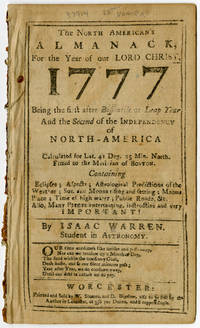
1776WRCAM37914Worcester: Printed and sold by W. Stearns and D. Bigelow 1776. 24pp. 12mo. Printed self-wrappers stitched. Lower half and upper outer corner of title-leaf lacking with text supplied in manuscript. Second and third leaves torn from fore-edge to spine repaired; upper outer corner of second leaf lacking with text supplied in manuscript. Eleventh leaf over-trimmed at fore-edge affecting some text. Several additional leaves chipped and torn at margins with repair. Rubbed and worn. A fair copy. Revolutionary-era almanac by Isaac Warren featuring a map of the forts at New York. Also included are lists of roads pieces of verse an account of Peter the Great and the "Celebrated Speech of Galgacus.worthy of the attention of all officers and soldiers in the American Army" p.17. The North AMERICAN IMPRINTS Project notes that while Evans is correct in calling the almanac "essentially the same" as Samuel Stearns' NORTH-AMERICAN'S ALMANACK for the same year with regard to the prose matter and the map of the New york forts the calendar is entirely different from that of Stearns. DRAKE 3269. EVANS 15212. ESTC W25152. NEBENZAHL BATTLE PLANS OF THE AMERICAN REVOLUTION 98 variant. Printed and sold by W. Stearns and D. Bigelow unknown books
1799525891799. WELD Isaac. Travels through the States of North America and the Provinces of Upper and Lower Canada During the Years 1795 1796 and 1797. London: Printed for John Stockdale 1799. 2 vols. 2nd ed. xxiii 427; xii 376pp. 16 folding plates. Orig. boards with paper spine labels. An excellent uncut set. "According to the Travels Weld landed at Philadelphia in November 1795 from which he made excurisions in all directions. On one of these he visited Baltimore Washington Alexandria and Mount Vernon. On another he moved west to York and Lancaster the northern neck of Virginia and Williamsburg and Norfolk apparently going as far south as the Dismal Swamp. At Williamsburg he noted that the captial was crumbling to pieces that William and Mary was a grammar school rather that a college that the church was out of repair and that the hospital for the insane was not well regulated. On his return he journeyed to Richmond and west to the mountains and as was usual with travelers he described Rock Bridge. After coming back to Philadelphia he went to Canada. His departure for home took place at New York."--Clark II 132. HOWES W-235. Sabin 102541. Haynes 20950. unknown
177441120La Haye, P. F. Gosse, 1774. In-8 de 140 pp., veau brun granité, dos orné à nerfs, tranches jaspées (reliure de l'époque).
177619583Leipzig, Junius, 1776. 2 Teile in 1 Bd. XIII S., 1 Bl., 568 S., 4 Bll. 16 mehrfach gefalt. Kupfertafeln. Gr.-8°. Mod. HLdr. unter Verwendung der Reste des alten Materials (etw. berieben).
1720523641720. Amsterdam Chez Pierre Humbert 1720 12° 15 1 328 pp.; 1 pp.331-583; 17 pp. Catalgoue des Livres Impres Chez Pierre Humbert . 12 gefalt. Kupferstichtafeln; Ledereinband d.Zt.; Rücken erneuert; feines Exemplar. PREMIERE EDITION FRANCAISE ! Pierre Coste 1668-1747 "the translator spent many years in England where he fled on the revocation of the Edict of Nantes and where he became intimate with Locke. His translations were of durable service and helped to introduce english thought to the French of the XVIIIth century" Babson Babson 139; Wallis 186; Dibner 148; PMM 172; Horblit N° 79b all 1st engl. Ed. unknown
172849631728. Complete with 5 folding maps 2 folding plates 67 portraits 2 frontispieces. Contains 4 different engraved title-vignettes. Some letters decorated. Part 1: 6 Blank pages / Half Title / Title Page / 20 NNP / 396-400 Fout genummerd bladen missen niet / 802 Pages / 6 Blank pages / 4 Folding maps / 1 Folding Plates / 1 Portret Part 2: 6 Blank pages / Title Page / 6 NNP / 496 Pages / 1 Blank pages / 332 Pages / 6 Blank pages / 32 Portret Part 3: 6 Blank pages / Title Page / 2 NNP / 665 Pages / 1 NNP / 6 Blank pages / 17 Portret / 1 Folding maps Part 4: 6 Blank pages / Title Page / 4 NNP / 684 Pages / 88 NNP / 6 Blank pages / 17 Portret / 1 Folding Plates This book can only be viewed by appointment. Binding: Contemporary Full Vellum Elephant Folio Height cm: 404 CM Width cm: 283 CM Thickness cm: 225 CM hardcover
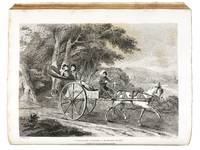
1799elala340London: Printed For John Stockdale 1799. 1799. 4to. pp. xxiv 464. 5 engraved maps & plans 1 folding & partially coloured in outline & 11 engraved plates incl. frontis. complete with the rare erratum slip relating to one of the plates mounted at foot of plate list. contemporary mottled calf rebacked some foxing to plates & neighbouring leaves. First Edition of one of the most popular American travel narratives. Weld came to North America with the hope of finding more cheerful prospects than those offered by war-torn Europe but after two years he left "without a sigh and without entertaining the slightest wish to revisit it." Story notes that "his account of Canada letters 21-25 is a clear and sustained description of an area and a way of life that pleased him more than had the United States." The plates are engraved after original sketches by the author. Clark II 132. Gagnon I 3701. Howes W-235. Lande 890. JCB II 4062. Sabin 192541. TPL 708. Vlach 754. Story p. 103. Winsor V p. 284 & VIII pp. 174 & 491. 1st Edition. London: Printed For John Stockdale, 1799. unknown
1728000772London: James and John Knapton 1728. 2nd Edition Corrected . Hardcover. Good/N/A. Full leather darkened and some cracking to spine. 5 bands to spine. Vol 2 part 2. Illustrated with Dr. Samuel Clark's notes taken mostly out of Sir Isaac Newton's Philosophy in olde English. Rubricated title page. Hinges cracked. Also fold out tables numbered XII to XXVII laid in the back all in good shape. ex lib from the Hartford Seminary. First belonging to Aaron Day dated May 3 1737. Then belonging to H A Gleason Jr. A very rare book. photos on request. <br/> <br/> James and John Knapton hardcover
1732285967Leyden: Verbeek 1732. Third. hardcover. very good. Title page in red & black with engraved vignette; illustrated with 13 folding copperplates. 344 pages short 4to bound in 19th century leather-backed marbled boards lightly edge-rubbed; new end-leaves. Lugduni Batavorum: Joh. et Herm. Verbeek 1732.<br/><br/> Third Latin edition of his professorial lectures on mathematics mostly on algebra and analytic geometry given at Cambridge during 1673-83. Some of this material was incorporated into the Principia. Babson no. 204. Lowndes 1674. Some browning to the pages and light staining in top gutter but a very good copy.<br/><br/> Verbeek unknown books
1740D4441Paris: Chez de Bure l'aine 1740. First Edition in French. Hardcover. Very Good. xxx 2 148 2 pp. With diagrams in the text. 4to 9¾ x 7½ period paneled calf spine tooled in gilt raised bands morocco label. First French Edition of Newton's important work the most extensive description of the mathematical method he used in his "Principia" the method of infinitesimals which was already written about 1671 but not published until 1736 with the title "Method of Fluxions and Infinite Series." Extensive notes in French on the title-page in a contemporary hand along with 3 wax seals which affect the top of the first three letters of METHODE. Additional ink notes some crossed out in margins of the first two pages of the preface. Two ink ownership signatures on front flyleaf. Spine scuffed label chipped rubbing to cover edges; pp. xix-xx of preface partially detached with edge wear as also final errata leaf; else very good. <br/><br/> Chez de Bure l'aine hardcover books
1768191607London: Printed for J. Rivington L. Davis and C. Reymers R. Baldwin W. Owen H. Woodfall W. Strahan and B. Collins 1768. Leather bound. Fair front and rear covers detached heavy shelfwear to covers with taped repairs dampstaining to bottom of most pages last 8 pages have a small section missing from the corner expected age toning with some foxing spots bookplate inside front cover. Oversized full brown leather covers with blind stamped design burgundy title block with gilt lettering on spine bw frontispiece 17 748 pp 4 pp 122 pages of engraved plates with several being fold-out. Reprint of the 1756 edition with a different title page. Includes a table of the plates errata and a table of contents. Isaac Ware's important comprehensive overview of Georgian architectural theory and practice. This work covers nearly every imaginable element of architectural design. 17x11x3" Printed for J. Rivington, L. Davis and C. Reymers, R. Baldwin, W. Owen, H. Woodfall, W. Strahan, and B. Collins hardcover
179941787London: Printed for John Stockdale 1799. Quarto. 10 7/16 x 8 1/8 inches. xxiv 464 pp. 11 engraved plates including the frontispiece 2 plans and 3 maps one of which is hand colored in outline. Complete with the rare erratum slip mounted at the foot of the plate list. Contemporary full calf. Spine gilt with black morocco lettering piece. Neat repairs to joints<br/> <br/> First edition of the travel narrative that influenced a generation of British emigrants to the Canadian provinces.<br/> <br/> Isaac Weld traveled through North America in the late 18th century and recorded his adventures in this wry series of letters. He arrived in America in 1795 at the age of 19 accompanied by a servant and traveled the continent on horseback on foot and by canoe. His distaste for American frontiersmen and the coarseness of manners in the United States would prove typical of English travelers for decades to come. Between July and November 1796 he travelled from Lake Champlain to Montréal and Québec returning through Montréal and continuing his journey to Kingston Newark Niagara-on-the-Lake Malden Amherstburg Detroit and Fort Erie. He declared the scenery from the Upper Town of Québec to surpass 'all that I have hitherto seen in America or indeed in any other part of the globe' and felt that travelling conditions between Québec and Montréal were the best in North America. Based on these observations he concluded that 'a man of moderate property could provide for his family with much more ease in Canada than in the United States' because of the abundance of affordable land. Like many other British travellers then and later Weld felt most at home in the Canadian provinces. Weld's narrative was reprinted more than that of any other European traveler to North America in the later 18th-century. The engraved plates are after sketches by the author. 'A New Map of Upper & Lower Canada' dated 1798 extends from James's Bay to the north Lake Winnipeg to the west and New Brunswick to the east with the territory of the United States below the Candian border left undefined by blank space.<br/> <br/> Cox 176; Stanton and Tremaine 708; Lowndes 2868; Gagnon I: 3701; Lande 890; JCB II: 4062; Clark II: 132; Rich 1799; Allibone 2636; Sabin 102541; ESTC T110539; Howes W-235; Story p. 103; Vlach 754; Winsor V p.284 & VIII 174 191. Printed for John Stockdale unknown
174820909Paris GABRIEL MARTIN, J. B. COIGNARD & ANT. BOUDET, PIERRE-JEAN MARIETTE, HIPPOLYTE-LOUIS GUERIN 1748-1750 -in-4 plein-veau 14 volumes, reliure plein veau havane marbré in-quarto (binding full calfskin in-4) (26 x 20,3 cm), RELIURE D'EPOQUE, dos à nerfs (spine with raised bands) décoré "or" et à froid (gilt and blind stamping decoration), titre et tomaisons frappés "or", pièce de Titre et de Tomaison sur fond bordeaux foncé avec filet "or" et filet perlé "or" en encadrement, (avec en plus pour la tomaison une roulette "fleur de lys" "or" de part et d'autre de la tomaison), roulette "or" en place des nerfs avec un filet à froid de part et d'autre, entre-nerfs à fleuron central "or"au fer évidé (between the raised bands floweret with hollowed out blocking stamp) dans un encadrement d'un filet "or" et un filet perlé "or" avec rinceaux "or" aux angles, roulette "fleur de lys" "or" avec filet "or" et filet perlé "or" en tête et en pied, plats ornés d'un double filet à froid en encadrement, double filets "or" aux coupes avec manque de dorure (blurred gilding), toutes tranches lisses rouges, ETAT DE LIVRES : TOME I : coiffes de tête et de pied manquantes, mors haut et bas de la 1ère et 4ème de couverture fendus sur 2 cm, TOME II : mors haut et bas du 1er plar fendus sur 4 cm, TOME III : léger manque de cuir à la coiffe inférieure (angle) et tache brune légère au 1er plat, TOME IV : légère tache brune au 4ème plat (1 cm2), léger manque de cuir en tête (moins de 1/5 cm 2), petit accident à la coiffe de tête à l'angle, TOME V : légers accidents à la coiffe de tête et de pied, TOME VI : léger accident à la coiffe de tête, TOME VII : petite tache brune en haut du 1er plat (2cm2), TOME VIII : mors haut du 1er plat fendu sur 1,5 cm, pièce de tomaison manquante (à restaurer), TOME IX : léger accident à la coiffe de tête, mors haut du 1er et 4ème plats fendus sur 2,5 cm, TOME X : coiffe de tête manquante, angle gauche bas de la pièce de titre et de la pièce de tomaisons épidermés, TOME XI : coiffes de tête et de pied manquantes, petit manque de cuir en têt et en pied (moins de 1/2 cm2), tache brune en haut du 1er plat (2 cm2), TOME XII : la coiffe de tête manque, épidermures à la pièce de titre, de tomaison et en pied, TOME XIII : coiffe de pied accidentée, épidermure à la pièce de titre et à la pièce de tomaison, mors haut et bas fendus du 1er plat sur 4 cm, mors haut du 4ème plat fendu sur 4 cm, TOME XIV : coiffes de tête et de pied accidentées, 2 épidermures à la pièce de tomaison, mors tachés (tache brune sur toute la longueur), Titre orné d'une vignette gravée sur bois en noir "branches de gui de part et d'autre avec fleur de lys au centre" en bas de la page de titre, orné de 46 planches dépliantes hors-texte gravées sur bois en noir (gravures, cartes, tableaux et plans) , TOME I : (X + 957) + TOME II ((2) + II + 781) + TOME III ((4) + 184 + 592) + TOME IV ((4) + 789) + TOME V((2) +V + 753) + TOME VI((4) + 680) + TOME VII((4) + 924) + TOME VIII((2) + II + 841) + TOME IX (VI + 929) + TOME X ((6) + 110 + 653) + TOME XI(192 + 614) + TOME XII (IV + 248 + 448) + TOME XIII(VIII + 927) + TOME XIV (232 + 187) Pages, 1748-1750 à Paris CHEZ GABRIEL MARTIN, J. B. COIGNARD & ANT. BOUDET, PIERRE-JEAN MARIETTE, HIPPOLYTE-LOUIS GUERIN Editeurs,
1713Flo315<p>Suite of 2 frontispieces and 61 portraits from Isaac de Larrey's <i>History of England Scotland and Ireland</i> 1713-1730.</p><p>All portraits by Dutch Baroque master Adriaen van der Werff.</p><p>Copperplates engraved by Pieter Stevens van Gunst and others including Gerard Valck Cornelis Vermeulen Nicholas Pitaut Benedict Audran Jean Audran Charles Simonneau Pierre Drevet Etienne Desrochers and Willem van der Gouwen.</p><p>Allegorical frontispiece by Bernard Picart and 28 portraits from Isaac de Larrey's <i>Histoire d'Angleterre d'Ecosse et d'Irlande</i> Reinier Leers Amsterdam 1713. </p><p>Allegorical frontispiece and 33 portraits from Isaac de Larrey's <i>Histoire d'Angleterre d'Ecosse et d'Irlande</i> Johann Covens and Cornelis Mortier Amsterdam 1730.</p><p>Plates mostly by Pieter Stevens van Gunst and others including Gerard Valck Cornelis Vermeulen Nicholas Pitaut Benedict Audran Jean Audran Charles Simonneau Pierre Drevet and Etienne Desrochers.</p><p>A sumptuous collection of oval portraits in decorative Baroque frames surrounded with allegorical figures putti crowns coats of arms garlands and other paraphernalia.</p> <p>Portraits of English royalty aristocrats and clergy from the 16th and 17th centuries including Henry VII Henry VIII Edward VI James I Charles I Oliver Cromwell Charles II James II William III and Mary II James IV and V of Scotland etc.</p><p>Many queens and ladies including four wives of Henry VIII Catherine of Aragon Jane Seymour Catherine Parr and Catherine Howard Elizabeth of York Mary Queen of Scots Lady Jane Grey the Nine Day Queen Bloody Mary Anne Hyde Margaret Tudor Mary of Guise and more.</p><p>Also includes European royalty Holy Roman Emperor Charles V Philip II of Spain Frederick V of the Palatinate William I Prince of Orange Ferdinand 3rd Duke of Alba Francis Duke of Anjou Alexander Duke of Parma etc.</p><p>Adriaen van der Werff 1659-1722 was a Dutch painter of religious and mythological scenes and portraits active mainly in Rotterdam. He combined the precise finish of the Leiden tradition learned from his master Eglon van der Neer with the classical standards of the French Académie Royale. From 1697 he was Kabinettsmaler court painter to Johann Wilhelm Elector of Palatine in Dusseldorf. </p><p>Brown leather spine worn and chipped paper title label illegible marble paper boards scuffed and stained torn stubs of two plates removed at front some plates coming loose from binding. All plates with wide margins good solid impressions of the engravings with even age-toning to the paper. A few scattered spots of foxing slight curling of a few corners and dust to page edges but generally very good.</p> Reinier Leers, Johann Covens and Cornelis Mortier paperback
1747RW1580London:: Printed by W. Innys T. Longman and T. Shewell C. Hitch and M. Senex 1747. 1747. 2 volumes. 4to. 4 lxxv 1 475 1; ii 389 33 pp. Original full calf raised bands calf gilt-stamped red & brown spine labels; joints cracked. Small rubberstamp on title. Very good. NICE CLEAN COPY. Sixth edition "greatly improved by the author" of 'sGravedande's extensive experimentation and instruction in Newtonian physics. The experiments range from basic physics to hydraulics optics electricity and astronomy. The entire work is profusely illustrated with folding engraved plates detailing among many other experiments and apparatuses a steam-powered Hero's Engine plate 78 a static electricity generator plate 79 the first magic lantern slide projector plate 109 the prismatic effect of a rainbow plate 120 and the known solar system plate 122. 'sGravesande "is the author of Elements de physique demonstres mathematiquement. . . ou introduction a la philosophie Newtonienne which was translated from the Latin and published at Leyden in 1746. In the second volume he gives a description of an electrical machine constructed on the plan of that of Hauksbee. It consisted merely of a crystal globe which was mounted upon a copper stand and against which was pressed the hand of the operator while it was made to revolve rapidly by means of a large wheel." Mottelay. / Willem Jacob 'sGravesande was a Dutch philosopher and mathematician. Born in 's-Hertogenbosch he studied law in Leiden and wrote a thesis on suicide. In 1715 he visited London and King George I. He became a member of the Royal Society. In 1717 he became professor in physics and astronomy in Leiden and introduced the works of his friend Newton in the Netherlands. He was ardently opposed to fatalists like Hobbes and Spinoza. In 1724 Peter the Great offered him a job in Saint Petersburg but 'sGravesande did not accept. His best remembered work is Physices elementa mathematica experimentis confirmata sive introductio ad philosophiam Newtonianam or Mathematical Elements of Natural Philosophy Confirm'd by Experiments Leiden 1720 in which he laid the foundations for teaching Newtonian physics. / 'sGravesande's chief original contribution to physics involved an experiment in which brass balls are dropped with varying velocity onto a soft clay surface. This demonstrated that a ball with twice the velocity of another would leave an indentation four times as deep that three times the velocity yielded nine times the depth and so on. He shared these results with Emilie du Châtelet who subsequently corrected Newton's formula E = mv to E = mv2. / 'sGravesande was also the owner of the oldest known magic lantern which was built around 1720 by Jan van Musschenbroek and is currently housed at the Museum Booerhave in Leiden. / "From the outset of his teaching both physics and astronomy 'sGravesande modeled his lectures on the example of Newton in the Principia and Opticks although in later years they incorporated other influences especially that of Boerhaave. Moreover he adopted from Keill and Desaguliers the notion of demonstrating to his classes the experimental proof of scientific principles accumulating an ever larger collection of apparatus as may be seen from successive editions of his Physics elementa mathematica experimentis confirmata. Sive introductio ad philosophiam Newtonianam Leiden 1720 1721. The scientific reputation of 'sGravesande is enshrined in this book which he constantly corrected and amplified in later editions. An 'official' English translation prepared by Desaguliers to whom copies of the Latin original were sent in haste was also issued in 1720 and 1721 and it passed through six editions. The booksellers Mears and Woodward printed a rival version under the name of John Keill. French translations appeared only in 1746 and 1747 but a critical review by L. B. Castel was published in the Memoires de Trevoux in May and October 1721. The book was at once welcomed by British and a number of German scholars." – DSB V p. 510. References: Babson 70; Mottelay p. 181. Printed by W. Innys, T. Longman and T. Shewell, C. Hitch, and M. Senex, 1747. hardcover books
179916287London: John Stockdale 1799. First Edition First Issue. Full leather. Near fine. The first edition first issue of Travels Through The States Of North America by Isaac Weld published in London in 1799 and complete with 16 maps and plates. Quarto 2 xxiv 464pp 8pp catalogue. Full calf raised bands six compartments title in gilt over red morocco label on spine. Includes the publisher's catalogue but lacking the errata slip. Even toning to leaves throughout a few leaves of text with transference. Contemporary gray endpapers. From the library of noted abolitionist and antiquarian collector George Head Head of Rickerby with his bookplate affixed to the front pastedown. The first issue with the index incorrectly identifying the fourth plate as: "The Patowmac River from Mount Vernon." This work is complete with 12 copper engraved plates including a frontispiece a large fold-out map of the eastern United States hand-colored map of Upper and Lower Canada and two plans for Quebec and Washington D.C. A few plates with light toning and scatter foxing. All plates and maps with solid hinges tissue covers and vibrant imagery. Sabin 102541 Howes W235 Lowndes 2868 Clark II 132 Includes a handwritten note from Arthur H. Masten to the recipient of this copy. An attractive work. Isaac Weld 1774-1856 conducted a survey of the United States from 1795 to 1797 covering the Eastern Seaboard and parts of the American frontier including Virginia Pennsylvania New York and the Carolinas. Weld traveled by horseback boat and on foot observing the social political and economic conditions of the newly formed nation. In "Travels" he commented on the vast natural beauty of the American landscape the state of infrastructure and the way of life of settlers and Native American tribes he encountered. Weld was critical of the rough manners and egalitarianism he witnessed contrasting it with European refinement yet he admired the industrious spirit of Americans. His narrative of the nascent United States helped to shape European opinions of the new nation during the Revolutionary period. John Stockdale unknown
17941252491794. First Edition. EATON Daniel Isaac. The Trial of Daniel Isaac Eaton for Publishing a Supposed Libel Comparing the King of England to a Game Cock In a Pamphlet Intitled Politics for the People; or Hog Wash at Justice Hall in the Old Bailey February Twenty-Fourth 1794. New York: L. Wayland 1794. Octavo modern half calf marbled boards pp. 48. $2400.First American edition of this account of the prosecution of radical printer Daniel Isaac Eaton for sedition with a wood engraving on the title page of the King of England next to a gamecock.In 1793 ""having acquired his own press Eaton launched Hog's Wash or A Salmagundy for Swine a weekly designed to spread political enlightenment among the masses. Partly original items partly excerpts enlivened by satire irony humour and verse it was immediately successful. Renamed Politics for the People it ran for sixty numbers September 1793 to March 1795. Through its pagesas through his pamphletsEaton consistently advocated universal manhood suffrage annual parliaments peace among nations education of the poor and unfettered discussion of politics and religion. When in the eighth number 16 November 1793 he published two items attacking monarchy one comparing the king to a cruel tyrannical gamecock Eaton was prosecuted for seditious libel but acquitted on both counts. He triumphantly adopted the imprint: 'Printed by D. I. Eaton at the Cock and Swine No. 74 Newgate Street.' The London Corresponding Society caused silver medals to be struck commemorating his acquittal. His shop became a gathering place for reformers and radicals"" DNB. Eaton is perhaps best remembered today for being arrested and convicted for publishing Thomas Paine's The Age of Reason serving 18 months in prison. Published earlier that same year in London. Scattered foxing extremely good condition. hardcover
1756191111London: Printed for T. Osborne and J. Shipton in the Gray's Inn J. Hodges near London Bridge L. Davis in Fleetstreet J. Ward in Cornhill and R. Baldwin in Pater-Noster-Row 1756. Hardcover. Fair missing coversmissing frontispiece and title page missing pages prior to page 9 expected age toning throughout spine is split plate 1 is loose appears all plates are here but many are wrongly numbered or double numbered pages 13-22 are torn appx 4 inches down from the top. Oversized missing front and rear covers brown leather spine with 6 raised bands 9-748 pp 20 pp 122 pages of engraved plates with several being fold-out. Includes a table of the plates errata and a table of contents. Isaac Ware's important comprehensive overview of Georgian architectural theory and practice. This work covers nearly every imaginable element of architectural design. 16x10x3" Printed for T. Osborne and J. Shipton, in the Gray's Inn, J. Hodges, near London Bridge, L. Davis, in Fleetstreet, J. Ward, in C hardcover
1740012680Lausanne & Geneve.: Marci-Michaelis Bousquet & Sociorum 1740. All edges stained red. Spine labelled near top. Half-title page present. Portrait frontispiece. Title-page with vignette printed in red and black. Errata page at end of text. Engraved head and tail pieces. Illuminated first letters of sections. Front free endpaper has missing piece at top corner. Endpaper are browned. Very faint suggestion of erasure at top of title-page. Wide margins and clean text throughout. Old water-staining to bottom of first 30 pages See photo. Twelve fold-out plates all intact and clean. This treatise on optics was first published in English in 1704 the first Latin edition published in 1706. Sir Isaac Newton 1643-1727 was an English physicist mathematician astronomer alchemist philosopher and theologian. He is most well-known for his "Philosophiae Naturalis Principia Mathematica" published in 1687 laying the ground work for most classical mechanics. He built the first practical reflecting telescope and he developed a theory of color based on the observation that a prism decomposes white light into many colors that form the visible light spectrum. He expanded on these theories in "Opticks". We find 20 libraries worldwide holding the book. ABPC shows a total of 7 copies sold at auction in the past 32 years. ii half-title blank frontispiece and title-page xxxii 1-363 errata 12 folding plates ii. Collated complete 10 May 2011. See "Printing And The Mind Of Man" 172. New Edition. Full Vellum. Moderate General Soiling. Quarto. Marci-Michaelis Bousquet & Sociorum Hardcover books
1732D427Amsterdam: R. en J. Wetstein en W. Smith 1732. Hardcover. Very Good. 2 volumes Elephant folio 445 x 296mm. 16 524pp. 4. Title-page in black and red with engraved vignettes. Text in Dutch and Latin parallel. Contemporary vellum with central medallion stamped in blind. Slight bowing to vellum as typical overall a superb two volume set of the Metamorphoses illustrated with in-text copper-engravings by Bernard Picart Charles le Brun and several other artists. Internally there are scattered stains but an excellent copy overall. The translator of this edition Isaac Verburg was born in Leiden around the year 1684. He was Rector of the Latin schools in Amsterdam and author and translator of several books; he died in 1745 in Amsterdam. Rare copy of the popular Dutch translation of Ovids masterpiece in prose Metamorphoses with clean bright and large illustrations. <br/><br/> R. en J. Wetstein, en W. Smith hardcover
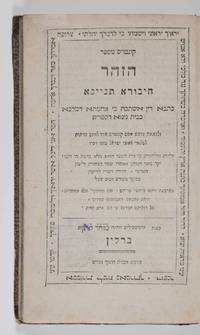
178248885Berlin and Dessau: Hevrat Hinukh Ne‘arim Berlin Freischule/n.p. 1782. First editions 2 of 4. Hardcover. Nearly Fine. Sammelband of four opuscules published between 1782 and 1819 octavo. Contemporary half calf top inch perished over pastepaper boards; spine lettered and tooled in gilt. Edges speckled blue. Covers lightly worn else fine clean copies the fourth work lightly foxed throughout. The first three works issued from the Hevrat Hinukh Ne'arim Berlin Freischule under the supervision of Isaac Satanow 1732-1804 the most prolific Hebrew writer of the Berlin Haskalah. As director of the publishing house Satanow was assigned the task of reissuing old Hebrew classics by the Marpeh ha-Nefesh a philanthropic group headed by the banker Daniel Itzig his son-in-law David Friedländer and the famous physican and philosopher Marcus Herz. A number of these editions however were in fact original works by Satanow which he presented as the work of earlier writers. The first item in the sammelband is an outstanding example of this latter type.<br /> <br /> I. Kuntres mi-Sefer ha-Zohar Hibura Tinyana Berlin: Hevrat Hinukh Ne‘arim 1783. aleph-gimel8 dalet1; 25ff. Vinograd Berlin 313. First edition of this polemic styled in imitation of the Zohar as a response to the Mitpahat Sefarim 1768 of Jacob Emden 1697-1776 in which the latter calls into question the antiquity and textual integrity of that chief work of the Jewish mystical tradition. Emden's critique may be understood as an attempt to undermine the doctrinal foundation of the Frankists who based their beliefs on the Zohar. "Emden had suspected the authenticity of the Zohar for a long time and he hoped some time 'to reveal the strange things found in the book.' But these intentions were secretly nursed within him for many years until the time was propitious for his exposé" Cohen. Perhaps surprisingly for a maskil Satanow held a very different view: "While advocating secular knowledge and the study of science Satanow also expressed great admiration for Kabbalah. In contrast to Emden he claims that the whole Zohar was written by Bar Yohai and Moses De Leon had nothing to do with its writing. He also rejects Emden's claim that in the Zohar there are words against the Talmud and promises to 'consult the Zohar and prove that all its words are right and truthful none of them is crooked Kuntres mi-Sefer ha-Zohar pp. 25 26" N. Rezler-Bersohn. Born in the Polish now Ukrainian town of Satanov Isaac Satanow settled in Berlin around 1771. "Among the most prolific of the early Haskalah writers. Satanow demonstrated a wealth of knowledge of the Hebrew language ranking as a model stylest throughout the Haskalah period" EJ 14: 905-906. As a leading representive of the eighteenth-century Jewish Enlightement Satanow boldly displayed a "conglomeration of contrasts" Jewish Enc. XI: 71: “Though Orthodox in his beliefs he nevertheless favored Reform in practice. He was one of the greatest authorities on Jewish tradition and lore yet he was one of the most free-thinking of philosophers.†For a more detailed discussion of this and other works by Satanow see N. Rezler-Bersohn "Isaac Satanow - An Epitome of an Era" in: Year Book XXV Leo Baeck Institute 1980. For Emden in the present context see M. L. Cohen Jacob Emden A Man of Controversy Philadelphia: The Dropsie College 1937 pp. 254ff.<br /> <br /> II. Sefer Igeret ha-Kodesh Berlin 553 1793. 7ff. Vinograd Berlin 415. Later edition of this well-known work. The celebrated talmudist and exegete Nachmanides the Ramban Moses ben Nachman ca. 1195-ca. 1270 acted as a conciliator between the parties in the early 13th-century controversies surrounding the philosophical and secular direction of Maimonides' growing influence. "After having given the earlier part of his life to his Talmudical works Moses Nachmanides devoted himself to writing of a homiletic-exegetic and devotional character. To these belong the "Iggeret ha-Kodesh" and the "Torat ha-Adam." In the former which deals with the holiness and significance of marriage Moses criticizes Maimonides for stigmatizing as a disgrace to man certain of the desires implanted in the human body. In Moses' opinion the body with all its functions being the work of God none of its impulses can be regarded as intrinsically objectionable" Jewish Enc. IX:88. The rare editio princeps appeared at Rome in 1546; the editor of the present edition Isaac Satanow notes at the title that the letter was “printed in Basel in the year 5340†referring to the 1580 edition of Ambrosius Froben Prijs 127.<br /> <br /> III. Nevu’at ha-Yeled Berlin: Hevrat Hinukh Ne‘arim 549 1789. asterisk8 2asterisk2. 10 unnumbered leaves. Vinograd Berlin 384. Later edition of a medieval Hebrew short story with commentary first printed at the end of Jacob Zemah's Sefer Nagid u-Metzaveh Constantinople 1726. "The body of the tale is followed by a number of occult prophecies in Aramaic. it was known already as early as the end of the 15th century and the beginning of the 16th when some kabbalists among them R. Abraham b. Eliezer ha-Levi wrote commentaries on the prophecies. The story tells of a wonder child Nahman born in the fifth century to a kabbalist; the child died very young but immediately upon birth began to tell his mother secrets of the heavenly worlds. His father cautioned him not to reveal mysteries forbidden to man and from then the child spoke only obscurely and enigmatically. Modern scholars have attempted to date the story and the prophecies therein by tracing known historical events hinted at and relating them to the text. The obscurity of the text makes this very difficult but it seems probable that historical events in the 15th century especially in the East are referred to in the prophecies. However the purpose of the story and its prophecies was to anticipate the coming of the Messiah and to describe the major political and historical events and catastrophes bringing about his final revelation. The kabbalists interpreted the prophecies as hinting at the coming of the Messiah in the early 16th century" JE XII:1020. Here the commentary on the Aramaic "prophecies" is likely attributable to Satanow.<br /> <br /> IV. Herev Nokemet Nekam Berit Dessau 5579 1819. 16pp. Vinograd Dessau 77. First edition of this famous polemical letter. A leader of the Reform movement Meyer Israel Bresselau d. 1839 together with I. S. Fraenkel edited and adapted in 1818 a prayer book for the Hamburg Reform Temple under the title Seder ha-Avodah. He anonymously published the present work in response to Eleh Divrei ha-Berit Altona 1819 "a pamphlet which collated the views of the greatest Orthodox rabbis of Western Europe against Reform Judaism and its innovations." A rhymed work written in a satirical biblical style Herev Nokemet is "remarkable in its witty take-off on the Orthodox rabbis who opposed the reforms in the Hamburg Reform synagogue. It ranks among the best Hebrew polemic literature written at the time of the Haskalah" EJ 4:1358 In response Meir Leib Reinitz published his Lahat ha-Herev ha-Mithappekhet in 1820. Bresselau's polemic was reprinted as an appendix to Bernfelds's Toledot ha-Reformazyon ha-Datit be-Yisrael in 1900. ×§×•× ×˜×¨×¡ מספר הזהר ×—×™×‘×•×¨× ×ª× ×™×™× ×<br /> ספר ×גרת הקדש<br /> × ×‘×•×ת הילד<br /> חרב × ×§×ž×ª × ×§× ×‘×¨×™×ª. Hevrat Hinukh Ne‘arim (Berlin Freischule)/[n.p.] hardcover
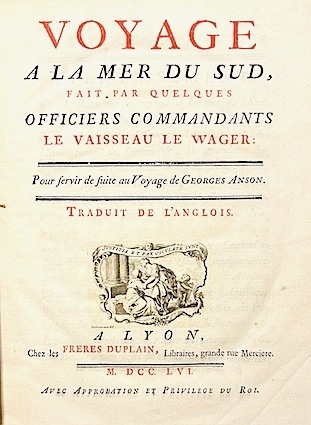
175614817Frères Duplain Lyon 1756 1 vol. In-4 de 2 ff.n.ch. XVI 185 pp. XIV (table) 1 f.n.ch., veau marbré de l'époque, dos à nerfs orné, pièce de titre, triple filet doré en encadrement sur les plats armoriés, tranches rouges.
1740S13116Lausannae & Geneva: Marci-Michaelis Bousquet & Sociorum 1740. 1740. 4to. iv xxxii 363 1 pp. Half-title engraved frontispiece portrait of Newton engr. Jean-Louis Daudet after Vanderbank 12 engraved folding plates title vignette of 4 cherubs and a female figure each using an optical instrument representing learning optics/perspective drawn by Delamoncein and engraved by Daudet head & tail pieces and woodcut initial letters drawn by Papillon index; first 11 leaves browned. Contemporary full vellum green leather gilt-stamped spine label edges with decorative red freckling as designed by the binder; foot of spine with faint ink marking "11-". Paper unevenly browned. Verso of title with small ink annotation "=1135="; rear pastedown with another notation "á 20.Luglio 1801." Very good. Third Latin edition edited by Bousquet with a dedication to Joannes Bernoulli. This edition contains the full array of 31 querries. / "Newton's contributions to the science of optics :: his discovery of the unequal refractions of rays of different color his theory of color and his investigations of 'Newton's rings' to mention only a few of the most noteworthy :: place him among the premier contributors to that science. . . . Today we recognize that his work on optics offers unique rewards in its exciting innovative conjunction of physical theory experimental investigation and mathematics and in the revealing glimpse that it provides of a crucial period in the evolution of experimental science." :: Alan E. Shapiro The Optical Papers of Isaac Newton: Volume 1 1984 p. xi. / Jean-Louis Daudet 1695-1756 who made the frontispiece and title vignette was an engraver and print publisher active in Lyon inherited business from his father Etienne Joseph Daudet. He flourished from 1722 till his death in 1756. Thereafter the business continued by his widow in association with his son-in-law Louis Martin Roch Joubert until 1773. / "Newton famously declared that it is not the business of science to make hypotheses. However it's well to remember that this position was formulated in the midst of a bitter dispute with Robert Hooke who had criticized Newton's writings on optics when they were first communicated to the Royal Society in the early 1670's. The essence of Newton's thesis was that white light is composed of a mixture of light of different elementary colors ranging across the visible spectrum which he had demonstrated by decomposing white light into its separate colors and then reassembling those components to produce white light again. However in his description of the phenomena of color Newton originally included some remarks about his corpuscular conception of light perhaps akin to the cogs and flywheels in terms of which James Maxwell was later to conceive of the phenomena of electromagnetism. Hooke interpreted the whole of Newton's optical work as an attempt to legitimize this corpuscular hypothesis and countered with various objections." / "Newton quickly realized his mistake in attaching his theory of colors to any particular hypothesis on the fundamental nature of light and immediately back-tracked arguing that his intent had been only to describe the observable phenomena without regard to any hypotheses as to the cause of the phenomena. Hooke and others continued to criticize Newton's theory of colors by arguing against the corpuscular hypothesis causing Newton to respond more and more angrily that he was making no hypothesis he was describing the way things are and not claiming to explain why they are. This was a bitter lesson for Newton and in addition to initiating a life-long feud with Hooke went a long way toward shaping Newton's rhetoric about what science should be. . ." / "The first edition of The Opticks 1704 contained only 16 queries but when the Latin edition was published in 1706 Newton was emboldened to add seven more which ultimately became Queries 25 through 31 when in the second English edition he added Queries 17 through 24. Of all these one of the most intriguing is Query 28 which begins with the rhetorical question "Are not all Hypotheses erroneous in which Light is supposed to consist of Pression or Motion propagated through a fluid medium" In this query Newton rejects the Cartesian idea of a material substance filling in and comprising the space between particles. Newton preferred an atomistic view believing that all substances were comprised of hard impenetrable particles moving and interacting via innate forces in an empty space as described further in Query 31." :: Newton's Cosmological Queries :: MathPages. / Grace K. Babson Sir Isaac Newton 1950 141; George J. Gray A Bibliography of the Works of Sir Isaac Newton 182; Wallis 182. See: Printing and the Mind of Man 172. Marci-Michaelis Bousquet & Sociorum, 1740. hardcover books
1740S13116Lausannae & Geneva: Marci-Michaelis Bousquet & Sociorum 1740. 1740. 4to. iv xxxii 363 1 pp. Half-title engraved frontispiece portrait of Newton engr. Jean-Louis Daudet after Vanderbank title printed in red & black 12 engraved folding plates title vignette of 4 cherubs and a female figure each using an optical instrument representing learning optics/perspective drawn by Delamoncein and engraved by Daudet head & tail pieces and woodcut initial letters drawn by Papillon index; first 11 leaves browned. Contemporary full vellum green leather gilt-stamped spine label edges with decorative red freckling as designed by the binder; foot of spine with faint ink marking "11-". Paper unevenly browned. Verso of title with small ink annotation "=1135="; rear pastedown with another notation "a 20.Luglio 1801." Very good. Third Latin edition edited by Bousquet with a dedication to Joannes Bernoulli. This edition contains the full array of 31 querries. / "Newton's contributions to the science of optics :: his discovery of the unequal refractions of rays of different color his theory of color and his investigations of 'Newton's rings' to mention only a few of the most noteworthy :: place him among the premier contributors to that science. . . . Today we recognize that his work on optics offers unique rewards in its exciting innovative conjunction of physical theory experimental investigation and mathematics and in the revealing glimpse that it provides of a crucial period in the evolution of experimental science." :: Alan E. Shapiro The Optical Papers of Isaac Newton: Volume 1 1984 p. xi. / Jean-Louis Daudet 1695-1756 who made the frontispiece and title vignette was an engraver and print publisher active in Lyon inherited business from his father Etienne Joseph Daudet. He flourished from 1722 till his death in 1756. Thereafter the business continued by his widow in association with his son-in-law Louis Martin Roch Joubert until 1773. / "Newton famously declared that it is not the business of science to make hypotheses. However it's well to remember that this position was formulated in the midst of a bitter dispute with Robert Hooke who had criticized Newton's writings on optics when they were first communicated to the Royal Society in the early 1670's. The essence of Newton's thesis was that white light is composed of a mixture of light of different elementary colors ranging across the visible spectrum which he had demonstrated by decomposing white light into its separate colors and then reassembling those components to produce white light again. However in his description of the phenomena of color Newton originally included some remarks about his corpuscular conception of light perhaps akin to the cogs and flywheels in terms of which James Maxwell was later to conceive of the phenomena of electromagnetism. Hooke interpreted the whole of Newton's optical work as an attempt to legitimize this corpuscular hypothesis and countered with various objections." / "Newton quickly realized his mistake in attaching his theory of colors to any particular hypothesis on the fundamental nature of light and immediately back-tracked arguing that his intent had been only to describe the observable phenomena without regard to any hypotheses as to the cause of the phenomena. Hooke and others continued to criticize Newton's theory of colors by arguing against the corpuscular hypothesis causing Newton to respond more and more angrily that he was making no hypothesis he was describing the way things are and not claiming to explain why they are. This was a bitter lesson for Newton and in addition to initiating a life-long feud with Hooke went a long way toward shaping Newton's rhetoric about what science should be. . ." / "The first edition of The Opticks 1704 contained only 16 queries but when the Latin edition was published in 1706 Newton was emboldened to add seven more which ultimately became Queries 25 through 31 when in the second English edition he added Queries 17 through 24. Of all these one of the most intriguing is Query 28 which begins with the rhetorical question "Are not all Hypotheses erroneous in which Light is supposed to consist of Pression or Motion propagated through a fluid medium" In this query Newton rejects the Cartesian idea of a material substance filling in and comprising the space between particles. Newton preferred an atomistic view believing that all substances were comprised of hard impenetrable particles moving and interacting via innate forces in an empty space as described further in Query 31." :: Newton's Cosmological Queries :: MathPages. / Grace K. Babson Sir Isaac Newton 1950 141; George J. Gray A Bibliography of the Works of Sir Isaac Newton 182; Wallis 182. See: Printing and the Mind of Man 172. Marci-Michaelis Bousquet & Sociorum, 1740. hardcover
1731EAHll[SA32Stockholm: Benjamin Gottlieb Schneider 1731. 1731. 2 Volumes in 1. pp. 8 p.l. 398 2; 1 p.l. 88 64 90 72. first title in red & black. woodcut ornaments. contemporary sprinkled calf gilt back rubbed spine & label bit chipped. old inscription on front free-endpaper: "Till Advocat Fisalen George Adolf Rutenschiöd". First Edition. "A survey of Dutch commercial affairs with considerable emphasis on its overseas companies and alliances." Bell Large sections are devoted to the Dutch East and West India Companies and their activities in Africa India south-east Asia and America. The engraved frontispiece to Volume II announced on the last page of Volume I was never published. Rare: two copies cited in NUC Harvard and Bell Library. Bell S35. Kress S.3380. Not in Sabin. Signed by Authors. F. Hardcover. Stockholm: Benjamin Gottlieb Schneider, 1731. Hardcover