"GREGORY, DAVID and (ISAAC NEWTON).Livre Rare Book

528 résultats
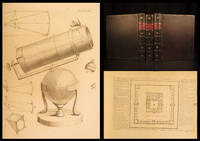
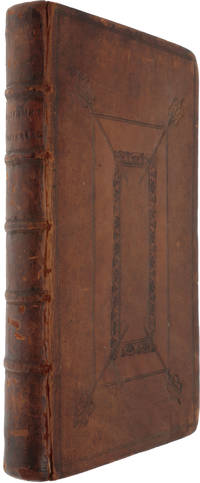
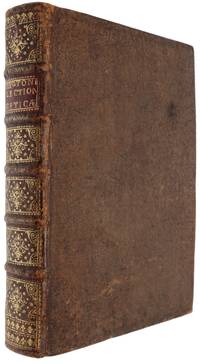
170247776Oxoniae (Oxford), E Theatro Sheldoniano, 1702. Folio. Contemporary full calf, raised bands, rectangular blindtooled frames and central panel ""mirror"" on covers, Cambridge-style binding. leather at joints cracked, but cords intact so that covers not loose. Corners a bit bumped. Light wear to spine ends. Spine a bit rubbed. Pastedowns and flyleaves with browning. Title-page with large engraved vignette (Sheldon Theater). (12),494,(2) pp. With numerous textdiagrams. Very light browning to titlepage and a few marginal brownspots to last leaf, a fine clean copy, printed on good paper with wide margins.On the verso of the title-page is pasted the book plate of Sir William Baird of Newbaith. He habitually pasted his armorial bookplate on the verso of the title-pages of the books in his large and fine library.
170247776Oxoniae Oxford E Theatro Sheldoniano 1702. Folio. Contemporary full calf raised bands rectangular blindtooled frames and central panel "mirror" on covers Cambridge-style binding. leather at joints cracked but cords intact so that covers not loose. Corners a bit bumped. Light wear to spine ends. Spine a bit rubbed. Pastedowns and flyleaves with browning. Title-page with large engraved vignette Sheldon Theater. 124942 pp. With numerous textdiagrams. Very light browning to titlepage and a few marginal brownspots to last leaf a fine clean copy printed on good paper with wide margins.On the verso of the title-page is pasted the book plate of Sir William Baird of Newbaith. He habitually pasted his armorial bookplate on the verso of the title-pages of the books in his large and fine library. <br/><br/><em>First edition of the first text book of astronomy based on Newtonian principles. Apart from its importance in the remodeling of astronomy in conformity with physical theory the work is of the utmost importance as a source book - it contains the FIRST PRINTING OF NEWTON'S PAPER ON LUNAR THEORY "Lunae Theoria Newtoniana" pp. 332-336 as well as the FIRST EXPOSITION OF NEWTON'S CLASSICAL SCHOLIA which Newton himself considered an important part of his philosophy.Gregory a Scottish mathematician who taught at Edinburgh and Oxford was one of Newton's closest friends and associates. Newton thought highly of his work and communicated for insertion it in his Lunar Theory. He also permitted Gregory to use the material of that which is known as his "Classical Scholia" which are incorporated into Gregory's preface. "Newtonian scholars have long been aware of a set of draft Scholia to Propositions IV to IX of Book III of the "Principia". These were composed in the 1690's as part of an unimplemented plan for a second edition of the work. Since they describe supposed anticipation of Newton's doctrines in the thought of Greco-Roman antiquity they have been known as the 'classical' Scholia. Newton's thoughts on these matters were not however kept completely concealed. HE PERMITTED DAVID GREGORY TO USE THE MATERIAL EXTENSIVELY in a long historical preface to his "Astronomiae Physicae & Geometricae Elementa" 1702 IF WITHOUT ATTRIBUTION. It was also available to Maclaurin for his much later work." McGuire & Rattansi in "Newton and the Pipes of Pan" 1966."It was the first textbook composed on gravitational principles and remodeling astronomy in conformity with physical theory. Newton thought highly of it and communicated for insertion in it p. 332 his 'lunar theory' long the guide of practical astronomers in determining the Moon's motions. The discussion in the preface in which the doctrine of gravitation was brought into credit on the score of its antiquity likewise emanated from Newton." DNB."His thick folio text on foundations of astronomy Astronomiae.elementa 1702 is a well-documented but unimaginative attempt to graft the gravitational synthesis propounded in the first book and especially the third book of Newton's Principia onto the findings of traditional astronomy. While respected as a source book it is now chiefly remembered for the remarks by Newton on the prisca sapientia of the ancients and their "knowledge" of the inverse-square law of universal gravitation and for the Latin version of Newton's short paper on lunar theory which it reproduces." DSB.Babson No. 71. - Houzeau & Lancaster 9240. </em> hardcover
1744109523Lausanne and Geneva: Aoud Marcum-Michaelem Bousquet & Socios 1744. First edition of the first collected edition of <span class="match">Newton</span>'s writings which has been hailed as "a fine piece of bookmaking" Babson. Quarto bound in contemporary velum contains 64 folding engraved plates; 2 folding letterpress tables. In very good condition. Small stamps to the spine and title pages. Rare in contemporary binding. English mathematician astronomer theologian author and physicist Sir Isaac Newton is widely considered one of the most influential scientists of all time and a key figure in the scientific revolution. In one of his most important works Philosophiae Naturalis Principia Mathematica Newton formulated the the laws of motion and universal gravitation that formed the dominant scientific viewpoint until being superseded by the theory of relativity. Aoud Marcum-Michaelem Bousquet & Socios unknown books
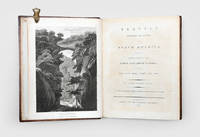
17991299131799. First Edition. WELD Isaac. Travels through the States of North America and the Provinces of Upper and Lower Canada During the Years 1795 1796 and 1797. London: John Stockdale 1799. Quarto contemporary full diced tan calf rebacked with original elaborately gilt-decorated spine laid down raised bands all edges marbled. $4800.First edition of this fascinating account of ""all the adventures incident to passing through an unsettled country"" with two maps one folding and hand-colored in outline plans of the cities of Washington and Quebec and 12 full-page copper-engraved plates of scenic views including ""The Horse-Shoe Fall of Niagara.""Weld arrived in America in 1795 at the age of 19 and ""accompanied by a faithful servant sometimes on horseback sometimes on foot or in a canoe he made his way often under the guidance of Indians through the vast forests and along the great rivers. He narrowly escaped shipwreck on Lake Erie and experienced all the adventures incident to passing through an unsettled country. While in the towns he mixed in the best society and had the privilege of meeting George Washington"" Cox. The journey took him through Virginia Pennsylvania and New York and then ""from Montreal to Quebec thence up to St. Lawrence and the lakes to Kingston Niagara and Detroit with comment on the country its settlement and administration. Weld an Irishman came to explore the possibilities of Canada and the United States as fields for Irish emigration"" Staton & Tremaine. Weld's travels are told through a series of 38 letters chronicling the two years he spent in North America and was one of the most popular narratives of the day. Translated into many languages Weld's account ""was regarded as the great authority of the period on American subjects"" Allibone III 2636. Includes examinations of taverns slave conditions tobacco cultivation and Indian tribes. ""In the first edition the view of the Hudson River is incorrectly designated on the plate itself and in the list of plates as 'View on or of the Patowmac River from Mount Vernon.' A number of copies have an erratum slip noting the error pasted at the foot of the list of plates or facing it"" Sabin 102541. This copy has no erratum slip suggesting it may be among the earliest copies preceding the discovery of the error. Without publisher's advertisements. A second edition in two volumes was also published in 1799. Sabin 102541. Howes W235. Cox II 176. Staton & Tremaine 708. Stevens 2808. Stiles 1921. Lowndes 2868. Rich 1799. In a royal armorial binding possibly from Carlton House the residence of George IV during the regency with a royal armorial bookplate.Mild dampstaining to top edge of frontispiece and title page text fairly clean with modest foxing to maps and plates one leaf with minor expert paper repair; handsome contemporary binding with light wear. hardcover
178225494<p><strong>1782 Isaac NEWTON Works OPTICS Ancient Kingdoms Gravity Mundi Systemate Horsley</strong></p><p><em>"Whence arises all that order and beauty we see in the world" </em></p><p>― Isaac Newton<em> Opticks</em></p><p>Few names in the course of the history of science have been as influential as Isaac Newton. His works such as '<em>Opticks'</em> summarized great discoveries and theories concerning light and color reflections color wheel invention of the telescope early theories of the rainbow and Newtonian rings – <strong><u>one of the greatest works on optics</u></strong>. '<em>Opticks'</em> in addition to his other famous treatises were published together in the 1782 collected works of Newton by Samuel Horsley. </p><p>This set of three volumes from the Horsley collected edition includes not only '<em>Opticks'</em> but works such as "<em>Chronology of Ancient Kingdoms</em>" correspondence with Boyle on gravity and "<em>De mundi systemate</em>" or "<em>Systems of the World".</em></p><p>Item number: #25493</p><p>Price: $4950</p><p>NEWTON Isaac</p><p><strong><em>Opera Quae Exstant Omnia</em></strong></p><p>Londini: Excudebat Joannes Nichols 1782-1785.</p><p><u>Details</u>: </p><p><!-- if !supportLists-->· <!--endif-->Collation: 3 volumes</p><p><!-- if !supportLists-->o <!--endif-->Vol. III – 10 174 5 180-242 3 246-437 8 4-48</p><p><!-- if !supportLists-->§ <!--endif-->plates no.2-11</p><p><!-- if !supportLists-->o <!--endif-->Vol. IV – 9 6-264 5 270-617p</p><p><!-- if !supportLists-->§ <!--endif-->12 plates</p><p><!-- if !supportLists-->o <!--endif-->Vol. V – 11 550p</p><p><!-- if !supportLists-->§ <!--endif-->3 folding plates</p><p><!-- if !supportLists-->· <!--endif-->Language: English</p><p><!-- if !supportLists-->· <!--endif-->Binding: Modern Leather; tight and secure</p><p><!-- if !supportLists-->· <!--endif-->Size: ~12in X 9.75in 30.5cm x 24.5cm</p><p>Our Guarantee:</p><p>Very Fast. Very Safe. Free Shipping Worldwide.</p><p>Customer satisfaction is our priority! Notify us with 7 days of receiving and we will offer a full refund without reservation!</p><p>163</p> Joannes Nichols hardcover
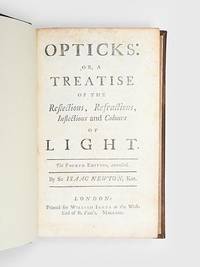
1730187897London: Printed for William Innys 1730. The definitive edition of Newton's second great work Fourth edition the final edition to be revised and approved by Newton himself. The Opticks is Newton's definitive study of light the basis for the corpuscular theory of light rays that remained dominant into the 19th century. The Opticks's greatest achievement is showing that colour is a mathematically definable property. Newton demonstrates that white light is a mixture of infinitely varied coloured rays and that each ray is definable by the angle through which it is refracted. Other topics include colour circles theories of the rainbow and the phenomenon now known as Newton's rings. In his later years Newton made a sustained effort to tidy up his scientific legacy. This edition of the Opticks was published three years after his death by his long-time publisher drawing on corrections "by the Author's own Hand" preface. In those three years Newtonian devotees had published the Optical Lectures 1728 that he had delivered at Cambridge in the 1660s making public a work that he had only circulated in manuscript among close friends. The Lectures employed a more mathematical analysis of colour theory than did the Opticks and Innys' fourth edition harmonizes the two works by cross-referencing philosophical propositions in the latter with geometrical demonstrations in the former. Octavo 195 x 123 mm pp. viii 382 2. Complete with terminal advertisement leaf and 12 folding plates. Wood-engraved initials head- and tailpieces. Twentieth-century calf spine ruled and decorated in blind and with red morocco label marbled endpapers edges sprinkled red. Minimal foxing to contents paper flaw to lower outer corner of K1 text unaffected plates crisp: a very good copy indeed. Babson 136; ESTC T69138; Gray 178; Wallis 178. unknown
1799162628London: John Stockdale 1799. An enthusiastic admirer of the beauties of nature First edition with the index incorrectly identifying the fourth plate. This work handsomely illustrated from the author's sketches "was regarded as the great authority of the period on American subjects. There can be no question that the colonization of Canada was mainly promoted and influenced by this book" Bibliotheca Americana. Isaac Weld 1774-1856 left Dublin for Philadelphia in 1795 and "accompanied by a faithful servant sometimes on horseback sometimes on foot or in a canoe he made his way often under the guidance of Native Americans through the vast forests and along the great rivers. He narrowly escaped shipwreck on Lake Erie and experienced all the adventure incident to passing through an unsettled country while in the towns he mixed in the best society and had the privilege of meeting George Washington" ODNB. Aside from the attractive folding map the work includes plans of Washington DC and Quebec; maps of Canada and the Niagara Falls; three views of the Falls; and an illustration of an "American stage waggon" leaving a staging post. The work proved popular going through four editions by 1807 and being translated into French German and Dutch. The plate showing the Hudson River is labelled as "View of the Patowmac River from Mount Vernon". The index of the second edition is corrected. Quarto 270 x 207 mm pp. xxiv 464 8. Engraved frontispiece and 14 plates views and plates one folding map hand-coloured in outline; 8 pp. publisher's advertisements at end. Contemporary speckled calf smooth spine with gilt bands red morocco spine label covers ruled in blind. Brent Gration-Maxfield 1916-1983 book collector and scholar with his ownership signature dated 1969 on front pastedown and extensive neatly pencilled bibliographic notes on the front free endpaper; contemporary gift note loosely inserted. Binding refurbished with gilt retouched superficial abrasions to covers folding map with short tear at stub small paper tears to b3 and G1. A very good copy. Bibliotheca Americana 3282; Howes W235; Lowndes 2868; Sabin 102541. unknown
171938274London, Impensis Gul. & Joh. Innys, 1719 (colophon: Londini: Ex Officina Gulielmi Bowyer, 1718). 8vo. Contemp. full calf. Corners, fronthinge and spineends professionally repaired. Inner hinges reinforced. Gilt lineborders on back. Titlelabel in red leather with gilt lettering. Old owners name stamped on titlepage (small).Instead of htitle is bound ""Catalogus Librorum prostantium apud Gul. & Joh. Innys"" (1 leaf), the Cataloque is furthermore bound at end, but with a different typography. (2),XI,(1),415 pp. and 12 folded engraved plates. Very light brownning to a few margins. Printed on good paper, in general fine and clean internally.
171938274London Impensis Gul. & Joh. Innys 1719 colophon: Londini: Ex Officina Gulielmi Bowyer 1718. 8vo. Contemp. full calf. Corners fronthinge and spineends professionally repaired. Inner hinges reinforced. Gilt lineborders on back. Titlelabel in red leather with gilt lettering. Old owners name stamped on titlepage small.Instead of htitle is bound "Catalogus Librorum prostantium apud Gul. & Joh. Innys" 1 leaf the Cataloque is furthermore bound at end but with a different typography. 2XI1415 pp. and 12 folded engraved plates. Very light brownning to a few margins. Printed on good paper in general fine and clean internally. <br/><br/><em>Scarce second Latin edition of Newton's "Optics: or a Treatise of the Reflections Refractions Inflections and Colours of Light. London 1704." one of the great books in the history of science. "Newton's Optics did for Light what his Principia had done for Gravitation namely placed it on a scientific basis." E.W. Brown. The translation was brought to light "At the request of Newton Dr. Samuel Clarke prepared a Latin edition of his Optics which appeared 1706 and he was generously presented by Sir Isaac with GBP 500 or GBP 100 for each of his five children as a token of the appreciation and gratitude of the author. DeMoivre is said to have secured and taken charge of this translation and to have spared neither time nor trouble in the task. Newton met him every evening at a coffe-house and when they have finished their work he took De Moivre home with him to spend the evening in philosophical conversation."Brewster in his "Newton" 1855"."In the accumulation of optical phenomena from his first paper the short memoir in Philosophical Transaction 1672 until the above book the Optics. 33 years later Newton had gathered explanations to many problems. The rainbow is fully explained and also "Newton's rings" produced by pressing the flat side of a plano-convex glass against a double convex lens of long focal lenght producing rings of alternating brightness and darkness; his explanation was not valid as he did not know optical interference. He speculated on the double refraction of Icelandic spar." Dibner in Heralds of Science No 148 - G.J. Gray No 180. </em> hardcover
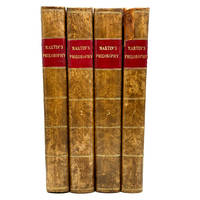
17715136166113<p><strong>NEWTON MARTIN Benjamin</strong><strong>.</strong> <em>Philosophia Britannica: Or A New and Comprehensive System of the Newtonian Philosophy Astronomy and Geography; In a Course of Twelve Lectures; With Notes; Containing the Physical Mechanical Geometrical and Experimental Proofs and Illustrations of All the Principal Propositions in Every Branch of Natural Science: Also a Particular Account of the Invention Structure Improvement and Uses of All the Considerable Instruments Engines and Machines; With New Calculations Relating to Their Nature Power and Operation.</em></p><p>London: Printed for W. Strahan; J. & F. Rivington; W. Johnston; Hawes & Co.; T. Carnan and F. Newbery; B. Collins; W. Frederick; and sold by the Author at his House in Fleet-Street 1771. Third edition. Complete in four volumes. Three text volumes plus a separate atlas volume of plates. Quarto. Approximately 8.5" x 5.5". Vol. I: xxx 333pp 3 ads; Vol. II: xiv 390pp 2 ads; Vol. III: x 405pp index. Atlas volume with 81 engraved copperplates the majority folding. Contemporary or near-contemporary half marbled calf over marbled boards with one repair to the upper spine of Vol. IV. Bindings sound and well-aligned. Engraved plates clean and strong with no losses; folds supple and correctly opening. Text generally clean throughout with manuscript annotations on the versos of the plates linking them to the relevant portions of text. Overall Very Good to Very Good.</p><p>Third and expanded edition of Benjamin Martin's monumental exposition of Newtonian natural philosophy combining physics astronomy geography mechanics and experimental science into a single unified system. The work includes extensive treatment of optics celestial motion gravitation hydrostatics pneumatics electricity and the mechanical powers alongside detailed explanations of contemporary scientific instruments and experimental apparatus. The separate atlas volume contains 81 finely engraved plates illustrating astronomical systems orreries telescopes microscopes air pumps electrical machines engines survey instruments and mechanical demonstrations.</p><p>This third edition represents the fully mature state of Martin's project as a practical synthesis of Newtonian science for broad professional use in the later eighteenth century. Unlike earlier editions which often survive without the full engraved apparatus this issue consolidates the theoretical text and the mechanical-visual program into a coherent instructional system. The separate atlas format allows for larger clearer mechanical and astronomical engravings than the inline plates of earlier printings making this edition particularly well suited for institutional reference in the history of science technology and scientific pedagogy.</p> Printed for W. Strahan; J. & F. Rivington; W. Johnston; Hawes & Co.; T. Carnan and F. Newbery; B. Collins; W. Frederick hardcover
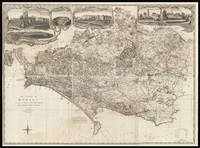
179514355<p>Charing Cross Road Large-scale engraved map on six sheets original hand-colour in outline. </p><p>Isaac Taylor was born in Worcester in 1730 and earned an early reputation as a surveyor of both county maps and city plans. His style was easily recognisable and gave particular emphasis to the hills on his county maps; Herefordshire 1754 Hampshire 1759 Dorset 1765 Worcestershire 1772 and Gloucestershire 1777. It is surprising that Taylor like Rocque and Jefferys was not successful in gaining the approval of the Society of Arts who appeared to favour the amateur surveyors rather than the professional mapmakers Nearly all the awards went to applicants who produced just one or two maps rather than men like Taylor and Jefferys who between them published fifteen fine large-scale map accurately surveyed and well engraved and in some instances more competent than most of those that were recognised by the Society.</p><p>On the first edition of 1765 the title and dedication cartouches took up most of the bottom left-hand sheet with the bottom right-hand corner containing an extensive key. Both have been removed by William Faden for this second edition with a more sober title and a rationalisation of the key together with the removal of the majority of the ships to the sea. Although the numerous engraved notes remain which refer to the stranding of many vessels and a long engraved note just off Weymouth refers to the "Chesil Bank where The Stones at Portland are about the size of an Egg opposite Fleet and Langston they are much smaller; at Beckingston they are scarcely bigger than Pease and between Swyre and Barton-cliffe where the Bank ends it is entirely a fine clear Sand" The legend goes on to remark about composition of the soil – a firm clay – beneath the pebbles. A large part of the top three sheets is occupied by six topographical views within the county – Corfe Castle Maiden Castle The Amphitheatre at Dorchester Lulworth Castle the Observatory at Horton and Sherborne Castle.</p><p>Taylor's map was acknowledged as an outstanding piece of work at the time and was the first map to be put forward for the prestigious Society of Arts Award just ahead of Donn's Devon. Despite tremendous efforts however to win the coveted prize it was unsuccessful due to the slight inaccuracy of its place names which proved unacceptable to some of the local gentry. Even so it is a paricularly rare map with the present copy in fantastic condition with full original colour.</p><p>Many of the errors which cost Taylor his prize such as place names were amended by William Faden on the present map who had acquired much of Taylor's stock following his death in 1788. The most notable addition is the maps highlighting of the numerous trunk roads together with the distance in miles marked between market towns.</p> hardcover
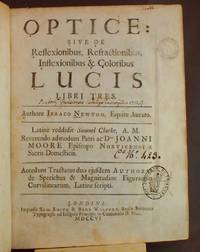
17066324London: Samuel Smith & Benjamin Walford 1706. First Latin edition. Very Good/The Latin edition of Newton's 1704 Opticks was intended for the broader pan-European "Republic of Letters" and it was the first printing to carry Newton's name on the title. This is the edition that inspired Emelie du Chatelet and Voltaire and through them the whole of Europe. It is a compendium of Newton's main discoveries concerning light and color including the spectrum of sunlight the color circle the reflecting telescope and interference effects that is the so-called 'Newton's rings'. In expansion of the 1704 English text the Latin edition presents seven added "Quaestiones" which are partly devoted to Newton's support for the "corpuscular" or particle theory of light. The collation of this copy corresponds to the copy in the Babson Collection catalogue with "Pp" consisting of a single leaf and with pages 21-24 repeated in the Tractatus. . Quarto 26 cm; 14 348 2 24 2 24 21-43 1 pages 19 folded leaves of engraved plates with errata corrigenda and addenda. Ss1 a cancel. In original calf with blind-ruled border rebacked with corners built up. Spine with gilding and leather title label. Speckled edges. Old library stamps on title page along with early ownership inscriptions. References: Bowes and Bowes #179; Babson Collection 137; Norman 1589. Samuel Smith & Benjamin Walford, hardcover books
1771180611Amsterdam: Marc Michel Rey 1771. The beginner of the modern age of economics First edition of "one of the great documents in the history of political economy" Encyclopaedia Judaica p. 533 arguing that an expanding system of national debt would lead to economic prosperity. Written in refutation of the physiocrats the treatise contended that public debt when managed responsibly could support commercial growth by increasing liquidity credit and monetary circulation. Britain Pinto argued showed the model for a high debt as a bedrock of economic success. Beyond this he defended credit and circulation as the basic form of economic endeavour against what he termed the physiocrats' "frenzy of the soil". Implicitly he was defending the Jews who had long been denigrated for their role in the financial sphere. One of the most prominent Jewish economic writers of the 18th century Pinto's importance has long been recognized. "Marx called him 'the Pindar of the Amsterdam stock exchange' for his advocacy of speculation. Werner Sombart regarded him as the beginner of the modern age of economics and the first to understand the growth of credit. Sée claimed he was the first to say that speculation was useful" Encyclopaedia Judaica. Provenance: Arnold Heertje 1934-2020 Dutch economist with his bookplate; "W. Fredsberg" with their ownership signature on the front free endpaper and initial blank versos dated 1821 and 1818 respectively and again to title all struck through in an early hand. Octavo 198 x 120 mm pp. xvi 128 8129-368 2; bound with the additional 8-page note on the state of English finances in 1770 interim half-sheet H and the terminal errata; without the 16-page "Addition" sometimes found. Contemporary marbled calf twin red and green morocco labels gilt in compartments marbled endpapers red edges. Binding firm and fresh with only a hint of rubbing; scattered very light foxing and browning to contents else clean: an excellent copy. Einaudi 4447; Goldsmiths' 10791; Higgs 5282; INED 3603; Kress 6811; Mattioli 2851; McCulloch p. 347; Quérard VII 183. Encyclopaedia Judaica Volume 13 1972. unknown
1730035995London: William Innys 1730. 4th Edition 1st Printing. Hardcover. Near Fine. New Calf Spine And Tips Over Marbled Paper Covered Boards New Endpapers. Two Preliminary Blanks Title Advertisements To First Second And Fourth Editions382 Pp 12 Folding Plates And Two Pages Of Publisher's Ads At Rear. Page Block 19.5 Cm Text Block 6.5" X 3 1/2" From Top To Bottom Of Printed Area Including Page Running Headings Tall. Top Edge Of Page Block Is Dark Grey Or Black Fore Edge And Bottom Edge Red All Polished. Leaves 7 5/8" Tall; Binding 7 3/4" X 5 3/16". The Last And Best Edition Prepared By Newton Corrected From The Third Edition By Newton; In This Fourth Edition Of 1730 There Are 31 Queries And It Is The Famous "31St Query" That Over The Next Two Hundred Years Stimulated A Great Deal Of Speculation And Development On Theories Of Chemical Affinity. The Publishers Have Added To This Edition Several Citations From The Lectiones Opticae 1669-1671 To Show Where Demonstrations Omitted From The Opticks May Be Found. Unusually Well Preserved Binding Fine Contents Clean Some Tiny Foxing Spots Mainly In Margins And Mainly Towards Beginning Of Book; Very Slight Wear To Edges Of Page Block. . <br/> <br/> William Innys hardcover
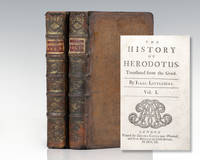
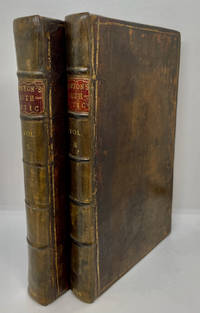
170996521London: Printed for Edward Castle and Sam Buckley 1709. First complete edition in English of Littlebury's translation of the histories of Herodotus also the first appearance in English since Thomas Marshe's 1584 incomplete translation of only the first two books. Octavo two volumes. Bound in full contemporary calf with gilt titles and tooling to the spine in six compartments within raised bands red morocco spine labels stamped ruling all edged speckled red woodcut ornaments to the title pages and colophon of volume II index. From the library of George Paterson of Castle Huntly with his armorial bookplates to the pastedowns. After amassing a large fortune with the East India Company Paterson purchased the famed Scottish Castle Huntly in 1770. In very good condition. Rare and with noted provenance. Herodotus is generally considered ‘the father of history’. Departing from the Homeric chronicle ‘he was the first to collect his materials systematically to test their accuracy as far as he could and arrange his story in such a way as to appeal to as well as inform his readers’ PMM. His main theme which is also the subject of the present work was the struggle between Persia and Greece. Printed for Edward Castle and Sam Buckley hardcover
170996521London: Printed for Edward Castle and Sam Buckley 1709. First complete edition in English of Littlebury's translation of the histories of Herodotus also the first appearance in English since Thomas Marshe's 1584 incomplete translation of only the first two books. Octavo two volumes. Bound in full contemporary calf with gilt titles and tooling to the spine in six compartments within raised bands red morocco spine labels stamped ruling all edged speckled red woodcut ornaments to the title pages and colophon of volume II index. From the library of George Paterson of Castle Huntly with his armorial bookplates to the pastedowns. After amassing a large fortune with the East India Company Paterson purchased the famed Scottish Castle Huntly in 1770. In very good condition. Rare and with noted provenance. Herodotus is generally considered 'the father of history'. Departing from the Homeric chronicle 'he was the first to collect his materials systematically to test their accuracy as far as he could and arrange his story in such a way as to appeal to as well as inform his readers' PMM. His main theme which is also the subject of the present work was the struggle between Persia and Greece. Printed for Edward Castle and Sam Buckley hardcover books
176519374Cambridge: J. Bentham 1765. FIRST EDITION. The first ten pages contain a list of subscribers mainly from Oxford and Cambridge and a corrigenda. With12 folding plates. Bound in old boards rebacked a clean and crisp copy uncut. First edition of this rather rare series of excerpts from Newton’s Principia. “Although there is no mention of it in the book itself the annotators were John Jebb M.D. Rector of Ovington Robert Thorp Archdeacon of Northumberland and Francis Wollaston Rector of Chislehurt†Babson.<br /> <br /> In addition to the myriad of books explaining the mathematics of Newton’s masterpiece published in the hundred years following the first edition the public clamored for copies and excerpts from the book itself. Jebb 1736-1786 was a medical doctor and a Fellow of the Royal Society. Thorp 1783-1862 succeeded his father as rector of Chillingham and in 1792 was created archdeacon of Northumberland. In addition to this work he published a translation of the Principia in English Mathematical principles of natural philosophy London 1777. Wollaston 1738-1826 a mathematician and son of the astronomer Francis Wollaston was a Fellow of the Royal Society.<br /> <br /> Babson 15; Wallis 20. J. Bentham unknown
17225823London: Benji & Sam. Tooke 1722. Second edition. <p>Second edition but the first authorised and edited by Newton probably with the assistance of John Machin of his treatise on algebra or 'universal arithmetic' his "most often read and republished mathematical work" Whiteside. "Included are 'Newton's identities' providing expressions for the sums of the ith powers of the roots of any polynomial equation for any integer i plus a rule providing an upper bound for the positive roots of a polynomial and a generalization to imaginary roots of René Descartes' Rule of Signs" Parkinson.</p>. NEWTON'S ALGEBRA - THE FIRST EDITION AUTHORISED AND EDITED BY NEWTON. <p>Second edition but the first authorised and edited by Newton probably with the assistance of John Machin - see below of his treatise on algebra or 'universal arithmetic' his "most often read and republished mathematical work" Whiteside Papers V p. xiv. "Included are 'Newton's identities' providing expressions for the sums of the ith powers of the roots of any polynomial equation for any integer i pp. 251-2 plus a rule providing an upper bound for the positive roots of a polynomial and a generalization to imaginary roots of René Descartes' Rule of Signs pp. 242-5" Parkinson p. 138. About this last rule for determining the number of imaginary roots of a polynomial which Newton offered without proof Gjertsen p. 35 notes: "Some idea of its originality . can be gathered from the fact that it was not until 1865 that the rule was derived in a rigorous manner by James Sylvester." The work is a printed version of lectures Newton prepared in the period 1672-83. Although the editor of the first edition William Whiston later claimed that he had Newton's permission to print the lectures Newton was far from satisfied with the result complaining that the titles and headings were not his and that it contained numerous mistakes. His real concern was that "an unfinished text composed so long before should now be presented to the world as though it represented his latest researches into the structure and applications of algebra" Papers V p. 11 and that Whiston had "too faithfully and impercipiently followed the parent manuscript incorporating in his princeps edition its several inconsistencies and lapses into error without in the main even bringing them to the reader's notice . In his private library copy of the edition Newton corrected many minor misprints inserted more appropriate running heads 'Multiplicatio' 'Divisio' 'Extractio Radicum' 'De Forma Aequationis' 'Reductio Aequationum' 'Resolutio Quaestionum Arithmeticarum Geometricarum' and the like and on the Arithmetica page 279 deleted an unwarranted half-title 'Aequationum Constructio linearis'; more radically he mapped out a large-scale reordering of the sixty-one geometrical problems comprising its central portion seeking to grade them into a more logical sequence and in increasing levels of difficulty while in the concluding section on the 'curvilinear ' construction of equations he pared away all not directly needed flesh reducing it to two skeletal conchoidal neuses now denuded of their proof. That last savage act of butchery apart all these improvements were incorporated in the Latin revise - future parent and rightfully so of all subsequent editions - which he himself brought to publication in 1722" ibid. pp. 13-14. Babson notes that "This edition was the last issued during Newton's lifetime and is almost as rare as the first." In commerce this edition is in fact much rarer than the first: ABPC/RBH list only two other copies of this edition since 1975 but ten of the first.</p> <br /> <p>"In fulfilment of his obligations as Lucasian Professor Newton first lectured on algebra in 1672 and seems to have continued until 1683. Although the manuscript of the lectures in Cambridge University Library carries marginal dates from October 1673 to 1683 it should not be assumed that the lectures were ever delivered. There are no contemporary accounts of them and apart from Cotes who made a transcript of them in 1702 they seem to have been totally ignored. Whiteside Papers V p. 5 believes that they were composed 'over a period of but a few months' during the winter of 1683-4" Gjertsen pp. 33-4.</p> <br /> <p>The Arithmetica "derives partly in its discussion of the elemental algebraic operations and of the reduction and exact solution of equations from Newton's earlier unpublished 'Observations' on the introduction to Cartesian algebra presented by Gerard Kinckhuysen in his 1661 Stelkonst partly in its techniques for delimiting the number and nature real or complex of the roots of equations and for reducing these by factorization from his own independent researches as a young postgraduate student into the theory of equations and partly in its approximate geometrical construction of cubics from his previously elaborated 'Problems for construing aequations'. Apart from novelties in detail and the fabrication of new illustrative 'questions' what is most notable is Newton's developing awareness - still far from completely expressed - of the fundamental structural equivalence which exists between the elements constants and free variables and their functional relationships of algebra and those given lines and undetermined line-lengths and their coordinate interconnections of geometry and his deepening grasp of the still more general isomorphism which permits a two-way 'translation' between mathematical 'speech' and the 'language' of exact science in all its manifestations. His guiding doctrine that algebra is 'universal arithmetick' embroiders a theme stated briefly in an opening phrase of his 1671 treatise on infinite series and fluxions and expounded in a geometrical context earlier still in preface to James Gregory's study of universal mathematical principles. Now also however he reaches tentatively forward to Barrow's notion that algebra is in its essence the abstract logic of relationships between quantities in divorce from their particular setting and hence to be developed as an independent metamathematical system" Papers V pp. 3-4.</p> <br /> <p>"We may reasonably conjecture that pressure was in some manner put upon Newton in late 1683 to fulfil however tardily his statutory obligation annually to deposit a fair copy of ten of his lecture scripts and be all but sure that the arrival in Cambridge the next spring of his young amanuensis Humphrey Newton able to take over from Isaac the dreary time-consuming chore of rewriting his much cancelled and corrected worksheets in legible and coherent form gave him new heart to codify and expand his previous mathematical investigations. But these surmises remain as unproved and essentially undemonstrable as the plausible suggestion that it was Edmond Halley's famous first visit to Cambridge in the late summer of 1684 to talk about the unsolved problem of elliptical planetary motion which provoked him abruptly to relinquish his restructuring of the Arithmetica. We may guess still more tenuously that the appearance in mid-1685 of John Wallis' voluminous Treatise of Algebra Both Historical and Practical would have long deterred Newton from making any efforts to have his own rival studies made publicly available. In later years certainly he grew increasingly soured with the often cumbersome computations and techniques of Cartesian algebra - at one point indeed if we may believe David Gregory he qualified it as 'the Analysis of the Bunglers in Mathematicks - and we may be certain that his reluctance during 1705-6 to have Whiston edit the deposited text of his algebraic lectures was not merely the manifestation of a growing personal antagonism to his successor in the Lucasian chair" ibid. pp. xi-xii.</p> <br /> <p>"When Newton resigned his Lucasian professorship to his deputy William Whiston in December 1701 it was natural that the latter should wish to familiarize himself with the deposited lectures of his predecessor. Whiston did not hesitate to introduce portions of Newton's earlier optical lectures concerning the mathematical theory of the rainbow into his own Lucasian Praelectiones physico-mathematica in the spring of 1706 and about that time also he turned his attention to the succeeding ones on algebra and began to consider their publication. In the meantime rumours began to spread in both Oxford and London that 'Newton's friends solicit him to publish a Treatise of Algebra which he wrote long since. If such ill-founded whispers penetrated to Cambridge Whiston ignored them and went quietly ahead arranging with the London stationer to underwrite the expense of printing the deposited manuscript and then subsequently between September 1705 and the following June correcting both specimen and proof sheets as they emerged from the compositor's bench at the University Press. In February 1706 David Gregory accurately noted in his memoranda that 'Its talked that there is now printing at Cambridge Elements or Principles of Algebra written long since by Sir Isaac Newton but withdrew his added remark that it was 'lately revised by him' when he saw Newton in London in July and was given a first-hand account of the history of the 'Algebra that is printing and near printed at Cambridge'. Though as Whiston was later to announce publicly Newton had given his reluctant approval for the edition . Despite its minor inconsistencies and confusions Gregory's report vividly conveys Newton's concern that an unfinished text composed so long before should now be presented to the world as though it represented his latest researches into the structure and applications of algebra" pp. 8-11.</p> <br /> <p>For a book that was to become Newton's most often republished mathematical work the Arithmetica initially made little impact in Britain and was not even graced by a review in the Philosophical Transactions. On the Continent the reception accorded the lectures was more positive. "Leibniz unhesitatingly divining their author beneath the cloak of anonymity gave them a long review in the Acta Eruditorum of Leipzig in 1708. Written thirty years before he noted and now deservingly printed by William Whiston he assured the reader that 'you will find in this little book certain particularities that you will seek in vain in great tomes on analysis.' His close associate Johann Bernoulli despite some adverse remarks paid Newton the compliment in 1728 of basing his own course on the elements of algebra upon Newton's text. Perhaps partly in consequence of Newton's recent death in Britain too the book began about this time to arouse greater interest than when it was first issued in 1707" Hall p. 174.</p> <br /> <p>Despite the impressive contributions of the work to the theory of equations mentioned earlier it is difficult to pigeonhole the work as being either algebraic or geometric. From one point of view the Arithmetica can be seen as a fulfillment of the programme outlined by Descartes in the Géométrie because it teaches how geometrical problems and also arithmetical and mechanical ones can be translated into the language of algebra. Paradoxically however Newton criticized Descartes maintaining that at least in some cases Apollonian geometry is to be preferred to Cartesian algebra in the analysis of indeterminate problems. Modern analysts he complained had confused algebra and geometry: "The Ancients so assiduously distinguished them one from the other that they never introduced arithmetical terms into geometry. recent people by confusing both have lost the simplicity in which all elegance in geometry consists" Papers V p. 429. The last section of the work 'The linear construction of equations' pp. 279-326 is particularly anti-Cartesian the term 'linear' in this context does not refer to straight lines but derives from Pappus. Newton here deals with the problem of constructing cubics third-degree equations that Descartes solved via the intersection of a circle and a parabola. Newton proposed instead to use a curve of degree higher than the conics as a means of construction namely the conchoid a fourth-degree curve. Newton regarded the conchoid as preferable because it has a mechanical construction and leads to a more elegant solution of the problem.</p> <br /> <p>The present 1722 revision is "the standard text of the Arithmetica published much as before 'Impensis Benj. & Sam. Tooke'. It appeared to Newton's first editor that 'that acute Mathematician Mr. John Machin Professor of Astronomy at Gresham College . and one of the Secretaries of the Royal Society published this Work again by the Author's later Desire or Permission; I lay no claim to it' Whiston Memoirs; John Conduitt's memorandum King's College Cambridge. Keynes MS 130.5 again adds the clarification that 'Machin overlooked the press for which Sir I intended to have given him 100 Guineas but he made him wait 3 years for a preface & then did not write one'. Elsewhere Keynes MS 130.6 2 Conduitt noted that 'Sir I. told me that Machin understood his Principia better than anybody that Halley was the best Astronomer but Machin the best Geometer'. Newton's active stage-managing of the 1722 revise can be documented in several ways: most notably a stray autograph sentence on an otherwise clean folio page now ULC. Add. 3960.7: 95 differs by only a single trivial adverb from an inserted footnote clarifying the reference to the unimplemented 'Regulae post docendae' on page 52 of the deposited copy. The ubiquitous presence of its author's editorial hand was not missed by W. J. 's Gravesande when he came to reissue the Arithmetica ten years later: 'Secunda vice liber in lucem prodiit Londini 1722; sed in statu perfectiore ut quis facile percipiat non omnino foetum abdicasse virum Celeberrimum; ordo propositionum non tantum mutatus est sed in ipsis solutionibus & demonstrationibus correctiones multae reperiuntur non nisi ipsi Auctori tribuendae'" ibid. p. 14 n 60.</p> <br /> <p>"Benjamin Tooke the London publisher and printer he was Queen's printer had eight books published at the Cambridge Press all of them by Whiston between 1702 and 1712. There are two London printer's ornaments used in this volume pp. 283 & 289 and nowhere else but we know that the woodcuts for the illustrations in the 1707 edition were delivered to Cambridge possibly from London 6d. was paid for the parcel. So far as one can tell the woodcuts are identical and we must assume they had been reclaimed by Tooke. Unfortunately we have no letters from Newton about the printing history of this volume" Macclesfield sale catalogue.</p> <br /> <p>Babson 200; Macclesfield 1520; Wallis 278. Gjertsen Newton Handbook 1986. Hall Isaac Newton 1992. Westfall Never at Rest 1983.</p> <br/> <br/> 8vo pp. iv 332 including half-title with list of books on verso woodcut diagrams throughout ink name of Newton on half-title ink inscription identifying Newton as author and another Whiston as editor on title slightly browned. Contemporary panelled calf ink signature of former owner Robert Andrews on front free endpaper corners and edges rubbed joints splitting spine rubbed. Benji & Sam. Tooke unknown
17693016<p>1769. Hardcover. Very Good/No Dust Jacket. Printed for W. Johnston; London 1769; translated by Mr. Ralphson and Revised and Corrected by Mr. Cunn; to which is added a Treatise upon the Measures of Ratios by James Maguire the whole Illustrated and Explained in a series of Notes by the Rev. Theak</p> hardcover
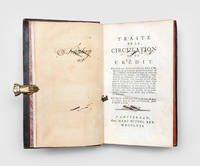
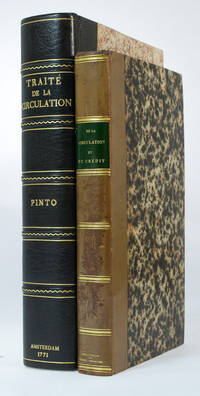
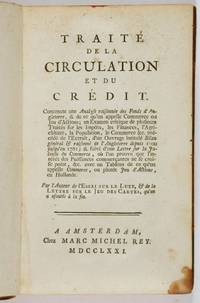
177166800The Very Scarce First Edition of "TraitÈ de la Circulation et du CrÈdit" PINTO Isaac De. TraitÈ de la Circulation et du CrÈdit. Contenant une Analyse raisonnÈe des Fonds d'Angleterre & de ce qu'on appelle Commerce ou Jeu d'Actions; un Examen critique de plusieurs TraitÈs sur les ImpÙts les Finances l'Agriculture la Population le Commerce &c. PrÈcÈdÈ de l'Extrait d'un Ouvrage initulÈ Bilan sur la Jalousie du Commerce o˘ l'on prouve que l'intÈrÃt des Puissances commerÃantes ne se croise point &c. avec un Tableau de ce qu'on appelle Commerce ou plutÙt Je d'Actions en Hollande. Par l'auteur de l'Essai sur le Luxe & de la Lettre sur le Jeu des Cartes qu'on a ajoutÈs ‡ la fin. Amsterdam: Chez Marc Michel Rey 1771. The very scarce first edition. xvi 368 with additional 8 pp. sheet H inserted before gathering I: entitled Etat des Finances en Angleterre a la fin de la session du Parlement en 1770. Nineteenth-century half calf over marbled boards spine ruled in gilt with green label and gilt lettering: at foot of spine in gilt lettering 'BibliothËque de Michel Chevalier' spine head slightly frayed. Occasional spotting and staining but a very good copy and with the bookplate of Michel Chevalier 1806-1879 follower of Saint-Simon author of the Cours d'…conomie Politique and co-architect of the Anglo-French 'Cobden-Chevalier' commercial treaty of 1860. Housed in a quarter brown morocco clamshell. "Economique. Sur le commerce l'agriculture les finances; passages pp. 70-72 sur la populatin anglaise; pp. 183-196 et 216-335 sur la population en France et en Angleterre. En particulier nÈcessitÈ d'augmenter Ègalement la population dans les villes et danse les campagnes pout Èviter les dÈsÈquilibres sociaux et Èconomiques. Analyse de plusieurs ouvrages dont un livre qualifiÈ de rare: 'Le dÈtail de la France' part Boisguilbert" INED. Pinto admired the Physiocrats but disagreed with them. "Pinto's TraitÈ is written from a national as well as an international perspective. Pinto's experience as a merchant and financier in the Republic along with his knowledge of French and English economic thought laid the foundations for his European economic model. Pinto wanted above all to convince his readers of hte soundness of the British system of public debt. With the adoption of improvements in the redemption policy proposed in his book the system would achieve a high degree of perfection. In France the physiocratic opinions of the elder Mirabeau in particular required Pinto to respond and in England the otherwise admiring Hume was in disagreement. By means of a critical discussion of the work of these and other authors Pinto propagated a financial policy that he thought would benefit both the State and the individual" I.J.A. Nijenhuis Een Joodse Philosophe. Isaac de Pinto 1717-1787 Amsterdam NEHA 1992. Goldsmiths' 10791. Higgs 5282. Kress 6811. Palgrave III pp. 109-110. HBS 66800. $8500 Chez Marc Michel Rey hardcover books
177166800Amsterdam: Chez Marc Michel Rey 1771. The very scarce first edition. xvi 368 with additional 8 pp. sheet H inserted before gathering I: entitled Etat des Finances en Angleterre a la fin de la session du Parlement en 1770.<br> <br> Nineteenth-century half calf over marbled boards spine ruled in gilt with green label and gilt lettering: at foot of spine in gilt lettering 'Bibliothèque de Michel Chevalier' spine head slightly frayed. Occasional spotting and staining but a very good copy and with the bookplate of Michel Chevalier 1806-1879 follower of Saint-Simon author of the Cours d'Économie Politique and co-architect of the Anglo-French 'Cobden-Chevalier' commercial treaty of 1860. Housed in a quarter brown morocco clamshell.<br> <br> "Economique. Sur le commerce l'agriculture les finances; passages pp. 70-72 sur la populatin anglaise; pp. 183-196 et 216-335 sur la population en France et en Angleterre. En particulier nécessité d'augmenter également la population dans les villes et danse les campagnes pout éviter les déséquilibres sociaux et économiques. Analyse de plusieurs ouvrages dont un livre qualifié de rare: 'Le détail de la France' part Boisguilbert" INED. Pinto admired the Physiocrats but disagreed with them. "Pinto's Traité is written from a national as well as an international perspective. Pinto's experience as a merchant and financier in the Republic along with his knowledge of French and English economic thought laid the foundations for his European economic model. Pinto wanted above all to convince his readers of hte soundness of the British system of public debt. With the adoption of improvements in the redemption policy proposed in his book the system would achieve a high degree of perfection. In France the physiocratic opinions of the elder Mirabeau in particular required Pinto to respond and in England the otherwise admiring Hume was in disagreement. By means of a critical discussion of the work of these and other authors Pinto propagated a financial policy that he thought would benefit both the State and the individual" I.J.A. Nijenhuis Een Joodse Philosophe. Isaac de Pinto 1717-1787 Amsterdam NEHA 1992.<br> <br> Goldsmiths' 10791. Higgs 5282. Kress 6811. Palgrave III pp. 109-110.<br> <br> HBS 66800.<br> <br> $8500. Chez Marc Michel Rey unknown
17521862Spain 1752. 18th-century manuscript. Text in Spanish. 24 handwritten pages in ink in three different hands. Later binding of blank paper using old material. Tiny wormholes at the lower edge of the pages on the first 7 leaves not affecting the legibility. Occasional foxing ink ghosting. Water stains on the last 2 leaves. Overall in fine condition. 18th-century manuscript. Text in Spanish. 24 handwritten pages in ink in three different hands. ff 12. <p><br /> 18th-Century Spanish manuscript about the Spanish involvement in the French Geodesic Mission of 1735 and the Ellipsoid Model of the Earth.<br /> <p><p><br /> The manuscript is an interesting collection of contemporary reports proving the importance of the Spanish role performed by Jorge Juan y Santacilia and Antonio de Ulloa in the so-called French Geodesic Mission 1735 with a particular focus on the polemic over the shape of the Earth. The quotations are conjugated with connecting texts by an anonymous author.<br /> <p><p><br /> One of the important scientific disputes of the late 17th early 18th century was the debate on the shape of the Earth. The assumption of the spherical shape was dominating until the late 17th century when Sir Isaac Newton determined that the Earth was oblate a spheroid stretched over the Equator however at the same time Giovanni Domenico Cassini and his son Jacques supposed that the Earth was prolate stretched along the poles. Eventually in 1735 two expeditions were sent by Louis XV and the French Academy to the Arctic Circle Lapland and to the Equator Ecuador and Peru to gain certainty by measuring the meridian arcs at polar and equatorial latitudes. The equatorial mission was accompanied by two Spanish geographers Jorge Juan y Santacilia and Antonio de Ulloa thus it became the first major international scientific expedition. The findings of the missions confirmed Newton’s hypothesis that the Earth was oblate a rotational ellipsoid.<br /> <p><p><br /> The first part of the manuscript is a lengthy citation of an early Spanish report on the equatorial mission published in the Mercurio histórico y político February 1745; pp. 99–107 which is followed by further references and quotations related to the geographer’s their work and the figure of the Earth such as Benito Jerónimo Feijóo y Montenegro’s Theatro critico universal 1751 Bernardo’s de Ulloa’s Antonio’s father Restablecimento de las fabricas y comercio español 1749 and articles from the Journal de Trévoux or the Gaceta de Zaragoza. The second part is Diego de Torres Villarroel’s 1693–1770 study Prevenciones in: Libros en que estan reatados. Vol. IV.; 1752 in which de Torres the almanac writer and professor of mathematics of a dubious repute opposes the findings of the missions and Newton’s hypothesis of the oblate Earth.<br /> <p><p><br /> Antonio de Ulloa 1716–1795 was a Spanish scientist and explorer the first Spanish governor of Louisiana who is also credited as the discoverer of the element platinum. De Ulloa was a Fellow of the Royal Society and a foreign member of the Royal Swedish Academy of Sciences. His associate Spanish scientist in the Geodesic Mission to Peru was Jorge Juan y Santacilia 1713–1773 who during the mission also measured the heights of the mountains of the Andes. Jorge Juan was the founder of the Real Observatorio de Madrid Royal Observatory of Madrid and he became a Fellow of the Royal Society too. Their co-written memoirs were published in Spanish from 1748 on and their books were very soon translated into French English and German.<br /> <p><p><br /> Literature: Lafuente A.; Mazuecos A.: Gentlemen of the Fixed Point: Science Politics and Adventure in the Geodesic Expedition to the Viceroyalty of Peru in the XVIII Century. pp. 171–203. Retrieved on July 8 2020 from Mayboudi L. S.: chapter 5.1 In: Geometry Creation and Import With COMSOL Multiphysics. Dulles VA USA: Mercury Learning & Information 2019.; Richardson D.; et al: The International Encyclopedia of Geography People the Earth Environment and Technology: Chichester UK; Hoboken NJ: John Wiley & Sons 2017.<br /> <p>. unknown
17296375London: William Innys for the Royal Society 1729. First edition. <p>First edition in the original Latin of Newton's Cambridge lectures on optics-his earliest systematic exposition of the mathematical theory of light and colour delivered as Lucasian Professor and published here for the first time from his manuscripts. These lectures form the foundation of Newton's later Opticks 1704 but include substantial mathematical content omitted from that more accessible English version. Notably they contain Newton's formulation of the compound nature of white light a cornerstone of modern optical theory.</p>. <p>EDITIO PRINCEPS OF NEWTON'S CAMBRIDGE LECTURES ON OPTICS</p> . <p>First edition of the complete text in the original Latin of Newton's inaugural lectures as the second Lucasian professor of mathematics at Cambridge and the first publication of his lectures on his new mathematical science of colour including his discovery of the compound nature of white light. It was from this material that Newton composed his Opticks of 1704 although in the Opticks he left out the specifically mathematical parts of the lectures which are included here. Newton "was obliged by the statutes of the post to lecture and to deposit the lectures in the University Library. For the period 1670-72 Newton lectured on optics and deposited the lectures in the ULC in October 1674. At one time Newton seemed to be contemplating publishing the lectures together with the mathematical work De methodis but by May 1672 he had decided otherwise and wrote to Collins: 'I have now determined otherwise of them; finding already by the little use I have made of the Presse that I shall not enjoy my former serene liberty till I have done with it' Correspondence I p 161. Consequently . the lectures remained unpublished until after his death as did the De methodis" Gjertsen pp. 409-410. Following Newton's death in March 1727 his followers decided to publish the lectures both in the original Latin and in English. In fact only Part I on the mathematical theory of reflection and refraction was translated and published in English in 1728; part II on colours was omitted. The present Latin edition which includes both parts is thus the editio princeps of the complete series of Newton's lectures including the first publication of his lectures on colours. Based on a copy belonging to David Gregory it was discovered during the printing that there were discrepancies between Gregory's copy and the copy deposited by Newton in the ULC which necessitated the inclusion of a five-page 'Addenda and Corrigenda'. "Today we can appreciate the Lectiones as an invaluable document of Newton's investigations of optics that reveals his ideas in the midst of his most productive period of research. In the inevitable comparison with the Opticks 1704 which recounts research for the most part carried out twenty to thirty years earlier and since refined - sometimes overrefined - the lectures must be judged neither as carefully developed nor as polished. But whatever polish it may lack is more than compensated for by its vitality as Newton boldly attempts in the following pages to create a new mathematical science of color" Shapiro p. 25. Since the Lectiones "was his first and most comprehensive account of his theory of color he naturally drew upon it in his later writings. It served as the immediate source for his 'New theory of light and colors' 1672 in the Philosophical Transactions his first public statement of his theory outside the Cambridge lecture halls. And twenty years later it remained the foundation for the 'definitive' statement of his theory in Book I of the Opticks" ibid. p. 1. This was the only separate edition of Newton's complete lectures: the text was published six more times in the eighteenth century in various collections of Newton's works.</p> <br /> <p>Provenance: 'Ex-libris Dutour' on front free endpaper followed by a price; some marginal notes in Latin.</p> <br /> <p>"Upon his appointment as Isaac Barrow's successor to the Lucasian chair in the late autumn of 1669 Newton was confronted with developing a series of lectures to begin the following January. In a natural extension to Barrow's prior series of optical lectures published as Lectiones XVIII 1669 he took the opportunity to make the first formal presentation of his new mathematical science of color. The Lucasian Professor was required to give one lecture for about one hour each week during the term and to submit annually not fewer than ten of those lectures to the Vice-Chancellor for deposit in the University Library for public use. Newton complied with this regulation somewhat tardily in October 1674 when he delivered to the Vice-Chancellor his Optica divided into two parts with a total of thirty-one lectures. According to the marginal annotations the first lecture of Part I was delivered in January 1670 at the beginning of Lent term and Lecture 9 of Part I and Lectures 4 and 14 of Part II opened the Michaelmas terms beginning in October of 1670 1671 and 1672" Shapiro p. 16.</p> <br /> <p>As noted above by the winter of 1671-2 Newton had decided to publish the Optica together with his mathematical treatise De methodis serierum et fluxionum the latter was not actually published until 1736. However following the publication of his 'New theory of light and colours' in the Philosophical Transactions a few months later Newton changed his mind: his 'New theory' had resulted in controversy which he was loathe to encourage by further publications. "In September 1672 Newton had decided to recast his theory in a more formal structure 'in imitation of the Method by wch Mathematicians are wont to prove their doctrines.' The next year in outlining his restructured theory for Christiaan Huygens he recognized that it needed a more rigorous proof . Instead Newton was planning a work very much like the later Opticks . In this newly projected work the sections of the Optica on color were to be extensively rewritten and its mathematical part omitted. There is no evidence that Newton wrote such a discourse during this period but when in the early 1690s he eventually composed the Opticks he in essence followed the plan he had proposed in the mid-1670s . When after still another postponement the Opticks was finally published in 1704 Newton felt it necessary to warn that 'If any other Papers writ on this Subject are got out of my Hands they are imperfect and were perhaps written before I had tried all the Experiments here set down and fully satisfied my self about the Laws of Refractions and Composition of Colours I have here Published what I think proper to come abroad.' He is here inter alia surely referring to his Optica deposited thirty years earlier in the Cambridge University Library . During his lifetime Newton's disavowal was respected by eager members of the Newtonian circle but an English translation of Part I appeared in 1728 the year after his death followed in the next year by the editio princeps of the complete Latin text of the Optica . The editor of the Latin edition emphasized the significance of the geometrical demonstrations and philosophical arguments in Part I because in the Opticks Newton 'seems to have been as careful as possible not to mix geometrical demonstrations with philosophical arguments and when it was necessary to set forth a mathematical proposition its demonstration scarcely ever occurs' . He also perceptively recognized that with respect to color 'many things are found in each with the same meaning but are explained in a different manner'" ibid. pp. 21-23.</p> <br /> <p>"After briefly paying tribute to Barrow and deriding efforts to improve refracting telescopes by the use of nonspherical lenses Newton devotes the first two lectures of Part I to laying the foundations for the whole of the Lectures: a demonstration that direct sunlight consists of rays that differ in their degree of refrangibility. Virtually the entire burden of his demonstration is borne by an analysis of the elongated spectrum formed by passing a narrow beam of sunlight through a prism. Newton's major insight and the key to his demonstration was to recognize that when a prism is placed symmetrically with respect to the incident and emergent beams or at minimum deviation the sun's image would be circular rather than elongated if all rays were refracted equally. An exact solution for the shape of the sun's image with monochromatic rays is exceedingly difficult involving a finite source and aperture and rays incident out of the principal plane; but he is able to demonstrate that under particular conditions such as with a point aperture the image is nearly circular. This was sufficient for his purpose for he had found the spectrum's length to be five times its breadth thus making small deviations from the assumed condition inconsequential.</p> <br /> <p>"Newton begins Lecture 2 by describing the shape of the spectrum to be an oblong bounded by straight edges and semicircular ends and he argues formed by innumerable overlapping circular images of the sun each consisting of rays of a different refrangibility . The thrust of the remainder of the lecture describes how to decrease the effective size of the source and thus the circular images and to approach the ideal spectrum - a straight line with no breadth - formed by a point source. By this mode of demonstration culminating in the observation of Venus's spectrum he makes the actually observed shape of the sun's spectrum inessential to his proof that its elongation is caused by unequal refrangibility ibid. pp. 26-27.</p> <br /> <p>"Newton begins his 'dissertation on the measure of refractions' which constitutes the next three lectures with an explanation of Descartes's sine law of refraction which he extends - without experimental demonstration - to rays of each color . Next in two lemmas he derives the equations for his preferred method to measure the index of refraction that of minimum deviation in prisms one of his most important contributions to quantitative experimental optics . Newton opens Lecture 10 by extending the method of minimum deviation to fluids with the use of a hollow prism with glass sides and he illustrates this method by a measurement of the mean index of refraction of water . He then advances to the next phase of his investigation of refraction: to determine the indices of refraction of the extreme rays or the chromatic dispersion . When the prism is placed at minimum deviation for the mean refrangible rays he measure the length of the spectrum and thereby determines the angular dispersion. He presents a simple measurement and calculation for the dispersion of glass .</p> <br /> <p>"Newton concludes his 'dissertation on the measures of refraction' in Lecture 11 by setting forth a dispersion law which serves as the foundation for the rest of the Lectures. He freely admits that it is a purely theoretical construct that he has not yet experimentally tested. Though he presents his dispersion law solely in mathematical terms without any mechanical interpretation it is evidently a modification of Descartes's projectile model for a single sort of ray extended to apply to polychromatic rays. It represents the very ideal of a rational optics for the indices of refraction of rays of every color in any medium can be determined with only a single measurement as Newton illustrates with water .</p> <br /> <p>"In Lectures 12 and 13 on refraction at a single plane surface Newton attempts to uncover the physical implications of the laws of refraction the sine law and his dispersion law by a thorough mathematical analysis. Since that dispersion law was so tenuously founded and is the starting point for much of his analysis these lectures are now as notable for their mathematical analyses as for their contributions to optics.</p> <br /> <p>"Lecture 12 is . devoted to the single problem in Proposition 3 of determining the position of a luminous point viewed obliquely across a plane reflecting surface. Newton's recognition here that there are two image points effectively begins the study of astigmatism . Lecture 13 . studies a natural extension of Proposition 3: to determine the shape of the extended image of a point source due to the varying index of refraction when the point is viewed across a plane surface. He elegantly demonstrates that the images of the point lie on a Dioclean cissoid .</p> <br /> <p>"In the next two pairs of Lectures 14 15 and 16 17 Newton continues his attempt to create a rational science of color by investigating the variation of angular dispersion as the index of refractions and hence the chromatic dispersion of the refracting media vary . The brief Lecture 18 treats refraction in prisms .</p> <br /> <p>"Section 4 on refraction at curved surfaces the conclusion of the mathematical part of the Optica is its highpoint an intimate blend of mathematics and physics consistently yielding novel interesting results . He effectively begins this section in Proposition 29 by determining the image point in a form equivalent to the Gaussian formula for paraxial rays incident upon a single spherical surface; and then in Proposition 30 he extends this result to any curved surface by substituting the center of curvature determined in Lemma 9 in the immediate neighborhood of the incident rays for the center of the spherical surface. In Proposition 31 Newton applies many of the newly wrought mathematical methods such as series expansions and the determination of extrema to find the longitudinal spherical aberration for rays incident on the plane face of a plano-convex lens and then the circle of least confusion. Because of its algebraic formulation this proposition is particularly accessible to the modern reader and provides a fine example of Newton's application of mathematics to physics. In the next proposition he elegantly derives the location of the primary image point or caustic locus for rays obliquely incident upon a spherical surface while also noting the existence and location of the secondary image point. Proposition 33 extends this result to any curved refracting surface. In Proposition 34 he presents his own solution to a problem posed and solved by Descartes: to find the aplanatic surface a Cartesian oval that refracts rays perfectly from a given point to a given point. Pursuing the Cartesian theme in Propositions 35 and 36 he derives the radii of the primary and secondary rainbows and then moving beyond all his contemporaries he generalizes his solution to bows of any order. And to conclude Newton in Proposition 37 calculates the chromatic aberration to show that it is much more enormous - some 1500 times greater - than spherical aberration and once again stresses the significance of his discovery of unequal refrangibility for practical optics" ibid. pp. 36-41.</p> <br /> <p>In Part II Newton begins the 'dissertation on colors' by reiterating his inaugural remarks on the defects of contemporary telescopes and the impediment presented by chromatic aberration and in prelude to his own theory he vigorously attacks both Aristotelian and more recent modification theories of colour. He then presents his theory in five propositions. The first proposition that to differently refrangible rays there correspond different colors had already been established in Part I. Its converse states that different colors are unequally refracted. "To demonstrate this he introduces his crossed-prism experiments where spectra cast on a second transverse prism become inclined to their original orientation because the blue end is always refracted more than the red. Initially he places the second prism transverse to the first one to minimize the unequal incidence arising from the refraction of the first prism; but by passing the refracted rays through two holes far apart so that they fall on the second prism at very nearly the same angle of incidence he eliminated the requirement for any particular orientation of the second prism and arrives at an experimental arrangement virtually identical to the experimentum crucis of the 'New theory' .</p> <br /> <p>"Proposition 2 on the immutability of monochromatic colors is established by first separating the spectral colors from one another and then demonstrating that the more completely they are separated the smaller are their changes after additional refractions. He first separates the colors with two parallel prisms and observes some color change because the adjacent colors are still intermingled but when he adds two more prisms he is unable to detect any further sensible change .</p> <br /> <p>"In Lectures 4-7 Newton carries out the first part of his demonstration of Proposition 3 that white light in particular sunlight is composed of rays of every color by showing five different ways to make white from a mixture of spectral colors: i colors from three prisms are cast onto a screen where they are mixed; ii one face of a prism is covered with an opaque paper with six slits each functioning as one of the prisms in the preceding experiment and then the colors from the various slits mix on a screen; iii light scattered from a screen on which a spectrum has been projected is received on a second screen where the scattered rays mix; iv the colors dispersed by a prism are transmitted through a lens and brought together at its focus; v in a variant of the preceding way a mirror is substituted for the lens. He also illustrates the compound nature of white by a mixture of colored powders and by a froth of soap bubbles .</p> <br /> <p>"Newton now applies himself to the second and more difficult part of his demonstration of Proposition 3 namely to show that the sun's direct light is compounded of colors even before they are apparent. He bases his demonstration on the phenomenon of total reflection for as he discovered the critical angle of reflection varies for each color. In the first and simplest experiment a beam of sunlight is partially reflected and partially refracted at the base of a prism. As the prism is rotated the colors are totally reflected in sequence and the reflected and transmitted beams change color until when the red rays are at last totally reflected and the transmitted beam vanishes the reflective beam is restored to white. Newton argues implicitly appealing to the emission theory of light that this reveals that the colors are in the rays as they arrive from the sun since they preserve and exhibit the same color whether they are reflected refracted. Furthermore this shows that reflected light is compound since white is restored when the last color red is totally reflected. To make this interpretation still more certain he introduces three variants of this basic experiment one of which is an exact analog of the experimentum crucis but with total reflection replacing the second refraction . Newton concludes the proof of Proposition 3 by briefly explaining why the sun's light is yellowish rather than white and then by showing that black is compounded from all colors grey from white and black and all other compound colors from the painter's primaries red yellow and blue. Despite the need for some restrictions and the brevity of its demonstration Proposition 4 that spectral colors can be compounded from their neighbouring colors is an important contribution to the theory of compound colors and displays Newton's keen experimental skill.</p> <br /> <p>"Newton now turns to his fifth and final proposition that natural bodies derive their color from the sort of rays they reflect most. By the principle of color immutability the color of a ray cannot be changed my reflection so that bodies can appear only the color of the rays illuminating them. To explain why all bodies are not therefore the same color in daylight as this principle alone would demand he adds that bodies reflect more of their own daylight color than others. After demonstrating this by illuminating various bodies with monochromatic light he moves beyond this phenomenological account and attributes two distinct powers to bodies: to reflect rays and to transmit them. These rays are complementary for the rays that are not reflected pass through the body and he illustrates this with the colors of such substances as gold leaf which reflects yellow light and transmits blue. Newton did recognize that most bodies are not of this sort but are the same color all around and to explain this he introduces a third power - and a new concept in optics - selective absorption .</p> <br /> <p>"In the concluding section of the Optica Newton considers the colors generated by refractions at curved surfaces namely lenses the eye and raindrops or the rainbow. He first describes the chromatic aberration of a plano-convex lens and gives a simple physical derivation and numerical estimate of its magnitude. Observing that the eye is a lens of sorts which should likewise suffer from chromatic aberration he presents a simple experimental demonstration of its existence. In the last article of Lecture 14 and in all of Lecture 15 Newton indulges in the sort of speculative or hypothetical natural philosophy that he frequently and vigorously decried yet could not always resist. Exhibiting a firm command of Cartesian natural philosophy he explains the cause of the colored circles or coronas that Descartes saw around a candle after he had pressed his eye shut for a long time. While Newton recognizes that an infinity of causes may be devised to explain these colored circles he ascribes them to refractions in wrinkles impressed on the cornea and invoking the principles of hydrostatics rejects Descartes's own suggestion that they are impressed on the crystalline lens. He concludes the Optica in Lecture 16 with a far more notable achievement an explanation of the dimensions and colors of the rainbow based on the mathematical results derived in Part I" ibid. pp. 28-36.</p> <br /> <p>Babson 155; Wallis 191; ESTC t18664. Gjertsen The Newton Handbook 1986. Shapiro ed. The Optical Papers of Isaac Newton Vol. 1 The Optical Lectures 1670-1672 1984.</p> <br/> <br/> 4to 221 x 165 mm pp xii 144 145-152 153-291 5 Addenda and corrigenda with 24 folding engraved plates some spotting scattered foxing. Contemporary marbled sheep spine gilt in compartments red morocco spine label marbled endpapers red edges a little rubbed minor abrasion to upper board. William Innys for the Royal Society unknown
177153117Amsterdam: Marc Michel Rey 1771. First Edition. Very Good. Octavo. xvi 128 8: "Etat des Finances en Angleterre" 129-384 2: errata; blankpp. Woodcut ornaments; 4 half-titles. Collation: 8 A-H8 H4 I-Z8 Aa8 chi1 = 205 leaves. Contemporary marbled calf lightly rubbed at extremities gilt-tooled spine with raised bands gilt morocco lettering piece; edges stained red; marbled endleaves. Small patch of marginal damp staining to bottom corner of first 15 and final 10 leaves; signature Aa mildly embrowned else text crisp and clean throughout. Overall a very good copy.<br /> <br /> Rare complete first edition of "one of the great documents in the history of political economy" EJ. In addition to the brief discursus on English finances inserted between the second and third parts of the main treatise our copy includes the usually missing supplement pp. 369-384 "Addition au Traité de la Circulation et du Crédit. Mémoire pour la suppression du Belasting" along with the concluding errata leaf.<br /> <br /> The present Treatise is a refutation of the physiocrats who had advocated a primarily agricultural economy. Arguing against Hume de Pinto seeks to defend the economically productive role of the national debt which he sees exemplified in the current British system. While Marx notoriously described de Pinto as "the Pindar of the Amsterdam stock exchange" for his advocacy of speculation Werner Sombart regarded him as the "beginner of the modern age of economics and the first to understand the growth of credit" EJ. De Pinto's other works include Essai sur le luxe and Du jeu de cartes both reprinted in the present work and the later Precis de arguments contre les matérialistes The Hague 1774.<br /> <br /> The main treatise is divided into four parts followed by six brief works: 1. Lettre sur la jalousie du commerce Letter on the Jealousy of Commerce; 2. Tableau ou Exposé de ce qu'on appelle le Commerce ou plutôt le Jeu d'Actions en Hollande A Presentation of What is Called Commerce or the Game of Actions in Holland; 3. Methode dont on se sert en Hollande pour faire la perceptions des taxes & des impôts sur les biens fonds; & comment on en verse le provenu dans la Caisse de l'Etat The Method Used in Holland to Collect Duties and Real Estate Taxes and How the Proceeds Are Payed into the State Treasury; 4. Essai sur le luxe An Essay on Luxury first printed at Amsterdam 1762; 5. Lettre de l'autheur à Mr. D. sur le jeu des cartes The Author's Letter to Mr. Diderot on Card Playing first printed at London 1768; 6. Mémoire pour la suppression du Belasting ou Impôt sur les Actions de Compagnie des Indes Orientales A Memorandum for the Suppression of the "Belasting" or Tax on the East India Company Shares. The final opuscule which appears in relatively few copies of the Traité is published here for the first time.<br /> <br /> Isaac de Pinto 1717-1787 was the scion of a wealthy Sephardic family which traced their origins back to Portugal and had emigrated to the Dutch Republic. "He had a broad education and had mastered many languages in which he corresponded with famous philosophers and maintained contact with the European elite of his day including the court of the Dutch stadholder. In 1748 he helped to finance Stadholder William IV's war against France" Bernfeld & Wallet. "For his services in arranging favorable terms for English trade in India at the Treaty of Paris which ended the Seven Years' War 1756-63 Pinto was lavishly rewarded by the East India Company a few years later 1767" EJ. His correspondents included David Hume and Denis Diderot. De Pinto made a name for himself when he responded to Voltaire's mocking article on the Jews which appeared in the latter's Dictionnaire Philosophique with his Apologie pour la nation juive Amsterdam 1762. Presenting himself as a proud Portuguese he argued that "Voltaire had neglected to draw a distinction between the often wealthy Sephardim with their refined manners and the Ashkenazim whom he regarded as far poorer and sometimes unprincipled as a result of persecution and economic misery" Bernfeld & Wallet. Barbier 4: 752; T. L. Bernfeld & B. Wallet Jews in the Netherlands: A Short History Amsterdam Univ. Press 2023 p. 89; Enc. Jud. 13: 553-554; Goldsmiths' 10792; Kress 6812.<br /> <br /> Full title and Imprint: Traité de la Circulation et du Crédit. Contenant une Analyse raisonnée des Fonds d'Angleterre & de ce qu'on appelle Commerce ou Jeu d'Actions ; un Examen critique de plusieurs Traités sur les Impôts les Finances l'Agriculture la Population le Commerce &c. précédé de l'Extrait d'un Ouvrage intitulé Bilan général & raisonné de l'Angleterre depuis 1600 jusqu'en 1761 ; & Suivi d'une Lettre sur la Jalousie du Commerce où l'on prouve que l'intérêt des Puissances commerçantes ne se croise point &c. avec un Tableau de ce qu'on appelle Commerce ou plutôt Jeu d'Actions en Hollande. Par l'auteur de l'Essai sur le Luxe & de la Lettre sur le Jeu des Cartes qu'on a ajoutés à la fin. A Amsterdam chez Marc Michel Rey. MDCCLXXI. Marc Michel Rey unknown
175646122London.: Printed for T. Osborne and J. Shipton . &c. 1756. Contemporary mottled calf. 2 vols. Folio. 412 x 258 mm. Engraved frontispiece printed title in red and black with engraved vignette preface list of plates contents and Ware's text in ten books illustrated with 114 engraved plates 14 folding with irregular numbering in first state with the numbers within the platemark and plate 70 / 71 titled 'Warwick Shire' final eaves with index. PROVENANCE: Ownership signature of John Ingilby to title likely Sir John Ingilby 1705 - 1772 or his illegitimate son also SIr John Ingilby 1758 - 1815; ownership signature of W. B. Colthunt and date '27 Oct. 1919' to front free endpaper. The first edition of Isaac Ware's practical and comprehensive manual of architecture.Isaac Ware 1704 - 1766 the associate of Lord Burlington member of the St. Martin's Lane Academy and member of the 'Board of Works' was already associated with a number of important architecture books 'The Designs of Inigo Jones . &c.' of 1731 the 'Plans . of Houghton' of 1735 'The Four Books of Architecture of Andrea Palladio' of 1738 and the translation of Sirigatti of 1756 before he issued this his massive magnum opus. A follower but not a slavish one of Palladio and Vitruvius Ware offers the two as the pinnacles and authorities for all of architecture but cautions against blind acceptance. Of major importance to English Palladianism Ware's Georgian legacy is also relevant and his 'Complete Body' was of such interest to his contemporaries that a second edition was published a short time after his death in 1766.'Like Vitruvius and Alberti before him Ware arranged his treatise in ten books. Having defined the most commonly used architectural terms he devotes the rest of book one to a discussion of materials. Book two is divided into five sections: the first on location; the second on the functional parts of a building and the third fourth and fifth on the orders. Book three begins the practical advice on house construction. Books four five and six deal with doors windows and interior ornament book seven with exterior ornament and garden buildings book eight with bridges. Book nine consists of an interesting return to what Ware calls 'the construction of elevations upon the true principles of architecture' . It is in the nature of an appendix to the whole and allows Ware to write cuttingly of modern practices. Book ten is a brief introduction to mathematics and mensuration . '. Millard.'There was a copy of either the 1756 or 1767 edition in Jefferson's private library at the time of his death . The copy Jefferson ordered for the University in the section on 'Architecture' of the want list can be identified as either of these two editions from the title but there is no record of the library's ever having received it.' Jefferson's Fine Arts Library pg. 374.Park 84; Fowler 436; Millard 87; Jefferson's Fine Arts Library 126a. Printed for T. Osborne and J. Shipton ... &c. unknown