528 résultats
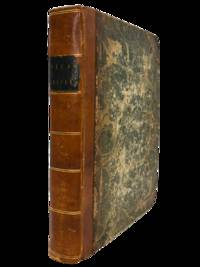
1760RW1581Geneva:: Sumptibus Cl. & Ant. Philibert 1760. 1760. 3 volumes. 4to. xxxii 548; viii 422; 8 xxviii 703 1 pp. Half-titles woodcut title vignettes title printed in red & black woodcut head & tail pieces numerous mathematical figs. index. Contemporary mottled calf raised bands gilt-stamped spines maroon & green spine labels; occasional browning. Ownership signature "Nolland avocat"auvcat. An excellent set. Very good . Second Jesuit edition emended and corrected based on the text of the third London edition of the Principia. This version is valued for its excellent annotations and copious commentary which is nearly the same length as the Principia itself. It contains Newton's Dedication to the Royal Society; Prefaces to the first second and third editions and Roger Cotes's Preface. In addition the Jesuits' edition of the Principia is prized for the inclusion of the important treatises on the theory of the tides: Daniel Bernoulli's Traite sur le Flux et Reflux de la Mer Colin MacLaurin's De Causa Physica Fluxus et Refluxus Maris and Leonardo Euler's Inquisitio Physica in causam Fluxus ac Refluxus Maris. These three works gained the prize given by the Royal Academy of Sciences in 1724 for resolving tidal problems relating to the theory of gravity. They represent the most significant discovery concerning tidal mechanics between the publication of the Principia and the discoveries of Laplace. REFERENCES: Babson 31; Gray 14; Wallis 14. Sumptibus Cl. & Ant. Philibert, 1760. hardcover books
1760SW1581Geneva:: Sumptibus Cl. & Ant. Philibert 1760. 1760. 3 volumes. 4to. xxxii 548; viii 422; 8 xxviii 703 1 pp. Half-titles woodcut title vignettes title printed in red & black woodcut head & tail pieces numerous mathematical figs. index. Contemporary mottled calf raised bands gilt-stamped spines maroon & green spine labels; occasional browning. Ownership signature "Nolland avocat"auvcat. An excellent set. Very good . Second Jesuit edition emended and corrected based on the text of the third London edition of the Principia. This version is valued for its excellent annotations and copious commentary which is nearly the same length as the Principia itself. It contains Newton's Dedication to the Royal Society; Prefaces to the first second and third editions and Roger Cotes's Preface. In addition the Jesuits' edition of the Principia is prized for the inclusion of the important treatises on the theory of the tides: Daniel Bernoulli's Traite sur le Flux et Reflux de la Mer Colin MacLaurin's De Causa Physica Fluxus et Refluxus Maris and Leonardo Euler's Inquisitio Physica in causam Fluxus ac Refluxus Maris. These three works gained the prize given by the Royal Academy of Sciences in 1724 for resolving tidal problems relating to the theory of gravity. They represent the most significant discovery concerning tidal mechanics between the publication of the Principia and the discoveries of Laplace. REFERENCES: Babson 31; Gray 14; Wallis 14. Sumptibus Cl. & Ant. Philibert, 1760. hardcover books
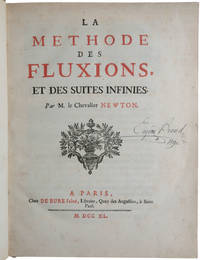
17405802Paris: De Bure l'aine 1740. First edition. <p>First edition in French of Newton's first exposition of his fluxional calculus translated with a long and impotant preface by the celebrated naturalist Comte de Buffon. Originally written in 1671 in Latin this was Newton's first comprehensive presentation of his method of fluxions which according to Hall 'might have effected a mathematical revolution in its own day' Philosophers at War pp. 65-6. It should properly be placed first in the great trilogy of Newton's major works: Fluxions Principia 1687 and Opticks 1704.</p>. BUFFON'S TRANSLATION OF NEWTON'S EXPOSITION OF CALCULUS. <p>First edition in French of Newton's first exposition of his fluxional calculus translated with a long and important preface by the celebrated naturalist Comte de Buffon. Originally written in 1671 in Latin this was Newton's first comprehensive presentation of his method of fluxions which according to Hall 'might have effected a mathematical revolution in its own day' Philosophers at War pp. 65-6. It should properly be placed first in the great trilogy of Newton's major works: Fluxions Principia 1687 and Opticks 1704. Newton's Methodus fluxionum remained unpublished until its English translation by John Colson in 1736. In it he presents a method of determining the magnitudes of finite quantities by the velocities of their generating motions. At its time of preparation it was Newton's fullest exposition of the fundamental problem of the calculus in which he presented his successful general method. Newton prepared this treatise just before his death. The autograph manuscript which survives in Cambridge University Library was entrusted to Henry Pemberton after Newton's death but he did not publish it. John Colson 1680-1760 based his translation on a copy of Newton's original manuscript made by William Jones. Both Newton's manuscript and Jones's copy lack a title page and it is unknown what title if any Newton gave to the manuscript. The title 'De methodus fluxionum' originates with Colson. In the preface Colson writes "I thought it highly injurious to the memory and reputation of our own nation that so curious and useful a piece should be any longer suppressed." Buffon translated Colson's edition in 1737 and added his lengthy preface the following year. The most interesting part of the preface is that dealing with the conception of the infinite and the metaphysical errors to which it leads. This includes a discussion of Berkeley's The analyst 1734 which oddly he criticizes although Berkeley's conclusions are very similar to his own.</p> <br /> <p>Provenance: Eugène Brand signature on title dated 1890.</p> <br /> <p>Newton wrote three accounts of the calculus. The composition of the first a tract entitled 'De analysi per aequationes numero terminorum infinitas' resulted from Newton's reception from Isaac Barrow in the early months of 1669 of a copy of Mercator's Logarithmotechnia a work which contained the series for log1 x. The work in which Newton demonstrated his much more general methods of infinite series was not published until 1711 when William Jones included it along with a number of other tracts in his Analysis per quantitatum series. In 'De analysi' however Newton "did not explicitly make use of the fluxionary notation or idea. Instead he used the infinitely small both geometrically and analytically in a manner similar to that found in Barrow and Fermat and extended its applicability by the use of the binomial theorem. . It will be noticed that although the work of Newton contains the essential procedures of the calculus the justification of these is not clear from the explanation he gave. Newton did not point out by what right the terms involving powers of o were to be dropped out of the calculation any more than Fermat or Barrow . His contribution was that of facilitating the operations rather than of clarifying the conceptions. As Newton himself admitted in this work his method is 'shortly explained rather than accurately demonstrated'" Boyer The Concept of Calculus p.191.</p> <br /> <p>It was first in 'Methodus fluxionum' that "Newton introduced his characteristic notation and conceptions. Here he regarded his variable quantities as generated by the continuous motion of points lines and planes rather than as aggregates of infinitesimal elements the view which had appeared in 'De analysi'. . In the 'Methodus fluxionum' Newton stated clearly the fundamental problem of the calculus: the relation of quantities being given to find the relation of the fluxions of these; and conversely" ibid. pp. 192-3.</p> <br /> <p>In Newton's third exposition De quadratura which was composed some twenty years after 'Methodus fluxionum' and published as an appendix to the Opticks "Newton sought to remove all traces of the infinitely small" ibid.</p> <br /> <p>"It was often lamented that the world had had to wait so many years to see Newton's masterpiece on fluxions. It is astonishing to realize that publication sixty years beforehand would have changed the history of the calculus and would have avoided for Newton any controversy over priority. In 1736 all the results contained in Newton's treatise were well known to mathematicians. However it was too concise for a beginner and Colson added almost 200 pages of explanatory notes. His commentary contributed to the establishment of a kinematical approach to the problem of foundations. In his explanatory notes Colson presents the 'geometrical and Mechanical Elements of Fluxions'. He writes:</p> <br /> <p>'The foregoing Principles of the Doctrine of Fluxions being chiefly abstracted and Analytical. I shall here endeavour after a general manner to shew something analogous to them in Geometry and Mechanicks: by which they may become not only the object of the Understanding and of the Imagination which will only prove their possible existence but even of Sense too by making them actually to exist in a visible and sensible form'.</p> <br /> <p>"Colson was convinced that by using moving diagrams it is possible to exhibit 'Fluxions and Fluents Geometrically and Mechanically . so as to make them the objects of Sense and ocular Demonstration'. The motivation for using the geometrical and mechanical elements of fluxions is clearly that of guaranteeing an ontological basis to the calculus; in fact:</p> <br /> <p>'Fluents Fluxions and their rectilinear Measures will be sensibly and mechanically exhibited and therefore must be allowed to have a place in rerum natura'.</p> <br /> <p>"Colson's approach to the calculus is representative of a whole generation of British mathematicians: his 'sensibly exhibited rectilinear measures' of fluxions are a naive anticipation of Maclaurin's kinematic definitions of the basic concepts of the calculus" Guicciardini The Development of Newtonian Calculus in Britain 1700-1800 pp. 56-57.</p> <br /> <p>"In his preface . Colson noted:</p> <br /> <p>'The chief Principle upon which the Method of Fluxions is here built is. taken from the Rational Mechanicks; which is That Mathematical Quantity particularly Extension may be conceived as generated by continued local Motion; and that all Quantities may be conceived as generated after a like manner. Consequently there must be comparative Velocities of increase and decrease during such generations whose Relations are fixt and determinable and may therefore . proposed to be found.'</p> <br /> <p>"Thus a line or a curve was seen as generated by a continuously moving point a surface by the motion of a line and a solid by the motion of a surface. After defining fluxions fluents and moments Newton went on to show how within this framework significant results could be derived. Following an introduction in which it was shown how equations could be solved with the use of infinite series seven major problems were considered:</p> <br /> <br /> From the Following Quantities fluents given to find their fluxions.<br /> From the given Fluxions to find the Flowing Quantities.<br /> To determine Maxima and Minima of Quantities.<br /> To draw Tangents to Curves.<br /> To find the Quantity of Curvature in any Curve.<br /> To find the Quality of Curvature in any Curve.<br /> To find any number of Curves that may be squared"<br /> <br /> <p>Gjertsen Newton Handbook p. 158.</p> <br /> <p>"Buffon did start his scientific career as a Newtonian. He agreed that science should search for nature's laws and that those laws should be as simple and as universal as possible. Buffon's strong stance in favor of an orthodox Newtonianism was most obvious during his academic polemics with Alexis Clairaut. Buffon also published translations of two English books: Stephen Hales's Vegetable Staticks 1735 and Newton's Treatise on Fluxions 1740. The young man who wrote the prefaces to these books praised the experimental spirit of the English. But to what extent did these texts in fact express Buffon's supposed Newtonian position .</p> <br /> <p>"The case of the preface to Newton's Fluxions 1740 was a different matter since it appeared to be a sign of allegiance both to Newton and to mathematics in the guise of the calculus. But in fact Buffon's preface while acknowledging the perfect clarity of Newton's ideas developed a metaphysical critique of the concept of the infinite that had been closely tied to the practice of geometry. Buffon asserted that our daily experience by means of sensation is restricted to the limited the finite-and therefore that the arithmetical or geometrical infinite had no actual existence. The preface to the Fluxions far from being a sign of Buffon's loyalty to mathematical conceptions of science instead stressed the lack of reality of mathematical ideas. Some of these strong statements would later be developed near the end of the 'Premier discours' of the Histoire naturelle" Hoquet pp. 39-41.</p> <br /> <p>"In his preface Buffon rewrote the history of the calculus - drawing inspiration largely from a book that Fontenelle had published in 1727 Élémens de la géométrie de l'infini - in which he sided strongly with Newton against Leibniz. He was rightly criticized for his lack of objectivity and he became closely tied with English scholars whose point of view he blindly adopted. In France furthermore he became involved with Clairaut Maupertuis and Voltaire in a battle in defense of Newton. His translation and preface must be viewed from his perspective - historical objectivity was not his main concern .</p> <br /> <p>"The debate on infinity tells us something about Buffon's intellectual temperament . At the end of the seventeenth century a lengthy evolution of ideas had led to the Newtonian conception of an infinite time and space and therefore an infinite universe . Calculus gave a new topicality to this philosophical debate since it raised the question of whether the infinitely small quantities manipulated by the new calculus really existed. Leibniz did not believe so . In 1727 Fontenelle defended their real existence and Buffon seemed at first to have accepted his argument. He now attacked Fontenelle without naming him .</p> <br /> <p>"Buffon rejected Fontenelle's conclusion mainly because he did not differentiate between geometrical and metaphysical infinities. 'The idea of infinity' he said 'is only an idea of absence and has no concrete representation.' Even 'space time and duration are not real Infinities.' Likewise 'there is no number that is at present Infinite or infinitely small or smaller or bigger than an Infinity etc.' Because 'Numbers are no more than representations and never exist independently of the things they represent' they do not have a 'real existence' and things themselves cannot be infinite .</p> <br /> <p>"The direct consequence of this philosophy was that mathematics does not teach us anything about reality. More precisely - and here Buffon distanced himself radically from Fontenelle - mathematics does not have its own reality. Fontenelle gives an intellectual reality to numbers and geometrical figures independent of all physical and metaphysical reality. For Buffon there was only physical reality. Thus mathematics was only a tool practical even indispensable but nothing more .</p> <br /> <p>"The last argument in which Buffon intervened was the one that the idealistic philosopher Berkeley had provoked by attacking the metaphysical foundations of calculus .it is clear that Buffon addressed it only to defend his friend the English doctor and mathematician James Jurin. Regardless of what he said Buffon certainly had not read Berkeley's book The analyst 1734 attentively otherwise he would have seen that Berkeley's criticisms of the status of the infinitely small corresponded exactly to his own although they were based on an extremely different metaphysics. As with Leibniz the fundamental philosophical differences prevented Buffon from recognising what they had in common. His attack on Berkeley was more satire than philosophical discussion. By intervening so lightly into a serious debate Buffon exposed himself to criticism. The interesting thing about this episode is that it shows his friendship with James Jurin and suggest that it was Jurin who had advised him in the Leibniz-Newton controversy" Roger pp. 34-38.</p> <br /> <p>Babson 173; Macclesfield 1533; Wallis 236. Hoquet 'History without Time. Buffon's natural history as a nonmathematical physique Isis 101 2010 pp. 30-61. Roger Buffon: A Life in Natural History 1997.</p> <br/> <br/> 4to 255 x 196 mm pp. xxx 4 errata and privilege 148 title printed in red and black woodcut figures in text. Contemporary quarter-morocco and marbled boards spine ruled and in gilt with red lettering-piece a little rubbed joints starting. De Bure l'aine unknown
1728117773London: Printed for J. Senex W. and J. Innys J. Osborne and T. Longman 1728. 2nd Edition. Hardcover. Very Good. London Printed for J. Senex W. and J. Innys J. Osborne and T. Longman 1728 'Second Edition very much Corrected'/ 1720 first edition in English/ 1707 first edition in Latin. Octavo iv half-title and title leaves versos blank iv 271 1 publisher's advertisement pages plus 8 full-page plates. Early full polished calf decorated in blind on the sides later expertly recornered and rebacked retaining the original gilt-decorated spine with two contrasting leather title-labels; leather a little unevenly discoloured and rubbed with minor loss to the polished surface of the spine; scattered foxing moderate in places; plates offset; tiny blemish to the bottom margin of one plate a paper flaw well clear of the printed surface; trifling signs of age and use a shallow crease to the bottom corner-tip of the last ten leaves is about the extent of it; overall an excellent copy. The eight plates normally found with a small folding section are bound into this copy in an unfolded state by the simple expedient of having the narrow left-hand border of the printed surface of each plate deep in the gutter. The border is visible in four instances and although the border cannot be seen on the other four plates all of the other printed plate surface is visible. Interestingly the plates show no evidence of ever having been folded. Babson 202. Printed for J. Senex, W. and J. Innys, J. Osborne, and T. Longman hardcover
170208586Oxoniae Oxford: Sheldonian Theatre 1702. First Edition. The first astronomical book on gravitational principles; important because it contains the first publication of Isaac Newton's Lunar Theory "Lunae Theoria" pp. 332-336. The rather lengthy Preface contains Newton's Classical Scholia." Folio 14 1/8" x 9 1/2" 124942. bound in contemporary full paneled calf rebacked to style with red leather label on spine; with a plethora of diagrams in the text and a fine engraving on the title page. A lovely wide-margined copy printed on laid paper. First several leaves with light marginal dampstain affecting only a few words of text; small chip at foot of FFEP; discreet archival repair to gutter and lower part of title page; page 237 with light marginal soiling. David Gregory 1659 - 1708 was a close friend and associate of Isaac Newton. Babson 71. <br/><br/> Sheldonian Theatre hardcover books
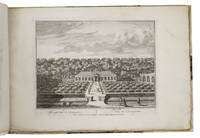
1731ABC_46670Amsterdam 1731. Small oblong folio 22 x 32.5 cm. Hendrik de Leth 20th-century half vellum marbled paper sides. With 26 numbered engraved prints including the title-page. 26 engraved ll. Second edition of a fine series of 26 beautiful and delicate etchings of the sumptuous 17th-century Heemstede estate near Utrecht not in the municipality Heemstede including a bird's-eye view of the entire estate and detailed views of the gardens house and other buildings fountains sculpture hedges and trellises all drawn and etched by Isaac van Moucheron. It also shows visitors strolling through the gardens horses coaches dogs and gardeners at work with pruning saws. "The fame of the gardens of Heemstede near Houten in the province of Utrecht was and still is considerable. . a highlight in Dutch garden art." Anglo-Dutch garden. Each print has a caption in Dutch and French the bird's-eye view with a key to five numbered features.With the bookplate of the Dutch entomologist Frans.Titus. Valck-Lucassen 1885-1939 on the front paste-down. Binding slightly worn and the vellum a little scuffed especially around the spine and the lower corners on the fore-edge vellum slightly dust-soiled. Leaves very slightly browned and slightly frayed some minor marginal staining never affecting the images overall in good condition.l Hollstein Dutch & Flemish XIV p. 94 nos. 10-35; cf. Anglo-Dutch garden pp. 193-198; STCN 4 copies of the 1st ed. incl. 2 incompl.; Springer Bibl. overzicht p. 47 1st ed. hardcover
174731752AB1747. First English Edition. London Printed for R.Dodsley 1747. Octavo. 72 pages. Modern cloth. The bookblock with signs of stitching to the inner margin possibly used to be part of a Sammelband. Last three leaves with paper-restoration and manuscript inscription to last page looks like a 18th century gift-inscription. With numerous manuscript - annotations in the tracts of George Berkeley namely in "A Word to the Wise" "Farther Thoughts on Tar-Water" "The Querist". From the library of Daniel Conner Manch House County Cork. Bound with: "Berkeley George Bishop of Coyne - "A Miscellany Containing Several Tracts on Various Subjects. By the Bishop of Cloyne. London Printed for J. and R. Tonson and S.Draper 1752. VI 267 1 pages. Title-page witme minor paper-restoration. This wonderful collection by the eminent ANglo-Irish Philosopher includes the following Pamphlets / Tracts as called for: 1. Farther Thoughts on Tar-Water 2. An Essay towards preventing the Ruin of Great-Britain 3. A Discourse addressed to Magistrates and Men in Authority. Occasioned by the enormous Licence and Irreligion of the Times. 4. A Word to the Wise - Or an Exhortation to the Roman Catholic Clergy of Ireland This section "A Word to the Wise" includes several interesting annotations: a. an underlining of the sentence: "Seeing you are obnoxious of the Law" with a comment "Oh! infamous" b. annotation: "the catholic clergy cannot be accused even by there greatest enemies of having been influenced by interested motives therefore this hint of his lordship was not of much avail" 5. A Letter to the Roman Catholics of the Diocese of Cloyne 6. Maxims concerning Patriotism 7. The Querist - Containing several Queries proposed to the Consideration of the Public 8. Verses on the Prospect of Planting Arts and Learning in America 9. A Proposal for the better supplying of Churches in our Foreign Plantations and for converting the Savage Americans to Christianity by a College to be erected in the Summer Islands otherwise called The Isles of Bermuda 10. A Sermon preached before the Incorporated Society for the Propagation of the Gospel in Foreign Parts; at their Anniversary Meeting in the Parish-Church of St.Mary-le-Bow in 1731 11. De Motu ; sive de motus principio & natura & de causa communicationis motuum ______________________________________________________________________________ hardcover
1720102659Amsterdam, Humbert, 1720, , 2 vol. in-12 : XV-[1]-228 pp. + [2] pp. 331 à 583 pp. [17] pp. 12 pl, Demi-basane marbrée havane de Lobstein-Laurenchet, dos à nerfs orné de caissons dorés, pièce de titre rouge, Édition originale de la traduction depuis l'anglais par M. Coste, faite sur la seconde édition augmentée par l'auteur. Elle est illustrée de 12 planches dépliantes, reliées in fine du 2nd volume. La pagination est continue sur les 2 tomes mais chacun possède sa propre page de titre. Newton commence la rédaction de ce traité alors qu'il est encore étudiant à Cambridge et en termine la rédaction autour de 1665-1666. Il y explore notamment le spectre des couleurs, sa nature, ses réactions et ses différentes modifications autant par le prisme de la théorie mathématique que celui de l'expérimentation. L'ouvrage connaît une grande répercussion à sa publication tant chez ses détracteurs que ses admirateurs et sera maintes fois réédité et traduit. Petits frottements, restaurations de l'angle inférieur du f. *2 au premier vol, dans l'angle supérieur des ff. O7 et O8, aux pl. 2, 4, 8, 10 et 12, quelques rousseurs et taches éparses. Ex-libris manuscrits Esparron et P. Morel au titre . Babson, 139; PMM, 172; Gray, 186; Dictionary of National biography, XII, p. 275 : "His translations were of durable service and helped to introduce english thought to the French of the eighteenth century." Couverture rigide
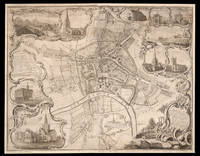
175721794Publish'd According to Act of Parliament March 21 1757. 700 by 890mm. 27.5 by 35 inches. Taylor's Plan of Hereford Engraved plan on two sheets joined remnants of old creases laid on later linen some minor areas of loss and a few tears skilfully repaired trimmed to right and upper image. Beautifully engraved plan of Hereford. The central city-plan is surrounded by views of notable places in Hereford framed by elaborate rococo strapwork among them: "General View from Broomy Hill" "Crofs of the White Fryers" "The Palace Church & part of the Town" the "Town Hall" and "St Ethelbert's Cathedral". Bottom-right the title is housed in an elaborate cartouche accompanied by apparently a self-portrait of Taylor himself at work. To the left are listed the number of houses and of inhabitants of different streets from "Broad Cabbage lane" to "Cooker row". Isaac Taylor of Ross fl.1750-1778 was born in Hereford. He earned a reputation as a surveyor of both county maps and city plans. His style was easily recognizable with his county maps Herefordshire 1754 Hampshire 1759 Dorset 1765 Worcestershire 1772 and Gloucestershire 1777 giving particular emphasis to the hills. It is surprising that Taylor like Rocque and Jefferys was not successful in gaining the approval of the Society of Arts who appeared to favour the amateur surveyors rather than the professional map-makers. Nearly all the awards went to applicants who produced just one or two maps rather than men like Taylor or Jefferys who between them published 15 fine large-scale maps accurately surveyed and well engraved and in some instances more competent than most of those that were recognized by the Society. It is unlikely that Taylor's plan of Hereford was hugely successful at its time of publication given the lack of wealth and of population in the county. Indeed for his map of Herefordshire published three years earlier Taylor had only managed to raise 77 subscribers and print less than 100 copies of which few examples survive today. The plan is engraved by Richard Benning fl.1743-1781. Little is known about Benning beyond his work. Born perhaps in St Martin in the Fields in 1720 he was possibly related to William Benning fl.1746-1756 a copperplate printer. He engraved several plans and maps for John Rocque of Paris London Berkshire and also engraved the plan of Brest and Recouvrance for Isaac Ross Taylor. Rare: we have only been able to trace two institutional examples of this plan one in the British Library and one in the Biblioteca Nacional de Espana. We are unable to trace an example coming up at auction since the war. Publish'd According to Act of Parliament, unknown
1732D427Amsterdam: R. en J. Wetstein en W. Smith 1732. Hardcover. Very Good. 2 volumes Elephant folio 445 x 296mm. 16 524pp. 4. Title-page in black and red with engraved vignettes. Text in Dutch and Latin parallel. Contemporary vellum with central medallion stamped in blind; occasional spotting and marginal dampstaining; vellum soiled and covers somewhat bowed corners bumped. A fine two volume set of the Metamorphoses illustrated with in-text copper-engravings by Bernard Picart Charles le Brun and several other artists. The translator of this edition Isaac Verburg was born in Leiden around the year 1684. He was Rector of the Latin schools in Amsterdam and author and translator of several books; he died in 1745 in Amsterdam. Rare copy of the popular Dutch translation of Ovids masterpiece in prose Metamorphoses with clean bright and large illustrations. <br/><br/> R. en J. Wetstein, en W. Smith hardcover books
1778001367London: J. W. Parsham 1778. Hand-Painted Vellum; With Full Morocco Box. Near Fine. 2 volumes in one. 12mo 4.75 by 3" 12 by 7 cm. 4 240 20 4 216 26 pp. Above all else this is a beautifully painted vellum binding in the style of the Edwards of Halifax a family of bookbinders in the late 18th century who developed a process of producing painting on vellum or parchment. The painting would actually lie under the surface giving it a greater permanence as well as a subtle glassy aura. On the front of this particular binding is a lady in late Georgian attire playing an organ with a cherub at her side and a lute at her feet. The rear board has a tinted illustration of a castle in a park-like setting. The spine is divided into five compartments four of which have a lyre ornament. Gilt ornamental borders and other detail work add further refinement to the binding. This comes with a brown levant gilt folding case shaped like book octavo in size and with plush interior with resting compartment for book itself by Sangorski & Sutcliffe. The joints of the book are partly cracked. The first title page has some light soilage. There is a small tear partially repaired on pp 1/2 of the second work. The vellum has light soilage and wear. Front joint of box repaired. Some minor scuffs and rubbing along edges. Notwithstanding these issues the book remains a highly attractive work of book art. <br/><br/> J. W. Parsham hardcover books
1778001367London: J. W. Parsham 1778. Hand-Painted Vellum; With Full Morocco Box. Near Fine. 2 volumes in one. 12mo 4.75 by 3" 12 by 7 cm. 4 240 20 4 216 26 pp. Above all else this is a beautifully painted vellum binding in the style of the Edwards of Halifax a family of bookbinders in the late 18th century who developed a process of producing painting on vellum or parchment. The painting would actually lie under the surface giving it a greater permanence as well as a subtle glassy aura. On the front of this particular binding is a lady in late Georgian attire playing an organ with a cherub at her side and a lute at her feet. The rear board has a tinted illustration of a castle in a park-like setting. The spine is divided into five compartments four of which have a lyre ornament. Gilt ornamental borders and other detail work add further refinement to the binding. This comes with a brown levant gilt folding case shaped like book octavo in size and with plush interior with resting compartment for book itself by Sangorski & Sutcliffe. The joints of the book are partly cracked. The first title page has some light soilage. There is a small tear partially repaired on pp 1/2 of the second work. The vellum has light soilage and wear. Front joint of box repaired. Some minor scuffs and rubbing along edges. Notwithstanding these issues the book remains a highly attractive work of book art. J. W. Parsham unknown
1799786441799. WELD Isaac Jr. Travels through the States of North America and the Provinces of Upper and Lower Canada during the Years 1795 1796 and 1797. London: Printed for John Stockdale 1799. xxiv464pp. plus 16 maps and plates one folding. 4to. Contemporary 3/4 calf and marbled boards rebacked in matching style with original spine label laid down endpapers refreshed. Boards rubbed corners and edges slightly worn lower spine a bit scuffed. Contemporary ownership inscription "D. Erskine" on frontispiece recto early bookplate laid in. Light tanning and foxing. Very good. HOWES W-235 "aa." Clark II:132. ESTC T110539. Gagnon I:3701. Lande 890. JCB II:4062. Sabin 192541. Scheidley 170. TPL 708. Reese Federal Hundred 78. Weld an Irishman arrived in Philadelphia in late 1795 at the age of nineteen. His observations during two years of travels through eastern North America and Canada told through a series of letters comprise one of the most popular narratives of the day. Story wrote that "his account of Canada letters 21-25 is a clear and sustained description of an area and a way of life that pleased him more than had the United States." Weld made one trip south as far as Virginia as well as crossing Pennsylvania and New York. He said that he left the United States "without a sigh and without entertaining the slightest wish to revisit it." The engraved plates are after sketches by the author. The map with its borders and those of the states colored by hand shows the East Coast of America south through North Carolina with an inset map of South Carolina and west through the Great Lakes region. unknown
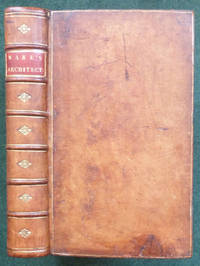
1756006153London: Grays-Inn; near London Bridge; in Fleetstreet; in Cornhill; in Pater-Noster-Row.: T Osborne and J Shipton; J Hodge; L Davies; J Ward; And R Baldwin. 1756. First Edition . Hardcover. Very Good. Elephant Folio - over 15 - 23" tall. WARE I. WATE J. SMITH GL. ROBERTS Thos. VG 1st ed later issue 122 pls frontis & 2 vignettes. In contemporary boards gilt edge tooling corners & edges rubbed. Skilfully rebacked raised bands gilt tooling gilt titles to red morocco label. Internally frontis some spotting 17 1 1 2-92 93-96 2 97-112 2 113-120 2 121-748 4 complete with all 122 plates some large & folding plus frontispiece title page in red & black inks 2 vignettes leaves watermarked IA or XA pl 110 with 2 short gutter tears old ink name to title head Frances Puleston some browning & light spotting pls generally mounted per pl list 1 pl with Warwick Shire rather than Berkshire contents lists Books 1-10. But a Very Good copy. Originally issued in parts 1756-1757. 250420 mm. O'Neil 126a/b. Fowler 436. Avery AAW21. 'A work of Sterling Merit; it relates to the practical as well as the theoretical and decorative part of the Art' - Allibone 2581. Ware's best known work a translation of Palladio's great treatise which offers a comprehensive overview of the theory & practice of Georgian Architecture. It is organized in ten 'Books' treating all aspects of architecture including construction the classical orders interior & exterior details elevations bridges and geometry. <br/> <br/> T Osborne and J Shipton; J Hodge; L Davies; J Ward; And R Baldwin. hardcover
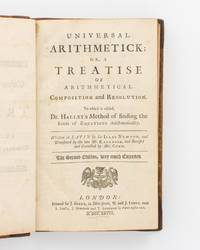
1769102661Londres W. Johnston, 1769, in-8, VIII-536-[2]-63-[3] pp. 8 pl, Demi-veau à coins brun, filets à froid sur les plats, dos à nerfs orné de frises à froid, Troisième édition de la traduction anglaise de Mr. Ralphson, révisée et corrigée Mr. Cunn, annotée par le révérend Theaker Wilder et augmentée d'un traité sur les mesures de ratio de James Maguire. L'originale a d'abord paru en latin en 1707 et la première traduction anglais en 1720. Elle est illustrée de 8 planches dépliantes reliées in fine. Cette édition fut mise au point par le commentateur Theaker Wilder à l'usage de ses élèves dublinois. À l'origine, ce petit traité abordant l'algèbre et la solution des équations a paru sans le nom de son illustre auteur et provient de ses leçons professées de 1673 à 1683 alors qu'il est professeur de mathématiques à Cambridge. Son successeur à ce poste n'est autre que William Whiston, traducteur de la première édition anglaise. Newton y donne notamment, sans démonstration, son interprétation de la règle des signes de Descartes pour obtenir le nombre de racines réelles d'un polynôme. Il faudra attendre 1865 pour que le mathématicien anglais James Joseph Sylvester en fasse la démonstration après que nombres de mathématiciens, et parmi eux Euler, s'y soient essayés en vain. Peu commun. Reliure restaurée, frottements et épidermures, quelques taches et rousseurs éparses. Ex-libris manuscrit Richard M. Elligott; ex-libris manuscrit Peter Villeneuve[?]; ex-libris manuscrit Cavanagh Wilder [? un parent du commentateur de l'ouvrage ?]. Gray, 286; Babson, 203. Couverture rigide
1719SS13189London:: Printed for B. Creake . . . J. Sackfield . . .; And sold by W. Mears . . . 1719. 1719. Sm. 4to. xxii 201 5 pp. 10 folding engraved copperplates 5 figs. pp. 24 54 75 112 half-title is a publisher's ad for Boerhaave rear publisher's ads 2 ff. head and tail-pieces; title edges chipped. With errata. Title p.101 perforated stamp and with a rubber stamp on verso of the John Crerar Library eight plates with the ex-library rubber stamp on versos; waterstained throughout. WITH FREQUENT EARLY INK CORRECTIONAL NOTES. Modern half blind-stamped dark calf gilt spine title raised bands marbled paper over boards new endleaves bindery ticket at rear: Pat M. Bruno. Inscription on recto of front blank verso is ad for Boerhaave book "W. --- 1720 Power." SPURIOUS EDITION OF DESAGULIERS' FAMOUS PRIVATE LECTURES CONTAINING NOTES ON BOYLE'S AIR PUMP AND NEWTON ON COLOR THEORY. FIRST ENLARGED EDITION early issue without "All carefully Examined and Corrected by Mr. Desaguliers" on title which otherwise is re-titled "Lectures of Experimental Philosophy". Includes: Sir Isaac Newton's Colours. Proposition. Lights which differ in Colour differ also in Degrees of Refrangibility. Initially published without the author's permission and then by evidence of the printed Preface agreed to issue the book with an erratum. / There are multiple forms of this edition as different copies collate differently Andrade Kenney Honeyman copies. The Honeyman copy called a second edition has two title-pages and the Preface by Desaguliers with an imprint of 1719. There are also differences in the title-pages. The fiasco of the unauthorized edition is the cause of the various issue differences. "Perhaps Dawson hoped . . . to ingratiate himself with his patron but instead he incurred the wrath of the lecturer. Immediately Desaguliers became aware of the book which he called 'ill put together sadly transcrib'd and worse corrected' he approached the booksellers. He found that two-thirds of the imprint had already been sold by Messrs Mears Creake and Sackfield but they paid him ten guineas 'to pacifie me'. They also promised to insert into all remaining copies a preface that Desaguliers would write together with a substantial errata. The preface follows the Dawson dedication in some copies of the book entitled A System of Experimental Philosophy but precedes it in another version called Lectures in Experimental Philosophy." See: Carpenter pp. 34-5 119. / Contents: Mechanical experiments Mechanical powers & definitions; How to make a heavy Body seem to rise it self; gravity balance leaver pulley wheel axle wedge screw laws of nature hydrostatics; Description of Robert Boyle's Air-Pump uses & experiments; How to make an air vacuum; Barometers Thermometers Hydrometers; Catoptrichs; Dioptrichs; Sir Isaac Newton's Colours; Condensing Engine; "Rowley's Horary being a machine to represent the Motion of the Moon about the Earth and the Earth Venus and Mercury about the Sun." / The preface written by Desaguliers himself explains that this volume of lectures was released "before I designed to publish them." He then retells how Paul Dawson "took a copy of the lectures . . . that they may be service to him when he went thro' my courses and they were afterwards sold and published without my knowledge." He obtained a copy of the text and made numerous corrections :: thus the micro-print 1 ½ page errata. The he invites the owner to annotate the book throughout "before he begins to read the lectures." And indeed the owner named Powers did annotate this copy :: clear evidence he read that Preface. A2-3. / The DNB asserts that Desaguliers "held in great esteem by Sir Isaac Newton" "is said to have been the first to deliver learned lectures to general audiences. Lectures by him at his London house were widely attended and were made attractive by experiments." In addition it mentions that Paul Dawson was responsible for the work and that Desaguliers himself "disavowed" himself of the edition. :: DNB pp. 850-1. / Nicholas A Hans describes the types of persons attending Desaguliers' lectures: "merchants craftsmen and clerks and his private audiences consisted of gentlemen and courtiers and included ladies as well." :: Nicholas A Hans New Trends in Education in the Eighteenth Century 1951 p. 141. / Westfall says of Desaguliers he "became a fixture at the meetings of the Royal Society where he carried out sets of experiments intimately related to various aspects of Newtonian natural philosophy. Some of his experiments such as the transmission of heat through a vacuum influenced Newton's views and other found their way into the third edition of the Principia." :: Never at Rest pp. 685-6. / Writing for the DSB A. Rupert Hall points out that Desaguliers did not produce his own version of these lectures until 1734 "when he took occasion to denounce this unauthorized version. . ." :: DSB IV pp. 43-6. / John Theophilus Desaguliers 1683-1744 born at La Rochelle emigrated to England in 1685 as a Huguenot refugee hidden in a tub at 2-years of age studied at Oxford he became a Fellow of the Royal Society in 1714. As the Society's experimenter and a close friend of Newton he often verified Newton's theories through experimentation. "In 1717 he published Physico-Mechanical Lectures an eighty-page abstract of the twenty-two lectures of his course. Although not authorized by Desaguliers the present work is the first full account of his lectures edited by his student Paul Dawson. Primarily of interest as a textbook of Newtonian physics many chemical topics are included. The first issue appeared with the title A System of Experimental Philosophy." / REFERENCES: Bakken title: "Lectures of experimental philosophy . . . 1719" pp. 52-3; Goodison English Barometers 1680-1860 p. 369; Keynes Boyle 366 pp. 122-9; Roy G. Neville I p. 354 second issue; Poggendorff I 554; Wellcome II p. 451; Wheeler 249. Not in Babson Barchas Gray or Verne L. Roberts catalogues. See: DSB IV p. 45; Taylor Mathematical Practitioners 1714-1840 35; Audrey T. Carpenter John Theophilus Desaguliers: A Natural Philosopher Engineer and Freemason in Newtonian England Bloomsbury Academic 2011. FULL TITLE: A System of Experimental Philosophy Prov'd by Mechanicks wherein the principles and laws of Physicks Mechanicks Hydrostaticks and Opticks are demonstrated and explained at large by a great number of curious experiments. . . To which is added Sir Isaac Newton's colours: the description of the condensing engine with its apparatus: and Rowley's Horary; a machine representing the motion of the Moon about the Earth; Venus and Mercury about the Sun according to the Copernican System. Printed for B. Creake, . . . J. Sackfield . . .; And sold by W. Mears, . . . 1719. hardcover books
174039297Paris, De Bure, 1740. 4to. Contemporary half calf, raised bands, richly gilt spine and and red speckled edges. Leather title-label to spine. Corners neatly repaired. Title in red/black. (2), III-XXX, (2) Errata, 148 pp., many diagrams. The ""Preface"" and the first 18 leaves of the text with a foxing to lower margin and right corners. The ""Preface"" is an historical account of Newton's method ""la sublime méthode"", written by Buffon. Without the leaf ""Extrait des Registres"".
174039297Paris De Bure 1740. 4to. Contemporary half calf raised bands richly gilt spine and and red speckled edges. Leather title-label to spine. Corners neatly repaired. Title in red/black. 2 III-XXX 2 Errata 148 pp. many diagrams. The "Preface" and the first 18 leaves of the text with a foxing to lower margin and right corners. The "Preface" is an historical account of Newton's method "la sublime méthode" written by Buffon. Without the leaf "Extrait des Registres". <br/><br/><em>The influential first French edition of Newton's important work which constitutes the most extensive description of the mathematical method he used in his famous "Principia" the method of infinitesimals which was already written about 1671 but not published until 1736 i.e. posthumously with the title "Method of Fluxions and Infinite Series.". In this work "Newton stated clearly the fundamental problem of the calculus: the relation of quantities being given to find the relation of the fluxions of these and conversely. In conformity with this problem and the new notation Newton then gave examples of his method.In this book Newton introduced his characteristic notation and conceptions. He regarded his variable quantities as generated by the continuous motion of points lines and planes rather than as aggregates of infinitesimal elements the view which had appeared in "De analysi".The rate of generation Newton called a "fluxion" designating it by means of a letter with a dot over it a "pricked letter" the quantity generates he called a "fluent". Boyer The History of the Calculus.Colson in his preface to the first edition from 1736 says: "I gladly embraced the opportunity that was put into my hands of publishing this posthumous work because I found it had been composed with that view and design. And that my own Country-men might first enjoy the benefit of this publication I resolved upon giving it an English translation with some additional remarks of my own I thought it highly injurious to the memory and reputation of the real Author as well as invidious to the glory of our own Nation that so curious and useful a piece should be any longer suppress'd and confined to a few private hands which ought to be communicated to all the learned World for general Instruction.It was through the French translations of his works that Newton came to play the seminal role as the most important of mathematicians that he did in France and particularly the years around 1740 when the present work appeared in French for the first time were seminal to the scientific development in France where the likes of Voltaire had only just made the nation acquinted with the work of the great mathematician. Gray No 236. Babson No 173. </em> hardcover
17348863Amsterdam, J. Frédéric Bernard, 1734-1739. 2 volumes in-8 (196 x 242 mm), 2 ff. n. ch., LXXVI pp., 594 pp. ; VIII pp., XXXIV pp., 806 pp. Maroquin rouge, triple filet d'encadrement avec fers, dos à nerfs orné, pièce de titre en maroquin citron, filet sur les coupes et les coiffes, roulette intérieure, tranches dorées sur marbrure, rares rousseurs (reliure de l'époque).
1740102648?Paris, Debure?, 1740, in-4, XXX-[2]-148-[2] pp, Veau havane marbrée, dos à nerfs orné de caissons dorés, pièce de titre rouge, tranches rouges, Édition originale de la traduction française par Buffon dont le nom n'est mentionné que dans les Extraits des registres de l'Académie royale des sciences, in fine. Elle est traduite sur la traduction anglaise de John Colson parue en 1736 (sans son commentaire), elle-même traduite sur l'édition originale en latin de Newton qui ne fut jamais publiée. Elle est illustrée de figures en noir dans le texte. Dans sa longue préface, il explique vouloir donner un "Newton clair, plus traitable, & à la portée du commun des géomètres", donne une courte notice historique des mathématiques pré-newtoniennes, critique sévèrement ses rivaux, notamment lorsqu'il évoque la controverse avec Liebniz et expose la méthode de calcul de Newton. Dans cet ouvrage le célèbre physicien anglais expose sa méthode de calcul infinitésimal dans sa première partie, lui donne une notation propre et propose ses applications dans la seconde. Bien que cet ouvrage fut relativement confidentiel lors de sa rédaction et sa première circulation via manuscrits, il est aujourd'hui reconnu comme fondamental dans l'histoire des mathématiques. Petits manques et épidermures, quelques taches. Complet de son errata. Gray, 236; Babson, 173. Couverture rigide
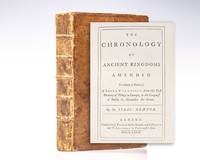
1728149863London: Printed for J. Tonson in the Strand and J. Osborn and T. Longman in Pater-noster Row 1728. First edition of Newton's ambitious attempt to reconstruct and rationalize the timelines of ancient history. Quarto bound in full contemporary Cambridge calf ruled and tooled in blind with speckled panels gilt turn-ins ordinary paper issue illustrated with 3 folding engravings. From the library of Harvard University professor Owen Gingerich. Owen Gingerich 1930–2023 was an American astronomer and historian of science renowned for his scholarship on early modern astronomy particularly his meticulous census of De revolutionibus that illuminated how Copernicus’s work was read and received in the sixteenth century. A longtime professor at Harvard and a senior astronomer at the Smithsonian Astrophysical Observatory Gingerich helped bridge scientific and humanistic inquiry demonstrating how historical context shapes the development and interpretation of scientific ideas. In very good condition. The Chronology of Ancient Kingdoms Amended published posthumously in 1728 was Isaac Newton’s ambitious attempt to reorganize and compress the timelines of ancient history by applying critical philology comparative mythology and astronomical calculation. Seeking to reconcile classical sources with biblical chronology Newton argued that the conventional dating of Egyptian Greek and Near Eastern kingdoms was excessively long and he used evidence such as eclipse records regnal lists and mythic genealogies to propose a shorter more unified ancient past. Although modern historians largely rejected Newton’s revised dates the work was significant for revealing the breadth of his intellectual pursuits beyond physics and mathematics and for illustrating how early Enlightenment thinkers employed scientific reasoning to interrogate historical and scriptural authority. Printed for J. Tonson in the Strand, and J. Osborn and T. Longman in Pater-noster Row unknown
177114425A Amsterdam, chez Marc Michel Rey, 1771. In-8 de XVI-368-(9) pp., veau marbré, dos orné à nerfs, pièce de titre en maroquin rouge, tranches rouges (reliure de l'époque).
1756140742London, T.Osborne and J. Shifton, 1756. Engraved frontispiece, title in red and black with engraved vignette, 8 leaves, 748 pp. with engraved head-piece, 2 leaves (index), 114 plates, of which 14 folding. / Mit gest. Frontispiz, Titelblatt in Rotschwarz-Druck mit gest. Vignette, 8 Bll., 748 S. Mit 1 breiten gestochenen Kopfleiste, 2 Bll. Index, 114 Kupfertafeln, davon 14 gefaltet. Folio, full contemporary calf, gilt spine, six raised bands.
174492332Lausanne and Geneva: Aoud Marcum-Michaelem Bousquet & Socios 1744. First edition of the first collected edition of <span class="match">Newton</span>'s writings which has been hailed as "a fine piece of bookmaking" Babson. Quarto bound in contemporary velum contains 64 folding engraved plates; 2 folding letterpress tables. In very good condition wide margins. Rare in contemporary binding. English mathematician astronomer theologian author and physicist Sir Isaac Newton is widely considered one of the most influential scientists of all time and a key figure in the scientific revolution. In one of his most important works Philosophiae Naturalis Principia Mathematica Newton formulated the the laws of motion and universal gravitation that formed the dominant scientific viewpoint until being superseded by the theory of relativity. Aoud Marcum-Michaelem Bousquet & Socios unknown books
1755000341Various: Various 1755. Bound volume containing six sermons dated from 1755 to 1788: I. Lyman Joseph. A Sermon Preached Before His Excellency James Bowdoin Esq. Governour; His Honour Thomas Cushing Esq. Lieutenant-Governour.of the Commonwealth of Massachusetts May 30 1787 Being the Day of General Election. Boston: Adams and Nourse 1787 61 pages front cover used as pastedown for the volume with some old insect damage to pastedown and margins of first two leaves. II. Cumings Henry. A Sermon Preached in Billerica on the 23rd of November 1775 Being the Day appointed by Civil Authority for a Public Thanksgiving Throughout the Province of Massachusetts-Bay. Worcester Massachusetts-Bay: I. Thomas 1775. 29 pages. Final two leaves dampstained but very readable next-to-last leaf has margin chip. III. Morrill Isaac. The Soldier exhorted to Courage in the Service of his King and Country from a Sense of God and Religion: in a Sermon Preach'd at Wilmington April 3 1755 to Capt. Philehas Osgood and his Company of Soldiers Before their going out into Publick Service. Boston New-England: J. Draper 1755. 23 pages. Large margin chip at bottom of one leaf not affecting text. IV. Bridge Ebenezer. A Sermon Preached before his Excellency Francis Bernard Esq. Governor.of the Province of the Massachusetts-Bay in New-England May 27th 1767. Being the Anniversary for the Election of His Majesty's Council for the Province. Boston: Green and Russell 1767. 60 pages last three leaves have internal tears with the last two having some paper loss and affecting a small part of the text. V. Cumings Henry. A Thanksgiving Sermon Preached at Billerica November 27 1766. Boston N.E.: Kneeland and Adams for Thomas Leverett 1766. 32 pages. VI. Parsons David. A Sermon Preached Before His Excellency John Hancock Esq.of the Commonwealth of Massachusetts May 28 1788 being the day of General Election. Boston: Adams and Nourse 1788.46 pages. The group is bound into a full blind-tooled calf binding measuring 21.75 cm x 13 cm. Other than the noted issues with the individual sermons cited above the pages are mainly clean and free from significant chips or tears with age-tanning and intermittent foxing throughout. The binding is lightly shelfworn with some minor separation at the spine ends joints good with covers firmly attached. A good collection of mainly scarce sermons. Full Leather. Good/None. 8vo - over 7¾" - 9¾" tall. Various Hardcover