NEWTON, IsaacBiblio.com
527 résultats
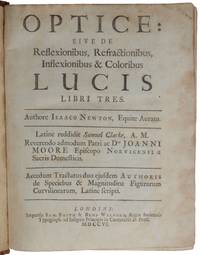
17066373London: Samuel Smith and Benjamin Walford 1706. First edition. <p>First Latin edition of the Opticks the extremely rare first issue with Ss1 in its original state. "Newton's Opticks did for light what his Principia had done for gravitation namely placed it on a scientific basis" Babson. This Latin edition is important for the seven new Queries it contains. In one of these Newton wrote that space is the 'Sensorium of God'. He later changed his mind cancelling the relevant leaf Ss1 in almost all copies although a copy in its uncancelled state found its way to Leibniz who ridiculed Newton's rash statement.</p>. <p>THE VERY RARE FIRST ISSUE WITH THE 'MISSING TANQUAM'</p> . <p>First Latin edition of the Opticks the extremely rare first issue with Ss1 in its original state cancelled in almost all copies. Of Newton's three greatest contributions to science - his theory of gravity his theories of light and colour and the invention of calculus - the first was published for the first time in the Principia 1687 and the other two in the Opticks 1704 "one of the supreme productions of the human mind" Andrade. "Newton's Opticks did for light what his Principia had done for gravitation namely placed it on a scientific basis" Babson p. 66."One of the supreme productions of the human mind" Andrade "All previous philosophers and mathematicians had been sure that white light is pure and simple regarding colors as modifications or qualifications of the white. Newton showed that the opposite is true . Natural white light far from being simple is a compound of many pure elementary colors which can be separated and recombined at will" PMM. The Optice contains translations not only of the Opticks itself but also of the two appended mathematical tracts Tractatus de quadratura curvarum and Enumeratio linearum tertii ordinis. The former is Newton's first publication of his method of fluxions or calculus which he developed in terms of 'prime and ultimate ratios' an early version of the theory of limits; it includes the first published statement of the general binomial theorem and of 'Taylor's theorem' on series expansions. The real importance of this Latin edition is the seven new 'Queries' it contains: "The Queries contain some of Newton's most influential and speculative writing" Gjertsen p. 519. The purpose of the original 16 queries in the Opticks was principally to compensate for the many years' delay between the writing of Opticks and its publication during which many discoveries had been made by Newton and others. Each of the new Queries with one exception is longer than the original 16 taken together. "In the new Queries Newton expressed fundamental views on the nature of light on the nature of bodies on the relation of God to the physical universe and on the presence in nature of a whole range of forces which furnish the activity necessary for the operation of the world and for its permanence. At the last moment he dared even a bit more and inserted three further speculative passages in the Addenda to the volume. The new Queries were the most informative of the speculations that Newton ever published." Westfall p. 644. "This edition is known in two states. In query 20 Newton had written of space: 'Annon spatium universuum sensorium est entis incorporei viventis et intelligentis' Is not infinite space the sensorium of a Being incorporeal living and intelligent. It must have struck Newton that to call space 'the sensorium of God' without any qualification was too bold a claim. Consequently he chose to substitute for page 315 a cancel in which he spoke of infinite space 'spatio infinito' as 'tanquam sensorio suo' which is as it were his sensorium. He failed however to modify the whole edition and copies with the missing tanquam been found in the Babson collection the Bodleian library and Cambridge University Library. But worse from Newton's point of view an uncancelled copy found its way to Leibniz who lost no time in accusing Newton of claiming that space is an organ of God" Gjertsen p. 413. Some of the other added Queries contain remarkably prescient speculations. Query 23 "was an extended version of the speculations on forces that Newton had once planned to insert in the Principia. Heavily indeed overwhelmingly chemical in content it was arguably the most advanced product of seventeenth-century chemistry" Westfall p. 644. "In a remarkable paragraph in Query 22 pp. 320-321 which did not survive into subsequent English editions he compared the force of attraction in proportion to size in particles of light and gross bodies by comparing velocities and radii of curvature of rays of light and projectiles. He concluded that the force of attraction in particles of light is more powerful by a factor of 1015 that is the short-range forces are immensely more powerful than gravity" ibid. p. 646.</p> <br /> <p>"Newton wrote most of the Opticks between 1687 and early 1692. He wrote Book I Parts I and II expounding his new theory of light and colour in 1687. He then appears to have set aside the Opticks for about three years but by the late summer or autumn of 1691 he had considered it - at least for a few months - to be complete. It is most likely that he carried out new research and wrote the remainder of the Opticks - that is Books II and III - in the winter or spring of 1692 or perhaps six months earlier. At some time between late August 1691 and late February 1692 Newton decided to revise the draft significantly. After this effort he brought it close to its published form except for the brief last book on diffraction which Newton called 'inflexion' and the queries which were not prepared for publication until shortly before publication in 1704.</p> <br /> <p>"The composition of Book II in 1690 or 1691 at first went very quickly. Newton made so few changes in the text that he was able to mark up the manuscript of the 'Discourse of Observations' from 1675 for his amanuensis to copy for the Opticks. This formed Parts I and II and much of Part III . After revising the 'Observations' Newton was confronted with a decision on how to end his book. At first he planned to follow this material with a new fourth book or part on diffraction but he was also toying with the idea of a speculative 'Fourth Book'. Newton soon reined in his more speculative tendencies and turned to more empirical optical investigations. He continued experiments on diffraction and also discovered an entirely new phenomenon: coloured rings produced in transparent thick plates. By the autumn of 1691 Newton had completed and written up his investigations of thick plates as Book IV Part I which together with his research on diffraction Book IV Part II was to form the concluding book of the Opticks.</p> <br /> <p>"Between late August 1691 and late February 1692 Newton removed the two parts of the new Book IV from the manuscript and set about revising them. The part on diffraction was troublesome and remained incomplete until shortly before publication. Within six months however he revised the part on the colours of thick plates incorporated it into Book III because of their affinity to those of thin films and essentially put it into its published state. During this revision Newton also introduced his theory of fits - an immaterial vibration to explain the physical cause of periodicity in light that replaced his earlier aetherial and corpuscular vibrations" Shapiro pp. 187-188. </p> <br /> <p>On 15 November 1702 according to a memorandum by the Scottish mathematician and Oxford Professor of Astronomy David Gregory Newton "promised Mr Roberts Mr Fatio Capt. Hally & me to publish his Quadratures his treatise of Light & his treatise of the Curves of the 2d Genre" i.e. cubic curves. The book appeared by 16 February 1704 when Newton presented a copy to the Royal Society" ibid. p. 196.</p> <br /> <p>In the published work "Newton presented his main discoveries and theories concerning light and color in logical order beginning with eight definitions and eight axioms . Eight propositions follow the first stating that 'Lights which differ in Colour differ also in Degrees of Refrangibility.' In appended experiments Newton discussed the appearance of a paper colored half red and half blue when viewed through a prism and showed that a given lens produces red and blue images respectively at different distances. The second proposition incorporates a variety of prism experiments as proof that 'The Light of the Sun consists of Rays differently refrangible.'</p> <br /> <p>"The figure given with experiment 10 of this series illustrates 'two Prisms tied together in the form of a Parallelopiped'. Under specified conditions sunlight entering a darkened room through a small hole F in the shutter would not be refracted by the parallelopiped and would emerge parallel to the incident beam from which it would pass by refraction through a third prism which would by refraction 'cast the usual Colours of the Prism upon the opposite Wall.' Turning the parallelopiped about its axis Newton found that the rays producing the several colors were successively 'taken out of the transmitted Light' by 'total Reflexion'; first 'the Rays which in the third Prism had suffered the greatest Refraction and painted the wall with violet and blew were . taken out of the transmitted Light the rest remaining' then the rays producing green yellow orange and red were 'taken out' as the parallelopiped was rotated yet further. Newton thus experimentally confirmed the 'experimentum crucis' showing that the light emerging from the two prisms 'is compounded of Rays differently Refrangible seeing that the more Refrangible Rays may be taken out while the less Refrangible remain' . In proposition 6 Newton showed that contrary to the opinions of previous writers the sine law of refraction actually holds for each single color. The first part of book I ends with Newton's remarks on the impossibility of improving telescopes by the use of color corrected lenses and his discussion of his consequent invention of the reflecting telescope.</p> <br /> <p>"In the second part of book I Newton dealt with colors produced by reflection and refraction or transmission and with the appearance of colored objects in relation to the color of the light illuminating them. He discussed colored pigments and their mixture and geometrically constructed a color wheel drawing an analogy between the primary colors in a compound color and the "seven Musical Tones or Intervals of the eight Sounds Sol la fa sol la mi fa sol."</p> <br /> <p>"Proposition 9 'Prob. IV. By the discovered Properties of Light to explain the Colours of the Rain-bow' is devoted to the theory of the rainbow. Descartes had developed a geometrical theory but had used a single index of refraction in his computation of the path of light through each raindrop. Newton's discovery of the difference in refrangibility of the different colors composing white light and their separation or dispersion as a consequence of refraction on the other hand permitted him to compute the radii of the bows for the separate colors. He used 108:81 as the index of refraction for red and 109:81 for violet and further took into consideration that the light of the sun does not proceed from a single point. He determined the widths of the primary and secondary bows to be 2°15' and 3°40' respectively and gave a formula for computing the radii of bows of any order n and hence for orders of the rainbow greater than 2 for any given index of refraction .</p> <br /> <p>"Book II which constitutes approximately one third of the Opticks is devoted largely to what would later be called interference effects growing out of the topics Newton first published in his 1675 letter to the Royal Society. Newton's discoveries in this regard would seem to have had their origin in the first experiment that he describes Book II Part 1 Observation 1; he had he reported compressed 'two Prisms hard together that their sides which by chance were a very little convex might somewhere touch one another' as in the figure provided for Experiment 10 of Book I Part 1. He found 'the place in which they touched' to be 'absolutely transparent' as if there had been one 'continued piece of Glass' even though there was total reflection from the rest of the surface; but 'it appeared like a black or dark spot by reason that little or no sensible light was reflected from thence as from other places' . Rotating the two prisms around their common axis Observation 2 produced 'many slender Arcs of Colours' which the prisms being rotated further 'were compleated into Circles or Rings.' In Observation 4 Newton wrote that 'To observe more nicely the order of the Colours . I took two Object-glasses the one a Plano-convex for a fourteen Foot Telescope and the other a large double Convex for one of about fifty Foot; and upon this laying the other with its plane side downwards I pressed them slowly together to make the Colours successively emerge in the middle of the Circles and then slowly lifted the upper Glass from the lower to make them successively vanish again in the same place.' It was thus evident that there was a direct correlation between particular colors of rings and the thickness of the layer of the entrapped air . Furthermore as he noted in Observation 13 'the Circles which the red Light made' were 'manifestly bigger than those which were made by the blue and violet' . He concluded that the rings visible in white light represented a superimposition of the rings of the several colors and that the alternation of light and dark rings for each color must indicate a succession of regions of reflection and transmission of light produced by the thin layer of air between the two glasses . </p> <br /> <p>"Book II Part 2 of the Opticks has a nomogram in which Newton summarized his measures and computations and demonstrated the agreement of his analysis of the ring phenomenon with his earlier conclusions drawn from his prism experiments - 'that whiteness is a dissimilar mixture of all Colours and that Light is a mixture of Rays endued with all those Colours.' The experiments of Book II further confirmed Newton's earlier findings 'that every Ray have its proper and constant degree of Refrangibility connate with it according to which its refraction is ever justly and regularly perform'd' from which he argued that 'it follows that the colorifick Dispositions of Rays are also connate with them and immutable.' The colors of the physical universe are thus derived 'only from the various Mixtures or Separations of Rays by virtue of their different Refrangibility or Reflexibility'; the study of color thus becomes 'a Speculation as truly mathematical as any other part of Opticks.' </p> <br /> <p>"In Part 3 of Book II Newton analyzed 'the permanent Colours of natural Bodies and the Analogy between them and the Colours of thin transparent Plates.' He concluded that the smallest possible subdivisions of matter must be transparent and their dimensions optically determinable. A table accompanying Proposition 10 gives the refractive powers of a variety of substances 'in respect of . Densities.' Proposition 12 contains Newton's conception of 'fits': 'Every Ray of Light in its passage through any refracting Surface is put into a certain transient Constitution or State which in the progress of the Ray returns at equal Intervals and disposes the Ray at every return to be easily transmitted through the next refracting Surface and between the returns to be easily reflected by it.' The succeeding definition is more specific: 'The returns of the disposition of any Ray to be reflected I will call its Fits of easy Reflection and those of its disposition to be transmitted its Fits of easy Transmission and the space it passes between every return and the next return the Interval of its Fits.' The 'fits' of easy reflection and of easy refraction could thus be described as a numerical sequence; if reflection occurs at distances 0 2 4 6 8 . from some central point then refraction or transmission must occur at distances 1 3 5 7 9 . Newton did not attempt to explain this periodicity stating that 'I do not here enquire' into the question of 'what kind of action or disposition this is' . Newton thus integrated the periodicity of light into his theoretical work . His work was moreover based upon extraordinarily accurate measurements - so much so that when Thomas Young 1773-1829 devised an explanation of Newton's rings based on the revived wave theory of light and the new principle of interference he used Newton's own data to compute the wavelengths and wave numbers of the principal colors in the visible spectrum and attained results that are in close agreement with those generally accepted today.</p> <br /> <p>"In Part 4 of Book II Newton addressed himself to 'the Reflexions and Colours of thick transparent polish'd Plates.' This book ends with an analysis of halos around the sun and moon and the computation of their size based on the assumption that they are produced by clouds of water or by hail. This led him to the series of eleven observations that begin the third and final book 'concerning the Inflexions of the Rays of Light and the Colours made thereby' in which Newton took up the class of optical phenomena previously studied by Grimaldi in which 'fringes' are produced at the edges of the shadows of objects illuminated by light 'let into a dark Room through a very small hole.' Newton discussed such fringes surrounding the projected shadows of a hair the edge of a knife and a narrow slit" DSB.</p> <br /> <p>"Since Newton published the Opticks without a complete investigation into diffraction which he had hoped would support a corpuscular theory of light in which light corpuscles were acted on by short-range forces of matter" Shapiro p. 196 "Newton concluded the first edition of the Opticks with a set of sixteen queries introduced 'in order to a further search to be made by others.' He had at one time hoped he might carry the investigations further but was 'interrupted' and wrote that he could not 'now think of taking these things into farther Consideration.' In the eighteenth century and after these queries were considered the most important feature of the Opticks . The original sixteen queries at once go beyond mere experiments on diffraction phenomena. In Query 1 Newton suggested that bodies act on light at a distance to bend the rays; and in Queries 2 and 3 he attempted to link differences in refrangibility with differences in 'flexibility' and the bending that may produce color fringes. In Query 4 he inquired into a single principle that by 'acting variously in various Circumstances' may produce reflection refraction and inflection suggesting that the bending in reflection and refraction begins before the rays 'arrive at the Bodies.' Query 5 concerns the mutual interaction of bodies and light the heat of bodies being said to consist of having 'their parts put into a vibrating motion'; while in Query 6 Newton proposed a reason why black bodies 'conceive heat more easily from Light than those of other Colours.' He then discussed the action between light and 'sulphureous' bodies the causes of heat in friction percussion putrefaction and so forth and defined fire in Query 9 and flame in Query 10 discussing various chemical operations. In Query 11 he extended his speculations on heat and vapors to sun and stars. The last four queries 12 to 16 of the original set deal with vision associated with 'Vibrations' excited by 'the Rays of Light' which cause sight by 'being propagated along the solid Fibres of the optick Nerves into the Brain.' In Query 13 specific wavelengths are associated with each of several colors. In Query 15 Newton discussed binocular vision along with other aspects of seeing while in Query 16 he took up the phenomenon of persistence of vision" DSB.</p> <br /> <p>Newton appended to the Opticks two mathematical tracts of which the first Tractatus de quadratura curvarum is Newton's first published account of the calculus of fluxions. In Newton's time finding the 'quadrature' of a curve meant finding the area enclosed or subtended by it which for us is a problem of integral calculus and for Newton one of the 'inverse method of fluxions'. Newton wrote three extended treatises on fluxions. The first of these 'De analysi per aequationes numero terminorum infinitas' was composed in 1669 and treats Newton's general methods of infinite series. It was not published until 1711 when William Jones included it along with a number of other tracts in his Analysis per quantitatum series. In 'De analysi' however Newton "did not explicitly make use of the fluxionary notation or idea. Instead he used the infinitely small both geometrically and analytically in a manner similar to that found in Barrow and Fermat and extended its applicability by the use of the binomial theorem" Boyer The Concept of Calculus p. 191. It was in the second of Newton's calculus treatises 'De methodus fluxionum' composed in 1671 but not published until 1736 that he first "introduced his characteristic notation and conceptions. Here he regarded his variable quantities as generated by the continuous motion of points lines and planes rather than as aggregates of infinitesimal elements the view which had appeared in 'De analysi'. . In the 'Methodus fluxionum' Newton stated clearly the fundamental problem of the calculus: the relation of quantities being given to find the relation of the fluxions of these; and conversely" ibid. pp. 192-3 i.e. the processes that we call differentiation and integration.</p> <br /> <p>De quadratura was the first of Newton's treatises on fluxions to be published but the last to be composed so that it represents his most mature view of the subject. It was prompted by a letter from David Gregory on 7 November 1691 sending Newton "my method of squaring figures published three years ago but now clarified by examples. If only I might be allowed to know your method too which as I have subsequently gathered differs little from mine." "De quadratura contained the first published statement of the binomial theorem discovered by Newton some forty years before. The text of De quadratura in its published form is in two parts. In the first part Newton in the manner of De analysi demonstrated how infinite series could be deployed to determine the quadrature and rectification of curves. In the second part he returned to the topic of fluxions discussed at greater length in his then unpublished De methodis eventually published as The method of fluxions and infinite series in 1736" Gjertsen p. 579. But perhaps "Newton's most important achievement in his 'De quadratura' was the first explicit enunciation of the Taylor expansion of a general function - Newton deduced the particular 'Maclaurin' form in his Corollary 3 by successive differentiation it would seem and then passed to the general theorem in his Corollary 4" Papers VII pp. 18-19. The expansion was rediscovered by Brook Taylor in 1715.</p> <br /> <p>The second appended mathematical treatise Enumeratio linearum tertii ordinis was composed in summer 1695 although it was based on researches carried out intermittently over the previous three decades. "In some ways the Enumeratio is the most original of Newton's mathematical works. It had no predecessors met with no rivals claiming to have anticipated the results or few even who acknowledged its results" Gjertsen p. 187. Since the inception of analytic geometry - most notably with Descartes's Géométrie 1637 which Newton carefully studied in its Latin translation 1659-61 - European mathematicians became interested in the algebraic representation of plane curves. As Descartes showed and John Wallis further developed conic sections can be represented by second-degree polynomial equations in two variables in Cartesian coordinates as we would say nowadays and they can be divided into circle parabola ellipse and hyperbola. The question naturally arises of how to move a step further and study the graphs of third-degree polynomials. In the Enumeratio Newton gave a classification of cubic curves analogous to the classification of conic sections. He identified 72 species of cubic curves mostly classified in terms of the properties of their diameters and asymptotes. There are in fact 78 species: four were added by James Stirling in his Lineae tertii ordinis Newtonianae 1717 and the remaining two by François Nicole and Nicolas I Bernoulli in the 1730s. Newton uses oblique Cartesian axes something Descartes did not do and has no qualms in using negative coordinates a novelty at the time. Newton also demonstrates deep geometrical insights stating a general theorem according to which all cubic curves can be obtained by centrally projecting the five 'divergent parabolas' very much as all conics can be obtained by projecting the circle; this was proved by Nicole and Alexis-Claude Clairaut in 1731. In the final section of the work Newton shows how the real roots of polynomial equations of degree up to 9 can be found from the points of intersection of cubic curves with lines conics or other cubic curves. Newton gave almost no proofs of his claims but Stirling revealed the methods Newton had used: algebra and infinite series. Newton's published treatise is "a marvellous epitome of results whose subtleties were only just becoming to be understood by mathematicians in the last decade of Newton's life half a century after their initial discovery" Papers VII p. 588 n1.</p> <br /> <p>Gjertsen p. 520 summarizes the content of the seven new Queries added to the Optice as follows:</p> <br /> <br /> 17-18: Double refraction<br /> 19: The 'Phenomena of Light' are not to be explained by 'new Modifications of the Rays'<br /> 20: Objections to wave theory of light and to a dense fluid medium; rejection of hypotheses in natural philosophy; limits of mechanism and a list of fundamental questions; space is the Sensorium of God<br /> 21: Rays of light are 'very small Bodies emitted from Shining substances' a view which allows many of the properties of light to be explained<br /> 22: Bodies and light are interconvertible<br /> 23: Small particles of bodies capable of acting at a distance as can be seen in a number of chemical and physical processes; evidence for the view that 'All Bodies seem to be composed of hard Particles'; Hauksbee's experiments; motion and its need of certain active principles; matter also made in the beginning by God from 'solid massy hard impenetrable moveable Particles' in need of 'certain active Principles'; examples of the divine providence in the universe.<br /> <br /> <p>In Query 20 "the refutation of wave theories of light led Newton into an argument against the possibility of a dense Cartesian ether filling the heavens and thence into an explication of his ultimate objection against conventional mechanical philosophies their tendency to make nature self-sufficient and thus to dispense with God. Some ancient philosophers he argued took atoms the void and the gravity of atoms as the first principles of their philosophy and attributed gravity to some other cause than matter.</p> <br /> <p>'Latter Philosophers banish the Consideration of such a Cause out of natural Philosophy feigning Hypotheses for explaining all things mechanically and referring other Causes to Metaphysicks: Whereas the main Business of natural Philosophy is to argue from Phenomena without feigning Hypotheses and to deduce Causes from Effects till we come to the very first Cause which certainly is not mechanical; and not only to unfold the Mechanism of the World but chiefly to resolve these and such like Questions. What is there in places empty of Matter and whence is it that the Sun and Planets gravitate towards one another without dense Matter between them Whence is it that Nature doth nothing in vain; and whence arises all that Order and Beauty which we see in the World . . . How do the Motions of the Body follow from the Will and whence is the Instinct in Animals Is not infinite Space the Sensorium of a Being Annon Spatium Universum Sensorium est Entis incorporeal living and intelligent who sees the things themselves intimately and thoroughly perceives them and comprehends them wholly by their immediate presence to himself .'</p> <br /> <p>"David Gregory who held an extensive discussion of the new Queries with Newton on 21 December 1705 recorded the interpretation of this passage in a memorandum.</p> <br /> <p>'His Doubt was whether he should put the last Quaere thus. What the space that is empty of body is filled with. The plain truth is that he believes God to be omnipresent in the literal sense; And that as we are sensible of Objects when their Images are brought home within the brain so God must be sensible of every thing being intimately present with every thing: for he supposes that as God is present in space where there is no body he is present in space where a body is also present. But if this way of proposing this his notion be too bold he thinks of doing it thus. What Cause did the Ancients assign of Gravity. He believes that they reckoned God the Cause of it nothing els that is no body being the cause; since every body is heavy.'</p> <br /> <p>"At the last moment after the last moment really Newton decided that he had indeed been too bold. He tried to recall the whole edition; and from all the copies he could lay his hands on he cut out the relevant page and pasted in a new one which asserted not that infinite space is the sensorium of God but that 'there is a Being incorporeal living intelligent omnipresent who in infinite Space as it were in his Sensory tanquam Sensorio suo sees the things themselves intimately .' Alas he failed to alter every copy and one of the originals made its way to Leibniz who did not fail to hold up to ridicule the concept of space as the sensorium of God. In its initial form the passage recalled 'De gravitatione' the beginning of Newton's rebellion against Cartesian philosophy because of its atheistical tendencies. Following the implications of the rebellion he had traveled far. In the Latin edition of the Opticks he gave the fullest exposition of his own conception of nature he would ever put in print before in his old age he tried to placate critics by seeming retreats to more conventional positions.</p> <br /> <p>"In addition to its importance for Newton's philosophy the Latin edition of the Opticks also provided the occasion for a graceful personal relation. Abraham De Moivre saw it through the press. Every evening according to the story Newton would wait for him in a coffeehouse where De Moivre would go as soon as he finished the mathematical lessons with which he supported himself. Newton would take him home and the two would spend the evening in philosophical discussion. De Moivre was one of the young men in London disciples really with whom Newton found companionship possible in a way it had never been in Cambridge. Another young disciple Samuel Clarke translated the Opticks into Latin and received £500 for his pains: £100 for each of his five children" Westfall pp. 646-8.</p> <br /> <p>Babson 137; Honeyman 2326; Poggendorff II 277; Wallis 179. Gjertsen The Newton Handbook 1986. Shapiro 'Newton's Optics' pp. 165-198 in: The Oxford Handbook of the History of Physics Buchwald & Fox eds. 2013. Westfall Never at Rest 1980.</p> <br/> <br/> 4to mm pp. xiv 348 2 24 2 43 recte 47 with 19 engraved plates. Contemporary calf. Samuel Smith and Benjamin Walford unknown
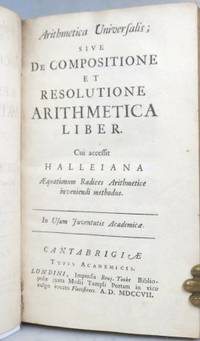
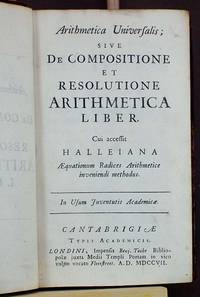
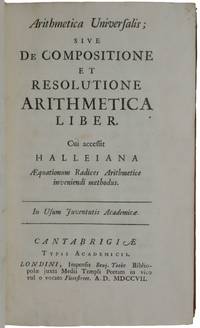
170751058Cantabrigiæ Cambridge: Typis academicis; Londini London impensis Benj. Tooke 1707. First edition. 8vo. viii 343 1 pp. 19th century full diced calf spine with raised bands gilt lettered black label blind tooled borders to the boards ownership inscription of a William Fitton dated June 1800 to the half title another contemporary owner's inscription - that of a Philip Crampton the date cropped "180" mathemetical annotations to the front and rear leaves and in the margins at intervals within. Joints skilfully repaired some mild soiling to the front and rear leaves an attractive copy. A mathemetical text composed entirely in Latin by Newton and edited by William Whiston who had succeeded him as the Lucasian professor of Mathematics at Cambridge University in 1702. The two had become acquainted during the previous decade and Newton was impressed enough with his acolyte that he invited him to lecture at the university when he was occupied with his other work. It was Whiston who persuaded Newton to publish some of his lectures on algebra but Newton was dissatisfied with Whiston's editing and additions to the text - to the extent that he considered buying the entire stock of the book to prevent its appearance in public. That clearly didn't happen although Newton succeeded in having the book published anonymously and its relative scarcity in commerce suggests a truncated print run. The first ownership inscription is that of the Irish geologist William Fitton 1780-1861. The son of a Dublin lawyer his paternal grandfather had been a mathematical instrument maker. Fitton began his studies at Trinity College Dublin in 1794 and earned his B.A. in 1799 but continued studying there until 1803. He went on to study medicine at Edinburgh University becoming a doctor in 1810 and continued his medical studies in London and Cambridge during the following six years. Fitton's interest in geology and mineralogy were his true passions and after marrying into a wealthy family he was able to devote his studies exclusively to these subjects. He subsequently served as secretary and later as president of the Geological Society published numerous reviews and papers plus a small number of books including 'A Geological Sketch of the Vicinity of Hastings' in 1833. Fitton was awarded the Wollaston Medal the society's highest prize in 1852. The other inscription is almost certainly that of Sir Philip Crampton 1777-1858 an Irish surgeon who awarded many honours and held various senior positions in a long and illustrious career: "elected FRS in 1812. In 1813 he was appointed surgeon-general to the forces in Ireland and he was surgeon to the queen in Ireland a member of the senate of the Queen's University of Ireland and four times president of the Royal College of Surgeons in Ireland in 1811 1820 1844 and 1855. In 1839 he was created baronet" ODNB. Cantabrigiæ [Cambridge]: Typis academicis; Londini [London], impensis Benj. Tooke unknown
17531512210020London: Royal Society Great Britain; The Royal Society of London for Improving Natural Knowledge: 1753 - 1880; 1960 1753. Hardcover. Good. 0x0x0. A massive collection of the Philosophical Transactions of the Royal Society of London. 109 volume set in 102 volumes. Buckram red cloth. Original volumes begin with 1753 volumes: 48 50 part 1 53-56 59-61 63 67 69 71-74 76-84 86-87 89 93-95 97 135 137 140 160 166 167 169-171 end in 1880 vols. 181 186 191-192 197-198 216 1916; Also includes the Royal Society's facsimile reprint of volumes: 1-47 1665 - 1752 49 51-52 57-58 62 64 66 68 70 Index. University library stamps on front paste down title and some edges. Good binding and covers. Over 1053 plates and maps many are folding. <br> The Philosophical Transactions of the Royal Society was first published in 1665 to promote the discussion and diffusion of scientific knowledge. It was the world's first scientific journal and has lasting and significant influence. In the Philosophical Transactions peer review the scientific method and evidence based research were standardized. The discoveries described in this publication are of fundamental importance to the development of our modern world. Robert Boyle John Wilkins and Robert Hooke were some of the original 17th century English polymaths who established and contributed to the publication. Isaac Newton notably led the society which printed his first paper New Theory about Light and Colours in 1672. Notable articles in the original format contained in this set: Thomas Bayle's: An essay towards solving a problem in the Doctrine of Chances. Vol. 53 1763; Barrington's account of Mozart. Volume 60. 1770; Alessandro Volta. Del modo di render sensibilissima la piu debole Elettricita fia Naturale fia Artificiale. vol. 72. 1782; William Roy. The distance between Greenwich and Paris Observatories. Vol. 1783; Flinders. Concerning the Differences in the Magnetic Needle vol. 95. 1805; Benjamin Franklin. Physical and Meteorological Observations vol. 55. 1765; William Herschel. On the Proper Motion of the Sun and Solar System vol. 73. 1783. Printing and the Mind of Man 227; William Herschel. On Nebulous Stars. Volume 81. 1791; William Herschel. Account of a Comet. Volume 71. 1781. Other notable entries: Henry Cavendish's experiments William Hamilton's observations of an earthquake in Italy John Hunter David Rittenhouse's observation of the transit of Venus William Bartram's naturalist observations in America etc. <br> Please contact us if you would like a full list of contents. Note: Domestic shipping is included. International buyers please contact us before purchase. London: Royal Society (Great Britain); The Royal Society of London for Improving Natural Knowledge: 1753 - 1880; 1960 hardcover
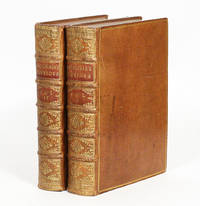
17422085Edinburgh: T.W. and T. Ruddimans 1742. First edition. Contemporary calf gilt. Fine. FIRST EDITION of MacLaurin's most important work including a strong defense of Isaac Newton and the first full presentation and development of Newton's calculus. The William Jones- Macclesfield copy. "Colin MacLaurin was a younger contemporary and to some extent a protégé of Isaac Newton and he wrote the first thorough systematic axiomatic development of the method of fluxions the Newtonian version of the calculus. MacLaurin's magnum opus the Treatise of Fluxions published in 1742 was begun as a response to Berkeley's Analyst. MacLaurin founded the method of fluxions on a limit concept drawn from the method of exhaustions in classical geometry avoiding the use of infinitesimals infinite processes and actually infinite quantities and avoiding any shifting of the hypothesis. In addition he went on in this treatise of over 760 pages to demonstrate that the method so founded would support the entire received structure of fluxions and the calculus and could deal effectively with all of the challenge problems then being exchanged between British and continental mathematicians" Oxford National Biography. Provenance: Williams Jones the great mathematician and champion and publisher of Newton with his signed manuscript note on p. 621: "His collection of some 15000 books was considered to be the most valuable mathematical library in England and was bequeathed to George Parker the second earl of Macclesfield." The Macclesfield copy with Macclesfield bookplates and embossed stamps in each volume. Edinburgh: T.W. and T. Ruddimans 1742. Quarto 234x175mm contemporary full calf with elaborately gilt-decorated spines. With half-title in volume 1. A little worming in lower margins of first few leaves of volume 2. An outstanding set with a distinguished provenance. T.W. and T. Ruddimans unknown books
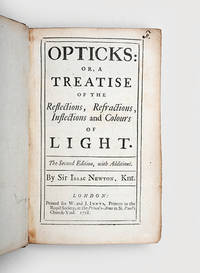
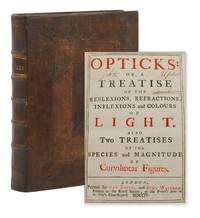
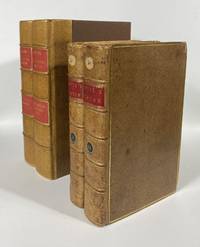
1718184239London: printed for W. and J. Innys 1718. His most important work on light with significant revisions Second edition second issue as usual of this seminal study which "did for light what Newton's Principia had done for gravitation namely place it on a scientific basis" Babson. Newton arrived at most of his innovative ideas on colour by about 1668 and Opticks was largely complete by 1692. However when he first expressed his theories in public they provoked hostile criticism. As a result Newton delayed publication until his most vocal critics - especially Robert Hooke - were dead. By the mid-1710s Opticks was established in Britain as the model for blending theoretical speculation and quantitative experimentation. Newton's aim was not to "explain the properties of light by hypotheses but to propose and prove them by reason and experiments" p. 1. The work's greatest achievement is showing that colour is a mathematically definable property. Newton demonstrates that white light is a mixture of infinitely varied coloured rays and that each ray is definable by the angle through which it is refracted. Other topics include colour circles theories of the rainbow and the phenomenon now known as Newton's rings. The textual revisions for this edition demonstrate the development of Newton's experimentation process. The first edition was published in 1704 followed by the Latin translation of 1706. This edition was the first in octavo format. It had a print run of 750 copies and within that two issues. The scarce first issue is dated 1717 on the title page and includes William Bowyer's name in the imprint; copies are recorded both with and without the cancel A2. The second issue as here has a cancel title dated 1718 and only the names of W. and J. Innys Printers to the Royal Society in the imprint; A2 the first two pages of the "Advertisement" is set as the cancel. Octavo 194 x 123 mm pp. viii 382 2 publisher's advertisement. With 12 folding engraved plates woodcut diagram on p. 330 tables in text woodcut head- and tailpieces and initials. Contemporary panelled calf spine with raised bands and early paper label edges sprinkled red. Ownership label of chemist Karol J. Mysels 1914-1998 laid in; occasional tiny marginal notations in contemporary ink to title page and p. 371 and in later pencil to pp. 323 and 328. Extremities restored spine label chipped and browned boards a little splayed contents toned and generally clean: a very good copy in an attractive period binding. Babson 134; ESTC T18663; Gray 176. hardcover
174595840London: Printed by James Bettenham for the Society for the Encouragement of Learning 1745. First edition in English of the mathematical appendixes to <span class="match">Newton</span>'s fundamental 1704 Opticks one of the greatest works of science ever published. Translated from the Latin by James Bettenham Professor of Mathematics at the University of Aberdeen. Quarto bound in contemporary calf gilt titles to the spine burgundy morocco spine label rebacked woodcut diagrams throughout the text engraved tailpiece. In very good condition with some light wear and browning to the text with wide margined text. Exceptionally rare and desirable first editions are scarce with only four appearing at auction in the last 90 years. English mathematician astronomer theologian author and physicist Sir Isaac Newton is widely considered one of the most influential scientists of all time and a key figure in the scientific revolution. In one of his most important works Philosophiae Naturalis Principia Mathematica Newton formulated the the laws of motion and universal gravitation that formed the dominant scientific viewpoint until being superseded by the theory of relativity. Considered one of the greatest works of science ever published Newton's second major book Opticks analyzes the fundamental nature of light by means of the refraction of light with prisms and lenses the diffraction of light by closely spaced sheets of glass and the behavior of color mixtures with spectral lights or pigment powders. Printed by James Bettenham for the Society for the Encouragement of Learning unknown books
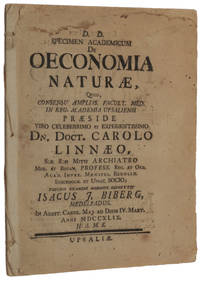
17495245Uppsala: np 1749. First edition. <p>First edition extremely rare. "This essay was the first sketch of a science of ecology. Linnaeus used his economy-of-nature concept as an organising principle to unify an important but previously amorphous part of natural history. In so doing he was also attempting to transform an important background concept into the central theory of a new science" Egerton. "In regard to Linnaeus' concepts of an economy of nature Darwin used these ideas as major explanations of the workings of natural selection. So Linnaeus supplied major assistance for Darwin's arriving at his theory of evolution" Stauffer.</p>. THE BIRTH OF THE SCIENCE OF ECOLOGY. <p>First edition extremely rare of Linnaeus' pioneer dissertation which created the science of ecology. "This essay was the first sketch of a science of ecology. Linnaeus used his economy-of-nature concept as an organising principle to unify an important but previously amorphous part of natural history. In so doing he was also attempting to transform an important background concept into the central theory of a new science . The term 'economy of nature' bore an obvious similarity to the contemporary term for animal physiology 'animal economy' which involved studying how the parts contributed to the functioning of the whole. Linnaeus may indeed have had in mind an analogy between the organs in an animal and the species in a habitat because his analysis of the interrelations between the plants and animals in nature implied a close and well-defined interaction for the good of the whole: 'To perpetuate the established course of nature in a continued series the divine wisdom has thought fit that all living creatures should constantly be employed in producing individuals that all natural things should contribute and lend a helping hand towards preserving every species and lastly that the death and destruction of one thing should always be subservient to the restitution of another' . The Oeconomia naturae begins with the above-quoted definition and then explains how that concept can be used to interpret phenomena in inanimate nature and in the plant and animal kingdoms. For both the plant and animal kingdoms Linnaeus considered propagation preservation and destruction as the phenomena which maintained the economy of nature" Egerton p. 335. "The phrase 'Oeconomy of Nature' "should be familiar to readers of Darwin for he claims in the Origin p. 102 that 'all organic beings are striving it may be said to seize on each place in the economy of nature.' When the work 'economy' appears in Darwin's texts there is a tendency to look to political economy for precursors . but concepts like the animal economy and the economy of nature debatable belonged to intellectual lineages that were relatively independent of their social and political context . I will argue that Darwin's idea of a place in the economy of nature stems from the work of previous naturalists like Carl Linnaeus and Charles Lyell and that it played a key role in the development of his evolutionary ideas. . Darwin read translations of Linnaeus' dissertations Oeconomia naturae 1749 and Politia naturae 1760 in May 1841. Although the phrase 'economy of nature' appears only once in Darwin's notebooks of the late 1830s it can be found throughout his first sketches on transmutation in 1842 and 1844. Given this chronology it is likely that the idea came to play a greater role in Darwin's work because of his encounter with these Linnaean texts" Pearce pp. 494-6. The dissertation was dictated by Linnaeus in Swedish to Isaac Biberg a doctoral candidate who translated it into Latin and defended it according to the academic custom of the eighteenth century. ABPC/RBH lists no copy in the last 80 years. OCLC lists 5 copies in US Madison Wisconsin; Kansas; Harry Ransom Texas; Minnesota; Huntington.</p> <br /> <p>"Like most naturalists of his time Linnaeus was trained in medicine and thus would have been familiar with the term 'oeconomia animalis' as employed by Charleton Hermann Boerhaave and others. However Linnaeus set his sights higher - what he wanted to describe was not the animal economy but the economy of nature as a whole. Of course others had used the term 'economy of nature' e.g. Sir Kenelm Digby in a variety of works but only as a brief metaphor. For example Digby writes in 1644 that natural motion 'hath its birth from the universall oeconomy of nature here among us.' What Linnaeus did instead was extend the physiological idea of the animal economy to nature in its entirety. In his eyes the economy of nature deserved a description just as detailed and rational as that of the animal economy.</p> <br /> <p>"In the dissertation 'Oeconomia Naturae' defended by his student Isaac Biberg in 1749 Linnaeus defines his title as follows: 'By the oeconomy of nature we understand the all-wise disposition of the creator in relation to natural things by which they are fitted to produce general ends and reciprocal uses.' The 'reciprocal uses' are the key to the whole idea for 'the death and destruction of one thing should always be subservient to the restitution of another;' thus mould spurs the decay of dead plants to nourish the soil and the earth then 'offers again to plants from its bosom what it has received from them.' Linnaeus points out that natural processes always follow a certain order with each stage dependent on the previous. A fallen tree for instance does not go to waste but is colonized and eliminated by an ordered series of creatures: liverworts mushrooms beetles caterpillars and woodpeckers. Just as the respiratory cardiovascular lymphatic and digestive systems play different functional roles in the economy of the human body different species play different functional roles in the economy of nature as a whole. For example each kind of insect lays its eggs on a particular kind of plant:</p> <br /> <p>'. every different tribe chooses its own species of plant. Nay there is scarce any plant which does not afford nourishment to some insect; and still more there is scarcely any part of a plant which is not preferred by some of them. Thus one insect feeds upon the flower; another upon the trunk another upon the root; and another upon the leaves.'</p> <br /> <p>"Each type of organism therefore according to Linnaeus has its special function in nature's economy. Just as the animal economy ensures the health and well-being of the animal body the economy of nature ensures the health and well-being of the natural world. Linnaeus discusses the many creatures that help cleanse and purify nature's body without which the 'whole earth would be overwhelmed with carcases and stinking bodies.' Thus if a horse dies near a roadway its body will 'be filled with innumerable grubs of carniverous flies by which he is entirely consumed and removed out of the way that he may not become a nuisance to passengers by his poisonous stench.' Likewise specialized aquatic predators like the thornback the hound fish or the conger eel consume fish carcasses near the shore. Linnaeus even suggests an experiment to prove the purifying potential of insects:</p> <br /> <p>'. knats lay their eggs in stagnant putrid and stinking waters and the grubs that arise from these eggs clear away all the putrefaction; and this will easily appear if any one will make the experiment by filling two vessels with putrid water leaving the grubs in one and taking them all out of the other. For then he will soon find the water that is full of grubs pure and without any stench while the water that has no grubs will continue stinking.' </p> <br /> <p>"Thus for Linnaeus even scavengers and grubs the lowest of all species play an essential role in the economy of nature" Pearce pp. 497-8.</p> <br /> <p>"Oeconomia Naturae is both the culmination of a great tradition - that of Christian natural theology and the starting point of a new science the one that Ernst Haeckel named 'ecology' in 1866. In accordance with the natural theology and the 'age of optimism' celebrated in the works of William Derham John Ray Bernhard Nieuwentyt Gottfried von Leibniz and Christian von Wolff Linnaeus defines 'the economy of nature' as the Creator's wise arrangement and deposition of all things according to which they fulfil their purpose for the glory of God and the happiness of Man.</p> <br /> <p>"And although individuals perish their roles persist . The roles in Linnaean nature are what today's ecologists call 'niches': a multidimensional 'space' defined by the abilities of the species and their interactions with the environment - their physiology and habitat preferences position in food chains and ecosystem structure. Although the Oeconomia Naturae reads like an ecology textbook it also sparkles with the eroticism of the Baroque. Like a voluptuous painter Linnaeus revels in the splendour of life in its beautiful 'costumes' its sensual appeal and showy extravagance the delightful colours forms and adaptations the impressive devices for preservation survival defence attack sex and propagation mating and pollination the means of dispersal and child-rearing .</p> <br /> <p>"Between 1743 and 1776 Linnaeus wrote more than 180 such academic theses. But few achieved the instant success of the Oeconomia Naturae. A Swedish translation was produced within a year. English and German versions soon appeared. It was also reprinted in Latin in the many editions of Linnaeus's Amoenitates academicae published in Amsterdam Leyden Erlangen and Graz through the second half of the eighteenth century. New translations continue to appear today" Hestmark.</p> <br /> <p>"Darwin's influence on the history of ecology resulted in the very christening of the science itself by Ernst Haeckel who once explained that 'By ecology we mean the body of knowledge concerning the economy of nature' and who concluded 'in a word ecology is the study of all those complex interrelationships referred to by Darwin as the conditions of the struggle for existence' .</p> <br /> <p>"When we come to consider the sources of Darwin's ecological insight the importance of his personal experience is obvious . Besides the influence of Darwin's field observations there was the influence of his reading . The importance for Darwin of Lyell's discussion of the economy of nature and allied topics in his Principles of Geology is very clear . Lyell's references in regard to the economy of nature point directly back to the major earlier source: the writings of Carl Linnaeus. The importance of Linnaeus in the evolution of ecology is very great and it is striking that among the naturalists writing after Linneaus and before Darwin it is the geologist Charles Lyell who shows the clearest grasp of Linnaeus' ideas on the economy of nature and who makes the fullest use of them in his own work . After coming to know in the pages of Lyell's Principles ideas and facts from a number of these Linnaean essays Darwin encountered Linnaeus himself in English translation in May of 1841 . From this year of 1841 on Darwin made increasing use of the phrases 'economy of nature' and 'polity of nature' .</p> <br /> <p>"The conventional wisdom is that Darwin overthrew the work of Linnaeus in so far as he replaced the orthodox dogma of fixity of species by his theory of evolution. But in regard to Linnaeus' concepts of an economy of nature Darwin used these ideas as major explanations of the workings of natural selection. So Linnaeus supplied major assistance for Darwin's arriving at his theory of evolution" Stauffer.</p> <br /> <p>"In German and Swedish universities in the eighteenth century the serious test of the student was the skill with which he conducted his oral defence of the thesis he presented. His major professor who presided at the disputation was often the author of the thesis to be defended. At Uppsala Linnaeus generally dictated the essays which his students published and paid the printer's bill for. He quite naturally regarded these dissertations as his own work. In a letter to his friend the English naturalist John Ellis he wrote:</p> <br /> <p>'The fourth volume of my Amoenitates Academicae is very nearly printed . Among the dissertations I am about to publish are Genera morborum Aer habitabilis Flora Jamaicensis Sus porcus Anthropomorpha & Generatio ambigens. In the last of these I shall show that the brain and spinal marrow only proceed from the mother and the rest of the body from the father.'</p> <br /> <p>"Nowadays unless there is direct evidence to the contrary it is customary to regard Linnaeus as the author of all these dissertations" ibid.</p> <br /> <p>Soulsby Catalogue of the works of Linnaeus 2nd ed. 1933 1514. Egerton 'Changing concepts of the balance of nature' The Quarterly Review of Biology 48 1973 pp. 322-50. Hestmark 'Oeconomia Naturae L' Nature 405 2000 p. 19. Pearce 'A great complication of circumstances - Darwin and the Economy of Nature' Journal of the History of Biology 43 2010 pp. 493-528. Stauffer 'Ecology in the long manuscript version of Darwin's 'Origin of Species' and Linnaeus' 'Oeconomy of Nature'' Proceedings of the American Philosophical Society 104 1960 pp. 235-41.</p> <br /> <br/> <br/> 4to pp. viii 48 woodcut initials head- and tail-pieces first and last pages tanned spotted water stain to upper edge of the first two leaves. String bound. A very good copy in original state of this extremely rare dissertation. np unknown
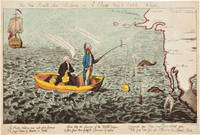
1791WRCAM51520London: H. Humphreis sic 1791. Handcolored etching 14 x 21 inches. Cropped within plate borders with no loss to image or text. Remnants of older paper pasted to verso. Color bright and fresh. Near fine. In 1789 and 1790 Nootka Sound in the Pacific Northwest looked to be the spur of a major conflict between the kingdoms of Britain and Spain. The inlet was an important outpost for maritime fur trading and had therefore become the focus of the centuries-old struggle for advantage in the New World. Courtesy of explorer and trader John Meares news of Spanish indiscretions reached Britain in 1790 and intensified the growing anti- Spanish rhetoric and call for war. Meares whose credibility was famously contested in two remarkable pamphlets by George Dixon claimed not only that the Spanish had seized British ships but that they had removed his settlement at Nootka and replaced it with their own. After debate in the House of Commons it was decided the British Navy would be mobilized. <br> <br> While Spain initially sought to go to war they could not attain the essential support of France and thus required a diplomatic solution to the problem. This came in the form of the first Nootka Convention which was signed on Oct. 28 1790. The convention guaranteed Britain the right to have outposts on Nootka Sound and to practice whaling in waters beyond the "Ten-League Line" off the coast. The Convention eventually resulted in the seminal voyage of George Vancouver to survey the Pacific Northwest. <br> <br> This print is a satire on the British Tory government's handling of the crisis. Its central critical point attacks part of the convention concerning fishing rights which Pitt's opposition latched onto as evidence of underhanded dealings. They noted that the original importance of Nootka Sound was not for whaling but rather for fur trading and that the whaling industry had surely redirected political attention toward their interests. Thus the print shows Pitt and Henry Dundas in the Pacific off the west coast of North America hopelessly fishing with millions from the treasury. As Pitt expresses worry over the spending Dundas soothes him with the knowledge that "the Gudgeons we caught in England will pay for it all." In saying so Dundas declares the Britons who supported the war to have been bait for his and Pitt's political maneuvering. The coastline is shown from southern Alaska to Mexico likewise making this an early map of California Alaska and the west coast. <br> <br> In all it is a lively expression of disbelief and anger at the amount expended on preparing for war set against the eventual prize - namely the indeterminate profitability of whaling. H. Humphreis [sic] unknown books
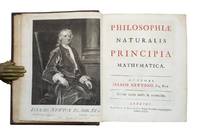
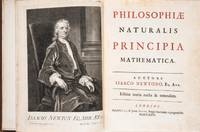
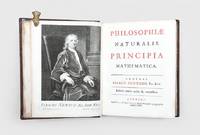
172669561London: Apud Guil. & Joh. Innys 1726. Full Description:<br> <br> NEWTON Sir Isaac. Philosophiæ naturalis principia mathematica. Editio tertia aucta & emendata. London: Apud Guil. & Joh. Innys 1726.<br> <br> Third edition. One of only 1250 copies printed. Quarto. 34 530 6 index pp. Engraved frontispiece portrait facing title by George Vertue after I. Vanderbank. Bound without the advertisement leaf. Numerous diagrams in the text and one engraving of cometary orbit on p. 506. Title printed in red and black. With the Royal Privilege printed on verso of the first leaf as in Babson copy 2.<br> <br> In full goatskin. Spine ruled and lettered in gilt. Boards paneled in blind. Inner hinges repaired. Some old ink manuscript notes on front flyleaf. Numerous instances of light early pencil marginalia and a few in ink. Some ghost dampstaining throughout. Previous owner's bookplate on front pastedown. Overall a very good copy.<br> <br> "This edition was the last published during the author's lifetime and the basis of all subsequent editions. It was edited by Henry Pemberton M.D. F.R.S. and contains a new preface by Newton and a large number of alterations the most important being the scholium on fluxions in which Leibnitz had been mentioned by name. This had been considered an acknowledgement of Leibnitz's independent discovery of the calculus. In omitting Leibnitz's name in this edition Newton was criticized as taking advantage of an opponent whose death had prevented any reply" Babson p. 12.<br> <br> Third edition of "the greatest work in the history of science" Printing and the Mind of Man. In the Principia Newton formulated the three laws of motion from which he derived the principle of universal gravitation "wherein all bodies of whatever mass attract one another in proportion to their masses and in inverse ratio as the square of the distance between them. This applies to dust particles as to the mightiest celestial bodies" Dibner.<br> <br> "Copernicus Galileo and Kepler had certainly shown the way; but where they described the phenomena they observed Newton explained the underlying universal laws. The Principia provided the great synthesis of the cosmos proving finally its physical unity. Newton showed that the important and dramatic aspects of nature that were subject to the universal law of gravitation could be explained in mathematical terms within a single physical theory.The same laws of gravitation and motion rule everywhere; for the first time a single mathematical law could explain the motion of objects on earth as well as the phenomena of the heavens. The whole cosmos is composed of inter-connecting parts influencing each other according to these laws. It was this grand conception that produced a general revolution in human thought equalled perhaps only by that following Darwin's Origin of Species" Printing and the Mind of Man 161 describing the first edition.<br> <br> Babson 13. Gray 9. Wallis 9.<br> <br> HBS 69561.<br> <br> $22500. Apud Guil. & Joh. Innys unknown
17076325Cambridge and London: Typis Academicis; Benj. Tooke 1707. First edition. Very Good/William Whiston the successor to Newton's chair at Cambridge "extracted from Newton a somewhat reluctant permission to print" this remarkable "schoolbook" based on Newton's lecture notes Babson Catalogue. So reluctant in fact that Newton kept his name out of it and supposedly considered purchasing the press run in order to destroy it! He later republished it himself. Several new theorems are laid out including a formula to determine the number of imaginary roots of any equation. The rule is complicated and is offered without proof. Yet 180 years later the rule was proven by rigorous analysis. The text also includes Edmond Halley's "Aequationum radices arithmetice inveniendi methodus. Octavo 19cm; 8 343 1 pages the last page blank . Figure and diagrams in text. Running-title: Algebrae elementa. Editor's preface signed: G.W. i.e. William Whiston. In contemporary paneled calf rebacked with new burgundy morocco spine label. Edges of boards rubbed. Early ink ownership inscriptions on blank endleaves the contemporary autograph of Edward Harington and the 19th-century mathematician William Fleetwood Sheppard. Half-title present. References: Babson Newton Collection; 199; ESTC; T018645; Bowes and Bowes 277. Typis Academicis; Benj. Tooke hardcover books
17074639Cambridge; London: Typis Academicus; Benjamin Tooke 1707. First edition. <p>First edition of Newton's treatise on algebra or 'universal arithmetic' his "most often read and republished mathematical work" Whiteside. Included are 'Newton's identities' providing expressions for the sums of the powers of the roots of any polynomial equation plus a rule providing an upper bound for the positive roots of a polynomial and a generalization to imaginary roots of René Descartes' 'Rule of Signs.'</p>. Hardcover. NEWTON'S TREATISE ON ALGEBRA. <p>First edition of Newton's treatise on algebra or 'universal arithmetic' his "most often read and republished mathematical work" Whiteside. "Included are 'Newton's identities' providing expressions for the sums of the ith powers of the roots of any polynomial equation for any integer i pp. 251-2 plus a rule providing an upper bound for the positive roots of a polynomial and a generalization to imaginary roots of René Descartes' Rule of Signs pp. 242-5" Parkinson p. 138. About this last rule for determining the number of imaginary roots of a polynomial which Newton offered without proof Gjertsen p. 35 notes: "Some idea of its originality . can be gathered from the fact that it was not until 1865 that the rule was derived in a rigorous manner by James Sylvester."</p> <br /> <p>Provenance: Jesuit College at Ghent ink inscription 'Bibliotheca Collegii Gandavensis Societatis Jesu.' and shelfmark on title; extensive marginal annotations by a well-informed contemporary reader. This reader was possibly the English Jesuit Christopher Maier 1697-1767. Born in Durham England Maier entered the Society of Jesus in 1715. He taught at Liège where he became interested in astronomy. In 1750 Maire was commissioned by Pope Benedict XIV to measure two degrees of the meridian from Rome to Rimini with fellow Jesuit Roger Boscovich with a view to mapping the Papal States; in turn they proved that the earth is an oblate spheroid as Newton had proposed in Principia publishing their results in Litteraria Expeditione 1755. Maier spent his final years at the English Jesuit College in Ghent.</p> <br /> <p>"In fulfillment of his obligations as Lucasian Professor Newton first lectured on algebra in 1672 and seems to have continued until 1683. Although the manuscript of the lectures in Cambridge University Library carries marginal dates from October 1673 to 1683 it should not be assumed that the lectures were ever delivered. There are no contemporary accounts of them and apart from Cotes who made a transcript of them in 1702 they seem to have been totally ignored. Whiteside Papers V p. 5 believes that they were composed 'over a period of but a few months' during the winter of 1683-4" Gjertsen pp. 33-4. The course of lectures stemmed from a project on which Newton had embarked in the autumn of 1669 thanks to the enthusiasm of John Collins: the revision of Mercator's Latin translation of Gerard Kinckhuysen's Dutch textbook on algebra Algebra ofte stel-konst 1661. Newton composed a manuscript 'Observations on Kinckhuysen' in 1670 see Whiteside Papers II and used it in the preparation of his lectures. He took the opportunity not only to extend Cartesian algebraic methods but also to restore the geometrical analysis of the ancients giving his lectures on algebra a strongly geometric flavor.</p> <br /> <p>"When Newton resigned his Lucasian professorship to his deputy William Whiston in December 1701 it was natural that the latter should wish to familiarize himself with the deposited lectures of his predecessor" Whiteside Papers V p. 8. Whiston later claimed in his Memoirs London: 1749 that Newton gave him his reluctant permission to publish the lectures. Whiston arranged with the London stationer to underwrite the expense of printing the deposited manuscript and then subsequently between September 1705 and the following June corrected both specimen and proof sheets as they emerged from the University Press. The completed editio princeps finally appeared in May 1707 priced at 4s. 6d. without Newton's name on the title page although references inside the work made no attempt to hide the author's identity. It included an appended tract by Halley on 'A new accurate and easy method for finding the roots of any equations generally without prior reduction' pp. 327-343. Publication of the work had been delayed by Newton who complained that the titles and headings were not his and that it contained numerous mistakes. Yet when he prepared a second edition in 1722 the changes he introduced were "primarily reorderings of his own manuscript not corrections of Whiston's additions" Westfall p. 649. In reality Newton's misgivings probably derived more from his reluctance to place before the public a relatively immature and poorly organized work and one that did not take into account the developments in the subject that had taken place in the quarter century since the manuscript was composed.</p> <br /> <p>For a book that was to become Newton's most often republished mathematical work the Arithmetica initially made little impact in Britain and was not even graced by a review in the Philosophical Transactions. On the Continent the reception accorded the lectures was more positive. "Leibniz unhesitatingly divining their author beneath the cloak of anonymity gave them a long review in the Acta Eruditorum of Leipzig in 1708. Written thirty years before he noted and now deservingly printed by William Whiston he assured the reader that 'you will find in this little book certain particularities that you will seek in vain in great tomes on analysis.' His close associate Johann Bernoulli despite some adverse remarks paid Newton the compliment in 1728 of basing his own course on the elements of algebra upon Newton's text. Perhaps partly in consequence of Newton's recent death in Britain too the book began about this time to arouse greater interest than when it was first issued in 1707" Hall p. 174.</p> <br /> <p>Despite the impressive contributions of the work to the theory of equations mentioned earlier it is difficult to pigeonhole the work as being either algebraic or geometric. From one point of view the Arithmetica can be seen as a fulfillment of the programme outlined by Descartes in the Géométrie because it teaches how geometrical problems and also arithmetical and mechanical ones can be translated into the language of algebra. Paradoxically however Newton criticized Descartes maintaining that at least in some cases Apollonian geometry is to be preferred to Cartesian algebra in the analysis of indeterminate problems. Modern analysts he complained had confused algebra and geometry: "The Ancients so assiduously distinguished them one from the other that they never introduced arithmetical terms into geometry. recent people by confusing both have lost the simplicity in which all elegance in geometry consists" Whiteside Papers V p. 429. The last section of the work 'The linear construction of equations' pp. 279-326 is particularly anti-Cartesian the term 'linear' in this context does not refer to straight lines but derives from Pappus. Newton here deals with the problem of constructing cubics third-degree equations that Descartes solved via the intersection of a circle and a parabola. Newton proposed instead to use a curve of degree higher than the conics as a means of construction namely the conchoid a fourth-degree curve. Newton regarded the conchoid as preferable because it has a mechanical construction and leads to a more elegant solution of the problem.</p> <br /> <p>William Whiston 1667-1752 was "a member of the first generation of Cambridge students to emulate Newton's method and principles. He went up to Cambridge in 1686 claimed to have attended one or two incomprehensible lectures by Newton on his Principia and was elected a Fellow of Clare Hall in 1691. After taking orders he left Cambridge for a while returning in 1700 when chosen by Newton to be his deputy as Lucasian Professor. About a year later upon Newton's resignation and commendation Whiston succeeded him. Aberrant theology was to be his downfall. While Newton and their common friend Dr Samuel Clarke kept private their doubts about Trinitarianism the Creed and the Thirty-nine Articles Whiston sought publicly to amend the errors of the Anglican faith; for this he was summoned before the heads of houses in the university and dismissed from his post in 1710" Hall p. 175.</p> <br /> <p>Babson 199; Wallis 277; D. Gjertsen Newton Handbook 1986; A. R. Hall Isaac Newton 1992; R. S. Westfall Never at Rest 1983.</p> <br/> <br/> 8vo pp. viii 343. Woodcut diagrams throughout. Former owner's signature F. Percy White Feb. 1920 on half-title partially erased. Contemporary mottled calf covers with floral border and corner fleurons in blind. / Hardcover. Typis Academicus; Benjamin Tooke unknown
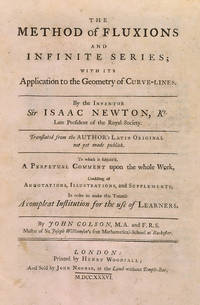
173614348London: Henry Woodfall 1736. FIRST EDITION. With engraved frontispiece interpolated leaf 143-144 and leaf containing errata on the recto publisher’s advertisements on the verso. Paneled sprinkled calf in a contemporary style; a large paper copy with very wide margins a few contemporary annotations. First edition of Newton’s treatise on the calculus a work of great importance and rarity. Ready for publication in 1671 Newton circulated the manuscript among his friends who urged him to establish priority by publishing his own work. He steadfastly refused and prior to his death entrusted it to Henry Pemberton who never had it published. It was not until 1736 that Method of fluxions was finally published in the present English translation by John Colson who added a lengthy commentary. The original Latin edition did not appear until 1779 in the Opera omnia.<br /> <br /> Babson 171; Gray 232; Wallis 232; Smith History of Mathematics I p. 404. Henry Woodfall unknown
1726vBC4008<p>RARE 1726 THIRD EDITION OF NEWTON'S PRINCIPIA THE LAST EDITION PUBLISHED IN HIS LIFETIME EDITED BY NEWTON HIMSELF THE BASIS FOR ALL SUBSEQUENT EDITIONS. ONE OF ONLY 1250 COPIES PRINTED. AT 300 FAR FEWER REMAIN! London: Guil. & Joh. Innys Regiae Societatis typographos 1726. Quarto 240 x 192 mm. Lauded by Albert Einstein as "perhaps the greatest intellectual stride that has ever been granted to any man to make" Newton's Principia is arguably the most influential book in history. Grounded on the premise that virtually everything in the universe is amenable to scientific understanding this transformative milestone abounding with interdisciplinary impact "is generally described as the greatest work in the history of science. Copernicus Galileo and Kepler had certainly shown the way; but where they described the phenomena they observed Newton explained the underlying universal laws. The Principia provided the greatest synthesis of the cosmos proving finally its physical unity. Newton showed that the important and dramatic aspects of nature that were subject to the universal law of gravitation could be explained in mathematical terms with a single physical theory. With him the separation of the natural and supernatural of sublunar and superlunar worlds disappeared. The same laws of gravitation and motion rule everywhere; for the first time a single mathematical law could explain the motion of objects on earth as well as the phenomena of the heavens. The whole cosmos is composed of inter-connecting parts influencing each other according to these laws. It was this grand conception that produced a general revolution in human thought equaled perhaps only by that following Darwin's Origin of Species… Newton is generally regarded as one of the greatest mathematicians of all time and the founder of mathematical physics. It was the final irrevocable break with a medieval conception based on Greek and Roman cosmology and a scholastic system derived from the medieval interpretation of Aristotle. Newton's universe almost independent of the spiritual order ushered in the age of rationalism scientific determinism and the acceptance of a mechanistic view of nature" PMM 161. Dissatisfied with the first two editions of his own masterpiece London 1687; Amsterdam 1723 Newton towards the end of his life "gave one last effort to the Principia. It is clear that he regarded the Principia rather than the Opticks as his masterwork. He worked over the Principia without end to hone its language to a perfect expression of his ideas… . Perhaps a serious illness in 1722 reminded him that he could not delay forever. We know only that the printing of an edition more sumptuous than either of the others began in the fall of 1723." Westfall The Life of Isaac Newton. With portrait engraving by Vertue bound before first text leaf and numerous illustrations in text. Complete with the privilege leaf half-title dedication leaf index and ad leaf. 240 x 192 mm. 18th-century paneled calf gilt-lettered spine rebacked hinges cracked but holding. Frontispiece caption trimmed with some loss to artists' signatures minor foxing and toning but a very good crisp copy. Engraved armorial bookplate of the Earl of Hopetoun. Third edition revised and expanded edited by Henry Pemberton M.D. F.R.S. contains a new preface by Newton and many alterations and clarifications the scholium on fluxions chief among them. Sir Isaac Newton died on March 31 1727 at the age of 84 one year after his treasured edition was published. This Third Edition of his Principia is the final definitive statement of the man who invented calculus determined the composition of light and discovered the laws of gravity and motion which govern the universe the founder of modern science Sir Isaac Newton. Book #vBC4008. $26000. We specialize in rare Ayn Rand and other legends and landmarks.</p> Guil. & Joh. Innys hardcover
1726H-142<p>Philosophiae Naturalis Principia Mathematica third edition half-title engraved portrait frontispiece title in red and black woodcut illustrations and diagrams some foxing and soiling contemporary calf joints and corners worn <strong>4to</strong> William & John Innys <strong>1726</strong>.<br />This edition was edited by Henry Pemberton and Sir Isaac Newton wrote a preface with new edits just one year before he passed away in 1727. <strong>This third edition printed in London is the very basis of all subsequent printings</strong> of the Principia and a true history existing through time.<br /><strong>One out of 1250 copies</strong> Demy 1000 regular issue see below printed and with complete pagination this copy is a remarkable and rare book in the history of science.</p><p>The 1726 edition was comprised of 1250 copies evidenced by William Bowyer's paper stock ledger which records the following: Superfine 50 largest paper; Royal 200 large paper; Demy 1000 regular issue. Royal copies can be identified by their size and CC watermark. See: Henry P. Macomber and Gerald G. Grubb "A census of the owners of copies of the 1687 first edition of Newton's Principia" <em>PBSA </em>47 1953 269-304 p.293. Babson 11-12 Wallis 9.</p> Guil. & Joh. Innys, Regiae Societatis typographos hardcover
1789184162Mostly at sea: 8 June 1786 - 31 March 1789. The last surviving crew member of Cook's Endeavour A window onto the later career of Isaac Manley 1755-1837 mourned on his death as the last remaining participant in Cook's historic first voyage. Manley joined Cook's crew aged only 13 and was promoted to midshipman on 5 February 1771 during the journey home. He rose to the rank of admiral of the red becoming one of the fifteen most senior officers in the Royal Navy. On the Endeavour Manley acted as servant to the master Robert Molineux. The ravages of disease in the later part of the voyage offered opportunities for advancement. Molineux died off Cape Town in April 1771 and Manley was promoted a day either side of the deaths of midshipmen John Bootie and Jonathan Monkhouse. "The Muster Rolls show Isaac being charged £3.13.2 for slops at this time and £15.18.6 for dead men's clothes presumably he was buying the dead middies' uniforms. And his tobacco charge which began at 19/- in September 1769 also increased to £1.8.6" Hill. Writing to the First Secretary of the Admiralty on his return to England Cook gave Manley his endorsement in typically reserved fashion: "Midshipmen Mr Isaac Smith and Mr Isaac Manly both too young for the preferment yet their behaviour merits the best recommendation" quoted by Hill. Manley signed up for Cook's second voyage but was discharged for still unknown reasons in April 1772 before the Resolution sailed. He was commissioned lieutenant in May 1777 serving with the Channel Fleet and in North America and the West Indies and fought in the Battle of the Saintes. In 1786 at the rank of commander he was appointed to HMS Fairy - the service covered by this log - and ended his active duties in 1790. While living the life of a landed gentleman he continued to earn promotion reaching flag rank in 1809. He was promoted to admiral of the red a few months before his death. The daily log commences on 8 June 1786: "Came on board and took the command of Her Majesty's Sloop Fairy by virtue of a commission dated the 17th May 1786." The ship is tasked with patrolling the Channel and cracking down on smugglers seizing spirits tobacco and other contraband. There are also references to punishing sailors for drunkenness and mutinous behaviour. In late 1787 Manley was also occupied with naval impressment and was ruthlessly effective recording ships stopped and men pressed-ganged. In 1788 the ship is ordered to Africa the log ending in media res on 31 March 1789 near the equator. a By family descent; b Sold at Sotheby's London "Atlases Maps Topographical Prints and Travel Books" 2 May 1985 Lot 220 buyer: Quaritch; c Sold by Quaritch c.1987 to Cecil George Whitmont 1912-1991 Australian collector with his bookplate and a selection of paperwork formerly in an improvised acetate rear pocket. Quarto 245 x 195 mm. With 182 leaves all but 3 pages filled in neat manuscript. Original quarter calf parchment sides. Housed in custom green cloth solander box green spine label. Wear from shipboard use contents clean: very good. Anthony Hill "Isaac Manley - Servant on Endeavour to Admiral" Captain Cook Society. hardcover
17262210London: Guil. & Joh. Innys Regiae Societatis typographos 1726. Third Edition. contemporary full vellum. RARE 1726 THIRD EDITION OF NEWTON'S PRINCIPIA THE LAST EDITION EDITED BY NEWTON AND THE BASIS FOR ALL SUBSEQUENT EDITIONS. ONE OF ONLY 1250 COPIES PRINTED. "The Principia is generally described as the greatest work in the history of science. Copernicus Galileo and Kepler had certainly shown the way; but where they described the phenomena they observed Newton explained the underlying universal laws. The Principia provided the great synthesis of the cosmos proving finally its physical unity. Newton showed that the important and dramatic aspects of nature that were subject to the universal law of gravitation could be explained in mathematical terms within a single physical theory. With him the separation of natural and supernatural of sublunar and superlunar worlds disappeared. The same laws of gravitation and motion rule everywhere; for the first time a single mathematical law could explain the motion of objects on earth as well as the phenomena of the heavens. The whole cosmos is composed of inter-connecting parts influencing each other according to these laws. It was this grand conception that produced a general revolution in human thought equalled perhaps only by that following Darwin's Origin of Species. It was the final irrevocable break with a medieval conception based on Greek and Roman cosmology and a scholastic system derived from the medieval interpretation of Aristotle. Newton's universe almost independent of the spiritual order ushered in the age of rationalism scientific determinism and the acceptance of a mechanistic view of nature" Printing and the Mind of Man 161. On the history and importance of the third edition: Towards the end of his life Newton "gave one last effort to the Principia. It is clear that he regarded the Principia rather than the Opticks as his masterwork. He worked over the Principia without end to hone its language to a perfect expression of his ideas. Perhaps the appearance of a reprint of the second edition in Amsterdam in 1723 stimulated Newton to put his plan for a new edition into action. Perhaps a serious illness in 1722 reminded him that he could not delay forever. We know only that printing of an edition more sumptuous than either of the others began in the fall of 1723. As editor Newton had the services of a young member of the Royal Society Henry Pemberton. In the fall of 1723 Pemberton addressed to him the first of thirty-one communications which stretched over the following two-and-a-half years while the edition passed through the press. Through 1724 and 1725 the edition made its slow but steady progress toward completion with none of the delays that stopped the press during the second edition. Newton dated the preface 12 January 1726. It was the last day of March when Martin Folkes presented a copy 'richly Bound in morocco Leather' to the Royal Society in Newton's name. In all 1250 copies were printed." Westfall The Life of Isaac Newton. The third edition "contains a new preface by Newton and a large number of alterations" Babson 13. With portrait engraving by Vertue bound before first text leaf and numerous illustrations in text. Complete with the privilege leaf half-title dedication leaf index and ad leaf. London: Guil. & Joh. Innys Regiae Societatis typographos 1726. Quarto 186x241 mm contemporary full Dutch vellum; custom half-leather box. Unidentified early signatures on front pastedown half-title and ad leaf verso. Mild scuffing to binding boards a little bowed. Text with occasional light soiling and scattered foxing but generally clean. A beautiful copy. SCARCE IN AN UNRESTORED CONTEMPORARY BINDING. Guil. & Joh. Innys, Regiae Societatis typographos unknown books
1726188378London: William & John Innys printers to the Royal Society 1726. The final lifetime edition Third edition revised by Newton himself; the final and most lavish edition to appear in his lifetime. The revisions include a new preface by Newton and one of his final statements on the nature of philosophy. By 1726 the 83-year-old Newton was making a sustained effort to tidy up his scientific legacy. For the Principia that meant adapting his arguments in light of his many disputes with continental philosophers following the first edition of 1687. The third edition is perhaps most notable for the new Rule IV of Book III in which Newton codifies his contention that hypotheses and particularly Leibnizian aether hypotheses have no place in true philosophy. Newton also adds extensive revisions to the sections on fluxions and lunar motion. Henry Pemberton 1694-1771 a 30-year-old physician and correspondent of the Oxford Newtonian John Keill was selected as the co-editor although Newton remained the primary force shaping the edition. A contemporary reader has made four ink annotations throughout this copy on pages 388 414 416 and 465 along with a handful of underlinings. The reader is particularly interested in Newton's treatment of lunar theory: the annotation on page 414 observes that "faciliùs multò polest hic calculus perfici ope motûs lunaris" "this calculation could be completed much more easily with the help of the lunar movement". Quarto 240 x 188 mm pp. xxxiv 530 8. Engraved portrait frontispiece after George Vertue engraved illustration by John Senex at p. 506 woodcut tables diagrams headpiece and initial within the text. Title page lettered in red and black. Contemporary mottled calf spine rebacked to style and with later red morocco label covers with double-fillet panel in gilt. With December 1922 signature of one Herbert Brittain possibly the Treasury official and mathematics graduate 1894-1961 to front pastedown. Light rubbing extremities restored infrequent foxing to contents: a very good copy. Babson 13; ESTC T98375; Gray 9; Wallis II.9. unknown
1719146958November 11 1719. Rare and unrecorded 18th century legal document signed twice at the conclusion by Sir Isaac Newton as a witness to a land indenture. Manuscript document signed twice on the verso "Isaac Newton" one vellum membrane dated 11 November 1719 signed by Thomas Sturgess and with his seal witnessed twice on the dorse the sealing of the document and the payment of the PS270 witnessed separately by Newton and also by Richard Cox and James Weston and also signed again by Sturgess. The document records an indenture by which Thomas Sturgess of the parish of St Martin's in the Fields sells to Robert Newton of Colsterworth Lincs for the sum of PS270 a messuage or tenement in Colsterworth in the tenure of William Bulliner and also around 70 acres of arable land and pasture in Colsterworth and Woolsthorpe "Woollstrop" also occupied by the Bulliner family William Joan and son John also one rood i.e. quarter acre of land previously belonging to John Storey of Kneeton Notts and other lands. Newton was in his mid-70s when he witnessed this deed and was living in London as Master of the Mint. He almost certainly knew both parties to this transaction. His home in St Martin's Street was in the parish of St Martin's in the Fields which was also the home of Thomas Sturgess who was selling the land in this transaction. The buyer was his first cousin once removed Robert Newton of Colsterworth d.1734. Isaac Newton would also have been familiar with the fields and houses that his cousin was buying: the property in question included land in Newton's native hamlet of Woolsthorpe as well as in the adjacent village of Colsterworth. In near fine condition. The piece measures 20 inches by 23. Documents signed by Sir Isaac Newton are rare and most relate to his work as Master of the Mint. A document closely related to this one was however sold at auction in 2015. Dated one day before the current document that deed recorded the sale of land by Sturgess to Robert Newton for the nominal sum of 5 shillings. It was similarly signed only once by Isaac Newton as a witness. English mathematician astronomer theologian author and physicist Sir Isaac Newton is widely considered one of the most influential scientists of all time and a key figure in the scientific revolution. In one of his most important works Philosophiæ Naturalis Principia Mathematica Newton formulated the laws of motion and universal gravitation that formed the dominant scientific viewpoint until being superseded by the theory of relativity. Considered one of the greatest works of science ever published Newton’s second major book Opticks analyzes the fundamental nature of light by means of the refraction of light with prisms and lenses the diffraction of light by closely spaced sheets of glass and the behavior of color mixtures with spectral lights or pigment powders. hardcover
17286610London: J. Tonson J. Osborn & T. Longman 1728. First edition. <p>First edition an extraordinary Newtonian association copy of Newton's rarest book inscribed by James Stirling recording the gift from Abraham de Moivre "Ja: Stirling Ex Dono Dni De Moivre". Drafted in the mid-1680s as the liber secundus of the earliest Principia the text differs substantially from the published Book III. Among its non-Principia contents are the thought-experiment of the orbiting cannonball anticipating the artificial satellite the first acceptable photometric determination of a stellar distance and passages that point to terrestrial tides Michelson 1919 and to the existence of the planet Uranus Herschel 1781. OCLC lists six copies worldwide; no copy in Cambridge.</p>. An Exceptional Newtonian Association Copy. <p>First edition of Newton's rarest book - the discarded first draft of what would become Book III of Principia posthumously published in the year following his death - and an extraordinary association copy in contemporary panelled calf inscribed on the front pastedown by James Stirling: "Ja: Stirling Ex Dono Dni De Moivre". The inscription records the gift in the year of publication from Abraham de Moivre to Stirling his junior by twenty-five years. The two men were the foremost mathematicians at work in London at Newton's death and the leading contemporary proponents of Newtonian mathematics; both had been part of Newton's personal circle for decades both were Fellows of the Royal Society in his lifetime and within two years of the present gift their joint correspondence on the asymptotic behaviour of the binomial coefficient would yield what is now known as Stirling's formula. Of de Moivre the ODNB remarks that he was the man "whose early investigations led Stirling into this topic". The book passed with the rest of Stirling's mathematical library into the family seat at Garden House in Stirlingshire where it remained for nearly three centuries until the dispersal at Lyon & Turnbull Edinburgh on 23 October 2025. No comparable association copy of the Latin first edition is recorded in the modern trade.</p> <br /> <br /> <p>The text Conduitt brought through the press in 1728 had been written in 1685 in the same Cambridge year as the first two books of Principia and was originally intended to constitute the second of two books under the title De motu corporum liber secundus. By the summer of 1685 Newton had expanded the design of Principia to three books with the original second book becoming the third; at the same moment he reconsidered the character of the new Book III. He had at first envisaged a popular treatment that as he noted in the introduction to the published Book III 'might be read by many'; but fearing the controversies such a work would invite he replaced the popular draft with a strictly mathematical exposition that could be read only by those who had mastered the first two books Gjertsen p. 573. Having no immediate use for the rejected version Newton had Humphrey Newton no relation his Cambridge amanuensis make a fair copy of part of the manuscript and on 29 September 1687 deposited it in the Cambridge University Library in the supposed fulfilment of his obligations as Lucasian Professor: that deposit mostly in Humphrey's hand is now ULC MS Add. 3990. A further copy by Roger Cotes is preserved at Trinity College Cambridge and a third copy is held at Clare College; Ernst Weil offered a fourth in his Catalogue 27 no. 152. Newton's distaste for controversy precluded the printing of any of these copies in his lifetime.</p> <br /> <br /> <p>The 1728 publication was arranged by John Conduitt the husband of Newton's half-niece Catherine Barton and his successor as Master of the Mint who had taken charge of Newton's manuscripts after his death in March 1727. Conduitt sold the deposit copy to the bookseller Jacob Tonson for thirty-one pounds and ten shillings and Tonson published in partnership with John Osborn and Thomas Longman. It was almost certainly Conduitt who substituted the title De mundi systemate for Newton's own De motu corporum liber secundus - a definite improvement corresponding much more closely to the content but one that has caused enduring confusion with the title of the published Book III of Principia from which the present text differs sharply in style and method.</p> <br /> <br /> <p>What is published here differs from the printed Book III of 1687 not only in style but in substance. The first part offers a non-mathematical account of centripetal force; the next turns to the dynamics of the solar system; two long discussions then follow on the theory of tides and the nature and dynamics of comets the work closing with the inverse problem of recovering a comet's orbit from its observed velocity and distance from the Sun. Several discoveries and observations preserved in the rejected text never reached the printed Principia at all. Pages 3-4 contain Newton's thought-experiment of the orbiting cannonball with an accompanying diagram here Tab. I Fig. 1 showing that there is no kind-difference between projectile and orbital motion: a ball fired from the top of a mountain with progressively greater velocity falls further and further from the base of the mountain until at length it never reaches the ground at all and enters into orbit. Ernst Weil regarded this as "the anticipation of an artificial satellite 270 years before its advent". The discussion and diagram do not appear in the 1687 Principia in any form.</p> <br /> <br /> <p>More substantial still is the discussion of stellar distances on which the printed Principia is virtually silent. Newton had investigated the question in 1685 by a method devised by James Gregory in 1668: comparing the brightness of the Sun by way of its reflection from Saturn with that of a fixed star and then applying the inverse-square law of photometry. With assumptions about the nature of reflection the absence of light-loss in interstellar space and the equality of intrinsic brightness between the Sun and the comparison star Newton found Sirius to lie at a distance of about a million astronomical units. The figure is too great by an order of magnitude but as J. D. North has argued this can be counted as "the first acceptable determination of a star's distance" Cosmos p. 418. Newton's motivation was theological as much as astronomical: he had been perplexed by the question why the cosmos did not collapse upon itself under the action of universal gravitation and the immense interstellar distances supplied a workable answer.</p> <br /> <br /> <p>The text further records in advance of their observational confirmation two phenomena that would not be detected for another two centuries. Newton points to the possibility of terrestrial tidal effects; these were observed by Albert A. Michelson and Henry G. Gale at Yerkes Observatory in 1919 by the application of monochromatic interference fringes to a determination of the rigidity of the Earth and reported in Science 50 pp. 327-8. In another passage first identified by J. Ph. Wolfers in his German Principia of 1872 Newton indicates the possible existence of a planet beyond Saturn ultimately observed by Herschel in 1781 and named Uranus - ironically Herschel himself on first observation took it to be a comet the very class of body that Newton throughout the present work regards as continuous with the planets and as moving on closely related orbits.</p> <br /> <br /> <p>The publication history of 1728 is further complicated by the simultaneous appearance of an anonymous English translation A Treatise of the System of the World sometimes attributed to Andrew Motte the translator of Principia in 1729; its translator has never been certainly identified. The Latin and English texts diverge in important respects and it is unclear whether the Treatise is a translation of a different and now-lost manuscript or whether the differences reflect interpolations by the translator. The Latin version is unambiguously based on the manuscript in Humphrey's hand: the compositor uses a half-square bracket in the margins to mark the end of one page and the beginning of another in the manuscript and to flag in some places the start of a manuscript signature Cohen p. xii. The translator additionally suppressed Newton's many citations to specific propositions in the original-draft Principia sometimes adversely affecting the readability of the result; in the Latin the citations have been preserved but updated to correspond to the proposition numbering of the third edition of Principia London 1726 which makes the present Latin text the more informative scientifically and historically. The citations were restored only in the second English edition of 1731 an edition that I. B. Cohen accordingly considered "of far more value . than the first" English version Cohen p. xiii. The Treatise is much more frequently encountered in commerce: OCLC lists more than fifty copies of the English first edition and twenty-five or more have appeared at auction. The Latin first edition presents a quite different picture.</p> <br /> <br /> <p>The Latin De mundi systemate is exceptionally rare. OCLC lists only six copies worldwide three of them in North America Chicago the Huntington Library - the Babson copy - and Yale and no copy is recorded in either the Cambridge College libraries or the Cambridge University Library despite Newton's manuscript residing on the same site. The Cambridge Digital Library editorial note to MS Add. 3990 states in a small error perhaps connected to the Cambridge gap that the work was first published in 1731 - the year of the second edition. Auction appearances over the last fifty years have been restricted to two recorded copies: the Honeyman copy rebacked and damp-stained and the Macclesfield copy from the Earls of Macclesfield's celebrated mathematical library at Shirburn Castle. The present copy is the third copy to come to public sale in that period and is the first to be offered with a contemporary presentation inscription linking it directly to two of Newton's closest mathematical contemporaries. The Latin text was reprinted in London in 1731 and again in Amsterdam in 1742; it was incorporated into Johannes Castillioneus's Isaaci Newtoni Opuscula at Lausanne in 1744 and into Samuel Horsley's five-volume Isaaci Newtoni Opera at London in 1779-85; none of these later printings carries the textual authority of the 1728 first edition prepared in the immediate aftermath of Newton's death from the manuscript his executors retained.</p> <br /> <br /> <p>James Stirling 1692-1770 to whom the present copy was given was born at Garden House in Stirlingshire on 11 May 1692 the third son of Archibald Stirling and Anna Hamilton into a Scottish family with deep Jacobite sympathies. He matriculated at Balliol College Oxford on 18 January 1711 as a Snell Exhibitioner from the University of Glasgow and held a Bishop Warner Exhibition from October of the same year. His Jacobite associations cost him both scholarships and his place at Oxford in 1715 when he refused to swear the oaths of allegiance and abjuration following the rising of 1715. Stirling travelled to the Continent - reaching Venice by 1717 - where he supported himself by teaching mathematics and where in the same year he published his first major work Lineae Tertii Ordinis Neutonianae a treatise on the cubic curves that completed and extended Newton's classification appended to Opticks in 1704. The book was dedicated to Newton with whom Stirling had begun corresponding from Venice through Newton's Royal Society colleagues and it secured Stirling's standing in the British mathematical community despite his political exile.</p> <br /> <br /> <p>By 1725 Stirling had returned to London with Newton's personal assistance and was appointed to the staff of William Watts's Academy in Little Tower Street off Covent Garden - one of the leading commercial training schools of the city where Stirling's 1727 syllabus advertised lectures on mechanical and experimental philosophy spanning mechanics hydrostatics optics and astronomy. Newton proposed Stirling for fellowship of the Royal Society; he was elected on 3 November 1726 four months before Newton's death. Throughout his London decade Stirling was a frequent visitor to the aged Newton at his country house at Kensington: "Sr Isaac Newton lives a little way off in the country" he wrote to Maclaurin in 1725 finding Newton kind and serviceable but much enfeebled. The fruit of these London years was Stirling's second and most famous work Methodus Differentialis London 1730 the early classic of numerical analysis containing what are now known as Stirling numbers Stirling's interpolation formula and the asymptotic formula for the logarithm of the factorial that bears his name.</p> <br /> <br /> <p>Abraham de Moivre 1667-1754 the donor had reached England as a Huguenot refugee in 1685 following the Revocation of the Edict of Nantes and supported himself in London by tutoring the sons of the gentry and by giving mathematical lessons in the coffee-houses of St Martin's Lane. He had become a friend of Newton by about 1692 and was elected Fellow of the Royal Society in 1697. He saw Samuel Clarke's Latin Optice through the press in 1706 the year following Opticks in English; in 1712 he served on the Royal Society's commission alongside Halley Arbuthnot Jones Machin and others that arbitrated the priority dispute between Newton and Leibniz over the calculus and adjudicated in Newton's favour. De Moivre's own publications - De Mensura Sortis 1711; The Doctrine of Chances in three editions 1718 1738 1756; Miscellanea Analytica 1730; the formula linking complex exponentials to trigonometry and the early statement of the central limit theorem - placed him among the foremost probabilists of his century. The story preserved by his Royal Society colleagues that the aged Newton would direct mathematical questioners to him with the words "he knows all these things better than I do" was already current in his lifetime.</p> <br /> <br /> <p>The friendship between Stirling and de Moivre was the closest mathematical relationship of the older man's last decades and the most consequential of Stirling's. Stirling's letter to de Moivre of 19 June 1729 preserved in the Royal Society archives and reproduced in Ian Tweddle's annotated translation of Methodus Differentialis Springer 2003 illustrates how Stirling had calculated the coefficient of the middle term of the binomial expansion a bn for large n by means of a logarithmic series; de Moivre who had pursued the same problem for some years was able to extend his earlier results using Stirling's ideas and shortly afterwards published a Supplement to his Miscellanea Analytica. By September 1730 Stirling was relating the new exchange to Gabriel Cramer at Geneva. The joint provenance of the asymptotic formula for n! named after Stirling but resting on de Moivre's earlier "Approximatio ad summam terminorum binomii" has its origin in this exchange. The Methodus Differentialis of 1730 which states the formula in 'Example 2 to Proposition 28' was published two years after the present gift; the book Stirling received from de Moivre in 1728 carried the work of their common master the rejected first draft of Principia into the next mathematical generation.</p> <br /> <br /> <p>The dating of the inscription is precise. The Latin De mundi systemate published in London in the second half of 1728 would have come into the hands of the leading London mathematicians within weeks of issue; de Moivre's presentation to Stirling recorded in Stirling's own hand on the front pastedown can therefore be placed in the closing months of 1728 or in early 1729 in the year following Newton's death and within two years of Stirling's election to the Royal Society. The form of the inscription is the recipient's record of the gift not the donor's presentation: it is unsigned by de Moivre and the courtesy form "Dni De Moivre" Domini De Moivre is the standard early-eighteenth-century Latin used between Fellows. The hand is the same as that of Stirling's 1729 letter to de Moivre and of his autograph manuscript of Methodus Differentialis both preserved at Garden House until the same dispersal of October 2025.</p> <br /> <br /> <p>The book is in entirely original condition in the contemporary panelled calf binding it received in London in 1728: the covers framed by double gilt fillets enclosing a recessed central panel the spine in compartments separated by raised bands the red morocco lettering-piece preserving the gilt label 'DE MUNDI SYSTE MAT' with characteristic compartment dotted ornament and the edges sprinkled red. It travelled with Stirling from London to Garden House in or about 1735 when he relinquished his London teaching to take up the management of the Scots Mining Company at Leadhills in Lanarkshire an appointment he held until his retirement; the books and instruments he had assembled in his London years went with him were preserved by his collateral heirs Stirling died unmarried in Edinburgh on 5 December 1770 and remained at Garden House through nine generations of the Stirling family until the dispersal at Lyon & Turnbull on 23 October 2025. In the same sale Stirling's autograph Methodus Differentialis manuscript brought £50400 his own annotated copy of Principia £42840 and the Edinburgh silver pocket microscope by John Clark used in his Leadhills assays a further £42840: the present De mundi systemate stands within the same archive of working tools by which one of Newton's leading disciples carried his mathematics into the next century.</p> <br /> <br /> References: Babson 16 - Wallis 19 - Norman 1593 English translation only - Gray 19 1731 reprint only - Cohen I. B. introduction to A Treatise of the System of the World London & Berkeley 1969 - Gjertsen D. The Newton Handbook London 1986 p. 573 - North J. D. Cosmos: An Illustrated History of Astronomy and Cosmology Chicago 2008 p. 418 - Tweddle I. James Stirling's Methodus Differentialis: An Annotated Translation of Stirling's Text London 2003 - Hoskin M. A. 'Newton Providence and the Universe of Stars' Journal for the History of Astronomy 8 1977 pp. 77-101 - Walker H. M. Studies in the History of Statistical Method Baltimore 1929 - The Library of James Stirling Mathematician Lyon & Turnbull Edinburgh 23 October 2025 lot 9.<br /> <br/> <br/> <br /> <p>4to 231 × 177 mm pp. iv 108 with two folding engraved plates of geometrical diagrams Tab. I and Tab. II title printed in red and black with engraved typographic ornament. Contemporary panelled calf covers framed by double gilt fillets enclosing a recessed central panel spine in six compartments with five raised bands red morocco lettering-piece preserving gilt 'DE MUNDI SYSTE MAT' edges sprinkled red. Covers rubbed with surface wear to the recessed central panels spine and joints sound lettering-piece intact.</p> . J. Tonson, J. Osborn & T. Longman unknown
1713181514Cambridge: Printed by Cornelius Crownfield at the University Press 1713. I feign no hypotheses Second edition extensively revised by Newton himself and including the first appearance of the General Scholium: among his last discussions of scientific enquiry and the source of his famed principle "Hypotheses non fingo" "I feign no hypotheses" - p. 484. "The Principia that has shaped Western scientific tracition is substantially the second edition" ODNB. Together with Roger Cotes 1682-1716 Cambridge's Plumian Professor of Astronomy Newton extensively overhauled the Principia over a period of four years: almost 400 of the first edition's 494 pages have been revised here. Alongside the Scholium the pair made particularly extensive annotations to the sections on lunar theory comets and fluid dynamics. Cotes was a gifted mathematician in his own right: after his early death Newton commented that "if he had lived we might have learned something". Cotes's lengthy preface together with Newton's Scholium and the revisions to the text itself helped to fashion the second edition of the Principia into a key text in the lengthy debate between Newton and continental philosophy most particularly that of Leibniz. The "Hypotheses non fingo" principle is directly framed to emphasize Newton's focus on descriptive analysis in contrast to continental speculation over causes. This is one of 750 copies printed at the Cambridge university press under the supervision of Richard Bentley the famed and feared master of Trinity College. Quarto 233 x 191 mm pp. xxviii 484 8. Leaf 3Q2 cancelled. Folding engraved plate facing p. 465 engraved Cambridge University Press printer's device on title page extensive wood-engraved diagrams in text. Recent vellum spine with red morocco label covers with yapp edges edges sprinkled red. With 20th-century engraved bookplate of the noted science collectors Peter and Margarethe Braune. Light finger soiling infrequent minor browning and foxing running wormhole throughout with discreet infill to most leaves and marginal repair to title and leaf b1 contents otherwise crisp and clean: a very good copy indeed. Babson 12; Dibner 11 note; ESTC T93210; Gray 8; Wallis 8. hardcover
1704140946960London: Printed for Sam. Smith and Benj. Walford Printers to the Royal Society at the Prince's Arms in St. Paul's Church-Yard 1704. First Edition. Very Good. First edition first issue of this foundational work in the field of optics in which Isaac Newton explores the nature of light and color presenting his experiments and theories on how light behaves. Title printed in red and black within a double-rule border and without author's name. Bound in contemporary paneled calf boards sympathetically rebacked; with 19 engraved folding plates. <p>Very Good. Soiling to textblock and endsheets bookplate of Irish naturalist John Vandeleur Stewart affixed to the front pastedown ownership signature to title page. Amateur repair to gutter at title page. Numerous pencil notations throughout though mostly confined to the margins or blank areas. Plate 5 is torn at the fold plate 6 with corner loss affecting the image several shaved. Second book with page 120 misnumbered as 112. <p>A lovely copy of Newton's second major book on physical science considered one of the Scientific Revolution's three major works on optics. It overturned centuries of thinking attributed to Aristotle or Theophrastus and accepted by scholars in Newton's time that "pure" light such as the light attributed to the Sun is fundamentally white or colorless and is altered into color by mixture with darkness caused by interactions with matter. Here Newton shows the opposite was true: light is composed of different spectral hues he describes seven – red orange yellow green blue indigo and violet and all colors including white are formed by various mixtures of these hues. He demonstrates that color arises from a physical property of light – each hue is refracted at a characteristic angle by a prism or lens – but he clearly states that color is a sensation within the mind and not an inherent property of material objects or of light itself. <p>Unlike his earlier work Philosophiae Naturalis Principia Mathematica which took a more deductive approach Opticks is largely experimental and inductive. Newton's study includes detailed descriptions of his experiments with prisms and lenses leading to the conclusion that white light is composed of a spectrum of colors. The work also delves into the phenomena of diffraction and interference which were crucial to the development of wave theory in later years. The work is notable for containing Newton's first mathematical papers in print and for giving the first full explanation of the rainbow complete with related diagrams. Like Galileo Newton decided to publish this text in his native English rather than Latin the language of scholarship; an enlarged Latin edition would be published two years later. Printed for Sam. Smith and Benj. Walford, Printers to the Royal Society, at the Prince's Arms in St. Paul's Church-Yard unknown
1704157612London: Smith & Walford 1704. First. hardcover. very good. Also Two Treatises of the Species and Magnitude of Curvilinear Figures. 4 parts in 1 volume. Title page printed in red & black within a double-ruled border. Illustrated with 19 folding copperplate engravings.4 144 211 1pp. In the second sequence p. 120 is marked 112 and there are blank pages between 137-8 and 138-9. Thick 4to contemporary blind-tooled panelled calf expertly rebacked in matching leather contemporary signature on title dated 1704; last several pages have marginal dampstains otherwise a remarkably clean crisp copy. London: Smith & Walford 1704.<br/><br/> First edition first issue - with the author not named on title page. The work contains: The First Book of Opticks The Second Book of Opticks The Thrid Book of Opticks Tertii Ordinis: Enumeratio Linearum Tractatus de Quadratura Curvarum. The main work is in English the 2 treatises pages 138-211 are in Latin. Babson 132; Gray 174; Horblit 79b; PMM 172; Norman 1588; Dibner 148; Wallis 174.<br/><br/> Smith & Walford unknown books
1704157612London: Smith & Walford 1704. First. hardcover. very good. 4 parts in 1 volume. Title page printed in red & black within a double-ruled border. Illustrated with 19 folding copperplate engravings.4 144 211 1 pages. In the second sequence p. 120 is marked 112 and there are blank pages between 137-8 and 138-9. Thick 4to contemporary blind-tooled paneled calf well-worn and now expertly re-backed in sympathetic leather; last several pages have marginal dampstains otherwise a remarkably clean crisp copy. London: Smith & Walford Printers to the Royal Society 1704. First edition first issue - with the author not named on title page.<br/> <br/> "Newton's Opticks expounds his corpuscular theory of light and summarizes his experiments concerning light and colour. It also prints two important mathematical treatises omitted in later editions describing his invention of the fluxional calculus the grounds for his claim of priority over Leibniz. Newton arrived at most of his unconventional ideas on colour by about 1668 and Opticks was largely complete by 1692. However when he first partially expressed his theories in public in 1672 and 1675 they provoked hostile criticism especially on the continent. As a result Newton delayed the publication of Opticks until his most vociferous critics - especially Robert Hooke - were dead. Unusually for Newton and in what was probably a further defensive move the work was first published in English rather than Latin becoming a major contribution to the development of vernacular scientific literature. By about 1715 Opticks established itself as a model for interweaving theory with quantitative experimentation. Newton's aim was not to "explain the properties of light by hypotheses but to propose and prove them by reason and experiments" p. 1. The great achievement of the work was to show that colour was a mathematically definable property."<BR> <BR> The work contains: The First Book of Opticks The Second Book of Opticks The Thrid Book of Opticks Tertii Ordinis: Enumeratio Linearum Tractatus de Quadratura Curvarum. The main work is in English the 2 treatises pages 138-211 are in Latin. Babson 132; Gray 174; Horblit 79b; PMM 172; Norman 1588; Dibner 148; Wallis 174.Provenance: Signature of Francis Cremer the initial owner & contemporary of Newton's dated 1704 is on the title page with the price he paid of 12 shillings. Another ownership signature "Gul Bryant" also a sudent at Cambridge some decades later is on the rear flyleaf and the library label of Francis E. Nipher 1847- 1926 the American physicist on the front paste-down.<br/> <br/> Smith & Walford unknown
17294526London: For Benjamin Mott 1729. first Edition in English. Two vols. 8vo. 19 x 11 cm. Paginated: 36 320; 2 393 13; viii 3 4-71 1 pp. Collation = Ad 1: pi1 A2 2A8 a8 B-X8. Ad 2: pi1 B-Z8 Aa-Cc8 Dd3 lacking blank leaf Dd4 as commonly; a4 A-D8 E4 with cancel C1 headling = "Gentium"; stain on fols. b7-8 and c1-2. Lacking engraved allegorical frontispiece to each volume not unusually. With 47 engraved folding plates numbered 1-25 and 1-19 with 3 unnumbered plates at rear of volume 2 2 folding letterpress tables 3 engraved headpieces. Bound in contemporary English sprinkled calf very minor wear wear along binding extremities spines with red morocco lettering pieces gilt black oval volume numbers gilt old shelf labels in MS on paper circles "30". BEAUTIFUL COPY OF THE FIRST ENGLISH-LANGUAGE EDITION OF THE GREATEST WORK IN THE HISTORY OF SCIENCE "PERHAPS THE GREATEST INTELLECTUAL STRIDE THAT IT HAS EVER BEEN GRANTED TO ANY MAN TO MAKE" EINSTEIN. <br /> <br /> "The Principia is generally described as the greatest work in the history of science. These provided the great synthesis of the cosmos proving finally its physical unity. Newton showed that the important and dramatic aspects of nature that were subject to the universal law of gravitation could be explained in mathematical terms within a single physical theory. With him the separation of natural and supernatural of sublunar and superlunar worlds disappeared" Bernard Cohen Introduction in The Mathematical Principles of Natural Philosophy 1968.<br /> <br /> PMM: "Copernicus Galileo and Kepler had certainly shown the way; but where they described the phenomena they observed Newton explained the underlying laws." Originally published in Latin in 1687 the Principia "marked the culmination of the scientific revolution . ushered in modern science and through its legacy the work may have done more to shape the modern world than any other ever published" ODNB. Newton here laid the foundation for classical mechanics establishing the three laws of motion and universal gravitation. It is universally considered a masterpiece that unified physical laws of the heavens and earth. <br /> <br /> This finely printed translation into English by Mott made the work available to a wider lay audience. This edition also contains John Machin's attempt to rectify Newton's lunar theory "The Laws of the Moon's Motion according to Gravity." Most copies have an engraved frontispiece in each volume although some have only one Ransom Center etc. while a surprising number have neither of them as here including the Gonville and Caius copy at Cambridge University M.26.7-8. Because the book has been of enduring interest for almost 300 years with commensurately heavy use copies as fresh as this in contemporary bindings are of genuine rarity.<br /> <br /> Babson 20. Wallis 23. PMM 161. For Benjamin Mott unknown
17045582London: Sam. Smith and Benj. Walford Printers to the Royal Society 1704. Hardcover. Near Fine. 4to. 24.2 x 18.8 cm. 2 ff. 144 pp. 211 pp 1 pp. with 19 folding engraved plates. Bound in contemporary English paneled calf. Minor ribbing to binding. Only very minor marginal traces of use. Very genuine. Excellent. First edition first issue of this landmark in science by Sir Isaac Newton 1642-1727 here in a remarkably well preserved unrestored example. "The work summarized Newton's discoveries and theories concerning light and color: the spectrum of the sunlight the degrees of refraction associated with different colors the color circle the first in the history of color theory the invention of the reflecting telescope the first workable theory of the rainbow and experiments on what would later be called 'interference effects' in conjunction with Newton's rings . . . The first edition of the Opticks ends with two mathematical treatises in Latin written to establish his priority over Leibnitz in the invention of the calculus" Norman 1588. Babson 132; Dibner 148; Horblit 79b; PMM 172; Norman 1588; Wallis 174. <br/> <br/> Sam. Smith and Benj. Walford, Printers to the Royal Society hardcover books