Newton, IsaacBiblio.com
470 résultats
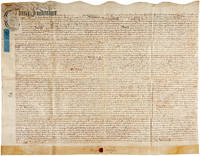
1719146958November 11 1719. Rare and unrecorded 18th century legal document signed twice at the conclusion by Sir Isaac Newton as a witness to a land indenture. Manuscript document signed twice on the verso "Isaac Newton" one vellum membrane dated 11 November 1719 signed by Thomas Sturgess and with his seal witnessed twice on the dorse the sealing of the document and the payment of the PS270 witnessed separately by Newton and also by Richard Cox and James Weston and also signed again by Sturgess. The document records an indenture by which Thomas Sturgess of the parish of St Martin's in the Fields sells to Robert Newton of Colsterworth Lincs for the sum of PS270 a messuage or tenement in Colsterworth in the tenure of William Bulliner and also around 70 acres of arable land and pasture in Colsterworth and Woolsthorpe "Woollstrop" also occupied by the Bulliner family William Joan and son John also one rood i.e. quarter acre of land previously belonging to John Storey of Kneeton Notts and other lands. Newton was in his mid-70s when he witnessed this deed and was living in London as Master of the Mint. He almost certainly knew both parties to this transaction. His home in St Martin's Street was in the parish of St Martin's in the Fields which was also the home of Thomas Sturgess who was selling the land in this transaction. The buyer was his first cousin once removed Robert Newton of Colsterworth d.1734. Isaac Newton would also have been familiar with the fields and houses that his cousin was buying: the property in question included land in Newton's native hamlet of Woolsthorpe as well as in the adjacent village of Colsterworth. In near fine condition. The piece measures 20 inches by 23. Documents signed by Sir Isaac Newton are rare and most relate to his work as Master of the Mint. A document closely related to this one was however sold at auction in 2015. Dated one day before the current document that deed recorded the sale of land by Sturgess to Robert Newton for the nominal sum of 5 shillings. It was similarly signed only once by Isaac Newton as a witness. English mathematician astronomer theologian author and physicist Sir Isaac Newton is widely considered one of the most influential scientists of all time and a key figure in the scientific revolution. In one of his most important works Philosophiæ Naturalis Principia Mathematica Newton formulated the laws of motion and universal gravitation that formed the dominant scientific viewpoint until being superseded by the theory of relativity. Considered one of the greatest works of science ever published Newton’s second major book Opticks analyzes the fundamental nature of light by means of the refraction of light with prisms and lenses the diffraction of light by closely spaced sheets of glass and the behavior of color mixtures with spectral lights or pigment powders. hardcover
1797028149New York: Printed and sold by Isaac Collins no. 189 Pearl-Street 1797. Small Octavo. xii 2 360 pages. In this travelogue and account of American Quaker practice Scott recounts how he traveled from his home in Rhode Island to congregations of Friends throughout the United States in 1779. The big issue was the Quaker refusal to pay taxes to support the war. Though evocative place names are abundant travel-detail is limited. His diary is divided between his soul-searching and specific accounts of his experiences at various meetings. Although Scott often records feeling compelled to remain silent in these meetings he was a notable speaker and his writings although they became controversial after his death were highly influential. "A testimony from the Monthly Meeting of Providence concerning Job Scott."--Page iii-x./ Bio/History: "The Rhode Island Quaker minister Job Scott . was not a deist but a Quietist who advocated the inward experience of God over any outward authorities and placed personal experience as central to authentic spiritual experience ." Previous owner's gift of book reads: "Mary Lawson to Lactitia Harry to Sarah Lukens". The inscription appears to be in the early 19th century. Bound in modern black cloth spine lettering gilt newer endpapers some toning to leaves. A very good copy. Cf. Dandelion Introduction to Quakerism p. 84. Evans 32810; Howes S-228. Printed and sold by Isaac Collins, no. 189, Pearl-Street unknown
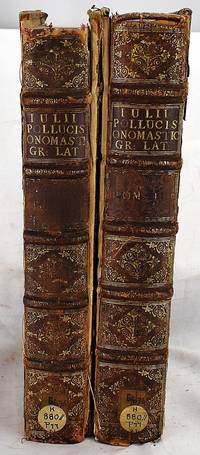
17061902070089Amsterdam: Ex officina Wetsteniana MDCCVI 1706. Hardcover. Good. Onomasticon = Onomastikon 2 volume set. Folios 41 cm. Bound in contemporary calf. Gilt ruled spine compartments 5 raised bands. Hinges cracked. Boards detached. Early hand-written "Yale College Library" on front end page. Later library book plates and blind stamps. All edges red. 8 48 1388 16 178 10 p. Paged continuously. Page are generally clean in very good shape with wide margins. Latin and Greek in parallel columns. Engraved frontispiece. Includes indexes. BMC20:628.523. Julius Pollux was a Greek scholar and rhetorician from Egypt 2nd century AD. His thesaurus of Attic Greek was an important reference for understanding antiquity and had an influence on the Renaissance rediscovery and understanding of the classics. This is an oversized or heavy book which requires additional postage for international delivery outside the US. Amsterdam: Ex officina Wetsteniana, MDCCVI hardcover
1722k5662Padua: Patavii Typis Seminarii / Joannem Mansre. G : in good condition without dust jacket. Cover lightly soiled and scratched. Corner tear title panel on spine with loss. Previous owner's inscription to fep. Fore-edge and margins foxed. 1722. Reprint. Cream hardback vellum cover. 180mm x 130mm 7" x 5". 448pp. Engraved frontis plate. . Patavii Typis Seminarii / Joannem Mansre hardcover
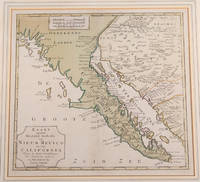
176517201Amsterdam 1765. Engraved hand-colored map matted and framed. A beautiful hand-colored map of the American southwest focusing on the Southern California Baja California the Gulf of California and Arizona notwithstanding the title there is no portion of New Mexico depicted. Tirion names San Diego the Santa Catalina Islands Ensenada and Cabo San Lucas on the coast plus Casa Grande on the River Gila which though marked as a mission was a large site of a Native American ruin. He includes images of missions and forts in Baja at San Jose del Cabo and Loretto.<br /> <br /> This is apparently the earliest printing of the map published in Tirion’s Nieuwe en Beknopte Hand-Atlas 1765. It was re-issued a number of times over the next decade. <br /> <br /> Tirion 1705-1765 was a Dutch publisher in Amsterdam. He produced several atlases and Dutch town plans as well as a number of pamphlets which are all quite scarce. unknown
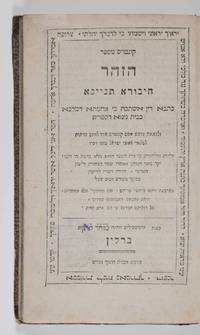
178248885Berlin and Dessau: Hevrat Hinukh Ne‘arim Berlin Freischule/n.p. 1782. First editions 2 of 4. Hardcover. Nearly Fine. Sammelband of four opuscules published between 1782 and 1819 octavo. Contemporary half calf top inch perished over pastepaper boards; spine lettered and tooled in gilt. Edges speckled blue. Covers lightly worn else fine clean copies the fourth work lightly foxed throughout. The first three works issued from the Hevrat Hinukh Ne'arim Berlin Freischule under the supervision of Isaac Satanow 1732-1804 the most prolific Hebrew writer of the Berlin Haskalah. As director of the publishing house Satanow was assigned the task of reissuing old Hebrew classics by the Marpeh ha-Nefesh a philanthropic group headed by the banker Daniel Itzig his son-in-law David Friedländer and the famous physican and philosopher Marcus Herz. A number of these editions however were in fact original works by Satanow which he presented as the work of earlier writers. The first item in the sammelband is an outstanding example of this latter type.<br /> <br /> I. Kuntres mi-Sefer ha-Zohar Hibura Tinyana Berlin: Hevrat Hinukh Ne‘arim 1783. aleph-gimel8 dalet1; 25ff. Vinograd Berlin 313. First edition of this polemic styled in imitation of the Zohar as a response to the Mitpahat Sefarim 1768 of Jacob Emden 1697-1776 in which the latter calls into question the antiquity and textual integrity of that chief work of the Jewish mystical tradition. Emden's critique may be understood as an attempt to undermine the doctrinal foundation of the Frankists who based their beliefs on the Zohar. "Emden had suspected the authenticity of the Zohar for a long time and he hoped some time 'to reveal the strange things found in the book.' But these intentions were secretly nursed within him for many years until the time was propitious for his exposé" Cohen. Perhaps surprisingly for a maskil Satanow held a very different view: "While advocating secular knowledge and the study of science Satanow also expressed great admiration for Kabbalah. In contrast to Emden he claims that the whole Zohar was written by Bar Yohai and Moses De Leon had nothing to do with its writing. He also rejects Emden's claim that in the Zohar there are words against the Talmud and promises to 'consult the Zohar and prove that all its words are right and truthful none of them is crooked Kuntres mi-Sefer ha-Zohar pp. 25 26" N. Rezler-Bersohn. Born in the Polish now Ukrainian town of Satanov Isaac Satanow settled in Berlin around 1771. "Among the most prolific of the early Haskalah writers. Satanow demonstrated a wealth of knowledge of the Hebrew language ranking as a model stylest throughout the Haskalah period" EJ 14: 905-906. As a leading representive of the eighteenth-century Jewish Enlightement Satanow boldly displayed a "conglomeration of contrasts" Jewish Enc. XI: 71: “Though Orthodox in his beliefs he nevertheless favored Reform in practice. He was one of the greatest authorities on Jewish tradition and lore yet he was one of the most free-thinking of philosophers.†For a more detailed discussion of this and other works by Satanow see N. Rezler-Bersohn "Isaac Satanow - An Epitome of an Era" in: Year Book XXV Leo Baeck Institute 1980. For Emden in the present context see M. L. Cohen Jacob Emden A Man of Controversy Philadelphia: The Dropsie College 1937 pp. 254ff.<br /> <br /> II. Sefer Igeret ha-Kodesh Berlin 553 1793. 7ff. Vinograd Berlin 415. Later edition of this well-known work. The celebrated talmudist and exegete Nachmanides the Ramban Moses ben Nachman ca. 1195-ca. 1270 acted as a conciliator between the parties in the early 13th-century controversies surrounding the philosophical and secular direction of Maimonides' growing influence. "After having given the earlier part of his life to his Talmudical works Moses Nachmanides devoted himself to writing of a homiletic-exegetic and devotional character. To these belong the "Iggeret ha-Kodesh" and the "Torat ha-Adam." In the former which deals with the holiness and significance of marriage Moses criticizes Maimonides for stigmatizing as a disgrace to man certain of the desires implanted in the human body. In Moses' opinion the body with all its functions being the work of God none of its impulses can be regarded as intrinsically objectionable" Jewish Enc. IX:88. The rare editio princeps appeared at Rome in 1546; the editor of the present edition Isaac Satanow notes at the title that the letter was “printed in Basel in the year 5340†referring to the 1580 edition of Ambrosius Froben Prijs 127.<br /> <br /> III. Nevu’at ha-Yeled Berlin: Hevrat Hinukh Ne‘arim 549 1789. asterisk8 2asterisk2. 10 unnumbered leaves. Vinograd Berlin 384. Later edition of a medieval Hebrew short story with commentary first printed at the end of Jacob Zemah's Sefer Nagid u-Metzaveh Constantinople 1726. "The body of the tale is followed by a number of occult prophecies in Aramaic. it was known already as early as the end of the 15th century and the beginning of the 16th when some kabbalists among them R. Abraham b. Eliezer ha-Levi wrote commentaries on the prophecies. The story tells of a wonder child Nahman born in the fifth century to a kabbalist; the child died very young but immediately upon birth began to tell his mother secrets of the heavenly worlds. His father cautioned him not to reveal mysteries forbidden to man and from then the child spoke only obscurely and enigmatically. Modern scholars have attempted to date the story and the prophecies therein by tracing known historical events hinted at and relating them to the text. The obscurity of the text makes this very difficult but it seems probable that historical events in the 15th century especially in the East are referred to in the prophecies. However the purpose of the story and its prophecies was to anticipate the coming of the Messiah and to describe the major political and historical events and catastrophes bringing about his final revelation. The kabbalists interpreted the prophecies as hinting at the coming of the Messiah in the early 16th century" JE XII:1020. Here the commentary on the Aramaic "prophecies" is likely attributable to Satanow.<br /> <br /> IV. Herev Nokemet Nekam Berit Dessau 5579 1819. 16pp. Vinograd Dessau 77. First edition of this famous polemical letter. A leader of the Reform movement Meyer Israel Bresselau d. 1839 together with I. S. Fraenkel edited and adapted in 1818 a prayer book for the Hamburg Reform Temple under the title Seder ha-Avodah. He anonymously published the present work in response to Eleh Divrei ha-Berit Altona 1819 "a pamphlet which collated the views of the greatest Orthodox rabbis of Western Europe against Reform Judaism and its innovations." A rhymed work written in a satirical biblical style Herev Nokemet is "remarkable in its witty take-off on the Orthodox rabbis who opposed the reforms in the Hamburg Reform synagogue. It ranks among the best Hebrew polemic literature written at the time of the Haskalah" EJ 4:1358 In response Meir Leib Reinitz published his Lahat ha-Herev ha-Mithappekhet in 1820. Bresselau's polemic was reprinted as an appendix to Bernfelds's Toledot ha-Reformazyon ha-Datit be-Yisrael in 1900. ×§×•× ×˜×¨×¡ מספר הזהר ×—×™×‘×•×¨× ×ª× ×™×™× ×<br /> ספר ×גרת הקדש<br /> × ×‘×•×ת הילד<br /> חרב × ×§×ž×ª × ×§× ×‘×¨×™×ª. Hevrat Hinukh Ne‘arim (Berlin Freischule)/[n.p.] hardcover
1723AL12GTB29322Jean Villette Paris 1723. Hardback full calf. Folio 39 x 27cm. 1723 Nouvelle edition. 14 548pp. 267 engraved illustrations in the text. Lacks 1 leaf of prelims following advertisement and the final two un-numbered leaves following page 548. First page of main text loose with a tear to the margin. Occasional marks and a few marginal stains but generally clean. Previous owner's armorial bookplate on the front pasetdown. Calf worn and rubbed but binding remains secure. . Hard Cover. Fair. Jean Villette, Paris Hardcover
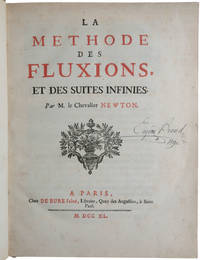
174039297Paris De Bure 1740. 4to. Contemporary half calf raised bands richly gilt spine and and red speckled edges. Leather title-label to spine. Corners neatly repaired. Title in red/black. 2 III-XXX 2 Errata 148 pp. many diagrams. The "Preface" and the first 18 leaves of the text with a foxing to lower margin and right corners. The "Preface" is an historical account of Newton's method "la sublime méthode" written by Buffon. Without the leaf "Extrait des Registres". <br/><br/><em>The influential first French edition of Newton's important work which constitutes the most extensive description of the mathematical method he used in his famous "Principia" the method of infinitesimals which was already written about 1671 but not published until 1736 i.e. posthumously with the title "Method of Fluxions and Infinite Series.". In this work "Newton stated clearly the fundamental problem of the calculus: the relation of quantities being given to find the relation of the fluxions of these and conversely. In conformity with this problem and the new notation Newton then gave examples of his method.In this book Newton introduced his characteristic notation and conceptions. He regarded his variable quantities as generated by the continuous motion of points lines and planes rather than as aggregates of infinitesimal elements the view which had appeared in "De analysi".The rate of generation Newton called a "fluxion" designating it by means of a letter with a dot over it a "pricked letter" the quantity generates he called a "fluent". Boyer The History of the Calculus.Colson in his preface to the first edition from 1736 says: "I gladly embraced the opportunity that was put into my hands of publishing this posthumous work because I found it had been composed with that view and design. And that my own Country-men might first enjoy the benefit of this publication I resolved upon giving it an English translation with some additional remarks of my own I thought it highly injurious to the memory and reputation of the real Author as well as invidious to the glory of our own Nation that so curious and useful a piece should be any longer suppress'd and confined to a few private hands which ought to be communicated to all the learned World for general Instruction.It was through the French translations of his works that Newton came to play the seminal role as the most important of mathematicians that he did in France and particularly the years around 1740 when the present work appeared in French for the first time were seminal to the scientific development in France where the likes of Voltaire had only just made the nation acquinted with the work of the great mathematician. Gray No 236. Babson No 173. </em> hardcover
17405802Paris: De Bure l'aine 1740. First edition. <p>First edition in French of Newton's first exposition of his fluxional calculus translated with a long and impotant preface by the celebrated naturalist Comte de Buffon. Originally written in 1671 in Latin this was Newton's first comprehensive presentation of his method of fluxions which according to Hall 'might have effected a mathematical revolution in its own day' Philosophers at War pp. 65-6. It should properly be placed first in the great trilogy of Newton's major works: Fluxions Principia 1687 and Opticks 1704.</p>. BUFFON'S TRANSLATION OF NEWTON'S EXPOSITION OF CALCULUS. <p>First edition in French of Newton's first exposition of his fluxional calculus translated with a long and important preface by the celebrated naturalist Comte de Buffon. Originally written in 1671 in Latin this was Newton's first comprehensive presentation of his method of fluxions which according to Hall 'might have effected a mathematical revolution in its own day' Philosophers at War pp. 65-6. It should properly be placed first in the great trilogy of Newton's major works: Fluxions Principia 1687 and Opticks 1704. Newton's Methodus fluxionum remained unpublished until its English translation by John Colson in 1736. In it he presents a method of determining the magnitudes of finite quantities by the velocities of their generating motions. At its time of preparation it was Newton's fullest exposition of the fundamental problem of the calculus in which he presented his successful general method. Newton prepared this treatise just before his death. The autograph manuscript which survives in Cambridge University Library was entrusted to Henry Pemberton after Newton's death but he did not publish it. John Colson 1680-1760 based his translation on a copy of Newton's original manuscript made by William Jones. Both Newton's manuscript and Jones's copy lack a title page and it is unknown what title if any Newton gave to the manuscript. The title 'De methodus fluxionum' originates with Colson. In the preface Colson writes "I thought it highly injurious to the memory and reputation of our own nation that so curious and useful a piece should be any longer suppressed." Buffon translated Colson's edition in 1737 and added his lengthy preface the following year. The most interesting part of the preface is that dealing with the conception of the infinite and the metaphysical errors to which it leads. This includes a discussion of Berkeley's The analyst 1734 which oddly he criticizes although Berkeley's conclusions are very similar to his own.</p> <br /> <p>Provenance: Eugène Brand signature on title dated 1890.</p> <br /> <p>Newton wrote three accounts of the calculus. The composition of the first a tract entitled 'De analysi per aequationes numero terminorum infinitas' resulted from Newton's reception from Isaac Barrow in the early months of 1669 of a copy of Mercator's Logarithmotechnia a work which contained the series for log1 x. The work in which Newton demonstrated his much more general methods of infinite series was not published until 1711 when William Jones included it along with a number of other tracts in his Analysis per quantitatum series. In 'De analysi' however Newton "did not explicitly make use of the fluxionary notation or idea. Instead he used the infinitely small both geometrically and analytically in a manner similar to that found in Barrow and Fermat and extended its applicability by the use of the binomial theorem. . It will be noticed that although the work of Newton contains the essential procedures of the calculus the justification of these is not clear from the explanation he gave. Newton did not point out by what right the terms involving powers of o were to be dropped out of the calculation any more than Fermat or Barrow . His contribution was that of facilitating the operations rather than of clarifying the conceptions. As Newton himself admitted in this work his method is 'shortly explained rather than accurately demonstrated'" Boyer The Concept of Calculus p.191.</p> <br /> <p>It was first in 'Methodus fluxionum' that "Newton introduced his characteristic notation and conceptions. Here he regarded his variable quantities as generated by the continuous motion of points lines and planes rather than as aggregates of infinitesimal elements the view which had appeared in 'De analysi'. . In the 'Methodus fluxionum' Newton stated clearly the fundamental problem of the calculus: the relation of quantities being given to find the relation of the fluxions of these; and conversely" ibid. pp. 192-3.</p> <br /> <p>In Newton's third exposition De quadratura which was composed some twenty years after 'Methodus fluxionum' and published as an appendix to the Opticks "Newton sought to remove all traces of the infinitely small" ibid.</p> <br /> <p>"It was often lamented that the world had had to wait so many years to see Newton's masterpiece on fluxions. It is astonishing to realize that publication sixty years beforehand would have changed the history of the calculus and would have avoided for Newton any controversy over priority. In 1736 all the results contained in Newton's treatise were well known to mathematicians. However it was too concise for a beginner and Colson added almost 200 pages of explanatory notes. His commentary contributed to the establishment of a kinematical approach to the problem of foundations. In his explanatory notes Colson presents the 'geometrical and Mechanical Elements of Fluxions'. He writes:</p> <br /> <p>'The foregoing Principles of the Doctrine of Fluxions being chiefly abstracted and Analytical. I shall here endeavour after a general manner to shew something analogous to them in Geometry and Mechanicks: by which they may become not only the object of the Understanding and of the Imagination which will only prove their possible existence but even of Sense too by making them actually to exist in a visible and sensible form'.</p> <br /> <p>"Colson was convinced that by using moving diagrams it is possible to exhibit 'Fluxions and Fluents Geometrically and Mechanically . so as to make them the objects of Sense and ocular Demonstration'. The motivation for using the geometrical and mechanical elements of fluxions is clearly that of guaranteeing an ontological basis to the calculus; in fact:</p> <br /> <p>'Fluents Fluxions and their rectilinear Measures will be sensibly and mechanically exhibited and therefore must be allowed to have a place in rerum natura'.</p> <br /> <p>"Colson's approach to the calculus is representative of a whole generation of British mathematicians: his 'sensibly exhibited rectilinear measures' of fluxions are a naive anticipation of Maclaurin's kinematic definitions of the basic concepts of the calculus" Guicciardini The Development of Newtonian Calculus in Britain 1700-1800 pp. 56-57.</p> <br /> <p>"In his preface . Colson noted:</p> <br /> <p>'The chief Principle upon which the Method of Fluxions is here built is. taken from the Rational Mechanicks; which is That Mathematical Quantity particularly Extension may be conceived as generated by continued local Motion; and that all Quantities may be conceived as generated after a like manner. Consequently there must be comparative Velocities of increase and decrease during such generations whose Relations are fixt and determinable and may therefore . proposed to be found.'</p> <br /> <p>"Thus a line or a curve was seen as generated by a continuously moving point a surface by the motion of a line and a solid by the motion of a surface. After defining fluxions fluents and moments Newton went on to show how within this framework significant results could be derived. Following an introduction in which it was shown how equations could be solved with the use of infinite series seven major problems were considered:</p> <br /> <br /> From the Following Quantities fluents given to find their fluxions.<br /> From the given Fluxions to find the Flowing Quantities.<br /> To determine Maxima and Minima of Quantities.<br /> To draw Tangents to Curves.<br /> To find the Quantity of Curvature in any Curve.<br /> To find the Quality of Curvature in any Curve.<br /> To find any number of Curves that may be squared"<br /> <br /> <p>Gjertsen Newton Handbook p. 158.</p> <br /> <p>"Buffon did start his scientific career as a Newtonian. He agreed that science should search for nature's laws and that those laws should be as simple and as universal as possible. Buffon's strong stance in favor of an orthodox Newtonianism was most obvious during his academic polemics with Alexis Clairaut. Buffon also published translations of two English books: Stephen Hales's Vegetable Staticks 1735 and Newton's Treatise on Fluxions 1740. The young man who wrote the prefaces to these books praised the experimental spirit of the English. But to what extent did these texts in fact express Buffon's supposed Newtonian position .</p> <br /> <p>"The case of the preface to Newton's Fluxions 1740 was a different matter since it appeared to be a sign of allegiance both to Newton and to mathematics in the guise of the calculus. But in fact Buffon's preface while acknowledging the perfect clarity of Newton's ideas developed a metaphysical critique of the concept of the infinite that had been closely tied to the practice of geometry. Buffon asserted that our daily experience by means of sensation is restricted to the limited the finite-and therefore that the arithmetical or geometrical infinite had no actual existence. The preface to the Fluxions far from being a sign of Buffon's loyalty to mathematical conceptions of science instead stressed the lack of reality of mathematical ideas. Some of these strong statements would later be developed near the end of the 'Premier discours' of the Histoire naturelle" Hoquet pp. 39-41.</p> <br /> <p>"In his preface Buffon rewrote the history of the calculus - drawing inspiration largely from a book that Fontenelle had published in 1727 Élémens de la géométrie de l'infini - in which he sided strongly with Newton against Leibniz. He was rightly criticized for his lack of objectivity and he became closely tied with English scholars whose point of view he blindly adopted. In France furthermore he became involved with Clairaut Maupertuis and Voltaire in a battle in defense of Newton. His translation and preface must be viewed from his perspective - historical objectivity was not his main concern .</p> <br /> <p>"The debate on infinity tells us something about Buffon's intellectual temperament . At the end of the seventeenth century a lengthy evolution of ideas had led to the Newtonian conception of an infinite time and space and therefore an infinite universe . Calculus gave a new topicality to this philosophical debate since it raised the question of whether the infinitely small quantities manipulated by the new calculus really existed. Leibniz did not believe so . In 1727 Fontenelle defended their real existence and Buffon seemed at first to have accepted his argument. He now attacked Fontenelle without naming him .</p> <br /> <p>"Buffon rejected Fontenelle's conclusion mainly because he did not differentiate between geometrical and metaphysical infinities. 'The idea of infinity' he said 'is only an idea of absence and has no concrete representation.' Even 'space time and duration are not real Infinities.' Likewise 'there is no number that is at present Infinite or infinitely small or smaller or bigger than an Infinity etc.' Because 'Numbers are no more than representations and never exist independently of the things they represent' they do not have a 'real existence' and things themselves cannot be infinite .</p> <br /> <p>"The direct consequence of this philosophy was that mathematics does not teach us anything about reality. More precisely - and here Buffon distanced himself radically from Fontenelle - mathematics does not have its own reality. Fontenelle gives an intellectual reality to numbers and geometrical figures independent of all physical and metaphysical reality. For Buffon there was only physical reality. Thus mathematics was only a tool practical even indispensable but nothing more .</p> <br /> <p>"The last argument in which Buffon intervened was the one that the idealistic philosopher Berkeley had provoked by attacking the metaphysical foundations of calculus .it is clear that Buffon addressed it only to defend his friend the English doctor and mathematician James Jurin. Regardless of what he said Buffon certainly had not read Berkeley's book The analyst 1734 attentively otherwise he would have seen that Berkeley's criticisms of the status of the infinitely small corresponded exactly to his own although they were based on an extremely different metaphysics. As with Leibniz the fundamental philosophical differences prevented Buffon from recognising what they had in common. His attack on Berkeley was more satire than philosophical discussion. By intervening so lightly into a serious debate Buffon exposed himself to criticism. The interesting thing about this episode is that it shows his friendship with James Jurin and suggest that it was Jurin who had advised him in the Leibniz-Newton controversy" Roger pp. 34-38.</p> <br /> <p>Babson 173; Macclesfield 1533; Wallis 236. Hoquet 'History without Time. Buffon's natural history as a nonmathematical physique Isis 101 2010 pp. 30-61. Roger Buffon: A Life in Natural History 1997.</p> <br/> <br/> 4to 255 x 196 mm pp. xxx 4 errata and privilege 148 title printed in red and black woodcut figures in text. Contemporary quarter-morocco and marbled boards spine ruled and in gilt with red lettering-piece a little rubbed joints starting. De Bure l'aine unknown
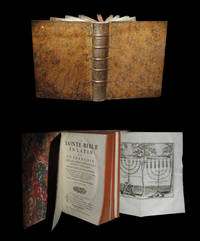
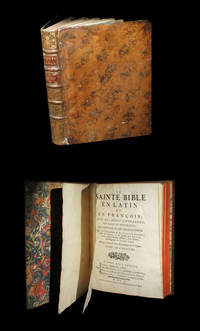
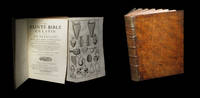
1750274581750. A Paris chez Gabriel Martin / J. B. Coignard et Ant. Antoine Boudet / Pierre-Jean Mariette / Hippolyte-Louis GuÂŽrin 1749. Un fort vol. au format in-4 264 x 207 mm de 1 f. bl. 2 ff. n.fol. 789 pp. et 1 f. bl. Reliure de l'ÂŽpoque de plein veau glacÂŽ et marbrÂŽ havane triple filet ˆ froid encadrant les plats dos ˆ nerfs ornÂŽ de filets gras ˆ froid jeu de petits filets obliques sur les nerfs doubles caissons d'encadrement dorÂŽs filets verticaux dentelÂŽ dorÂŽs larges fleurons dorÂŽs semis d'ÂŽtoiles dorÂŽes piÂces de titre et de tomaison de maroquin brun titre dorÂŽ tomaison dorÂŽe palette dorÂŽe en queue filet dorÂŽ sur les coupes tranches rouges. Edition en partie originale. Tome 4Âme seul ; cependant complet en tant que tel. ll renferme Les Deux derniers livres des Rois ainsi que les ParalipomÂnes. 15 planches dÂŽpliantes gravÂŽes. ''Traduction de Port-Royal due essentiellement ˆ Isaac Lemaistre de Sacy avec insertion en italiques du texte de Louis CarriÂres complÂŽtÂŽ par des Notes de Laurent-Etienne Rondet. Les prÂŽfaces et dissertations sont tirÂŽes pour l'essentiel des textes d'Augustin Calmet de Louis CarriÂres et d'Henri-FranÂois de Vence ; dont certaines paraissent ici pour la premiÂre fois''. in Bibles imprimÂŽes conservÂŽes ˆ Paris. ''Traduction estimÂŽe du fait des commentaires qui l'accompagnent''. in Brunet. ParticuliÂrement ceux d'Augustin Calmet. Bibles imprimÂŽes conservÂŽes ˆ Paris n¡617 - Brunet I Manuel du libraire et de l'amateur de livres 887 - De Bure Bibliographie instructive ou TraitÂŽ de la connaissance des livres rares et singuliers 123 pour les commentaires de Calmet - QuÂŽrard II La France littÂŽraire p. 25 - Barbier I Dictionnaire des ouvrages anonymes 404. Angles ÂŽlimÂŽs. Coiffes arasÂŽes. Dos lÂŽgÂrement craquelÂŽ. Petite galerie de ver en marge gauche des premiers feuillets sans atteinte au texte. Plusieurs planches dÂŽsolidarisÂŽes ; pouvant en outre prÂŽsenter des plissures ou dÂŽchirures marginales ainsi que parfois des petits manques marginaux. Du reste ensemble en bonne condition. b42961 unknown
1750274601750. A Paris chez Gabriel Martin / J. B. Coignard et Ant. Antoine Boudet / Pierre-Jean Mariette / Hippolyte-Louis GuÂŽrin 1750. Un fort vol. au format in-4 264 x 207 mm de 1 f. bl. 3 ff. n.fol. 653 pp. et 1 f. bl. Reliure de l'ÂŽpoque de plein veau glacÂŽ et marbrÂŽ havane triple filet ˆ froid encadrant les plats dos ˆ nerfs ornÂŽ de filets gras ˆ froid jeu de petits filets obliques sur les nerfs doubles caissons d'encadrement dorÂŽs filets verticaux dentelÂŽ dorÂŽs larges fleurons dorÂŽs semis d'ÂŽtoiles dorÂŽes piÂces de titre et de tomaison de maroquin brun titre dorÂŽ tomaison dorÂŽe palette dorÂŽe en queue filet dorÂŽ sur les coupes tranches rouges. Edition en partie originale. Tome 10Âme seul ; cependant complet en tant que tel. ll renferme Les Commentaires de Zacharie Malachie et AggÂŽe ainsi que Les MacchabÂŽes. 1 planche dÂŽpliante et 1 carte gravÂŽe gravÂŽe. ''Traduction de Port-Royal due essentiellement ˆ Isaac Lemaistre de Sacy avec insertion en italiques du texte de Louis CarriÂres complÂŽtÂŽ par des Notes de Laurent-Etienne Rondet. Les prÂŽfaces et dissertations sont tirÂŽes pour l'essentiel des textes d'Augustin Calmet de Louis CarriÂres et d'Henri-FranÂois de Vence ; dont certaines paraissent ici pour la premiÂre fois''. in Bibles imprimÂŽes conservÂŽes ˆ Paris. ''Traduction estimÂŽe du fait des commentaires qui l'accompagnent''. in Brunet. ParticuliÂrement ceux d'Augustin Calmet. Bibles imprimÂŽes conservÂŽes ˆ Paris n¡617 - Brunet I Manuel du libraire et de l'amateur de livres 887 - De Bure Bibliographie instructive ou TraitÂŽ de la connaissance des livres rares et singuliers 123 pour les commentaires de Calmet - QuÂŽrard II La France littÂŽraire p. 25 - Barbier I Dictionnaire des ouvrages anonymes 404. Coiffes arasÂŽes. DiscrÂte abrasion en marge du premier plat. Quelques cahiers oxydÂŽs et claires rousseurs dans le corps d'ouvrage. Petit manque angulaire affectant un feuillet. Du reste bonne condition. b42961 unknown
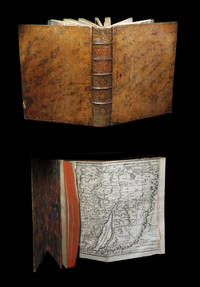
1750274651750. A Paris chez Gabriel Martin / J. B. Coignard et Ant. Antoine Boudet / Pierre-Jean Mariette / Hippolyte-Louis GuÂŽrin 1748. Un fort vol. au format in-4 264 x 207 mm de 1 f. bl. ii - 781 pp. et 1 f. bl. Reliure de l'ÂŽpoque de plein veau glacÂŽ et marbrÂŽ havane triple filet ˆ froid encadrant les plats dos ˆ nerfs ornÂŽ de filets gras ˆ froid jeu de petits filets obliques sur les nerfs doubles caissons d'encadrement dorÂŽs filets verticaux dentelÂŽ dorÂŽs larges fleurons dorÂŽs semis d'ÂŽtoiles dorÂŽes piÂces de titre et de tomaison de maroquin brun titre dorÂŽ tomaison dorÂŽe palette dorÂŽe en queue filet dorÂŽ sur les coupes tranches rouges. Edition en partie originale. Tome 2Âme seul ; cependant complet en tant que tel. ll renferme Le LÂŽvitique les Nombres et le DeutÂŽronome. 3 planches dÂŽpliantes gravÂŽes et une carte dÂŽpliante. ''Traduction de Port-Royal due essentiellement ˆ Isaac Lemaistre de Sacy avec insertion en italiques du texte de Louis CarriÂres complÂŽtÂŽ par des Notes de Laurent-Etienne Rondet. Les prÂŽfaces et dissertations sont tirÂŽes pour l'essentiel des textes d'Augustin Calmet de Louis CarriÂres et d'Henri-FranÂois de Vence ; dont certaines paraissent ici pour la premiÂre fois''. in Bibles imprimÂŽes conservÂŽes ˆ Paris. ''Traduction estimÂŽe du fait des commentaires qui l'accompagnent''. in Brunet. ParticuliÂrement ceux d'Augustin Calmet. Bibles imprimÂŽes conservÂŽes ˆ Paris n¡617 - Brunet I Manuel du libraire et de l'amateur de livres 887 - De Bure Bibliographie instructive ou TraitÂŽ de la connaissance des livres rares et singuliers 123 pour les commentaires de Calmet - QuÂŽrard II La France littÂŽraire p. 25 - Barbier I Dictionnaire des ouvrages anonymes 404. DiscrÂtes altÂŽrations superficielles affectant les reliures. Papier parfois lÂŽgÂrement oxydÂŽ. PrÂŽsence de quelques rousseurs et t‰ches claires. Deux planches dÂŽsolidarisÂŽes ; l'une avec manque marginal sans atteinte ˆ la composition. Du reste bonne condition. b42961 unknown
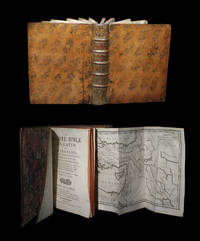
1750274611750. A Paris chez Gabriel Martin / J. B. Coignard et Ant. Antoine Boudet / Pierre-Jean Mariette / Hippolyte-Louis GuÂŽrin 1750. Deux parties reliÂŽs en un fort vol. au format in-4 264 x 207 mm de 1 f. bl. xxiv - 232 pp. ; 28 et 196 pp. Reliure de l'ÂŽpoque de plein veau glacÂŽ et marbrÂŽ havane triple filet ˆ froid encadrant les plats dos ˆ nerfs ornÂŽ de filets gras ˆ froid jeu de petits filets obliques sur les nerfs doubles caissons d'encadrement dorÂŽs filets verticaux dentelÂŽ dorÂŽs larges fleurons dorÂŽs semis d'ÂŽtoiles dorÂŽes piÂces de titre et de tomaison de maroquin brun titre dorÂŽ tomaison dorÂŽe palette dorÂŽe en queue filet dorÂŽ sur les coupes tranches rouges. Edition en partie originale. Tome 14Âme seul ; cependant complet en tant que tel. ll renferme des Dissertations sur la Vulgate une Table des noms chaldÂŽens syriaques et grecs rÂŽpandus dans la Bible ainsi qu'une Table des matiÂres contenues dans les textes de l'Ancien et du Nouveau Testament. ''Traduction de Port-Royal due essentiellement ˆ Isaac Lemaistre de Sacy avec insertion en italiques du texte de Louis CarriÂres complÂŽtÂŽ par des Notes de Laurent-Etienne Rondet. Les prÂŽfaces et dissertations sont tirÂŽes pour l'essentiel des textes d'Augustin Calmet de Louis CarriÂres et d'Henri-FranÂois de Vence ; dont certaines paraissent ici pour la premiÂre fois''. in Bibles imprimÂŽes conservÂŽes ˆ Paris. ''Traduction estimÂŽe du fait des commentaires qui l'accompagnent''. in Brunet. ParticuliÂrement ceux d'Augustin Calmet. Bibles imprimÂŽes conservÂŽes ˆ Paris n¡617 - Brunet I Manuel du libraire et de l'amateur de livres 887 - De Bure Bibliographie instructive ou TraitÂŽ de la connaissance des livres rares et singuliers 123 pour les commentaires de Calmet - QuÂŽrard II La France littÂŽraire p. 25 - Barbier I Dictionnaire des ouvrages anonymes 404. Angles ÂŽlimÂŽs. Infime manque en marge infÂŽrieure du premier plat. Quelques claires rousseurs dans le texte. Du reste bonne condition. b42961 unknown
1750274641750. A Paris chez Gabriel Martin / J. B. Coignard et Ant. Antoine Boudet / Pierre-Jean Mariette / Hippolyte-Louis GuÂŽrin 1749. Un fort vol. au format in-4 264 x 207 mm de 1 f. bl. 2 ff. n.fol. 680 pp. et 1 f. bl. Reliure de l'ÂŽpoque de plein veau glacÂŽ et marbrÂŽ havane triple filet ˆ froid encadrant les plats dos ˆ nerfs ornÂŽ de filets gras ˆ froid jeu de petits filets obliques sur les nerfs doubles caissons d'encadrement dorÂŽs filets verticaux dentelÂŽ dorÂŽs larges fleurons dorÂŽs semis d'ÂŽtoiles dorÂŽes piÂces de titre et de tomaison de maroquin brun titre dorÂŽ tomaison dorÂŽe palette dorÂŽe en queue filet dorÂŽ sur les coupes tranches rouges. Edition en partie originale. Tome 6Âme seul ; cependant complet en tant que tel. ll renferme Les Psaumes de David. 1 planche dÂŽpliante gravÂŽe. ''Traduction de Port-Royal due essentiellement ˆ Isaac Lemaistre de Sacy avec insertion en italiques du texte de Louis CarriÂres complÂŽtÂŽ par des Notes de Laurent-Etienne Rondet. Les prÂŽfaces et dissertations sont tirÂŽes pour l'essentiel des textes d'Augustin Calmet de Louis CarriÂres et d'Henri-FranÂois de Vence ; dont certaines paraissent ici pour la premiÂre fois''. in Bibles imprimÂŽes conservÂŽes ˆ Paris. ''Traduction estimÂŽe du fait des commentaires qui l'accompagnent''. in Brunet. ParticuliÂrement ceux d'Augustin Calmet. Bibles imprimÂŽes conservÂŽes ˆ Paris n¡617 - Brunet I Manuel du libraire et de l'amateur de livres 887 - De Bure Bibliographie instructive ou TraitÂŽ de la connaissance des livres rares et singuliers 123 pour les commentaires de Calmet - QuÂŽrard II La France littÂŽraire p. 25 - Barbier I Dictionnaire des ouvrages anonymes 404. Dos prÂŽsentant un ÂŽclat lÂŽgÂrement altÂŽrÂŽ. Brunissures au second plat. rares et claires rousseurs dans le texte. Quelques feuillets oxydÂŽs. Du reste belle condition. b42961 unknown
1750274621750. A Paris chez Gabriel Martin / J. B. Coignard et Ant. Antoine Boudet / Pierre-Jean Mariette / Hippolyte-Louis GuÂŽrin 1749. Un fort vol. au format in-4 264 x 207 mm de 1 f. bl. 2 ff. n.fol. 924 pp. et 1 f. bl. Reliure de l'ÂŽpoque de plein veau glacÂŽ et marbrÂŽ havane triple filet ˆ froid encadrant les plats dos ˆ nerfs ornÂŽ de filets gras ˆ froid jeu de petits filets obliques sur les nerfs doubles caissons d'encadrement dorÂŽs filets verticaux dentelÂŽ dorÂŽs larges fleurons dorÂŽs semis d'ÂŽtoiles dorÂŽes piÂces de titre et de tomaison de maroquin brun titre dorÂŽ tomaison dorÂŽe palette dorÂŽe en queue filet dorÂŽ sur les coupes tranches rouges. Edition en partie originale. Tome 7Âme seul ; cependant complet en tant que tel. ll renferme Les Cinq Livres moraux dont les Proverbes de Salomon L'EcclÂŽsiaste Le Cantique des Cantiques ainsi qu'un AbrÂŽgÂŽ de l'histoire profane. ''Traduction de Port-Royal due essentiellement ˆ Isaac Lemaistre de Sacy avec insertion en italiques du texte de Louis CarriÂres complÂŽtÂŽ par des Notes de Laurent-Etienne Rondet. Les prÂŽfaces et dissertations sont tirÂŽes pour l'essentiel des textes d'Augustin Calmet de Louis CarriÂres et d'Henri-FranÂois de Vence ; dont certaines paraissent ici pour la premiÂre fois''. in Bibles imprimÂŽes conservÂŽes ˆ Paris. ''Traduction estimÂŽe du fait des commentaires qui l'accompagnent''. in Brunet. ParticuliÂrement ceux d'Augustin Calmet. Bibles imprimÂŽes conservÂŽes ˆ Paris n¡617 - Brunet I Manuel du libraire et de l'amateur de livres 887 - De Bure Bibliographie instructive ou TraitÂŽ de la connaissance des livres rares et singuliers 123 pour les commentaires de Calmet - QuÂŽrard II La France littÂŽraire p. 25 - Barbier I Dictionnaire des ouvrages anonymes 404. Coiffe supÂŽrieure lÂŽgÂrement ÂŽlimÂŽe. Dos prÂŽsentant un ÂŽclat lÂŽgÂrement altÂŽrÂŽ. Quelques feuillets oxydÂŽs et claires rousseurs dans le corps d'ouvrage. DÂŽchirure en tÂte du dernier feuillet. Du reste bonne condition. b42961 unknown
1750274571750. A Paris chez Gabriel Martin / J. B. Coignard et Ant. Antoine Boudet / Pierre-Jean Mariette / Hippolyte-Louis GuÂŽrin 1750. Deux parties reliÂŽes en un fort vol. au format in-4 264 x 207 mm de 1 f. bl. iv - 247 pp. ; 448 pp. et 1 f. bl. Reliure de l'ÂŽpoque de plein veau glacÂŽ et marbrÂŽ havane triple filet ˆ froid encadrant les plats dos ˆ nerfs ornÂŽ de filets gras ˆ froid jeu de petits filets obliques sur les nerfs doubles caissons d'encadrement dorÂŽs filets verticaux dentelÂŽ dorÂŽs larges fleurons dorÂŽs semis d'ÂŽtoiles dorÂŽes piÂces de titre et de tomaison de maroquin brun titre dorÂŽ tomaison dorÂŽe palette dorÂŽe en queue filet dorÂŽ sur les coupes tranches rouges. Edition en partie originale. Tome 12Âme seul ; cependant complet en tant que tel. ll renferme Les Actes des Ap™tres et les Ep”tres de saint Paul. Une carte dÂŽpliante gravÂŽe. ''Traduction de Port-Royal due essentiellement ˆ Isaac Lemaistre de Sacy avec insertion en italiques du texte de Louis CarriÂres complÂŽtÂŽ par des Notes de Laurent-Etienne Rondet. Les prÂŽfaces et dissertations sont tirÂŽes pour l'essentiel des textes d'Augustin Calmet de Louis CarriÂres et d'Henri-FranÂois de Vence ; dont certaines paraissent ici pour la premiÂre fois''. in Bibles imprimÂŽes conservÂŽes ˆ Paris. ''Traduction estimÂŽe du fait des commentaires qui l'accompagnent''. in Brunet. ParticuliÂrement ceux d'Augustin Calmet. Bibles imprimÂŽes conservÂŽes ˆ Paris n¡617 - Brunet I Manuel du libraire et de l'amateur de livres 887 - De Bure Bibliographie instructive ou TraitÂŽ de la connaissance des livres rares et singuliers 123 pour les commentaires de Calmet - QuÂŽrard II La France littÂŽraire p. 25 - Barbier I Dictionnaire des ouvrages anonymes 404. LÂŽgÂres altÂŽrations superficielles affectant la reliure. Quelques rousseurs et t‰ches claires dans le corps d'ouvrage. Petite cerne en marge supÂŽrieure de quelques feuillets. Du reste belle condition. b42961 unknown
1750274631750. A Paris chez Gabriel Martin / J. B. Coignard et Ant. Antoine Boudet / Pierre-Jean Mariette / Hippolyte-Louis GuÂŽrin 1748. Un fort vol. au format in-4 264 x 207 mm de 1 f. bl. 2 ff. n.fol. 592 pp. et 1 f. bl. Reliure de l'ÂŽpoque de plein veau glacÂŽ et marbrÂŽ havane triple filet ˆ froid encadrant les plats dos ˆ nerfs ornÂŽ de filets gras ˆ froid jeu de petits filets obliques sur les nerfs doubles caissons d'encadrement dorÂŽs filets verticaux dentelÂŽ dorÂŽs larges fleurons dorÂŽs semis d'ÂŽtoiles dorÂŽes piÂces de titre et de tomaison de maroquin brun titre dorÂŽ tomaison dorÂŽe palette dorÂŽe en queue filet dorÂŽ sur les coupes tranches rouges. Edition en partie originale. Tome 3Âme seul ; cependant complet en tant que tel. ll renferme Le Livre de JosuÂŽ Le Livre des Juges le Livre de Ruth et Les Deux premiers livres des Rois. 3 cartes dÂŽpliantes gravÂŽes. ''Traduction de Port-Royal due essentiellement ˆ Isaac Lemaistre de Sacy avec insertion en italiques du texte de Louis CarriÂres complÂŽtÂŽ par des Notes de Laurent-Etienne Rondet. Les prÂŽfaces et dissertations sont tirÂŽes pour l'essentiel des textes d'Augustin Calmet de Louis CarriÂres et d'Henri-FranÂois de Vence ; dont certaines paraissent ici pour la premiÂre fois''. in Bibles imprimÂŽes conservÂŽes ˆ Paris. ''Traduction estimÂŽe du fait des commentaires qui l'accompagnent''. in Brunet. ParticuliÂrement ceux d'Augustin Calmet. Bibles imprimÂŽes conservÂŽes ˆ Paris n¡617 - Brunet I Manuel du libraire et de l'amateur de livres 887 - De Bure Bibliographie instructive ou TraitÂŽ de la connaissance des livres rares et singuliers 123 pour les commentaires de Calmet - QuÂŽrard II La France littÂŽraire p. 25 - Barbier I Dictionnaire des ouvrages anonymes 404. LÂŽgÂres altÂŽrations superficielles affectant la reliure. DiscrÂte cerne en marge des premiers feuillets. Petite galerie de ver en marge de quelques feuillets sans atteinte au texte. Quelques rousseurs. Au demeurant bel ensemble. b42961 unknown
1750274661750. A Paris chez Gabriel Martin / J. B. Coignard et Ant. Antoine Boudet / Pierre-Jean Mariette / Hippolyte-Louis GuÂŽrin 1749. Un fort vol. au format in-4 264 x 207 mm de 1 f. bl. 2 ff. n.fol. 614 pp. et 1 f. bl. Reliure de l'ÂŽpoque de plein veau glacÂŽ et marbrÂŽ havane triple filet ˆ froid encadrant les plats dos ˆ nerfs ornÂŽ de filets gras ˆ froid jeu de petits filets obliques sur les nerfs doubles caissons d'encadrement dorÂŽs filets verticaux dentelÂŽ dorÂŽs larges fleurons dorÂŽs semis d'ÂŽtoiles dorÂŽes piÂces de titre et de tomaison de maroquin brun titre dorÂŽ tomaison dorÂŽe palette dorÂŽe en queue filet dorÂŽ sur les coupes tranches rouges. Edition en partie originale. Tome 11Âme seul ; cependant complet en tant que tel. ll renferme l'ensemble des texte des Evangiles Matthieu Marc Luc et Jean. ''Traduction de Port-Royal due essentiellement ˆ Isaac Lemaistre de Sacy avec insertion en italiques du texte de Louis CarriÂres complÂŽtÂŽ par des Notes de Laurent-Etienne Rondet. Les prÂŽfaces et dissertations sont tirÂŽes pour l'essentiel des textes d'Augustin Calmet de Louis CarriÂres et d'Henri-FranÂois de Vence ; dont certaines paraissent ici pour la premiÂre fois''. in Bibles imprimÂŽes conservÂŽes ˆ Paris. ''Traduction estimÂŽe du fait des commentaires qui l'accompagnent''. in Brunet. ParticuliÂrement ceux d'Augustin Calmet. Bibles imprimÂŽes conservÂŽes ˆ Paris n¡617 - Brunet I Manuel du libraire et de l'amateur de livres 887 - De Bure Bibliographie instructive ou TraitÂŽ de la connaissance des livres rares et singuliers 123 pour les commentaires de Calmet - QuÂŽrard II La France littÂŽraire p. 25 - Barbier I Dictionnaire des ouvrages anonymes 404. Angles et coiffes ÂŽlimÂŽs. LÂŽgÂres altÂŽrations superficielles affectant par ailleurs la reliure. Rares rousseurs dans le texte. Nonobstant belle condition. b42961 unknown
180033248BB1800 . Paris: Brunot um 1800 16°. 208 S. 4 Tafeln Pappband Rücken beschabt; Ecken leicht bestossen; gut erhalten unknown
1718119622Amsterdan : Chez Pierre Humbert 1718. 250x200mm. 2 frontispices 4 ff. - CCCVII - 490 pages XXXVIII - 1 ff. - 702 pages reliure plein maroquin noir de l'ÂŽpoque dos trÂs ornÂŽs ˆ cinq nerfs toutes tranches dorÂŽes petite galerie de vers sur le haut du dos du tome deuxiÂme. Bonne ÂŽdition de cette traduction en partie inÂŽdite dans laquelle Jacques Lenfant et Isaac de Beausobre revendiquent la nÂŽcessitÂŽ de situer la Bible dans son contexte littÂŽraire et historique. Ouvrage illustrÂŽ de deux beaux frontispices dessinÂŽs et gravÂŽs par Picart qui est ÂŽgalement lÕauteur des vignettes gravÂŽes. Bon exemplaire malgrÂŽ les lÂŽgers dÂŽfauts signalÂŽs ˆ la reliure complet des deux cartes dÂŽpliantes : Lieux de la Terre Sainte dont il est parlÂŽ dans les Evangiles & Carte pour les Actes des Ap™tres. Bel exemplaire. 2850 Chez Pierre Humbert unknown
17531812280001A Paris chez Guillaume Desprez 1753. Hardcover. Acceptable. The 18th Century Bible of Marie Madelaine Mutel Bound in full contemporary leather. Binding shaken small chips to head / tail of spine. Marbled end sheets. xvi 653 pages. Blank end sheets heavily notated as Madame Mutel used the sheets to practice writing her name and penmanship. Engraved title vignette. Vignette au titre representant la distribution des N.T. avec la devise : "Sine sumptu ponam Evangelium." French bible. Reprint of the 1717 edition. A Paris, chez Guillaume Desprez hardcover
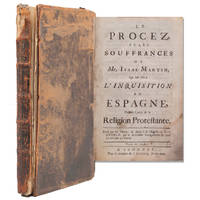
1723332777Londres: Pour le compte de l'Auteur 1723. Published the same year as the first edition in English. Frontispiece and 6 plates 3 folding backed. 12 121 1pp. 1 vols. 12mo. Contemp. calf front hinge off. Published the same year as the first edition in English. Frontispiece and 6 plates 3 folding backed. 12 121 1pp. 1 vols. 12mo. Martin an English merchant who was arrested in Malaga in 1718 and spent 8 months in the hands of the inquiition. He recounts his experiences in great detail. Pour le compte de l'Auteur unknown