NEWTON, IsaacBiblio.com
470 résultats
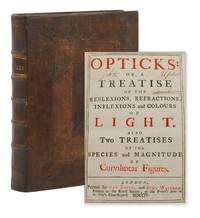
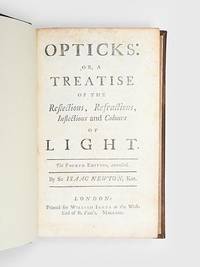
1730187897London: Printed for William Innys 1730. The definitive edition of Newton's second great work Fourth edition the final edition to be revised and approved by Newton himself. The Opticks is Newton's definitive study of light the basis for the corpuscular theory of light rays that remained dominant into the 19th century. The Opticks's greatest achievement is showing that colour is a mathematically definable property. Newton demonstrates that white light is a mixture of infinitely varied coloured rays and that each ray is definable by the angle through which it is refracted. Other topics include colour circles theories of the rainbow and the phenomenon now known as Newton's rings. In his later years Newton made a sustained effort to tidy up his scientific legacy. This edition of the Opticks was published three years after his death by his long-time publisher drawing on corrections "by the Author's own Hand" preface. In those three years Newtonian devotees had published the Optical Lectures 1728 that he had delivered at Cambridge in the 1660s making public a work that he had only circulated in manuscript among close friends. The Lectures employed a more mathematical analysis of colour theory than did the Opticks and Innys' fourth edition harmonizes the two works by cross-referencing philosophical propositions in the latter with geometrical demonstrations in the former. Octavo 195 x 123 mm pp. viii 382 2. Complete with terminal advertisement leaf and 12 folding plates. Wood-engraved initials head- and tailpieces. Twentieth-century calf spine ruled and decorated in blind and with red morocco label marbled endpapers edges sprinkled red. Minimal foxing to contents paper flaw to lower outer corner of K1 text unaffected plates crisp: a very good copy indeed. Babson 136; ESTC T69138; Gray 178; Wallis 178. unknown
1704140946960London: Printed for Sam. Smith and Benj. Walford Printers to the Royal Society at the Prince's Arms in St. Paul's Church-Yard 1704. First Edition. Very Good. First edition first issue of this foundational work in the field of optics in which Isaac Newton explores the nature of light and color presenting his experiments and theories on how light behaves. Title printed in red and black within a double-rule border and without author's name. Bound in contemporary paneled calf boards sympathetically rebacked; with 19 engraved folding plates. <p>Very Good. Soiling to textblock and endsheets bookplate of Irish naturalist John Vandeleur Stewart affixed to the front pastedown ownership signature to title page. Amateur repair to gutter at title page. Numerous pencil notations throughout though mostly confined to the margins or blank areas. Plate 5 is torn at the fold plate 6 with corner loss affecting the image several shaved. Second book with page 120 misnumbered as 112. <p>A lovely copy of Newton's second major book on physical science considered one of the Scientific Revolution's three major works on optics. It overturned centuries of thinking attributed to Aristotle or Theophrastus and accepted by scholars in Newton's time that "pure" light such as the light attributed to the Sun is fundamentally white or colorless and is altered into color by mixture with darkness caused by interactions with matter. Here Newton shows the opposite was true: light is composed of different spectral hues he describes seven – red orange yellow green blue indigo and violet and all colors including white are formed by various mixtures of these hues. He demonstrates that color arises from a physical property of light – each hue is refracted at a characteristic angle by a prism or lens – but he clearly states that color is a sensation within the mind and not an inherent property of material objects or of light itself. <p>Unlike his earlier work Philosophiae Naturalis Principia Mathematica which took a more deductive approach Opticks is largely experimental and inductive. Newton's study includes detailed descriptions of his experiments with prisms and lenses leading to the conclusion that white light is composed of a spectrum of colors. The work also delves into the phenomena of diffraction and interference which were crucial to the development of wave theory in later years. The work is notable for containing Newton's first mathematical papers in print and for giving the first full explanation of the rainbow complete with related diagrams. Like Galileo Newton decided to publish this text in his native English rather than Latin the language of scholarship; an enlarged Latin edition would be published two years later. Printed for Sam. Smith and Benj. Walford, Printers to the Royal Society, at the Prince's Arms in St. Paul's Church-Yard unknown
1730035995London: William Innys 1730. 4th Edition 1st Printing. Hardcover. Near Fine. New Calf Spine And Tips Over Marbled Paper Covered Boards New Endpapers. Two Preliminary Blanks Title Advertisements To First Second And Fourth Editions382 Pp 12 Folding Plates And Two Pages Of Publisher's Ads At Rear. Page Block 19.5 Cm Text Block 6.5" X 3 1/2" From Top To Bottom Of Printed Area Including Page Running Headings Tall. Top Edge Of Page Block Is Dark Grey Or Black Fore Edge And Bottom Edge Red All Polished. Leaves 7 5/8" Tall; Binding 7 3/4" X 5 3/16". The Last And Best Edition Prepared By Newton Corrected From The Third Edition By Newton; In This Fourth Edition Of 1730 There Are 31 Queries And It Is The Famous "31St Query" That Over The Next Two Hundred Years Stimulated A Great Deal Of Speculation And Development On Theories Of Chemical Affinity. The Publishers Have Added To This Edition Several Citations From The Lectiones Opticae 1669-1671 To Show Where Demonstrations Omitted From The Opticks May Be Found. Unusually Well Preserved Binding Fine Contents Clean Some Tiny Foxing Spots Mainly In Margins And Mainly Towards Beginning Of Book; Very Slight Wear To Edges Of Page Block. . <br/> <br/> William Innys hardcover
1704157612London: Smith & Walford 1704. First. hardcover. very good. 4 parts in 1 volume. Title page printed in red & black within a double-ruled border. Illustrated with 19 folding copperplate engravings.4 144 211 1 pages. In the second sequence p. 120 is marked 112 and there are blank pages between 137-8 and 138-9. Thick 4to contemporary blind-tooled paneled calf well-worn and now expertly re-backed in sympathetic leather; last several pages have marginal dampstains otherwise a remarkably clean crisp copy. London: Smith & Walford Printers to the Royal Society 1704. First edition first issue - with the author not named on title page.<br/> <br/> "Newton's Opticks expounds his corpuscular theory of light and summarizes his experiments concerning light and colour. It also prints two important mathematical treatises omitted in later editions describing his invention of the fluxional calculus the grounds for his claim of priority over Leibniz. Newton arrived at most of his unconventional ideas on colour by about 1668 and Opticks was largely complete by 1692. However when he first partially expressed his theories in public in 1672 and 1675 they provoked hostile criticism especially on the continent. As a result Newton delayed the publication of Opticks until his most vociferous critics - especially Robert Hooke - were dead. Unusually for Newton and in what was probably a further defensive move the work was first published in English rather than Latin becoming a major contribution to the development of vernacular scientific literature. By about 1715 Opticks established itself as a model for interweaving theory with quantitative experimentation. Newton's aim was not to "explain the properties of light by hypotheses but to propose and prove them by reason and experiments" p. 1. The great achievement of the work was to show that colour was a mathematically definable property."<BR> <BR> The work contains: The First Book of Opticks The Second Book of Opticks The Thrid Book of Opticks Tertii Ordinis: Enumeratio Linearum Tractatus de Quadratura Curvarum. The main work is in English the 2 treatises pages 138-211 are in Latin. Babson 132; Gray 174; Horblit 79b; PMM 172; Norman 1588; Dibner 148; Wallis 174.Provenance: Signature of Francis Cremer the initial owner & contemporary of Newton's dated 1704 is on the title page with the price he paid of 12 shillings. Another ownership signature "Gul Bryant" also a sudent at Cambridge some decades later is on the rear flyleaf and the library label of Francis E. Nipher 1847- 1926 the American physicist on the front paste-down.<br/> <br/> Smith & Walford unknown
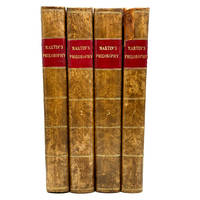
17715136166113<p><strong>NEWTON MARTIN Benjamin</strong><strong>.</strong> <em>Philosophia Britannica: Or A New and Comprehensive System of the Newtonian Philosophy Astronomy and Geography; In a Course of Twelve Lectures; With Notes; Containing the Physical Mechanical Geometrical and Experimental Proofs and Illustrations of All the Principal Propositions in Every Branch of Natural Science: Also a Particular Account of the Invention Structure Improvement and Uses of All the Considerable Instruments Engines and Machines; With New Calculations Relating to Their Nature Power and Operation.</em></p><p>London: Printed for W. Strahan; J. & F. Rivington; W. Johnston; Hawes & Co.; T. Carnan and F. Newbery; B. Collins; W. Frederick; and sold by the Author at his House in Fleet-Street 1771. Third edition. Complete in four volumes. Three text volumes plus a separate atlas volume of plates. Quarto. Approximately 8.5" x 5.5". Vol. I: xxx 333pp 3 ads; Vol. II: xiv 390pp 2 ads; Vol. III: x 405pp index. Atlas volume with 81 engraved copperplates the majority folding. Contemporary or near-contemporary half marbled calf over marbled boards with one repair to the upper spine of Vol. IV. Bindings sound and well-aligned. Engraved plates clean and strong with no losses; folds supple and correctly opening. Text generally clean throughout with manuscript annotations on the versos of the plates linking them to the relevant portions of text. Overall Very Good to Very Good.</p><p>Third and expanded edition of Benjamin Martin's monumental exposition of Newtonian natural philosophy combining physics astronomy geography mechanics and experimental science into a single unified system. The work includes extensive treatment of optics celestial motion gravitation hydrostatics pneumatics electricity and the mechanical powers alongside detailed explanations of contemporary scientific instruments and experimental apparatus. The separate atlas volume contains 81 finely engraved plates illustrating astronomical systems orreries telescopes microscopes air pumps electrical machines engines survey instruments and mechanical demonstrations.</p><p>This third edition represents the fully mature state of Martin's project as a practical synthesis of Newtonian science for broad professional use in the later eighteenth century. Unlike earlier editions which often survive without the full engraved apparatus this issue consolidates the theoretical text and the mechanical-visual program into a coherent instructional system. The separate atlas format allows for larger clearer mechanical and astronomical engravings than the inline plates of earlier printings making this edition particularly well suited for institutional reference in the history of science technology and scientific pedagogy.</p> Printed for W. Strahan; J. & F. Rivington; W. Johnston; Hawes & Co.; T. Carnan and F. Newbery; B. Collins; W. Frederick hardcover
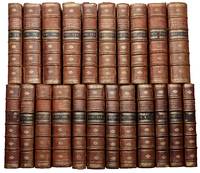
17326441London: Various printers to the Royal Society 1732. 1665-1732. <p>First edition of the first 426 issues an unbroken run from March 1665 to December 1732 of the world's oldest continuous scientific journal and the single most important record of the first announcement and communication of scientific discoveries and inventions PMM. It contains groundbreaking research by Newton - all 17 of his optical papers and therefore his first printed contribution to science - and by Halley Hooke Boyle Flamsteed Leeuwenhoek Cassini Hevelius Huygens and many others across astronomy physics chemistry mathematics medicine and natural history. Through Newton's optical papers of 1672-1676 the Transactions saw the first experimentally grounded proposal for the radical reform of a scientific theory to be advanced through a technical journal - a proposal that became the first to arouse international discussion and debate in print and within the pattern of public announcement discussion and professional consensus then established science has advanced ever since. Provenance: armorial bookplate of Sir Marcus Beresford 1st Earl of Tyrone 1694-1763; contemporary inscription at the end of one issue January 1692/3 noting its donation by Robert Hooke; manuscript corrections and notes on more than eighty pages with eight further pages on the measurement of the Earth bound in at the end.</p>. The World's Oldest Continuous Scientific Journal. <p>First edition of the first 426 issues an unbroken run from March 1665 to December 1732 of the world's oldest continuous scientific journal and the single most important record of the first announcement and communication of scientific discoveries and inventions PMM. It contains groundbreaking research by Newton - all 17 of his optical papers and therefore his first printed contribution to science - and by Halley Hooke Boyle Flamsteed Leeuwenhoek Cassini Hevelius Huygens and many others in astronomy physics chemistry mathematics medicine and natural history. Thomas Henry Huxley observed in his 1866 address On the Advisableness of Improving Natural Knowledge that if every book in the world apart from the Philosophical Transactions were destroyed the foundations of physical science would remain secure and the intellectual progress of the last two centuries largely recoverable. Long unbroken runs of the first four-and-a-half decades are now of the greatest rarity. ABPC and RBH record only two comparable sets at auction in the last three decades - Norman 1694 Christie's New York 15 June 1998 lot 716 $112500 and Macclesfield 1782 Sotheby's 25 October 2005 lot 1782 £96000 = $171400 - and a set of just the seven volumes containing Newton's papers on light realised $75600 at Christie's in October 2022.</p> <br /> <br /> <p>Provenance: armorial bookplate of Sir Marcus Beresford 1st Earl of Tyrone 1694-1763 Anglo-Irish peer and politician on the front pastedowns; contemporary inscription at the end of one issue January 1692/3 noting its donation by Robert Hooke; numerous manuscript corrections on more than sixty pages additional notes on about twenty pages and eight pages of manuscript notes on the measurement of the Earth bound in at the end.</p> <br /> <br /> <p>In November 1660 members of the Oxford Philosophical Club - John Wilkins John Wallis Robert Boyle Christopher Wren Robert Hooke among them - met a group of London natural philosophers at Gresham College and agreed to form a philosophical society that would meet weekly to exchange information and to conduct experiments. The society received its charter from the newly restored Charles II in 1662 and Henry Oldenburg a German-English diplomat and friend of Boyle was installed as one of its two secretaries. One of the charter's terms called for the exchange of information with other learned societies and Oldenburg almost at once began a sustained correspondence - with the Cimento Academy in Florence the Montmor Academy in Paris and after its foundation in 1666 the Académie Royale des Sciences - and with hundreds of working natural philosophers in places that had no scientific society of their own. Oldenburg was fluent in German Dutch French English and Latin and he was able to translate most foreign correspondence himself including Antoni van Leeuwenhoek's letters on his microscopical investigations and the communications of Johannes Hevelius of Gdansk and Marcello Malpighi of Bologna. After some years writing letters without salary Oldenburg decided to compile a monthly newsletter summarising a month's Royal Society activities and send it out to his correspondents in a single printing. On 6 March 1665 Old Style; 16 March by the Gregorian calendar then in use on the continent the first issue of the Philosophical Transactions appeared. It consisted of letter-excerpts reviews and summaries of recently published books and accounts of observations and experiments from European natural philosophers. Some of the pieces Oldenburg wrote himself summarising the minutes of Society meetings; others he translated or adapted from printed sources; still others were composite pieces assembled from the letters of several correspondents on a common subject. After his death in 1677 the journal passed through the hands of a succession of editors frequently also Secretaries of the Society - Edmond Halley and Hans Sloane the best-known among them - and through a succession of printers its form and content broadly reflecting the priorities of the current editor and to a degree of the Society. The Royal Society assumed financial responsibility for the journal only in 1752.</p> <br /> <br /> <p>Until the last third of the seventeenth century most original contributions to science appeared in books in which an author's own findings were embedded within a systematic exposition of a larger subject. The chartering of the Royal Society in 1662 and of the Académie Royale des Sciences in 1666 and the launching in 1665 of the Journal des Sçavans at Paris and the Philosophical Transactions at London gave institutional expression to a new conception of science as a cooperative enterprise: the immediate objective of the individual scientist became the experimental contribution to an eventual system of nature rather than the construction of the system itself and the journal article began to replace the book as the unit in which that contribution was made. Newton was the first to advance through this new medium an experimentally grounded proposal for the radical reform of a scientific theory and his proposal was the first to arouse international debate within the columns of a scientific journal. Through that exchange - in which all the participants modified their positions - a consensus of scientific opinion was produced; and within the same pattern of public announcement discussion and professional consensus science has advanced ever since Kuhn in Cohen Isaac Newton's Papers and Letters on Natural Philosophy 2nd ed. 1978 pp. 27-29.</p> <br /> <br /> <p>Newton's seventeen optical papers comprising his entire published optical contribution to the journal across the 1670s run as a single intellectual sequence: the seminal 1672 New Theory paper No. 80 pp. 3075-3087 introducing the prism experiment and the spectral analysis of white light; the catadioptrical-telescope paper No. 81; a series of exchanges with the French Jesuit Pardies Nos. 82 84 85 with Christiaan Huygens via an 'ingenious person from Paris' Nos. 96 97 and with the Liège Jesuits Linus and Lucas Nos. 110 121 123 128 - together more than half of the seventeen papers all responding to objections raised against the New Theory. Newton's answer to Hooke's objections No. 88 is the most polemical of the set prefiguring the priority dispute that would dominate the Principia years; the answer to Sir Robert Moray on behalf of the Royal Society No. 83 the most measured. Across the seven volumes containing them the papers transformed optics from a body of empirical reports into a quantitative experimental science driven by decisive testing among hypotheses and supplied the methodological core that Newton would eventually assemble decades later into the Opticks of 1704.</p> <br /> <br /> <p>These papers together constitute the first major contribution to science made through a technical journal - the medium that rapidly became the standard mode of communication among scientists - and as Christianson puts it if Newton had published nothing else the optical papers alone would guarantee him a place among the immortals of modern science Christianson In the Presence of the Creator 1984 p. 150. They yield further an insight into Newton's mental processes that the Principia and the Opticks - formal impersonal Olympian - conceal; it is in these early brief sometimes hasty letters to Oldenburg as in his notebooks and unpublished manuscripts that the creative scientist is to be found Kuhn in Cohen pp. 27-29.</p> <br /> <br /> <p>When Newton was first appointed Lucasian Professor at Cambridge in 1669 he chose optics for the subject of his first lectures and researches and by the end of that year he had worked out in detail the decomposition of a beam of white light into rays of different colours by means of a prism the complete explanation of the rainbow following from this discovery. These results formed the subject of his Lucasian lectures in 1669 1670 and 1671 and their principal conclusions were communicated to the Royal Society in February 1672 and printed soon afterwards in the Transactions No. 80. Before Newton light had been believed to be a homogeneous substance and colour was held to be produced by the mixture of light with darkness - the prism in the standard account supplying the darkness that coloured the light with all rays of white light striking the prism at the same angle being equally refracted. Newton's experiments led him to the radically different conclusion that white light is a mixture of rays of many distinct types each refracted at a slightly different angle and each responsible for producing one spectral colour. He set up a prism near his window at Trinity College and projected the spectrum onto a wall twenty-two feet away; to prove that the prism refracted light rather than colouring it he refracted the beam a second time back to white. The crucial experiment that confirmed the theory was to isolate a narrow ray of a single colour from the first spectrum and pass it through a second prism where no further elongation or separation occurred - a demonstration that each spectral ray was itself unmixed and uniformly refrangible. The reception of the paper was mixed. Many contemporaries simply ignored it; Mariotte in 1679 Pardies 1672 and Linus 1675 all claimed to have failed to replicate the basic experiments described. Rather than argue with them in detail Newton invited his critics to repeat his experiments with greater care; they did so without success. Others - Hooke among them who confirmed the experiments himself before a committee of the Royal Society in April 1676 - conceded the results but held that they could be accommodated by minor modification of existing theories making Newton's radical interpretation unnecessary. The controversy lasted six years after the paper's first appearance and left Newton conspicuously wary of publication.</p> <br /> <br /> <p>Newton's invention of the reflecting telescope reported in the issue immediately following his first optical paper No. 81 had in fact prompted the optical work rather than the other way round: the chromatic aberration of refracting lenses - their inability to bring different colours of light to a single focal point - was the original stimulus for Newton's investigation of the nature of light. Newton had sent Oldenburg his letter describing the telescope before his letter describing the new theory and had hoped to present the telescope as a practical test-piece for the theory. Oldenburg however printed the material in the reverse order the theory first followed by the description of the instrument. The telescope made a considerable impression at the Royal Society which promptly elected Newton a Fellow; a corresponding notice appeared in the Journal des Sçavans in February 1672 with emphasis on the instrument's compactness and it was the telescope rather than the theory of light that first made Newton's name known on the Continent Dilaura Bibliotheca Opticoria 1475-1925 2019 pp. 235-236.</p> <br /> <br /> <p>Newton published three non-optical papers in his lifetime all anonymously. His only published paper on chemistry Scala Graduum Caloris No. 270 April 1701 pp. 824-829 states what has since become known as Newton's law of cooling - that the rate at which a hot body loses heat is proportional to the difference between its temperature and that of its surroundings - and describes the construction of a thermometer capable of measuring temperatures up to almost 1000 °C. An Account of the Book entituled Commercium Epistolicum Collinii & Aliorum De Analysi promota No. 342 February 1715 pp. 173-224 is Newton's anonymous review of the Commercium epistolicum the official report of the committee appointed by the Royal Society to adjudicate in the dispute between Newton and Leibniz over priority in the invention of calculus - the most bitter and consequential priority dispute in the history of science; the Account purports to be impartial but was in fact written like the Commercium epistolicum itself by Newton. In the same volume No. 347 March 1716 pp. 399-400 appeared Newton's Problematis Mathematicis Anglis Nuper Propositi Solutio Generalis his response to a challenge problem set by Johann Bernoulli to the English mathematicians; tradition has it that Newton solved it in a single evening after returning from a day's work at the Mint. With the exception of this minor paper none of Newton's original work on gravitation or on mathematics was published in the Transactions. Edmond Halley's review of the Principia however appeared soon after its publication No. 186 pp. 291-297 - Halley was then the journal's editor - and is prefaced by an advertisement apologising for the fact that the Transactions had been delayed for some months because Halley had had the entire care of the Principia's own edition and had therefore as he put it been more serviceable to the Commonwealth of Learning in seeing Newton's book into print than he would have been in issuing his own periodical on time. Halley pointed out with justice that one of the most striking features of the Principia was Newton's great skill in using the new mathematics - by which Halley meant Newton's own method of infinite series.</p> <br /> <br /> <p>Edmond Halley 1656-1742 was one of the most original minds of his time and he made a long series of important contributions of his own to the Transactions. The best-known of them is Astronomiae cometicae synopsis No. 297 March 1705 pp. 1882-1899 the first printing of the theory according to which comets belong to the solar system and move in eccentric elliptical orbits; it was here that Halley set out his method of computing the motion of comets of establishing their periodicity in elliptical orbits and of identifying the comet that would bear his name DSB. The confirmation of the comet's return - in 1759 after Halley's death - was the first time that a body other than a planet had been shown to orbit the Sun the earliest successful observational test of Newtonian physics and a vivid demonstration of its explanatory power; the comet was named after Halley by the French astronomer Nicolas-Louis de Lacaille in 1759. Halley's other major contributions to the journal include his Methodus singularis No. 348 June 1716 pp. 454-464 in which he challenged the international astronomical community to use the transits of Venus across the Sun predicted for 1761 and 1769 to transform astronomy into a fully empirical science by measuring the Earth-Sun distance - a challenge that astronomers took up organising expeditions to the farthest corners of the globe and overcoming obstacles of every kind; A short History of the several New-Stars No. 346 December 1715 pp. 354-356 in which he observed that the new stars of 1572 and 1604 Tycho's and Kepler's stars were not the only changing stars on record that others had been observed in 1596 1600 1670 and 1686 some of them fading and reappearing and one of them - Mira - appearing to wax and wane with a regular 330-day period; An Account of several Nebulae or lucid Spots like Clouds No. 347 March 1716 pp. 390-392 in which Halley assembled the first list of known nebulae with their discoverers crediting the Great Nebula in Orion to Huygens the Andromeda nebula to Boulliau and the two spherical nebulae in Centaurus and Hercules to himself; 'Of the infinity of the sphere of fix'd stars & Of the number order and light of the fix'd stars' No. 364 April 1720 pp. 22-26 in which Halley posed what later generations would call Olbers's paradox a century before Olbers did; and outside astronomy his paper on the Breslaw life table No. 196 January 1692/3 pp. 596-610 which produced the first life table based on sound demographic data and gave the first correct calculation of annuities using essentially the methods still in use today - a paper of first importance in the history of statistics.</p> <br /> <br /> <p>John Flamsteed 1646-1719 was with Halley the most important English astronomer of his generation; his major works are the Historiae coelestis first published in 1712 without his consent by Halley and Newton and the Atlas coelestis published posthumously in 1729 but he also contributed more than thirty articles to the Transactions chiefly on observational astronomy. No other Astronomer Royal before Airy displayed anything like Flamsteed's concern for the reduction and manipulation of his own data: far from bequeathing the mass of raw observations that Bradley would he reduced and applied them himself DSB.</p> <br /> <br /> <p>Robert Boyle 1627-1691 contributed some thirty-seven papers to the Transactions Fulton p. 138 among them his influential questionnaire General Heads for the Natural History of a Country a number of major experimental essays that sometimes filled a whole issue and most revealingly An Experimental Discourse of Quicksilver growing hot with Gold No. 122 February 1675/6 pp. 515-533 - a paper on a kind of mercury that would incalesce when amalgamated with gold suggesting that Boyle had achieved the long-sought alchemical philosophical mercury capable of transmuting base metals. Boyle's trials went back to 1652 when he had received the recipe from his American mentor George Starkey; his decision to go public in 1676 signalled a newly intense period of alchemical activity on his part. The paper drew from Newton - himself a committed alchemical enthusiast - a letter to Oldenburg urging that such matters were not to be communicated without immense damage to the world if there should be any truth in the Hermetic writers; Oldenburg took the hint and the incalescence paper remained a one-off in the Transactions Hunter Alchemy in the Transactions Royal Society blog 1 July 2015.</p> <br /> <br /> <p>The Dutch microscopist Antoni van Leeuwenhoek 1632-1723 contributed 116 articles to the Transactions over the half-century 1673-1723; the most famous of them the letter on the protozoa No. 133 March 1677 pp. 821-831 gives the first detailed description of protists and bacteria in a range of environments. Leeuwenhoek is universally acknowledged as the father of microbiology: he discovered both protists and bacteria but more than being the first to see the microscopic world of his animalcules he was the first even to think of looking - certainly the first with the power to see. Using his own deceptively simple single-lensed microscopes he did not merely observe but conducted ingenious experiments exploring and manipulating his microscopic universe with a curiosity that belied his lack of any map or bearings. The verification of Leeuwenhoek's new world by the natural philosophers of the Royal Society set out the ground rules that still define experimental science today Lane The unseen world: reflections on Leeuwenhoek 1677 Philosophical Transactions B370 2015 pp. 1-10.</p> <br /> <br /> <p>Martin Lister 1639-1712 contributed in 1673 what is now regarded as the earliest journal article on palaeontology: A description of certain stones figured like plants No. 100 pp. 6181-6191 on the preservation of St Cuthbert's beads - crinoid remains - in the approximately 350-million-year-old Carboniferous limestones of northern England. The biological nature of fossils was then controversial: Kircher had argued that they formed by abiogenic plastic forces within the rock while Hooke and Steno had suggested they were the remains of living organisms. Lister was the first to explore how direct observation could decide between the two making observations about what modern geobiology calls taphonomy and biogenicity criteria - observations that presage current debates about the earliest signs of life on Earth and Mars Brasier Philosophical Transactions A373 2015 pp. 1-16. Other natural-historical papers scattered through the journal's first century - Account of a very odd monstrous calf Some experiments and observations on May-dew Some observations on strange swarms of insects - are in places fanciful but in many others acute; Hooke's own contributions which began in the very first issue March 1665 with A spot in one of the belts of Jupiter are sometimes held to include the first observation of the Great Red Spot still visible on Jupiter today.</p> <br /> <br /> <p>The early volumes also contain the record of the world's first experiments with blood transfusion conducted in England in the mid-1660s. The procedure - gruesome - was first carried out between dogs with arteries and veins in the animals' necks opened and blood transferred from one to another through quills most likely of goose feather inserted into the vessels and clamped with running knots; in the physician Richard Lower's account No. 20 pp. 353-358 the transfusion came to an end when the emittent dog fell into convulsions and died. Shortly afterwards Boyle published a remarkable set of questions about the likely effects of transfusion on the animal receiving blood No. 22 pp. 385-388 asking whether transfusion might change a dog of one breed into another alter its temperament render a fierce dog cowardly transmit satiety or hunger obliterate learned behaviours or make a dog forget its master - a sequence of questions which as recent commentators have noted read like an alchemical programme turned inward upon the living body. Researchers soon proposed transfusion into a human subject. Since the procedure generally killed the emittent a human-to-human transfusion was thought impossible and a sheep was settled upon as donor. The choice of human recipient fell in 1667 upon Arthur Coga - mentally unstable but sufficiently educated to report in Latin on the effects of the procedure - and the operation was performed by Lower and the physician Edmund King No. 30 pp. 557-559 who judged that Coga had received nine or ten ounces of sheep's blood. A few days afterwards Coga reported back to the Society in Latin and Samuel Pepys meeting him at a dinner party shortly thereafter found him to speak very reasonably though cracked a little in his head.</p> <br /> <br /> <p>Other contributors in these decades include Cassini on the satellites of Jupiter Huygens on mechanics and optics Malpighi Swammerdam Borelli Steno Fahrenheit and Redi whose experimental refutation of spontaneous generation appeared in the journal alongside a steady stream of domestic material from Harvey Wren Ray Petty Locke Wallis Winthrop Tyson Lancisi Leibniz and Hales. To turn the pages of these thirty-seven volumes is to watch the first two generations of a new scientific public discover how to work together - how to record observation propose hypothesis invite replication agree or disagree in print and build by open argument the provisional consensus that is the hallmark of modern science.</p> <br /> <br /> <p>References: Grolier/Horblit 95b - Macclesfield 1782 - Norman 1694 - PMM 148 Vol. 1 - Brasier Deep questions about the nature of early-life signals: a commentary on Lister 1673 Philosophical Transactions A373 2015 pp. 1-16 - Christianson In the Presence of the Creator 1984. Cohen ed. Isaac Newton's Papers and Letters on Natural Philosophy 2nd ed. 1978 - Dilaura Bibliotheca Opticoria 1475-1925 2019 - Fulton A Bibliography of the Honourable Robert Boyle 1932 - Lane The unseen world: reflections on Leeuwenhoek 1677 Philosophical Transactions B370 2015 pp. 1-10.</p> <br /> <br/> <br/> 37 vols. bound in 22 4to 215 × 165 mm containing all issues from March 1665 No. 1 through December 1732 No. 426 with 380 engraved plates 306 folding 176 woodcut illustrations and diagrams and 7 folding tables occasional damp-staining a few tears and small holes occasionally affecting a word or two a few headlines shaved the plate in No. 56 map of part of Languedoc with a 7 cm tear that in No. 60 apparatus shaved at head and that in No. 196 with bottom corner repaired with loss of about a quarter of the plate relating to the dissection of a rat. Uniformly bound in eighteenth-century probably mid-1730s sprinkled calf spines ruled and tooled in gilt in compartments with title and volume-number labels some joints cracking but firm a few labels missing slightly rubbed. Generally very clean and well-preserved. Various printers to the Royal Society unknown
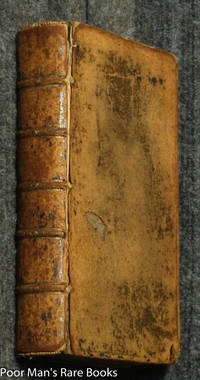
174236832London: Printed for James Brackstone. Very Good with no dust jacket. 1742. Hardcover. xiii/407 1 pages; Perpetual Consciousness Place and Motion of Spirits the Departing Soul the Resurrection of the Body the Production and Operations of Plants and Animals: With Some Remarks on Mr. Locke's Essay on the Human Understanding. To Which Is Subjoined a Brief Scheme of Ontology or the Science of Being in General with Its Affections. Isaac Watts was an English hymnwriter theologian and logician. A prolific and popular hymnwriter he was recognised as the "Father of English Hymnody" credited with some 650 hymns. Many of his hymns remain in use today and have been translated into many languages. He was marked by many as an uncommonly wise and realistic philosopher. Provenance- John Provost armorial bookplate. Full contemporary leather heavily rubbed. Hinges cracked. Lacking first free end paper. Contents generally clean with a little scattered light foxing. Contents complete and firm Philosophy Ontology Place & Motion Resurrection Locke's Essay . Printed for James Brackstone hardcover
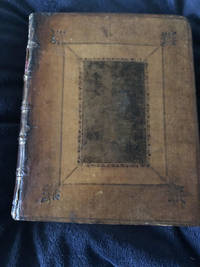
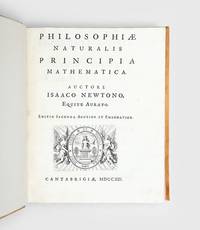
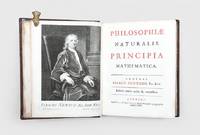
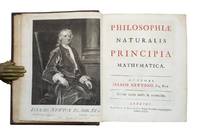
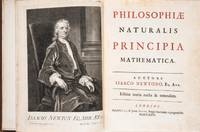
1726vBC4008<p>RARE 1726 THIRD EDITION OF NEWTON'S PRINCIPIA THE LAST EDITION PUBLISHED IN HIS LIFETIME EDITED BY NEWTON HIMSELF THE BASIS FOR ALL SUBSEQUENT EDITIONS. ONE OF ONLY 1250 COPIES PRINTED. AT 300 FAR FEWER REMAIN! London: Guil. & Joh. Innys Regiae Societatis typographos 1726. Quarto 240 x 192 mm. Lauded by Albert Einstein as "perhaps the greatest intellectual stride that has ever been granted to any man to make" Newton's Principia is arguably the most influential book in history. Grounded on the premise that virtually everything in the universe is amenable to scientific understanding this transformative milestone abounding with interdisciplinary impact "is generally described as the greatest work in the history of science. Copernicus Galileo and Kepler had certainly shown the way; but where they described the phenomena they observed Newton explained the underlying universal laws. The Principia provided the greatest synthesis of the cosmos proving finally its physical unity. Newton showed that the important and dramatic aspects of nature that were subject to the universal law of gravitation could be explained in mathematical terms with a single physical theory. With him the separation of the natural and supernatural of sublunar and superlunar worlds disappeared. The same laws of gravitation and motion rule everywhere; for the first time a single mathematical law could explain the motion of objects on earth as well as the phenomena of the heavens. The whole cosmos is composed of inter-connecting parts influencing each other according to these laws. It was this grand conception that produced a general revolution in human thought equaled perhaps only by that following Darwin's Origin of Species… Newton is generally regarded as one of the greatest mathematicians of all time and the founder of mathematical physics. It was the final irrevocable break with a medieval conception based on Greek and Roman cosmology and a scholastic system derived from the medieval interpretation of Aristotle. Newton's universe almost independent of the spiritual order ushered in the age of rationalism scientific determinism and the acceptance of a mechanistic view of nature" PMM 161. Dissatisfied with the first two editions of his own masterpiece London 1687; Amsterdam 1723 Newton towards the end of his life "gave one last effort to the Principia. It is clear that he regarded the Principia rather than the Opticks as his masterwork. He worked over the Principia without end to hone its language to a perfect expression of his ideas… . Perhaps a serious illness in 1722 reminded him that he could not delay forever. We know only that the printing of an edition more sumptuous than either of the others began in the fall of 1723." Westfall The Life of Isaac Newton. With portrait engraving by Vertue bound before first text leaf and numerous illustrations in text. Complete with the privilege leaf half-title dedication leaf index and ad leaf. 240 x 192 mm. 18th-century paneled calf gilt-lettered spine rebacked hinges cracked but holding. Frontispiece caption trimmed with some loss to artists' signatures minor foxing and toning but a very good crisp copy. Engraved armorial bookplate of the Earl of Hopetoun. Third edition revised and expanded edited by Henry Pemberton M.D. F.R.S. contains a new preface by Newton and many alterations and clarifications the scholium on fluxions chief among them. Sir Isaac Newton died on March 31 1727 at the age of 84 one year after his treasured edition was published. This Third Edition of his Principia is the final definitive statement of the man who invented calculus determined the composition of light and discovered the laws of gravity and motion which govern the universe the founder of modern science Sir Isaac Newton. Book #vBC4008. $26000. We specialize in rare Ayn Rand and other legends and landmarks.</p> Guil. & Joh. Innys hardcover
1713181514Cambridge: Printed by Cornelius Crownfield at the University Press 1713. I feign no hypotheses Second edition extensively revised by Newton himself and including the first appearance of the General Scholium: among his last discussions of scientific enquiry and the source of his famed principle "Hypotheses non fingo" "I feign no hypotheses" - p. 484. "The Principia that has shaped Western scientific tracition is substantially the second edition" ODNB. Together with Roger Cotes 1682-1716 Cambridge's Plumian Professor of Astronomy Newton extensively overhauled the Principia over a period of four years: almost 400 of the first edition's 494 pages have been revised here. Alongside the Scholium the pair made particularly extensive annotations to the sections on lunar theory comets and fluid dynamics. Cotes was a gifted mathematician in his own right: after his early death Newton commented that "if he had lived we might have learned something". Cotes's lengthy preface together with Newton's Scholium and the revisions to the text itself helped to fashion the second edition of the Principia into a key text in the lengthy debate between Newton and continental philosophy most particularly that of Leibniz. The "Hypotheses non fingo" principle is directly framed to emphasize Newton's focus on descriptive analysis in contrast to continental speculation over causes. This is one of 750 copies printed at the Cambridge university press under the supervision of Richard Bentley the famed and feared master of Trinity College. Quarto 233 x 191 mm pp. xxviii 484 8. Leaf 3Q2 cancelled. Folding engraved plate facing p. 465 engraved Cambridge University Press printer's device on title page extensive wood-engraved diagrams in text. Recent vellum spine with red morocco label covers with yapp edges edges sprinkled red. With 20th-century engraved bookplate of the noted science collectors Peter and Margarethe Braune. Light finger soiling infrequent minor browning and foxing running wormhole throughout with discreet infill to most leaves and marginal repair to title and leaf b1 contents otherwise crisp and clean: a very good copy indeed. Babson 12; Dibner 11 note; ESTC T93210; Gray 8; Wallis 8. hardcover
1726188378London: William & John Innys printers to the Royal Society 1726. The final lifetime edition Third edition revised by Newton himself; the final and most lavish edition to appear in his lifetime. The revisions include a new preface by Newton and one of his final statements on the nature of philosophy. By 1726 the 83-year-old Newton was making a sustained effort to tidy up his scientific legacy. For the Principia that meant adapting his arguments in light of his many disputes with continental philosophers following the first edition of 1687. The third edition is perhaps most notable for the new Rule IV of Book III in which Newton codifies his contention that hypotheses and particularly Leibnizian aether hypotheses have no place in true philosophy. Newton also adds extensive revisions to the sections on fluxions and lunar motion. Henry Pemberton 1694-1771 a 30-year-old physician and correspondent of the Oxford Newtonian John Keill was selected as the co-editor although Newton remained the primary force shaping the edition. A contemporary reader has made four ink annotations throughout this copy on pages 388 414 416 and 465 along with a handful of underlinings. The reader is particularly interested in Newton's treatment of lunar theory: the annotation on page 414 observes that "faciliùs multò polest hic calculus perfici ope motûs lunaris" "this calculation could be completed much more easily with the help of the lunar movement". Quarto 240 x 188 mm pp. xxxiv 530 8. Engraved portrait frontispiece after George Vertue engraved illustration by John Senex at p. 506 woodcut tables diagrams headpiece and initial within the text. Title page lettered in red and black. Contemporary mottled calf spine rebacked to style and with later red morocco label covers with double-fillet panel in gilt. With December 1922 signature of one Herbert Brittain possibly the Treasury official and mathematics graduate 1894-1961 to front pastedown. Light rubbing extremities restored infrequent foxing to contents: a very good copy. Babson 13; ESTC T98375; Gray 9; Wallis II.9. unknown
172669561London: Apud Guil. & Joh. Innys 1726. Full Description:<br> <br> NEWTON Sir Isaac. Philosophiæ naturalis principia mathematica. Editio tertia aucta & emendata. London: Apud Guil. & Joh. Innys 1726.<br> <br> Third edition. One of only 1250 copies printed. Quarto. 34 530 6 index pp. Engraved frontispiece portrait facing title by George Vertue after I. Vanderbank. Bound without the advertisement leaf. Numerous diagrams in the text and one engraving of cometary orbit on p. 506. Title printed in red and black. With the Royal Privilege printed on verso of the first leaf as in Babson copy 2.<br> <br> In full goatskin. Spine ruled and lettered in gilt. Boards paneled in blind. Inner hinges repaired. Some old ink manuscript notes on front flyleaf. Numerous instances of light early pencil marginalia and a few in ink. Some ghost dampstaining throughout. Previous owner's bookplate on front pastedown. Overall a very good copy.<br> <br> "This edition was the last published during the author's lifetime and the basis of all subsequent editions. It was edited by Henry Pemberton M.D. F.R.S. and contains a new preface by Newton and a large number of alterations the most important being the scholium on fluxions in which Leibnitz had been mentioned by name. This had been considered an acknowledgement of Leibnitz's independent discovery of the calculus. In omitting Leibnitz's name in this edition Newton was criticized as taking advantage of an opponent whose death had prevented any reply" Babson p. 12.<br> <br> Third edition of "the greatest work in the history of science" Printing and the Mind of Man. In the Principia Newton formulated the three laws of motion from which he derived the principle of universal gravitation "wherein all bodies of whatever mass attract one another in proportion to their masses and in inverse ratio as the square of the distance between them. This applies to dust particles as to the mightiest celestial bodies" Dibner.<br> <br> "Copernicus Galileo and Kepler had certainly shown the way; but where they described the phenomena they observed Newton explained the underlying universal laws. The Principia provided the great synthesis of the cosmos proving finally its physical unity. Newton showed that the important and dramatic aspects of nature that were subject to the universal law of gravitation could be explained in mathematical terms within a single physical theory.The same laws of gravitation and motion rule everywhere; for the first time a single mathematical law could explain the motion of objects on earth as well as the phenomena of the heavens. The whole cosmos is composed of inter-connecting parts influencing each other according to these laws. It was this grand conception that produced a general revolution in human thought equalled perhaps only by that following Darwin's Origin of Species" Printing and the Mind of Man 161 describing the first edition.<br> <br> Babson 13. Gray 9. Wallis 9.<br> <br> HBS 69561.<br> <br> $22500. Apud Guil. & Joh. Innys unknown
1726H-142<p>Philosophiae Naturalis Principia Mathematica third edition half-title engraved portrait frontispiece title in red and black woodcut illustrations and diagrams some foxing and soiling contemporary calf joints and corners worn <strong>4to</strong> William & John Innys <strong>1726</strong>.<br />This edition was edited by Henry Pemberton and Sir Isaac Newton wrote a preface with new edits just one year before he passed away in 1727. <strong>This third edition printed in London is the very basis of all subsequent printings</strong> of the Principia and a true history existing through time.<br /><strong>One out of 1250 copies</strong> Demy 1000 regular issue see below printed and with complete pagination this copy is a remarkable and rare book in the history of science.</p><p>The 1726 edition was comprised of 1250 copies evidenced by William Bowyer's paper stock ledger which records the following: Superfine 50 largest paper; Royal 200 large paper; Demy 1000 regular issue. Royal copies can be identified by their size and CC watermark. See: Henry P. Macomber and Gerald G. Grubb "A census of the owners of copies of the 1687 first edition of Newton's Principia" <em>PBSA </em>47 1953 269-304 p.293. Babson 11-12 Wallis 9.</p> Guil. & Joh. Innys, Regiae Societatis typographos hardcover
17632329682London: Printed for J. Buckland and T. Longman in Pater-Noster-Row; J. Waugh in Lombard-Street; E. Dilly in the Poultry; and T. Field in Cheap-side 1763. Sixth Edition. Full-Leather. Good/No Jacket. Sixth edition. Joints splitting edges rubbed with some loss from corners. 1763 Full-Leather. xvi 407 1 pp. 12mo. An exploration of ontology discussing John Locke's writings and other related topics. "In philosophy Watts described as 'a favourite employment of my thoughts' the relation between soul and body and the function of the sensations appetites and passions preface to Philosophical Essays on Various Subjects 1733; Works 6.481. His most important works on these topics in addition to the Philosophical Essays are The Doctrine of the Passions and Discourses of the Love of God and the Use and Abuse of the Passions in Religion 1729 and Self-Love and Virtue Reconciled Only by Religion 1739. Watts objected to Locke's attack on innate ideas and supported the existence of the moral sense provided it was regarded as 'reason exercising itself' Works 6.526 but for religious reasons he strongly disapproved of Shaftesbury. His interest in the passions was closely related to his concern with the ways in which the preacher might work on them for religious ends." - Oxford Dictionary of National Biography Printed for J. Buckland, and T. Longman, in Pater-Noster-Row; J. Waugh in Lombard-Street; E. Dilly in the Poultry; and T. Field hardcover
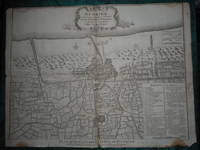
1735114291London: Unknown. Fair with no dust jacket. 1735. Unknown. Map. Copper engraved Map. Map image size not including Margins = 41 cm x 48 cm. Uncoloured. With an Attractive Central Carouche and an 'Explanation of the Figures'. = " Royal Marine 1 Battery; Barracks for the Troops; Powder Magazine" etc etc plus an inset 'Side view of the Little and Great Camp'. Double page plan. Horizontal Centre fold has split an inch either side and similar to the vertical fold and right in the centre where both folds meet but NO LOSS - I haven't repaired as this should be done with expertise. Some pretty uniform browning in general to the map and some staining to the bottom margin and close trimmed but leaving the border at the top edge where some staining has leeched into the top blank edge. Generally a good image and complete but with some fault as noted. NO date but written in pencil by a former owner in the margin is "Published 1735" and this may be the date of the Edition the map was originally taken from but could be as late as 1747 - I can't be certain. See Image. ; 41 cm x 48 cm. . Unknown unknown
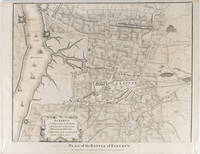
1745170773c1745. Highly detailed copper engraved regional map showing Fort St. Philip F. de la Croix F. Liefkenshock and Lillo. Beyond the river are towns farms and roads. A number of ships in the Escaut. Depicts the French attack of June 30 1703. Trifle browned in the left section of the image but otherwise very good. Large title cartouche. From Tindal's Continuation of Rapin's History. The cartouche reads: Eckeren - A Village in the Netherlands in Brabant in the county of Ryem at which were attacked by ye French 30 June 1703. . unknown
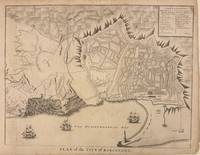
1745337014London: Isaac Basire 1745. unbound. Map. Uncolored engraving. Image measures 14 1/4" x 19"<br/> <br/> A detailed city plan of Barcelona in the 18th century showing street grids fortifications roads waterways and surrounding topography. Major points of interest are lettered corresponding with an index in the upper right corner. Several ships are illustrated in the harbor. Published for Mr Tindal's Continuation of Mr Rapin's History of England<br> <br> James Basire 1704-1768 was a London based engraver producing mostly maps and book illustrations. He often worked closely with the publisher John Nourse engraving as well as printing his plates for publication. His father Isaac Basire was the first in a family line of prolific engravers with James his grandson and great-grandson all named James also becoming prominent engravers.<br/> <br/> Isaac Basire unknown
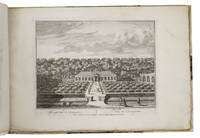
1731ABC_46670Amsterdam 1731. Small oblong folio 22 x 32.5 cm. Hendrik de Leth 20th-century half vellum marbled paper sides. With 26 numbered engraved prints including the title-page. 26 engraved ll. Second edition of a fine series of 26 beautiful and delicate etchings of the sumptuous 17th-century Heemstede estate near Utrecht not in the municipality Heemstede including a bird's-eye view of the entire estate and detailed views of the gardens house and other buildings fountains sculpture hedges and trellises all drawn and etched by Isaac van Moucheron. It also shows visitors strolling through the gardens horses coaches dogs and gardeners at work with pruning saws. "The fame of the gardens of Heemstede near Houten in the province of Utrecht was and still is considerable. . a highlight in Dutch garden art." Anglo-Dutch garden. Each print has a caption in Dutch and French the bird's-eye view with a key to five numbered features.With the bookplate of the Dutch entomologist Frans.Titus. Valck-Lucassen 1885-1939 on the front paste-down. Binding slightly worn and the vellum a little scuffed especially around the spine and the lower corners on the fore-edge vellum slightly dust-soiled. Leaves very slightly browned and slightly frayed some minor marginal staining never affecting the images overall in good condition.l Hollstein Dutch & Flemish XIV p. 94 nos. 10-35; cf. Anglo-Dutch garden pp. 193-198; STCN 4 copies of the 1st ed. incl. 2 incompl.; Springer Bibl. overzicht p. 47 1st ed. hardcover