D'Israeli, IsaacBiblio.com
527 résultats
1795338787London: t. Cadell & W. SDavies 1795. First Edition. xxiii1 226pp. 8vo. In Original boards uncut. Very Good in cloth slipcasze. First Edition. xxiii1 226pp. 8vo. ESTC T109852; Bibliotheca Anglo-Judaica B20; CBEL III 1278 t. Cadell & W. SDavies unknown
179523991London: T. Cadell and W. Davies 1795. First Edition. 1 vols. 8vo. Bound in half later blue morocco and marbled boards all edges uncut. First Edition. 1 vols. 8vo. Very scarce. Roth Bibliotheca Anglo-Judaica B20; CBEL III 1278 T. Cadell and W. Davies unknown books
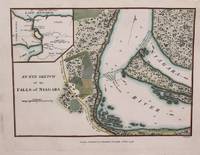
179862497London:: J. Stockdale 1798 1807. engraved map. Vertical creases where folded and some light spotting. Approx. 7 x 9 inches. From Isaac Weld's Travels Through the States of North America; 4th ed. London 1807. J. Stockdale, unknown
1798M8902London: J. Stockdale 1798. Very Good. Notes: Map of Niagara Falls showing surrounding lands and vicinity in fine detail. Included is an inset map of the Niagara Straits detailing how Lake Ontario connects with Lake Erie. <br><br> Size : 163x226 mm 6.42x8.90 Inches Coloring: Hand Colored Category: Maps Canada Ontario South; J. Stockdale unknown
1742028864London: James Brackstone 1742. Book. Fair Book Condition. Leather. Third Edition. Fair. Some loss of text and tears to pages 233-241. Foxing throughout. Front hinge started usual rubbing to leather cover. Reader's copy. Our rating system: 1. Fine; 2. Near Fine; 3. Very Good; 4. Good; 5. Fair. James Brackstone Hardcover
173123751London: E. Matthews R. Ford & R. Hett 1731. 12mo. 2 ix 1 360 pp. <br><br>First edition and scarce in commerce: Not in the CBEL list of his writings. Watts 16741748 an Independent minister wrote this as a response to a Strickland Gough essay and believed "the essence of religion as the dissenters' puritan fathers had known it lay in the proper relationship between minister and congregation" DNB online. <br>Â Â Â Â <br>Â Â Â Â ESTC T81766. Contemporary brown leather worn dry flaking; top of spine pulled with loss. Ex-library: bookplate on front pastedown rubber-stamps pencilling. Waterstaining and other stains; pages cockled. Hinges inside open. A poor scholar's copy. E. Matthews, R. Ford & R. Hett hardcover books
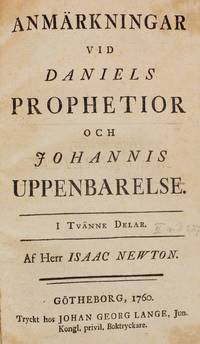
1760B4388Gothenburg c. 1760. In very good condition. Binding: Contemporary half calf with speckled boards. Notes: Ex Libris Abel E. Berland. First Edition in Swedish after original 1733 First Edition in English. <br><br>Newton's work: Observations on the Prophecies on the Prophecies of Daniel and the Prophecies of St. John. Six years after his death Newton's nephew Benjamin Smith published a small portion of Newton's later writings on the prophetic Books of Daniel and Revelation. For more than two centuries this book provided the only glimpse into Newton's prophetic thought. In addition scientific historians suggest that “Newton was an apocalyptic thinker†Snobelen Canadian Journal of History who “arrived at his theory of gravity partly through his exploration of alchemy and early biblical theology†White 358. Size: 8vo: 115mm x 190mm Volume: 2 Volumes in 1 Pages: P. Title Printer infoforward iii-vi Contents vii-viii 1-324 Category: Book Religious Christianity hardcover
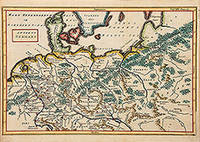
174578441London: 1745. An interesting map of the Northern parts of Germany with the names of the ancient tribes that inhabited them. Copper engraving. Hand coloured. Size: 226 x 314 mm Good condition. A repaired tear to lower right corner. unknown
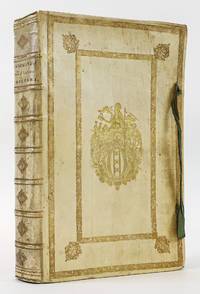
17402007210108A Paris chez Jean-François Moreau. M. DCC. XL 1740. Hardcover. Good. A custom made book safe. 17.3 x 10.5 cm. Bound in contemporary French leather. Title and first 20 pages intact. Housed inside the book is a hallowed-out safe with marbled paper borders. A secretive place to store something special. Safe dimensions are 13.5 x 7.4 x 2.3 cm. A Paris, chez Jean-François Moreau. M. DCC. XL hardcover
17700038601London 1770. No Binding. Very Good Plus. Folio. LONDON : circa 1770. Antique Portrait of John Gill D.D. 18th century engraving. Mounted. Clean bright engraving. VERY GOOD INDEED. Mount size 12 x 10 inches. Print area; 9.5 x 6.5 inches. Ideal for framing. Will be well-packed for posting/shipping. 8vo. Rosley Books for Antiquarian books Cumberland Everyman Keswick Inklings Literature MacDonald Rarities Theology and History. <br/> <br/> unknown
17101395682Amstelodami Amsterdam: Sumptibus Thomæ Fritsch Thomas Fritsch 1710. Hardcover. Quarto 12 xxviii 580 324 60 pages. In Good plus condition. Bound in full vellum has gilt ornamentation to boards and spine. Binding with armorial stamp on both boards. Boards have slight yellowing small brown dots to front board and minor cracking to head of front joint. Extremities have slight discoloration from wear and mild bumping to corners in some cases exposing the board. Contains 1 of 4 ties intact. Textblock has slight separation and closed tears along the pastedowns splitting along the gutter between the second front free end page and titlepage age toning and foxing ranges from mild to moderate plus and speckling to edges. Text in Latin and Greek. Shelved in Room A. 1395682. Special Collections. Sumptibus Thomæ, Fritsch [Thomas Fritsch] hardcover
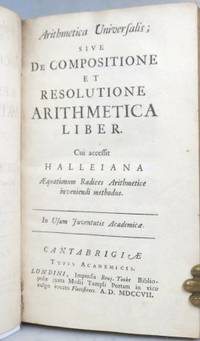
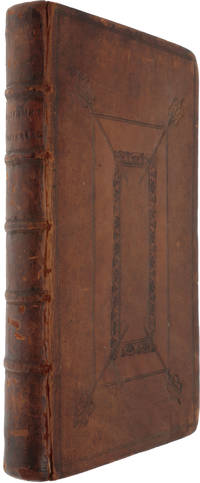
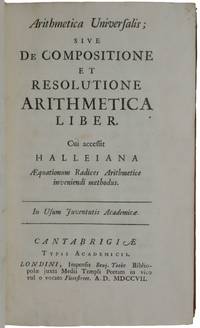
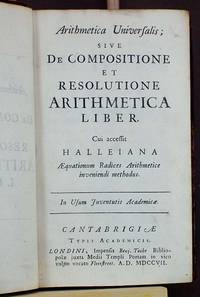
170751058Cantabrigiæ Cambridge: Typis academicis; Londini London impensis Benj. Tooke 1707. First edition. 8vo. viii 343 1 pp. 19th century full diced calf spine with raised bands gilt lettered black label blind tooled borders to the boards ownership inscription of a William Fitton dated June 1800 to the half title another contemporary owner's inscription - that of a Philip Crampton the date cropped "180" mathemetical annotations to the front and rear leaves and in the margins at intervals within. Joints skilfully repaired some mild soiling to the front and rear leaves an attractive copy. A mathemetical text composed entirely in Latin by Newton and edited by William Whiston who had succeeded him as the Lucasian professor of Mathematics at Cambridge University in 1702. The two had become acquainted during the previous decade and Newton was impressed enough with his acolyte that he invited him to lecture at the university when he was occupied with his other work. It was Whiston who persuaded Newton to publish some of his lectures on algebra but Newton was dissatisfied with Whiston's editing and additions to the text - to the extent that he considered buying the entire stock of the book to prevent its appearance in public. That clearly didn't happen although Newton succeeded in having the book published anonymously and its relative scarcity in commerce suggests a truncated print run. The first ownership inscription is that of the Irish geologist William Fitton 1780-1861. The son of a Dublin lawyer his paternal grandfather had been a mathematical instrument maker. Fitton began his studies at Trinity College Dublin in 1794 and earned his B.A. in 1799 but continued studying there until 1803. He went on to study medicine at Edinburgh University becoming a doctor in 1810 and continued his medical studies in London and Cambridge during the following six years. Fitton's interest in geology and mineralogy were his true passions and after marrying into a wealthy family he was able to devote his studies exclusively to these subjects. He subsequently served as secretary and later as president of the Geological Society published numerous reviews and papers plus a small number of books including 'A Geological Sketch of the Vicinity of Hastings' in 1833. Fitton was awarded the Wollaston Medal the society's highest prize in 1852. The other inscription is almost certainly that of Sir Philip Crampton 1777-1858 an Irish surgeon who awarded many honours and held various senior positions in a long and illustrious career: "elected FRS in 1812. In 1813 he was appointed surgeon-general to the forces in Ireland and he was surgeon to the queen in Ireland a member of the senate of the Queen's University of Ireland and four times president of the Royal College of Surgeons in Ireland in 1811 1820 1844 and 1855. In 1839 he was created baronet" ODNB. Cantabrigiæ [Cambridge]: Typis academicis; Londini [London], impensis Benj. Tooke unknown
1761500030438Amstelodami: Marcum Michaelem Rey 1761. First Edition. . Hardcover. Poor. Giovanni Francesco Mauro Melchiorre SALVEMINI DI CASTIGLIONE. 4to. Richmond College Library bookplate. spine replaced by green cloth. Foxing. Worming affects text & plates up to page 235. Two small worm holes affect plates at rear. <br/> <br/> Marcum Michaelem Rey hardcover
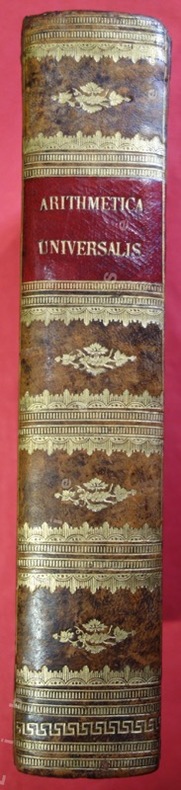
17225823London: Benji & Sam. Tooke 1722. Second edition. <p>Second edition but the first authorised and edited by Newton probably with the assistance of John Machin of his treatise on algebra or 'universal arithmetic' his "most often read and republished mathematical work" Whiteside. "Included are 'Newton's identities' providing expressions for the sums of the ith powers of the roots of any polynomial equation for any integer i plus a rule providing an upper bound for the positive roots of a polynomial and a generalization to imaginary roots of René Descartes' Rule of Signs" Parkinson.</p>. NEWTON'S ALGEBRA - THE FIRST EDITION AUTHORISED AND EDITED BY NEWTON. <p>Second edition but the first authorised and edited by Newton probably with the assistance of John Machin - see below of his treatise on algebra or 'universal arithmetic' his "most often read and republished mathematical work" Whiteside Papers V p. xiv. "Included are 'Newton's identities' providing expressions for the sums of the ith powers of the roots of any polynomial equation for any integer i pp. 251-2 plus a rule providing an upper bound for the positive roots of a polynomial and a generalization to imaginary roots of René Descartes' Rule of Signs pp. 242-5" Parkinson p. 138. About this last rule for determining the number of imaginary roots of a polynomial which Newton offered without proof Gjertsen p. 35 notes: "Some idea of its originality . can be gathered from the fact that it was not until 1865 that the rule was derived in a rigorous manner by James Sylvester." The work is a printed version of lectures Newton prepared in the period 1672-83. Although the editor of the first edition William Whiston later claimed that he had Newton's permission to print the lectures Newton was far from satisfied with the result complaining that the titles and headings were not his and that it contained numerous mistakes. His real concern was that "an unfinished text composed so long before should now be presented to the world as though it represented his latest researches into the structure and applications of algebra" Papers V p. 11 and that Whiston had "too faithfully and impercipiently followed the parent manuscript incorporating in his princeps edition its several inconsistencies and lapses into error without in the main even bringing them to the reader's notice . In his private library copy of the edition Newton corrected many minor misprints inserted more appropriate running heads 'Multiplicatio' 'Divisio' 'Extractio Radicum' 'De Forma Aequationis' 'Reductio Aequationum' 'Resolutio Quaestionum Arithmeticarum Geometricarum' and the like and on the Arithmetica page 279 deleted an unwarranted half-title 'Aequationum Constructio linearis'; more radically he mapped out a large-scale reordering of the sixty-one geometrical problems comprising its central portion seeking to grade them into a more logical sequence and in increasing levels of difficulty while in the concluding section on the 'curvilinear ' construction of equations he pared away all not directly needed flesh reducing it to two skeletal conchoidal neuses now denuded of their proof. That last savage act of butchery apart all these improvements were incorporated in the Latin revise - future parent and rightfully so of all subsequent editions - which he himself brought to publication in 1722" ibid. pp. 13-14. Babson notes that "This edition was the last issued during Newton's lifetime and is almost as rare as the first." In commerce this edition is in fact much rarer than the first: ABPC/RBH list only two other copies of this edition since 1975 but ten of the first.</p> <br /> <p>"In fulfilment of his obligations as Lucasian Professor Newton first lectured on algebra in 1672 and seems to have continued until 1683. Although the manuscript of the lectures in Cambridge University Library carries marginal dates from October 1673 to 1683 it should not be assumed that the lectures were ever delivered. There are no contemporary accounts of them and apart from Cotes who made a transcript of them in 1702 they seem to have been totally ignored. Whiteside Papers V p. 5 believes that they were composed 'over a period of but a few months' during the winter of 1683-4" Gjertsen pp. 33-4.</p> <br /> <p>The Arithmetica "derives partly in its discussion of the elemental algebraic operations and of the reduction and exact solution of equations from Newton's earlier unpublished 'Observations' on the introduction to Cartesian algebra presented by Gerard Kinckhuysen in his 1661 Stelkonst partly in its techniques for delimiting the number and nature real or complex of the roots of equations and for reducing these by factorization from his own independent researches as a young postgraduate student into the theory of equations and partly in its approximate geometrical construction of cubics from his previously elaborated 'Problems for construing aequations'. Apart from novelties in detail and the fabrication of new illustrative 'questions' what is most notable is Newton's developing awareness - still far from completely expressed - of the fundamental structural equivalence which exists between the elements constants and free variables and their functional relationships of algebra and those given lines and undetermined line-lengths and their coordinate interconnections of geometry and his deepening grasp of the still more general isomorphism which permits a two-way 'translation' between mathematical 'speech' and the 'language' of exact science in all its manifestations. His guiding doctrine that algebra is 'universal arithmetick' embroiders a theme stated briefly in an opening phrase of his 1671 treatise on infinite series and fluxions and expounded in a geometrical context earlier still in preface to James Gregory's study of universal mathematical principles. Now also however he reaches tentatively forward to Barrow's notion that algebra is in its essence the abstract logic of relationships between quantities in divorce from their particular setting and hence to be developed as an independent metamathematical system" Papers V pp. 3-4.</p> <br /> <p>"We may reasonably conjecture that pressure was in some manner put upon Newton in late 1683 to fulfil however tardily his statutory obligation annually to deposit a fair copy of ten of his lecture scripts and be all but sure that the arrival in Cambridge the next spring of his young amanuensis Humphrey Newton able to take over from Isaac the dreary time-consuming chore of rewriting his much cancelled and corrected worksheets in legible and coherent form gave him new heart to codify and expand his previous mathematical investigations. But these surmises remain as unproved and essentially undemonstrable as the plausible suggestion that it was Edmond Halley's famous first visit to Cambridge in the late summer of 1684 to talk about the unsolved problem of elliptical planetary motion which provoked him abruptly to relinquish his restructuring of the Arithmetica. We may guess still more tenuously that the appearance in mid-1685 of John Wallis' voluminous Treatise of Algebra Both Historical and Practical would have long deterred Newton from making any efforts to have his own rival studies made publicly available. In later years certainly he grew increasingly soured with the often cumbersome computations and techniques of Cartesian algebra - at one point indeed if we may believe David Gregory he qualified it as 'the Analysis of the Bunglers in Mathematicks - and we may be certain that his reluctance during 1705-6 to have Whiston edit the deposited text of his algebraic lectures was not merely the manifestation of a growing personal antagonism to his successor in the Lucasian chair" ibid. pp. xi-xii.</p> <br /> <p>"When Newton resigned his Lucasian professorship to his deputy William Whiston in December 1701 it was natural that the latter should wish to familiarize himself with the deposited lectures of his predecessor. Whiston did not hesitate to introduce portions of Newton's earlier optical lectures concerning the mathematical theory of the rainbow into his own Lucasian Praelectiones physico-mathematica in the spring of 1706 and about that time also he turned his attention to the succeeding ones on algebra and began to consider their publication. In the meantime rumours began to spread in both Oxford and London that 'Newton's friends solicit him to publish a Treatise of Algebra which he wrote long since. If such ill-founded whispers penetrated to Cambridge Whiston ignored them and went quietly ahead arranging with the London stationer to underwrite the expense of printing the deposited manuscript and then subsequently between September 1705 and the following June correcting both specimen and proof sheets as they emerged from the compositor's bench at the University Press. In February 1706 David Gregory accurately noted in his memoranda that 'Its talked that there is now printing at Cambridge Elements or Principles of Algebra written long since by Sir Isaac Newton but withdrew his added remark that it was 'lately revised by him' when he saw Newton in London in July and was given a first-hand account of the history of the 'Algebra that is printing and near printed at Cambridge'. Though as Whiston was later to announce publicly Newton had given his reluctant approval for the edition . Despite its minor inconsistencies and confusions Gregory's report vividly conveys Newton's concern that an unfinished text composed so long before should now be presented to the world as though it represented his latest researches into the structure and applications of algebra" pp. 8-11.</p> <br /> <p>For a book that was to become Newton's most often republished mathematical work the Arithmetica initially made little impact in Britain and was not even graced by a review in the Philosophical Transactions. On the Continent the reception accorded the lectures was more positive. "Leibniz unhesitatingly divining their author beneath the cloak of anonymity gave them a long review in the Acta Eruditorum of Leipzig in 1708. Written thirty years before he noted and now deservingly printed by William Whiston he assured the reader that 'you will find in this little book certain particularities that you will seek in vain in great tomes on analysis.' His close associate Johann Bernoulli despite some adverse remarks paid Newton the compliment in 1728 of basing his own course on the elements of algebra upon Newton's text. Perhaps partly in consequence of Newton's recent death in Britain too the book began about this time to arouse greater interest than when it was first issued in 1707" Hall p. 174.</p> <br /> <p>Despite the impressive contributions of the work to the theory of equations mentioned earlier it is difficult to pigeonhole the work as being either algebraic or geometric. From one point of view the Arithmetica can be seen as a fulfillment of the programme outlined by Descartes in the Géométrie because it teaches how geometrical problems and also arithmetical and mechanical ones can be translated into the language of algebra. Paradoxically however Newton criticized Descartes maintaining that at least in some cases Apollonian geometry is to be preferred to Cartesian algebra in the analysis of indeterminate problems. Modern analysts he complained had confused algebra and geometry: "The Ancients so assiduously distinguished them one from the other that they never introduced arithmetical terms into geometry. recent people by confusing both have lost the simplicity in which all elegance in geometry consists" Papers V p. 429. The last section of the work 'The linear construction of equations' pp. 279-326 is particularly anti-Cartesian the term 'linear' in this context does not refer to straight lines but derives from Pappus. Newton here deals with the problem of constructing cubics third-degree equations that Descartes solved via the intersection of a circle and a parabola. Newton proposed instead to use a curve of degree higher than the conics as a means of construction namely the conchoid a fourth-degree curve. Newton regarded the conchoid as preferable because it has a mechanical construction and leads to a more elegant solution of the problem.</p> <br /> <p>The present 1722 revision is "the standard text of the Arithmetica published much as before 'Impensis Benj. & Sam. Tooke'. It appeared to Newton's first editor that 'that acute Mathematician Mr. John Machin Professor of Astronomy at Gresham College . and one of the Secretaries of the Royal Society published this Work again by the Author's later Desire or Permission; I lay no claim to it' Whiston Memoirs; John Conduitt's memorandum King's College Cambridge. Keynes MS 130.5 again adds the clarification that 'Machin overlooked the press for which Sir I intended to have given him 100 Guineas but he made him wait 3 years for a preface & then did not write one'. Elsewhere Keynes MS 130.6 2 Conduitt noted that 'Sir I. told me that Machin understood his Principia better than anybody that Halley was the best Astronomer but Machin the best Geometer'. Newton's active stage-managing of the 1722 revise can be documented in several ways: most notably a stray autograph sentence on an otherwise clean folio page now ULC. Add. 3960.7: 95 differs by only a single trivial adverb from an inserted footnote clarifying the reference to the unimplemented 'Regulae post docendae' on page 52 of the deposited copy. The ubiquitous presence of its author's editorial hand was not missed by W. J. 's Gravesande when he came to reissue the Arithmetica ten years later: 'Secunda vice liber in lucem prodiit Londini 1722; sed in statu perfectiore ut quis facile percipiat non omnino foetum abdicasse virum Celeberrimum; ordo propositionum non tantum mutatus est sed in ipsis solutionibus & demonstrationibus correctiones multae reperiuntur non nisi ipsi Auctori tribuendae'" ibid. p. 14 n 60.</p> <br /> <p>"Benjamin Tooke the London publisher and printer he was Queen's printer had eight books published at the Cambridge Press all of them by Whiston between 1702 and 1712. There are two London printer's ornaments used in this volume pp. 283 & 289 and nowhere else but we know that the woodcuts for the illustrations in the 1707 edition were delivered to Cambridge possibly from London 6d. was paid for the parcel. So far as one can tell the woodcuts are identical and we must assume they had been reclaimed by Tooke. Unfortunately we have no letters from Newton about the printing history of this volume" Macclesfield sale catalogue.</p> <br /> <p>Babson 200; Macclesfield 1520; Wallis 278. Gjertsen Newton Handbook 1986. Hall Isaac Newton 1992. Westfall Never at Rest 1983.</p> <br/> <br/> 8vo pp. iv 332 including half-title with list of books on verso woodcut diagrams throughout ink name of Newton on half-title ink inscription identifying Newton as author and another Whiston as editor on title slightly browned. Contemporary panelled calf ink signature of former owner Robert Andrews on front free endpaper corners and edges rubbed joints splitting spine rubbed. Benji & Sam. Tooke unknown
17074639Cambridge; London: Typis Academicus; Benjamin Tooke 1707. First edition. <p>First edition of Newton's treatise on algebra or 'universal arithmetic' his "most often read and republished mathematical work" Whiteside. Included are 'Newton's identities' providing expressions for the sums of the powers of the roots of any polynomial equation plus a rule providing an upper bound for the positive roots of a polynomial and a generalization to imaginary roots of René Descartes' 'Rule of Signs.'</p>. Hardcover. NEWTON'S TREATISE ON ALGEBRA. <p>First edition of Newton's treatise on algebra or 'universal arithmetic' his "most often read and republished mathematical work" Whiteside. "Included are 'Newton's identities' providing expressions for the sums of the ith powers of the roots of any polynomial equation for any integer i pp. 251-2 plus a rule providing an upper bound for the positive roots of a polynomial and a generalization to imaginary roots of René Descartes' Rule of Signs pp. 242-5" Parkinson p. 138. About this last rule for determining the number of imaginary roots of a polynomial which Newton offered without proof Gjertsen p. 35 notes: "Some idea of its originality . can be gathered from the fact that it was not until 1865 that the rule was derived in a rigorous manner by James Sylvester."</p> <br /> <p>Provenance: Jesuit College at Ghent ink inscription 'Bibliotheca Collegii Gandavensis Societatis Jesu.' and shelfmark on title; extensive marginal annotations by a well-informed contemporary reader. This reader was possibly the English Jesuit Christopher Maier 1697-1767. Born in Durham England Maier entered the Society of Jesus in 1715. He taught at Liège where he became interested in astronomy. In 1750 Maire was commissioned by Pope Benedict XIV to measure two degrees of the meridian from Rome to Rimini with fellow Jesuit Roger Boscovich with a view to mapping the Papal States; in turn they proved that the earth is an oblate spheroid as Newton had proposed in Principia publishing their results in Litteraria Expeditione 1755. Maier spent his final years at the English Jesuit College in Ghent.</p> <br /> <p>"In fulfillment of his obligations as Lucasian Professor Newton first lectured on algebra in 1672 and seems to have continued until 1683. Although the manuscript of the lectures in Cambridge University Library carries marginal dates from October 1673 to 1683 it should not be assumed that the lectures were ever delivered. There are no contemporary accounts of them and apart from Cotes who made a transcript of them in 1702 they seem to have been totally ignored. Whiteside Papers V p. 5 believes that they were composed 'over a period of but a few months' during the winter of 1683-4" Gjertsen pp. 33-4. The course of lectures stemmed from a project on which Newton had embarked in the autumn of 1669 thanks to the enthusiasm of John Collins: the revision of Mercator's Latin translation of Gerard Kinckhuysen's Dutch textbook on algebra Algebra ofte stel-konst 1661. Newton composed a manuscript 'Observations on Kinckhuysen' in 1670 see Whiteside Papers II and used it in the preparation of his lectures. He took the opportunity not only to extend Cartesian algebraic methods but also to restore the geometrical analysis of the ancients giving his lectures on algebra a strongly geometric flavor.</p> <br /> <p>"When Newton resigned his Lucasian professorship to his deputy William Whiston in December 1701 it was natural that the latter should wish to familiarize himself with the deposited lectures of his predecessor" Whiteside Papers V p. 8. Whiston later claimed in his Memoirs London: 1749 that Newton gave him his reluctant permission to publish the lectures. Whiston arranged with the London stationer to underwrite the expense of printing the deposited manuscript and then subsequently between September 1705 and the following June corrected both specimen and proof sheets as they emerged from the University Press. The completed editio princeps finally appeared in May 1707 priced at 4s. 6d. without Newton's name on the title page although references inside the work made no attempt to hide the author's identity. It included an appended tract by Halley on 'A new accurate and easy method for finding the roots of any equations generally without prior reduction' pp. 327-343. Publication of the work had been delayed by Newton who complained that the titles and headings were not his and that it contained numerous mistakes. Yet when he prepared a second edition in 1722 the changes he introduced were "primarily reorderings of his own manuscript not corrections of Whiston's additions" Westfall p. 649. In reality Newton's misgivings probably derived more from his reluctance to place before the public a relatively immature and poorly organized work and one that did not take into account the developments in the subject that had taken place in the quarter century since the manuscript was composed.</p> <br /> <p>For a book that was to become Newton's most often republished mathematical work the Arithmetica initially made little impact in Britain and was not even graced by a review in the Philosophical Transactions. On the Continent the reception accorded the lectures was more positive. "Leibniz unhesitatingly divining their author beneath the cloak of anonymity gave them a long review in the Acta Eruditorum of Leipzig in 1708. Written thirty years before he noted and now deservingly printed by William Whiston he assured the reader that 'you will find in this little book certain particularities that you will seek in vain in great tomes on analysis.' His close associate Johann Bernoulli despite some adverse remarks paid Newton the compliment in 1728 of basing his own course on the elements of algebra upon Newton's text. Perhaps partly in consequence of Newton's recent death in Britain too the book began about this time to arouse greater interest than when it was first issued in 1707" Hall p. 174.</p> <br /> <p>Despite the impressive contributions of the work to the theory of equations mentioned earlier it is difficult to pigeonhole the work as being either algebraic or geometric. From one point of view the Arithmetica can be seen as a fulfillment of the programme outlined by Descartes in the Géométrie because it teaches how geometrical problems and also arithmetical and mechanical ones can be translated into the language of algebra. Paradoxically however Newton criticized Descartes maintaining that at least in some cases Apollonian geometry is to be preferred to Cartesian algebra in the analysis of indeterminate problems. Modern analysts he complained had confused algebra and geometry: "The Ancients so assiduously distinguished them one from the other that they never introduced arithmetical terms into geometry. recent people by confusing both have lost the simplicity in which all elegance in geometry consists" Whiteside Papers V p. 429. The last section of the work 'The linear construction of equations' pp. 279-326 is particularly anti-Cartesian the term 'linear' in this context does not refer to straight lines but derives from Pappus. Newton here deals with the problem of constructing cubics third-degree equations that Descartes solved via the intersection of a circle and a parabola. Newton proposed instead to use a curve of degree higher than the conics as a means of construction namely the conchoid a fourth-degree curve. Newton regarded the conchoid as preferable because it has a mechanical construction and leads to a more elegant solution of the problem.</p> <br /> <p>William Whiston 1667-1752 was "a member of the first generation of Cambridge students to emulate Newton's method and principles. He went up to Cambridge in 1686 claimed to have attended one or two incomprehensible lectures by Newton on his Principia and was elected a Fellow of Clare Hall in 1691. After taking orders he left Cambridge for a while returning in 1700 when chosen by Newton to be his deputy as Lucasian Professor. About a year later upon Newton's resignation and commendation Whiston succeeded him. Aberrant theology was to be his downfall. While Newton and their common friend Dr Samuel Clarke kept private their doubts about Trinitarianism the Creed and the Thirty-nine Articles Whiston sought publicly to amend the errors of the Anglican faith; for this he was summoned before the heads of houses in the university and dismissed from his post in 1710" Hall p. 175.</p> <br /> <p>Babson 199; Wallis 277; D. Gjertsen Newton Handbook 1986; A. R. Hall Isaac Newton 1992; R. S. Westfall Never at Rest 1983.</p> <br/> <br/> 8vo pp. viii 343. Woodcut diagrams throughout. Former owner's signature F. Percy White Feb. 1920 on half-title partially erased. Contemporary mottled calf covers with floral border and corner fleurons in blind. / Hardcover. Typis Academicus; Benjamin Tooke unknown
17076325Cambridge and London: Typis Academicis; Benj. Tooke 1707. First edition. Very Good/William Whiston the successor to Newton's chair at Cambridge "extracted from Newton a somewhat reluctant permission to print" this remarkable "schoolbook" based on Newton's lecture notes Babson Catalogue. So reluctant in fact that Newton kept his name out of it and supposedly considered purchasing the press run in order to destroy it! He later republished it himself. Several new theorems are laid out including a formula to determine the number of imaginary roots of any equation. The rule is complicated and is offered without proof. Yet 180 years later the rule was proven by rigorous analysis. The text also includes Edmond Halley's "Aequationum radices arithmetice inveniendi methodus. Octavo 19cm; 8 343 1 pages the last page blank . Figure and diagrams in text. Running-title: Algebrae elementa. Editor's preface signed: G.W. i.e. William Whiston. In contemporary paneled calf rebacked with new burgundy morocco spine label. Edges of boards rubbed. Early ink ownership inscriptions on blank endleaves the contemporary autograph of Edward Harington and the 19th-century mathematician William Fleetwood Sheppard. Half-title present. References: Babson Newton Collection; 199; ESTC; T018645; Bowes and Bowes 277. Typis Academicis; Benj. Tooke hardcover books
1761168701761 Amsterdam, Marc Michel Rey, 1761, 3 parties en 2 tomes rel. en 1 vol. in 4 de (6)-XVIII-310-(2) pp. ; (4)-288 pp. ; (2)-134-(2) pp., pages de titres imprimées en rouge et noir, 37 planches dépliantes gravées, rel. début XIXe de plein veau brun raciné, dos richement orné de fers dorés, pièce de titre de maroquin rouges, tranches jaspées de couleurs, bel ex.
1732285967Leyden: Verbeek 1732. Third. hardcover. very good. Title page in red & black with engraved vignette; illustrated with 13 folding copperplates. 344 pages short 4to bound in 19th century leather-backed marbled boards lightly edge-rubbed; new end-leaves. Lugduni Batavorum: Joh. et Herm. Verbeek 1732.<br/><br/> Third Latin edition of his professorial lectures on mathematics mostly on algebra and analytic geometry given at Cambridge during 1673-83. Some of this material was incorporated into the Principia. Babson no. 204. Lowndes 1674. Some browning to the pages and light staining in top gutter but a very good copy.<br/><br/> Verbeek unknown books
173031377AB1730. The Fifth Edition. London Printed for Emanuel Matthews 1730. Small Octavo. 5 156 1 pages. Hardcover / Original early 18th century full-leather with armorial embossing to both boards. New spine-label. Ruth Corker's Library-stamp verso the titlepage. This used to be Ruth Corker's mother's book prior to her own and the name Mary Falkiner is written in ink on top of the Preface-page. Manuscript entry "Ruth Corker Her Book 1731" on halftitle with several entries informing on marriages and relationships within the Falkiner and Corker and Robinson - family added obviousy by a later relative Ruth Robinson who was married to Robert Robinson. Excellent condition with only minor signs of wear. Armorial Bindings held in University of Toronto Libraries: Corker Ruth 1693 -1760 Mrs Ruth Corker of 41 St Stephen's Green Dublin was born Ruth Falkiner the only daughter of Richard Falkiner and Mary Mason of Dublin. She married Thomas Corker 1700-1772 merchant of Dublin. She died in 1760. Her name appears as one of the subscribers to Oldmixons The history of England during the reigns of King William and Queen Mary London 1735. Stamp Information of the Armorial Binding of Ruth Corker: Monogram: R R C Source: utoronto.ca Isaac Watts 17 July 1674 25 November 1748 was an English Congregational minister hymn writer theologian and logician. He was a prolific and popular hymn writer and is credited with some 750 hymns. His works include "When I Survey the Wondrous Cross" "Joy to the World" and "Our God Our Help in Ages Past". He is recognized as the "Godfather of English Hymnody"; many of his hymns remain in use today and have been translated into numerous languages. Wikipedia hardcover
170247776Oxoniae Oxford E Theatro Sheldoniano 1702. Folio. Contemporary full calf raised bands rectangular blindtooled frames and central panel "mirror" on covers Cambridge-style binding. leather at joints cracked but cords intact so that covers not loose. Corners a bit bumped. Light wear to spine ends. Spine a bit rubbed. Pastedowns and flyleaves with browning. Title-page with large engraved vignette Sheldon Theater. 124942 pp. With numerous textdiagrams. Very light browning to titlepage and a few marginal brownspots to last leaf a fine clean copy printed on good paper with wide margins.On the verso of the title-page is pasted the book plate of Sir William Baird of Newbaith. He habitually pasted his armorial bookplate on the verso of the title-pages of the books in his large and fine library. <br/><br/><em>First edition of the first text book of astronomy based on Newtonian principles. Apart from its importance in the remodeling of astronomy in conformity with physical theory the work is of the utmost importance as a source book - it contains the FIRST PRINTING OF NEWTON'S PAPER ON LUNAR THEORY "Lunae Theoria Newtoniana" pp. 332-336 as well as the FIRST EXPOSITION OF NEWTON'S CLASSICAL SCHOLIA which Newton himself considered an important part of his philosophy.Gregory a Scottish mathematician who taught at Edinburgh and Oxford was one of Newton's closest friends and associates. Newton thought highly of his work and communicated for insertion it in his Lunar Theory. He also permitted Gregory to use the material of that which is known as his "Classical Scholia" which are incorporated into Gregory's preface. "Newtonian scholars have long been aware of a set of draft Scholia to Propositions IV to IX of Book III of the "Principia". These were composed in the 1690's as part of an unimplemented plan for a second edition of the work. Since they describe supposed anticipation of Newton's doctrines in the thought of Greco-Roman antiquity they have been known as the 'classical' Scholia. Newton's thoughts on these matters were not however kept completely concealed. HE PERMITTED DAVID GREGORY TO USE THE MATERIAL EXTENSIVELY in a long historical preface to his "Astronomiae Physicae & Geometricae Elementa" 1702 IF WITHOUT ATTRIBUTION. It was also available to Maclaurin for his much later work." McGuire & Rattansi in "Newton and the Pipes of Pan" 1966."It was the first textbook composed on gravitational principles and remodeling astronomy in conformity with physical theory. Newton thought highly of it and communicated for insertion in it p. 332 his 'lunar theory' long the guide of practical astronomers in determining the Moon's motions. The discussion in the preface in which the doctrine of gravitation was brought into credit on the score of its antiquity likewise emanated from Newton." DNB."His thick folio text on foundations of astronomy Astronomiae.elementa 1702 is a well-documented but unimaginative attempt to graft the gravitational synthesis propounded in the first book and especially the third book of Newton's Principia onto the findings of traditional astronomy. While respected as a source book it is now chiefly remembered for the remarks by Newton on the prisca sapientia of the ancients and their "knowledge" of the inverse-square law of universal gravitation and for the Latin version of Newton's short paper on lunar theory which it reproduces." DSB.Babson No. 71. - Houzeau & Lancaster 9240. </em> hardcover
170208586Oxoniae Oxford: Sheldonian Theatre 1702. First Edition. The first astronomical book on gravitational principles; important because it contains the first publication of Isaac Newton's Lunar Theory "Lunae Theoria" pp. 332-336. The rather lengthy Preface contains Newton's Classical Scholia." Folio 14 1/8" x 9 1/2" 124942. bound in contemporary full paneled calf rebacked to style with red leather label on spine; with a plethora of diagrams in the text and a fine engraving on the title page. A lovely wide-margined copy printed on laid paper. First several leaves with light marginal dampstain affecting only a few words of text; small chip at foot of FFEP; discreet archival repair to gutter and lower part of title page; page 237 with light marginal soiling. David Gregory 1659 - 1708 was a close friend and associate of Isaac Newton. Babson 71. <br/><br/> Sheldonian Theatre hardcover books
170247776Oxoniae (Oxford), E Theatro Sheldoniano, 1702. Folio. Contemporary full calf, raised bands, rectangular blindtooled frames and central panel ""mirror"" on covers, Cambridge-style binding. leather at joints cracked, but cords intact so that covers not loose. Corners a bit bumped. Light wear to spine ends. Spine a bit rubbed. Pastedowns and flyleaves with browning. Title-page with large engraved vignette (Sheldon Theater). (12),494,(2) pp. With numerous textdiagrams. Very light browning to titlepage and a few marginal brownspots to last leaf, a fine clean copy, printed on good paper with wide margins.On the verso of the title-page is pasted the book plate of Sir William Baird of Newbaith. He habitually pasted his armorial bookplate on the verso of the title-pages of the books in his large and fine library.
171347024Amstelaedami Amsterdam: Joannem Wolters 1713. Very Good. Amstelaedami Amsterdam: Joannem Wolters 1713. "Edition ultima auctior & correctior." Small thick octavo 16cm; full contemporary parchment manuscript spine titling dark topstain; 4457424pp. collated complete; steel engraved portrait frontispiece and added title page woodcut initials head- and tail-pieces. Parchment dust-soiled and unevenly darkened brief scratches to rear cover light dampstaining affecting final few leaves fore-edge of several gatherings mysteriously sliced without affecting text extensive manuscript notes in a contemporary and a 19th-century hand to front free endpapers; overall Very Good and sound. <br /> <br /> Handy edition of the only surviving reference work by the Roman encyclopedist Aulus Cornelius Celsus ca. 25 BCD - 40 CE. Rediscovered in the 15th century the eight books of De Medicina were first published in 1478 "the first general text of medicine to come from a printing press" John G. Simmons "Doctors and Discoveries" 2002 p. 378. Joannem Wolters unknown
17821974Connecticut Huts New Windsor Cantonment: 27 January 1782. Very Good. In 1781 the 5th Regiment Connecticut line drew in the remains of the former 8th regiment and re-formed with the rest of the Continental Army at New Windsor. Writing from the Connecticut Huts sector of the cantonment Colonel Isaac Sherman commander of the 5th Regiment certifies the service of one Jedidiah Ensworth as surgeon's mate in the former 8th regiment on the battlefield. <br /><br /> 27 January unknown
1791007574London: S. W. Fores 1791. First Edition. 18th Century broadside of song lyrics and hand-colored etching of foxhunting scene. Uncommon in physical form. Dibdin 1745-1814 was a singer-songwriter nearly two centuries prior to the elevation of that combination. There were always composers who publicly performed their own music of course. He was more versatile than that though. He also wrote operas novels and plays. He collaborated with legendary theater manager David Garrick and served for a time as the Music Director at Covent Garden. The "Oddities" for which this song was written was performed in 1789. Visible part of broadside under glass and matting 36 by 24 cm. With wood frame and matting 50 by 36.5 cm. The frame is of a burled cherry we believe the matting green with a thin white beveling and we believe most would find the framing attractive and worth retaining. S. W. Fores unknown