527 résultats
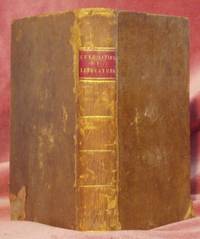
179721661Printed at Newburyport By Edmund M. Blunt for Mathew Carey Philadelphia 1797. HB NODustJacket 1797 on title page. 1st edition Later Printing Brown full LEATHER contemporary sheepskinwith Much Rubbed Label on Spine Cover rub wear & tiny Chips Tears Extremities Outer Hinges along spine Partially Separated & Rather Fragile with small chips top & bottom Spine VG-/VG- AS-IS NODJ Delacate Condition Interior relatively tight Wear FOXing some dogeared pgs Last two pages show some Silverfish Damage 239 pgs withLast Page Corner Margin Chip 12mo in 6s gilt spine morocco label; text fingered and soiled top and base of spine chipped corners worn upper front joint cracked. . Full-Leather. Printed at Newburyport, By Edmund M. Blunt, for Mathew Carey, Philadelphia, hardcover
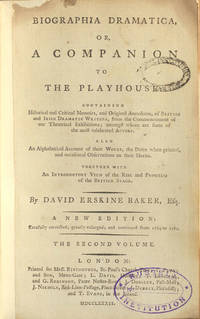
1782008138London:: Mess. Rivingtons and others 1782. 2nd Edition . Hardcover. Very Good. 8vo - over 7¾ - 9¾" tall. Over a thousand dramas listed. Second edition New Edition two volumes in 19c half calf over cloth some blind tooling. Spines gilt titles blind & gilt tooling. Internally Vol 1 1782 2 v-lii 496 pp. Vol 2 1782 2 1 2-442 pp. Lacking half titles an interleaved example text in 2 columns both volumes with title & endpage tipped to gutter stubs & eps with some paper repairs. Pencil name Arthur Wm Ashby Oxon to feps Exeter College coat of arms to fpd binders stamp to fpds Mattby bookseller label to epds 2 oval stamps to titles Russell Institution 2 tipped in old catalogue descriptions to fep. First edition published anonymously 1764 under the title "The companion to the playhouse". 207131 mm. ESTC T89214. <br/> <br/> Mess. Rivingtons, and others hardcover
173220801732. : 9 . With engraved plate after page 158 4 Blank pages / 14 NNP / 893 Pages / 11 NNP / 4 After blanks / 1 Engraved Plates Binding: Contemporary Full Vellum Octavo 8vo Height cm: 216 CM Width cm: 165 CM Thickness cm: 7 CM hardcover
176471469-A-59264Hoorn: T. Tjallingius 1764. Eerste en tweede deel in 1 band. Fraaie orig. perkamenten band titelschildjes in rood en blauw verguld 5 ribben. Zonder portret maar met gravure van het Jacob van Maerlandt gedenkteken in het stadhuis van Damme. 14 893 11 p. . -Met vele aantekeningen in potlood en inkt ingeplakt label verso voorplat. Overigens is de uitgave in goede conditie pagina's redelijk helder binding solide. T. Tjallingius unknown
1740204952Amsterdam: Giovanni Battista Albrizzi 1740. unbound. very good. Map. Uncolored copper plate engraving. Image measures 11" x 13.25".<br/> <br/> Exquisite impression. Map includes both Schleswig and Holstein while today part of the former and all of the latter are northern Germany. Full original margins very small tear to left edge.<br/> <br/> Giovanni Battista Albrizzi unknown
1740204952Amsterdam: Giovanni Battista Albrizzi 1740. unbound. very good. Map. Uncolored copper plate engraving. Image measures 11" x 13.25".<br/><br/> Exquisite impression. Map includes both Schleswig and Holstein while today part of the former and all of the latter are northern Germany. Full original margins very small tear to left edge.<br/><br/> Giovanni Battista Albrizzi unknown books
1710341261710 Hambourg - Sumptibus Christiani Libezeit - 1710 - 1 volume in8 broché de 368 pages sous couverture muette - Titre manuscrit au dos - Rousseurs -
179519605Baltimore: Clayland Dobbin & Co. for Keatinge's Book-Store 1795. Leather covers detached. Half title present. viii 127 1 blank xii pp. Text lightly foxed and Very Good. Pagination corresponds with the London edition. A Table of Cases appears at the beginning; an Index comprises the last twelve pages. <br /> FIRST AMERICAN EDITION. Evans 28636. Not in Harv. Law Cat. Cohen Marviin Marke. Clayland, Dobbin, & Co. for Keatinge's Book-Store unknown
179519605Baltimore: Clayland Dobbin & Co. for Keatinge's Book-Store 1795. Leather covers detached. Half title present. viii 127 1 blank xii pp. Text lightly foxed and Very Good. Pagination corresponds with the London edition. A Table of Cases appears at the beginning; an Index comprises the last twelve pages. <br/>FIRST AMERICAN EDITION. Evans 28636. Not in Harv. Law Cat. BEAL or Marvin though many of his other works are Jenkins Marke. Clayland, Dobbin, & Co. for Keatinge's Book-Store unknown books
1786h42110Sulzbach: Ze l ben Aharon 1786. Hardcover. Fair. 8vo 8.5 x 7 inches in amateur cloth backed boards mid-20th century fair copy with title page and next leaf in photocopy the leaf after that with damage and loss the remainder of the text in very good condition; last leaf with some edgewear and loss resulting in the loss of some letters. Over 260 leaves seems complete with quite a number of small woodcut illustrations 2.75 x 1.5 inches on average. Tseno Ureno sometimes called the Women's Bible is a Yiddish-language prose work whose structure parallels the weekly Torah portions and Haftorahs used in Jewish prayer services. The book was written by Jacob ben Isaac Ashkenazi 1550–1625 of Janów Lubelski near Lublin Poland and mixes Biblical passages with teachings from Judaism's Oral Torah such as the Talmud's Aggadah and Midrash which are sometimes called "parables allegories short stories anecdotes legends and admonitions" by secular writers. Ze l ben Aharon hardcover
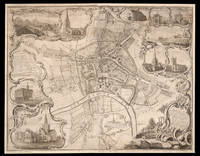
175721794Publish'd According to Act of Parliament March 21 1757. 700 by 890mm. 27.5 by 35 inches. Taylor's Plan of Hereford Engraved plan on two sheets joined remnants of old creases laid on later linen some minor areas of loss and a few tears skilfully repaired trimmed to right and upper image. Beautifully engraved plan of Hereford. The central city-plan is surrounded by views of notable places in Hereford framed by elaborate rococo strapwork among them: "General View from Broomy Hill" "Crofs of the White Fryers" "The Palace Church & part of the Town" the "Town Hall" and "St Ethelbert's Cathedral". Bottom-right the title is housed in an elaborate cartouche accompanied by apparently a self-portrait of Taylor himself at work. To the left are listed the number of houses and of inhabitants of different streets from "Broad Cabbage lane" to "Cooker row". Isaac Taylor of Ross fl.1750-1778 was born in Hereford. He earned a reputation as a surveyor of both county maps and city plans. His style was easily recognizable with his county maps Herefordshire 1754 Hampshire 1759 Dorset 1765 Worcestershire 1772 and Gloucestershire 1777 giving particular emphasis to the hills. It is surprising that Taylor like Rocque and Jefferys was not successful in gaining the approval of the Society of Arts who appeared to favour the amateur surveyors rather than the professional map-makers. Nearly all the awards went to applicants who produced just one or two maps rather than men like Taylor or Jefferys who between them published 15 fine large-scale maps accurately surveyed and well engraved and in some instances more competent than most of those that were recognized by the Society. It is unlikely that Taylor's plan of Hereford was hugely successful at its time of publication given the lack of wealth and of population in the county. Indeed for his map of Herefordshire published three years earlier Taylor had only managed to raise 77 subscribers and print less than 100 copies of which few examples survive today. The plan is engraved by Richard Benning fl.1743-1781. Little is known about Benning beyond his work. Born perhaps in St Martin in the Fields in 1720 he was possibly related to William Benning fl.1746-1756 a copperplate printer. He engraved several plans and maps for John Rocque of Paris London Berkshire and also engraved the plan of Brest and Recouvrance for Isaac Ross Taylor. Rare: we have only been able to trace two institutional examples of this plan one in the British Library and one in the Biblioteca Nacional de Espana. We are unable to trace an example coming up at auction since the war. Publish'd According to Act of Parliament, unknown
171011775Hanoviae Hannover: NP 1710. Second revised. Hardcover. fair. Folio. 7 pp .L.3-343 f.9 1 L. 11 f . 3/4 calf over brown blind-embossed cloth boards with gilt lettering. Marbled end papers. 2 Title pages Hebrew and Latin. Dedication in Latin. Commentary on the Hebrew Bible by renowned Medieval Jewish philosopher Don Isaac Abarbanel 1437-1508 see below. Age wear to binding. Front board detached but present. Rear endpaper reinforced with gray binder's tape along gutter. Publisher's mark on Title and endpaper. Minor browning throughout with sporadic foxing. In Hebrew. Binding in fair inside in good condition. On the author Source: Public Domain:<br /> Isaac ben Judah or Yitzchak ben Yehuda Abravanel 1437 - 1508 was a Jewish statesman philosopher Bible commentator and financier. In many works he is referred to solely by his last name which is variously spelled as Abravanel Abarbanel and Abrabanel. Many Torah and Talmud scholars today simply refer to him as "The Abarbanel". He was born in Lisbon Portugal. He died in Venice and was buried in Padua next to Rabbi Judah Minz Rabbi of Padua. Isaac Abravanel developed many works during his lifetime which are often categorized into three groups: exegesis philosophy and apologetics. Exegesis refers to biblical commentary his philosophy dealt with the sciences and how the general field relates to the Jewish religion and traditions and apologetics defends the Jewish idea of the coming of the Messiah. Abravanel’s exegetic writings were different from the usual biblical commentaries because he took social and political issues of the times into consideration. He believed that mere commentary was not enough but that the actual lives of the Jewish people must be deliberated on as well when discussing such an important topic as the Bible. He also took the time to include an introduction concerning the character of each book he commented on as well as its date of composition and the intention of the original author in order to make the works more accessible to the average reader. Christian scholars appreciated the convenience of Abravanel's commentaries and often used them when preparing their own exegetical writing. This may have had something to do with Abravanel’s openness towards the Christian religion since he worked closely with Messianic ideas found within Judaism. Because of this Abravanel’s works were translated and distributed within the world of Christian scholarship.<br /> Ozar Hasefer p164 item #65. NP hardcover
179228826London : Printed for J. Murray 1792. 215x130mm. XI 2 ff. - 13Êpages index calfskin binding red title patch lower corners damaged. 725 Printed for J. Murray unknown
17540000722Upsaliae Uppsala : Exc. Laur. Magnus Hojer 1754 . First Edition. Quarter calf. Very good . 4to Recent quarter sprinkled-tan calf marble boards; green morocco label. Collation: 8 29 3pp. Inked number 26 to title <br/><br/>This is one of the most significant of all Linnaen theses being the first arrangement of English plants in the Linnaen method and also “the first of thos compendious Florae in which the newly-invented trial names had been exemplified and which have since been much used.” Pulteney A General View of the Writings of Linnaeus. London 1781 p. 270. Composed by Isaaac Olof Grufberg 1736-1764 one of the many students of Carl Linnaeus at Uppsala Univesity 1743-76 who presented and defended theses in order to expound the theories of their masters as well as advance their academic careers. These theses were printed locally with an eye to economy for distribution a week before the pupil’s defence in this case 3 April 1754. After discussing the climate and situation of England and its plant-life excelling in marine plants Grufberg compares the English flora with that of Sweden in which alpine upland and wood plants thrive. This thesis contains a listing of nearly 1000 phaneogram and cryptogram plants that are ordered according to the 24 Classes of the Linnaean System noting abpit 300 plants which were not found in Sweden. He concludes with a list of more than 100 plants that he was unable to investigate. This list is not indicated as a separate Addendum. Soulsby 1299 1805 Exc. Laur. Magnus Hojer unknown books
176558444London: Other. Very Good. 1765. Hardcover. Rebound 24pp. marbled boards paper label to front cover Very Good. . Other hardcover books
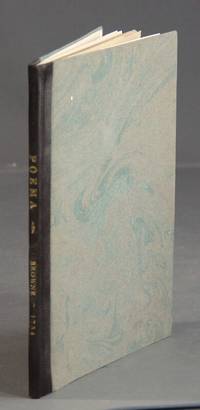
175458056Londini: impensis J. & R. Tonson & S. Draper 1754. 4to pp. 4 40; modern boards gilt lettering on spine; some toning of the text and the textblock trimmed to 23.5 x 18.5 cm; all else very good. This is the variant with the price 1 s. 6 d. on the title page. Painfully common but Browne's best known work a poem on the immortality of the soul. impensis J. & R. Tonson & S. Draper unknown
1754003732London: J. & R. Tonson & S. Draper 1754. Hardcover. Good. 8vo - over 7¾ - 9¾" tall. 4 lacks all before title page seemingly published as a pamphlet with paper covers 40 title page dust-stained small ink stain on final page generally clean and well-preserved. Rebound in recent half calf with marbled boards gilt titles. This edition with the price 1s 6d at the foot of the title page. One of several editions published in this year this without an English translation presumed earlier. He was an imitator of Swift and Pope and went into politics as MP for Much Wenlock 1744-54. Died in Bloomsbury Square in 1760 after having "drunk hard for thirty years" according to Dr Johnson. Text in Latin only <br/> <br/> J. & R. Tonson & S. Draper hardcover
175458056Londini: impensis J. & R. Tonson & S. Draper 1754. 4to pp. 4 40; modern boards gilt lettering on spine; some toning of the text and the textblock trimmed to 23.5 x 18.5 cm; all else very good. This is the variant with the price 1 s. 6 d. on the title page. Painfully common but Browne's best known work a poem on the immortality of the soul. <br/><br/> impensis J. & R. Tonson & S. Draper hardcover books
175453447Londini London: J. & R. Tonson & S. Draper 1754. 4to. pp. 40; late twentieth-century quarter-bound leather over decorative-paper boards with a binder's ticket in the rear stating "Restored by B R Lhotka 1992". This variant has the price on the title page. A near fine book with the rear hinge starting and an archival tape repair to the front hinge. Hawkins Brown is cited as a friend of Samuel L. Johnson and was a poet MP and Barrister during his lifetime 1706-1760 Trinity College Chapel Memorials. His poem reads as a pseudo-philosophical exploration of the immortality of the human soul drawing on humanist beliefs about the universe as well as theology. <br/><br/> J. & R. Tonson & S. Draper hardcover books
1732D427Amsterdam: R. en J. Wetstein en W. Smith 1732. Hardcover. Very Good. 2 volumes Elephant folio 445 x 296mm. 16 524pp. 4. Title-page in black and red with engraved vignettes. Text in Dutch and Latin parallel. Contemporary vellum with central medallion stamped in blind. Slight bowing to vellum as typical overall a superb two volume set of the Metamorphoses illustrated with in-text copper-engravings by Bernard Picart Charles le Brun and several other artists. Internally there are scattered stains but an excellent copy overall. The translator of this edition Isaac Verburg was born in Leiden around the year 1684. He was Rector of the Latin schools in Amsterdam and author and translator of several books; he died in 1745 in Amsterdam. Rare copy of the popular Dutch translation of Ovids masterpiece in prose Metamorphoses with clean bright and large illustrations. <br/><br/> R. en J. Wetstein, en W. Smith hardcover
1732D427Amsterdam: R. en J. Wetstein en W. Smith 1732. Hardcover. Very Good. 2 volumes Elephant folio 445 x 296mm. 16 524pp. 4. Title-page in black and red with engraved vignettes. Text in Dutch and Latin parallel. Contemporary vellum with central medallion stamped in blind; occasional spotting and marginal dampstaining; vellum soiled and covers somewhat bowed corners bumped. A fine two volume set of the Metamorphoses illustrated with in-text copper-engravings by Bernard Picart Charles le Brun and several other artists. The translator of this edition Isaac Verburg was born in Leiden around the year 1684. He was Rector of the Latin schools in Amsterdam and author and translator of several books; he died in 1745 in Amsterdam. Rare copy of the popular Dutch translation of Ovids masterpiece in prose Metamorphoses with clean bright and large illustrations. <br/><br/> R. en J. Wetstein, en W. Smith hardcover books
178233195BBBasel, Jean Schweighauser 1782. Gross-8°. VII; 429 S., XXXII S. Pappband der Zeit mit goldgeprägtem Rückenschild und wenig Rückenvergoldung.
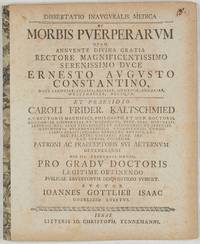
1750550061750. Jenae Litteris Jo. Christoph Tennemanni 1750 4° 24; 8 pp. Rückenbroschur. Erste Ausgabe! Dissertatio inauguralis medica de morbis puerperarum / quam .Praesidio Caroli Frider. Kaltschmied . publicae eruditorum disquisitioni subiciit auctor Ioannes Gottlieb Isaac Goerlizio Lusatus. Kaltschmied Carl Friedrich 1706-1769 Präses; Isaac Johann Gottlieb 1724-1763 Resp. Georgii Erhardi Hambergeri . Programma Avspiciale . : De Aere Corporibvs / Georg Erhard Hamberger. Hamberger Georg Erhard 1697-1755 unknown
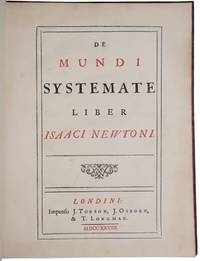
17286610London: J. Tonson J. Osborn & T. Longman 1728. First edition. <p>First edition an extraordinary Newtonian association copy of Newton's rarest book inscribed by James Stirling recording the gift from Abraham de Moivre "Ja: Stirling Ex Dono Dni De Moivre". Drafted in the mid-1680s as the liber secundus of the earliest Principia the text differs substantially from the published Book III. Among its non-Principia contents are the thought-experiment of the orbiting cannonball anticipating the artificial satellite the first acceptable photometric determination of a stellar distance and passages that point to terrestrial tides Michelson 1919 and to the existence of the planet Uranus Herschel 1781. OCLC lists six copies worldwide; no copy in Cambridge.</p>. An Exceptional Newtonian Association Copy. <p>First edition of Newton's rarest book - the discarded first draft of what would become Book III of Principia posthumously published in the year following his death - and an extraordinary association copy in contemporary panelled calf inscribed on the front pastedown by James Stirling: "Ja: Stirling Ex Dono Dni De Moivre". The inscription records the gift in the year of publication from Abraham de Moivre to Stirling his junior by twenty-five years. The two men were the foremost mathematicians at work in London at Newton's death and the leading contemporary proponents of Newtonian mathematics; both had been part of Newton's personal circle for decades both were Fellows of the Royal Society in his lifetime and within two years of the present gift their joint correspondence on the asymptotic behaviour of the binomial coefficient would yield what is now known as Stirling's formula. Of de Moivre the ODNB remarks that he was the man "whose early investigations led Stirling into this topic". The book passed with the rest of Stirling's mathematical library into the family seat at Garden House in Stirlingshire where it remained for nearly three centuries until the dispersal at Lyon & Turnbull Edinburgh on 23 October 2025. No comparable association copy of the Latin first edition is recorded in the modern trade.</p> <br /> <br /> <p>The text Conduitt brought through the press in 1728 had been written in 1685 in the same Cambridge year as the first two books of Principia and was originally intended to constitute the second of two books under the title De motu corporum liber secundus. By the summer of 1685 Newton had expanded the design of Principia to three books with the original second book becoming the third; at the same moment he reconsidered the character of the new Book III. He had at first envisaged a popular treatment that as he noted in the introduction to the published Book III 'might be read by many'; but fearing the controversies such a work would invite he replaced the popular draft with a strictly mathematical exposition that could be read only by those who had mastered the first two books Gjertsen p. 573. Having no immediate use for the rejected version Newton had Humphrey Newton no relation his Cambridge amanuensis make a fair copy of part of the manuscript and on 29 September 1687 deposited it in the Cambridge University Library in the supposed fulfilment of his obligations as Lucasian Professor: that deposit mostly in Humphrey's hand is now ULC MS Add. 3990. A further copy by Roger Cotes is preserved at Trinity College Cambridge and a third copy is held at Clare College; Ernst Weil offered a fourth in his Catalogue 27 no. 152. Newton's distaste for controversy precluded the printing of any of these copies in his lifetime.</p> <br /> <br /> <p>The 1728 publication was arranged by John Conduitt the husband of Newton's half-niece Catherine Barton and his successor as Master of the Mint who had taken charge of Newton's manuscripts after his death in March 1727. Conduitt sold the deposit copy to the bookseller Jacob Tonson for thirty-one pounds and ten shillings and Tonson published in partnership with John Osborn and Thomas Longman. It was almost certainly Conduitt who substituted the title De mundi systemate for Newton's own De motu corporum liber secundus - a definite improvement corresponding much more closely to the content but one that has caused enduring confusion with the title of the published Book III of Principia from which the present text differs sharply in style and method.</p> <br /> <br /> <p>What is published here differs from the printed Book III of 1687 not only in style but in substance. The first part offers a non-mathematical account of centripetal force; the next turns to the dynamics of the solar system; two long discussions then follow on the theory of tides and the nature and dynamics of comets the work closing with the inverse problem of recovering a comet's orbit from its observed velocity and distance from the Sun. Several discoveries and observations preserved in the rejected text never reached the printed Principia at all. Pages 3-4 contain Newton's thought-experiment of the orbiting cannonball with an accompanying diagram here Tab. I Fig. 1 showing that there is no kind-difference between projectile and orbital motion: a ball fired from the top of a mountain with progressively greater velocity falls further and further from the base of the mountain until at length it never reaches the ground at all and enters into orbit. Ernst Weil regarded this as "the anticipation of an artificial satellite 270 years before its advent". The discussion and diagram do not appear in the 1687 Principia in any form.</p> <br /> <br /> <p>More substantial still is the discussion of stellar distances on which the printed Principia is virtually silent. Newton had investigated the question in 1685 by a method devised by James Gregory in 1668: comparing the brightness of the Sun by way of its reflection from Saturn with that of a fixed star and then applying the inverse-square law of photometry. With assumptions about the nature of reflection the absence of light-loss in interstellar space and the equality of intrinsic brightness between the Sun and the comparison star Newton found Sirius to lie at a distance of about a million astronomical units. The figure is too great by an order of magnitude but as J. D. North has argued this can be counted as "the first acceptable determination of a star's distance" Cosmos p. 418. Newton's motivation was theological as much as astronomical: he had been perplexed by the question why the cosmos did not collapse upon itself under the action of universal gravitation and the immense interstellar distances supplied a workable answer.</p> <br /> <br /> <p>The text further records in advance of their observational confirmation two phenomena that would not be detected for another two centuries. Newton points to the possibility of terrestrial tidal effects; these were observed by Albert A. Michelson and Henry G. Gale at Yerkes Observatory in 1919 by the application of monochromatic interference fringes to a determination of the rigidity of the Earth and reported in Science 50 pp. 327-8. In another passage first identified by J. Ph. Wolfers in his German Principia of 1872 Newton indicates the possible existence of a planet beyond Saturn ultimately observed by Herschel in 1781 and named Uranus - ironically Herschel himself on first observation took it to be a comet the very class of body that Newton throughout the present work regards as continuous with the planets and as moving on closely related orbits.</p> <br /> <br /> <p>The publication history of 1728 is further complicated by the simultaneous appearance of an anonymous English translation A Treatise of the System of the World sometimes attributed to Andrew Motte the translator of Principia in 1729; its translator has never been certainly identified. The Latin and English texts diverge in important respects and it is unclear whether the Treatise is a translation of a different and now-lost manuscript or whether the differences reflect interpolations by the translator. The Latin version is unambiguously based on the manuscript in Humphrey's hand: the compositor uses a half-square bracket in the margins to mark the end of one page and the beginning of another in the manuscript and to flag in some places the start of a manuscript signature Cohen p. xii. The translator additionally suppressed Newton's many citations to specific propositions in the original-draft Principia sometimes adversely affecting the readability of the result; in the Latin the citations have been preserved but updated to correspond to the proposition numbering of the third edition of Principia London 1726 which makes the present Latin text the more informative scientifically and historically. The citations were restored only in the second English edition of 1731 an edition that I. B. Cohen accordingly considered "of far more value . than the first" English version Cohen p. xiii. The Treatise is much more frequently encountered in commerce: OCLC lists more than fifty copies of the English first edition and twenty-five or more have appeared at auction. The Latin first edition presents a quite different picture.</p> <br /> <br /> <p>The Latin De mundi systemate is exceptionally rare. OCLC lists only six copies worldwide three of them in North America Chicago the Huntington Library - the Babson copy - and Yale and no copy is recorded in either the Cambridge College libraries or the Cambridge University Library despite Newton's manuscript residing on the same site. The Cambridge Digital Library editorial note to MS Add. 3990 states in a small error perhaps connected to the Cambridge gap that the work was first published in 1731 - the year of the second edition. Auction appearances over the last fifty years have been restricted to two recorded copies: the Honeyman copy rebacked and damp-stained and the Macclesfield copy from the Earls of Macclesfield's celebrated mathematical library at Shirburn Castle. The present copy is the third copy to come to public sale in that period and is the first to be offered with a contemporary presentation inscription linking it directly to two of Newton's closest mathematical contemporaries. The Latin text was reprinted in London in 1731 and again in Amsterdam in 1742; it was incorporated into Johannes Castillioneus's Isaaci Newtoni Opuscula at Lausanne in 1744 and into Samuel Horsley's five-volume Isaaci Newtoni Opera at London in 1779-85; none of these later printings carries the textual authority of the 1728 first edition prepared in the immediate aftermath of Newton's death from the manuscript his executors retained.</p> <br /> <br /> <p>James Stirling 1692-1770 to whom the present copy was given was born at Garden House in Stirlingshire on 11 May 1692 the third son of Archibald Stirling and Anna Hamilton into a Scottish family with deep Jacobite sympathies. He matriculated at Balliol College Oxford on 18 January 1711 as a Snell Exhibitioner from the University of Glasgow and held a Bishop Warner Exhibition from October of the same year. His Jacobite associations cost him both scholarships and his place at Oxford in 1715 when he refused to swear the oaths of allegiance and abjuration following the rising of 1715. Stirling travelled to the Continent - reaching Venice by 1717 - where he supported himself by teaching mathematics and where in the same year he published his first major work Lineae Tertii Ordinis Neutonianae a treatise on the cubic curves that completed and extended Newton's classification appended to Opticks in 1704. The book was dedicated to Newton with whom Stirling had begun corresponding from Venice through Newton's Royal Society colleagues and it secured Stirling's standing in the British mathematical community despite his political exile.</p> <br /> <br /> <p>By 1725 Stirling had returned to London with Newton's personal assistance and was appointed to the staff of William Watts's Academy in Little Tower Street off Covent Garden - one of the leading commercial training schools of the city where Stirling's 1727 syllabus advertised lectures on mechanical and experimental philosophy spanning mechanics hydrostatics optics and astronomy. Newton proposed Stirling for fellowship of the Royal Society; he was elected on 3 November 1726 four months before Newton's death. Throughout his London decade Stirling was a frequent visitor to the aged Newton at his country house at Kensington: "Sr Isaac Newton lives a little way off in the country" he wrote to Maclaurin in 1725 finding Newton kind and serviceable but much enfeebled. The fruit of these London years was Stirling's second and most famous work Methodus Differentialis London 1730 the early classic of numerical analysis containing what are now known as Stirling numbers Stirling's interpolation formula and the asymptotic formula for the logarithm of the factorial that bears his name.</p> <br /> <br /> <p>Abraham de Moivre 1667-1754 the donor had reached England as a Huguenot refugee in 1685 following the Revocation of the Edict of Nantes and supported himself in London by tutoring the sons of the gentry and by giving mathematical lessons in the coffee-houses of St Martin's Lane. He had become a friend of Newton by about 1692 and was elected Fellow of the Royal Society in 1697. He saw Samuel Clarke's Latin Optice through the press in 1706 the year following Opticks in English; in 1712 he served on the Royal Society's commission alongside Halley Arbuthnot Jones Machin and others that arbitrated the priority dispute between Newton and Leibniz over the calculus and adjudicated in Newton's favour. De Moivre's own publications - De Mensura Sortis 1711; The Doctrine of Chances in three editions 1718 1738 1756; Miscellanea Analytica 1730; the formula linking complex exponentials to trigonometry and the early statement of the central limit theorem - placed him among the foremost probabilists of his century. The story preserved by his Royal Society colleagues that the aged Newton would direct mathematical questioners to him with the words "he knows all these things better than I do" was already current in his lifetime.</p> <br /> <br /> <p>The friendship between Stirling and de Moivre was the closest mathematical relationship of the older man's last decades and the most consequential of Stirling's. Stirling's letter to de Moivre of 19 June 1729 preserved in the Royal Society archives and reproduced in Ian Tweddle's annotated translation of Methodus Differentialis Springer 2003 illustrates how Stirling had calculated the coefficient of the middle term of the binomial expansion a bn for large n by means of a logarithmic series; de Moivre who had pursued the same problem for some years was able to extend his earlier results using Stirling's ideas and shortly afterwards published a Supplement to his Miscellanea Analytica. By September 1730 Stirling was relating the new exchange to Gabriel Cramer at Geneva. The joint provenance of the asymptotic formula for n! named after Stirling but resting on de Moivre's earlier "Approximatio ad summam terminorum binomii" has its origin in this exchange. The Methodus Differentialis of 1730 which states the formula in 'Example 2 to Proposition 28' was published two years after the present gift; the book Stirling received from de Moivre in 1728 carried the work of their common master the rejected first draft of Principia into the next mathematical generation.</p> <br /> <br /> <p>The dating of the inscription is precise. The Latin De mundi systemate published in London in the second half of 1728 would have come into the hands of the leading London mathematicians within weeks of issue; de Moivre's presentation to Stirling recorded in Stirling's own hand on the front pastedown can therefore be placed in the closing months of 1728 or in early 1729 in the year following Newton's death and within two years of Stirling's election to the Royal Society. The form of the inscription is the recipient's record of the gift not the donor's presentation: it is unsigned by de Moivre and the courtesy form "Dni De Moivre" Domini De Moivre is the standard early-eighteenth-century Latin used between Fellows. The hand is the same as that of Stirling's 1729 letter to de Moivre and of his autograph manuscript of Methodus Differentialis both preserved at Garden House until the same dispersal of October 2025.</p> <br /> <br /> <p>The book is in entirely original condition in the contemporary panelled calf binding it received in London in 1728: the covers framed by double gilt fillets enclosing a recessed central panel the spine in compartments separated by raised bands the red morocco lettering-piece preserving the gilt label 'DE MUNDI SYSTE MAT' with characteristic compartment dotted ornament and the edges sprinkled red. It travelled with Stirling from London to Garden House in or about 1735 when he relinquished his London teaching to take up the management of the Scots Mining Company at Leadhills in Lanarkshire an appointment he held until his retirement; the books and instruments he had assembled in his London years went with him were preserved by his collateral heirs Stirling died unmarried in Edinburgh on 5 December 1770 and remained at Garden House through nine generations of the Stirling family until the dispersal at Lyon & Turnbull on 23 October 2025. In the same sale Stirling's autograph Methodus Differentialis manuscript brought £50400 his own annotated copy of Principia £42840 and the Edinburgh silver pocket microscope by John Clark used in his Leadhills assays a further £42840: the present De mundi systemate stands within the same archive of working tools by which one of Newton's leading disciples carried his mathematics into the next century.</p> <br /> <br /> References: Babson 16 - Wallis 19 - Norman 1593 English translation only - Gray 19 1731 reprint only - Cohen I. B. introduction to A Treatise of the System of the World London & Berkeley 1969 - Gjertsen D. The Newton Handbook London 1986 p. 573 - North J. D. Cosmos: An Illustrated History of Astronomy and Cosmology Chicago 2008 p. 418 - Tweddle I. James Stirling's Methodus Differentialis: An Annotated Translation of Stirling's Text London 2003 - Hoskin M. A. 'Newton Providence and the Universe of Stars' Journal for the History of Astronomy 8 1977 pp. 77-101 - Walker H. M. Studies in the History of Statistical Method Baltimore 1929 - The Library of James Stirling Mathematician Lyon & Turnbull Edinburgh 23 October 2025 lot 9.<br /> <br/> <br/> <br /> <p>4to 231 × 177 mm pp. iv 108 with two folding engraved plates of geometrical diagrams Tab. I and Tab. II title printed in red and black with engraved typographic ornament. Contemporary panelled calf covers framed by double gilt fillets enclosing a recessed central panel spine in six compartments with five raised bands red morocco lettering-piece preserving gilt 'DE MUNDI SYSTE MAT' edges sprinkled red. Covers rubbed with surface wear to the recessed central panels spine and joints sound lettering-piece intact.</p> . J. Tonson, J. Osborn & T. Longman unknown
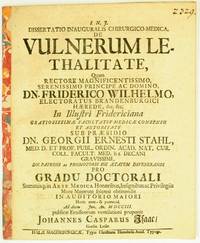
1703451081703. Halae Magdeb. Literis Christiani Henckelii 1703 Kl.4° 50 4 pp. orig. Broschur. Erste Auflage! Johann Kasper Isaac "Doktor der Medicin und ausübender Arzt wie auch Stadtphysikus in Görlitz wo er seinen Vater Daniel Isaac einem Barbierer 1674 am 13. Okt. geboren wurde; studierte in seiner Vaterstadt so wie auch in Leipzig erlangte daselbst 1700 die Doktorwürde - und starb 1738 am 19. Januar." G.F. Otto: Lex. der . Oberlausizschen Schriftsteller und Künstler 2 1802. 1 D. inaug. pro Lic. praes. D. Mich. Ern. Ettmüller. de variolis; L. 1700. 4. 2D. inaug. pro. Lic. praes. Geo. Ern. Stahl de vulnerum lethalitates; Hal. 1704. 4. 3 Kurzer Unterricht von der Pestilenz; Görl. 4. unknown