KALICH, JACOBBiblio.com

1 825 résultats
18192518New York Nov. 18 1941. JACOB KALICH. COMMEMORATION TO JACOB KALICH. FOR FIFTY YEARS OF PROGRESS AS A PLAYWRITE DIRECTOR AND PRODUCER IN THE YIDDISH THEATRE. SIGNED BY KALICH and his ardent admirers. Over thirty signatures of those in the Yiddish Theatre.Watercolor pen and ink gouache. On vellum. 23 x 15.<br /> Right side: Tillie Rabmovitzty Ben Pepper Dolly Pepper O Salzman Michael Field David Dubin All the best Luba S.C. Cantor Edmond Bayends Blanche d. Ross Rose Dubrow Wm. H. Silverblatt May Glaubeman Jean Joan Grunfield Alias Yor II Sara Libromshow. Center: Hoseph Buloff Jeanne Greene Betty Sims Marvin Lowenthanl Zesnile John Jerome Veltin Miriam Kressyn Minnis Salzman Louis Golding Max Kozyk I. Grazabeman David Dubin Alexander Salzman Yetta Zweilig Clara Picon. <br />Left Side: Joseph Kalich Joseph Rumchinsky composer and writer Non Einhorn Molly Picon Seymour Rechzeit husband of M. Kressyn Abe Eller Slyvia Reger Kline Fred Berns Lucy and Michael German Mr. and Mrs. Isadore Gatevi Jacob A. Zanger R. Gurkin Frieda Rumshinsky/Victor Sims Nelson Picon Aaron Hoffman Ernie Norma's husband Welcome stranger Adelstein.<br />Please notify me for detail photos.
18072114<p><b>Rage against missions: a landmark anti-colonialist treatise</b></p><p>Haarlem Joh. Enschedé en Zoonen & J. van Walré 1807.<br /></p><p>4°. 4 X 2 27 1 blank 296 pp. With two engraved medallions on the first title-page.</p><p>First edition of a landmark Dutch anti-colonialist and anti-missionary treatise. This controversial and heavily criticized work marks a shift in thinking about the Western influence around the world. It is a rare work and here in excellent. Only a few copies are recorded in libraries outside The Netherlands.At the end of November 1803 the Teyler's Religious Society in Haarlem organized a competition. A treatise was to be prepared on the question "What service have missionaries done to the propagation of true Christianity in the past two centuries and what fruit is there been to expected from the present active missionary societies in this regard". On November 30 1804 Haafner's manuscript of 195 pages arrived. This turned out to be the only entry making it inevitable to crown him the prize winner.He was born in Halle in Germany in 1754 came to Amsterdam with his parents in 1765 and left with his father in 1766 for the East Indies. Shortly before arriving in Cape Town Haafner's father died and the twelve-year-old boy was left alone. He was taken into foster care. In 1770 he returned to Amsterdam but the following year he left for Batavia. Via Dutch India he ended up in the British Indies. He spent years on the Coromandel Coast in eastern India traveled in India and Sri Lanka and returned to the Netherlands in 1787. He made bad investments and lost all his money which is why he tried to earn some money as a translator later also as a publicist. His first travelogue appeared in 1806 the present award-winning treatise on missions in 1807 and he died in 1809. After his death his son published many of his father's works with success.Haafner had seen missionaries at work with his own eyes in the Cape Colony in Indonesia and in India. His judgment on missions is damning. He recognized that mission implies cultural destruction and is an illicit interference with other religious beliefs. In his treatise Haafner treats various population groups per chapter. In the first chapter of his essay he deals with missions among the Hottentots. During his years in the Cape Colony he'd gotten to know these people and even had a relationship with a Hottentot girl. He qualified the mission to the Hottentots as a hopeless task. But Haafner not only scathingly judged what he saw with his own eyes of missionary zeal and missionary crime. In his second chapter he writes about the black slaves in the Americas. He vigorously rages against slavery against the capture of slaves in Africa and against the transfer of them to the Americas. In the third chapter Haafner deals with the mission to the Indians in North America and the fourth chapter on the mission among the Hindus in India.His style and eloquence make him the best Dutch writer on this subject before Multatuli and as a polemicist in many ways ahead of him that. This treatise is still a pleasure to read and relevant today. Later editions appeared in 1823 same publisher and 1993 edited by Jaap de Moor and Paul Van de Velde. Haafner's creed is as follows:"I see all people of whatever colour nation and religion as my fellow humans and brothers; whomever thinks the same will not be offended but indeed be pleased that I defend and intercede the innocent and oppressed Indians and seek to load their tyrants with shame".</p><p>Condition: repair in blank page very minor spotting on a couple pages otherwise an excellent wholly untrimmed copy.</p><p>Reference: P. van de Velde Wie onder palmen leeft. De sublieme wereld van Jacob Haafner 2008.</p> Enschedé
1817880761817. THE FIRST BOTANICAL WORK PUBLISHED IN AMERICA BIGELOW Jacob. AMERICAN MEDICAL BOTANY BEING A COLLECTION OF THE NATIVE MEDICINAL PLANTS OF THE UNITED STATES CONTAINING THEIR BOTANICAL HISTORY AND CHEMICAL ANALYSIS AND PRPOERTIES AND USES IN MEDICINE DIET AND THE ARTS WITH COLOURED ENGRAVINGS. Boston: Cummings and Hilliard 1817-1820. First edition. 60 color plates most with tissue guards: 10 hand-colored copper engravings and 50 plates printed in color a la poupee probably from an etched stone with some plates finished by hand. Six parts bound in three volumes. Octavo in fours nineteenth-century quarter calf bindings with marbled boards red morocco label and horizontal double-rules in gilt to spines. Ex library: each volume has a bookplate and ink stamp on front pastedown a perforated stamp to title-leaf with an ink stamp on verso a perforated stamp in top margin of first text leaf and an ink stamp on p. 51. Plates are unmarked. Bindings are worn and scuffed with joints tender some starting. Plates are clean for the most part though some have offset on versos from text leaves or slight toning from tissue guards. Text is clean. "This is the first botanical work published in America. Bigelow originally planned to use hand-colored copper plate engravings which are employed in the first half of the first volume. This method proving too expensive and laborious he sought a method of printing color rather than applying it by hand. Richard Wolfe who has made an exhaustive study of the work believes that the rest of the plates the book was issued in six parts over a three-year period were made by etching a stone block then applying the colors to the stone 'a la poupee'. The stone inked with multiple colors was then printed in a single impression. This is the only use of such a process an American color plate book." - Reese 19th Century American Color Plates Books #10. Bennett p. n11 Nissen 164 Pritzel 773 Staflue & Cowan 514 Sabin 5294. unknown books
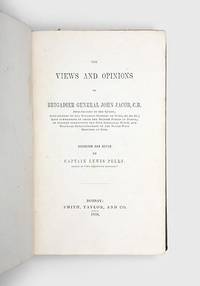
1858175736Bombay: Smith Taylor and Co. 1858. The thoughts of an influential British administrator in India on British policy in the east First edition of this important collection of Jacob's often controversial views; a London edition followed in the same year. The book covers general and civil administration military matters the North-West Frontier the Anglo-Persian War and Jacob's proposals for reorganizing India's civil and military administration. John Jacob 1812-1858 travelled to India in 1828 as a second lieutenant in the Bombay Artillery. He served in Gujarat before joining the Bombay column in the First Anglo-Afghan War. He was placed in charge of ordnance stores at Fort Bukkur and later appointed to command the Sind Irregular Horse under Sir James Outram. In this role he suppressed raiding in Sind and Kachhi though his support for Outram in a dispute with Charles Napier damaged his career prospects. Despite this Napier authorized him in 1846 to expand his force to 1600 horsemen. He successfully led campaigns against Bugti Baloch tribesmen and as political superintendent of Upper Sind developed frontier defences roads and canals. He also negotiated a treaty with the khan of Kalat. Promoted brigadier-general during the Persian War 1856 he commanded British forces in Persia after the fall of Muhammarah. He died of brain fever in Jacobabad in 1858 mourned by an estimated 10000 residents. The editor Lewis Pelly 1825-1892 a Bombay Army captain joined Jacob as aide-de-camp in Persia in 1857 and became brigade major of the Sind Frontier Force. After Jacob's death Pelly's career flourished under Sir Bartle Frere's patronage. He became chargé d'affaires at Tehran 1859 political agent and consul at Zanzibar 1861 and in 1863 replaced J. Felix Jones as British Resident in the Persian Gulf. Pelly relocated the residency from Bushire to Muscat expanding British influence in the Gulf. His impact is noted in Saudi Arabia's Memorial on the Muscat-Abu Dhabi territorial dispute: "Lieutenant Colonel Lewis Pelly became the British Resident in the Persian Gulf in 1863 and for the next nine years he played an important part in events there. Pelly came to the Gulf after a long association with General John Jacob whose forthright views on the position of the British in the East he admired to the point of collecting and publishing them in a volume for the enlightenment of the British public" Memorial p. 230. This first edition is scarce WorldCat showing six locations only plus the Oriental and India Office Collection British Library. We trace only a single copy of the London edition at auction. The book reflects both Jacob's strategic vision and Pelly's commitment to shaping British policy in the Gulf. Provenance: Charles Waddington 1796-1858 with his ownership inscription on the front free endpaper dated "Kurachee Karachi 19th Feby. 1858". Waddington served in the Bombay Engineers from 1813 and was superintending engineer for Bombay and southern southern provinces. He was ADC to Napier at Miani 1843 and in October 1847 was appointed superintending and executive engineer at Aden altered to chief engineer in April 1851. In 1854 he was appointed chief engineer in the public works department Bombay and "his services in preparing the Persian expedition received official acknowledgement. In November 1857 he was appointed to the command in Sind" ODNB; in September 1858 he left India due to ill health and died in London on 22 November. With the armorial bookplate of his son Horace Waddington 1834-1930to front pastedown. Octavo. Tables to the text 4 engraved plates on 2 leaves. Original green morocco-grain cloth gilt lettered on the spine embossed arabesque panels to the covers. A little rubbed neatly rebacked with majority of original spine laid down 3 letters partially replaced on the underlying cloth endpapers browned contents with pale toning and occasional light foxing overall a well-preserved copy very good. Memorial of the Government of Saudi Arabia 1955. hardcover
182625234Cumberland Maryland: for the author by J.M. Buchanan 1826. First edition small 8vo pp. 123 1; contemporary roan-backed marbled boards rebacked old spine with gilt lettering direct neatly laid down; all edges yellow; light wear and rubbing to the binding but generally a good sound copy or better. With the bookplates of Frank Deering and Herbert R. Strauss. "This biography of Cresap was written to refute Jefferson's account in Notes on Virginia of Cresap's tendency to murder Indians especially in the famous case of the Indian Logan and his defenseless family. The immediate occasion for this now rare book written by the revolutionary officer late clergyman who had married Cresap's widow was the reopening of old sores by Doddridge in his then recently published Notes of 1824. The defense is complete and the biography is of absorbing interest" Streeter III 1335. American Imprints 24967; Howes J32; Field 769; Sabin 35488; Thomson 640. The Streeter copy brought $650; the Siebert copy $4500. <br/><br/> for the author, by J.M. Buchanan hardcover books
1873140948037Vienna: L. C. Zamarski & C. Dittmarsch 1873. The Babylonian Talmud complete in 24 books bound in 12 volumes. The title page to the first volume is undated but typically dated 1864 in institutional catalogs; the second volume is dated 1866 the last volume is dated 1872 but the last page of the Taharot Vol. XXIV is dated 1873. Tall quarto each volume measuring 14" x 10". Bound in half cloth and paper-covered boards leather spine labels with gilt lettering. Title pages printed in red black yellow and gilt. Very Good overall lots of edge wear with exposed boards chipping toning and wear to spines. Cloth of volume 7 appears to have been inexpertly repaired; binding tape repair to rear hinge. Other than that the bindings are sturdy; contents have a little foxing with age. Occasional marginal notes presumably from either Ernest or Walter Jacob; a few pages of notes in Hebrew laid in as well. <p>This set has a very distinguished provenance: it came from the estate of Walter Jacob a significant leader in Reform Judaism in America author of 43 books and the chief rabbi at Rodef Shalom in Pittsburgh. His father Ernest Israel Jacob 1899-1974 was district rabbi of Augsburg and was deported to Dachau concentration camp for several months after Kristallnacht in 1938; he eventually emigrated to the US. Walter's grandfather Benno Jacob was considered one of the great biblical commentators of liberal Judaism. Ernest Jacob has written a note on the front pastedown of the first volume: "The textual corrections and marginal annotations in this Vienna edition of the Babylonian Talmud are by the late orientalist Samuel Landauer a great Aramaic scholar formally librarian of the University library at Strasbourg Alsace from whose estate I bought this work. Ernest I. Jacob." <p>A lovely 19th century Hebrew edition of the central text of Rabbinic Judaism and the source of Jewish law and theology compiled in the 3rd to 6th centuries in Mesopotamia. <p>International buyers please note: shipping this set outside the United States will require extra charges due to its weight and size. L. C. Zamarski & C. Dittmarsch unknown
1876195603Philadelphia: J. B. Lippincott 1876. Fourth Edition; revised. Hardcover. Very Good in boards. Rubbing along panel edges. J. B. Lippincott hardcover
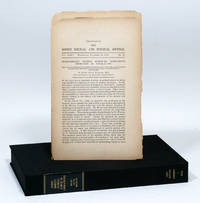
18472758Boston 1847. 1st Edition. Original Wrappers. Very Good. FIRST EDITION OFFPRINT of the first announcement of the successful use of anesthesia during surgical operations one of the greatest discoveries of nineteenth-century medicine. A visitor to Boston Massachusetts would be well advised to take a stroll to the Ether Dome at Massachusetts General Hospital to see the amphitheater where surgery without pain began. On October 16 1846 dentist William T.G. Morton publicly performed a painless surgery through the use of general anesthesia thereby transforming surgical medicine and marking one of the greatest advances in medicine one that not only liberated patients from pain but enabled surgeons to perform more extensive operations. <br /> <br /> Offered here is the first edition offprint of the first announcement of Morton's seminal achievement as reported by Henry Jacob Bigelow in the November 18 1846 issue of The Boston Medical and Surgical Journal Vol. XXXV No. 16 pp. 309-316. Interestingly the offprint omits the last seven paragraphs from the journal article critical of the patent-holders: Drs. Morton and Charles T. Jackson. The redacted paragraphs likely indicates the offprint was issued shortly after the journal. <br /> <br /> Offprint from: The Boston Medical and Surgical Journal vol. XXXV No. 16. 8 pages. As issued without wrappers. Paper uniformly toned. First and last leaves detached from stitching. Small closed tear in margin of last leaf edges rough. Presented in a handsome custom box. RARE. unknown
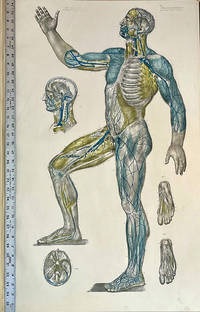
185451129Brussels: Comptoir des éditeurs 1854. <p>Bourgery Jean-Baptiste Marc 1797-1849 and Nicolas Henri Jacob 1782-1871. Anatomie élémentaire en vingt planches representant chacune un sujet dans son entier à la proportion de demi-nature . . . Atlas only. Elephant folio. Title-leaf and 20 lithographed plates most hand-colored. Brussels: Meline Cans et Cie; Comptoir des Éditeurs 1854. 888 x 600 mm. 20th-century quarter morocco boards slight wear. A few marginal tears repaired minor dampstaining but very good.</p> <p> Later edition first published in both Paris and Brussels in 1836 of this set of very large anatomical plates that were intended to be mounted on the walls of dissection rooms. All editions are extremely rare-OCLC does not cite any copies of the 1854 edition. This is the only copy of any edition of this work that we have handled in over 50 years of trading. The work was originally accompanied by a small 20-page pamphlet of text that is not present here.</p> <p> The impressive plates in this atlas reproduce the illustrations in Bourgery and Jacob's Traité complet d'anatomie at a much larger scale than their counterparts in the Traité-roughly half life-size. Some plates were lithographed in Paris; others in Brussels. Plates I and II are devoted to osteology and syndesmology; plates III - VIII to myology and aponeurology; plates IX-XIV to angiology; plates XV-XVII to neurology; plates XVIII-XIX to the digestive system; and plate XX to the reproductive organs. The plates were originally sold separately; uncolored versions were priced at 6 francs and colored versions at 12 francs. Currently two uncolored plates from this series are on the market for about $1300.</p> . Comptoir des éditeurs unknown
18371206921837. First Edition. WHEELER Jacob D. A Practical Treatise on the Law of Slavery. Being a Compilation of all the Decisions Made on that Subject in the Several Courts of the United States and State Courts. New York and New Orleans: Allan Pollock Jr. and Benjamin Levy 1837. Octavo modern half brown sheep burgundy morocco spine label. $3600.First edition of this important work on the legal aspects of slavery in the United States one of the earliest digests on the subject.Wheeler's Practical Treatise is one of the earliest digests of virtually all American court decisions on slavery including cases from both the North and South. This book was initially intended for use by slaveholders and other interested parties but it became an important tool of abolitionists who used it for its incidental descriptions of slavery and its attendant cruelty. ""The work bears marks of haste in its preparation but it is a valuable compilation of decisions on practical questions arising under the Law of Slavery in the United States. It will be serviceable to the Profession as a comprehensive digest of authorities on this branch of law and it will afford much instruction to philanthropists and statesmen interested in reconciling the welfare of slaves with the integrity and just operation of Constitutional Law"" Marvin 729. Harvard Law Catalogue 908. Cohen 9883. Work 344. Light to moderate foxing to text a few spots of soiling to edges of text block binding attractive. An extremely good copy. unknown
1817044454Boston: Cummings and Hillard 1817. First Edition. Hardcover Full Leather. Very Good Condition. Three volumes in one bound in contemporary paneled calf with an embossed eagle motif. Wear at corners and spine ends with a bit of loss to leather rehinged with inner joint strengthened with cloth. Old Yale library plate with a note that it was purchased from Yale as a duplicate in 1882. Modest foxing to text and plates heavier in spots fairly clean overall. 60 engraved plates colored a la poupee some finished by hand. In addition to being the first proper US botanical book Bigelow's Botany is the first US book printed in color. Remarkably two decades before the invention of chromolithography a method for printing in color was invented to print the plates for American Medical Botany. Sabin 5294 xi 1 18-197 1 195-197 1; xvi i.e. xiv 15-199 1; x 11-193 1. Pp. 195-198 of volume three bound at the end of volume one. Size: Quarto 4to. Quantity Available: 1. Shipped Weight: 2-3 kilos. Category: Science & Technology; Botany; Americana. Inventory No: 044454. <br/><br/> Cummings and Hillard hardcover books
1826WRCAM36095Cumberland Md.: Printed for the Author by J.M. Buchanan 1826. 1231pp. 12mo. Contemporary three-quarter roan and marbled boards spine gilt. Boards lightly rubbed and shelfworn. Early ownership signature on front free endpaper. Light tanning scattered foxing old light dampstain in lower third of final five leaves of text. About very good. In a burgundy half morocco and cloth slipcase spine gilt and folding cloth chemise. First edition of this biography of Captain Cresap defending him against charges that he slaughtered Indians before the beginning of the Revolutionary War. In particular Cresap became infamous in the case of the Indian Logan and the murder of his defenseless family in 1774. "This biography of Cresap was written to refute Jefferson's account in NOTES ON VIRGINIA.The immediate occasion for this now rare book written by the revolutionary officer later clergyman who had married Cresap's widow was the reopening of old sores by Joseph Doddridge in his then recently published NOTES ON THE SETTLEMENT AND INDIAN WARS OF THE WESTERN PARTS OF VIRGINIA & PENNSYLVANIA FROM THE YEAR 1763 UNTIL THE YEAR 1783 INCLUSIVE of 1824. The defense is complete and the biography is of absorbing interest" - Streeter. <br> <br> The Streeter copy was bought by Sessler for $650 in 1968. HOWES J32 "b." SABIN 35488. STREETER SALE 1335. FIELD 769. THOMSON 640. AMERICAN IMPRINTS 24967. DAB IV p.538 Cresap. Printed for the Author, by J.M. Buchanan hardcover books
1833262<p>Lansing Alfred A. Alexander Anderson Jacob Maas Milton F. Harrison <i>Galaxy of Comicalities</i> Philadelphia: Printed by Lesher & Shelly No. 303 Callowhill St. at $1.25 per annum in advance 1833. Twelve Issues: Volume 1: Nos. 1 – 12. These are twelve issues of only forty printed between October 2 1833 and July 5 1834. Galaxy of Comicalities is said to be the first illustrated comic periodical printed in America. Issue 11 December 11 1833 contains a review of <i>Sketches and Eccentricities of Colonel David Crockett of East </i>sic<i> Tennessee</i>. Crockett 1786 – 1836 a consummate self-promoter was the subject of numerous books. <i>Life and Adventures of Colonel David Crockett of West Tennessee</i> a spurious biography not authorized by Crockett was published in 1833 and reprinted later in the same year under the more accurate title of <i>Sketches and Eccentricities of Colonel David Crockett of West Tennessee</i>. <i>Galaxy of Comicalities</i> was a racist publication characteristic of humor during the Andrew Jackson administration. Mocking people of color during their "days off" writing in racial dialect and making sexist jokes about women this short-lived publication was intended for a semi-literate reader or listener sympathetic to the publishers' racist views. The editorial standard is as execrable as the spelling and views expressed. Illustrated with woodcuts of a similarly pejorative nature. </p><p>Condition of this rare worn and dis-bound surviving set: Issue 1 old repairs to page edges tear repair to page 1 slight text loss on p. 2; issue 2 repair to worn margins; issue 3 old tear repair to title-page margin repairs with text loss repair patch with text from another source p. 10; issue 4 margin repairs significant text loss; issue 5 good condition no repairs; issue 6 good condition no repairs; issue 7 text loss of a few words to three lines of one page; issue 8 good condition; issue 9 good condition; issue 10 margin repairs loss of few words on one page; issue 11 margin repairs text loss of a few letters on one page; issue 12 old tear repair. All twelve copies have browned with some spotting to the laid paper.</p>Housed in a folder with the ownership tag of Richard S. Wormser. Mr. Wormser a former president of the International League of Antiquarian Book Sellers and the Antiquarian Book Sellers Association of America was a member of the Grolier Club the American Antiquarian Society of Worcester Mass. the Club of Odd Volumes of Boston and the Old Book Table of New York. Lesher & Shelly, No. 303 Callowhill St. books
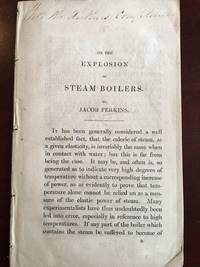
182730<p><b>AN EXTRAORDINARY EARLY AMERICAN INVENTOR AND ENGINEER</b></p><p><b>"THE THEORY OF THIS INGENIOUS METHOD OF ABSTRACTING HEAT"</b></p><p><b>PERKINS Jacob. </b><i>On the Explosion of Steam Boilers. </i>caption-title. 8vo disbound pp. 18 folding plate. N.p. n.d. i.e. London: 1827. <br /></p><p>First Edition. Rare. "In 1823 at fifty-seven years of age Perkins started an entirely new type of activity new to him and almost entirely new to science. This was his experimental work with steam of high pressure."-Dirk J. Struik <b>Yankee Science in the Making </b>1948 p. 69. Our copy is exactly like the BL copy without formal title-page and beginning on sig. "B"1. Inscribed on title: "With the Author's Compliments" and with a single correction in ink on p. 16. In 1823 Perkins invented super heated steam in an experiment called a "flash boiler" one thousand shots per minute using 900psi steam. This steam was later used in nuclear power plants to turn the steam turbines and small flash boilers were used on some steam automobiles and provided quick acceleration. In flash boilers water is delivered to preheated tubes and vaporizes almost immediately. "The theory of this ingenious method of abstracting heat was described by Perkins in a small printed pamphlet published in 1827 entitled <i>On the Explosion of Steam Boilers…</i>This pamphlet consists of eighteen pages and a folding plate engraved with a diagram showing the relationship of the piston and the crank at various pressures. Perkins was very chary of distributing copies of his pamphlet before his patent of March 22 1827 was finally sealed for fear that it might prematurely reveal the nature of his invention. A copy is in the author's possession Perkins has written on the margin of the first page: 'With the author's compliments. Confidential."-Greville Bathe & Dorothy Bathe <b>Jacob Perkins: His Inventions His Times & His Contemporaries </b>1943 p. 123 & note. Perkins says in a long letter to his friend and one-time-partner Dr. Thomas P. Jones in Philadelphia that he is sending him a copy of the pamphlet and that he gave copies to Dr. Wollaston and Michael Faraday "and to several engineers whom I could trust and who all agree that it assigns the true cause of explosions."-<b>Barthe</b> p. 125. Born in 1766 in Newburyport Massachusetts Perkins 1766-1849 was a gifted and prolific inventor running a goldsmith business by age 15! By 21 the state of Massachusetts commissioned him to make the dies for the State's copper coins. At 31 he invented a machine for heading and pointing nails and tacks in a single operation a remarkable invention for its day. He moved to New York later to Philadelphia where he developed probably the first steel plates for banknote engraving a system of preventing banknote forgery. Unable to get financial backing in this country he moved to England in 1819 taking his sons and a group of craftsmen with him. "America's loss was Britain's gain…He started a successful banknote business and went on to develop instruments for measuring ships' speeds for determining diving depths and a score of other devices. When he turned his attention to steam development this amazing man really hit his stride…Then he invented his steam gun. The Duke of Wellington became very interested in this Perkins gun…" and its military uses were explored then spurned by the British government. <i>The London Mechanics Register</i> of Nov. 6 1824 said "If Mr. Perkin's steam guns were introduced into general use there would be but very short wars; since no fecundity could provide population for its attacks." See W. H. B. Smith <b>Mr. Perkin's Extraordinary Steam Gun of 1824</b><i> </i>original published in 1957 and reprinted in <b>Lateral Science: A plethora of science & engineering subjects both real & virtual</b> 8 July 2012. The <b>DAB </b>calls his experiments with high-pressure steam "unique" saying "He received recognition in various countries particularly in England but he was a hundred years ahead of his time." In all Perkins created over 21 inventions and between 1819 and 1836 patented 19 of them. His biography in <b>ODNB </b>is included in the biography of his son Angier March Perkins and in fact gets the longest treatment there. Another useful biography is at <b>madehow.com</b>. For all things Perkins see <b>Baker Perkins Historical Society</b> online. <b>OCLC </b>locates two copies National Library of Sweden & Swarthmore College. <b>NUC </b>adds Univ. of Illinois. First Edition not in <b>COPAC.</b> </p><p><b><br /></b></p><p><b><br /></b></p><br /><p><br /></p>
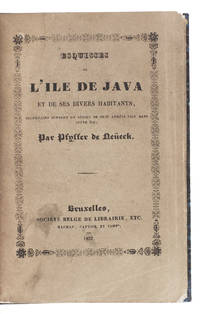
183722302Brussels 1837. 12mo. P.J. Voglet for Société Belge de Librairie Hauman Cattoir and company Modern grained brown half calf preserving the original lithographed wrappers partly uncut. 4 III 1 blank XV 1 blank 239 1 blank pp. Very rare first edition of the French translation of a work on Java by Joseph Jacob Xaver Pfyffer zu Neueck 1798-1853 a German in military service of the Dutch East India Company. The work covers Java's topography natural history ethnography customs religion local inhabitants government etc. and also discusses the Europeans their habits and customs. Included is a short extract with a vocabulary of the Malay language. The original German edition was published in parts between 1829-1832 and contained 15 plates Skizzen von der Insel Java und derselben verschiedenen Bewohnern. A second edition of the French translation appeared in 1854 Description de Java and it was also translated in Dutch as Schetsen van het eiland Java in 1838.Wrappers soiled; trivial spotting inside. Interesting work on Java in good condition.l Bastin & Brommer 197; cf. Haks and Maris p. 236; Tiele Bibl. 858. ABE CAT Anthropology & Ethnography unknown
18640001441Very Good. 1864. On offer is a significant historical relic of the Civil War being a book of 71 bound-in original handwritten telegraphs dated from May 19 1864 to December 6 1864. All appear to be handwritten and all have been folded at least 2 times or more. Many have original autographs by the sender. Several different types of paper were used to write them on. All in excellent condition. Examples of some of the subjects of telegrams are: Where to send white and colored recruits; payment amounts for recruits; forbidden furloughs granted to recruits by Provost Marshalls; Arrest Acting Masters Mate Edw. Parsons at Lebanon Springs and have him delivered on board the receiving ship North Carolina at Brooklyn Navy Yard plus many many more. The premium book is 8" x 10" with leather spine and corners with gilt stamped title on the spine attests to the importance of the contents. VG.; 4to - over 9¾" - 12" tall; KEYWORDS: CIVIL WAR GRAND ARMY OF THE UNION NORTH AGAINST THE SOUTH WAR BETWEEN THE STATES BROTHER AGAINST BROTHER AMERICANA UNION ARMY HANDWRITTEN MANUSCRIPT DOCUMENT LETTER AUTOGRAPH DIARY JOURNAL LOG KEEPSAKE WRITER HAND WRITTEN DOCUMENTS SIGNED LETTERS MANUSCRIPTS HISTORICAL HOLOGRAPH WRITERS DIARIES JOURNALS LOGS AUTOGRAPHS PERSONAL MEMOIR MEMORIAL PERSONAL HISTORY AMERICANA Als antiquité contrat vélin document manuscrit papier Antike Brief Pergament Dokument Manuskript Papier oggetto d'antiquariato atto velina documento manoscritto carta antigüedad hecho vitela documento manuscrito papel. . hardcover
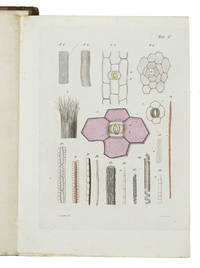
1812K7BC7632IMESKiel 1812. 4to. Königlichen Schulbuchdruckerei printed by C.L. Wäser Contemporary half calf gold-tooled spine black spine label. With 6 engraved folding plates 3 partly handcoloured. xii 335 1 pp. Rare first edition of a botanical classic the principal work of Johann Moldenhawer published in 1812. This copy was part of the collection of the famous German botanist and explorer of Brazil Philipp von Martius 1794-1868 as the book-plate on the front pastedown shows. The Beyträge reflects the knowledge acquired in the field of plant anatomy during the period 1800-1812 when many new texts on the structure of plant organs were published and Moldenhawer made advances in his own research. This book contains important findings concerning plant anatomy based on Moldenhawer's own experiments where he isolated the cells and the vessels. By completely isolating the cells and vessels in his preparations Moldenhawer demonstrated that the cell wall is closed on all sides. Moldenhawers Beiträge zur Anatomie der Pflanzen the result of eighteen years of unremitting research on plant anatomy reflects his critical insights and methodical observations both in his own experiments and in his analysis of earlier and contemporary research on plant anatomy by others. This makes it a classic overview of the history of plant anatomy.With the bookplate of the explorer Philipp von Martius on the front paste-down. Some folds in the engraved plates not affecting the images binding slightly rubbed and discoloured head of the spine and foot of the black spine label chipped but still in good condition.l BMC NH III p. 1333; Bradley I p. 98; Pritzel 6357; for the author: DSB IX p. 455. unknown
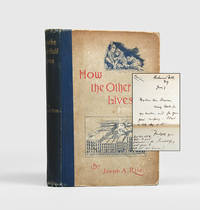
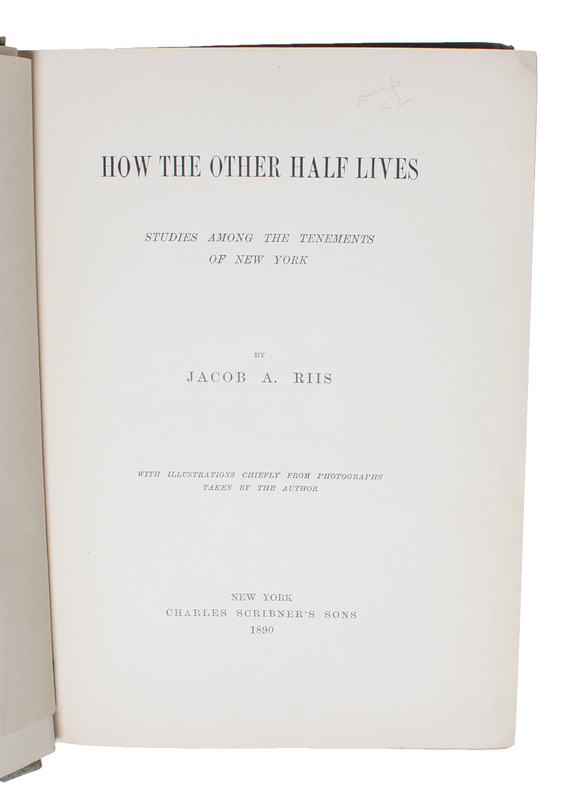
1890191014New York: Charles Scribner's Sons 1890. One of the most important photobooks ever published First edition with an autograph letter signed from the author tipped-in to the front free endpaper thanking the recipient "for your kindness and for your good company - I had a bully day of it". He adds in a postscript: "Good luck with the trout. A good fisherman is a good fellow I will bet. Ask Grover!". The letter is dated 7 June and noted as received 8 June 1902. The reference is presumably to the keen fisherman and former president Grover Cleveland. The front free endpaper has the ownership signature of the recipient Elizabeth M. Brown of Belvidere New Jersey dated 25 April 1891. A lifelong campaigner for child welfare Riis exposed overcrowded tenements raised funds to send children into the countryside advocated city parks and pressed for better-funded public schools. His exposés of New York poverty and decades of campaigning helped drive Progressive Era reforms and forced the city's slum conditions into public view. How the Other Half Lives is his the most important work. "His book is about the tenements of New York: the overcrowded slums of the Lower East Side that were home to boatloads of immigrants who had come to the United States to seek a better life. it is one of the most important photobooks ever published. It represents the first extensive use of halftone photographic reproductions in a book. These reproductions are rough to say the least but it is the beginning not of a photographic genre but a photographic attitude an ethos - humanist documentary photography - in which the photographic social document is employed to bear critical witness to what is going on in the world" Parr & Badger p. 53. Octavo. With 43 illustrations including 18 halftones from photographs by the author. Original blue quarter cloth spine lettered in gilt front cover lettered and decorated in red and blue. Tipped-in at rear is the pamphlet Jacob A. Riis: A Sketch of his Life and Work circa 1903. Rubbed and a little shaken and toned still a very good copy. Martin Parr & Gerry Badger The Photobook: A History Vol. I 2004. hardcover
1813WRCAM41998Sackets Harbor N.Y. 1813. 1p. manuscript letter signed docketed on verso. Folio. Old fold lines. Some separation at folds; one tear closed with archival tape. Lightly soiled. Good. An eyewitness account of the second battle of Sackets Harbor on the shores of Lake Ontario from the commander of the American forces there Gen. Jacob Brown to his friend Joshua Hatheway quartermaster general and formerly the commander of the defenses at Sackets Harbor. The town situated near the entrance to the St. Lawrence River at the far eastern end of Lake Ontario and opposite the Canadian town of Kingston was a vital defensive point for the Americans challenging British control of the St. Lawrence and the lake and preventing a British thrust into New York State. If either side could control both sides of the entrance to the St. Lawrence they could control the Upper Great Lakes. Taking advantage of the American action against York which drew troops away to the western end of the Lake the British decided to strike. On May 28 1813 the British Great Lakes squadron under the command of James Yeo appeared off Sackets Harbor carrying troops under the command of the governor-general Lieut. Gen. George Prevost. Having been forewarned by several men who escaped the Battle of Henderson Bay the previous day the Americans had some time to reinforce their defenses before the British could attack. The British landed on the 28th but launched their main attack the next morning. They easily routed the American militia but the regulars under Brown were able to fight off repeated attacks on their fortifications. Prevost fearing the arrival of more American troops ordered a retreat which nearly became a rout. Brown was the hero of the day and was later rewarded with a commission as brigadier general. He must have immediately written this letter describing the action. This appears to be written in a secretarial hand and signed by Brown himself. The letter states: "Dr. Sir I received an order some days since from Genl Dearborn to take comm. at this Post. Comd. Chauncey is up the lake. We were this morning attacked as day dawned by Sir George Prevost in person who made good his landing with at least a thousand picked men. Sir James Yeo commanded the fleet after loosing some distinguished officers and of course some gallant men. Our loss is very severe as to the quality of those who have fallen. The enemy left many of their wounded on the Field - but I have no doubt carried off many more. We shall probably be again attacked as Sir George must feel very sore. All I can say is whatever may be the result we will not be disgraced." A superb battlefield letter reporting on one of the most significant military actions of the War of 1812. unknown books
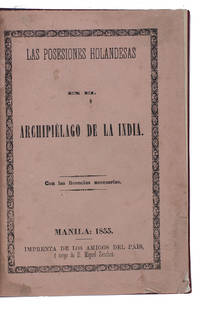
1855D329MFC3UKU0Manila 1855. 8vo. Miguel Sanchez Modern red half calf preserving the original pink lithographed wrappers. 243 1 pp. Rare Spanish translation printed in Manila of an important work on the Dutch East Indies by the famous ornithologist Coenraad Jacob Temminck 1778-1858 director of the Rijksmuseum van Natuurlijke Historie Leiden. The present edition is a translation of a part of Coup d'il general sur les possessions néerlandaises dans l'Inde archipélagique 1846-1849 and focuses on historical ethnographical and socio-economic factors of the Dutch possessions in the East Indies.Very good copy.l Palau 329928. ABE CAT Anthropology & Ethnography unknown
1845E4PBJL5NT60TAmsterdam: Coenraad Weddepohl 1845. Original publisher's cloth with a gold-blocked lyre in the centre of each board and a tissue guard over each lithograph gilt edges. Folio. With a lithographed portrait of the artist mounted 8 lithographed plates of stage designs and 9 poems in red decorated letterpress frames the lithographs by Desguerrois & Co. With the 8 plates of stage designs hand-coloured as published. First and only edition of a memorial to the costume and stage designer François Joseph Pfeiffer Jr. 1778-1835 with a biographical sketch by Gerrit van Enst Koning 1794-1853 lithographic portrait lists of his work and coloured lithographs of his stage designs with a poem facing the portrait and each of the stage designs all written for the present book by the famous Dutch author and poet Jacob van Lennep 1802-1868. Pfeiffer was best known for his Romantic stage designs for the Amsterdam Schouwburg city theatre. From 1820 to 1835 he created complete decors for many different plays but none has survived. The lithographs in the present book therefore form an essential primary source for the history of Dutch theatre. Also included is a list of the most important decorations Pfeiffer made for various theatres. A good copy with a few plates lightly browned the leaf on which the portrait is mounted foxed and a few occasional minor stains. Binding slightly faded. An important primary source for the history of Dutch stage design and a feast for the eye with its beautiful hand-coloured stage designs.l NCC 5 copies; Thieme & Becker XXVI p. 528; Waller p. 253. Coenraad Weddepohl, hardcover
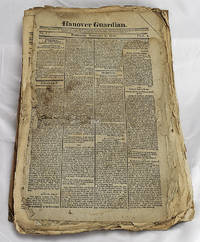
18182603240008Hanover Guardian; Joseph Schmuck Hanover Pa 1818. Magazines & Periodicals. Good. A large run of an very early newspaper from York County Pennsylvania from James Monroe's Presidency. 62 issues printed on four pages 248 pages total. Unbound. Some minor stains but generally a clean and legible collection. The first issue has a tear at the center with some loss. The second issue has a closed tear at the rear page. Includes v.1. complete in 52 issues Sept 2 1818 - Aug. 25 1819; v.2. 6 issues 1819: no. 60 Oct 20 no.62 Nov. 3 no.65 Nov. 24 no.66 Dec 1 no.68 Dec 15 no.72 Jan 12 1820; v.3. 4 issues from 1820: no. 108 Sept. 27 no. 111 Oct. 18 no. 113 Nov. 1 115 Nov. 15. "Weekly. Established in August 1818 by Jacob H. Wiestling with the title of the "Guardian." In 1819 he sold the paper to Joseph Schmuck who continued it until after 1820 J. Gibson "History of York County" 1886 p. 382." - American Antiquarian Society. <br> Includes advertisements for agricultural products real estate sales political news international news Revolution in e.g. Sicily Spain; local Democratic York county politics; support for President James Monroe; and many interesting news articles. One very interesting front page piece from the York's Democratic party includes resolutions against Gov. Joseph Hiester. The York Democrats opposed him because he voted against the gradual abolition of slavery in Pennsylvania "that curse and stigma on humanity; he also voted in effect in favor of slave trade against the punishment of kidnappers." An interesting early pro-abolitionist opinion from rural Pennsylvania. Includes James Monroe's 1819 message to Congress on the State of the Union. Also prints accounts of local murders and other crimes. Hanover Guardian; Joseph Schmuck, Hanover, Pa unknown
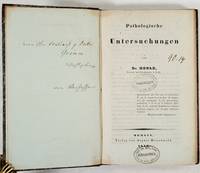
1840549061840. Berlin Verlag von August Hirschwald 1840 8° VI 274 pp. 2 pp. Verlagsanzeigen Halbledereinband der Zeit mit reichlicher Rückenvergoldung; Rücken neu unterlegt St.a.Tit.; mit eigenhändiger Widmung des Verfassers. Sehr seltene erste Ausgabe mit eigenhändiger Widmung "Herrn Ober Stasbsarzt u. Doctor Grimm . vom Verfasser" auf dem Vorsatzblatt und dem Stempel der "KÖN. PR. MED. CHIR. Frid. Wihl. Institut" auf dem Titelblatt. Jacob Henle 1809-1885 leitet mit seinen "Pathologischen Untersuchungen" eine neue Etappe in der Lehre von den Infektionskrankheiten ein. Der erste Abschnitt dieses Buches enthält die klassische Abhandlung "von den Miasmen und Contagien pp.1-87". Das Kontagium der Ansteckungsstoff muß aus Lebewesen bestehen ähnlich denen der Hefe und der Pilze. Ausgangspunkt dieser Erkenntnis bilden die Forschung auf dem Gebiet der Gärung. -- Henles Arbeit ist ein genialer Entwurf. Seine Reflextionen sind zwingend. Die Theorie des "contagium vivum" wurde später von Robert Koch Henles Schüler glänzend bestätigt. -- Aber Henle konnte 1840 die Lebewesen die er annahm nicht zeigen und man glaubte nur noch was man sah. So blieb diese geistvolle Arbeit seinen Zeitgenossen nur eine Spekulation. "The significance of Henle's book lies in its long opening essay 'Von den Miasmen und Contagien' in which Henle formulated on the basis of deductive reasoning his conviction that living organisms were the cause of contagious and infectious diseases. Drawing upon a wide body of work performed by other researchers on the origin of infectious diseases such as Bassi's recent demonstration of the parasitical nature of muscardine disease of silkworms Henle argued that infectious agents had to be organic in nature since they appeared to multiply from the moment of entering the body a statement supported by the fact that a certain period of incubation usually precedes the outbreak of disease and only organic life has the property of growth. The fact that infectious agents could be destroyed by heat and disinfectants also suggested their animate nature. Henle assumed that each infectious disease had its own etiology but realized that such views would be difficult to prove; he therefore proposed that an agent constantly found in association with a particular disease be isolated and tested in its isolated state to see whether it could produce the disease. 'This approach to the proof of the germ theory Henle communicated to his pupil Robert Koch and was forty years later to become one of the cornerstones of classical bacteriology under the name of "Koch's postulates" ' Foster "He laid down postulates on the aetiological relation of microbes to disease which became fundamentals of bacteriology." Long Foster Medical Bacteriology pp. 8-9; Bulloch History of Bacteriology 163-65; G.Rosen Henle on miasmata and contagia. In Bull. Hist. Med. 1938 907; Howard-Jones Frascatoro & Henle. In Med. Hist. 1977 61-68; Sigerist Große Ärzte 314-320. Brock Milestones in Microbiology pp.76-79; Garrison-Morton 2533; Norman 1051; Waller 4336 unknown
189048301New York, Charles Scribner's Sons, 1890. Lex 8vo. Original blue full clothWith title in blue to front board and blue and gilt lettering to spine. Spine and parts of boards lightly brownspotted. A bit of wear to capitaks and corners. But overall a very nice copy of this fairly fragile and delicate cloth binding (there is an original variant binding with cloth spine and illustrated boards, but no precidency between the bindings has been established). Internally very nice and clean. XV, (1), 304 pp. Wih numerous illustrations, most of them photographic.
189048301New York Charles Scribner's Sons 1890. Lex 8vo. Original blue full clothWith title in blue to front board and blue and gilt lettering to spine. Spine and parts of boards lightly brownspotted. A bit of wear to capitaks and corners. But overall a very nice copy of this fairly fragile and delicate cloth binding there is an original variant binding with cloth spine and illustrated boards but no precidency between the bindings has been established. Internally very nice and clean. XV 1 304 pp. Wih numerous illustrations most of them photographic. <br/><br/><em>First edition of this landmark work on the miserable living conditions of the poor immigrants in New York constituting one of the very earliest - and certainly the most popular and influential - attempts at making "the other half" i.e. the middle and upper classes aware of how the poor in New York actually lived. Riis's work created attention to the neglected and overseen community that was the underprivileged in New York. In the long run the great success of the work created attention to the status living conditions and general health of the poor and it initiated social reform movements in all major North American cities. Furthermore the work is regarded the very first example of "muckraking" journalism and was the first to extensively use halftone photographic reproductions in a book.Riis used a convincing combination of facts from Dr. Roger S. Tracy Registrar of Vital Statistics and his own talents as a photo journalist to make a hitherto unseen powerful description of the correlation between the high crime rate drunkenness and reckless behavior of the poor and their lack of proper homes. The statistical facts made it a relevant and sober work and lent it enough authority to the book's claims for it to be taken serious by city official. His groundbreaking photographs confirmed the dry numbers and "spoke directly to people's hearts". Pascal "Jacob Riis: Reporter and Reformer" p. 87. Unlike all previously works on the living conditions of the poor "How the Other Half Lives" offered concrete solutions on how to improve living condition how to make the tenants improve their buildings and finally how the politicians and city officials could make the appropriate and necessary juridical changes.The effect of the work was immediately seen and included: the tearing down of New York's worst tenements sweatshops and the reformation of the city's schools. The book led to a decade of improvements in Lower East Side conditions with garbage collection sewers and indoor plumbing all following soon after. Because of the present work Riis quickly rose to fame and in 1895 he became close friends with Theodore Roosevelt then a New York City official who wrote of Riis: "Jacob Riis whom I am tempted to call the best American I ever knew although he was already a young man when he came hither from Denmark". After Roosevelt became President he wrote a tribute to Riis that started: "Recently a man well qualified to pass judgment alluded to Mr. Jacob A. Riis as "the most useful citizen of New York". Those fellow citizens of Mr. Riis who best know his work will be most apt to agree with this statement. The countless evils which lurk in the dark corners of our civic institutions which stalk abroad in the slums and have their permanent abode in the crowded tenement houses have met in Mr. Riis the most formidable opponent ever encountered by them in New York City."The title refers to the French writer François Rabelais who famously wrote in Pantagruel: "one half of the world does not know how the other half lives". As a work of journalism and of social criticism Riis's book still stands as a truly seminal testimony to how the lower classes lived at the turn of the century. Due to this work attention was eventually paid to them and their conditions bettered. </em> hardcover