1 825 résultats
18112473New York / Philadelphia: I. Riley and P. Byrne 1811. First American Edition. Full leather. Very good. From the personal library of President James Buchanan The Law Dictionary signed by Buchanan on the title page. Octavo ii 553pp. Full period calf title in gilt on spine over red morocco label. Statement on title page that this is the First American Edition from the Second London Edition. Spine repaired at ends reinforced hinges. Some age toning with foxing on endpapers. This is Volume V from a complete set of 6 volumes. Signed by President James Buchanan on the title page. This law book is from the personal library of President James Buchanan. His library was primarily held at his home in Lancaster PA called Wheatland. The majority of his presidential papers correspondence and books went to Dickinson college his alma mater. After graduating with honors in 1809 James Buchanan moved to Lancaster and became a legal apprentice to James Hopkins. He was admitted to the Pennsylvania Bar in 1812. Buchanan would go on to serve in the House of Representatives from 1821-1831 United States Senator 1834-1845 then as the 17th Secretary of State under President James K. Polk. He was elected President of the United States in 1856 serving one term. He predicted in retirement that "history would vindicate my memory" but his inability to stop the succession of the southern states has sealed his legacy as one of the least successful presidents in history. I. Riley and P. Byrne unknown books
1826316088Cumberland MD: Printed for the Author by J.M. Buchanan 1826. First edition. 8vo. Contemporary half roan and marbled boards spine lettered in gilt. Covers scuffed and worn small semicircular portion of rear cover fire damaged with loss wear extending into final 25 pages at top margin touching a few letters text foxed and faintly dampstained some contemporary pen annotations 1839 ownership inscription on front free endpaper. First edition. 8vo. First edition of this defense of colonial frontiersman Captain Cresap 1742-1775 whom Jefferson echoing others blamed for the murder of the family of the Mingo war chief James Logan during Lord Dunmore's War. Cresap has since been exonerated and the Virginian Daniel Greathouse is now blamed for the massacre of Logan's family.<br /> "This biography of Cresap was written to refute Jefferson's account in NOTES ON VIRGINIA.The immediate occasion for this now rare book written by the revolutionary officer later clergyman who had married Cresap's widow was the reopening of old sores by Joseph Doddridge in his then recently published NOTES ON THE SETTLEMENT AND INDIAN WARS OF THE WESTERN PARTS OF VIRGINIA & PENNSYLVANIA FROM THE YEAR 1763 UNTIL THE YEAR 1783 INCLUSIVE of 1824. The defense is complete and the biography is of absorbing interest" Streeter. Streeter Sale 1335; Howes J32; Graff 2185; Sabin 35488; Siebert Sale 379 Printed for the Author, by J.M. Buchanan unknown
1826316088Cumberland MD: Printed for the Author by J.M. Buchanan 1826. First edition. 8vo. Contemporary half roan and marbled boards spine lettered in gilt. Covers scuffed and worn small semicircular portion of rear cover fire damaged with loss wear extending into final 25 pages at top margin touching a few letters text foxed and faintly dampstained some contemporary pen annotations 1839 ownership inscription on front free endpaper. First edition. 8vo. First edition of this defense of colonial frontiersman Captain Cresap 1742-1775 whom Jefferson echoing others blamed for the murder of the family of the Mingo war chief James Logan during Lord Dunmore's War. Cresap has since been exonerated and the Virginian Daniel Greathouse is now blamed for the massacre of Logan's family.<br/>"This biography of Cresap was written to refute Jefferson's account in NOTES ON VIRGINIA.The immediate occasion for this now rare book written by the revolutionary officer later clergyman who had married Cresap's widow was the reopening of old sores by Joseph Doddridge in his then recently published NOTES ON THE SETTLEMENT AND INDIAN WARS OF THE WESTERN PARTS OF VIRGINIA & PENNSYLVANIA FROM THE YEAR 1763 UNTIL THE YEAR 1783 INCLUSIVE of 1824. The defense is complete and the biography is of absorbing interest" Streeter. Streeter Sale 1335; Howes J32; Graff 2185; Sabin 35488; Siebert Sale 379 Printed for the Author, by J.M. Buchanan unknown books
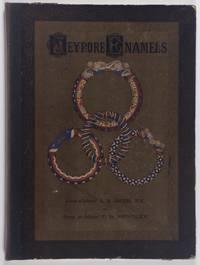
188651088London: W. Griggs Elm House 1886. First edition. Hardcover. Very good condition. Folio. 16pp. 28 plates in chromolithography. Original black half-cloth over dark brown paper-covered color-illustrated boards with elaborate decorative gilt framing black lettering with decorative heightened initials and gilt lettering on cover gilt lettering on spine. Back cover with same decorative framing as cover and gilt decorative vignette. Gilt edges. Brown endpapers. The twenty-eight chromolithographic plates containing one hundred and twenty designs by W. Griggs. Decorative historiated initial in red. <br /> <br /> Extraordinary designs for enamel work on metal from Jaipur considered to be the best work in this field. "The enamels of Europe and Persia are poor and lustreless in comparison with those of Jeypore and in none of them is the fiery red for which the latter is so remarkable at all approached." Hendley. <br /> <br /> The introduction by Hendley provides an interesting comparative overview of enamel work of the time with details on the historic economic and artistic implications of this work. Contains three pages with detailed descriptions of the work an appendix stating name of the articles their value in Rupees the names of the enamelers the number of times the works were fired the time of their completion in month the names of the purchasers and additional remarks e.g. "Set with diamonds." <br /> <br /> The chromolithographs include one full page depicting a group of Jaipur enamelers at work and one hundred and twenty designs for daggers bracelets swords plates saucers perfume stands vases etc. Plates twelve to twenty-six with numerous extraordinary designs for jewelry and plates twenty-seven and eight depict instruments used by enamelers for their work.<br /> <br /> Binding with light wear along edges small chips and lightly rubbed. Small dealer sticker on inside front cover. Some foxing on front endpaper and title page. Plates nine through fifteen with crease at lower foredge corner plate fifteen here with two inch closed tear. Light offsetting to verso of plates from facing imagery. W. Griggs, Elm House hardcover
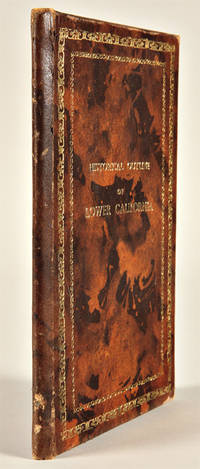
186564770First Edition in Original Printed Wrappers LEESE Jacob P. Historical Outline of Lower California. New York: E. S. Dodge & Co. 1865. First edition. Octavo 8 3/4 x 5 3/4 inches; 223 x 146 mm.1-46 2 blank pp. Original grey printed wrappers. Wrappers chipped along lower portion of the spine and slightly chipped along edges. Some light foxing throughout. Overall a very good copy. "Jacob Primer Leese was a Santa Fe trader who settled in San Francisco in 1836 and engaged in the hide and tallow trade with Yankee ships. He married a sister of General Vallejo and became very wealthy. In 1863 Leese and other promoters founded the Mexican Mining and Colonization Company and obtained a land grant from the Mexican government of some 46800 square miles between the 24th and 31st parallels of latitude in Baja California. They failed to meet their obligations however and the grant was transferred to another party in 1866. The outline was written "in the interest of the Mexican Mining and Colonization Company." In addition to details on the grant it provides material on the discovery early settlements missions mineral resources and pearl fisheries of Baja California." Hill 998. Hill 998. Sabin 39834. HBS 64770. $2500 E. S. Dodge & Co. unknown books
186564770New York: E. S. Dodge & Co 1865. Historical Outline of Lower California. New York: E. S. Dodge & Co. 1865.<br> <br> First edition. Octavo 8 3/4 x 5 3/4 inches; 223 x 146 mm.1-46 2 blank pp.<br> <br> Original grey printed wrappers. Wrappers chipped along lower portion of the spine and slightly chipped along edges. Some light foxing throughout. Overall a very good copy.<br> <br> "Jacob Primer Leese was a Santa Fe trader who settled in San Francisco in 1836 and engaged in the hide and tallow trade with Yankee ships. He married a sister of General Vallejo and became very wealthy. In 1863 Leese and other promoters founded the Mexican Mining and Colonization Company and obtained a land grant from the Mexican government of some 46800 square miles between the 24th and 31st parallels of latitude in Baja California. They failed to meet their obligations however and the grant was transferred to another party in 1866. The outline was written "in the interest of the Mexican Mining and Colonization Company." In addition to details on the grant it provides material on the discovery early settlements missions mineral resources and pearl fisheries of Baja California." Hill 998.<br> <br> Hill 998. Sabin 39834.<br> <br> HBS 64770.<br> <br> $2500. E. S. Dodge & Co unknown
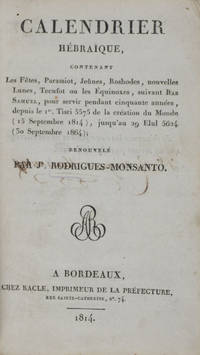
181441217Bordeaux: Chez Racle 1814. First edition. Hardcover. g- to g. 12mo. 234pp. 2. Brown leather with gilt tooling and gilt stamped floral design on spine. Signed author's attestation of printing at verso of title page. The publication is considered to be the first work to incorporate Hebrew printing in Bordeaux. The work is a comprehensive annotated fifty year Hebrew Jewish calendar that documents many important aspects of the Jewish year including holidays new moons beginnings of the Hebrew months Rosh Chodesh weekly Torah portions and equinoxes. The final leaf has an approbation from Abraham Andrande Chief Rabbi of Bordeaux. Text in French and Hebrew. Binding with some rubbing abrasions and light staining to the front and back covers. Head & tail of spine and corners of covers with some rubbing and chipping. Interior with some light pencil marking to interior front cover and front free endpapers. Some sporadic light foxing throughout usually to edges of pages with text mostly unaffected. Book block tight. Binding in good- interior in overall good condition. Chez Racle hardcover
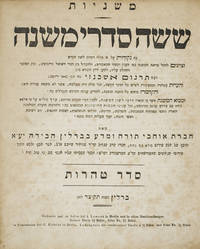
183419636Berlin: I. Lewent 1834. Hardcover. g. Six octavo volumes bound in three quarter leather over paper covered boards. Each volume has ties on fore edge of front and rear boards. Vol. 1: "Seder Zeraim" 196 pp. Vol. 2: "Seder Moed" 232 pp. Vol. 3: "Seder Nashim" 212 pp. Vol. 4: "Seder Nezikin" 268 pp. Vol. 5: "Seder Kodshim" 264 pp. Vol. 6: "Seder Tehorot" 212 pp. Book has the original Hebrew of the Mishnah and the translation into Judeo-German in double columns atop the commentary "Melo Kaf Nahat" which is in Hebrew Rashi Script. The author of the commentary was a renowned talmudic scholar and author who lived in the first half of the eighteenth century. This groundbreaking commentary was considered a “funnel of sorts†for previous rabbinic and Medieval commentaries on the Mishnah for it collected explanations from Rashi Maimonides Bertinoro and Tosafot Yom-Tov. It also drew heavily upon Isaac ibn Gabbai's commentary. This work was originally in Amsterdam in the year of 1732. This is the later reprint from Berlin printed between the years 1832-1834. Age wear and scuffing to leather some Hebrew script handwriting on front endpapers but books are in overall good condition. I. Lewent hardcover
184468037Lepzig, Wilh. Engelmann, 1844, , VIII-242 pp, 9 pl, demi-basane prune de l'époque, dos lisse à filets dorés et à froid, UN PAS DÉCISIF DANS L'ÉLABORATION DE LA THÉORIE CELLULAIRE. Tout ce qui a paru, malgré la mention "erster Band". Importantes Notions de botanique, comprenant le texte fondamental de Schleiden, Beiträge zur Phytogenesis (p. 121-159), publié à l'origine dans les Archiv für Anatomie, Physiologie und wissenschaftliche Medicin, 1838 (pp 137-76), et par lequel le savant allemand contribua à démontrer, avec Theodor Schwamm, que la cellule est l'unité de base du vivant. "After [Robert Brown], Schleiden, in his 'Contributions to Photogenesis', taking the embryonic cell as his starting-point proceeded to attempt a reconstruction of the develepment of the cell. He went seriously astray in this but he insisted on the independance of the cell and presented for the first time the notion that a plant, for exemple, is a community of cells" (PMM). "Schleiden demonstrated that plant tissues are made up of and developed from groups of cells, of which he recognized the 'cycloblast' or cell-nucleus" (DSB). L'article fut immédiatement traduit en français et en anglais et réimprimé dans les présents mélanges de botanique. Matthias Jacob Schleiden (1804-1881) étudia le droit à l'université d'Heidelberg et exerça à Hambourg avant d'abandonner la profession en 1833 pour se consacrer l'étude de l'histoire naturelle à l'université de Göttingen puis à Berlin, où résidaient alors Robert Brown et Alexander von Humboldt. Schleiden travailla auprès de Johannes Müller dans son laboratoire de physiologie ; il y fit la rencontre de Theodor Schwann, avec qui il contribua à élaborer la théorie cellulaire Cachet et étiquette ex-libris de l'Institut catholique de Paris. Épidermures. Pritzel, n° 8225. PMM, 307a, Garrison & Morton n° 112 (pour l'édition originale des Beiträge zur Phytogenesis). DSB XII, p. 173 et suiv. Couverture rigide
1851605DG1851. Chur 1851 Lthographie Bildformat: 48 x 37 cm. Mit Holzrahmen: 67 x 56 cm. Barth 10852 für dem gesamten Stammbaum. Wappentafel umrahmt von 22 kleinen Ansichten von: Albertigut Davos Kirchen Davos Ruine Bernegg Strassberg in Fonday Furna Davos Dörfli Alte Haus Dörfli Davos Horlauben Davos Grosse Haus Grüsch Herrensitz St. Margrethen Wohnsiz des Bundeslandaman Seewis Schloss Spree Lausiz - Sachsen Wohnsitz des Bundeslandaman Jenins Schloss Senftenau Lindau Mehrere Häuser Luzein Stammhaus Clus Brüggersche Haus Maienfeld Das Haus auf der Sand und Spaniöl Herrenhaus Küblis Der Hof. Die Kumma Glaris Wohnsiz des Bundeslandaman Jenins Löwenhof Chur. Das Blatt stärker stockfleckig. unknown
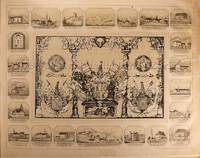
1851605DGChur, 1851 Lthographie Bildformat: 48 x 37 cm. Mit Holzrahmen: 67 x 56 cm. Barth 10852 für dem gesamten Stammbaum. Wappentafel umrahmt von 22 kleinen Ansichten von: Albertigut (Davos), Kirchen (Davos) Ruine Bernegg, Strassberg in Fonday, Furna, Davos Dörfli, Alte Haus (Dörfli Davos), Horlauben (Davos), Grosse Haus (Grüsch), Herrensitz (St. Margrethen), Wohnsiz des Bundeslandaman (Seewis), Schloss Spree (Lausiz - Sachsen), Wohnsitz des Bundeslandaman (Jenins), Schloss Senftenau (Lindau), Mehrere Häuser (Luzein), Stammhaus (Clus), Brüggersche Haus (Maienfeld), Das Haus auf der Sand und Spaniöl, Herrenhaus (Küblis), Der Hof. Die Kumma (Glaris), Wohnsiz des Bundeslandaman (Jenins), Löwenhof (Chur). – Das Blatt stärker stockfleckig.
18480000156Boston: David Clapp Printer 1848. First edition. Original Wraps. Very Good . 8vo24 cm. Original offprint with printed orange wrapper housed in a cloth clamshell box. Collation: 2 27 1p.; 18p. This is a very good to fine copy in original wrappers. The first article was originally published in the Boston Medical Surgical Journal in 1846. The second article is from the Transactions of the American Medical Association Vol. 1. <br/><br/>Bigelow had great concern for the suffering of surgical patients and was interested in finding an ideal agent which could be used as an anaesthetic. Ether had the potential to be of use though there was concern over its flammability. Bigelow used ether and published his observations on use of vapors from sulphuric ether in the Boston Medical Surgical Journal in 1846. In the present report Bigelow discusses the pros and cons on using ether vapors or chloroform and compares this in the second article with other anaesthetic agents. This clinical research was a major advancement for surgical operations where pain to the patient was greatly minimized or not felt during the surgery. G & M 5730. David Clapp, Printer paperback books
1865WRCAM42696New York 1865. 46pp. Modern mottled calf gilt. Extremities rubbed. Bookplate on front pastedown. Minor soiling. Very good. A scarce work on Baja California. "Jacob Primer Leese was a Santa Fe trader who settled in San Francisco in 1836 and engaged in the hide and tallow trade with Yankee ships. He married a sister of General Vallejo and became very wealthy. In 1863 Leese and other promoters founded the Mexican Mining and Colonization Company and obtained a land grant from the Mexican government of some 46800 square miles between the 24th and 31st parallels of latitude in Baja California. They failed to meet their obligations however and the grant was transferred to another party in 1866. This outline was written 'in the interest of the Mexican Mining and Colonization Company.' In addition to details on the grant it provides material on the discovery early settlements missions minerals and pearl fisheries of Baja California" - Hill. BARRETT 1460. HILL 998. SABIN 39834. unknown books
1878019037Columbus OH: Jacob H. Studer & Co. 1878. First Edition. Hardcover. Contents fresh one long closed tear to a text page in the second volume. Rubbing with some splitting to the leather along the spine edge of the front cover of the first volume but covers firm. Some loss of cloth to the second volume. Very Good with clean bright plates. Theodore Jasper. Two folio 11-3/4" x 15" volumes bound in publisher's half morocco leather with matching morocco corners. The first volume illustrated with 119 lovely chromolithographs drawn and colored from nature by Theodore Jasper; the second volume with 37 tinted lithographs. One of the best as well as one of the last great color-illustrated ornithologies. Later editions especially the 1903 edition have noticeably inferior quality plates. <br/><br/> Jacob H. Studer & Co. hardcover
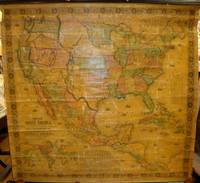
1854M7535Baltimore: Jacob Monk 1854. Some minor discolourations and some marginal chipping and staining not affecting the map altogether a very good copy laid down on original canvas as a scroll on two wooden rods. . Notes: Inset map of the world sits beneath the title in the lower left corner. It is centred on the Americas and charts the course of Wilkes' circumnavigation of the globe in the 1840s. To its right sits an index of counties and towns. Above the title on the left side are a legend and scale. On the right by the mid margin is a table of distances. The oceans are decorated with tall ships and the whole map sits within a decorative floral border.<br><br>This map marks the dawn of the Manifest Destiny era of American history. Soon after the American victory of Mexico large new states and territories were carved out from the newly acquired land. Here we see the newly formed California and Texas along with the Oregon and Washington territories securing the country's claim to the Pacific coast. With California's gold rush getting into full swing the map accentuates many details of that state's gold region. North-South tensions are revealed in the ambiguity of the central states and territories: Northern interests sought to create a massive Nebraska territory which would have included present-day Kansas; however Southern lawmakers pressed Congress to make two separate territories. Size : 1405x1500 mm 55.31x59.06 Inches Coloring: Original Hand Coloring Reference: Wheat 794 earlier edition; Rumsey 603. Category: Maps Central America; Maps North America; Maps West Indies Whole; Maps Wall Maps; Jacob Monk unknown
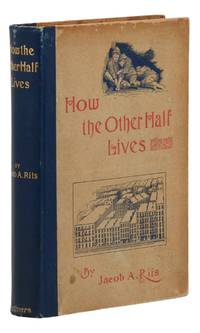
1890140947069New York: Charles Scribner's Sons 1890. First Edition. Very Good. First edition first printing. Bound in publisher's decorated paper-covered boards over blue spine cloth lettered in gilt. Very Good with toning and wear to the binding contents tanned and with occasional soiling. A pioneering work of photojournalism documenting New York City's poor lower class living in squalid conditions at the turn of the century. Charles Scribner's Sons unknown
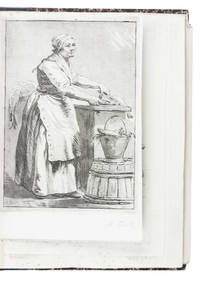
18181418Rotterdam 1818. 4to or cut down folio. J. Immerzeel Mid-19th-century half maroon sheepskin chemical-marbled sides shell-marbled endpapers manuscript spine label. A series of 32 of 33 numbered full-page aquatint and stipple-engraved costume and profession prints engraved by Matthias de Sallieth after drawings made ca. 1790 by Perkois and Prins including folk musicians with their instruments. Lacking plate 5 which has been replaced by an aquatint of a woman cleaning fish by Hermanus Fock with his name in pencil at the foot. With 2 extra prints loosely inserted: colour-printed versions inked a la poupée of plates 20 and 25. 33 engr. ll. An aquatint and stipple-engraved print series of costumes and professions. They were drawn by Perkois 1756-1804 and Prins 1757-1806 ca. 1790 and engraved by Sallieth 1749-1791 as models for young artists to follow. The 1818 publication indicates that they had previously been issued individually but never before collected for publication in book form. The two loosely inserted prints have the exposed skin of the faces necks arms and hands printed in a soft shade of red with the rest in black inked a la poupée. With a tear in one plate not affecting the image repaired with tape 3 plates foxed and a few others with minor foxing but still in very good condition.l Cat. Kunsthist. Bibl. Rijksmuseum Amsterdam II p. 777; Colas 2311; Landwehr Colour plates 389; Lipperheide Gb 46 note. ABE CAT Art History ABE CAT Costumes & Uniforms unknown
1847M12984Philadelphia:: American Medical Association 1847/8. 1847. Offprint. Series: Transactions of the American Medical Association. Sm. 8vo. 18 pp. Contemporary plain brown wrappers probably as issued; extracted from a bound volume thus a remnant residue affecting spine. Front cover library withdrawal rubber stamp possibly: "Concord Free Public Library". Very good. First SEPARATE OF BIGELOW ON ANESTHESIA the journal form has an entirely different pagination being pages 197-214 in the 1847 issue. We believe this is the original offprint form of this paper by Bigelow. There are several clear differences between this offprint form and the journal issue is 1 the pagination for the offprint is 1-18 for the journal it is 197-214 and 2 the journal issue has "C.-1. at the head of the paper and foot of the page has no page number – whereas the offprint form adds the line "Extracted. . . raises the title text higher on the page and includes a page number "1" at the bottom left margin. There is no known textual difference. <br /><br /> "The committee considered in detail the various anesthetic agents. According to the report some surgeons were afraid to use anesthesia in their surgical operations feeling that the advantages afforded by the relief of pain might be offset by the risks involved. However even at this early date authors of this report felt that a large group of surgeons were wholly in favor of anesthesia. The authors did however admit that some surgeons would restrict the use of these agents to severe operations after the introduction of ether anesthesia in Boston it was not until several months later that the method became generally popular in other communities in the United States. The favorable reports of its use in Boston and in Europe made for the more extensive use in American communities in 1847 and 1848. The dangers of etherization were also considered. In some cases it was thought that convulsions prolonged stupor intense cerebral excitement alarming depression of the vital powers and asphyxia apparently were caused by the inhalation of ether and chloroform. Secondary effects attributed to inhalation in a few cases were bronchitis pneumonia and inflammation of the brain. Interestingly enough according to this report p. 190 ether was considered to be a safer drug than chloroform" Keys pp. 36-47. <br /><br /> "Dr. Bigelow was the unflinching advocate of sulphuric ether as the only safe anesthetic: and his unshaken opinion had a very wide and lasting influence. Bigelow instituted important and productive experiments in anesthesia. He inhaled new and untried anesthetic agents. He made practical and original studies of asphyxia and thoroughly established the fact that insensibility from the inhalation of nitrous oxide gas is largely due to asphyxia. He was also the first to show that anesthesia by nitrous oxide could be accomplished with certainty only by the use of a large volume of gas; and thus made the way plain to Colton and others for its successful adoption in tooth-pulling and in brief surgical operations" Mayo p. 603. <br /><br /> Bigelow 1818–1890 born in Boston studied at Harvard from 1833 and became a prominent surgeon and Professor of Surgery at Harvard University. "His 1846 article 'Insensibility during Surgical Operations Produced by Inhalation' detailed the discovery of ether anesthesia and was selected by readers of the New England Journal of Medicine as the 'most important article in NEJM history' in commemoration of the journal's 200th anniversary." "He was a vocal opponent of vivisection and was best known for his description of the hip joint and for a technique for treating patients with kidney stones." – Wikip. REFERENCES: Keys Thomas The History of Surgical Anesthesia Park Ridge IL: Wood Library Museum of Anesthesiology 1996; Fulton & Stanton Anesthesia VII p. 191; Mayo William J. "In the Time of Henry Jacob Bigelow." JAMA Vol. 77 No. 8. 1921. 597-603 pp. American Medical Association, [1847/8]. unknown books
1847M12984Philadelphia:: American Medical Association 1847/8. 1847. Offprint. Series: Transactions of the American Medical Association. Sm. 8vo. 18 pp. Contemporary plain brown wrappers probably as issued; extracted from a bound volume thus a remnant residue affecting spine. Front cover library withdrawal rubber stamp possibly: "Concord Free Public Library". Very good. First SEPARATE OF BIGELOW ON ANESTHESIA the journal form has an entirely different pagination being pages 197-214 in the 1847 issue. We believe this is the original offprint form of this paper by Bigelow. There are several clear differences between this offprint form and the journal issue is 1 the pagination for the offprint is 1-18 for the journal it is 197-214 and 2 the journal issue has "C.-1. at the head of the paper and foot of the page has no page number – whereas the offprint form adds the line "Extracted. . . raises the title text higher on the page and includes a page number "1" at the bottom left margin. There is no known textual difference. <br /><br /> "The committee considered in detail the various anesthetic agents. According to the report some surgeons were afraid to use anesthesia in their surgical operations feeling that the advantages afforded by the relief of pain might be offset by the risks involved. However even at this early date authors of this report felt that a large group of surgeons were wholly in favor of anesthesia. The authors did however admit that some surgeons would restrict the use of these agents to severe operations after the introduction of ether anesthesia in Boston it was not until several months later that the method became generally popular in other communities in the United States. The favorable reports of its use in Boston and in Europe made for the more extensive use in American communities in 1847 and 1848. The dangers of etherization were also considered. In some cases it was thought that convulsions prolonged stupor intense cerebral excitement alarming depression of the vital powers and asphyxia apparently were caused by the inhalation of ether and chloroform. Secondary effects attributed to inhalation in a few cases were bronchitis pneumonia and inflammation of the brain. Interestingly enough according to this report p. 190 ether was considered to be a safer drug than chloroform" Keys pp. 36-47. <br /><br /> "Dr. Bigelow was the unflinching advocate of sulphuric ether as the only safe anesthetic: and his unshaken opinion had a very wide and lasting influence. Bigelow instituted important and productive experiments in anesthesia. He inhaled new and untried anesthetic agents. He made practical and original studies of asphyxia and thoroughly established the fact that insensibility from the inhalation of nitrous oxide gas is largely due to asphyxia. He was also the first to show that anesthesia by nitrous oxide could be accomplished with certainty only by the use of a large volume of gas; and thus made the way plain to Colton and others for its successful adoption in tooth-pulling and in brief surgical operations" Mayo p. 603. <br /><br /> Bigelow 1818–1890 born in Boston studied at Harvard from 1833 and became a prominent surgeon and Professor of Surgery at Harvard University. "His 1846 article 'Insensibility during Surgical Operations Produced by Inhalation' detailed the discovery of ether anesthesia and was selected by readers of the New England Journal of Medicine as the 'most important article in NEJM history' in commemoration of the journal's 200th anniversary." "He was a vocal opponent of vivisection and was best known for his description of the hip joint and for a technique for treating patients with kidney stones." – Wikip. REFERENCES: Keys Thomas The History of Surgical Anesthesia Park Ridge IL: Wood Library Museum of Anesthesiology 1996; Fulton & Stanton Anesthesia VII p. 191; Mayo William J. "In the Time of Henry Jacob Bigelow." JAMA Vol. 77 No. 8. 1921. 597-603 pp. American Medical Association, [1847/8]. unknown
1859721591859. JACOB John G. The Life and Times of Patrick Gass Now Sole Survivor of the Overland Expedition to the Pacific under Lewis and Clark in 1804-5-6. Also a Soldier in the War with Great Britain from 1812 to 1815 and a Participant in the Battle of Lundy's Lane. Together with Gass' Journal of the Expedition Condensed; and Sketches of Some Events Occurring During the Last Century in the Upper Ohio Country Biographies Reminiscences etc. Wellsburg VA: Jacob & Smith Publishers and Printers 1859. 1st ed. 280 pp. Portrait frontis. 3 plates. Orig. blindstamped cloth. A very good copy. HOWES J-31 "aa." Wagner-Camp 6:10. Graff 2183. Gass outlived all others of the Lewis and Clark expedition dying in 1870 aged 99. This biography not only records much from his recollections and journal of the expedition but is also of interest for his career as a soldier in the War of 1812 and an account of life in Ohio in the early part of the 19th century. Very scarce. unknown
189944062Cleburne TX: A.H. Yeager publisher T. L. Saunders printer 1899. 12mo.; 129pp. Original printed gray wrappers some wear to spine; text paper somewhat browned but a very good copy. First edition. Autobiographical story of a Confederate soldier from Washington County Tennessee; Civil War experiences include his capture at Kennesaw Mountain in June 1864 his incarceration as a prisoner of war at Camp Douglas Illinois his journey home and after reflecting on his childhood in east Tennessee how he came to join an infantry company as the war began. Yeager 1842-1940 served with the 29th Tennessee Infantry Confederate until his capture; though not included in this autobiography his post-Civil War years were spent first as a lawyer in Tennessee then as a newspaperman and farmer in Johnson County Texas. Rare. OCLC locates ten copies but only one in Tennessee Knox County Public. Not in Nevins Eicher or Broadfoot. Not in Sam Smith's TENNESSEE HISTORY: A BIBLIOGRAPHY. <br/><br/> A.H. Yeager, publisher (T. L. Saunders, printer) unknown books
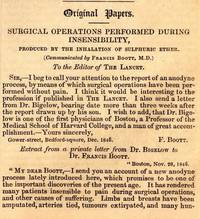
1847424711847. Lancet 1847/1. - London George Churchill 1847 4° 702 pp. Halbledereinband der Zeit. FIRST EDITION and the first publication on this side of the Atlantic of the first account of ether anaesthesia. The appearance of this paper in the Boston Medical & Surgical Journal some six weeks previously. This was thus the first account published in Europe of an operation performed with the aid of ether anaesthesia. "The original title "Insensibility during surgical operations produced by inhalation" as given in the Boston. Med. & Surg. J. was not given. Jacob Bigelow the father of H.J. Bigelow wrote on 28 November to Francis Boott of London telling him of Morton's discovery and enclosing the text of his son's communication as it had appeared in the Boston Daily Advertiser. Boott forwarded Jacob Bigelow's letter and H. J. Bigelow's paper to The Lancet which published them both in their number for 2 January 1847. Appended to the reprint was a letter from Robert Liston to Dr. Boott dated 21 December 1846 saying that on that day he had successfully used ether during an amputation at the knee thus recording the first operation under ether anaesthesia in Europe. Liston had learned of Bigelow's letter to Boott on Saturday the 19th and carried out his first operation on Monday the 21st!" Fulton & Stanton. The first reference to ether in the British press is a short paragraph in the London Medical Gazette for 18 December 1846 and the second is in The Lancet for 26 December. The two are evidently based on the same source and are statements only reprinted by Fulton & Stanton rather than full accounts. In The Lancet for 9 January 1847 further correspondence pp. 49-51 on Bigelow's patent is included and in the issue for 16 January "a long and well written editorial appears excoriating both Jackson and Morton for attempting the patent" and pp. 77-80 give accounts of operations under anaesthesia including an illustration of "Mr. Hooper's Ether Inhalator constructed according to Dr. Boott and Mr. Robinson's Instructions". John F. Fulton & Madeline E. Stanton The Centennial of Surgical Anesthesia pp.36-39 Following other Milestones of Anesthesia we find in this rare volume: Plomley Francis: Operations upon on the Eye pp.134-135. "John Snow and AE. Guedel are known for assigning stages to anesthesia; the following article by Francis Plomley is an earlier description of these levels. The pretending on the part of the physicians that the already completed operation had not yet been undertaken typified the wonder that was associated with the newness of the invention; conservations like that described in the second paragraph are to be found in many early articles. Plomley's definition of the third stage is accurate. It is now felt however that in the second stage "three exists" as he says "a perfect consciousness of everything said or done." His remarks in the final paragraph relating in this article to the site of action of the ether is interesting" Cole Milestone of Anesthesia Nr. 7 Wells Horace: Fatal Operation under the Influence of Ether pp.340-342. "The world owes much to Horace Wells 185-1848. He conceived the idea of surgical anesthesia experimented on himselfe and others and demonstrated anesthesia publicly for all to see. He succeeded in the sense that the failure of his demonstration was the failure of his audience to appreciate the earth-shaking nature of what they were being shown and in the sense that the final success was an immediate and direct result if his work. He published fefenses in the United States England and France." Cole Milestone of Anesthesia Nr. 8 Snow John: Apparatus for Inhaling the Vapour of Ether pp.120-121 1 Abb.; Observations of the Vapour of Ether and its Application to Prevent Pain in Surgical Operations pp.227-228; Ether Inhalation pp.388-389; A Lecture on the Inhalation of Vapour of Ether in Surgical Operations delivered at the United Service Institution and addressed to the Medical Members of the Institution on May 12th 1847 pp.551-554. ". this is the earliest article on the subject in his own words that I have been able to find" Cole Milestone of Anesthesia Nr. 11 In the index of this valuable volume we find following entries relating ether: Ether-vapour and surgery 392; and oxygen 395 422 Ether insensibility caused by the inhalation of prior to the performance of surgical operations Dr. Boott's notes on 5 8 49 ; Dr. H. J. Bigelow's paper on 6 ; Mr. Liston's note on 8 ; Mr. Dorr's note announcing the process being patented 8 ; editorial remarks on 2 16 74; opinion of counsel against the patent 49 ; Mr. Clendon on the inhalation of prior to operating 50 ; Mr. Squire's apparatus for 73; Mr. Hooper's 77; operations under the influence of 54 77 104 132 158 '. 184 210 237 342 367 499 549 639 ; Mr. Lansdown's operation 79; Dr. Fairbrother on 79 ; Mr. Edwards' operation 79; Dr. Brett's operations on the eye 80 ; Mr. Clen-don's on the teeth 80 ; Mr. Dorr on the patent for the letheon 80; Dr. Chowne on the inhalation of 99; Mr. Parker's operations for strabismus 106 ; Mr. Tracy's on the teeth 106; Dr. J. C. Hall's removal of a tumour 107 134; Dr. Snow's apparatus 120; Dr. Flomley on operations on the eye after the inhalation of 134 ; Dr. Ranking on in tetanus 135 ; Mr. Wintle on 162 ; Dr. Allan on the prevention of coughing while inhaling 163 ; Mr. Dudley on the alleged discovery of the influence of in 1824 163; Mr. Lee on the same forty years ago 164 ; Mr. Robinson on the inhalation of 168 284; experience of the French physicians relative to 176 ; observations on 187 ; action of confined to the cerebral system 214; experiments on 216 ; effects of 227 ; Dr. Snow on 227; Mr. Higginson's apparatus 239 ; Baron P. Dubois on in midwifery 246 ; experiments on by the Society of German Physicians in Paris 259 ; Messrs. Goddard Smith Tarrant Dickenson Leslie and Wraith on 264 265; Dr. Collyer's claims to the invention of 265 ; proposal for a public thanksgiving for 265 ; Mr. Wells' claims to the discovery of; letters from Dr. Bennet Mr. Ellsworth Mr. Wells and Dr. Marcy 265 471; Mr. Ray on the inhalation of 267 ; Dr. Wright's cases illustrative of 280 ; Mr. Dorr on the original discoverer of the inhalation of 289; Dr. Willis on the inhalation of in asthma and hooping-cough 315 ; Dr. Tyler Smith on in obstetric practice 321; Mr. Semple on the inhalation of in rheumatic neuralgia of the head and face 332 ; fatal operation under the influence of 340 ; Dr. Edwards' operations under the influence of 343 ; effects of 345; Dr. Gardner on 349 431; Dr. Marshall Hall on the influence of on the nervous system 368 395; Dr. Radford on the inhalation of in labour 384; as a remedy in spasmodic disease 388; Dr. Snow on ether inhalation 388 : Mr. Wakley's jun. circular note respecting 392; Messrs. Henderson and Cherry's experiments with on the horse 396 604; Dr. R. Chambers on the inhalation of 405; physiological effects of 411 ; effects of on a pregnant female 411; practical application of to medical jurisprudence 411; in midwifery 411 538 ; Dr. C. Ii. Hall on the effects of the inhalation of in reference to mesmerism 434; injection of into the arteries 443 ; used in reducing dislocation of the shoulder 444; Mr. Lansdown on in midwifery 446 ; Dr. P. Smith on 452 ; Dr. Pring on the direct action of on the blood 457; Dr. Brady's case of tetanus treated by the inhalation of 516; Mr. Broughton's case of tetanus treated by 517 ; misuse of in midwifery 521; Dr. Heame on the vapour of and the fatal case of Mrs. Parkinson 533 ; Dr. Dauriol's substitute for 540 ; Mr. Dorr on the discovery of the application of to surgical operations 547 ; Dr. Snow on the inhalation of in surgical operations 552; Mr. Hewett on the inhalation of 561; morphia versus 578 ; Mr.Lansdown on the inhalation of in natural labour 584 ; M. Ducros on the effects of electricity in overcoming the stupor produced by the inhalation of 503; Messrs. Holmes Coote and T. Taylor's experiments on the effects of inhalation of on the lower vertebrate animals 644; inhalation of in laryngismus stridulus 652; Etherization 398; fatal 370; and asphyxia 355 ; Mr. Robinson on resuscitating patients after 371 Further we find following entries about Inhalation: Inhalation patent for 163 ; of ether prior to the performance of surgical operations Dr. Boott's notes on 5 8 49 ; Dr. H. J. Bigelow on 6 ; Mr. Liston on 8; Mr. Dorr's note respecting the patenting of the process of 8 80; editorial remarks on 16 74; opinion of counsel against the patent 49 ; Mr. Clendon on prior to operating 50 ; Mr. Squire's apparatus for 73 ; Mr. Hooper's 77 ; operations under the influence of 54 77 104 132 158 184 210 237 342 367 499 549 639 ; Mr. Lansdown's operation 79 ; Dr. Fairbrother on 79; Mr. Edwards' operation 79; Dr. Brett's operations on the eye 80 ; Mr. Clendon's on the teeth 80 ; Dr. Chowne on the 99 ; Mr. Parker's operations for strabismus 106 ; Mr. Tracy's on the teeth 106 ; Dr. J. C. Hall's removal of a tumour 107134 ; Dr. Snow's apparatus 120 ; Dr. Plomley on operations on the eye after 134; Dr. Ranking on in tetanus 135 ; Mr.Wintle on 162 ; Dr. Allan on the prevention of coughing during 163 ; Mr. Dudley on the alleged discovery of in 1824 163; Mr. Lee on the same forty years ago 164; Mr. Robinson on 168 284; experience of the French physicians relative to 176; observations on 187; action of confined to the cerebral system 214; experiments on 216; effects of 227; Dr. Snow on 227; Mr. Higginson's ether inhaler 239; Baron P. Dubois on in midwifery 246 ; experiments on by the Society of German Physicians at Paris 259; Messrs. Goddard Smith Tarrant Dickenson Leslie and "Wraith on 264 265 ; Dr. Collyer's claims to the invention of 265 ; proposal for a public thanksgiving for 265 ; Mr. Wells' claim3 to the discovery of; letters from Dr. Bennet Mr. Ellsworth Mr. Wells and Dr. Marcy 265 471; Mr. Pay on 261; Dr. Wright's cases illustrative of 280; Mr. Dorr on the original discoverer of 289 ; Dr. Willis on in asthma and hooping-cough 315 ; Dr. Tyler Smith on in obstetric practice 321; Mr. Semple on in rheumatic neuralgia of the head and face 332 ; fatal operation under the influence of 340 ; Dr. Edwards' operations under the influence of 343 ; effects of 345 ; Dr. Gardner on 349 431; Dr. Marshall Hall on the influence of on the nervous system 368 395 ; Dr. Radford on in labour 384; in spasmodic diseases 388 ; Dr. Snow on 38S; Mr. Wakley's jun. circular note respecting 392; Messrs. Henderson and Cherry's experiments with on the horse 396 604 ; Dr. R. Chambers on 405 ; physiological effects of 411; effects of on a pregnant female 411; practical application of to medical jurisprudence 411; in midwifery 411 538; Dr. C. R. Hall on the effects of in reference to mesmerism 434 ; used in reducing dislocation of the shoulder 444; Mr. Lansdown on in midwifery 446; Dr. P. Smith on 452; Dr. Brady's case of tetanus treated by 516 ; Mr. Broughton's case 617; Dr. Hearne on 532 ; Dr. Dauriol's substitute for 540 ; Mr. Dorr on the discovery of the application of to surgical operations 547 ; Dr. Snow on 552 ; Mr. Hewett on 561; morphia versus 578 ; Mr. Lansdown on in natural labour 584; M. Ducros on the effects of electricity in overcoming the stupor produced by 593; Messrs. Holmes Coote and T. Taylor's experiments on the effects of on the lower vertebrate animals 644; in laryngismus stridulus 652 unknown
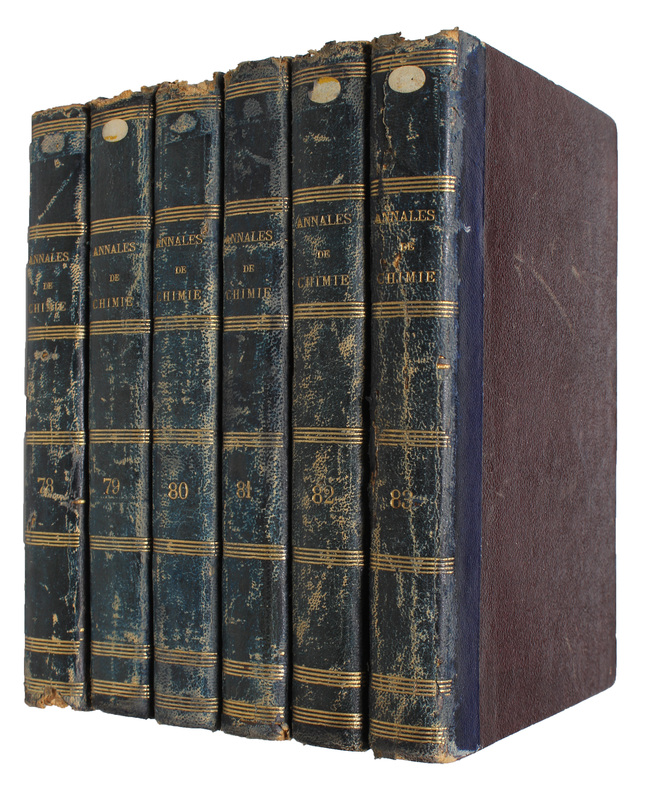
181146030Paris, Chez J. Klostermann fils, 1811-12. Bound in 6 contemp. hcalf. Gilt spines, slightly rubbed. Wear to top of spines. In: ""Annales de Chimie, ou Recueil de Mémoires concernant la Chemie"" Tome 78, 79, 80, 81, 82 and 83. (Entire volumes offered). The 14 parts: (Tome 78:) pp. 5-37, 105-132, 217-242. - (Tome 79:) pp. 113-142, 233-264. - (Tome 80:) pp. 5-37, 225-258. - (Tome 81:) pp. 5-36, 278-303. - (Tome 82:) pp. 5-33, 113-125, 225-72. (Tome 83:) pp. 5-35 a. pp. 117-127. With in all 3 engraved plates. Some scattered brownspots.
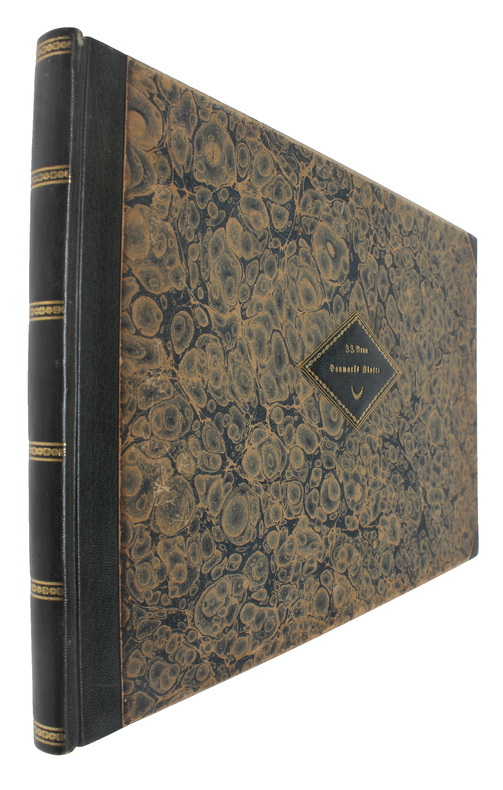
18059453(Kbhvn., G.L. Lahde, 1805). Tv-folio. Smukt senere hldrbd. (Anker Kyster) med rig rygforgyldning og rhombeformet forgyldt skindtitel på forperm. Beskrivende tekst på dansk og tysk. Med 24 kobberstukne prospekter af danske Slotte fra Bruun's ikke fuldendte værk ""Novus Atlas Danicus"", som af Lahde i 1805 blev genoptrykt med de originale plader og for slottenes vedkommende samlet under denne titel. De sidste 4 med lidt brunpletter.
181146030Paris Chez J. Klostermann fils 1811-12. Bound in 6 contemp. hcalf. Gilt spines slightly rubbed. Wear to top of spines. In: "Annales de Chimie ou Recueil de Mémoires concernant la Chemie" Tome 78 79 80 81 82 and 83. Entire volumes offered. The 14 parts: Tome 78: pp. 5-37 105-132 217-242. - Tome 79: pp. 113-142 233-264. - Tome 80: pp. 5-37 225-258. - Tome 81: pp. 5-36 278-303. - Tome 82: pp. 5-33 113-125 225-72. Tome 83: pp. 5-35 a. pp. 117-127. With in all 3 engraved plates. Some scattered brownspots. <br/><br/><em>The papers represents one of the first announcements of Berzelius' discovery of the fixed chemical proportions determining the weights and valencies of the various constituent elements in inorganic compounds. The papers were published at the same time in Swedish German both here in Annalen and in Schweiger's Journal and in French. By running many hundreds of analysis of chemical compounds he gave so many examples of the law of definite proportions that the world of chemistry could no longer doubt its validity and in so doing he gave experimental evidence to the atomic theory. He hereby laid a solid fundation for the further development of chemistry. A reprint is found in Ostwald's Klassiker der exakten Wissenschaften No. 35.According to Söderbaum Jac. Berzelius 2 p.12 "It was a giant work one of the most importent in the history of chemistry which was here presented. One is even more impressed when one remembers that it was a pioneer undertaking in every sense of the term. Analytic and synthetic methods existed before Berzelius' time to be sure but there were no precise methods of the sort which he required. They all had to be elaborated at the cost of time and labour."J. Erik Jorpes "Jac. Berzelius" p.45."In general Berzelius's efforts were directed toward the consolidation and extension of the atomic theory. He improved chemical analysis and determined the composition of a large number of compounds thus verifying the laws of constant and multiple proportions and furnishing the most accurate equivalent weights then available. By ingenious methods he arrived at the correct atomic composition of most common substances and thus was enabled to draw up in 1826 a table of atomic weights very nearly identical with the modern one."Leicester & Klicktein "A Source Book in Chemistry" p. 258.Parkinson "Breakthroughs" 1810-20 C. </em> unknown