112 résultats
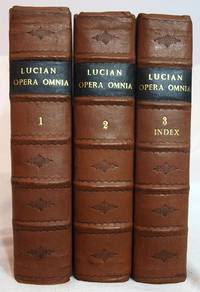
17431503260010Amstelodami : Sumptibus Jacobi Wetstenii 1743-01-01. Hardcover. Good. 0x0x0. 3 Volumes. 2 pl in Volume I. Bound in modern 3/4 brown leather. Gilt lettering to spine. 5 raised bands. Red cloth boards. Good bindings and covers. Wear to top page end of Volume II near spine. Soiling to top page ends.Tanning to pages with foxing throughout. Brunet III.1207 Amstelodami : Sumptibus Jacobi Wetstenii hardcover
1789ABC_50040Berlin 1789. 8vo. Friedrich Vieweg Slightly later gold-tooled half calf sewn on 3 supports with the corresponding raised bands on the spine with the author title and a monogram lettered in gold on the spine a red round morocco label with the number "125" mounted at the foot dark brown cloth sides brown sprinkled edges. 6 "250" = 248 pp. First edition of this posthumous collection of shorter writings by the influential German-Jewish philosopher Moses Mendelssohn 1729-1786 edited by Johann Georg Müchler 1724-1819. The collection was intended to preserve and re-circulate a number of Mendelssohns shorter philosophical essays many of which had previously appeared scattered across contemporary journals and had already become difficult to obtain. In bringing them together Müchler ensured the continued availability of texts that illuminate the breadth of Mendelssohns thought and the literary clarity for which he was celebrated.With a bookplate mounted on the front pastedown inscribed Noel Gouton 1903 made by Stern Graveur a prominent Parisian engraving house active during the late 19th and early 20th centuries which specialized in high-quality ex-libris. The edges of the boards are slightly scuffed the spine is somewhat discoloured. Internally very clean. Otherwise in very good condition.l Fürst II p. 362; Goedeke IV p. 164 no. 19; VD18 13630814; WorldCat 231070909 172996042 10 copies; cf. Albrecht Moses Mendelssohn 1729-1786. Das Lebenswerk eines jüdischen Denkers der deutschen Aufklärung 1986. hardcover
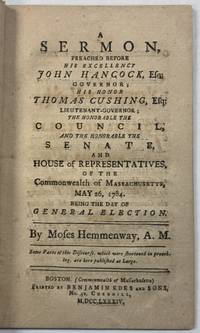
178441998Boston: Benjamin Edes 1784. 52pp with the half title. Disbound occasional light toning. Else Very Good. <br /> <br /> In this first Massachusetts Election Sermon after the peace with England Hemmenway counsels that God has ordained human liberty. "God has called us to liberty." The Christian has "a new covenant right to the common privileges of humanity." But Liberty means freedom from tyranny under the authority of a just government and God; it does not consist of "lawless licentiousness." We are all "subject to the obligation of the law of God." <br /> The sermon cautions against the "abuse of liberty." Hemmenway was the pastor of a Congregational Church in Wells then in Massachusetts and now in Maine.<br /> FIRST EDITION. Evans 18526. Williamson 4411. ESTC W29297. Benjamin Edes unknown
17962330942Berlin: Bey Haude und Spener 1796. Second Edition. Hard Cover. Very Good/No Jacket. Second edition. Sticker on front corner edges rubbed ink name and stamp on endpapers. Scarce - only 12 in OCLC. 1796 Hard Cover. 124 pp. German text. Paper over boards handwritten titles on spine. Mendelssohn's ideas brought about the Haskalah Jewish Enlightenment. This work applies mathematical proofs to metaphysics. It won the author first prize in a Berlin Academy essay contest over Immanuel Kant and Thomas Abbt. Bey Haude und Spener hardcover
178928250Berlin: bei Friedrich Vieweg dem álteren 1789.- 3 h. 250 p.; 8º 17 x 11 cm.; buena impresión en letra gótica sobre excelente papel verjurado; Plena Piel valenciana en tonos marrones lomo dorado con filetes y bandas sobre los nervios estuche. Salvo una pequeña marca de humedad en el margen superior de unas 8 hojas que no toca texto su estado es excelente. FILOSOFÃA E HISTORIA DE LA CULTURA Buch auf deutsch bei Friedrich Vieweg, dem álteren hardcover
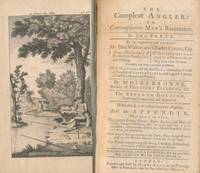
175933781London: Henry Kent 1759. Rare First Moses Browne Edition. Illustrated with ten copper-engraved plates by H. Burgh 15 woodcuts in the text one page of music and engraved head- and tailpieces. 12mo bound in full contemporary polished calf the covers double gilt fillet ruled at the borders the spine raised bands separating the compartments two compartments lettered in gilt. xiv 340 viii Index pp. A well preserved copy sometime respined the text-block and illustrations clean and in good order some offsetting to the title-page from the facing plate the binding strong and the hinges tight. THE SECOND MOSES BROWNE EDITION PRINTED IN 1754 AND CONTAINING TWENTY EIGHT PAGES MORE THAN THE FIRST NOW RARE IN COMMERCE. THIS COPY IN A CONTEMPORARY BINDING. A beloved classic of the English language and what many call the finest "How-To" book ever written; Walton's ANGLER has been described as "full of wisdom kindly humour and charity; it is one of the most delightful and care-dispelling books in the language." "More than most authors he lives in his writings which are the pure expression of a kind humorous and pious soul in love with nature while the expression itself is unique for apparent simplicity which is really elaborately studied art" DNB. <br> After the 1676 edition of The Compleat Angler the last Walton published before his death in 1683 no new editions of The Compleat Angler were published for almost one hundred years. Moses Browne editor of the 1750 edition and John Hawkins editor of the 1760 edition were likely both influenced to publish new editions of the Angler by Dr. Samuel Johnson the famous literary master. Browne produced a second edition of his version in 1759 leading to a dispute with Hawkins whose 1760 version was already being printed at the time. Each editor boasted that their version was the only correct one and Browne accused Hawkins of copying images and biographical information from his earlier version. Despite this controversy the 18th century editions introduced new context for the work in a new century as well as contemporary illustrations indicating the beginning of a revival for The Compleat Angler. University of Pittsburgh Henry Kent hardcover
179729346V.p.: v.i. 1797. Very Good. V.p.: v.i. 1797-1799. Six volumes bound in one; octavo; contemporary limp blue paste-paper boards. Boards a bit rubbed most notably along spine textblock uniformly toned binding a bit tight with text along gutter edges of some leaves just barely visible else a Very Good sound copy all contents collated complete. Contemporary ownership signature in pencil on rear pastedown of a Mary Hawthorne Bunker. Contents as follows: <br /> <br /> 1. Moses Adams. "A Sermon Delivered at the Ordination of the Rev. Thomas Noyes to the Pastoral Care of the Second Church in Needham July 10 1799." Printed at the Minerva Press in Dedham by Herman Mann 1799. 271pp. EVANS 35076.<br /> <br /> 2. Stephen Palmer. "A Sermon Delivered at Rowley Second Parish July 7 1797. At the Ordination of the Rev. Isaac Braman to the Pastoral Care of the Second Church and Society in that town." Dedham: Nathaniel and Benjamin Heaton 1797. 351pp. ESTC W003029; EVANS 32636; SABIN 58373.<br /> <br /> 3. Nathaniel Sermon. "A Sermon Preached at the Installation of the Reverend William Emerson to the Pastoral Care of the First Church in Boston on the 16th of October 1799." Boston: Samuel Hall 1799. 302pp. ESTC W29258; EVANS 36409.<br /> <br /> 4. Abel Holmes. "A Sermon Preached at the Ordination of the Rev. Jonathan Whitaker to the Pastoral Care of the Church and Society in Sharon Massachusetts February 27 1799." Dedham: Herman Mann 1799. 493pp. EVANS 36530.<br /> <br /> 5. Ezra Ripley. "A Sermon Delivered at York October 10 1798 at the Ordination of the Rev. Rosewell Messinger Pastoral Charge of the First Church as Colleague Pastor with the Rev. Isaac Lyman." Portsmouth NH: Printed by Charles Peirce at the Oracle-Press No. 5. Daniel-Street 1798. 24pp. EVANS 34471; SABIN 71513<br /> <br /> 6. Enos Hitchcock. "A Sermon Delivered at Wrentham at the Ordination of the Rev. Elisha Fisk June the 12th 1799." Providence: Bennett Wheeler 1799. 28pp. ALDEN 1620; EVANS 35624; SABIN 32257. v.i. unknown
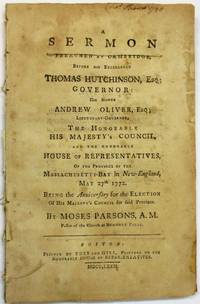
177236416Boston: Edes and Gill 1772. 43 1 blank pp but lacking the half title. Disbound light to moderate foxing. Good. Ownership signature "Chas. Stearns 1780" at head of title. <br /> <br /> A desirable pre-Revolutionary War sermon. Parsons locates God's hand in all events "either when we enjoy the advantages of good civil government or find that it is altered and become grievous." The British heritage of good civil government is now disturbed: "The scene is changed- Grievances are complain'd of- In Great Britain- In Ireland- In America- In this Province.- The day is become gloomy and dark and the waters are troubled." <br /> Even in England "A King may be misled by evil counsellors- He may be corrupted by bad ministers and give into those measures which are injurious to the subject." As God has brought us safely out of the "howling wilderness" He will do so today when "our liberties have been invaded and hostile measures made use of to bring us to submit to things which are grievous." <br /> FIRST EDITION. Evans 12502. ESTC W29233. Edes and Gill unknown
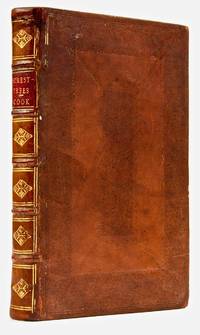
1717BB1599London: Printed for Daniel Browne Andrew Bell John Darby Arthur Bettesworth John Pemberton Charles Rivington John Hooke R. Cruttenden and T. Cox Jer. Battley Edward Symon 1717. Early Reprint. Full Calf. Fine. Second Edition "very much corrected" of this influential treatise by the head gardener to the Earl of Essex. 8vo: xix1276pp with frontispiece depicting tree-fellers at work and two fold-out plates containing 48 figures showing ways to calculate the scale and design of landscape features. Cambridge-style paneled calf spine gilt in six compartments very skillfully relaid red morocco lettering piece gilt edges speckled red. An excellent example in a handsome contemporary binding with pages and plates fresh bright and all but free of foxing. Henrey 40 and pp. 116-118. Goldsmiths' 6265. Kress Library 3011. Originally published in 1676 going through several editions the final one in 1724. Cook gives rudimentary designs for avenues walks and lawns in the strict geometric manner of George London and Henry Wise partners at the celebrated Brompton Park Nursery which Cook helped found. After John Evelyn whose own pioneering works on tree cultivation was published in 1664 visited the Earl of Essex in the spring of 1680 and toured the gardens he praised in his diary the "incomparable collection of the choicest fruits" and called Cook "so skillful an artist." Some fifty years later another commentator and gardener noted "Cooke's is indeed an excellent book and one that has done more good in the nursery and forest way than any other that I know of." N. B. With few exceptions always identified we only stock books in exceptional condition. All orders are packaged with care and posted promptly. Satisfaction guaranteed. Fine Editions Ltd is a member of the Independent Online Booksellers Association and we subscribe to its code of ethics. Printed for Daniel Browne, Andrew Bell, John Darby, Arthur Bettesworth, John Pemberton, Charles Rivington, John Hooke, R. Crutte unknown
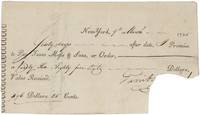
179542478New York 1795. paperback. Single leaf 4x7 inches. Printed on one side with blanks filled in in manuscript and signature obscured by cancellation tear-off; “Isaac Moses & Sons†penned on blank side in period hand. Early American Jewish merchants Isaac Moses & Sons operated on Greenwich Street.Isaac Moses 1742-1818 was born in Giessen Germany but moved to New York in 1764 and in 1766 he became a “freeman†of New York City. He became a prominent businessman and American patriot. He worked in his uncle's Hayman Levy's mercantile firm until he established Isaac Moses & Company with two new business partners in 1775. This firm supported the revolutionary army by accepting $20000 in Continental paper dollars in exchange for $20000 in hard currency thereby financing the war effort. The firm also traded for military supplies internationally and sold guns and ammunition to the army. When the British occupied New York Isaac Moses left for Philadelphia and ran the firm from there. In 1783 he returned to New York City and continued his commercial enterprises. He was generally financially successful establishing Isaac Moses & Sons an international trading company. He was also a founder and major stockholder in the Bank of New York  a Mason in New York City's Union Lodge and an important member of the New York City Chamber of Commerce. Isaac Moses was also president of Congregation Shearith Israel in New York the oldest Synagogue in American and the only Jewish congregation in New York City until 1820. He was also one of the principle organizers of the Congregation Mikveh Israel in Philadelphia. His descendants were prominent Jewish businessmen in New York who traveled internationally and served in the Union Army during the Civil War AJHS & Wikipedia. For more on Isaac Moses see the JTA’s report on the donation of his portrait by John Wesley Jarvis to the Museum of the City of New York in 1934 https://www.jta.org/archive/painting-of-isaac-moses-patriot-of-revolution- given-to-museum. Portraits of Moses can be viewed online at https://loebjewishportraits.com/portrait/isaac-moses/ and https://loebjewishportraits.com/portrait/isaac-moses-2/. An indenture signed by his heirs after his death in 1818 sold for $3500 plus commissions at auction in 2019 https://www.sothebys.com/en/auctions/ecatalogue/2019/fine-manuscripts-prin ted-americana-n10002/lot.2180.html. Promiser’s signature torn of as cancellation as often found otherwise Very Good Condition BK5 AMR-67-39. New York unknown
1737230095London: John Noon 1737. First Edition . Leather. Fair. 8 x 10 1/2. 283 pages in quite good condition; white and very readable. Stains throughout. Outer edges and endpapers yellowed and stained. Previous owners' names and small notations on the endpapers. Brown full leather contemporary binding. Five raised bands and titles on the spine; titles are almost rubbed off. Front hinge is torn and loose but intact. Corners bumped and frayed. Edges and boards very rubbed. Binding tight. Scarce in first edition. Interior is GOOD exterior POOR. Overall FAIR <br/> <br/> John Noon hardcover
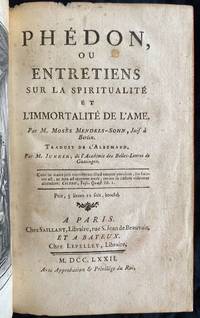
177243257Paris et Bayeux chez Saillant et Lepelley 1772. 1st French-language edition. Period full leather binding with gilt spine and red edges with original marbled endpapers 8vo. Includes frontis copperplate etching. XXIV 342 1 pages. “Traduit de l’Allemand par M. Junker de l’Académie des Belles-Lettres de Goettingen.â€<br> This first French edition appeared 5 years after the first German edition of 1767<br> <br> "Phaedon or On the Immortality of the Soul" Phaedon Oder Ueber Die Unsterblichkeit Der Seele In Drey Gespraechen is one of Mendelssohn's 1729-1786 most famous publications establishing his reputation as the "German Socrates of Berlin." It is a philosophical interpretation of the Platonic dialogue "Phaedo" and is preceded by a biography on "The Life and Character of Socrates." The important German-Jewish philosopher was one of the most important representatives of the Enlightenment in Prussia and throughout Germany.<br> <br> Mendelssohn's Phaedon is a “classic of rational psychology on the immortality of the human soul a defining work by this leading enlightenment philosopher who launched the Jewish thinking of the modern age" with his tribute to Socrates modeled on Plato's dialogue the Phaedo.<br> Mendelssohn used Plato's famous dialogue the Phaedo as a model to publish Phädon oder über die Unsterblichkeit der Seele. With this seminal work "he reached the heights of fame" Wigoder Dictionary of Jewish Biography 342. <br> The work unites Mendelssohn's "paean to Socrates with an elaboration of the dreadful personal moral and political implications if a person's life is her 'highest good'… <br> This 'classic of rational psychology' as Dilthey put it also contains an argument for the simplicity and immortality of the human soul explicitly singled out for criticism by Kant in the 2nd edition of the Critique of Pure Reason. Mendelssohn supports the notion that the soul is simple and thus indestructible by noting that certain features of the soul namely the unifying character of consciousness and the identity of self-consciousness cannot be derived from anything composite whether those composite parts be capable or not of thinking… <br> As for the human soul's fate after death Mendelssohn appeals to divine goodness and providence which perhaps explains why following the publication of the Phaedo he finds himself needing to revisit the proofs for God's existence" Stanford Encyclopedia.<br> According to Mendelssohn’s modern biographer Alexander Altmann “The work that would establish Mendelssohn's world-wide renown and win him the title 'the German Socrates' was the dialogue Phaedon which was published in 1767. In this work he presented Socratic wisdom from the mouth of the ancient philosopher but in the language of the Enlightenment that is in his own words as a modern philosopher. <br> The work drew both praise and criticism but was on the whole popular in intellectual circles. It demonstrates Mendelssohn's unique ability as a Jew to be comfortable in the realm of both classical and enlightened philosophy not to mention languages. David Sorkin remarks ‘What is ironic is that Mendelssohn was known and revered as much for the quality of his prose as for his thought.†<br> Mendelssohn was himself often referred to as the German Plato or the German Socrates. <br> And “As a Jew living in Germany Moses Mendelssohn 1729-1786 stands at a pivotal point in the history of Jewish emancipation in Europe. There were Jews before him who had access to the corridors of power in Germany and elsewhere in Europe but Mendelssohn represents the first to be socially accepted to a significant extent within enlightened German culture without converting. <br> He not only conformed to the culture of the German Enlightenment in many ways but also helped shape the culture through his philosophical contributions. At the same time Mendelssohn refused to turn away from traditional Judaism. He attempted to become a full- fledged member of society during the emergence of modern Europe while remaining a proponent of Judaism as a revealed religion. Moreover he sought to use his place of influence to encourage Jewish acculturation in Germany and to speak on behalf of the emancipation of Jewish people…. <br> The traditional mentality of the European Jews prior to Mendelssohn's time included a kind of resignation to the incompatibility of Jewish learning and 'worldly' philosophy. This resignation contributed to Jewish cultural isolation. Alfred Jospe describes the conundrum in which a Jew found himself if he wished to enter the culture of the non-Jewish world: The Jew could gain access to the culture of the world only by rebelling against the traditional repudiation of all mundane wisdom. <br> It is just at this point that Mendelssohn broke the mold. He not only acquired modern German culture but did so by means of his understanding of and contributions to the philosophy that shaped that culture. In his monumental biographical study Alexander Altmann focuses as much on Mendelssohn's philosophy and his answers to contemporary critics as he does on the details of the events and influences of his life. Altmann states with appropriate admiration that “Considering the state of degradation in which the Jewish population lived in eighteenth-century Germany. Mendelssohn's rise to fame and his acceptance into the republic of letters was an amazing feat of personal achievement.†<br> The amazing feature of Mendelssohn's achievement is that he accomplished it as an avowedly traditional Jew. Mendelssohn has been rightly described as a rabbinic scholar but he made his reputation in non-Jewish intellectual circles as a literary critic and philosopher….with the help of both Gotthold Lessing and the Berlin publisher Friedrich Nicolai he was accepted into the inner circle of the Berlin Aufklärung. <br> His essays reviews and translations earned him tremendous status among German intellectuals. <br> The favorable comparison made by Lessing between the quintessential German poet Goethe and Mendelssohn is a mark of the esteem in which he was held. ‘Lessing told Friedrich Heinrich Jacobi that once Goethe regained his reason he would be hardly more than an ordinary man. At the very same time he said of Mendelssohn that he was the most lucid thinker the most excellent philosopher and the best literary critic of the century’" Clark 2005. P. 57-58. <br> OCLC: 19939219. <br> Very light edgewear to front endpapers touch of spotting a gorgeous copy in the original leather binding with tooled gilt spine with raised bands and leather label. Beautiful and scarce. B KH-10-30-RLB-’e. Paris et Bayeux, chez Saillant et Lepelley unknown
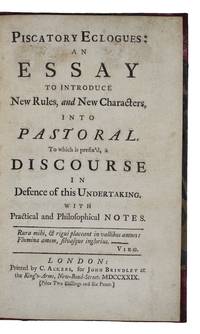
1729AQ26633London: Printed by C. Ackers for John Brindley 1729. 14 129pp 1. Later red straight-grain half-morocco marbled paper boards ruled and lettered in gilt. Lightly rubbed and marked. Marbled endpapers title page browned. The first edition of poet and Church of England clergyman Moses Browne's 1704- 1787 highly naturalistic angling pastorals that include the first avowed imitation of Milton's 'Lycidas'. The didactic portions are adapted from Izaak Walton's Compleat Angler a work which Browne was to edit and republish for the first time since 1676 in 1750 at the suggestion of his friend Samuel Johnson. The nine poems were reprinted under the title Angling Sports in 1773. ESTC records copies at five locations in the British Isles BL Cambridge Leeds NLS and Oxford and a further 11 in North America California Harvard Huntington Illinois NYPL Newberry North Carolina Pennsylvania Princeton Virginia and Yale. ESTC T55150. First edition. 8vo. Printed by C. Ackers, for John Brindley hardcover
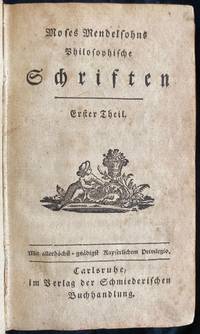
178043258Carlsruhe: im Verlag der Schmiederischen Buchhandlung 1780. No Date 1780s. Period laquered boards with leather spine label. 12mo. XXIV 278; 283 pages. In German. Title translates as “Writings.†Includes 2 different title vignettes 1 on each title page.<br> <br> Goedeke IV 1 488 6. Meyer 108; Dorn 105-107; Holzmann/Bohatta Deutsches Anomymen-Lexikon IV no. 1559. <br> <br> Early printing of Mendelssohn’s second work in which he "began his formulation of a new psychological theory that stressed the autonomy of aesthetics logic and ethics relative to each other." Merriam-Webster's Encyclopedia of World Religions p. 710. <br> <br> Contents:<br> <br> Vol. 1. Vorrede. <br> I. Ueber die Empfindungen.<br> II. Gespräche; <br> <br> Vol. 2. I. Rhapsodie oder Zusätze zu den Briefen über die Empfindungen. <br> II. Ueber die Hauptgrundsätze der schönen Künste und Wissenschaften. <br> III. Ueber das Erhabene und Naive in den schönen Wissenschaften. <br> IV. Ueber die Wahrscheinlichkeit. <br> <br> Also includes bibliographical references.<br> <br> Included within these is a series of writings on aesthetics which influenced Lessing and Schiller with Lessing noting“We have to thank him Mendelssohn for the true theory of mixed sensations.â€<br> <br> Moses Mendelssohn Moses of Dessau; 1729–1786 was a philosopher of the German Enlightenment in the pre-Kantian period early Maskil and a renowned Jewish figure in the 18th century. Mendelssohn was fluent in German and Hebrew and learned Latin Greek English French and Italian. His early teachers were young broadly educated Jews and he met the writer and dramatist G.E. Lessing 1754 and a deep and lifelong friendship developed between them. Throughout his life he worked as a merchant while carrying out his literary activities and widespread correspondence in his free time. In 1754 Mendelssohn began to publish – at first with the assistance of Lessing – philosophical writings and later also literary reviews. <br> He also started a few literary projects for example the short-lived periodical Kohelet Musar in order to enrich and change Jewish culture and took part in the early Haskalah. In 1763 he was awarded the first prize of the Prussian Royal Academy of Sciences for his work Abhandlung über die Evidenz in metaphysischen Wissenschaften "Treatise on Evidence in Metaphysical Knowledge". However when the academy elected him as a member in 1771 King Frederick II refused to ratify its decision. <br> <br> In 1769 he became embroiled in a dispute on the Jewish religion and from then on he confined most of his literary activity to the sphere of Judaism. His most notable and enduring works in this area included the translation into German and commentary on the Pentateuch Sefer Netivot ha-Shalom "Book of the Paths of Peace" 1780–83 and his Jerusalem: oder Ueber religiöse Macht und Judenthum "Jerusalem or On Religious Power and Judaism" 1783 this work the first polemical defense of Judaism in the German language and one of the pioneering works of modern Jewish philosophy. <br> <br> An active intermediary on behalf of his own people in difficult times and a participant in their struggle for equal rights he was at the same time a forceful defender of the Enlightenment against the opposition to it which gained strength toward the end of his life. In the midst of a literary battle against one of the leading figures of the counter-Enlightenment he died in 1786 EJ. <br> <br> SUBJECTS: Philosophy -- Early works to 1800. Philosophie -- Ouvrages avant 1800. Philosophy. OCLC: 1352546328. <br> <br> Light wear to original boards more so at spine but solid and attractive light spotting as expected About Very Good- Condition an attractive 18th Century copy. B KH-10-31. Carlsruhe: im Verlag der Schmiederischen Buchhandlung unknown
1759wal759London: Henry Kent. G : in good condition. Rebacked. Some foxing. 1759. Seventh Edition. Green hardback cloth cover with grey slipcase. 160mm x 90mm 6" x 4". xxiv 340pp viii plates. 10 b/w plates numerous b/w vignettes. Inscribed by Moses Browne on frontis verso numerous hand-written notes on fishing within. . Henry Kent hardcover
1785SZEPEBKS007095IWien: Sebastian Hartl 1785. First . Soft cover. Very Good/No Jacket. 16mo. 17x10.5 cm. - 79 pp. - Near fine in contemporary strong grey wrappers. - Small ownership stamp on title-page. <br/> <br/> Sebastian Hartl paperback
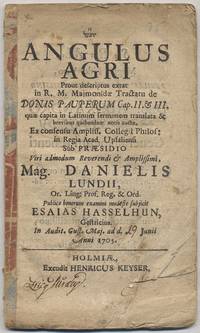
1705385644Holmiae Stockholm: Henricus Keyser 1705. Hardcover. Near Fine/Near Fine. First edition. 12mo. 7 28pp.; illustration. Sewn. Text in parallel Latin and Hebrew. Remnant of old marbled wrapper else disbound contemporary name on titlepage chip at the bottom of titlepage removing no text edgewear about very good. A thesis on the nature of a field with a Latin translation of Maimonides' Hebrew text. OCLC locates seven copies over three records; three in the U.S. Henricus Keyser hardcover
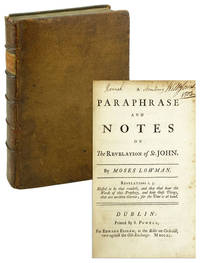
174025748Dublin: Printed by S. Powell for Edward Exshaw 1740. Very Good. Dublin: Printed by S. Powell for Edward Exshaw at the Bible on Cork-hill over-against the Old-Exchange 1740. First Dublin Edition. Octavo; full contemporary calf gilt-lettered spine in six compartments; xxxvi241-3526pp. A3 B-2X4 2Y2 2Z2 collated complete despite error in pagination. Minor scuffing to leather extremities with a few tiny chips endpapers foxed at extremities contemporary ownership signature of a Hannah Armstrong at head of title page along with that of a Will Jones dated 1803. A Very Good sound copy overall.<br /> <br /> Extensive Biblical annotations by the English nonconformist minister Moses Lowman 1680-1752. Includes the list of subscribers on pp. xxxvii-xxxviii. The previous owner Hannah Armstrong does not appear on the list of subscribers though if she had she would have been one of just two women. The latter half of p. xxxviii is devoted to the publisher's advertisements which ran from sermons to histories and something called "The Tales of the Faries" by the Countess d'Anoise in three volumes. <br /> <br /> ESTC T170485. Printed by S. Powell, for Edward Exshaw unknown
177214851A Paris Saillant 1772. Cont. full mottled calf. Back worn as the golddecoration is nearly gone. Engraved frontisp. XXIV3422 pp. A few lvs. slightly browned otherwise internally fine. <br/><br/><em>Scarce first French edition. </em> unknown
176542130Boston: Printed by Richard and Samuel Draper in Newbury - street 1765. 36pp with the half title as issued. Disbound with recent stitching mild scattered spotting Good plus or Very Good. Clipped inscription at top margin of half title: "For the Revd Jonathan Parso--."<br /> <br /> The half title is "Mr. Parsons's Sermon at the Ordination of the Reverend Joseph Dana."<br /> Ministers says Parsons are God's agents "send by him to shew unto Men the Way of Salvation."<br /> Evans 10439. ESTC W26196. Printed by Richard and Samuel Draper, in Newbury - street unknown
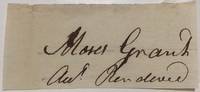
17852791581785. unbound. very good. 1 x 2.5-inch signature removed from a document no place no date circa 1785. Smudged ink on the first letter of his name but still in very good condition overall.<br/> <br/> American patriot and religious leader best remembered for his participation in the Boston Tea Party.<br/> <br/> unknown
1745273905London: John Moon 1745. Hardcover. Fair. Second Edition. Full leather. Fair with well worn and stained boards and spine front board detached spine shows some loss contemporary owners name and date on torn pastedown title page and rear end paper loose overall internally good with first four pages torn and chipped at edges a few sporadic tears and spotty browing. John Moon hardcover