LINCOLN ABRAHAMABAA

26 503 résultats
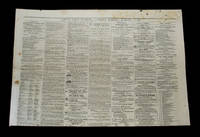
18602444New York: New York Tribune 1860. First edition. Original wrappers. Very Good. FIRST EDITION of Lincoln's historic Cooper Union Address delivered on February 27 1860 at the Cooper Institute in New York. The speech is largely credited to having launched Lincoln's Presidential bid. In the fall of 1859 James A. Briggs who served on the lecture committee of the Plymouth Church in Brooklyn invited presidential candidate hopeful Abraham Lincoln to speak to a New York audience on any subject of his choosing. Lincoln accepted the invitation choosing to speak of the current political climate in America. William O. Stoddard an Illinois journalist who worked for President Lincoln during his administration noted that "No previous effort of his life cost him so much hard work as did that Cooper Institute speech" and that the resulting speech "was a masterly review of the history of the slavery question from the foundation of the government with a clear bold statesmanlike presentation of the then present attitude of parties and of sections. It exhibited a careful research a thorough knowledge and understanding of political movements and developments that staggered even the most laborious and painstaking students. It showed a grasp a breadth a mental training and a depth of penetration which compelled the admiration of critical scholars" Stoddard Abraham Lincoln: The True Story of a Great Life. <br /> <br /> "Horace Greeley had rushed out the speech in pamphlet form as 'Tribune Tract' Number 4 under the headline: National Politics. Speech of Abraham Lincoln of Illinois Delivered at the Cooper Institute Monday Feb. 27 1860. The pamphlet was ready March 6 while Lincoln was still traveling through Connecticut. When he returned to New York he found it already available to the public. <br /> <br /> "Greeley marketed the eleven-page Tribune edition aggressively. As a bonus the publication included Wisconsin Republican senator James Doolittle's February 24 speech attaching 'the new doctrine of judicial infallibility' as did Lincoln's address at Cooper Union just three days later and also like Cooper Union railing agains 'the headstrong zeal pursued by the other party to force slavery into Territories'.<br /> <br /> "It was as if Republicans were now speaking with one voice: identifying with the founders attacking the Dred Scott decision rebuking John Brown and drawing their own 'dividing line' on slavery extension. Lincoln did not say it alone; but he said it best. 'Mr. Lincoln's is probably the most systematic and complete defense yet made of the Republican position with regard to Slavery' the Tribune declared in its initial advertisement for the reprints. 'We believe no speech has yet been made better calculated to win the intelligent minds over to our standard. Will the friends of the Cause everywhere aid us to circulate it'<br /> <br /> "The answer was yes. The Tribune Tract edition proved enormously popular going through at least five additional editions. Lincoln's New York oration was enjoying a new and sustained life in pamphlet form and was being purchased individually and in bulk alike by admirers and groups across the North.<br /> <br /> "The Cooper Union address tested whether Lincoln's appeal could extend from the podium to the page and from the rollicking campaigns of the rural West to the urban East. Cooper Union held the promise of transforming Lincoln from a regional phenomenon to a national figure. Lincoln knew it and rose to the occasion." Harold Holzer Lincoln at the Copper Union: The Speech That Made Abraham Lincoln President.<br /> <br /> New York: New York Tribune Tribune Tracts No. 4 1860. Octavo original wrappers; custom box. Lincoln's speech comprises pages 1-11 out of a total of 16 pages. With New York Tribune ads and subscription terms on rear wrapper. Only a spot of soiling in the bottom margin of the rear wrapper creeping lightly into preceding leaves. A beautiful copy in a remarkable state of preservation. RARE. New York Tribune unknown books
186369186Boston: Boston Daily Courier 1863. Full Description:<br> <br> LINCOLN Abraham. Emancipation Proclamation."President's Proclamation. Emancipation of Slaves in Rebellious States." Boston. Published in: Boston Daily Courier Volume LXXVIII no. 2. Friday Morning January 2 1863.<br> <br> The publication of Lincoln's Emancipation Proclamation in the Boston Daily Courier and one of if not the first official public announcements of the Final Emancipation Proclamation once it was signed and in effect as of January 1 1863. The Proclamation is featured at the top of the center column of page 3.<br> <br> We could find no other copies of this or any other January 2nd edition at auction and it is not mentioned in Eberstadt. Eberstadt's entry for the second edition of the "Final Proclamation" Eberstadt 9 states "Second edition. Apparently the only separate newspaper edition of the final proclamation and the earliest non-official edition. Printed on Friday evening January 2 1863 this Extra in point of chronological sequence was preceded only by the first official edition." Our present copy although not a separate newspaper edition was rushed to press and published in the Friday Morning edition of the Courier placing it's publication prior to Eberstadt 9.<br> <br> According to Eberstadt "A number of newspapers did not issue on January 2nd because of the previous day's holiday but most of those that did carried the final proclamation. Many of the others printed it on January 3rd." pg. 17.<br> <br> Broadsheet folio one large leaf folded along side to make four pages two leaves printed on recto and verso. Seven-column format. 26 x 19 inches; 655 x 490 mm. Light creases down the middle in both directions. A few minor closed tears. A large old ink signature along top margin of front page causing some bleed-through and foxing but not affecting text. Still a very good copy of this important declaration.<br> <br> Abraham Lincoln issued the preliminary Emancipation Proclamation on September 22 1862 stating that if the rebelling states did not cease fighting and rejoin the Union by January 1 1863 the slaves in those states would be set free. Once January 1st 1863 arrived President Lincoln signs and issues the final Emancipation Proclamation freeing the slaves in the Confederate states. The Boston Courier issued this early printing of Lincoln's Proclamation the very next morning January 2 1863. "<br> <br> HBS 69186.<br> <br> $8500. Boston Daily Courier unknown
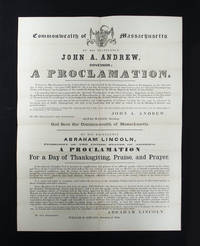
186368373Massachusetts 1863. LINCOLN Abraham. Massachusetts: 1863.<br> <br> Letterpress broadside 27 3/4 x 20 in.; 708 x 508 mm on paper incorporating several display and ornamental fonts as well as the seal of Massachusetts docketed on the verso "Post Office Hanover.' Some light offsetting. Nearly invisible professional repairs to the verso along the folds. A very nice example of this rare and important broadside<br> <br> This original broadside produced in Massachusetts is formatted in two halves with the top half being Governor John A. Andrew's announcement of Lincoln's Proclamation endorsing the observation of this day of Thanksgiving in his state dated July 27 1863 and the bottom half being Lincoln's actual proclamation dated July 15th 1863 and announcing that August 6th shall be set aside as a National Day of Thanksgiving. Though the exact printing date is unknown it can be assumed that it was printed within the week following July 27th.<br> <br> Thanksgiving was observed as a Holiday since colonial times and each state would set aside its own day for celebration. This proclamation was the first time that the Holiday would be celebrated on a set day nation wide making it the first observed Thanksgiving as a National Holiday.<br> <br> Though later the same year on October 3rd 1863 Lincoln made a second proclamation again announcing Thanksgiving as a Holiday but this time in November a date closer to the time most states had been celebrating it in the past. This earlier proclamation is actually the first time Thanksgiving was given national status but because the second proclamation was widely accepted the knowledge of this earlier one has been somewhat forgotten making this piece a rare and important document in the annals of American history.<br> <br> Though this broadside is for the State of Massachusetts no other broadsides from any other states that announce this date are known to exist and only three other copies of this rare document are located through OCLC.<br> <br> HBS 68373.<br> <br> $8500. Massachusetts unknown
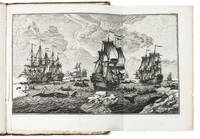
172019012Amsterdam 1720. 4to. Joannes Oosterwyk Contemporary half sheepskin marbled paper sides. With an engraved allegorical frontispiece by J. Folkema after F. Ottens 6 folding engraved maps and 7 engraved plates including 1 folding showing ships at sea by A. Salm after Van der Hem. Further with the title page printed in red and black a small woodcut vignette on the title page some woodcut decorated initials and some large woodcut floral tailpieces. 38 330 14 pp. First edition of the most important early account of whaling in the northern seas. The author a ship's commander in the Dutch Greenland fleet describes the history of the Dutch whaling in the northern seas. Dutch whaling dominating in Europe for most of the 17th and 18th century was not confined to the Greenland waters only but ranged widely across the northern fisheries from the Davis Straits to the Siberian Sea. The work also includes short histories of the northern explorations in Greenland Iceland Spitsbergen Nova Zembla Jan Mayen Island and Strait Davis all accompanied by the newest maps and preceded by a map of the North Pole. The plates show the different whales and ships of the whalers. To Zorgdrager's work detailed lists are added of captains ships equipment and provisions for the ships caught whales the cost of equipment and crew etc. Also the practical and technical aspects of whaling are fully described. The book was used as one of the sources for Melville's Moby Dick.With a printed ex libris bookplate of N. Du Jardin-Van der Avoort mounted on the front pastedown. The spine and boards are somewhat scuffed the corners of the boards are slightly bumped a tear in one leaf some occasional foxing and water staining the edges are slightly frayed. Otherwise a good copy of a rare and interesting work.l Cat. NHSM p. 899; Chavanne 2110; Leclerc 678; Sabin 106374; STCN 201968800 14 copies incl. 1 incomplete; Tiele Bibl. 1241 note; V. Gestel - Van het Schip Maps in books on Russia and Poland 299. ABE CAT Alaska Canada & Greenland hardcover
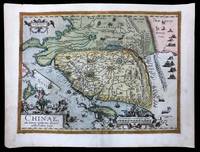
158415208Antwerp: Plantin Press 1584 1595. 440 by 550mm. 17.25 by 21.75 inches. Hand-coloured engraved map with fine original colour. The earliest printed map to focus on China and the first to illustrate the Great Wall. It was the first western map of China drawn directly from the findings of the Portuguese mapmaker Luis Jorge de Barbuda or Ludovicus Georgius. Barbuda was a Jesuit and he made a manuscript map of China from information on the area gathered by the Jesuit mission. Arias Montanus passed this map on to Ortelius. He issued this first separately published map of China in 1584 which remained the standard map of China for over fifty years. The map is oriented to the west. Japan is shown on a curved projection borrowing from Portuguese sources. Wind wagons are shown in the north a Chinese invention that also became popular in the Low Countries. The text on the reverse of the map is in Latin and gives an insight into the climate national features inhabitants and economy of China at that time. Abraham Ortelius is one of the most famous of the early mapmakers and publishers. His 'Atlas of the Whole World' 'Theatrum Orbis Terrarum' was first published in 1570 the first uniformly sized systematic collection of maps and hence can be called the first 'Atlas'. These beautiful maps were elegantly engraved by Frans Hogenberg. Plantin Press], unknown
6509ABRAHAM LINCOLN 1809-1865. Lincoln was the Sixteenth President.DS. 1pg. August 1 1864. Washington. A vellum military commission signed Abraham Lincoln as President and co-signed E.M. Stanton as Secretary of War. The President appointed James Wylie Crawford a First Lieutenant in the Veterans Reserve Corps. Crawford 1832-1910 was from Maine; according to family lore he was badly wounded at Antietam I bought this directly from a descendant. This injury required his enlistment in the Veterans Reserve Corps. The Veterans Reserve Corps allowed wounded soldiers to remain active often performing small tasks and light duty; established in the middle of 1863 it was first known as the Invalid Corps until the official name was changed. The document recently underwent conservation with the vellum stretched and flattened; the top right corner of the vellum has shrunk and the document was once rolled. The Lincoln autograph is a tad light and gets lighter as the autograph gets towards the conclusion; the Stanton is also a bit faint but vellum does not hold ink that well especially compared to paper. hardcover
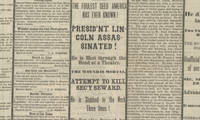
15042913315/04/1865. <blockquote><p>The Assassination:<strong><br /></strong></p></blockquote><p>Abraham Lincoln continues to stand as America’s most beloved President. Of our nation’s historical icons Lincoln is the quintessential embodiment of American possibility in his mythic-like rise from rail-splitter to Chief Executive and Emancipator of the oppressed. The admiration felt by Americans for Lincoln’s humble integrity his performance in office his noble statesmanship and his keen sense of justice is enduring. Lincoln is not given the highest marks just for character but for the transformation of the nation that he left behind which was both profound and long-lasting.</p><p>Polls of historians generally show their belief that Lincoln faced the hardest job of any president. He had to define the issues inspire the people be steadfast in the face of losses win the Civil War free the slaves and lay the groundwork to reunite the nation. All that in the face of determined opposition. He accomplished all this in four years but was assassinated on April 14 1865 and his death left him unable to finish the job a job that quite likely he was the only one with a chance to get completed in a way that would truly bring the nation together.</p><p>The end of the Civil War left the nation with two overwhelming questions: what to do with and do for the millions of freed slaves; and how to reintegrate the South into the Union. On the first point Lincoln was focused on African American access to land economic prosperity and legal rights and had just approved Gen. William T. Sherman’s order distributing parcels of former slave plantations to the slaves themselves. Lincoln wanted black Union veterans to have the right to vote which was a step to ultimately embracing full suffrage for African American males. In what proved to be his final speech three evenings before his death Lincoln had become the first president ever to support black voting. Lincoln’s successor Andrew Johnson was a Southerner uninterested in fair treatment of the liberated slaves. He opposed plans designed to guarantee the civil rights of black Americans and cancelled Sherman’s order granting land to slaves. Johnson accepted the draconian post-Civil War Black Codes which limited the rights and liberties of African-Americans something Lincoln would never have done.</p><p>On the second point the readmission of the Southern states Johnson felt that once Southern states returned their loyalty to the national government they could manage their own affairs. This meant they could pass any Jim Crow laws they liked. He opposed the Republican plan for Reconstruction of the South including provisions designed to guarantee the civil rights of black Americans. The Republican Congress had no rapport with Johnson and the initial four years era of Reconstruction which was a disaster to the nation was essentially a bitter battle between a North and South that remained locked in contention presided over by a weak President Johnson and a Congress at loggerheads with him. Lincoln had enormous power and influence some of which extended into the South. He saw the end of the war as an opportunity to not simply celebrate victory but an opportunity to move the country forward. Johnson had no such feeling. Lincoln would have been much better placed to direct moderate and ease the contentions of Reconstruction.</p><p>John Wilkes Booth was a member of a famous acting family and he enjoyed a phenomenally successful stage career during the Civil War: By 1864 he earned $20000 a year at a time when the average Northern family earned around $300 annually. A Marylander by birth Booth was an open Confederate sympathizer during the war. A supporter of slavery Booth believed that Lincoln was determined to overthrow the Constitution and to destroy his beloved South. After Lincoln’s reelection in November 1864 Booth devised a plan to kidnap the president and spirit him to Richmond where he could be ransomed for some of the Confederate prisoners languishing in northern jails. That winter Booth and his conspirators plotted a pair of elaborate plans to kidnap the president; the first involved capturing Lincoln in his box at Ford’s Theater and lowering the president to the stage with ropes. Booth ultimately gave up acting to focus on these schemes. Neither of the kidnapping plans bore fruit. On the evening of April 11 the President stood on the White House balcony and delivered a speech to a small group gathered on the lawn. Two days earlier Robert E. Lee had surrendered the Army of Northern Virginia at Appomattox Court House and after four long years of struggle it had become clear that the Union cause would shortly emerge from the war victorious. Lincoln’s speech that evening outlined some of his ideas about reconstructing the nation and bringing the defeated Confederate states back into the Union. Lincoln also indicated a wish to extend the franchise to some African-Americans—at the very least those who had fought in the Union ranks during the war - and expressed a desire that the southern states would extend the vote to literate blacks as well. Booth stood in the audience for the speech and this notion seems to have amplified his rage at Lincoln. “That means nigger citizenship†he told Lewis Powell one of his band of conspirators. “Now by God I’ll put him through. That is the last speech he will ever make.â€</p><p>Three days later Booth made good on his promise. Upon learning that Lincoln and his wife intended to see the play “Our American Cousin†at Ford’s Theater Booth used his actor’s connections there to gain access to the President’s box. He shot Lincoln at about 10 pm on April 14 1865 and Lincoln died about after 7 am on the 15th.</p><p>Dr. Charles Leale was in the audience. Leale leapt over theater seats got to the president’s box and announced that he was a doctor. As he entered the President was sitting in a chair with his eyes closed and head slumped. He already looked dead Leale recalled. He felt Lincoln’s right arm for a pulse but couldn’t find one. He and some others eased Lincoln to the floor and Leale began searching for the wound. “I quickly passed the separated fingers of both hands through his blood-matted hair…and I discovered his mortal wound†Leale recalled. “The president had been shot in the back part of the head behind the left ear.†Leale stuck the little finger of his left hand into the hole in Lincoln’s skull. “I then knew it was fatal and told the bystanders†he wrote later. Leale knew he had to get Lincoln out of the theater to treat him. But he believed a carriage ride back to the White House would kill him. He and several other men lifted the president and with Leale holding Lincoln’s head they began to maneuver him outside. Across the street from the theater was the house of William Peterson and Lincoln was taken there. Lincoln was carried to a small back room stripped of his clothes and covered with blankets. His 6-foot-4-inch frame had to be placed diagonally to fit on the bed. Leale ordered the window opened and the wait began. A parade of anguished government officials and family members came and went. The President sank steadily his breathing labored and his pulse nearly undetectable. At 7:22 am on April 15 President Lincoln breathed his last. Leale smoothed the contracted muscles of Lincoln’s features placed two coins over his eyes and pulled a sheet up over his face. Famously Secretary of War Stanton saluted the fallen President and uttered “Now he belongs to the ages.†Stanton further eulogized Lincoln with the apt observation “There lies the most perfect ruler of men the world has ever seen.â€</p><p><strong>Original report</strong> on the assassination printed the very day he died</p><p>The public was hungry for information and the newspapers equally hungry to report the momentous news. One of these was the Binghamton Daily Republican and this is its issue of April 15 1865 with black mourning columns.</p><p>The front page as was routine at the time was taken up by ads. The news then began on page two. There at top left is the headline <em>“The Assassination of President Lincoln! A Nation in Mourning!!!â€</em> It begins <em>“We feel too unfitted by this awful event to allude to the calamity in terms becoming its solemnity and importance! LINCOLN IS DEAD! Struck down by the hands of a brutal assassin in the midst of the triumphs which were commemorating his salvation of the country. A great man indeed has fallen! The foremost man of his time is no more…We dare not contemplate what may follow this sad and inscrutable providence.â€</em> This was followed by a proclamation of the governor of New York. On page three were dispatches from 12:30 AM to noon to 3:00. An early dispatch reports that<em> “the President was shot… and is not expected to liveâ€</em> and told of the events of the assassination then available in detail. It mentioned <em>“The screams of Mrs. Lincoln first disclosed the fact to the audience that the President had been shot.â€</em> Later it reported of Lincoln <em>“At midnight the Cabinet…a few personal friends with Surg. Gen. Barnes and his immediate assistants were beside his bedside…The parting of his family with the dying president is too sad for description.â€</em></p><p>At noon the newspaper had more news and reported <em>“Later concerning the President. He died this morning at 7:20. Two villains engaged in the horrible crime. The murder planned before March 4th.â€</em> At the bottom of the column is a report on the progress of the army of General William T. Sherman saying that in response to Grant’s hope Sherman would pursue the remaining Confederates Sherman said <em>“I think we’ll do it.â€</em> At 3:00 the paper printed the latest from Washington. It contained <em>“Full particulars of the Death of Abraham Lincolnâ€</em> plus <em>“Inauguration of President Johnsonâ€</em> and Johnson’s statement on taking office.</p><p>Original newspapers reporting Lincoln’s assassination have become very scarce this being our first in over a decade. This one is comprehensive and with its black borders and large headlines is evocative of the moment and would be perfect for display.</p><p><img class=""alignnone wp-image-25018 size-post-window"" src=""https://cdn.raabcollection.com/wp-content/uploads/20231204144051/Folder-site-11-1600x1327.jpg"" alt="""" width=""1600"" height=""1327"" /></p> hardcover
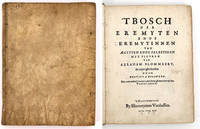
16191516Hantvverpen Antwerp: Hieronymus Verdussen 1619. First Edition in book form. Near Fine. Bloemart Abraham. 4to 8 7/8 x 6 3/4 inches 251 x 171 mm. ix pp 51 sheets on cream laid paper text in Dutch gothic letters. 50 numbered full page copperplate engravings of Christian hermit saints 25 male 25 female printed recto with text pages on verso. Full-page frontispiece for the work and with an additional full-page frontispiece for each of the two sections. Full contemporary vellum untitled with some handling discoloration but the vellum remains supple and the binding is tight. Pages clean and bright with a couple of foxing spots and a small brown stain on the 2nd frontis titled "Sacra Eremus ascetarum"; toned page edges. Previous owner's name and date in ink on front flyleaf and small pencil and ink notations inside back cover; bookplate of Buijnsters Smets pasted inside front cover.<br /> De Backer/ Sommervogel VII 194-5; Hollstein 355-403; Roethlisberger 163 ill. 262-317<br /> <br /> Full title: 't Bosch der Eremyten ende eremilinnen van Aegypten ende Palestinen met figuren van Abraham Blommaert door Ghristophorus a Sichem. Met kort verhael van een yders leven getrocken uyt het Vadersboeck door H. Jan van Gorcum Priesler ende H. R. Societatus sic Jesu. The Forest of the Hermits of Egypt and Palestine with illustrations by Abraham Blommaert engraved by Ghristophorus a Sichem. With brief stories of their lives taken from the book of the Fathers by H. Jan van Gorcum priest of the Society of Jesus. A fine series of engravings of the early Christian male and female hermits living in the Egyptian and Palestinian desert engraved in copper by Boetius A Balswert on drawings by Abraham Bloemart 1566 - 1651 the Dutch painter and engraver know mostly for his historical subjects and for being a central figure and teacher among the Utrecht Caravaggisti. <br /> Provenance: the library of the book- and art-historians Piet Buijnsters and Leontine Smets. Hieronymus Verdussen unknown
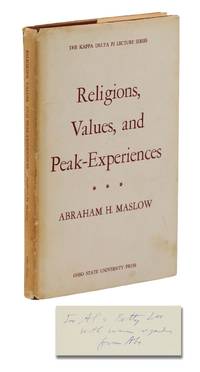
1964140948656Columbus OH: Ohio State University Press 1964. First edition. Very Good/Very Good. First edition first printing. Signed by Abraham H. Maslow on the front free end paper and inscribed to sociologist Alfred McClung Lee and his wife Elizabeth Briant Lee "For Al & Betty Lee With warm regards from Abe." xx 123 pp. Bound in publisher's brick red cloth stamped in blind on the front board with spine lettered in gilt. Very Good with trivial sunning and wear to spine ends light foxing to text-block edges and underlining and marginalia in ink on pp. 42-43. In a Very Good unclipped dust jacket with toning to spine rubbing and light chipping to ends with rubbing and finger soiling to covers. <p>An early work that examines the human need for spiritual expression and articulation by the famed psychologist most famous for creating Maslow’s Hierarchy of Needs. In a series of essays Maslow describes transcendental experiences focusing more on human condition rather than scientific rigidity. Inscribed to American sociologists Alfred McClung Lee and his wife Elizabeth "Betty" Lee who co-wrote The Fine Art of Propaganda 1939 which remained in print for the better part of the 20th century. Alfred was named the executive director of the Institute for Propaganda Analysis during WWII and would pen numerous academic texts including his best known works The Daily Newspaper in America: The Evolution of a Social Instrument 1937 and Principals of Sociology 1946 that endured for two decades as a staple text book for college students; quite uncommon signed. Ohio State University Press unknown
180037722London 1800. Hand-coloured and colour-printed mezzotint engraving by Dunkerton. The most strikingly beautiful flower plates ever to be printed in England.<br/> <br/>"The plant shown in this picture Selenicereus grandiflorus L. Britton & Rose. is also known as the Moon Cactus from the moon-like appearance of the fully open flower. Thornton also says that. it was sometimes called the `Torch Thistle' as it `exhibits to the observer a figure equally grotesque as terrific with flowers possessing actually the blazing appearance of a torch.' The plant is a native of Jamaica and Cuba. This picture is one of the most arresting in the collection. The plant itself is of interest not only for its large and beautiful flowers but as a representative of those which growing in a hot and dry environment open their flowers at night for pollination by night-flying insects pollinators being scarce in such climates during the heat of the day. This has a curious effect where public botanic gardens are concerned since these are shut at night to visitors who thus never see the plant in full bloom." Ronald King. The Temple of Flora by Robert Thornton. 1981 p.74. Thornton's Temple of Flora is the greatest English colour-plate flower book. ".Thornton inherited a competent fortune and trained as a doctor. He appears to have had considerable success in practice and was appointed both physician to the Marylebone Dispensary and lecturer in medical botany at Guy's and St. Thomas's hospitals. But quite early in his career he embarked on his. great work. What Redouté produced under the patronage of L'Héritier Marie Antoinette the Empress Josephine Charles X and the Duchesse de Berry Thornton set out to do alone. Numerous important artists were engaged. twenty-eight paintings of flowers commissioned from Abraham Pether known as `Moonlight Pether' Philip Reinagle . Sydenham Edwards and Peter Henderson. The result. involved Thornton in desperate financial straits. In an attempt to extricate himself he organized the Royal Botanic Lottery under the patronage of the Prince Regent. it is easy to raise one's eyebrows at Thornton's unworldly and injudicious approach to publishing. But he produced. one of the loveliest books in the world" Alan Thomas Great Books and Book Collecting pp.142-144 First state of plate A. unknown books
186425614<p>The second in a series of four racist political cartoons published in 1864 by Bromley & Company which was closely affiliated with the Copperhead New York <i>World</i> newspaper. These prints sought to undermine Abraham Lincoln's chances for reelection by branding him as a "miscegenationist" and playing on white fears of "race-mixing." The cartoon scene pictures several interracial couples enjoying a day at the park eating ice cream discussing wedding plans and a woman's upcoming lecture. Two African American families have white employees a carriage driver and footmen and a babysitter.</p><p>The only other example traced at auction brought $7800 in 2010.</p> <b>ABRAHAM LINCOLN. RACISM.</b>Print. "Miscegenation or the Millennium of Abolitionism." Political Cartoon. New York: Bromley & Co. 1864. 1 p. 20¾ x 13â… in.<p><br /></p><p>American politics had long played on fears of sexual relationships between races. A powerful new word for "race-mixing" was coined in an anonymous December 1863 pamphlet entitled <i>Miscegenation: The Theory of the Blending of the Races Applied to the American White Man and Negro</i> published in New York. Purporting to advocate the virtues of the "blending of the white and black races on this continent" it was a literary forgery prepared by <i>The World</i> managing editor David Goodman Croly and reporter George Wakeman. The authors were unsuccessful in their attempt to trick President Lincoln into endorsing the work.</p><p>At the far left of the image Abraham Lincoln declares "<i>I shall be proud to number among my intimate friends any member of the Squash family especially the little Squashes.</i>" The African American woman to whom he is speaking replies "<i>I'se 'quainted wid Missus Linkum I is washed far her 'fore de hebenly Miscegenation times was cum. Dont do nuffin now but gallevant 'round wid de white gem'men! he-ah! he-ah! he-ah!</i>"</p><p>Senator Charles Sumner says "<i>Mr. President! Allow me the honor of introducing my very dear friend Miss Dinah Arabella Aramintha Squash.</i>" A white carriage driver complains in the background "<i>Gla-a-ang there 240t! White driver white footmen niggers inside my heys! I wanted a situation when I took this one</i>" while a black man in the carriage tells his companion "<i>Phillis de_ah dars Sumner. We must not cut him if he is walking.</i>" A black woman at a table tells a white man with her "<i>Ah! Horace its-its-its-bully 'specially de cream</i>" and he replies "<i>Ah! my dear Miss Snowball we have at last reached our political and social Paradise. Isn't it extatic</i>"</p><p>To the right are two couples embracing each a white woman and an African American man. The first white women tells her partner "<i>Oh! You dear creature. I am so agitated! Go and ask Pa</i>" to which he replies "<i>Lubly Julia Anna name de day when Brodder Beecher shall make us one!</i>" The second white woman says "<i>Adolphus now you'll be sure to come to my lecture to morrow night won't you</i>" to which he answers "<i>I'll be there Honey on de front seat sure!</i>" In the background are various immigrant minorities viewing the scene. One exclaims "<i>Most hextwadinary! Aw neva witnessed the like in all me life if I did dem me!</i>" and another adds "<i>Mine Got vat a guntry vat a beebles!</i>" An Irish girl complains "<i>And is it to drag nagur babies that I left old Ireland Bad luck to me.</i>"</p><p>Manton Marble the editor of <i>The World</i> collaborated with printmaker Bromley & Company to issue a series of four anti-Lincoln "Political Caricatures." The present example was the No. 2 in that series. No. 1 was "The Grave of the Union or Major Jack Downing's Dream"; No. 3 "The Abolition Catastrophe Or the November Smash-up"; and No. 4 "The Miscegenation Ball."</p><p>Republicans responded by trying to turn the "miscegenation" charge against the Democrats. A Republican print "The Political "Siamese" Twins: The Offspring of Chicago Miscegenation" pictures McClellan and Pendleton joined together despite their very different ideas on ending the war.</p><p>Although Abraham Lincoln won New York states' electoral votes in 1860 Stephen Douglas had carried New York City and its environs. Financial elites fearing that civil war would ruin business and recent immigrants fearing competition with free black labor supported Douglas. Lincoln's unpopularity in New York City during the Civil War was a factor in the deadly 1863 Draft Riots.</p><p>In 1864 Lincoln again won the states' electoral votes while New York City favored his Democratic opponent McClellan. In fact Lincoln's majority dropped from 50136 votes in 1860 to only 7373 votes in 1864 with approximately 50000 more total votes cast than in 1860.</p><p>Bromley and Company continued to sell the caricatures after the election as this January 1865 advertisement from an Ohio newspaper makes clear. Another advertisement assured purchasers that the set of four prints available for $1 were "sent on wooden rollers to insure safe carriage."</p><p><b><i>The World</i></b> 1860-1931 a daily independent newspaper was published in New York City. Alexander Cummings founded it as a religious Republican outlet in 1860. August Belmont and others purchased it in 1862 changing the editorial focus. With editor Manton Marble 1834-1917 <i>The World</i> soon became the country's leading Democratic newspaper. In 1864 Union authorities shut down <i>The World</i>and another paper for three days after they published forged documents purportedly written by Lincoln that were really part of a hoax to manipulate the price of gold. The paper actively supported George B. McClellan against Lincoln in 1864.</p><p><b>Condition</b></p><p>Fine for exhibit despite flaws. Cropped with loss of "Political Caricature No. 2" from top edge and part of printed pricing information from bottom edge publisher's name rubbed out from the copyright statement lacking ½" from lower left corners a few short tape repairs by the edges a 2" closed tear through the second dialogue bubble along the top edge and a 3" closed tear parallel to the right edge. Mount remnants on verso.</p> books
191918085GREAT ASSOCIATION COPY THE MOON POOL Liveright Inc. 1919 some fading to the spine else a vg copy. Inscribed by the author to fellow writer "Doc" Smith thusly "For Doc Smith You Skylarks have so often taken me on the most interesting flights thought that maybe you'd like to go to the subterranean again and in the Moonpool with Jon Hetzdorf turned Russian. May your power never lesson and the hand of God and never his fist be over you. Your Sincere Admirer A. Merritt". Adorned with original drawings by the author. Liveright Inc. unknown
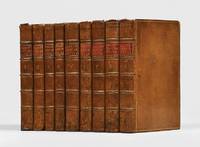
1768150964London: Printed by T. Jones & W. Oliver 1768 & 1777. The complete set of an influential philosophical work First edition a complete set of Tucker's magnum opus which outlined a vast and idiosyncratic philosophical system and which had a noted influence on his philosophical contemporaries. The set pairs the five volumes he published in 1768 with the four-volume continuation posthumously published in 1777 uniformly bound in contemporary calf and very scarce thus. "Although an occasionally eccentric and digressive text The Light of Nature Pursued enjoyed a high reputation from its first appearance. In the introduction to his Moral and Political Philosophy 1785 William Paley emphasized his deep indebtedness to Tucker in expounding his ethical theory. Paley considered Tucker to be a very original thinker. His work was also highly praised by Sir James MacIntosh who had used his ideas in his lectures on ethics. Mildmay had looked to MacIntosh to provide an introduction to his edition of the work but MacIntosh had been too busy to oblige. Hazlitt produced an abridged edition in 1807. Tucker's speculations also had some influence on Malthus whose family were resident in Surrey. Tucker's style is direct conversational and full of deliberately familiar metaphors and analogies. He was very much an amateur metaphysician and The Light of Nature Pursued is noticeably unsystematic and occasionally rambling in tone. His theory of consciousness and knowledge owes a great deal to John Locke though his speculations about the nervous system and the brain are closer to those of David Hartley whom he nevertheless disliked and whose theories he criticized" ODNB. The first five volumes were published under Tucker's pseudonym of "Edward Search" but his daughter Judith discarded this pseudonym when arranging the posthumous publication of the latter four volumes. Together 9 vols octavo 212 x 130 mm. Contemporary calf red morocco labels red speckled edges. Book label of bookseller and bibliographer John Stephens 1948-2006. Some slight wear around extremities occasional light foxing or worming but contents otherwise fresh; a nice set. ESTC T109651 & T153498. unknown
18345037<p>Half brown morocco; ruled raised bands marbled boards. Mouradgea d'Ohsson was a Swedish historian and diplomat of Armenian descent. This important work is a large expansion of his 1824 publication which was the first serious study of Genghis Khan. Kenneth Meyer Setton A History of the Crusades notes "among the general histories of the Mongols d'Ohsson remains unequaled. Avowedly or tacitly most later works rely on it." Two folding genealogical charts; large 1824 folding map of Asia in the thirteenth century to rear of volume four. Previous owner's bookplates removed from front pastedowns. A nice wide-margined set many pages yet uncut in a sound period binding.; lxviii452; 651; 6241; 774.; 8vo 22 x 15 cm; All shipments through USPS insured Priority Mail.</p> Freres van Cleff hardcover
18345037Half brown morocco; ruled raised bands marbled boards. Mouradgea d'Ohsson was a Swedish historian and diplomat of Armenian descent. This important work is a large expansion of his 1824 publication which was the first serious study of Genghis Khan. Kenneth Meyer Setton A History of the Crusades notes "among the general histories of the Mongols d'Ohsson remains unequaled. Avowedly or tacitly most later works rely on it." Two folding genealogical charts; large 1824 folding map of Asia in the thirteenth century to rear of volume four. Previous owner's bookplates removed from front pastedowns. A nice wide-margined set many pages yet uncut in a sound period binding.; lxviii452; 651; 6241; 774.; 8vo 22 x 15 cm; All shipments through USPS insured Priority Mail. Freres van Cleff hardcover books
1819805K1London: A. J. Valpy 1819-1830. Hardback. Good. 10" by 7". None. A scarce 136 volume set of the Regent's Edition 'Delphin Classics' based off of a published series used to educate le Grand Dauphin Louis with works by notable thinkers such as Virgil Horace and Cicero. An extensive run of the scarce 'Delphin Classics' very scarce to see a large run of the work like this.This set contains volumes I-CVIII CXIII-CXLI published between 1819 and 1830 a total of 136 volumes.The Regent's Edition of this work.In Latin.'The Delphin Classics' was an extensive series of the Latin classics which reached to 182 volumes this set containing 136 of the volumes.The series printed the prominent works of writers such as Virgil Sallust Pliny the Elder Ovid Horace Cicero and Caesar often printing their complete works in the original Latin.Edited by George Dyer the series was based off a monumental publication of the Latin classics that had been published for the education of le Grand Dauphin Louis the heir to Louis XIV to assist in his education. In fact the title 'Delphin' translates to 'Dauphin'. Le Grand Dauphin was the eldest son of Louis XIV but predeceased him and thus never became the king his grandson succeeding to the throne as Louis XV after the death of Louis XIV.Working off those original Dauphin editions Dyer and the publisher Abraham John Valpy supplemented the texts with the best variorum editions and literary notes from important late eighteenth century editions. These include the Variorum Classics and the Zweibrucken editions.This Georgian edition reached around six hundred subscribers and saw great success. Publisher's adverts to the front of volumes XII XXV XXVII XL and CXXVIII.Subscriber's lists bound in to volumes I and XXXII.With remarks on 'The Review Relative to Stephens' Greek Thesaurus in the Quarterly review No. 48 bound in with vol. XXXI. The Classical Journal No. XLIII bound into the front of no. XX. With 'Delphin Classics with the Variorum Notes' sheet bound in with no. X XXI and LXIV. In the original publisher's paper covered boards. Externally generally sound with shelf wear and bumping to the head and tail of the spine and extremities minor chipping to the extremities of the boards and rubbing to the occasional volume a touch of edge wear; general light soiling to the boards and age toning to the spine. Tears and losses to back strips of XLIV LXXXI XLVII LXXIII and XCIII with back strips of volumes CXLI and LIVII absent. Faint handling mark to the front board of nos. I IV XI XXXIV XXIX XXXII LVI LVII LXIII and LXIV. Minor staining mark to the front board of no. XXXIV. Small library stamps to the front board of the majority of volumes. A little loss to the paper of the front board of volume XLVII LIV and LXXV. Joints to nos. VII XI XXII XXX XXXIII XCIV LXXI and CXXXI starting. Front joint of Volume XI is starting with boards held by cords only. Front joint of volumes CXXXV CXXXIII CXXXVI XLIX starting with boards holding firm. Rear joint is strained to CXIX. Rear joint is starting to Volumes III VI XVIII XXIV XL CXIII and CXV. Rear joint to no. LXXXV strained held by cords only. Rear joint of no. XIX has failed with board held by the front joint. Front joint no. IX XL XXX XXXIX LXXXIV LXXV and CXIX are starting. Front joint of no. LXXXVI cracked binding held by endpapers. Front joints to CXVII CXIII CXX and CXVI have failed front boards are detached but present. CI with cracked joints front and rear board loose but present light soiling to the rear of the text block. Back strip and front board of volume XLVII detached but present both boards and back strip of volumes XCIX LXXXII and LII detached but present. Boards of volumes LIVII and CXXXIX detached. Boards of volumes CXLI and CXXXII loosely held. Minor chipping to the spine of no. II V XIX XI XVII XXXVII XXIX XXXVI LXV LXXXIV LXXXV CI CVI and CVII. Loss to the head and tail of the spine of no. XIX XXI and XXIX. Loss to head of the spine on no. I II IV XIX CXVII CXVIII and CXX and paper to spine is lifting exposing interior of the spine. Tearing to the spines on no. XXV and XL. A few ink marks to the spine of IV and VII. Spine is lifting to XI CXIII CXXI and CXIX. General bumping particularly noticeable to the extremities of XVI XCV CXXX. Volume CXXIV has the odd mark to the front board. Volume CXXIII has some slight loss to the paper of the front board front joint is starting a little to the tail. Volumes LXIX LXVII have slight loss to the paper of the front board. Tidemarks and loss to the front board of volume XCV. Loss to the head of the spine of volumes XIII CXXX XXVII LXXXVI and LXVIII. Small perforation to the tail of the spine of LXXIV. Loss to the tail of the spine of XIV. Loss to the paper of the rear board to volumes LXXXVII and CXXVI. Minor loss to the tail of the spine of no. XXXII minor chipping to the joints holding firm. Backstrip no. LIX laid down. Backstrip is lifting to the tail of volume XCII CXXIV. Backstrip is loose to volumes XXVIII XC. Head of the backstrip of volume XVII is detached but present with the remainder of the backstrip held at the rear board. Backstrips of volumes LXX LXXI LXXXIX are loose. Backstrip lifting to the head of volume LXVII. Front and rear hinges starting to volumes XCIV CXXXVII with boards holding firm. Rear hinge to no. XXV is strained. Rear hinge to II III V VI XXIV starting. Hinges to no. XXX and CXXI have failed and boards are hanging by cords only. Front hinges to no. VIII and XXXIII are starting. Front hinges to no. VII and X are tender. Front hinge of No III XI are weak. Rear hinge to no. III LI and CXV is attached by cords only and may detach with further handling. Hinges to no. XXXIX and CXIV have failed; boards and spine are detached but present. Front hinge to CXVIII has failed front board is detached but present. Rear hinge is held by cords only. Front and rear hinge of volume XCI strained with boards tenderly held. Front hinge strained to volume LXXXVIII and held by two cords only. Front hinge has failed to volumes XC XCIII LXXXIX CXXVII; front boards are loose but present. Textblock is held to the rear board of XC by a cord only. Front board is held by cords only to volume XV XXVIII. Rear hinge starting to LXXXVIII . Rear hinge has failed to XIV XVI XVII with rear boards held by a cord only. Front and rear hinges failed to volumes LXXXIX XCII with rear board held by two cords only paper in the case of XCII. Rear joint starting to CXXVI and LXXXVI. Rear joint starting at the tail of LXVI. Front joint starting to volume LXX and LXVII. Front joint starting at the tail of volume CXII and LXXIII. Front endpaper detached to XCIII. Front free-endpaper of no. CXIV is torn. Tidemark to the head of the front pastedown in no. XL and to rear pastedown of no. XI. Small bookseller sticker to the front pastedown of volumes XVI XVII XIX XX XXII XXIV XXV XXVI XXVII XXVIII XXX XXXII XXXIII XXXIV XXXVI XXXVIII XXXIX LXIII CVIII CXXVIIII and CXXIX. Internally generally firmly bound though some volumes are tender. Binding tender to p. 497 no. LVI holding firm; p. 769 no. LXXXV held by three cords only; p. 3049 of no. CII holding firm; and to p. 5640 no. CVI held by two cords only; p. 5001 no. CV; binding of volume CXLI tender. Binding is tender to LXXXVI noticeably at pages 928 and 929 XCV CXII and LXXII. Binding is tender to Volumes XV XXVIII XIV XVI XVII. Some light spotting or handling marks to the odd leaf particularly to the first and last few otherwise the pages are generally bright and clean throughout. Some leaves unopened. Large mark to top corner of page 1729 of no. XIX. Half title and title page bound in to the rear of no. XXXVII. Half title and title page to vol. I II III IV and V 'Quinti Curtii Rufi' bound in to no. LXXIX. Half title and title page for vols. II - IV of 'P. Papinii Santi' as well as for vol. III 'L. Annaei Flori' and vol. II 'Boethi' vol. III 'Justini' bound in to no. LXIV. Title page to vol. I 'Pub. Terentii Afri' and half titles and title pages for vol. II-IV of 'Pub. Terentii Afri' bound in to no. LXI. Half title and title page for vol. I-III 'D. Magni Ausonii' to no. LVII. With remarks on 'The Review Relative to Stephens' Greek Thesaurus in the Quarterly review No. 48 bound in with vol. XXXI. Subscribers leaflet bound in with no. XXXII. Insert of fifteen pages of the front of No. I with list of 'Subscribers' Names Already Received to the New and Corrected Edition of the Delphin Classics; with the Variorum Notes'. The Classical Journal No. XLIII bound into the front of no. XX. With 'Delphin Classics with the Variorum Notes' sheet bound in with no. X XXI and LXIV. Publisher's advert bound into the front of no. XXV and XL. Publisher's adverts to the front of volumes XII XXVII and CXXVIIII. Good A. J. Valpy hardcover
167376SED10JGA06The Hague 1673. 4to. Jan and Daniel Steucker Contemporary vellum with the gold-stamped and crowned initials "E.F.V.D" on the front board. With 10 scenes on the horrors of war on 8 folding engraved plates ca. 31 x 20 cm by Romeyn de Hooghe. 1 1 blank 202 pp. First edition of a famous Dutch history book vividly describing as well as depicting the cruelties of war committed by the French army of Louis XVI in The Netherlands in the years 1672 and 1673. The illustrations also rank among the best masterpieces of Baroque book-illustration. By their passionate denunciation of the horrors of war Romeyn de Hooghe's illustrations stand comparison with Goya's Desastres de la Guerra. Thieme & Becker calls the artist "the most important and fertile master of the second half of the 17th century in Holland". And Furstenberg judged the present print-series "One of the few and too-little known masterpieces of the period The Book Collector 1960 p. 432.''The text includes a detailed account of the cruelties committed by the French army of Louis XIV in the Dutch villages of Bodegraven and Swammerdam. The work was published anonymously because the author Abraham de Wicqefort 1598-1682 a diplomat and politician was well-known at Paris and the French court. He also wrote an excellent manual for ambassadors: "L'Ambassadeur ses fonctions" published at The Hague in 1682. The present work became popular in The Netherlands and was several times republished in Dutch with the plates reduced.Back hinge loosening. Fine large paper copy with contemporary manuscript owner's entry on the title page. Otherwise in good condition.l Hofer Baroque Book Ill. plate 140; Hollstein Dutch & Flemish IX pp. 90-96 only 7 plates; Landwehr De Hooghe Book Illustrator 30; Nierop Grabowsky etc. Romeyn de Hooghe 1673.19 p. 263; STCN 851219519; Thieme & Becker XVII p. 458; Willems 1874. hardcover
162451428Köln, Ioannis Gymnici, Antonius Boetzer, 1624 a. 1621-1640. Folio. (40 x 26 cm.). Bound in 8 (thick) uniform contemporary full pigskin bindings over wooden boards. Raised bands and richly blind-tooled boards. Title labels with gilt lettering. Clasps missing. Spines a bit rubbed. Wear to some spine-ends. Some upper compartments with nicks, one volume having a tear in leather at upper compartment. One volume with a small loss of leather to upper compartement. With engraved title-page, engraved portrait of Baronius, engraved portrait of pope Urban VII. More than 10.000 pp. Printed in double-columns. In general internally fine.
162451428Köln Ioannis Gymnici Antonius Boetzer 1624 a. 1621-1640. Folio. 40 x 26 cm. Bound in 8 thick uniform contemporary full pigskin bindings over wooden boards. Raised bands and richly blind-tooled boards. Title labels with gilt lettering. Clasps missing. Spines a bit rubbed. Wear to some spine-ends. Some upper compartments with nicks one volume having a tear in leather at upper compartment. One volume with a small loss of leather to upper compartement. With engraved title-page engraved portrait of Baronius engraved portrait of pope Urban VII. More than 10.000 pp. Printed in double-columns. In general internally fine. <br/><br/><em>Baronius's monumental work with its continuation by Bzovius up to the year 1565 hailed by Roman Catholic writers as the greatest history of the church ever written and Baronius hailed as the "father of ecclestical history" 1-12 dealt with Anno 1-1198 and volume13 -20 Anno 1198-1565."The Annales were first published between 1588 and 1607. This work functioned as an official response to the Lutheran Historia Ecclesiae Christi History of the Church of Christ. In that work the Magdeburg theologians surveyed the history of the Christian church in order to demonstrate how the Catholic Church represented the Antichrist and had deviated from the beliefs and practices of the early church. In turn the Annales fully supported the claims of the papacy to lead the unique true church."Before Baronius was appointed Librarian of the Vatican in 1597 he had access to material and sources in its archives that were previously unpublished or unused. He used these in the development of his work. Accordingly the documentation in Annales Ecclesiastici is considered by most as extremely useful and complete. Lord Acton called it "the greatest history of the Church ever written"."Graesse I 296. - Brunet I 662-631. </em> hardcover
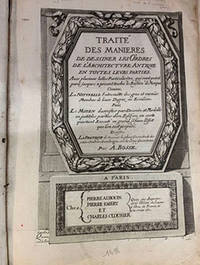
51-6927Paris: Chez P. Aubouin P. Emery et C. Clousier Paris 1688. Folio. 26.5 x 38cm. Contemporary calf covers with new goatskin spine and endpapers by the artisan binder Sasha Mosalov. Part I: 44 leaves title page ttrmmed at bottom; Part II: 11 leaves; Part III: 23 leaves.OCLC Number / Unique Identifier:861558893 microfiche; Fowler Architectural collection pp. 46-53; Brunet I 1127; BAL/RIBA 341 337 340; Berlin Kat. 2378 2379 and 3858; Cicognara 444-446; .3 parties en un vol. in-folio veau du temps dos à nerfs orné. Frontispice titre gravé XLIV ff. de planches et de texte ; titre-frontispice de la 2e partie ff. A à G compris puis ff. S T V soit 10 ff. de texte et planches ; titre de la 3e partie avec encadrement 2 ff. de texte 20 ff. de planches. petites mouillures taches et rousseurs à certains ff. Première et troisième partie complètes. Deuxième partie incomplète : manque la planche sur double page et 10 ff. gravés. Rare nouvelle édition des trois principaux ouvrages théoriques d'architecture d'Abraham Bosse entièrement dessinés et gravés en taille-douce par lui-même. .3 parts in one vol. in-folio contemporary calf decorated ribbed spine. Frontispiece engraved title XLIV ff. of plates and text; title-frontispiece of the 2nd part ff. A to G inclusive then ff. S T V i.e. 10 ff. of text and plates; title of the 3rd part with frame 2 ff. of text 20 ff. of plates. Small water stains stains and foxing on some ff. First and third parts complete. Second part incomplete: missing the double-page plate and 10 engraved ff. Rare new edition of the three main theoretical works on architecture by Abraham Bosse entirely drawn and engraved in intaglio by himself. Paris: Chez P. Aubouin, P. Emery et C. Clousier, Paris, 1688 unknown
186369520Washington D.C.: War Department 1863. CIVIL WAR. War Department General Orders 1863. Washington D.C.: War Department 1863.<br> <br> Full Description:<br> <br> LINCOLN Abraham. CIVIL WAR. Emancipation Proclamation War Department General Orders 1863. Washington D.C.: War Department 1863.<br> <br> The first War Department printing General Orders #1 Jan 2 1863 and fifth overall printing of the final Emancipation Proclamation. The 4 page pamphlet bound together with a nearly complete run of War Department general orders for the year 1863. Two octavo volumes 6 7/8 x 4 5/8 inches; 174 x 119 mm. Volume I comprising General Orders of the War Department Adjutant General's Office Numbers 1-221 2 January 1863 to 16 July 1863 and Volume II comprising Numbers 222-400 16 July 1863 to 28 December 1863. Nearly complete only lacking numbers 55 63 116-119 148 in volume I and 274 352 and 381 in volume II. With 5 copies of number 149 and and 3 copies of number 240.<br> <br> Contemporary half calf over marbled boards. Spine lettered in gilt. All edges speckled brown. Hinges repaired. Some rubbing to board edges. Previous owner's contemporary ink signature Bvt. Col. E.J. Wells on front paste down of each volume. Numerous annotations in the same old ink throughout generally noting when the order was received and dated 1863. Some glue marks to the General Order #1 not affecting text. A small tear to last leaf of text in volume I with no loss. Overall a very good copy.<br> <br> In addition to the very important first War department printing of the Emancipation Proclamation these volumes contain several other very important and interesting General Orders from the War Department as well as President Abraham Lincoln in relation to the military during this year in the Civil War.<br> <br> Notably:<br> <br> No. 100 April 24 "Instructions for the Government of Armies of the United States in the Field." "commonly known as the 'Lieber Code' after its main author Francis Franz Lieber. The Lieber Code set out rules of conduct during hostilities for Union soldiers throughout the U.S. Civil War. Even today it remains the basis of most regulations of the laws of war for the United States. The Lieber Code consists of 157 provisions that deal with a wide range of legal issues that must be considered in armed conflict. It contains general principles but also very detailed rules. Among the issues addressed are whether armed force is justified by military necessity the principle of humanity the distinction between combatants and civilians POW status retaliation and permissible methods and means of warfare." LOC"<br> <br> No. 143 May 22 the establishment of the United States Colored Troops. This authorized the establishment of a bureau regulating the recruitment training and organization of the U.S. Army's first regiments composed entirely of African-American soldiers.<br> <br> Numerous court cases are documented including #17- The sentenced hanging death of a "colored man" for "attempted rape". #346- The trial of George Woolfolk for "Being secretly within lines of the US forces as the same time belonging to the so-called Confederate Army." He was sentenced to be shot to death. And #396- The trial brought by Colonel John Gault against Dr. Aaron James for "Being the captain of a band of guerillas or marauders and shooting at US soldiers." He was sentenced to death but the President disapproved the sentence and directed him to be released.<br> <br> A number of orders of Military discharges both honorable and dishonorable as well as military promotions. #337 announces "Major General U.S. Grant U.S. Army is placed in command of the Military Division of the Mississippi Headquarters in the field." #349 announces "Major General William T. Sherman is appointed to the command of the Department and Army of the Tennessee Headquarters in the field." #194 is the appointment of Major General George Meade as commander of the Army of the Potomac who would defeat General Robert E. Lee at Gettysburg only days later. And #398 honors Ulysses S. Grant for his Mississippi River campaign and presents him a gold medal.<br> <br> Numerous obituaries including #71 which announces the death of Major General E.V. Sumner who fell ill and died on his way to take command of the Department of the Missouri and directs the ways that Department should give him military honors.<br> <br> Important presidential proclamations including #58- Calling to all soldiers who were "absent without leave" urging them to return to their regiments and would not face punishment beside loss of wages for time missed. #252- Orders regarding the treatment of prisoners of war stating that 'if the enemy shall sell or enslave anyone because of his color the offence shall be punished by retaliation upon the enemy's prisoners in our possession'. "President Abraham Lincoln issued an 'eye-for-eye' order warning the Confederacy that Union soldiers would shoot a rebel prisoner for every Black prisoner shot. It also would condemn a rebel prisoner to a life of hard labor for every Black prisoner sold into slavery. AA Registry. #315- Lincoln's suspension of the "writ of habeas corpus." "The doctrine of habeas corpus is the right of any person under arrest to appear in person before the court to ensure that they have not been falsely accused. Lincoln's suspension of the "writ of habeas corpus" was one of the most controversial acts of his administrations. Lincoln defended himself against charges that his administration had subverted the Constitution however arguing that acts that might be illegal in peacetime might be necessary "in cases of rebellion" when the nation's survival was at stake." The Gilder Lehrman Institute of American History. #340- Proclamation by the President calling for three hundred thousand volunteers. "Whereas the term of service of a part of the volunteer forces of the United States will expire during the coming year; and Whereas in addition to the men raised by the present draft it is deemed expedient to call out 300000 volunteers to serve for three years or the war not however. exceeding three years."<br> <br> And numerous other General Orders pertaining to soldiers and the war effort including #35- A list of items that could be sold to soliders by sutlers. #40- The establishment of a Volunteer force for Kentucky. #163- "A resolution to encourage the enlistments in the Regular Army and Volunteer forces." #323- which authorized each enlisted cook "two under-cooks of African descent who shall receive for their full compensation ten dollars per month and one ration per day." #351- This discusses the governance of "The Employment of women nurses in the U.S. General Hospitals." and #364 which discusses the cos of clothing and camp for the U.S. Army and includes a folding chart.<br> <br> Eberstadt 12. Grolier 100 American 71. Streeter 1751.<br> <br> HBS 69520.<br> <br> $7500. War Department unknown
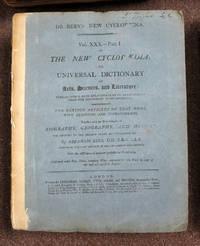
182041461London: Printed for T. N. Longman and O. Rees No. 39 Paternoster-Row 1820. 1st edition thus. 80 volumes in original publishers quarter-bound cloth beige spines over light blue paper-covered boards black lettering printed to front board and paper title labels on spine. 7 volumes period half-bound in black leather spine and edges with gilt & brown lettering and labels to spines over green cloth boards. Boards heavily worn and rubbed edges bumped and spines chipping. Some boards detached. Some volumes with previous owner signature penned to front board B. Fulford. Binding and paper age-toned as one would expect with the ages of the titles with the occasional stain & foxing. Withal a Good original set sold w.a.f. 87 volumes total. 80 of the Cyclopaedia 7 volumes of Plates. 7 volumes of plates b/w engravings. Cyclopaedias: ~ 11-1/4" x 9". Plate Volumes: 11" x 8-3/4" <br/><br/>"I. The Work will be printed in Quarto at the Office of A. Strahan Esq. with New Types cast for the Purpose and on a superfine yellow woven Paper. II. The Work will be comprised in about Twenty Volumes. III. Three sheets stitched in blue paper will be regularly published every Week till the whole be completed price One Shilling. IV. Numerous Plates engraved in a superior stile sic of elegance will be given in the course of the Publication. V. A Part of Half a Volume containing Seventeen Numbers together with the Plates will be regularly published in advance price Eighteen Shillings in boards. VI. A few copies will be printed on a superfine royal woven Paper with proof impressions of the Plates to be sold in Parts of Half Volumes only price One Pound Sixteen Shillings in boards. VII. Number I and Part I was published on Saturday January 2 1802." <br /> <br />"The encyclopaedia was largely Rees' own work and was especially strong in new and well-written biographical articles. The articles on music were written by Dr. Charles Burney and those on botany were mostly written by Sir James Edward Smith the founder of the Linnean Society.Rees's Cyclopaedia is said to have outclassed the Encyclopaedia Britannica of that time and 'remains a monument to the memory of another native of Wales namely dr. Abraham Rees the Encyclopaedist who was a native of Llanbrynmair Montgomeryshire." Cyclopaedia - dot - org. <br /> <br />Dr. Rees' Cyclopaedia is known all over the world and is often hailed as one of the greatest collections of material in the field of Encyclopedias. Printed for T. N. Longman and O. Rees, No. 39 Paternoster-Row hardcover books
1767JC14337London: Printed by T. Jones. and Sold by T. Payne. / Printed by W. Oliver. and Sold by T. Payne and Son. et al 1767-8. First Edition. Hardcover. Very Good. Contemporary specked calf ornate gilt-stamped border on boards gilt-stamped lettering and ornament in spine compartments 5 raised bands; complete set of 9 volumes published and bound as Volume I Parts i-ii Volume II Parts i-iii Volume III Parts i-iv 8vo; pp. xlvi 384; 384; 315; 335; 540 3 blank errata; 403; 432; 462; 505 1 errata. Volumes I-II bound as the first 5 volumes of this set printed by T. Jones 1768 and with the armorial bookplate of Reverend John St. John of Farley; Volume III the last 4 volumes of this set printed by W. Oliver 1767. Bindings just a bit worn with some bumping and very light chipping along spines and edges of boards. Contents somewhat tanned with some faint foxing here and there but overall tight bright clean and unmarked. A nice set of the rare first edition difficult to find in a straight run. <br/><br/> Printed by T. Jones... and Sold by T. Payne... / Printed by W. Oliver... and Sold by T. Payne and Son... [et al] hardcover books
2091202133212055Abraham Ortelius N.A. Soft Cover. Fine. Number of books: 1 Abraham Ortelius paperback
1768EXP4-B-3London: T. Jones 1768-1778. Leather. Fair. 8.5" by 5". None. A set of five very scarce volumes by Abraham Tucker under the pen name of Edward Search in leather binding. Very important texts and all contemporary editions are extremely rare. As these were published separately they are usually seen individually and a five volume collection is highly unusal. The original work was seven volumes broken in to parts. Not special externally and would really benefit from the attentions of a good binder but we keep them here are entirely original. Bound and marked as an eight volume set this collection comprises Volumes III Volume II Part I- 1768 Volume V Volume II part III-1768 Volume VI Volume III Part I- 1778 Volume VI IV Part II- 1777 and Volume VIII Volume V Part III- 1777 The volumes are major works of eighteenth century philosophy and theology anticipating utilitarianism and holding that "every man's satisfaction" is the ultimate end of any action. Contains the bookplate of one George Phillips to the pastedown of volume III. In calf binding with gilt detailing. Externally there is wear to the boards joints extremities and backstrips with tenderness to hinges. The front board is detached but present to the sixth volume and missing to the eighth. Internally the pages are firmly bound but are somewhat spotted and age-toned with some creasing. Overall: FAIR due to binding though internally presentable. Fair T. Jones hardcover