26 503 résultats
2024__032390386XElsevier Science Ltd 2024. Hardcover. New. 2nd edition. 2900 pages. 10.88x8.50 inches. Elsevier Science Ltd hardcover
177876402Chez Samuel Fauche | à Neuchâtel 1778 | 19 x 25 cm | 2 volumes reliés
18525677A bord de l'Uranie, Brest, Circa 1851-1852. 1852 1 vol. grand in-4° manuscrit à l'encre brune (325 x 225 mm) de: 313 pp. majoritairement numérotées; très nombreux schémas et tableaux en marge et dans le texte. Demi-veau dépoque raciné et teinté de mauve, plats recouverts de percaline violette, dos lisse orné et titré (reliure frottée).
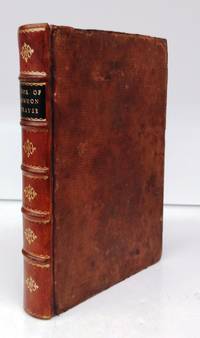
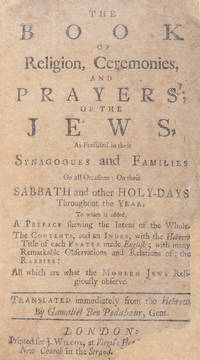
106895London Printed for J. Wilcox 1738. . First edition 8vo 20.5 x 13 cm; xiv 96; 291 7 pp.; modern blue cloth boards; first and last leaf restored with some marginal loss of text; edges stained corners rubbed. <br /> The earliest translation to English of the Jewish Prayer-book.<br /><br />This comprehensive and occasionally rather critical study of Jewish life and practices is dominated by the first English translation of any part of the Siddur the definitive Jewish prayer-book. Translated by Abraham Mears under the pseudonym of Gamaleil Ben Pedahzur according to Roth an apostate member of the English Ashkenazi community it was intended as an exposition of Judaism rather than a service book but in providing phonetic translations of the Hebrew title of each prayer Mears explicitly promotes its use 'to Beginners in the Hebrew Tongue' and 'all Persons that resort to the Synagogues'. The transliterated Hebrew title for each prayer is found in the margins enabling the curious non-Hebrew reading Christian to attend and follow a synagogue service. The transliteration of the Hebrew characters provides a clue as to how Hebrew was pronounced in the eighteenth-century Ashkenazi community of London.<br /><br />The book was not intended for liturgical use but rather for scholarly readership so it is not in effect a prayer-book. It reflects the growing interest in Judaism on the part of non-Jewish Englishmen of the eighteenth century.<br /> ESTC T86072; Roth B8:6. London, Printed for J. Wilcox, 1738. hardcover
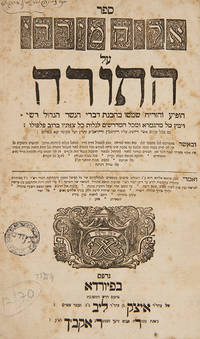
109205Furth Itzik ben Leib Buchbinder 1763. . 4to; restored publisher's half-calf marbled covers almost entirely perished spine rubbed and chipped at the top end; some browning to leaves a stamp and an old ownership inscription to title; 2 241 ll.<br /> Commentary on Rashi's commentary on the Pentatuch with a schematic map of Israel from the collection of Yosef Asher Pollock a 19th-century rabbi whose books were posthumously gifted to various collections.<br /><br />Elijah ben Abraham Mizrahi a.k.a. Re'em c. 1455-1525 or 1526 was a Constantinople rabbi and mathematician who became the Chief Rabbi of the Ottoman Empire in 1495 a post which he held until his death. As part of the role Mizrahi had a seat in the divan assigned to him by the Sultan beside the Mufti and above the Patriarch of the Christians. He had written several works in his lifetime but considered this to be his most important one. 'Sefer HaMizrahi' as it's known is a super-commentary on Rashi's commentary on the Torah and is counted as one of the most important works on the subject. It was first published in Venice in 1527 after Mizrahi's death by his son Israel. Israel edited his work adding a preface to it in which he asked the readers in case they were unable to understand certain passages not to criticise his father but to apply to Israel for explanations instead.<br /><br />In this edition Rashi's commentary is printed in block letters while the Biur Mizrahi commentary appears in Rashi script. On reverse of l.211 there is a schematic map of Israel drawn primarily in straight lines with its east side facing upward. This map was first printed in 1717.<br /> Vinograd Furth 292. Furth, Itzik ben Leib Buchbinder, 1763. unknown
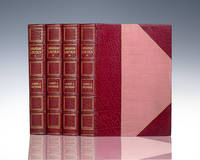
1928146970Boston and New York: Houghton Mifflin Company 1928. Limited manuscript edition of this complex and revealing biography of one of the most popular Presidents of the United States. Octavo four volumes bound in the publisher's cherry-red three-quarter crushed morocco at the Riverside Press with gilt titles and ruling to the spine in six compartments top edge gilt red silk ribbons tipped in tissue-guarded frontispiece portrait of Abraham Lincoln and additional tissue-guarded color plate views of the Lincoln Memorial to each volume illustrated with thirty-two tissue-guarded plates and maps throughout window-mounted leaf of the author's manuscript research notes adhered to the front flyleaf of Vol. I some pages uncut stamp-signed by the Riverside Press. One of one thousand numbered sets printed at the Riverside Press Cambridge U. S. A. this is number 130. In fine condition bookplate from the library of American banker and philanthropist Frank K. Houston to the front flyleaf of Vol. II. An exceptional set. Praised for his biographies of Chief Justice John Marshall and President Abraham Lincoln American historian and United States Senator Albert J. Beveridge has introduced the public to the realities of the lives of revered historical figures. Using analysis and thorough investigation Beveridge was able to contextualize the actions of America's sixteenth president with his traditions and influences in his four-volume biography 'Abraham Lincoln 1809-1858' published post-humously in 1928. His contributions to historical study cannot be understated and the American Historical Association's Beveridge Award exists to demonstrate as much. Houghton Mifflin Company unknown
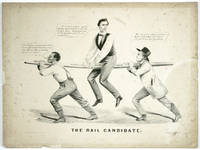
1860WRCAM37633New York: Currier & Ives 1860. Lithograph 13 1/2 x 18 inches. Moderate age-toning foxing and soiling. Moderate browning in margins. Small closed tears and chips in margins one moderate-size closed tear in left margin. A fair copy. A lithographic political cartoon published by Currier & Ives commenting upon the anti- slavery plank of the 1860 Republican platform. "The 'essential' anti-Lincoln cartoon of 1860" - Holzer et al. Abraham Lincoln is shown being carried uncomfortably in the middle of a split wooden rail an allusion to both the platform and to Lincoln's backwoods origins. Supporting the left end of the rail is a black man in simple working clothes who states "Dis N asterisks ours strong and willin' but its awful hard work to carry Old Massa Abe on nothing but dis ere rail!!" Holding the right end of the rail is well-dressed newspaper editor and strong Lincoln supporter Horace Greeley identified by a copy of his NEW YORK TRIBUNE in his coat pocket. Greeley tells Lincoln "We can prove that you have split rails & that will ensure your election to the Presidency." Lincoln replies "It is true I have split rails but I begin to feel as if this rail would split me it's the hardest stick I ever straddled." Lincoln is depicted - visually and thematically - as a straddler at best while the images of Greeley and the African American supporting the rail are derisive. <br> <br> A finely drawn and insightful political cartoon from the 1860 election. REILLY AMERICAN POLITICAL PRINTS 1860-31. WEITENKAMPF p.123. CURRIER & IVES: CATALOGUE RAISONNÉ 5478. Harold Holzer Gabor Borritt & Mark Neely THE LINCOLN IMAGE p.38 figure 18. Currier & Ives hardcover books
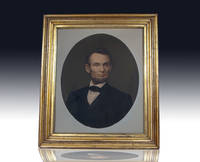
1864109542Cincinnati: E.C. Middleton 1864. Rare oleographic portrait of Abraham Lincoln by E.C. Middleton. With Middleton's Warranted Oil Colors imprint to the verso of the frame dated 1864. Between 1861 and 1873 E.C. Middleton of Cincinnati published a series oval oleographic portraits intended to have the appearance of oil paintings including thirteen “Portraits of American Statesmen and Heroes.†Middleton invented the method of oleography which used the process of chromolithographic printing with oil based inks mounted on canvas. The portraits were exclusively sold in frames directly through agents by subscription. In near fine condition. Matted and framed. The portrait measures 13.25 inches by 16.25 inches. The entire piece measures 20 inches by 23.25 inches. A rare striking portrait of Lincoln. Abraham Lincoln served as the 16th President of the United States from March 1861 until his assassination in April 1865. He led the United States through its Civil War and in doing so preserved the Union of the United States of America abolished slavery and strengthened the federal government. Lincoln began constructing his cabinet on election night and sought to create a cabinet that would unite the Republican party. His eventual cabinet would include his primary rivals for the Republican nomination and although his appointees held differing views on economic issues all were opposed to the expansion of slavery into the territories of the United States. The most senior cabinet post of Secretary of State was appointed to William Seward who had recently failed to win the 1860 Republican presidential nomination and Lincoln's choice for Secretary of the Treasury was Ohio Senator Salmon P. Chase Seward's primary political rival and the leader of a radical faction of the Republican party that sought the immediate abolition of slavery. E.C. Middleton unknown
1842151189Hamilton: Printed at Ruthven's Book and Job Office 1842. First edition in Mohawk. Hardcover. Very good. viii 456 p. 22 cm. Full leather. Respined with gilt impressing 5 raised bands and gilt-lettered label. Hinges repaired internally. New England Corporation bookplate on front pastedown. Ink presentation inscription on front free endpaper: "Presented to James Powles by his friend & minister The Rev. A Nelles 19 June 1842." Signature spelled James Powlass above. Mohawk inscription and signature on next leaf. Occasional stains and thumbing. <br/><br/>Rev. Abraham or Abram Nelles 1805-1884 was a Church of England clergyman and missionary to the Six Nations. Nelles was principal of the Mohawk Institute a day-school operated by the New England Company for "Indian" students. Nelles first used his knowledge of the Mohawk language to publish in 1839 a hymnal entitled "A collection of psalms and hymns in the Mohawk language for the use of the Six Nations Indians." This translation project also published in Hamilton dates to a few years later. He is buried in the graveyard of the Mohawk Church. Interestingly two individuls named "Powless" are also buried there so James was probably one of his parishioners. Printed at Ruthven's Book and Job Office hardcover
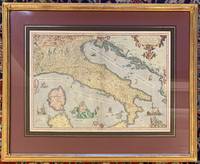
1573311532Antwerp: Ortelius Abraham 1573. framed. Map. Color engraving. Image measures 14 3/8" x 19.75". In gilt frame with empire French matting 23 x 28 1/2 inches.<br/> <br/> Gorgeous 16th century map of Italy. Elevations are beautifully colored and major towns are noted in red. Part of the Balkans Corsica and northern Sardinia are included along with part of Switzerland. Monaco is noted to the West. It was Ortelius's first map of Italy with a depiction of Neptune embracing and kissing a Neirid merwoman. A Sphinx perches atop the distance scale cartouche. Seven ships complete the composition. Some foxing and toning but otherwise a beautiful example of this uncommon edition. <br> <br> Abraham Ortelius 1527--1598 started his career as a Flemish map colorist eventually becoming a publisher cartographer and geographer. He widely regarded as one of the important and influential cartographers in history. He is known for his "Theatrum Orbis Terrarum" which was the first modern atlas. Van den Broecke 118.<br/> <br/> Ortelius, Abraham unknown
1669D6035Paris: Frederic Leonard 1669. First Edition. Hardcover. Very Good. 4to 242 x 185 mm. 120pp. Printers woodcut device on title depicting the winged lion of Evangelist Mark and motto Virtute invidiam vince Virtue overcometh envy and the legend Pax tibi marce Evangelista meus. 5 engraved folding plates 4 by Sebastien Le Clerc and one by Abraham Bosse depicting a chameleon on a branch and a plate with chameleons skeleton and organs in the upper part on a trompe-loeil sheet; and the same anatomical analysis for the beaver the camel the bear and the gazelle decorative woodcut head- and tail-pieces. Contemporary mottled calf spine gilt in compartments plates with some tears along folds repaired on verso some light darkening minor marginal worming at end; light edgewear. From the collection of Charles Philippe Robin 1821-1885 French doctor anatomist and politician bibliographical note at foot of title. Other early inscriptions to title referring to the engraver M. LeClerc and on rear pastedown to the state of the engravings. <br/><br/>First Edition and second publication dealing with the comparative anatomy of the animals the chameleon the beaver the camel the bear and the gazelle. Perrault scientist and naturalist was the leader of a team of comparative anatomists called the Parisians that included Guichard-Joseph Duverney Jean Pecquet Moyse Charas and Philippe de la Hire. Their investigations began in June 1667 with a thresher shark and lion from the royal academy and went on to encompass forty-nine vertebrate species. The detailed reports and exact descriptions on these dissections were the first of a long series of anatomical descriptions which ultimately included those of twenty-five species of mammals seventeen birds five reptiles one amphibian and one fish. Perrault and the team of Parisians prided themselves on several discoveries and in the process debunked many popular myths attached to certain species such as the legend that salamanders live in fire or that chameleons subsist on air. The scientists also recorded how they obtained their results providing a glimpse of how such anatomical research was conducted in the seventeenth century. The work is illustrated beautifully with five large folding plates by the expert painter engraver and writer Sebastian Leclerc 1637-1714 four of which were engraved by Leclerc and one by the watercolor painter writer and printmaker Abraham Bosse c. 1604-1676. Very fine work; the large folding plates remain fresh and intact. No such detailed and exact descriptions and illustrations had been published before. It is hard to measure another such important addition to the anatomical study of animals. Frederic Leonard hardcover books
18051602180078Philadelphia : Samuel F. Bradford Murray Fairman and Co. Peter A. Mesier New-York; Blake et Cunningham Boston; Cushing et Appleton Hezekiah Howe Charles Whipple John W. Adams Stephen Patten Fielding Lucas Baltimore; Daniel Rapine Washington; Joseph Milligan Georgetown; John A. Stewart Alexandria; D. Henderson Fredericksburg; Wm. H. Fitzwhylsonn Richmond; Richard Cottom John Hoff William Williams Savannah; Hobby et Bunce Cramer Spear Eichbaum James Palmer 1805. First Edition. Hardcover. Acceptable. 0x0x0. 47 volumes. Includes the 6 plate and atlas volumes. 1st American edition published 1806-1822. A massive set. 4to 28 cm high. Over 1000 engraved plates some folding or double-page Atlas is collated; all 61 double-page maps present 28 x 43 cm. 4 of the maps are browned. Internally generally clean bright and unmarked. Scattered spotting. Printed in two columns. An unsophisticated set. Bound in contemporary 1/4 black leather over marbled boards. A majority of the boards are detached and the leather spines are chipped with loss. All volumes come in modern archival folding boxes. Early signature of G. K. Richardson 1840 on fep of one volume. Previously owned by the National Trust for Historic Preservation. <br><br> Abraham Rees 1743-1825 was a British clergyman best known for this his outstanding encyclopedic work The Cyclopaedia. Initially published 1802-1820 in parts in Great Britain. Rees' work not only featured theological and humanistic issues but also extensive articles on mathematics and natural sciences. The Cyclopaedia "is the richest work for technology of the period with detailed text and handsome carefully prepared plates." Ferguson Eugene. "Contributions to Bibliography in the History of Technology part II". Technology and Culture 3.2 1962: 169 p. "Rees was convinced that the important progress made during the last decades of the eighteenth century especially in the fields of history geography geology natural history and the physical sciences senu lato required a new type of encyclopedia with the accent on these fields as well as the still relatively undeveloped domains of biography and the history of sciences. The Cyclopaedia thus became one of the first works of its kind to be compiled with the help of 'persons eminently distinguished in these branches of science to which they had devoted their talents.'" Taxon Vol. 35 No. 2 1986 452-453. Some of the notable contributors to this work were Charles Bruney on music; Charles Koenig Robert Bakewell and John Farey on geology; John Dalton and Humphry Davy on chemistry; David Mushet on metallurgy; William Pearson on astronomy; James Edward Smith William Wood William Fitt Drake and William Woodville on botany. "Rees Cyclopaedia is one of the first works to interpret correctly William Smith's ideas on strata identification on the basis of fossil organisms." Ibid. The Cyclopaedia included other notable recent scientific breakthroughs such as Robert Fulton's Cast Iron Aqueduct described in his 1796 book which would become his notable steam engine. See also Ferguson E. "Cast-iron Aqueduct in Rees's "cyclopaedia". Technology and Culture 9.4 1968: 597-600. Refs: BMC. vol 21 p. 2871. Sabin 68634. Rink E. Technical Americana 121. Shaw et Shoemaker 19907. Shaw et Shoemaker 9234. <br> International buyers please note that this is an extremely large heavy set. Shipping will be very expensive outside of the United States. Philadelphia : Samuel F. Bradford, Murray, Fairman and Co. Peter A. Mesier, New-York; Blake et Cunningham, Boston; Cushing et Ap hardcover
12542Paris, Pierre Des-Hayes, 1643.
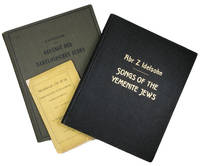
1922ABC_47387Jerusalem; Berlin; Vienna 1922. Benjamin Harz Verlag The first volume in contemporary black morocco with the title lettered in gold on the front board and spine the second volume in contemporary grey cloth with the title lettered in black on the front and spine ad 2 in the original publisher's printed wrappers. With musical scores throughout. 2 works in 3 volumes. XII 47 3 117 1; IX 1 140; 47 1 pp. Abraham Idelsohn 1882-1938 is widely considered the pioneer of modern Jewish musicology. Born in todays Latvia he travelled extensively and recorded the musical traditions of the diasporic Jewish communities. Over the course of 20 years Idelsohn surveyed the musical traditions of various Jewish communities in Palestine and throughout the Diaspora including Babylonian Persian Bukharian Oriental Sephardi Moroccan German Eastern European and Hassidic communities and published the final volume of his collection in 1932. The two volumes offered here form part of his monumental and very rare work collecting the songs of the Yemenite and Babylonian Jews. Idelsohns survey and catalogue of the songs encompass Synagogal and Non-Synagogal songs comprising of songs for the Sabbath feasts and high feast working days as well as lamentations penitential songs and songs for other occasions and folk songs. In his monumental work he presented an extensive introduction to the musical culture of the Jewish tribes and extensive commentary on the variations within the chant. Idelsohns works were printed by Breitkopf & Härtel in Leipzig the worlds oldest music publishing house and renowned for their high quality musical scores. Idelsohn travelled extensively. During his stay in Jerusalem he observed a rich variety of musical traditions among the Jewish communities there. By studying these traditional tunes he discovered recurring patterns and sequences unique to Jewish music. This led him to conclude that these musical phrases had a common origin dating back to the first century C.E in Israel and Palestine. He found that these motifs were categorized into three tonal centres corresponding to the Dorian Phrygian and Lydian modes of ancient Greece. Each of these modes produced a specific emotional response - the Dorian was used for elevated and inspired texts the Phrygian for sentimental and emotional texts and the Lydian for lamenting and confessions of sins. Idelsohn also categorized musical motives as those that prepare begin or conclude a musical phrase.In Jerusalem Idelsohn started his career as a cantor and music teacher at the Hebrew Teacher's College. He was deeply influenced by the diverse Jewish community in Palestine and embarked on a massive project to document their unique musical and linguistic traditions. He received a research grant from the Academy of Science in Vienna and a phonograph to assist with his field work. In 1914 he released the first volume of his landmark ten-volume work Thesaurus of Oriental Hebrew Melodies which focused on the Yemenite community in Palestine. Idelsohn was particularly interested in this community as he believed that their Hebrew pronunciation and musical heritage dated back to the first century CE and had remained relatively untouched by outside influences due to their migratory history and isolated location.With the owners mark of composer Ludovicus Mirandolle 1904-1974 in all volumes. The bindings of ad 1 show slight traces of use the paper wrappers of ad 2 are partly detached. A few pencil marks to the pages. Otherwise in good condition.l Bohlmann Central European Folk Music 60. hardcover
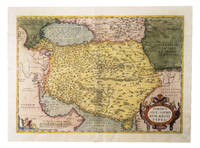
1574G1ADU6GU6IANAntwerp: Christophe Plantin 1574. Engraved map 35 x 50 cm in contemporary hand-colouring and highlighted in gold. Scale 1:9000000. 16th-century Dutch map of Persia based on the Gastaldi map with additional new cartographic information.l Alai General maps E.70; Al-Qasimi 30; Van den Broecke 167 first state. Christophe Plantin, unknown
1646182261646 1 volume, reliure demi-veau havane in-douze (binding half calfskin in-12) (8,5 x 14,8 cm), reliure tardive (XVIIIème), dos 5 nerfs (spine with raised band) décoré or (gilt decoration) filets et filets perlés or (gilt lines and gilt beaded lines) - titre frappé or (gilt title), filets perlés or en place des nerfs entouré de part et d'autre d'un double dilet or, papier peigné aux plats (cover with painting paper), toutes tranches lisses (all smooth edges)rouges (red sedges), EX-LIBRIS : manuscrit au crayon bleu par le Baron Gaetan de Wismes : " au Baron de Wismes, acheté chez Gaizen, Hiver 1872 ", orné d'une gravure-titre gravée sur bois en noir+ 24 gravures hors-texte en noir + 6 vignettes et bandeaux dans le texte et 3 lettrines, le tout gravé à l'eau-forte par Abraham BOSSE d'après les compositions de Jacques STELLA, manque les feuillets 241/242, 393/394, 395/396, 399/400, 459/460, 475/476, 513/514 et 515/516 correspondant aux gravures manquantes, 566 pages + 3 p. de privilège, 1646 [Paris] : Pierre Des Hayes Editeur,
169011932A Cologne, chez Pierre Marteau, 1690. 3 parties en 2 vol. in-4 de (4)-457 pp. ; 219-(49) pp. ; (2)-267-(1) pp., maroquin rouge, dos finement orné à nerfs, tranches dorées sur marbrure (reliure de l'époque).
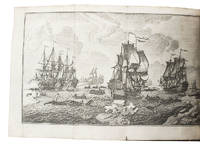
1728A6CH5N3RHVIKAmsterdam 1728. 4to. Isaak Tirion Contemporary calf gold-tooled spine and board edges red and blue sprinkled edges. With the title page printed in red and black with 5 of 6 folding engraved maps 11 engraved plates 1 folding 2 woodcut illustrations in text 7 decorated woodcut initials and 6 woodcut tailpieces. 40 392 13 pp. Scarce reissue of the 1727 second and final edition greatly expanded and revised from the first edition of 1720 and with additional plates of a highly esteemed work on whaling. "It is by far the most important of the early authorities on the northern whale fishery and must always be one of the chief sources of information for the early history of the subject. It also gives one of the best figures of the Greenland Right Whale published prior to the present century and also one of the best early figures of the Cachelot" Allen. Unfortunately lacking the frontispiece and the map of Nova Zembla but otherwise a very good copy with some water stains and a tiny wormhole. Binding good though worn at the hinges. The definitive edition of an essential resource for any study of the whaling trade.l Allen 192 note; Sabin 106376; Tiele Bibl. 1241 note; STCN 3 copies. unknown
5980157 leaves of text paginated 1-124 & 129-317 nothing seems lacking. Large 4to 318 x 215 mm cont. sheep-backed black cloth extremities slightly worn title in gilt on spine. S.l.: c. 1852. A finely written and illustrated manuscript with highly technical observations on French naval artillery training and testing in the mid-19th century which are complemented by numerous hand-drawn marginal diagrams and many tables. The present manuscript was composed by Floucaud de Fourcroy 1831-1929 a descendant of the famous chemist Antoine de Fourcroy as a cadet aboard the Uranie a former frigate converted into a training ship in 1851. By the end of his career Floucaud de Fourcroy was a highly decorated admiral and commander in the Legion of Honor. The present manuscript recapitulates the curriculum of naval artillery in the middle of the 19th century. It begins with a survey of weapons classifications artillery rifles swords pikes axes etc. and the situations in which to use them different types of ammunition and their purposes and the history of their development. There are then lengthy explanations of each weapon's size range reloading time effectiveness etc. Each of these is presented with precise measurements and dimensions. The author recounts the multitude of exercises which a cadet had to undergo and master in order to progress as a naval officer pp. 265-90. There are also extensive notes on his lessons in ballistics often accompanied by intricate diagrams and mathematical formulas. Pages 295-96 feature a section entitled in trans.: "Notes on the Practical Instruction which a Sailor-Gunner must Receive." The drawings in the margins many very complex illustrate the composition of ships weapons ammunition and instruments the trajectory of cannons and firearms the construction of equipment the optimal angles of attack the adjustments necessary to maintain accuracy while the ship is in motion etc. etc. On page 317 Floucaud de Fourcroy has drawn detailed cross-sections of five types of cannons. The tables concern the range of various cannons their effectiveness at specific ranges in terms of speed and their penetration the supply needs of cannons the number of cannons that can fit on a ship etc. A most interesting manuscript in fine condition that captures the state of French naval training and warfare in the middle of the 19th century. Pages 227-28 258-64 and 315-16 are blank. hardcover books
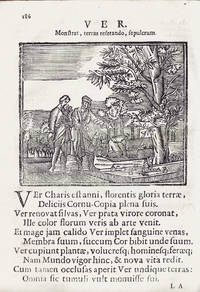
1717116<p>4° mm 230x168; ll. 6 pp. 400. Woodcut frontispiece and <strong>100 emblematic woodcuts</strong> each approx. 105×120 mm. Contemporary vellum binding. Small restorations to the title page and pp. 353–54. Overall a fine copy.</p><p>First edition in Italian the original title: <em>Huy und Pfuy der Welt</em> 1707.</p><p>A very interesting richly illustrated book by the Augustinian preacher Abraham a Sancta Clara https://en.wikipedia.org/wiki/Abraham_a_Sancta_Clara. The treatise is a kind of iconographic and textual compendium intended for use by the popular preacher. Its format of emblem commentary 'favola' enables a constellation of homiletic <em>exempla</em> to be committed to memory in keeping with a very ancient rhetorical and visual tradition cfr. L. Bolzoni <em>La rete delle immagini. Predicazione in volgare dalle origini a San Bernardino da Siena</em> Torino 2002.</p><p>"One of the greatest orators Germany has ever produced. People flocked to hear him drawn by the power and vivid clarity of his speech by the inexhaustible wealth of his wit and by the impartial severity with which he denounced the vices of all social classes. He poured his whole being into everything he said. Endowed with extraordinary creativity and inventive originality Abraham blended into his imaginative style fables short stories anecdotes erudite quotations witty sayings colourful and sometimes trivial wordplay sudden asperations personal recollections and vivid genre sketches with flashes of true eloquence—passionate fiery and vibrant. Even when he wrote he stood so to speak at the pulpit and saw his audience before him face to face" L. Bianchi.</p> Per Gio. Parone
1993C93592Davaco Publishers. As New. 1993. Hardcover. 9070288834 . FREE UPGRADE to Courier/Priority Shipping Upon Request - IN STOCK AND IMMEDIATELY AVAILABLE FOR SHIPMENT - Flawless copy brand new pristine never opened -- TWO 2 VOLUME SET. Text in English. Many illustrations including 38 color plates. Catalogue Raisonne Catalog Raisonné Complete Works Life and Work Raisonnee -- with a bonus offer-- - May be EITHER: out of print OOP and extremely rare in this pristine condition; signed by author or contributor; or a first or special edition; inquire for details . Davaco Publishers hardcover
2008C87145Michael Imhof Verlag. As New. 2008. Hardcover. 3865681441 . FREE UPGRADE to Courier/Priority Shipping Upon Request - IN STOCK AND IMMEDIATELY AVAILABLE FOR SHIPMENT - Flawless copy brand new pristine never opened -- Text in German and English. 296 pages; 145 illustrations. Catalogue Raisonne Catalog Raisonné Complete Works Leben Und Werk Oeuvre-Katalog Kritischem Oeuvrekatalog Raisonnee -- with a bonus offer-- - May be EITHER: out of print OOP and extremely rare in this pristine condition; signed by author or contributor; or a first or special edition; inquire for details . Michael Imhof Verlag hardcover
184822094.01 -.02<p>Lincoln's spot resolution and speech condemns the pretexts for starting the war with Mexico. He requests proof from President Polk that American blood was shed on American soil and that the enemy provoked the Americans and he asks if those Americans present were ordered there by the United States Army.</p> <b>ABRAHAM LINCOLN.</b>Newspaper. <i>National Intelligencer</i> Thursday December 23 1847. Washington: Gales & Seaton . 4 pp. Offered with another issue of the <i>National Intelligencer</i> January 20 1848. 4 pp.<p><b><br /></b></p><p><b>Excerpts:</b></p><p><b>December 23 1847 issue</b></p><p>Page 2 bottom of first column to second column</p><p><i>Mr. LINCOLN moved the following preamble and resolutions which were read and laid over under the rule:</i></p><p><i> Whereas the President of the United States in his message of May 11 1846 has declared that "the Mexican Government not only refused to receive him the envoy of the United States or listen to his propositions but after a long-continued series of menaces have at last invaded </i>our territory<i> and shed the blood of our fellow citizens on</i> our own soil<i>."</i></p><p><i> And again in his message of December 8 1846 that "we had ample cause of war against Mexico long before the breaking out of hostilities; but even we forbore to take redress into our own hands until Mexico herself became the aggressor by invading </i>our soil <i>in hostile array and shedding the blood of our citizens."</i></p><p><i> And yet again in his message of December 7 1847.</i></p><p> Resolved by the House of Representatives<i> that the President of the United States be respectfully requested to inform this House—</i></p><p><i> 1st. Whether the spot on which the blood of our citizens was shed as in his messages declared was or was not within the territory of Spain at least after the treaty of 1819 until the Mexican Revolution.</i></p><p><i> 2d. Whether that spot is or is not within the territory which was wrested from Spain by the revolutionary Government of Mexico. </i></p><p><i> 3d. Whether that spot is or is not within a settlement of people which settlement has existed ever since long before the Texas revolution and until its inhabitants fled before the approach of the United States army.</i></p><p> <i>4th. Whether that settlement is or is not isolated from any and all other settlements by the Gulf and the Rio Grande on the south and west and by wide uninhabited regions on the north and east.</i></p><p><i> 5th. Whether the people of that settlement or a majority of them have ever submitted themselves to the government or laws of Texas or of the United States by consent or by compulsion either by accepting office or voting at elections or paying tax or serving on juries or having process served upon them or in any other way.</i></p><p><i> 6th . Whether the people of that settlement did or did not flee from the approach of the United States army leaving unprotected their homes and their growing crops </i>before<i> the blood was shed as in the messages stated; and whether the first blood so shed was or was not shed within the enclosure of one of the people who had thus fled from it. </i></p><p><i> 7th. Whether our </i>citizens<i> whose blood was shed as in his messages declared were or were not at that time armed officers and soldiers sent into that settlement by the military order of the President through the Secretary of War.</i></p><p><i> 8th. Whether the military force of the United States was or was not so sent into that settlement after Gen. Taylor had more than once intimated to the War Department that in his opinion no such movement was necessary to the defense or protection of Texas. </i></p><p><i> Several resolutions of inquiry were here offered my Messrs. GEORGE S. HOUSTON W.P. HALL PHELPS GREEN McCLELLAND and KAUFMAN which are omitted for want of room.</i></p><p><b>January 20 1848 issue: </b></p><p>Page 2 bottom of 3rd column thru 6th column. In this lengthy address Lincoln questions President Polk's judgment regarding the aims and prosecution of the war in Mexico putting it in the context of the American Revolution: <i>"Texas revolutionized against Mexico and became the owner of something…if she got it in any way she got it by revolution; one of the most sacred of rights—the right which he believed was yet to emancipate the world; the right of a people if they have a government they do not like to rise and shake it off…He talked like an insane man. He did not propose to give Mexico any credit at all for the country we had already conquered; he proposed to take more than he asked for last fall…"</i></p><p>Additional news: page 2 middle of 4th column prints a lively senatorial debate involving Jefferson Davis. Page 3 bottom of 2nd column <i>"Mr. LINCOLN from the same committee reported a bill for the relief of William Fuller and Orlando Saltmarsh. Read and committed." </i>Page 4 middle of 3rd column <i>"By Mr. LINCOLN: A bill to amend an act entitled 'An Act to raise for a limited time an additional military force and for other purposes' approved February 11 1847."</i> This act gave the president permission to raise one regiment of dragoons and nine regiments of infantry to be used in the war with Mexico. In addition the act dealt with the logistics of each regiment such as raising the pay for field surgeons or adding a quartermaster to each regiment.</p> books
1648001623Paris: Pierre Des-Hayes 1648. Book. Very good- condition. Hardcover. First Edition. 16mo - over 5¾" - 6¾" tall. xviii 342 pages of text. Defective copy lacking five plates the frontis and a final engraved table. Attractive early-to-mid-18th century leather binding with moderate wear to the hinges spine extremities and corners. Raised bands gilt tooling and lettering on spine. Decorative marbled endpapers and blank endsheets supplied at time of binding. Present is the full-page engraved portrait of Michel Larcher engraved armorial dedication to Larcher and the engraved title page following page 58. A complete copy has the plate numbers 151 and 156 used twice totalling 158 plates showing plans and designs of perspective of which 153 only are present in this copy. Lacks plate numbers 110 151 both 154 and 155. However early hand-drawn facsimiles of plates 151 one of two and 155 are supplied and bound-in leaving three images unrepresented. The majority of the plates are double-sided. Plate 156 is in less than good condition with heavy staining and soiling. Engraved title page is repaired with early conservator's tape with no loss. Pages 168 through 193 are bound out of order. Several leaves are affected by damp staining and minor rippling; approximately 15 front and 30 rear. The title page and several adjacent leaves as well as a few at the rear of the text are heavily stained. Some of the staining appears to originate from washed-out markings -- notations to which an attempt at removal were made -- that are in blank areas mainly in the front and rear pages but also in the blank areas in the introduction. Includes Desargues New Theory at the end with demonstrations. Protected in a modern circa 1950 slipcase decorated with marbled endpaper the seams of which are detached at the top edge. Desargues 1593-1661 was a French mathemetician and a founder of modern Geometry. With Pascal he introduced the method of perspective; treated conic sections as projections of circles formulated the so-called Arguesian transformation; developed the theory of involution and of transversals; defined parallels as lines that intersect at infinity. Measures 6-5/8" tall by 4-1/2" wide; printed on thick paper with ample margins. 20th century bookplate of Paul and Verner Mac Alister on front pastedown and a neatly handwritten identification on the 2nd front endpaper. On the same leaf is a contemporary name or marking. French France Fortifications Conics Cartography Projective and Descriptive Geometry. Early editions of Desargues works are quite uncommon. Pierre Des-Hayes Hardcover books
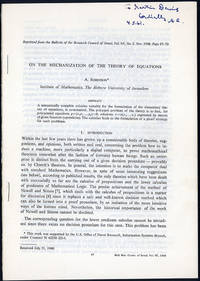
1960516851960. <p>Robinson Abraham 1918-74. On the mechanization of the theory of equations. Offprint from Bulletin of the Research Council of Israel 9F 1960. 47-70pp. 241 x 170 mm. Without wrappers. Very good. Presentation Copy inscribed by Robinson to Martin Davis 1928-2023 on the first page: "To Martin Davis Cordially A. R. 4.5.61." </p> <p> First Edition Offprint Issue. Robinson is best known for developing nonstandard analysis which reincorporated infinitesimal and infinite numbers into mathematics. In the present paper which addresses "the problem of how to induce a machine more particularly a digital computer to prove mathematical theorems somewhat after the fashion of certain human beings" he constructed "a semantically complete calculus for the formulation of the elementary theory of equations" leading to "the formulation of a proof strategy for such problems" p. 47.</p> . unknown