ABRAHAM LINCOLNABAA

26 503 résultats
186522935<p><b>ABRAHAM LINCOLN.</b>Print. <i>Abraham Lincoln. The Nations Martyr. Assassinated April 14th. 1865.</i> Currier & Ives New York N.Y. 1865. 1 p. 13½ x 18 in. Light toning. </p>By recycling stock images Currier & Ives could issue "rush" prints of important 19th century events thus providing Americans with graphic depictions of current events. Based on Anthony Berger's famed photograph taken in February 1864 this is a fine example of a "rush" print of Lincoln following his assassination to hang in the homes of Americans mourning the loss of their president.<br /> books
186520323<p><b>ABRAHAM LINCOLN.</b>Currier & Ives. Lithograph New York 1865. In 24 x 29 in. hand-gilt frame. </p><p>From the hairs on Lincoln's head to the fabric of his suit this lithograph is a beautifully detailed rendering and remains even with a few areas of foxing a commanding showpiece.</p><p><b>Historical Background</b></p><p>The copyright date of <i>"1865"</i> along the bottom edge suggests that this oversized portrait was created to honor either Lincoln's second presidential term or his untimely death.</p><p>Lithographer <b>Nathaniel Currier</b> 1813-1888 and artist <b>James Merritt Ives</b>1824-1895 formed Currier & Ives in New York City in 1857 to publish art prints. The company closed in 1907 after the deaths of its founders when business had declined due to new printing technologies and changing artistic tastes.</p><p><b>Condition</b></p><p>There are a few areas of light age toning. It is displayed in a vintage frame not contemporary to 1865 as we bought it so it is not guaranteed to be archival.</p> books
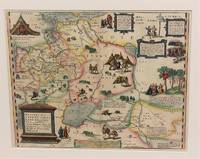
1574M10843Antwerp Belgium c.1574. Very Good. Notes: Latin text on verso. L.61<br>Decorative map of Russia by Abraham Ortelius. Size : 352x448 mm 13.86x17.64 Inches Coloring: Original Hand Coloring Reference: Marcel P. R. van den Broecke #162. Category: Maps Russia; unknown
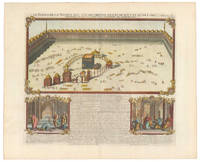
1719NL-02162<p>This is Henri Chatelain's dramatic and detailed capture of the <em>Haram</em> or Sacred Precinct in Mecca—the holiest site in Islam. It provides a detailed view of the historic complex which draws millions of pilgrims annually. In the center of the view the quadratic black Kaaba dominates. According to Islamic tradition this complex stands on the remains of the first temple that Abraham and his son Ishmael built for God.</p><p>In addition to the Kaaba several shrines and other buildings have been drawn in their relative positions and domed porticoes frame the enormous courtyard holding it all. In this manner the view almost takes on the character of a plan. Chatelain brings his view to life by including many worshippers within the complex.</p><p>While the view of the Holy Precinct occupies the upper register of the print in the lower register we find two smaller vignettes depicting the various positions that Muslims assume during prayer. Between the vignettes is a text that includes a legend and key related to the larger view as well as an introduction to the Islamic faith and tradition.</p><p><strong>Census</strong></p><p>The copper-engraved view comes from Chatelain's seminal seven-volume <em>Atlas Historique</em> published in Amsterdam between 1705 and 1720. The atlas combines the finest engraving and cartographic craftsmanship with academic studies of geography history ethnology heraldry and cosmography and it was one of the most widely distributed atlases in the 18th century.</p><p><strong>Context is Everything</strong></p><p>When Chatelain's detailed plan of Mecca was first published it was a true rarity. Few European travelers had ventured so profoundly into Arabia and the accounts of Muslims did not resonate broadly among the European intelligentsia at the time. Western Arabia particularly Mecca had been subjugated by the Ottoman Empire when Selim I defeated and dissolved the Mamluk Sultanate in Egypt. For centuries the Mamluks had controlled access to the sacred cities but now Barakat bin Muhammed the Sharif of Mecca was forced to acknowledge Ottoman supremacy. The only European to ever truly penetrate Mamluk Arabia was the Italian traveler Ludovico di Varthema who in 1502-03 visited Mecca with a Hajj caravan on his journey to India.</p><p>But a French traveler truly opened Western Arabia to the world. The Parisian Jean Chardin 1643-1712 was a distinguished French traveler merchant and polyglot whose extensive travels in the Middle East and beyond significantly impacted the European understanding of Islam and its holy sites in the 18th century. Chardin spent eleven years exploring the Middle East where he gained access to the Persian court being appointed a royal merchant by Shah 'Abbas II. His journeys took him through Persia Turkey India and Georgia before he eventually settled in England. Among the most notable aspects of Chardin's voyages was his attempt to depict Islam's holy places particularly Mecca and Medina. His depictions were mainly based on information he acquired from Muslims who had performed the Hajj.</p><p>Depictions of Islam's holiest sites were virtually non-existent in Europe at his time and Chardin's drawings constitute some of the earliest and best sources available. There is an unfinished manuscript plan of the Prophet's Tomb in Medina at the Royal Society in London. Still the more impactful image was Chardin's completed plan of the Kaaba precinct in Mecca. While this pioneering plan accurately captures the individual buildings and minarets including the colonnaded porticoes surrounding the central courtyard it also conflated elements from Medina and Mecca the circular colonnade around the Kaaba.</p><p>Despite traveling with two professional artists including Grélot the drawings attributed to Chardin were most likely his work demonstrating his engagement with documenting his experiences. His detailed accounts and illustrations were later included in his publication <em>Voyages en Perse et Autres Lieux de l'Orient</em> the first volume published in 1686. Further volumes followed in 1711. These works were praised for their detailed observations and accuracy providing a valuable non-Persian perspective on the Safavid and Ottoman empires and it is clear that they were the source for Chatelain's view.</p><p>Chardin's extensive travels and keen observations earned him a knighthood from Charles II of England for his services to the East India Company. His pioneering contributions remain crucial sources on Persia and Arabia's political history and cultural landscapes.</p><p>Cartographer:</p><p><strong>Henri Abraham Chatelain 1684 – 1743</strong> was a Protestant pastor Huguenot from Paris who due to his faith was forced to flee his native France. He settled first in London and later in Holland where he worked from both The Hague and Amsterdam during the early 18th century. While his primary calling was as a preacher his <em>Atlas Historique</em>became a huge success partly due to the vivacious decoration and abundance of information on his charts.</p>
632Jacob Abraham Grohusko 1908. First edition. Hardcover book bound in the publisher�s original full cloth gilt. 85 pp. In good condition. Lacks front fixed end page. Front hinge cracked but holding to the book block. A few interior pages contain notations/markings. A few pages with splatter stains. Moderate to heavy wear/soiling/bumping to the cloth covers. Rare. hardcover
95124Rare caste metal relief portrait of President Abraham Lincoln in profile. Housed in a custom circular frame with gilt decorative floral reliefs. The entire piece measures 16 inches by 16 inches. A handsome example. Abraham Lincoln served as the 16th President of the United States from March 1861 until his assassination in April 1865. He led the United States through its Civil War and in doing so preserved the Union of the United States of America abolished slavery and strengthened the federal government. Lincoln sought to create a Presidential cabinet that would unite the Republican party. His eventual cabinet would include his primary rivals for the Republican nomination and although his appointees held differing views on economic issues all were opposed to the expansion of slavery into the territories of the United States. The most senior cabinet post of Secretary of State was appointed to William Seward who had recently failed to win the 1860 Republican presidential nomination and Lincoln's choice for Secretary of the Treasury was Ohio Senator Salmon P. Chase Seward's primary political rival and the leader of a radical faction of the Republican party that sought the immediate abolition of slavery. unknown books
1518100999Newspaper disbound 23" x 16" 8 pp. Probably removed dbd minor staining and browning a little creasing and fading; otherwise very good.This is an early report under the heading "Important Assassination of President Lincoln." This is the second morning edition with the 3 a.m. update from Edward Stanton the Secretary of War which indicates Lincoln was still alive but in very bad shape. The article describes John Wilkes Booth "the actor" as the alleged assassin of the president. It describes how Booth entered Lincoln's box and after shooting him stating "Sic semper tyranis" before he leaped on to the stage. This report gives considerable detail about the how Washington reacted to the news and the scene at Lincoln's deathbed. There is also a good deal of coverage of the assassination attempt on Secretary of State William Seward. This paper represents an important piece of American history. books
95124Rare cast metal relief portrait of President Abraham Lincoln in profile. Housed in a custom circular frame with gilt decorative floral reliefs. The entire piece measures 16 inches by 16 inches. A handsome example. Abraham Lincoln served as the 16th President of the United States from March 1861 until his assassination in April 1865. He led the United States through its Civil War and in doing so preserved the Union of the United States of America abolished slavery and strengthened the federal government. Lincoln sought to create a Presidential cabinet that would unite the Republican party. His eventual cabinet would include his primary rivals for the Republican nomination and although his appointees held differing views on economic issues all were opposed to the expansion of slavery into the territories of the United States. The most senior cabinet post of Secretary of State was appointed to William Seward who had recently failed to win the 1860 Republican presidential nomination and Lincoln's choice for Secretary of the Treasury was Ohio Senator Salmon P. Chase Seward's primary political rival and the leader of a radical faction of the Republican party that sought the immediate abolition of slavery. unknown
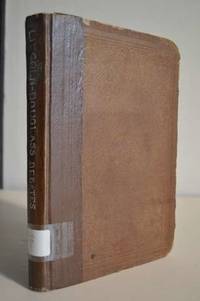
1860SKU1039674Follett Foster and Company 1860. First Edition. hardcover. Acceptable. 0x0x0. This Book is an Ex-Library Book with several library markings. Political debates between Hon. Abraham Lincoln and Hon. Stephen A. Douglas in the celebrated campaign of 1858 in Illinois; including the preceding speeches of each at Chicago Springfield etc.; also the two great speeches of Mr. Lincoln in Ohio in 1859 as carefully prepared by the reporter of each party and published at the times of their delivery. Follett Foster and Company; Columbus 1860. Hardcover. First Edition First Issue. First issue with no advertisements no rule above the publishers imprint on the copyright page and with numeral 2 at the bottom of page 17. An Acceptable brown cloth binding with blind stamped ornate design on boards re-enforced spine with handwritten white ink title and library locations sticker on spine binding shaky starting hinges with partially cracked rear hinge heavy wear to board corners with some loss some scuffing and discoloration to boards abrasions along board margins specifically to rear bit pulpy text block with age toning and scattered foxing throughout rubbing to board and spine edges previous owner handwritten ink info on front free endpaper few small dog-eared pages faint moisture stain on fore-edge and slightly on page margins several library markings include: library bookplate library due date card pocket embossed library stamp ink library stamps few ink and pencil notes barcode sticker without Dust wrapper. 8vooctavo or approx. 6 x 9 inches. 268pp. We pack securely and ship daily with delivery confirmation on every book. The picture on the listing page is of the actual book for sale. Additional Scans are available for any item please inquire. Follett, Foster and Company hardcover
1894112666Lincoln Memorial University 1894. Leather. Very Good. 1894 Lincoln Memorial University Sponsors edition #500 of unstated limitation. 12 volume gilt decorated full leather bindings top edge gilt. Fine condition with no issues. oversized and overweight. B67 Please email for photos. Lincoln Memorial University hardcover
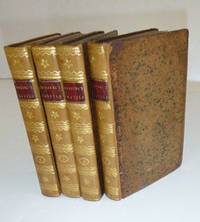
51-5978London : Printed for F. and C. Rivington . and sold by W. Richardson Cornwill1795. 8vo. 10.5 x 19.1cm. 4 vols. Contemporary mottled calf rebacked - calf spine gilt with red morocco title labels. Repair by A. & M. Winstanley's Salisbury Bookbinders England in 1969.Frontispiece and 4 plates in vol. 1; 4 plates in vol. 2. No plates in vols. 3 & 4.Second edition volume 4 lacks half-title advertisement leaf at end of volume 4 offsetting to text occasional spotting washed.Vol. I. Voyage to the Southern Parts of Europe and to the Cape of Good Hope in Africa. xii 318 index.x Vol. II. Containing two expeditions to the interior part of the country adjacent to the Cape of Good Hope and a voyage to the island of Java; performed in the years 1773 1774 and 1775.iv 316. index;.Vol. III. containing a voyage to Japan and travels in different parts of that empire. In the years 1775 and 1776. .xvi 286 xvi 32pp.Vol. IV. Travels in the Empire of Japan and in the Islands of Java and Ceylon together with the Voyage home. .xix 293 index. .OCLC Number / Unique Identifier:185263447 vol. 3 only. .Provenance : Sir Abraham Hume 2nd Baronet 29 February 1749 -24 March 1838 in London was a British floriculturist and Tory politician who sat in the House of Commons .Sep 30 2019 : Charles Berman mine medical officer and expert on primary liver cancer dies in Johannesburg. References. Verwey E.J. ed1995. London, : Printed for F. and C. Rivington ... and sold by W. Richardson, Cornwill,1795 unknown
18871002385New York City 1887. Invitation to Walt Whitman's private reception after his celebrated lecture "The Death of Abraham Lincoln" at Madison Square Theatre on April 14 1887. Whitman had given public readings of his Lincoln lecture variously edited since 1879; one version was published in Specimen Days in 1882-1883. Scheduled on the twenty-second anniversary of Lincoln's assassination the 1887 event was staged as a benefit for the ailing Whitman who remained seated throughout his sold-out tribute to the Union's "Martyr Chief": "there is a cement to the whole people subtler more underlying than any thing in written constitution or courts or armies - namely the cement of a death identified thoroughly with that people at its head and for its sake." As William Pannapacker notes Whitman's passionate public identification with Lincoln was central to his emergence as "The Good Gray Poet" a national treasure: "Whitman's experiments in self-creation finally succeeded with a major segment of the public when he enclosed his persona within the halo encircling the martyred President" Revised Lives 22. The New York audience for Whitman's performance included Mark Twain John Hay Augustus St. Gaudens James Russell Lowell and Charles Eliot Norton; Andrew Carnegie could not make it but purchased a box for $350. At the end of his performance Whitman was surprised by a gift of lilacs from poet E.C. Stedman's young granddaughter a reference to his great elegy for Lincoln "When Lilacs Last in the Dooryard Bloom'd." In New York City for a single night Whitman hosted a reception in his rooms at the Westminster Hotel after the lecture; this invitation was printed for the occasion. The evening was an important one for New York literary society a celebration "at least as spectacular as the event itself" according to the New York Sun. Looking "like a painting of Jove" Whitman entertained a constant stream of admirers relieved only by the performance of the Afro-Cuban violinist Claudio Brindis de Salas Garrido "El Paganini Negro" who serenaded Whitman on a seventeenth-century Ruggeri violin: "Walt was mightily pleased with the music." A surprising survival a near-fine artifact of the nineteenth-century American literary scene. Ivory card measuring 2.75 x 3.75 inches printed recto only: "Walt Whitman / At Home -- Thursday Evening / April 14th 1887 / Westminster Hotel Irving Place and 16th St. New York." Penciled bookseller note to verso: "April 14 1887 for his most famous lecture Lincoln / WW in NY for only one 1 night." Card lightly toned; half-inch closed tear to head expertly repaired. Housed in envelope fragment with penciled inventory number bookseller note and collector's note: "Whitman card / gift from Capt. Cohn -- / House of Books / Aug 7 1950.". unknown books
CBS 9780471370321USA Edition . New. Brand New! Fast Delivery US Edition and ship within 24-48 hours. Deliver by FedEx and Dhl & Aramex UPS & USPS and we do accept APO and PO BOX Addresses. Order can be delivered worldwide within 6-10 days and we do have flat rate for up to 2LB. Extra shipping charges will be requested if the Book weight is more than 5 LB. This Item May be shipped from India United states & United Kingdom. Depending on your location and availability. unknown
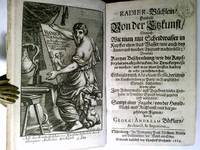
9a928Paul Fürstens/ Christoff Gerhard Nürnberg 1669. 10 Bl. 155 S. 2 Bl. mit einem gestochenem Frontispiz 16 Kupfertafeln und einem gestochenem Textkupfer Pergamenteinband der Zeit mit handschriftlichem Rückentitel Einband etwas fleckig/ Rücken unten eingerissen/ alter Stempel auf Titel oben rechts "königliche Hand Bibliothek". - VD 17 12:652368M/ Graesse I 501./ Frühe deutsche Ausgabe erstmals 1645 in Paris erschienen/ Die Kupfer zeigen die Werkstatt sowie verschiedene Drucktechniken/ innen sauber - unknown
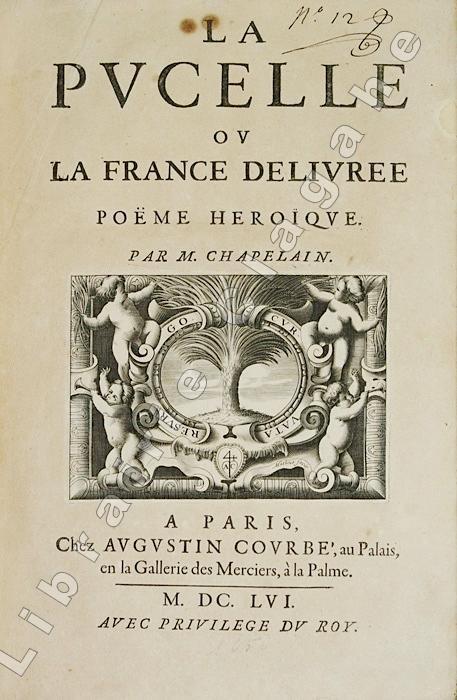
17788Paris, Augustin Courbé (imprimerie Jean Roger), 1656 ; in folio, basane havane, dos refait et plats d'époque conservés, fleurons dorés à l'ancienne ; 1blanc, frontispice, titre ; (6) ff. , portrait de l'auteur, (16) ff. , 522 pp. , (6) ff.
13144Paris, Melchior Tavernier, 1634. In-4, (11)-(58)-(2 : table) ff., reliure ancienne plein vélin crème (en partie débroché, papier bruni, quelques restaurations anciennes). Tampon humide : "Bibl. Sem. S. Sulp."
Signed, without inscription, by author upon title page. Also signed and inscribed by author upon front free endpaper. xvi, 662 pages. Black and white reproductions of archival photos. "Except for the last few chapters, this entire work was written from day to day during the three years of the author's internment in Santo Tomas and is therefore to be considered as a prison document. The writing of any such record as this was forbidden by the Japanese under strong menace. In the end they destroyed their own records and those of the successive internee executive committees, but the author's voluminous typescript, carefully hidden away, was never found by them. Every story is based on interviews with numerous persons who participated in the events they talked about." - Foreword. No dust jacket. Unmarked with somewhat above-average wear to grey boards. Binding intact. Please note that we are offering volume one only of this important two volume chronicle. Book
1574LBW-589Anvers 1574-1575 363 x 434 mm.
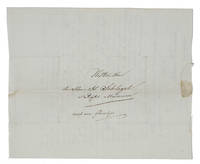
1834ABC_45429Noordwijk 1834. Folio 23 x 38.5 cm & 26 x 44 cm. 2 autograph letters each written on a single leaf and folded for posting with the address and remnants of a seal. 2 ll. Both letters were written by Abraham Hendrik Verster van Wulverhorst 1797-1882 living in Noordwijk Binnen near Leiden as a forester in the Dutch province of Zuid-Holland he was Inspecteur der Opperhoutvesterij. The present letters contain detailed observations on the Salamander punctata probably the European spotted salamandar now designated Salamandra salamandra. The letters further offer laudatory words regarding Heinrich Boie 1794-1827 who had also worked at the Rijksmuseum but had left for the Dutch East Indies to study the Southeast Asian fauna and sadly had died there in 1827. Also interesting remarks by Verster as a bird watcher on the bird migration: he had observed that the gallingo snipe and the rusticola woodcock were very early that year.The edges of the second letter are frayed. Otherwise in good condition. unknown
1370233Dijon: L.N. Frantin, 1790 in-12 (17,5 x 11 cm), xxx-[2]-350 p., 8 tableaux dépliants. Demi reliure veau d'ép., dos lisse orné, tranches rouges, qqs trous de vers au dos, plats frottés, autrement bel exemplaire exempt de rousseurs, anciens cachets sur la page de titre. Edition originale de la traduction française de ce livre important pour l'histoire de la minéralogie. Traduction de Madame Guyton-Morveau, considérée comme la meilleure de l'époque. Rare. Ref. W. E. Wilson. The History of Mineral Collecting & Schuh’s Annotated Bio-Bibliography.
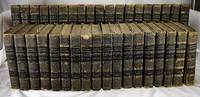
18192007240053London : Longman Hurst Rees Orme & Brown 1819. Hardcover. Good. Rees' Cyclopedia 37 volume set. Missing volumes 7 and 8. Bound in contemporary navy Russia Leather-backed marbled boards. Good bindings with minor shelf wear/rubbing. All edges marbled. Lacks the plate volumes. Armorial bookplate of John Proctor Anderdon. Anderdon 1760-1846 was a London merchant and noted collector. <br> Abraham Rees 1743-1825 was a British clergyman best known for this his outstanding encyclopedic work The Cyclopaedia. Initially published 1802-1820. Rees' work not only featured theological and humanistic issues but also extensive articles on mathematics and natural sciences. The Cyclopaedia "is the richest work for technology of the period with detailed text and handsome carefully prepared plates." Ferguson Eugene. "Contributions to Bibliography in the History of Technology part II". Technology and Culture 3.2 1962: 169 p. "Rees was convinced that the important progress made during the last decades of the eighteenth century especially in the fields of history geography geology natural history and the physical sciences senu lato required a new type of encyclopedia with the accent on these fields as well as the still relatively undeveloped domains of biography and the history of sciences. The Cyclopaedia thus became one of the first works of its kind to be compiled with the help of 'persons eminently distinguished in these branches of science to which they had devoted their talents.'" Taxon Vol. 35 No. 2 1986 This is an oversized or heavy book that requires additional postage for international delivery outside the US. Encyclopedia London : Longman, Hurst, Rees, Orme & Brown hardcover
186421371<p><i>Report of the Select Committee Relative to the Soldier's National Cemetery Together with the Accompanying Documents as Reported to the House of Representatives of the Commonwealth of Pennsylvania March 31 1864.</i></p> <b>ABRAHAM LINCOLN.</b>Book. Includes a foldout map of the planned cemetery and a copy of Lincoln's dedication. Published in Harrisburg 1864. Fair condition. <br /> hardcover books
6726Engraved frontis.; eight engraved vignettes and head- & tailpieces 19 finely engraved plates most folding & some engravings in the text. 18 p.l. 254 36 pp. of index & errata. Thick 8vo 160 x 105 mm. late 18th-cent. marbled boards extremities a little rubbed & worn. Dresden: C. G. Nitzsche 1765.<br/> <br/> An important German edition of Bosse’s Traité des manières de graver en Taille douce 1st ed. in French: 1645 considerably augmented for the German audience. This work was translated and published by Carl Gottlieb Nitzsche from the 1745 Cochin edition. The Cochin edition was the first to promote etching with hard etching-ground vernis dur instead of the soft etching-ground vernis mol to imitate line engraving. It also featured long sections on Le Blon’s color printing and the refining of mezzotint illustration. In the present book we find four illustrations of the rolling press which Cochin had updated to account for several design upgrades. There are also several diagrams and cross-sections of printing presses. <br/> <br/> This book is richly illustrated with plates and vignettes executed by Carl Gottfried Nestler 1730-80 that depict various techniques equipment and the interiors of print shops. Nestler reworked the engraved title-page from the 1645 first edition for this book’s frontispiece.<br/> <br/> A very good copy internally fresh. Unidentified engraved bookplates with the initials “G. F.†on front and rear paste-downs. <br/> <br/> ⧠Benezit Dictionary of Artists Vol. 10 p. 258 Nestler. unknown
171025803Amsterdam 1710. Copper-engraved map period hand-colouring in outline. Tables upper left and along the right side. Attractive map of North America based upon De L'Isle's highly influential map of North America published in 1700.<br/> <br/> By combining a wealth of information and geographical observation with delicate engraving and an uncomplicated composition this elegant map is a superb example from the golden age of French mapmaking and was published in Chatelain's Atlas Historique an important encyclopaedic historical atlas. California is shown as a peninsula with a number of villages and mountains; the Mississippi River extends far north of its true source. The table along the right side details the various native tribes from each region with lettered references for locating on the map.<br/> <br/> Lowery 263; Phillips 579. unknown
182718472Stockholm: Johan Horberg 1827. First edition. leather_bound. Contemporary half polished russet calf and marbled boards. All edges yellow. Fine. 137 pages. 27 1/2 x 22 cm. Forty-seven hand-colored engraved plates with tissue guards plus hand-colored vignette title and two engraved plates of music. Grafstrom poet and historian wrote the text and Forssell made the engravings. Index. List of Plates and errata. Costumes from Dalarna Helsingland Lappland Sodermanland Westergothland Smaland Blekinge and Skane. Lovely copy plates and text clean fresh and bright; bookplate raised bands spine panels richly guilt in floral motifs marbled endpapers maroon morocco spine label printed in gilt. Johan Horberg unknown books