400 résultats
1743185338Boston: S. Kneeland and T. Green 1743. Hardcover. Good pages are clean and clear. Missing title page and last two sermons. Rebound in white thick cardboard covers with cloth ties along spine; vi 110 pp. Full title: The necessity of holding fast the truth : Represented in three sermons on Rev. III. 3 : preached at New-York April 1742 : with an appendix relating to errors lately vented by some Moravians in those parts : to which are added a sermon on the priestly-office of Christ and another on the virtue of charity : together with a sermon of a Dutch divine on taking the little foxes faithfully translated. <br/>Includes: To the Reader on pages i-vi and signed by Benjamin Colman Thomas Prince John Webb William Cooper Thomas Foxcroft and Joshua Gee. The necessity of Holding Fast the Truth; Sermon II Sermon III Appendix. S. Kneeland and T. Green hardcover books
1733050535London: None Given 1733. First Edition. Softcover Disbound. Good Condition/No Dust Jacket. 8vo. Disbound pamphlet no wrappers light foxing pages untrimmed and some edge soiling & light wear. Size: 8vo. 33 pages. Quantity Available: 1. Shipped Weight: 1 pound or less. Category: Antiquarian & Rare; 18th century; Religion & Theology. Pictures of this item not already displayed here available upon request. None Given paperback
175779383London:: Printed for and sold by the Author.by Mr. Meadows 1757. old full calf attractively rebacked with a new calf spine and the original gilt-lettered spine labels. Bookplate on pastedown; a little foxing/age toning to the text; plates generally clean. Folio. This volume complete with 65 numbered engraved plates. This is Volume II ONLY. Printed for and sold by the Author...by Mr. Meadows, unknown
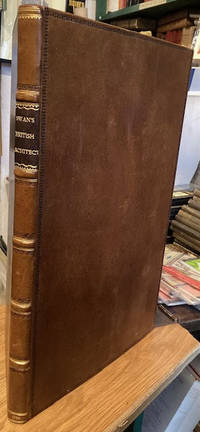
175747855London.: Printed for and sold by the author near the George in Portland Street Cavendish Square; by Mr. Brotherton over against the Royal-Exchange; Mr Buckland at the Buck in Pater-Noster Row; H. Piers and Partner at the Bible and Crown in High Holborn. 1757 - 1758. Later calf-backed marbled boards spine with compartments and black morocco label bearing titles in gilt board edges tooled in gilt. 3 vols. in 1. Folio 400 x 260 mm. Two vols with Title page Preface and a Description of the Plates each followed by 60 full page copper plate engravings all plates numbered signed and with imprints dated '1757'; final vol with Title page Introduction iii - viii Description of the plates beginning 'Of the Orders in General' pp. 1 - 16 followed by 65 numbered plates. PROVENANCE: Label of Doddington Library to front pastedown. Abraham Swan's extensive two volume study of domestic architectural designs 'A Collection of Designs' bound here with his seminal work on staircases 'The British Architect . ' .The two volume 'Collection of Designs' - the second of three pattern books published by Swan a carpenter and joiner - was his attempt to provide an inexpensive pattern book of inexpensive designs. Swan made his intentions of quantity over quality clear in his Preface: 'I hope that whatever defects may be observed in any of them will be candidly excused considering what a number of designs are contained in these two volumes and that they are all of my own contriving and drawing.' 'The first volume contains 4 engravings of the staircase at Blair Castle Perthshire which Swan designed for the Duke of Atholl 1757. Two Chinese Bridges for the grounds at Blair appear in the second volume. Swan's designs belong to the 'rococo' taste popular in the mid-18th century'. Weinreb.Swan's comprehensive work 'The British Architect' - first published 1745 here in the 3rd edition - was destined to be the first architectural book published in America. The title page of the earlier edition described the author as 'Abraham Swan Carpenter' later changed to 'Abraham Swan Architect.' The work includes the following: 'I. An easier more intelligible and expeditious Method of drawing the Five Orders than has been hitherto been published by a Scale of Twelve equal Parts free from those troublesome Divisions call'd Aliquot Parts. Shewing also how to glue up their Columns and Capitals.II. Likewise Stair-Cases those most useful ornamental and necessary Parts of a Building though never before sufficiently described in any Book Ancient or Modern; shewing their most convenient Situation and the Form of their Ascending in the most grand Manner: With a great Variety of curious Ornaments whereby any Gentleman may fix on what will suit him best there being Examples of all Kinds; and necessary Directions for such Persons as are unacquainted with the Branch.III. Designs of Arches Doors and Windows.IV. A great Variety of New and Curious Chimney-Pieces in the most elegant and modern Taste.V. Corbels Shields and other beautiful Decorations.VI. Several useful and necessary Rules of Carpentry; with the Manner of Truss'd Roofs and the Nature of a splay'd circular Soffit both in a streight and circular Wall never published before. Together with Raking Cornices Groins and Angle Brackets described.' From the title-page.Across all three volumes the title page imprint has been altered Meadows and Hitch and Hawes erased and replaced in ink manuscript with 'Mr Brotherton' and 'Buckland at the Buck'.'This is one of the books that had great influence on the builders and architects of eighteenth-century America.' Fowler.Park 80 / 79 first edition 1745 but citing other eds. including the present; RIBA Early Printed Books 3220; Fowler 341 second American edition 1794; Weinreb 1:166; Millard Architectural Collection Vol. 2 82; Berlin 2285. Printed for and sold by the author, near the George in Portland Street, Cavendish Square; by Mr. Brotherton, over against the Ro hardcover
174578052London:: Printed for the Author 1745. First edition. later old half calf and marbled boards. Large chips to the spine at both ends; leather worn at edges; rear joint cracked and weak. Contents very attractive. . Folio. Illustrated with sixty fine engravings; most of them full-page. . Printed for the Author, hardcover
175076374London: 1750. Narrow Folio. Second edition. viii 20 pp. 60 engraved plates complete some with accompanying text. Bound in a modern full speckled calf tooled in blind to board borders and with raised bands gilt ruling small blind details and gilt lettered label to spine. Binding just a touch rubbed at points with a few scratches. A few short closed tears to edges of leaves though otherwise very clean. Swan's designs here for "homes for the professional and middle classes in England were well suited to the needs of the colonial elite" The Met New York. This was the first architecture book printed in America when it was published in Philadelphia in 1775. An impressive work. Binding 42 cms. tall. . Near Fine. Full Speckled Calf. Second Edition. 1750. 1750 unknown
175043277London.: Printed for the Author. 1750. Full reverse calf front and rear boards ruled in blind and with pattern decoration in blind banded spine in seven compartments. Binding worn and rubbed corners bumped joints cracking head and foot of spine worn. Folio. 414 x 270 mm. Printed title 3 leaves with Swan's introduction 10 leaves with text and 60 engraved plates all printed recto only and numbered I - LX the five plates depicting the 'Orders' printed half-page vertically at right with explanatory text at left. PROVENANCE: Unidentified armorial bookplate to front pastedown with the motto 'rapido contrarius orbi'. A good unsophisticated copy of the second edition of Swan's building manual with the explanation of the 'Orders'.Swan's comprehensive work includes the following: 'The work contains: 'I. An easier more intelligible and expeditious Method of drawing the Five Orders than has been hitherto been published by a Scale of Twelve equal Parts free from those troublesome Divisions call'd Aliquot Parts. Shewing also how to glue up their Columns and Capitals.II. Likewise Stair-Cases those most useful ornamental and necessary Parts of a Building though never before sufficiently described in any Book Ancient or Modern; shewing their most convenient Situation and the Form of their Ascending in the most grand Manner: With a great Variety of curious Ornaments whereby any Gentleman may fix on what will suit him best there being Examples of all Kinds; and necessary Directions for such Persons as are unacquainted with the Branch.III. Designs of Arches Doors and Windows.IV. A great Variety of New and Curious Chimney-Pieces in the most elegant and modern Taste.V. Corbels Shields and other beautiful Decorations.VI. Several useful and necessary Rules of Carpentry; with the Manner of Truss'd Roofs and the Nature of a splay'd circular Soffit both in a streight and circular Wall never published before. Together with Raking Cornices Groins and Angle Brackets described.' From the title-page.'This is one of the books that had great influence on the builders and architects of eighteenth-century America.' Fowler.Park 79 first edition 1745 but citing other eds. including the present; Fowler 341 second American edition 1794; Printed for the Author. hardcover
17581605120006Printed for the Author 1758-01-01. Third edition. Hardcover. Acceptable. 60 plates. Full leather binding. Wear with loss to spine leather wear to boards with loss to leather especially at edges. Lacking end pages. Ink stains to title page. Early signature of James Yale no. 11 Brunswick Street Stockbridge Edinburgh Scotland inside front cover. Notes on blank sides of plates in an old hand. Some hand draw architectural sketches on blank pages. Scattered spotting / staining throughout. Contents: I. An easier more intelligible and expeditious method of drawing the five orders . by a scale of twelve equal parts . shewing also how to glue up their columns and capitals --II. Likewise stair-cases . shewing their most convenient situation and the form of their ascending in the most grand manner : with a great variety of curious ornaments . --III. Designs of arches doors and windows --IV. A great variety of new and curious chimney-pieces . --V. Corbels shields and other beautiful decorations --VI. Several useful and necessary rules of carpentry; with the manner of truss'd roofs and the nature of a splay'd circular soffit . together with raking cornices groins and angle brackets described. Builder's treasury of stair-cases. Avery p. 1002. This is an oversized or heavy book that requires additional postage for international delivery outside the US. Printed for the Author hardcover
1767D11183n.p. Berlin 1767. Hardcover. Very Good. 8vo 160 x 90mm. 4 363 1 pages. 18th-century mottled calf marbled endpapers and edges spine ends chipped scattered stains mostly marginal. Front flyleaf with contemporary French verse inscription Sur cet coteaux depouilles de verdure; je vois courir le lievre fuigtif et loiseau mort de froide accuse la nature and ownership inscription on title Elisabeth Lagravere. <br/><br/>French translation of Sulzers theory on the origins of pleasure following a Cartesian school of thought. Zurich native Johann George Sulzer was a well-established member of the Prussian Academy of Sciences and Belle-Lettres who published widely on the appreciation of art. Sulzers influence on aesthetic theory was well known within theoretical circles in late eighteenth century Berlin. Owing to the work of Descartes particularly his Passions of the Soul 1649 Sulzers work on the origins of pleasure aimed to initiate a move toward moral psychology and ethical theory within studies of the mind. Sulzer focused on the derivation of joy and gladness in the model of a Cartesian system; simply it opposed the idea of Hedonism which believed pleasure was the sole aim of humankind. Instead Sulzers theories supported a metaphysical experience within ones own cognitive condition. Sulzers work supplements the great accomplishment of many of his near contemporary theorists who contributed to the study of emotions Descartes Hobbes Malebranche and Spinoza. His work preceded that of Kants division of the mind into pleasure or pain and who with later Kant outwardly disagreed with the weakness of the proofs promulgated by Sulzer. Abraham Gotthelf Kästner was a German poet and mathematician also a devout Lutheran. He was known in his professional life for compiling and reflecting on content for textbook study. Kästner translated and revised this Sulzers theoretical work on pleasure showcasing his encyclopedic interests but remains better known for his contributions on the history of mathematics and his various epigrams. hardcover
1767D11183n.p. Berlin 1767. Hardcover. Very Good. 8vo 160 x 90mm. 4 363 1 pages. 18th-century mottled calf marbled endpapers and edges spine ends chipped scattered stains mostly marginal. Front flyleaf with contemporary French verse inscription Sur cet coteaux depouilles de verdure; je vois courir le lievre fuigtif et loiseau mort de froide accuse la nature and ownership inscription on title Elisabeth Lagravere. <br/><br/>French translation of Sulzers theory on the origins of pleasure following a Cartesian school of thought. Zurich native Johann George Sulzer was a well-established member of the Prussian Academy of Sciences and Belle-Lettres who published widely on the appreciation of art. Sulzers influence on aesthetic theory was well known within theoretical circles in late eighteenth century Berlin. Owing to the work of Descartes particularly his Passions of the Soul 1649 Sulzers work on the origins of pleasure aimed to initiate a move toward moral psychology and ethical theory within studies of the mind. Sulzer focused on the derivation of joy and gladness in the model of a Cartesian system; simply it opposed the idea of Hedonism which believed pleasure was the sole aim of humankind. Instead Sulzers theories supported a metaphysical experience within ones own cognitive condition. Sulzers work supplements the great accomplishment of many of his near contemporary theorists who contributed to the study of emotions Descartes Hobbes Malebranche and Spinoza. His work preceded that of Kants division of the mind into pleasure or pain and who with later Kant outwardly disagreed with the weakness of the proofs promulgated by Sulzer. Abraham Gotthelf Kästner was a German poet and mathematician also a devout Lutheran. He was known in his professional life for compiling and reflecting on content for textbook study. Kästner translated and revised this Sulzers theoretical work on pleasure showcasing his encyclopedic interests but remains better known for his contributions on the history of mathematics and his various epigrams. hardcover books
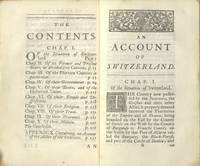
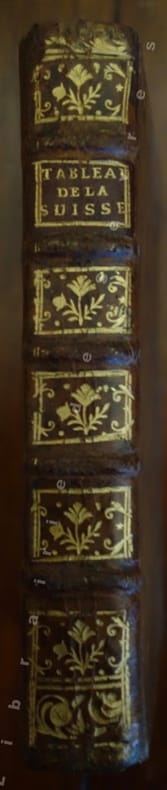
1714008296London : at Shakespear's Head over-against Catherine-street in the Strand.: Jacob Tonson 1714. 1st Edition . Hardcover. Very Good. 12mo - over 6¾ - 7¾" tall. First edition 1714 in full calf gilt tooled central image a few small marks edge blind tooling tips repaired. Professionally respined gilt & blind tooling gilt titles to black morocco label. Internally title within double ruled border & vignette port. of Shakespeare 8 1 2-247 pp marbled endpapers faded gilt text block edges some edge browning more towards end. Uncommon at printing no other copy available commercially! 188114 mm. The author describes the people customs economy and trade militia as well as the government and democratic institutions. The book was used by William Coxe in his Sketches of Switzerland published in 1779 and was the first significant book on the country by an English traveler. The appendix is an Account of the Allies of the Switzers. <br/> <br/> Jacob Tonson hardcover
1766173751766 Imprimé à Fribourg et se trouve à Paris, Chez Lottin le jeune, 1766, in-12 de XII-384 pp., rel. d'ép. de plein veau brun granité, dos à nerfs orné de fers dorés, pièce de titre de chagrin rouge, bon ex.
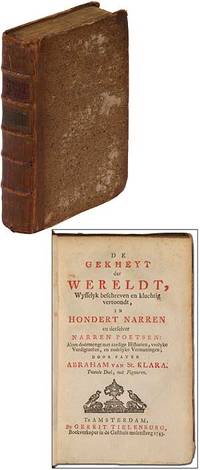
1743318179Amsterdam: Gerrit Tielenburg 1743. Hardcover. Very Good. Later edition but first by this publisher. Small octavo. Contemporary half-calf with red and green morocco spine labels gilt. 546 14pp. Engraved title Illustrated with engravings in text. Modest rubbing and wear to the extremities a handsome very good or better copy in contemporary binding. A compendium of jesters and fools. Part Two Only but apparently complete unto itself. OCLC locates a single copy of this edition in Tilburg. Gerrit Tielenburg hardcover
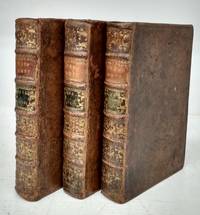
1763146314Amsterdam: Gerrit Ten Boekelaar 1763. Hardcover. Very good. 3 vols.: 6 382; 6 367 14; 4 393 18 p. 16 cm. Engraved title in vol. I. Black and red title pages. Full leather with gilt trim on spines marbled endpapers and red text block edges. Light wear to extremities. Dutch text. <br/><br/>Title continues: "Welke Hutte niet alleen met Loof-en Bladeren maar met een Tafel vol heerlyke Spysen en Vruchten voorzien is: Aangericht Voor Jooden Ter Bekeering Voor Christenen Ter Leering. Met Veele uitgeleezene zoo wel Heilige als andere Zinryke Geschriften Geschiedeniffen en Gedichten verciered. Door Pr. Abraham a st. Clara. Augustiner der Barvoeteris-Ordens en Roomsch-Keyserlyke Hof-Prediker Uit bet Hoogduitsch Vertaaldt." Gerrit Ten Boekelaar hardcover
171037844Frankfurt a. M. 1710. First edition. Hardcover. fair to g. Folio. 1 leaf 4 leaves 99 leaves 114 leaves 9 leaves 13 leaves 1 leaf. Contemporary brown leather with blind tooling along the border and spine as well as raised bands. Blue edges. Illustrated title page with image of a swan. Head and tail pieces. Commentary on the Talmud that elucidates contradictions within the text. Author makes use of gematriot based on his name. Text printed in double columns with talmudic text in regular script and author's comments in Rashi script. Source notes on side margins. Text in Hebrew. Significant peeling and scratching to leather boards. Bottom edge torn. Tail of spine mostly missing. Some misnumbering to leaves. Leaf 5 was bound after the fact. Name of previous owner on front endpaper. Heavy foxing to leaves. Overall in fair to good condition. hardcover
1710precDisbound quarto; 15 x 23 cm; xii 56 pages; worn and soiled; blindstamp of Chicago Theological Seminary on title page.<br /><i>Seder Mitzvot Nashim</i> The Order of Women's Precepts by Benjamin Aaron ben Abraham Slonik of Grodno c. 1550–c. 1619 translated into Italian by Jacob ben Elhanan Heilbronn in 1614; this copy printed in Venice 1710. <br /><br />A practical and fairly sympathetic guide to women's ritual obligation first published in Yiddish in Cracow 1577 in Italian in Padua 1616. This was probably the most popular of the rabbinical guides to a woman's three ritual obligations: 1 the taking of a piece of dough before baking bread 2 the lighting of lights on the eve of the Sabbath and festivals and 3 observing the various rules of ritual purity during and after menstruation. It went through numerous editions in Yiddish and Italian through 1750. OCLC locates ten copies of this edition.<br /> Gioanni de'Paoli. Nella Stamparia Bragadina books
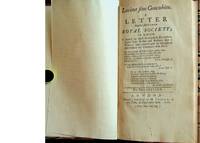
1750AA429London: M. Cooper 1750. Third. <p>Hoax- Hill "Sir" John "Abraham Johnson" Lucina sine Concubitu A Letter humbly address'd to the Royal Societythat a woman might conceive and be brought to Bed without any Commerce with Man The Third Edition light staining to inner margin of title modern roan-backed marbled boards 8vo by MCooper 1750</p> <p>An amusing satire concerning women becoming pregnant without sexual intercourse written by "Sir" John Hill in revenge for his rejection by the Royal Society One of 5 London editions issued in 1750 two designated "third" this with 50pp another with 35pp; there was also a Dublin printing</p> <p>From Wikipedia:</p> <p>"Sir" John Hill was an English composer actor author and botanist He contributed to contemporary periodicals and engaged in literary battles with poets playwrights and scientists He is remembered for his illustrated botanical compendium The Vegetable System one of the first works to use the nomenclature of Carl Linnaeus In recognition of his efforts he was created a knight of the Order of Vasa in 1774 by Gustav III of Sweden and thereafter called himself Sir John Hill</p> <p>During the 1740s and especially in 1746â€"1747 Hill attended many meetings of the Royal Society and there presented the results of several of his studies both in the field of botany on the propagation of moss medicine a surgical operation to remove a needle from the abdominal wall of a man and geology-chemistry on the origin of the sapphire's colour on chrysocolla on an alternative to Windsor loam for the making of fire-resistant bricks His works On the manner of seeding mosses and On Windsor loam appeared in the Royal Society's journal the Philosophical Transactions</p> <p>On the basis of these contributions Hill apparently hoped to be elected Fellow of the Royal Society Furthermore he had the backing of several members of the Royal Society: the botanist Peter Collinson the physician and scientist William Watson and the antiquarian William Stukeley Moreover Hill had links with important nobles: John Montagu 2nd Duke of Montagu and Charles Lennox 2nd Duke of Richmond also Fellows of the Royal Society; and Sir Thomas Robinson Governor of Barbados and antiquarian Despite Hill's merits as a scientist at a time when many Fellows had no scientific background and his relations his election to the title of Fellow failed to materialise</p> <p>Disappointed by the Royal Society's lack in his opinion of scientific standards Hill started to criticise the Society In December 1749 he started writing anonymous critical reviews of some articles published in the Philosophical Transactions Moreover in January 1750 Hill began a campaign of criticism and derision against the Royal Society and its president Martin Folkes by publishing under an alias a treatise entitled Lucina sine concubitu A letter humbly address'd to the Royal Society; In which is proved by most Incontestable Evidence drawn from Reason and Practice that a Woman may conceive and be brought to bed without any commerce with Man Under the false name of Abraham Johnson a physician and man-midwife Hill claimed to have observed cases where women had become pregnant without having had any kind of sexual relations with a man</p> <br /> 50 pp. M. Cooper unknown
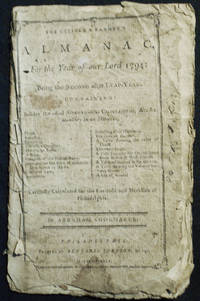
1793007662Philadelphia: Benjamin Johnson 1793. Paperback. Good. 36 p.: illustration; 17 cm. Stitched. Wrapper included in page count. Woodcut illustration of "The Anatomy of Man's Body as governed by the Twelve Constellations." "David Jenkins" written in the margin of one page. Not in Early American Imprints or Morrison's Preliminary Check List of American Almanacs. One copy in WorldCat. This appears to be the earliest of the many almanacs for which Abraham Shoemaker provided calculations. Very scarce. In Good Condition: restitched at some point; loss at edges of front wrapper; old dampstaining heaviest on back wrapper and preceding leaf; loss at lower edge of back wrapper without loss of text; minor ink marks in a few margins; corners creased. Benjamin Johnson paperback
1732129198La Haye : Chez P. Gosse & J. Neaulme 1732. First Edition. Hardback. Full contemporary tree calf very good. Red Morocco label; spine compartments uniformly tooled in gilt. Generalized wear to extremities with insignificant dust-dulling. Internally altogether clean and quite sound. Scans and additional detail on request. ; 165 pages; Physical desc. : c 165 i. E. 157 2 p. ; 8vo. Subject: Jesus Christ - Resurrection. La Haye : Chez P. Gosse & J. Neaulme hardcover
1767JC14337London: Printed by T. Jones. and Sold by T. Payne. / Printed by W. Oliver. and Sold by T. Payne and Son. et al 1767-8. First Edition. Hardcover. Very Good. Contemporary specked calf ornate gilt-stamped border on boards gilt-stamped lettering and ornament in spine compartments 5 raised bands; complete set of 9 volumes published and bound as Volume I Parts i-ii Volume II Parts i-iii Volume III Parts i-iv 8vo; pp. xlvi 384; 384; 315; 335; 540 3 blank errata; 403; 432; 462; 505 1 errata. Volumes I-II bound as the first 5 volumes of this set printed by T. Jones 1768 and with the armorial bookplate of Reverend John St. John of Farley; Volume III the last 4 volumes of this set printed by W. Oliver 1767. Several boards detached. Nevertheless a nice set of the rare first edition difficult to find in a straight run. Images available upon request. <br/><br/> Printed by T. Jones... and Sold by T. Payne... / Printed by W. Oliver... and Sold by T. Payne and Son... [et al] hardcover
1767JC14337London: Printed by T. Jones. and Sold by T. Payne. / Printed by W. Oliver. and Sold by T. Payne and Son. et al 1767-8. First Edition. Hardcover. Very Good. Contemporary specked calf ornate gilt-stamped border on boards gilt-stamped lettering and ornament in spine compartments 5 raised bands; complete set of 9 volumes published and bound as Volume I Parts i-ii Volume II Parts i-iii Volume III Parts i-iv 8vo; pp. xlvi 384; 384; 315; 335; 540 3 blank errata; 403; 432; 462; 505 1 errata. Volumes I-II bound as the first 5 volumes of this set printed by T. Jones 1768 and with the armorial bookplate of Reverend John St. John of Farley; Volume III the last 4 volumes of this set printed by W. Oliver 1767. Bindings just a bit worn with some bumping and very light chipping along spines and edges of boards. Contents somewhat tanned with some faint foxing here and there but overall tight bright clean and unmarked. A nice set of the rare first edition difficult to find in a straight run. <br/><br/> Printed by T. Jones... and Sold by T. Payne... / Printed by W. Oliver... and Sold by T. Payne and Son... [et al] hardcover books
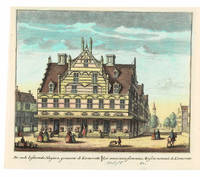
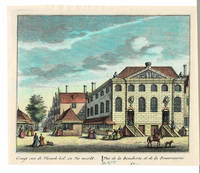
173698583Amsterdam: Leonardus Schenk 1736. 1736. Very good. - A 6 inch high by 7-1/2 inch wide handcolored engraving on a 7 inch high by 7-3/4 inch wide sheet of watermarked laid paper. The image was drawn by Abraham Rademaker and the copperplate engraving is by Leonardus Schenk. "Delft" and what appears to be an initial are penned in ink in an early hand along the bottom margin. Near fine. <p>The print originally appeared in the view book: "Alle de voornaamste gesigten Van de Wydberoemde Steeden Alkmaar Delft en Dordregt Geleegen in de Provintie van Holland Vertoont in Seeven-en-sestig afbeeldingen Naar het Leeven geteekent door Abraham Rademaker En in het Kooper gebragt door Leonardus Schenk". Published Amsterdam Leonardus Schenk 1736. Amsterdam: Leonardus Schenk, 1736. unknown
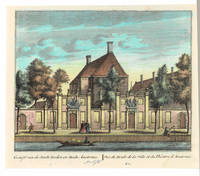
173698580Amsterdam: Leonardus Schenk 1736. 1736. Very good. - A 6 inch high by 7-1/2 inch wide handcolored engraving on a 7 inch high by 8-1/8 inch wide sheet of watermarked laid paper. The image was drawn by Abraham Rademaker and the copperplate engraving is by Leonardus Schenk. "Delft" and what appears to be an initial are penned in ink in an early hand along the bottom margin. There is some slight dampstaining to the bottom right corner. Very good. <p>The print originally appeared in the view book: "Alle de voornaamste gesigten Van de Wydberoemde Steeden Alkmaar Delft en Dordregt Geleegen in de Provintie van Holland Vertoont in Seeven-en-sestig afbeeldingen Naar het Leeven geteekent door Abraham Rademaker En in het Kooper gebragt door Leonardus Schenk". Published Amsterdam Leonardus Schenk 1736. Amsterdam: Leonardus Schenk, 1736. unknown
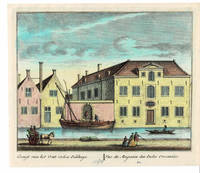
173698591Amsterdam: Leonardus Schenk 1736. 1736. Very good. - A 6 inch high by 7-1/2 inch wide handcolored engraving on a 7 inch high by 8-1/4 inch wide sheet of laid paper. The image was drawn by Abraham Rademaker and the copperplate engraving is by Leonardus Schenk. "Delft" and what appears to be an initial are penned in ink in an early hand along the bottom margin. Near fine. <p>The print originally appeared in the view book: "Alle de voornaamste gesigten Van de Wydberoemde Steeden Alkmaar Delft en Dordregt Geleegen in de Provintie van Holland Vertoont in Seeven-en-sestig afbeeldingen Naar het Leeven geteekent door Abraham Rademaker En in het Kooper gebragt door Leonardus Schenk". Published Amsterdam Leonardus Schenk 1736. Amsterdam: Leonardus Schenk, 1736. unknown
173698582Amsterdam: Leonardus Schenk 1736. 1736. Very good. - A 6 inch high by 7-1/2 inch wide handcolored engraving on a 7 inch high by 8-1/2 inch wide sheet of watermarked laid paper. The image was drawn by Abraham Rademaker and the copperplate engraving is by Leonardus Schenk. "Delft" and what appears to be an initial are penned in ink in an early hand along the bottom margin. Near fine. <p>The print originally appeared in the view book: "Alle de voornaamste gesigten Van de Wydberoemde Steeden Alkmaar Delft en Dordregt Geleegen in de Provintie van Holland Vertoont in Seeven-en-sestig afbeeldingen Naar het Leeven geteekent door Abraham Rademaker En in het Kooper gebragt door Leonardus Schenk". Published Amsterdam Leonardus Schenk 1736. Amsterdam: Leonardus Schenk, 1736. unknown