775 résultats
18831170313.20Lane S. Hart Printer Harrisburg PA 1883. Paperback. Good. 8vo paperback. Original paper pamphlet. Good condition. Spine reinforced with aging transparent tape; chipping around edges of front & rear covers w/ faint water-stain at lower corner of front/rear cover not affecting interior: Contents clean no markings binding firm. 32 p. fold-out map reproducing John Smith's 1606 map of Virginia. Lane S. Hart, Printer, Harrisburg, PA paperback
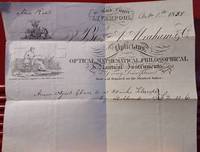
1838001861Liverpool: A. Abraham & Co 1838. No Binding. Very Good/No Jacket. An illustrated trade receipt dated 1838 for a new Object Glass for a 30 inch telescope. I find this curious as I can find no mention of a telescope of this size in 1838. The receipt mentions the lens' construction by Dollond the famous telscope manufacturers of that time. Generally in very good condition with a 1cm closed tear on the edge of one of the folds of the receipt. With some light pencil notes on the rear <br/> <br/>An illustrated trade receipt dated 1838 for a new Object Glass for a 30 inch telescope. A. Abraham & Co unknown
18454416Wien: Edlen v. Schmid und Busch 1845 139 pp.; cover is worn; spine is missing; foxed; else n good- condition. Size: 21 cm Tall Edlen v. Schmid und Busch hardcover
189530940cPALMA: Establecimiento Tipográfico de B. Rotger 1895. 4º.- 63 páginas.- Rústica cubiertas originales. . Establecimiento Tipográfico de B. Rotger unknown
189522575PALMA: B. Rotger 1895. Primera edición.- 4º.- Rústica cubiertas originales.- 63 páginas.- 71 páginas.- 80 páginas.- 79 páginas. Contiene: Edad de oro - El Arte del Canto - Verdi - Apogeo del Canto - La decadencia del Canto. B. Rotger unknown
1821133T2Printed for F. Nichols by Clark & Raser Philadelphia: 1821. 1821 144 p. 12mo. Original leather backed paper boards. Very scarce American Imprint. PRICE JUST REDUCED! SMALL BOX 7 Language: eng. Hardcover. Good. Printed for F. Nichols by Clark & Raser, Philadelphia: 1821. hardcover
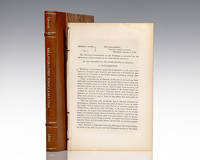
1863149486Washington: Government Printing Office January 2 1863. Rare first War Department and fifth overall printing of the Emancipation Proclamation. Twelvemo General Orders No. 1 extracted from the larger volume of orders for 1863 4 pages disbound. President Lincoln had intended to issue the order earlier in 1862 but deliberately delayed its release until after the Union's strategic victory at Antietam at which point he announced the Preliminary Emancipation Proclamation. General Order No. 139 September 22 1862 which declared that all slaves held in rebelling states would be forever free from the first day of January 1863. The text of the final Emancipation Proclamation present in this order is noted for its direct and decisive language: "By the President of the United States of America . That on the first day of January in the year of our Lord one thousand eight hundred and sixty-three all persons held as slaves within any State or designated part of a State the people whereof shall then be in rebellion against the United States shall be then thenceforward and forever free; and the Executive Government of the United States including the military and naval authority thereof will recognize and maintain the freedom of such persons and will do no act or acts to repress such persons or any of them in any efforts they may make for their actual freedom." The first printing for the War Department of General Orders No. 1 was distributed to various military outposts and bureaus throughout the United States. Based on the extensive research of Charles Eberstadt the copy for the War Department was the fifth time the final version of the Emancipation Proclamation appeared in print on January of 1863 following three hastily prepared issues for the State Department and another for Lincoln's hometown Illinois States Journal newspaper in Springfield Illinois. A copy of the War Department Printing was included in the Grolier Club's One Hundred Influential American Books Printed before 1900. Eberstadt 12; Grolier Club One Hundred Influential American Books 71; Streeter 1751. In near fine condition. Housed in a custom half morocco case. A scarce work. The Emancipation Proclamation issued by President Abraham Lincoln on January 1 1863 represented a pivotal moment in the trajectory of the American Civil War and the broader struggle over the institution of slavery. Although it did not immediately free all enslaved individuals the proclamation declared that all persons held as slaves in states or parts of states still in rebellion against the United States were to be henceforth free. This executive order grounded in Lincoln's war powers as commander-in-chief was intended primarily as a military measure to weaken the Confederacy by undermining its labor force and discouraging foreign powers from recognizing or supporting the secessionist cause. The proclamation also signaled a significant shift in Union war aims reframing the conflict from a struggle solely to preserve the Union to one explicitly linked to the abolition of slavery. While its immediate legal impact was limited to areas outside Union control the Emancipation Proclamation laid the groundwork for the eventual passage of the Thirteenth Amendment which formally abolished slavery throughout the United States. Government Printing Office unknown
1862100336Newspaper folio unbound 8pp. Dampstained browned at edges with some foxing early owner's ink stamp on top margin some small tears and chips along edges and a little creasing. Still in decent shape overall. This is one of the earliest printings of the Emancipation Proclamation which was issued on September 22 1862. The Emancipation Proclamation declared freedom for all slaves in any Confederate state that didn't return to the Union by January 1 1863. Although this executive order did not actually free a large number of slaves it set the stage for the freedom of all slaves. Coverage of the Emancipation in this newspaper begins in the middle of the first page. This newspaper article represents important coverage of a very significant event in American History. archives government exhibits emancipation website
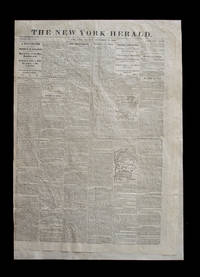
186268870New York: The New York Herald 1862. Full Description:<br> <br> LINCOLN Abraham. Emancipation Proclamation."A Proclamation by the President of the United States. Operations of the Confiscation Act. All Slaves in States in Rebellion January 1 1863 to Be Free." New York. Published in: The New York Herald Tuesday September 23 1862. Whole No. 9506.<br> <br> The publication of Lincoln's Emancipation Proclamation in James Gordon Bennett's pro-Democratic New York Herald and one of if not the first official public announcements of the preliminary Emancipation Proclamation.<br> <br> Broadsheet folio one large leaf folded along top to make four pages two leaves printed on recto and verso. Six-column format. 22 x 15 1/2 inches; 560 x 395 mm. Light creases down the middle in both directions. Some nearly invisible repaird along top margin and edges. Some of the repairs just touching a few letters in the headline. Still a very good copy of this important declaration. We could only find 3 copies of this at auction and it is not mentioned in Eberstadt. Eberstadt mentions that his Third edition of the Emancipation has a publication date somewhere between September 24th and 26th therefore putting the current copy before this. Eberstadt's first and second edition are the official state department editions printed the day of the declaration September 22nd just the day before this New York Herald was printed.<br> <br> Abraham Lincoln issued the preliminary Emancipation Proclamation on September 22 1862 stating that if the rebelling states did not cease fighting and rejoin the Union by January 1 1863 the slaves in those states would be set free. The New York Herald issued this front-page top left corner early printing of Lincoln's Proclamation the very next day appearing under the headline: "All Slaves in States of Rebellion January 1 1863 to Be Free."<br> <br> "Lincoln read the first draft of what came to be known as the Preliminary Emancipation Proclamation to his cabinet on 22 July 1862. Given the criticism directed at Lincoln for moving too slowly on the issue of emancipation it is worth noting that this first reading took place just sixteen months after he had pledged not to 'interfere with the institution of slavery in the States where it exists.' He continued to revise the document throughout the summer and following the Union victory at Antietam he issued the preliminary proclamation-which managed to balance daring with prudence-on 22 September. This first proclamation essentially gave the Rebel States one hundred days to return to the Union after which period any slaves within their borders would be "then thenceforward and forever free." Any rebellious states that returned to the Union in the interim would be able to adopt immediate or gradual-and compensated-abolition of slavery within their borders." Sotheby's.<br> <br> The front page of this newspaper also contains two maps and reports of the campaigns in Kentucky.<br> <br> HBS 68870.<br> <br> $3500. The New York Herald unknown
186369186Boston: Boston Daily Courier 1863. Full Description:<br> <br> LINCOLN Abraham. Emancipation Proclamation."President's Proclamation. Emancipation of Slaves in Rebellious States." Boston. Published in: Boston Daily Courier Volume LXXVIII no. 2. Friday Morning January 2 1863.<br> <br> The publication of Lincoln's Emancipation Proclamation in the Boston Daily Courier and one of if not the first official public announcements of the Final Emancipation Proclamation once it was signed and in effect as of January 1 1863. The Proclamation is featured at the top of the center column of page 3.<br> <br> We could find no other copies of this or any other January 2nd edition at auction and it is not mentioned in Eberstadt. Eberstadt's entry for the second edition of the "Final Proclamation" Eberstadt 9 states "Second edition. Apparently the only separate newspaper edition of the final proclamation and the earliest non-official edition. Printed on Friday evening January 2 1863 this Extra in point of chronological sequence was preceded only by the first official edition." Our present copy although not a separate newspaper edition was rushed to press and published in the Friday Morning edition of the Courier placing it's publication prior to Eberstadt 9.<br> <br> According to Eberstadt "A number of newspapers did not issue on January 2nd because of the previous day's holiday but most of those that did carried the final proclamation. Many of the others printed it on January 3rd." pg. 17.<br> <br> Broadsheet folio one large leaf folded along side to make four pages two leaves printed on recto and verso. Seven-column format. 26 x 19 inches; 655 x 490 mm. Light creases down the middle in both directions. A few minor closed tears. A large old ink signature along top margin of front page causing some bleed-through and foxing but not affecting text. Still a very good copy of this important declaration.<br> <br> Abraham Lincoln issued the preliminary Emancipation Proclamation on September 22 1862 stating that if the rebelling states did not cease fighting and rejoin the Union by January 1 1863 the slaves in those states would be set free. Once January 1st 1863 arrived President Lincoln signs and issues the final Emancipation Proclamation freeing the slaves in the Confederate states. The Boston Courier issued this early printing of Lincoln's Proclamation the very next morning January 2 1863. "<br> <br> HBS 69186.<br> <br> $8500. Boston Daily Courier unknown
186210466Washington: Government Printing Office 1862. Hard Cover. Very Good binding. Octavo. 910 pp. First edition. As issued in publisher's embossed cloth; spine titled "Messages / and / Diplomatic / Correspondence. / 1862 / Ho. Reps." Binding is a trifle sunned at the spine but generally it presents quite nicely; early and occasional tidelines; occasional scattered foxing. <br /> <br /> This contains Lincoln's second "State of the Union" though at that time it was a printed message rather than an address. In this message Lincoln tangles with the year and a half old civil war and his struggle to preserve the Union while wrestling with the central impasse of the rebellion slavery. A remarkable address that contains at the conclusion one of his memorable lines "The dogmas of the quiet past are inadequate to the stormy present. The occasion is piled high with difficulty and we must rise with the occasion. As our case is new so we must think anew and act anew. We must disenthrall ourselves and then we shall save our country" p. 23. Of profound importance and one of Lincoln's boldest moves to "rise with the occasion" this volume contains the 22 September 1862 preliminary Emancipation Proclamation the final version would be issued and enforced a month after Lincoln's message. The idea of an executive action that would free the slaves in states that were in open rebellion with the Union came in the summer of 1862. An early version of the proclamation was read by Lincoln to his cabinet in July 1862. On the advice of Secretary of State William Seward this penultimate version of the proclamation was thought to be more effective if issued after a significant Union victory—that victory turned out to be at Antietam. The Emancipation Proclamation is among the most important documents in United States history and this preliminary version offers a glimpse into Lincoln's steps towards the abolition of slavery in service of the preservation of the Union. Government Printing Office unknown
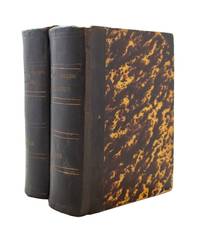
186369520Washington D.C.: War Department 1863. CIVIL WAR. War Department General Orders 1863. Washington D.C.: War Department 1863.<br> <br> Full Description:<br> <br> LINCOLN Abraham. CIVIL WAR. Emancipation Proclamation War Department General Orders 1863. Washington D.C.: War Department 1863.<br> <br> The first War Department printing General Orders #1 Jan 2 1863 and fifth overall printing of the final Emancipation Proclamation. The 4 page pamphlet bound together with a nearly complete run of War Department general orders for the year 1863. Two octavo volumes 6 7/8 x 4 5/8 inches; 174 x 119 mm. Volume I comprising General Orders of the War Department Adjutant General's Office Numbers 1-221 2 January 1863 to 16 July 1863 and Volume II comprising Numbers 222-400 16 July 1863 to 28 December 1863. Nearly complete only lacking numbers 55 63 116-119 148 in volume I and 274 352 and 381 in volume II. With 5 copies of number 149 and and 3 copies of number 240.<br> <br> Contemporary half calf over marbled boards. Spine lettered in gilt. All edges speckled brown. Hinges repaired. Some rubbing to board edges. Previous owner's contemporary ink signature Bvt. Col. E.J. Wells on front paste down of each volume. Numerous annotations in the same old ink throughout generally noting when the order was received and dated 1863. Some glue marks to the General Order #1 not affecting text. A small tear to last leaf of text in volume I with no loss. Overall a very good copy.<br> <br> In addition to the very important first War department printing of the Emancipation Proclamation these volumes contain several other very important and interesting General Orders from the War Department as well as President Abraham Lincoln in relation to the military during this year in the Civil War.<br> <br> Notably:<br> <br> No. 100 April 24 "Instructions for the Government of Armies of the United States in the Field." "commonly known as the 'Lieber Code' after its main author Francis Franz Lieber. The Lieber Code set out rules of conduct during hostilities for Union soldiers throughout the U.S. Civil War. Even today it remains the basis of most regulations of the laws of war for the United States. The Lieber Code consists of 157 provisions that deal with a wide range of legal issues that must be considered in armed conflict. It contains general principles but also very detailed rules. Among the issues addressed are whether armed force is justified by military necessity the principle of humanity the distinction between combatants and civilians POW status retaliation and permissible methods and means of warfare." LOC"<br> <br> No. 143 May 22 the establishment of the United States Colored Troops. This authorized the establishment of a bureau regulating the recruitment training and organization of the U.S. Army's first regiments composed entirely of African-American soldiers.<br> <br> Numerous court cases are documented including #17- The sentenced hanging death of a "colored man" for "attempted rape". #346- The trial of George Woolfolk for "Being secretly within lines of the US forces as the same time belonging to the so-called Confederate Army." He was sentenced to be shot to death. And #396- The trial brought by Colonel John Gault against Dr. Aaron James for "Being the captain of a band of guerillas or marauders and shooting at US soldiers." He was sentenced to death but the President disapproved the sentence and directed him to be released.<br> <br> A number of orders of Military discharges both honorable and dishonorable as well as military promotions. #337 announces "Major General U.S. Grant U.S. Army is placed in command of the Military Division of the Mississippi Headquarters in the field." #349 announces "Major General William T. Sherman is appointed to the command of the Department and Army of the Tennessee Headquarters in the field." #194 is the appointment of Major General George Meade as commander of the Army of the Potomac who would defeat General Robert E. Lee at Gettysburg only days later. And #398 honors Ulysses S. Grant for his Mississippi River campaign and presents him a gold medal.<br> <br> Numerous obituaries including #71 which announces the death of Major General E.V. Sumner who fell ill and died on his way to take command of the Department of the Missouri and directs the ways that Department should give him military honors.<br> <br> Important presidential proclamations including #58- Calling to all soldiers who were "absent without leave" urging them to return to their regiments and would not face punishment beside loss of wages for time missed. #252- Orders regarding the treatment of prisoners of war stating that 'if the enemy shall sell or enslave anyone because of his color the offence shall be punished by retaliation upon the enemy's prisoners in our possession'. "President Abraham Lincoln issued an 'eye-for-eye' order warning the Confederacy that Union soldiers would shoot a rebel prisoner for every Black prisoner shot. It also would condemn a rebel prisoner to a life of hard labor for every Black prisoner sold into slavery. AA Registry. #315- Lincoln's suspension of the "writ of habeas corpus." "The doctrine of habeas corpus is the right of any person under arrest to appear in person before the court to ensure that they have not been falsely accused. Lincoln's suspension of the "writ of habeas corpus" was one of the most controversial acts of his administrations. Lincoln defended himself against charges that his administration had subverted the Constitution however arguing that acts that might be illegal in peacetime might be necessary "in cases of rebellion" when the nation's survival was at stake." The Gilder Lehrman Institute of American History. #340- Proclamation by the President calling for three hundred thousand volunteers. "Whereas the term of service of a part of the volunteer forces of the United States will expire during the coming year; and Whereas in addition to the men raised by the present draft it is deemed expedient to call out 300000 volunteers to serve for three years or the war not however. exceeding three years."<br> <br> And numerous other General Orders pertaining to soldiers and the war effort including #35- A list of items that could be sold to soliders by sutlers. #40- The establishment of a Volunteer force for Kentucky. #163- "A resolution to encourage the enlistments in the Regular Army and Volunteer forces." #323- which authorized each enlisted cook "two under-cooks of African descent who shall receive for their full compensation ten dollars per month and one ration per day." #351- This discusses the governance of "The Employment of women nurses in the U.S. General Hospitals." and #364 which discusses the cos of clothing and camp for the U.S. Army and includes a folding chart.<br> <br> Eberstadt 12. Grolier 100 American 71. Streeter 1751.<br> <br> HBS 69520.<br> <br> $7500. War Department unknown
1865863261865. BROADSIDE - Lithograph LINCOLN Abraham. EMANCIPATIONS PROKLAMATION. Davenport Iowa: W.H. Pratt 1865. August Hageboeck lithographer. This is the second German-language version of the Emancipation Proclamation. It is printed in cursive within an oval border. The weight of the individual letters is varied so that when viewed from a distance a portrait of Lincoln emerges from the text. Originally printed on a rectangular sheet but here trimmed to an oval that surrounds the image the sheet is 37 x 29.5 cm. The image is 32 x 23 cm. The paper is browned and dampstained at the bottom center at the copyright information. It is matted and housed in a custom archival portfolio. A rare print. unknown
1862100336Newspaper folio unbound 8pp. Dampstained browned at edges with some foxing early owner's ink stamp on top margin some small tears and chips along edges and a little creasing. Still in decent shape overall. This is one of the earliest printings of the Emancipation Proclamation which was issued on September 22 1862. The Emancipation Proclamation declared freedom for all slaves in any Confederate state that didn't return to the Union by January 1 1863. Although this executive order did not actually free a large number of slaves it set the stage for the freedom of all slaves. Coverage of the Emancipation in this newspaper begins in the middle of the first page. This newspaper article represents important coverage of a very significant event in American History. archives government exhibits emancipation website books
1865863261865. BROADSIDE - Lithograph LINCOLN Abraham. EMANCIPATIONS PROKLAMATION. Davenport Iowa: W.H. Pratt 1865. August Hageboeck lithographer. This is the second German-language version of the Emancipation Proclamation. It is printed in cursive within an oval border. The weight of the individual letters is varied so that when viewed from a distance a portrait of Lincoln emerges from the text. Originally printed on a rectangular sheet but here trimmed to an oval that surrounds the image the sheet is 37 x 29.5 cm. The image is 32 x 23 cm. The paper is browned and dampstained at the bottom center at the copyright information. It is matted and housed in a custom archival portfolio. A rare print. unknown books
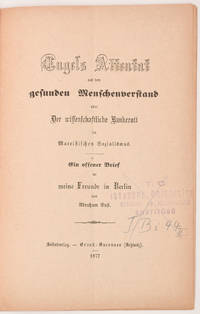
18771812Grand-Saconnex Schweiz: Selbstverlag 1877. First edition. In publisher’s wrappers. Collection stamp and shelfmarks written in ink and pencil on the cover and the title-page. Distributor’s stamp on the cover. With traces of folding. Cover slightly dusted. Pages yellowed due to ageing. First five leaves with minor damage to the lower corners. Overall in fine condition. First edition. In publisher’s wrappers. 24 p. <p><br /> Scarce pamphlet reflecting on the debate on early Marxist communism countering Engels for Anti-Dühring.<br /> <p><p><br /> First and only edition of the socialist theorist Abraham Enss’ pamphlet in which he criticises Marx and his followers for “doing humbug with socialism†and virulently defending Dühring from Engels’ “pseudoscientific†diatribes on him. Since the editors of Berliner Freie Presse refused to accept his writing Enss self-published his open letter dated to February 4 1877 and supplemented by two postscripts dated to March 1 and March 18 respectively in the present pamphlet in Switzerland. In response to the appearance of his writings Engels called Enss the “Sancho Panza†of Dühring who he referred to as “modern Don Quixote†while Liebknecht wrote in his letters to Engels that “Enß is stupid and will soon go to the madhouse†and that he is “generally regarded as a donkey even an idiotâ€.<br /> <p><p><br /> Abraham Enss was a follower and friend of Eugen Dühring. From 1887 he edited Der Antikrat a Dühringian paper with anti-Semitic tendencies which appeared with the subtitle Gegen Parteigewalt und Hebräer-Einfluß. Für selbständige Geistesführung und sociale Gerechtigkeit. Against Party Violence and Hebrew Influence. For Independent Spiritual Leadership and Social Justice.<br /> <p><p><br /> Scarce WorldCat locates only one copy in institutional holding in the US in the Columbia University Library in New York. <br /> <p><p><br /> Literature: Engels F.; Marx K.: Marx & Engels Collected Works. Volume 25. London: Lawrence & Wishart 1987. p. 298.; Firedlaender B.: Der freiheitliche Sozialismus: im Gegensatz zum Staatsknechtsthum der Marxisten. Mit besonderere Berücksichtigung der Werke und Schicksale Eugen Dühring’s. Berlin: Freie Verlagsanschaft 1892. p. 71; Gay J.: The Blind Prometheus of German Social Science. Eugen Dühring as Philosopher Economist and Controversial Social Critic. Universität Erfurt 2012.; Liebknecht W.: Briefwechsel mit Karl Marx und Friedrich Engels. Berlin: Walter de Gruyter 2020. pp. 212–214.; Nettlau M.: Bibliographie de l’anarchie. Année 1897. — N° 8. Bruxelles: Bibliothèque des Temps Nouveaux 1897. p. 41.<br /> <p>. Selbstverlag unknown
18806045011880. gazing at a bust of George Washington after the painting by Alonzo Chappel. 7 1/2" x 10". Very good. ca. 1880. No Binding. Very Good/No Jacket. unknown books
18806045021880. 3 3/4" x 5" on paper 6 1/2" x 9 3/4". Very good. ca. 1880. No Binding. Very Good/No Jacket. unknown books
1851653951851. Wschr. ges. Heilk. 1851/ 1-3. - Berlin bei August Hirschwald 4. 11. und 18. Januar 1851 8° pp.1-48 Rückenbroschur. Erstdruck! "Den 1 August 1849 wurde ich zu Batavia von dem damaligen holländischen Admiral der die Seemacht in Ostindien kommandierte nur dem holländischen Kriegsschiffe Kurrier angestellt um darauf die Reise nach China und Californien mitzumachen und von da entweder wieder zurück nach Batavia oder um dem Cap Horn herum nach Holland. Da wir vorher wussten dass die Reine eine sehr lange werden würde und wegen zu langer Entbehrung von frischer Nahrung für das Schiffsvolk viele Krankheiten und namentlich Scorbut zu befürchten seien wurden Vorkehrungen getroffen um diesem Uebel so viel als möglich vorzubeugen. Es wurde namentlich darauf gesehen da" die Viktualien wie gesalzene" Fleisch Brod Erbsen Bohnen &c. von der besten Sorte seien ausserdem wurden 20 Fässer mit eingemachten Gurken mitgenommen und für die etwaigen Kranken versahen wir uns mit 30 Flaschen Citronensaft und einer grossen Menge blecherner Gefässe worin Suppen bereits gekochte Gemüse und Fleisch hermetisch verschlossen waren. Die Austheilung der Viktualien auf holländischen Kriegsschiffen ist gewöhnlich folgende: Sonntag: Pudding von weissem Mehl dabei eingesalzenes Rindfleisch. Montag: Erbsensuppe von getrockneten grünen Erbsen mit gesalzenem Schweinefleisch. Dienstag: Reis mit gesalzenem Rindfleisch. Mittwoch: Bohnen mit eingesalzenem Schweinefleisch. Donnerstag: Sauerkraut mit gesalzenem Schweinefleisch. Freitag: Erbsensuppe von getrockneten gelben Erbsen mit eingesalzenem Rindfleisch. Sonnabend: Wie Mittwoch. Des Morgens essen sie entweder gekochten Reis oder Gerste mit Butter und Zucker oder sie trinken Kaffee mit Brod und Butter dazu. Des Abends Thee mit Brod und Butter. Ausserdem erhalten die Matrosen täglich zwei Portionen Genever des Morgens unmittelbar nachdem sie aufgestanden sind und des Mittags vor dem Essen. Ferner bekommen sie Pfeffer Salz Essig und Senf verabreicht. Die Schiffsmannschaft bestand aus 103 Köpfen die meisten darunter waren 4-6 Jahre hintereinander in den holländisch - ostindischen Colonien gewesen hatten viele Krankheiten überstanden namentlich biliöse und intermittirende Fieber Dysenterien und Syphilis und in Folge davon viel Quecksilber geschluckt viel salivirt und hierdurch hatten viele bereits eine Prädisposition für den Scorbut auf die Reise mitgenommen." Abraham Lilienfeld: Erfahrungen über den Seescorbut ; auf einer Reise um die Welt gesammelt. Von Dr. A. Lilienfeld königlich holländischem Sanitätsofficier. Inaugural Abhandlung / Würzburg 1850 unknown
1819011194London: John Sharpe 1819. Hardcover. Several Discourses by Way of Essays in prose and verse. Brown leather gilt decoration to front gilted text block edges spine and back brown endpapers frontispiece ribbon marker missing but for a small remnant 187 pages. Edge wear spine rubbed and spine ends worn and at the bottom it has a split booksellers sticker to first pastedown previous owner's bookplate to first pastedown foxing to the first few pages and the last few pages inside very minor foxing. An interesting and handsome little book. Shipping charges are calculated for a standard parcel under 1 kg. Additional charges will apply for heavier shipments but not until the customer agrees. Canadian customers please note that applicable sales taxes will be added. Please contact us with any questions you might have. Size: 24mo - over 5" - 5¾" tall <br/> <br/> John Sharpe hardcover
183086879New York: G. & C. & H. Carwil 1830. Hardcover. Ex-library with standard markings though exterior only has two quite faded sets of call letters spine and front board upper inner corner; leaves very mildly foxed throughout; mild wear to board edge in parts card pocket and circualtion card to rear paste-down. Intelligent book-related notes in pencil to rear enedpapers; else very good. Binding tight. Small quarto in full light brown calf leather; 418 pages 23 cm. Philosophy; Aesthetics. Esthetics. G. & C. & H. Carwil hardcover
182718472Stockholm: Johan Horberg 1827. First edition. leather_bound. Contemporary half polished russet calf and marbled boards. All edges yellow. Fine. 137 pages. 27 1/2 x 22 cm. Forty-seven hand-colored engraved plates with tissue guards plus hand-colored vignette title and two engraved plates of music. Grafstrom poet and historian wrote the text and Forssell made the engravings. Index. List of Plates and errata. Costumes from Dalarna Helsingland Lappland Sodermanland Westergothland Smaland Blekinge and Skane. Lovely copy plates and text clean fresh and bright; bookplate raised bands spine panels richly guilt in floral motifs marbled endpapers maroon morocco spine label printed in gilt. Johan Horberg unknown
182718472Stockholm: Johan Horberg 1827. First edition. leather_bound. Contemporary half polished russet calf and marbled boards. All edges yellow. Fine. 137 pages. 27 1/2 x 22 cm. Forty-seven hand-colored engraved plates with tissue guards plus hand-colored vignette title and two engraved plates of music. Grafstrom poet and historian wrote the text and Forssell made the engravings. Index. List of Plates and errata. Costumes from Dalarna Helsingland Lappland Sodermanland Westergothland Smaland Blekinge and Skane. Lovely copy plates and text clean fresh and bright; bookplate raised bands spine panels richly guilt in floral motifs marbled endpapers maroon morocco spine label printed in gilt. Johan Horberg unknown books
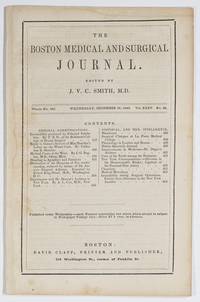
1846229711846. Boston Med. Surg. J. 35/22. - Boston David Clapp December 30 1846 8° pp.445-464 orig. wrapper. First Edition! First use of sulphuric ether as a surgical anesthetic in New York! Abraham Lidden Cox 1800-1864 "graduated from the medical department of the University of Pennsylvania and spent most of his career in New York. His article published on December 30 describes the first use of sulphuric ether as a surgical anesthetic in New York. Cox discussed several operations including one in which Valentine Mott 1785-1865 removed 'a cluster of tumefied glands from the right axilla.' Cox noted that he had himself had 'repeatedly inhaled the vapor of sulphuric ether as long ao as the year 1822 and as I had seen it inhaled repeatedly by others I was desirous of trying on myself the effects of this agent . and I recognized precisely the sensations which I had formerly experienced from the effects of ether." Rutkow Rutkow ANp14 unknown
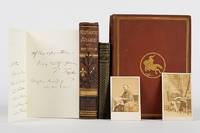
185028839AB1850. London / Cambridge etc. Chatto & Windus / Routledge & Sons / etc. c. 1850-1879. Octavo. Ballads and Songs of Brittany 1865 edition: Frontispice XXII 239 pages / Ballads and Songs of Brittany Later Routledge edition: XVI 176 pages / Tom Taylor's Historical Dramas: VIII 466 32 pages. / Manuscript Letter: 2 1/2 pages. Original Hardcover / The manuscript letter in a Folder it includes an A4 manuscript leaf from a 19th century autograph-collector describing the letter by Taylor. / The two vintage cabinet photographs of Taylor included in the Folder with the autograph. Very good condition with only minor signs of external wear. Tom Taylor 19 October 1817 12 July 1880 was an English dramatist critic biographer public servant and editor of Punch magazine. Taylor had a brief academic career holding the professorship of English literature and language at University College London in the 1840s after which he practised law and became a civil servant. At the same time he became a journalist most prominently as a contributor to and eventually editor of Punch. In addition to these vocations Taylor began a theatre career and became best known as a playwright with up to 100 plays staged during his career. Many were adaptations of French plays but these and his original works cover a range from farce to melodrama. Most fell into neglect after his death but Our American Cousin 1858 which achieved great success in the 19th century remains famous as the piece that was being performed in the presence of US President Abraham Lincoln when he was assassinated in 1865. hardcover