Frohlich, Abraham EmanuelBiblio.com
775 résultats
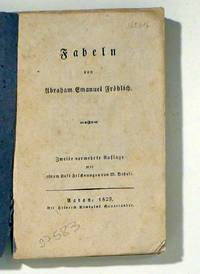
1829165916Aarau: Sauerländer 1829. Softcover. Einband mit Randeinrissen Seiten nicht aufgeschnitten. kl.8°. Interimsbroschur Rümann 328. Ohne die Illustrationen von Martin Disteli. Schweiz; 19. Jahrhundert; Helvetica Sauerländer, paperback
182950850BBAarau, Bei Heinrich Remigius Sauerländer. 1829. 8° und Quer-4°. 200 S., 4 S. Verlagsanzeigen; 10 Bl. Mit gestochenem Titel und 9 Blatt Umrissradierungen von Martin Disteli. Typographisch bedruckte violette und gelbe Originalbroschuren.
1851019255London: J. Wertheimer 1851. Ex-Library. Good. Hardcover. First Edition. A solid copy. Signed by the translator. Library bookplate and 2 cards pasted in. Pen inscription to back pastedown. Tanning to pages. Hinges starting reinforced by clear tape. Board of spine missing yet spine remains strong. Pencil inscription of title to bottom edge of pages. Rubbing soiling and moisture stains to covers. Montreal Books rating system: 1. Fine; 2. Near Fine; 3. Very Good; 4. Good; 5. Fair. J. Wertheimer Hardcover
18599999_01126Zalt-Bommel Noman & Fils; Paris Borrani 1859. 1st Edition . Hardcover. . ~ ~ NOTE: THE PRICE OF THIS BOOK IS CURRENTLY REDUCED! ~ ~ . Crown quarto. Pp. vi iv vii i iv ii 720 40 20 viii ii. Half-title title dedication preface introduction. Extra title-page illustrated with allegorical motifs and printed in tinted lithograph. Plus 2 handsome plates in tinted lithograph depicting battle scenes and 3 fine lithographic portraits all with facing tissue guards. Plus one full-page lithograph ordnance map with additional colour added by contemporary hand. Plus 6 large folding lithograph maps one with additional colours added by contemporary hand to represent troop positions all bound at rear. With 2 engraved maps printed in letterpress to the text. Footnotes appendices bibliography index. HARDCOVER bound in the original publisher's full cloth richly decorated in gilt. Binding worn loose from bookblock but complete. Excellent binding or working copy with fine interior. ~ FIRST EDITION. Rare original cloth binding richly decorated but requires restoration. Descriptive text Copyright Librarium The Hague 005-10 <br/> <br/> Zalt-Bommel, Noman & Fils; Paris, Borrani hardcover
18599999_01128Zalt-Bommel Noman & Fils; Paris Borrani 1859. 1st Edition . Hardcover. . ~ ~ NOTE: THE PRICE OF THIS BOOK IS CURRENTLY REDUCED! ~ ~ . Crown quarto. Pp. vi iv vii i iv ii 720 40 20 viii ii. Half-title title dedication preface introduction. Extra title-page illustrated with allegorical motifs and printed in tinted lithograph. Plus 2 handsome plates in tinted lithograph depicting battle scenes and 3 fine lithographic portraits all with facing tissue guards. Plus one full-page lithograph ordnance map with additional colour added by contemporary hand. Plus 6 large folding lithograph maps one with additional colours added by contemporary hand to represent troop positions all bound at rear. With 2 engraved maps printed in letterpress to the text. Footnotes appendices bibliography index. HARDCOVER bound in contemporary half calf and marbled boards 2 contrasting gilt morocco lettering-pieces to spine old small ticket at foot bit worn at extremities rubbed and chafed; old military institutional stamps to half-title. Bit foxed in places few light dampmarks at margin else a good copy with well preserved interior and folding maps. ~ FIRST EDITION. Descriptive text Copyright Librarium The Hague 005-10 <br/> <br/> Zalt-Bommel, Noman & Fils; Paris, Borrani hardcover
18591900Zalt-Bommel Noman & Fils; Paris Borrani 1859. 1st Edition . Hardcover. . ~ ~ NOTE: THE PRICE OF THIS BOOK IS CURRENTLY REDUCED! ~ ~ . Crown quarto. Pp. vi iv vii i iv ii 720 40 20 viii ii. Half-title title dedication preface introduction. Extra title-page illustrated with allegorical motifs and printed in tinted lithograph. Plus 2 handsome plates in tinted lithograph depicting battle scenes and 3 fine lithographic portraits all with facing tissue guards. Plus one full-page lithograph ordnance map with additional colour added by contemporary hand. Plus 6 large folding lithograph maps one with additional colours added by contemporary hand to represent troop positions all bound at rear. With 2 engraved maps printed in letterpress to the text. Footnotes appendices bibliography index. HARDCOVER bound in contemporary half calf and pebbled cloth spine richly decorated in gilt cloth inner hinges red ribbon signet; scattered foxing corners rubbed bumped. In about fine condition. Some leaves still unopened. A very handsome copy. ~ FIRST EDITION. This copy is or was intended to be a Presentation Copy from the Author to Maréchal Comte Randon Marshall of France. With an autograph letter handwritten in ink in a very neat hand by Gerlach signed by himself dated March 2 1860 addressed to the Maréchal. It comprises a large leaf folded into a four-page document last page blank with 47 lines of text date and signature. "I request Your Excellency to be willing to accept this copy of the Military annals of the Dutch East-Indies" it opens written in French. Expressing his appreciation to Randon's military achievements he begs that the book will be presented to His Majesty the Emperor of the French continuing "Voilà monsieur le Maréchal ce qui me porte à vous offrir ce travail et à vous prier d'être mon interprète auprès de l'Auguste chef du peuple français pour que Sa Majesté daigne accepter un exemplaire de mon livre." The letter is in exceptionally fine condition though a bit foxed. Jacques Louis César Alexandre Maréchal Comte Randon 1795-1871. The author Abraham Jean Arnaud Gerlach was born in 1811 in Groningen. He received his education at the Koninklijke Militaire Academie graduating as Lieutenant of the Artillery. As Colonel he later had a long teaching career at the same academy and contributed regularly to military studies and publications. He translated his "Fastes militaires des Indes" into Dutch and published it in Zalt-Bommel and Paris in 1874-75 as the three-volume set "Neerlands heldenfeiten in Oost-Indië". He died in 1906. The importance of this work is remarkable: OCLC lists no less than 20 major North American libraries who keep a copy including Johns Hopkins Harvard Washington Princeton and Columbia university libraries as well as NYPL. Descriptive text Copyright Librarium The Hague F-3 <br/> <br/> Zalt-Bommel, Noman & Fils; Paris, Borrani hardcover
186339807BBBerlin, Julius Springer 1863. 8°. Titel, 1 Bl., 112 S. Mit einer farbigen Tonlithografie als Frontispiz und einer gefalteten Karte. Schlichter Pappband der Zeit mit Kleisterpapierbezügen und Papierrückenschild.
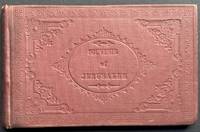
1900H38464Jerusalem: Aron Zwebner 1900. Hardcover. Very good. Oblong 8vo 6.75 x 4 inches publisher's terracotta embossed cloth very good with 12 stiff leaves with dried flowers affixed to pages and facing descriptive pages. OCLC locates 3 holdings Cornell Central Florida Hebrew Union NY and dates this 1900. Abraham Moses Luncz 1854-1918 was a significant and interesting figure. was a Russian scholar and editor born at Kovno Russia. At age 14 he came to Jerusalem. Luncz who grew blind early in life founded in conjunction with Dr. Koisewski an institution for the blind at Jerusalem. In the exploration of the Holy Land Luncz rendered great services from the historical geographical and physical standpoints through his guide-books for Palestine his Palestine annuals and his Jerusalem almanac. How he collected these samples blind as he was we have no idea. Aron Zwebner hardcover
187325837A. Lloyd 1873. First Edition. hard cover. Very Good/No jacket. New York: A. Lloyd. 1873. First Edition. Hardcover no jacket. 327pp. Near Very Good condition. Brown cloth boards with gilt titling and beveled edges. Covers well worn with a little fabric wear through and chipping at top/bottom of spine. Gilt tiltling and decoration to front cover is still bright. There is a dampstain that oddly affects only the edges of the front and rear endpapers. The main textblock is age toned but is clean and unmarked. The binding is square and secure. cfm A. Lloyd hardcover
187356476E-154: Lloyd. Very Good. 1873. Hardcover. Hardcover. 8vo. A. Lloyd New York. 1873. Viii 327 pgs. Signed and inscribed by Abraham Messler on the FFEP. Bound in black cloth with gilt titles present to the front board and the spine. Boards have light wear present to the extremities of the boards. No ownership marks present. Text is clean and free of marks. Binding tight and solid Important source of Somerset County local history and genealogy. E-154; Signed by Author . Lloyd hardcover
187749814Boston: Henry A. Young and Co. 1877. first edition. Hardcover. Good. 5 x 7 in. 220 pp. Brown cloth boards. Condition is GOOD ; front hinge is started with muslin broken at the ends but holding fairly well. Covers clean spine sunned wear to corners and spine ends. Text clean bright and unmarked. Science. Stax. Henry A. Young and Co. hardcover
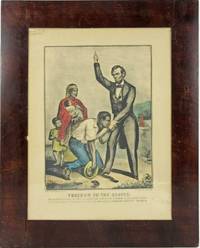
186538499New York: Currier & Ives 1865. Color print 11-3/4" x 15-1/2" by sight. A black man newly freed from slavery kneels at Lincoln's feet his shackles broken. He kisses Lincoln's hand. His wife and babies stand behind him. Lincoln's right arm is raised and pointing heavenward. Light uniform toning but brightly colored. Two blank margin tears at lower right corner one blank margin tear at upper left corner. Framed in wood a few small dings to overall size 16" x 20." Very Good.<br /> <br /> "This commemorative print was issued soon after the assassination of President Lincoln to comfort his supporters. The semi-allegorized representation portrayed the former president as the emancipator of enslaved African Americans guided by divine principles" Description online at The Met. <br /> Entering Richmond in 1865 Lincoln was met by many former slaves who kneeled before him. Lincoln told them to stand and thank God not Lincoln for their freedom. A decade later the Colored People's Educational Monument Association headed by the African-American abolitionist Henry Highland Garnet. created a memorial to Lincoln. The result was a sculpture erected in 1876 in Lincoln Park near Capitol Hill depicting a supplicant slave and a towering Lincoln. Known as the Emancipation Memorial or the Freedmen's Memorial it generated some contemporary criticism for its depiction of the inferior position of the black man. <br /> Gale 2311. Not in LCP Reilly or Weitenkampf. OCLC 1292616124 1- OH Hist. Connection 870219805 1- IN Hist. Soc. as of May 2024. AAS also owns a copy. Currier & Ives unknown
18463117130/03/1846. <blockquote><p>At the time Lincoln wrote this he was running for Congress</p></blockquote><blockquote><p>It shows the relationship between perhaps the most famous senior and junior law partners</p><p> </p></blockquote><p>https://vimeo.com/943731365share=copy</p><p> </p><p>In his nearly 25 years as a lawyer in Springfield Illinois Abraham Lincoln had three partners. He joined John Todd Stuart as a junior partner then started a new practice as a junior partner with Stephen T. Logan. In 1844 Lincoln and Logan took on William H. Herndon. In the fall of 1844 Lincoln was tired of being a junior partner. He had worked for senior partners with political ambitions and Lincoln wanted a younger partner to whom he could relate. Logan and Lincoln dissolved their partnership in December 1844. Logan wanted to practice law with his son David and Lincoln wanted to start his own law firm. In October Lincoln invited his friend William Herndon to form a partnership with Herndon as junior partner. Thus was born Lincoln and Herndon. The firm would become a legend. In all three firms Lincoln functioned as a general practitioner taking a wide variety of civil and criminal cases. Herndon did not disappoint his friend. He contributed to the practice by performing research for his older and more experienced partner building the firm's law library and overseeing young men who came to study law read the law at their office.</p><p>Business began slowly for the new firm. Not until March 1845 was their first case heard in the Sangamon County Circuit Court. That first case was Hope v. Beebe et al and was action in debt with Lincoln and Herndon appearing for plaintiff and Logan for defendant. Here is a description of that case: A plaintiff Norwood had won a replevin suit against the Beebee also spelled Beebe Brothers in the U. S. Circuit Court Beebee Brothers v. Whitney & Norwood. Hope the marshal of the U. S. Circuit Court District of Illinois to help Norwood collect what he was owed retained Lincoln and Herndon and sued Beebee and others in an action of debt the intent being to collect money ordered paid by the court. Beebee and others named on the replevin bond in the federal suit failed to perform the obligation of bond - they did not or would not pay. Beebee claimed that he was unable to pay because of another suit that Norwood instituted against Beebee.</p><p>On March 18 1845 the case was continued and heard again in July when Lincoln filed documents allowing for concessions on both sides. It was again continued until March of 1846. Lincoln with the help of Herndon then drafted another document seemingly pointing to the another aspect of the suit and explaining why the plaintiff should not have to drop the suit.</p><p>In 1846 Lincoln was running for what would be his first elected position Congressman. In August he won that election and served one term. In March he was campaigning and seeking to gain support.</p><p><strong>Autograph document signed</strong> <em>""Lincoln & Herndon""</em> Springfield late March 1846 in the hand of both partners showing their collaboration. It begins in Lincoln's hand: <em>“And for further replication"" before switching to Herndons for the lines"" to the said plea of the said defendants by them above pleaded said plaintiff says that to be further precluded from maintaining his said action against said defendants because of the matters in said plea alleged he ought not because he says that since the pleading of the last plea by said defendants to wit on — day of February AD 1846 the said replevin suit by the said Norwood and Turner against the said Beebees in the Said plea mentioned was by the same court at which it was pending determined in favor of the said Beebees and against the said Norwood and Turner and by the judgment of said court a return of the bacon in the plea mentioned.â€</em></p><p>Lincoln hand wrote the balance: <em>“…Mentioned was awarded to the said Beebees and also adjudged that the said Beebees should recover of and from the said Norwood and Turner the sum of $650 damages and costs of suit and this he is ready to verify. Wherefore he prays judgment.â€</em> At that time Lincoln was preparing for his run for Congress his only national election until 1860.</p><p>The parties would later reach an agreement in March 1847 and the court dismissed the case. Lincoln and Herndon received fees of $25 for their legal services. A final version of this filed document is published by the Papers of Abraham Lincoln as is the judge's further March 1846 continuance. The present document is three pieces affixed either by Lincoln or at a later date.</p><p>This is the only paperwork from Lincoln and Herndon’s first case we have ever seen on the market.</p><p><img class=""alignnone size-post-window wp-image-25018"" src=""https://cdn.raabcollection.com/wp-content/uploads/20231204144051/Folder-site-11-1600x1327.jpg"" alt="""" width=""1600"" height=""1327"" /></p> unknown
1865235590Boston: Oliver Ditson & Co 1865. First edition front wrapper without portrait of Lincoln appearing in later issues. Engraved title and piano score; 5 pp. 1 vols. Folio. Loose as issued; split along spine with some chipping to extremities. First edition front wrapper without portrait of Lincoln appearing in later issues. Engraved title and piano score; 5 pp. 1 vols. Folio. Donizetti died 17 years before Lincoln having gone mad from syphilis. His Funeral March gained a measure of recognition in America after it was performed during Lincoln's funeral ceremonies. It is a heavy solemn piece in a minor with droning octaves in the bass a haunting chromatic figure in the middle register and a lyrical upper voice. see Barret Sale Lot 693; Stern Collection of Lincolniana Oliver Ditson & Co unknown
1865235590Boston: Oliver Ditson & Co 1865. First edition front wrapper without portrait of Lincoln appearing in later issues. Engraved title and piano score; 5 pp. 1 vols. Folio. Loose as issued; split along spine with some chipping to extremities. First edition front wrapper without portrait of Lincoln appearing in later issues. Engraved title and piano score; 5 pp. 1 vols. Folio. Donizetti died 17 years before Lincoln having gone mad from syphilis. His Funeral March gained a measure of recognition in America after it was performed during Lincoln's funeral ceremonies. It is a heavy solemn piece in a minor with droning octaves in the bass a haunting chromatic figure in the middle register and a lyrical upper voice. see Barret Sale Lot 693; Stern Collection of Lincolniana Oliver Ditson & Co unknown books
186230695Dieppe Émile Delevoye 1862 In-8 424 pp, menus défauts d'usage, dos à nerfs décoré de fleurons dorés
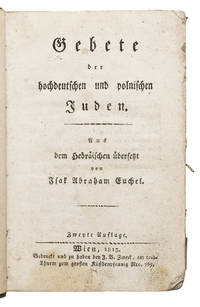
18131152Vienna 1813. 8vo. J.B. Zweck Contemporary blind-tooled half calf and brown marbled paper sides with a red title label on the spine. With a woodcut head-piece. The book is printed in Gothic type with the original titles also in Hebrew type. 4 394 2 pp. Very rare copy of an important work for the history of the German Jews in the age of Emancipation. One of the many editions of these Gebete which are translated from the Hebrew the chief work of Isaac Euchel one of the most important German jews of the Enlightenment. The original edition of the Gebete appeared in 1786 in Königsberg other editions: Vienna 1790-98; there exists also a 'Zweite Auflage': Berlin 1799. Euchel has translated the original and until then obscure old Hebrew Book of prayers for German and Polish Jews. It contains prayers for all occasions and for all times of the day including songs and psalms. After the prayers follows "Massecheth Aboth" in 6 parts teaching the Jewish laws and the rules for a virtuous life. In the preface the publisher explains that the first edition of this excellent translation from the Hebrew is long since sold out. This and the fact that many Israelites especially the women do not have suficient knowledge of the Hebrew language and that also many Christians visit the Synagoge which by the graciousness of the Emperor was recently established at Vienna convinced the publisher that the book will find a wide public.With a manuscript owner's inscription on the recto of the first free flyleaf "Salomon Landesman Teplitz. 18. Decemb. 1830" and some slightly faded annotations on the final free flyleaf and the back paste-down. The binding is worn internally very slightly foxed. Otherwise in good condition.l Worldcat 505218461 1 copy; cf. Isaac Euchel: der Kulturrevolutionär der jüdischen Aufklärung ed. Marion Aptroot Hannover 2010; David Friedländer 'Isaac Euchel und die Gebete-Übersetzungen in ihrem bildungshistorischen Kontext' in: Chr. Schulte Marion Aptroot Andreas Kennecke edd. Isaac Euchel. Der Kulturrevolutionär der jüdischen Aufklärung Hannover 2009. unknown
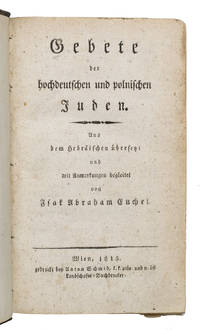
18151154Vienna 1815. 8vo. Anton Schmid Contemporary marbled paper over boards with a brown label on the spine. The book is mainly printed in Gothic type with some Hebrew types to the titles and in the notes. 458 pp. Rare later edition of the German translation by Isaac Abraham Euchel of a Hebrew prayerbook for German and Polish Jews. It is Euchel's chief work who was one of the most important German jews of the Enlightenment. The original edition of the Gebete appeared in 1786 in Königsberg other editions: Vienna 1790-98; there exists also a "Zweite Auflage": Berlin 1799. Euchel has translated the original - and until then obscure - old Hebrew book of prayers for German and Polish Jews. It contains prayers for all occasions and for all times of the day including songs and psalms. After the prayers follows "Massecheth Aboth" in 6 parts teaching the Jewish laws and the rules for a virtuous life. In the preface the publisher explains that the first edition of this excellent translation from the Hebrew is long since sold out. This and the fact that many Israelites especially the women do not have suficient knowledge of the Hebrew language and that also many Christians visit the Synagoge which by the graciousness of the Emperor was recently established at Vienna convinced the publisher that the book will find a wide public.The binding is worn slightly browned throughout otherwise in good condition.l WorldCat 1056763629 1 digitalised copy. hardcover
1852604511852. Notiz. Geb. Nat. Heilk. 4 685. - Geburtshülfe u. Kinderkrankheiten 1.Bd. No.46. - Frorieps Tagsberichte. - Weimar December 1852 8° pp.337-344 Rückenbroschur. Erste deutsche Übersetzung des Aufsatzes aus der "Nederlandsch Lancet des Dr. F. C. Donders III. Serie I. Jahrg. No. 8". Abraham Everard Simon Thomas 1820-1886 niederländischer Mediziner; seine Studien beschäftigten sich unter anderem mit dem Schrägverengten Becken und mit der Gebärmutternaht nach dem Kaiserschnitt. unknown
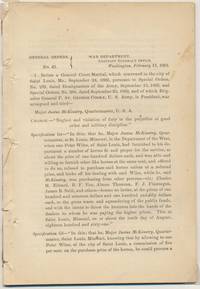
186324813Washington DC: War Department 1863. Paperback. 16mo. Self-cover. 35pp. Very good. Mild age toning; minor binding traces. Lengthy Court Martial proceeding against the U.S. Army Quartermaster at St. Louis Justus McKinstry 1814-97 who is charged with "prostituting his office" in these 61 specifications -- in 26 of which is he found "Guilty" with the recommendation "To be dismissed the service." Lincoln who signs in type at the conclusion supports this finding. Also signed in type by Adjutant General L. Thomas who dissolves the General Court Martial. War Department paperback
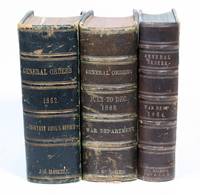
18622923Washington D.C.: War Department 1862. Calf marbled boards. Very Good. FIRST OBTAINABLE PRINTING OF THE PRELIMINARY EMANCIPATION PROCLAMATION setting a date for the freedom of more than three million enslaved in the United States and reframing the Civil War as a fight against slavery. Issued by the War Department to regimental commanders in the field during the Civil War in the week after the completion of President Lincoln’s official manuscript version. Contained is a set of three volumes of General Orders covering the full year 1862 July-Dec 1863 and the full year 1864. History of the Emancipation Proclamation:<br /> <br /> “The proclamation has been called by responsible persons one of the three great<br /> documents of world history ranking with Magna Carta and the Declaration of<br /> Independence†– Eberstadt<br /> <br /> “From the first days of the Civil War slaves had acted to secure their own liberty. The Emancipation Proclamation confirmed their insistence that the war for the Union must become a war for freedom. It added moral force to the Union cause and strengthened the Union both militarily and politically. As a milestone along the road to slavery’s final destruction the Emancipation Proclamation has assumed a place among the great documents of human freedom†– National Archives<br /> <br /> Following the Seven Days Battle and General McClellan’s retreat from the Peninsula at the end of June 1862 President Lincoln realized that there would be no early end to the war and found himself “as inconsolable as it was possible for a human to be and yet live.†Anxious for news from the army and needing to escape the constant interruptions at the White House he frequently visited the telegraph office in the War Department building to await dispatches. It was during one such visit early in July that he asked the chief of the telegraph staff Major Thomas Thompson Eckert for some paper to “write something special†and began the first draft of the Emancipation Proclamation completing it in a few weeks. Lincoln had long hoped to resolve the slavery issue through a congressional act of emancipation compensating slave owners for their loss of “property†but that approach was roundly rejected by representatives from the border states leaving the President who had decided upon the necessity of emancipation with a presidential proclamation as the only option. The extraordinary document he conceived would announce the liberation on January 1 1863 of all slaves in those states still in rebellion against the Union and promised compensation to slave owners in those states that returned to the fold before that time if they adopted “immediate or gradual abolishment of slavery.†This proclamation would be followed by a final proclamation issued on the 1st of January identifying those states still in rebellion and confirming the liberation of all slaves therein.<br /> <br /> On Tuesday July 22 Lincoln presented his draft to the Cabinet telling them that he had resolved firmly upon the course of action it specified and asking them not for advice but suggestions. The only observation he had not anticipated came from Secretary of State Seward who proposed that it might be best to wait for a military victory before issuing the Proclamation as it could otherwise seem like “the last measure of an exhausted government.†Immediately recognizing the wisdom of the suggestion Lincoln held back. On September 17 after an anxious wait of nearly two months he received the victory he needed at the bloody Battle of Antietam. Completing his final draft Lincoln presented it to his cabinet for refinement on September 22. Following the meeting Seward took the amended draft with him to the State Department where a formal manuscript copy was made then signed by Lincoln and Seward. The formal official “Emancipation Proclamation†was of course issued on January 1 1863 the day it became the law of the land.<br /> <br /> Printing History:<br /> <br /> This printing in the War Department’s official “General Orders†is the fourth printing overall but realistically the first obtainable printing. It is preceded by:<br /> <br /> -The first printing Eberstadt #1 a small three-page circular intended for distribution within the government and to the local press likely printed on September 22. At the time that Charles Eberstadt published his study of the Proclamation 1950 he was able to locate only one copy which he himself owned and as nearly as we have been able to determine no other copies have come to light since then.<br /> <br /> -The second printing Eberstadt #2 may be a phantom printing. Charles Eberstadt was not able to locate a copy but he inferred its existence from the standard State Department practice of printing a folio edition consisting solely of the text of the proclamation followed by another printing consisting of the text of a letter of transmittal from the Secretary of State as well as the text of the proclamation. While there may be a copy of Eberstadt #2 in the National Archives as he speculated it is not recorded in their online catalogue nor have we been able to find a copy in any other online catalogue including OCLC the Library of Congress and the Abraham Lincoln Library.<br /> <br /> -Eberstadt’s third printing is of legendary rarity. It consists of Secretary of State Seward’s one-page letter of transmittal addressed “To the Diplomatic and Consular Officers of the United States in foreign countries†and the text of the proclamation. Eberstadt located a total of only five copies in institutions at the Library of Congress the National Archives Yale the Clements Library and Brown. OCLC does not record any additional copies nor is it recorded in Monaghan. There has been one copy at auction $400000 in 2021 and that was described as the only copy in private hands. <br /> <br /> -The present copy General Orders No. 139 is Eberstadt’s fourth printing of the Preliminary Emancipation Proclamation dated in print on September 24. Eberstadt surmises that this field order printing could have been accomplished as late as September 29 or 30. Although it may have been printed in as many as 15000 copies it is very rare in commerce likely due to the ephemeral nature of the printing and distribution.<br /> <br /> Additional General Orders and Provenance:
<br /> <br /> The three volumes once belonged to John G. Haskell A.Q.M. Chief Quartermaster and contain the General Orders for the year 1862 July-December only for the year 1863 and for the full year 1864. John Gideon Haskell 1832-1907 was a resident of Kansas and joined the Union Army when the war broke out. He enlisted with the 14th Kansas Volunteer Cavalry Regiment and later served as Assistant Quartermaster General of Kansas as quartermaster of the Third Kansas and the Tenth Kansas Volunteers as Captain and Assistant Quartermaster on the staff of General James G. Blunt and as Chief Quartermaster of the Army of the Frontier. After the war Haskell was named official state architect and worked on the state house the capitol the State University and more.<br /> <br /> In addition to the preliminary Emancipation Proclamation the three volumes also contain the Acts of Congress on many other subjects including pay discharge recruitment handling of troops etc.<br /> <br /> Washington D.C.: War Department Adjutant General’s Office 1862-64. Three volumes. Small octavo contemporary three-quarter brown morocco two volumes with cloth boards one with marbled boards. Some rubbing and wear to bindings pencil notations on endpapers with collation and highlighting certain orders and some internal pages. Dampstaining to general title of 1862 volume; internal text and Emancipation Proclamation generally fine. RARE AND IMPORTANT.<br /> <br /> References:<br /> <br /> Charles Eberstadt. “Lincoln’s Emancipation Proclamation.†New York: 1950. War Department unknown
18661009808vo one sheet printed on both sides. Even toning and aging small closed tear to the upper margin; otherwise very good. This is a rather scarce government document that informs the military that the "Thirteenth Amendment" has passed and slavery is officially abolished. Article XIII states "Neither slavery nor involuntary servitude except as a punishment for a crime whereby the party shall have been duly convicted shall exist within the United States or any place subject to their jurisdiction." This document is signed in type by William H. Seward 1801-1872 as the Secretary of State. Congress would follow with a Civil Rights Act of 1866 to give African Americans the same rights as all citizens but this small printed document presenting the essence of the "Thirteenth Amendment" is an important piece of history. ANB.
1862WRCAM11943Washington 1862. Small broadside 5 x 7 1/2 inches. Very good. Lincoln appoints Henry Halleck as general-in- chief of all of the Union armies. unknown books
1862WRCAM54585Washington D.C.: War Department Adjutant General's Office 1862. Three volumes with over 300 individual imprints. 12mo. Uniformly bound in contemporary three- quarter roan and marbled boards gilt leather labels. Wear to leather and edges boards somewhat rubbed front hinges tender. Contemporary ownership inscriptions and binder's tickets on front endpapers of second and third volumes; later bookplate on front pastedown of first volume. Light toning in places otherwise internally clean. Very good. A uniformly-bound set of General Orders issued by the Adjutant General's Office of the War Department in Washington D.C. previously owned by Brig. Gen. John Pope Cook. The orders cover 1861 and 1862 and comprise a nearly complete run of orders for the Union Army during the first two years of the Civil War. Undoubtedly the most significant General Order in this collection is a preliminary printing of the Emancipation Proclamation. <br> <br> A handful of the orders are signed in ink by the various adjutant generals. The Emancipation Proclamation bound in the third volume is as follows: <br> <br> GENERAL ORDERS No. 139. THE FOLLOWING PROCLAMATION BY THE PRESIDENT IS PUBLISHED FOR THE INFORMATION AND GOVERNMENT OF THE ARMY AND ALL CONCERNED: BY THE PRESIDENT OF THE UNITED STATES OF AMERICA A PROCLAMATION caption title. Washington D.C.: War Department Adjutant General's Office ca. September 24 1862. 3pp. This work is one of the earliest printings of the Preliminary Emancipation Proclamation issued to regimental commanders in the field during the Civil War in the week after President Lincoln's official manuscript version was finished. Here the third paragraph rings out with Lincoln's timeless words: "That on the first day of January in the year of our Lord one thousand eight hundred and sixty- three all persons held as slaves within any State or designated area of a State the people whereof shall then be in rebellion against the United States shall be then thenceforward and forever free." <br> <br> Following the Seven Days Battle and Gen. McClellan's retreat from the Peninsula at the end of June 1862 President Lincoln realized that there would be no early end to the war and found himself "as inconsolable as it was possible for a human to be and yet live." Anxious for news from the army and needing to escape the constant interruptions at the White House he frequently visited the telegraph office in the War Department building to await dispatches. It was during one such visit early in July that he asked the chief of the telegraph staff Maj. Thomas Thompson Eckert for some paper to "write something special" and began the first draft of the Emancipation Proclamation completing it in a few weeks. <br> <br> Lincoln had long hoped to resolve the slavery issue through a congressional act of emancipation compensating slave owners for their loss of "property" but that approach was roundly rejected by representatives from the border states leaving the President who had decided upon the necessity of emancipation with a presidential proclamation as the only option. The extraordinary document he conceived would announce the liberation on January 1 1863 of all slaves in those states still in rebellion against the Union and promised compensation to slave owners in those states that returned to the fold before that time if they adopted "immediate or gradual abolishment of slavery." This proclamation would be followed by a final proclamation issued on the 1st of January identifying those states still in rebellion and confirming the liberation of all slaves therein. <br> <br> On Tuesday July 22 Lincoln presented his draft to the Cabinet telling them that he had resolved firmly upon the course of action it specified and asking them not for advice but suggestions. The only observation he had not anticipated came from Secretary of State Seward who proposed that it might be best to wait for a military victory before issuing the Proclamation as it could otherwise seem like "the last measure of an exhausted government." Immediately recognizing the wisdom of the suggestion Lincoln held back. On September 17 after an anxious wait of nearly two months he received the victory he needed at the bloody Battle of Antietam. Completing his final draft Lincoln presented it to his cabinet for refinement on September 22. Following the meeting Seward took the amended draft with him to the State Department where a formal manuscript copy was made then signed by Lincoln and Seward. <br> <br> The first edition of the Preliminary Emancipation Proclamation Eberstadt #1 a small three-page circular intended for distribution within the government and to the local press was likely printed on September 22. At the time that Charles Eberstadt published his study of the Proclamation 1950 he was able to locate only one copy which he himself owned and as nearly as we have been able to determine no other copies have come to light since then. <br> <br> Eberstadt #2 is a supposed second edition no copy of which Charles Eberstadt was able to locate whose existence he inferred from the standard State Department practice of printing a folio edition consisting solely of the text of the proclamation followed by another printing consisting of the text of a letter of transmittal from the Secretary of State as well as the text of the proclamation. While there may be a copy of Eberstadt #2 in the National Archives as he speculated it is not recorded in their online catalogue nor have we been able to find a copy in any other online catalogue including OCLC the Library of Congress and the Abraham Lincoln Library. <br> <br> Eberstadt's third printing of the Preliminary Emancipation Proclamation is without a doubt the earliest obtainable printing. It consists of Secretary of State Seward's one-page letter of transmittal addressed "To the Diplomatic and Consular Officers of the United States in foreign countries" and the text of the proclamation. Eberstadt located a total of only five copies in institutions at the Library of Congress the National Archives Yale the Clements Library and Brown. OCLC does not record any additional copies nor is it recorded in Monaghan. This firm sold a copy several years ago. <br> <br> The present copy of GENERAL ORDERS No. 139 is Eberstadt's fourth printing of the Preliminary Emancipation Proclamation dated in print on September 24. Charles Eberstadt surmises that this field order printing could have been accomplished as late as September 29 or 30 and produced in as many as 15000 copies. It is however rather uncommon in the market and this is the first copy of this printing of the Preliminary Emancipation Proclamation offered by this firm. <br> <br> "From the first days of the Civil War slaves had acted to secure their own liberty. The Emancipation Proclamation confirmed their insistence that the war for the Union must become a war for freedom. It added moral force to the Union cause and strengthened the Union both militarily and politically. As a milestone along the road to slavery's final destruction the Emancipation Proclamation has assumed a place among the great documents of human freedom" - National Archives. "The proclamation has been called by responsible persons one of the three great documents of world history ranking with Magna Carta and the Declaration of Independence" - Eberstadt. <br> <br> Besides including about 300 orders on all manner of Union military activity at the outset of the Civil War the present collection also contains the 1861 printing of REGULATIONS FOR THE UNIFORM AND DRESS FOR THE ARMY OF THE UNITED STATES. Set out in GENERAL ORDERS No. 6 this twenty-four-page printing of the Army dress regulations was the first to set out uniform requirements for the Union during the conflict. The first sentence of the first section requires officers to "wear a frock coat of dark blue cloth." Thus the Blue and the Gray begins. <br> <br> This set was collected and bound by John Pope Cook who began the Civil War as a colonel in command of the 7th Illinois Volunteer Regiment. He was promoted to brigadier general after his troops played a key role in the Union victory at Fort Donelson early in 1862. After his promotion he was transferred to a command in the Department of Iowa and Dakota Territory where he remained until early 1863 conducting campaigns against the Sioux from his base in Sioux City Iowa. These orders must have been bound near the end of this period since contemporary labels note the binder one William F. Kiter as being from relatively close by Council Bluffs. <br> <br> A very early printing of one of the most important political acts in the Civil War and indeed in American history contained in a set of General Orders contemporaneously assembled by a significant Union Army commander. EBERSTADT LINCOLN'S EMANCIPATION PROCLAMATION 4. War Department, Adjutant General's Office hardcover books
18661009808vo one sheet printed on both sides. Even toning and aging small closed tear to the upper margin; otherwise very good. This is a rather scarce government document that informs the military that the "Thirteenth Amendment" has passed and slavery is officially abolished. Article XIII states "Neither slavery nor involuntary servitude except as a punishment for a crime whereby the party shall have been duly convicted shall exist within the United States or any place subject to their jurisdiction." This document is signed in type by William H. Seward 1801-1872 as the Secretary of State. Congress would follow with a Civil Rights Act of 1866 to give African Americans the same rights as all citizens but this small printed document presenting the essence of the "Thirteenth Amendment" is an important piece of history. ANB. books