SMITH, AdamBiblio.com
42 895 résultats
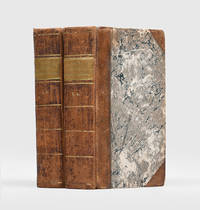
1794177518Breslau: Wilhelm Gottlieb Korn 1794-96. The Wealth of Nations in the German Enlightenment First edition of the German translation by Garve 1742-1798 the second overall after Schiller's edition of 1776-8. Of the two this second was arguably the more influential in disseminating Smithian economics throughout the German-speaking world as it built on a wider overall familiarity with Scottish philosophy. Garve was a prominent Enlightenment philosopher in his own right and a respected opponent of Kant. 4 vols bound in 2 octavo 204 x 119 mm. Tables in the text woodcut headpieces. Contemporary half sheep spines ruled and lettered in gilt and with yellow morocco labels marbled sides and pastedowns edges green. Light wear to extremities minor browning and foxing short tear to head of spine of first volume contents otherwise clean: a very good copy. Tribe 52. Vanderblue p. 26. Kenneth E. Carpenter: Dialogue in Political Economy 1977 p. 46. unknown
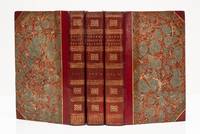
18299273Paris, Firmin-Didot, 1829 - 1833 ; 2 tomes reliés en 3 volumes in-folio atlantique (53 x 35,3 cm) ; demi-chagrin maroquiné à coins grenat, dos à nerfs soulignés de filets fins à froid, titre doré en lettres majuscules, filets à froid sur les plats, armes poussées à froid sur le premier plat de chaque volume, ex-libris Belton House (Grande-Bretagne), tête dorée, tranches juste ébarbées (reliure de l’époque) ; [4], 4, 9, [1 bl.], 50 pp. ; [4], pp.51-143, [1 bl.] pp.; [4], 143, [1bl.] pp. et en tout 254 lithographies hors-texte tirées sur Chine contrecollé sur vélin fort (quelques unes le sont directement sur la feuille), par Taylor, Fragonard, Eugène Isabey (17), Jorand, Deroy, Bourgeois, Sabatier, Bouton, Jaime, Athalin, Adam, J.D. Harding, Dauzats, Daguerre, Regnier, Brascassat, Ciceri, Bichebois, Tirpenne, Goré, Nouveaux, Villeneuve, Hubert, Monthelier, Alcaux, etc... ; 15 dessins in-texte lithographiés, 3 grandes lettrines de style celtique.
161431198AB1614. Herbornæ Nassoviorum Herborn 1614. Octavo. 16 423 p. Hardcover / Original very decorative 17th century binding in full leather with coat of arms supralibro of Danish Statesman and Diplomat Adam Gottlob Moltke to boards. Binding with some minor cracks to spine but still holding boards slightly rubbed and partially with minor loss to leather but with the original spine-label intact and the binding overall still in splendid glory / Extrem seltene Publikation des Wetteraner Mediziners Johannes Pincier Professor in Herborn und Marburg sowie Leibarzt in Dillenburg und Braunfels. Aus der Bibliothek des dänischen Oberhofmarschalls am Hof in Kopenhagen Adam Gottlob Moltke 1710 - 1791. Lenz / Müller-Jahncke p. 198 Wetteraner Mediziner des 16.Jahrhunderts: "Das Werk stellt eine Uebersicht ueber die Anatomie des menschlichen Koerpers in lateinischen Hexametern dar." / Allgemeine Deutsche Biographie 26 1888 S. 148-149 Online-Version hardcover
51-6279Paris: Chez F. Buisson an XIII 1804. Original wraps and labels; backstrip mainly gone on the atlas.Very good.3 volumes atlas. xvi 412; 4 431; 4 473. Text in French. 8vo 20.5 x 13.3 cm 8x5¼" . Atlas volume: 58 engraved plates several folding including maps views botanical and zoological illustrations. 36 x 28 cm 14 x 11".OCLC Number / Unique Identifier: 2609762.Bory de St-Vincent effectue un voyage de reconnaissance géographique à bord de la corvette Le Géographe. Il réside tout d'abord à l'île de France et ensuite à l'île de La Réunion du 12 août au 5 décembre 1801 avant de retourner en France. En 1804 il publie la relation de son séjour sous le titre "Voyage dans les quatre principales îles des mer d'Afrique Fait par ordre du gouvernement pendant les années neuf et dix de la République 1801-1802" imprimé par F. Buisson à Paris en 1804. Les trois volumes de texte sont accompagnés d'un atlas de 58 planches. Quand Bory de Saint-Vincent débarque à l'île de France en mars 1801 il offre ses services au gouverneur le général Magallon de la Morlière qui l'envoie à La Réunion. Bory de Saint-Vincent passe quelques mois à visiter l'île et dessine les sites les plus pittoresques de l'île.Harvard: The Friedman Lab.Evolutionary History andPlant Development:Jean Baptiste Genevieve Marcellin Bory de Saint Vincent Bory was a vocal and important French supporter of materialist transformist thought in the early 19th century. In keeping with the biographical norm for many of the most influential 19th century naturalists Bory served as the naturalist on board a naval expedition later publishing a travel narrative Voyage dans les quatre principals iles des mers d’Afrique 1804. Bory’s astonishment at the high levels of animal and plant endemism in the Mascarene Islands led him to muse on the possibility of an evolutionary world asking “How did greenery come to shade an isolated volcano†.Much of what is known of Bory’s evolutionary thought is revealed in his entries in the multivolume Dictionnaire classique des sciences naturelles which he edited in the 1820s. Bory was a frequent contributor to the Dictionnaire writing on such topics as “Creation†“Natural History†“Geography†“Man†“Orang†“Instinct†and “Intelligence.†Of particular interest is the fact that Bory’s Dictionnaire is known to have been on board the Beagle with Charles Darwin.Unlike other evolutionists such as Leopold von Buch 1825 and Charles Darwin who concluded that islands are colonized by long distant transport of species from neighboring mainlands Bory explicitly rejected this possibility. Instead he proposed a theory of multiple “modern creations†of life on isolated islands that involved instances of spontaneous generation from which more complex life forms then developed via Lamarckian transformism. Importantly for Bory the process of evolutionary innovation involved “individual aberrations†which become permanent and give rise to new species. Thus variation is central to his evolutionary speculations. Bory also argued that evolutionary advances must take place within a strict order or ecological succession in which early-appearing “primitive species†prepare the ground for “newer†more complex species which rely on these pioneers for their own survival.Bory’s transformist views did not go unnoticed. In an 1805 anonymous review of Voyage dans les quatre principals iles des mers d’Afrique published in the Edinburgh Review the author describes Bory’s theory of multiple spontaneous creations as “unphilosophical†and “by no means countenanced by fact.†It is interesting to note that the subsequent 1805 English translation of Voyage Voyage to and travels through the four principle islands of the African seas lacks many of the evolutionary bits of its original French . Paris: Chez F. Buisson, an XIII (1804) paperback
1796180931Philadelphia: Printed by Thomas Dobson 1796. In an unrestored binding from the early years of the republic Second American edition of the "greatest classic of modern economic thought" PMM a key influence on the founding fathers and the development of the young republic. First published in 1776 the Wealth of Nations includes several sections focusing on specifically American concerns. The work analyses the deteriorating British-American relationship at length and reflects approvingly on several aspects of American life most particularly the colonial separation between church and state. The work consequently won praise and attention from the founding fathers: Madison included it in his list of core items for the proposed congressional library while Jefferson judged it "the best book extant" on political economy quoted in Fleischacker p. 903. For Fleischacker the influence was still more fundamental: "America has a Constitution that in the functions it gives to government the structure its sic provides for the military and the strict separation it proclaims between religious and secular powers fits Smith's conception of politics better than any government of his day" p. 924. 3 vols duodecimo 172 x 103 mm. Contemporary tree sheep spines ruled in gilt and with red and green morocco labels. Light wear slight loss to spine ends minor browning foxing and offsetting to contents: a very good copy. ESTC W13002; Evans 31196; Kress B3288; Vanderblue p. 20; not in Tribe. Samuel Fleischacker "Adam Smith's Reception among the American Founders 1776-1790" William and Mary Quarterly Vol. 59 No. 4 Oct. 2002. unknown
117809London Printed for A. Strahan; and T. Cadell jun. and W. Davies in the Strand 1799. . Ninth edition; 3 vols; 8vo 21.5 x 14 cm; bookplate to front pastedown of each vol. ownership inscription to front free endpaper recto; contemporary mottled calf later contrasting black morocco lettering-pieces to spine joints expertly restored covers slightly abraded very good; xii 499 1; 2 vi 518 6; vii 1 465 51pp.<br /> The final eighteenth-century edition of Smith's masterpiece the 'first and greatest classic of modern economic thought' PMM. <br /><br />As the title explains the work is fundamentally an investigation into what makes certain nations prosperous. Smith's originality lies in locating the roots of this comparative wealth in the specialisation of labour which had occurred in developed economies for the 'annual labour of every nation is the fund which originally supplies it with all the necessaries and conveniences of life which it annually consumes and which consist always either in the immediate produce of that labour or in what is purchased with that produce from other nations' Introduction. <br /><br />'The history of economic theory up to the end of the nineteenth century consists of two parts: the mercantilist phase which was based not so much on a doctrine as on a system of practice which grew out of social conditions; and the second phase which saw the development of the theory that the individual had the right to be unimpeded in the exercise of economic activity. While it cannot be said that Smith invented the latter theory. his work is the first major expression of it. He begins with the thought that labour is the source from which a nation derives what is necessary to it. The improvement of the division of labour is the measure of productivity and in it lies the human propensity to barter and exchange. Labour represents the three essential elementswages profit and rentand these three also constitute income. From the working of the economy Smith passes to its matter'stock'which compasses all that man owns either for his own consumption or for the return which it brings him. The Wealth of Nations ends with a history of economic development a definitive onslaught on the mercantile system and some prophetic speculations on the limits of economic control' PMM.<br /> London, Printed for A. Strahan; and T. Cadell jun. and W. Davies in the Strand, 1799. unknown
121311London Printed for A. Strahan; and T. Cadell in the Strand 1791. . Sixth edition; 3 vols; 8vo 22 x 14 cm; old binder and bookseller's tickets to front pastedown of vol. I textblock a little toned vol. I 2K2 paper flaw with slight loss to upper margin not affecting text; contemporary mottled calf by Hookham & Carpenter of Bond Street contrasting green morocco lettering-pieces to spine sympathetically rebacked preserving original spines with areas of in-fill lettering-pieces with slight loss of gilt to vol. 3 corners rubbed very good; x 499 1; vi 518 6; v 1 465 51pp.<br /> The first posthumous edition of Smith's masterpiece the 'first and greatest classic of modern economic thought' PMM. <br /><br />As the title explains the work is fundamentally an investigation into what makes certain nations prosperous. Smith's originality lies in locating the roots of this comparative wealth in the specialisation of labour which had occurred in developed economies for the 'annual labour of every nation is the fund which originally supplies it with all the necessaries and conveniences of life which it annually consumes and which consist always either in the immediate produce of that labour or in what is purchased with that produce from other nations' Introduction. <br /><br />'The history of economic theory up to the end of the nineteenth century consists of two parts: the mercantilist phase which was based not so much on a doctrine as on a system of practice which grew out of social conditions; and the second phase which saw the development of the theory that the individual had the right to be unimpeded in the exercise of economic activity. While it cannot be said that Smith invented the latter theory. his work is the first major expression of it. He begins with the thought that labour is the source from which a nation derives what is necessary to it. The improvement of the division of labour is the measure of productivity and in it lies the human propensity to barter and exchange. Labour represents the three essential elementswages profit and rentand these three also constitute income. From the working of the economy Smith passes to its matter'stock'which compasses all that man owns either for his own consumption or for the return which it brings him. The Wealth of Nations ends with a history of economic development a definitive onslaught on the mercantile system and some prophetic speculations on the limits of economic control' PMM.<br /> ESTC T95383; Tribe 41. London, Printed for A. Strahan; and T. Cadell, in the Strand, 1791. unknown
1796187836London: Printed for A. Strahan; and T. Cadell jun. and W. Davies 1796. The foundation of modern economics Eighth edition of Smith's masterpiece "the first and greatest classic of modern economic thought" PMM following its first publication in 1776. "The Wealth of Nations had no rival in scope or depth when published and is still one of the few works in its field to have achieved classic status meaning simply that it has sustained yet survived repeated reading critical and adulatory long after the circumstances which prompted it have become the object of historical enquiry" ODNB. 3 vols octavo 206 x 126 mm. Contemporary tree calf red morocco spine labels board edges tooled in gilt. Ownership stamps and signatures of historian Kenneth Porter Kirkwood 1899-1968. Spines dry and cracked restoration to ends loss to head of vol. II printing error to vol. II sig. T7r loss to outer margins of vol. II sig. Z3 and vol. III sig. G7: in very good condition. Goldsmiths' 16558; Kress B.3289; Tribe 58; Vanderblue p. 4. unknown
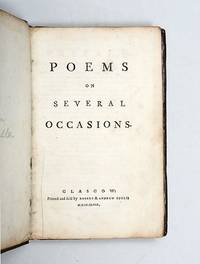
1748152859Glasgow: Robert & Andrew Foulis 1748. Adam Smith's first appearance in print First edition of Hamilton's poems edited and with a preface by Adam Smith marking his first appearance in print. Hamilton 1704-1754 had been an army officer in the Jacobite risings during which time his poetry aroused considerable interest. His poem 'Ode to the Battle of Gladsmuir' set to music by McGibbon became a popular Jacobite ballad. Hamilton went into exile in France after the failure of the risings. A group of his friends likely including Adam Smith's patron Lord Kames feared that his sudden fame would lead to pirated and shoddy editions and consequently prepared the current collection see preface. Smith then twenty-five years old was entrusted with its editorship his first enterprise in publication which indicates that his circle held his literary taste in high regard following his lecture series of 1748-9 lectures given at the suggestion of Kames. When Hamilton was pardoned and returned to Scotland in 1750 he and Smith became intimate friends. In 1758 Foulis published a second edition giving the author's name for which Smith added the dedication to the poet's great friend the Glasgow merchant William Crawford. Octavo 158 x 98 mm. Contemporary calf red morocco label. Bookplate and shelflabel to front pastedown. Joints and extremities neatly restored light rubbing. Front endpaper with small chips at foot repaired 7 cm closed tear at foot of title contents otherwise fresh; a good copy. ESTC T42625; Gaskell 110; Vanderblue p. 46. See Rae Life 3841; Simpson Ross Life p. 96. unknown
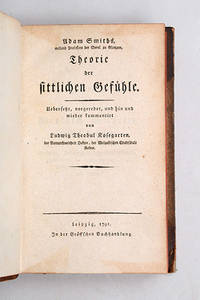
1791104689Leipzig: In der Gräffschen Buchhandlung 1791-95. First complete German translation of Smith's Theory of Moral Sentiments the second German translation overall volume II providing a translation of the additional material contained in the English sixth edition published shortly before Smith's death in 1790. The first German translation of 1770 was made from the third edition of 1767. "The Kosegarten translation of 1791 had more impact than the 1770 one partly because of its timing and also because it did provide some contextualization for work and author" Tribe. 2 vols bound in one octavo 197 x 120 mm. Contemporary half sheep and sprinkled boards spine ruled gilt in compartments morocco spine label edges stained red. Corners and extremities slightly rubbed occasional light spotting; an excellent copy. Tribe 40 & 54; Vanderblue p. 42 listed but not apparently held although Harvard locates 3 copies in its various libraries. hardcover
51-6028London: Printed for A. Millar J. and R. Tonson J. Rivington R. Baldwin W. Johnston L. Hawes W. Clarke and R. Collins T. Longman J. Dodsley and R. Horsfield. MDCCC LXIV. Folio. 26.5 x 41cm. 2 volumes. Rebound by the artisan binder Sasha Mosalov in full goatskin in 2 brown textures. Original spine labels preserved.2 volumes. x xxxiv 4 500; 2 433 1 126 4 111 1 5 pp. Three folding maps.Coming down from earliest times to the year 1762 Anderson's work is a monument of stupendous industry. Composed in the form of annals it is not merely a record of commercial progress and colonial enterprise but a history of the political industrial and social development of all civilised countries and especially of Great Britain and Ireland" DNB. "The author was a clerk in the South-Sea House London. It contains a most accurate account of the South-Sea Company and the very extraordinary actions of the year 1720." Sabin. Sabin 1382; Kress 6154. Chinese seal to both title pages.OCLC Number / Unique Identifier:863535986: xxxiv 4 500 pages 3 folded leaves of plates; 2 433 128 111 6 pages : maps ; folio. London: Printed for A. Millar, J. and R. Tonson, J. Rivington, R. Baldwin, W. Johnston, L. Hawes, W. Clarke and R. Collins, T. L unknown
1787000055Göttengen: J. C. Dieterich 1787. Half Calf. Very Good . Folio 39.2 x 24.6 cm Large paper copy bound in later half calf and marble boards. Collation: 2 iii-xlv 1 Err. 1-124 8 pp. 31 3 folding engraved plates. The present half calf binding replaced the original green-paper boards. The new binding has raised bands and gilt decorated panels with brief gilt title and author stamped into red morocco label in upper panel. The boards and corners are in very good condition. There is upper edge paper repair to front free end paper and title page presumably replacing removed early ownership information. The text proper including the half title not mentioned by Sabin is very clean and bright. The personal circular stamp of previous owner Inz. Mgr. M. Kubiak is in the blank area of the fore edge on p. xxxix and the lower right corner of Tab. III. The plates are generally very clean except for Tab XVIII XXVI XXIX and XXXI where there is striking from the printing of the plate or minor spot in center area away from image Tab. XXXI. Plate XXVI has the most striking near the stub area. It is also the only plate that was placed on the stub too high and the upper edge with Tab number was trimmed during the rebinding with number unreadable. The table on pp. xxxviii- xlv lists properties of 21 North American trees with aspects of growth roots base location/habitat bark wood/lumber leaves sex flowering time seeds seed maturity beginning of growth life span propagation and uses of timber. <br/><br/>Each tree illustrated is discussed separately in the text portion of this work. Wangenheim gives the German Latin and English name for each tree along with Latin description and cites authors who have named and described the tree previously. Several of the trees were new and are described by Wangenheim who cites Linneaus Species Plantarum and Gronovius Flora Virginiana for the other trees. This is one of the first systematic treatment of North American trees with illustrations that would be suitable for a climate outside North America other than Catesby's 1763 Hortus britanno-americannus… and predates Michaux's first illustrated work on oakes by 14 years. There was an earlier publication by Wangenheim that was more of a catalog of trees he observed in his travels as an Hessian soldier with the British troops during the War of Independence. All of the plates were made from field drawings done by Wangenheim although none of them is signed. Johnston notes Cleveland Collection p. 537 that Wangenheim returned to "Prussia where he engaged in forestry. This is the first edition of this work on introducing North American trees into Germany. This is the first edition of this work on introducing North American trees into Germany." Cleveland 574; Lib. Arnold Arboretum p. 730; Nissen BBI 2105; Rehder I 304; Sabin 101238 J. C. Dieterich unknown books
18469London : for John Starkey and Thomas Basset 1669. Second edition. Two parts in one volume folio contemporary full mottled calf with blind embossed boards spine with raised bands and contrasting morocco title label with gilt lettering and ornament front pastedown with eighteenth century armorial bookplate of John and Louisa Trevelyan additional engraved title incorporating 5 portraits main title leaf pp 18 316; 6 232 9; with 2 engraved portraits and 6 folding or double-page maps including one of the East Indies engraved illustration of the Ruthenian script; engraved headpieces and historiated initials; complete with all the folding maps in very good condition; a fine copy in a contemporary binding. The principal aim of the Duke of Holstein's embassies was to establish an overland trade route with Persia. A first embassy travelled to Russia in 1633-34 to secure a right of passage through the Tsar's realms; the embassy to Persia itself was sent in 1635. Adam Olearius acted as secretary on both embassies and his accounts of Tartary and Persia first published in Dutch in 1647 were of the utmost value to European travellers of the later seventeenth century. This is the second 'corrected' English edition translated by John Davies the first English edition had appeared in 1662. The second part with separate title comprises the narrative of German adventurer Johann Albrecht von Mandelslo who was also a member of the Holstein embassy. He was given permission to journey on to India also visiting Ceylon before returning to Europe via the Cape. Although he did not personally travel to the Far East Mandelslo's account includes secondhand descriptions of Formosa and China. Wing 0-270; Löwendahl China illustrata nova. Supplement 1571 hardcover
200288323PPP Editions 2002-01-01. Paperback. Like New. #10/50 signed limited oversized string bound softcover in black clamshell as issued. oversized and overweight. Please email for photos. PPP Editions paperback
17862442London: A. Strahan and T. Cadell 1786. Fourth edition. Contemporary calf. Very Good. HANDSOME EIGHTEENTH-CENTURY EDITION OF THE "GREATEST CLASSIC OF MODERN ECONOMIC THOUGHT.". This classic work of the Scottish Enlightenment - originally published in the same year as the Declaration of Independence and Gibbon's History of the Decline and Fall of the Roman Empire - is a magisterial study of the sources of national wealth and of the political and institutional arrangements that foster or suppress it. Based on a 2016 analysis of data from Google Scholar The Wealth of Nations is the second only to Marx's Das Kapital as the most-frequently cited among books in the social sciences published before 1950. And while Smith recognized the economic benefits that flow from voluntary transactions between individuals and is as a result sometimes thought of as the apostle of laissez faire capitalism he supported several forms of government intervention in the economy either to create and maintain the necessary conditions for economic growth or to ameliorate the incidental harms that such conditions could create.<br /> <br /> The Wealth of Nations proposed that "no society can surely be flourishing and happy of which the far greater part of the members are poor and miserable. It is but equity besides that they who feed cloath and lodge the whole body of the people should have such a share of the produce of their own labour as to be themselves tolerably well fed cloathed and lodged." WN this edition vol. 1 page 119. Smith believed that this condition of society could be achieved only through the higher productivity that is made possible by the division of labor. As an example of the division of labor Smith offered the example of the "trade of the pin-maker" which he apparently learned about from Diderot and d'Alembert's Encyclopédie in which "one man draws out the wire another straights it a third cuts it a fourth points it a fifth grinds it at the top for receiving the head ." and so forth. WN this edition vol. 1 pages 7-8.<br /> <br /> In a famous passage Smith explains that such arrangements arise naturally from voluntary transactions between individuals based on their common recognition of the benefits that division of labor creates:<br /> <br /> This division of labour from which so many advantages are derived is not originally the effect of any human wisdom which foresees and intends that general opulence to which it gives occasion. It is the necessary though very slow and gradual consequence of a certain propensity in human nature which has in view no such extensive utility; the propensity to truck barter and exchange one thing for another.<br /> <br /> . Man has almost constant occasion for the help of his brethren and it is in vain for him to expect it from their benevolence only. He will be more likely to prevail if he can interest their self-love in his favour and shew them that it is for their own advantage to do for him what he requires of them. Whoever offers to another a bargain of any kind proposes to do this. Give me that which I want and you shall have this which you want is the meaning of every such offer; and it is in this manner that we obtain from one another the far greater part of those good offices which we stand in need of. It is not from the benevolence of the butcher the brewer or the baker that we expect our dinner but from their regard to their own interest. We address ourselves not to their humanity but to their self-love and never talk to them of our own necessities but of their advantages. WN this edition vol. 1 pages 19-21.<br /> <br /> "Throughout the book Smith's 'system of natural liberty and justice' . plays a pervasive role as explanatory model and regulatory ideal though the famous image of an 'invisible hand' appears late and only once in the whole work . It appears at volume 3 page 181 of this edition. A quasi-Newtonian treatment is given to those forces which act like gravity when market price departs from natural price and it always carries with it a normative implication that policies or practices that prevent these forces from acting are detrimental to the public interest. Monopolies special privileges informal combinations by merchants or employers to raise prices and keep down wages import duties export bounties as well as institutions such as apprenticeships and restrictions on labour mobility . are all condemned from this perspective." Dictionary of National Biography.<br /> <br /> Smith was not unmindful of possible deleterious consequences of the division of labor: "The man whose whole life is spent in performing a few simple operations of which the effects too are perhaps always the same or very nearly the same has no occasion to exert his understanding or to exercise his invention in finding out expedients for removing difficulties which never occur. He naturally loses therefore the habit of such exertion and generally becomes as stupid and ignorant as it is possible for a human creature to become." WN this edition vol. 3 pages 182-83. Smith believed that public elementary education would compensate for this tendency.<br /> <br /> Edition: This copy of The Wealth of Nations is the fourth edition 1786 issued ten years after the first. It was the penultimate edition published during Smith's lifetime the last being the fifth edition of 1789. It carried forward the significant changes made in the third edition of 1784 without making any material additional changes of its own as Smith specifically admitted in the prefatory Advertisement to this edition. A detailed collation of the first five editions is provided in Edwin Cannan's 1904 edition of Smith's work.<br /> <br /> Provenance: With the armorial bookplate of Thomas Howitt bearing the motto "Aquila Non Capit Muscas" "Eagles do not catch flies" on the front pastedown of each volume. Howitt may have been the Lancaster physician of that name 1785-1832; see archives of the Royal College of Surgeons of England ref no. GB 0114 MS0092 the entry for Howitt's son also named Thomas Howitt. It is possible that Howitt's son Thomas Jr. 1830-1922 was responsible for the additions to these volumes described below.<br /> <br /> Volume 2 is bound with additional pages at the end on which a prior owner has pasted articles on the California gold rush of 1849 citing a discussion on page 354 of the volume in which Smith argues that "of all those expensive and uncertain projects however which bring bankruptcy upon the greater part of the people who engage in them there is none perhaps more perfectly ruinous than the search after new silver and gold mines." Another extract pasted at the beginning of volume 1 from an unknown source recommends the reduction of taxes.<br /> <br /> London: A. Strahan and T. Cadell 1786. Octavo contemporary full calf with elaborately gilt-decorated spines; vol 1 rebacked with original spine laid-down. Bound without half-titles. Vol 1 spine darker more toned than the other two. Light flaking to spines a little chipping to leather at extremities. Some foxing to title and first few leaves of each volume; otherwise text clean. A lovely early set of Smith's masterpiece. A. Strahan and T. Cadell unknown books
165739Various cities: RAM / Whitney Museum / Steidl / Nash Editions 2005. Hardcover. Limited Edition complete in three volumes one of a numbered edition of 55 this being No. 42 with an original print SIGNED by the artist. Each volume additionally SIGNED by the artist on the half-title page. Text in English and German.<br /> <br /> Each volume Fine in a Near Fine dust jacket with light toning along the jacket spines. Print Fine in publisher's paper folio. Print and volumes housed together in publisher's white hard plastic slipcase. <br /> <br /> Oversize volume shipping billed at cost. RAM / Whitney Museum / Steidl / Nash Editions unknown
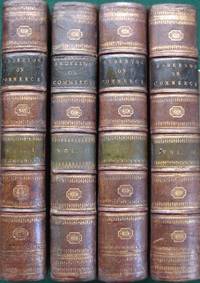
178755106IMPORTANT HISTORY OF COMMERCE - THE BEST EDITION - GREATLY EXPANDED & REVISED<br />first edition thus revised and expanded second overall 4 vols. 4to. 2 title v-lxxxviii 556; 2 title 647 1 blank; 2 title 508 59 chronological index 1 blank 11 index & appendix 1 blank; 2 title iv 4 list of subscribers 718 43 alphabetical & chronological index 1 blankpp. 2 folding maps 1 frontispiece plate 1 folding table contemporary speckled calf sides with a decorative gilt rolled border spines panelled by gilt highlighted raised bands panels gilt tooled black morocco title labels and olive green morocco numbering labels labels on vol. 2 renewed very close match to originals minor old worm trace in a few early gatherings of vol.2 very skillfully repaired minor damps stains to margins of some leaves mainly of terminal leaves some minor cracking of joints sometime very skillfully refurbished. Overall a nice and a handsome copy.<br /><br />ESTC t79287 SABIN 1382 <br />Anderson's work was first published in 2 folio vols. in 1764. A prospectus for this greatly extended edition was issued on January 21 1787 and it was thereafter issued in parts. Vols. 1-3 are dated 1787 and vol. 4 1789. There is a list of subscribers in vol. 4.Attractive copy of this "monument of industry in the form of annals treating specially Great Britain and Ireland" Palgrave <i>Political Economy</i> v.1 p.39. The initial work of 1764 is here greatly extended by Coombe and especially in this later form it has long been valued by economic historians as an important source. Anderson worked for many years in the South Sea Company and this work is particularly notable for its accurate account of that company and the great crash of 1720. There is also considerable information on aspects of American and Canadian economic affairs such as the history of the fur trade the fisheries of Nova Scotia and Newfoundland and John Law's Mississippi scheme. Printed at the Logographic Press, by J. Walter and sold by [many listed booksellers in London, Dublin, Edinburgh & Glasgow] hardcover
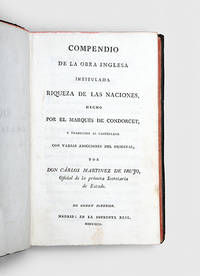
1792164946Madrid: en la Imprenta Real 1792. THE FIRST APPEARANCE OF ADAM SMITH IN SPANISH First Spanish translation of Condorcet's summary of Smith's Wealth of Nations the first appearance of any of his work in Spanish prior to the complete translation by J. A. Ortiz in 1794. The translator of the present summary is the young marqués de Casa Carlos Martinez de Yrujo y Tacón 1763-1824. "This is a translation of the Roucher/Blavet condensation of Wealth of Nations in the Bibliothèque de l'homme publique. to which Condorcet lent his name. The translator restores to the text a summary of Smith's Digression on the Bank of Amsterdam WN IV iii. b 479-88 a five-line qualification of the argument for free trade. The criticism of Catholic clergy is omitted." Tribe. Octavo 174 x 108 mm. Contemporary tree sheep flat spine ruled and decorated in gilt red morocco label marbled endpapers red edges. 19th-century ownership inscription to front free blank leaf extremities lightly rubbed one corner slightly worn; a crisp clean copy in fine condition. Palau 59126; Tribe 47. This edition not listed in Goldsmiths' Kress or Vanderblue. unknown
1811119352Vilnius: Drukarnia XX Bazylianów 1811. Scarce Polish translation of Georg Sartorius's Von den Elementen des National-Reichthums und von der Staatswirtschaft nach Adam Smith translated from the second German edition of 1806 first 1796 translated by Jan Znosko holder of the chair of political economy at the Vilnian University from 1810 to 1823. "Znosko established his credentials with a work entitled A Science of Political Economy according to Adam Smith thought by his contemporaries to be an original work but which later turned out to be a translation of the second editoin of Gaorg Sartorius's 1796 Handbuch. The book is of course a summary of Wealth of Nations but in places Znosko inserts some critical obervations printed in a smaller typeface. The longest of these is related to Smith's conception of 'fertile' and 'infertile' labour that is productive and unproductive labour." Stefan Zabieglik 'The Reception of Adam Smith's Works in Poland from the Eighteenth to the Twentieth Centuries' in: A critical Bibliography of Adam Smith. Octavo 168 x 97 mm. Contemporary roan-backed drab paper boards spine renewed yellow edges. Ownership stamp of Gwalbert Pawlinkowski to title verso and T6 verso library stamps to title recto and verso partly blacked out. Spine renewed corners worn stamp to lower margin of B1 cut away; occasional light spotting; a good copy. Tribe p. 174. Not in Vanderblue. OCLC locates only the Polish national union catalogue copy. hardcover
181127288London: J. Maynard.Haymarket; and F. Zinke.Strand 1811. 3 volumes. Very early printing. This printing now with an Account of the Life of the Author which has been specially drawn up for the first time as well as studies on the author and the French economists of the period and a method of facilitating the study of the work. 8vo bound in very handsome and well preserved three-quarter contemporary polished calf over cloth covered boards compartments of the spines decorated with gilt decorated raised bands bordering decorations tooled in blind one compartment lettered in gilt one with maroon morocco lettering label gilt. lxxi 360; vi 512 513-514 appendix; vi 448 50 pp.extensive index. An especially bright and fine set in very handsome and well preserved contemporary bindings. The text remains very clean crisp and fresh. There has been no restoration work of any sort to bindings or text. Rare thus. AN UNUSUALLY WELL PRESERVED AND HANDSOME SET OF THIS EXTRAORDINARY WORK. Eighteenth century editions of Smith’s magnum opus are becoming very scarce. This edition of 1811 is a very early English printing of the nineteenth century still in 18th century style. It retains Smith’s introduction and also incorporates the author’s advertisements to the third and fourth editions and a new advertisement to this edition setting out the additions made to the preliminary materials for this edition.<br> ‘The history of economic theory up to the end of the nineteenth century consists of two parts: the mercantilist phase which was based not so much on a doctrine as on a system of practice which grew out of social conditions; and the second phase which saw the development of the theory that the individual had the right to be unimpeded in the exercise of economic activity. While it cannot be said that Smith invented the latter theory – the physiocrats had already suggested it and Turgot in particular had constructed an organised study of social wealth – his work is the first major expression of it. He begins with the thought that labour is the source from which a nation derives what is necessary to it. The improvement of the division of labour is the measure of productivity and in it lies the human propensity to barter and exchange: "labour is the real measure of the exchangeable value of all commodities … it is their real price; money is their nominal price only". Labour represents the three essential elements – wages profit and rent – and these three also constitute income. From the working of the economy Smith passes to its matter – "stock" – which compasses all that man owns either for his own consumption or for the return which it brings him. The Wealth of Nations ends with a history of economic development a definite onslaught on the mercantile system and some prophetic speculations on the limits of economic control.<br> ‘Where the political aspects of human rights had taken two centuries to explore Smith’s achievement was to bring the study of economic aspects to the same point in a single work … The certainty of its criticism and its grasp of human nature have made it the first and greatest classic of modern economic thought’ PMM. <br> Smith's classic work was begun at Toulouse in 1763-64 where he had travelled as guardian of Henry Scott the young duke of Buccleuch and in the company of David Hume historian and fellow professor at Glasgow University. The work took shape over the next ten years and was finally published in 1776. At one point during its composition Hume wrote that Smith was "cutting himself off entirely from human society." But his labors however severe his methods yielded the "first and greatest classic of modern economic thought" Printing and the Mind of Man.<br> "It may be said that the WEALTH OF NATIONS certainly operated powerfully through the harmony of its critical side with the tendencies of the half-century which followed its publication to the assertion of personal freedom and 'natural rights.' It discredited the economic policy of the past and promoted the overthrow of institutions which had come down from earlier times but were unsuited to modern society. As a theoretic treatment of social economy and therefore as a guide to social reconstruction and practice in the future it is provisional not definitive. But when the study of its subject comes to be systematized on the basis of a general social philosophy more complete and durable than Smith's no contribution to that final construction will be found so valuable as his" Britannica J. Maynard...Haymarket; and F. Zinke...Strand hardcover
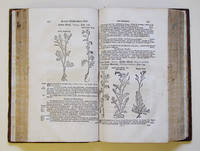
52487Ulm Albrecht Friedrich Bartholomäi 1770. 2° 4 Bl. n.n. 750 S. 11 Bl. n. n. Register Index; 4 Bl. n. n. 136 S. über 800 Holzschnitten OLdr. der Zeit m. Rückenschild Deckel berieben auf Vorsatz Notationen von alter Hand einige Bl. m. Randfehlstellen kein Textverlust diese fachfrauisch augefüllt. Einige Seiten wasserrändig und fingerfleckig. Insgesamt ein gutes Exemplar. Seitensprung zwischen 2. u. 3. Teil von S. 566 auf 571 Graesse IV 256. - Eines der beliebtesten Kräuterbücher der Zeit. Lonitzer - Mediziner Botaniker 1528-1586 seit 1545 Magister artium wurde L. 1553 Prof. der Mathematik in Marburg und im folgenden Jahr zum Dr. med. promoviert. Das Amt des Stadtphysikus in Frankfurt/Main übte er bis zu seinem Tod aus. 1551-55 veröffentlichte L. eine bearbeitete lateinische Neuauflage des Kräuterbuchs seines Amtsvorgängers Eucharius Rößlin dessen deutsche Fassung EA 1557 noch zu L.s Lebzeiten fünf Auflagen erlebte und fast 250 Jahre lang als volkstümliches Heilpflanzenbuch benutzt wurde. Neben Pflanzen behandelt das Werk auch Tiere Erze Edelsteine und Metalle. DBE 010 Ulm, Albrecht Friedrich Bartholomäi, 1770 unknown
1793124986London: A. Strahan and T. Cadell 1793. Rare 18th century edition of Adam Smith's magnum opus and cornerstone of economic thought. Octavo 3 volumes bound in half calf over marbled boards gilt titles to the spine morocco spine labels. In near fine condition. A very nice set of this classic work. Adam Smith's masterpiece first published in 1776 is the foundation of modern economic thought and remains the single most important account of the rise of and the principles behind modern capitalism. "The history of economic theory up to the end of the nineteenth century consists of two parts: the mercantilist phase which was based not so much on a doctrine as on a system of practice which grew out of social conditions; and the second phase which saw the development of the theory that the individual had the right to be unimpeded in the exercise of economic activity. While it cannot be said that Smith invented the latter theory.his work is the first major expression of it. He begins with the thought that labour is the source from which a nation derives what is necessary to it. The improvement of the division of labour is the measure of productivity and in it lies the human propensity to barter and exchange.Labour represents the three essential elements-wages profit and rent-and these three also constitute income. From the working of the economy Smith passes to its matter -'stock'- which encompasses all that man owns either for his own consumption or for the return which it brings him. The Wealth of Nations ends with a history of economic development a definitive onslaught on the mercantile system and some prophetic speculations on the limits of economic control.The Wealth of Nations is not a system but as a provisional analysis it is complete convincing. The certainty of its criticism and its grasp of human nature have made it the first and greatest classic of modern economic thought" PMM. A. Strahan and T. Cadell hardcover books
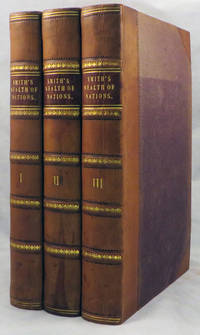
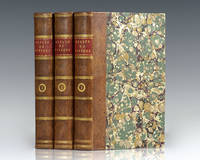
18063464Edinburgh: Arch. Constable and Company 1806. First Edinburgh Edition. Leather Bound. Very Good. First Edinburgh Edition. Leather Bound. 3 vol. Adam Smith An nurture into the Nature and Causes of the Wealth of Nations.<br /> First Edinburgh Edition. With Life of the author. Bound in 3/4 red crushed Morocco leather with marbled boards and gilt embellishment motifs and lettering on spines. Marbled endpapers all edges marbled. Published Edinburgh: Arch. Constable and Company 1806.<br /> H: 8 3/4" W: 5 1/2" D: 1 1/4". Arch. Constable and Company unknown
05952Paris & London: V. Morlet & McLean 1830. Twelve Superb Hand-Colored Lithographed Plates <br /> Depicting Scenes from the Debtor's Prison of Sainte-Pélagie<br /> <br /> ADAM Victor. Album de Sainte-Pélagie Prison de la Dette. Gravures réhaussées à l'aquarelle. Douze scènes intérieures dessinées et lithographiées d'après nature par V. Adam. Paris & London: Publié par V. Morlot & Mc.Léan n.d. ca. 1830. <br /> <br /> First edition. Oblong folio 10 5/8 x 13 7/8 inches; 270 x 352 mm. 4 pp. of descriptive text. Twelve numbered hand-colored lithographed plates. Plates lithographed by Bernard. Each plate with the publisher's oval blind-stamp in lower blank margin. Bound without the printed title-page.<br /> <br /> Mid-nineteenth century quarter red calf over marbled boards smooth spine ruled and lettered in gilt. <br /> A superb example with fine contemporary hand-coloring.<br /> <br /> The plates are captioned: "L'Écrou;" "Chambre du détenu malheureux;" "Chambre du détenu philosophe;" "Les Élections;" "Le Cabinet de lecture;" "Le Cabaret;" "Le Café;" "Le Repas dans la cour;" "Les Jeux dans la cour;" "Le Bain du créancier;" "Le Paye;" and "Sortie du débiteur;." <br /> <br /> A rare album depicting various scenes at the Parisian prison of Sainte-Pélagie. This prison once located in the 5th arrondissement was active from 1790-1899 and housed many renowned prisoners during and after the French Revolution including the Marquis de Sade. In this series Adam conveys in various scenes of prison life the dignified squlor to which its inhabitants were reduced.<br /> <br /> Exceptionally rare. We have only seen this book once before - a copy with modern hand-coloring which we sold in 2003.<br /> <br /> OCLC locates just one copy - BCU Dorigny Lausanne Switzerland.<br /> <br /> Jean Victor Adam 1801-1866 was a French painter and lithographer. Born in Paris he was the son of Jean Adam an esteemed engraver. During the years 1814 to 1818 he studied at the Ecole des Beaux-Arts and also in the ateliers of Meynier and Régnault. In 1819 he exhibited 'Herminia succouring Tancred.' He was almost immediately afterwards employed to paint various subjects for the Museum at Versailles amongst which are 'The Entry of the French into Mainz' 'The Battle of Varroux' 'The Taking of Menin 'The Battle of Castiglione' 'The Passage of the Cluse' 'The Battle of Montebello' 'The Capitulation of Meiningen;' the last three in association with Alaux. He also exhibited down to the year 1838: 'Henry IV. after the Battle of Coutras' 'Trait of Kindness in the Duke de Berri' 'The Postillion' 'The Vivandiere' 'The Road to Poissy' 'The Return from the Chase' 'Horse-fair at Caen' and numerous other subjects. He then retired from publicity till 1846 when he appeared as the exhibitor of some works in lithography to which branch of art he afterwards restricted himself. In this line he produced a lithographic album 'Views in the Environs of Paris' 'Studies of Animals for an edition of Buffon' &c. He obtained a gold medal in 1824 a second class medal in 1836 besides several others from Lille Douai and other cities. He died at Viroflay in 1866.<br /> <br /> "Beraldi assigns between 7000 and 8000 designs to Victor Adam 1801-1865.A Parisian by birth he remained in the capital all his life but this did not prevent him from drawing negroes Turks Chinese and other peoples all over the world in his Paris studio. He was famous indeed as a faiseur de bonshommes that is to say a specialist in adding groups of small figures to the foreground of architectural or landscape drawings by other artists.His immense production contains many amusing albums concerning the life of the time" Ray The Art of the French Illustrated Book p. 194. <br /> <br /> Sainte-Pélagie was a debtor's prison in Paris in active use from 1790 to 1899. The former Parisian prison was located between the current group of buildings bearing No. 56 Rue de la Clef with Rue du Puits-de-l'Ermite in the 5th arrondissement of Paris at the old Place Sainte-Pélagie. The penal structure held many noted prisoners during the French Revolution with Madame Roland Grace Dalrymple Elliott and Marie-Louise O'Murphy being among the known prisoners. After the revolution the Marquis de Sade was imprisoned here as was the young mathematician Évariste Galois. During the July Monarchy the "April insurgees" were also detained there and some managed to escape through a tunnel. The painter Gustave Courbet was also imprisoned there for his activities in the Paris Commune. <br /> <br /> Bobins V 1524. Paris [&] London: V. Morlet [&] McLean, 1830 unknown
190958833Lund, C. W. K. Gleerups förlag, 1909 & 1911. 8vo. Both volumes in the original printed wrappers. Light wear to spines, otherwise a very fine and clean set. XVI,191, (4), 179 pp.