42 895 résultats
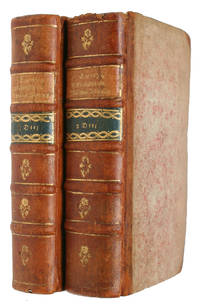
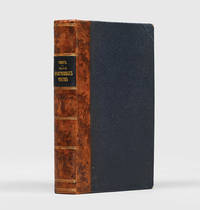
29235In two volumes. Translated from the original German by Richard Belgrave Hoppner Esq. London : Printed by C. Roworth Volume II Printed by T. Davison for John Murray Bookseller to the Admiralty and the Board of Longitude 1813. First edition in English. Two volumes in one quarto later half calf over marbled papered boards lightly rubbed spine in gilt-ruled compartments with black morocco title piece lettered in gilt marbled edges and endpapers front pastedown with armorial bookplate of William Philip Earl of Sefton; Volume 1. frontispiece handcoloured aquatint plate of Native of Nukahiva drawn and engraved by J. A. Atkinson xxxii 314 pp with a folding engraved map by Neele Chart of The Northwest Part of the Great Ocean Drawn By D. F. Sotzmann 1811 Reduced from Captn. Krusenstern's Original Chart; Volume 2. frontispiece handcoloured aquatint plate View of Nangasaki by Atkinson x 404 pp; light foxing and toning to preliminaries of Volume 1 else clean and crisp throughout with the plates and map in fine condition; an excellent wide-margined copy. First edition in English of Krusenstern's important narrative of the first Russian circumnavigation. Although ostensibly under the auspices of the Czar Krusenstern's expedition was actually funded by the Russian American Company to ""open relations with Nippon and the Sandwich Islands to facilitate trade in South America to examine California for a possible colony and to make a thorough study and report on the Northwest coast its trade and future"" Hill. A number of the officers under Krusenstern's command including Lisiansky commanding the Neva Bellingshausen Kotzebue Rezanov and Langsdorff would go on to make significant voyages of exploration in the Pacific. After visiting Brazil the expedition entered the Pacific where the Neva and Nadeshda were separated in a storm. Lisiansky in the Neva made for Easter Island later meeting up with Krusenstern in the Nadeshda in the Marquesas. The two ships then sailed together to Hawaii. From there Krusenstern continued west to Kamchatka Sakhalin and Japan - his narrative contains an extensive account of his failed ambassadorial mission in Nippon - while Lisiansky made for Russian America. The expedition ships would eventually rendezvous in Canton before returning to Kronstadt by way of the Cape of Good Hope. Krusenstern's account was first published in Russian in three volumes plus folio atlas at St. Petersburg 1809-1813. The English edition was translated by Hoppner from the first German edition also in three volumes plus folio atlas published at St. Petersburg 1810-1814 with the title Reise um die Welt in den Jahren 1803 1804 1805 und 1806. Hill 952; Sabin 38331; Kroepelien 693; Lada-Mocarski 61 & 62 note; Arctic Bib. 9381; Cordier Japonica 459 hardcover
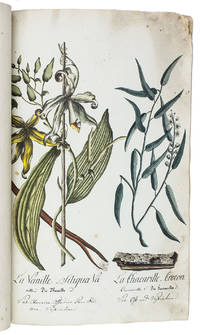
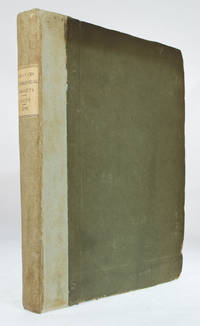
1804K59DWF5YDV43Ofen Buda 1804. Small folio 31.5 x 20 cm. Contemporary marbled paper wrappers. With manuscript title-page followed by 18 leaves of coloured drawings of plants and trees. 19 ll. Collection of high quality drawings of plants and trees by the physician Adam Johann Ingruber who graduated from the faculty of Medicine of the University of Pest in 1803. The 18 leaves of drawings mostly show two species of plants or trees each with captions in French Latin and German at the foot the last two show silkworms bees a rattlesnake and a scorpion. Most species are from Asia South America Africa and the southern part of Europe.Water stained some occasional smudges a few leaves cut short tattered spine: in fair condition. unknown
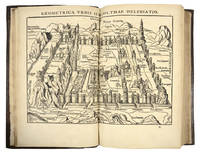
90734Frankfurt Georg Raben Sigismund Feyerabend and heirs of Weigand Han 1563. . First edition folio 31.5 x 21.3 cm; contemporary blind-stamped calf morocco lettering piece and gilt compartments to spine; old ownership signatures to title page; text in German. 12 pp. including title page with woodcut device 635 33 double-page woodcut map 42 woodcut illustrations in text.<br /> A fine example in an attractive contemporary binding of the first edition in Latin of this important illustrated history of Jerusalem prior to its destruction by the Romans.<br /><br />Adam Reisner 1500-1572 a German mystic and poet was the pupil of Johann Reuchlin a German humanist and prominent scholar of Greek and Hebrew. Reisner taught theology for many years and wrote historical and theological works including an 'anti-papal history.' He later made a name for himself as a writer of hymns.<br /><br />This is one of Reisner's most important works in which he describes the city of Jerusalem in detail with all its holy landmarks. He paints a picture of 'Heavenly Jerusalem' in stark contrast to what he sees as the 'Satanic Babylon' of the corrupt papacy. For Reisner a supporter of the Protestant reformer Caspar Schwenckfeld Jerusalem represents a community of true believers in constant battle with the Antichrist of Rome. With constant comparisons of historical events to selected Bible passages Reisner eventually comes to the conclusion that Judgement Day has indeed arrived.<br /><br />The lovely woodcut illustrations by Virgil Solis were taken or possibly copied from the Luther Bible published in 1560 by the Frankfurt publisher Sigmund Feyerabend. This edition is a translation of the first volume of the German edition published in the same year and entitled Ierusalem die alte Haubtstat der Juden. We could not find any bibliographical evidence that the second volume has ever been translated and published in spite of such claims in the Allgemeine Deutsche Biographie.<br /> Rohricht 708; VD16 R1058; Adams R340; not in Atabey. Frankfurt, Georg Raben, Sigismund Feyerabend and heirs of Weigand Han, 1563. unknown
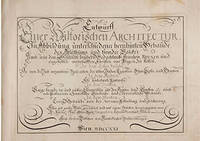
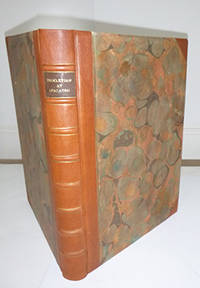
51-7134Vienna: by the author 1721. Oblong folio. 391 x 535 mm. Later calf upper cover decorated in blind and gilt with initials "SRG" and armorial crown motif gilt lettered morocco spine label.5 parts in one volume.Engraved calligraphic title and 5 engraved calligraphic section titles by J.A Delsenbach engraved calligraphic dedication page by Fischer von Erlach 85 of 86 plates 3 folding Book 3 plate 6 trimmed lacking Book IV plate 20. A few plates with tears repaired on verso.FIRST EDITION of this history of architecture "the first of its kind" Neville. The work includes plates illustrating a broad array of architectural styles including pyramids temples castles palaces and churches. Each volume highlights the architecture of a different regions and styles or decorative objects: the Near East architecture Part I Roman architecture Part II Islamic and Asian architecture Part III Fischer von Erlach's own works primarily in Vienna and Salzburg Part IV and antique and Baroque vases Part V. Berlin Kat. 2105; see Kristoffer Neville: "The Early Reception of Fischer von Erlach's Entwurff einer historischen Architectur" Journal of the Society of Architectural Historians vol 66 no 2 2007 pp 160-175.Erstes Buch. Die von der Zeit vergrabene Bau-arten der alten Jüden Egÿptier Sÿrer Perser und Griechen.Andres Buch. Alte unbekante Römische.Drittes Buch. Einige fremde in- und ausser-europäische als der Araber und Türcken etc. auch neue persianische siamitische sinesische und japonische Gebäude.Viertes Buch. Einige Gebäude von des Autoris Erfindung und Zeichnung.Fischer’s architectural oeuvre ranges from summer and city residences for the Viennese nobility to church buildings for the Archbishop of Salzburg and the major imperial monuments of baroque Vienna. By eloquently referring to antiquity while being unmistakably modern his buildings complied with the notion of noble representation with its roots in tradition and history.“Entwurff Einer Historischen Architectur†which Fischer published in 1721 was the first illustrated history of global architecture. The work ranging in content from the Wonders of the Ancient World and Greek Roman Arabic Persian and Chinese monuments to his own projects earned him acclaim across Europe. The impressive copperplates from “Historischen Architektur†and the preserved preparatory drawings form the centerpiece of the exhibition which was organized in cooperation with the Salzburg Museum. Its nine chapters span an arc from Fischer’s early days in Rome to his later masterpieces and above all the Karlskirche. A wealth of objects some previously unseen — drawings prints models paintings sculptures and books — illustrate his exceptional artistic oeuvre. By presenting Fischer’s buildings from new and sometimes unexpected perspectives the photographs taken by Werner Feiersinger trace the artistic intentions of the architect.Die Karlskirche gilt als das bedeutendste Bauwerk des Barock in Österreich und ist ein Wahrzeichen Wiens. Ihr Architekt Johann Bernhard Fischer von Erlach 1656–1723 steht im Zentrum der ersten Sonderausstellung im neueröffneten Wien Museum. Fast 70 Jahre nach der letzten großen Schau wird Fischers Werk neu betrachtet und mit der Gestaltung durch Werner Feiersinger in einen zeitgenössischen künstlerischen Kontext gestellt. Fischers Schaffen als Architekt reicht von Garten- und Stadtpalästen für den Wiener Adel über die Kirchenbauten für den Erzbischof von Salzburg bis hin zu den großen kaiserlichen Monumenten in Wien. Seine Bauten verwiesen auf die Antike und waren doch unverkennbar modern – damit kamen sie den zeitgenössischen Vorstellungen herrschaftlicher Repräsentation entgegen für die Tradition und Geschichte eine zentrale Rolle spielte.1721 veröffentlichte Fischer mit dem „Entwurff Einer Historischen Architectur“ die erste Weltgeschichte der Baukunst in Bildern. Das Werk das von den Weltwundern der Antike über griechische römische arabische persische und chinesische Monumente bis zu seinen eigenen Bauten und Projekten reicht machte Fischer in ganz Europa bekannt. Die eindrucksvollen Kupferstiche der Historischen Architektur und die dazu erhaltenen eigenhändigen Vorzeichnungen bilden das Zentrum der in Kooperation mit dem Salzburg Museum entstandenen Ausstellung. In neun Kapiteln spannt sie einen Bogen von Fischers Anfängen in Rom bis zu den späten Hauptwerken mit der Karlskirche als dem Höhepunkt. Eine Vielzahl zum Teil noch nie gezeigter Objekte – Zeichnungen Druckgrafiken Modelle Gemälde Skulpturen Bücher – macht sein außerordentliches künstlerisches Werk anschaulich. Die Fotografien von Werner Feiersinger zeigen die Bauten aus neuen mitunter ungeahnten Blickwinkeln und spüren damit den künstlerischen Absichten des Architekten nach.OCLC Number / Unique Identifier: 3700919:Yale Beinecke Rare Book and Manuscript Library Catalog Record no. 9953851383408651. Vienna: by the author, 1721 unknown
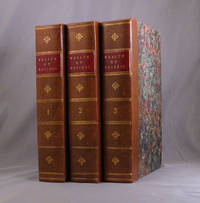
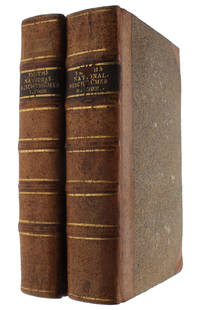
178620767London: for A. Strahan and T. Cadell 1786. 3 volumes. An especially early printing the fourth only the second of the octavo editions the last edition with any changes includes a new preface never before printed issued only 10 years after the first 2 vol. quarto edition. 8vo beautiful three-quarter polished calf in fine antique style over marbled paper covered boards red morocco lettering labels gilt the spine in compartments separated by gilt bands gilt central devices in the compartments. viii 499 errata; vi 518 5 Appendix errata; v errata 465 47 index 1 ad pp. A remarkably fine and handsome set the text blocks completely untrimmed and with the original deckled edges as issued from the printer. Bindings in excellent condition. A BEAUTIFUL SET OF THIS EXTRAORDINARY WORK. Smith's classic work was begun at Toulouse in 1763-64 where he had travelled as guardian of Henry Scott the young duke of Buccleuch and in the company of David Hume historian and fellow professor at Glasgow University. The work took shape over the next ten years and was finally published in 1776. At one point during its composition Hume wrote that Smith was "cutting himself off entirely from human society." But his labors however severe his methods yielded the "first and greatest classic of modern economic thought" Printing and the Mind of Man.<br> "It may be said that the WEALTH OF NATIONS certainly operated powerfully through the harmony of its critical side with the tendencies of the half-century which followed its publication to the assertion of personal freedom and 'natural rights.' It discredited the economic policy of the past and promoted the overthrow of institutions which had come down from earlier times but were unsuited to modern society. As a theoretic treatment of social economy and therefore as a guide to social reconstruction and practice in the future it is provisional not definitive. But when the study of its subject comes to be systematized on the basis of a general social philosophy more complete and durable than Smith's no contribution to that final construction will be found so valuable as his" Britannica.<br> The fourth edition contains a special ‘advertisement’ first appearing here in which Smith declares that he is now ‘at liberty to acknowledge my very great obligations to Mr. Henry Hop of Amsterdam. To that gentleman I owe the most distinct as well as liberal information concerning a very interesting and important subject the Bank of Amsterdam’. Eighteenth century editions of Smith’s magnum opus are now becoming very scarce. for A. Strahan and T. Cadell hardcover
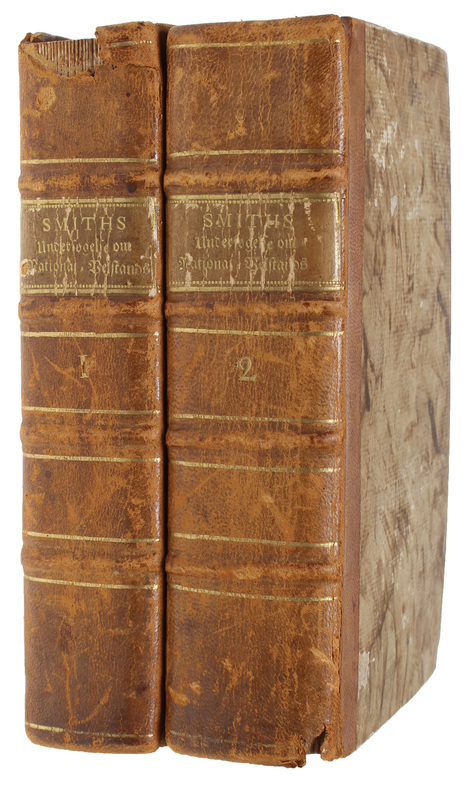
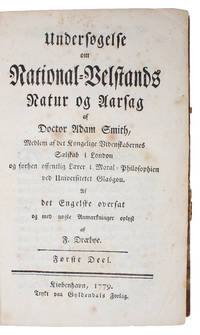
177947455Kiøbenhavn [Copenhagen], 1779-80. 8vo. Two very nice contemporary brown half calf bindings with raised bands, gilt ornamentations and gilt leather title- and tome-labels. Volume two with a bit of wear to upper capital. Corners slightly bumped. Pencil annotations to verso of title-page in volume one" title-page in volume two mounted to cover up a small hole caused by the removal of an old owner's name. Internally very clean and bright. All in all a very nice, clean, fresh, and tight copy. Engraved (by Weise, 1784) armorial book plate to inside of front boards (Gregorius Christianus Comes ab Haxthausen). (12), 575" (8), 775, (3, - errata) pp.
177947455Kiøbenhavn Copenhagen 1779-80. 8vo. Two very nice contemporary brown half calf bindings with raised bands gilt ornamentations and gilt leather title- and tome-labels. Volume two with a bit of wear to upper capital. Corners slightly bumped. Pencil annotations to verso of title-page in volume one; title-page in volume two mounted to cover up a small hole caused by the removal of an old owner's name. Internally very clean and bright. All in all a very nice clean fresh and tight copy. Engraved by Weise 1784 armorial book plate to inside of front boards Gregorius Christianus Comes ab Haxthausen. 12 575; 8 775 3 - errata pp. <br/><br/><em>The extremely scarce first Danish edition of Adam Smith's seminal main work "the first and greatest classic of modern economic thought" PMM 221 the main foundational work of the era of liberal free trade. This publication constitutes the first Danish work worth mentioning in the history of economic thought - in spite of the great interest in political economy that dominated Danish political thought in the last quarter of the 18th century. The value of Smith's work was not immediately recognized in Denmark at the time of its appearance and a quarter of a century had to go by for its importance to be acknowledged and for Danish political economy to adapt the revolutionizing theories of Adam Smith. Few copies of the translation were published and sold and the book is now a great scarcity. As opposed to for instance the German translation of the work Smith concerned himself a great deal with this Danish translation. As is evident from preserved correspondence about it he reacted passionately to it and was deeply concerned with the reaction to his work in Scandinavia see "Correspondence of Adam Smith" Oxford University Press 1977.- As an example Smith writes in a letter to Andreas Holt on Oct. 26th 1780: "It gives me the greatest pleasure to hear that Mr. Dreby has done me the distinguished honour of translating my Book into the Danish language. I beg you will present to him my most sincere thanks and most respectful Compliments. I am much concerned that I cannot have the pleasure of reading it in his translation as I am so unfortunate as not to understand the Danish language." The translation was made by Frants Dræby 1740-1814 the son a whiskey distiller in Copenhagen who mastered as a theologian and was then hired by the great Norwegian merchant James Collett as tutor to his son. There can be no doubt that Dræbye's relation to the Collett house had a great impact upon his interest in economics. In the middle of the 1770'ies Dræbye accompanied Collett's son on travels throughout Europe which took them to England in the year 1776 the same year that the "Wealth of Nations" was published for the first time. Through the Colletts Dræbye was introduced to the mercantile environment in England and here became thoroughly acquainted with English economics and politics at the time. It is presumably here that he gets acquainted with Adam Smith's freshly published revolutionary work. When Dræbye returned to Denmark at the end of 1776 he was appointed chief of the Norwegian secretariat of the Board of Economics and Trade. He began the translation of the "Wealth of Nations" that he brought back with him from England immediately after his return."WN i.e. Wealth of Nations was translated into Danish by Frants Dræbye and published in 1779 three years after the first English edition. The translation was initiated by Andreas Holt and Peter Anker who were acquainted with Smith. Dræbye was a Dane who lived mainly in Norway reflecting the fact that Norway was much more British-oriented than Denmark proper Denmark and Norway were united until 1814 when Sweden took Norway away from the Danes; in 1905 Norway became an independent state. Norwegian merchants lived from exporting timber to Britain and tended on the whole to be adherents of a liberal economic policy whereas the absolutist government in Copenhagen was more German-oriented and had economic views similar to those in contemporary Prussia." Cheng-chung Lai edt.: "Adam Smith Across Nations" p. 37. The last quarter of the eighteenth century in Denmark was dominated by a lively discussion of monetary policy and the institutional framework best suited to realize that policy. There was a vital interest in questions of economic concern and contemporary Danish sources refer to the period as "this economic age" and state things such as "never was the world more economically minded" both from "Denmark and Norway's Economic Magazine". During this period Smith's revolutionary ideas did not play a major role however and only at the beginning of the 19th century did Danish politicians and economists come to realize the meaning of Smith's views. "Without exaggeration it can essentially be said that a quarter of a century was to pass from the time of the publication of the book in Denmark before Danish political economy fully made Adam Smith's theories and points of view its own. It took so long a time because the economic conditions as a whole in the years from 1780-1800 did not make desirable or necessary the changing of their concepts. That glorious commercial period had to pass before it was understood that we had altogether too little help in our own natural resources and that a different course was therefore necessary. Only when one had come so far could the new thinking find a nourishing soil so that it could develop strength with which to push aside the old ideas."Hans Degen: "On the Danish Translation of Adam Smith and Contemporary Opinion Concerning It." Translated by Henrietta M. Larson. In: Adam Smith Across Nations p. 51. This first Danish translation is one of the very earliest translations of "Wealth of Nations"; it is only preceded by the German 1776-78 and the extremely scarce French 1778-79. As a comparison the Italian translation does not appear until 1790-91 the Spanish 1792 the Swedish 1800-1804 the Russian 1802 etc.Adam Smith Across Nations: A4 - nr. 1. "All five books were translated; appears to be a complete translation. The long letter from Governor Pownall to Adam Smith 25 Sept. 1776 is added as the Appendix vol. 2 pp. 683 ff."PMM 221 - first edition </em> hardcover
177860523Leipzig Weidmann 1776-78. 8vo. Bound in two nice uniform contemporary half calf bindings with five raised bands black title-label and gilt lettering to spine. Small paper-label to upper compartment Catalogue-number from an estate-library. Light wear to extremities otherwise a very nice set. VIII 632 pp; XII 740 pp. <br/><br/><em>First German edition also being the very first overall translation of Adam Smith's ground-breaking main work the "Inquiry into the Nature and Causes of the Wealth of Nations". This seminal first translation of the work was undertaken by J.F. Schiller who finished the first part of the translation in time for it to appear as soon as 1776 the same year as the original English edition. The second part appeared in 1778 the same year as the exceedingly scarce first French translation. This first German translation has been of the utmost importance to the spreading of Smith's ideas throughout Europe and after the true first this must count as the most important edition of the work."The influence of the Wealth of Nations . in Germany . was so great that 'the whole of political economy might be divided into two parts - before and since Adam Smith; the first part being a prelude and the second a sequel." Backhouse Roger E. The Methodology of Economics: Nineteenth-Century British Contributions Routledge 1997."The first review of the translation which appeared in the Göttingische gelehrte Anzeigen for March 10 1777 by J. G. H. Feder professor of Philosophy at the University of Göttingen was very favorable. In the words of the reviewer: "It is a classic; very estimable both for its thorough not too limited often far-sighted political philosophy and for the numerous frequently discursive historical notes" but the exposition suffers from too much repetition." Lai Cheng-chung. Adam Smith Across Nations: Translations and Receptions of The Wealth of Nations Clarendon Press UK 2000.Until 1797 . the work of Adam Smith received scant attention in Germany. While Frederick II was living Cameralism held undisputed sway in Prussia and the economic change which began with the outbreak of the French Revolution had still not gained sufficient momentum to awake the economic theorists from their dogmatic slumber." Lai Cheng-chung. Adam Smith Across Nations: Translations and Receptions of The Wealth of Nations Clarendon Press UK 2000.Various German economist read the german translations and was inspired by it."Christian Garve . must be considered as among the important contributors to the spread of Smith's views. Himself a popularizer of philosophical doctrines he was early attracted by the Scotch writers and became one of their foremost exponents in Germany." In 1791 Garve began a second translation of the Smith's work and in the introduction to the the translation he wrote: "It Smith's work attracted me as only few books have in the course of my studies through the number of new views which it gave me not only concerning the actual abject of his investigations but concerning all related material from the philosophy of civil and social life". Georg Sartorius August Ferdinand Lueder and perhaps the most important economist of the period Christian Jacob Kraus were all important figures in the spread of Smith's thought. "The most significant of Kraus' works and that also which shows his conception of economic science most clearly is the five-volume work entitled State Economy. The first four volumes of this work are little more than a free paraphrase of the Wealth of Nations". Kraus was: "to a large extent responsible for the economic changes which took place in Prussia after 1807 in so far as they can be ascribed to Smithan influence." Lai Cheng-chung. Adam Smith Across Nations: Translations and Receptions of The Wealth of Nations Clarendon Press UK 2000.Kraus wrote of the present volume: "The world has seen no more important book than that of Adam Smith. Certainly since the times of the New Testament no writing has had more beneficial results than this will have. Smith's doctrines form the only true great beautiful just and beneficial system." Fleischacker Samuel A Third Concept of Liberty Princeton University Press 1999._____________Hailed as the "first and greatest classic of modern thought" PMM 221 Adam Smith's tremendously influential main work has had a profound impact on thought and politics and is considered the main foundation of the era of liberal free trade that dominated the nineteenth century. Adam Smith 1723-1790 is considered the founder of Political Economy in Britain mainly due to his groundbreaking work the "Wealth of Nations" from 1776. The work took him 12 years to write and was probably in contemplation 12 years before that. It was originally published in two volumes in 4to and was published later the same year in Dublin in three volumes in 8vo. The book sold well and the first edition the number of which is unknown sold out within six months which came as a surprise to the publisher and probably also to Smith himself partly because the work "requires much thought and reflection qualities that do not abound among modern readers to peruse to any purpose." Letter from David Hume In: Rae Life of Adam Smith 1895 p. 286 partly because it was hardly reviewed or noticed by magazines or annuals. In spite of this it did evoke immense interest in the learned and the political world and Buckle's words that the work is "in its ultimate results probably the most important book that has ever been written" and that it has "done more towards the happiness of man than has been effected by the united abilities of all the statesmen and legislators of whom history has preserved an authentic account" History of Civilisation 1869 I:214 well describes the opinion of a great part of important thinkers then as well as now. Kress S. 2567Goldsmith 11394Menger 521Not in Einaudi </em> hardcover
177860523Leipzig, Weidmann, 1776-78. 8vo. Bound in two nice uniform contemporary half calf bindings with five raised bands, black title-label and gilt lettering to spine. Small paper-label to upper compartment (Catalogue-number from an estate-library). Light wear to extremities, otherwise a very nice set. VIII, 632 pp" XII, 740 pp.
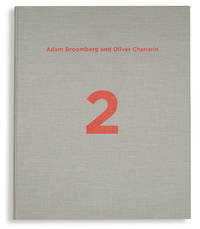
110758London Mack 2011. . First edition an altered artists' book number 68 of 100 copies signed by both artists on the front free endpaper; 4to 294 x 243 mm 11½ x 9½ in; 85 black-and-white photographs printed in offset each with a new photographic reproduction partially pasted over it by hand the final image with a screen printed red square new notes screen printed in red over the original text section; plain endpapers grey cloth-covered boards original titles stamped on spine in silver new titles screen printed in red on upper side starting at head near-fine; 176 xxivpp.<br /> German poet and dramatist Bertold Brecht's Kriegsfibel War Primer was first published in 1955. Brecht's mistrust of the press imagery emerging from the Second World War led him to compose four-line poems which he juxtaposed with photographs sourced from newspapers and magazines many of which were from LIFE magazine as Brecht was living in the United States in exile from Nazi Germany. Broomberg & Chanarin concerned with the proliferation of imagery relating to the 'War on Terror' that began with 9/11 have taken copies of the 1998 first English edition of Brecht's War Primer as the starting point for this revised version. Keeping the original captions intact they have partially overlaid the original photographs selected by Brecht with contemporary imagery from both sides of the recent conflict drawn from online sources. The URL for each image is provided with a caption in a new set of notes screenprinted over the originals. Broomberg & Chanarin were awarded the 2013 Deutsche Börse Photography Prize for this work.<br /> The Photobook: A History III p285. London, Mack, 2011. hardcover
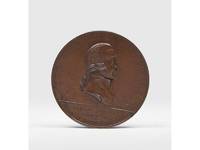
1797179182Scotland: Boog junior des. P. Kempson fecit 1797. A very good example of the one ounce Penny of Scotland commemorating Adam Smith. The portrait of Smith is after the Tassie medallion of 1787 which is described by John M. Gray as follows: 'The head which appears turned in pure profile to the right of the spectator shows a particularly full forehead a full nose slightly aquiline in its curve; a long thin upper lip and a lower lip that protudes a little; and a firm well-shaped chin and jaw. The eyebrow is strongly curved the upper eyelid heavy and drooping the eyeball particularly prominent; and beneath the lower eyelid the skin is loose and wrinkled. A wig is worn tied behind in a bag with ribbons showing small curls in front and two large curls at the side which cover and conceal the ear' quoted in Bonar A Catalogue of the library of Adam Smith 1932 p. xxi. The reverse of the penny entitled 'Wealth of Nations' depicts the various elements of commerce; in the foreground of a harbour scene are a plough and a spinning wheel along with other symbols of agriculture and industry in addition to which there are a wool-pack and a barrel standing on the quayside with two three-masted ships sailing out of the harbour. Penny token cast in bronze 35 mm in diameter with portrait of Adam Smith after Tassie on the obverse and scene entitled 'Wealth of Nations' depicting various elements of commerce on the reverse. Housed in a red leatherette velvet-lined case. In very good condition. Scott Adam Smith as Student and Professor 1937. Dalton and Hamer Fifeshire no. 1. hardcover
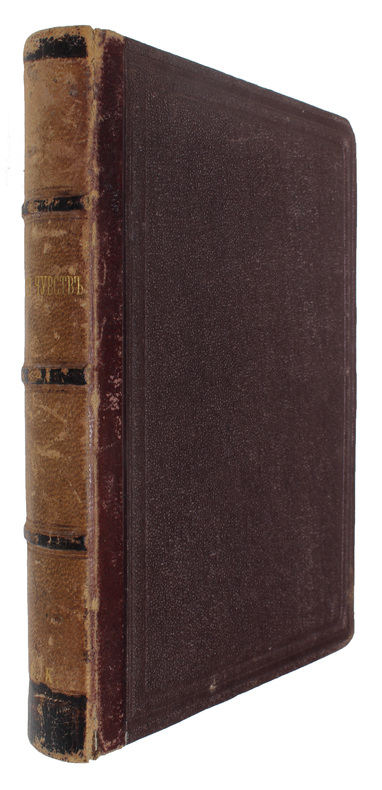
1868128700St Petersburg: I. I. Glazunov 1868. First edition in Russian of The Theory of Moral Sentiments very rare. This landmark translation it is still the one used in Russia today was made by Pavel Bibikov who had brought out a translation of the Wealth of Nations the edition read by Lenin two years before. Both were published as part of his series the Library of Classical European Writers. "Bibikov 1831-1875 already had a reputation as a historian philosopher and literary critic and this undoubtedly had a part in the generally high level of presentation of the translations" Artemieva p. 160. The translations were probably made via French but whereas Bibikov's Wealth of Nations was superceded by the end of the century his Theory of Moral Sentiments remained the only Russian version available until 1997. Tatiana V. Artemieva "Adam Smith in Russian translation" A Critical Bibliography of Adam Smith ed. Keith Tribe 2002 pp. 153-167. Octavo 207 x 138 mm pp. 2 5-515 4pp. contents and advertisement leaf complete. Recently bound in quarter marbled calf and pebble grain cloth vellum tips spine ruled gilt black morocco label. First and last leaves a little darkened short chip to upper margin of title small stain to final few leaves and last leaf strengthened in the gutter; a very good copy. Tribe 186; Vanderblue p. 42 but not in the collection. OCLC locates copies at National Library of Scotland Yale Illinois and the National Library of Israel only. Not in the British Library. hardcover
51-3852London: Printed for the Author 1764 . Folio 536 x 365 mm. 20.75 x 14.5 inches. Later half morocco with 8 raised bands over decorative paper-covered boards; in fine condition. 23 leaves. i-xii 133 34p. I=LXI engraved plates incl. the frontispiece by Bartolozzi.Engraved frontispiece and 60 engraved plates on 54 sheets some double-page and/or folding printed list of subscribers; small area of dampstaining in the right margins of the text and less so in the plates; and light foxing throughout; a few plates cropped to the plate mark sometimes affecting captions or plate numbers scattered marginal tears and repairs.First edition. An elaborate description of a rare private residence of the Imperial period Diocletian -- Emperor of Rome-- 245-313.The Fowler Architectural Collectin no. 2:" The plates .are of interest not only as fine examples of architectural engraving but as showing the source of some of the motives of the Adam style." OCLC Numbers 228757007; 456750309. [London]: Printed for the Author, 1764 hardcover
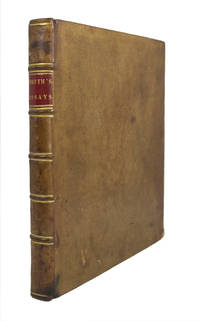
179566518First Edition In Contemporary Boards Uncut SMITH Adam. Essays on Philosophical Subjects. To Which is Prefixed an Account of the Life and Writings of the Author; by Dugald Stewart. London: Printed for T. Cadell Jun. and W. Davies etc. 1795. First edition. Quarto. xcv 244 pp. Contemporary boards rebacked. Small library stamp on title and verso and on last page a small ink smudge on title previous owner's bookplate. Overall a very good large paper copy totally uncut. A posthumously published collection of essays mainly of scientific and philosophical nature. Smith had instructed his literary editors Joseph Black and James Hutton to destroy almost all of his manuscript material amounting to some sixteen volumes. These essays were exempted because the editors perceived them to "be part of a plan he had once formed for giving a connected history of the liberal sciences and elegant arts" even though Smith had to abandon the plan because it was too extensive. HBS 66518. $10000 Printed for T. Cadell Jun. and W. Davies, etc. hardcover books
179566518London: Printed for T. Cadell Jun. and W. Davies etc. 1795. First edition. Quarto. xcv 244 pp.<br> <br> Contemporary boards rebacked. Small library stamp on title and verso and on last page a small ink smudge on title previous owner's bookplate. Overall a very good large paper copy totally uncut.<br> <br> A posthumously published collection of essays mainly of scientific and philosophical nature. Smith had instructed his literary editors Joseph Black and James Hutton to destroy almost all of his manuscript material amounting to some sixteen volumes. These essays were exempted because the editors perceived them to "be part of a plan he had once formed for giving a connected history of the liberal sciences and elegant arts" even though Smith had to abandon the plan because it was too extensive.<br> <br> HBS 66518.<br> <br> $10000. Printed for T. Cadell Jun. and W. Davies, etc. unknown
17271510220001Amsterdam: Michel Charles Le Cene 1727-01-01. Hardcover. Very Good. Folio. 2 12 439 pp.; 2 pp. 445-808p pagination continuous 43 of 44 plates. 2 Volumes in One Bound in contemporary vellum. 7 raised bands. Leather spine label. Good binding and cover. Spine and hinges restored. Faint soiling to vellum. Pages tanned with a several pages with some offsetting and foxing. Lacks frontis and added title. All 27 plates & 16 maps are present. Brunet IV 178; Cordier Japonica 367-68; Cordier Sinaca 2077; Lust 342 <br><Br> Jean Albert Mandeslo set out in 1636 with the Embassy that the Duke of Holstein sent to Russia and Persia. He visited India Ceylon Madagascar West Africa Congo and returned four years later. His story gives a very vivid picture of luxury vices curiosity and absolute disregard for life under the despotic tyranny of the Moghul Empire under Shah Jahan. In the port of Surat he arrived in April 1638 after he went to Ahmedabad and Agra. Although his observations of life in the capital are useful he apparently did not hear anything about the Taj Mahal which at that time was in the sixth year of building. Amsterdam: Michel Charles Le Cene hardcover
186856148St Petersburg, I. I. Glazunov, 1868. 8vo. In contemporary half calf with with embossed boards. Three raised bands and gilt lettering to spine. Spine with wear. Small label pasted on to top left corner of pasted down front free end-paper. Removed stamp to half-title and title-page with stamp and a a few number written to top of title-page. A few light occassional underlining in pencil, otherwise internally fine and clean. (1)-515, (1), IV pp.
177950523Kiøbenhavn [Copenhagen], 1779-80. 8vo. Two nice contemporary half calf bindings with four raised bands and gilt leather title label to spines. Volume one lacking one cm of upper part of spine. Volume two with a small tear to lower part of spine. Both volumes with light brown spotting throughout, however, mainly affecting first and last five leaves of both volumes. A fine set. (12), 575"" (8), 775, (3, - errata) pp.
186856148St Petersburg I. I. Glazunov 1868. 8vo. In contemporary half calf with with embossed boards. Three raised bands and gilt lettering to spine. Spine with wear. Small label pasted on to top left corner of pasted down front free end-paper. Removed stamp to half-title and title-page with stamp and a a few number written to top of title-page. A few light occassional underlining in pencil otherwise internally fine and clean. 1-515 1 IV pp. <br/><br/><em>Rare first Russian translation of Adam Smith's 'The Theory of Moral Sentiments'.The translator Pavel Bibikov 1831-1875 also translated the 'Wealth of Nations' in 1866 both being part of his series the Library of Classical European Writers. Bibikov regarded the two works as complementing each other as he remarks in his preface to this translation "the works reinforce each other. That is why having published in Russian Adam Smith's great work of political economy I decided to translate and publish his other work which is no less remarkable and yet known even less to Russian society than the first" p. 5. "Bibikov's translation probably done via French remained the only Russian version available until 1997". National Library of Scotland.Adam Smith developed a comprehensive and unusual version of moral sentimentalism in his Theory of Moral Sentiments 1759 TMS. He did not expressly lay out a political philosophy in similar detail but a distinctive set of views on politics can be extrapolated from elements of both TMS and his Wealth of Nations. Although these economic doctrines had not been unheard of in Russia prior to the rise of Anglophile feelings at the beginning of the nineteenth century "it was not until interest and admiration for things British was firmly rooted that classical economics could secure its ground in Russia" Tanaka The Controversies Concerning Russian Capitalism - An Analysis of the Views of Plekhanov and Lenin this processes coincided with the present publication which became important in the spreading of Adam Smith's economic principles in Russia. OCLC only locates three copies. </em> hardcover
177950523Kiøbenhavn Copenhagen 1779-80. 8vo. Two nice contemporary half calf bindings with four raised bands and gilt leather title label to spines. Volume one lacking one cm of upper part of spine. Volume two with a small tear to lower part of spine. Both volumes with light brown spotting throughout however mainly affecting first and last five leaves of both volumes. A fine set. 12 575; 8 775 3 - errata pp. <br/><br/><em>The extremely scarce first Danish edition of Adam Smith's seminal main work "the first and greatest classic of modern economic thought" PMM 221 the main foundational work of the era of liberal free trade. This publication constitutes the first Danish work worth mentioning in the history of economic thought - in spite of the great interest in political economy that dominated Danish political thought in the last quarter of the 18th century. The value of Smith's work was not immediately recognized in Denmark at the time of its appearance and a quarter of a century had to go by for its importance to be acknowledged and for Danish political economy to adapt the revolutionizing theories of Adam Smith. Few copies of the translation were published and sold and the book is now a great scarcity. As opposed to for instance the German translation of the work Smith concerned himself a great deal with this Danish translation. As is evident from preserved correspondence about it he reacted passionately to it and was deeply concerned with the reaction to his work in Scandinavia see "Correspondence of Adam Smith" Oxford University Press 1977.- As an example Smith writes in a letter to Andreas Holt on Oct. 26th 1780: "It gives me the greatest pleasure to hear that Mr. Dreby has done me the distinguished honour of translating my Book into the Danish language. I beg you will present to him my most sincere thanks and most respectful Compliments. I am much concerned that I cannot have the pleasure of reading it in his translation as I am so unfortunate as not to understand the Danish language." The translation was made by Frants Dræby 1740-1814 the son a whiskey distiller in Copenhagen who mastered as a theologian and was then hired by the great Norwegian merchant James Collett as tutor to his son. There can be no doubt that Dræbye's relation to the Collett house had a great impact upon his interest in economics. In the middle of the 1770'ies Dræbye accompanied Collett's son on travels throughout Europe which took them to England in the year 1776 the same year that the "Wealth of Nations" was published for the first time. Through the Colletts Dræbye was introduced to the mercantile environment in England and here became thoroughly acquainted with English economics and politics at the time. It is presumably here that he gets acquainted with Adam Smith's freshly published revolutionary work. When Dræbye returned to Denmark at the end of 1776 he was appointed chief of the Norwegian secretariat of the Board of Economics and Trade. He began the translation of the "Wealth of Nations" that he brought back with him from England immediately after his return."WN i.e. Wealth of Nations was translated into Danish by Frants Dræbye and published in 1779 three years after the first English edition. The translation was initiated by Andreas Holt and Peter Anker who were acquainted with Smith. Dræbye was a Dane who lived mainly in Norway reflecting the fact that Norway was much more British-oriented than Denmark proper Denmark and Norway were united until 1814 when Sweden took Norway away from the Danes; in 1905 Norway became an independent state. Norwegian merchants lived from exporting timber to Britain and tended on the whole to be adherents of a liberal economic policy whereas the absolutist government in Copenhagen was more German-oriented and had economic views similar to those in contemporary Prussia." Cheng-chung Lai edt.: "Adam Smith Across Nations" p. 37. The last quarter of the eighteenth century in Denmark was dominated by a lively discussion of monetary policy and the institutional framework best suited to realize that policy. There was a vital interest in questions of economic concern and contemporary Danish sources refer to the period as "this economic age" and state things such as "never was the world more economically minded" both from "Denmark and Norway's Economic Magazine". During this period Smith's revolutionary ideas did not play a major role however and only at the beginning of the 19th century did Danish politicians and economists come to realize the meaning of Smith's views. "Without exaggeration it can essentially be said that a quarter of a century was to pass from the time of the publication of the book in Denmark before Danish political economy fully made Adam Smith's theories and points of view its own. It took so long a time because the economic conditions as a whole in the years from 1780-1800 did not make desirable or necessary the changing of their concepts. That glorious commercial period had to pass before it was understood that we had altogether too little help in our own natural resources and that a different course was therefore necessary. Only when one had come so far could the new thinking find a nourishing soil so that it could develop strength with which to push aside the old ideas."Hans Degen: "On the Danish Translation of Adam Smith and Contemporary Opinion Concerning It." Translated by Henrietta M. Larson. In: Adam Smith Across Nations p. 51. This first Danish translation is one of the very earliest translations of "Wealth of Nations"; it is only preceded by the German 1776-78 and the extremely scarce French 1778-79. As a comparison the Italian translation does not appear until 1790-91 the Spanish 1792 the Swedish 1800-1804 the Russian 1802 etc.Adam Smith Across Nations: A4 - nr. 1. "All five books were translated; appears to be a complete translation. The long letter from Governor Pownall to Adam Smith 25 Sept. 1776 is added as the Appendix vol. 2 pp. 683 ff." </em> hardcover
179568261Adam SmithÃs Posthumously Published Essays SMITH Adam. Essays on Philosophical Subjects. To Which is Prefixed an Account of the Life and Writings of the Author; by Dugald Stewart.London: Printed for T. Cadell Jun. and W. Davies. 1795. First edition. Quarto 10 3/4 x 8 1/2 inches; 273 x 215 mm. xcv 1 blank 244 pp. Contemporary speckled calf. Board edges ruled in gilt. Spine ruled in gilt. Red morocco spine label lettered in gilt. Edges speckled brown. Green silk page-marker. Board edges a bit rubbed and corners bumped. Previous owner's old ink signature on title-page not affecting text. Occasional minor foxing or staining. Otherwise an excellent copy. A posthumously published collection of essays mainly of a scientific and philosophical nature. Smith had instructed lis literary editors Joseph Black and James Hutton to destroy almost all of his manuscript material amounting to some sixteen volumes. These essays were exempted because the editors perceived them to ìbe part of a plan he had once formed for giving a connected history of the liberal sciences and elegant artsî even though Smith had to abandon the plan because it was too extensive. The essays illustrate the diversity of Adam SmithÃs interests and comprise: ìThe Principles which lead and direct Philosophical Enquiries; illustrated by the History of Astronomy;î ìThe Principles which lead and direct Philosophical Enquiries; History of the Ancient Physics;î ìThe Principles which lead and direct Philosophical Enquiries; History of the Ancient Logics and Metaphysics; ìOf the Nature of that Imitation which takes place in what are called the Imitative Arts;î ìOf the Affinity between Music Dancing and Poetry;î ìOf the Affinity between certain English and Italian Verses;î ìOf the External Senses.î ESTC T33499 . Goldsmiths' 16218. Kress B. 3038. Rothschild 1902. HBS 68261. $9500 Printed for T. Cadell Jun. and W. Davies, etc. unknown books
179568261London: Printed for T. Cadell Jun. and W. Davies etc. 1795. London: Printed for T. Cadell Jun. and W. Davies. 1795.<br> <br> First edition. Quarto 10 3/4 x 8 1/2 inches; 273 x 215 mm. xcv 1 blank 244 pp.<br> <br> Contemporary speckled calf. Board edges ruled in gilt. Spine ruled in gilt. Red morocco spine label lettered in gilt. Edges speckled brown. Green silk page-marker. Board edges a bit rubbed and corners bumped. Previous owner's old ink signature on title-page not affecting text. Occasional minor foxing or staining. Otherwise a fine copy.<br> <br> A posthumously published collection of essays mainly of a scientific and philosophical nature. Smith had instructed lis literary editors Joseph Black and James Hutton to destroy almost all of his manuscript material amounting to some sixteen volumes. These essays were exempted because the editors perceived them to "be part of a plan he had once formed for giving a connected history of the liberal sciences and elegant arts" even though Smith had to abandon the plan because it was too extensive.<br> <br> The essays illustrate the diversity of Adam Smith's interests and comprise: "The Principles which lead and direct Philosophical Enquiries; illustrated by the History of Astronomy;" "The Principles which lead and direct Philosophical Enquiries; History of the Ancient Physics;" "The Principles which lead and direct Philosophical Enquiries; History of the Ancient Logics and Metaphysics; "Of the Nature of that Imitation which takes place in what are called the Imitative Arts;" "Of the Affinity between Music Dancing and Poetry;" "Of the Affinity between certain English and Italian Verses;" "Of the External Senses."<br> <br> ESTC T33499 . Goldsmiths' 16218. Kress B. 3038. Rothschild 1902.<br> <br> HBS 68261.<br> <br> $9500. Printed for T. Cadell Jun. and W. Davies, etc. unknown
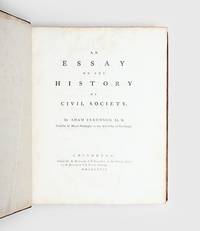
1767187228Edinburgh: for A. Millar & T. Cadell London; and A. Kincaid & J. Bell Edinburgh 1767. Synthetizing the Enlightenment First edition of this key text of the Scottish Enlightenment a pioneering precursor of modern sociology. The Essay explores how nations had developed towards the state of commerce refinement and liberty associated with 18th-century Britain. It consequently examines the development of human society from barbarism to civilized refinement and the consequences of that development - both beneficial and detrimental. Widely seen as synthesizing the thought of his times Ferguson followed Montesquieu in emphasizing the great variety of factors informing the historical rise and fall of polities in Europe and beyond. He had much to say on the issues of contemporary society including the thorny question of balancing wealth and virtue. His answer was to challenge the tendency of wealthy commercial men to withdraw from politics and thus from virtuous activities by inculcating a greater civic consciousness among such individuals. Among his contemporaries Ferguson's Essay made a particularly significant impact on the efforts to develop a discipline of social sciences at the University of Göttigen: "They were impressed by his comparative attitude to societies ancient and modern and by his attack on Rousseau's concept of the state of nature. Ferguson's approach inspired a comparative ethnography that went beyond the traditional dichotomy between 'primitive' and 'civilized' and tried to map the varieties of social mores without grading them on a strict ladder of historical progress" ODNB. Quarto 263 x 201 mm pp. viii 430. Contemporary sprinkled calf spine ruled in gilt and with red morocco label edges sprinkled red. Light bumping and wear minor infrequent foxing to otherwise crisp contents: a very good copy indeed. ESTC T76205; Goldsmiths' 10264; Higgs 3973; Kress 6432. unknown
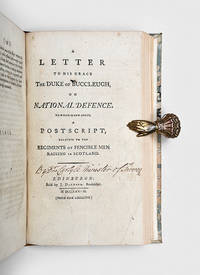
1778152780Edinburgh: J. Dickson 1778. First edition second issue "a re-issue of the London edition of the same year with a cancel title page and the addition of a postscript dated: Lincoln's Inn July 20th 1778" ESTC this copy also retaining the London title page. "This discussion of the bill for extending the militia law of Scotland introduced in 1776 contains a number of passing references to the war in America" Adams. The postscript comments on Burgoyne's defeat. Carlyle is identified as author in a contemporary hand on the Edinburgh title. After studies at Edinburgh Glasgow and Leiden where his classmates included William Robertson Adam Ferguson and John Home Carlyle was licensed to preach in 1746 and was introduced to the parish of Inveresk some five miles south-east of Edinburgh by the duke of Buccleuch the following year receiving his ordination in 1748. A moderate in his support for ecclesiastical patronage and politically conservative issues as well as in his endorsement of Enlightenment cultural principles including liberal education polite learning and religious toleration Carlyle was a familiar figure in the cultural life of what has come to be known as the Scottish Enlightenment. Strong and outspoken in his support for the Scots militia cause having written in 1760 The Question relating to a Scots Militia Considered the present pamphlet attacks Smith's apparent opposition to militias in the Wealth of Nations citing passages from Smith's book and also referring to the opinions of the Encyclopedistes. The other pamphlets included in this volume are: DOUGLAS John William Pulteney and Junius attributed authors. A Letter addressed to two Great Men on the prospect of peace; and on the terms necessary to be insisted upon in the negotiation. London: Millar and A. Kincaid & J. Bell Edinburgh 1760. Howes 6095. DALRYMPLE Sir John. The Rights of Great Britain asserted against the Claims of America: being an answer to the declaration of the General Congress. The third edition with additions. London: T. Cadell 1776. Howes 2564. LIND John. An Answer to the Declaration of the American Congress. The fourth edition. London: T. Cadell J. Walter and T. Sewell 1776. Howes 6167. TOWNSHEND Charles. Remarks on the Letter addressed to two Great Men. I a Letter to the author of that piece. London: printed in the year 1760. Howes 10372. Manuscript attribution to Henry Lord Holland on title. Octavo 209 x 122 mm. Bound fourth with four other pamphlets related to American affairs in contemporary quarter sheep and marbled boards vellum tips spine ruled gilt in compartments red morocco label lettered "Pamphlets" and numbered 2 direct sprinkled edges. Ownership inscription "Binning" to front pastedown dated 1779 with a manuscript list of the volume's contents to front free endpaper. Short tear to head of front joint; a very good copy. Adams The American Controversy 78-56b variant; ESTC T179898 locating copies at the National Library of Scotland and Harvard Business School only. The London imprint ESTC T107064 is slightly more common with copies located at British Library Columbia Harvard JCB and the New York Historical Society only; Vanderblue p. 50. hardcover
177648982Leipzig, Weidmann, 1776-78. 8vo. Bound in two nice uniform contemporary half calf bindings with five raised bands and gilt lettering to spine. Ex-libris pasted on to pasted down front free end-papers and a small embossed stamp to front free end paper on volume 1 (""Buchhändler u. Antiquar Carl Helf""). Stamp to p. 1 of both volumes. Spines with light soiling and capital on volume 1 lacking a small part of the leather. A few light brown spots throught. A fine set. VIII, 632 pp"" XII, 740 pp.