336 résultats
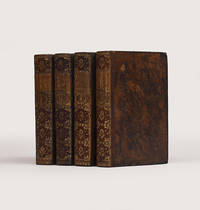
1790018055Paris: Buisson 1790-91. Quattro volumi in 8° di XI-570pp; 4-312pp; 4-602pp; 4-591pp. Legatura in piena pelle del tempo cornice dorata ai piatti; dorso liscio ornato. Mancanza al piatto del vol I; spellature e mancanze a piatti angoli e cuffia al vol II; spellature e mancanze ai piatti cerniera spaccata al vol. III; spellature e mancanze ai piatti al vol IV. Prima edizione di questa traduzione del Roucher la terza in lingua francese. Il titolo annuncia suivi d'un volume de Notes par M. le Marquis de Condorcet ma queste note non furono mai stampate. Einaudi 5338. Buisson unknown
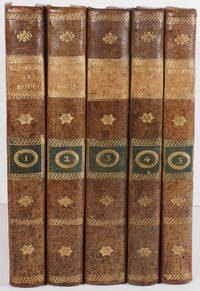
17958592a<p>Smith's Wealth of Nations had first appeared in French in 1778-9 in an anonymous translation followed by a second by Jean-Louis Blavet in 1781. Roucher's translation first appeared in four volumes in 1790-1. Jean-Antoine Roucher 1745–94 was a poet from Montpellier friend and admirer of J.-J. Rousseau. He welcomed the Revolution but was arrested in the Terror and went to the guillotine.</p><p>Rochedieu 304; Goldsmiths 14106; Kress B 1986. K. E. Carpenter The Dissemination of The Wealth of Nations in French and in France New York 2002 pp. 85-87.</p><p>5 vols 8vo 195 × 110 mm pp. 6 vi 438; 4 494; 4 624 4 411 1; 4 370 one leaf of index in final vol pp. 211-2 bound out of order complete with half-titles the first with printed facsimile of Buisson's signature. Very occasional paper flaws with very minor losses of a few letters here and there. Contemporary quarter sprinkled sheep spines gilt with tan and green labels. A very good set.</p> Buisson ... An 3e [
1778184198A La Haye though Zweibrücken: no publisher stated though the ducal French press of Deux-Ponts 1778-79. The first foreign-language appearance of a milestone in economics Very rare first edition in French of the Wealth of Nations the first translation following its publication in English in 1776. "This translation of the 1776 English edition of WN has remained a mystery. Was it printed in The Hague If not where was it printed Who was M identified on the title pages as the translator Copies are rare within French libraries" Carpenter p. 20. Carpenter & Sabbagh's recent scholarship identifies the printer as the ducal press of Deux-Ponts now Zweibrücken. Though a commercial venture the press used a fictitious imprint to avoid problems when printing French-language works that risked running afoul of the censor. The translator was Jean-Louis Carra 1742-1793 an active contributor to the Encyclopédie d'Yverdon later in the French Revolution to join the Jacobins where he was appointed joint head of the Bibliothèque nationale but clashed with Robespierre and was guillotined in 1793. The text follows the original closely omitting a section on religious instruction alongside other minor religious changes. The edition was preceded in French translation only by an extract Fragment sur les colonies en général et sur celles des anglois en particulier translated by Reverdil which had been published in Lausanne and Basel earlier in 1778 to test public demand for the work. 4 vols duodecimo in 4s and 8s 162 x 95 mm collates complete with half-titles and blank "table des matieres" bound following title pages rather than at rear. Contemporary calf twin brown and green labels smooth spines with gilt floral decoration marbled endpapers red edges. Contemporary ownership signature of Mats Zachrisson to front free endpaper. Light rubbing and insect abrasion with some loss to lettering on labels bindings otherwise with little wear and without repair staining to Vol. IV and a few leaves in Vol. I else fresh. A very good copy. Goldsmiths' 11664; Kress B155; Tribe 16; Vanderblue 24. Kenneth E. Carpenter The Dissemination of the Wealth of Nations in French and in France 2002; Kenneth Carpenter & Gabriel Sabbagh "Unveiling the First French Translation of Adam Smith's Wealth of Nations" in Oeconomia vol. 14 no. 1 2024. unknown
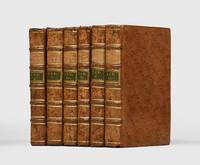
1781159019Yverdon: De Felice 1781. An attractive set Second edition in book form of Blavet's translation of The Wealth of Nations the earliest obtainable. Jean-Louis Blavet 1719-c.1809 was librarian for the prince du Conti; he had already published a translation of The Theory of Moral Sentiments in 1774-75. Blavet later claimed that Smith personally requested he translate The Wealth of Nations and sent him a copy. Blavet's translation was first published periodically in the Journal de l'agriculture from February 1779 to December 1780 and in book form in Paris earlier in 1781 in an edition of only 20 copies offprinted from the Journal de l'agriculture appearance. Only two copies of that edition are now known Carpenter p. 33. This edition was printed in Switzerland and apparently distributed largely outside France. Blavet claimed to not have been involved but "evidence suggests otherwise" ibid. p. 36. The Wealth of Nations was first published in French in 1778-79 by an unknown translator; Carpenter notes it as full of errors. Blavet's translation marks the second appearance in the language. 6 vols duodecimo 161 x 95 mm. Contemporary mottled calf twin orange and green spine labels marbled endpapers red edges. Contemporary annotation to vol. V p. 240. Slight wear at extremities slight worming to spines still a very attractive set contents clean. Tribe 24. Kenneth E. Carpenter The Dissemination of the Wealth of Nations in French and in France 1776-1843 2002. unknown
178842376Londres Pierre J. Duplain 1788. 8vo Two nice uniform contemporary full calf bindings with gilt spines. Some loss of leather to back hinge and lower capital of volume one and minor loos of leather to spine of volume two all due to worming. Worming is not bad and does not affect anything but outer layer of small parts of the bindings. Apart from the worming a very nice fresh and clean copy indeed. 8 IV 503; 4 496 pp. With both half-titles the advertisment both prefaces and the table of contents. <br/><br/><em>Rare early French translation of Adam Smith's political and economic classic the "Wealth of Nations". Translated by Blavet. The present edition constitutes the third reprint of the second French translation. The second French translation was done by Blavet and is the first translation into French of which the translator and publisher are known. "The reprint of Blavet's version appeared at Yverdon in 1781 in 6 volumes 12mo and at Paris in the same year in 3 volumes 12mo and again at London and Paris in 1788 in 2 volumes 8vo the present edition and revised and corrected with Blavet's name as translator at Paris An ix 1800-01 in 4 volumes 8vo.He Blavet had no intention of publishing it until his friend M. Ameilhon happened to complain of scarcity of interesting articles for his Journal de l'Agriculture du Commerce des Arts et des Finances which had just come under the control of the Mercantilist. It struck him that he might offer it to him which he did with the explanation that it was far from perfect. It was accepted and appeared in the issues of the Journal between January 1779 and December 1780. He did not anticipate that it would go further. The edition of 1788 likewise appeared without his knowledge or consent and was still more marred by errors than that of Yverdon". Lai Cheng-chung. Adam Smith Across Nations: Translations and Receptions of The Wealth of Nations Clarendon Press UK 2000. Hailed as the "first and greatest classic of modern thought" PMM 221 Adam Smith's tremendously influential main work has had a profound impact on thought and politics and is considered the main foundation of the era of liberal free trade that dominated the nineteenth century. Adam Smith 1723-1790 is considered the founder of Political Economy in Britain mainly due to his groundbreaking work the "Wealth of Nations" from 1776. The work took him 12 years to write and was probably in contemplation 12 years before that. It was originally published in two volumes in 4to and was published later the same year in Dublin in three volumes in 8vo. The book sold well and the first edition the number of which is unknown sold out within six months which came as a surprise to the publisher and probably also to Smith himself partly because the work "requires much thought and reflection qualities that do not abound among modern readers to peruse to any purpose." Letter from David Hume In: Rae Life of Adam Smith 1895 p. 286 partly because it was hardly reviewed or noticed by magazines or annuals. In spite of this it did evoke immense interest in the learned and the political world and Buckle's words that the work is "in its ultimate results probably the most important book that has ever been written" and that it has "done more towards the happiness of man than has been effected by the united abilities of all the statesmen and legislators of whom history has preserved an authentic account" History of Civilisation 1869 I:214 well describes the opinion of a great part of important thinkers then as well as now. Considering the groundbreaking views presented in "Wealth of Nations" it comes as no surprise that the work was considered part of the revolutionary cultural development in France. As Adam Smith's friend the Marquis of Lansdowne said after quoting Smith's work: "With respect to French principles as they had been denominated those principles had been exported from us to France and could not be said to have originated among the population of the latter country." Quoted in: Rae p. 291. The ideas of Adam Smith were often considered so dangerously closely connected with French ideas at the time that the term "political economy" almost became synonymous with questions concerning the constitution of governments. "The French Revolution seems to have checked for a time the growing vogue of Smith's book and the advance of his principles in this country just as it checked the progress of parliamentary and social reform because it filled men's mind with a fear of change with a suspicion of all novelty with an unreasoning dislike of anything in the nature of general principle." Rae p. 293. There can be no question that this seminal work greatly influenced French opinion at the time. </em> hardcover
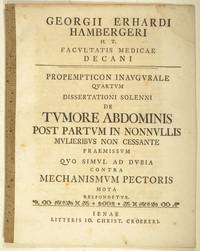
1746529801746. Jenae : Litteris Christ. Croeckeri 1746 4° 8 pp. Rückenbroschur. Erstdruck - Georgii Erhardi Hambergeri propempticon inaugurale . dissertationi . de tumore abdominis post partum in nonullis mulieribus non cessante praemissum quo simul ad dubia contra mechanismum pectoris mota respondentur Hamberger Georg Erhard 1697-1755 Praes.: Reichart Johann Adam 1711- Resp. Enthält u.a. die Vita von Johann Adam Reichart. unknown
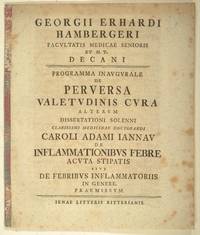
1750529781750. Jenae : Litteris Ritterianis 1750 4° 8 pp. Rückenbroschur. Erstdruck - Georgii Erhardi Hambergeri . programma inavgvrale de perversa valetvdinis cvra altervm dissertationi solenni . Caroli Adami Iannav de inflammationibvs febre acvta stipatis sive de febribvs inflammatoriis in genere praemissvm Hamberger Georg Erhard 1697-1755 Praes.; Jannau Karl Adam 1724-1760 Resp. Carl Adam Jannau "geb. zu Riga 1. Jan 1724. stud. 1745 bis 50 in Jena praktiz. 1750-60 in Riga wo er verstarb 7. Januar 1760. ." . J. Brennsohn: Die Ärzte Livlands. 1905. Enthält u.a. die Vita von Karl Adam Jannau. unknown
1755AQ20641London: Printed for C. Hitch and L. Hawes 1755. vi 1 118pp 2. With a final leaf of publisher's advertisements. Handsomely bound in ninetenth-century polished calf tooled in gilt and blind contrasting red morocco lettering-piece marbled edges. Lightly rubbed. Marbled endpapers internally clean and crisp. A choice copy of the second edition and first to appear with a London imprint of a set of 10 'lectures' on Christian teaching stressing the importance of personal devotion by Yorkshire-born English clergyman Thomas Adam 1701-1784. A popular reprinted throughout the eighteenth- and into the nineteenth-centuries especially in the provinces these lectures are said to have profoundly influenced the Liverpudlian evangelical divine William Romaine 1714-1795. As with the Lincoln printed first edition rare: ESTC records copies of this edition at two locations in the British Isles BL and Manchester and none elsewhere. ESTC T88403. Second edition. 12mo. Printed for C. Hitch and L. Hawes unknown
17992080502106912477Not Available 1799. Soft Cover. Fine. The book is in fine condition. Not Available paperback
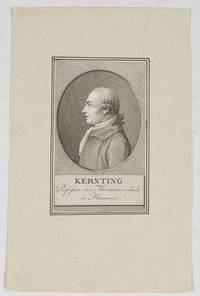
1789709451789. Kupferstich Paunktiermanier sc. von Adam Ludwig d'Argent nach 1789. Plattengröße 114 x 75 mm; beschnitten und alt montiert. Johann Adam Kersting 1727-1784 - Unter dem Bildnis befindet sich eine Schrifttafel mit der Aufschrift: "KERSTING. Professor der Thierarzneyschule in Hannover." Die Darstellung vermittelt den Eindruck einer respektablen gelehrten Persönlichkeit und unterstreicht seinen Status als Direktor der von ihm mitbegründeten Institution. Er prägte die frühe tierärztliche Ausbildung durch einen damals neuartigen strukturierten Ansatz der Theorie und Praxis eng miteinander verknüpfte. Als ehemaliger Rossarzt und Schmied legte Kersting großen Wert darauf dass die Ausbildung nicht rein empirisch "Heilen nach Erfahrung" sondern auf wissenschaftlichen Grundlagen basierte. Er kombinierte das praktische Wissen der Schmiede mit anatomischen und pathologischen Erkenntnissen. Unter Kersting umfasste der Unterricht ein breites Spektrum das er als erster und zunächst einziger Lehrer der Anstalt abdeckte: Anatomie und Physiologie: Er unterrichtete die "Geschäfte des thierischen Körpers im gesunden Zustande" Physiologie. Spezielle Fachgebiete: Er hielt Vorlesungen über Pathologie Therapie Chirurgie und Tiergeburtshilfe. Visuelle Lehrmittel: Um anatomische Zusammenhänge zu verdeutlichen nutzte Kersting detaillierte Federzeichnungen und Figuren z. B. Darstellungen von Pferdeschädeln die er seinen Erklärungen beifügte. Pionier der Tiergeburtshilfe: Er war einer der Ersten der die Tiergeburtshilfe systematisch in den akademischen Stundenplan integrierte und darüber Vorlesungen hielt was die Professionalisierung dieses Feldes maßgeblich vorantrieb. Kerstings Methoden legten den Grundstein für den Übergang von der handwerklichen "Roßarzney" zur modernen universitären Veterinärmedizin. Coburg Kunstsammlungen der Veste Coburg Inventar-Nr. VI355 unknown
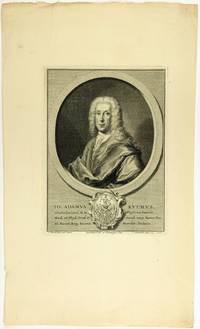
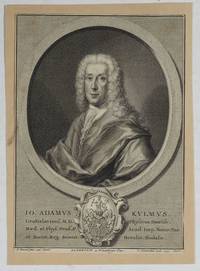
1740276281740. Kupferstich I.Wessel pinx 1740. Dantzig; J.Houbraken sculp. 1743. Amsterdamm 192x144 auf 366x244 mm. Johann Adam Kulmus was born on Danzig in 1689 and studied medicine at Halle Strassburg and Basel. In 1725 he became a lecturer in medicine at the Gymnasium in Danzig where he died in 1745. His most noted work was the anatomical textbook Anatomischen Tabellen first published in Danzig 1722. The work was extremely popular and was translated into Latin French Dutch and eventually Japanese. Most of the illustrations are imitations of those in Philippe Verheyen's Corporis humani anatomia which are themselves heavily patterned after Vesalius. By 1770 Japan had been cut off from the rest of the world for well over a century with the exception of limited trade with the Netherlands and China. About that time a group of Japanese physicians led by Maeno Ryotaku 1733-1803 and Genpaku Sugita 1733-1817 undertook the study of Dutch medicine and in 1771 managed to obtain copies of the Dutch translation of Kulmus' anatomical work entitled Ontleedkundige tafelen published in Amsterdam in 1734. Taking the book with them to the dissection of an executed criminal's corpse they were enthralled by the accuracy of the Dutch work and decided to translate it into Japanese. After years of work which involved finding a new vocabulary in Japanese for many anatomical terms the work was published under the title Kaitai shinsho in Tokyo in 1774. Kaitai shinsho is considered to be the first Western book published in Japan in the Japanese language. It was also a large step in the development of European medicine in Japan mainly because it called into question the Chinese anatomical theories of Japan's kampo medicine. -cf. NLM unknown
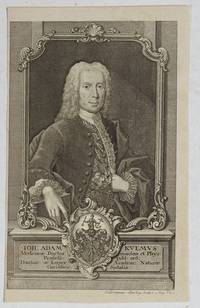
1741277431741. Hieronymus Sperling Sculps. Aug. Vind Leipzig bey Caspar Fritsch 1741 121 x 202 cm. Kulmus practised at Danzig and his Tabulae anatomicae were very popular and have been repeatedly reprinted and translated. The "Anatomische Tabellen" were even translated into Japanese after a Japanese physician named MAYENO had satisfied himself by a dissection of a Japanese woman Aocha-Baba that they presented the true anatomical relations and thus demonstrated that such anatomy as had been taught in Japan up to that time was absoltely false. cf. Hirsch-H. III 632; Choulant-Frank p.34. unknown
1740647551740. Kupferstich I.Wessel pinx 1740. Dantzig; J.Houbraken sculp. 1743. Amsterdamm 192x144 auf 10ßx133 mm. mm. Johann Adam Kulmus was born on Danzig in 1689 and studied medicine at Halle Strassburg and Basel. In 1725 he became a lecturer in medicine at the Gymnasium in Danzig where he died in 1745. His most noted work was the anatomical textbook Anatomischen Tabellen first published in Danzig 1722. The work was extremely popular and was translated into Latin French Dutch and eventually Japanese. Most of the illustrations are imitations of those in Philippe Verheyen's Corporis humani anatomia which are themselves heavily patterned after Vesalius. By 1770 Japan had been cut off from the rest of the world for well over a century with the exception of limited trade with the Netherlands and China. About that time a group of Japanese physicians led by Maeno Ryotaku 1733-1803 and Genpaku Sugita 1733-1817 undertook the study of Dutch medicine and in 1771 managed to obtain copies of the Dutch translation of Kulmus' anatomical work entitled Ontleedkundige tafelen published in Amsterdam in 1734. Taking the book with them to the dissection of an executed criminal's corpse they were enthralled by the accuracy of the Dutch work and decided to translate it into Japanese. After years of work which involved finding a new vocabulary in Japanese for many anatomical terms the work was published under the title Kaitai shinsho in Tokyo in 1774. Kaitai shinsho is considered to be the first Western book published in Japan in the Japanese language. It was also a large step in the development of European medicine in Japan mainly because it called into question the Chinese anatomical theories of Japan's kampo medicine. -cf. NLM unknown
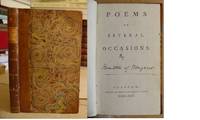
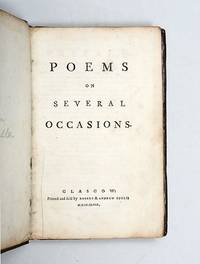
174928985Printed by Robert And Andrew Foulis Glasgow 1749. 2nd impression. Hardback. Half calf over marbled boards VG. vi148pp booksellers ticket of Thomas Miller of Dundee to the pastedown a previous owner has added 'Hamilton of Bangour' in ink to the title a nice clean near fine copy. Paper fault at page 128 not affecting the text. This copy has the preface over 2 pages with the last line of pp3 reads 'It is owing to the delicay of' in some copies the preface is contained upon a single page. The work was first issued in 1748 with an errata slip & page 133 mis-numbered. The errors have been corrected in this impression. A 'second edition' of the book infact a third impression contains a portrait frontis this 2nd impression & the first edition of 1748 do not. See Chalmers in Archaeologia Scotica Vol III for a descriptive list of the printings. He states - 'Poems on Several Occasions' Glasgow printed by Rob and Andrew Foulis 1749 Small 8vo. pp 148 besides 3 leaves prefixed. This is an exact reprint of the preceding 1748 1st edition and contains the same number of pages. Though certainly a reprint it is not called a second edition. A subsequent reprint by the same printers is called The second edition. To my copy of this in 1749 there is prefixed an anonymous head of the Author engraved from the portrait by Gavin Hamilton at Rome'. Poems of the Scottish Jacobite poet William Hamilton 1704 - 1754 which were published in Scotland is his absence by friends whilst he was in exile in France following the Battle of Culloden. The preface by Adam Smith is Smith's first published work. Printed by Robert And Andrew Foulis, Glasgow hardcover
1748152859Glasgow: Robert & Andrew Foulis 1748. Adam Smith's first appearance in print First edition of Hamilton's poems edited and with a preface by Adam Smith marking his first appearance in print. Hamilton 1704-1754 had been an army officer in the Jacobite risings during which time his poetry aroused considerable interest. His poem 'Ode to the Battle of Gladsmuir' set to music by McGibbon became a popular Jacobite ballad. Hamilton went into exile in France after the failure of the risings. A group of his friends likely including Adam Smith's patron Lord Kames feared that his sudden fame would lead to pirated and shoddy editions and consequently prepared the current collection see preface. Smith then twenty-five years old was entrusted with its editorship his first enterprise in publication which indicates that his circle held his literary taste in high regard following his lecture series of 1748-9 lectures given at the suggestion of Kames. When Hamilton was pardoned and returned to Scotland in 1750 he and Smith became intimate friends. In 1758 Foulis published a second edition giving the author's name for which Smith added the dedication to the poet's great friend the Glasgow merchant William Crawford. Octavo 158 x 98 mm. Contemporary calf red morocco label. Bookplate and shelflabel to front pastedown. Joints and extremities neatly restored light rubbing. Front endpaper with small chips at foot repaired 7 cm closed tear at foot of title contents otherwise fresh; a good copy. ESTC T42625; Gaskell 110; Vanderblue p. 46. See Rae Life 3841; Simpson Ross Life p. 96. unknown
1748GT1007Glasgow: Robert & Andrew Foulis 1748. 1st Edition . Hardback. Vg. 12mo. iv 148pp. With a preface by Adam Smith. Original speckled full calf and ORIGINAL 18TH CENTURY marbled end-papers. The binding is rubbed with some loss to the surface of the rear cover and mottled to the front. A fine gilt decorated original spine with raised bands and gilt decoration to the compartments A fine original red calf gilt label to the spine with no repairs. A small contemporary paper scrap of a dove has been lightly pasted above the letter E in the title 3cms. The boards are attached and have double-ruled gilt border line front and band. Nice wide margins to the printed sheets. AN EXCEPTIONAL COPY IN UNRESTORED STATE OF A RARE ITEM IN ORIGINAL STATE.158x100mm <br/> <br/> Robert & Andrew Foulis hardcover
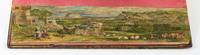
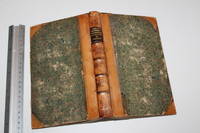
1788ST19954London: Printed for the Author and sold by Edwards in Pall Mall; Also by Edwards's in Halifax 1788. FIRST EDITION quarto issue with the etchings printed directly above the text. 257 x 205 mm. 10 1/8 x 8 1/8". iv 27 1 pp. 25 leaves; 11 1 pp. 25 leaves. Two parts bound in one volume. <br/> HANDSOME ORIGINAL ESTRUSCAN CALF BY EDWARDS OF HALIFAX covers with central panel of tree calf enclosed by a gilt Greek key border and a frame of stenciled dark brown palmettes on light tan calf this surrounded by graceful gilt ivy roll on dun-colored calf all within a gilt pentaglyph-and-metoped border smooth spine divided into panels by strips of inlaid black morocco tooled with gilt Greek key roll panels with inlaid central oval medal featuring an Etruscan vase calligraphic gilt flourishes at corners black morocco label bright pink endpapers all edges gilt expertly rebacked preserving original spine. WITH A FINE BRIGHTLY COLORED FORE-EDGE PAINTING OF THE CRAIGMILLAR CASTLE RUINS WITH EDINBURGH IN THE DISTANCE. WITH 50 ENGRAVED VIGNETTES 60 x 85 mm. of the ruins of Scottish castles and abbeys. A Large Paper Copy. Front pastedown with engraved armorial bookplate of Christopher Turnor Stoke Rochford Library. Lowndes 370; ESTC T153718 but with a variant title page. Front cover with a couple small areas of lost patina from insect activity rear cover just slightly marked upper corners a bit bumped faint freckled foxing in the margins more noticeable on the first two leaves slight offsetting of engravings on facing blank versos. A few condition issues but still a very attractive book the lovely binding retaining virtually all of its antique appeal and the contents with nothing approaching a significant problem.<br/> <br/> This is an excellent atypically large example of an Edwards of Halifax binding enhanced with a most appealing early fore-edge painting depicting one of the castles pictured in this attractive quarto edition. Scottish surgeon and antiquary Adam de Cardonnel 1746/7 - 1820 wrote and illustrated the present work "to preserve from oblivion the ancient remains of Caledonian splendour." Originally intended as a supplement to the popular "Pennant's Tour" of Scotland it appeared in four parts the first two in 1788 in a few different forms including an octavo edition and the second two published in 1793. The fore-edge painting features Craigmillar castle a Medieval fortress located a few miles from Edinburgh whose most famous guest was Mary Queen of Scots. One of her stays resulted in the so-called "Craigmillar bond" which set in motion plans to dispatch Mary's husband Henry Stuart. By the late 18th century the castle had fallen into disrepair and it appears in the present painting as an idyllic ruin with sheep and cows grazing in the fore-ground and the city with Edinburgh Castle rising in the distance. The Edwards of Halifax bindery was founded by William Edwards 1723-1808 and continued by several of his brothers half-brothers and sons by far the most important of the sons being Thomas who lived from 1762-1834. This famous firm produced a number of important innovations in binding design the most significant being the idea of concealing a painting under the gilt of the fore edge. This hidden treasure could be revealed once the edge was fanned out as a special surprise element of the volumes the Edwards firm bound--typically in Etruscan calf as here or in their patented transparent vellum. Although bindings produced by the Edwards workshop are almost never signed the present item is surely Edwards' work as indicated by the characteristic binding style and by the fact that our volume was actually sold by the Edwards firm. As usual there is no clear way to assign a precise date to the painting; while it is not done in the soft grays that can be firmly associated with the earliest Edwards examples it clearly is a painting done before 1850. While fore-edge paintings likely produced at the Edwards bindery and especially produced by their imitators appear in the marketplace with some regularity most offered are octavo or duodecimo in size. Of the fore-edge paintings attributed to Edwards of Halifax that have appeared in RBH over the past 65 years fewer than one in 10 were on quarto volumes. This copy was previously owned by the MP Christopher Turnor 1809-86 a member of the House of Commons and owner of more than 20000 acres in Linconshire where he built the grand Stoke Rochford Hall. Printed for the Author, and sold by Edwards, in Pall Mall; Also by Edwards's, in Halifax unknown
1793C215426London: Privately Published 1793. Hardcover Hardcover. Very Good. Octavo. v 3 99. Rebound in recent cloth with gilt spine titles new endpapers. Contents untrimmed with dust darkened fore-edge first few pages slightly marked a couple of plates slightly damp marked one plate with tear at text one with tear at image otherwise about very good. 99 etched plates with description. Privately Published, hardcover
1793013666London: Printed for the author 1793 Book. Good. Hardcover. Although not stated on the title page this is parts III and IV only of 4. The introduction states that it is to parts III and IV. vi 3 1 53 pages of text and 53 plates. This copy has india paper proofs of the images pasted on to the text pages as well as the plates which face them. There are though 2 of the india paper proofs which are missing - Werk Castle and Tinnis Castle. The india paper is browned throughout. Offsetting to some of the images. In later half leather binding but this is very worn and the spine is split with the boards just holding on by cords. Bookplate to the front pastedown of William Roughead. Old bookbinder's ticket for Carss of Glasgow. More modern manuscript list of places covered to one of the front end papers. Some spotting to pages. Page vi is misnumbered v. Printed for the author hardcover
1788013667London: Printed for the author 1788 Book. Good. Hardcover. This is parts I and II only of 4. iv 30 pages 25 plates; 12 pages 25 plates. The plates have the image and text printed on the rectos only. Bookplate to the front pastedown of William Roughead. Pencil notes to the front free end paper Thick paper Buccleuch's copy. The paper used is thicker than usual. In old full leather binding but this is now worn and the spine is completely split down the front edge. Gilt arms presumably of the Duke of Buccleuch to the front board. End papers are browned from contact with the leather. Some spotting to the inner edge of the title page. Some light offsetting to facing pages. Printed for the author hardcover
178847141London: Printed for the Author 1788. Moderate rubbing and bumping to boards gutters weak and cracked. Period ink inscrip to flyleaf botherwise clean and tidy interior. PP and illus clean and neat. Both vols bound as one. Half Leather Marbled Boards. Very Good/No Jacket. 8vo. Printed for the Author Hardcover
17889851London: for the author and sold by Edwards in Pall Mall also by Edwards's in Halifax 1788. 2 parts only of 4 in one volume 4to. pp. iv 27 i 25 leaves; 11 i 25 leaves the 50 unnumbered leaves printed on the rectos only: etched illustrations on india paper somewhat browned are mounted as headpieces on each leaf with a letterpress description below. Contemporary olive morocco gilt light wear probably by Staggemeir and Welcher who often worked for Edwards of Halifax: triple fillet border flat-backed spine with overall rococo design composed from various tools including swags an urn a lyre prince-of-wales feathers and incorporating a red morocco lettering-piece turn-ins with metope-and-pentaglyph roll all edges gilt. Neat early bibliophiles inscription on front free endpaper describing this as a proof impression and noting the price paid as two guineas; 19th century armorial bookplate of Simeon Warner. Parts three and four were published in 1793. Adam de Cardonnel 1746/7-1820 trained as a surgeon but his easy circumstances left him leisure to indulge his interest in the study of antiquities and numismatics ODNB. He was a founding fellow of the Society of Antiquaries of Scotland and assisted Francis Grose in his antiquarian researches during Groses Scottish travels. Part of lot 94 sold by Christies 22 October 1992 in their sale 4852. Book for the author and sold by Edwards in Pall Mall, also by Edwards's in Halifax, unknown
179359006509London: Printed and Sold By Edwards 1793. Bound in 1/4 leather over boards. Scuffing to spine ends. Two of Four parts in one volume. This is the final two volumes. 99 illustrations of Religious houses and Castles interspersed. With a brief description below the plates. The work was intended as a supplement for travellers to Pennants "Tour in Scotland" and the first two parts were published in 1788. According to OCLC this later volume is scarcer than the 1788 book. First Edition. Hard Cover. Very Good/No Jacket. 21 Cm. Printed and Sold By Edwards Hardcover
1788BRDctCAR98London: Printed For The Author And Sold By Edwards 1788. 1788. 8vo. pp. iv 29 ff. 25; pp. 12 ff. 25. 50 text etchings. contemporary tree calf rebacked long crack down centre spine extremities worn. Inscribed from the Author. First Edition. Two further parts were published in 1793. Signed by Authors. F. London: Printed For The Author, And Sold By Edwards, 1788. unknown