Jean ADAMBiblio.com
336 résultats
177760927Cadomi Caen Caen: Apud J.C. Pyron 1777. Fine. Apud J.C. Pyron Cadomi Caen Caen 1777 9.50 x 16 cm relié New edition after the first of 1771. Printed in Caen. Contemporary marbled sheep binding. Spine with raised bands decorated. Red morocco title label. Lacking at head with board present. Lower joint cracked at head. Rubbed. A manual of philosophical logic intended for students. Jean Adam was a professor at the University of Caen. Apud J.C. Pyron hardcover
177531064London 1775. Engraving by D. Cunego. Adam's design for a surprise for George III's 25th birthday<br/> <br/> Robert Adam was probably introduced to the Royal Family by Lord Bute fellow Scotsman and patron. Queen Charlotte employed him to create a large temporary folly in the garden of Buckingham House. As shown here several portals held large painted linens. These were allegories showing George III as a bringer of peace and prosperity the Treaty of Paris ending the Seven Years' War had recently been signed. These painting were illuminated from behind and the overall effect must have been quite grand. Adam clearly succeeded in making a structure that was festive triumphant and regal. Robert and his brother James Adam forever changed the face of British architecture by introducing innovative Classical design ideas. From 1754-57 Robert lived in Italy where he had a long productive friendship with Piranesi which was inspirational for both men. Adam's first book on Diocletian's palace in Dalmatia is clearly very like the archaeological investigations Piranesi was making at the same time of similar ruins. Piranesi's friendship and passion for Roman Classicism were seminal influences on Adam and the greatest single factor other than his own talent in the work Adam produced on his return to England. Upon his return the brothers launched their career by building the Adelphi from the Thames to the Strand in London which although not a commercial success at the time included one of London's most cherished buildings the Adlephi Theatre. Together the Adam brothers designed and built some of the most famous buildings in England including such bastions of English architecture as Kenwood House Keddlestone Manor and Syon House. To the interiors of their English country houses the Adams brought wonderful ornamental elements in niches lunettes festoons and reliefs. Their classically designed buildings were so numerous in London that they changed the prevailing feel of the city and established their brand of neo-Classicism as the model of elegance and importance. It is asserted that the brothers originated the concept of the uniform facade attached to the typical English row house an architectural device that distinguishes London buildings. This monumental contribution is evidenced in the Adams' designs for Portland Place and Fitzroy Square and these were used as architectural models for the whole city. The brothers brought their talents into other areas by designing furniture to complement their beautiful interiors and by creating and publishing a treatise of design entitled 'Works in Architecture'. The work was published in three volumes over an extended span of time beginning in 1773 with the final volume being published posthumously in 1822.<br/> <br/> Cf. Brunet I.47; cf. Lowndes I p.8. unknown
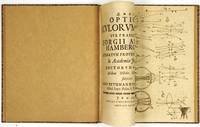
1707524801707. Jena : Literis Gollnerianis 1707 Kl.-4° 2 64 pp. mit 1 Kupfertafel feiner Pappband im Stil d. Zeit. Rare - Second Edition of the first monograph on refractive errors ! "Physiology in general and physiologic optics in specific made great progress during the 18th century. These advances were at first made not by practicing ophthalmologists but the mathematicians and physicists. This situation is therefore similar to that of the 17th century when progress was achieved by Kepler Scheiner Kircher Mariotte Hooke Rohault Deschales Huygens and others. The mathematician Georg Albrecht Hamberger 1662-1716 was the author of a most curios monograph which was printed toward of the end of the 17th century. Modern historian did not know about it and it is not mentioned by A. Hirsch not by Helmholtz in the second edition of his Physiological Optik. It is difficult to determine how much this book influenced the thought progress of the 18th century. It is only mentioned in the review of the literature by Julius Beer in his first 'Augenheilkunde' of 1792 and Haller quotes it in his 'Elementa physiologiae humani' ." The book is called: Optica oculorum vitia sub praesidio Geogrii Alberti Hambergeri . This is the first monograph on refractive errors - the root so to speak from which 170 years later the classical book by Donders evolved; the monograph is for its time extraordinarily clear strictly mathematical and physical written in an entirely different spirit from the scholastic descriptions of the fourth book by Plempius "Opthalmographia" 1632 and also far superior to the corresponding remarks in Boerhaave's lectures on ophtahlmology 1708 printed in 1746 to 1771. These two publications are usually regarded as the beginning of physiologic optics. . Also Modern ocular hygiene was created by Professor Hamberger in Jena in 1696 . Only the reform of ophthalmology during the middle of the 19th century which was based on the ophthalmoscope and the correct recognition of refraction changed the situation." Hirschberg/Blodi IV pp.284-291 "Es ist dies die erste Sonderschrift über die Fehler der Einstellung des Auges . für die damalige Zeit außerordentlich klar streng mathematisch-physikalisch . geschrieben . Die Hygiene des Auges . ist in den zahllosen Schriften über diesen Gegenstand die um die Wende des 18. zum 19. Jahrhundert . erschienen sind nur wenig verbessert und erweitert worden " Hirschberg unknown
179753615Stockholm Henrik A. Nordström 1797-1801. 8vo. Uncut partly unopened in the original wrappers. In 22 volumes as issued. Last volume name written on title-page otherwise an exceptionally fine clean and untouched set rarely seen in this condition. 4102 pp.; 2182 pp.; 2107 pp.; 21571 pp.; 21764 pp.; 41382 pp.; 22051 pp. 1 folded table; 2188 pp; 2190 pp.; 2894 pp.; 41351 pp.; 21161 pp.; 2157 pp.; 2120 pp.; 21511 blank10 pp. 1 folded map; 2215 pp. 1 folded table; 21315 pp.; 4207 pp.; 21831 pp. 1 folded table; 2218 pp.; 21444 pp.; 64491 pp. 5 folded plates."Om Beskatning" Part: 36 37 38:Pp. 145-177"Om Jordbrukets förfall i Europa efter Romerska Väldets undergäng" Part: 27 28. Pp. 93-120"Om Handelsbalancen" Part: 2526. Pp. 92-114"Om Jordbruks-systemet I en Rikshushållning samt om Economisterne I Frankrike" Part: 25-26. Pp. 43-92"Om Pappers-myntet I Norr-Amerika Kolonierne före Revolutionen". Part: 27-28. Pp.57-62"Om Krono-jord". Part: 293031. Pp 139-146."Theorien för statsskulder". Part: 44 45 46 47 48 49 & 50. Pp. 151-161. <br/><br/><em>First however partial translation of Adam Smith's Wealth of Nations in Swedish rarely seen in this condition thus making it the very first opportunity for Swedish speakers to study Adam Smith. A more lengthy translation was made in 1909 - 1911 but to this day a full Swedish translation has not been made."Von Schulzenheim nobleman physician country squire and politician also published shorter articles in the review 'Läsning I blandade ämnen' an organ of the opposition to the absolutist and obscurantist regime of Gustavus IV Adolphus. The editor of the review was count Georg Adlersparre an army officer and a political writer who in 1809 was to become one of the prime-movers behind the dethronement of the king. Adlersparre to was an admirer of Adam Smith. In 1799-1800 he published in the 'Läsning' his own Swedish translation of several selections from Wealth of Nations. In some cases Adlersparre added footnotes making it easier for the readers to apply Smith's ideas to Swedish conditions. Those translations to the best of my knowledge were the first ones of Wealth of Nations in Sweden. They were followed by translations of other parts of Wealth of Nations published in 1800 amd 1808. This time the translator was Erik Erland Bodell an official of the Swedish Customs and thus if you like a colleague of Adam Smith." Cheng-chung Adam Smith Across Nations. Despite the comparatively late translation into Swedish it still had a profound influence not on economists since they were well aware of the original work in English but upon politics and public opinion in general: "There are few things more striking to the modem student of the history of ideas in Sweden than the negative phenomenon that Sweden was almost entirely uninfluenced by this fact and thus remained almost unaffected by English economic thought during a period when its superiority was most evident. As far as I am acquainted with the Swedish economic discussion and our popular economic literature of the 1860's and 1870's there is almost no trace of any influence from English writers. .Of Adam Smith we have still only one abbreviated translation of his famous work and that was published as late as during this century; and as far as I know nothing of Ricardo's or Malthus' exists in Swedish nor do any of the major economic works of J.S. Mill." Heckscher A survey of economic thought in Sweden 1875-1950.The journal was preceded by Adlersparre's "Läsning för landtmän" 1795-96. The content is a mixture of literature agriculture law philosophy and politics. Apart from the many contributions by Swedish authors "Läsning i blandade ämnen" also contains texts by Kant Gibbon and De Lolme OCLC lists copies at Yale Minnesota and Texas. </em> unknown
1776269431Berlin, Pauli, 1776-84. 4to. Pappbände d. Zeit mit 4 (von 7) Rückenschildern (fleckig, berieben u. bestoßen, Vorsatzpapier meist von den Deckeln gelöst, Band 8 mit Wasserschaden, Vorderdeckelbezug fehlt). [2 Warenabbildungen]
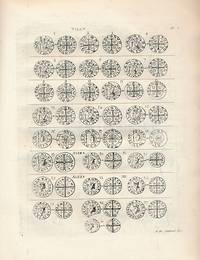
1786457770Edinburgh : printed for George Nicol His Majesty's bookseller London 1786. First Edition. Hardcover. Good copy in cloth-backed plain boards now edgeworn and dust-stained with paper label to spine. Preliminary and final leaves somewhat foxed. Core text with some faint foxing only and marginal dust-dulling. Binding tight throughout; pages somewhat edgeworn but remaining strong -- unread and unopened. Remains well-preserved overall. Physical description: 6 157 3 33 1 p.; XIV IV II leaves of plates : ill. ; 34 cm. Notes: With half-title page. Each section with divisional title page. Appendix with separate pagination. Subjects: Coins Scottish - History - Early works to 1800. Numismatics - Scotland - Early works to 1800. Coinage - Scotland - History. Edinburgh : printed for George Nicol, His Majesty's bookseller, London hardcover
1786r5129Edinburgh: George Nicol. Worn condition. Heavy wear and soiling to covers. Splits to outer hinges binding weak; front cover and early pages nearly disbound. Sporadic foxing throughout. 1786. First Edition. Cloth backed board cover. 330mm x 250mm 13" x 10". 157pp 33pp plates. 20 engraved plates. . George Nicol hardcover
1787mon0003248102Leipzig: Johann Friedrich Junius 1787. Hardcover. Good. . Half-leather cover with plain boards shows heavy wear and rubbing joints starting some loss at the spine ends. Bookplate and label of former owner on the front endpaper. Pages lightly tanned and foxed. Leipzig: Johann Friedrich Junius hardcover
1787mon0003248103Leipzig: Johann Friedrich Junius 1787. Hardcover. Good. . Half-leather cover with plain boards shows heavy wear rubbing joints starting some loss at the spine ends. Pages are lightly tanned and foxed. Leipzig: Johann Friedrich Junius hardcover
176961822Lpz.: M.G. Weidmanns Erben u. Reich 1769. 1 Bl., XX, 128 Ss. (beginnend mit S. 3). Kl.8°. HKalbLd. d.Z. mit 5 aufgesetzten Bünden, rotem Rückenschild, reicher floraler Rückenvergold. u. Rotschnitt (Deckel etw. angestaubt u. tls. leicht berieben, Ecken etw. bestoßen). [2 Warenabbildungen]
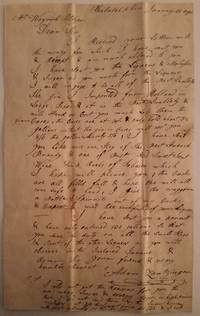
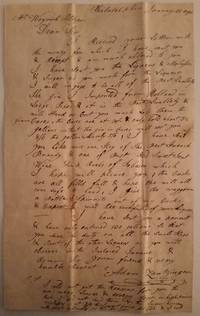
1790319Philadelphia 1790. Autograph Letter Signed. Folio sheet folded. 1 page of text with address on the verso. Folded with small tears at the folds blank piece missing at the wax seal. Highly legible hand. Watermark paper " I R ".Letter from Adam Zantzinger concern the receipt of money and shipment of "Liquers and Molasses and Sugar . . all of the best quality. The gin I imported from Holland in large Pipes & it is the best Quality & will cost you much less then the gin in cases; the cases are at 30/ only hold about 3 1/2 gallons so that the gin in cases will cost you 8/6 the gallon & this only 5/6. I have sent you like wise on keg of the best French Brandy & one of the best Red Sweet Wines and a Roal of Tobacco which I hope will please you. The casks are all filled full and hope thy will all com safe to hand. I give the waggoner a bottle of Spirrits out of my casks & expect he will see carefully of your liquor."Adam Zantzinger was a member of the Pennsylvania Militia 1775-1783 and is listed in the Revolutionar War Batallion Index. In 1775 he purchased a 9 acre parcel of land north of the City of Philadelphia called the Norther Liberites on Ridge Avenue across the street from what is now Girard College. He was listed in the membership rolls of the Carpenters Company for 1786 and became a shareholder in the Library Company of Philadelphia in 1790. unknown
1790549Philadelphia 1790. Autograph Letter Signed. Folio sheet folded. 1 page of text with address on the verso. Folded with small tears at the folds blank piece missing at the wax seal. Highly legible hand. Watermark paper "I R". Letter from Adam Zantzinger concern the receipt of money and shipment of "Liquers and Molasses and Sugar . . all of the best quality. The gin I imported from Holland in large Pipes & it is the best Quality & will cost you much less than the gin in cases; the cases are at 30/ only hold about 3 1/2 gallons so that the gin in cases will cost you 8/6 the gallon & this only 5/6. I have sent you like wise one keg of the best French Brandy & one of the best Red Sweet Wines and a Roal of Tobacco which I hope will please you. The casks are all filled full and hope they will all com safe to hand. I give the waggoner a bottle of Spirrits out of my casks & expect he will see carefully of your liquor." Adam Zantzinger was a member of the Pennsylvania Militia 1775-1783 and is listed in the Revolutionary War Batallion Index. In 1775 he purchased a 9-acre parcel of land north of the City of Philadelphia called the Norther Liberites on Ridge Avenue across the street from what is now Girard College. He was listed in the membership rolls of the Carpenters Company for 1786 and became a shareholder in the Library Company of Philadelphia in 1790. 319 549. unknown
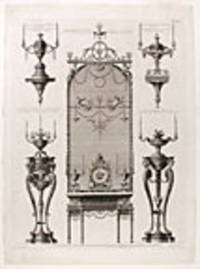
177517575London 1775. Engraving by B. Pastorini. In excellent condition. A fine engraving of various pieces of ornate furniture from Robert Adam's seminal work on British architecture.<br/> <br/> Robert and his brother James Adam forever changed the face of British architecture by introducing innovative Classical design ideas. From 1754-57 Robert lived in Italy where he had a long productive friendship with Piranesi which was inspirational for both men. Adam's first book on Diocletian's palace in Dalmatia is clearly very like the archaeological investigations Piranesi was making at the same time of similar ruins. Piranesi's friendship and passion for Roman Classicism were seminal influences on Adam and the greatest single factor other than his own talent in the work Adam produced on his return to England. Upon his return the brothers launched their career by building the Adelphi from the Thames to the Strand in London which although not a commercial success at the time included one of London's most cherished buildings the Adlephi Theatre. Together the Adam brothers designed and built some of the most famous buildings in England including such bastions of English architecture as Kenwood House Keddlestone Manor and Syon House. To the interiors of their English country houses the Adams brought wonderful ornamental elements in niches lunettes festoons and reliefs. Their classically designed buildings were so numerous in London that they changed the prevailing feel of the city and established their brand of neo-Classicism as the model of elegance and importance. It is asserted that the brothers originated the concept of the uniform facade attached to the typical English row house an architectural device that distinguishes London buildings. This monumental contribution is evidenced in the Adams' designs for Portland Place and Fitzroy Square and these were used as architectural models for the whole city. The brothers brought their talents into other areas by designing furniture to complement their beautiful interiors and by creating and publishing a treatise of design entitled 'Works in Architecture'. The work was published in three volumes over an extended span of time beginning in 1773 with the final volume being published posthumously in 1822.<br/> <br/> Cf. Brunet I.47; cf. Lowndes I p.8; DNB; Wilton-Ely The Mind and Art of Giovanni Battista Piranesi. unknown
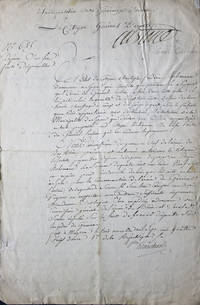
1792304899Speyer Austria 1792. 4 pp. pen and ink on paper in French in various hands with embossed seal. Old folds and light soiling paper repairs at folds. 4 pp. pen and ink on paper in French in various hands with embossed seal. Document payorder for firewood for the French Army encamped at Speyer "pour le chauffage de l'armée au Camp et Corps de Gardes" signed by General Adam Philippe Comte de Custine and Claude Blanchard. Both Custine 1740-1793 and Blanchard 1742-1802 fought in the American Revolution. Custine who lead the French forces in the Rhine campagins that seized Speyer and Mainz was guillotined in 1793 during the Reign of Terror. unknown
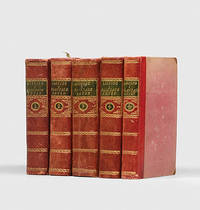
1797135144Stockholm: Henrik A. Nordström 17971801. First edition of all 50 parts of the Swedish literary periodical Läsning i blandade ämnen containing over 200 pages of passages from various sections of the Wealth of Nations making it the first opportunity for Swedish speakers to study Adam Smith. Georg Sartorius's abridgement of the Wealth of Nations the Handbuch der Staatswirthschaft. had appeared in a Swedish translation in 1800 but according to Tribe a complete translation has never appeared. There are many other translations from English in the periodical including biographies of Samuel Johnson and William Blackstone and poetry by Alexander Pope and Thomas Gray. 50 parts bound in 5 vols octavo 182 x 109 mm. Complete with 5 folding tables folding engraved map and 3 folding engraved plates of agricultural implements; woodcut vignettes on divisional titles. Contemporary red half morocco and marbled or drab boards spines with gilt roll rules green labels lettered and numbered in gilt blue edges silk bookmarkers. Contemporary ownership stamp of Daniel Eberstein to each title modern bookplate to each front pastedown. Occasional light spotting and the odd stain short tear to one leaf in vol. 3 with loss of 1 character; a very good set in an attractive contemporary binding. Vanderblue p. 32; not in Tribe; WorldCat lists copies at Yale Minnesota and Texas. On the influence of Smith in Sweden see Torbjörn Vallinder "University Professors and Amateur Writers: The Wealth of Nations in Sweden up to 1990" in Cheng-chung Lai Adam Smith Across Nations 2000. hardcover
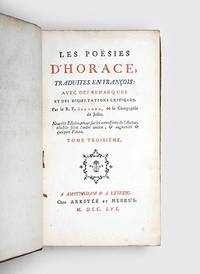
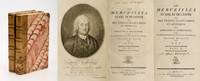
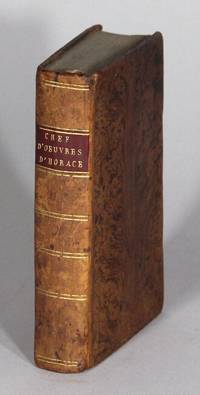
1756163096Amsterdam & Leipzig: Arkstée and Merkus 1756. We grow weary of the grave pedantic and long-sentenced love of Cowley and Petrarca. but the gaiety of Ovid and the gallantry of Horace are always agreeable" TMS I. ii. 2.1. A hitherto unrecorded volume from Adam Smith's library with his bookplate centrally positioned on the front pastedown volume 3 of an 8-volume set of Horace's poems the text in French and Latin on facing pages with the extensive remarks and critical notes of Noël-Étienne Sanadon of the Society of Jesus. Horace was clearly a favourite author of Smith's with thirteen different editions listed by Mizuta in his Catalogue of Smith's library 81-823 all but one of which are in Latin the only other entry being a ten-volume set in French of Horace's works equally with parallel Latin and French texts and notes and commentaries by Dacier. This single volume was purchased by its previous owner in the basement of Holleyman and Treacher booksellers of Brighton several decades ago. Duodecimo 168 x 95 mm. Woodcut vignettes and tailpieces title printed in red and black. Contemporary calf spine with five raised bands ruled in gilt black morocco label numbered direct in gilt. Housed in a dark brown quarter morocco solander box by the Chelsea Bindery. Spine ends chipped and corners worn spine label with slight loss free endpapers with burn marks from the leather turn-ins around the edges somewhat browned and brittle contents crisp and clean; a very good copy. Not listed in Mizuta or Yanaihara. hardcover
178229252AB1782. 2 Volumes ensemble complet. Berlin G.J.Decker 1782. Octavo 13 cm x 20 cm. Frontispice 98 1 304; 2 382 1 pages. Reliure originale demi-cuir de 19ème siècle. Tres bon exemplaire. This work is listed in Albert Louis Calillet - Manuel bibliographique des sciences psychiques ou occultes - No. 10472 First French edition of one of Swedenborg's main works from the library of swedish baron Carl Adam Wrangel with his name on the titlepage in ink. Carl Adam Wrangel af Adinal born 28 November 1748 in Ovesholm died 16 April 1829 in Araslöv in Färlöv parish was a Swedish baron one of the kingdom's lords and governor of Kristianstad county. He was the son of Baron Henning Reinhold Wrangel af Adinal and his wife Hedvig Sofia Winterfeld. Wrangel became a lifeguard in 1766 a captain in the army in 1772 and then resigned in April 1773. He became chamberlain to the widowed queen Lovisa Ulrika in 1774 and governor of Kristianstad county from 1786 to January 1803. After his father's death in 1783 Carl Adam Wrangel inherited Ovesholm's estate in Träne parish from his parents. In 1787 he also inherited Araslöv's estate which at this time encompassed the entire parish of Färlöv. Araslöv was previously owned by his mother's aunt Sofia Elisabeth Ridderschantz. She was called "Skånska Prinsessan" because she was the grand-granddaughter of King Christian IV of Denmark and her habits were also very royal. Carl Adam Wrangel was a prominent farmer fully comparable to Macklean on Svaneholm and Stjernswärd on Engeltofta and carried out major reforms on his Scanian properties. Through large ditching companies new land was laid under the plow. One shift was carried out and Araslöv was divided according to the Scottish pattern into farm units eleven so-called farmer. Each farm covered a few hundred acres and was provided with magnificent and stately buildings newly laid out gardens and avenue-planted access roads. During the years 1790-1820 the manors Wrangelsberg Sofieberg Sofiedal Hamiltonhill Harastorp Gustafsfält Skottlandshus Wrangelsdal Ulriksdal Adinal and Kristineberg arose to which was added the mother property Araslöv. An entire parish was transformed in this way and today Araslöv's farmers with their fields and avenue systems give a definite touch to the landscape. Carl Adam Wrangel finally inherited Sperlingsholm's estate in Övraby parish outside Halmstad in 1789 from his uncle Georg Gustaf Wrangel who this year moved abroad. He married 6 April 1779 at Barsebäck in Skåne to Countess Anna Margareta Hamilton born 1760. She was the daughter of the field marshal Baron Gustaf David Hamilton af Hageby and his wife Jakobina Henrietta Hildebrand. In the marriage two sons were born: Henning Gustaf 1780-1833. Ludvig Ulrik Carl Adam 1783-1809. None of the sons had children and the baronial family Wrangel af Adinal was thus extinct in 1833. unknown
178770526Lyon: chez Bruyset freres 1787. 2 volumes in 1 12mo pp. 2 lxiv 156; iv 290; Latin and French on facing pages; woodcut vignettes on title pages woodcut ornaments; contemporary tree calf smooth gilt-paneled spine laid out in 6 compartments red morocco label in 1; a very good sound and clean copy. Not in Mills College Check List or Riedel-Horatiana. In the U.S. OCLC locates copies at Union Northwestern and Chapel Hill only. chez Bruyset freres unknown