30 547 résultats
252239H. Franz`sche Buch- und Kunst-Handlung J. Roth München n.g. Hardcover Leinen ohne Schutzumschlag Zustand: keine Beschädigungen keine Eintragungen. Rücken Ecken Kanten gut. Der Einband ist fleckig. Der Rücken ist lichtrandig. H. Franz`sche Buch- und Kunst-Handlung (J. Roth), München, hardcover
1790P1-3J-0PARIS (LEROY) 1790. 2 volumes In 8° (200 x 130) relié plein veau époque. Faux titres, titre frontispice XXIV - 381 pp. Faux titres, titre 399 pp. illustré de 12 planches dont le Hottentote à tablier. Bon état, peu de rousseurs.
Querformat. (ca. 14,9 x 9,9 cm). 10 Photographien. Original-Photographien mit weissem Bildrand, Rückseiten sämtlich mit Beschriftung (Schreibmaschinenschrift). Photographien gut erhalten, leichte Gebrauchsspuren. Altersentsprechend guter Zustand. Alle Aufnahmen haben das selbe Format und gleiche fotografische Bildqualität, zudem sind sie identisch mit blauen Lettern (Schreibmaschinenschrift) und in detaillierter Form beschriftet. Es handelt sich hier um eine Tabakplantage, das geht aus den Beschriftungen und Bildinhalten klar hervor. Eine der Aufnahmen aus einem verwandten Zyklus von Photographien nennt den Ort Mbanga. Dieser Ort ist nach zeitgenössischen Schriften mit den Anbaugebieten der Tabakbau- und Pflanzungsgesellschaft Kamerun AG assoziiert. Mit gewisser Wahrscheinlichkeit handelt es sich hierbei um die einstigen Plantagegebiete dieser Firma. (Für genaueren Einblick zur Selbstüberprüfung siehe unsere zur Verfügung gestellten Bilddateien). Eine weitere Aufnahme zeigt den Besuch von Wilhelm Solf und seines Stabs auf der Plantage. Da Solf in seinem Amt als Kolonialstaatssekretär die westafrikanischen Kolonien erst mit seiner zweiten Afrika-Reise besuchte, scheinen die vorliegenden Photographien aus dem Jahr 1913 zu stammen. Die Aufnahmen tragen folgende konkrete Beschriftung: Ansicht des Etablissements / Trockenscheunen / Junger Tabak. Wellblechscheune / Mattentrockenscheune / Saatbeete mit Kindern Würmer suchend / Hospital / Besuch Solf mit Begleitung. Feldbahnschienen / Schürings im Tabakfeld (2 Aufnahmen) / Beim Nähen der Ballen. Die historischen Aufnahmen stammen aus der deutschen Kolonialzeit selbst, erst mit Kriegsverlauf ab August 1914 wurden die Gebiete enteignet und anderen Mächten übergeben. Im Falle der Tabakbau- und Pflanzungsgesellschaft Kamerun AG gingen die Gebiete nach dem Weltkrieg wohl gänzlich verloren, während andere Firmen die einstigen Plantagen wieder zurück kaufen konnten. Die sehr interessanten Ansichten zeigen Tabakfelder und zahlreiche Funktionsgebäude für die Tabakherstellung. Sogar der Krankenhaus-Komplex ist dokumentiert. Auch der dokumentierte Besuch von Wilhelm Solf legt nahe, daß es sich um eine in ihrer Größe bedeutende Plantage gehandelt haben muss wenn sie den Besuch eines kaiserlichen Staatssekretärs hervorruft. Es ist zudem von Schürings im Feld die Rede, möglicherweise handelte es sich hier um einen ehemaligen Aufseher oder eine auf der Plantage ansässige und in Funktion stehende Familie. Belegt ist durch die Aufnahmen auch die Arbeit von afrikanischen Kindern auf der Plantage. Die Aufnahme, auf der afrikanische Männer die Ballen zum Verpacken des Tabaks fertigen, zeigt ein weiteres Detail: einer der Arbeiter hält einen fertigen Ballen für die Kamera ins Bild. Hier sind auch Buchstaben zu erkennen, vermutlich Lettern einer assoziierten Firma, die sicher Relevanz für die Provenienz der Aufnahmen besitzen. Historische Bilder aus der Kolonialgeschichte des heutigen Kamerun!
185352524London: John Murray 1853. First edition 2 volumes 8vo pp. xv 1 425 1; iv 432; folding map with route outlined in red 18 plates plus other wood-engraved illustrations in the text; recent half maroon morocco gilt-decorated spines in 6 compartments gilt-lettered direct in 2; old institutional rubberstamp in bottom margin of title pages both frontispieces a bit dampstained but overall a fine-looking copy. <br/><br/> John Murray unknown books
185352524London: John Murray 1853. First edition 2 volumes 8vo pp. xv 1 425 1; iv 432; folding map with route outlined in red 18 plates plus other wood-engraved illustrations in the text; recent half maroon morocco gilt-decorated spines in 6 compartments gilt-lettered direct in 2; old institutional rubberstamp in bottom margin of title pages both frontispieces a bit dampstained but overall a fine-looking copy. John Murray unknown
189152582London & New York: Ward Lock & Co 1891. First edition in English large 8vo pp. xviii 597 1; folding map in back cover pocket gravure frontispiece portrait 32 plates 50 illustrations in the text; original pictorial green cloth stamped in gilt white and black; spine ends chipped small break in the cloth on the lower joint one gathering extended; all else good and sound or better. Czech Africa p. 128: "A German counterpart to Henry M. Stanley's notable work In Darkest Africa this represents Peters' journey to find Emin Pasha on the Upper Nile but approach from Africa's east coast . This work is wonderfully illustrated particularly regarding the battles waged between the expedition and hostile tribes." <br/><br/> Ward, Lock, & Co hardcover books
- Imprimerie Impériale, Paris 1809-1829, 53,5x70,5cm, une feuille. - Original, unshaved, full-page etching from the "Imperial edition" of the Description de l'Égypte, or 'Recueil des observations et recherches faites en Égypte pendant l'expédition française, publié par les ordres de Sa Majesté l'Empereur Napoléon le Grand [A Collection of the observations and research carried out in Egypt during the French expedition, published on the orders of his Majesty the Emperor Napoleon the Great]'. Produced between February 1802 and 1830 on the orders of Naopleon Bonaparte and published between 1809 and 1828, 1,000 copies were printed and distributed to institutions, on vergé paper with an 'Égypte ancienne et moderne' watermark, visible when held up to the light. Light marginal spotting not touching image, otherwise in very fresh, fine condition. An engraving from the Description de l'Egypte, one of the masterpieces of French printing and the birth of a new field: Egyptology. A gigantic survey of Egypt at the time of Bonaparte's conquests in 1798 and 1799, the work is divided into 13 volumes of engravings making up 892 plates, of which 72 colored, as well as presenting the splendors of the Egypt of the Pharaohs in 9 volumes. The other volumes discuss natural history and present a fascinating portrait of Coptic and Islamic Egypt as it was seen by Bonaparte's Eastern Armies. The 'Egyptian campaign', militarily a disaster, demonstrates, through the engravings of the Description d'Egypte, the scientific success it nonetheless became thanks to the 167 expert members of the Commission of the Sciences and Arts of the Institut d'Egypte [Egyptian Institute] who followed Napoleon's army. The Institut gathered together in Egypt the mathematician Monge, the chemist Berthollet, the naturalist Geoffroy Saint-Hilaire as well as numerous artists, engineers, architects and doctors. They were tasked with re-discovering modern and ancient Egypt and displaying its natural treasures as well as the know-how of its inhabitants. This edition, the so-called "Imperial" edition of the plates for the Description de l'Egypte was printed in four large formats, two of which were specially created for it and christened "Moyen-Egypte" and "Grand-Egypte". A special press was built to print it, the process extending over 20 years, from 1809 to 1829. The "Imperial" edition proved so popular that a second edition, this time in black and white and without the "Egypte ancienne et moderne" watermark - known as the "Royal Edition" - was published during the Restoration by the printing house of C.-L.-F. Panckoucke (Paris). The engravings of the Description d'Egypte owe a great deal to Baron Dominique-Vivant Denon, illustrator, diplomat, collector and later Director of the Musée Napoléon (the Louvre). His exploration of the South of Egypt gave Bonaparte the idea of sending the experts of the Institut there, thus creating a faithful and complete portrait of the area. This was the research gathered together from 1802 in the mammoth Description de L'Egypte. Denon embarked on this story of archeological exploration at the age of 51, reaching first Alexandria and then Cairo before exploring Upper Egypt. Along with the members of the Institut d'Egypte, the Natural History Museum's painter H.J. Redouté (brother of Pierre-Joseph Redouté, author of Roses), the mineralogist Dolomiue, and the draughtsman Joly, Denon then explored the Nile Delta and Lower Egypt. When, however, he joined the 21st Light Infantry Regiment as it marched across Upper Egypt in pursuit of the retreating Mameluks in November 1798, he found himself the only civilian. In the very midst of the battle itself, he reeled off sketches of the works of art that peppered his path right up to the threshold of the Sudan. He said that he had crossed "a country that is, apart from its name, entirely unknown to Europeans, and therefore everything was worth describing" (Voyages dans la Basse et la Haute Egypte pendan
- Imprimerie Impériale, Paris 1809-1829, 71x53,5cm, une feuille. - Original, unshaved, full-page etching from the "Imperial edition" of the Description de l'Égypte, or 'Recueil des observations et recherches faites en Égypte pendant l'expédition française, publié par les ordres de Sa Majesté l'Empereur Napoléon le Grand [A Collection of the observations and research carried out in Egypt during the French expedition, published on the orders of his Majesty the Emperor Napoleon the Great]'. Produced between February 1802 and 1830 on the orders of Naopleon Bonaparte and published between 1809 and 1828, 1,000 copies were printed and distributed to institutions, on vergé paper with an 'Égypte ancienne et moderne' watermark, visible when held up to the light. Light marginal spotting not touching image, otherwise in very fresh, fine condition. An engraving from the Description de l'Egypte, one of the masterpieces of French printing and the birth of a new field: Egyptology. A gigantic survey of Egypt at the time of Bonaparte's conquests in 1798 and 1799, the work is divided into 13 volumes of engravings making up 892 plates, of which 72 colored, as well as presenting the splendors of the Egypt of the Pharaohs in 9 volumes. The other volumes discuss natural history and present a fascinating portrait of Coptic and Islamic Egypt as it was seen by Bonaparte's Eastern Armies. The 'Egyptian campaign', militarily a disaster, demonstrates, through the engravings of the Description d'Egypte, the scientific success it nonetheless became thanks to the 167 expert members of the Commission of the Sciences and Arts of the Institut d'Egypte [Egyptian Institute] who followed Napoleon's army. The Institut gathered together in Egypt the mathematician Monge, the chemist Berthollet, the naturalist Geoffroy Saint-Hilaire as well as numerous artists, engineers, architects and doctors. They were tasked with re-discovering modern and ancient Egypt and displaying its natural treasures as well as the know-how of its inhabitants. This edition, the so-called "Imperial" edition of the plates for the Description de l'Egypte was printed in four large formats, two of which were specially created for it and christened "Moyen-Egypte" and "Grand-Egypte". A special press was built to print it, the process extending over 20 years, from 1809 to 1829. The "Imperial" edition proved so popular that a second edition, this time in black and white and without the "Egypte ancienne et moderne" watermark - known as the "Royal Edition" - was published during the Restoration by the printing house of C.-L.-F. Panckoucke (Paris). The engravings of the Description d'Egypte owe a great deal to Baron Dominique-Vivant Denon, illustrator, diplomat, collector and later Director of the Musée Napoléon (the Louvre). His exploration of the South of Egypt gave Bonaparte the idea of sending the experts of the Institut there, thus creating a faithful and complete portrait of the area. This was the research gathered together from 1802 in the mammoth Description de L'Egypte. Denon embarked on this story of archeological exploration at the age of 51, reaching first Alexandria and then Cairo before exploring Upper Egypt. Along with the members of the Institut d'Egypte, the Natural History Museum's painter H.J. Redouté (brother of Pierre-Joseph Redouté, author of Roses), the mineralogist Dolomiue, and the draughtsman Joly, Denon then explored the Nile Delta and Lower Egypt. When, however, he joined the 21st Light Infantry Regiment as it marched across Upper Egypt in pursuit of the retreating Mameluks in November 1798, he found himself the only civilian. In the very midst of the battle itself, he reeled off sketches of the works of art that peppered his path right up to the threshold of the Sudan. He said that he had crossed "a country that is, apart from its name, entirely unknown to Europeans, and therefore everything was worth describing" (Voyages dans la Basse et la Haute Egypte pendant
- Imprimerie Impériale, Paris 1809-1829, 71x54cm, une feuille. - Original, unshaved, full-page etching from the "Imperial edition" of the Description de l'Égypte, or 'Recueil des observations et recherches faites en Égypte pendant l'expédition française, publié par les ordres de Sa Majesté l'Empereur Napoléon le Grand [A Collection of the observations and research carried out in Egypt during the French expedition, published on the orders of his Majesty the Emperor Napoleon the Great]'. Produced between February 1802 and 1830 on the orders of Naopleon Bonaparte and published between 1809 and 1828, 1,000 copies were printed and distributed to institutions, on vergé paper with an 'Égypte ancienne et moderne' watermark, visible when held up to the light. Light marginal spotting not touching image, otherwise in very fresh, fine condition. An engraving from the Description de l'Egypte, one of the masterpieces of French printing and the birth of a new field: Egyptology. A gigantic survey of Egypt at the time of Bonaparte's conquests in 1798 and 1799, the work is divided into 13 volumes of engravings making up 892 plates, of which 72 colored, as well as presenting the splendors of the Egypt of the Pharaohs in 9 volumes. The other volumes discuss natural history and present a fascinating portrait of Coptic and Islamic Egypt as it was seen by Bonaparte's Eastern Armies. The 'Egyptian campaign', militarily a disaster, demonstrates, through the engravings of the Description d'Egypte, the scientific success it nonetheless became thanks to the 167 expert members of the Commission of the Sciences and Arts of the Institut d'Egypte [Egyptian Institute] who followed Napoleon's army. The Institut gathered together in Egypt the mathematician Monge, the chemist Berthollet, the naturalist Geoffroy Saint-Hilaire as well as numerous artists, engineers, architects and doctors. They were tasked with re-discovering modern and ancient Egypt and displaying its natural treasures as well as the know-how of its inhabitants. This edition, the so-called "Imperial" edition of the plates for the Description de l'Egypte was printed in four large formats, two of which were specially created for it and christened "Moyen-Egypte" and "Grand-Egypte". A special press was built to print it, the process extending over 20 years, from 1809 to 1829. The "Imperial" edition proved so popular that a second edition, this time in black and white and without the "Egypte ancienne et moderne" watermark - known as the "Royal Edition" - was published during the Restoration by the printing house of C.-L.-F. Panckoucke (Paris). The engravings of the Description d'Egypte owe a great deal to Baron Dominique-Vivant Denon, illustrator, diplomat, collector and later Director of the Musée Napoléon (the Louvre). His exploration of the South of Egypt gave Bonaparte the idea of sending the experts of the Institut there, thus creating a faithful and complete portrait of the area. This was the research gathered together from 1802 in the mammoth Description de L'Egypte. Denon embarked on this story of archeological exploration at the age of 51, reaching first Alexandria and then Cairo before exploring Upper Egypt. Along with the members of the Institut d'Egypte, the Natural History Museum's painter H.J. Redouté (brother of Pierre-Joseph Redouté, author of Roses), the mineralogist Dolomiue, and the draughtsman Joly, Denon then explored the Nile Delta and Lower Egypt. When, however, he joined the 21st Light Infantry Regiment as it marched across Upper Egypt in pursuit of the retreating Mameluks in November 1798, he found himself the only civilian. In the very midst of the battle itself, he reeled off sketches of the works of art that peppered his path right up to the threshold of the Sudan. He said that he had crossed "a country that is, apart from its name, entirely unknown to Europeans, and therefore everything was worth describing" (Voyages dans la Basse et la Haute Egypte pendant le
- Imprimerie Impériale, Paris 1809-1829, 71x53,5cm, une feuille. - Original, unshaved, full-page etching from the "Imperial edition" of the Description de l'Égypte, or 'Recueil des observations et recherches faites en Égypte pendant l'expédition française, publié par les ordres de Sa Majesté l'Empereur Napoléon le Grand [A Collection of the observations and research carried out in Egypt during the French expedition, published on the orders of his Majesty the Emperor Napoleon the Great]'. Produced between February 1802 and 1830 on the orders of Naopleon Bonaparte and published between 1809 and 1828, 1,000 copies were printed and distributed to institutions, on vergé paper with an 'Égypte ancienne et moderne' watermark, visible when held up to the light. Light marginal spotting not touching image, otherwise in very fresh, fine condition. An engraving from the Description de l'Egypte, one of the masterpieces of French printing and the birth of a new field: Egyptology. A gigantic survey of Egypt at the time of Bonaparte's conquests in 1798 and 1799, the work is divided into 13 volumes of engravings making up 892 plates, of which 72 colored, as well as presenting the splendors of the Egypt of the Pharaohs in 9 volumes. The other volumes discuss natural history and present a fascinating portrait of Coptic and Islamic Egypt as it was seen by Bonaparte's Eastern Armies. The 'Egyptian campaign', militarily a disaster, demonstrates, through the engravings of the Description d'Egypte, the scientific success it nonetheless became thanks to the 167 expert members of the Commission of the Sciences and Arts of the Institut d'Egypte [Egyptian Institute] who followed Napoleon's army. The Institut gathered together in Egypt the mathematician Monge, the chemist Berthollet, the naturalist Geoffroy Saint-Hilaire as well as numerous artists, engineers, architects and doctors. They were tasked with re-discovering modern and ancient Egypt and displaying its natural treasures as well as the know-how of its inhabitants. This edition, the so-called "Imperial" edition of the plates for the Description de l'Egypte was printed in four large formats, two of which were specially created for it and christened "Moyen-Egypte" and "Grand-Egypte". A special press was built to print it, the process extending over 20 years, from 1809 to 1829. The "Imperial" edition proved so popular that a second edition, this time in black and white and without the "Egypte ancienne et moderne" watermark - known as the "Royal Edition" - was published during the Restoration by the printing house of C.-L.-F. Panckoucke (Paris). The engravings of the Description d'Egypte owe a great deal to Baron Dominique-Vivant Denon, illustrator, diplomat, collector and later Director of the Musée Napoléon (the Louvre). His exploration of the South of Egypt gave Bonaparte the idea of sending the experts of the Institut there, thus creating a faithful and complete portrait of the area. This was the research gathered together from 1802 in the mammoth Description de L'Egypte. Denon embarked on this story of archeological exploration at the age of 51, reaching first Alexandria and then Cairo before exploring Upper Egypt. Along with the members of the Institut d'Egypte, the Natural History Museum's painter H.J. Redouté (brother of Pierre-Joseph Redouté, author of Roses), the mineralogist Dolomiue, and the draughtsman Joly, Denon then explored the Nile Delta and Lower Egypt. When, however, he joined the 21st Light Infantry Regiment as it marched across Upper Egypt in pursuit of the retreating Mameluks in November 1798, he found himself the only civilian. In the very midst of the battle itself, he reeled off sketches of the works of art that peppered his path right up to the threshold of the Sudan. He said that he had crossed "a country that is, apart from its name, entirely unknown to Europeans, and therefore everything was worth describing" (Voyages dans la Basse et la Haute Egypte pendant
- Imprimerie Impériale, Paris 1809-1829, 70,5x53,5cm, une feuille. - Original etching in plano, untrimmed, extracted from the'' Imperial Edition 'of the Description of Egypt or Collection of Observations and Research made in Egypt during the French expedition, published by order of His Majesty the Emperor Napoleon Grand. Conducted between 1802 and 1830 and published between 1809 and 1828, she was taken in 1000 copies available to institutions. Laid the watermark visible by transparency ancient and modern Egypt paper. This engraving shows a great view of the Tulun Mosque and its minaret in Cairo. The Ibn Tulun Mosque (named Ahmad Ibn Tulun) is the oldest mosque in the city that is in its original state and the oldest Islamic monument in the country. It is also the largest in terms of floor space. It is located near the Citadel of Saladin and the Mosque of Sultan Hassan. Its spiral minaret reminds Samarra. Its construction was ordered by Ahmad Ibn Tulun, the Abbasid governor of Egypt, who ruled the country virtually self-Way 868-884 According to historian Al Maqrizi, the construction of the building began in 876.; a registration date of the completion year 265 AH, that is to say, the year AD 879. Marginal tiny bites do not affect any of the board and without a hitch lack in upper left margin, otherwise excellent freshness and preservation. The monumental first edition of the Description of Egypt in 13 volumes contained 892 colored plates of which 72, including 9 volumes involved antiquity. Other volumes dealt with the Natural History and modern Egypt as Napoleon Bonaparte had brought with him a commission of scholars from all disciplines so that it was said, in his description was stored the richest museum of universe. This book was written in part by Baron Dominique Vivant Denon, before he is appointed Managing Director of the Louvre Museum Napoleon. More than 80 artists and 400 writers were hired for this huge project. The unusually large size boards necessitated the creation of a special press and a specific piece of furniture to keep them ...! --- Please note that the translation in english is done automatically, we apologize if the formulas are inaccurate. Contact us for any information! [FRENCH VERSION FOLLOWS] Gravure originale à l'eau-forte in plano, non rognée, extraite de l'édition dite « Impériale » de la Description de l'Égypte ou Recueil des observations et recherches faites en Égypte pendant l'expédition française, publié par les ordres de Sa Majesté l'Empereur Napoléon le Grand. Réalisée entre février 1802 et 1829 sur ordre de Napoléon Bonaparte et publiée à partir de 1809 [en réalité 1810], elle fut tirée à 1000 exemplaires sur Vergé filigrané « Égypte ancienne et moderne » et offerte aux institutions. Cette gravure présente une superbe vue de la Mosquée de Touloun et de son minaret au Caire. La mosquée Ibn Touloun (du nom d'Ahmad Ibn Touloun) est la plus ancienne mosquée de cette ville qui soit dans son état originel et le plus ancien monument islamique du pays. C'est aussi la plus vaste en termes de surface au sol. Elle se trouve non loin de la Citadelle de Saladin et de la mosquée du Sultan Hassan. Son minaret en forme de spirale rappelle Samarra. Sa construction fut ordonnée par Ahmad Ibn Touloun, gouverneur abbasside d'Égypte, qui gouverna le pays de manière pratiquement autonome de 868 à 884. Selon l'historien Al Maqrizi, la construction de l'édifice commença en 876 ; une inscription date son achèvement de l'an 265 de l'Hégire, c'est-à-dire l'année 879 de notre ère. Infimes piqûres marginales n'affectant pas du tout la planche et un accroc sans manque en marge supérieure gauche, sinon excellent état de fraîcheur et de conservation. ARCHITECTURE ISLAMIQUE DU CAIRE : L'ensemble de gravures auquel cette planche appartient constitue une des premières études raisonnées des monuments de l'Egypte islamique au Caire, rassemblant plans, coupes et élévations de mosquées, de mausolées et de fortifications, depuis l
Front board with one corner lightly bumped. Boards with light rubbing to extremities. Bookplate. Very faint foxing to first few pages. Title page and introduction page are a bit smaller due to a binding error. Small closed tear to page xvii. Else a very handsome copy with tight binding. ; With an introduction by the Rt. Hon. Winston Churchill and numerous illustrations from photographs taken by the author
2026x-1032268786Routledge 2026. Hardcover. New. 342 pages. 9.68x6.87x9.61 inches. Routledge hardcover
88303aafin-8vo, 113 s/w Fotos im Format bis 10x14.5 cm, auf braunen Albumsseiten montiert und handschriftlich kommentiert vom Autor, eingeklebt oder zwischen den Seiten auch die 2 Flugtickets, Sitzkarten und ein Nordrhodesischer Führerschein, Halbleinenbd., Rücken auf halber Länge aufgeplatzt, oben mit Klebeband repariert, fester Einband.
60479aafLeipzig, Karl W. Hiersemann, 1930-34, in-4to, XII + 220 S. mit 55 Textabb. + 48 Lichtdrucktafeln / X + 306 S. mit 111 Textabb. + 26 Lichtdrucktafeln, Original-Halbleinenband.
94982aafLondon, Horace Cox, 1913, in-8vo, XII + 310 p. + some stains here and there, small legacy stamp on first fly, dedication of former owner on h.-title, publ. orig. green ill. cloth. Joint on top of spine starting. In all very good, sound copy.
186601807Jena, Costenoble, 1866. PP, 353+346S, gute Exemplare, Karte mit kleinem Einriss
8vo [22 x 15 cm]; viii, 352 pp, with the half-title. contemporary half green morocco, with elaborate gilt design and gilt title lettering on spine, library gilted stamp on cover else unmarked, marbled edges and endpapers, lightly foxed on first few leaves, a near fine copy in attractive binding. A picture o 'The materials for this work were notes taken during visits made to the principal islands lying off the west coast of Africa, in the course of fifteen voyages to and from South and West Africa, between 1871 and 1882' (author's note). The author describes the geography, nature, history, productions, climate, etc of St. Helena, Ascension, Fernado Po, Isle de Los, St. Vincent, San Antonio, Goree, Grand Canary, Tenerife, Madeira. No copies were traced at auction in the last 25 years.
1842AQ24365London: Printed by William Clowes and Sons 1842. 46pp. Stitched as issued. Slight chipping to fore-edge of title page occasional spotting. An apparently unrecorded report of Her Majesty's Commissioner on the state of the British Settlements on the Western Coast of Africa specifically regarding the climate of the Gold Coast Sierra Leone and Gambia and its relation to the health of residences in those areas such as the detrimental effects of high temperatures and the spread of dysentery and fever. . First edition. Folio. Printed by William Clowes and Sons unknown
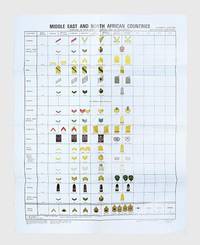
1982178862Washington DC: Defense Intelligence Agency January 1982. A poster comparing the enlisted ranks of US army to that of 17 Middle Eastern countries from basic private through to W-4 chief warrant officer. They were never distributed to the public and were marked to be destroyed after they became outdated. This was as part of a series featuring various militaries from around the world; other examples include the NATO countries and the Asian and Pacific countries. It covers Algeria The Arab Republic of Egypt Iran Iraq Israel Jordan Kuwait Lebanon The Libyan Arab Republic Morocco Oman Saudi Arabia South Yemen People's Democratic Republic of Yemen Sudan Syria Tunisia and the Yemen Arab Republic. Colour poster 555 x 430 mm folded as issued. Bright a few small creases two small pinholes: a very good example. unknown
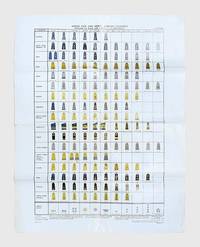
1979178863Washington DC: Defense Intelligence Agency January 1979. A poster comparing the officer ranks of the US air force to that of 17 Middle Eastern countries from 2nd lieutenant through to general of the air force. They were never distributed to the public and were marked to be destroyed after they became outdated. This was issued as part of a series featuring various militaries from around the world; other examples include the NATO countries and the Asian and Pacific countries. It covers Algeria The Arab Republic of Egypt Iran Iraq Israel Jordan Kuwait Lebanon The Libyan Arab Republic Morocco Oman Saudi Arabia South Yemen People's Democratic Republic of Yemen Sudan Syria Tunisia and the Yemen Arab Republic. This is marked as chart 3 of 3 the other two possibly showing the comparative officer ranks of the army and navy. Colour poster 555 x 430 mm folded as issued. Bright a few small creases split along fold not touching printed area a few pinholes: a very good example. unknown
185714402Édition originale. Paris, Michel Lévy frères - 1857 - 294 pages.Reliure demi chagrin vert de l'époque. Dos à 4 nerfs orné et doré. Signet. Pales rousseurs sur la page de titre uniquement. Très bon état. Format in-12°(18x12).
179222647(Wien, Schrämbl, 1792). XVI S., 352 S.; 1 Bl., 374 S. 12 (davon 2 mehrfach gefalt.) Kupfertafeln. Kl.-8°. HLdr. der Zeit mit goldgeprägtem Rückenschild (etw. berieben und bestoßen). [5 Warenabbildungen]
1st Edition. Period Boards with Original Paper Wrappers bound inside. 12mo. 60 pages; 18 cm. In French. Antisemitic French title featuring a blood libel accusation which helped stoke Antisemitic feelings in France leading up to the Dreyfus Affair. Title Translates into English as, Killed by the Jews: April 1890: History of a Ritual Murder. Henri Desportes was a Catholic priest and French essayist His book, Killed by the Jews: April 1890: History of a Ritual Murder is based on a crime that took place in Algeria, which revived blood libel against Jews. (Wikipedia, 2016) Includes a 6 page preface by the notable Anti-Semite Édouard Drumont. (Drumont) founded the Antisemitic League of France in 1889, and was the founder and editor of the newspaper La Libre Parole. After spending years of research, he synthesized three major strands of antisemitism. The first strand was traditional Catholic attitudes toward the Christ killers augmented by vehement antipathy toward the French Revolution. The second strand was hostility to capitalism, of the sort promoted by the Socialist movement. The third strand was scientific racism, based on the argument that races have fixed characteristics, and the Jews have highly negative characteristics. (Wikipedia, 2016) SUBJECT(S) : Blood accusation -- Syria -- Damascus. OCLC lists 9 copies worldwide. Ex-library with usual markings. Water damage throughout. Tear to Original Paper Wrapper with one letter effected. Good- condition. (FR-2-11)