(Russia) Catherine the GreatBiblio.com

17 864 résultats
177536879Moscow: Meisto Pechati first piece 1775. 2; 6 2 blank. 1 vols. Folio. The two pieces loosely stitched together. Some stains not affecting legibility stitchmarks light soiling else very good. 2; 6 2 blank. 1 vols. Folio. Decrees relating to the military issued by Catherine II. These were issued the year following the end of the Russo-Turkish wars and the treaty of Kuchuk Kainarji signed the 21st July 1774 and after the Cossack rebellion lead by Ymelyan Pugachev who claimed to be Peter III and who was finally captured and executed at Moscow the 11th of January 1775. As a result of the wars and the rebellion in 1775 Catherine seriously reformed the provincial and urban administrations giving greater control to the central government. The first decree lists eight numbered points perhaps officers for promotion or commendation it has the Royal titles as a caption title and commences citing the decree of 3 August 1744. The second piece bears no caption title or heading but lists 47 separately numbered points each a short paragraph imprint on final leaf of text. Meisto Pechati [first piece] unknown
1965011354Moscow Russia: Progress Publishers 1965. 3 Volume Set Translated from the third German edition by Samuel Moore and Edward Aveling and edited by Frederick Engels. First English edition published in Moscow. Vol. 1- 1st ed 1st pt- 1965- Very Good book square tight no marks 807 pages in Near Fine jacket. Vol. 2 - 1st ed 4th pt- 1967- Fine book square tight no marks 551 pages in very good white jacket with smalltears/chips. Vol. 3- 1st ed 3rd pt- 1966- Fine book square tight no marks 948 pages in Very Good clean near fine white jacket. All books have previous owner name on ffep. Cloth. Very Good/Very Good. 8vo - over 7¾" - 9¾" tall. Progress Publishers Hardcover
57309Second half of the 18th C. 12-1/2 x 17 inches. Bordered in green paper. Light rubbing and creasing some browning around the edges else Very Good. 12-1/2 x 17 inches. unknown books
177536879Moscow: Meisto Pechati first piece 1775. 2; 6 2 blank. 1 vols. Folio. The two pieces loosely stitched together. Some stains not affecting legibility stitchmarks light soiling else very good. 2; 6 2 blank. 1 vols. Folio. Decrees relating to the military issued by Catherine II. These were issued the year following the end of the Russo-Turkish wars and the treaty of Kuchuk Kainarji signed the 21st July 1774 and after the Cossack rebellion lead by Ymelyan Pugachev who claimed to be Peter III and who was finally captured and executed at Moscow the 11th of January 1775. As a result of the wars and the rebellion in 1775 Catherine seriously reformed the provincial and urban administrations giving greater control to the central government. The first decree lists eight numbered points perhaps officers for promotion or commendation it has the Royal titles as a caption title and commences citing the decree of 3 August 1744. The second piece bears no caption title or heading but lists 47 separately numbered points each a short paragraph imprint on final leaf of text. Meisto Pechati [first piece] unknown books
1866030652London: Chapman And Hall 1866. 1st Edition . Hardcover. Fine. Vi 298 Pp. Modern Blue Cloth Gilt Stamped Black Leather Spine Label. The Modern Binding Is Fine Contents Just Very Good With Wear At Corners And Slight Even Foxing To Title Page. Scarce. Morley Reports That The Observations Were Provided By A Friend Who Brought Them From A Doctor Long Resident In Russia. The Quality And Immediacy Of The Observations Are Remarkable. <br/> <br/> Chapman And Hall hardcover
8vo., First Edition, with portrait frontispiece, 14 plates on 11 and 3 folding maps (2 coloured); handsomely bound in full navy crushed morocco, sides with gilt frame border, back with raised bands, second and fourth compartments lettered and ruled in gilt, all other compartments tooled in gilt, gilt top, hand-made endpapers, ribbon marker, custom-made-slip-case, an elegant copy ideal as a gift or for presentation. [SLIP-CASE NOT SHOWN IN IMAGE.] A classic of its time, recalling Maclean's Buchan-like experiences before and during WWII. Includes coverage of the Moscow State Trials, operating with LRDG in the Western Desert, kidnapping a general and being dropped in occupied Europe as Churchill's personal envoy to Tito. Enser, p.481
175016523A large engraved cont. handcoloured map of the Northern part of Russia from Novaja Semlja in the north to the Caspian Meer in the South from Finland to Jakusskkáy measuring 485 x 62 cm. Folded in center. A few tears in margins. <br/><br/><em>This large map is from Vaugondy: Atlas universel Paris 1757. </em> unknown
175016523A large engraved cont. handcoloured map of the Northern part of Russia from Novaja Semlja in the north to the Caspian Meer in the South, from Finland to Jakusskkáy, measuring 48,5 x 62 cm. Folded in center. A few tears in margins.
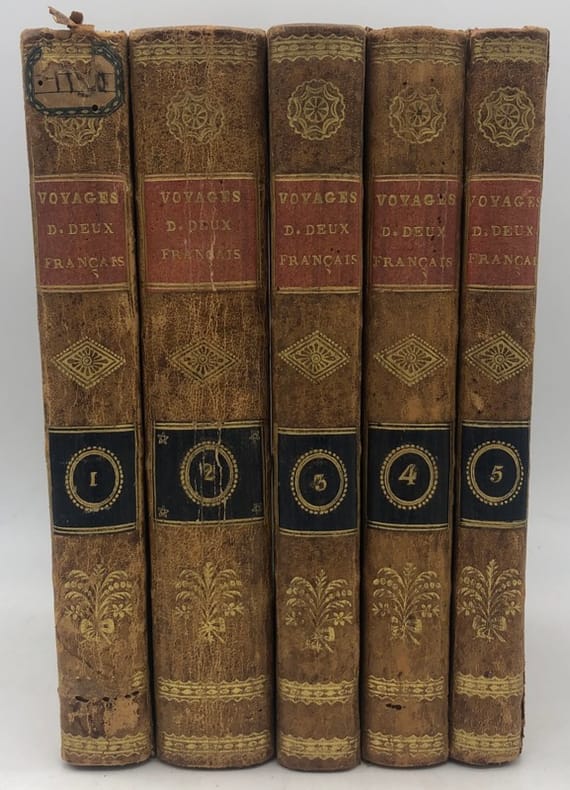
663833A Paris, Chez Desenne, 1796 5 vol. in-8, [4]-VIII-391, VIII-556, VIII-372, [4]-400 et [4]-299 pp., avec 6 tableaux dépliants, basane fauve marbrée, dos lisse orné de fleurons et de filets dorés, tranches mouchetées jaunes (reliure de l'époque). Petits trous de vers au dos de certains tomes, mors du tome V fendus. Qqs épidermures sur les plats. Rousseurs.
238091A Paris, Chez Desenne, 1796 5 vol. in-8, [4]-VIII-391, VIII-556, VIII-372, [4]-400 et [4]-299 pp., avec 6 tableaux dépliants, demi-basane brune à coins, dos lisse, filets dorés (reliure de l'époque). Accroc à la coiffe supérieure du tome 1.
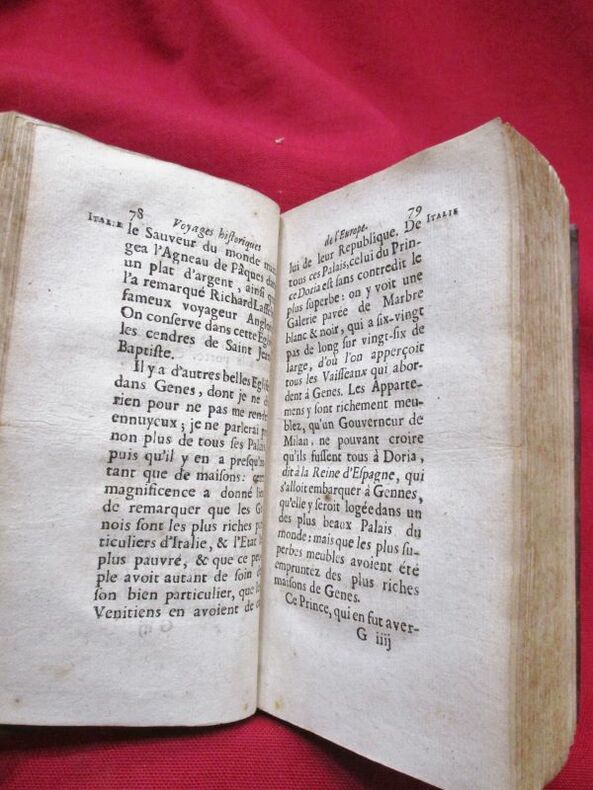
111832A Paris, Chez Nicolas Le Gras, 1706 (I, IV, VI, VII) - 1701 (II, III, V) -1700 (VIII), 8 volumes in-12 de 90 x 160 mm environ, 292-268-349-426-316-367-234-341 pages. Ensemble comportant 27 cartes et 5 vues contrecollées. Pleines reliures mouchetées d'époque, dos à 5 nerfs portant tomaisons dorées et titres dorés sur pièce de cuir tabac, caissons ornés, roulettes dorées sur les coupes, tranches mouchetées. Reliures solides mais avec des défauts (7 coiffes manquantes, travail de vers par endroits, coins émoussés, quelques manques de cuir), des rousseurs, des pages brunies et des traces de mouillures, il manque 1 feuillet au tome VIII (p.223-224, sans manque de texte : feuillet vierge ? faux-titre ?), ensemble néanmoins très correct.
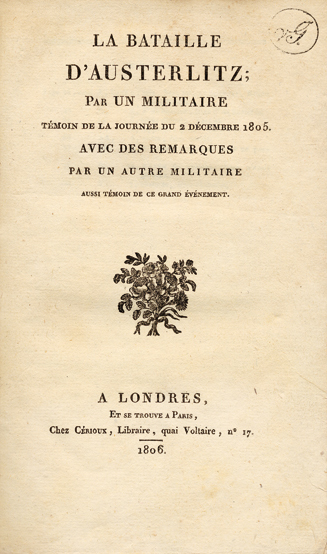
180615664Londres et Paris, Cérioux, 1806 ; in-8 ; demi-veau glacé marron clair à petits coins, dos à faux-nerfs décoratifs dorés, fleurons-soleils dorés, pièce de titre rouge (reliure de l'époque) ; 123 pp., (1 bl.), (1) f. d'errata.
224622Vienne, Alfred Hölder, 1896 2 vol. in-8, XII pp., 608 pp. ; V pp., 313 pp., avec un tirage photographique contrecollé sur papier fort sous serpente en guise de frontispice, brochés.
231037Paris, Dumont, 1834 in-8, [2] ff. n. ch., 303 pp., demi-basane havane, dos lisse orné de filets et guirlandes dorés, tranches marbrées (reliure un peu postérieure). Coins abîmés, rousseurs, mouillures claires en début de volume.
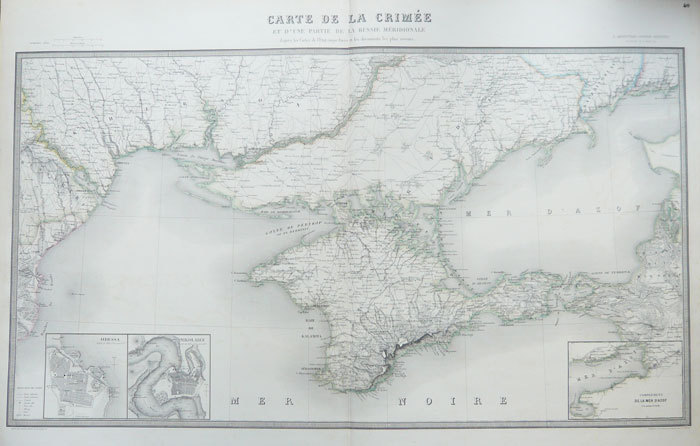
1856LBW-1084Paris, J. Andriveau-Goujon, 1856. 579 x 955 mm.
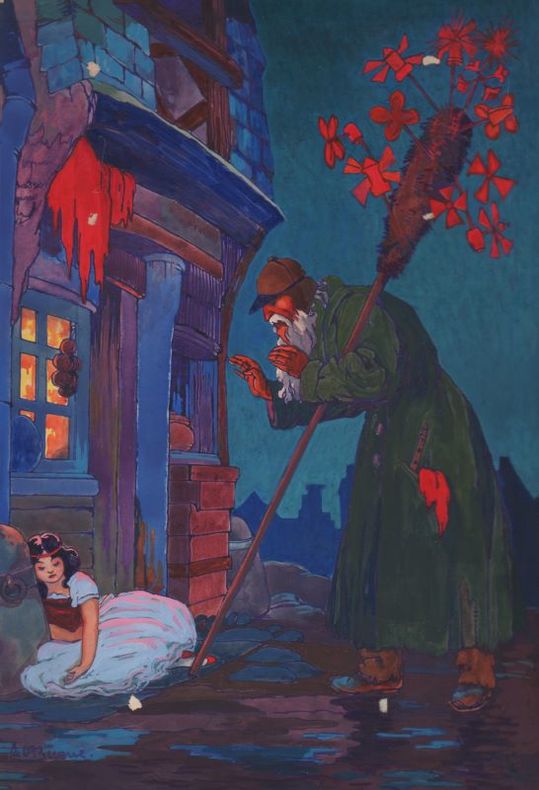
1920222981920 Gouache sur papier fort signée en bas à gauche, (1920), 39 x 26.7 cm ( format à vue), 48 x 31.4 cm (format de la feuille).
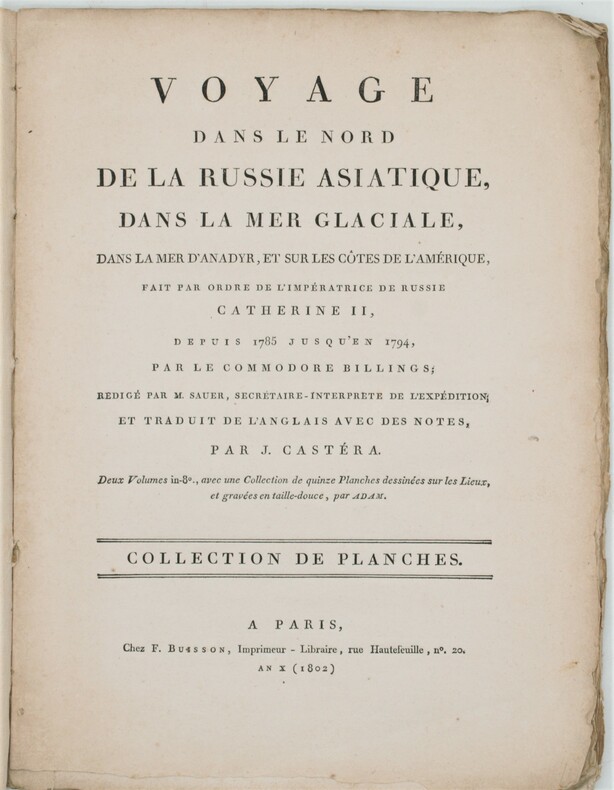
1802PHO-1231Paris, F. Buisson, et Giguen, an X – 1802. In-4, broché ,titre sur le plat Atlas seul contenant 14 planches gravées (vues, costumes) et une carte dépliante du détroit qui sépare l'Asie de l'Amérique. Bon exemplaire.
1369968Saint Pétersbourg: Ministère des voies de communication; Société d'impression artistique, 1900 in-4, [4]-572 pages, 2 portrait des Tsars Nicolas et Alexandre III, 363 photo-typogravures, 4 cartes (carte de la Russie, carte du chemin de fer Samara-Zlatooust, Chelabinsk-Baïkal, Baïkal-Vladivostok) et 3 plans de villes (Irkoutsk, Tomsk, Vladivostok) + 1 f. Publicité de la Fabrique de parfumerie de Frédéric Plus à Varsovie. Demi maroquin lie de vin, légère épidermure en tête, dos à nerfs, monogramme et année dorés en queue, tête dorée, 1ère couv. conservée, coins un peu emoussés, sinon, très bel exemplaire. Envoi de Dmitrief-Mamonof.
222362Paris, Dupont, 1833 2 vol. in-8, [4]-420 pp., 1 f. d'errata et 436, 1 f. d'errata, gravures en frontispice, demi-veau havane, dos lisse orné (reliure de l'époque). Mors frottés. Rousseurs, très prononcées aux pages de titre, tache brune marginale à la fin du tome 1.
231437Paris, Librairie-imprimerie des Halles et de la Bourse de commerce, s.d. (1894) 4 vol. in-4, demi-chagrin cerise, dos à nerfs fleuronnés, tranches mouchetées (reliure de l'époque). Étiquette et trace d'étiquette au dos, petits frottements.
191601Paris, Perrotin, 1857 in-8, XVI-428-[2] pp., avec une carte dépl., demi-chagrin violine, dos lisse, filets dorés et à froid (reliure de l'époque). Rousseurs, plus particulièrement en début d'ouvrage. Dos passé.
25176Paris Au Sans Pareil 1926 in 8 (19,5x14,5) 1 volume broché, couverture imprimée rempliée, 42 pages [1], illustré de 6 eaux-fortes hors-texte gravées par Nathalie Gontcharova, dos et plat supérieur de la couverture légérement insolés. Edition originale. Tirage limité, celui-ci un 120 exemplaires numérotés sur papier de Hollande Van Gelder, accompagné d'une suite sur papier japon impérial des 6 eaux-fortes hors-texte. Nathalie Gontcharova, peintre sculpteur et décorateur, Ladhyzhino 1881-1962, école russe. Bel exemplaire ( Photographies sur demande / We can send pictures of this book on simple request )
1st edition of authors second book. Period boards with original modernist wrappers mounted front and back. 12mo, 62 pages; 22 cm. In Yiddish. Title translates as Hard Reality. Beautiful modernist typographical title and author on front cover, signed by artist in the print (illegible). Moyshe Khashtshevatski (1897 - 1943) was born in Buky, near Uman, Ukraine. He father was a teacher in the local Talmud-Torah. He studied in religious elementary school and in a Talmud-Torah, and in 1916 he graduated from the commercial school in Uman. In the last years of WWI and the first years of the Russian Revolution, he was studying at the Universities of Petrograd and Ekaterinburg. In 1918 (April 6) he debuted in print with a poem, entitled Friling kumt (Spring comes), in Di naye tsayt (The new times) in Kievusing the pen name M. Mishal. In 1921 he moved to Kiev, where he forged a strong bond with the local Yiddish writers (Dobrushin, Hofshteyn, Dis Nister, and others), and from that point he enhanced ever more his reputation as a creator and builder of Soviet Yiddish literature. In the Soviet Yiddish periodicals of Kiev, Kharkov, Minsk, and Moscow, he published poetry and ballads. He also translated from the Russian and Ukrainian classics, as well as from other languages. From 1923 over the course of three years, he contributed intensively to Emes (Truth) in Moscow, and he actively took part in the Soviet community and political life. His first works were in the symbolist vein, although he would later switch to a more realistic depiction of life and address the major issues of the time. He brought new motifs and imagery into Soviet Yiddish poetry. His range of interest was extremely broad. His books include: Dorsht (Thirst), poems (Kiev, 1922), 31 pp.; Harte vor (Hard reality) (Moscow, 1924), 62 pp.; and 38 other titles. Shortly after the outbreak of the Nazi-Soviet war in 1941, he was evacuated to Samarkand, Uzbekistan, and there he learned of the death at the front of his only son. He proceeded to volunteer for mobilization into the Red Army, despite the fact that he was forty-six years of age. He contributed in the harshest of battles in that period of the fighting and died in battle. Moyshe Khashtshevatski is, it seems to me, wrote Shmuel Niger, [was] the most candid among all Yiddish poets in Ukraine. His lyric poetry was born with an old, broken, wrinkled, quietly suffering soul; unabashed, he says that it is old, broken, wrinkled, and suffering in silence. He makes no pretense and no heroic or demagogic poses. It does not shake the earth and demonstrates no valor against the empty, blue skies. (Borekh Tshubinski in Yiddish Leksikon, 2017). For more on Khashtshevatski, see M. Litvakov, In umru (Disquiet), vol. 2 (Moscow, 1926), M. Litvakov, In umru (Disquiet), vol. 2 (Moscow, 1926), pp. 189-219; D. Tsharni (Daniel Charney), in Literarishe bleter (Warsaw) (January 21, 1927); A. R. Tsvayg, in Shtern (Minsk) (December 1930); Y. Daytsh, in Literarishe tribune (Lodz) 10 (1931); Y. Bronshteyn, in Tsaytshrift (Minsk) 5 (1931); Y. Dobrushin, In iberboy, literarish-kritishe artiklen (Under reconstruction, literary-critical articles) (Moscow, 1932), pp. 88-101; N. Oyslender and Y. Dobrushin, in Eynikeyt (Moscow) (October 5, 1944); A. Kushnirov, in Naye prese (Paris) (July 27, 1945); F. Sito, in Eynikeyt (New York) (March 1945); Y. Serebryani, in Eynikeyt (Moscow) (October 11, 1945); N. Mayzil, in Yidishe kultur (New York) (May 1957); Mayzil, Dos yidishe shafn un der yidisher shrayber in sovetnfarband (Jewish creation and the Yiddish writer in the Soviet Union) (New York, 1959), see index; A. Finkel, in Folks-shtime (Warsaw) (June 8, 1957); M. Shklyar, in Folks-shtime (November 7, 1957); Shmuel Niger, Yidishe shrayber in sovet-rusland (Yiddish writers in Soviet Russia) (New York, 1958), pp. 56, 61, 411-20; Leksikon fun yidish-shraybers (Biographical dictionary of Yiddish writers) (New York, 1986), col. 316; Leksikon fun yidishe shrayber in ratn-farband (Biographical dictionary of Yiddish writers in the Soviet Union), ed. Boris Sandler and Gennady Estraikh (New York: Congress for Jewish Culture, Inc., 2011), pp. 189-90.] Interestingly, the book, obviously published in the Soviet Union, is overstamped faintly (in English), Printed in Poland on the cover, probably an attempt to get past postal inspectors and to make import into North America easier. 1 of 1100 copies printed. SUBJECT(S): Yiddish poetry. OCLC: 51754692. OCLC lists 8 copies worldwide. Spine label removed, unobtrusive number on spine. Jewish library stamps on blank endpapers, title page and margins of 2 text pages. Number penned in upper margin of blank endpapers as well. Toning to covers and pages. Otherwise Good Condition. Dramatic modernist 1st edition of important Soviet Yiddish writers second book. YID-36-6 -LOE-xcc).
208507Paris, Benjamin Duprat, Saint-Pétersbourg, A. Cluzel, 1857 in-8, XXIII-343 pp., avec un portrait-frontispice ajouté, légendé en russe et contrecollé sur un feuillet inséré avant le faux-titre (Alexandre Ier), demi-maroquin marine à long grain, dos à nerfs, monogramme P D couronné en pied (reliure de l'époque). Rousseurs et mouillures. Coiffe supérieure frottée.
217112À Paris, Chez Treuttel & Würtz, 1824 in-8, VIII-440 pp., portrait-frontispice, demi-veau caramel, dos lisse orné de filets dorés (reliure de l'époque). Début de fente aux mors. Qqs rousseurs.