[RUSSIA]. [SLAVONIC LITURGY].Biblio.com
17 662 résultats
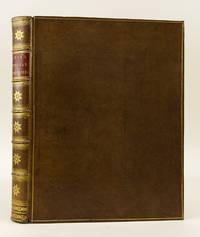
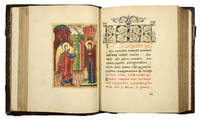
94903Russia 1866. . 4to 23 x 185 cm. Illuminated manuscript on paper ff. 4 index 4 blank 344 17 lines per page alphabetic signatures and pagination of Cyrillic alphabetic numerals 35 full-page illuminations in watercolour 36 headpieces in black and gold with first lines in gilt; occasional light spotting and soiling mostly marginal. Contemporary gilt-stamped red morocco gilt spine with raised bands edges gilt and gauffered gilt endpapers; slightly rubbed lacking both clasps.<br /> An exceptionally fine example of an Old Believer liturgical book beautifully illustrated with 35 full-page illuminations.<br /><br />Created by a skilful master they depict in great detail the most significant events of the New Testament including the Annunciation the Nativity the Baptism of Christ the Ascension the Twelve Apostles and more.<br /><br />This volume was made for and used by Old Believers who separated from the official Russian Orthodox Church as a protest against church reforms introduced by Patriarch Nikon of Moscow between 1652 and 1666. These Old Believers refused to accept alterations and amendments to the Holy texts aimed at bringing their religious practice closer to the 'original' Greek Orthodoxy. They refused to allow sacred texts to be printed instead reproducing them as manuscripts. <br /><br />The large size of this book its high-quality paper neat script very detailed illuminations and attractive gilt binding prove beyond doubt that no expense was spared on its production. As the colophon indicates it was made for Evdokiia Ivanovna Babaeva the wife of a merchant in Kolomna which was then an important trade point near Moscow. There are records of several men with this surname in Kolomna during the mid-XIX century all of them owners of factories in the city and probably members of the same wealthy merchant family. Kolomna was also important as a centre of the Old Believer community. The city's Bishop Paul fiercely opposed Patriarch Nikon's reforms and was consequently stripped of the rank of Bishop exiled and eventually killed in 1656 rendering him a martyr in the view of many Old Believers.A century later 156 Old Believers were officially registered in Kolomna then a city of 5400 inhabitants. Many more practised their beliefs in secret to avoid persecution.<br /><br />This volume later belonged to Cornelius J. Hauck 1893-1967 whose outstanding and somewhat eclectic collection was formed with the help of the well-respected antiquarian bookseller Emil Offenbacher between 1945 and 1965. The collection was given to the Cincinnati Historical Society Library in 1966 where it remained largely unknown to the world until part of it was auctioned by Christie's in New York in 2006.<br /><br />Russian manuscripts of this quality and preserved in such pristine condition are extremely rare.<br /> S.S. Mikhailov Istoriya staroobriadchestva g. Kolomna i ego okrestnostey Kolomna Staroobriadcheskaya obshchina khrama Nikoly na Posade v g. Kolomna 2013. Russia, [1866]. hardcover
In-4° oblungo, occhietto inciso, titolo a stampa, legatura in pergamena, nervi al dorso, 1 carta di spiegazioni, 60 tavole (di cui 9 ripiegate), titolo inciso (Navigli del Giappone), 12 tavole, titolo inciso (Barche di Venezia), 2 carte di spiegazioni, 11 tavole (di cui 2 ripiegate). In totale 83 tavole di navi (di cui 11 ripiegate). Edizione originale estremamente rara. L’unico esemplare conosciuto nelle biblioteche pubbliche è quello della Marciana a Venezia. L’altro esemplare citato da Armao (Correr) non esiste più in questa biblioteca. Quello della Marciana ha solo 74 tavole. Armao, pp 171-72 conta 86 tavole (oltre al testo e il titolo). Crediamo che si tratti d’un errore: anche il numero di tavole ripiegate dato da Armao è inferiore a quello dell’esemplare in questione. Presente qualche piccolo restauro a due o tre tavole, altrimenti esemplare fresco proveniente dal Dipartimento Idrografico di Russia, di cui porta il timbro al verso del titolo: si ricorderà come quest’opera venne composta dal Coronelli per la Nazione Moscovitica, come è indicato nel titolo, v. Armao p.171.: “Vivissimo era a Venezia l’interesse per la costruzione di navi e quando il Governo veneto affidò al suo cosmografo e lettore di geografia l’istruzione di un gruppo di ‘cavalieri moscoviti’ inviati a venezia da Pietro il Grande nel 1697, Coronelli curò il disegno di tutta una serie di navigli che fece poi incidere su rame”. V. “Il P. Vincenzo Coronelli nel III centenario della nascita” p. 357 n.41, che dà la seguente collazione: tav. 71+15 e pp 2+4 In-4 ° oblong, engraved half title, printed title, vellum binding, bands on spine, 1 explanation leaf, 60 plates (9 of which folded), engraved title (Navigli of Japan), 12 plates, engraved title (Boats of Venice), 2 explanatory leaves, 11 plates (2 of which folded). In total 83 plates of ships (11 of which folded). Extremely rare original edition. The only copy known in public libraries is that of the Marciana in Venice. The other copy cited by Armao (Correr) no longer exists in this library. The Marciana one has only 74 plates. Armao, pp 171-72 has 86 plates (in addition to the text and title). We believe this is an error: even the number of folded tables given by Armao is less than that of the specimen in question. There are some small restoration with two or three plates, otherwise a fresh copy from the Hydrographic Department of Russia, whose stamp is on the back of the title: this work was composed by Coronelli for the “Nazione Moscovitica”, as indicated in the title , v. Armao p.171 .: “The interest in the construction of ships was very high in Venice and when the Venetian government entitled its cosmographer and geographer to the instruction of a group of 'Muscovite knights' sent to Venice by Pietro the Great in 1697, Coronelli oversaw the design of a whole series of ships that he then engraved on copper ". V. "Father Vincenzo Coronelli on the third centenary of his birth" p. 357 n.41, which gives the following collation: tav. 71 + 15 and pp 2 + 4
1815120459London: Printed for Edward Orme 1815. Magnificent hand-coloured views of St Petersburg First edition "one of the most beautiful plate books of St Petersburg" Bobins Collection offering a wonderfully evocative picture of the city in the wake of the Napoleonic Wars issued during the lifetime of one of its most famous inhabitants Alexander Pushkin. Published at 6 guineas coloured this is a superb record of the city of Peter the Great and is divided into two sections: the first 12 plates represent the months of the year through characteristic views of the city; the other 8 illustrate different modes of transport various types of sledges and carriages but include excellent character studies showing diverse types of costume by class and by season. The 26-page introduction entitled "The present state of St Petersburgh" includes a brief historical survey and a few statistics along with descriptions of the main sites and monuments. "Though unsigned the letterpress was chiefly compiled from Robert Ker Porter's Travelling Sketches in Russia and Sweden during the years 1805-1808 as many sections repeat his text verbatim" Giroud p.72. Mornay the artist responsible for the original sketches upon which Clark and Dubourg's aquatints were based eludes identification and does not appear in Thieme-Becker. Martin Hardie in characteristically waspish fashion describes the plates as "lurid in colouring very much in the style of toy theatre scenery" English Coloured Books 1906 p. 138; this is entirely unfair the colouring in the present copy is certainly not "lurid" and the "toy theatre" quality of the views only lends them a most appealing charm: many of them are composed in such a way that they resemble vues d'optiques - symmetrical and theatrical middle-distance perspectives - which combine well with the small scaling figures staffage adding splashes of bright colour against backgrounds of snowy streets grey skies and yellowish-brown buildings of this "city of stone" forming a satisfyingly picturesque effect. Two of the buildings shown - the Exchange 1809 and the Kazan Cathedral 1811 - had only recently been completed. Edward Orme - "Publisher to His Majesty and HRH the Prince Regent" - was "after Rudolph Ackermann the most important publisher of illustrated books during the short golden age of the coloured aquatint" ODNB. He would have had a prudent eye on the visit of the Allied sovereigns to London in June 1814 which celebrated the Treaty of Fontainebleau 11 April 1814 and the peace following the defeat and abdication of Napoleon. Among them was Tsar Alexander I who stayed with his sister the Grand Duchess of Oldenburg at the Pulteney Hotel on Piccadilly. "In 1809 Edward Orme had begun buying land and property in Bayswater London. He exploited the gravel deposits built houses and in 1818 added a chapel of ease. Orme Square developed between 1823 and 1826 was named after him and Moscow Road and St Petersburgh Place nearby may have commemorated the state visit of Tsar Alexander I in June 1814. In the following year he published a volume of twenty coloured aquatint views of St Petersburg and the reference in his will to jewellery presented to him by the emperor of Russia may be connected with these events" ibid. This is a marvellous survey of one of the world's great cities captured at the time when it served as the backdrop for Tolstoy's War and Peace. Folio 469 x 310 mm. Additional engraved title page incorporating a large double-headed Russian eagle 20 hand-coloured aquatint plates by Clark & Dubourg after Mornay; watermarks: plates J. Whatman 1825 text W. Balston 1813. Late 19th-century dark brown morocco-grain half skiver professionally refurbished marbled sides gilt edges drab grey endpapers. From the library of noted bibliophiles Maxine and Joel Spitz with their "Trail Tree" bookplate Joel Spitz was a member of Chicago's prestigious Caxton Club. Light offsetting from frontispiece to engraved title. An excellent copy the plates fresh and bright and with the four leaves of explanation of the plates in French and English. Abbey Travel 226; Bobins Collection 203; Tooley 355; Vincent Giroud St. Petersburg: A Portrait of a Great City Yale University Press 2003. unknown
110232. <br/><br/><em>An account of Jean Francois Gamba 1763-1833 French Consul at Tiflis describing his journey along the Black Sea littoral and into the Caucaus. Provenance: Gösta Nobel 1886-1955. Gösta Nobel was the youngest son of Ludvig and Edla Nobel. He took over as Branobel`s Managing Director at the time of the Russian Revolution and had to flee Russia in 1918. Branobel or The Nobel Brothers Petroleum Company was founded by Robert and Ludvig Nobel in Baku in 1876. </em> unknown
1803ST15927London: Cadell and Davies 1803. ONE OF 60 LARGE PAPER COPIES of the "considerably enlarged" Fourth Edition ours a variant retaining the date of 1803 on the title-page rather than 1804. 330 x 252 mm. 13 x 9 7/8". xviii 4 xix 1 380 pp. Two leaves usually bound at the end and containing the "List of Principle Books Referred to in this Work" and "Works by the same Author" bound between pp. xvii and xix here. <br/> VERY FINE CONTEMPORARY SPRINKLED CALF raised bands flanked by plain and decorative gilt rules and chain roll spine panels with star centerpiece red morocco label marbled endpapers. With six engravings: five maps two folding and one view. A Large Paper Copy. Front pastedown with engraved armorial bookplate of Marcus Gage; title page with ink inscription at head: "M. Gage's Book got from Mr. Asperne London April 15th 1805." Lada-Mocarski 29 note; Howes C-834; Sabin 17309; Streeter VI 3501; Cordier Bibliotheca Sinica pp. 2447-48. ◆Small chip to tail of spine corners a bit rubbed flyleaves somewhat foxed the usual minor foxing to plates and a bit of offsetting to adjacent pages otherwise A VERY FINE COPY OF AN ESPECIALLY DESIRABLE EDITION clean and fresh internally with vast margins and the binding firm lustrous and with only very minor wear to the joints.<br/> <br/> This is an extremely well-preserved copy in an elegant contemporary binding of the most sought-after edition of a key source on Russian exploration and that country's efforts to expand trade with China and Alaska. Eminent historian William Coxe 1747-1828 studied the voyages and exploration by Bering and others to the regions of Kamchatka the Aleutian Islands and Siberia to prepare this overview of the geography and cultures of the lands between Russia and North America and to analyze the economic potential of trade--particularly in furs--with the region. According to Sabin "Mr. Coxe's book contains many curious and important facts with respect to the various attempts of the Russians to open a communication to the New World." The 1780 first edition of this work covered Russian voyages of discovery between 1740 and 1769; the 1787 third edition added a supplement comparing these explorations to those of Captains Cook and Clerke. Our much-expanded fourth edition gives in the words of the Preface "a complete series of voyages from 1711 to 1792 comprising all that is known on the subject." Some of this supplementary information was gleaned from earlier accounts by German historians G. F. Muller and P. S. Pallas and some from Coxe's own travels in Russia. According to Lada-Mocarski Coxe "also succeeded in securing additional material: for instance the narrative and maps of Krenitzin and Levashev's 'secret' expedition the first official Russian government expedition since Bering's 2nd expedition of 1741. He was able to secure this particular information not widely known at the time even in Russia from Dr. Wm. Robertson who in turn obtained it through his friend Dr. Rogerson first physician to the Empress Catherine II. . . . In view of the above additions one should consider the fourth edition of 1803 as the most desirable." He concludes: "Coxe's work particularly the fourth edition is a result of contemporary and authoritative sources translated into English not to be overlooked by scholars and collectors alike." There are also distinct aesthetic advantages to the present Large Paper version over the octavo printing. Not only is the type beautifully re-set and laid out as well as surrounded by vast margins but as Streeter notes there are two charts here that are not included in the octavo issue of 1803. The original owner of this volume Marcus Gage is known to have assembled a substantial library of beautifully cared-for books on travel and discovery see for example "Exploration & Discovery 1576-1939 Books from the Library of Franklin Brooke-Hitching" passim. Gage notes that he got the book from "Mr. Asperne"—no doubt the London publisher and bookseller James Asperne 1757-1820. ABPC and RBH find just four other Large Paper copies at auction in the past 45 years two of which had condition issues. One could wait a considerable time to find a copy as attractive and desirable as the present one. Cadell and Davies unknown
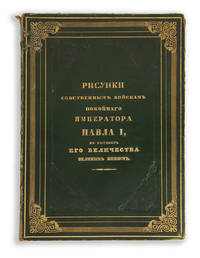
109898St. Petersburg Lithographic Department of the Military Settlement 1835. . First edition small folio 31 x 22 cm; lithographic title and 10 unnumbered coloured by contemporary hand title soiled at foot where mark of ownership erased bottom corners of leaves with very light staining pl. 7 with printed Russian caption and early manuscript German translation; contemporary green Russian morocco upper cover lettered in gilt both covers with elaborate panelling in gilt and blind flat spine in gilt panels gilt turn-ins blue endpapers gilt edges extremities rubbed tiny split in joint at head of spine a fine copy.<br /> Remarkably fine series of hand-coloured prints of military costumes after Paul I in an exceptional contemporary Russian binding. The book was printed at the personal bequest of his son Tsar Nicholas I in an incredibly small edition. The short reign of Paul I ended with his murder in 1801 and was marked by his obsession with dress uniforms. All ten of the figures in this rare suite are drawn in the same posture at attention with arms firmly clasped to sides and though this gives them a slightly doll-like quality they are painstakingly and beautifully coloured by a contemporary hand. Nicholas I viewed his father with deep reverence and also admired the pomp and order of the Imperial army this publication was an attempt to honour his father's legacy.<br /> [St. Petersburg], Lithographic Department of the Military Settlement, 1835. unknown
2 parti in 2 volumi. In-folio. [8] ll. comprensivi di titolo e occhietto, 69 pagine e 180 tavole incise di cui due frontespizi, testo in italiano e francese su pagine contrapposte; qualche macchia marginale su più piatti. Tavole marmorizzate originali, bordi rossi. Rilegato su carta di una rivista italiana contemporanea. Bella copia. PRIMA EDIZIONE DELLA PIÙ COMPLETA COLLEZIONE DI PROGETTI ARCHITETTONICI RUSCA PER ST. PIETROBURGO. Interessante opera dedicata allo Zar Alessandro I che svela il magnifico programma architettonico russo pochi anni prima dell'invasione di Napoleone. Luigi Rusca (1758-1822), allievo di Giacomo Quarenghi, lavorò a lungo al Palazzo Imperiale Russo all'inizio del XIX secolo. Era noto per il suo stile neoclassico e per la sua abilità nel gestire la costruzione e l'organizzazione di grandi opere pubbliche. Rusca era un grande favorito a corte e questi volumi sono dedicati allo Zar Alessandro I. Il testo fornisce interessanti note tecniche su tutti gli aspetti della costruzione come il tipo di materiale. 2 parts in 2 volumes. In-folio . [8] ll. including title and half-titles, 69 pp. and 180 engraved plates including two frontispieces, text in Italian and French on opposite pages; some marginal spotting on several plates. Original marbled boards, red edges. Bound in a leaf of a contemporary Italian review. Fine copy. FIRST EDITION OF THE MOST COMPREHENSIVE COLLECTION OF RUSCA'S ARCHITECTURAL PROJECTS FOR ST. PETERSBURG. An interesting work dedicated to Csar Alexander I which reveals the magnificent Russian architectural program a few years before the invasion of Napoleon.Luigi Rusca (1758-1822), a pupil of Giacomo Quarenghi, worked extensively at the Russian Imperial Palace at the beginning of the nineteenth century. He was well known for his neo-classical style and his skill in handling the construction and organisation of large public commissions. Rusca was a great favourite at court and these volumes are dedicated to the Csar Alexander Ist. The text supplies interesting technical notes on all aspects of building such as the type of material.
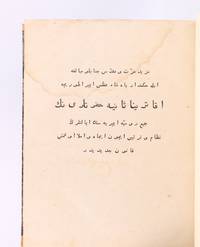
178089640Saint Petersburg: Sans nom d'éditeur 1780. Fine. Sans nom d'éditeur Saint Petersburg 1780 20.8 x 27 cm Relié Very rare first edition of the new laws enacted in 1775 by Catherine II Empress of Russia here translated into Turkish for the recently annexed Turkic-speaking provinces taken from the Ottoman Empire.The work is divided into two parts: the first dated 12 November 1775 comprises the first 28 chapters pp. 1190; the second contains chapters 29 to 31 pp. 191248.Contemporary-style half mottled sheep with small corners unlettered spine with five raised bands decorated with double gilt fillets and gilt thistle tools marbled paper boards red edges modern binding.Pale marginal dampstaining to the upper right corner of the initial leaves. Sans nom d'éditeur hardcover
17568737Paris Didot 1756 3 10x17 maroquin Trois volumes in-12° (171 x 104 mm) de [4]+395+[1] / [18]+332 / [8]+270+227+[1] pages. Reliures en plein maroquin rouge, triple filet doré sur les plats, dentelles sur les coupes, tranches dorées, plats frappés aux armes de Maria-Feodorovna, née princesse Sophie-Dorothée de Wurtemberg-Montbéliard (1759 1828), seconde épouse en 1776 du tsar Paul Ier de Russie (1754 1801), mère des tsars Alexandre Ier (1777 1825) et Nicolas Ier (1796 1855): à droite les armes des Romanov, à gauche celles des Wurtemberg, au centre celles de lEmpire russe, le tout ceint du cordon de lordre de Sainte Catherine (reliure de la fin du XVIIIe siècle). Sur les trois contre-plats de tête, un ex-libris rectangulaire de la bibliothèque du Palais de Pavlovsk (Saint-Pétersbourg), de la seconde moitié du XIXe siècle.
In folio gr. (mm. 515 x 379), p. pelle coeva (restaurata), cornici a secco e dorate al piatto anter. con titolo oro, dorso a cordoni, tagli dorati, pp. XIV (manca l’occhietto),154,30,78,13,15; cinque parti in 1 volume, illustrato da: 58 (su 62) tavole in cromolitografia, 1 tavola in tinta litografata, 1 tabella etnografica e statistica a doppia pag. e 1 carta geografica dell’Impero russo, pure a doppia pag. e a colori. Dedica all’Imperatore Alessandro II. "Prima edizione" di questa superba opera illustrata, sui popoli della Russia, scritta da Théodore de Pauly (1817-1867) “membre effectif de la Société Géographique Impériale de Russie”. L’opera è divisa in 5 parti, ciascuna dedicata a una serie di regioni, con la relativa descrizione etnografica e storica dei suoi abitanti e suoi costumi. La prima tratta i “Peuples Indo-Européens” (Slaves, Lithuaniens, de race Latine, Iraniens, fractions de peuples Indo-Européens habitant la Russie, “Appendice: Juifs - appartenant aux peuples sémitiques) con 21 (su 23) tavole - La seconda i “Peuples du Caucase (Géorgiens, Lesghis, Kistes, Tcherkesses) con 4 (su 6) tavole - La terza i “Peuples Ouralo-Altaiques (Samoiedes, “Appendice: Ostiaks”, Finnois, Tatars, Mongols, ecc.) con 27 tavole - La quarta i “Peuples de la Sibérie Orientale (Youkaghirs, Ainos, ecc.) con 4 tavole - La quinta i “Peuples de l’Amérique Russe (Aléoutes, Eskimos, Koloches) con 2 tavole. L’opera termina con 1 tavola “cranologique” in tinta che raffigura 15 tipi di crani - 1 tabella di statistica e 1 “carte ethnographique de l’Empire de Russie par R. Erckert, dessinéè par H. Kiepert, a colori. Le 4 tavole mancanti sono: Russes du centre de la Grande Russie - Russes des gouvernements de Pskov, Tver, Smolensk, Kalouga et Toula - Georgiens (Karthles ou Grouziens) - Différents peuples du Caucase. Le magnifiche tavole, tutte ambientate, raffigurano nativi delle diverse regioni nei loro costumi o uniformi, sia uomini che donne, e portano didascalie in francese e in russo. Le litografie furono realizzate da Winckelmann a Berlino, Kuhn a Monaco, Charpentier o Lemercier a Parigi. sui disegni di Kris Huhn, Karpoff, N. Sauerweid, Zakkaroff, F. Teichel, e altri. “The rich imagery of the plates is rendered with great technical skill and cannot fail to impress”. Cfr. Colas, 2292: “L’ouvrage est très rare et c’est l’un des plus beaux sur les différents costumes des peuplades de la Russie” - Lipperheide, 1367 - Vinet, 2329. Testo con fiorit. e uniformi arrossature, accentuate su alc. pagine; tavole con fioriture marginali, più o meno pesanti. Complessivam. buon esemplare, su carta distinta.
178089640Sans nom d'éditeur | Saint-Pétersbourg 1780 | 20.8 x 27 cm | Relié
053813Sans lieu 1783-1794 1783 in folio (51x34) 1 volume reliure demi basane havane de l'époque, dos lisse orné, pièce de titre de maroquin rouge. Nicolas-Gabriel Clerc, dit Le Clerc, médecin français du duc d'Orléans. Cet exemplaire renferme 39 cartes, plans, planches et 16 tableaux, non rogné. Collationné complet: une grande carte de Saint-Pétersbourg, une grande carte de la Tartarie, 3 cartes, 3 plans de ville, 5 plans de sièges et d'attaque, 4 planches d'objets (8 tableaux), 5 planches des peuples et costumes, 17 vues gravées d'aprés Charles de Lespinasse, et 16 tableaux (atlas with 39 engraved plates, some double-page and / or folding, and 16 printed tables). Rare atlas complet. Bon exemplaire ( Photographies sur demande / We can send pictures of this book on simple request )
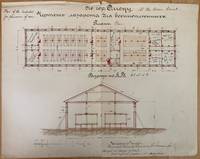
1916List1025Siberia Petrograd et al. 1916. First Edition. Various documents and letters most legal format roughly 200 pages in total with three publications and several newspapers on the subject and thirteen hand drawn architectural plans for a new camp at Omsk measuring between 25 x 17 and 13 x 8 inches. During World War One a staggering number of prisoners - roughly 2.4 of the five million in total who were sent to the Eastern Front - ended up as prisoners of war in Russia. Of that number roughly two million were from Austria-Hungary. Though often neglected by historians due to the attention given to the Russian Civil War and the atrocities of World War Two the subject has drawn increased historical interest with the historian Gerald H. Davis and others calling attention to its importance in the 1980s. Davis and others have written on the relationship between the large prisoner population and the dissolution of their nations as well as the abhorrent conditions many were forced to endure partially due to hierarchical structure of treatment due to differing attitudes by their Russian hosts toward different nations and ethnicities and partially due to the lack of appropriate infrastructure and resources to support such a large prisoner population. <br /> <br /> Offered here are the papers of Herbert H.D. Pierce the Special Aide to Embassador George T. Marye in Petrograd containing a substantial amount of firsthand accounts of prison conditions from the early years of the war as well as a striking series of manuscript architectural plans for a new prison camp that was built in Omsk. Pierce a diplomat who was most famously involved with a case involving seal fishing in the Berings Strait was appointed as a Special Aide out of his retirement and served until his death in 1916. It is possible that he was assigned the task of dealing with the prisoner of war situation as nearly all of his papers that we recovered from his estate from this period deal with the subject. Pierce was involved specifically with the disbursal of relief funds received from the German and Austro-Hungarian governments that were to be disbursed to their citizens. <br /> <br /> The highlight of the collection is a series of hand drawn architectural plans for a series of POW camp structures in Omsk bearing the signature of a N. Alexandrow architect. It is unclear what Pierce's exact relationship was to this project. The plans are translated into English in ink. Of particular interest are the separate officers' barracks plans as one of the violations of POW laws in Russia was the varying levels of treatment given to different prisoners in particular in their recognition of German and Austro-Hungarian ranking officers. There were twenty-eight prison camps in Omsk this one is not identified specifically. The Siberian camps often held up to 35000 prisoners this one shows plans for 10000. There were 128 camps in the Moscow region where camps typically housed 2000-5000 prisoners. The conditions of the camps were generally abysmal with camp capacities routinely exceeded by roughly 50-100%. Frequent disease outbreaks killed thousands of prisoners during the conflict in Omsk Novo-Nikolaevsk Sretensk and Totskoe specifically. <br /> <br /> The group includes letters written to Marye describing conditions in the camps as well as reports of the Americans' own observations in Siberia Moscow and elsewhere. Most are in English though several original documents in German are included. Also included are Pierce's working copies of the Second Hague Convention guidelines of 1907 Order 697 of the War Department that established the regulations regarding prisoners of war in 1914 and a copy of the agreement made between Germany and Russia in August of 1914 which allowed for all women and all men over 45 years and younger than 17 to leave the country unheeded. Some of the letters document violations of this agreement for example a fifty-five year old Austrian man writing to the embassy stating that he had been detained. The authorship of some of the reports is often unclear - one report is credited to "A Russian Lady" another from Krasnaya-Ratchka near Khabaraovsk is an uncredited 18 page description of prisoner conditions. One uncredited report nineteen pages long on the conditions of prisoners in the Moscow Circuit may have been written by Pierce himself and is addressed to Marye. Another 44 page report on Siberian prison conditions is uncredited and likely produced by the embassy itself. A portion - perhaps 25% or so - of the reports are incomplete or unclear in origin though there is much to glean from them regardless. <br /> <br /> Also included are three printed publications. The first is entitled Rapport du Conseiller Prive E.G. Chinkevitch Membre du Comte special de secours aux prisonniers de guerre sur la visite des camps des prissoniers Austro-Hongrois dans l'arrondissement militair d'Omsk printed in 1915. OCLC locates a single copy in France. The report outlines the observed conditions and includes twenty-six photographs of prisoners. The second is a forty-three page report addressed to James Gerard the American ambassador in Berlin by an unidentified author which outlines the prisoner of war conditions in England written in February of 1915. The third is a scarce map of Russian prisoner of war camps printed by L. Friederichsen in Hamburg in 1915 entitled Karte vom Europäischen und Asiatischen Russland mit Angabe der hauptsächlichsten Orte in denen sich Kriegsgefangene und zurückgehaltene Zivilpersonen befinden sowie mit Bestimmungen über den Postverkehr nach diesen Orten. The map shows locations of prison camps throughout the Russian Empire and also shows the mail routes. It is in fine condition overall and we locate six copies in OCLC. <br /> <br /> Overall a scarce survival of primary source material on a somewhat overlooked but important period in Russian history with relevance to diplomatic historians as well worthy of further study. <br /> <br /> Works cited: <br /> <br /> Grekov N. V.: Germanskie i avstriiskie plennye v Sibiri 1914-1917 German and Austrian prisoners in Siberia 1914-1917 in: Vibe P. P. ed.: Nemtsy. Rossiia. Sibir' Germans. Russia. Siberia Omsk 1997 p. 159.<br /> <br /> Nachtigal Reinhard: Seuchen unter militärischer Aufsicht in Rußland. Das Lager Tockoe als Beispiel für die Behandlung der Kriegsgefangenen 1915/16 in: Jahrbücher für Geschichte Osteuropas 48/3 2000 pp. 367-368; Brändström Kriegsgefangenen 1922 pp. 41-48.<br /> <br /> Nachtigal Reinhard; Radauer Lena: Prisoners of War Russian Empire. In: 1914-1918 Online. https://encyclopedia.1914-1918-online.net/article/prisoners_of_war_russian_empire Accessed 5/21. unknown books
17997152CBLeipzig, Gottfried Martini, 1799?1801. 4°. XXXII, 516 S.; XXIV, 526 S. Mit 52 meist gef. (davon 23 koloriert) Kupfertafeln und 3 Kupferkarten (alt montiert auf einem Blatt, dieses lose). Lederbände der Zeit mit reicher Rücken- und Deckelvergoldung (nicht uniform). + Wichtig: Für unsere Kunden in der EU erfolgt der Versand alle 14 Tage verzollt ab Deutschland / Postbank-Konto in Deutschland vorhanden +, A|B|C|D 2 Bände (inkl. Tafeln und Karten). [4 Warenabbildungen]
17997152CB2 Bände (inkl. Tafeln und Karten). Leipzig, Gottfried Martini, 1799–1801. 4°. XXXII, 516 S.; XXIV, 526 S. Mit 52 meist gef. (davon 23 koloriert) Kupfertafeln und 3 Kupferkarten (alt montiert auf einem Blatt, dieses lose). Lederbände der Zeit mit reicher Rücken- und Deckelvergoldung (nicht uniform).
1960475Marc Chagall B. 1887 VITEBSK RUSSIA; D. 1985 SAINT-PAUL-DE-VENCE FRANCE DRAWINGS FOR THE BIBLE as published for Verve.<br /> Verve Vol. X no. 37/38. 1960. Text by Gaston Bachelard. Folio. With 24 original lithographs in color including the cover by Chagall and 96 reproductions in black and white. Complete as issued. Verve hardcover
1960475Marc Chagall B. 1887 VITEBSK RUSSIA; D. 1985 SAINT-PAUL-DE-VENCE FRANCE DRAWINGS FOR THE BIBLE as published for Verve.<br /> Verve Vol. X no. 37/38. 1960. Text by Gaston Bachelard. Folio. With 24 original lithographs in color including the cover by Chagall and 96 reproductions in black and white. Complete as issued. Verve hardcover books
110201The second edition corrected. London Printed for John Starkey and Thomas Basset 1669. Folio. 20 316 6 232 9 1 blank pp. Additional engraved title-page. 2 engraved portraits. 6 engraved folding maps 2 with neatly repaired tear. Contemporary vellum. Red labels. Joints skilfully repaired. New endpapers. . <br/><br/><em>Originally published in 1662. This is the second English edition. </em> hardcover
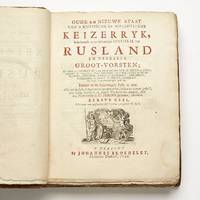
110601Utrecht Johannes Broedelet 1744. 4to. 16 1-296 2 1-200 2 blank 2 201-501 1 blank 2 503-830 2 blank pp. 4 title-pages printed in red and black with engraved vignette. 3 folding engraved maps. 1 folding engraved plan. 1 folding table. 3 folding engraved plates. Contemporary half calf with five raised bands. Gilt spines. Occasional minor spotting and dampstaing. . <br/><br/><em>Provenance: Gösta Nobel 1886-1955 was the youngest son of Ludvig and Edla Nobel. He took over as Branobel`s Managing Director at the time of the Russian Revolution and had to flee Russia in 1918. Branobel or The Nobel Brothers Petroleum Company was founded by Robert and Ludvig Nobel in Baku in 1876. </em> hardcover
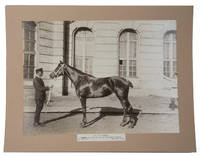
1900L7NBLF1PS3N8Russia 1900. Each photo ca. 27 x 37 cm. Pasted on cardboard. Series of 12 fine large and sharp photographs of Russian race horses. Pasted below each photo a slip with text written in cyrillic script names the horse owner pedigree and breed of horse in the photograph. Each horse is accompanied by a man holding the reins dressed in possibly a matching costume. They were all photographed at the same track in the yard of what seems to be a palace. The names of the horses are: Prezes Jako Velizarij Fanfara Taran Lenta Mon Barry Karina Lusty Nord-Ost Lena and Forteca.With a blind stamped signature of the photographer unidentified by us. Paperboard supports slightly warped. One photo with a minor tear otherwise all in very good condition. unknown
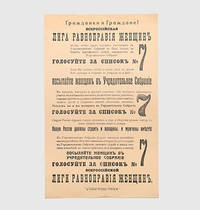
1917134554Petrograd: Tsentr. Tipograf 1917. A new Russia should be built by women and men together A remarkable survival of a flyer printed by the All-Russian League of Equal Rights for Women for their political campaign for the election to the Constituent Assembly in November 1917. The League participated in elections as its own party under the number 7. In English the flyer text reads: ''Female Citizens and male citizens! The League of Equality for Women wishing that the right of women to participate in the Constituent Assembly was not only on paper expose its candidates to the Constituent Assembly. Vote for the list number 7. If you want our children not to grow up without a home and the old people to not die on the street - send women to the Constituent Assembly. In America Australia and other countries where women take part in the drafting of laws the number of schools is multiplied prisons are empty debauchery and drunkenness noticeably diminish the protection of children and the elderly is fully secured by law. Let's send women to the Constituent Assembly too. The old Russia was built only by men and the grief and misfortunes of the motherland were always shared with them by mothers wives and daughters. A new Russia should be built by women and men together! The most important Russian laws will be written in the Constituent Assembly. From the laws that will be created in the Constituent Assembly the fate and life of many generations depends not only on men but also on women and so send women to the Constituent Assembly.''. The campaign for women's political rights in Russia termed the ''women's liberation movement'' became possible only with the beginning of the revolution in 1905 when the question of the democratization of the political system arose. The oldest women's association in Russia the All-Russian Women's Mutual Charity Society established in 1895 was actively involved and new organizations were created: the Union for the Equality of Women 1905 Women's Progressive Party 1905 and the All-Russian League of Equal Rights for Women 1907. The most influential organization was the first the Union which had 48 offices in various cities across Russia and actively conducted agitation among women workers and peasants. After its disintegration the League of Equal Rights for Women became its successor. Members of the League deliberately abandoned the broad political programme and focused their attention only on suffragist demands practising agitation tours through the provinces Orel Saratov Rostov-on-Don Kremenets Tomsk Kiev Simferopol and Narva. As a result branches of the League emerged in many cities including Moscow 1910 Kharkov 1912 Tomsk 1914 and Yekaterinburg 1914. This included the establishment of the following departments: a reading room for street children with a view to preventing child prostitution; a publishing committee that printed cheap pamphlets and books on women's issues; and an editorial commission that published the proceedings of the congress. Every day reports were given on the issues of women's equality in the League's premises. After the February Revolution delegates from the League repeatedly met with the leaders of the Soviet of Workers' and Soldiers' Deputies on the issue of women's suffrage. Despite initial promises of support they refused to immediately act on granting political rights to women. In response the League organized the famous mass march on 20 March 1917 which brought together about 40000 women. To that date it was the most numerous and memorable stand by the Russian women's movement and resulted in the adoption by the Provisional Government of a decree on universal suffrage which was passed on 20 July 1917. Single-sided flyer 365 x 220 mm. In near-fine condition. unknown
1698112625London: R. Baldwin 1698. First edition of this work. Octavo bound in modern wrappers 28 pages. In very good condition with some browning and toning to the text. Rare with no other examples appearing at auction in the last 80 years. R. Baldwin unknown
1698112625London: R. Baldwin 1698. First edition of this work. Octavo bound in modern wrappers 28 p<span class="match">a</span>ges. In very good condition with some browning and toning to the text. Rare with no other examples appearing at auction in the last 80 years. R. Baldwin unknown books
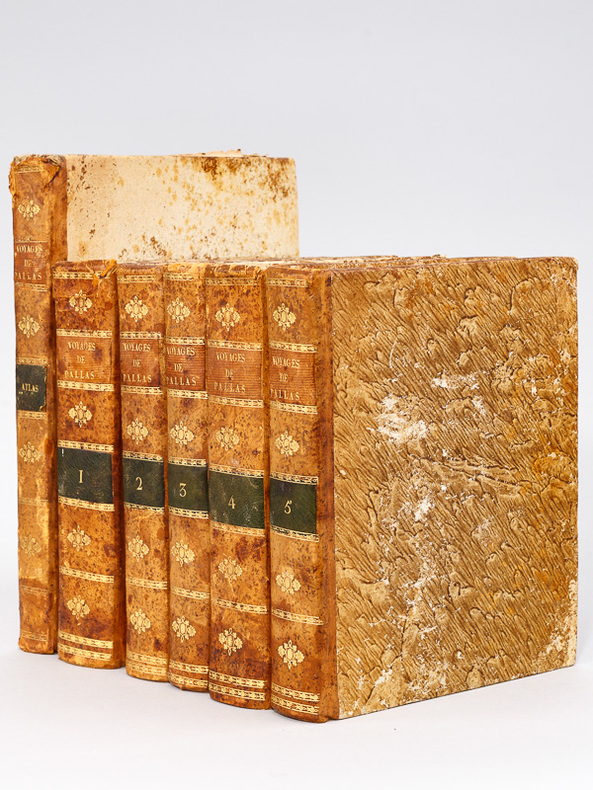
1788585455 vol. in-4 et un atlas in-folio, reliure de l'époque demi-basane marron, Chez Lagrange, Libraire [ puis : ] Chez Maradan, 1788-1793, Tome I : 2 ff., xxxij-773 pp. et 1 f. (errata) ; Tome II : 2 ff., 550 pp. et 1 f. ; Tome III : 2 ff., 491 pp. avec ; Tome IV : 2 ff., 722 pp. et 1 f. (errata) ; Tome V : 2 ff., 559 pp. ; VI (Atlas format en marges 30,8 x 23,8 cm) : 121 planches en 105 feuillets, ainsi décomposées : pour le tome I, 27 planches sur 29 (manquent les planches 1 et 3) dont carte dépliante de la Contrée qui s'étend le long de la Soka, carte dépliante des Landes situées entre le Volga et l'Oural et carte dépliante du Cours du Jaïk au-dessous de Gourief ; pour le tome II, 16 planches sur 17 (manque planche 1, la planche 3 est en double) dont carte dépliante minéralogique des Monts Ouralsks et carte dépliante de la Contrée qui s'étend le long de la Soka ; pour le tome III, 22 planches sur 22 dont carte dépliante des Monts Altaisk ; pour le tome IV, 35 planches (ou 36, selon la manière dont l'on peut compter, car présence des planches 8-9 et 9-10) dont carte dépliante d'une partie des gouvernements de Tobolsk et d'Irkoutsk ; pour le tome V, 21 planches sur 21 dont carte dépliante des Colonies allemandes sur le Volga dans le territoire de Saratof
5 vol. in-4 et un atlas in-folio, reliure de l'époque demi-basane marron, Chez Lagrange, Libraire [ puis : ] Chez Maradan, 1788-1793, Tome I : 2 ff., xxxij-773 pp. et 1 f. (errata) ; Tome II : 2 ff., 550 pp. et 1 f. ; Tome III : 2 ff., 491 pp. avec ; Tome IV : 2 ff., 722 pp. et 1 f. (errata) ; Tome V : 2 ff., 559 pp. ; VI (Atlas format en marges 30,8 x 23,8 cm) : 121 planches en 105 feuillets, ainsi décomposées : pour le tome I, 27 planches sur 29 (manquent les planches 1 et 3) dont carte dépliante de la Contrée qui s'étend le long de la Soka, carte dépliante des Landes situées entre le Volga et l'Oural et carte dépliante du Cours du Jaïk au-dessous de Gourief ; pour le tome II, 16 planches sur 17 (manque planche 1, la planche 3 est en double) dont carte dépliante minéralogique des Monts Ouralsks et carte dépliante de la Contrée qui s'étend le long de la Soka ; pour le tome III, 22 planches sur 22 dont carte dépliante des Monts Altaisk ; pour le tome IV, 35 planches (ou 36, selon la manière dont l'on peut compter, car présence des planches 8-9 et 9-10) dont carte dépliante d'une partie des gouvernements de Tobolsk et d'Irkoutsk ; pour le tome V, 21 planches sur 21 dont carte dépliante des Colonies allemandes sur le Volga dans le territoire de Saratof Rare exemplaire de l'édition originale en reliure d'époque, avec son bel atlas, contenant 121 planches (sur 124) en 105 feuillets (sur 108), dont 8 cartes dépliantes. Intéressant exemplaire en reliure d'époque (accrocs avec petits mq. en coiffes et dos, mq. en coiff à l'atlas, reliure de l'atlas faible, restauration n'affectant pas le texte à un f. d'errata, bon état intérieur) relatant les pérégrinations en Russie du zoologiste et botaniste prussien Peter Simon Pallas (1741-1811). Nommé par l'impératrice Catherine II à la tête d'une expédition en Sibérie dans la région d'Orenbourg, Pallas quitte Saint-Pétersbourg en juin 1768 ; il ne rentrera qu'en juin 1774, ayant parcouru plus de 29000 kilomètres dans les conditions les plus éprouvantes. Nissen, 3076 (qui indique 16 planches pour le tome second, mais notre exemplaire contient une planche 17) ; Cohen, II, 781 ; Chadenat, 4792 Français